
All Topics  
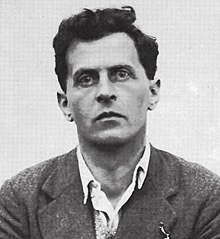
Ludwig Wittgenstein

 
Ludwig Wittgenstein

   Email Print
   Bookmark   Link


Ludwig Wittgenstein


Ludwig Josef Johann Wittgenstein (26 April 1889 – 29 April 1951) was an Austrian
Austrian

Austrian can refer to:* Someone from Austria or of Austrian descent. See Austrians.* Someone who is considered an Austrian citizen. See Austrian nationality law....
-British
United Kingdom

The United Kingdom of Great Britain and Northern Ireland, commonly known as the United Kingdom , the UK or Britain,is a sovereign state located off the northwestern coast of continental Europe....
 philosopher who worked primarily in logic
Logic

Logic is the study of the principles of valid demonstration and inference. Logic is a branch of philosophy, a part of the classical Trivium . The word derives from Greek language ?????? , fem....
, the philosophy of mathematics
Philosophy of mathematics

The philosophy of mathematics is the branch of philosophy that studies the philosophical assumptions, foundations, and implications of mathematics....
, the philosophy of mind
Philosophy of mind

Philosophy of mind is the branch of philosophy that studies the nature of the mind, mental events, mental functions, mental property, consciousness and their relationship to the physical body, particularly the brain....
, and the philosophy of language
Philosophy of language

Philosophy of language is the reasoned inquiry into the nature, origins, and usage of language. As a topic, the philosophy of language for Analytic philosophys is concerned with four central problems: the nature of Meaning , language use, language cognition, and the relationship between language and reality....
.

Described by Bertrand Russell
Bertrand Russell

Bertrand Arthur William Russell, 3rd Earl Russell, Order of Merit , Fellow of the Royal Society , was a British people philosopher, mathematical logic, mathematician, historian, advocate for social reform, and pacifism....
 as "the most perfect example I have ever known of genius as traditionally conceived, passionate, profound, intense, and dominating", he helped inspire two of the twentieth century's principal philosophical movements: the Vienna Circle
Vienna Circle

The Vienna Circle was a group of philosophers who gathered around Moritz Schlick when he was called to the Vienna University in 1922, organized in a philosophical association, of which Schlick was chairman, named the Ernst Mach Society in honour of Ernst Mach....
 and Oxford ordinary language philosophy
Ordinary language philosophy

Ordinary language philosophy or linguistic philosophy is a philosophical school that approached traditional philosophical problems as rooted in misunderstandings philosophers develop by forgetting what words actually mean in a language....
.


Discussion
Ask a question about 'Ludwig Wittgenstein'
Start a new discussion about 'Ludwig Wittgenstein'
Answer questions from other users
Full Discussion Forum


Quotations


205. If the true is what is grounded, then the ground is not true, nor yet false.

225. What I hold fast to is not one proposition but a nest of propositions.

Certainly it is correct to say: Conscience is the voice of God.

If I cannot say a priori what elementary propositions there are, then the attempt to do so must lead to obvious nonsense. (5.5571)

If I have exhausted the justifications, I have reached bedrock and my spade is turned. Then I am inclined to say: This is simply what I do. (217)

It is not how things are in the world that is mystical, but that it exists. (6.44)


Encyclopedia


Ludwig Josef Johann Wittgenstein (26 April 1889 – 29 April 1951) was an Austrian
Austrian

Austrian can refer to:* Someone from Austria or of Austrian descent. See Austrians.* Someone who is considered an Austrian citizen. See Austrian nationality law....
-British
United Kingdom

The United Kingdom of Great Britain and Northern Ireland, commonly known as the United Kingdom , the UK or Britain,is a sovereign state located off the northwestern coast of continental Europe....
 philosopher who worked primarily in logic
Logic

Logic is the study of the principles of valid demonstration and inference. Logic is a branch of philosophy, a part of the classical Trivium . The word derives from Greek language ?????? , fem....
, the philosophy of mathematics
Philosophy of mathematics

The philosophy of mathematics is the branch of philosophy that studies the philosophical assumptions, foundations, and implications of mathematics....
, the philosophy of mind
Philosophy of mind

Philosophy of mind is the branch of philosophy that studies the nature of the mind, mental events, mental functions, mental property, consciousness and their relationship to the physical body, particularly the brain....
, and the philosophy of language
Philosophy of language

Philosophy of language is the reasoned inquiry into the nature, origins, and usage of language. As a topic, the philosophy of language for Analytic philosophys is concerned with four central problems: the nature of Meaning , language use, language cognition, and the relationship between language and reality....
.

Described by Bertrand Russell
Bertrand Russell

Bertrand Arthur William Russell, 3rd Earl Russell, Order of Merit , Fellow of the Royal Society , was a British people philosopher, mathematical logic, mathematician, historian, advocate for social reform, and pacifism....
 as "the most perfect example I have ever known of genius as traditionally conceived, passionate, profound, intense, and dominating", he helped inspire two of the twentieth century's principal philosophical movements: the Vienna Circle
Vienna Circle

The Vienna Circle was a group of philosophers who gathered around Moritz Schlick when he was called to the Vienna University in 1922, organized in a philosophical association, of which Schlick was chairman, named the Ernst Mach Society in honour of Ernst Mach....
 and Oxford ordinary language philosophy
Ordinary language philosophy

Ordinary language philosophy or linguistic philosophy is a philosophical school that approached traditional philosophical problems as rooted in misunderstandings philosophers develop by forgetting what words actually mean in a language....
. According to an end of the century poll, professional philosophers in Canada and the U.S. rank both his Tractatus Logico-Philosophicus
Tractatus Logico-Philosophicus

Tractatus Logico-Philosophicus is the only book-length philosophical work published by the Austrian philosopher Ludwig Wittgenstein during his lifetime....
 and Philosophical Investigations
Philosophical Investigations

Philosophical Investigations is, along with the Tractatus Logico-Philosophicus, one of the two major works by 20th-century philosopher Ludwig Wittgenstein....
 among the top five most important books in twentieth-century philosophy, the latter standing out as "...the one crossover masterpiece in twentieth-century philosophy, appealing across diverse specializations and philosophical orientations". Wittgenstein's influence has been felt in nearly every field of the humanities and social sciences, yet there are widely diverging interpretations of his thought.

Life

Ludwig Wittgenstein was born in Vienna
Vienna

Vienna is the Capital of Republic of Austria and also one of the nine states of Austria. Vienna is Austria's primary city, with a population of about 1.7 million...
 on 26 April 1889, to Karl
Karl Wittgenstein

Karl Wittgenstein was a steel tycoon. At the end of 19th century, he controlled an effective monopoly on steel and iron resources within the Austro-Hungarian Empire, and had by the 1890s acquired one of the largest fortunes in Europe....
 and Leopoldine Wittgenstein. He was the youngest of eight children, born into one of the most prominent and wealthy families in the Austro-Hungarian empire. His father's parents, Hermann Christian and Fanny Wittgenstein (who was a first cousin of the violinist Joseph Joachim
Joseph Joachim

Joseph Joachim was a Hungarian people violinist, conducting, composer and teacher. He is regarded as one of the most influential violinists of all time....
), were both born into Jew
Jew

A Jew is a member of the Jewish people, an ethnoreligious group that traces its ancestry to the Israelites or Hebrews of the Ancient Near East....
ish families but later converted to Protestantism
Protestantism

Protestantism is a movement within Christianity that originated in the sixteenth-century Protestant Reformation. It is considered to be one of the three principal traditions of Christianity, together with Roman Catholicism and Eastern Orthodoxy....
, and after they moved from Saxony
Saxony

The Free State of Saxony is a States of Germany of Germany. Located in the southeastern part of present-day Germany. It is the tenth-largest German state in area and the sixth largest in population , of Germany's sixteen states....
 to Vienna in the 1850s, assimilated into the Viennese Protestant professional classes. Ludwig's father, Karl Wittgenstein, became an industrialist and went on to make his fortune in iron and steel. By the late 1880s, Karl controlled an effective monopoly
Monopoly

In economics, a monopoly exists when a specific individual or enterprise has sufficient control over a particular product or service to determine significantly the terms on which other individuals shall have access to it....
 on steel and iron resources within the empire, and was one of the richest men in the world. Eventually, Karl transferred much of his capital into real estate, stocks, shares, precious metals, and foreign currency reserves, which were spread across Switzerland, Austria, The Netherlands and North America. Consequently, the family's colossal wealth was insulated from the inflation-crises which followed in subsequent years. Ludwig's mother, Leopoldine Kalmus, was born to a Jewish father and a Catholic mother, and was an aunt of the Nobel Prize laureate Friedrich von Hayek on her maternal side. Despite his paternal grandparents' conversion to Protestantism, the Wittgenstein children were baptized
Baptism

In Christianity, baptism is the ritual act, with the use of water, by which one is admitted as a full member of the Christian Church and, in the view of some, as a member of the particular Church in which the baptism is administered....
 as Roman Catholics—the faith of their maternal grandmother—and Ludwig was given a Roman Catholic burial upon his death.

Early life


Ludwig grew up in a household that provided an exceptionally intense environment for artistic and intellectual achievement. His parents were both very musical and all their children were artistically and intellectually educated. Karl Wittgenstein was a hugely successful steel tycoon, but also became a leading patron of the arts. He commissioned works by Rodin and Klimt
Gustav Klimt

Gustav Klimt was an Austrian Symbolism and one of the most prominent members of the Vienna Art Nouveau movement. His major works include paintings, murals, Sketch , and other art objects, many of which are on display in the Vienna Secession gallery....
, and fully financed the Vienna Secession Building
Secession hall (Austria)

The Secession building was built in 1897 by Joseph Maria Olbrich as architectural manifesto and exhibition hall for the Vienna Secession. The building is located in Vienna, Austria....
. The Wittgenstein house hosted many figures of high culture
High culture

High culture is a term, now used in a number of different ways in academic discourse, whose most common meaning is the set of culture products, mainly in the arts, held in the highest esteem by a culture....
—but above all, musicians. The family was often visited by composer
Composer

A composer is a person who creates music, usually in the medium of musical notation, for interpretation and performance. The level of distinction between composers and other musicians varies, which affects issues such as copyright and the deference given to individual interpretations of a particular piece of music....
s such as Johannes Brahms
Johannes Brahms

Johannes Brahms , composer and pianist, was one of the leading musicians of the Romantic music. Born in Hamburg, Brahms spent much of his professional life in Vienna, Austria, where he was a leader of the musical scene....
 and Gustav Mahler
Gustav Mahler

Gustav Mahler was a Bohemian-born Austrian composer and conducting. He was best known during his own lifetime as one of the leading orchestral and operatic conductors of the day....
. Brahms had given piano lessons to Ludwig's two eldest sisters, and debut recitals for some his major works were performed in the family's music rooms. Ludwig's older brother Paul Wittgenstein
Paul Wittgenstein

Paul Wittgenstein was an Austrian-born concert pianist, who became known for his ability to play with just his left hand, after he lost his right arm during the World War I....
 went on to become a world-famous concert pianist, even after losing his right arm in World War I. Ludwig himself had absolute pitch
Absolute pitch

Absolute pitch , widely referred to as perfect pitch, is the ability of a person to identify or recreate a musical note without the benefit of an external reference....
, and his devotion to music remained vitally important to him throughout his life: he made frequent use of musical examples and metaphors in his philosophical writings, and was said to be unusually adept at whistling lengthy and detailed musical passages. He also played the clarinet
Clarinet

The clarinet is a musical instrument in the woodwind family. The name derives from adding the suffix -et meaning little to the Italian word clarino meaning a particular type of trumpet, as the first clarinets had a strident tone similar to that of a trumpet....
 and is said to have remarked that he approved of this instrument because it took a proper role in the orchestra.

His family also had a history of intense self-criticism, to the point of depression
Clinical depression

Major depressive disorder is a mental disorder characterized by a pervasive depression , low self-esteem, and anhedonia in normally enjoyable activities....
 and suicidal
Suicide

Suicide is the intentional taking of one's own life. Many dictionaries also note the metaphorical sense of "willful destruction of one's self-interest"....
 tendencies. Three of his four brothers committed suicide. The eldest of the brothers, Hans—an early musician who started composing at age four—killed himself in April 1902, in Havana
Havana

Havana is the capital city, major port, and leading commercial centre of Cuba. The city is one of the 14 Provinces of Cuba. The city/province has 2.1 million inhabitants, and the urban area over 3.5 million, making Havana the largest city in both Cuba and the Caribbean....
, Cuba
Cuba

The Republic of Cuba is a country in the Caribbean. It consists of the island of Cuba , the island of Isla de la Juventud, and several adjacent small islands....
. The third son, Rudolf, followed in May 1904 in Berlin. Their brother Kurt shot himself at the end of World War I, in October 1918, when the Austrian troops he was commanding deserted en masse.

Until 1903, Ludwig was educated at home; after that, he began three years of schooling at the Realschule
Realschule

The Realschule is a type of secondary school in Germany, Austria, Switzerland, and Liechtenstein. It has also existed in Croatia , Denmark , Sweden , Hungary and Russian Empire ....
 in Linz
Linz

Linz is the third largest city of Austria and capital of the States of Austria of Upper Austria . It is located in the north centre of Austria, approximately 30 km south of the Czech Republic border, on both sides of the river Danube....
, a school emphasizing technical topics. For one school year Adolf Hitler
Adolf Hitler

Adolf Hitler was an Austrian-born Germany politician and the leader of the National Socialist German Workers Party , popularly known as the Nazi Party....
 was a student there at the same time but two grades below Wittgenstein, when both boys were 14 or 15 years old. It is a matter of controversy whether Hitler and Wittgenstein even knew of each other, and if so whether either had any memory of the other.

At the school, Wittgenstein spoke with a slight stutter, wore very elegant clothes, and was highly sensitive and extremely unsociable. It was one of his idiosyncrasies to use the formal form of address with his classmates and to demand that they too (with the exception of a single acquaintance) address him formally, with "Sie" and "Herr Ludwig".

Ludwig was interested in physics and wanted to study with Ludwig Boltzmann
Ludwig Boltzmann

Ludwig Eduard Boltzmann was an Austrian physicist famous for his founding contributions in the fields of statistical mechanics and statistical thermodynamics....
, whose collection of popular writings, including an inspiring essay about the hero and genius who would solve the problem of heavier-than-air flight ("On Aeronautics") was published during this time (1905). However, Boltzmann committed suicide in 1906.

In 1906, Wittgenstein began studying mechanical engineering
Mechanical engineering

Mechanical Engineering is an engineering discipline that involves the application of physics#branches of physics for analysis, design, manufacturing, and maintenance of machine....
 in Berlin, and in 1908 he went to the Victoria University of Manchester
Victoria University of Manchester

The Victoria University of Manchester was a university in Manchester, England. On 1 October 2004 it merged with the University of Manchester Institute of Science and Technology to form a new entity, "University of Manchester"....
 to study for his doctorate
Doctorate

A doctorate is an academic degree that in most countries represents the highest level of formal study or research in a given field. In some countries it also refers to a class of degrees which qualify the holder to practice in a specific profession ....
 in engineering
Engineering

Engineering is the discipline and profession of applying Technology and science knowledge and utilizing natural laws and physical resources in order to design and implement materials, structures, machines, devices, systems, and process that safely realize a desired objective and meet specified criteria....
, full of plans for aeronautical projects. He registered as a research student in an engineering laboratory, where he conducted research on the behaviour of kites in the upper atmosphere
Earth's atmosphere

The Earth's atmosphere is a layer of gases surrounding the planet Earth that is retained by the Earth's gravity. Dry air contains roughly 78.08% nitrogen, 20.95% oxygen, 0.93% argon, 0.038% Carbon dioxide in the Earth's atmosphere, and trace amounts of other gases....
, and worked on the design of a propeller with small jet engines on the end of its blades. During his research in Manchester, he became interested in the foundations of mathematics
Foundations of mathematics

Foundations of mathematics is a term sometimes used for certain fields of mathematics, such as mathematical logic, axiomatic set theory, proof theory, model theory, and recursion theory....
, particularly after reading Alfred N. Whitehead and Bertrand Russell
Bertrand Russell

Bertrand Arthur William Russell, 3rd Earl Russell, Order of Merit , Fellow of the Royal Society , was a British people philosopher, mathematical logic, mathematician, historian, advocate for social reform, and pacifism....
's Principia Mathematica
Principia Mathematica

The Principia Mathematica is a 3-volume work on the foundations of mathematics, written by Alfred North Whitehead and Bertrand Russell and published in 1910?1913....
 and Gottlob Frege
Gottlob Frege

Friedrich Ludwig Gottlob Frege was a Germany mathematics who became a logician and philosophy. He helped found both modern mathematical logic and analytic philosophy....
's Grundgesetze der Arithmetik, vol. 1 (1893) and vol. 2 (1903). In the summer of 1911 Wittgenstein visited Frege and, after having corresponded with him for some time, was advised by Frege to attend the University of Cambridge
University of Cambridge

The University of Cambridge , located in Cambridge, England, is the List of oldest universities in continuous operation university in the Anglosphere....
 to study under Russell.

In October 1911 Wittgenstein arrived unannounced at Russell's rooms in Trinity College
Trinity College, Cambridge

Trinity College is one of the 31 Colleges of the University of Cambridge of the University of Cambridge. Trinity has more members than any other college in Cambridge or University of Oxford, with around 700 undergraduates, 430 graduate students, and over 160 Fellows; however, counting only the student body it has somewhat fewer than Homert...
 and was soon attending his lectures and discussing philosophy with him at great length. He made a great impression on Russell (who soon became convinced of his genius) and G. E. Moore, and started to work on the foundations of logic and mathematical logic.

Russell was, by this time, increasingly tired of philosophy and envisaged Wittgenstein as his successor who would carry on his work in the foundations of mathematics. He was also frequently overpowered by the latter's forceful personality and criticisms. Faced with criticisms of his work by Wittgenstein, Russell wrote "I saw that he was right, and I saw that I could not hope ever again to do fundamental work in philosophy." During this period Wittgenstein's other major interests were music and travelling (he went to Iceland
Iceland

Iceland, officially the Republic of Iceland , is an island country located in the North Atlantic Ocean between mainland Europe and Greenland....
, in September 1912), often in the company of David Pinsent
David Pinsent

David Pinsent was a friend and collaborator of the Austrian philosopher Ludwig Wittgenstein. Wittgenstein described him as his first and only friend....
, an undergraduate who became a firm friend. He was also invited to join the Cambridge Apostles
Cambridge Apostles

The Cambridge Apostles, also known as the Cambridge Conversazione Society, is an intellectual secret society at the University of Cambridge founded in 1820 by George Tomlinson, a Cambridge student who went on to become the first Bishop of Gibraltar in Europe....
, an elite secret society
Secret society

Secret society is a term used to describe a variety of organizations. Although the exact meaning of the term is disputed, several of the definitions advanced indicate a degree of secrecy and secret knowledge, which might include denying membership or knowledge of the group, negative consequences for acknowledging one's membership, strong ties...
 which Russell and Moore had both belonged to as students. Whilst in Cambridge Wittgenstein often liked to go to the cinema.

Wittgenstein's father died in 1913. On receiving his inheritance, Wittgenstein became one of the wealthiest men in Europe. He donated some of it, initially anonymously, to Austrian artists and writers, including Rainer Maria Rilke
Rainer Maria Rilke

Rainer Maria Rilke is considered one of the German language's greatest 20th century poets. His haunting images focus on the difficulty of communion with the ineffable in an age of disbelief, solitude, and profound anxiety ? themes that tend to position him as a transitional figure between the traditional and the modernist poets....
 and Georg Trakl
Georg Trakl

Georg Trakl was a preeminent Austrian poet....
. In 1914 he went to visit Trakl when the latter wanted to meet his benefactor, but Trakl died (an apparent suicide) days before Wittgenstein arrived.

Although he was invigorated by his study in Cambridge and his conversations with Russell, Wittgenstein came to feel that he could not get to the heart of his most fundamental questions while surrounded by other academics. In 1913 he retreated to the relative solitude of the remote village of Skjolden
Skjolden

Skjolden is a village in the municipality of Luster, Norway in Sogn og Fjordane county, Norway. It is located at the end of the Lustrafjord....
 at the end of the Sognefjord
Sognefjord

The Sognefjord is the list of Norwegian fjords fjord in Norway, and the second longest in the world, after Scoresby Sund on Greenland. Located in Sogn og Fjordane it stretches 1 E5 m inland to the small village of Skjolden....
 in Norway
Norway

Norway , officially the Kingdom of Norway, is a constitutional monarchy in Northern Europe that occupies the western portion of the Scandinavian Peninsula....
. Here he rented the second floor of a house and stayed for the winter. The isolation from academia allowed him to devote himself entirely to his work, and he later saw this period as one of the most passionate and productive times of his life. While there he wrote a book entitled Logik, a ground-breaking work in the foundations of logic which was the immediate predecessor and source of much of the Tractatus Logico-Philosophicus
Tractatus Logico-Philosophicus

Tractatus Logico-Philosophicus is the only book-length philosophical work published by the Austrian philosopher Ludwig Wittgenstein during his lifetime....
.

World War I


The outbreak of World War I
World War I

World War I, or the First World War , was a global military conflict which involved the Great powers, organized into two opposing military alliances: the Allies of World War I and the Central Powers....
 in the next year took him completely by surprise, as he was living a secluded life at the time. He volunteered for the Austro-Hungarian army
Austro-Hungarian Army

The Austro-Hungarian Army was the ground force of the Austria Hungary Dual Monarchy . It was composed of the joint army , the Austrian Landwehr , and the Hungarian Honv?ds?g ....
, first serving on a ship and then in an artillery
Artillery

Artillery is a military Combat Arms which employs any apparatus, machine, an assortment of tools or instruments, a system or systems used as weapons for the discharge of large projectiles in combat as a major contribution of fire power within the overall military capability of an armed force....
 workshop. In 1916 he was sent as a member of a howitzer
Howitzer

A howitzer is a type of artillery piece that is characterized by a relatively short Barrel and the use of comparatively small explosive charges to propel projectiles at trajectories with a steep angle of descent....
 regiment to the Russia
Russia

Russia , or the Russian Federation , is a list of countries spanning more than one continent country extending over much of northern Eurasia....
n front, where he won several medals for bravery, then in the Italian southern Tyrol (today Trentino, in Italy), where he was taken as a prisoner of war by the Italian army in November 1918 near Trento
Trento

Trento is an Italy city located in the Adige in Trentino-Alto Adige/S?dtirol. It is the capital of the region and of the Autonomous Province of Trento....
.

His notebook entries during the war reflect his contempt for the baseness, as he saw it, of his fellow soldiers. Throughout the war, Wittgenstein kept notebooks in which he frequently wrote philosophical and religious reflections alongside personal remarks. The notebooks reflect a profound change in his religious life: a militant atheist during his stint at Cambridge, Wittgenstein discovered Leo Tolstoy
Leo Tolstoy

Leo Tolstoy, or Count Lev Nikolayevich Tolstoy Tolstoy's further talents as essayist, dramatist and Education reform made him the most influential member of the aristocracy Tolstoy....
's The Gospel in Brief at a bookshop in Galicia
Kingdom of Galicia and Lodomeria

The Kingdom of Galicia and Lodomeria official ) was a kingdom dependent to the Habsburg Monarchy, the Austrian Empire and Austria?Hungary from 1772 to 1917; independent from July 26, 1917 to November 14, 1918....
. He devoured Tolstoy's commentary and became an evangelist of sorts; he carried the book everywhere he went and recommended it to anyone in distress (to the point that he became known to his fellow soldiers as "the man with the gospels"). Monk notes that at the end of his life, Wittgenstein still firmly believed in the Resurrection
Resurrection

Miraculous resurrection of one sort or another has been a recurrent theme or central doctrine of Judaism, Christianity, and Islam, and other Abrahamic religions....
 of Jesus. Wittgenstein's other religious influences include Saint Augustine, Fyodor Dostoevsky
Fyodor Dostoevsky

Fyodor Mikhaylovich Dostoyevsky "An Honest Thief"* "Elka i svad'ba" ; English translation: "A Christmas Tree and a Wedding"* Belye nochi ; English translation: White Nights ...
 and, most notably, Søren Kierkegaard
Søren Kierkegaard

S?ren Aabye Kierkegaard was a prolific 19th century Denmark philosopher and theologian. Kierkegaard strongly criticised both the Hegelianism of his time, and what he saw as the empty ceremony of the Church of Denmark....
, whom Wittgenstein referred to as "a saint".

Developing the Tractatus

Wittgenstein's work on Logik began to take on an ethical and religious significance. With this new concern with the ethical, combined with his earlier interest in logical analysis, and with key insights developed during the war (such as the so-called "picture theory" of propositions), Wittgenstein's work from Cambridge and Norway
Norway

Norway , officially the Kingdom of Norway, is a constitutional monarchy in Northern Europe that occupies the western portion of the Scandinavian Peninsula....
 was transfigured into the material that eventually became the Tractatus. Towards the end of the war in 1918 Wittgenstein was promoted to reserve officer (lieutenant) and sent to northern Italy
Italy

Italy , officially the Italian Republic , is a country located on the Italian Peninsula in Southern Europe and on the two largest islands in the Mediterranean Sea, Sicily and Sardinia....
 as part of an artillery regiment. On leave in the summer of 1918 he received a letter from David Pinsent's mother telling Wittgenstein that her son had been killed in an airplane accident. Suicidal, Wittgenstein went to stay with his uncle Paul, and there completed the Tractatus, which he dedicated to Pinsent. The book was then sent to publishers, but without success.

In October 1918, Wittgenstein returned to the Italian front but was captured by the Italians shortly thereafter. While he was a prisoner of war at Cassino (Central Italy), through the intervention of his Cambridge friends Russell
Bertrand Russell

Bertrand Arthur William Russell, 3rd Earl Russell, Order of Merit , Fellow of the Royal Society , was a British people philosopher, mathematical logic, mathematician, historian, advocate for social reform, and pacifism....
 and Keynes, Wittgenstein managed to get access to books, prepare his manuscript, and send it back to England
England

native_name =|conventional_long_name = England|common_name = England|image_flag = Flag of England.svg|image_coat = England COA.svg|symbol_type = Royal Coat of Arms...
. Russell recognized it as a work of supreme philosophical importance and worked with Wittgenstein to get it published after his release in 1919. An English
English language

English is a West Germanic language that originated in Anglo-Saxon England and has lingua franca status in many parts of the world as a result of the military, economic, scientific, political and cultural influence of the British Empire in the 18th, 19th and early 20th centuries and that of the United States from the mid 20th century onwa...
 translation was prepared, first by Frank P. Ramsey
Frank P. Ramsey

Frank Plumpton Ramsey was a United Kingdom mathematician who, in addition to mathematics, made significant contributions in philosophy and economics....
 and then by C. K. Ogden, with Wittgenstein's involvement. After some discussion of how best to translate the title, G. E. Moore suggested Tractatus Logico-Philosophicus, an allusion to Baruch Spinoza
Baruch Spinoza

Baruch or Benedict de Spinoza was a Netherlands Philosophy of Iberian Jews origin. Revealing considerable scientific aptitude, the breadth and importance of Spinoza's work was not fully realized until years after his death....
's Tractatus Theologico-Politicus. Russell wrote an introduction, lending the book his reputation as one of the foremost philosophers in the world.

However, difficulties remained. Wittgenstein had become personally disaffected with Russell and was displeased with Russell's introduction, which he thought evinced a fundamental misunderstanding of the Tractatus. Wittgenstein grew frustrated as interested publishers proved difficult to find. To add insult to injury, those publishers who were interested proved to be so mainly because of Russell's introduction. Finally Wilhelm Ostwald
Wilhelm Ostwald

Friedrich Wilhelm Ostwald was a Baltic German chemist. He received the Nobel Prize in Chemistry in 1909 for his work on catalysis, chemical equilibria and reaction velocities....
's journal Annalen der Naturphilosophie printed a German edition in 1921, and Routledge's Kegan Paul printed a bilingual edition with Russell's introduction and the Ramsey-Ogden translation in 1922.

The "lost years" after the Tractatus

By then Wittgenstein was a profoundly changed man. He had embraced the Christianity that he had previously opposed, faced harrowing combat in World War I, and crystallized his intellectual and emotional upheavals with the exhausting composition of the Tractatus
Tractatus

Tractatus may refer to:* Tractatus Theologico-Politicus, a philosophical work by Spinoza* Tractatus Logico-Philosophicus, a philosophical work by Ludwig Wittgenstein...
. It was a work which transfigured all of his past work on logic into a radically new framework that he believed offered a definitive solution to all the problems of philosophy. These changes in Wittgenstein's inner and outer life left him both haunted and yet invigorated to follow a new, ascetic life. One of the most dramatic expressions of this change was his decision in 1919 to give away the portion of the family fortune he had inherited when his father died. The money was divided between his sisters Helene and Hermine and his brother Paul, and Wittgenstein insisted that they promise never to give it back. He felt that giving money to the poor could only corrupt them further, whereas the rich would not be harmed by it.

Since Wittgenstein thought that the Tractatus had solved all the problems of philosophy, he left philosophy and returned to Austria
Austria

Austria , officially the Republic of Austria , is a landlocked country in Central Europe. It borders both Germany and the Czech Republic to the north, Slovakia and Hungary to the east, Slovenia and Italy to the south, and Switzerland and Liechtenstein to the west....
 to train as a primary school teacher. He was educated in the methods of the Austrian School Reform Movement which advocated the stimulation of the natural curiosity of children and their development as independent thinkers, instead of just letting them memorize facts. Wittgenstein was enthusiastic about these ideas but ran into problems when he was appointed as an elementary teacher in the rural Austrian villages of Trattenbach
Trattenbach

Trattenbach is a town in Austria, situated in Lower Austria. 81.31% of the municipality is forested. It is in the industrial part of Lower Austria....
, Puchberg-am-Schneeberg, and Otterthal
Otterthal

Otterthal is a town in Austria. Situated in Lower Austria, it is in the industrial part of Lower Austria. 61.72 percent of the municipality is forested....
. During his time as a school teacher Wittgenstein wrote a pronunciation and spelling dictionary for his own use in teaching students. The publishers insisted upon the removal of Wittgenstein's introduction (on the grounds that it contained poor grammar) and some additions to the list of words, and it was moderately well received by his colleagues (although not reprinted in his lifetime). This would be the only book besides the Tractatus that Wittgenstein published in his lifetime. Wittgenstein had unrealistic expectations of the rural children he taught, and his teaching methods were intense and exacting—he had little patience with those children who had no aptitude for mathematics. However, he achieved good results with children attuned to his interests and style of teaching, especially boys. His severe disciplinary methods (often involving corporal punishment, not unusual at the time)—as well as a general suspicion amongst the villagers that he was somewhat mad—led to a long series of bitter disagreements with some of his students' parents, and eventually culminated in April 1926 in the collapse of an eleven year old boy whom Wittgenstein had struck on the head. The boy's father attempted to have Wittgenstein arrested, and despite being cleared of misconduct he resigned his position and returned to Vienna, feeling that he had failed as a school teacher.

After abandoning his work as a school teacher, Wittgenstein worked as a gardener's assistant in a monastery near Vienna. He considered becoming a monk, and went so far as to inquire about the requirements for joining an order. However, at the interview he was advised that he would not find in monastic life what he sought.

Two major developments helped to save Wittgenstein from this despairing state. The first was an invitation from his sister Margaret ("Gretl") Stonborough
Margaret Stonborough-Wittgenstein

Margarethe "Gretl" Stonborough-Wittgenstein , of the prominent and wealthy Viennese Karl Wittgenstein, was a sister of the philosopher Ludwig Wittgenstein and the pianist Paul Wittgenstein....
 (who was painted by Gustav Klimt
Gustav Klimt

Gustav Klimt was an Austrian Symbolism and one of the most prominent members of the Vienna Art Nouveau movement. His major works include paintings, murals, Sketch , and other art objects, many of which are on display in the Vienna Secession gallery....
 in 1905) to work on the design and construction of her new house. He worked with the architect, Paul Engelmann
Paul Engelmann

Paul Engelmann was a Viennese architect who is now best known for his friendship with the philosopher Ludwig Wittgenstein between 1916 and 1928, and for being Wittgenstein's partner in the design and building of the Stonborough House in Vienna....
, who had become a close friend of Wittgenstein's during the war, and the two designed a spare modernist house after the style of Adolf Loos
Adolf Loos

Adolf Loos was one of the most important and influential Austrian and Czechoslovak architects of European Modern architecture. In his essay "Ornament and Crime" he repudiated the florid style of the Vienna Secession, the Austrian version of Art Nouveau....
 (whom they both greatly admired). Wittgenstein found the work intellectually absorbing and exhausting; he poured himself into the design in painstaking detail, including even small aspects such as doorknobs and radiators, spending a year on each as they had to be exactly positioned to maintain the symmetry of the rooms. As a work of modernist architecture the house evoked some high praise; G. H. von Wright
Georg Henrik von Wright

Georg Henrik von Wright was a Finland philosopher, who succeeded Ludwig Wittgenstein as professor at the Faculty of philosophy cambridge. He published in English language, Finnish language, German language, and in his mother tongue Swedish language....
 said that it possessed the same "static beauty" as the Tractatus. The effort of totally involving himself in intellectual work once again did much to restore Wittgenstein's spirits. Describing the intentions behind his architecture, Wittgenstein wrote "I am not interested in erecting a building, but in [...] presenting to myself the foundations of all possible buildings." Of the house, Ludwig's eldest sister, Hermine, wrote: "Even though I admired the house very much, I always knew that I neither wanted to, nor could, live in it myself. It seemed indeed to be much more a dwelling for the gods".

Secondly, toward the end of his work on the house, Wittgenstein was contacted by Moritz Schlick
Moritz Schlick

Moritz Schlick was a Germany philosopher and the founding father of logical positivism and the Vienna Circle....
, one of the leading figures of the newly formed Vienna Circle
Vienna Circle

The Vienna Circle was a group of philosophers who gathered around Moritz Schlick when he was called to the Vienna University in 1922, organized in a philosophical association, of which Schlick was chairman, named the Ernst Mach Society in honour of Ernst Mach....
. The Tractatus had been tremendously influential to the development of the Vienna positivism and, although Schlick never succeeded in drawing Wittgenstein into the discussions of the Vienna Circle itself, he and some of his fellow circle members, especially Friedrich Waismann
Friedrich Waismann

Friedrich Waismann was an Austrian mathematician, physicist, and philosopher. He is best known for being a member of the Vienna Circle and one of the key theorists in logical positivism....
, met occasionally with Wittgenstein to discuss philosophical topics. Wittgenstein was frequently frustrated by these meetings—he believed that Schlick and his colleagues had fundamentally misunderstood the Tractatus, and at times would refuse to talk about it at all. (Much of the disagreements concerned the importance of religious life and the mystical; Wittgenstein considered these matters as a sort of wordless faith, whereas the positivists disdained them as useless. In one meeting Wittgenstein refused to discuss the Tractatus at all, and sat with his back to his guests while he read aloud from the poetry of Rabindranath Tagore
Rabindranath Tagore

, also known by the sobriquet Gurudev, was a Bengali people mystic, Brahmo poet, visual artist, playwright, novelist, and composer whose works reshaped Bengali literature and Music of Bengal in the late 19th and early 20th centuries....
.) Nevertheless, the contact with the Vienna Circle stimulated Wittgenstein intellectually and revived his interest in philosophy. He also met with Frank P. Ramsey
Frank P. Ramsey

Frank Plumpton Ramsey was a United Kingdom mathematician who, in addition to mathematics, made significant contributions in philosophy and economics....
, a young philosopher of mathematics who traveled several times from Cambridge to Austria to meet with Wittgenstein and the Vienna Circle. In the course of his conversations with the Vienna Circle and with Ramsey, Wittgenstein began to think that there might be some "grave mistakes" in his work as presented in the Tractatus—marking the beginning of a second career of ground-breaking philosophical work, which would occupy him for the rest of his life.

Return to Cambridge

In 1929 he decided, at the urging of Ramsey and others, to return to Cambridge. He was met at the railway station by a crowd of England's greatest intellectuals, discovering rather to his horror that he was one of the most famed philosophers in the world. In a letter to his wife, Lydia Lopokova
Lydia Lopokova

Lydia Vasilyevna Lopokova, Baroness Keynes was a famous Russian ballerina dancer during the early 20th-century. She is known also as Lady Keynes, the wife of the economist, John Maynard Keynes....
, Wittgenstein's old friend John Maynard Keynes wrote: "Well, God has arrived. I met him on the 5.15 train."

Despite this fame he could not initially work at Cambridge as he did not have a degree, so he applied as an advanced undergraduate. Russell noted that his previous residency was in fact sufficient for a doctoral degree, and urged him to offer the Tractatus as a doctoral thesis, which he did in 1929. It was examined by Russell and Moore; at the end of the thesis defence, Wittgenstein clapped the two examiners on the shoulder and said, "Don't worry, I know you'll never understand it." Moore commented in the examiner's report: "In my opinion this is a work of genius; it is, in any case, up to the standards of a degree from Cambridge." Wittgenstein was appointed as a lecturer and was made a fellow of Trinity College.

Although Wittgenstein was involved in a relationship with Marguerite Respinger (a young Swiss woman he had met as a friend of the family), his plans to marry her were broken off in 1931 and he never married. Most of his romantic attachments were to young men. There is considerable debate over how active Wittgenstein's homosexual
Homosexuality

Homosexuality refers to human sexual behavior or same-sex attraction between people of the same sex or to homosexual orientation. As a sexual orientation, homosexuality refers to "having sexual and romantic attraction primarily or exclusively to members of one?s own sex"; "it also refers to an individual?s sense of personal and social identi...
 life was, inspired by W. W. Bartley's
William Warren Bartley

William Warren Bartley, III, was an United States Professor of Philosophy, a Senior Research Fellow at Stanford University and an author....
 claim to have found evidence of not only active homosexuality but in particular several casual liaisons with young men in the Wiener Prater park during his time in Vienna. Bartley published his claims in a biography of Wittgenstein in 1973, claiming to have his information from "confidential reports from... friends" of Wittgenstein, whom he declined to name, and to have discovered two coded notebooks unknown to Wittgenstein's executors that detailed the visits to the Prater. Wittgenstein's estate and other biographers disputed Bartley's claims and asked him to produce the sources that he claims. What has become clear, at least, is that Wittgenstein had several long-term homoerotic attachments, including an infatuation with his friends David Pinsent
David Pinsent

David Pinsent was a friend and collaborator of the Austrian philosopher Ludwig Wittgenstein. Wittgenstein described him as his first and only friend....
, Francis Skinner
Francis Skinner

Francis Skinner was a friend, collaborator, and alleged lover of the Austrian philosopher Ludwig Wittgenstein. He was born in 1912 in Letchworth Garden City, Hertfordshire, England....
, and Ben Richards.

Although some commentators have assumed that Wittgenstein's political sympathies lay on the left
Left-wing politics

In politics, left-wing, leftist, and the Left are terms applied to Social progressivism and Egalitarianism positions. Originally, during the French Revolution, left-wing referred to seating arrangements in parliament; those who sat on the left opposed the monarchy and supported Political radicalism reform....
, and while he once described himself as a "communist at heart" and romanticized the life of labourers in many ways he was a reactionary and a totalitarian. He particularly admired the philosophy of the Austrian fascist, Otto Weininger
Otto Weininger

Otto Weininger was an Austrian philosopher. In 1903, he published the book Geschlecht und Charakter which gained popularity after his suicide at the age of 23....
, whose philosophy praised a typically Aryan male superhero and condemned women and non-Aryans as irrational and emotional. Wittgenstein distributed copies of Weininger's theories to bemused colleagues at Cambridge, and the famous last sentence of the Tractatus is perhaps somewhat influenced by Weininger. (Weininger says: "Kant's solitary man laughs not, nor dances, shouts not, nor rejoices. For him, no need to make a noise, so deeply does the world expanse its silence keep.".) Nonetheless, in 1934, attracted by his friend Keynes' description of Soviet life in Short View of Russia, he conceived the idea of emigrating to the Soviet Union
Soviet Union

The Union of Soviet Socialist Republics was a Constitution of the Soviet Union socialist state that existed in Eurasia from 1922 to 1991.The name is a translation of the , romanization of Russian Soyuz Sovetskikh Sotsialisticheskikh Respublik, abbreviated ????, SSSR....
 with Skinner. They took lessons in Russian and in 1935 Wittgenstein traveled to Leningrad and Moscow in an attempt to secure employment. He was offered teaching positions but preferred manual work and returned three weeks later. From 1936 to 1937 Wittgenstein lived again in Norway, leaving Skinner behind. He worked on the Philosophical Investigations. In the winter of 1936/37, he delivered a series of "confessions" to close friends, most of them about minor infractions like white lies, in an effort to cleanse himself. In 1938 he traveled to Ireland
Ireland

Ireland is the List of islands by area in Europe, and the twentieth-largest island in the world. It lies to the north-west of continental Europe and is surrounded by hundreds of islands and islet....
 to visit Maurice Drury, a friend who was training as a doctor, and considered such training himself, with the intention of abandoning philosophy for psychiatry
Psychiatry

Psychiatry is a Medicine Specialty devoted to the Treatment of mental disorders, Biomedical research and Prevention of mental disorder. The term was first coined by the German physician Johann Christian Reil in 1808....
. The visit to Ireland was at the same time a response to the invitation of the then Irish Taoiseach
Taoiseach

The Taoiseach The Taoiseach is appointed by the President of Ireland upon the nomination of D?il ?ireann , and must, while he remains in office, retain the support of a majority in the D?il....
, Eamon de Valera
Éamon de Valera

?amon de Valera was one of the dominant political figures in 20th century Ireland. His political career spanned over half a century, from 1917 to 1973; he served multiple terms as head of government and head of state, and is credited with a leading role in the authorship of the present-day Constitution of Ireland....
, himself a mathematics teacher. De Valera hoped that Wittgenstein's presence would contribute to an academy for advanced mathematics.

While he was in Ireland, Germany annexed Austria in the Anschluss
Anschluss

The ' , also known as the ', was the 1938 unification of Austria into Gro?deutschland by Nazi Germany.Austria was merged into Nazi Germany on 12 March 1938....
; the Viennese Wittgenstein was now a citizen of the enlarged Germany
Germany

Germany , officially the Federal Republic of Germany , is a country in Central Europe. It is bordered to the north by the North Sea, Denmark, and the Baltic Sea; to the east by Poland and the Czech Republic; to the south by Austria and Switzerland; and to the west by France, Luxembourg, Belgium, and the Netherlands....
 and a Jew
Jew

A Jew is a member of the Jewish people, an ethnoreligious group that traces its ancestry to the Israelites or Hebrews of the Ancient Near East....
 under its racial laws. He found this intolerable and started to investigate the possibilities of acquiring British or Irish citizenship with the help of Keynes, but this put his siblings Hermine, Helene and Paul, all still living in Austria, in considerable danger. Wittgenstein's first thought was to travel to Vienna, but he was dissuaded by friends. Had the Wittgensteins been classified as Jews their fate would have been the same as other Austrian Jews, only a minority of whom survived the war. Their only hope was to be classified as Mischling
Mischling

File:WernerGoldberg.jpgMischling was the German term used during the Third Reich era in the German Empire to denote persons deemed to have partial Jewish ancestry....
e: Aryan/Jewish crossbreeds, whose treatment, while harsh, was less brutal than that reserved for Jews. This reclassification was known as a "Befreiung". The successful conclusion of these negotiations required the personal approval of Adolf Hitler. "The figures show how difficult it was to gain a Befreiung. In 1939 there were 2,100 applications for a different racial classification: the Führer allowed only twelve."

Gretl, an American citizen by marriage, started negotiations with the Nazi authorities over the racial status of their grandfather Hermann, claiming that he was the illegitimate son of an "Aryan". The Reichsbank
Reichsbank

The Reichsbank was the central bank of Germany from 1876 until 1945. It was founded on 1 January 1876 . The Reichsbank was a privately owned central bank of Prussia, under close control by the Reich government....
 was keen to get its hands on the large amounts of foreign currency owned by the Wittgenstein family, and this was used as a bargaining tool. Paul, who had escaped to Switzerland and then the United States in July 1938, disagreed with the family's stance.

In the summer of 1937 Wittgenstein had been introduced to Alan Turing
Alan Turing

Alan Mathison Turing, Order of the British Empire, Fellow of the Royal Society was a British mathematician, logician and Cryptanalysis....
 by Alister Watson
Alister Watson

Alister George Douglas Watson was a mathematician who was identified by several writers as a key member of the Cambridge Five.Education...
. After G. E. Moore's resignation in 1939, Wittgenstein, who was by then considered a philosophical genius, was appointed to the chair in Philosophy at Cambridge. He acquired British citizenship soon afterwards, and in July 1939 he traveled to Vienna to assist Gretl and his other sisters, visiting Berlin for one day to meet with an official of the Reichsbank. After this, he traveled to New York to persuade Paul, whose agreement was required, to back the scheme. The required Befreiung was granted in August 1939. The unknown amount signed over to the Nazis by the Wittgenstein family, a week or so before the outbreak of war, included amongst many other assets 1.7 tonnes of gold. At 2008 prices (US$900 per ounce), this amount of gold alone would be worth in excess of US$50 million. Had the transfer occurred only weeks later, it would have counted as aiding an enemy state in time of war, for which the maximum penalty was death by hanging. There is also a report that Wittgenstein went on in 1939 from Berlin to visit Moscow a second time and met again the philosopher/academician Sophia Janowskaya
Sofya Yanovskaya

Sofya Aleksandrovna Yanovskaya was a mathematician and historian, specializing in the history of mathematics, mathematical logic, and philosophy of mathematics....
.

After exhausting philosophical work Wittgenstein would often relax by watching a western movie, where he preferred to sit at the very front of the cinema, or reading detective stories
Detective fiction

Detective fiction is a branch of crime fiction in which a detective , either professional or amateur, investigate a crime, usually murder. Detective fiction is the most popular form of both mystery fiction and hardboiled crime fiction....
. These tastes are in stark contrast to his preferences in music, where he rejected anything after Brahms as a symptom of the decay of society.

By this time Wittgenstein's view on the foundations of mathematics
Foundations of mathematics

Foundations of mathematics is a term sometimes used for certain fields of mathematics, such as mathematical logic, axiomatic set theory, proof theory, model theory, and recursion theory....
 had changed considerably. Earlier he had thought that logic could provide a solid foundation, and he had even considered updating Russell and Whitehead's Principia Mathematica
Principia Mathematica

The Principia Mathematica is a 3-volume work on the foundations of mathematics, written by Alfred North Whitehead and Bertrand Russell and published in 1910?1913....
. Now he denied that there were any mathematical facts to be discovered and he denied that mathematical statements were "true" in any real sense: they simply expressed the conventional established meanings of certain symbols. He also denied that a contradiction
Contradiction

In classical logic, a contradiction consists of a logical incompatibility between two or more propositions. It occurs when the propositions, taken together, yield two logical consequences which form the logical inversions of each other....
 should count as a fatal flaw of a mathematical system. He gave a series of lectures on the foundations of mathematics
Foundations of mathematics

Foundations of mathematics is a term sometimes used for certain fields of mathematics, such as mathematical logic, axiomatic set theory, proof theory, model theory, and recursion theory....
 discussing this and other topics, documented in a book. The book contains lectures by Wittgenstein as well as discussions between Wittgenstein and several attending students including the young Alan Turing.

During World War II
World War II

World War II, or the Second World War , was a global military conflict which involved a Participants in World War II, including all of the great powers, organised into two opposing military alliances: the Allies of World War II and the Axis powers....
 he left Cambridge and volunteered as a hospital porter in Guy's Hospital
Guy's Hospital

Guy's Hospital is a large National Health Service hospital in the London Borough of Southwark in south east London, England. It is administratively a part of Guy's and St Thomas' NHS Foundation Trust....
 in London and as a laboratory assistant in Newcastle upon Tyne's
Newcastle upon Tyne

Newcastle upon Tyne is a City status in the United Kingdom and metropolitan borough of Tyne and Wear, in North East England. Situated on the north bank of the River Tyne, the city developed from a Roman Empire settlement called Pons Aelius, though it owes its name to the Newcastle Castle built in 1080, by Robert Curthose, the eldest son of...
 Royal Victoria Infirmary
Royal Victoria Infirmary

The Royal Victoria Infirmary , in Newcastle upon Tyne, England, was opened on 11 July 1906 by Edward VII of the United Kingdom on of Town Moor, Newcastle upon Tyne given by the Corporation and Freemen....
. This was arranged by his friend John Ryle
John Ryle

John Ryle was Regius Professor of Physic [not Physics; "Physic" here is an archaic term for Medicine] at University of Cambridge. He is a brother of the Oxford philosopher Gilbert Ryle....
, a brother of the philosopher Gilbert Ryle
Gilbert Ryle

Gilbert Ryle , was a United Kingdom philosopher, and a representative of the generation of British ordinary language philosophys influenced by Ludwig Wittgenstein's insights into language, and is principally known for his critique of Cartesian dualism, for which he coined the phrase "the ghost in the machine"....
, who was then working at the hospital. After the war, Wittgenstein returned to teach at Cambridge, but he found teaching an increasing burden: he had never liked the intellectual atmosphere at Cambridge, and in fact encouraged several of his students, including Skinner, to find work outside of academic philosophy. There are stories, perhaps apocryphal, that if any of his philosophy students expressed an interest in pursuing the subject, he would ban them from attending any more of his classes.

Final years

Wittgenstein Gravestone
Wittgenstein resigned his position at Cambridge in 1947 to concentrate on his writing. He was succeeded as professor by his friend Georg Henrik von Wright
Georg Henrik von Wright

Georg Henrik von Wright was a Finland philosopher, who succeeded Ludwig Wittgenstein as professor at the Faculty of philosophy cambridge. He published in English language, Finnish language, German language, and in his mother tongue Swedish language....
. He stayed at Kilpatrick House guesthouse in East Wicklow
Wicklow

Wicklow is the county seat of County Wicklow in Republic of Ireland. Located south of the capital Dublin on the east coast of the island, it has a population of 10,070 according to the 2006 census....
 in 1947 and 1948. Much of his later work was done on the west coast of Ireland in the rural isolation he preferred. By 1949, when he was diagnosed as having prostate cancer
Prostate cancer

Prostate cancer is a disease in which cancer develops in the prostate, a gland in the male reproductive system. It occurs when cell s of the prostate Mutation and begin to multiply out of control....
, he had written most of the material that would be published after his death as Philosophische Untersuchungen (Philosophical Investigations), which arguably contains his most important work.

He spent the last two years of his life working in Vienna, the United States, Oxford, and Cambridge. He worked continuously on new material, inspired by the conversations that he had had with his friend and former student Norman Malcolm
Norman Malcolm

Norman Malcolm was an United States philosophy, born in Selden, Kansas. He studied philosophy with O.K. Bouwsma at the University of Nebraska, then enrolled as a graduate student at Harvard University in 1933....
 during a long vacation at the Malcolms' house in the United States. Malcolm had been wrestling with G.E. Moore's common sense response to external world skepticism ("Here is one hand, and here is another; therefore I know at least two external things exist"). Wittgenstein began to work on another series of remarks inspired by his conversations, which he continued to work on until two days before his death, and which were published posthumously as On Certainty
On Certainty

On Certainty is a philosophy text written by Ludwig Wittgenstein. The book's concerns are largely epistemology, its main theme being that there are some things which must be exempt from doubt in order for human practices to be possible ....
.

Wittgenstein wrote his final entry, in manuscript MS 177, less than a day before he completely lost consciousness:

"If someone believes that he has flown from America to England in the last few days, then, I believe, he cannot be making a mistake.
And just the same if someone says that he is at this moment sitting at a table and writing.
But even if in such cases I can’t be mistaken, isn’t it possible that I am drugged?”
If I am and if the drug has taken away my consciousness,
then I am not now really talking and thinking. I cannot seriously suppose that I am at this moment dreaming.
Someone who, dreaming, says “I am dreaming", even if he speaks audibly in doing so, is no more right than if he said in his dream “it is raining", while it was in fact raining.
Even if his dream were connected with the noise of the rain."
Wittgenstein died from prostate cancer at the home of Edward Vaughan Bevan
Edward Vaughan Bevan

Dr. Edward Vaughan Bevan was a Great Britain Rowing and a doctor. During the 1920s, he attended Trinity College, Cambridge, where he rowed with the First Trinity Boat Club....
, his doctor, in Storey's Way, Cambridge in 1951. He was buried at the Parish of the Ascension Burial Ground
Ascension Parish Burial Ground, Cambridge

The Ascension Parish Burial Ground, formerly St Giles and St Peter's Parish, is a cemetery just off Huntingdon Road in the north-west of Cambridge, England....
 in Cambridge. His last words were: "Tell them I've had a wonderful life".

Work

Although many of Wittgenstein's notebooks, papers, and lectures have been published since his death, he published only one philosophical book in his lifetime, the Tractatus Logico-Philosophicus in 1921. Wittgenstein's early work was deeply influenced by Arthur Schopenhauer
Arthur Schopenhauer

Arthur Schopenhauer was a Germany philosopher known for his atheistic pessimism and philosophical clarity. At age 25, he published his doctoral dissertation, On the Fourfold Root of the Principle of Sufficient Reason, which examined the fundamental question of whether reason alone can unlock answers about the world....
, and by the new systems of logic put forward by Bertrand Russell
Bertrand Russell

Bertrand Arthur William Russell, 3rd Earl Russell, Order of Merit , Fellow of the Royal Society , was a British people philosopher, mathematical logic, mathematician, historian, advocate for social reform, and pacifism....
 and Gottlob Frege
Gottlob Frege

Friedrich Ludwig Gottlob Frege was a Germany mathematics who became a logician and philosophy. He helped found both modern mathematical logic and analytic philosophy....
. He was also influenced by the ideas of Immanuel Kant
Immanuel Kant

Immanuel Kant was an 18th-century German Philosophy from the Kingdom of Prussia city of K?nigsberg . He is regarded as one of the most influential thinkers of modern Europe and of the late Age of Enlightenment....
, especially in relation to transcendentality. When the Tractatus was published, it was taken up as a major influence by the Vienna Circle
Vienna Circle

The Vienna Circle was a group of philosophers who gathered around Moritz Schlick when he was called to the Vienna University in 1922, organized in a philosophical association, of which Schlick was chairman, named the Ernst Mach Society in honour of Ernst Mach....
 positivists. However, Wittgenstein did not consider himself part of that school and alleged that logical positivism involved grave misunderstandings of the Tractatus.

With the completion of the Tractatus Wittgenstein believed he had solved all the problems of philosophy and he abandoned his studies, working as a schoolteacher, a gardener at a monastery, and as an architect, along with Paul Engelmann, on his sister's new house in Vienna. However, in 1929, he returned to Cambridge
Cambridge

The city status in the United Kingdom of Cambridge is a College town and the administrative centre of the county of Cambridgeshire, England. It lies about 50 miles north of London....
, where he was awarded a Ph.D. for the Tractatus and took a teaching position. He renounced or revised much of his earlier work, and his development of a new philosophical method and a new understanding of language culminated in his second magnum opus, the Philosophical Investigations, which was published posthumously.

The Tractatus

In a letter to Bertrand Russell
Bertrand Russell

Bertrand Arthur William Russell, 3rd Earl Russell, Order of Merit , Fellow of the Royal Society , was a British people philosopher, mathematical logic, mathematician, historian, advocate for social reform, and pacifism....
 from 1919, Wittgenstein says of his Tractatus Logico-Philosophicus
Tractatus Logico-Philosophicus

Tractatus Logico-Philosophicus is the only book-length philosophical work published by the Austrian philosopher Ludwig Wittgenstein during his lifetime....
:

This corresponds to the Preface where he writes:

Those things that cannot be expressed in words make themselves manifest; Wittgenstein calls them the mystical (6.522). They include everything which is the traditional subject matter of philosophy because what can be said is exhausted by the natural sciences.

So with respect to Frege's and Russell
Russell

People...
's efforts in logic (which is part of philosophy) Wittgenstein responds:

The Vienna Circle
Vienna Circle

The Vienna Circle was a group of philosophers who gathered around Moritz Schlick when he was called to the Vienna University in 1922, organized in a philosophical association, of which Schlick was chairman, named the Ernst Mach Society in honour of Ernst Mach....
, broadly speaking, took this to mean that only empirically verifiable sentences were meaningful, and on these grounds flatly dismissed traditional metaphysical and ethical discourse. This is how Rudolf Carnap
Rudolf Carnap

Rudolf Carnap was an influential Germany-born philosophy who was active in Europe before 1935 and in the United States thereafter. He was a leading member of the Vienna Circle and a prominent advocate of logical positivism....
 reacted to the TLP. He thought the lesson was to conceive of philosophy as a strictly meta-logical task in the service of a scientific epistemology. His project of logical syntax was meant to provide philosophers with formalized rational reconstructions of scientific reasoning such that the difference between pseudo-questions (which are about languages) and genuine scientific questions (which are about the world in a theory-laden sense) would be clearly displayed. Once disputes about a choice of language were recognized as such they could simply be settled pragmatically. This work, in Carnap's view, was all that was left for philosophers to do after traditional philosophy had been relegated to the realm of nonsense.

Although we may be able to see in the TLP what led Carnap
Rudolf Carnap

Rudolf Carnap was an influential Germany-born philosophy who was active in Europe before 1935 and in the United States thereafter. He was a leading member of the Vienna Circle and a prominent advocate of logical positivism....
 to his ideas, it is pretty clear that this account of philosophy was never quite what Wittgenstein had in mind. This is not very surprising seeing as the two men had decidedly different temperaments and approaches to philosophical problems in general. Carnap was harshly critical of Heidegger
Martin Heidegger

Martin Heidegger was an influential Germany Philosophy. His best known book, Being and Time, is generally considered to be one of the most important philosophical works of the 20th century....
, for instance, while Wittgenstein stated that he could "readily think what Heidegger means", and was respectful of "the impulse to run up against the limits of language". In Carnap’s autobiography he notes: "...there was a striking difference between Wittgenstein's attitude toward philosophical problems and that of Schlick and myself. Our attitude toward philosophical problems was not very different from that which scientists have toward their problems."

As for Wittgenstein:

Wittgenstein, according to Carnap, "tolerated no critical examination by others" either–an attitude very different from that of analytic philosophers and scientists who assume that facing the doubts and objections of others is an important way of testing their hypotheses.

Knowing this, we should perhaps expect that Carnap's interpretation of the TLP is incorrect. Carnap is close to Wittgenstein, however, insofar as he detects the importance of paying attention to language in resolving philosophical disputes. He maintains that some disputes are fruitless because we fail to see that they are linguistically superficial; that there are many possible ways of talking about, say, numbers, each of which may have its legitimate use in a different context. The young Wittgenstein would probably have replied to Carnap, however, (as did the elder W.V.O. Quine) that the logical analysis of scientific language is better left to the scientists themselves. His idea in the TLP, after all, was not to turn philosophy into meta-logic, but rather to secure as philosophical everything that lies outside the scope of science and therefore beyond the reach of language. A letter written to Ficker makes Wittgenstein’s own understanding of the scope and goal of the TLP clear:

The Tractatus is probably most well known for the logical atomism that Russell himself stressed in it: the picture theory of meaning.

  • The world consists of independent atomic facts—existing states of affairs—out of which larger facts are built.
  • Language consists of atomic, and then larger-scale proposition
    Proposition

    This article is about the term proposition in logic and philosophy; for other uses see PropositionIn logic and philosophy, proposition refers to either the "content" or Meaning of a meaningful declarative sentence or the pattern of symbols, marks, or sounds that make up a meaningful declarative sentence....
    s that correspond to these facts by sharing the same "logic
    Logic

    Logic is the study of the principles of valid demonstration and inference. Logic is a branch of philosophy, a part of the classical Trivium . The word derives from Greek language ?????? , fem....
    al form".
  • Thought, expressed in language, "pictures" these facts.


On this theory any piece of language that is not representative of some fact, i.e. is not a proposition, is to be classified as nonsense. The Tractatus itself is constructed of such pseudo-propositions, however, as Wittgenstein readily admits:

This leads him to reassert the main point of the book.

Some have chosen to interpret this as deliberate irony, others as outright performative contradiction.

Wittgenstein may be fairly compared in some respects to Immanuel Kant
Immanuel Kant

Immanuel Kant was an 18th-century German Philosophy from the Kingdom of Prussia city of K?nigsberg . He is regarded as one of the most influential thinkers of modern Europe and of the late Age of Enlightenment....
 who similarly seeks to delimit the sphere of the ethical and save it from the encroachment of science and theoretical reason. Kant is concerned, like Wittgenstein, with antinomies which point out the limits of language and human thought. Moreover, Wittgenstein's project is transcendental: he is investigating the conditions of possibility of representation.

In the preface to the Tractatus Wittgenstein says "the truth of the thoughts that are here communicated seems to me unassailable and definitive". Tractatus Logico-Philosophicus
Tractatus Logico-Philosophicus

Tractatus Logico-Philosophicus is the only book-length philosophical work published by the Austrian philosopher Ludwig Wittgenstein during his lifetime....
 was submitted by Wittgenstein for the degree of PhD upon his return to Cambridge University in 1929. At his oral defense Russell, who was one of his examiners, expressed doubts about Wittgenstein's ability to express unassailable truths with meaningless sentences.

Wittgenstein might have countered with another line from the preface: "Perhaps this book will be understood only by someone who has himself already had the thoughts that are expressed in it—or at least similar thoughts." What he did reply was harsher still: "Don't worry, I know you'll never understand it."

In his examiner's report, G.E. Moore stated "It is my personal opinion that Mr. Wittgenstein's thesis is a work of genius". Wittgenstein was awarded his PhD.

Intermediate works

Wittgenstein wrote copiously after his return to Cambridge, and arranged much of his writing into an array of incomplete manuscripts. Some thirty thousand pages existed at the time of his death. Much, but by no means all, of this has been sorted and released in several volumes. During his "middle work" in the 1920s and 1930s, much of his work involved attacks from various angles on the sort of philosophical perfectionism embodied in the Tractatus. Of this work, Wittgenstein published only a single paper, "Remarks on Logical Form," which was submitted to be read for the Aristotelian Society and published in their proceedings. By the time of the conference, however, Wittgenstein had repudiated the essay as worthless, and gave a talk on the concept of infinity instead. Wittgenstein was increasingly frustrated to find that, although he was not yet ready to publish his work, some other philosophers were beginning to publish essays containing inaccurate presentations of his own views based on their conversations with him. As a result, he published a very brief letter to the journal Mind
Mind (journal)

Mind is a well-respected British journal, currently published by Oxford University Press on behalf of the Mind Association, which deals with philosophy in the Analytic philosophy tradition....
, taking a recent article by R. B. Braithwaite
R. B. Braithwaite

Richard Bevan Braithwaite was an England philosopher who worked in the philosophy of science, ethics, and the philosophy of religion. Although Braithwaite was a logical positivism, which is a particular view on the purposefulness of language, in which religious language falls into the category 'meaningless'....
 as a case in point, and asked philosophers to hold off writing about his views until he was himself ready to publish them. Although unpublished, the Blue Book, a set of notes dictated to his class at Cambridge in 1933–1934, contains seeds of Wittgenstein's later thoughts on language (later developed in the Investigations), and is widely read today as a turning point in his philosophy of language.

Philosophical Investigations

Alongside Tractatus, Wittgenstein's Philosophical Investigations (Philosophische Untersuchungen) is his other major work. In 1953, two years after Wittgenstein's death, the long-awaited book was published in two parts. Most of the 693 numbered paragraphs in Part I were ready for printing in 1946, but Wittgenstein withdrew the manuscript from the publisher. The shorter Part II was added by the editors, G.E.M. Anscombe and Rush Rhees
Rush Rhees

Rush Rhees was a philosopher at Swansea University from 1940 to 1966Rhees is principally known as a student, friend, and literary executor of the philosopher Ludwig Wittgenstein....
.
Duckrabbit
It is difficult to find consensus among interpreters of Wittgenstein's work, and this is particularly true in the case of the Investigations. Wittgenstein asks the reader to think of language and its uses as a multiplicity of language-games within which the parts of language function and have meaning. As a result of this perspective, many conventional philosophical problems (i.e., what is truth?) become meaningless wordplay.

The conventional view of the task of the philosopher is to solve seemingly intractable problems of philosophy using logical analysis (for example, the problem of free will
Free will

The question of free will is whether, and in what sense, rational agents exercise control over their actions and decisions. Addressing this question requires understanding the relationship between freedom and Causality, and determining whether the laws of nature are causally deterministic....
, the relationship between mind and matter, what the good or the beautiful or the true consist of, and so on). However, Wittgenstein argues that these problems are, in fact, "bewitchments" that arise from philosophers' misuse of language.

In Wittgenstein's view, language is inextricably woven into the fabric of life, and as part of that fabric it works relatively unproblematically. Philosophical problems arise when language is forced from its proper home and into a metaphysical environment, where all the familiar and necessary landmarks and contextual clues are absent—removed, perhaps, for what appear to be sound philosophical reasons, but which lead, for Wittgenstein, to the source of the problem. Wittgenstein describes this metaphysical environment as like being on frictionless ice: where the conditions are apparently perfect for a philosophically and logically perfect language (the language of the Tractatus), where all philosophical problems can be solved without the confusing and muddying effects of everyday contexts; but where, just because of the lack of friction, language can in fact do no actual work at all. There is much talk in the Investigations, then, of "idle wheels" and language being "on holiday" or a mere "ornament", all of which are used to express the idea of what is lacking in philosophical contexts. To resolve the problems encountered there, Wittgenstein argues that philosophers must leave the frictionless ice and return to the "rough ground" of ordinary language in use; that is, philosophers must "bring words back from their metaphysical to their everyday use."

In this regard, one can see affinities between Wittgenstein and Kant. In the Critique of Pure Reason, Kant argues that when concepts grounded in experience are applied outside of the range of possible experience, the result is contradictions and confusion. Thus the second part of the Critique consists of refutations, typically by reductio ad absurdum, of logical proofs of the existence of God and the existence of souls, and attacks on strong notions of infinity and necessity. In this way, Wittgenstein's objections to applying words outside the contexts in which they have an established meaning mirror Kant's objections to the non-empirical use of empirical reason.

Returning to the rough ground of ordinary uses of words is, however, easier said than done. Philosophical problems have the character of depth and run as deep as the forms of language and thought that set philosophers on the road to confusion. Wittgenstein therefore speaks of "illusions", "bewitchment", and "conjuring tricks" performed on our thinking by our forms of language, and tries to break their spell by attending to differences between superficially similar aspects of language which he feels lead to this type of confusion. For much of the Investigations, then, Wittgenstein tries to show how philosophers are led away from the ordinary world of language in use by misleading aspects of language itself. He does this by looking at the role language plays in the development of various philosophical problems, to some general problems involving language itself, then at the notions of rules and rule following, and then on to some more specific problems in the philosophy of mind
Philosophy of mind

Philosophy of mind is the branch of philosophy that studies the nature of the mind, mental events, mental functions, mental property, consciousness and their relationship to the physical body, particularly the brain....
. Throughout these investigations, the style of writing is conversational, with Wittgenstein in turn taking the role of the puzzled philosopher (on either or both sides of traditional philosophical debates), and that of the guide attempting to show the puzzled philosopher the way back: the "way out of the fly bottle."

Much of the Investigations, then, consists of examples of how philosophical confusion is generated and how, by a close examination of the actual workings of everyday language, the first false steps towards philosophical puzzlement can be avoided. By avoiding these first false steps, philosophical problems themselves simply no longer arise and are therefore dissolved rather than solved. As Wittgenstein puts it, "the clarity we are aiming at is indeed complete clarity. But this simply means that the philosophical problems should completely disappear."

Criticism

Some have criticized Wittgenstein for his position on the limits of language, and his abandonment of empirical explanation for linguistic description in his later works. His friend Friedrich Waismann
Friedrich Waismann

Friedrich Waismann was an Austrian mathematician, physicist, and philosopher. He is best known for being a member of the Vienna Circle and one of the key theorists in logical positivism....
, who had spent much of the 1930s unsuccessfully attempting to co-author a book with Wittgenstein, eventually accused him of "complete obscurantism
Obscurantism

Obscurantism is the practice of deliberately preventing the facts or full details of something from becoming known. There are two common senses of this: opposition to the spread of knowledge—a policy of withholding knowledge from the Public; and a style characterized by deliberate vagueness or abstruseness....
" because of his apparent betrayal of logical positivism
Logical positivism

Logical positivism is a school of philosophy that combines empiricism, the idea that observational evidence is indispensable for knowledge of the world, with a version of rationalism incorporating mathematical and logico-linguistic constructs and deductions in epistemology.See, e.g., : in Stanford Encyclopedia of Philosophy
 and empirical inquiry. This criticism has been further developed by Ernest Gellner
Ernest Gellner

Ernest Andr? Gellner was a philosopher, a sociologist and a Social Anthropology, cited as one of the world's "most vigorous intellectuals" and a "one-man crusade for critical rationalism," whose first book, Words and Things famously, and uniquely for a philosopher, prompted a editorial in The Times and a month-long correspondence o...
. Frank Cioffi discusses the various senses of obscurantism in Wittgenstein, which he designates as "limits obscurantism", "method obscurantism", and "sensibility obscurantism".

Influence

Both his early and later work have been major influences in the development of analytic philosophy. Former colleagues and students include Bertrand Russell
Bertrand Russell

Bertrand Arthur William Russell, 3rd Earl Russell, Order of Merit , Fellow of the Royal Society , was a British people philosopher, mathematical logic, mathematician, historian, advocate for social reform, and pacifism....
, G.E. Moore, Gilbert Ryle
Gilbert Ryle

Gilbert Ryle , was a United Kingdom philosopher, and a representative of the generation of British ordinary language philosophys influenced by Ludwig Wittgenstein's insights into language, and is principally known for his critique of Cartesian dualism, for which he coined the phrase "the ghost in the machine"....
, Friedrich Waismann
Friedrich Waismann

Friedrich Waismann was an Austrian mathematician, physicist, and philosopher. He is best known for being a member of the Vienna Circle and one of the key theorists in logical positivism....
, Norman Malcolm
Norman Malcolm

Norman Malcolm was an United States philosophy, born in Selden, Kansas. He studied philosophy with O.K. Bouwsma at the University of Nebraska, then enrolled as a graduate student at Harvard University in 1933....
, G. E. M. Anscombe
G. E. M. Anscombe

G. E. M. Anscombe , born Gertrude Elizabeth Margaret Anscombe, but better known as Elizabeth Anscombe, was a United Kingdom Analytic philosophy....
, Rush Rhees
Rush Rhees

Rush Rhees was a philosopher at Swansea University from 1940 to 1966Rhees is principally known as a student, friend, and literary executor of the philosopher Ludwig Wittgenstein....
, Georg Henrik von Wright
Georg Henrik von Wright

Georg Henrik von Wright was a Finland philosopher, who succeeded Ludwig Wittgenstein as professor at the Faculty of philosophy cambridge. He published in English language, Finnish language, German language, and in his mother tongue Swedish language....
 and Peter Geach
Peter Geach

Peter Thomas Geach is a British philosopher. His areas of interest are the history of philosophy, philosophical logic, the theory of Identity theory of mind, and the philosophy of religion....
.

Contemporary philosophers heavily influenced by him include Michael Dummett
Michael Dummett

Knight Bachelor Michael Anthony Eardley Dummett Fellow of the British Academy Doctor of Letters is a leading British philosopher. He has both written on the history of analytic philosophy, and made original contributions to the subject, particularly in the areas of philosophy of mathematics, philosophy of logic, philosophy of language and me...
, Donald Davidson
Donald Davidson (philosopher)

Donald Herbert Davidson was an United States philosopher, who served as Slusser Professor of Philosophy at the University of California, Berkeley, from 1981 to 2003, after having also held substantive teaching appointments at Stanford University, Rockefeller University, Princeton University and the University of Chicago....
, P.M.S. Hacker, John R. Searle, Saul Kripke
Saul Kripke

Saul Aaron Kripke is an American philosophy and logician, now emeritus from Princeton University. He teaches as distinguished professor of philosophy at CUNY Graduate Center....
, John McDowell
John McDowell

John Henry McDowell is a philosopher, formerly a fellow of University College, Oxford, Oxford University and now University Professor at the University of Pittsburgh....
, David Pears, Hilary Putnam
Hilary Putnam

Hilary Whitehall Putnam is an American philosopher who has been a central figure in analytic philosophy since the 1960s, especially in philosophy of mind, philosophy of language, and philosophy of science....
, Anthony Quinton, Peter Strawson, Paul Horwich
Paul Horwich

Paul Horwich is a United Kingdom analytic philosophy at New York University, whose work includes writings on causality, truth, and meaning. Horwich earned his PhD from Cornell University; his thesis advisor was Richard Boyd....
, Colin McGinn
Colin McGinn

Colin McGinn is a United Kingdom philosopher currently working at the University of Miami. McGinn has also held major teaching positions at Oxford University and Rutgers University....
, Daniel Dennett
Daniel Dennett

Daniel Clement Dennett is a prominent United States Philosophy whose research centers on philosophy of mind, philosophy of science and philosophy of biology, particularly as those fields relate to evolutionary biology and cognitive science....
, Richard Rorty
Richard Rorty

Richard McKay Rorty was an American philosopher. He had a long and diverse career in Philosophy, Humanities, and Literature departments. His complex intellectual background gave him a comprehensive and nuanced understanding of the analytic philosophy tradition in philosophy he would later famously reject....
, D. Z. Phillips
D. Z. Phillips

Dewi Zephaniah Phillips , known as D. Z. Phillips, Dewi Z, or simply DZ, was a leading proponent of Wittgensteinian philosophy of religion and had a long academic career spanning five decades....
, Stanley Cavell
Stanley Cavell

Stanley Louis Cavell is an United States philosopher. He is the Cabot family Professor Emeritus of Aesthetics and the General Theory of Value at Harvard University....
, Cora Diamond, James F. Conant
James F. Conant

James Ferguson Conant is an United States philosopher who has written extensively on topics in philosophy of language, ethics, and metaphilosophy....
, Isaiah Berlin
Isaiah Berlin

Sir Isaiah Berlin, Order of Merit was a philosopher and historian of ideas, regarded as one of the leading liberal thinkers of the twentieth century....
, Iris Murdoch
Iris Murdoch

Dame Jean Iris Murdoch Order of the British Empire was an Ireland-born British people author and philosopher, best known for her stories regarding ethical and sexual themes....
, Anthony Kenny
Anthony Kenny

Sir Anthony John Patrick Kenny Fellow of the British Academy is an English people philosopher whose interests lie in the philosophy of mind, ancient philosophy and Scholasticism philosophy, the philosophy of Ludwig Wittgenstein and the philosophy of religion....
, Jürgen Habermas
Jürgen Habermas

J?rgen Habermas is a Germany philosopher and sociologist in the tradition of critical theory and American pragmatism. He is perhaps best known for his work on the concept of the public sphere, the topic of his first book....
, Jean-François Lyotard
Jean-François Lyotard

Jean-Fran?ois Lyotard was a France Philosophy and Literary theory. He is well-known for his articulation of postmodernism after the late 1970s and the analysis of the impact of postmodernity on the human condition....
 and radical ethiologist Robin Dunford.

With others, Conant, Diamond and Cavell have been associated with an interpretation of Wittgenstein sometimes known as the New Wittgenstein.

However, it cannot really be said that Wittgenstein founded a "school" in any normal sense. The views of most of the above are generally contradictory. Indeed there are strong strains in his writings from the Tractatus onwards which would probably have regarded any such enterprise as fundamentally misguided.

Wittgenstein has also had a significant influence in the social sciences. Psychologists and psychotherapists inspired by Wittgenstein's work include Fred Newman
Fred Newman

Fred Newman, Ph.D. is a philosopher, psychotherapist, playwright and political activist, and creator of a therapeutic modality called Social Therapy....
, Lois Holzman
Lois Holzman

Lois Holzman is a cofounder with Fred Newman of the East Side Institute for Group and Short Term Psychotherapy and the Institute's current director....
, Brian J. Mistler
Brian J. Mistler

Brian J. Mistler, B.A., B.S., M.A. , is an American born philosopher and writer. His work suggests strong influence by Ludwig Wittgenstein, William James, Fritz Perls, and Hazrat Inayat Khan....
, and John Morss. American anthropologist Clifford Geertz
Clifford Geertz

Clifford James Geertz was an United States anthropologist and served until his death as professor emeritus at the Institute for Advanced Study, Princeton, New Jersey....
 heavily grounded his development of linguistic symbolism in Wittgenstein's work. While the influential French sociologist, Pierre Bourdieu
Pierre Bourdieu

Pierre Bourdieu was an acclaimed France Sociology and writer known for his outspoken political views and public engagement. One of the principal players in French intellectual life, Bourdieu became the "intellectual reference" for movements opposed to neo-liberalism and globalisation that developed in France and elsewhere during the 1990s....
, stated that "Wittgenstein is probably the philosopher who has helped me most at moments of difficulty. He's a kind of saviour for times of great intellectual distress".

Wittgenstein's influence has extended beyond what is normally considered philosophy and may be found in various areas of the arts. For example, the writings and art work of conceptual artist, Joseph Kosuth
Joseph Kosuth

Joseph Kosuth is an influential United States conceptual artist....
, is heavily influenced by Wittgensteinian thought. American composer Steve Reich
Steve Reich

File:Steve Reich2.jpgStephen Michael Reich is an United States composer who pioneered the style of minimalist music. His innovations include using tape loops to create phasing patterns , and the use of simple, audible processes to explore musical concepts ....
 has twice set quotes from Wittgenstein to music. "How small a thought it takes to fill a whole life!" is the basis for Proverb
Proverb (Reich)

Proverb is a musical composition by Steve Reich for three sopranos, two tenors, two vibraphones, and two electric organs. It is set to a text by Ludwig Wittgenstein....
 (1995) while the third movement of You Are (Variations) (2004), uses a sentence from Philosophical Investigations
Philosophical Investigations

Philosophical Investigations is, along with the Tractatus Logico-Philosophicus, one of the two major works by 20th-century philosopher Ludwig Wittgenstein....
: "Explanations come to an end somewhere." Reich received a B.A. in philosophy from Cornell University in 1957, having written his thesis on Wittgenstein. Wittgenstein was the last person considered in the final edition of the six-part BBC documentary, "Sea of Faith". The only known fragment of music composed by Wittgenstein was premiered in November 2003. The piece of music comprises four bars and lasts less than half a minute.

Bibliography


Works

  • Logisch-Philosophische Abhandlung, Annalen der Naturphilosophie, 14 (1921)
    • Tractatus Logico-Philosophicus
      Tractatus Logico-Philosophicus

      Tractatus Logico-Philosophicus is the only book-length philosophical work published by the Austrian philosopher Ludwig Wittgenstein during his lifetime....
      , translated by C.K. Ogden (1922)
  • Philosophische Untersuchungen (1953)
    • Philosophical Investigations
      Philosophical Investigations

      Philosophical Investigations is, along with the Tractatus Logico-Philosophicus, one of the two major works by 20th-century philosopher Ludwig Wittgenstein....
      , translated by G.E.M. Anscombe (1953)
  • Bemerkungen über die Grundlagen der Mathematik, ed. by G.H. von Wright, R. Rhees, and G.E.M. Anscombe (1956) (a selection from his writings on the philosophy of logic and mathematics between 1937 and 1944)
    • Remarks on the Foundations of Mathematics, translated by G.E.M. Anscombe, rev. ed. (1978)
  • Bemerkungen über die Philosophie der Psychologie, ed. G.E.M. Anscombe and G.H. von Wright (1980)
    • Remarks on the Philosophy of Psychology, Vols. 1 and 2, translated by G.E.M. Anscombe, ed. G.E.M. Anscombe and G.H. von Wright (1980) (a selection of which makes up 'Zettel')
  • The Blue and Brown Books (1958) (Notes dictated in English to Cambridge students in 1933–35)
  • Philosophische Bemerkungen, ed. by Rush Rhees (1964)
    • Philosophical Remarks (1975)
    • Philosophical Grammar (1978)
  • Bemerkungen über die Farben, ed. by G.E.M. Anscombe (1977)
    • Remarks on Colour ISBN 0520037278. Remarks on Goethe's Theory of Colours.
  • On Certainty
    On Certainty

    On Certainty is a philosophy text written by Ludwig Wittgenstein. The book's concerns are largely epistemology, its main theme being that there are some things which must be exempt from doubt in order for human practices to be possible ....
     — A collection of aphorisms discussing the relation between knowledge and certainty, extremely influential in the philosophy of action.
  • Culture and Value — A collection of personal remarks about various cultural issues, such as religion and music, as well as critique of Søren Kierkegaard
    Søren Kierkegaard

    S?ren Aabye Kierkegaard was a prolific 19th century Denmark philosopher and theologian. Kierkegaard strongly criticised both the Hegelianism of his time, and what he saw as the empty ceremony of the Church of Denmark....
    's philosophy.
  • Zettel, another collection of Wittgenstein's thoughts in fragmentary/"diary entry" format as with On Certainty and Culture and Value.


A collection of Ludwig Wittgenstein's manuscripts is held by Trinity College, Cambridge
Trinity College, Cambridge

Trinity College is one of the 31 Colleges of the University of Cambridge of the University of Cambridge. Trinity has more members than any other college in Cambridge or University of Oxford, with around 700 undergraduates, 430 graduate students, and over 160 Fellows; however, counting only the student body it has somewhat fewer than Homert...
.

Works online
  • (1913): a polemical book review, written in 1912 for the March 1913 issue of the The Cambridge Review when Wittgenstein was an undergraduate studying with Russell. The review is the earliest public record of Wittgenstein's philosophical views.
  • (1922/1923), German text and Ogden-Ramsey translation


Further reading


  • Explores the continental influences on Wittgenstein, often overlooked by traditional analytic works.
A collection of Drury's writings concerning Wittgenstein, edited and introduced by David Berman, Michael Fitzgerald and John Hayes. A review of the origin of the conflict between Karl Popper
Karl Popper

Knight Bachelor Karl Raimund Popper Order of the Companions of Honour, Fellow of the Royal Society, Fellow of the British Academy was an Austrian and British philosopher and a professor at the London School of Economics....
 and Wittgenstein, focused on events leading up to their volatile first encounter at 1946 Cambridge meeting.
  • Fonteneau, Françoise : L’éthique du silence. Wittgenstein et Lacan. Paris: Seuil. 1999


An introduction aimed at the non-specialist reader.

An analysis of the relationship between Wittgenstein's thought and that of Frege
Gottlob Frege

Friedrich Ludwig Gottlob Frege was a Germany mathematics who became a logician and philosophy. He helped found both modern mathematical logic and analytic philosophy....
, Russell
Bertrand Russell

Bertrand Arthur William Russell, 3rd Earl Russell, Order of Merit , Fellow of the Royal Society , was a British people philosopher, mathematical logic, mathematician, historian, advocate for social reform, and pacifism....
, and the Vienna Circle
Vienna Circle

The Vienna Circle was a group of philosophers who gathered around Moritz Schlick when he was called to the Vienna University in 1922, organized in a philosophical association, of which Schlick was chairman, named the Ernst Mach Society in honour of Ernst Mach....
. Looks at practical uses of Wittgenstein's later theories in a hands-on psychological context.

Reviewed . A portrait by someone who knew Wittgenstein well.

Collects the most substantial correspondence and documents relating to Wittgenstein’s long association with Cambridge. Using key texts from Wittgenstein's writings the author gives insight into how his philosophy can be interpreted. A biography that also attempts to explain his philosophy. A concise introduction to Wittgenstein's philosophy illuminated with passages from his work. Accessible study of early years up to writing of Tractatus, interweaving history of flight, science and technology with logic and philosophy.

For an in-depth exegesis of Wittgenstein's later work, see the 4-volume analytical commentary by P.M.S. Hacker
Peter Hacker

Peter Michael Stephan Hacker is a British philosopher.His principal expertise is in the philosophy of mind andphilosophy of language. He is well known for his detailed...
, volumes 1 and 2 co-authored with G. P. Baker:


Works referencing Wittgenstein

  • The Jew of Linz
    The Jew of Linz

    The Jew of Linz is a controversial book by Australian writer Kimberley Cornish. It alleges that Ludwig Wittgenstein, later a renowned philosopher, as a schoolboy was acquainted with and had a profound impact on Adolf Hitler, later leader of Nazi Germany, and thereby on subsequent history, and that Wittgenstein later was involved in a Cam...
    , by Kimberley Cornish
    Kimberley Cornish

    Kimberley Cornish is an Australian writer. According to his "Author Bio" at the University of Sydney website, he was born in 1949, is a graduate of the University of Western Australia, and was "currently completing a Philosophy PhD at Monash University on 'Memes and the No-ownership Theory of Mind'"....
    , puts forward the controversial thesis that Hitler's antisemitism arose from his dislike of Wittgenstein, and that Wittgenstein was a Soviet agent who recruited the "Cambridge Five
    Cambridge Five

    The Cambridge Five was a ring of Soviet espionage in the UK who passed information to the Soviet Union during World War II and into the early 1950s....
    ". Century Books (1998). ISBN 0712679359
  • City of God depicts an imaginary rivalry between Wittgenstein and Einstein, with Wittgenstein assuming the role of the narrator. Authored by E. L. Doctorow
    E. L. Doctorow

    Edgar Lawrence Doctorow is an USA author whose critically acclaimed and award-winning fiction ranges through his country?s social history from the American Civil War to the present....
    . Plume (2001). ISBN 0452282098
  • The World as I Found It by Bruce Duffy
    Bruce Duffy

    Bruce M. Duffy is an United States author. He is best known for his novel The World As I Found It, a fictionalized account of the life of Ludwig Wittgenstein, a prominent 20th century philosopher....
    , a recreation of the life of Wittgenstein. Ticknor & Fields (1987). ASIN B001PGGD54
  • Wittgenstein
    Wittgenstein (film)

    Wittgenstein is a 1993 in film film by the English director Derek Jarman. It is loosely based on the life story as well as the philosophical thinking of the philosopher Ludwig Wittgenstein....
    , a film by avant-garde filmmaker Derek Jarman
    Derek Jarman

    Derek Jarman was an England film director, stage designer, artist, and writer....
     (1993). The script and the original treatment by Terry Eagleton
    Terry Eagleton

    Terence Francis Eagleton is a British people literary theorist and critic, regarded by some as one of Britain's most influential living literary critics....
     have been published as a book by the British Film Institute. BFI Publishing (1993). ISBN 0851703968
  • The Fifth Wittgenstein, a discussion of the connection between Wittgenstein's architecture and his philosophy by Kari Jormakka
    Kari Jormakka

    Kari Jormakka is a Finland architect, historian, critic and pedagogue. He studied architecture at Helsinki University of Technology and Tampere University of Technology, completing his PhD in 1992....
    , Datutop 24, 2004. University of Technology Tampere, 2004. ISBN 9521511613
  • A Philosophical Investigation
    A Philosophical Investigation

    A Philosophical Investigation is a 1992 techno-thriller by Philip Kerr....
    , a dystopian thriller by Philip Kerr
    Philip Kerr

    Philip Kerr is a United Kingdom author. He studied at the University of Birmingham and worked as an advertising copywriter for Saatchi and Saatchi before becoming a full-time writer....
     set in 2012. London: Chatto & Windus, 1992. ISBN 0-7011-4553-6
  • The Architecture of Ludwig Wittgenstein: A Documentation by Bernhard Leitner, Press of the Nova Scotia College of Art and Design (1973). ISBN 0919616003
  • Feminist Interpretations of Ludwig Wittgenstein, edited by Naomi Scheman and Peg O'Connor, offers a look at Wittgenstein's philosophies through a feminist perspective. ISBN 0-271-02198-5.
  • Ludwig Wittgenstein, Architect, an extensive account of Wittgenstein's design of the house for his sister in Vienna. Written by Paul Wijdeveld, MIT Press, 1994. ISBN 0262231751.
  • Wittgenstein's Mistress
    Wittgenstein's Mistress

    Wittgenstein's Mistress is a novel by David Markson. It is a highly stylized, experimental novel in the tradition of Samuel Beckett. The novel is mainly comprised of a series of statements made in the First-person narrative; the protagonist is a woman who believes herself to be the last human on earth....
    , an experimental novel by David Markson
    David Markson

    David Markson is an United States author, born in Albany, New York in 1927. He is the author of several postmodern literature, including This is Not a Novel, Springer's Progress, and Wittgenstein's Mistress....
    , is a first-person account of what it would be like to live in the world as described in Wittgenstein's Tractatus Logico-Philosophicus
    Tractatus Logico-Philosophicus

    Tractatus Logico-Philosophicus is the only book-length philosophical work published by the Austrian philosopher Ludwig Wittgenstein during his lifetime....
    . Dalkey Archive Press (1988). ISBN 1564782115


See also

  • List of Austrian scientists
    List of Austrian scientists

    This is a list of Austrian scientists and scientists from the Austria of Austria-Hungary....


External links

  • * at the University of Bergen
    University of Bergen

    The University of Bergen is located in Bergen, Norway, Norway. Although founded as late as 1946, academic activity had taken place at Bergen Museum as far back as 1825....
     in Norway
    Norway

    Norway , officially the Kingdom of Norway, is a constitutional monarchy in Northern Europe that occupies the western portion of the Scandinavian Peninsula....
    .
  • is a comprehensive resource of material
  • In Our Time (BBC Radio 4)
    In Our Time (BBC Radio 4)

    In Our Time is a discussion programme hosted since 2002 by Melvyn Bragg on BBC Radio 4 in the United Kingdom, described as a series investigating the "history of ideas"....
    .
  • - German and English, includes pictures, biography, searchable database of manuscripts
  • discusses Wittgenstein's attitude towards music and music inspired by Wittgenstein