

Neural network

Encyclopedia
The term neural network was traditionally used to refer to a network or circuit of biological neurons
. The modern usage of the term often refers to artificial neural network
s, which are composed of artificial neuron
s or nodes. Thus the term has two distinct usages:
This article focuses on the relationship between the two concepts; for detailed coverage of the two different concepts refer to the separate articles: biological neural network
and artificial neural network
.
diffusion, which have an effect on electrical signaling. As such, neural networks are extremely complex.
Artificial intelligence
and cognitive modeling try to simulate some properties of biological neural networks. While similar in their techniques, the former has the aim of solving particular tasks, while the latter aims to build mathematical models of biological neural systems.
In the artificial intelligence
field, artificial neural networks have been applied successfully to speech recognition
, image analysis
and adaptive control
, in order to construct software agents (in computer and video games) or autonomous robot
s. Most of the currently employed artificial neural networks for artificial intelligence are based on statistical estimations, Classification optimization
and control theory
.
The cognitive modelling field involves the physical or mathematical modeling of the behavior of neural systems; ranging from the individual neural level (e.g. modelling the spike response curves of neurons to a stimulus), through the neural cluster level (e.g. modelling the release and effects of dopamine in the basal ganglia) to the complete organism (e.g. behavioral modelling of the organism's response to stimuli). Artificial intelligence, cognitive modelling, and neural networks are information processing paradigms inspired by the way biological neural systems process data.
Neural network theory has served both to better identify how the neurons in the brain function and to provide the basis for efforts to create artificial intelligence. The preliminary theoretical base for contemporary neural networks was independently proposed by Alexander Bain (1873) and William James (1890). In their work, both thoughts and body activity resulted from interactions among neurons within the brain.
For Bain, every activity led to the firing of a certain set of neurons. When activities were repeated, the connections between those neurons strengthened. According to his theory, this repetition was what led to the formation of memory. The general scientific community at the time was skeptical of Bain’s theory because it required what appeared to be an inordinate number of neural connections within the brain. It is now apparent that the brain is exceedingly complex and that the same brain “wiring” can handle multiple problems and inputs.
James’s theory was similar to Bain’s, however, he suggested that memories and actions resulted from electrical currents flowing among the neurons in the brain. His model, by focusing on the flow of electrical currents, did not require individual neural connections for each memory or action.
C. S. Sherrington (1898) conducted experiments to test James’s theory. He ran electrical currents down the spinal cords of rats. However, instead of the demonstrating an increase in electrical current as projected by James, Sherrington found that the electrical current strength decreased as the testing continued over time. Importantly, this work led to the discovery of the concept of habituation
.
McCullouch and Pitts (1943) created a computational model for neural networks based on mathematics and algorithms. They called this model threshold logic. The model paved the way for neural network research to split into two distinct approaches. One approach focused on biological processes in the brain and the other focused on the application of neural networks to artificial intelligence.
In the late 1940s psychologist Donald Hebb created a hypothesis of learning based on the mechanism of neural plasticity that is now known as Hebbian learning. Hebbian learning is considered to be a 'typical' unsupervised learning
rule and its later variants were early models for long term potentiation. These ideas started being applied to computational models in 1948 with Turing's B-type machines.
Farley and Clark (1954) first used computational machines, then called calculators, to simulate a Hebbian network at MIT. Other neural network computational machines were created by Rochester, Holland, Habit, and Duda (1956).
Rosenblatt (1958) created the perceptron, an algorithm for pattern recognition based on a two-layer learning computer network using simple addition and subtraction. With mathematical notation, Rosenblatt also described circuitry not in the basic perceptron, such as the exclusive-or circuit, a circuit whose mathematical computation could not be processed until after the backpropogation algorithm was created by Werbos (1975).
The perceptron
is essentially a linear classifier
for classifying data specified by parameters
  and an output function
  . Its parameters are adapted with an ad-hoc rule similar to stochastic steepest gradient descent. Because the inner product is a linear operator in the input space, the perceptron can only perfectly classify a set of data for which different classes are linearly separable
in the input space, while it often fails completely for non-separable data. While the development of the algorithm initially generated some enthusiasm, partly because of its apparent relation to biological mechanisms, the later discovery of this inadequacy caused such models to be abandoned until the introduction of non-linear models into the field.
Neural network research stagnated after the publication of research of machine learning research by Minsky and Papert (1969). They discovered two key issues with the computational machines that processed neural networks. The first issue was that single-layer neural networks were incapable of processing the exclusive-or circuit. The second significant issue was that computers were not sophisticated enough to effectively handle the long run time required by large neural networks. Neural network research slowed until computers achieved greater processing power. Also key in later advances was the backpropogation algorithm which effectively solved the exclusive-or problem (Werbos 1975).
The cognitron (1975) designed by Kunihiko Fukushima was an early multilayered neural network with a training algorithm. The actual structure of the network and the methods used to set the interconnection weights change from one neural strategy to another, each with its advantages and disadvantages. Networks can propagate information in one direction only, or they can bounce back and forth until self-activation at a node occurs and the network settles on a final state. The ability for bi-directional flow of inputs between neurons/nodes was produced with the Hopfield's network
(1982), and specialization of these node layers for specific purposes was introduced through the first hybrid network
.
The parallel distributed processing
of the mid-1980s became popular under the name connectionism
. The text by Rummelhart and McClelland (1986) provided a full exposition of the use connectionism in computers to simulate neural processes.
The rediscovery of the backpropagation
algorithm was probably the main reason behind the repopularisation of neural networks after the publication of "Learning Internal Representations by Error Propagation" in 1986 (Though backpropagation itself dates from 1969). The original network utilized multiple layers of weight-sum units of the type , where
  was a sigmoid function
or logistic function
such as used in logistic regression
. Training was done by a form of stochastic gradient descent
. The employment of the chain rule of differentiation in deriving the appropriate parameter updates results in an algorithm that seems to 'backpropagate errors', hence the nomenclature. However it is essentially a form of gradient descent. Determining the optimal parameters in a model of this type is not trivial, and local numerical optimization methods such as gradient descent can be sensitive to initialization because of the presence of local minima of the training criterion. In recent times, networks with the same architecture as the backpropagation network are referred to as multilayer perceptron
s. This name does not impose any limitations on the type of algorithm used for learning.
The backpropagation network generated much enthusiasm at the time and there was much controversy about whether such learning could be implemented in the brain or not, partly because a mechanism for reverse signaling was not obvious at the time, but most importantly because there was no plausible source for the 'teaching' or 'target' signal. However, since 2006, several unsupervised learning procedures have been proposed for neural networks with one or more layers, using so-called deep learning
algorithms. These algorithms can be used to learn intermediate representations, with or without a target signal, that capture the salient features of the distribution of sensory signals arriving at each layer of the neural network.
A subject of current research in theoretical neuroscience is the question surrounding the degree of complexity and the properties that individual neural elements should have to reproduce something resembling animal intelligence.
Historically, computers evolved from the von Neumann architecture
, which is based on sequential processing and execution of explicit instructions. On the other hand, the origins of neural networks are based on efforts to model information processing in biological systems, which may rely largely on parallel processing as well as implicit instructions based on recognition of patterns of 'sensory' input from external sources. In other words, at its very heart a neural network is a complex statistical processor (as opposed to being tasked to sequentially process and execute).
Neural coding
is concerned with how sensory and other information is represented in the brain by neurons. The main goal of studying neural coding is to characterize the relationship between the stimulus
and the individual or ensemble neuronal responses and the relationship among electrical activity of the neurons in the ensemble. It is thought that neurons can encode both digital
and analog
information.
s that uses a mathematical or computational model
for information processing
based on a connectionistic
approach to computation
. In most cases an ANN is an adaptive system
that changes its structure based on external or internal information that flows through the network.
In more practical terms neural networks are non-linear statistical data modeling
or decision making
tools. They can be used to model complex relationships between inputs and outputs or to find patterns
in data.
However, the paradigm of neural networks - i.e., implicit, not explicit , learning is stressed - seems more to correspond to some kind of natural intelligence than to the traditional symbol-based Artificial Intelligence, which would stress, instead, rule-based learning.
involves a network of simple processing elements (artificial neurons) which can exhibit complex global behavior, determined by the connections between the processing elements and element parameters. Artificial neurons were first proposed in 1943 by Warren McCulloch
, a neurophysiologist, and Walter Pitts
, a logician, who first collaborated at the University of Chicago
.
One classical type of artificial neural network is the recurrent Hopfield net
.
In a neural network model simple nodes (which can be called by a number of names, including "neurons", "neurodes", "Processing Elements" (PE) and "units"), are connected together to form a network of nodes — hence the term "neural network". While a neural network does not have to be adaptive per se, its practical use comes with algorithms designed to alter the strength (weights) of the connections in the network to produce a desired signal flow.
In modern software implementations
of artificial neural networks the approach inspired by biology has more or less been abandoned for a more practical approach based on statistics and signal processing. In some of these systems, neural networks, or parts of neural networks (such as artificial neuron
s), are used as components in larger systems that combine both adaptive and non-adaptive elements.
The concept of a neural network appears to have first been proposed by Alan Turing
in his 1948 paper "Intelligent Machinery".
(1983), and more recently, deep learning
algorithms, which can implicitly learn the distribution function of the observed data. Learning in neural networks is particularly useful in applications where the complexity of the data or task makes the design of such functions by hand impractical.
The tasks to which artificial neural networks are applied tend to fall within the following broad categories:
Application areas of ANNs include system identification and control (vehicle control, process control), game-playing and decision making (backgammon, chess, racing), pattern recognition (radar systems, face identification, object recognition), sequence recognition (gesture, speech, handwritten text recognition), medical diagnosis, financial applications, data mining
(or knowledge discovery in databases, "KDD"), visualization and e-mail spam
filtering.
is the field concerned with the theoretical analysis and computational modeling of biological neural systems.
Since neural systems are intimately related to cognitive processes and behaviour, the field is closely related to cognitive and behavioural modeling.
The aim of the field is to create models of biological neural systems in order to understand how biological systems work. To gain this understanding, neuroscientists strive to make a link between observed biological processes (data), biologically plausible mechanisms for neural processing and learning (biological neural network
models) and theory (statistical learning theory and information theory
).
, acetylcholine
, and serotonin
on behaviour and learning.
Biophysical
models, such as BCM theory
, have been important in understanding mechanisms for synaptic plasticity
, and have had applications in both computer science and neuroscience. Research is ongoing in understanding the computational algorithms used in the brain, with some recent biological evidence for radial basis networks and neural backpropagation
as mechanisms for processing data.
Computational devices have been created in CMOS for both biophysical simulation and neuromorphic computing. More recent efforts show promise for creating nanodevices for very large scale principal components analyses and convolution
. If successful, these efforts could usher in a new era of neural computing that is a step beyond digital computing, because it depends on learning
rather than programming and because it is fundamentally analog
rather than digital
even though the first instantiations may in fact be with CMOS digital devices.
In other applications, the changes of the activation values of the output neurons are significant, such that the dynamical behavior constitutes the output of the network. Other neural network architectures include adaptive resonance theory
maps and competitive networks.
A. K. Dewdney, a former Scientific American
columnist, wrote in 1997, "Although neural nets do solve a few toy problems, their powers of computation are so limited that I am surprised anyone takes them seriously as a general problem-solving tool." (Dewdney, p. 82)
Arguments for Dewdney's position are that to implement large and effective software neural networks, much processing and storage resources need to be committed. While the brain has hardware tailored to the task of processing signals through a graph
of neurons, simulating even a most simplified form on Von Neumann technology may compel a NN designer to fill many millions of database
rows for its connections - which can consume vast amounts of computer memory
and hard disk space. Furthermore, the designer of NN systems will often need to simulate the transmission of signals through many of these connections and their associated neurons - which must often be matched with incredible amounts of CPU processing power and time. While neural networks often yield effective programs, they too often do so at the cost of efficiency (they tend to consume considerable amounts of time and money).
Arguments against Dewdney's position are that neural nets have been successfully used to solve many complex and diverse tasks, ranging from autonomously flying aircraft http://www.nasa.gov/centers/dryden/news/NewsReleases/2003/03-49.html to detecting credit card fraud http://www.visa.ca/en/about/visabenefits/innovation.cfm.
Technology writer Roger Bridgman commented on Dewdney's statements about neural nets:
In response to this kind of criticism, one should note that although it is true that analyzing what has been learned by an artificial neural network is difficult, it is much easier to do so than to analyze what has been learned by a biological neural network. Furthermore, researchers involved in exploring learning algorithms for neural networks are gradually uncovering generic principles which allow a learning machine to be successful. For example, Bengio and LeCun (2007) wrote an article regarding local vs non-local learning, as well as shallow vs deep architecture http://www.iro.umontreal.ca/~lisa/publications2/index.php/publications/show/4.
Some other criticisms came from believers of hybrid models (combining neural networks and symbolic approaches). They advocate the intermix of these two approaches and believe that hybrid models can better capture the mechanisms of the human mind (Sun and Bookman 1990).
Neuron
A neuron is an electrically excitable cell that processes and transmits information by electrical and chemical signaling. Chemical signaling occurs via synapses, specialized connections with other cells. Neurons connect to each other to form networks. Neurons are the core components of the nervous...
. The modern usage of the term often refers to artificial neural network
Artificial neural network
An artificial neural network , usually called neural network , is a mathematical model or computational model that is inspired by the structure and/or functional aspects of biological neural networks. A neural network consists of an interconnected group of artificial neurons, and it processes...
s, which are composed of artificial neuron
Artificial neuron
An artificial neuron is a mathematical function conceived as a crude model, or abstraction of biological neurons. Artificial neurons are the constitutive units in an artificial neural network...
s or nodes. Thus the term has two distinct usages:
- Biological neural networkBiological neural networkIn neuroscience, a biological neural network describes a population of physically interconnected neurons or a group of disparate neurons whose inputs or signalling targets define a recognizable circuit. Communication between neurons often involves an electrochemical process...
s are made up of real biological neurons that are connected or functionally related in a nervous systemNervous systemThe nervous system is an organ system containing a network of specialized cells called neurons that coordinate the actions of an animal and transmit signals between different parts of its body. In most animals the nervous system consists of two parts, central and peripheral. The central nervous...
. In the field of neuroscienceNeuroscienceNeuroscience is the scientific study of the nervous system. Traditionally, neuroscience has been seen as a branch of biology. However, it is currently an interdisciplinary science that collaborates with other fields such as chemistry, computer science, engineering, linguistics, mathematics,...
, they are often identified as groups of neurons that perform a specific physiological function in laboratory analysis. - Artificial neural networkArtificial neural networkAn artificial neural network , usually called neural network , is a mathematical model or computational model that is inspired by the structure and/or functional aspects of biological neural networks. A neural network consists of an interconnected group of artificial neurons, and it processes...
s are composed of interconnecting artificial neurons (programming constructs that mimic the properties of biological neurons). Artificial neural networks may either be used to gain an understanding of biological neural networks, or for solving artificial intelligence problems without necessarily creating a model of a real biological system. The real, biological nervous system is highly complex: artificial neural network algorithms attempt to abstract this complexity and focus on what may hypothetically matter most from an information processing point of view. Good performance (e.g. as measured by good predictive ability, low generalization error), or performance mimicking animal or human error patterns, can then be used as one source of evidence towards supporting the hypothesis that the abstraction really captured something important from the point of view of information processing in the brain. Another incentive for these abstractions is to reduce the amount of computation required to simulate artificial neural networks, so as to allow one to experiment with larger networks and train them on larger data sets.
This article focuses on the relationship between the two concepts; for detailed coverage of the two different concepts refer to the separate articles: biological neural network
Biological neural network
In neuroscience, a biological neural network describes a population of physically interconnected neurons or a group of disparate neurons whose inputs or signalling targets define a recognizable circuit. Communication between neurons often involves an electrochemical process...
and artificial neural network
Artificial neural network
An artificial neural network , usually called neural network , is a mathematical model or computational model that is inspired by the structure and/or functional aspects of biological neural networks. A neural network consists of an interconnected group of artificial neurons, and it processes...
.
Overview
A biological neural network is composed of a group or groups of chemically connected or functionally associated neurons. A single neuron may be connected to many other neurons and the total number of neurons and connections in a network may be extensive. Connections, called synapses, are usually formed from axons to dendrites, though dendrodendritic microcircuits and other connections are possible. Apart from the electrical signaling, there are other forms of signaling that arise from neurotransmitterNeurotransmitter
Neurotransmitters are endogenous chemicals that transmit signals from a neuron to a target cell across a synapse. Neurotransmitters are packaged into synaptic vesicles clustered beneath the membrane on the presynaptic side of a synapse, and are released into the synaptic cleft, where they bind to...
diffusion, which have an effect on electrical signaling. As such, neural networks are extremely complex.
Artificial intelligence
Artificial intelligence
Artificial intelligence is the intelligence of machines and the branch of computer science that aims to create it. AI textbooks define the field as "the study and design of intelligent agents" where an intelligent agent is a system that perceives its environment and takes actions that maximize its...
and cognitive modeling try to simulate some properties of biological neural networks. While similar in their techniques, the former has the aim of solving particular tasks, while the latter aims to build mathematical models of biological neural systems.
In the artificial intelligence
Artificial intelligence
Artificial intelligence is the intelligence of machines and the branch of computer science that aims to create it. AI textbooks define the field as "the study and design of intelligent agents" where an intelligent agent is a system that perceives its environment and takes actions that maximize its...
field, artificial neural networks have been applied successfully to speech recognition
Speech recognition
Speech recognition converts spoken words to text. The term "voice recognition" is sometimes used to refer to recognition systems that must be trained to a particular speaker—as is the case for most desktop recognition software...
, image analysis
Image analysis
Image analysis is the extraction of meaningful information from images; mainly from digital images by means of digital image processing techniques...
and adaptive control
Adaptive control
Adaptive control is the control method used by a controller which must adapt to a controlled system with parameters which vary, or are initially uncertain. For example, as an aircraft flies, its mass will slowly decrease as a result of fuel consumption; a control law is needed that adapts itself...
, in order to construct software agents (in computer and video games) or autonomous robot
Autonomous robot
Autonomous robots are robots that can perform desired tasks in unstructured environments without continuous human guidance. Many kinds of robots have some degree of autonomy. Different robots can be autonomous in different ways...
s. Most of the currently employed artificial neural networks for artificial intelligence are based on statistical estimations, Classification optimization
Optimization (mathematics)
In mathematics, computational science, or management science, mathematical optimization refers to the selection of a best element from some set of available alternatives....
and control theory
Control theory
Control theory is an interdisciplinary branch of engineering and mathematics that deals with the behavior of dynamical systems. The desired output of a system is called the reference...
.
The cognitive modelling field involves the physical or mathematical modeling of the behavior of neural systems; ranging from the individual neural level (e.g. modelling the spike response curves of neurons to a stimulus), through the neural cluster level (e.g. modelling the release and effects of dopamine in the basal ganglia) to the complete organism (e.g. behavioral modelling of the organism's response to stimuli). Artificial intelligence, cognitive modelling, and neural networks are information processing paradigms inspired by the way biological neural systems process data.
History of the neural network analogy
In the brain, spontaneous order appears to arise out of decentralized networks of simple units (neurons).Neural network theory has served both to better identify how the neurons in the brain function and to provide the basis for efforts to create artificial intelligence. The preliminary theoretical base for contemporary neural networks was independently proposed by Alexander Bain (1873) and William James (1890). In their work, both thoughts and body activity resulted from interactions among neurons within the brain.
For Bain, every activity led to the firing of a certain set of neurons. When activities were repeated, the connections between those neurons strengthened. According to his theory, this repetition was what led to the formation of memory. The general scientific community at the time was skeptical of Bain’s theory because it required what appeared to be an inordinate number of neural connections within the brain. It is now apparent that the brain is exceedingly complex and that the same brain “wiring” can handle multiple problems and inputs.
James’s theory was similar to Bain’s, however, he suggested that memories and actions resulted from electrical currents flowing among the neurons in the brain. His model, by focusing on the flow of electrical currents, did not require individual neural connections for each memory or action.
C. S. Sherrington (1898) conducted experiments to test James’s theory. He ran electrical currents down the spinal cords of rats. However, instead of the demonstrating an increase in electrical current as projected by James, Sherrington found that the electrical current strength decreased as the testing continued over time. Importantly, this work led to the discovery of the concept of habituation
Habituation
Habituation can be defined as a process or as a procedure. As a process it is defined as a decrease in an elicited behavior resulting from the repeated presentation of an eliciting stimulus...
.
McCullouch and Pitts (1943) created a computational model for neural networks based on mathematics and algorithms. They called this model threshold logic. The model paved the way for neural network research to split into two distinct approaches. One approach focused on biological processes in the brain and the other focused on the application of neural networks to artificial intelligence.
In the late 1940s psychologist Donald Hebb created a hypothesis of learning based on the mechanism of neural plasticity that is now known as Hebbian learning. Hebbian learning is considered to be a 'typical' unsupervised learning
Unsupervised learning
In machine learning, unsupervised learning refers to the problem of trying to find hidden structure in unlabeled data. Since the examples given to the learner are unlabeled, there is no error or reward signal to evaluate a potential solution...
rule and its later variants were early models for long term potentiation. These ideas started being applied to computational models in 1948 with Turing's B-type machines.
Farley and Clark (1954) first used computational machines, then called calculators, to simulate a Hebbian network at MIT. Other neural network computational machines were created by Rochester, Holland, Habit, and Duda (1956).
Rosenblatt (1958) created the perceptron, an algorithm for pattern recognition based on a two-layer learning computer network using simple addition and subtraction. With mathematical notation, Rosenblatt also described circuitry not in the basic perceptron, such as the exclusive-or circuit, a circuit whose mathematical computation could not be processed until after the backpropogation algorithm was created by Werbos (1975).
The perceptron
Perceptron
The perceptron is a type of artificial neural network invented in 1957 at the Cornell Aeronautical Laboratory by Frank Rosenblatt. It can be seen as the simplest kind of feedforward neural network: a linear classifier.- Definition :...
is essentially a linear classifier
Linear classifier
In the field of machine learning, the goal of statistical classification is to use an object's characteristics to identify which class it belongs to. A linear classifier achieves this by making a classification decision based on the value of a linear combination of the characteristics...
for classifying data
specified by parameters and an output function . Its parameters are adapted with an ad-hoc rule similar to stochastic steepest gradient descent. Because the inner product is a linear operator in the input space, the perceptron can only perfectly classify a set of data for which different classes are linearly separableLinearly separable
In geometry, two sets of points in a two-dimensional space are linearly separable if they can be completely separated by a single line. In general, two point sets are linearly separable in n-dimensional space if they can be separated by a hyperplane....
in the input space, while it often fails completely for non-separable data. While the development of the algorithm initially generated some enthusiasm, partly because of its apparent relation to biological mechanisms, the later discovery of this inadequacy caused such models to be abandoned until the introduction of non-linear models into the field.
Neural network research stagnated after the publication of research of machine learning research by Minsky and Papert (1969). They discovered two key issues with the computational machines that processed neural networks. The first issue was that single-layer neural networks were incapable of processing the exclusive-or circuit. The second significant issue was that computers were not sophisticated enough to effectively handle the long run time required by large neural networks. Neural network research slowed until computers achieved greater processing power. Also key in later advances was the backpropogation algorithm which effectively solved the exclusive-or problem (Werbos 1975).
The cognitron (1975) designed by Kunihiko Fukushima was an early multilayered neural network with a training algorithm. The actual structure of the network and the methods used to set the interconnection weights change from one neural strategy to another, each with its advantages and disadvantages. Networks can propagate information in one direction only, or they can bounce back and forth until self-activation at a node occurs and the network settles on a final state. The ability for bi-directional flow of inputs between neurons/nodes was produced with the Hopfield's network
Hopfield net
A Hopfield network is a form of recurrent artificial neural network invented by John Hopfield. Hopfield nets serve as content-addressable memory systems with binary threshold units. They are guaranteed to converge to a local minimum, but convergence to one of the stored patterns is not guaranteed...
(1982), and specialization of these node layers for specific purposes was introduced through the first hybrid network
Hybrid neural network
The term hybrid neural network can have two meanings:#biological neural networks interacting with artificial neuronal models, and#Artificial neural networks with a symbolic part ....
.
The parallel distributed processing
Connectionism
Connectionism is a set of approaches in the fields of artificial intelligence, cognitive psychology, cognitive science, neuroscience and philosophy of mind, that models mental or behavioral phenomena as the emergent processes of interconnected networks of simple units...
of the mid-1980s became popular under the name connectionism
Connectionism
Connectionism is a set of approaches in the fields of artificial intelligence, cognitive psychology, cognitive science, neuroscience and philosophy of mind, that models mental or behavioral phenomena as the emergent processes of interconnected networks of simple units...
. The text by Rummelhart and McClelland (1986) provided a full exposition of the use connectionism in computers to simulate neural processes.
The rediscovery of the backpropagation
Backpropagation
Backpropagation is a common method of teaching artificial neural networks how to perform a given task. Arthur E. Bryson and Yu-Chi Ho described it as a multi-stage dynamic system optimization method in 1969 . It wasn't until 1974 and later, when applied in the context of neural networks and...
algorithm was probably the main reason behind the repopularisation of neural networks after the publication of "Learning Internal Representations by Error Propagation" in 1986 (Though backpropagation itself dates from 1969). The original network utilized multiple layers of weight-sum units of the type
, where was a sigmoid functionSigmoid function
Many natural processes, including those of complex system learning curves, exhibit a progression from small beginnings that accelerates and approaches a climax over time. When a detailed description is lacking, a sigmoid function is often used. A sigmoid curve is produced by a mathematical...
or logistic function
Logistic function
A logistic function or logistic curve is a common sigmoid curve, given its name in 1844 or 1845 by Pierre François Verhulst who studied it in relation to population growth. It can model the "S-shaped" curve of growth of some population P...
such as used in logistic regression
Logistic regression
In statistics, logistic regression is used for prediction of the probability of occurrence of an event by fitting data to a logit function logistic curve. It is a generalized linear model used for binomial regression...
. Training was done by a form of stochastic gradient descent
Gradient descent
Gradient descent is a first-order optimization algorithm. To find a local minimum of a function using gradient descent, one takes steps proportional to the negative of the gradient of the function at the current point...
. The employment of the chain rule of differentiation in deriving the appropriate parameter updates results in an algorithm that seems to 'backpropagate errors', hence the nomenclature. However it is essentially a form of gradient descent. Determining the optimal parameters in a model of this type is not trivial, and local numerical optimization methods such as gradient descent can be sensitive to initialization because of the presence of local minima of the training criterion. In recent times, networks with the same architecture as the backpropagation network are referred to as multilayer perceptron
Multilayer perceptron
A multilayer perceptron is a feedforward artificial neural network model that maps sets of input data onto a set of appropriate output. An MLP consists of multiple layers of nodes in a directed graph, with each layer fully connected to the next one. Except for the input nodes, each node is a...
s. This name does not impose any limitations on the type of algorithm used for learning.
The backpropagation network generated much enthusiasm at the time and there was much controversy about whether such learning could be implemented in the brain or not, partly because a mechanism for reverse signaling was not obvious at the time, but most importantly because there was no plausible source for the 'teaching' or 'target' signal. However, since 2006, several unsupervised learning procedures have been proposed for neural networks with one or more layers, using so-called deep learning
Deep learning
Deep learning is a sub-field within machine learning that uses deep architectures to model complex relationships among data. Such models have proven to be effective feature extractors over high-dimensional, structured data ....
algorithms. These algorithms can be used to learn intermediate representations, with or without a target signal, that capture the salient features of the distribution of sensory signals arriving at each layer of the neural network.
The brain, neural networks and computers
Neural networks, as used in artificial intelligence, have traditionally been viewed as simplified models of neural processing in the brain, even though the relation between this model and brain biological architecture is debated, as little is known about how the brain actually works.A subject of current research in theoretical neuroscience is the question surrounding the degree of complexity and the properties that individual neural elements should have to reproduce something resembling animal intelligence.
Historically, computers evolved from the von Neumann architecture
Von Neumann architecture
The term Von Neumann architecture, aka the Von Neumann model, derives from a computer architecture proposal by the mathematician and early computer scientist John von Neumann and others, dated June 30, 1945, entitled First Draft of a Report on the EDVAC...
, which is based on sequential processing and execution of explicit instructions. On the other hand, the origins of neural networks are based on efforts to model information processing in biological systems, which may rely largely on parallel processing as well as implicit instructions based on recognition of patterns of 'sensory' input from external sources. In other words, at its very heart a neural network is a complex statistical processor (as opposed to being tasked to sequentially process and execute).
Neural coding
Neural coding
Neural coding is a neuroscience-related field concerned with how sensory and other information is represented in the brain by networks of neurons. The main goal of studying neural coding is to characterize the relationship between the stimulus and the individual or ensemble neuronal responses and...
is concerned with how sensory and other information is represented in the brain by neurons. The main goal of studying neural coding is to characterize the relationship between the stimulus
Stimulus (physiology)
In physiology, a stimulus is a detectable change in the internal or external environment. The ability of an organism or organ to respond to external stimuli is called sensitivity....
and the individual or ensemble neuronal responses and the relationship among electrical activity of the neurons in the ensemble. It is thought that neurons can encode both digital
Digital
A digital system is a data technology that uses discrete values. By contrast, non-digital systems use a continuous range of values to represent information...
and analog
Analog signal
An analog or analogue signal is any continuous signal for which the time varying feature of the signal is a representation of some other time varying quantity, i.e., analogous to another time varying signal. It differs from a digital signal in terms of small fluctuations in the signal which are...
information.
Neural networks and artificial intelligence
A neural network (NN), in the case of artificial neurons called artificial neural network (ANN) or simulated neural network (SNN), is an interconnected group of natural or artificial neuronArtificial neuron
An artificial neuron is a mathematical function conceived as a crude model, or abstraction of biological neurons. Artificial neurons are the constitutive units in an artificial neural network...
s that uses a mathematical or computational model
Mathematical model
A mathematical model is a description of a system using mathematical concepts and language. The process of developing a mathematical model is termed mathematical modeling. Mathematical models are used not only in the natural sciences and engineering disciplines A mathematical model is a...
for information processing
Information processing
Information processing is the change of information in any manner detectable by an observer. As such, it is a process which describes everything which happens in the universe, from the falling of a rock to the printing of a text file from a digital computer system...
based on a connectionistic
Connectionism
Connectionism is a set of approaches in the fields of artificial intelligence, cognitive psychology, cognitive science, neuroscience and philosophy of mind, that models mental or behavioral phenomena as the emergent processes of interconnected networks of simple units...
approach to computation
Computation
Computation is defined as any type of calculation. Also defined as use of computer technology in Information processing.Computation is a process following a well-defined model understood and expressed in an algorithm, protocol, network topology, etc...
. In most cases an ANN is an adaptive system
Adaptive system
The term adaptation arises mainly in the biological scope as a trial to study the relationship between the characteristics of living beings and their environments...
that changes its structure based on external or internal information that flows through the network.
In more practical terms neural networks are non-linear statistical data modeling
Data modeling
Data modeling in software engineering is the process of creating a data model for an information system by applying formal data modeling techniques.- Overview :...
or decision making
Decision making
Decision making can be regarded as the mental processes resulting in the selection of a course of action among several alternative scenarios. Every decision making process produces a final choice. The output can be an action or an opinion of choice.- Overview :Human performance in decision terms...
tools. They can be used to model complex relationships between inputs and outputs or to find patterns
Pattern recognition
In machine learning, pattern recognition is the assignment of some sort of output value to a given input value , according to some specific algorithm. An example of pattern recognition is classification, which attempts to assign each input value to one of a given set of classes...
in data.
However, the paradigm of neural networks - i.e., implicit, not explicit , learning is stressed - seems more to correspond to some kind of natural intelligence than to the traditional symbol-based Artificial Intelligence, which would stress, instead, rule-based learning.
Background
An artificial neural networkArtificial neural network
An artificial neural network , usually called neural network , is a mathematical model or computational model that is inspired by the structure and/or functional aspects of biological neural networks. A neural network consists of an interconnected group of artificial neurons, and it processes...
involves a network of simple processing elements (artificial neurons) which can exhibit complex global behavior, determined by the connections between the processing elements and element parameters. Artificial neurons were first proposed in 1943 by Warren McCulloch
Warren Sturgis McCulloch
Warren Sturgis McCulloch was an American neurophysiologist and cybernetician, known for his work on the foundation for certain brain theories and his contribution to the cybernetics movement.- Biography :...
, a neurophysiologist, and Walter Pitts
Walter Pitts
Walter Harry Pitts, Jr. was a logician who worked in the field of cognitive psychology.He proposed landmark theoretical formulations of neural activity and emergent processes that influenced diverse fields such as cognitive sciences and psychology, philosophy, neurosciences, computer science,...
, a logician, who first collaborated at the University of Chicago
University of Chicago
The University of Chicago is a private research university in Chicago, Illinois, USA. It was founded by the American Baptist Education Society with a donation from oil magnate and philanthropist John D. Rockefeller and incorporated in 1890...
.
One classical type of artificial neural network is the recurrent Hopfield net
Hopfield net
A Hopfield network is a form of recurrent artificial neural network invented by John Hopfield. Hopfield nets serve as content-addressable memory systems with binary threshold units. They are guaranteed to converge to a local minimum, but convergence to one of the stored patterns is not guaranteed...
.
In a neural network model simple nodes (which can be called by a number of names, including "neurons", "neurodes", "Processing Elements" (PE) and "units"), are connected together to form a network of nodes — hence the term "neural network". While a neural network does not have to be adaptive per se, its practical use comes with algorithms designed to alter the strength (weights) of the connections in the network to produce a desired signal flow.
In modern software implementations
Neural network software
Neural network software is used to simulate, research, develop and apply artificial neural networks, biological neural networks and in some cases a wider array of adaptive systems.-Simulators:...
of artificial neural networks the approach inspired by biology has more or less been abandoned for a more practical approach based on statistics and signal processing. In some of these systems, neural networks, or parts of neural networks (such as artificial neuron
Artificial neuron
An artificial neuron is a mathematical function conceived as a crude model, or abstraction of biological neurons. Artificial neurons are the constitutive units in an artificial neural network...
s), are used as components in larger systems that combine both adaptive and non-adaptive elements.
The concept of a neural network appears to have first been proposed by Alan Turing
Alan Turing
Alan Mathison Turing, OBE, FRS , was an English mathematician, logician, cryptanalyst, and computer scientist. He was highly influential in the development of computer science, providing a formalisation of the concepts of "algorithm" and "computation" with the Turing machine, which played a...
in his 1948 paper "Intelligent Machinery".
Applications of natural and of artificial neural networks
The utility of artificial neural network models lies in the fact that they can be used to infer a function from observations and also to use it. Unsupervised neural networks can also be used to learn representations of the input that capture the salient characteristics of the input distribution, e.g., see the Boltzmann machineBoltzmann machine
A Boltzmann machine is a type of stochastic recurrent neural network invented by Geoffrey Hinton and Terry Sejnowski. Boltzmann machines can be seen as the stochastic, generative counterpart of Hopfield nets...
(1983), and more recently, deep learning
Deep learning
Deep learning is a sub-field within machine learning that uses deep architectures to model complex relationships among data. Such models have proven to be effective feature extractors over high-dimensional, structured data ....
algorithms, which can implicitly learn the distribution function of the observed data. Learning in neural networks is particularly useful in applications where the complexity of the data or task makes the design of such functions by hand impractical.
The tasks to which artificial neural networks are applied tend to fall within the following broad categories:
- Function approximationFunction approximationThe need for function approximations arises in many branches of applied mathematics, and computer science in particular. In general, a function approximation problem asks us to select a function among a well-defined class that closely matches a target function in a task-specific way.One can...
, or regression analysisRegression analysisIn statistics, regression analysis includes many techniques for modeling and analyzing several variables, when the focus is on the relationship between a dependent variable and one or more independent variables...
, including time series prediction and modeling. - Classification, including patternPattern recognitionIn machine learning, pattern recognition is the assignment of some sort of output value to a given input value , according to some specific algorithm. An example of pattern recognition is classification, which attempts to assign each input value to one of a given set of classes...
and sequence recognition, novelty detection and sequential decision making. - Data processingData processingComputer data processing is any process that a computer program does to enter data and summarise, analyse or otherwise convert data into usable information. The process may be automated and run on a computer. It involves recording, analysing, sorting, summarising, calculating, disseminating and...
, including filtering, clustering, blind signal separationBlind signal separationBlind signal separation, also known as blind source separation, is the separation of a set of signals from a set of mixed signals, without the aid of information about the source signals or the mixing process....
and compression.
Application areas of ANNs include system identification and control (vehicle control, process control), game-playing and decision making (backgammon, chess, racing), pattern recognition (radar systems, face identification, object recognition), sequence recognition (gesture, speech, handwritten text recognition), medical diagnosis, financial applications, data mining
Data mining
Data mining , a relatively young and interdisciplinary field of computer science is the process of discovering new patterns from large data sets involving methods at the intersection of artificial intelligence, machine learning, statistics and database systems...
(or knowledge discovery in databases, "KDD"), visualization and e-mail spam
E-mail spam
Email spam, also known as junk email or unsolicited bulk email , is a subset of spam that involves nearly identical messages sent to numerous recipients by email. Definitions of spam usually include the aspects that email is unsolicited and sent in bulk. One subset of UBE is UCE...
filtering.
Neural networks and neuroscience
Theoretical and computational neuroscienceComputational neuroscience
Computational neuroscience is the study of brain function in terms of the information processing properties of the structures that make up the nervous system...
is the field concerned with the theoretical analysis and computational modeling of biological neural systems.
Since neural systems are intimately related to cognitive processes and behaviour, the field is closely related to cognitive and behavioural modeling.
The aim of the field is to create models of biological neural systems in order to understand how biological systems work. To gain this understanding, neuroscientists strive to make a link between observed biological processes (data), biologically plausible mechanisms for neural processing and learning (biological neural network
Biological neural network
In neuroscience, a biological neural network describes a population of physically interconnected neurons or a group of disparate neurons whose inputs or signalling targets define a recognizable circuit. Communication between neurons often involves an electrochemical process...
models) and theory (statistical learning theory and information theory
Information theory
Information theory is a branch of applied mathematics and electrical engineering involving the quantification of information. Information theory was developed by Claude E. Shannon to find fundamental limits on signal processing operations such as compressing data and on reliably storing and...
).
Types of models
Many models are used in the field, each defined at a different level of abstraction and trying to model different aspects of neural systems. They range from models of the short-term behaviour of individual neurons, through models of how the dynamics of neural circuitry arise from interactions between individual neurons, to models of how behaviour can arise from abstract neural modules that represent complete subsystems. These include models of the long-term and short-term plasticity of neural systems and its relation to learning and memory, from the individual neuron to the system level.Current research
While initially research had been concerned mostly with the electrical characteristics of neurons, a particularly important part of the investigation in recent years has been the exploration of the role of neuromodulators such as dopamineDopamine
Dopamine is a catecholamine neurotransmitter present in a wide variety of animals, including both vertebrates and invertebrates. In the brain, this substituted phenethylamine functions as a neurotransmitter, activating the five known types of dopamine receptors—D1, D2, D3, D4, and D5—and their...
, acetylcholine
Acetylcholine
The chemical compound acetylcholine is a neurotransmitter in both the peripheral nervous system and central nervous system in many organisms including humans...
, and serotonin
Serotonin
Serotonin or 5-hydroxytryptamine is a monoamine neurotransmitter. Biochemically derived from tryptophan, serotonin is primarily found in the gastrointestinal tract, platelets, and in the central nervous system of animals including humans...
on behaviour and learning.
Biophysical
Biophysics
Biophysics is an interdisciplinary science that uses the methods of physical science to study biological systems. Studies included under the branches of biophysics span all levels of biological organization, from the molecular scale to whole organisms and ecosystems...
models, such as BCM theory
BCM theory
BCM theory, BCM synaptic modification, or the BCM rule, named for Elie Bienenstock, Leon Cooper, and Paul Munro, is a physical theory of learning in the visual cortex developed in 1981...
, have been important in understanding mechanisms for synaptic plasticity
Synaptic plasticity
In neuroscience, synaptic plasticity is the ability of the connection, or synapse, between two neurons to change in strength in response to either use or disuse of transmission over synaptic pathways. Plastic change also results from the alteration of the number of receptors located on a synapse...
, and have had applications in both computer science and neuroscience. Research is ongoing in understanding the computational algorithms used in the brain, with some recent biological evidence for radial basis networks and neural backpropagation
Neural backpropagation
Neural backpropagation is the phenomenon in which the action potential of a neuron creates a voltage spike both at the end of the axon and back through to the dendritic arbor or dendrites, from which much of the original input current originated...
as mechanisms for processing data.
Computational devices have been created in CMOS for both biophysical simulation and neuromorphic computing. More recent efforts show promise for creating nanodevices for very large scale principal components analyses and convolution
Convolution
In mathematics and, in particular, functional analysis, convolution is a mathematical operation on two functions f and g, producing a third function that is typically viewed as a modified version of one of the original functions. Convolution is similar to cross-correlation...
. If successful, these efforts could usher in a new era of neural computing that is a step beyond digital computing, because it depends on learning
Learning
Learning is acquiring new or modifying existing knowledge, behaviors, skills, values, or preferences and may involve synthesizing different types of information. The ability to learn is possessed by humans, animals and some machines. Progress over time tends to follow learning curves.Human learning...
rather than programming and because it is fundamentally analog
Analog signal
An analog or analogue signal is any continuous signal for which the time varying feature of the signal is a representation of some other time varying quantity, i.e., analogous to another time varying signal. It differs from a digital signal in terms of small fluctuations in the signal which are...
rather than digital
Digital
A digital system is a data technology that uses discrete values. By contrast, non-digital systems use a continuous range of values to represent information...
even though the first instantiations may in fact be with CMOS digital devices.
Architecture
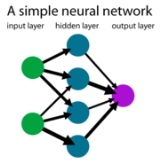
The basic architecture consists of three types of neuron layers: input, hidden, and output. In feed-forward networks, the signal flow is from input to output units, strictly in a feed-forward direction. The data processing can extend over multiple layers of units, but no feedback connections are present. Recurrent networks contain feedback connections. Contrary to feed-forward networks, the dynamical properties of the network are important. In some cases, the activation values of the units undergo a relaxation process such that the network will evolve to a stable state in which these activations do not change anymore.In other applications, the changes of the activation values of the output neurons are significant, such that the dynamical behavior constitutes the output of the network. Other neural network architectures include adaptive resonance theory
Adaptive resonance theory
Adaptive Resonance Theory is a theory developed by Stephen Grossberg and Gail Carpenter on aspects of how the brain processes information. It describes a number of neural network models which use supervised and unsupervised learning methods, and address problems such as pattern recognition and...
maps and competitive networks.
Criticism
A common criticism of neural networks, particularly in robotics, is that they require a large diversity of training for real-world operation. This is not surprising, since any learning machine needs sufficient representative examples in order to capture the underlying structure that allows it to generalize to new cases. Dean Pomerleau, in his research presented in the paper "Knowledge-based Training of Artificial Neural Networks for Autonomous Robot Driving," uses a neural network to train a robotic vehicle to drive on multiple types of roads (single lane, multi-lane, dirt, etc.). A large amount of his research is devoted to (1) extrapolating multiple training scenarios from a single training experience, and (2) preserving past training diversity so that the system does not become overtrained (if, for example, it is presented with a series of right turns – it should not learn to always turn right). These issues are common in neural networks that must decide from amongst a wide variety of responses, but can be dealt with in several ways, for example by randomly shuffling the training examples, by using a numerical optimization algorithm that does not take too large steps when changing the network connections following an example, or by grouping examples in so-called mini-batches.A. K. Dewdney, a former Scientific American
Scientific American
Scientific American is a popular science magazine. It is notable for its long history of presenting science monthly to an educated but not necessarily scientific public, through its careful attention to the clarity of its text as well as the quality of its specially commissioned color graphics...
columnist, wrote in 1997, "Although neural nets do solve a few toy problems, their powers of computation are so limited that I am surprised anyone takes them seriously as a general problem-solving tool." (Dewdney, p. 82)
Arguments for Dewdney's position are that to implement large and effective software neural networks, much processing and storage resources need to be committed. While the brain has hardware tailored to the task of processing signals through a graph
Graph (mathematics)
In mathematics, a graph is an abstract representation of a set of objects where some pairs of the objects are connected by links. The interconnected objects are represented by mathematical abstractions called vertices, and the links that connect some pairs of vertices are called edges...
of neurons, simulating even a most simplified form on Von Neumann technology may compel a NN designer to fill many millions of database
Database
A database is an organized collection of data for one or more purposes, usually in digital form. The data are typically organized to model relevant aspects of reality , in a way that supports processes requiring this information...
rows for its connections - which can consume vast amounts of computer memory
Ram
-Animals:*Ram, an uncastrated male sheep*Ram cichlid, a species of freshwater fish endemic to Colombia and Venezuela-Military:*Battering ram*Ramming, a military tactic in which one vehicle runs into another...
and hard disk space. Furthermore, the designer of NN systems will often need to simulate the transmission of signals through many of these connections and their associated neurons - which must often be matched with incredible amounts of CPU processing power and time. While neural networks often yield effective programs, they too often do so at the cost of efficiency (they tend to consume considerable amounts of time and money).
Arguments against Dewdney's position are that neural nets have been successfully used to solve many complex and diverse tasks, ranging from autonomously flying aircraft http://www.nasa.gov/centers/dryden/news/NewsReleases/2003/03-49.html to detecting credit card fraud http://www.visa.ca/en/about/visabenefits/innovation.cfm.
Technology writer Roger Bridgman commented on Dewdney's statements about neural nets:
Neural networks, for instance, are in the dock not only because they have been hyped to high heaven, (what hasn't?) but also because you could create a successful net without understanding how it worked: the bunch of numbers that captures its behaviour would in all probability be "an opaque, unreadable table...valueless as a scientific resource".
In spite of his emphatic declaration that science is not technology, Dewdney seems here to pillory neural nets as bad science when most of those devising them are just trying to be good engineers. An unreadable table that a useful machine could read would still be well worth having.
In response to this kind of criticism, one should note that although it is true that analyzing what has been learned by an artificial neural network is difficult, it is much easier to do so than to analyze what has been learned by a biological neural network. Furthermore, researchers involved in exploring learning algorithms for neural networks are gradually uncovering generic principles which allow a learning machine to be successful. For example, Bengio and LeCun (2007) wrote an article regarding local vs non-local learning, as well as shallow vs deep architecture http://www.iro.umontreal.ca/~lisa/publications2/index.php/publications/show/4.
Some other criticisms came from believers of hybrid models (combining neural networks and symbolic approaches). They advocate the intermix of these two approaches and believe that hybrid models can better capture the mechanisms of the human mind (Sun and Bookman 1990).
See also
- ADALINEADALINEADALINE is a single layer neural network. It was developed by Professor Bernard Widrow and his graduate student Ted Hoff at Stanford University in 1960. It is based on the McCulloch–Pitts neuron...
- 20Q20Q20Q is a computerized game of twenty questions that began as an experiment in artificial intelligence . It was invented by Robin Burgener....
is a neural network implementation of the 20 questions game - Artificial neural networkArtificial neural networkAn artificial neural network , usually called neural network , is a mathematical model or computational model that is inspired by the structure and/or functional aspects of biological neural networks. A neural network consists of an interconnected group of artificial neurons, and it processes...
- Backpropogation
- Biological cybernetics
- Biologically inspired computing
- Cerebellar Model Articulation ControllerCerebellar Model Articulation ControllerThe Cerebellar Model Articulation Controller is a type of neural network based on a model of the mammalian cerebellum. It is also known as the Cerebellar Model Arithmetic Computer...
- Cognitive architectureCognitive architectureA cognitive architecture is a blueprint for intelligent agents. It proposes computational processes that act like certain cognitive systems, most often, like a person, or acts intelligent under some definition. Cognitive architectures form a subset of general agent architectures...
- Cognitive scienceCognitive scienceCognitive science is the interdisciplinary scientific study of mind and its processes. It examines what cognition is, what it does and how it works. It includes research on how information is processed , represented, and transformed in behaviour, nervous system or machine...
- Cultured neuronal networks
- Digital morphogenesisDigital morphogenesisDigital morphogenesis is a process of shape development enabled by computation. While this concept is applicable in many areas, the term "digital morphogenesis" is used primarily in architecture....
- Exclusive Or
- Group method of data handlingGroup method of data handlingGroup method of data handling is a family of inductive algorithms for computer-based mathematical modeling of multi-parametric datasets that features fully automatic structural and parametric optimization of models....
- HabituationHabituationHabituation can be defined as a process or as a procedure. As a process it is defined as a decrease in an elicited behavior resulting from the repeated presentation of an eliciting stimulus...
- In Situ Adaptive TabulationIn Situ Adaptive TabulationIn situ adaptive tabulation is an algorithm for the approximation of nonlinear relationships. ISAT is based on multiple linear regressions that are dynamically added as additional information is discovered. The technique is adaptive as it adds new linear regressions dynamically to a store of...
- MemristorMemristorMemristor is a passive two-terminal electrical component envisioned by Leon Chua as a fundamental non-linear circuit element relating charge and magnetic flux linkage...
- Neural network softwareNeural network softwareNeural network software is used to simulate, research, develop and apply artificial neural networks, biological neural networks and in some cases a wider array of adaptive systems.-Simulators:...
- NeuroscienceNeuroscienceNeuroscience is the scientific study of the nervous system. Traditionally, neuroscience has been seen as a branch of biology. However, it is currently an interdisciplinary science that collaborates with other fields such as chemistry, computer science, engineering, linguistics, mathematics,...
- Parallel distributed processing
- Predictive analyticsPredictive analyticsPredictive analytics encompasses a variety of statistical techniques from modeling, machine learning, data mining and game theory that analyze current and historical facts to make predictions about future events....
- Radial basis function networkRadial basis function networkA radial basis function network is an artificial neural network that uses radial basis functions as activation functions. It is a linear combination of radial basis functions...
- Recurrent neural networks
- Simulated realitySimulated realitySimulated reality is the proposition that reality could be simulated—perhaps by computer simulation—to a degree indistinguishable from "true" reality. It could contain conscious minds which may or may not be fully aware that they are living inside a simulation....
- Support vector machineSupport vector machineA support vector machine is a concept in statistics and computer science for a set of related supervised learning methods that analyze data and recognize patterns, used for classification and regression analysis...
- Tensor product networkTensor product networkA tensor product network, in neural networks, is a network that exploits the properties of tensors to model associative concepts such as variable assignment...
- Threshold logic
- Time delay neural networkTime delay neural networkTime delay neural network is an alternative neural network architecture whose primary purpose is to work on continuous data. The advantage of this architecture is to adapt the network online and hence helpful in many real time applications, like time series prediction, online spell check,...
- Parallel Constraint Satisfaction ProcessesParallel Constraint Satisfaction ProcessesParallel Constraint Satisfaction Processes is a model that integrates the fastest growing research areas in the study of the mind; Connectionism, neural networks, and parallel distributed processing models.-Dynamic model of Attitude:...
Further reading
- Alspector, "Neuromorphic learning networks". October 17, 1989., p. 80 See chapter 3. See chapter 5.
- Jeffrey T. Spooner, Manfredi Maggiore, Raul Ord onez, and Kevin M. Passino, Stable Adaptive Control and Estimation for Nonlinear Systems: Neural and Fuzzy Approximator Techniques, John Wiley and Sons, NY, 2002.
External links
- A Brief Introduction to Neural Networks (D. Kriesel) - Illustrated, bilingual manuscript about artificial neural networks; Topics so far: Perceptrons, Backpropagation, Radial Basis Functions, Recurrent Neural Networks, Self Organizing Maps, Hopfield Networks.
- LearnArtificialNeuralNetworks - Robot control and neural networks
- Review of Neural Networks in Materials Science
- Artificial Neural Networks Tutorial in three languages (Univ. Politécnica de Madrid)
- Introduction to Neural Networks and Knowledge Modeling
- Another introduction to ANN
- Next Generation of Neural Networks - Google Tech Talks
- Performance of Neural Networks
- Neural Networks and Information
- PMML Representation - Standard way to represent neural networks