
All Topics  
Mosaic

 
Mosaic

   Email Print
   Bookmark   Link


Mosaic


Mosaic is the art
Art

Art is the process or product of deliberately arranging elements in a way that appeals to the senses or emotions. It encompasses a diverse range of human activities, creations, and modes of expression, including music and literature....
 of creating images with an assemblage of small pieces of colored glass
Glass

Glass generally refers to a Hardness, brittle, transparency amorphous solid, such as that used for windows, many Glass Bottles, or eyewear, including, but not limited to, soda-lime glass, borosilicate glass, acrylic glass, sugar glass, Muscovite , or aluminium oxynitride....
, stone, or other material. It may be a technique of decorative art, an aspect of interior decoration or of cultural and spiritual significance as in a cathedral
Cathedral

A cathedral is a Christian church that contains the seat of a bishop. It is a Religion building for worship, specifically of a denomination with an episcopal hierarchy, such as the Roman Catholic Church, Anglicanism, Orthodox Christian and some Lutheranism churches, which serves as a bishop's seat, and thus as the central church of a dioc...
.


Discussion
Ask a question about 'Mosaic'
Start a new discussion about 'Mosaic'
Answer questions from other users
Full Discussion Forum


Recent Posts


Encyclopedia


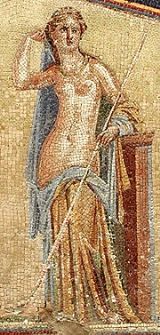
Amphitrite Mosaic


Mosaic is the art
Art

Art is the process or product of deliberately arranging elements in a way that appeals to the senses or emotions. It encompasses a diverse range of human activities, creations, and modes of expression, including music and literature....
 of creating images with an assemblage of small pieces of colored glass
Glass

Glass generally refers to a Hardness, brittle, transparency amorphous solid, such as that used for windows, many Glass Bottles, or eyewear, including, but not limited to, soda-lime glass, borosilicate glass, acrylic glass, sugar glass, Muscovite , or aluminium oxynitride....
, stone, or other material. It may be a technique of decorative art, an aspect of interior decoration or of cultural and spiritual significance as in a cathedral
Cathedral

A cathedral is a Christian church that contains the seat of a bishop. It is a Religion building for worship, specifically of a denomination with an episcopal hierarchy, such as the Roman Catholic Church, Anglicanism, Orthodox Christian and some Lutheranism churches, which serves as a bishop's seat, and thus as the central church of a dioc...
. Small tile
Tile

A tile is a manufactured piece of hard-wearing material such as ceramic, Rock , metal, or even glass. Tiles are generally used for covering roofs, floors, and walls, showers, or other objects such as tabletops....
s or fragments of pottery
Pottery

Pottery is the ceramic ware made by potters. Major types of pottery include earthenware, stoneware, and porcelain. The places where such wares are made are called potteries....
 (known as tesserae, diminutive tessellae), or of colored glass
Glass tiles

Glass tiles are pieces of glass formed into consistent shapes. Glass was used in mosaics as early as 2500 BC, but it took until the 3rd Century BC before innovative artisans in Greece, Persian empire and India created glass tiles....
 or clear glass backed with metal
Metal

In chemistry, a metal is a chemical element whose atoms readily lose electrons to form positive ions , and form metallic bonds between other metal atoms and ionic bonds between nonmetal atoms....
 foils are used to create a pattern
Pattern

A pattern, from the French language patron, is a type of theme of recurring events of or objects, sometimes referred to as elements of a set....
 or picture.

History of the Mosaic

, from Carthage. Now in the Bardo Museum
Bardo Museum

Bardo Museum is a museum in Tunis, Tunisia. It was originally a 13th century Hafsid palace, located in the suburbs of Tunis. It contains a major collection of Roman mosaics and other antiquities of interest from Ancient Greece, Tunisia, and from the Arab period....
, Tunisia
Tunisia

Tunisia , officially the Tunisian Republic , is a country located in North Africa. It is bordered by Algeria to the west and Libya to the southeast....
]] , from Carthage. Now in the Bardo Museum
Bardo Museum

Bardo Museum is a museum in Tunis, Tunisia. It was originally a 13th century Hafsid palace, located in the suburbs of Tunis. It contains a major collection of Roman mosaics and other antiquities of interest from Ancient Greece, Tunisia, and from the Arab period....
, Tunisia
Tunisia

Tunisia , officially the Tunisian Republic , is a country located in North Africa. It is bordered by Algeria to the west and Libya to the southeast....
]]
Dom Dramaturga
Mosaic
Mosaics of the 4th century BC are found in the Macedonian palace-city of tynan and they enriched the floors of Hellenistic villa
Villa

A villa was originally an upper-class country house, though since its origins in Roman Republic times the idea and function of a villa has evolved considerably....
s, and Roman
Ancient Rome

Ancient Rome was a civilization that grew out of a small agricultural community founded on the Italian Peninsula as early as the 10th century BC....
 dwellings from Britain to Dura-Europos
Dura-Europos

Hellenistic EraIt was founded in 303 BC by the Seleucid Empire on the intersection of an east-west trade route and the trade route along the Euphrates....
. Splendid mosaic floors are found in Roman villas across north Africa, in places such as Carthage
Carthage

Carthage refers both to an ancient city in present-day Tunisia, and a modern-day suburb of Tunis. The civilization that developed within the city's sphere of influence is referred to as Punic or Carthaginian....
, and still may be seen in the extensive collection in Bardo Museum
Bardo Museum

Bardo Museum is a museum in Tunis, Tunisia. It was originally a 13th century Hafsid palace, located in the suburbs of Tunis. It contains a major collection of Roman mosaics and other antiquities of interest from Ancient Greece, Tunisia, and from the Arab period....
 in Tunis
Tunis

Tunis is the Capital of the Tunisian Republic and also the Tunis Governorate, with a population of 1 200,000 in 2008 and over 3,980,500 in the municipal area....
, Tunisia
Tunisia

Tunisia , officially the Tunisian Republic , is a country located in North Africa. It is bordered by Algeria to the west and Libya to the southeast....
. In Rome, Nero and his architects used mosaics to cover the surfaces of walls and ceilings in the Domus Aurea
Domus Aurea

The Domus Aurea was a large landscaped portico villa, designed to take advantage of artificially created landscapes built in the heart of Ancient Rome by the Roman Empire Nero after the Great fire of Rome, which devastated Ancient Rome in 64 AD, had cleared away the aristocratic dwellings on the slopes of the Esquiline Hill....
, built AD 64.

The mosaics of the Villa Romana del Casale
Villa Romana del Casale

Villa Romana del Casale is a Roman villa located about 5 km outside the town of Piazza Armerina, Sicily, southern Italy. It contains the richest, largest and most complex collection of Roman Empire mosaics in the world....
 near Piazza Armerina in Sicily
Sicily

Sicily is an Autonomous regions with special statute of Italy. Of all the regions of Italy, Sicily covers the largest land area at 25,708 km? and currently has just over five million inhabitants....
 are the largest collection of late Roman mosaics in the world and are protected as a UNESCO
UNESCO

United Nations Educational, Scientific and Cultural Organization is a specialized agency of the United Nations established on 16 November 1945....
 World Heritage Site
World Heritage Site

A UNESCO World Heritage Site is a site that is on the list maintained by the international World Heritage Programme administered by the UNESCO World Heritage Committee, composed of 21 Sovereign state which are elected by their General Assembly for a four-year term....
. The large villa rustica, which probably was owned by Emperor Maximian
Maximian

Marcus Aurelius Valerius Maximianus Herculius , commonly referred to as Maximian, was Caesar from July 285 and Augustus from April 1, 286 to May 1, 305....
, was built largely in the early 4th century. The mosaics were covered and protected for 700 years, by a landslide that occurred in the 12th century. The most important pieces are the Circus Scene, the 64 m long Great Hunting Scene, the Little Hunt, the Labours of Hercules and the famous Bikini Girls, showing women in modern-looking bikinis. The peristyle, the imperial apartments and the thermae also were decorated with ornamental and mythological mosaics. Other important examples of Roman mosaic art in Sicily
Sicily

Sicily is an Autonomous regions with special statute of Italy. Of all the regions of Italy, Sicily covers the largest land area at 25,708 km? and currently has just over five million inhabitants....
 were unearthed on the Piazza Vittoria in Palermo
Palermo

Palermo is a historic city in southern Italy, the Capital of the autonomous region Sicily and the province of Palermo. The city is noted for its rich history, culture, architecture and gastronomy, playing an important role throughout much of its existence; it is over 2,700 years old....
 where two houses were discovered. The most important scenes there depicted Orpheus, Alexander the Great's Hunt and the Four Seasons.

In 2000 archaeologists working in Leptis Magna
Leptis Magna

Leptis Magna, also known as Lectis Magna , also called Lpqy or Neapolis, was a prominent city of the Roman Empire. Its ruins are located in Al Khums, Libya, 130 km east of Tripoli, on the coast where the Wadi Lebda meets the sea....
, Libya
Libya

Libya , officially the Great Socialist People's Libyan Arab Jamahiriya , is a country located in North Africa. Bordering the Mediterranean Sea to the north, Libya lies between Egypt to the east, Sudan to the southeast, Chad and Niger to the south, and Algeria and Tunisia to the west....
 uncovered a 30 ft length of five colorful mosaics created during the 1st or 2nd century. The mosaics show a warrior in combat with a deer, four young men wrestling a wild bull to the ground, and a gladiator resting in a state of fatigue, staring at his slain opponent. The mosaics decorated the walls of a cold plunge pool in a bath house within a Roman villa. The gladiator mosaic is noted by scholars as one of the finest examples of mosaic art ever seen — a "masterpiece comparable in quality with the Alexander mosaic in Pompeii."

Early Christian art

With the building of Christian basilica
Basilica

The Latin word basilica , was originally used to describe a ancient Rome public building , usually located in the Forum of a Roman town. In Hellenistic cities, public basilicas appeared in the 2nd century BC....
s in the late 4th century, wall and ceiling mosaics were adopted for Christian uses. The earliest examples of the first Christian basilicas have not survived, but the mosaics of Santa Constanza and Santa Pudenziana
Santa Pudenziana

The basilica of Santa Pudenziana is a 4th century churches of Rome Rome, dedicated to Saint Pudentiana, sister of Saint Praxedis and daughter of Saint Pudens....
, both from the 4th century, still exist. The winemaking putti in the ambulatory of Santa Constanza still follow the classical tradition (ie. feast of Bacchus
Dionysus

In classical mythology, Dionysus or Dionysos , is the God of wine, the inspirer of ritual madness and ecstasy, and a major figure of Greek mythology, and one of the twelve Olympians, among whom Greek mythology treated Dionysus as a late arrival....
)which symbolizes transformation or change and thus appropriate for a mausoleum, the original function this building had. Another great Constantinian basilica, the Church of the Nativity
Church of the Nativity

The Church of the Nativity in Bethlehem is one of the oldest continuously operating churches in the world. The structure is built over the cave that Sacred Tradition marks as the Nativity of Jesus of Christ, and it is considered sacred by followers of both Christianity and Islam ....
 in Betlehem partially preserved its original mosaic floor with typical Roman geometric motifs. The so-called Tomb of the Julii
Tomb of the Julii

The popularly-named "Tomb of the Julii" survives in the necropolis beneath St. Peter's Basilica, the so-called "Vatican grotto". The serendipitous discovery near the crypt has a vaulted ceiling bearing a mosaic depicting Helios with an aureole riding in his chariot, within a framing of rinceaux of vine leaves, which are not given their usu...
, near the crypt beneath St Peter's Basilica, is a fourth-century vaulted tomb with wall and ceiling mosaics that are given Christian interpretations. The former Tomb of Galerius in Thessaloniki
Thessaloniki

Thessaloniki , Thessalonica, or Salonica is the List of largest cities and second largest cities by country in Greece and the capital of Macedonia , the nation's largest Regions of Greece....
, converted into a Christian church during the course of the 4th century, was embellished with very high artistic quality mosaics. Only fragments survived of the original decoration, especially a band depicting saints with hands raised in prayer, in front of complex architectural fantasies.

In the following century Ravenna
Ravenna

Ravenna is a city and comune in the Emilia-Romagna region of Italy. The city is inland, but is connected to the Adriatic Sea by a canal. Ravenna once served as the seat of the Western Roman Empire and later the Ostrogoths and the Exarchate of Ravenna....
, the capital of the Western Roman Empire
Western Roman Empire

The Western Roman Empire refers to the western half of the Roman Empire, from its division by Diocletian in 285; the other half of the Roman Empire was the Eastern Roman Empire, today widely known as the Byzantine Empire....
, became the center of late Roman mosaic art (see details in Ravenna section). Milan
Milan

Milan is the second largest city of Italy, located in the plains of Lombardy. It is the capital in the Province of Milan, as well as the Regions of Italy capital of Lombardy....
 also served as the capital of the western empire in the 4th century. In the St Aquilinus Chapel of the Basilica of San Lorenzo
Basilica of San Lorenzo, Milan

The Basilica of Saint Lawrence is a church in Milan, northern Italy, dedicated to the Christian martyr St. Lawrence....
 mosaics executed in the late 4th-early 5th centuries, depict Christ with the Apostles and the Abduction of Elijah; these mosaics are outstanding for their bright colors, naturalism and adherence to the classical canons of order and proportion. The surviving apse mosaic of the Basilica of Sant'Ambrogio
Basilica of Sant'Ambrogio

The Basilica of Sant'Ambrogio is a church in Milan, northern Italy....
 which shows Christ enthroned between Saint Gervasius and Saint Protasius and angels before a golden background date back to the 5th and to the 8th century, although it was restored many times later. The baptistery of the basilica, which was demolished in the 15th century, had a vault covered with gold-leaf tesserae, large quantities of which were found when the site was excavated. In the small shrine of San Vittore in ciel d'oro, now a chapel of Sant'Ambrogio, every surface is covered with mosaics from the second half of the 5th century. In the center of the golden dome Saint Victor was depicted while figures of saints are shown on the walls before a blue background. The low spandrels give space for the symbols of the four.

Albingaunum
Albenga

Albenga is a city situated on the Gulf of Genoa on the Italian Riviera in the Province of Savona in Liguria, northern Italy.The economy is mostly based on tourism, local commerce and agriculture...
 was the main Roman port of Liguria
Liguria

Liguria is a coastal Regions of Italy of north-western Italy, the third smallest of the Italian regions. Its capital is Genoa. It is a popular region with tourists for its beautiful beaches, picturesque little towns, and food....
. The octagonal baptistry of the town was decorated in the 5th century with high quality blue and white mosaics representing the Apostles. The surviving remains are fragmentary.

A mosaic pavement depicting humans, animals and plants from the original fourth-century cathedral of Aquileia
Aquileia

Aquileia is an ancient history Roman Republic city in what is now Italy, at the head of the Adriatic Sea at the edge of the lagoons, about 10 km from the sea, on the river Natiso , the course of which has changed somewhat since Roman times....
 have survived in the later medieval church. This mosaic adopts pagan motifs such as the Nilotic scene but behind the traditional naturalistic content is Christian symbolism (ichthys, fisherman). The sixth-century early Christian basilicas of Sant' Eufemia and Santa Maria delle Grazie in Grado
Grado, Italy

Grado is a town in the north-eastern Italy region of Friuli-Venezia Giulia, located on a peninsula of the Adriatic Sea between Venice and Trieste....
 also have mosaic floors.

Ravenna

In the 5th century Ravenna
Ravenna

Ravenna is a city and comune in the Emilia-Romagna region of Italy. The city is inland, but is connected to the Adriatic Sea by a canal. Ravenna once served as the seat of the Western Roman Empire and later the Ostrogoths and the Exarchate of Ravenna....
, the capital of the Western Roman Empire
Western Roman Empire

The Western Roman Empire refers to the western half of the Roman Empire, from its division by Diocletian in 285; the other half of the Roman Empire was the Eastern Roman Empire, today widely known as the Byzantine Empire....
, became the center of late Roman mosaic art. The Mausoleum of Galla Placidia
Mausoleum of Galla Placidia

The Mausoleum of Galla Placidia is a highly important Roman Empire mausoleum in Ravenna, Italy. It is one of the eight structures in Ravenna that were inscribed on the World Heritage List in 1996....
 was decorated with mosaics of high artistic quality in 425-430. The vaults of the small, cross-shaped structure are clad with mosaics on blue background. The central motif above the crossing is a golden cross in the middle of the stary sky. Another great building established by Galla Placidia
Galla Placidia

File:Aelia Galla Placidia.jpgAelia Galla Placidia was the Empress consort of Constantius III, Western Roman Empire....
 was the Church of San Giovanni Evangelista. She erected it in fulfillment of a vow that she made having escaped from a deadly storm in 425 on the sea voyage from Constantinople to Ravenna. The mosaics depicted the storm, portraits of members of the western and eastern imperial family and the bishop of Ravenna, Peter Chrysologus
Peter Chrysologus

Saint Peter Chrysologus was Bishop of Ravenna from about 433 AD until his death. He is revered as a saint by the Roman Catholic Church, and was declared a Doctor of the Church by Pope Benedict XIII in 1729....
. They are only known from Renaissance sources because they were destroyed in 1569.

Ostrogoths kept alive the tradition in the sixth century, as the mosaics of the Arian Baptistry
Arian Baptistry

The Arian Baptistry in Ravenna, Italy was erected by Ostrogothic King Theodoric the Great between the end of the 5th century and the beginning of the sixth century....
, Baptistry of Neon
Baptistry of Neon

The Baptistry of Neon in Ravenna, Italy is the most ancient monument remaining in Ravenna, and was partly erected on the site of a Roman bath....
, Archiepiscopal Chapel
Archiepiscopal Chapel

Archiepiscopal Chapel is a chapel on the first floor of the bishops' palace in Ravenna, Italy. It is a private Oratory of Trinity bishops dating from the turn of the 6th century....
, and the earlier phase mosaics in the Basilica of San Vitale
Basilica of San Vitale

The Church or Basilica of San Vitale? styled an "Basilica" in the Roman Catholic Church, though it is not of Basilica form? is the most famous monument of Ravenna, Italy and is one of the most important examples of Byzantine Art and architecture in western Europe....
 and Basilica of Sant'Apollinare Nuovo
Basilica of Sant'Apollinare Nuovo

The Basilica of Sant' Apollinare Nuovo is a church in Ravenna, Emilia-Romagna . It was erected by the Arianism King Theodoric as his palace chapel, during the first quarter of the 6th century ....
 testify.

After 539 Ravenna was conquered by the Byzantine Empire
Byzantine Empire

Byzantine Empire and Eastern Roman Empire are conventional names used to describe the Roman Empire during the Middle Ages, centered on its capital of Constantinople....
 and became the seat of the Exarchate of Ravenna
Exarchate of Ravenna

The Exarchate of Ravenna or of Italy was a centre of Byzantine Empire power in Italy, from the end of the 6th century to 751, when the last Exarch was put to death by the Lombards....
. The greatest development of Christian mosaics unfolded in the second half of the 6th century. Outstanding examples of Byzantine mosaic art are the later phase mosaics in the Basilica of San Vitale
Basilica of San Vitale

The Church or Basilica of San Vitale? styled an "Basilica" in the Roman Catholic Church, though it is not of Basilica form? is the most famous monument of Ravenna, Italy and is one of the most important examples of Byzantine Art and architecture in western Europe....
 and Basilica of Sant'Apollinare Nuovo
Basilica of Sant'Apollinare Nuovo

The Basilica of Sant' Apollinare Nuovo is a church in Ravenna, Emilia-Romagna . It was erected by the Arianism King Theodoric as his palace chapel, during the first quarter of the 6th century ....
. The mosaic depicting Emperor Justinian I
Justinian I

Flavius Petrus Sabbatius Iustinianus , AD 482 or 483 ? 13 or 14 November 565, was the second member of the Justinian Dynasty and List of Roman Emperors from 527 until his death....
 and Empress Theodora
Theodora (6th century)

Theodora , was empress of the Byzantine Empire and the wife of Emperor Justinian I. Like her husband, she is a saint in the Eastern Orthodoxy, commemorated on November 14....
 in the Basilica of San Vitale were executed shortly after the Byzantine conquest. The mosaics of the Basilica of Sant'Apollinare in Classe
Basilica of Sant'Apollinare in Classe

The Basilica of Sant' Apollinare in Classe is an important monument of Byzantine art in Ravenna, Italy. When the UNESCO inscribed eight Ravenna sites on the World Heritage List, it cited this basilica as "an outstanding example of the early Christian basilica in its purity and simplicity of its design and use of space and in the sumptuous...
 were made around 549. The anti-Arian theme is obvious in the apse mosaic of San Michele in Affricisco, executed in 545-547 (largely destroyed, the remains in Berlin
Berlin

Berlin is the Capital of Germany city and one of sixteen States of Germany of Germany. With a population of 3.4 million within its city limits, Berlin is the country's largest city....
).

The last example of Byzantine mosaics in Ravenna was commissioned by bishop Reparatus between 673-79 in the Basilica of Sant'Apollinare in Classe
Basilica of Sant'Apollinare in Classe

The Basilica of Sant' Apollinare in Classe is an important monument of Byzantine art in Ravenna, Italy. When the UNESCO inscribed eight Ravenna sites on the World Heritage List, it cited this basilica as "an outstanding example of the early Christian basilica in its purity and simplicity of its design and use of space and in the sumptuous...
. The mosaic panel in the apse showing the bishop with Emperor Constantine IV
Constantine IV

Constantine IV , ; sometimes incorrectly called Pogonatos, "the Bearded", by confusion with his father; was Byzantine emperor from 668 to 685....
 is obviously an imitation of the Justinian panel in San Vitale.

Late Antique and Early Medieval Rome

Christian mosaic art also flourished in Rome, gradually declining as conditions became more difficult in the Early Middle Ages
Early Middle Ages

The Early Middle Ages is a period in the history of Europe following the fall of the Western Roman Empire spanning roughly five centuries from AD 500 to 1000....
. Fifth-century mosaics can be found over the triumphal arch and in the nave of the basilica of Santa Maria Maggiore. The 27 surviving panels of the nave are the most important mosaic cycle in Rome of this period. Two other important 5th-century mosaics are lost but we know them from 17th-century drawings. In the apse mosaic of Sant'Agata dei Goti
Sant'Agata dei Goti

Sant'Agata dei Goti is a churches in Rome Rome dedicated to the martyr Agatha of Sicily....
 (462-472, destroyed in 1589) Christ was seated on a globe with the twelve Apostles flanking him, six on either side. At Sant'Andrea in Catabarbara (468-483, destroyed in 1686) Christ appeared in the center, flanked on either side by three Apostles. Four streams flowed from the little mountain supporting Christ. The original 5th-century apse mosaic of the Santa Sabina
Santa Sabina

The Basilica of Saint Sabina at the Aventine is a titular minor basilica and mother church of the Roman Catholic Dominican order in Rome, Italy....
 was replaced by a very similar fresco by Taddeo Zuccari
Taddeo Zuccari

Taddeo Zuccaro or Zuccari , was an Italian painter, one of the most popular members of the Mannerism....
 in 1559. The composition probably remained unchanged: Christ flanked by male and female saints, seated on a hill while lambs drinking from a stream at its feet. All three mosaics had a similar iconography.

6th-century pieces are rare in Rome but the mosaics inside the triumphal arch of the basilica of San Lorenzo fuori le mura
San Lorenzo fuori le Mura

The Basilica of Saint Lawrence outside the Walls is a Roman Catholic minor basilica, located in churches of Rome, Italy. The basilica is one of the Seven Pilgrim Churches of Rome and one of the five Patriarchal basilica, each of which is assigned to a patriarchate....
 belong to this era. The Chapel of Ss. Primo e Feliciano in Santo Stefano Rotondo
Santo Stefano Rotondo

The Basilica of St. Stephen in the Round on the Celian Hill is an ancient basilica in Rome, Italy. Commonly named Santo Stefano Rotondo, the church is the National churches in Rome of Hungary dedicated to Saint Stephen and Saint Stephen of Hungary....
 has very interesting and rare mosaics from the 7th century. This chapel was built by Pope Theodore I
Pope Theodore I

Pope Theodore I , who was pope November 24, 642 - May 14 649, is considered a Greeks, but was born in Palestine. He was made a cardinal deacon, and a full Cardinal by Pope John IV....
 as a family burial place.

In the 7-9th centuries Rome fell under the influence of Byzantine art, noticeable on the mosaics of Santa Prassede
Santa Prassede

The Basilica of Saint Praxedes is a titular minor basilica in Rome, located near the major basilica of Santa Maria Maggiore.The current Cardinal Priest of Titulus Sancta Praxedis is Paul Cardinal Poupard....
, Santa Maria in Domnica
Santa Maria in Domnica

Santa Maria in Domnica ? also known as Santa Maria alla Navicella ? is a basilica churches of Rome Rome....
, Sant'Agnese fuori le Mura
Sant'Agnese fuori le mura

Sant'Agnese fuori le mura is a churches of Rome Rome, in which Saint Agnes's bones are reputed to rest. The underground area and built a large private mausoleum over it which is now known as the "mausoleo di Santa Costanza" , while the church of Saint Agnes was then built aside....
, Santa Cecilia in Trastevere
Santa Cecilia in Trastevere

Santa Cecilia in Trastevere is a 5th century Churches of Rome Rome, located in the Trastevere rioni of Rome and devoted to Saint Cecilia....
, Santi Nereo e Achilleo
Santi Nereo e Achilleo

Santi Nereo e Achilleo is a 4th century basilica churches of Rome Rome.The church is located in the rione Celio , close to the Baths of Caracalla....
 and the San Venanzio chapel of San Giovanni in Laterano. The great dining hall of Pope Leo III
Pope Leo III

Pope Saint Leo III was Pope from 795 to 816. Protected by Charlemagne from his enemies in Rome, he subsequently strengthened Charlemagne's position by crowning him as Roman Emperor....
 in the Lateran Palace
Lateran Palace

The Lateran Palace, formally the Apostolic Palace of the Lateran , is an ancient palace of the Roman Empire and later a Papal Palace. Adjacent to the Basilica di San Giovanni in Laterano, the cathedral Church of Rome, Italy....
 was also decorated with mosaics. They were all destroyed later except for one example, the so-called Triclinio Leoniano of which a copy was made in the 18th century. Another great work of Pope Leo, the apse mosaic of Santa Susanna
Santa Susanna

Santa Susanna is a church on the Quirinal in Rome, with a titulus at its site that dates back to about 280. The modern church, rebuilt in 1585–1603, is the English?speaking Roman parish which ministers to American Catholics living in or visiting Rome....
, depicted Christ with the Pope and Charlemagne
Charlemagne

Charlemagne was List of Frankish kings from 768 to his death. He expanded the Franks kingdoms into a Carolingian Empire that incorporated much of Western Europe and Central Europe....
 on one side, and SS. Susanna and Felicity on the other. It was plastered over during a renovation in 1585. Pope Paschal I (817-824) embellished the church of Santo Stefano del Cacco
Santo Stefano del Cacco

Santo Stefano de Pinea or more commonly Santo Stefano del Cacco is a church in Rome dedicated to Saint Stephen, located at Via di Santo Stefano del Cacco 26....
 with an apsidal mosaic which depicted the pope with a model of the church (destroyed in 1607).

The fragment of an eighth-century mosaic, the Epiphany is one of the very rare remaining pieces of the medieval decoration of Old St. Peter's Basilica, demolished in the late 16th century. The precious fragment is kept in the sacristy of Santa Maria in Cosmedin
Santa Maria in Cosmedin

The Basilica of Saint Mary in Cosmedin is a minor basilica churches of Rome Rome, Italy. It is located in the rione of ripa ....
. It proves the high artistic quality of the destroyed St. Peter's mosaics.
Greatpalacemosaic

Byzantine mosaics

Mosaics were more central to Byzantine culture than to that of Western Europe. Byzantine church interiors were generally covered with golden mosaics. Mosaic art flourished in the Byzantine Empire
Byzantine Empire

Byzantine Empire and Eastern Roman Empire are conventional names used to describe the Roman Empire during the Middle Ages, centered on its capital of Constantinople....
 from the 6th to the 15th century. The majority of Byzantine mosaics were destroyed without trace during wars and conquests, but the surviving remains still form a fine collection.

The great buildings of Emperor Justinian
Justinian I

Flavius Petrus Sabbatius Iustinianus , AD 482 or 483 ? 13 or 14 November 565, was the second member of the Justinian Dynasty and List of Roman Emperors from 527 until his death....
 like the Hagia Sophia
Hagia Sophia

Hagia Sophia is a former Patriarchate basilica, later a mosque, now a museum in Istanbul, Turkey. Famous in particular for its massive dome, it is considered the epitome of Byzantine architecture....
 in Constantinople
Constantinople

Constantinople was the empire capital of the Roman Empire , the Byzantine Empire , the Latin Empire , and the Ottoman Empire . Strategically located between the Golden Horn and the Sea of Marmara at the point where Europe meets Asia, Byzantine Constantinople had been the capital of a Christendom empire, successor to ancient ancient Greece...
, the Nea Church in Jerusalem
Jerusalem

Jerusalem is the capital of Israel and its List of Israeli cities in both population and area, with a population of 747,600 residents over an area of if Positions on Jerusalem East Jerusalem is included....
 and the rebuilt Church of the Nativity
Church of the Nativity

The Church of the Nativity in Bethlehem is one of the oldest continuously operating churches in the world. The structure is built over the cave that Sacred Tradition marks as the Nativity of Jesus of Christ, and it is considered sacred by followers of both Christianity and Islam ....
 in Betlehem were certainly embellished with mosaics but none of these survived.

Important fragments survived from the mosaic floor of the Great Palace of Constantinople
Great Palace of Constantinople

The Byzantine Empire Great Palace of Constantinople, , also known as the Sacred Palace , was a large palace complex, located in the south-eastern end of the peninsula where the city lies....
 which was commissioned during Justinian's reign. The figures, animals, plants all are entirely classical but they are scattered before a plain background. The portrait of a moustached man, probably a Gothic chieftain, is considered the most important surviving mosaic of the Justinian age. The so-called small sekreton of the palace was built during Justin II
Justin II

Flavius Iustinus Augustus was Eastern Roman emperor from 565 to 578. He was the nephew of Justinian I, and husband of Sophia , the niece of the late empress Theodora , and therefore member of the Justinian Dynasty....
's reign around 565-577. Some fragments survive from the mosaics of this vaulted room. The vine scroll motifs are very similar to those in the Santa Constanza and they still closely follow the Classical tradition. There are remains of floral decoration in the Panagia Acheiropoietos Church in Thessaloniki
Thessaloniki

Thessaloniki , Thessalonica, or Salonica is the List of largest cities and second largest cities by country in Greece and the capital of Macedonia , the nation's largest Regions of Greece....
 (5-6th centuries).

In the 6th century, Ravenna
Ravenna

Ravenna is a city and comune in the Emilia-Romagna region of Italy. The city is inland, but is connected to the Adriatic Sea by a canal. Ravenna once served as the seat of the Western Roman Empire and later the Ostrogoths and the Exarchate of Ravenna....
, the capital of Byzantine Italy, became the center of mosaic making. Istria
Istria

File:Istria Croatian Adriatic.pngIstria , formerly Histria , is the largest peninsula in the Adriatic Sea. The peninsula is located at the head of the Adriatic between the Gulf of Trieste and the Bay of Kvarner....
 also boasts some important examples from this era. The Euphrasian Basilica
Euphrasian Basilica

The Euphrasian Basilica is a basilica in Porec, Croatia. The episcopal complex, including, apart the basilica itself, a sacristy, a baptistery and the bell tower of the nearby archbishop's palace, is one of the best examples of early Byzantine art in the region....
 in Parentium
Porec

Porec is a town and municipality on the western coast of the Istria, in Istria County, Croatia. Its major landmark is the 6th century Euphrasian Basilica, a UNESCO World Heritage Site since 1997....
 was built in the middle of the 6th century and decorated with mosaics depicting the Theotokos
Theotokos

Theotokos is a title of Mary, the mother of Jesus used especially in the Eastern Orthodox Church, Oriental Orthodox, and Eastern Catholic Churches....
 flanked by angels and saints.

Fragments remain from the mosaics of the Church of Santa Maria Formosa in Pola
Pula

Pula is the largest city in Istria County, Croatia, situated at the southern tip of the Istria peninsula, with a population of 62,080 .Like the rest of the region, it is known for its mild climate, tame sea, and unspoiled nature....
. These pieces were made during the 6th century by artists from Constantinople
Constantinople

Constantinople was the empire capital of the Roman Empire , the Byzantine Empire , the Latin Empire , and the Ottoman Empire . Strategically located between the Golden Horn and the Sea of Marmara at the point where Europe meets Asia, Byzantine Constantinople had been the capital of a Christendom empire, successor to ancient ancient Greece...
. Their pure Byzantine style is different than the contemporary Ravennate mosaics.
Dimamosaic
Very few early Byzantine mosaics survived the Iconoclastic
Iconoclasm

Iconoclasm, Greek for "image-breaking," is the deliberate destruction of important symbolic images recognized within a culture, religion, or society....
 destruction of the 8th century. Among the rare examples are the 6th-century Christ in majesty (or Ezekiel's Vision) mosaic in the apse of the Osios David Church in Thessaloniki
Thessaloniki

Thessaloniki , Thessalonica, or Salonica is the List of largest cities and second largest cities by country in Greece and the capital of Macedonia , the nation's largest Regions of Greece....
 that was hidden behind mortar during those dangerous times. The mosaics of the Hagios Demetrios Church, which were made between 634 and 730, also escaped destruction. Unusually almost all represent Saint Demetrius of Thessaloniki
Saint Demetrius of Thessaloniki

Saint Demetrius of Thessaloniki was a Christianity martyr who is said to have lived in Thessaloniki in the early 4th century. During the Middle Ages, he came to be revered as one of the most important Orthodox military saints, often paired with Saint George....
, often with suppliants before him.

In the Iconoclastic
Iconoclasm

Iconoclasm, Greek for "image-breaking," is the deliberate destruction of important symbolic images recognized within a culture, religion, or society....
 era, figural mosaics were also condemned as idolatry. The Iconoclastic churches were embellished with plain gold mosaics with only one great cross in the apse like the Hagia Irene
Hagia Irene

Hagia Irene or Hagia Eirene is a former Eastern Orthodox church located in the outer courtyard of Topkapi Palace in Istanbul, Turkey....
 in Constantinople
Constantinople

Constantinople was the empire capital of the Roman Empire , the Byzantine Empire , the Latin Empire , and the Ottoman Empire . Strategically located between the Golden Horn and the Sea of Marmara at the point where Europe meets Asia, Byzantine Constantinople had been the capital of a Christendom empire, successor to ancient ancient Greece...
 (after 740). There were similar crosses in the apses of the Hagia Sophia Church
Hagia Sophia (Thessaloniki)

The Hagia Sophia in Thessaloniki, Greece, is one of the oldest churches in that city still standing today....
 in Thessaloniki
Thessaloniki

Thessaloniki , Thessalonica, or Salonica is the List of largest cities and second largest cities by country in Greece and the capital of Macedonia , the nation's largest Regions of Greece....
 and in the Church of the Dormition in Nicaea
Iznik

Iznik is a city in Turkey which is known primarily as the site of the First Council of Nicaea and Second Council of Nicaea Councils of Nicaea, the first and seventh Ecumenical councils in the early history of the Christianity church, the Nicene Creed, and as the capital city of the Empire of Nicaea....
. The crosses were substituted with the image of the Theotokos
Theotokos

Theotokos is a title of Mary, the mother of Jesus used especially in the Eastern Orthodox Church, Oriental Orthodox, and Eastern Catholic Churches....
 in both churches after the victory of the Iconodules
Iconodules

An iconodule is someone who espouses iconodulism, i.e. who supports or is in favor of religious images or icons and their veneration, and is in opposition to an Iconoclasm, someone against the use of religious images....
 (787-797 and in 8-9th centuries respectively, the Dormition church was totally destroyed in 1922).

A similar Theotokos
Theotokos

Theotokos is a title of Mary, the mother of Jesus used especially in the Eastern Orthodox Church, Oriental Orthodox, and Eastern Catholic Churches....
 image flanked by two archangels were made for the Hagia Sophia
Hagia Sophia

Hagia Sophia is a former Patriarchate basilica, later a mosque, now a museum in Istanbul, Turkey. Famous in particular for its massive dome, it is considered the epitome of Byzantine architecture....
 in Constantinople
Constantinople

Constantinople was the empire capital of the Roman Empire , the Byzantine Empire , the Latin Empire , and the Ottoman Empire . Strategically located between the Golden Horn and the Sea of Marmara at the point where Europe meets Asia, Byzantine Constantinople had been the capital of a Christendom empire, successor to ancient ancient Greece...
 in 867. The dedication inscription says: "The images which the impostors had cast down here pious emperors have again set up." In the 870s the so-called large sekreton of the Great Palace of Constantinople
Great Palace of Constantinople

The Byzantine Empire Great Palace of Constantinople, , also known as the Sacred Palace , was a large palace complex, located in the south-eastern end of the peninsula where the city lies....
 was decorated with the images of the four great iconodule patriarchs.

The post-Iconoclastic era was the heyday of Byzantine art with the most beautiful mosaics executed. The mosaics of the Macedonian Renaissance
Macedonian Renaissance

Macedonian Renaissance is a label sometimes used to describe the period of the Macedonian dynasty of the Byzantine Empire , especially the 10th century, which some scholars have seen as a time of increased interest in classical scholarship and the assimilation of classical motifs into Christian themes....
 (867-1056) carefully mingled traditionalism with innovation. Constantinopolitan mosaics of this age followed the decoration scheme first used in Emperor Basil I
Basil I

Basil I, called the Macedonian was a Byzantine Empire. He was perceived by Byzantines as one of their greatest emperors, the founder of one the most splendid imperial dynasties of Byzantium, the Macedonian dynasty , and the initiator of a Macedonian Renaissance of Byzantine art....
's Nea Ekklesia
Nea Ekklesia

The Nea Ekklesia was a church built by Byzantine Emperor Basil I the Macedonian in Constantinople between the years 876?80. It was the first monumental church built in the Byzantine Empire capital after the Hagia Sophia in the 6th century, and marks the beginning of middle period of Byzantine architecture....
. Not only this prototype was later totally destroyed but each surviving composition is battered so it is necessary to move from church to church to reconstruct the system.

An interesting set of Macedonian-era mosaics make up the decoration of the Hosios Loukas
Hosios Loukas

Hosios Loukas is an historic walled monastery situated near the town of Distomo, in Boeotia Prefecture, Greece. It is one of the most important monuments of Middle Byzantine architecture and art, and has been listed on UNESCO's World Heritage Sites, along with the monasteries of Nea Moni and Daphnion....
 Monastery. In the narthex there is the Crucifixion, the Pantokrator and the Anastasis above the doors, while in the church the Theotokos (apse), Pentecost, scenes from Christ's life and ermit St Loukas (all executed before 1048). The scenes are treated with a minimum of detail and the panels are dominated with the gold setting. The Nea Moni Monastery on Chios
Chios

Chios is the fifth largest of the Greece list of islands of Greece, situated in the Aegean Sea seven kilometres off the Turkey coast. The island is noted for its strong merchant shipping community, its unique mastic gum and its medieval villages....
 was established by Constantine Monomachos
Constantine IX Monomachos

Constantine IX Monomachos , c. 1000–January 11, 1055, reigned as Byzantine emperor from June 11, 1042 to January 11, 1055. He had been chosen by Zoe as a husband and co-emperor in 1042, although he had been exiled for conspiring against her previous husband, Emperor Michael IV the Paphlagonian....
 in 1043-1056. The exceptional mosaic decoration of the dome showing probably the nine orders of the angels was destroyed in 1822 but other panels survived (Theotokos with raised hands, four evangelists with seraphim, scenes from Christ's life and an interesting Anastasis where King Salomon bears resemblance to Constantine Monomachos). In comparison with Osios Loukas Nea Moni mosaics contain more figures, detail, landscape and setting.

Another great undertaking by Constantine Monomachos was the restoration of the Church of the Holy Sepulchre
Church of the Holy Sepulchre

The Church of the Holy Sepulchre , also called the Church of the Resurrection, by Eastern Christianitys, is a Christianity Church within the walled Old City of Jerusalem....
 in Jerusalem
Jerusalem

Jerusalem is the capital of Israel and its List of Israeli cities in both population and area, with a population of 747,600 residents over an area of if Positions on Jerusalem East Jerusalem is included....
 between 1042 and 1048. Nothing survived of the mosaics which covered the walls and the dome of the edifice but the Russian abbot Daniel, who visited Jerusalem in 1106-1107 left a description: "Lively mosaics of the holy prophets are under the ceiling, over the tribune. The altar is surmounted by a mosaic image of Christ. In the main altar one can see the mosaic of the Exhaltation of Adam. In the apse the Ascension of Christ. The Annunciation occupies the two pillars next to the altar."

The Daphni Monastery
Daphni Monastery

Dafni or Daphni is a monastery 11 km north-west of downtown Athens in Chaidari, south of Athinon Avenue . It is situated near the forest of the same name, on the Sacred Way that led to Eleusis....
 houses the best preserved complex of mosaics from the early Comnenan period (ca. 1100) when the austere and hieratic manner typical for the Macedonian epoch
Macedonian dynasty

The following is a list of emperors of the Byzantine Empire belonging to the Macedonia dynasty , of Greeks and Armenians descent, which is associated with the Macedonian Renaissance....
 and represented by the awesome Christ Pantocrator
Christ Pantocrator

Pantocrator or Pantokrator is one of many Names of God in Judaism. When the Hebrew Bible was translated into Greek as the Septuagint, Pantokrator was used to translate the Hebrew title El Shaddai....
 image inside the dome, was metamorphosing into a more intimate and delicate style, of which The Angel before St Joachim — with its pastoral backdrop, harmonious gestures and pensive lyricism — is considered a superb example.

The 9th and 10th-century mosaics of the Hagia Sophia
Hagia Sophia

Hagia Sophia is a former Patriarchate basilica, later a mosque, now a museum in Istanbul, Turkey. Famous in particular for its massive dome, it is considered the epitome of Byzantine architecture....
 in Constantinople
Constantinople

Constantinople was the empire capital of the Roman Empire , the Byzantine Empire , the Latin Empire , and the Ottoman Empire . Strategically located between the Golden Horn and the Sea of Marmara at the point where Europe meets Asia, Byzantine Constantinople had been the capital of a Christendom empire, successor to ancient ancient Greece...
 are truly classical Byzantine artworks. The north and south tympana beneath the dome was decorated with figures of prophets, saints and patriarchs. Above the principal door from the narthex we can see an Emperor kneeling before Christ (late 9th or early 10th century). Above the door from the southwest vestibule to the narthex another mosaic shows the Theotokos with Justinian and Constantine. Justinian I
Justinian I

Flavius Petrus Sabbatius Iustinianus , AD 482 or 483 ? 13 or 14 November 565, was the second member of the Justinian Dynasty and List of Roman Emperors from 527 until his death....
 is offering the model of the church to Mary while Constantine
Constantine I

Flavius Valerius Aurelius Constantinus , commonly known in English_language as Constantine I, Constantine the Great, or Saint Constantine , was Roman Emperor from 306, and the undisputed holder of that office from 324 until his death in 337....
 is holding a model of the city in his hand. Both emperors are beardless - this is an example for conscious archaization as contemporary Byzantine rulers were bearded. A mosaic panel on the gallery shows Christ with Constantine Monomachos
Constantine IX Monomachos

Constantine IX Monomachos , c. 1000–January 11, 1055, reigned as Byzantine emperor from June 11, 1042 to January 11, 1055. He had been chosen by Zoe as a husband and co-emperor in 1042, although he had been exiled for conspiring against her previous husband, Emperor Michael IV the Paphlagonian....
 and Empress Zoe
Zoe (empress)

Zoe , was Empress of the Byzantine Empire with co-rulers November 15, 1028–1050, and senior reigning Empress from April 19 to June 11, 1042....
 (1042-1055). The emperor gives a bulging money sack to Christ as a donation for the church.

The dome of the Hagia Sophia Church
Hagia Sophia (Thessaloniki)

The Hagia Sophia in Thessaloniki, Greece, is one of the oldest churches in that city still standing today....
 in Thessaloniki
Thessaloniki

Thessaloniki , Thessalonica, or Salonica is the List of largest cities and second largest cities by country in Greece and the capital of Macedonia , the nation's largest Regions of Greece....
 is decorated with an Ascension mosaic (c. 885). The composition resembles the great baptistries in Ravenna
Ravenna

Ravenna is a city and comune in the Emilia-Romagna region of Italy. The city is inland, but is connected to the Adriatic Sea by a canal. Ravenna once served as the seat of the Western Roman Empire and later the Ostrogoths and the Exarchate of Ravenna....
, with apostles standing between palms and Christ in the middle. The scheme is somewhat unusual as the standard post-Iconoclastic formula for domes contained only the image of the Pantokrator.

Christ Hagia Sofia
There are very few existing mosaics from the Komnenian period
Komnenos

The Komnenos or Comnenus was a romioi noble family and an important ruling Dynasty of the Byzantine Empire, as they are widely considered to have reversed the decline of the Byzantine Empire for over a century, from c.1081 to c.1185....
 but this paucity must be due to accidents of survival and gives a misleading impression. The only surviving 12th-century mosaic work in Constantinople
Constantinople

Constantinople was the empire capital of the Roman Empire , the Byzantine Empire , the Latin Empire , and the Ottoman Empire . Strategically located between the Golden Horn and the Sea of Marmara at the point where Europe meets Asia, Byzantine Constantinople had been the capital of a Christendom empire, successor to ancient ancient Greece...
 is a panel in Hagia Sophia
Hagia Sophia

Hagia Sophia is a former Patriarchate basilica, later a mosque, now a museum in Istanbul, Turkey. Famous in particular for its massive dome, it is considered the epitome of Byzantine architecture....
 depicting Emperor John II
John II Komnenos

John II Komnenos or Comnenus was Byzantine emperor from 1118 to 1143. Also known as Kalo?oannes , he was the eldest son of emperor Alexios I Komnenos and Irene Doukaina....
 and Empress Eirene
Piroska of Hungary

Piroska of Hungary was a daughter of Ladislaus I of Hungary and Adelaide of Swabia. Her maternal grandparents were Rudolf of Rheinfeld and his second wife Adelheid of Savoy....
 with the Theotokos
Theotokos

Theotokos is a title of Mary, the mother of Jesus used especially in the Eastern Orthodox Church, Oriental Orthodox, and Eastern Catholic Churches....
 (1122-34). The empress with her long braided hair and rosy cheeks is especially capturing. It must be a life-like portrayal because Eirene was really a redhead as her original Hungarian name, Piroska shows. The adjacent portrait of Emperor Alexios I Komnenos
Alexios I Komnenos

Alexios I Komnenos, or Comnenus , Byzantine Empire List of Byzantine Emperors , was the son of Ioannis Komnenos and Anna Dalassena, and the nephew of Isaac I Komnenos ....
 on a pier (from 1122) is similarly personal. The imperial mausoleum of the Komnenos
Komnenos

The Komnenos or Comnenus was a romioi noble family and an important ruling Dynasty of the Byzantine Empire, as they are widely considered to have reversed the decline of the Byzantine Empire for over a century, from c.1081 to c.1185....
 dynasty, the Pantokrator Monastery was certainly decorated with great mosaics but these were later destroyed. The lack of Komnenian mosaics outside the capital is even more apparent. There is only a "Communion of the Apostles" in the apse of the cathedral of Serres
Serres, Greece

S?rres is a city in Macedonia , Greece. It is situated in a fertile plain at an elevation of about 70 m, some 24 km northeast of the Strymon river and 69 km north-east of the Macedonian capital, Thessaloniki....
.

A striking technical innovation of the Komnenian period was the production of very precious, miniature mosaic icons. In these icons the small tesserae (with sides of 1 mm or less) were set on wax or resin on a wooden panel. These products of extraordinary craftmanship were intended for private devotion. The Louvre Transfiguration is a very fine example from the late 12th century. The miniature mosaic of Christ in the Museo Nazionale at Florence
Florence

Florence is the Capital city of the Italy Regions of Italy of Tuscany and of the provinces of Italy Province of Florence. It is the most populous city in Tuscany and has a population of 364,779 ....
 illustrates the more gentle, humanistic conception of Christ which appeared in the 12th century.

The sack of Constantinople in 1204 caused the decline of mosaic art for the next five decades. After the reconquest of the city by Michael VIII Palaiologos
Michael VIII Palaiologos

Michael VIII Palaiologos or Palaeologus reigned as Byzantine emperor 1259–1282. Michael VIII was the founder of the Palaeologos dynasty that would rule the Byzantine Empire until the Fall of Constantinople in 1453....
 in 1261 the Hagia Sophia was restored and a beautiful new Deesis
Deesis

In Byzantine art, and later Eastern Orthodox art generally, the De?sis or Deisis , "prayer" or "supplication"), is a traditional iconic representation of Christ in Majesty or Christ Pantocrator: enthroned, carrying a book, and flanked by the Mary, mother of Jesus and St....
 was made on the south galery. This huge mosaic panel with figures two and a half times lifesize is really overwhelming due to its grand scale and superlative craftsmanship. The Hagia Sophia Deesis is probably the most famous Byzantine mosaic in Constantinople.

The Pammakaristos Monastery
Pammakaristos Church

Pammakaristos Church, also known as the Church of Theotokos Pammakaristos , later known as Fethiye Mosque and today partly a museum, is one of the most famous Byzantine churches in Istanbul, Turkey....
 was restored by Michael Glabas, an imperial official, in the late 13th century. Only the mosaic decoration of small burial chapel (Parekklesion) of Glabas survived. This domed chapel was built by his widow, Martha around 1304-08. In the miniature dome the traditional Pantokrator can be seen with twelve prophets beneath. Unusually the apse is decorated with a Deesis
Deesis

In Byzantine art, and later Eastern Orthodox art generally, the De?sis or Deisis , "prayer" or "supplication"), is a traditional iconic representation of Christ in Majesty or Christ Pantocrator: enthroned, carrying a book, and flanked by the Mary, mother of Jesus and St....
, probably due to the funerary function of the chapel.

The Church of the Holy Apostles in Thessaloniki
Thessaloniki

Thessaloniki , Thessalonica, or Salonica is the List of largest cities and second largest cities by country in Greece and the capital of Macedonia , the nation's largest Regions of Greece....
 was built in 1310-14. Although some vandal systematically removed the gold tesserae of the background it can be seen that the Pantokrator and the prophets in the dome follow the traditional Byzantine pattern. Many details are similar to the Pammakaristos mosaics so it is supposed that the same team of mosaicists worked in both buildings. Another building with a related mosaic decoration is the Theotokos Paregoritissa Church in Arta
Arta, Greece

Arta is a city with a rich history in north-western Greece, capital of the Arta Prefecture which is part of the Epirus province. The city was known in ancient times as Ambracia ....
. The church was established by the Despot of Epirus
Epirus (region)

Epirus is a region in south-eastern Europe, currently divided between the Peripheries of Greece Epirus in Greece and the prefectures of Gjirokast?r, Vlor?, Kor??, and Berat in southern Albania....
 in 1294-96. In the dome is the traditional stern Pantokrator, with prophets and cherubim below.

The greatest mosaic work of the Palaeologan renaissance in art is the decoration of the Chora Church
Chora Church

The Chora Church is considered to be one of the most beautiful examples of a Byzantine architecture church . The church is situated in the western, Edirnekapi district of Istanbul....
 in Constantinople
Constantinople

Constantinople was the empire capital of the Roman Empire , the Byzantine Empire , the Latin Empire , and the Ottoman Empire . Strategically located between the Golden Horn and the Sea of Marmara at the point where Europe meets Asia, Byzantine Constantinople had been the capital of a Christendom empire, successor to ancient ancient Greece...
. Although the mosaics of the naos have not survived except three panels, the decoration of the exonarthex and the esonarthex constitute the most important full-scale mosaic cycle in Constantinople after the Hagia Sophia. They were executed around 1320 by the command of Theodore Metochites
Theodore Metochites

Theodoros Metochites was a Byzantine Empire statesman, author, gentleman philosopher, and patron of the arts. From c. 1305 to 1328 he held the position of personal adviser to emperor Andronicus II Palaeologus....
. The esonarthex has two fluted domes, specially created to provide the ideal setting for the mosaic images of the ancestors of Christ. The southern one is called the Dome of the Pantokrator while the northern one is the Dome of the Theotokos. The most important panel of the esonarthex depicts Theodore Metochites wearing a huge turban
Turban

The turban is a headgear consisting of a long scarf-like single piece of cloth wound around either the head itself or an inner hat. The word "turban" is a common umbrella term, loosely used in English to refer to several sorts of head wrap....
, offering the model of the church to Christ. The walls of both narthexes are decorated with mosaic cycles from the life of the Virgin and the life of Christ. These panels show the influence of the Italian trecento
Trecento

The Trecento refers to the 14th century in Italian cultural history.Commonly the Trecento is considered to be the beginning of the Renaissance in art history....
 on Byzantine art especially the more natural settings, landscapes, figures.

The last Byzantine mosaic work was created for the Hagia Sophia
Hagia Sophia

Hagia Sophia is a former Patriarchate basilica, later a mosque, now a museum in Istanbul, Turkey. Famous in particular for its massive dome, it is considered the epitome of Byzantine architecture....
, Constantinople
Constantinople

Constantinople was the empire capital of the Roman Empire , the Byzantine Empire , the Latin Empire , and the Ottoman Empire . Strategically located between the Golden Horn and the Sea of Marmara at the point where Europe meets Asia, Byzantine Constantinople had been the capital of a Christendom empire, successor to ancient ancient Greece...
 in the middle of the 14th century. The great eastern arch of the cathedral collapsed in 1346, bringing down the third of the main dome. By 1355 not only the big Pantokrator image was restored but new mosaics were set on the eastern arch depicting the Theotokos, the Baptist and Emperor John V Palaiologos
John V Palaiologos

John V Palaiologos or Palaeologus , was the son of Emperor Andronikos III Palaiologos and Anna of Savoy. His maternal grandparents were Count Amadeus V, Count of Savoy and his second wife Maria of Brabant....
 (discovered only in 1989).

In addition to the large-scale monuments several miniature mosaic icons of outstanding quality was produced for the Palaiologos court and nobles. The loveliest examples from the 14th century are Annunciation in the Victoria and Albert Museum
Victoria and Albert Museum

The Victoria and Albert Museum in London is the world's largest museum of decorative arts and design, housing a permanent collection of over 4.5 million Object ....
 and a mosaic diptych in the Cathedral Treasury of Florence
Florence

Florence is the Capital city of the Italy Regions of Italy of Tuscany and of the provinces of Italy Province of Florence. It is the most populous city in Tuscany and has a population of 364,779 ....
 representing the Twelve Feasts of the Church.

In the troubled years of the 15th century the fatally weakened empire could not afford luxurious mosaics. Churches were decorated with wall-paintings in this era and after the Turkish conquest.

Rome in the High Middle Ages

The last great period of Roman mosaic art was the 12-13th century when Rome
Rome

Rome is the capital city of Italy and Lazio, and is Italy's largest and most populous city, with 2,724,347 residents in an urban area of some ....
 developed its own distinctive artistic style, free from the strict rules of eastern tradition and with a more realistic portrayal of figures in the space. Well-known works of this period are the floral mosaics of the Basilica di San Clemente
Basilica di San Clemente

The Basilica of Saint Clement is a twelfth century Roman Catholic Church minor basilica dedicated to Pope Clement I located in Rome, Italy. Archaeologically speaking it is a three-tiered complex of buildings on the site, the lowermost notable as being an archaeological record of a first century insulae belonging to T....
, the façade of Santa Maria in Trastevere
Santa Maria in Trastevere

The Basilica of Our Lady's in Trastevere is a titular minor basilica, one of the oldest Churches of Rome Rome, perhaps the first in which mass was openly celebrated....
 and San Paolo fuori le Mura. The beautiful apse mosaic of Santa Maria in Trastevere (1140) depicts Christ and Mary sitting next to each other on the heavenly throne, the first example of this iconographic scheme. A similar mosaic, the Coronation of the Virgin
Coronation of the Virgin

The Coronation of the Virgin or Coronation of Mary is a subject in Christian art, especially popular in Italy in the 13th to 15th centuries, but continuing in popularity until the 18th century and beyond....
, decorates the apse of Santa Maria Maggiore. It is a work of Jacopo Torriti
Jacopo Torriti

Jacopo Torriti or Turriti was an Italian people painter and mosaic maker who lived in the 13th century.He worked in the decoration in San Giovanni in Laterano and Santa Maria Maggiore in Rome....
 from 1295. The mosaics of Torriti and Jacopo da Camerino
Jacopo da Camerino

Jacopo da Camerino was an Italy artist and a Franciscan monk, who assisted Torrita with the mosaics for the church of San Giovanni in Laterano, is known to have worked from 1288 to 1321....
 in the apse of San Giovanni in Laterano from 1288-94 were thoroughly restored in 1884. The apse mosaic of San Crisogono
San Crisogono

San Crisogono is a churches in Rome Rome dedicated to the martyr Saint Chrysogonus....
 is attributed to Pietro Cavallini
Pietro Cavallini

Pietro Cavallini was an Italian painter and mosaic designer working during the late Middle Ages. Little is known about his biography, though it is known he was from Rome, since he signed pictor romanus....
, the greatest Roman painter of the 13th century. Six scenes from the life of Mary in Santa Maria in Trastevere were also executed by Cavallini in 1290. These mosaics are praised for their realistic portrayal and attempts of perspective. There is an interesting mosaic medaillon from 1210 above the gate of the church of San Tommaso in Formis showing Christ enthroned between a white and a black slave. The church belonged to the Order of the Trinitarians which was devoted to ransoming Christian slaves.

The great Navicella
Navicella

Navicella is a genus of alga comprising one species....
 mosaic (1305-1313) in the atrium of the Old St. Peter's is attributed to Giotto di Bondone
Giotto di Bondone

Giotto di Bondone , better known simply as Giotto, was an italy Painting and architect from Florence. He is generally considered the first in a line of great artists who contributed to the Italian Renaissance....
. The giant mosaic, commissioned by Cardinal Jacopo Stefaneschi, was originally situated on the eastern porch of the old basilica and occupied the whole wall above the entrance arcade facing the courtyard. It depicted St. Peter walking on the waters. This extraordinary work was mainly destroyed during the construction of the new St. Peter's in the 17th century. Navicella means "little ship" referring to the large boat which dominated the scene, and whose sail, filled by the storm, loomed over the horizon. Such a natural representation of a seascape was known only from ancient works of art.

Sicily

The heyday of mosaic making in Sicily
Sicily

Sicily is an Autonomous regions with special statute of Italy. Of all the regions of Italy, Sicily covers the largest land area at 25,708 km? and currently has just over five million inhabitants....
 was the age of the independent Norman
Normans

The Normans were the people who gave their names to Normandy, a region in northern France. They descended from Viking conquerors of the territory and the native population of mostly Frankish and Gallo-Roman stock....
 kingdom in the 12th century. The Norman kings adopted the Byzantine tradition of mosaic decoration to enhance the somewhat dubious legality of their rule. Greek masters working in Sicily developed their own style, that shows the influence of Western European and Islamic artistic tendencies. Best examples of Sicilian mosaic art are the Cappella Palatina
Cappella Palatina

The Palatine Chapel is the royal chapel of the Italo-Normans kings of Sicily situated on the ground floor at the center of the Palazzo dei Normanni in Palermo....
 of Roger II
Roger II of Sicily

Roger II was King of Sicily, son of Roger I of Sicily and successor to his brother Simon, Count of Sicily. He began his rule as Count of Sicily in 1105, later became Duke of Apulia , then King of Sicily ....
, the Martorana
Martorana

La Martorana, also known as Santa Maria dell'Ammiraglio , is a church in Palermo . The church is annexed to the next-door church of San Cataldo, Palermo and overlooks the Piazza Bellini in central Palermo....
 church in Palermo
Palermo

Palermo is a historic city in southern Italy, the Capital of the autonomous region Sicily and the province of Palermo. The city is noted for its rich history, culture, architecture and gastronomy, playing an important role throughout much of its existence; it is over 2,700 years old....
 and the cathedrals of Cefalù and Monreale
Monreale

Monreale is a town and comune in the province of Palermo, in Sicily, Italy, on the slope of Monte Caputo, overlooking the very fertile valley called "La Conca d'oro" , famed for its Orange , olive and almond trees, the produce of which is exported in large quantities....
.

The Cappella Palatina clearly shows evidence for blending the eastern and western styles. The dome (1142-42) and the eastern end of the church (1143-1154) were decorated with typical Byzantine mosaics ie. Pantokrator, angels, scenes from the life of Christ. Even the inscriptions are written in Greek. The narrative scenes of the nave (Old Testament, life of Sts Peter and Paul) are resembling to the mosaics of the Old St. Peter's and St. Paul's Basilica in Rome
Rome

Rome is the capital city of Italy and Lazio, and is Italy's largest and most populous city, with 2,724,347 residents in an urban area of some ....
 (Latin inscriptions, 1154-66).

The Martorana church (decorated around 1143) looked originally even more Byzantine although important parts were later demolished. The dome mosaic is very similar to that of the Cappella Palatina with Christ enthroned in the middle and four bowed, elongated angels. The Greek incsriptions, decorative patterns, the evangelists in the squinches are obviously executed by the same Greek masters who worked on Capella Palatina. The mosaic depicting Roger II of Sicily, dressed in Byzantine imperial robes, receiving the crown by Christ was originally in the demolished narthex together with another panel, the Theotokos with Georgios of Antiochia, the founder of the church.

In Cefalù
Cefalù

Cefal? is a city and comune in the province of Palermo, located on the northern coast of Sicily, Italy on the Tyrrhenian Sea about 75 km east from the provincial capital and 185 km west of Messina, Italy....
 (1148) only the high, French Gothic presbytery was covered with mosaics: the Pantokrator on the semidome of the apse and cherubim on the vault. On the walls we can see Latin and Greek saints, with Greek inscriptions.

The Monreale
Monreale

Monreale is a town and comune in the province of Palermo, in Sicily, Italy, on the slope of Monte Caputo, overlooking the very fertile valley called "La Conca d'oro" , famed for its Orange , olive and almond trees, the produce of which is exported in large quantities....
 mosaics constitute the largest decoration of this kind in Italy, covering 0,75 hectares with at least 100 million glass and stone tesserae. This huge work was executed between 1176 and 1186 by the order of King William II of Sicily
William II of Sicily

William II , called the Good, was Kingdom of Sicily from 1166 to 1189.William was only eleven years old at the death of his father William I of Sicily, when he was placed under the regency of his mother, Margaret of Navarre....
. The iconography of the mosaics in the presbytery is similar to Cefalu while the pictures in the nave are almost the same as the narrative scenes in the Cappella Palatina. The Martorana mosaic of Roger II blessed by Christ was repeated with the figure of King William II instead of his predecessor. Another panel shows the king offering the model of the cathedral to the Theotokos.

The Cathedral of Palermo
Cathedral of Palermo

The Cathedral of Palermo is an architectural complex in Palermo . It is characterized by the presence of different styles, due to a long history of additions, alterations and restorations, the last of which occurred in the 18th century....
, rebuilt by Archbishop Walter in the same time (1172-85), was also decorated with mosaics but none of these survived except the 12th-century image of Madonna del Tocco above the western portal.

The cathedral of Messina, consecrated in 1197, was also decorated with a great mosaic cycle, originally on par with Cefalù and Monreale, but heavily damaged and restored many times later. In the left apse of the same cathedral 14th-century mosaics survived, representing the Madonna and Child between Saints Agata and Lucy, the Archangels Gabriel and Michael and Queens Eleonora and Elisabetta.

Southern Italy was also part of the Norman kingdom but great mosaics did not survive in this area except the fine mosaic pavement of the Otranto
Otranto

Otranto is a town and commune in the province of Lecce , in a fertile region once famous for its breed of horses.It is situated on the east coast of the Salento peninsula....
 cathedral from 1166, with mosaics tied into a tree of life, mostly still preserved. The scenes depict biblical characters, warrior kings, medieval beasts, allegories of the months and working activity. Only fragments survived from the original mosaic decoration of Amalfi
Amalfi

Amalfi is a town and commune in the province of Salerno, in the region of Campania, Italy, on the Gulf of Salerno, southeast of Naples. It lies at the mouth of a deep ravine, at the foot of Monte Cerreto , surrounded by dramatic cliffs and coastal scenery....
's Norman Cathedral. The mosaic ambos in the churches of Ravello
Ravello

Ravello is a town and commune situated above the Amalfi Coast in the Provinces of Italy of Salerno, Campania, Italy and has approximately 2,500 inhabitants....
 prove that mosaic art was widespread in Southern Italy during the 11-13th centuries.

The palaces of the Norman kings were decorated with mosaics depicting animals and landscapes. The secular mosaics are seemingly more Eastern in character than the great religious cycles and show a strong Persian influence. The most notable examples are the Sala di Ruggero in the Palazzo dei Normanni
Palazzo dei Normanni

The Palazzo dei Normanni is a palace in Palermo, Italy. It was the seat of the Kings of Sicily.It was started in the 9th century by the Emir of Palermo and extended in the 12th century by Roger II of Sicily and other italo-Normans....
, Palermo
Palermo

Palermo is a historic city in southern Italy, the Capital of the autonomous region Sicily and the province of Palermo. The city is noted for its rich history, culture, architecture and gastronomy, playing an important role throughout much of its existence; it is over 2,700 years old....
 and the Sala della Fontana in the Zisa
Zisa, Palermo

The Zisa is a castle in the western part of Palermo, Sicily.The construction was begun in the 12th century by Arabian craftsmen for king William I of Sicily, and completed by his son William II of Sicily....
 summer palace, both from the 12th century.

Venice


In parts of Italy
Italy

Italy , officially the Italian Republic , is a country located on the Italian Peninsula in Southern Europe and on the two largest islands in the Mediterranean Sea, Sicily and Sardinia....
, which were under eastern artistic influences, like Sicily
Sicily

Sicily is an Autonomous regions with special statute of Italy. Of all the regions of Italy, Sicily covers the largest land area at 25,708 km? and currently has just over five million inhabitants....
 and Venice
Venice

Venice is a city in northern Italy, the capital city of the Italian regions Veneto, a population of 271,251 . Together with Padua, Italy, the city is included in the Padua-Venice Metropolitan Area ....
, mosaic making never went out of fashion in the Middle Ages. The whole interior of the St Mark's Basilica
St Mark's Basilica

Saint Mark's Basilica , the cathedral of Venice, is the most famous of the city's Church and one of the best known examples of Byzantine architecture....
 in Venice is clad with elaborate, golden mosaics. The oldest scenes were executed by Greek masters in the late 11th century but the majority of the mosaics are works of local artists from the 12-13th centuries. The decoration of the church was finished only in the 16th century. One hundred and ten scenes of mosaics in the atrium of St Mark's were based directly on the miniatures of the Cotton Genesis
Cotton Genesis

The Cotton Genesis is a 5th- or 6th-century Greek language copy of the Book of Genesis. It was a luxury manuscript with many Illuminated manuscript....
, a Byzantine manuscript that was brought to Venice after the sack of Constantinople (1204). The mosaics were executed in the 1220s.

Other important Venetian mosaics can be found in the Cathedral of Santa Maria Assunta
Cathedral of Santa Maria Assunta

The Cathedral of Santa Maria Assunta is a minor basilica on the island of Torcello, Venice, northern Italy. It is a notable example of Venetian-Byzantine architecture, one of the most ancient religious edifices in the Veneto....
 in Torcello
Torcello

Torcello is a quiet and sparsely populated island at the northern end of the Venetian Lagoon. It is considered the oldest continuously populated region of Venice, and once held the largest population of the Republic of Venice....
 from the 12th century, and in the Basilical of Santi Maria e Donato in Murano
Murano

Murano is usually described as an island in the Venetian Lagoon, although like Venice itself it is actually an archipelago of islands linked by bridges....
 with a restored apse mosaic from the 12th century and a beautiful mosaic pavement (1140). The apse of the San Cipriano Church in Murano was decorated with an impressive golden mosaic from the early 13th century showing Christ enthroned with Mary, St John and the two patron saints, Cipriano and Cipriana. When the church was demolished in the 19th century, the mosaic was bought by Frederick William IV of Prussia
Frederick William IV of Prussia

King Frederick William IV of Prussia , the eldest son and successor of Frederick William III of Prussia, reigned as King of Prussia from 1840 to 1861....
. It was reassembled in the Friedenskirche
Church of Peace (Sanssouci)

The Evangelical Church in Germany Church of Peace is situated in the Marly Gardens on the Green Fence in the palace grounds of Sanssouci Park in Potsdam, Germany....
 of Potsdam
Potsdam

Potsdam is the capital city of the Germany States of Germany of Brandenburg and is part of the Metropolitan area of Berlin/Brandenburg. It is situated on the River Havel, some 25 kilometres southwest of the center of Berlin....
 in the 1840s.

Trieste
Trieste

Trieste is a city and port in northeastern Italy very near to the Slovenian border, to the North, East, and South. Trieste is located at the head of the Gulf of Trieste on the Adriatic Sea....
 was also an important center of mosaic art. The mosaics in the apse of the Cathedral of San Giusto were laid by master craftsmen from Veneto
Veneto

Veneto or Venetia , is one of the 20 Regions of Italy of Italy. Its population is about 4.8 million, and its capital is Venice. Once the cradle of the renowned Republic of Venice, then a land of mass emigration, Veneto is today among the wealthiest and most industrialized regions of Italy....
 in the 12-13th centuries.

Medieval Italy

The monastery of Grottaferrata
Grottaferrata

Grottaferrata is a small town and comune in the province of Rome, situated on the lower slopes of the Alban Hills, 20 km south east of Rome....
 founded by Greek Basilian monks and consecrated by the Pope in 1024 was decorated with Italo-Byzantine mosaics, some of which survived in the narthex and the interior. The mosaics on the triumphal arch portray the Twelve Apostles sitting beside an empty throne, evoking Christ's ascent to Heaven. It is a Byzantine work of the 12th century. There is a beautiful 11th-century Deesis above the main portal.

The Abbot of Monte Cassino
Monte Cassino

Monte Cassino is a rocky hill about 130 km southeast of Rome, Italy, c. 2 km to the west of the town of Cassino, Italy and 520 m altitude....
, Desiderius
Pope Victor III

Pope Victor III , born Daufer , Latinised Dauferius, was the Pope as the successor of Pope Gregory VII, yet his pontificate is far less impressive in history than his time as Desiderius, the great Abbot of Monte Cassino....
 sent envoys to Constantinople
Constantinople

Constantinople was the empire capital of the Roman Empire , the Byzantine Empire , the Latin Empire , and the Ottoman Empire . Strategically located between the Golden Horn and the Sea of Marmara at the point where Europe meets Asia, Byzantine Constantinople had been the capital of a Christendom empire, successor to ancient ancient Greece...
 some time after 1066 to hire expert Byzantine mosaicists for the decoration of the rebuilt abbey church. According to chronicler Leo of Ostia
Leo of Ostia

Leo Marsicanus or Ostiensis , also known as Leone dei Conti di Marsi , was a nobleman and monk of Monte Cassino around 1061 and Italian Cardinal from the twelfth century....
 the Greek artists decorated the apse, the arch and the vestibule of the basilica. Their work was admired by contemporaries but was totally destroyed in later centuries except two fragments depicting greyhounds (now in the Monte Cassino Museum). "The abbot in his wisdom decided that great number of young monks in the monastery should be thoroughly initiated in these arts" - says the chronicler about the role of the Greeks in the revival of mosaic art in medieval Italy.

In Florence
Florence

Florence is the Capital city of the Italy Regions of Italy of Tuscany and of the provinces of Italy Province of Florence. It is the most populous city in Tuscany and has a population of 364,779 ....
 a magnificiant mosaic of the Last Judgement decorates the dome of the Battistero
Battistero di San Giovanni (Florence)

The Florence Baptistry or Battistero di San Giovanni is a religious building in Florence , Italy, which has the status of a minor basilica....
. The earliest mosaics, works of art of many unknown Venetian craftsmen (including probably Cimabue
Cimabue

Cenni di Pepo Cimabue also known as Bencivieni di Pepo or in modern Italian, Benvenuto di Giuseppe, was an Italy Painting and creator of mosaics from Florence....
), date from 1225. The covering of the ceiling was probably not completed until the 14th century.

The impressive mosaic of Christ in Majesty, flanked by the Blessed Virgin and St. John the Evangelist in the apse of the cathedral of Pisa
Campo dei Miracoli

The Piazza del Duomo is a wide, walled area at the heart of the city of Pisa, Tuscany, Italy, recognized as one of the main centers for medieval art in the world....
 was designed by Cimabue
Cimabue

Cenni di Pepo Cimabue also known as Bencivieni di Pepo or in modern Italian, Benvenuto di Giuseppe, was an Italy Painting and creator of mosaics from Florence....
 in 1302. It evokes the Monreale mosaics in style. It survived the great fire of 1595 which destroyed most of the mediveval interior decoration.

Sometimes not only church interiors but façades were also decorated with mosaics in Italy like in the case of the St Mark's Basilica
St Mark's Basilica

Saint Mark's Basilica , the cathedral of Venice, is the most famous of the city's Church and one of the best known examples of Byzantine architecture....
 in Venice (mainly from the 17-19th centuries, but the oldest one from 1270-75, "The burial of St Mark in the first basilica"), the Cathedral of Orvieto
Duomo di Orvieto

The Duomo di Orvieto is a large 14th century Roman Catholic cathedral situated in the town of Orvieto in Umbria, central Italy. The building was constructed under the orders of Pope Urban IV to commemorate and provide a suitable home for the Corporal of Bolsena, a miracle which is said to have occurred in 1263 in the nearby town of Bolsena,...
 (golden Gothic mosaics from the 14th century, many times redone) and the Basilica di San Frediano
Basilica di San Frediano

The Basilica of San Frediano is a Romanesque architecture church in Lucca, Italy, situated on the Piazza San Frediano.Fridianus was an Irish bishop of Lucca in the first half of the 6th century....
 in Lucca
Lucca

Lucca is a city in Tuscany, northern central Italy, situated on the river Serchio in a fertile plain near the Ligurian Sea. It is the capital city of the Province of Lucca....
 (huge, striking golden mosaic representing the Ascension of Christ with the apostles below, designed by Berlinghiero Berlinghieri in the 13th century). The Cathedral of Spoleto
Cathedral of Spoleto

Spoleto Cathedral, also known as Duomo or Santa Maria dell'Assunta, is the main monument of the Umbrian city of Spoleto, in Italy....
 is also decorated on the upper façade with a huge mosaic portraying the Blessing Christ (signed by one Solsternus from 1207).

Western and Central Europe


Beyond the Alps
Alps

The Alps is the name for one of the great mountain range systems of Europe, stretching from Austria and Slovenia in the east; through Italy, Switzerland, Liechtenstein and Germany; to France in the west....
 the first important example of mosaic art was the decoration of the Palatine Chapel in Aachen
Palatine Chapel in Aachen

The Palatine Chapel in Aachen is the chapel of Charlemagne's Charlemagne's Palace in Aachen, now part of Aachen Cathedral in Aachen, Germany. It is Aachen's major landmark, the central monument of the so-called Carolingian Renaissance, and the reason the French call the city Aix-la-Chapelle....
, commissioned by Charlemagne
Charlemagne

Charlemagne was List of Frankish kings from 768 to his death. He expanded the Franks kingdoms into a Carolingian Empire that incorporated much of Western Europe and Central Europe....
. It was completely destroyed in a fire in 1650. A rare example of surviving Karolingian mosaics is the apsis decoration of the oratory of Germigny-des-Prés
Germigny-des-Prés

Germigny-des-Pr?s is a Communes of France in the Loiret Departments of France in north-central France.The oratory at Germigny-des-Pr?s was built by Bishop Theodulf of Orl?ans in 806 as part of his palace complex within the Gallo-Roman villa in Germaniacus....
 built in 805-806 by Theodulf, bishop of Orléans, a leading figure of Carolingian renaissance
Carolingian Renaissance

The Carolingian Renaissance was a period of intellectual and cultural revival occurring in the late Eighth century and Ninth century centuries, with the peak of the activities occurring during the reigns of the Carolingian rulers Charlemagne and Louis the Pious....
. This unique work of art, rediscovered only in the 19th century, had no followers.

Only scant remains prove that mosaics were still used in the Early Middle Ages. The Abbey of Saint-Martial in Limoges
Limoges

Limoges is a city and Communes of France in France, the Prefectures in France of the Haute-Vienne Departments of France, and the administrative capital of the Limousin Regions of France....
, originally an important place of pilgrimage, was totally demolished during the French Revolution
French Revolution

The French Revolution was a period of political and social upheaval and radical change in the history of France, during which the French governmental structure, previously an absolute monarchy with feudalism for the aristocracy and Roman Catholic Church clergy, underwent radical change to forms based on Age of Enlightenment principles of cit...
 except its crypt which was rediscovered in the 1960s. A mosaic panel was unearthed which was dated to the 9th century. It uses somewhat incongruously cubes of gilded glass and deep green marble, probably taken from antique pavements. This could also be the case with the early 9th century mosaic found under the cathedral of Saint-Quentin
Saint-Quentin

Places called Saint-Quentin include:*Saint-Quentin, Aisne, Aisne, Picardie, France*Saint-Quentin, New Brunswick, New Brunswick, CanadaSaint-Quentin is part of the name of several places, including:...
, where antique motifs are copied but using only simple colours. The mosaics in the Cathedral of Saint-Jean at Lyon
Lyon

||-||}Lyon, also known as Lyons in English, is a city in east-central France. Its name is pronounced in French language and Franco-Proven?al language, and or in English language....
 have been dated to the 11th century because they employ the same non-antique simple colours. More fragments were found on the site of Saint-Croix at Poitiers
Poitiers

Poitiers is a city on the Clain in west central France. It is a commune in France and the capital of the Vienne d?partement in France and of the Poitou-Charentes r?gion in France....
 which might be from the 6th or 9th century.

Later fresco replaced the more labor-intensive technique of mosaic in Western-Europe, although mosaics were sometimes used as decoration on medieval cathedrals. The Royal Basilica of the Hungarian kings in Székesfehérvár
Székesfehérvár

Sz?kesfeh?rv?r is a city in central Hungary, located around southwest of Budapest. It is inhabited by 106,346 people , with 138,995 in the direct vicinity, and is the centre of Fej?r county and the Regions of Hungary centre of Central Transdanubia....
 (Alba Regia) had a mosaic decoration in the apse. It was probably a work of Venetian or Ravennese craftsmen, executed in the first decades of the 11th century. The mosaic was almost totally destroyed together with the basilica in the 17th century. The Golden Gate of the St. Vitus Cathedral
St. Vitus Cathedral

Saint Vitus's Cathedral is a Roman Catholic cathedral in Prague, and the seat of the Archbishop of Prague. The full name of the cathedral is Saint Vitus, Saint Wenceslas and Adalbert of Prague Cathedral....
 in Prague
Prague

Prague is the Capital and World's largest cities of the Czech Republic. Its official name is Hlavn? mesto Praha, meaning Prague, the Capital City....
 got its name from the golden 14th-century mosaic of the Last Judgement above the portal. It was executed by Venetian craftsmen.

The Crusaders
Crusaders

The Crusaders are a New Zealand rugby union team based in Christchurch that compete in the Super 14 . They are the most successful team in Super Rugby history....
 in the Holy Land
Holy Land

The Holy Land , generally refers to the geographical region of the Levant called Land of Canaan or Land of Israel in the Bible, and constitutes the Promised land....
 also adopted mosaic decoration under local Byzantine influence. During their 12th-century reconstruction of the Church of the Holy Sepulchre
Church of the Holy Sepulchre

The Church of the Holy Sepulchre , also called the Church of the Resurrection, by Eastern Christianitys, is a Christianity Church within the walled Old City of Jerusalem....
 in Jerusalem
Jerusalem

Jerusalem is the capital of Israel and its List of Israeli cities in both population and area, with a population of 747,600 residents over an area of if Positions on Jerusalem East Jerusalem is included....
 they complemented the existing Byzantine mosaics with new ones. Almost nothing of them survived except the "Ascension of Christ" in the Latin Chapel (now confusingly surrounded by many 20th-century mosaics). More substantial fragments were preserved from the 12th-century mosaic decoration of the Church of the Nativity
Church of the Nativity

The Church of the Nativity in Bethlehem is one of the oldest continuously operating churches in the world. The structure is built over the cave that Sacred Tradition marks as the Nativity of Jesus of Christ, and it is considered sacred by followers of both Christianity and Islam ....
 in Betlehem. The mosaics in the nave are arranged in five horizontal bands with the figures of the ancestors of Christ, Councils of the Church and angels. In the apses the Annunciation, the Nativity, Adoration of the Magi and Dormition of the Blessed Virgin can be seen. The program of redecoration of the church was completed in 1169 as a unique collaboration of the Byzantine emperor, the king of Jerusalem and the Latin Church.

In 2003 remains of a mosaic pavement were discovered under the ruins of the Bizere Monastery
Frumuseni Mosaics

The Frumuseni Mosaics are a set of millennium-old mosaics discovered in Romania at "F?nt?na Turcului" , close to the locality of Frumuseni, on the left bank of Mures River, near the city of Arad, Romania....
 near the River Mures
Mures

The name Mures may refer to:*Mures County in Romania*Mures River in Romania and Hungary Also, the following localities contain the name Mures and lie on the banks of the river above....
 in present-day Romania
Romania

Romania is a country located in Southeastern Europe Central Europe, North of the Balkan Peninsula, on the Lower Danube, within and outside the Carpathian Mountains, bordering on the Black Sea....
. The panels depict real or fantastic animal, floral, solar and geometric representations. Some archeologists supposed that it was the floor of an Orthodox church, built some time between the 10th and 11th century. Other experts claim that it was part of the later Catholic monastery on the site because it shows the signs of strong Italianate influence. The monastery was situated that time in the territory of the Kingdom of Hungary
Kingdom of Hungary

The Kingdom of Hungary , which existed from 1000 to 1918, and then from 1920 to 1946, was a considerable state in Central Europe....
.

Renaissance and Baroque

Although mosaics went out of fashion and were substituted by frescoes, some of the great Renaissance artists also worked with the old technique. Raffaello's Creation of the World
Creation of the World (Raphael)

Creation of the World is a mosaic in the dome of the Chigi Chapel in Santa Maria del Popolo, Rome, designed by Raphael.The Chigi Chapel in Santa Maria del Popolo was designed by Raphael for his friend and patron, banker Agostino Chigi as a private chapel and family burial place....
 in the dome of the Chigi Chapel
Chigi Chapel

The Chigi Chapel is one of six chapels in the Church of Santa Maria del Popolo, Piazza del Popolo, Rome. The Chigi chapel, the second on the left-hand side of the nave, was designed by Raphael as a private chapel for his friend and patron Sienese banker Agostino Chigi, then completed by Gian Lorenzo Bernini more than a century after Raphael...
 in Santa Maria del Popolo
Santa Maria del Popolo

Santa Maria del Popolo is a notable Augustinian church located in Rome.It stands to the north side of the Piazza del Popolo, one of the most famous squares of the city, between the ancient Porta Flaminia and the Pincio park....
 is a notable example that was executed by a Venetian craftsman, Luigi di Pace.

During the papacy of Clement VIII (1592-1605), the “Congregazione della Reverenda Fabbrica di San Pietro" was established, providing an independent organisation charged with completing the decorations in the newly-built St. Peter's Basilica
St. Peter's Basilica

The Basilica of Saint Peter , officially known in Italian language as the Basilica di San Pietro in Vaticano and commonly known as St. Peter's Basilica, is located within the Vatican City....
. Instead of frescoes the cavernous Basilica was mainly decorated with mosaics. Among the explanations are:
  1. The old St. Peter's Basilica had been decorated with mosaic, as was common in churches built during the early Christian era; the seventeenth century followed the tradition to enhance continuity.
  2. In a church like this with high walls and few windows, mosaics were brighter and reflected more light.
  3. Mosaics had greater intrinsic longevity than either frescoes or canvases.
  4. Mosaics had an association with bejeweled decoration, flaunting richness.


The mosaics of St. Peter's often show lively Baroque
Baroque

In the the arts, the Baroque was a Western cultural Epoch , starting roughly at the beginning of the 17th century in Rome, Italy. It was exemplified by drama and grandeur in Baroque sculpture, Baroque painting, literature, Baroque dance, and Baroque music....
 compositions based on designs or canvases from like Ciro Ferri
Ciro Ferri

Ciro Ferri was an Italy Baroque sculptor and painter, the chief pupil and successor of Pietro da Cortona.He was born in Rome, where he began working under Cortona and with a team of artists in the extensive fresco decorations of the Quirinal Palace ....
, Guido Reni
Guido Reni

Guido Reni was a prominent Italy Painting of high-Baroque style....
, Domenichino, Carlo Maratta
Carlo Maratta

Carlo Maratta or Maratti was an Italian painter of the High Baroque period, active mostly in Rome....
, and many others. Raphael
Raphael

Raphael Sanzio, usually known by his first name alone was an Italy Painting and architect of the High Renaissance, celebrated for the perfection and grace of his paintings and drawings....
 is represented by a mosaic replica of this last painting, the Transfiguration
Transfiguration (Raphael)

The Transfiguration is considered the last painting by the Italy High Renaissance master Raphael. It was left unfinished by Raphael, and is believed to have been completed by his pupil, Giulio Romano, shortly after Raphael's death in 1520....
. Many different artists contributed to the seventeenth- and eighteenth-century mosaics in St. Peter's, including Giovanni Battista Calandra
Giovanni Battista Calandra

Giovanni Battista Calandra was an Italy mosaic artist in the Vatican City.He was born at Vercelli in 1568. In the pontificate of Urban VIII, it was found that the dampness of St....
, Fabio Cristofari
Fabio Cristofari

Fabio Cristofari was an Italy Baroque Painting and mosaicist active in Rome. He was a member of the Academy of Saint Luke by 1658, and became the leading mosaicist in St....
 (d. 1689), and Pietro Paolo Cristofari
Pietro Paolo Cristofari

Pietro Paolo Cristofari was a late-Baroque Italy Mosaic active in Rome, and the son of Fabio Cristofari. In July 1627 he became the first director of the Vatican City mosaic studio, responsible for dome for decorating the domes and altars in St....
 (d. 1743). Works of the Fabbrica were often used as papal gifts.

The Christian East


Madaba Map
The eastern provinces of the Eastern Roman and later the Byzantine Empire
Byzantine Empire

Byzantine Empire and Eastern Roman Empire are conventional names used to describe the Roman Empire during the Middle Ages, centered on its capital of Constantinople....
s inherited a strong artistic tradition from the Late Antiquity
Late Antiquity

Late Antiquity is a periodization used by historians to describe the transitional centuries from Classical antiquity to the Middle Ages, in both mainland Europe and the Mediterranean world: generally from the end of the Roman Empire's Crisis of the Third Century to the Islamic conquests and the re-organization of the Byzantine Empire under...
. Similarly to Italy
Italy

Italy , officially the Italian Republic , is a country located on the Italian Peninsula in Southern Europe and on the two largest islands in the Mediterranean Sea, Sicily and Sardinia....
 and Constantinople
Constantinople

Constantinople was the empire capital of the Roman Empire , the Byzantine Empire , the Latin Empire , and the Ottoman Empire . Strategically located between the Golden Horn and the Sea of Marmara at the point where Europe meets Asia, Byzantine Constantinople had been the capital of a Christendom empire, successor to ancient ancient Greece...
 churches and important secular buildings in Syria
Greater Syria

Greater Syria , also known simply as Syria, is a term that denotes a region in the Near East bordering the Eastern Mediterranean Sea or the Levant....
 and Egypt
Egypt

Egypt is a country mainly in North Africa, with the Sinai Peninsula forming a land bridge in Western Asia. Covering an area of about , Egypt borders the Mediterranean Sea to the north, the Gaza Strip and Israel to the northeast, the Red Sea to the east, Sudan to the south and Libya to the west....
 were decorated with elaborate mosaic panels between the 5th and 8th centuries. The great majority of these works of art were later destroyed but archeological excavations unearthed many surviving examples.

The single most important piece of Byzantine Christian mosaic art in the East is the Madaba Map
Madaba Map

The Madaba Map is part of a floor mosaic in the Byzantine architecture church of Saint George at Madaba, Jordan. The Madaba Map is the oldest surviving original cartography depiction of the Holy Land and especially Jerusalem....
, made between 542 and 570 as the floor of the church of Saint George at Madaba
Madaba

File:Madaba Jerusalem Mosaic.jpgMadaba, ?????, is the capital city of Madaba Governorate of Jordan , which has a population of about 60,000....
, Jordan
Jordan

Jordan , officially the Hashemite Kingdom of Jordan, is an Arab country in Southwest Asia spanning the southern part of the Syrian Desert down to the Gulf of Aqaba....
. It was rediscovered in 1894. The Madaba Map is the oldest surviving cartographic depiction of the Holy Land
Holy Land

The Holy Land , generally refers to the geographical region of the Levant called Land of Canaan or Land of Israel in the Bible, and constitutes the Promised land....
. It depicts an area from Lebanon
Lebanon

Lebanon , officially the Republic of Lebanon or Lebanese Republic , is a country in Western Asia, on the eastern shore of the Mediterranean Sea....
 in the north to the Nile Delta
Nile Delta

The Nile Delta is the River delta formed in Northern Egypt where the Nile River spreads out and drains into the Mediterranean Sea. It is one of the world's largest river deltas?from Alexandria in the west to Port Said in the east, it covers some 240 km of Mediterranean coastline?and is a rich agricultural region....
 in the south, and from the Mediterranean Sea
Mediterranean Sea

The Mediterranean Sea is a sea or Ocean off the Atlantic Ocean surrounded by the Mediterranean region and almost completely enclosed by land: on the north by Europe, on the south by Africa, and on the east by Asia....
 in the west to the Eastern Desert
Arabian Desert

The Arabian Desert is a vast desert wilderness stretching from Yemen to the Persian Gulf and Oman to Jordan and Iraq. It occupies most of the Arabian Peninsula with an area of 2,330,000 square kilometers ....
. The largest and most detailed element of the topographic depiction is Jerusalem
Jerusalem

Jerusalem is the capital of Israel and its List of Israeli cities in both population and area, with a population of 747,600 residents over an area of if Positions on Jerusalem East Jerusalem is included....
, at the center of the map. The map is enriched with many naturalistic features, like animals, fishing boats, bridges and palm trees.

One of the earliest examples of Byzantine mosaic art in the region can be found on Mount Nebo
Mount Nebo (Jordan)

Mount Nebo is an elevated ridge that is approximately 817 meters above sea level, in what is now western Jordan. The view from the summit provides a panorama of the Holy Land and, to the north, a more limited one of the valley of the Jordan river....
, an important place of pilgrimage in the Byzantine era where Moses
Moses

Moses is a Hebrew Bible Hebrews religious leader, lawgiver, prophet, to whom the Mosaic authorship of the Torah is traditionally attributed. Also called Moshe Rabbeinu in Hebrew , he is the most important prophet in Judaism, and also an important prophet of Christianity, Islam, the Bah?'? Faith, Rastafari movement, Chrislam and many ot...
 died. Among the many 6th-century mosaics in the church complex (discovered after 1933) the most interesting one is located in the baptistery. The intact floor mosaic covers an area of 9 x 3 m and was laid down in 530. It depicts hunting and pastoral scenes with rich Middle Eastern flora and fauna. The Church of Sts. Lot and Procopius was founded in 567 in Nebo village under Mount Nebo (now Khirbet Mukhayyat). Its floor mosaic depicts everyday activities like grape harvest. Another two spectacular mosaics were discovered in the ruined Church of Preacher John nearby. One of the mosaics was placed above the other one which was completely covered and unknown until the modern restoration. The figures on the older mosaic have thus escaped the iconoclasts.

The town of Madaba
Madaba

File:Madaba Jerusalem Mosaic.jpgMadaba, ?????, is the capital city of Madaba Governorate of Jordan , which has a population of about 60,000....
 remained an important center of mosaic making during the 5-8th centuries. In the Church of the Apostles the middle of the main panel Thalassa, goddess of the sea, can be seen surrounded by fishes and other sea creatures. Native Middle Eastern birds, mammals, plants and fruits were also added.

Important Justinian era mosaics decorated the Saint Catherine's Monastery
Saint Catherine's Monastery, Mount Sinai

Saint Catherine's Monastery on the Sinai Peninsula, at the mouth of an inaccessible gorge at the foot of Mount Sinai in Egypt. The monastery is Greek Orthodox Church and is a UNESCO World Heritage Site....
 on Mount Sinai
Mount Sinai

Mount Sinai , also known as Mount Horeb, Mount Musa, Gebel Musa or Jabal Musa by the Bedouin, is the name of a mountain in the Sinai Peninsula....
. Generally wall mosaics have not survived in the region because of the destruction of buildings but the St. Catherine's Monastery is exceptional. On the upper wall Moses
Moses

Moses is a Hebrew Bible Hebrews religious leader, lawgiver, prophet, to whom the Mosaic authorship of the Torah is traditionally attributed. Also called Moshe Rabbeinu in Hebrew , he is the most important prophet in Judaism, and also an important prophet of Christianity, Islam, the Bah?'? Faith, Rastafari movement, Chrislam and many ot...
 is shown in two panels on a landscape background. In the apse we can see the Transfiguration of Jesus
Transfiguration of Jesus

The Transfiguration of Jesus is an event reported by the Synoptic Gospels in which Jesus is transfigured upon a mountain . Jesus becomes radiant, speaks with Moses and Elijah, and is called "Son" by God....
 on a golden background. The apse is surrounded with bands containing medallions of apostles and prophets, and two contemporary figure, "Abbot Longinos" and "John the Deacon". The mosaic was probably created in 565/6.

Jerusalem
Jerusalem

Jerusalem is the capital of Israel and its List of Israeli cities in both population and area, with a population of 747,600 residents over an area of if Positions on Jerusalem East Jerusalem is included....
 with its many holy places probably had the highest concentration of mosaic-covered churches but very few of them survived the subsequent waves of destructions. The present remains do not do justice to the original richness of the city. The most important is the so-called "Armenian Mosaic" which was discovered in 1894 near the Damascus Gate
Damascus Gate

The Damascus Gate is an important gate in the Jerusalem's Old City and its Walls of Jerusalem. The modern gate was built in 1542 by the Ottoman Empire ruler Suleiman the Magnificent....
. It depicts a vine with many branches and grape clusters, which springs from a vase. Populating the vine's branches are peacocks, ducks, storks, pigeons, an eagle, a partridge, and a parrot in a cage. The inscription reads: "For the memory and salvation of all those Armenians whose name the Lord knows." The symbolism of the mosaic indicates that the room was used to remember the dead as a mortuary chapel.

An exceptionally well preserved, carpet-like mosaic floor was uncovered in 1949 in Bethany, the early Byzantine church of the Lazarium which was built between 333 and 390. Because of its purely geometrical pattern, the church floor is to be grouped with other mosaics of the time in Palestine and neighboring areas, especially the Constantinian mosaics in the central nave at Bethlehem. A second church was built above the older one during the 6th century with another more simple geometric mosaic floor.

The monastic communities of the Judean Desert also decorated their monasteries with mosaic floors. The Monastery of Martyrius
Monastery of Martyrius

The Monastery of Martyrius, now located in the center of the Israeli city of Ma'ale Adumim, east of Jerusalem, was one of the most important centres of monasteries life in the Judean Desert during the Byzantine period....
 was founded in the end of the 5th century and it was re-discovered in 1982-85. The most important work of art here is the intact geometric mosaic floor of the refectory although the severely damaged church floor was similarly rich. The mosaics in the church of the nearby Monastery of Euthymius are of later date (discovered in 1930). They were laid down in the Umayyad era, after a devastating earthquake in 659. Two six pointed stars and a red chalice are the most important surviving features.

Mosaic art also flourished in Christian Petra
Petra

Petra is an Archaeology site in the Arabah, Ma'an Governorate, Jordan, lying on the slope of Mount Hor in a Depression among the mountains which form the eastern flank of Arabah , the large valley running from the Dead Sea to the Gulf of Aqaba....
 where three Byzantine churches were discovered. The most important one was uncovered in 1990. It is known that the walls were also covered with golden glass mosaics but only the floor panels survived as usual. The mosaic of the seasons in the southern aisle is from this first building period from the middle of the 5th century. In the first half of the 6th century the mosaics of the northern aisle and the eastern end of the southern aisle were installed. They depict native as well as exotic or mythological animals, and personifications of the Seasons, Ocean, Earth and Wisdom.

The Arab conquest of the Middle East
Middle East

File:GreaterMiddleEast1.pngThe Middle East is a region that spans southwestern Asia, western Asia, and northeastern Africa. It has no clear boundaries, often used as a synonym to Near East, in opposition to Far East....
 in the 7th century did not break off the art of mosaic making. Arabs learned and accepted the craft as their own and carried on the classical tradition. During the Umayyad era Christianity retained its importance, churches were built and repaired and some of the most important mosaics of the Christian East were made during the 8th century when the region was under Islamic rule.

The mosaics of the Church of St Stephen in ancient Kastron Mefaa (now Umm ar-Rasas) were made in 785 (discovered after 1986). The perfectly preserved mosaic floor is the largest one in Jordan. On the central panel hunting and fishing scenes are depicted while another panel illustrates the most important cities of the region. The frame of the mosaic is especially decorative. Six mosaic masters signed the work: Staurachios from Esbus, Euremios, Elias, Constantinus, Germanus and Abdela. It overlays another, damaged, mosaic floor of the earlier (587) "Church of Bishop Sergius." Another four churches were excavated nearby with traces of mosaic decoration.

The last great mosaics in Madaba were made in 767 in the Church of the Virgin Mary (discovered in 1887). It is a masterpiece of the geometric style with a Greek inscription in the central medallion.

With the fall of the Umayyad dynasty in 750 the Middle East went through deep cultural changes. No great mosaics were made after the end of the 8th century and the majority of churches gradually fell into disrepair and were eventually destroyed. The tradition of mosaic making died out among the Christians and also in the Islamic community.

Jewish mosaics

Zodiacmosaictzippori
Under Roman and Byzantine influence the Jewish also decorated their synagogue
Synagogue

A synagogue is a Jewish house of prayer.Synagogues usually have a large hall for prayer , smaller rooms for study and sometimes a social hall and offices....
s with Classical floor mosaics. Many interesting examples were discovered in Galilee
Galilee

Galilee , is a large region in northern Israel which overlaps with much of the administrative North District of the country. Traditionally divided into Upper Galilee , Lower Galilee , and Western Galilee , extending from Dan to the north, at the base of Mount Hermon, along Mount Lebanon to the ridges of Mount Carmel and Mount Gilboa t...
 and the Judean Desert.

The remains of a 6th-century synagogue have been uncovered in Sepphoris, which was an important centre of Jewish culture between the 3-7th centuries and a multicultural town inhabited by Jews, Christians and pagans. The mosaic reflects an interesting fusion of Jewish and pagan beliefs. In the center of the floor the zodiac
Zodiac

Zodiac denotes an annual cycle of twelve stations along the ecliptic, the apparent path of the Sun across the heavens through the constellations that divide the ecliptic into twelve equal zones of celestial longitude....
 wheel was depicted. Helios
Helios

Helios is the god of sun.In Greek mythology the sun was personified as Helios . Homer often calls him simply Titan or Hyperion , while Hesiod and the Homeric Hymn separate him as a son of the Titans Hyperion and Theia or Euryphaessa and brother of the goddesses Selene, the moon, and Eos, the dawn....
 sits in the middle, in his sun chariot, and each zodiac
Zodiac

Zodiac denotes an annual cycle of twelve stations along the ecliptic, the apparent path of the Sun across the heavens through the constellations that divide the ecliptic into twelve equal zones of celestial longitude....
 is matched with a Jewish month
Hebrew calendar

The Hebrew calendar or Jewish calendar is a lunisolar calendar used by Jews, now predominantly for religious purposes. It is used to reckon the Jewish New Year and dates for Jewish holidays, and also to determine appropriate Torah reading of Torah portions, Yahrzeits , and daily Psalm reading, among many ceremonial uses....
. Along the sides of the mosaic are strips depicting Biblical scenes, such as the binding of Isaac
Isaac

According to the Hebrew Bible, Isaac The New Testament contains few references to Isaac. The Early Christianity views Abraham's willingness to follow God's command to Binding of Isaac as an example of faith and obedience....
, as well as traditional rituals, including a burnt sacrifice and the offering of fruits and grains.

Another zodiac mosaic decorated the floor of the Beit Alfa
Beit Alfa

Beit Alfa is a kibbutz in the North District of Israel, near the Gilboa ridge. The kibbutz was founded in 1922 by Hashomer Hatzair volunteers....
 synagogue which was built during the reign of Justin I
Justin I

Flavius Iustinus , known in English as Justin I, was a List of Byzantine Emperors , who rose through the ranks of the army of the Byzantine Empire and ultimately became its emperor, in spite of the fact he was illiterate and almost seventy years old at the time of accession....
 (518-27). It is regarded one of the most important mosaics discovered in Israel. Each of its three panels depicts a scene - the Holy Ark, the zodiac, and the story of the sacrifice of Isaac. In the center of the zodiac is Helios
Helios

Helios is the god of sun.In Greek mythology the sun was personified as Helios . Homer often calls him simply Titan or Hyperion , while Hesiod and the Homeric Hymn separate him as a son of the Titans Hyperion and Theia or Euryphaessa and brother of the goddesses Selene, the moon, and Eos, the dawn....
, the sun god, in his chariot. The four women in the corners of the mosaic represent the four seasons.

A third superbly preserved zodiac mosaic was discovered in the ancient resort town of Hammat Tiberias
Tiberias

Tiberias is a town on the western shore of the Sea of Galilee, Lower Galilee, Israel. It was named in honour of the emperor Tiberius....
. In the center of the 5th century mosaic the Sun god, Helios sits in his chariot holding the celestial sphere and a whip. Nine of the 12 signs of the zodiac survived intact. Another panel shows the Ark of Covenant and Jewish cultic objects.

In 1936 a synagogue was excavated in Jericho
Jericho

Jericho is a city located near the Jordan River in the West Bank of the Palestinian territories. It is the capital of the Jericho Governorate, and has a population of over 20,000 Arabs....
 which was named Shalom Al Israel synagogue
Shalom Al Israel synagogue

The Shalom Al Israel synagogue , is Jericho ancient synagogue.The synagogue, dating from the Byzantine Empire period, was revealed in excavations taken in 1936 by Dr....
 after an inscription on its mosaic floor ("Peace on Israel"). It appears to have been in use from the 5th to 8th centuries and contained a big mosaic on the floor with drawings of the Ark of the Covenant
Ark of the Covenant

The Ark of the Covenant is described in the Bible as a sacred container, where in rested the Tablets of stone containing the Ten Commandments as well as Aaron's rod and manna....
, the Menorah, a Shofar
Shofar

A shofar is a horn used for Jewish religious purposes. Shofar-blowing is incorporated in synagogue services on Rosh Hashanah and Yom Kippur....
 and a Lulav
Lulav

The lulav is a closed frond of the date palm tree. It is one of the arba'ah minim used in the morning prayer services during the Jewish holiday of Sukkot....
. Nearby in Naaran
Naaran

Naaran or Na'aran was a Jewish settlement and synagogue during the 5th and 6th century AD and was located north of Jericho, in Mount Ephraim, between Bethel and Jericho....
, there is another synagogue (discovered in 1918) from the 6th century that also has a mosaic floor. Most of its figurative features were defaced by ultra-religious Jews, reflecting the controversiality of figurative art in synagogue decoration.

The synagogue in Eshtemoa
Eshtemoa

Eshtemoa - obedience - is a name in the Bible.1. A son of Ishbah or maybe a town inhabited by Ishbah's descendants. 2. A descendent of Bithiahand Mered....
 (As-Samu
As-Samu

as-Samu or es-Samu is a town in the Hebron Governorate of the West Bank, 12 kilometers south of the city of Hebron. as-Samu is 60 kilometers south-west of Jerusalem....
) was built around the 4th century. The mosaic floor is decorated with only floral and geometric patterns. The synagogue in Khirbet Susiya (excavated in 1971-72, founded in the end of the 4th century) has three mosaic panels, the eastern one depicting a Torah
Torah

The term "Torah" , or Five Books of Moses or Pentateuch, refers to the entirety of Judaism's founding Halakha and ethical religious texts....
 shrine, two menorah
Menorah

The menorah , is a seven-branched candelabrum which has been a symbol of Judaism for almost 3000 years and is the emblem of Israel. It was used in the ancient Temple in Jerusalem in Jerusalem....
s, a lulav
Lulav

The lulav is a closed frond of the date palm tree. It is one of the arba'ah minim used in the morning prayer services during the Jewish holiday of Sukkot....
 and an etrog with columns, deer and rams. The central panel is geometric while the western one is seriously damaged but it has been suggested that it depicted Daniel
Daniel

Daniel is a figure appearing in the Hebrew Bible and the central protagonist of the Book of Daniel. The name "Daniel" means "Judged by El ". "Dan" = judge and "i" = a suffix conjugating the verb such that its action applies to the speaker....
 in the lion’s den. The Roman synagogue in Ein Gedi
Ein Gedi

Ein Gedi is an oasis in Israel, located west of the Dead Sea, close to Masada and the caves of Qumran. Location .It is known for its caves, spring s, and its rich diversity of flora and fauna....
 was remodelled in the Byzantine era and a more elaborate mosaic floor was laid down above the older white panels. The usual geometric design was enriched with birds in the center. It includes the names of the signs of the zodiac and important figures from the Jewish past but not their images suggesting that it served a rather conservative community.

The ban on figurative depiction was not taken so seriously by the Jews living in Byzantine Gaza
Gaza

Gaza is a Palestinian people city in the Gaza Strip, approximately southwest of Jerusalem, with a population of 410,000, making it the largest city under the control of the Palestinian National Authority....
. In 1966 remains of a synagogue were found in the ancient harbour area. Its mosaic floor depicts King David as Orpheus
Orpheus

Orpheus was a legendary figure, probably from Thracian origin, venerated by the Greeks and Thracians of the Classical age as a chief among poets and musicians, and the perfector of the lyre invented by Hermes....
, identified by his name in Hebrew letters. Near him were lion cubs, a giraffe and a snake listening to him playing a lyre. A further portion of the floor was divided by medallions formed by vine leaves, each of which contains an animal: a lioness suckling her cub, a giraffe, peacocks, panthers, bears, a zebra and so on. The floor was paved in 508/509. Its is very similar to that of the synagogue at Maon (Menois) and the Christian church at Shellal
Shellal

Shellal is a small ancient village in the banks of the Nile, south of Aswan in Egypt. It was the traditional north frontier of the Nubia region with both the Egyptian Empire and the Roman Empire....
, suggesting that the same artist most probably worked at all three places.

The House of Leontius in Bet She'an
Bet She'an

is a city in the North District of Israel which has played an important role historically due to its geographical location at the junction of the Jordan River and Jezreel Valley....
 (excavated in 1964-72) is a rare example of a synagogue which was part of an inn. It was built in the Byzantine period. The colorful mosaic floor of the synagogue room had an outer stripe decorated with flowers and birds, around medallions with animals, created by vine trellises emerging from an amphora. The central medallion enclosed a menorah (candelabrum) beneath the word shalom (peace).

A 5th-century building in Huldah
Huldah

Huldah was a prophetess mentioned briefly in , and . After the discovery of a book of the Torah during renovations at Solomon's Temple, on the order of King Josiah, Hilkiah together with Ahikam, Acbor, Shaphan and Asaiah approach her to get the Yahweh's opinion....
 may be a Samaritan
Samaritan

The Samaritans , known in the Talmud as Cuthim , are an ethnoreligious group of the Levant. Ancestrally, they claim descent from a group of Israelite inhabitants who have connections to ancient Samaria from the beginning of the Babylonian Exile up to the beginning of the Common Era....
 synagogue. Its mosaic floor contains typical Jewish symbols (menorah, lulav, etrog) but the inscriptions are Greek. Another Samaritan synagogue with a mosaic floor was located in Bet She'an (excavated in 1960). The floor had only decorative motifs and an aedicule (shrine) with cultic symbols. The ban on human or animal images was more strictly observed by the Samaritans than their Jewish neighbours in the same town (see above). The mosaic was laid by the same masters who made the floor of the Beit Alfa synagogue. One of the inscriptions was written in Samaritan script.

Orthodox countries

Michael of Salonica
The craft has also been popular in early medieval Russia
Russia

Russia , or the Russian Federation , is a list of countries spanning more than one continent country extending over much of northern Eurasia....
, inherited as part of the Byzantine tradition. Yaroslav
Yaroslav I the Wise

Yaroslav I the Wise was thrice Grand Prince of Novgorod and Kiev, uniting the two principalities for a time under his rule. During his lengthy reign, Kievan Rus' reached a zenith of its cultural flowering and military power....
, the Grand Prince of the Kievan Rus'
Kievan Rus'

Kievan Rus' , also written as Kyivan Rus', was a medieval state which existed from approximately 880 to the middle of the 12th century. Founded by the Scandinavian traders called "Rus' " and centered in the city of Kiev , Rus' polity is considered an early predecessor of three modern East Slavs nations: Belarusians, Russians, and Ukrai...
 built a large cathedral in his capital, Kiev
Kiev

Kiev, also known as Kyiv , is the Capital and the largest city of Ukraine, located in the north central part of the country on the Dnieper River....
. The model of the church was the Hagia Sophia
Hagia Sophia

Hagia Sophia is a former Patriarchate basilica, later a mosque, now a museum in Istanbul, Turkey. Famous in particular for its massive dome, it is considered the epitome of Byzantine architecture....
 in Constantinople
Constantinople

Constantinople was the empire capital of the Roman Empire , the Byzantine Empire , the Latin Empire , and the Ottoman Empire . Strategically located between the Golden Horn and the Sea of Marmara at the point where Europe meets Asia, Byzantine Constantinople had been the capital of a Christendom empire, successor to ancient ancient Greece...
, and it was also called Saint Sophia Cathedral
Saint Sophia Cathedral in Kiev

Saint Sophia Cathedral in Kiev is an outstanding architectural monument of Kievan Rus'. Today, it is one of the city's best known landmarks and the first Ukrainian patrimony to be inscribed on the World Heritage List....
. It was built mainly by Byzantine master craftsmen, sent by Constantine Monomachos
Constantine IX Monomachos

Constantine IX Monomachos , c. 1000–January 11, 1055, reigned as Byzantine emperor from June 11, 1042 to January 11, 1055. He had been chosen by Zoe as a husband and co-emperor in 1042, although he had been exiled for conspiring against her previous husband, Emperor Michael IV the Paphlagonian....
, between 1037 and 1046. Naturally the more important surfaces in the interior were decorated with golden mosaics. In the dome we can see the traditional stern Pantokrator supported by angels. Between the 12 windows of the drum were apostles and the four evangelists on the pendentives. The apse is dominated by an orant Theotokos
Theotokos

Theotokos is a title of Mary, the mother of Jesus used especially in the Eastern Orthodox Church, Oriental Orthodox, and Eastern Catholic Churches....
 with a Deesis
Deesis

In Byzantine art, and later Eastern Orthodox art generally, the De?sis or Deisis , "prayer" or "supplication"), is a traditional iconic representation of Christ in Majesty or Christ Pantocrator: enthroned, carrying a book, and flanked by the Mary, mother of Jesus and St....
 in three medallions above. Below is a Communion of the Apostles. Prince Sviatopolk II
Sviatopolk II of Kiev

Sviatopolk II Iziaslavich was supreme ruler of the Kievan Rus for 20 years, from 1093 to 1113. He was not a popular prince, and his reign was marked by incessant rivalry with his cousin Vladimir Monomakh....
 built St. Michael's Golden-Domed Monastery
St. Michael's Golden-Domed Monastery

St. Michael's Golden-Domed Monastery is a functioning monastery in Kiev, Ukraine. The monastery is located on the Western side of the Dnieper River on the edge of a bluff northeast of the Saint Sophia Cathedral in Kiev....
 in Kiev
Kiev

Kiev, also known as Kyiv , is the Capital and the largest city of Ukraine, located in the north central part of the country on the Dnieper River....
 in 1108. The mosaics of the church are undoubtedly works of Byzantine artists. Although the church was destroyed by Soviet authorities, majority of the panels were preserved. Small parts of ornamental mosaic decoration from the 12th century survived in the Saint Sophia Cathedral
Saint Sophia Cathedral in Novgorod

The Cathedral of St. Sophia in the Novgorod Kremlin in Veliky Novgorod is the cathedral church of the Archbishop of Novgorod and the mother church of the Novgorodian Eparchy....
 in Novgorod but this church was largely decorated with frescoes.

Mosaics stopped being used for church decoration as early as the 12th century in the eastern Slavic countries. Later Russian churches were decorated with frescoes, similarly than orthodox churches in the Balkan.

The apse mosaic of the Gelati Monastery
Gelati Monastery

The Monastery of the Virgin - Gelati near Kutaisi was founded by the King of Georgia David the Builder in 1106.The Gelati Monastery for a long time was one of the main cultural and intellectual centers in Georgia....
 in Georgia
Georgia (country)

Georgia is a transcontinental country in the Caucasus region, located at the dividing line between Europe and Asia. It is bordered by the Russia to the north, Azerbaijan to the east, Armenia to the south, and Turkey to the southwest....
 from c. 1130 is probably the work of Byzantine mosaicist invited by King Demetre I
Demetre I

Demetre I , from the Bagrationi dynasty, was King of Georgia from 1125 to 1156. He is also known as a poet....
. The fragmentary panel depicting the Theotokos flanked by two archangels looks thoroughly Byzantine (with Greek inscriptions). The use of mosaic in Gelati was a demonstration of the imperial ambition of the Bagrationids. The mosaic covered church could competed in magnificence with the churches of Constantinople. Gelati is the only monumental mosaic which survived in Georgia but fragments prove that the early churches of Pitsunda és Tsromi were also decorated with mosaic as well as other, lesser known sites. The destroyed 6th century mosaic floors in the Pitsunda Cathedral
Pitsunda Cathedral

Pitsunda Cathedral is a Georgian Orthodox Cathedral located in Pitsunda, in the Gagra district of the de facto independent Republic of Abkhazia, internationally recognised to constitute a part of Georgia ....
 have been inspired by Roman prototypes. In Tsromi the tesserae are still visible on the walls of the 7th century church but only faint lines hint about the original scheme. Its central figure was Christ standing and displaying a scroll with Georgian text.

Islamic art

Islamic architecture

Islamic architecture encompasses a wide range of both secular and religious styles from the History of Islam to the present day, influencing the design and construction of buildings and structures in Islamic culture....
 used mosaic technique to decorate religious buildings and palaces since the Arabs conquered the eastern provinces of the Byzantine Empire
Byzantine Empire

Byzantine Empire and Eastern Roman Empire are conventional names used to describe the Roman Empire during the Middle Ages, centered on its capital of Constantinople....
 in the 7th century. In Syria
Syria

Syria , officially the Syrian Arab Republic , is an Arab-majority country in Southwest Asia, bordering Lebanon and the Mediterranean Sea to the west, Israel to the southwest, Jordan to the south, Iraq to the east, and Turkey to the north....
 and Egypt
Egypt

Egypt is a country mainly in North Africa, with the Sinai Peninsula forming a land bridge in Western Asia. Covering an area of about , Egypt borders the Mediterranean Sea to the north, the Gaza Strip and Israel to the northeast, the Red Sea to the east, Sudan to the south and Libya to the west....
 the Arabs were influenced by the great tradition of Roman and Early Christian mosaic art. During the reign of the Umayyad Dynasty mosaic making remained a flourishing art form in Islamic culture. Umayyad era mosaics followed Byzantine models.

The first great religious building of Islam
Islam

Islam is a Monotheism, Abrahamic religion originating with the teachings of the Prophets of Islam Muhammad, a 7th century Arab religious and political figure....
, the Dome of the Rock
Dome of the Rock

The Dome of the Rock is an Islamic shrine and a major landmark located on the Temple Mount in Jerusalem. It was completed in 691, making it the oldest extant Islamic building in the world....
 in Jerusalem
Jerusalem

Jerusalem is the capital of Israel and its List of Israeli cities in both population and area, with a population of 747,600 residents over an area of if Positions on Jerusalem East Jerusalem is included....
, which was built between 688-692, was decorated with glass mosaics both inside and outside. Only parts of the interior decoration survived. The rich floral motives follow the Roman traditions, and "Islamic only in the sense that the vocabulary is syncretic and does not include representation of men or animals."
Arabischer Mosaizist Um 735 001
The most important early Islamic mosaic work is the decoration of the Umayyad Mosque in Damascus
Damascus

Damascus is the capital and largest city of Syria. It is List of oldest continuously inhabited cities and its current population is estimated at about 4,000,000....
, then capital of the Arab Caliphate. The mosque was built between 706 and 715. The caliph obtained 200 skilled workers from the Byzantine Emperor to decorate the building. This is evidenced by the partly Byzantine style of the decoration. The mosaics of the inner courtyard depict the Paradise with beautiful trees, flowers and small hill towns and villages in the background. The mosaics include no human figures which makes them different from the otherwise similar contemporary Constantinapolitan works. The biggest continuous section survived under the western arcade of the courtyard. This section is called "Barada Panel" after the river Barada
Barada

The Barada is the main river of Damascus, the capital city of Syria. It flows through the spring of `Ayn Fijah , about 27 km north west of Damascus in the Anti-Lebanon Mountains, but its source is Lake Barada, located at about 8 km from Zabadani....
. It is thought that the mosque used to have the largest golden mosaic in the world, at over 4.000 m². In 1893 a fire damaged the mosque extensively and many mosaics were lost, although some have been restored since.

The mosaics of the Umayyad Mosque gave inspiration to later Damascene mosaic works. The Dome of the Treasury, which stands in the mosque courtyard, is covered with fine mosaics, probably dating from 13th- or 14th-century restoration work. The style of them are strikingly similar to the Barada Panel. The mausoleum of Sultan Baibars
Baibars

Baibars, or al-Malik al-Zahir Rukn al-Din Baybars al-Bunduqdari , nicknamed Abu al-Futuh , was an important Mamluk Sultan of Egypt and Syria....
, Madrassa Zahiriyah
Az-Zahiriyah library

The Az-Zahiriyah library in Damascus, Syria dates back to 1277, taking its name from its founder Sultan Baibars . Building this library was his father?s idea but he died before he could achieve it....
, which was built after 1277, is also decorated with a band of golden floral and architectural mosaics, running around inside the main prayer hall.

Non-religious Umayyad mosaic works were mainly floor panels which decorated the palaces of the caliphs and other high-ranking officials. They were closely modelled after the mosaics of the Roman country villas, once common in the Eastern Mediterranean. The most superb example can be found in the bath house of Hisham's Palace
Hisham's Palace

Hisham's Palace is the archaeological remains of an Umayyad winter palace located five km north of Jericho in the West Bank....
, Palestine
Palestine

Palestine is a name which has been widely used since Roman times to refer to the region between the Mediterranean Sea and the Jordan River. It is derived from a name used already much earlier for a narrower geographical region, mainly along the coastal region....
 which was made around 744. The main panel depicts a large tree and underneath it a lion attacking a deer (right side) and two deers peacefully grazing (left side). The panel probably represents good and bad governance. Mosaics with classical geometric motifs survived in the bath area of the 8th century Umayyad palace complex in Anjar
Anjar, Lebanon

Anjar , also known as Haoush Mousa , is a town of Lebanon located in the Bekaa Valley. The population is about 2,400, consisting almost entirely of Armenians in Lebanon....
, Lebanon
Lebanon

Lebanon , officially the Republic of Lebanon or Lebanese Republic , is a country in Western Asia, on the eastern shore of the Mediterranean Sea....
. The luxurious desert residence of Al-Walid II
Al-Walid II

Walid ibn Yazid or Walid II was an Umayyad caliph who ruled from 743 until 744. He succeeded his uncle, Hisham ibn Abd al-Malik.Al-Walid succeeded to the throne on the death of Hisham on February 6, 743....
 in Qasr al-Hallabat (in present-day Jordan
Jordan

Jordan , officially the Hashemite Kingdom of Jordan, is an Arab country in Southwest Asia spanning the southern part of the Syrian Desert down to the Gulf of Aqaba....
) was also decorated with floor mosaics that show a high level of technical skill. The best preserved panel at Hallabat is divided by a Tree of Life flanked by "good" animals on one side and "bad" animals on the other. Among the Hallabat representations are vine scrolls, grapes, pomegranates, oryx, wolves, hares, a leopard, pairs of partridges, fish, bulls, ostriches, rabbits, rams, goats, lions and a snake. At Qastal, near Amman
Amman

Amman , sometimes spelled Ammann , is the Capital city of the Hashemite Kingdom of Jordan, a city of 2,525,000 inhabitants , and the administrative capital and commercial center of Jordan....
, excavations in 2000 uncovered the earliest known Umayyad mosaics in present-day Jordan
Jordan

Jordan , officially the Hashemite Kingdom of Jordan, is an Arab country in Southwest Asia spanning the southern part of the Syrian Desert down to the Gulf of Aqaba....
, dating probably from the caliphate of Abd al-Malik ibn Marwan (685-705). They cover much of the floor of a finely decorated building that probably served as the palace of a local governor. The Qastal mosaics depict geometrical patterns, trees, animals, fruits and rosettes. Except for the open courtyard, entrance and staircases, the floors of the entire palace were covered in mosaics.
Cordoba Moschee Innen5 Dome
Some of the best examples of later Islamic mosaics were produced in Moorish Spain
Spain

Spain or the Kingdom of Spain , is a country located in Southern Europe on the Iberian Peninsula.The Spanish constitution does not establish any official denomination of the country, even though Espa?a , Estado espa?ol and Naci?n espa?ola are used interchangeably....
. The golden mosaics in the mihrab
Mihrab

A mihrab is a niche in the wall of a mosque that indicates the qibla, that is, the direction of the Kaaba in Mecca and hence the direction that Muslims should face when praying....
 and the central dome of the Great Mosque in Corduba have a decidedly Byzantine character. They were made between 965 and 970 by local craftsmen, supervised by a master mosaicist from Constantinople
Constantinople

Constantinople was the empire capital of the Roman Empire , the Byzantine Empire , the Latin Empire , and the Ottoman Empire . Strategically located between the Golden Horn and the Sea of Marmara at the point where Europe meets Asia, Byzantine Constantinople had been the capital of a Christendom empire, successor to ancient ancient Greece...
, who was sent by the Byzantine Emperor to the Umayyad Caliph of Spain. The decoration is composed of colorful floral arabesques and wide bands of Arab calligraphy
Calligraphy

Calligraphy is the art of writing . A contemporary definition of calligraphic practice is "the art of giving form to signs in an expressive, harmonious and skillful manner" ....
. The mosaics were purported to evoke the glamour of the Great Mosque in Damascus, which was lost for the Umayyad family.

Mosaics generally went out of fashion in the Islamic world after the 8th century but a similar effect was reached by the use of geometric tilework, known as zillij in North Africa
North Africa

North Africa or Northern Africa is the northernmost region of the African continent, separated by the Sahara from Sub-Saharan Africa.Geopolitically, the United Nations subregion of Northern Africa includes the following seven countries or territories:...
 and Qashani
Qashani

Qashani is the method of mosaic production in the 19th century. The mosaic technique uses Persian-like floral-depicting 4- or 6-sided glazed tiles....
 further east.

Modern mosaics

A modern example of mosaic is the Museum of Natural History station of the New York Subway. Some modern mosaics are the work of modernisme
Modernisme

See also: ModernismModernisme also known, in English language, as Catalan modernism, was the Catalonia equivalent to a number of fin-de-si?cle art movements, such as Symbolism , Decadent movement and Art Nouveau / Jugendstil, from roughly 1888 to 1911....
 style architects Antoni Gaudí
Antoni Gaudí

Antoni Pl?cid Guillem Gaud? i Cornet ? in English sometimes referred to by the Spanish language translation of his name, Antonio Gaud? ? was a Spain Catalonia architecture who belonged to the Modernisme movement and was famous for his unique and highly individualistic designs....
 and Josep Maria Jujol
Josep Maria Jujol

Josep Maria Jujol Gibert was a Catalonia architecture.Jujol's wide field of activity ranged from furniture designs and painting, to architecture....
, for example the mosaics in the Park Güell
Park Güell

Parc Guell is a garden complex with Architecture elements situated on the hill of el Carmel in the Gr?cia district of Barcelona, Catalonia, Spain....
 in Barcelona
Barcelona

Barcelona is the capital and most populous city of the Autonomous communities of Spain of Catalonia and the second largest city in Spain, with a population of 1,615,908 in 2008, while the population of the Metropolitan Area was 3,161,081....
. Today, among of the leading figures of the world in mosaic art is Saimir Strati. His process is similar to traditional oil painting wherein the artist first sketches a design onto a canvas before creating the layers of the artwork. Among his credits are two Guinness World Records for largest 'Nail' and 'Toothpick' mosaics.

Mosaic Terminology

Mosaic is an art form which uses small pieces of materials placed together to create a unified whole. The materials commonly used are glass, ceramic, marble, pebble, mirror, shells and china.

The term for each piece of material is Tessera
Tessera

Tessera has different meanings in different contexts....
 (plural: tesserae). The term for the spaces in between where the grout goes is the Interstices. Andamento is the word used to describe the movement and flow of Tesserae. The 'opus', the Latin for ‘work’, is the way in which the pieces are cut and placed varies and is known.
  • Opus Tessellatum
    Opus tessellatum

    Opus tessellatum refers to a type of mosaic made from tesserae. Opus tessellatum is usually used for background consisting of horizontally or vertically arranged lines....
    : Tesserae laid in regular straight lines like bricks.
  • Opus Regulatum: Vertical and horizontal lines in regular grid.
  • Opus Vermiculatum
    Opus vermiculatum

    Opus vermiculatum is a type of mosaic which draws an outline around shapes using tesserae. This can be one or more rows and then contrasted in the background, typically with Opus tessellatum....
    : Flowing lines of tesserae wriggling over the surface.
  • Opus Musivum: Vermiculatum used totally over image and background.
  • Opus Palladianum: Irregular fitting shapes like crazy paving.


Three Techniques

There are three main methods: the direct method, the indirect method and the double indirect method.

Direct method

The direct method of mosaic construction involves directly placing (gluing) the individual tessera
Tessera

Tessera has different meanings in different contexts....
e onto the supporting surface. This method is well suited to surfaces that have a three-dimensional quality, such as vases.

The direct method suits small projects that are transportable. Another advantage of the direct method is that the resulting mosaic is progressively visible, allowing for any adjustments to tile colors placement.

The disadvantage of the direct method is that the artist must work directly at the chosen surface, which is often not practical for long periods of time. It is unsuitable for large scale projects. Also, it is difficult to control the evenness of the finished surface. This is of particular importance when creating a functional surface such as a floor or a table top.

A modern version of the direct method, sometimes called "double direct," is to work directly onto fiberglass mesh. The mosaic can then be constructed with the design visible on the surface and transported to its final location. Large work can be done in this way, with the mosaic being cut up for shipping and then reassembled for installation. It enables the artist to work in comfort in a studio rather than at the site of installation.

Indirect method

The indirect method of applying tesserae is often used for very large projects, projects with repetitive elements or for areas needing site specific shapes. Tiles are applied face-down to a backing paper using an adhesive, and later transferred onto walls, floors or craft projects. This method is most useful for extremely large projects as it gives the maker time to rework areas. Mosaic murals, benches and tabletops are some of the items usually made using the indirect method, as it results in a smoother and more even surface.

Double indirect method

The double indirect method can be used when it is important to see the work during the creation process as it will appear when completed. The tesserae are placed face-up on a medium (often adhesive-backed paper or sticky plastic) as it will appear when installed. When the mosaic is complete, a similar medium is placed atop it. The piece is then turned over, the original underlying material is removed, and the piece is installed as in the indirect method described above. In comparison to the indirect method, this is a fussy system to use and leads to a significant probability of damaging the work.

Mathematics

The best way to arrange variously shaped tiles on a surface can lead to complicated mathematical problems - see tessellation
Tessellation

A tessellation or tiling of the plane is a collection of plane figures that fills the plane with no overlaps and no gaps. One may also speak of tessellations of the parts of the plane or of other surfaces....
 for details. Roger Penrose
Roger Penrose

Sir Roger Penrose, Order of Merit , Royal Society is an English mathematical physicist and Emeritus Rouse Ball Professor of Mathematics at the Mathematical Institute, University of Oxford and Emeritus Fellow of Wadham College....
 is a British mathematician who has worked with tiling problems - see Penrose tiling
Penrose tiling

File:Penrose Tiling .svgA Penrose tiling is a nonperiodic tessellation generated by an aperiodic tiling of prototiles named after Roger Penrose, who investigated these sets in the 1970s....
s.

The artist M. C. Escher
M. C. Escher

Maurits Cornelis Escher , usually referred to as M.C. Escher , was a Netherlands Graphic arts. He is known for his often mathematically-inspired woodcuts, lithography, and mezzotints....
 was influenced by Moorish mosaics to begin his investigations into tessellation
Tessellation

A tessellation or tiling of the plane is a collection of plane figures that fills the plane with no overlaps and no gaps. One may also speak of tessellations of the parts of the plane or of other surfaces....
.

Digital imaging

A mosaic in digital imaging
Digital imaging

Digital imaging or digital image acquisition is the creation of digital images, typically from a physical object. The term is often assumed to imply or include the digital image processing, , , digital printing, and display of such images....
 is a plurality of non-overlapping images, arranged in some tessellation
Tessellation

A tessellation or tiling of the plane is a collection of plane figures that fills the plane with no overlaps and no gaps. One may also speak of tessellations of the parts of the plane or of other surfaces....
. A photomosaic is a picture made up of various other pictures (pioneered by Joseph Francis), in which each "pixel
Pixel

In digital imaging, a pixel is the smallest item of information in an image. Pixels are normally arranged in a 2-dimensional grid, and are often represented using dots, squares, or rectangles....
" is another picture, when examined closely.

A tile mosaic is a digital image
Digital image

A digital image is a representation of a two-dimensional using ones and zeros . Depending on whether or not the is fixed, it may be of vector graphics or raster graphics type....
 made up of individual tile
Tile

A tile is a manufactured piece of hard-wearing material such as ceramic, Rock , metal, or even glass. Tiles are generally used for covering roofs, floors, and walls, showers, or other objects such as tabletops....
s, arranged in a non-overlapping fashion, e.g. to make a static image on a shower room or bathing pool floor, by breaking the image down into square pixels formed from ceramic tiles (a typical size is 1 inch by 1 inch, as for example, on the floor of the University of Toronto
University of Toronto

The University of Toronto is a public university research university in Toronto, Ontario, Canada, situated a mile north of the city's Financial District, Toronto on grounds that surround Queen's Park ....
 pool, though sometimes larger tiles such as 2 by 2 inch are used). These digital images are coarse in resolution and often simply express text, such as the depth of the pool in various places, but some such digital images are used to show a sunset or other beach theme.

Other mosaic books

  • The Art of Mosaic - The Encyclopaedia of Projects, Techniques and Designs Sarah Kelly Search Press
  • Mosaic Techniques and Traditions Sonia King Sterling Publishing Co
  • The Art of Mosaic Design JoAnn Locktov & Leslie Plummer Clagett Quarry Books
  • The Art of Mosaic Caroline Suter & Celia Gregory Anness Publishing Limited
  • The Complete Pebble Mosaic Handbook Maggy Howarth Frances Lincoln
  • Ravenna- Art & History Giuseppe Bovini Longo Publisher
  • Ancient Mosaics Roger Ling British Museum Press
  • Mosaics – Inspiration & 24 Original Projects Kaffe Fassett & Candace Bahouth Ebury Press
  • Decorative Mosaics Elaine M. Goodwin Letts Contemporary Crafts
  • The Mosaic Book Peggy Vance & Celia Goodrick-Clarke Conran Octopus
  • Making Mosaics- Design, Techniques & Projects LeslieDierks Sterling/Lark
  • Antonio Gaudi-Master Architect Juan Bassegoda Nonell Abbeville Press
  • Stylish & simple Mosaic Emma Biggs & Tessa Hunkin Aurim
  • The Los Angeles Watts Towers Goldstone & Goldstone Thames & Hudson


External links

  • , Efthalia Rentetzi, (an unknown picture of a fish).