
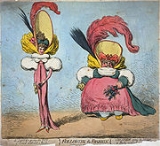
Fashion
The term fashion usually applies to a prevailing mode of expression, but quite often applies to a personal mode of expression that may or may not adhere to prevailing ideals. Inherent in the term is the idea that the mode will change more quickly than the
culture as a whole. The terms "fashionable" and "unfashionable" are employed to describe whether someone or something fits in with the current popular mode of expression.
The term "fashion" is often used in a negative sense, as a synonym for
fads and trends. In this sense, fashions are essentially a relief from bourgeoisie and petit bourgeoisie boredom, or a distraction from important matters, for the idle rich.
Encyclopedia
The term
fashion usually applies to a prevailing mode of expression, but quite often applies to a personal mode of expression that may or may not adhere to prevailing ideals. Inherent in the term is the idea that the mode will change more quickly than the
culture as a whole. The terms "fashionable" and "unfashionable" are employed to describe whether someone or something fits in with the current popular mode of expression.
The term "fashion" is often used in a negative sense, as a synonym for
fads and trends. In this sense, fashions are essentially a relief from bourgeoisie and petit bourgeoisie boredom, or a distraction from important matters, for the idle rich. The term is also frequently used in a positive sense, as a synonym for glamour and style. In this sense, fashions are a sort of communal
art, through which a culture examines its notions of
beauty and
goodness.
Fashions are social psychology phenomena common to many fields of human activity and thinking. The rises and falls of fashions have been especially documented and examined in the following fields:
...
, interior design, and landscape design
- Arts and crafts
- Body type, clothing or costume, cosmetics
- Testing cosmetics on animals [i] ...
, grooming, and personal adornment - Cuisine
- Dance and music
- Forms of address, slang, and other forms of speech
- Economics and spending choices, as studied in behavioral finance
- Entertainment, games, hobbies, sports, and other pastimes
- Etiquette
- Politics and media, especially the topics of conversation encouraged by the media
- Philosophy
...
and spirituality
- Technology, such as the choice of programming techniques
Of these fields,
costume especially has become so linked in the public eye with the term "fashion". The more general term "costume" has been relegated by many to only mean
fancy dress or
masquerade wear, while the term "fashion" means
clothing generally, and the study of it. This linguistic switch is due to the so-called fashion plates which were produced during the
Industrial Revolution, showing novel ways to use new textiles. For a broad cross-cultural look at clothing and its place in society, refer to the entries for clothing and costume. The remainder of this article deals with clothing fashions in the industrialized world.
Fashion and variation
The
European idea of fashion as a personal statement rather than a cultural expression begins in the
16th century: ten portraits of German or Italian gentlemen may show ten entirely different hats. But the local culture still set the bounds, as
Albrecht Dürer recorded in his actual or composite contrast of Nuremberg and Venetian fashions at the close of the
15th century . Fashions among upper-class Europeans began to move in synchronicity in the
18th century; though colors and patterns of textiles changed from year to year, , the cut of a gentleman's coat and the length of his waistcoat, or the pattern to which a lady's dress was cut changed more slowly. Men's fashions derived from military models, and changes in a European male silhouette are galvanized in theatres of European war, where gentleman officers had opportunities to make notes of foreign styles: an example is the "Steinkirk" cravat .
The pace of change picked up in the 1780s with the publication of French engravings that showed the latest Paris styles. By 1800, all Western Europeans were dressing alike: local variation became first a sign of provincial culture, and then a badge of the conservative
peasant .
Fashion in clothes has allowed wearers to express
emotion or solidarity with other people for millennia. Modern
Westerners have a wide choice available in the selection of their clothes among females, and to a significantly lesser extent among males. What a person chooses to wear can reflect that person's personality or likes. When people who have cultural status start to wear new or different clothes a fashion trend may start. People who like or respect them may start to wear clothes of a similar style.
Fashions may vary significantly within a
society according to
age,
social class, generation, occupation and
geography as well as over time. If, for example, an older person dresses according to the fashion of young people, he or she may look ridiculous in the eyes of both young and older people. The term "fashion victim" refers to someone who slavishly follows the current fashions .
One can regard the system of sporting various fashions as a fashion
language incorporating various
fashion statements using a grammar of fashion.
- Thornton, Peter. Baroque and Rococo Silks.
This is an example list of some of the fads and trends of the 21st century:
Capri pants,
handbags,
sport suits and sports jackets,
ripped jeans,
designer jeans,
blazer jackets, and
high-heeled shoes.
Fashion and the process of change
Fashion, by definition, changes constantly. The changes may proceed more rapidly than in most other fields of human activity . For some, modern fast-paced changes in fashion embody many of the negative aspects of
capitalism: it results in waste and encourages people
qua consumers to buy things unnecessarily. Others, especially young people, enjoy the diversity that changing fashion can apparently provide, seeing the constant change as a way to satisfy their desire to experience "new" and "interesting" things. Note too that fashion can change to enforce uniformity, as in the case where so-called
Mao suits became the national uniform of
mainland China.
Materially affluent societies can offer a variety of different fashions, in clothes or accessories, to choose from. At the same time there remains an equal or larger range designated 'out of fashion'.
Practically every aspect of appearance that can be changed has been changed at some time, including heels for men, skirt lengths ranging from ankle to mini, etc. In the past, new discoveries and lesser-known parts of the world could provide an impetus to change fashions based on the exotic: Europe in the eighteenth or nineteenth centuries, for example, might favor things Turkish at one time, things Chinese at another, and things Japanese at a third. A modern version of exotic clothing includes club wear. Globalization has reduced the options of exotic novelty in more recent times, and has seen the introduction of non-Western wear into the Western world such as
kaftans for women , and various skirted wear such as
kilts and
sarongs for men - common articles of men's clothing found elsewhere, but novel throughout most of Western culture.
Fashion houses and their associated
fashion designers, as well as high-status consumers , appear to have some role in determining the rates and directions of fashion change.
Fashion journalism
An important part of fashion is fashion journalism. Journalistic critique and commentary can be found in magazines, on TV, fashion websites and now more recently in "Fashion Blogs".
Fashion on television
High fashion did not become popular among the general population until it started getting featured on television; few designers were household names, models weren’t famous and fashion shows were not the celebrity driven extravaganzas of today. It began in the 1950s with small fashion how-tos during commercial breaks. In the 1960s and 1970s, fashion segments on various entertainment shows became more frequent, and by the 1980's, dedicated fashion shows like FashionTelevision started to appear.
History of fashion on the Internet
Fashion made its debut on the
world wide web in January 1995 with the launch of Fashion Net by Stig Harder in Paris, France. New York-based Fashionmall and French ELLE followed in the summer of 1995. , the first online fashion magazine, featuring photographers including Nick Knight and Jean-Baptiste Mondino, was unveiled in October 1995. Fashion Live produced internet's first live fashion webcast of
Yves Saint Laurent's runway show in 1996.
CNN Style and Hint Magazine arrived in 1998. The following year saw the rise and fall of
Boo.com as the company burned through $135 million in 18 months. Style.com, the online umbrella for Vogue and W, started in 2000, followed by Jason Campbell's JC | Report in 2002.
Quotes
- "Fashion is in the sky, in the street, fashion has to do with ideas, the way we live, what is happening." - Coco Chanel
- "Fashion is a form of ugliness so intolerable that we have to alter it every six months." - Oscar Wilde
- "The only thing that separates us from the animals is our ability to accessorize."- Olympia Dukakis
See also
- List of fashion designers
- List of grands couturiers
- Alternative fashion
- Fashion design
- Fashion Week
- Haute couture
- Resort wear
External links
- Fashion Net - the web's oldest fashion site
- Women's Wear Daily - the daily trade newspaper for the fashion industry
- The British Library - finding information on the fashion industry
- Fashion Television - the show and the channel
- Fashion Wire Daily - daily online fashion magazine