
|
|
|
|
Nature versus nurture
|
| |
|
| |
The nature versus nurture debates concern the relative importance of an individual's innate qualities ("nature", i.e. nativism, or innatism) versus personal experiences ("nurture", i.e. empiricism or behaviorism) in determining or causing individual differences in physical and behavioral traits.
The view that humans acquire all or almost all their behavioral traits from "nurture" is known as tabula rasa ("blank slate"). This question was once considered to be an appropriate division of developmental influences, but since both types of factors are known to play such interacting roles in development, many modern psychologists consider the question naive - representing an outdated state of knowledge.

Discussion
Ask a question about 'Nature versus nurture'
Start a new discussion about 'Nature versus nurture'
Answer questions from other users
|
Recent Posts

Encyclopedia
The nature versus nurture debates concern the relative importance of an individual's innate qualities ("nature", i.e. nativism, or innatism) versus personal experiences ("nurture", i.e. empiricism or behaviorism) in determining or causing individual differences in physical and behavioral traits.
The view that humans acquire all or almost all their behavioral traits from "nurture" is known as tabula rasa ("blank slate"). This question was once considered to be an appropriate division of developmental influences, but since both types of factors are known to play such interacting roles in development, many modern psychologists consider the question naive - representing an outdated state of knowledge. Psychologist Donald Hebb is said to have once answered a journalist's question of "which, nature or nurture, contributes more to personality?" by asking in response, "which contributes more to the area of a rectangle, its length or its width?"
For a discussion of nature versus nurture in language and other human universals, see also psychological nativism.
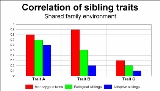
Scientific approach In order to disentangle the effects of genes and environment, behavioral geneticists perform adoption and twin studies. Behavioral geneticists do not generally use the term "nurture" in order to explain that portion of the variance for a given trait (such as IQ or the Big Five personality traits) that can be attributed to environmental effects. Instead, two different types of environmental effects are distinguished: shared family factors (i.e., those shared by siblings, making them more similar) and nonshared factors (i.e., those that uniquely affect individuals, making siblings different). In order to express the portion of the variance that is due to the "nature" component, behavioral geneticists generally refer to the heritability of a trait.
With regard to the Big Five personality traits as well as adult IQ in the general U.S. population, the portion of the overall variance that can be attributed to shared family effects is often negligible. On the other hand, most traits are thought to be at least partially heritable. In this context, the "nature" component of the variance is generally thought to be more important than that ascribed to the influence of family upbringing.
In her Pulitzer Prize-nominated book The Nurture Assumption, author Judith Harris argues that "nurture," as traditionally defined in terms of family upbringing does not effectively explain the variance for most traits (such as adult IQ and the Big Five personality traits) in the general population of the United States. On the contrary, Harris suggests that either peer groups or random environmental factors (i.e., those that are independent of family upbringing) are more important than family environmental effects.
Although "nurture" has historically been referred to as the care given to children by the parents, with the mother playing a role of particular importance, this term is now regarded by some as any environmental (not genetic) factor in the contemporary nature versus nurture debate. Thus the definition of "nurture" has been expanded in order to include the influences on development arising from prenatal, parental, extended family and peer experiences, extending to influences such as media, marketing, and socio-economic status. Indeed, a substantial source of environmental input to human nature may arise from stochastic variations in prenatal development.
Heritability estimates
While there are many examples of single-gene-locus traits, current thinking in biology discredits the notion that genes alone can determine most complex traits. At the molecular level, DNA interacts with signals from other genes and from the environment. At the level of individuals, particular genes influence the development of a trait in the context of a particular environment. Thus, measurements of the degree to which a trait is influenced by genes versus environment will depend on the particular environment and genes examined. In many cases, it has been found that genes may have a substantial contribution, including psychological traits such as intelligence and personality. Yet these traits may be largely influenced by environment in other circumstances, such as environmental deprivation.
A researcher seeking to quantify the influence of genes or environment on a trait needs to be able to separate the effects of one factor away from that of another. This kind of research often begins with attempts to calculate the heritability of a trait. Heritability quantifies the extent to which variation among individuals in a trait is due to variation in the genes those individuals carry. In animals where breeding and environments can be controlled experimentally, heritability can be determined relatively easily. Such experiments would be unethical for human research. This problem can be overcome by finding existing populations of humans that reflect the experimental setting the researcher wishes to create.
One way to determine the contribution of genes and environment to a trait is to study twins. In one kind of study, identical twins reared apart are compared to randomly selected pairs of people. The twins share identical genes, but different family environments. In another kind of twin study, identical twins reared together (who share family environment and genes) are compared to fraternal twins reared together (who also share family environment but only share half their genes). Another condition that permits the disassociation of genes and environment is adoption. In one kind of adoption study, biological siblings reared together (who share the same family environment and half their genes) are compared to adoptive siblings (who share their family environment but none of their genes).
Some have rightly pointed out that environmental inputs affect the expression of genes. This is one explanation of how environment can influence the extent to which a genetic disposition will actually manifest. The interactions of genes with environment, called gene-environment interaction, are another component of the nature-nurture debate. A classic example of gene-environment interaction is the ability of a diet low in the amino acid phenylalanine to partially suppress the genetic disease phenylketonuria. Yet another complication to the nature-nurture debate is the existence of gene-environment correlations. These correlations indicate that individuals with certain genotypes are more likely to find themselves in certain environments. Thus, it appears that genes can shape (the selection or creation of) environments. Even using experiments like those described above, it can be very difficult to determine convincingly the relative contribution of genes and environment.
Interaction of genes and environment
In only a very few cases is it fair to say that a trait is due almost entirely to nature, or almost entirely to nurture. In the case of most diseases now strictly identified as genetic, such as Huntington's disease, there is a better than 99.9% correlation between having the identified gene and the disease and a similar correlation for not having either. On the other hand, Huntington's animal models live much longer or shorter lives depending on how they are cared for (animal husbandry). At the other extreme, traits such as native language are environmentally determined: linguists have found that any child (if capable of learning a language at all) can learn any human language with equal facility. With virtually all biological and psychological traits, however, genes and environment work in concert, communicating back and forth to create the individual.
Examples of environmental, interactional, and genetic traits are:
| Predominantly Environmental | Interactional | Predominantly Genetic |
|---|
| Specific language | Height | Blood type | | Specific religion | Weight | Eye color | | Skin color | | |
|
Steven Pinker (2004) likewise described several examples:
- concrete behavioral traits that patently depend on content provided by the home or culture —which language one speaks, which religion one practices, which political party one supports— are not heritable at all. But traits that reflect the underlying talents and temperaments —how proficient with language a person is, how religious, how liberal or conservative— are partially heritable.
When traits are determined by a complex interaction of genotype and environment it is possible to measure the heritability of a trait within a population. However, many non-scientists who encounter a report of a trait having a certain percentage heritability imagine non-interactional, additive contributions of genes and environment to the trait. As an analogy, some laypeople may think of the degree of a trait being made up of two "buckets", genes and environment, each able to hold a certain capacity of the trait. But even for intermediate heritabilities, a trait is always shaped by both genetic dispositions and the environments in which people develop, merely with greater and lesser plasticities associated with these heritability measures.
Heritability measures always refer to the degree of variation between individuals in a population. These statistics cannot be applied at the level of the individual. It is incorrect to say that since the heritability index of personality is about .6, you got 60% of your personality from your parents and 40% from the environment. To help to understand this, imagine that all humans were genetic clones. The heritability index for all traits would be zero (all variability between clonal individuals must be due to environmental factors). And, contrary to erroneous interpretations of the heritibility index, as societies become more egalitarian (everyone has more similar experiences) the heritability index goes up (as environments become more similar, variability between individuals is due more to genetic factors).
A highly genetically loaded trait (such as eye color) still assumes environmental input within normal limits (a certain range of temperature, oxygen in the atmosphere, etc.). A more useful distinction than "nature vs. nurture" is "obligate vs. facultative" —under typical environmental ranges, what traits are more "obligate" (e.g., the nose —everyone has a nose) or more "facultative" (sensitive to environmental variations, such as specific language learned during infancy). Another useful distinction is between traits that are likely to be adaptations (such as the nose) and those that are byproducts of adaptations (such the white color of bones), or are due to random variation (non-adaptive variation in, say, nose shape or size).
IQ debate Evidence suggests that family environmental factors may have an effect upon childhood IQ, accounting for up to a quarter of the variance. On the other hand, by late adolescence this correlation disappears, such that adoptive siblings are no more similar in IQ than strangers. Moreover, adoption studies indicate that, by adulthood, adoptive siblings are no more similar in IQ than strangers (IQ correlation near zero), while full siblings show an IQ correlation of 0.6. Twin studies reinforce this pattern: monozygotic (identical) twins raised separately are highly similar in IQ (0.86), more so than dizygotic (fraternal) twins raised together (0.6) and much more than adoptive siblings (~0.0).
Personality traits
|
| |
|
|