
Home      Discussion      Topics      Dictionary      Almanac
Signup       Login
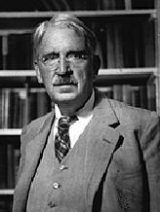
John Dewey

John Dewey

Overview
John Dewey was an American philosopher, psychologist
Psychologist
Psychologist is a professional or academic title used by individuals who are either:* Clinical professionals who work with patients in a variety of therapeutic contexts .* Scientists conducting psychological research or teaching psychology in a college...

 and educational reformer whose ideas have been influential in education and social reform. Dewey was an important early developer of the philosophy of pragmatism
Pragmatism
Pragmatism is a philosophical tradition centered on the linking of practice and theory. It describes a process where theory is extracted from practice, and applied back to practice to form what is called intelligent practice...

 and one of the founders of functional psychology
Functional psychology
Functional psychology or functionalism refers to a general psychological philosophy that considers mental life and behavior in terms of active adaptation to the person's environment. As such, it provides the general basis for developing psychological theories not readily testable by controlled...

. He was a major representative of the progressive and progressive populist
Populism
Populism can be defined as an ideology, political philosophy, or type of discourse. Generally, a common theme compares "the people" against "the elite", and urges social and political system changes. It can also be defined as a rhetorical style employed by members of various political or social...

 philosophies of schooling during the first half of the 20th century in the USA.
Discussion
Ask a question about 'John Dewey'
Start a new discussion about 'John Dewey'
Answer questions from other users
Full Discussion Forum
 
Unanswered Questions
Quotations

Every great advance in science has issued from a new audacity of imagination.

The Quest for Certainty (1929), Ch. XI

A possibility of continuing progress is opened up by the fact that in learning one act, methods are developed good for use in other situations. Still more important is the fact that the human being acquires a habit of learning. He learns to learn.

The Conditions of Growth

We have now to make explicit the differences in the spirit, material, and method of education as it operates in different types of community life.To say that education is a social function, securing direction and development in the immature through their participation in the life of the group to which they belong, is to say in effect that education will vary with the quality of life which prevails in a group.

Society is one word, but many things. Men associate together in all kinds of ways and for all kinds of purposes. One man is concerned in a multitude of diverse groups, in which his associates may be quite different. It often seems as if they had nothing in common except that they are modes of associated life.

A society which is mobile, which is full of channels for the distribution of a change occurring anywhere, must see to it that its members are educated to personal initiative and adaptability. Otherwise, they will be overwhelmed by the changes in which they are caught and whose significance or connections they do not perceive.

Encyclopedia
John Dewey was an American philosopher, psychologist
Psychologist
Psychologist is a professional or academic title used by individuals who are either:* Clinical professionals who work with patients in a variety of therapeutic contexts .* Scientists conducting psychological research or teaching psychology in a college...

 and educational reformer whose ideas have been influential in education and social reform. Dewey was an important early developer of the philosophy of pragmatism
Pragmatism
Pragmatism is a philosophical tradition centered on the linking of practice and theory. It describes a process where theory is extracted from practice, and applied back to practice to form what is called intelligent practice...

 and one of the founders of functional psychology
Functional psychology
Functional psychology or functionalism refers to a general psychological philosophy that considers mental life and behavior in terms of active adaptation to the person's environment. As such, it provides the general basis for developing psychological theories not readily testable by controlled...

. He was a major representative of the progressive and progressive populist
Populism
Populism can be defined as an ideology, political philosophy, or type of discourse. Generally, a common theme compares "the people" against "the elite", and urges social and political system changes. It can also be defined as a rhetorical style employed by members of various political or social...

 philosophies of schooling during the first half of the 20th century in the USA.

Although Dewey is known best for his publications concerning education, he also wrote about many other topics, including experience, nature
Nature
Nature, in the broadest sense, is equivalent to the natural world, physical world, or material world. "Nature" refers to the phenomena of the physical world, and also to life in general...

, art
Art
Art is the product or process of deliberately arranging items in a way that influences and affects one or more of the senses, emotions, and intellect....

, logic
Logic
In philosophy, Logic is the formal systematic study of the principles of valid inference and correct reasoning. Logic is used in most intellectual activities, but is studied primarily in the disciplines of philosophy, mathematics, semantics, and computer science...

, inquiry, democracy
Democracy
Democracy is generally defined as a form of government in which all adult citizens have an equal say in the decisions that affect their lives. Ideally, this includes equal participation in the proposal, development and passage of legislation into law...

, and ethics
Ethics
Ethics, also known as moral philosophy, is a branch of philosophy that addresses questions about morality—that is, concepts such as good and evil, right and wrong, virtue and vice, justice and crime, etc.Major branches of ethics include:...

.

In his advocacy of democracy, Dewey considered two fundamental elements—schools and civil society
Civil society
Civil society is composed of the totality of many voluntary social relationships, civic and social organizations, and institutions that form the basis of a functioning society, as distinct from the force-backed structures of a state , the commercial institutions of the market, and private criminal...

—as being major topics needing attention and reconstruction to encourage experimental intelligence and plurality. Dewey asserted that complete democracy was to be obtained not just by extending voting rights but also by ensuring that there exists a fully formed public opinion
Public opinion
Public opinion is the aggregate of individual attitudes or beliefs held by the adult population. Public opinion can also be defined as the complex collection of opinions of many different people and the sum of all their views....

, accomplished by effective communication among citizens, experts, and politicians, with the latter being accountable for the policies they adopt.

Life and works


Dewey was born in Burlington
Burlington, Vermont
Burlington is the largest city in the U.S. state of Vermont and the shire town of Chittenden County. Burlington lies south of the U.S.-Canadian border and some south of Montreal....

, Vermont
Vermont
Vermont is a state in the New England region of the northeastern United States of America. The state ranks 43rd in land area, , and 45th in total area. Its population according to the 2010 census, 630,337, is the second smallest in the country, larger only than Wyoming. It is the only New England...

, to a family of modest means. Like his older brother, Davis Rich Dewey
Davis Rich Dewey
Davis Rich Dewey, Ph. D. was an American economist and statistician.He was born at Burlington, Vermont, on 7 April 1858. Like his younger brother, John Dewey, he was educated at the University of Vermont and Johns Hopkins University. He later became professor of economics and statistics at the...

, he attended the University of Vermont
University of Vermont
The University of Vermont comprises seven undergraduate schools, an honors college, a graduate college, and a college of medicine. The Honors College does not offer its own degrees; students in the Honors College concurrently enroll in one of the university's seven undergraduate colleges or...

, from which he graduated (Phi Beta Kappa) in 1879. A significant professor of Dewey's at the University of Vermont was Henry A. P. Torrey, the son-in-law and nephew of former University of Vermont president Joseph Torrey
Joseph Torrey
Joseph Torrey was an American professor of philosophy at the University of Vermont and acting president of that university for five years....

. Dewey studied privately with Torrey between his graduation from Vermont and his enrollment at Johns Hopkins University
Johns Hopkins University
The Johns Hopkins University, commonly referred to as Johns Hopkins, JHU, or simply Hopkins, is a private research university based in Baltimore, Maryland, United States...

.

After two years as a high-school teacher in Oil City, Pennsylvania
Oil City, Pennsylvania
Oil City is a city in Venango County, Pennsylvania that is known in the initial exploration and development of the petroleum industry. After the first oil wells were drilled nearby in the 1850s, Oil City became central in the petroleum industry while hosting headquarters for the Pennzoil, Quaker...

 and one teaching elementary school in a small town in Vermont, Dewey decided that he was unsuited for employment in primary or secondary education. After studying with George Sylvester Morris
George Sylvester Morris
George Sylvester Morris was an American educator and philosophical writer, born in Norwich, Vermont. He was the son of a well known abolitionist and temperance man...

, Charles Sanders Peirce, Herbert Baxter Adams
Herbert Baxter Adams
Herbert Baxter Adams was an American educator and historian.Adams was born to Nathaniel Dickinson Adams and Harriet Adams in Shutesbury, Massachusetts. On his mother's side, he was a descendant of Thomas Hastings who came from the East Anglia region of England to the Massachusetts Bay Colony in...

, and G. Stanley Hall
G. Stanley Hall
Granville Stanley Hall was a pioneering American psychologist and educator. His interests focused on childhood development and evolutionary theory...

, Dewey received his Ph.D.
Doctor of Philosophy
Doctor of Philosophy, abbreviated as Ph.D., PhD, D.Phil., or DPhil , in English-speaking countries, is a postgraduate academic degree awarded by universities...

 from the School of Arts & Sciences at Johns Hopkins University
Johns Hopkins University
The Johns Hopkins University, commonly referred to as Johns Hopkins, JHU, or simply Hopkins, is a private research university based in Baltimore, Maryland, United States...

. In 1884, he accepted a faculty position at the University of Michigan
University of Michigan
The University of Michigan is a public research university located in Ann Arbor, Michigan in the United States. It is the state's oldest university and the flagship campus of the University of Michigan...

 (1884–88 and 1889–94) with the help of George Sylvester Morris
George Sylvester Morris
George Sylvester Morris was an American educator and philosophical writer, born in Norwich, Vermont. He was the son of a well known abolitionist and temperance man...

. His unpublished and now lost dissertation was titled "The Psychology of Kant
Immanuel Kant
Immanuel Kant was a German philosopher from Königsberg , researching, lecturing and writing on philosophy and anthropology at the end of the 18th Century Enlightenment....

."

In 1894 Dewey joined the newly founded University of Chicago
University of Chicago
The University of Chicago is a private research university in Chicago, Illinois, USA. It was founded by the American Baptist Education Society with a donation from oil magnate and philanthropist John D. Rockefeller and incorporated in 1890...

 (1894–1904) where he developed his belief in an empirically based theory of knowledge, becoming associated with the newly emerging Pragmatic philosophy. His time at the University of Chicago resulted in four essays collectively entitled Thought and its Subject-Matter, which was published with collected works from his colleagues at Chicago under the collective title Studies in Logical Theory (1903). During that time Dewey also initiated the University of Chicago Laboratory Schools
University of Chicago Laboratory Schools
The University of Chicago Laboratory Schools is a private, co-educational day school in Chicago, Illinois. It is affiliated with the University of Chicago...

, where he was able to actualize the pedagogical beliefs that provided material for his first major work on education, The School and Social Progress (1899). Disagreements with the administration ultimately caused his resignation from the University, and soon thereafter he relocated near the East Coast. In 1899, Dewey was elected president of the American Psychological Association
American Psychological Association
The American Psychological Association is the largest scientific and professional organization of psychologists in the United States. It is the world's largest association of psychologists with around 154,000 members including scientists, educators, clinicians, consultants and students. The APA...

. From 1904 until his retirement in 1930 he was professor of philosophy at both Columbia University
Columbia University
Columbia University in the City of New York is a private, Ivy League university in Manhattan, New York City. Columbia is the oldest institution of higher learning in the state of New York, the fifth oldest in the United States, and one of the country's nine Colonial Colleges founded before the...

 and Columbia University's Teachers College
Teachers College, Columbia University
Teachers College, Columbia University is a graduate school of education located in New York City, New York...

. In 1905 he became president of the American Philosophical Association
American Philosophical Association
The American Philosophical Association is the main professional organization for philosophers in the United States. Founded in 1900, its mission is to promote the exchange of ideas among philosophers, to encourage creative and scholarly activity in philosophy, to facilitate the professional work...

. He was a longtime member of the American Federation of Teachers
American Federation of Teachers
The American Federation of Teachers is an American labor union founded in 1916 that represents teachers, paraprofessionals and school-related personnel; local, state and federal employees; higher education faculty and staff, and nurses and other healthcare professionals...

.

Along with the historian Charles A. Beard
Charles A. Beard
Charles Austin Beard was, with Frederick Jackson Turner, one of the most influential American historians of the first half of the 20th century. He published hundreds of monographs, textbooks and interpretive studies in both history and political science...

, economists Thorstein Veblen
Thorstein Veblen
Thorstein Bunde Veblen, born Torsten Bunde Veblen was an American economist and sociologist, and a leader of the so-called institutional economics movement...

 and James Harvey Robinson
James Harvey Robinson
James Harvey Robinson was an American historian.Robinson was born Bloomington, Illinois. He taught history at the University of Pennsylvania and Columbia University , becoming a full professor in 1895...

, Dewey is one of the founders of The New School
The New School
The New School is a university in New York City, located mostly in Greenwich Village. From its founding in 1919 by progressive New York academics, and for most of its history, the university was known as the New School for Social Research. Between 1997 and 2005 it was known as New School University...

. Dewey's most significant writings were "The Reflex Arc Concept in Psychology" (1896), a critique of a standard psychological concept and the basis of all his further work; Democracy and Education
Democracy and Education
Democracy and Education: An Introduction to the Philosophy of Education is a book written in 1916 by John Dewey. .Dewey's philosophical anthropology, unlike Egan, Vico, Ernst Cassirer, Claude Lévi-Strauss, and Nietzsche, does not account for the origin of thought of the modern mind in the...

 (1916), his celebrated work on progressive education; Human Nature and Conduct (1922), a study of the function of habit in human behavior; The Public and its Problems
The Public and its Problems
The Public and its Problems is a book by John Dewey, an American philosopher, written in 1927. In this work, Dewey touches upon major political philosophy questions that have continued into the 21st century, specifically: can democracy work in the modern era? Is there such a thing as a "public"...

 (1927), a defense of democracy written in response to Walter Lippmann
Walter Lippmann
Walter Lippmann was an American intellectual, writer, reporter, and political commentator famous for being among the first to introduce the concept of Cold War...

's The Phantom Public
The Phantom Public
The Phantom Public is a book published in 1925 by journalist Walter Lippmann, in which he expresses his lack of faith in the democratic system, arguing that the public exists merely as an illusion, myth, and inevitably a phantom...

 (1925); Experience and Nature (1925), Dewey's most "metaphysical" statement; Art as Experience
Art as Experience
Art as Experience is John Dewey's major writing on aesthetics, originally delivered as the first William James Lecturer at Harvard . Dewey's aesthetics have been found useful in a number of disciplines, including the new media....

 (1934), Dewey's major work on aesthetics; A Common Faith (1934), a humanistic study of religion originally delivered as the Dwight H. Terry Lectureship
Dwight H. Terry Lectureship
The Dwight H. Terry Lectureship, also known as the Terry Lectures, was established at Yale University in 1905 by a gift from Dwight H. Terry of Bridgeport, Connecticut. Its purpose is to engage both scholars and the public in a consideration of religion from a humanitarian point of view, in the...

 at Yale; Logic: The Theory of Inquiry (1938), a statement of Dewey's unusual conception of logic; Freedom and Culture
Freedom and Culture
Freedom and Culture is a book by John Dewey. Published in 1939, the book is an analytical defense of democracy written in a time when democratic regimes had recently been replaced by non-democratic ones, and at a time when Marxism was considered a powerful political force.-The problem of...

 (1939), a political work examining the roots of fascism; and Knowing and the Known
Knowing and the Known
Knowing and the Known is a 1949 book by John Dewey and Arthur Bentley.- Overview :As well as a Preface, an Introduction and an Index, the book consists of 12 chapters, or papers, as the authors call them in their introduction...

 (1949), a book written in conjunction with Arthur F. Bentley
Arthur F. Bentley
Arthur Fisher Bentley was an American political scientist and philosopher who worked in the fields of epistemology, logic and linguistics and who contributed to the development of a behavioral methodology of political science.-Biography:He received his Bachelor of Arts in 1892 and his Ph.D...

 that systematically outlines the concept of trans-action, which is central to his other works. While each of these works focuses on one particular philosophical theme, Dewey included his major themes in most of what he published. He published more than 700 articles in 140 journals, and approximately 40 books.

Reflecting his immense influence on 20th-century thought, Hilda Neatby
Hilda Neatby
Hilda Marion Ada Neatby, was a Canadian historian and educator.Born in Surrey, England, the daughter of Andrew Mossforth Neatby and Ada Deborah Fisher, she received a B.A. and M.A. from the University of Saskatchewan and a Ph.D. from the University of Minnesota...

, in 1953, wrote "Dewey has been to our age what Aristotle
Aristotle
Aristotle was a Greek philosopher and polymath, a student of Plato and teacher of Alexander the Great. His writings cover many subjects, including physics, metaphysics, poetry, theater, music, logic, rhetoric, linguistics, politics, government, ethics, biology, and zoology...

 was to the later middle ages
Late Middle Ages
The Late Middle Ages was the period of European history generally comprising the 14th to the 16th century . The Late Middle Ages followed the High Middle Ages and preceded the onset of the early modern era ....

, not a philosopher, but the philosopher."

Dewey was first married to Alice Chipman. They had six children. His second wife was Roberta Lowitz Grant.

The United States Postal Service
United States Postal Service
The United States Postal Service is an independent agency of the United States government responsible for providing postal service in the United States...

 honored Dewey with a Prominent Americans series
Prominent Americans series
The Prominent Americans series is a set of definitive stamps issued by the United States Post Office Department between 1965 and 1978....

 30¢ postage stamp
Postage stamp
A postage stamp is a small piece of paper that is purchased and displayed on an item of mail as evidence of payment of postage. Typically, stamps are made from special paper, with a national designation and denomination on the face, and a gum adhesive on the reverse side...

.

Functional psychology


At University of Michigan, Dewey published his first two books, Psychology (1887), and Leibniz's New Essays Concerning the Human Understanding (1888), both of which expressed Dewey's early commitment to British neo-Hegelianism
Georg Wilhelm Friedrich Hegel
Georg Wilhelm Friedrich Hegel was a German philosopher, one of the creators of German Idealism. His historicist and idealist account of reality as a whole revolutionized European philosophy and was an important precursor to Continental philosophy and Marxism.Hegel developed a comprehensive...

. In Psychology, Dewey attempted a synthesis between idealism and experimental science.

While still professor of philosophy at Michigan, Dewey and his junior colleagues, James Hayden Tufts
James Hayden Tufts
James Hayden Tufts , an influential American philosopher, was a professor of the then newly founded Chicago University. Tufts was also a member of the Board of Arbitration, and the chairman of a committee of the social agencies of Chicago. The work Ethics in 1908 was a collaboration of Tufts and...

 and George Herbert Mead
George Herbert Mead
George Herbert Mead was an American philosopher, sociologist and psychologist, primarily affiliated with the University of Chicago, where he was one of several distinguished pragmatists. He is regarded as one of the founders of social psychology and the American sociological tradition in general.-...

, together with his student James Rowland Angell
James Rowland Angell
James Rowland Angell was an American psychologist and educator. He served as the president of Yale University between 1921 and 1937...

, all influenced strongly by the recent publication of William James
William James
William James was a pioneering American psychologist and philosopher who was trained as a physician. He wrote influential books on the young science of psychology, educational psychology, psychology of religious experience and mysticism, and on the philosophy of pragmatism...

' Principles of Psychology
Principles of Psychology
The Principles of Psychology is a monumental text in the history of psychology, written by William James and published in 1890.There were four methods in James' psychology: analysis , introspection , experiment The Principles of Psychology is a monumental text in the history of psychology, written...

 (1890), began to reformulate psychology, emphasizing the social environment on the activity of mind and behaviour rather than the physiological psychology of Wundt and his followers.

By 1894, Dewey had joined Tufts, with whom he would later write Ethics (1908), at the recently founded University of Chicago
University of Chicago
The University of Chicago is a private research university in Chicago, Illinois, USA. It was founded by the American Baptist Education Society with a donation from oil magnate and philanthropist John D. Rockefeller and incorporated in 1890...

 and invited Mead and Angell to follow him, the four men forming the basis of the so-called "Chicago group" of psychology.

Their new style of psychology, later dubbed functional psychology
Functional psychology
Functional psychology or functionalism refers to a general psychological philosophy that considers mental life and behavior in terms of active adaptation to the person's environment. As such, it provides the general basis for developing psychological theories not readily testable by controlled...

, had a practical emphasis on action and application. In Dewey's article "The Reflex Arc Concept in Psychology" which appeared in Psychological Review
Psychological Review
Psychological Review is a scientific journal that publishes articles on psychological theory. It was founded by Princeton psychologist James Mark Baldwin and Columbia psychologist James McKeen Cattell in 1894 as a publication vehicle for psychologists not connected with the Clark laboratory of G....

 in 1896, he reasons against the traditional stimulus-response understanding of the reflex arc
Reflex arc
A reflex arc is a neural pathway that controls an action reflex. In higher animals, most sensory neurons do not pass directly into the brain, but synapse in the spinal cord...

 in favor of a "circular" account in which what serves as "stimulus" and what as "response" depends on how one considers the situation, and defends the unitary nature of the sensory motor circuit. While he does not deny the existence of stimulus, sensation, and response, he disagreed that they were separate, juxtaposed events happening like links in a chain. He developed the idea that there is a coordination by which the stimulation is enriched by the results of previous experiences. The response is modulated by sensorial experience.

Dewey was elected president of the American Psychological Association in 1899.

In 1984, the American Psychological Association announced that Lillian Moller Gilbreth
Lillian Moller Gilbreth
Lillian Moller Gilbreth was an American psychologist and industrial engineer. One of the first working female engineers holding a Ph.D., she is arguably the first true industrial/organizational psychologist. She and her husband Frank Bunker Gilbreth, Sr...

 (1878–1972) had become the first psychologist to be commemorated on a United States postage stamp. However, psychologists Gary Brucato Jr. and John D. Hogan
John D. Hogan
John D. Hogan, born in 1939, is an American Psychologist and noted author on the history of Psychology. He is presently a Professor of Psychology at St. John's University in Jamaica, Queens, New York, where he taught since 1965...

 later made the case that this distinction actually belonged to John Dewey, who had been celebrated on an American stamp 17 years earlier. While some psychology historians consider Dewey more of a philosopher than a bona fide psychologist, the authors noted that Dewey was a founding member of the A.P.A., served as the A.P.A.'s eighth President in 1899, and was the author of an 1896 article on the reflex arc
Reflex arc
A reflex arc is a neural pathway that controls an action reflex. In higher animals, most sensory neurons do not pass directly into the brain, but synapse in the spinal cord...

 which is now considered a basis of American functional psychology.

Dewey also expressed interest in work in the psychology of visual perception
Visual perception
Visual perception is the ability to interpret information and surroundings from the effects of visible light reaching the eye. The resulting perception is also known as eyesight, sight, or vision...

 performed by Dartmouth research professor Adelbert Ames, Jr.
Adelbert Ames, Jr.
Adelbert Ames, Jr. was an American scientist who made contributions to physics, physiology, ophthalmology, psychology, and philosophy. He pioneered the study of physiological optics at Dartmouth College, serving as a research professor, then as director of research at the Dartmouth Eye Institute...

 He had great trouble with listening, however, because it is known Dewey could not distinguish musical pitches - in other words was tone deaf
Tone deafness
Tone deafness is the lack of relative pitch, or the inability to distinguish between musical notes that is not due to the lack of musical training or education...

.

Pragmatism and instrumentalism


Although Dewey referred to his philosophy as "instrumentalism
Instrumentalism
In the philosophy of science, instrumentalism is the view that a scientific theory is a useful instrument in understanding the world. A concept or theory should be evaluated by how effectively it explains and predicts phenomena, as opposed to how accurately it describes objective...

" rather than pragmatism
Pragmatism
Pragmatism is a philosophical tradition centered on the linking of practice and theory. It describes a process where theory is extracted from practice, and applied back to practice to form what is called intelligent practice...

, he was one of the three major figures in American pragmatism, along with Charles Sanders Peirce, who invented the term, and William James
William James
William James was a pioneering American psychologist and philosopher who was trained as a physician. He wrote influential books on the young science of psychology, educational psychology, psychology of religious experience and mysticism, and on the philosophy of pragmatism...

, who popularized it. Dewey worked from strongly Hegelian influences, unlike James, whose intellectual lineage was primarily British, drawing particularly on empiricist
Empiricism
Empiricism is a theory of knowledge that asserts that knowledge comes only or primarily via sensory experience. One of several views of epistemology, the study of human knowledge, along with rationalism, idealism and historicism, empiricism emphasizes the role of experience and evidence,...

 and utilitarian
Utilitarianism
Utilitarianism is an ethical theory holding that the proper course of action is the one that maximizes the overall "happiness", by whatever means necessary. It is thus a form of consequentialism, meaning that the moral worth of an action is determined only by its resulting outcome, and that one can...

 ideas. Neither was Dewey so pluralist or relativist
Relativism
Relativism is the concept that points of view have no absolute truth or validity, having only relative, subjective value according to differences in perception and consideration....

 as James. He stated that value
Value (personal and cultural)
A personal or cultural value is an absolute or relative ethical value, the assumption of which can be the basis for ethical action. A value system is a set of consistent values and measures. A principle value is a foundation upon which other values and measures of integrity are based...

 was a function not of whim nor purely of social construction, but a quality situated in events ("nature itself is wistful and pathetic, turbulent and passionate" (Experience and Nature).

James also stated that experiment
Experiment
An experiment is a methodical procedure carried out with the goal of verifying, falsifying, or establishing the validity of a hypothesis. Experiments vary greatly in their goal and scale, but always rely on repeatable procedure and logical analysis of the results...

ation (social, cultural, technological, philosophical) could be used as an approximate arbiter of truth
Truth
Truth has a variety of meanings, such as the state of being in accord with fact or reality. It can also mean having fidelity to an original or to a standard or ideal. In a common usage, it also means constancy or sincerity in action or character...

. For example he felt that, for many people who lacked "over-belief
Overbelief
Overbelief is philosophical term for a belief adopted that requires more evidence than one presently has. Generally, acts of overbelief are justified on emotional need or faith, rather than evidence. It contrasts with the less-often debated concept, underbelief. Someone who fails to adopt a belief...

" of religious
Religion
Religion is a collection of cultural systems, belief systems, and worldviews that establishes symbols that relate humanity to spirituality and, sometimes, to moral values. Many religions have narratives, symbols, traditions and sacred histories that are intended to give meaning to life or to...

 concepts, human life was superficial and rather uninteresting, and that while no one religious belief could be demonstrated as the correct one, we are all responsible for making a gamble on one or another theism
Theism
Theism, in the broadest sense, is the belief that at least one deity exists.In a more specific sense, theism refers to a doctrine concerning the nature of a monotheistic God and God's relationship to the universe....

, atheism
Atheism
Atheism is, in a broad sense, the rejection of belief in the existence of deities. In a narrower sense, atheism is specifically the position that there are no deities...

, monism
Monism
Monism is any philosophical view which holds that there is unity in a given field of inquiry. Accordingly, some philosophers may hold that the universe is one rather than dualistic or pluralistic...

, etc. Dewey, in contrast, while honoring the important function that religious institutions and practices played in human life, rejected belief
Belief
Belief is the psychological state in which an individual holds a proposition or premise to be true.-Belief, knowledge and epistemology:The terms belief and knowledge are used differently in philosophy....

 in any static ideal, such as a personal God
God
God is the English name given to a singular being in theistic and deistic religions who is either the sole deity in monotheism, or a single deity in polytheism....

. Dewey felt that only scientific method could reliably increase human good.

Of the idea of God, Dewey said, "it denotes the unity of all ideal ends arousing us to desire and actions."

As with the reemergence of progressive philosophy of education, Dewey's contributions to philosophy as such (he was, after all, much more a professional philosopher than an educator) have also reemerged with the reassessment of pragmatism, beginning in the late 1970s, by philosophers like Richard Rorty
Richard Rorty
Richard McKay Rorty was an American philosopher. He had a long and diverse academic career, including positions as Stuart Professor of Philosophy at Princeton, Kenan Professor of Humanities at the University of Virginia, and Professor of Comparative Literature at Stanford University...

, Richard J. Bernstein
Richard J. Bernstein
Richard J. Bernstein is an American philosopher, the Vera List Professor of Philosophy and former dean of the graduate faculty at The New School....

 and Hans Joas
Hans Joas
Hans Joas is a German sociologist and social theorist.Joas is the Director of the Max Weber Center for Advanced Cultural and Social Studies at the University of Erfurt and Professor of Sociology and a Member of the Committee on Social Thought at the University of Chicago. He currently serves as...

.

Because of his process-oriented and sociologically conscious opinion of the world and knowledge
Knowledge
Knowledge is a familiarity with someone or something unknown, which can include information, facts, descriptions, or skills acquired through experience or education. It can refer to the theoretical or practical understanding of a subject...

, his ideology is considered sometimes as a useful alternative to both modern
Modernism
Modernism, in its broadest definition, is modern thought, character, or practice. More specifically, the term describes the modernist movement, its set of cultural tendencies and array of associated cultural movements, originally arising from wide-scale and far-reaching changes to Western society...

 and postmodern ideology. Dewey's non-foundational
Foundationalism
Foundationalism is any theory in epistemology that holds that beliefs are justified based on what are called basic beliefs . This position is intended to resolve the infinite regress problem in epistemology...

 method pre-dates postmodernism by more than half a century. Recent exponents (like Rorty) have not always remained faithful to Dewey's original ideas, though this itself is completely consistent with Dewey's own usage of other writers and with his own philosophy— for Dewey, past doctrines always require reconstruction in order to remain useful for the present time.

Dewey's philosophy has had other names than "pragmatism". He has been called an instrumentalist, an experimentalist
Experimentalist
"Experimentalist" is a blanket term for all sorts of scientists engaged more in experimental activity than in the theoretical side of their sciences....

, an empiricist, a functionalist
Functional psychology
Functional psychology or functionalism refers to a general psychological philosophy that considers mental life and behavior in terms of active adaptation to the person's environment. As such, it provides the general basis for developing psychological theories not readily testable by controlled...

, and a naturalist
Naturalism (philosophy)
Naturalism commonly refers to the philosophical viewpoint that the natural universe and its natural laws and forces operate in the universe, and that nothing exists beyond the natural universe or, if it does, it does not affect the natural universe that we know...

. The term "transactional" may better describe his views, a term emphasized by Dewey in his later years to describe his theories of knowledge and experience.

Epistemology


The terminology problem in the fields of epistemology and logic is partially due, according to Dewey and Bentley, to inefficient and imprecise use of words and concepts that reflect three historic levels of organization and presentation. In the order of chronological appearance, these are:
  • Self-Action: Prescientific concepts regarded humans, animals, and things as possessing powers of their own which initiated or caused their actions.

  • Interaction: as described by Newton, where things, living and inorganic, are balanced against something in a system of interaction, for example, the third law of motion states that for every action there is an equal and opposite reaction.
  • Transaction: where modern systems of descriptions and naming are employed to deal with multiple aspects and phases of action without any attribution to ultimate, final, or independent entities, essences, or realities.


A series of characterizations of Transactions indicate the wide range of considerations involved.

Logic and method


Dewey sees paradox in contemporary logical theory. Proximate subject matter garners general agreement and advance, while the ultimate subject matter of logic generates unremitting controversy. In other words, he challenges confident logicians to answer the question of the truth of logical operators. Do they function merely as abstractions (e.g., pure mathematics) or do they connect in some essential way with their objects, and therefore alter or bring them to light?

Logical positivism
Logical positivism
Logical positivism is a philosophy that combines empiricism—the idea that observational evidence is indispensable for knowledge—with a version of rationalism incorporating mathematical and logico-linguistic constructs and deductions of epistemology.It may be considered as a type of analytic...

 also figured in Dewey's thought. About the movement he wrote that it "eschews the use of 'propositions' and 'terms', substituting 'sentences' and 'words'." ("General Theory of Propositions", in Logic: The Theory of Inquiry) He welcomes this changing of referents "in as far as it fixes attention upon the symbolic structure and content of propositions." However, he registers a small complaint against the use of "sentence" and "words" in that without careful interpretation the act or process of transposition "narrows unduly the scope of symbols and language, since it is not customary to treat gestures and diagrams (maps, blueprints, etc.) as words or sentences."
In other words, sentences and words, considered in isolation, do not disclose intent, which may be inferred or "adjudged only by means of context."

Yet Dewey was not entirely opposed to modern logical trends. Concerning traditional logic, he states:
Louis Menand
Louis Menand
Louis Menand is an American writer and academic, best known for his Pulitzer Prize-winning book The Metaphysical Club , an intellectual and cultural history of late 19th and early 20th century America....

 argues in The Metaphysical Club
The Metaphysical Club: A Story of Ideas in America
The Metaphysical Club: A Story of Ideas in America is a Pulitzer Prize-winning 2001 book by Louis Menand, an American writer and legal scholar...

 that Jane Addams
Jane Addams
Jane Addams was a pioneer settlement worker, founder of Hull House in Chicago, public philosopher, sociologist, author, and leader in woman suffrage and world peace...

 had been critical of Dewey's emphasis on antagonism in the context of a discussion of the Pullman strike
Pullman Strike
The Pullman Strike was a nationwide conflict between labor unions and railroads that occurred in the United States in 1894. The conflict began in the town of Pullman, Illinois on May 11 when approximately 3,000 employees of the Pullman Palace Car Company began a wildcat strike in response to recent...

 of 1894. In a later letter to his wife, Dewey confessed that Addams' argument was

He went on to add,
In a letter to Addams herself, Dewey wrote, clearly influenced by his conversation with her:

Aesthetics


Art as Experience (1934) is Dewey's major writing on aesthetics.
It is, according to his place in the Pragmatist tradition that emphasizes community, a study of the individual art object as embedded in (and inextricable from) the experiences of a local culture. See his Experience and Nature for an extended discussion of 'Experience' in Dewey's philosophy.

On democracy


The overriding theme of Dewey's works was his profound belief in democracy, be it in politics, education or communication and journalism. As Dewey himself stated in 1888, while still at the University of Michigan, "Democracy and the one, ultimate, ethical ideal of humanity are to my mind synonymous."

With respect to technological developments in a democracy:
His work on democracy influenced one of his students, Dr Ambedkar
B. R. Ambedkar
Bhimrao Ramji Ambedkar , popularly also known as Babasaheb, was an Indian jurist, political leader, philosopher, thinker, anthropologist, historian, orator, prolific writer, economist, scholar, editor, a revolutionary and one of the founding fathers of independent India. He was also the Chairman...

, who later went on to become one of the founding fathers of independent India.

On education


Dewey's educational theories were presented in My Pedagogic Creed (1897), The School and Society (1900), The Child and the Curriculum (1902), Democracy and Education
Democracy and Education
Democracy and Education: An Introduction to the Philosophy of Education is a book written in 1916 by John Dewey. .Dewey's philosophical anthropology, unlike Egan, Vico, Ernst Cassirer, Claude Lévi-Strauss, and Nietzsche, does not account for the origin of thought of the modern mind in the...

 (1916) and Experience and Education (1938). Throughout these writings, several recurrent themes ring true; Dewey continually argues that education and learning are social and interactive processes, and thus the school itself is a social institution through which social reform can and should take place. In addition, he believed that students thrive in an environment where they are allowed to experience and interact with the curriculum, and all students should have the opportunity to take part in their own learning.

The ideas of democracy and social reform are continually discussed in Dewey’s writings on education. Dewey makes a strong case for the importance of education not only as a place to gain content knowledge, but also as a place to learn how to live. In his eyes, the purpose of education should not revolve around the acquisition of a pre-determined set of skills, but rather the realization of one’s full potential and the ability to use those skills for the greater good. He notes that "to prepare him for the future life means to give him command of himself; it means so to train him that he will have the full and ready use of all his capacities" (1897, p. 6). In addition to helping students realize their full potential, Dewey goes on to acknowledge that education and schooling are instrumental in creating social change and reform. He notes that "education is a regulation of the process of coming to share in the social consciousness; and that the adjustment of individual activity on the basis of this social consciousness is the only sure method of social reconstruction" (1897, p. 16).

In addition to his ideas regarding what education is and what effect it should have on society, Dewey also had specific notions regarding how education should take place within the classroom. In The Child and the Curriculum (1902), Dewey discusses two major conflicting schools of thought regarding educational pedagogy. The first is centered on the curriculum and focuses almost solely on the subject matter to be taught. Dewey argues that the major flaw in this methodology is the inactivity of the student; within this particular framework, "the child is simply the immature being who is to be matured; he is the superficial being who is to be deepened" (1902, p. 13). He argues that in order for education to be most effective, content must be presented in a way that allows the student to relate the information to prior experiences, thus deepening the connection with this new knowledge.

At the same time, Dewey was alarmed by many of the "child-centered" excesses of educational-school pedagogues who claimed to be his followers, and he argued that too much reliance on the child could be equally detrimental to the learning process. In this second school of thought, "we must take our stand with the child and our departure from him. It is he and not the subject-matter which determines both quality and quantity of learning" (Dewey, 1902, p. 13-14). According to Dewey, the potential flaw in this line of thinking is that it minimizes the importance of the content as well as the role of the teacher.

In order to rectify this dilemma, Dewey advocated for an educational structure that strikes a balance between delivering knowledge while also taking into account the interests and experiences of the student. He notes that "the child and the curriculum are simply two limits which define a single process. Just as two points define a straight line, so the present standpoint of the child and the facts and truths of studies define instruction" (Dewey, 1902, p. 16). It is through this reasoning that Dewey became one of the most famous proponents of hands-on learning or experiential education
Experiential education
Experiential education is a philosophy of education that describes the process that occurs between a teacher and student that infuses direct experience with the learning environment and content. The term is mistakenly used interchangeably with experiential learning...

, which is related to, but not synonymous with experiential learning
Experiential learning
Experiential learning is the process of making meaning from direct experience. Simply put, Experiential Learning is learning from experience. The experience can be staged or left open. Aristotle once said, "For the things we have to learn before we can do them, we learn by doing them." David A...

. He argued that "if knowledge comes from the impressions made upon us by natural objects, it is impossible to procure knowledge without the use of objects which impress the mind" (Dewey, 1916/2009, p. 217-218). Dewey’s ideas went on to influence many other influential experiential models and advocates. Many researchers even credit him with the influence of Project Based Learning (PBL) which places students in the active role of researchers.

Dewey not only re-imagined the way that the learning process should take place, but also the role that the teacher should play within that process. According to Dewey, the teacher should not be one to stand at the front of the room doling out bits of information to be absorbed by passive students. Instead, the teacher’s role should be that of facilitator and guide. As Dewey (1897) explains it:

The teacher is not in the school to impose certain ideas or to form certain habits in the child, but is there as a member of the community to select the influences which shall affect the child and to assist him in properly responding to these influences (p. 9).

Thus the teacher becomes a partner in the learning process, guiding students to independently discover meaning within the subject area. This philosophy has become an increasingly popular idea within present-day teacher preparatory programs.

As well as his very active and direct involvement in setting up educational institutions such as the University of Chicago Laboratory Schools
University of Chicago Laboratory Schools
The University of Chicago Laboratory Schools is a private, co-educational day school in Chicago, Illinois. It is affiliated with the University of Chicago...

 (1896) and The New School for Social Research (1919), many of Dewey's ideas influenced the founding of Bennington College
Bennington College
Bennington College is a liberal arts college located in Bennington, Vermont, USA. The college was founded in 1932 as a women's college and became co-educational in 1969.-History:-Early years:...

 and Goddard College in Vermont, where he served on the Board of Trustees. Dewey's works and philosophy also held great influence in the creation of the short-lived Black Mountain College
Black Mountain College
Black Mountain College, a school founded in 1933 in Black Mountain, North Carolina, was a new kind of college in the United States in which the study of art was seen to be central to a liberal arts education, and in which John Dewey's principles of education played a major role...

 in North Carolina, an experimental college focused on interdisciplinary study, and whose faculty included Buckminster Fuller
Buckminster Fuller
Richard Buckminster “Bucky” Fuller was an American systems theorist, author, designer, inventor, futurist and second president of Mensa International, the high IQ society....

, Willem de Kooning
Willem de Kooning
Willem de Kooning was a Dutch American abstract expressionist artist who was born in Rotterdam, the Netherlands....

, Charles Olson
Charles Olson
Charles Olson , was a second generation American modernist poet who was a link between earlier figures such as Ezra Pound and William Carlos Williams and the New American poets, which includes the New York School, the Black Mountain School, the Beat poets, and the San Francisco Renaissance...

, Franz Kline
Franz Kline
Franz Jozef Kline was an American painter mainly associated with the Abstract Expressionist movement centered around New York in the 1940s and 1950s. He was born in Wilkes-Barre, Pennsylvania, and attended Girard College, an academy in Philadelphia for fatherless boys...

, Robert Duncan
Robert Duncan
-Arts:*Robert Duncan , American music critic*Robert Duncan , British TV actor*Robert Duncan , U.S. composer*Robert Duncan , U.S. poet-Politics:...

, and Robert Creeley
Robert Creeley
Robert Creeley was an American poet and author of more than sixty books. He is usually associated with the Black Mountain poets, though his verse aesthetic diverged from that school's. He was close with Charles Olson, Robert Duncan, Allen Ginsberg, John Wieners and Ed Dorn. He served as the Samuel P...

, among others. Black Mountain College was the locus of the "Black Mountain Poets" a group of avant-garde poets closely linked with the Beat Generation
Beat generation
The Beat Generation refers to a group of American post-WWII writers who came to prominence in the 1950s, as well as the cultural phenomena that they both documented and inspired...

 and the San Francisco Renaissance
San Francisco Renaissance
The term San Francisco Renaissance is used as a global designation for a range of poetic activity centered on San Francisco and which brought it to prominence as a hub of the American poetic avant-garde. However, others The term San Francisco Renaissance is used as a global designation for a range...

.

On journalism


Since the mid-1980s, Deweyan ideas have experienced revival as a major source of inspiration for the public journalism movement. Dewey's definition of "public," as described in The Public and its Problems
The Public and its Problems
The Public and its Problems is a book by John Dewey, an American philosopher, written in 1927. In this work, Dewey touches upon major political philosophy questions that have continued into the 21st century, specifically: can democracy work in the modern era? Is there such a thing as a "public"...

, has profound implications for the significance of journalism in society. As suggested by the title of the book, his concern was of the transactional relationship between publics and problems. Also implicit in its name, public journalism seeks to orient communication away from elite, corporate hegemony toward a civic public sphere. "The 'public' of public journalists is Dewey's public."

Dewey gives a concrete definition to the formation of a public. Publics are spontaneous groups of citizens who share the indirect effects of a particular action. Anyone affected by the indirect consequences of a specific action will automatically share a common interest in controlling those consequences, i.e., solving a common problem.
Since every action generates unintended consequence
Unintended consequence
In the social sciences, unintended consequences are outcomes that are not the outcomes intended by a purposeful action. The concept has long existed but was named and popularised in the 20th century by American sociologist Robert K. Merton...

s, publics continuously emerge, overlap, and disintegrate.

In The Public and its Problems, Dewey presents a rebuttal to Walter Lippmann
Walter Lippmann
Walter Lippmann was an American intellectual, writer, reporter, and political commentator famous for being among the first to introduce the concept of Cold War...

’s treatise on the role of journalism in democracy. Lippmann’s model was a basic transmission model in which journalists took information given them by experts and elites, repackaged that information in simple terms, and transmitted the information to the public, whose role was to react emotionally to the news. In his model, Lippmann supposed that the public was incapable of thought or action, and that all thought and action should be left to the experts and elites.

Dewey refutes this model by assuming that politics is the work and duty of each individual in the course of his daily routine. The knowledge needed to be involved in politics, in this model, was to be generated by the interaction of citizens, elites, experts, through the mediation and facilitation of journalism. In this model, not just the government is accountable, but the citizens, experts, and other actors as well.

Dewey also said that journalism should conform to this ideal by changing its emphasis from actions or happenings (choosing a winner of a given situation) to alternatives, choices, consequences, and conditions, in order to foster conversation and improve the generation of knowledge. Journalism would not just produce a static product that told what had already happened, but the news would be in a constant state of evolution as the public added value by generating knowledge. The "audience" would end, to be replaced by citizens and collaborators who would essentially be users, doing more with the news than simply reading it. Concerning his effort to change journalism, he wrote in The Public and its Problems: "Till the Great Society is converted in to a Great Community, the Public will remain in eclipse. Communication can alone create a great community" (Dewey, p. 142).

Dewey believed that communication creates a great community, and citizens who participate actively with public life contribute to that community. "The clear consciousness of a communal life, in all its implications, constitutes the idea of democracy." (The Public and its Problems, p. 149). This Great Community can only occur with "free and full intercommunication." (p. 211) Communication can be understood as journalism.

On humanism


Dewey participated with a variety of humanist activities from the 1930s into the 1950s, which included sitting on the advisory board of Charles Francis Potter
Charles Francis Potter
Dr Charles Francis Potter was an American Unitarian minister, theologian and author.In 1923 and 1924, he became nationally known through a series of debates with Dr. John Roach Straton, a fundamentalist Christian. The subjects, which Dr...

's First Humanist Society of New York
First Humanist Society of New York
In 1929 Charles Francis Potter founded the First Humanist Society of New York whose advisory board included Julian Huxley, John Dewey, Albert Einstein, and Thomas Mann. Potter was a minister from the Unitarian tradition and in 1930 he and his wife, Clara Cook Potter, published Humanism: A New...

 (1929); being one of the original 34 signatories of the first Humanist Manifesto
Humanist Manifesto
Humanist Manifesto is the title of three manifestos laying out a Humanist worldview. They are the original Humanist Manifesto , the Humanist Manifesto II , and Humanism and Its Aspirations...

 (1933) and being elected an honorary member of the Humanist Press Association (1936).

His opinion of humanism is best summarised in his own words from an article titled "What Humanism Means to Me", published in the June 1930 edition of Thinker 2:


"What Humanism means to me is an expansion, not a contraction, of human life, an expansion in which nature and the science of nature are made the willing servants of human good."
— John Dewey, "What Humanism Means to Me"

Social and political activism


As a major advocate for academic freedom, in 1935 Dewey, together with Albert Einstein
Albert Einstein
Albert Einstein was a German-born theoretical physicist who developed the theory of general relativity, effecting a revolution in physics. For this achievement, Einstein is often regarded as the father of modern physics and one of the most prolific intellects in human history...

 and Alvin Johnson
Alvin Johnson
Alvin Johnson may refer to:* Alvin Saunders Johnson , American economist* Al "Carnival Time" Johnson , American singer and piano player-See also:*Alvin M. Johnston , jet-age test pilot*Al Johnson...

, became a member of the United States section of the International League for Academic Freedom, and in 1940, together with Horace M Kallen, edited a series of articles related to the infamous Bertrand Russell Case
The Bertrand Russell Case
The Bertrand Russell Case edited by John Dewey and Horace M Kallen is a collection of articles on the 1940 dismissal of Bertrand Russell as Professor of Philosophy from the College of the City of New York....

.

As well as being active in defending the independence of teachers, and opposing a communist takeover of the New York Teachers' Union, Dewey was involved in the organization that eventually became the National Association for the Advancement of Colored People
National Association for the Advancement of Colored People
The National Association for the Advancement of Colored People, usually abbreviated as NAACP, is an African-American civil rights organization in the United States, formed in 1909. Its mission is "to ensure the political, educational, social, and economic equality of rights of all persons and to...

 (NAACP).

He directed the famous Dewey Commission
Dewey Commission
The Dewey Commission was initiated in March 1937 by the "American Committee for the Defense of Leon Trotsky." It was named after its Chairman, John Dewey...

 held in Mexico in 1937, which cleared Leon Trotsky
Leon Trotsky
Leon Trotsky , born Lev Davidovich Bronshtein, was a Russian Marxist revolutionary and theorist, Soviet politician, and the founder and first leader of the Red Army....

 of the charges made against him by Joseph Stalin
Joseph Stalin
Joseph Vissarionovich Stalin was the Premier of the Soviet Union from 6 May 1941 to 5 March 1953. He was among the Bolshevik revolutionaries who brought about the October Revolution and had held the position of first General Secretary of the Communist Party of the Soviet Union's Central Committee...

, and marched for women's rights, among many other causes.

In 1950, Dewey, Bertrand Russell
Bertrand Russell
Bertrand Arthur William Russell, 3rd Earl Russell, OM, FRS was a British philosopher, logician, mathematician, historian, and social critic. At various points in his life he considered himself a liberal, a socialist, and a pacifist, but he also admitted that he had never been any of these things...

, Benedetto Croce
Benedetto Croce
Benedetto Croce was an Italian idealist philosopher, and occasionally also politician. He wrote on numerous topics, including philosophy, history, methodology of history writing and aesthetics, and was a prominent liberal, although he opposed laissez-faire free trade...

, Karl Jaspers
Karl Jaspers
Karl Theodor Jaspers was a German psychiatrist and philosopher who had a strong influence on modern theology, psychiatry and philosophy. After being trained in and practicing psychiatry, Jaspers turned to philosophical inquiry and attempted to discover an innovative philosophical system...

, and Jacques Maritain
Jacques Maritain
Jacques Maritain was a French Catholic philosopher. Raised as a Protestant, he converted to Catholicism in 1906. An author of more than 60 books, he helped to revive St. Thomas Aquinas for modern times and is a prominent drafter of the Universal Declaration of Human Rights...

 agreed to act as honorary chairmen of the Congress for Cultural Freedom.

Other interests


Dewey's interests and writings included many topics, and according to the Stanford Encyclopedia of Philosophy
Stanford Encyclopedia of Philosophy
The Stanford Encyclopedia of Philosophy is a freely-accessible online encyclopedia of philosophy maintained by Stanford University. Each entry is written and maintained by an expert in the field, including professors from over 65 academic institutions worldwide...

, "a substantial part of his published output consisted of commentary on current domestic and international politics, and public statements on behalf of many causes. (He is probably the only philosopher in this encyclopedia to have published both on the Treaty of Versailles
Treaty of Versailles
The Treaty of Versailles was one of the peace treaties at the end of World War I. It ended the state of war between Germany and the Allied Powers. It was signed on 28 June 1919, exactly five years after the assassination of Archduke Franz Ferdinand. The other Central Powers on the German side of...

 and on the value of displaying art in post offices.)"

In 1917, Dewey met F. M. Alexander
F. Matthias Alexander
Frederick Matthias Alexander was an Australian actor who developed the educational process that is today called the Alexander Technique – a form of education that is applied to recognize and overcome reactive, habitual limitations in movement and thinking.-Early life:Alexander was born on a...

 in New York City and later wrote introductions to Alexander's Man's Supreme Inheritance (1918), Constructive Conscious Control of the Individual (1923) and The Use of the Self (1932). Alexander's influence is referenced in "Human Nature and Conduct" and "Experience and Nature."

As well as his contacts with people mentioned elsewhere in the article, he also maintained correspondence with Henri Bergson
Henri Bergson
Henri-Louis Bergson was a major French philosopher, influential especially in the first half of the 20th century. Bergson convinced many thinkers that immediate experience and intuition are more significant than rationalism and science for understanding reality.He was awarded the 1927 Nobel Prize...

, William M. Brown
William M. Brown
William M. Brown was a Republican Lieutenant Governor of Pennsylvania and an electee to the U.S. House of Representatives from Pennsylvania....

, Martin Buber
Martin Buber
Martin Buber was an Austrian-born Jewish philosopher best known for his philosophy of dialogue, a form of religious existentialism centered on the distinction between the I-Thou relationship and the I-It relationship....

, George S. Counts
George Counts
George Sylvester Counts was an American educator and influential education theorist.An early proponent of the progressive education movement of John Dewey, Counts became its leading critic affiliated with the school of Social Reconstructionism in education. Counts is credited for influencing...

, William Rainey Harper
William Rainey Harper
William Rainey Harper was one of America's leading academics of the late 19th and early 20th centuries. Harper helped to organize the University of Chicago and Bradley University and served as the first President of both institutions.-Early life:Harper was born on July 26, 1856 in New Concord,...

, Sidney Hook
Sidney Hook
Sidney Hook was an American pragmatic philosopher known for his contributions to public debates.A student of John Dewey, Hook continued to examine the philosophy of history, of education, politics, and of ethics. After embracing Marxism in his youth, Hook was known for his criticisms of...

, and George Santayana
George Santayana
George Santayana was a philosopher, essayist, poet, and novelist. A lifelong Spanish citizen, Santayana was raised and educated in the United States and identified himself as an American. He wrote in English and is generally considered an American man of letters...

.

Criticism


Dewey is considered the epitome of liberalism by many conservative pundits today (see The Closing of the American Mind
The Closing of the American Mind
The Closing of the American Mind, by Allan Bloom , describes "how higher education has failed democracy and impoverished the souls of today's students." He focuses especially upon the "openness" of relativism as leading paradoxically to the great "closing" referenced in the book's title...

), even being "portrayed as dangerously radical
Far left
Far left, also known as the revolutionary left, radical left and extreme left are terms which refer to the highest degree of leftist positions among left-wing politics...

" during the era of McCarthyism
McCarthyism
McCarthyism is the practice of making accusations of disloyalty, subversion, or treason without proper regard for evidence. The term has its origins in the period in the United States known as the Second Red Scare, lasting roughly from the late 1940s to the late 1950s and characterized by...

. Meanwhile, Dewey was critiqued strongly by American communists because he argued against Stalinism
Stalinism
Stalinism refers to the ideology that Joseph Stalin conceived and implemented in the Soviet Union, and is generally considered a branch of Marxist–Leninist ideology but considered by some historians to be a significant deviation from this philosophy...

 and had philosophical differences with Marx, despite identifying himself as a democratic socialist.

Other criticisms of him include his opinions of both the First and the Second World Wars, as well as, despite having been involved with the initiation of the NAACP, not having written more directly against racism.

Another source of criticism has been religion. While one biographer, Steven C. Rockefeller
Steven C. Rockefeller
Steven Clark Rockefeller , a fourth-generation member of the Rockefeller family and a former dean of Middlebury College, is a philanthropist who focuses on education, Planned Parenthood, human rights and environmental causes....

, traced Dewey's democratic convictions to his childhood attendance at the Congregational Church
Congregational church
Congregational churches are Protestant Christian churches practicing Congregationalist church governance, in which each congregation independently and autonomously runs its own affairs....

, with its strong proclamation of social ideals, another, Edward A. White, a Stanford University
Stanford University
The Leland Stanford Junior University, commonly referred to as Stanford University or Stanford, is a private research university on an campus located near Palo Alto, California. It is situated in the northwestern Santa Clara Valley on the San Francisco Peninsula, approximately northwest of San...

 professor of history, suggested in Science and Religion in American Thought
Science and Religion in American Thought
Science and Religion in American Thought is a book by Edward A. White, a Stanford University history professor. In 1952, the first edition was simultaneously published by both Stanford University Press in Stanford, California and Oxford University Press in London, England...

 (1952) that Dewey's work had led to the 20th century rift between religion
Religion
Religion is a collection of cultural systems, belief systems, and worldviews that establishes symbols that relate humanity to spirituality and, sometimes, to moral values. Many religions have narratives, symbols, traditions and sacred histories that are intended to give meaning to life or to...

 and science
Science
Science is a systematic enterprise that builds and organizes knowledge in the form of testable explanations and predictions about the universe...

. However, in reviewing the book in The Quarterly Review of Biology
The Quarterly Review of Biology
The Quarterly Review of Biology or QRB is a scientific review of current and historical topics in biology as well as a source of book reviews. It was begun in 1926 by Raymond Pearl. In the 1960s, the Review was purchased by the Stony Brook Foundation when the editor H. Bentley Glass became...

 (1954), noted geneticist
Geneticist
A geneticist is a biologist who studies genetics, the science of genes, heredity, and variation of organisms. A geneticist can be employed as a researcher or lecturer. Some geneticists perform experiments and analyze data to interpret the inheritance of skills. A geneticist is also a Consultant or...

 H. Bentley Glass
H. Bentley Glass
Hiram Bentley Glass was an American geneticist and noted columnist. Born in China to missionary parents, he attended college at Baylor University in Texas. He then furthered his education at the University of Texas, where he received his Ph.D. degree under the mentorship of geneticist Hermann...

 openly wondered if the controversy between religion and science would have been much the same, even if there had not been a John Dewey.

Academic awards

  • Copernican Citation (1943)
  • Doctor "honoris causa" – University of Oslo
    University of Oslo
    The University of Oslo , formerly The Royal Frederick University , is the oldest and largest university in Norway, situated in the Norwegian capital of Oslo. The university was founded in 1811 and was modelled after the recently established University of Berlin...

     (1946)
  • Doctor "honoris causa" – University of Pennsylvania
    University of Pennsylvania
    The University of Pennsylvania is a private, Ivy League university located in Philadelphia, Pennsylvania, United States. Penn is the fourth-oldest institution of higher education in the United States,Penn is the fourth-oldest using the founding dates claimed by each institution...

     (1946)
  • Doctor "honoris causa" – Yale University
    Yale University
    Yale University is a private, Ivy League university located in New Haven, Connecticut, United States. Founded in 1701 in the Colony of Connecticut, the university is the third-oldest institution of higher education in the United States...

     (1951)
  • Doctor "honoris causa" – University of Rome (1951)

Publications


Besides publishing prolifically himself, Dewey also sat on the boards of scientific publications such as Sociometry
Sociometry
Sociometry is a quantitative method for measuring social relationships. It was developed by psychotherapist Jacob L. Moreno in his studies of the relationship between social structures and psychological well-being....

 (advisory board, 1942) and Journal of Social Psychology
Journal of Social Psychology
The Journal of Social Psychology is a monthly psychology journal published by Routledge, who acquired it from Heldref Publications in 2009. The journal was founded in 1929 by John Dewey and Carl Murchison...

 (editorial board, 1942), as well as having posts at other publications such as New Leader (contributing editor, 1949).

The following publications by John Dewey are referenced or mentioned in this article. A more complete list of his publications may be found at List of publications by John Dewey.
  • "The New Psychology" Andover Review, 2, 278-289 (1884)
  • Psychology (1887)
  • Leibniz's New Essays Concerning the Human Understanding (1888)
  • "The Ego as Cause" Philosophical Review, 3,337-341. (1894)
  • "The Reflex Arc Concept in Psychology" (1896)
  • "My Pedagogic Creed" (1897)
  • The School and Society (1900)
  • The Child and the Curriculum (1902)
  • "The Postulate of Immediate Empiricism" (1905)
  • Moral Principles in Education (1909) The Riverside Press Cambridge Project Gutenberg
  • How We Think
    How We Think
    How We Think is a book written by John Dewey, published in 1910....

     (1910)
  • German Philosophy and Politics (1915)
  • Democracy and Education: an introduction to the philosophy of education
    Democracy and Education
    Democracy and Education: An Introduction to the Philosophy of Education is a book written in 1916 by John Dewey. .Dewey's philosophical anthropology, unlike Egan, Vico, Ernst Cassirer, Claude Lévi-Strauss, and Nietzsche, does not account for the origin of thought of the modern mind in the...

     (1916)
  • Reconstruction in Philosophy (1919)
  • Human Nature and Conduct: An Introduction to Social Psychology
  • Experience and Nature (1925)
  • The Public and its Problems
    The Public and its Problems
    The Public and its Problems is a book by John Dewey, an American philosopher, written in 1927. In this work, Dewey touches upon major political philosophy questions that have continued into the 21st century, specifically: can democracy work in the modern era? Is there such a thing as a "public"...

     (1927)
  • The Quest for Certainty (1929)
  • The Sources of a Science of Education (1929) The Kappa Delta Pi Lecture Series
  • Individualism Old and New
    Individualism Old and New
    Individualism Old and New is a politically and socially progressive book by John Dewey, an American philosopher, written in 1930. Written at the beginning of the Great Depression, the book argues that the emergence of a new kind of American individualism necessitates political and cultural reform...

     (1930)
  • Philosophy and Civilization (1931)
  • Ethics, second edition (with James Hayden Tufts) (1932)
  • Art as Experience
    Art as Experience
    Art as Experience is John Dewey's major writing on aesthetics, originally delivered as the first William James Lecturer at Harvard . Dewey's aesthetics have been found useful in a number of disciplines, including the new media....

     (1934)
  • A Common Faith (1934)
  • Liberalism and Social Action (1935)
  • Experience and Education (1938)
  • Logic: The Theory of Inquiry (1938)
  • Freedom and Culture
    Freedom and Culture
    Freedom and Culture is a book by John Dewey. Published in 1939, the book is an analytical defense of democracy written in a time when democratic regimes had recently been replaced by non-democratic ones, and at a time when Marxism was considered a powerful political force.-The problem of...

     (1939)
  • Theory of Valuation (1939). ISBN 0-226-57594-2
  • Knowing and the Known
    Knowing and the Known
    Knowing and the Known is a 1949 book by John Dewey and Arthur Bentley.- Overview :As well as a Preface, an Introduction and an Index, the book consists of 12 chapters, or papers, as the authors call them in their introduction...

     (1949)


See also
  • The Essential Dewey: Volumes 1 and 2. Edited by Larry Hickman and Thomas Alexander (1998). Indiana University Press
    Indiana University Press
    Indiana University Press, also known as IU Press, is an academic publisher at Indiana University that specializes in the humanities and social sciences. It was founded in 1950. Its headquarters are located in Bloomington, Indiana....

  • The Philosophy of John Dewey Edited by John J. McDermott (1981). University of Chicago Press
    University of Chicago Press
    The University of Chicago Press is the largest university press in the United States. It is operated by the University of Chicago and publishes a wide variety of academic titles, including The Chicago Manual of Style, dozens of academic journals, including Critical Inquiry, and a wide array of...


Dewey's Complete Writings is available in 3 multi-volume sets (37 volumes in all) from Southern Illinois University Press:
  • The Early Works: 1892-1898 (5 volumes)
  • The Middle Works: 1899-1924 (15 volumes)
  • The Later Works: 1925-1953 (17 volumes)
  • Posthumous Works: 1956-2009


The Correspondence of John Dewey is available in 4 volumes via online subscription and also in TEI format for university servers. (The CD-ROM has been discontinued).

Works about Dewey

  • Alexander, Thomas. John Dewey's Theory of Art, Experience, and Nature (1987) SUNY Press
  • Boisvert, Raymond. John Dewey: Rethinking Our Time. (1997) SUNY Press
  • Campbell, James. Understanding John Dewey: Nature and Cooperative Intelligence. (1995) Open Court Publishing Company
  • Caspary, William R. Dewey on Democracy (2000). Cornell University Press.
  • Crick, Nathan. Democracy & Rhetoric: John Dewey on the Arts of Becoming (2010) University of South Carolina Press.
  • Fishman, Stephen M. and Lucille McCarthy. John Dewey and the Philosophy and Practice of Hope (2007). University of Illinois Press.
  • Garrison, Jim. Dewey and Eros: Wisdom and Desire in the Art of Teaching. Charlotte: Information Age Publishing, 2010. Original published 1997 by Teachers College Press.
  • Hickman, Larry A. John Dewey's Pragmatic Technology. (1992) Indiana University Press.
  • Hook, S. John Dewey: An Intellectual Portrait (1939)
  • Kannegiesser, H. J. "Knowledge and Science" (1977) The Macmillan Company of Australia PTY Ltd
  • Martin, Jay. The Education of John Dewey. (2003) Columbia University Press
    Columbia University Press
    Columbia University Press is a university press based in New York City, and affiliated with Columbia University. It is currently directed by James D. Jordan and publishes titles in the humanities and sciences, including the fields of literary and cultural studies, history, social work, sociology,...

  • Putnam, Hilary. "Dewey's Logic: Epistemology as Hypothesis". In Words and Life, ed. James Conant. Cambridge, MA: Harvard University Press, 1994.
  • Rockefeller, Stephen. John Dewey: Religious Faith and Democratic Humanism. (1994) Columbia University Press
  • Rogers, Melvin. The Undiscovered Dewey: Religion, Morality, and the Ethos of Democracy (2008). Columbia University Press.
  • Roth, Robert J. John Dewey and Self-Realization. (1962). Prentice Hall
    Prentice Hall
    Prentice Hall is a major educational publisher. It is an imprint of Pearson Education, Inc., based in Upper Saddle River, New Jersey, USA. Prentice Hall publishes print and digital content for the 6-12 and higher-education market. Prentice Hall distributes its technical titles through the Safari...

  • Rorty, Richard. "Dewey's Metaphysics". In The Consequences of Pragmatism: Essays 1972-1980. Minneapolis: University of Minnesota Press, 1982.
  • Rud, A. G., Garrison, Jim, and Stone, Lynda (eds.) John Dewey at 150: Reflections for a New Century. West Lafayette: Purdue University Press, 2009.
  • Ryan, Alan. John Dewey and the High Tide of American Liberalism. (1995) W.W. Norton.
  • Seigfried, Charlene Haddock, (ed.). Feminist Interpretations of John Dewey (2001) Pennsylvania State University Press
  • Shook, John. Dewey's Empirical Theory of Knowledge and Reality. (2000) The Vanderbilt Library of American Philosophy
  • Sleeper, R.W. The Necessity of Pragmatism: John Dewey's Conception of Philosophy. Introduction by Tom Burke. (2001) University of Illinois Press
    University of Illinois Press
    The University of Illinois Press , is a major American university press and part of the University of Illinois system. Founded in 1918, the press publishes some 120 new books each year, plus 33 scholarly journals, and several electronic projects...

    .
  • Talisse, Robert B
    Robert B. Talisse
    Background InformationRobert B. Talisse is Professor of Philosophy at Vanderbilt University in Nashville, Tennessee. He is also a Professor in Vanderbilt's Political Science Department...

    . A Pragmatist Philosophy of Democracy (2007) Routledge
  • Westbrook, Robert B. John Dewey and American Democracy. (1991) Cornell University Press
    Cornell University Press
    The Cornell University Press, established in 1869 but inactive from 1884 to 1930, was the first university publishing enterprise in the United States.A division of Cornell University, it is housed in Sage House, the former residence of Henry William Sage....

    . online edition, the standard scholarly biography
  • White, Morton. The Origin of Dewey's Instrumentalism. (1943). Columbia University Press.

See also

  • List of American philosophers
  • Center for Dewey Studies
    Center for Dewey Studies
    The Center for John Dewey Studies at Southern Illinois University Carbondale was established as the central home for the works and study of philosopher/educator John Dewey. "By virtue of its publications and research, the Center has become the international focal point for research on Dewey's life...

  • Democratic education
    Democratic education
    Democratic education is a theory of learning and school governance in which students and staff participate freely and equally in a school democracy...

  • John Dewey Society
    John Dewey Society
    The John Dewey Society was founded in 1935, and was the first organization focused on philosophy of education. Its goal is to "keep alive John Dewey's commitment to the use of critical and reflective intelligence in the search for solutions to crucial problems in education and culture." The Society...

  • Inquiry-based science
  • Laboratory school
    Laboratory school
    A laboratory school or demonstration school is an elementary or secondary school operated in association with a university, college, or other teacher education institution and used for the training of future teachers, educational experimentation, educational research, and professional...

  • Learning by teaching
    Learning by teaching
    In professional education, learning by teaching designates currently the method by Jean-Pol Martin that allows pupils and students to prepare and to teach lessons, or parts of lessons...

  • League for Independent Political Action
    League for Independent Political Action
    The League for Independent Political Action was an American political organization established in late November or early December 1928 in New York City. The organization, which brought together liberals and socialists, was seen as a coordinating agency for a new political party in the United States...


External links