
All Topics  
Symmetry


   Email Print
   Bookmark   Link


Symmetry


Symmetry generally conveys two primary meanings. The first is an imprecise sense of harmonious or aesthetically-pleasing proportionality and balance; such that it reflects beauty or perfection. The second meaning is a precise and well-defined concept of balance or "patterned self-similarity" that can be demonstrated or proved according to the rules of a formal system
Formal system

In logic, a formal system consists of a formal language together with a deductive system which consists of a set of inference rules and/or axioms....
: by geometry
Geometry

Geometry arose as the field of knowledge dealing with spatial relationships. Geometry was one of the two fields of pre-modern mathematics, the other being the study of numbers....
, through physics
Physics

Physics is the natural science which examines basic concepts such as energy, force, and spacetime and all that derives from these, such as mass, charge, matter and its Motion ....
 or otherwise.

Although the meanings are distinguishable in some contexts, both meanings of "symmetry" are related and discussed in parallel.

The "precise" notions of symmetry have various measures and operational definitions.


Discussion
Ask a question about 'Symmetry'
Start a new discussion about 'Symmetry'
Answer questions from other users
Full Discussion Forum


Recent Posts


Encyclopedia


Sphere Symmetry Group O
Symmetry generally conveys two primary meanings. The first is an imprecise sense of harmonious or aesthetically-pleasing proportionality and balance; such that it reflects beauty or perfection. The second meaning is a precise and well-defined concept of balance or "patterned self-similarity" that can be demonstrated or proved according to the rules of a formal system
Formal system

In logic, a formal system consists of a formal language together with a deductive system which consists of a set of inference rules and/or axioms....
: by geometry
Geometry

Geometry arose as the field of knowledge dealing with spatial relationships. Geometry was one of the two fields of pre-modern mathematics, the other being the study of numbers....
, through physics
Physics

Physics is the natural science which examines basic concepts such as energy, force, and spacetime and all that derives from these, such as mass, charge, matter and its Motion ....
 or otherwise.

Although the meanings are distinguishable in some contexts, both meanings of "symmetry" are related and discussed in parallel.

The "precise" notions of symmetry have various measures and operational definitions. For example, symmetry may be observed:
  • with respect to the passage of time
    Time

    Time is a component of the measurement used to sequence events, to compare the durations of events and the intervals between them, and to quantify the motions of objects....
    ;
  • as a spatial relationship
    Space

    Space is the boundless, three-dimensional extent in which Physical body and events occur and have relative position and direction. Physical space is often conceived in three linear dimensions, although modern physics usually consider it, with time, to be part of the boundless four-dimensional continuum known as spacetime....
    ;
  • through geometric transformations such as scaling
    Scaling (geometry)

    In Euclidean geometry, uniform scaling or isotropic scaling is a linear transformation that enlarges or increases or diminishes objects; the scale factor is the same in all directions; it is also called a homothety....
    , reflection
    Reflection (mathematics)

    In mathematics, a reflection is a function that transforms an object into its mirror image. For example, a reflection of the small English letter p in respect to a vertical line would look like q....
    , and rotation
    Rotation (mathematics)

    In geometry and linear algebra, a rotation is a transformation in a plane or in space that describes the motion of a rigid body around a fixed point....
    ;
  • through other kinds of functional transformations; and
  • as an aspect of abstract object
    Abstract object

    An abstract object is an object which does not exist at any particular time or place, but rather exists as a Type_ of thing . In philosophy, an important distinction is whether an object is considered abstract or concrete....
    s, theoretic models, language
    Language

    A language is a form of symbol communication in which elements are combined to represents something other than themselves. Language can also refer to the use of such systems as a general phenomenon....
    , music
    Music

    Music is an art form whose media is sound organized in time. Common elements of music are pitch , rhythm , dynamics , and the sonic qualities of timbre and texture ....
     and even knowledge
    Knowledge

    Knowledge is defined in the Oxford English Dictionary as expertise, and skills acquired by a person through experience or education; the theoretical or practical understanding of a subject, what is known in a particular field or in total; facts and information or awareness or familiarity gained by experience of a fact or situation....
     itself.


This article describes these notions of symmetry from three perspectives. The first is that of mathematics
Mathematics

Mathematics is the study of quantity, structure, space, change, and related topics of pattern and form. Mathematicians seek out patterns whether found in numbers, space, natural science, computers, imaginary abstractions, or elsewhere....
, in which symmetries are defined and categorized precisely. The second perspective describes symmetry as it relates to science
Science

In its broadest sense, science refers to any systematic knowledge or practice. In its more usual restricted sense, science refers to a system of acquiring knowledge based on scientific method, as well as to the organized body of knowledge gained through such research....
 and technology
Technology

Technology is a broad concept that deals with an animal species' usage and knowledge of tools and crafts, and how it affects an animal species' ability to control and adapt to its Natural environment....
. In this context, symmetries underlie some of the most profound results found in modern physics
Physics

Physics is the natural science which examines basic concepts such as energy, force, and spacetime and all that derives from these, such as mass, charge, matter and its Motion ....
, including aspects of space and time
Spacetime

In physics, spacetime is any mathematical model that combines space and Time in physics into a single continuum . Spacetime is usually interpreted with space being Three-dimensional space and time playing the role of a fourth dimension that is of a different sort than the spatial dimensions....
. Finally, a third perspective discusses symmetry in the humanities
Humanities

The humanities are academic disciplines which study the human condition, using methods that are primarily analytic, critical, or speculative, as distinguished from the mainly empirical approaches of the natural science and social sciences....
, covering its rich and varied use in history
HIStory

HIStory: Past, Present and Future, Book I is a double album by Michael Jackson, released on June 20, 1995, and is Jackson's ninth. The first disc, named "HIStory Begins" consists of a selection of Jackson's greatest hits from the singer's past fifteen years, while the second, named "HIStory Continues" features new songs, with the...
, architecture
Architecture

The term architecture can refer to a process, a profession or documentation.As a process, architecture is the activity of designing and construction buildings and other physical structures by a person or a computer, primarily to provide shelter....
, art
Art

Art is the process or product of deliberately arranging elements in a way that appeals to the senses or emotions. It encompasses a diverse range of human activities, creations, and modes of expression, including music and literature....
, and religion
Religion

A religion is an organized approach to human spirituality which usually encompasses a set of myth, symbols, beliefs and practices, often with a supernatural or transcendence quality, that give meaning to the practitioner's experiences of life through reference to a higher power or truth....
.

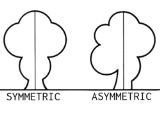
The opposite of symmetry is asymmetry
Asymmetry

Asymmetry is the absence of, or a violation of, a symmetry....
.

Symmetry in the field of mathematics


In formal terms, we say that an object is symmetric with respect to a given mathematical operation
Operation (mathematics)

In its simplest meaning in mathematics and logic, an operation is an action or procedure which produces a new value from one or more input values....
, if, when applied to the object, this operation does not change the object or its appearance. Two objects are symmetric to each other with respect to a given group of operations if one is obtained from the other by some of the operations (and vice versa).

Symmetries may also be found in living organisms including humans and other animals (see symmetry in biology below). In 2D geometry the main kinds of symmetry of interest are with respect to the basic Euclidean plane isometries
Euclidean plane isometry

In geometry, a Euclidean plane isometry is an isometry of the Euclidean plane, or more informally, a way of transforming the plane that preserves geometrical properties such as length....
: translations, rotation
Rotation

A rotation is a movement of an object in a circular motion. A two-dimensional object rotates around a center of rotation. A Three-dimensional space object rotates around a line called an axis....
s, reflections
Reflection (mathematics)

In mathematics, a reflection is a function that transforms an object into its mirror image. For example, a reflection of the small English letter p in respect to a vertical line would look like q....
, and glide reflection
Glide reflection

In geometry, a glide reflection is a type of isometry of the Euclidean plane: the combination of a reflection in a line and a translation along that line....
s.

Mathematical model for symmetry

The set of all symmetry operations considered, on all objects in a set X, can be modeled as a group action
Group action

In algebra and geometry, a group action is a way of describing symmetry of objects using group . The essential elements of the object are described by a Set and the symmetries of the object are described by the symmetry group of this set, which consists of bijective transformation of the set....
 g : G × X ? X, where the image of g in G and x in X is written as g·x. If, for some g, g·x = y then x and y are said to be symmetrical to each other. For each object x, operations g for which g·x = x form a group
Group (mathematics)

In mathematics, a group is an algebraic structure consisting of a set together with an Binary operation that combines any two of its element to form a third element....
, the symmetry group
Symmetry group

The symmetry group of an object is the group of all isometries under which it is invariant with Function composition as the operation. It is a subgroup of the isometry group of the space concerned....
 of the object, a subgroup of G. If the symmetry group of x is the trivial group then x is said to be asymmetric, otherwise symmetric. A general example is that G is a group of bijections g: V ? V acting on the set of functions x: V ? W by (gx)(v)=x(g−1(v)) (or a restricted set of such functions that is closed under the group action). Thus a group of bijections of space induces a group action on "objects" in it. The symmetry group of x consists of all g for which x(v)=x(g(v)) for all v. G is the symmetry group of the space itself, and of any object that is uniform throughout space. Some subgroups of G may not be the symmetry group of any object. For example, if the group contains for every v and w in V a g such that g(v)=w, then only the symmetry groups of constant functions x contain that group. However, the symmetry group of constant functions is G itself.

In a modified version for vector field
Vector field

In mathematics a vector field is a construction in vector calculus which associates a vector to every point in a Euclidean space.Vector fields are often used in physics to model, for example, the speed and direction of a moving fluid throughout space, or the strength and direction of some force, such as the magnetic field or gravity for...
s, we have (gx)(v)=h(g,x(g−1(v))) where h rotates any vectors and pseudovectors in x, and inverts any vectors (but not pseudovectors) according to rotation and inversion in g, see symmetry in physics
Symmetry in physics

Symmetry in physics includes all features of a physical system that exhibit the property of symmetry?that is, under certain transformation , aspects of these systems are "unchanged", according to a particular observation....
. The symmetry group of x consists of all g for which x(v)=h(g,x(g(v))) for all v. In this case the symmetry group of a constant function may be a proper subgroup of G: a constant vector has only rotational symmetry with respect to rotation about an axis if that axis is in the direction of the vector, and only inversion symmetry if it is zero.

For a common notion of symmetry in Euclidean space
Euclidean space

Around 300 Before Christ, the Ancient Greece mathematician Euclid undertook a study of relationships among distances and angles, first in a plane and then in space....
, G is the Euclidean group
Euclidean group

In mathematics, the Euclidean group E, sometimes called ISO or similar, is the symmetry group of n-dimensional Euclidean space. Its elements, the isometry associated with the Euclidean Metric , are called Euclidean moves....
 E(n), the group of isometries
Isometry

In mathematics, an isometry, isometric isomorphism or congruence mapping is a distance-preserving isomorphism between metric spaces....
, and V is the Euclidean space. The rotation group of an object is the symmetry group if G is restricted to E+(n), the group of direct isometries. (For generalizations, see the next subsection.) Objects can be modeled as functions x, of which a value may represent a selection of properties such as color, density, chemical composition, etc. Depending on the selection we consider just symmetries of sets of points (x is just a boolean
Boolean

Boolean , as a noun or an adjective, may refer to:* Boolean algebra , a logical calculus of truth values or set membership* Boolean algebra , a set with operations resembling logical ones...
 function of position v), or, at the other extreme, e.g. symmetry of right and left hand with all their structure.

For a given symmetry group, the properties of part of the object, fully define the whole object. Considering points equivalent
Equivalence relation

In mathematics, an equivalence relation is, loosely, a binary relation on a Set that specifies how to split up the set into subsets such that every element of the larger set is in exactly one of the subsets....
 which, due to the symmetry, have the same properties, the equivalence class
Equivalence class

In mathematics, given a Set X and an equivalence relation ~ on X, the equivalence class of an element a in X is the subset of all elements in X which are equivalent to a:...
es are the orbits
Group action

In algebra and geometry, a group action is a way of describing symmetry of objects using group . The essential elements of the object are described by a Set and the symmetries of the object are described by the symmetry group of this set, which consists of bijective transformation of the set....
 of the group action on the space itself. We need the value of x at one point in every orbit to define the full object. A set of such representatives forms a fundamental domain
Fundamental domain

In geometry, the fundamental domain of a symmetry group of an object or pattern is a part of the pattern, as small as possible, which, based on the symmetry, determines the whole object or pattern....
. The smallest fundamental domain does not have a symmetry; in this sense, one can say that symmetry relies upon asymmetry
Asymmetry

Asymmetry is the absence of, or a violation of, a symmetry....
.

An object with a desired symmetry can be produced by choosing for every orbit a single function value. Starting from a given object x we can e.g.:

  • take the values in a fundamental domain (i.e., add copies of the object)


  • take for each orbit some kind of average or sum of the values of x at the points of the orbit (ditto, where the copies may overlap)


If it is desired to have no more symmetry than that in the symmetry group, then the object to be copied should be asymmetric.

As pointed out above, some groups of isometries are not the symmetry group of any object, except in the modified model for vector fields. For example, this applies in 1D for the group of all translations. The fundamental domain is only one point, so we can not make it asymmetric, so any "pattern" invariant under translation is also invariant under reflection (these are the uniform "patterns").

In the vector field version continuous translational symmetry does not imply reflectional symmetry: the function value is constant, but if it contains nonzero vectors, there is no reflectional symmetry. If there is also reflectional symmetry, the constant function value contains no nonzero vectors, but it may contain nonzero pseudovectors. A corresponding 3D example is an infinite cylinder
Cylinder (geometry)

A cylinder is one of the most curvilinear basic geometric shapes: the surface formed by the points at a fixed distance from a given straight line, the axis of the cylinder....
 with a current perpendicular to the axis; the magnetic field
Magnetic field

A magnetism field is a vector field which can exert a magnetic force on moving electric charges and on magnetic dipoles . When placed in a magnetic field, magnetic dipoles tend to align their axes parallel to the magnetic field....
 (a pseudovector
Pseudovector

In physics and mathematics, a pseudovector is a quantity that transforms like a vector under a proper Rotation , i.e. a transformation that rotates vectors and pseudovectors by an arbitrary angle about an arbitrary axis, but gains an additional sign flip under an improper rotation: a transformation that can be expressed as a proper rotation...
) is, in the direction of the cylinder, constant, but nonzero. For vectors (in particular the current density
Current density

Current density is a measure of the density of flow of a conserved charge . Usually the charge is the electric charge, in which case the associated current density is the electric current per unit area of cross section, but the term current density can also be applied to other conserved quantities....
) we have symmetry in every plane perpendicular to the cylinder, as well as cylindrical symmetry. This cylindrical symmetry without mirror planes through the axis is also only possible in the vector field version of the symmetry concept. A similar example is a cylinder rotating about its axis, where magnetic field and current density are replaced by angular momentum
Angular momentum

In physics, the angular momentum of a particle about an origin is a vector quantity related to rotation, equal to the mass of the particle multiplied by the cross product of the position vector of the particle with its velocity vector....
 and velocity
Velocity

In physics, velocity is defined as the Derivative of Position vector. It is a vector physical quantity; both speed and direction are required to define it....
, respectively.

A symmetry group is said to act transitively on a repeated feature of an object if, for every pair of occurrences of the feature there is a symmetry operation mapping the first to the second. For example, in 1D, the symmetry group of acts transitively on all these points, while does not act transitively on all points. Equivalently, the first set is only one conjugacy class
Conjugacy class

In mathematics, especially group theory, the elements of any group may be partition of a set into conjugacy classes; members of the same conjugacy class share many properties, and study of conjugacy classes of non-abelian groups reveals many important features of their structure....
 with respect to isometries, while the second has two classes.

Non-isometric symmetry


As mentioned above, G (the symmetry group of the space itself) may differ from the Euclidean group
Euclidean group

In mathematics, the Euclidean group E, sometimes called ISO or similar, is the symmetry group of n-dimensional Euclidean space. Its elements, the isometry associated with the Euclidean Metric , are called Euclidean moves....
, the group of isometries
Isometry

In mathematics, an isometry, isometric isomorphism or congruence mapping is a distance-preserving isomorphism between metric spaces....
.

Examples:

  • G is the group of similarity transformations, i.e. affine transformation
    Affine transformation

    In geometry, an affine transformation or affine map or an affinity between two vector spaces consists of a linear transformation followed by a translation :...
    s with a matrix
    Matrix (mathematics)

    In mathematics, a matrix is a rectangular array of numbers, as shown at the right. In addition to a number of elementary, entrywise operations such as matrix addition a key notion is matrix multiplication....
     A that is a scalar times an orthogonal matrix
    Orthogonal matrix

    In matrix theory, a real number orthogonal matrix is a Matrix #Square matrices Q whose transpose is its inverse matrix:A special orthogonal matrix is an orthogonal matrix with determinant +1:...
    . Thus dilations
    Dilation (mathematics)

    In mathematics, a dilation is a function ƒ from a metric space into itself that satisfies the identityfor all points xy, where d is the distance from x to y and r is some positive real number....
     are added, self-similarity
    Self-similarity

    In mathematics, a self-similar object is exactly or approximately similarity to a part of itself . Many objects in the real world, such as coastlines, are statistically self-similar: parts of them show the same statistical properties at many scales....
     is considered a symmetry


  • G is the group of affine transformations with a matrix A with determinant 1 or -1, i.e. the transformation which preserve area; this adds e.g. oblique reflection symmetry
    Reflection symmetry

    The triangles with this symmetry are isosceles. The quadrilaterals with this symmetry are the kite s and the isosceles trapezoids.For each line or plane of reflection, the symmetry group is isomorphic with Cs , one of the three types of order two , hence algebraically C2....
    .


  • G is the group of all bijective affine transformations


  • In inversive geometry, G includes circle reflections, etc.


  • More generally, an involution
    Involution

    In mathematics, an involution, or an involutary function, is a function that is its own inverse function, so that...
     defines a symmetry with respect to that involution.


Directional symmetry


Reflection symmetry


Reflection symmetry, mirror symmetry, mirror-image symmetry, or bilateral symmetry is symmetry with respect to reflection.

In 1D, there is a point of symmetry. In 2D there is an axis of symmetry, in 3D a plane of symmetry. An object or figure which is indistinguishable from its transformed image is called mirror symmetric (see mirror image
Mirror Image

"Mirror Image" is an episode of the television series The Twilight Zone ....
).

The axis of symmetry of a two-dimensional figure is a line such that, if a perpendicular is constructed, any two points lying on the perpendicular at equal distances from the axis of symmetry are identical. Another way to think about it is that if the shape were to be folded in half over the axis, the two halves would be identical: the two halves are each other's mirror image. Thus a square
Square (geometry)

In Euclidean geometry, a square is a regular polygon with four equal sides and four equal angles . A square with vertices ABCD would be denoted ....
 has four axes of symmetry, because there are four different ways to fold it and have the edges all match. A circle
Circle

A circle is a simple shape of Euclidean geometry consisting of those point in a plane which are the same distance from a given point called the center....
 has infinitely many axes of symmetry, for the same reason.

If the letter T is reflected along a vertical axis, it appears the same. Note that this is sometimes called horizontal symmetry, and sometimes vertical symmetry! One can better use an unambiguous formulation, e.g. "T has a vertical symmetry axis."

The triangle
Triangle

A triangle is one of the basic shapes of geometry: a polygon with three corners or wikt:vertex and three sides or edges which are line segments....
s with this symmetry are isosceles, the quadrilateral
Quadrilateral

In geometry, a quadrilateral is a polygon with four 'sides' or edges and four vertices or corners. Sometimes, the term quadrangle is used, for analogy with triangle, and sometimes tetragon for consistency with pentagon , hexagon and so on....
s with this symmetry are the kites
Kite (geometry)

In geometry a kite, or deltoid, is a quadrilateral with two disjoint sets pairs of congruent adjacent sides, in contrast to a parallelogram, where the congruent sides are opposite....
 and the isosceles trapezoid
Trapezoid

In geometry, a trapezoid or trapezium is a quadrilateral with twoparallel sides. The term “trapezoid” is used in North America, while the term “trapezium” is prevalent in Britain....
s.

For each line or plane of reflection, the symmetry group is isomorphic with Cs (see point group
Point group

In mathematics, a point group is a group of geometric symmetry leaving a point fixed....
s in three dimensions), one of the three types of order two (involutions), hence algebraically C2. The fundamental domain is a half-plane or half-space.

Bilateria
Bilateria

The Bilateria are all animals having a symmetry #Bilateral symmetry, i.e. they have a front and a back end, as well as an upside and downside....
 (bilateral animals, including humans) are more or less symmetric with respect to the sagittal plane
Sagittal plane

A sagittal plane of the human body is an imaginary plane that travels from the top to the bottom of the body, dividing it into left and right portions....
.

In certain contexts there is rotational symmetry anyway. Then mirror-image symmetry is equivalent with inversion symmetry; in such contexts in modern physics the term P-symmetry is used for both (P stands for parity
Parity

Parity is a concept of equality of status or functional equivalence. It has several different specific definitions.* Parity , the name of the symmetry of interactions under spatial inversion...
).

For more general types of reflection there are corresponding more general types of reflection symmetry. Examples:

  • with respect to a non-isometric
    Isometry

    In mathematics, an isometry, isometric isomorphism or congruence mapping is a distance-preserving isomorphism between metric spaces....
     affine
    Affine

    Affine may refer to:*Affine cipher, a special case of the more general substitution cipher*Affine combination, a certain kind of constrained linear combination...
     involution
    Involution

    In mathematics, an involution, or an involutary function, is a function that is its own inverse function, so that...
     (an oblique reflection in a line, plane, etc).


  • with respect to circle inversion


Rotational symmetry


Rotational symmetry is symmetry with respect to some or all rotations in m-dimensional Euclidean space. Rotations are direct isometries
Euclidean group

In mathematics, the Euclidean group E, sometimes called ISO or similar, is the symmetry group of n-dimensional Euclidean space. Its elements, the isometry associated with the Euclidean Metric , are called Euclidean moves....
, i.e., isometries preserving orientation
Orientation (mathematics)

In mathematics, an orientation on a real number vector space is a choice of which ordered basis are "positively" oriented and which are "negatively" oriented....
. Therefore a symmetry group of rotational symmetry is a subgroup of E+(m)
Euclidean group

In mathematics, the Euclidean group E, sometimes called ISO or similar, is the symmetry group of n-dimensional Euclidean space. Its elements, the isometry associated with the Euclidean Metric , are called Euclidean moves....
.

Symmetry with respect to all rotations about all points implies translational symmetry with respect to all translations, and the symmetry group is the whole E+(m). This does not apply for objects because it makes space homogeneous, but it may apply for physical laws.

For symmetry with respect to rotations about a point we can take that point as origin. These rotations form the special orthogonal group SO(m), the group of m×m orthogonal matrices
Orthogonal matrix

In matrix theory, a real number orthogonal matrix is a Matrix #Square matrices Q whose transpose is its inverse matrix:A special orthogonal matrix is an orthogonal matrix with determinant +1:...
 with determinant
Determinant

In algebra, a determinant is a function depending on n that associates a scalar , det, to an n?n square matrix A. The fundamental geometric meaning of a determinant is a scale factor for measure when A is regarded as a linear transformation....
 1. For m=3 this is the rotation group
Rotation group

In classical mechanics and geometry, the rotation group is the group of all rotations about the origin of three-dimensional Euclidean space R3 under the operation of functional composition....
.

In another meaning of the word, the rotation group of an object is the symmetry group within E+(n), the group of direct isometries; in other words, the intersection of the full symmetry group and the group of direct isometries. For chiral objects it is the same as the full symmetry group.

Laws of physics are SO(3)-invariant if they do not distinguish different directions in space. Because of Noether's theorem
Noether's theorem

Noether's theorem states that any derivative Symmetry in physics of the action of a physical system has a corresponding conservation law. The action of a physical system is an integral of a so-called Lagrangian function, from which the system's behavior can be determined by the principle of least action....
, rotational symmetry of a physical system is equivalent to the angular momentum conservation law. See also rotational invariance
Rotational invariance

In mathematics, a function defined on an inner product space is said to have rotational invariance if its value does not change when arbitrary rotations are applied to its argument....
.

Translational symmetry


Translational symmetry leaves an object invariant under a discrete or continuous group of translations
Translation (geometry)

In Euclidean geometry, a translation is moving every point a constant distance in a specified direction. It is one of the Euclidean groups . A translation can also be interpreted as the addition of a constant vector space to every point, or as shifting the Origin of the coordinate system....
 .

Glide reflection symmetry


A glide reflection
Glide reflection

In geometry, a glide reflection is a type of isometry of the Euclidean plane: the combination of a reflection in a line and a translation along that line....
 symmetry (in 3D: a glide plane symmetry) means that a reflection in a line or plane combined with a translation along the line / in the plane, results in the same object. It implies translational symmetry with twice the translation vector.

The symmetry group is isomorphic with Z.

Rotoreflection symmetry


In 3D, rotoreflection or improper rotation
Improper rotation

In 3D geometry, an improper rotation, also called rotoreflection or rotary reflection is, depending on context, a linear transformation or affine transformation which is the combination of a rotation about an axis and a reflection in a plane perpendicular to the axis....
 in the strict sense is rotation about an axis, combined with reflection in a plane perpendicular to that axis. As symmetry groups with regard to a roto-reflection we can distinguish:
  • the angle has no common divisor with 360°, the symmetry group is not discrete
  • 2n-fold rotoreflection (angle of 180°/n) with symmetry group S2n of order 2n (not to be confused with symmetric group
    Symmetric group

    In mathematics, the symmetric group on a Set X, denoted by SX, or Sym, is the group whose underlying set is the set of all bijective function s from X to X, in which the group operation is that of Function composition, i.e., two such functions f and g can be composed to yield a new bijective function ,...
    s, for which the same notation is used; abstract group C2n); a special case is n=1, inversion, because it does not depend on the axis and the plane, it is characterized by just the point of inversion.
  • Cnh (angle of 360°/n); for odd n this is generated by a single symmetry, and the abstract group is C2n, for even n this is not a basic symmetry but a combination. See also point groups in three dimensions
    Point groups in three dimensions

    In geometry, a point group in three dimensions is an isometry group in three dimensions that leaves the origin fixed, or correspondingly, an isometry group of a sphere....
    .


Helical symmetry


Helical
Helix

A helix is a special kind of space curve, i.e. a Differentiable manifold curve in three-space. As a mental image of a helix one may take the spring ....
 symmetry is the kind of symmetry seen in such everyday objects as springs
Spring (device)

A spring is an Elasticity object used to store mechanical energy. Springs are usually made out of hardened steel. Small springs can be wound from pre-hardened stock, while larger ones are made from annealing steel and hardened after fabrication....
, Slinky
Slinky

Slinky is a helix-shaped toy that can travel down stairs end-over-end as it stretches and re-forms itself with the aid of gravity and its own momentum....
 toys, drill bits, and auger
Auger

An auger is a device for moving material or liquid by means of a rotating helical flighting. The material is moved along the axis of rotation....
s. It can be thought of as rotational symmetry along with translation along the axis of rotation, the screw axis
Screw axis

The screw axis of an object is a parameter for describing simultaneous rotation and translation components of that object.The axis angle is a directed line in cartesian space, along which a translation may occur, and about which rotation may occur....
). The concept of helical symmetry can be visualized as the tracing in three-dimensional space that results from rotating an object at an even angular speed while simultaneously moving at another even speed along its axis of rotation (translation). At any one point in time, these two motions combine to give a coiling angle that helps define the properties of the tracing. When the tracing object rotates quickly and translates slowly, the coiling angle will be close to 0°. Conversely, if the rotation is slow and the translation speedy, the coiling angle will approach 90°.

Three main classes of helical symmetry can be distinguished based on the interplay of the angle of coiling and translation symmetries along the axis:

  • Infinite helical symmetry. If there are no distinguishing features along the length of a helix
    Helix

    A helix is a special kind of space curve, i.e. a Differentiable manifold curve in three-space. As a mental image of a helix one may take the spring ....
     or helix-like object, the object will have infinite symmetry much like that of a circle, but with the additional requirement of translation along the long axis of the object to return it to its original appearance. A helix-like object is one that has at every point the regular angle of coiling of a helix, but which can also have a cross section
    Cross section

    Cross section can refer to:* Cross section , a three-piece rock band from the Mornington Peninsula, Australia* Cross section , the intersection of a 3-dimensional body with a plane...
     of indefinitely high complexity, provided only that precisely the same cross section exists (usually after a rotation) at every point along the length of the object. Simple examples include evenly coiled springs
    Spring (device)

    A spring is an Elasticity object used to store mechanical energy. Springs are usually made out of hardened steel. Small springs can be wound from pre-hardened stock, while larger ones are made from annealing steel and hardened after fabrication....
    , slinkies
    Slinky

    Slinky is a helix-shaped toy that can travel down stairs end-over-end as it stretches and re-forms itself with the aid of gravity and its own momentum....
    , drill bit
    Drill bit

    Drill bits are cutting tools used to create cylindrical holes. Bits are held in a tool called a drill, which rotates them and provides torque and axial force to create the hole....
    s, and auger
    Auger

    An auger is a device for moving material or liquid by means of a rotating helical flighting. The material is moved along the axis of rotation....
    s. Stated more precisely, an object has infinite helical symmetries if for any small rotation of the object around its central axis there exists a point nearby (the translation distance) on that axis at which the object will appear exactly as it did before. It is this infinite helical symmetry that gives rise to the curious illusion of movement along the length of an auger or screw bit that is being rotated. It also provides the mechanically useful ability of such devices to move materials along their length, provided that they are combined with a force such as gravity or friction that allows the materials to resist simply rotating along with the drill or auger.


  • n-fold helical symmetry. If the requirement that every cross section of the helical object be identical is relaxed, additional lesser helical symmetries become possible. For example, the cross section of the helical object may change, but still repeats itself in a regular fashion along the axis of the helical object. Consequently, objects of this type will exhibit a symmetry after a rotation by some fixed angle and a translation by some fixed distance, but will not in general be invariant for any rotation angle. If the angle (rotation) at which the symmetry occurs divides evenly into a full circle (360°), the result is the helical equivalent of a regular polygon. This case is called n-fold helical symmetry, where n = 360°/, see e.g. double helix
    Double helix

    In geometry a double helix typically consists of two congruence helix with the same axis, differing by a translation along the axis, which may or may not be half-way....
    . This concept can be further generalized to include cases where ' is a multiple of 360°—that is, the cycle does eventually repeat, but only after more than one full rotation of the helical object.


  • Non-repeating helical symmetry. This is the case in which the angle of rotation ' required to observe the symmetry is an irrational number such as radians that never repeats exactly no matter how many times the helix is rotated. Such symmetries are created by using a non-repeating point group in two dimensions
    Point group

    In mathematics, a point group is a group of geometric symmetry leaving a point fixed....
    . DNA
    DNA

    Deoxyribonucleic acid is a nucleic acid that contains the genetics instructions used in the development and functioning of all known living organisms and some viruses....
     is an example of this type of non-repeating helical symmetry.


Scale symmetry and fractals


Scale symmetry refers to the idea that if an object is expanded or reduced in size, the new object has the same properties as the original. Scale symmetry is notable for the fact that it does not exist for most physical systems, a point that was first discerned by Galileo. Simple examples of the lack of scale symmetry in the physical world include the difference in the strength and size of the legs of elephant
Elephant

Elephants are large land mammals of the order Proboscidea and the family Elephantidae. There are three living species: the African Bush Elephant, the African Forest Elephant and the Asian Elephant ....
s versus mice
Mouse

A mouse is a small animal that belongs to one of numerous species of rodents. The best known mouse species is the House Mouse . It is also a popular pet....
, and the observation that if a candle made of soft wax was enlarged to the size of a tall tree, it would immediately collapse under its own weight.

A more subtle form of scale symmetry is demonstrated by fractal
Fractal

A fractal is generally "a rough or fragmented Shape that can be split into parts, each of which is a reduced-size copy of the whole," a property called self-similarity....
s. As conceived by Mandelbrot
Mandelbrot

Mandelbrot, may refer to:* Beno?t Mandelbrot , a mathematician associated with fractal geometry, coined the term fractal* Mandelbrot set, a fractal popularized by Beno?t Mandelbrot...
, fractals are a mathematical concept in which the structure of a complex form looks exactly the same no matter what degree of magnification
Magnification

Magnification is the process of enlarging something only in appearance, not in physical size. This enlargement is quantified by a calculated number also called magnification....
 is used to examine it. A coast
Coast

The coast is defined as that part of the land adjoining or near the ocean or its saltwater arms. A precise line that can be called a coastline cannot be determined due to the process of tides....
 is an example of a naturally occurring fractal, since it retains roughly comparable and similar-appearing complexity at every level from the view of a satellite to a microscopic examination of how the water laps up against individual grains of sand. The branching of trees, which enables children to use small twigs as stand-ins for full trees in diorama
Diorama

The word diorama can refer either to a nineteenth century mobile theatre device, or, in modern usage, a three-dimensional model, usually enclosed in a glass showcase for a museum....
s, is another example.

This similarity to naturally occurring phenomena provides fractals with an everyday familiarity not typically seen with mathematically generated functions. As a consequence, they can produce strikingly beautiful results such as the Mandelbrot set
Mandelbrot set

In mathematics, the Mandelbrot set, named after Beno?t Mandelbrot, is a set of Point in the complex plane, the Boundary of which forms a fractal....
. Intriguingly, fractals have also found a place in CG
CG

CG, Cg or cg may stand for:*Airlines PNG IATA code*Categorial grammar*Constraint grammar*Carnival Games, video game for Wii and Nintendo DS...
, or computer-generated movie effects, where their ability to create very complex curves with fractal symmetries results in more realistic virtual world
Virtual world

A virtual world is a computer simulation intended for its user to inhabit and interact via Avatar s. These avatars are usually depicted as textual, two-dimensional, or 3D computer graphics representations, although other forms are possible ....
s.

Symmetry combinations


Symmetry in science


Symmetry in physics


Symmetry in physics has been generalized to mean invariance
Invariant (physics)

In mathematics and theoretical physics, an invariant is a property of a system which remains unchanged under some Transformation .The gravitational field of the Sun is invariant under a change of time ....
—that is, lack of any visible change—under any kind of transformation, for example arbitrary coordinate transformations
General covariance

In theoretical physics, general covariance is the invariance of the form of physical laws under arbitrary Derivative coordinate transformations....
. This concept has become one of the most powerful tools of theoretical physics, as it has become evident that practically all laws of nature originate in symmetries. In fact, this role inspired the Nobel laureate PW Anderson
Philip Warren Anderson

Philip Warren Anderson is an United States physicist and Nobel laureate. Anderson has made contributions to the theories of Anderson localization, antiferromagnetism and high-temperature superconductivity....
 to write in his widely-read 1972 article More is Different that "it is only slightly overstating the case to say that physics is the study of symmetry." See Noether's theorem
Noether's theorem

Noether's theorem states that any derivative Symmetry in physics of the action of a physical system has a corresponding conservation law. The action of a physical system is an integral of a so-called Lagrangian function, from which the system's behavior can be determined by the principle of least action....
 (which, as a gross oversimplification, states that for every continuous mathematical symmetry, there is a corresponding conserved quantity; a conserved current, in Noether's original language); and also, Wigner's classification
Wigner's classification

In mathematics and theoretical physics, Wigner's classificationis a classification of the nonnegative energy Irreducible representations of the Poincar? group, which have sharp mass eigenvalues....
, which says that the symmetries of the laws of physics determine the properties of the particles found in nature.

Symmetry in physical objects


Classical objects

Although an everyday object may appear exactly the same after a symmetry operation such as a rotation or an exchange of two identical parts has been performed on it, it is readily apparent that such a symmetry is true only as an approximation for any ordinary physical object.

For example, if one rotates a precisely machined aluminum equilateral triangle
Equilateral triangle

In geometry, an equilateral triangle is a triangle in which all three sides are equal. In traditional or Euclidean geometry, equilateral triangles are also Equiangular polygon; that is, all three internal angles are also congruent to each other and are each 60?....
 120 degrees around its center, a casual observer brought in before and after the rotation will be unable to decide whether or not such a rotation took place. However, the reality is that each corner of a triangle will always appear unique when examined with sufficient precision. An observer armed with sufficiently detailed measuring equipment such as optical
Optical microscope

The optical microscope, often referred to as the "light microscope", is a type of microscope which uses visible light and a system of lens to magnify images of small samples....
 or electron microscope
Electron microscope

An electron microscope is a type of microscope that uses a particle beam of electrons to illuminate a specimen and create a highly-magnified image....
s will not be fooled; he will immediately recognize that the object has been rotated by looking for details such as crystal
Crystal

A crystal or crystalline solid is a solid material whose constituent atoms, molecules, or ions are arranged in an orderly repeating pattern extending in all three spatial dimensions....
s or minor deformities.

Such simple thought experiment
Thought experiment

A thought experiment , sometimes called a Gedanken experiment, is a proposal for an experiment that would test or illuminate a hypothesis or theory....
s show that assertions of symmetry in everyday physical objects are always a matter of approximate similarity rather than of precise mathematical sameness. The most important consequence of this approximate nature of symmetries in everyday physical objects is that such symmetries have minimal or no impacts on the physics of such objects. Consequently, only the deeper symmetries of space and time
Symmetry in physics

Symmetry in physics includes all features of a physical system that exhibit the property of symmetry?that is, under certain transformation , aspects of these systems are "unchanged", according to a particular observation....
 play a major role in classical physics
Classical physics

Classical physics is a general term used to describe the branches of physics based on principles developed before the rise of general theory of relativity and Quantum mechanics, usually including special theory of relativity....
—that is, the physics of large, everyday objects.

Quantum objects

Remarkably, there exists a realm of physics for which mathematical assertions of simple symmetries in real objects cease to be approximations. That is the domain of quantum physics, which for the most part is the physics of very small, very simple objects such as electron
Electron

The electron is a subatomic particle that carries a negative electric charge. It has elementary particle and is believed to be a point particle....
s, proton
Proton

The proton is a subatomic particle with an electric charge of +1 elementary charge. It is found in the nucleus of each atom but is also stable by itself and has a second identity as the hydrogen ion, H+....
s, light
Light

Light, or visible light, is electromagnetic radiation of a wavelength that is Visible spectrum to the human eye , or up to 380?750 nm. In the broader field of physics, light is sometimes used to refer to electromagnetic radiation of all wavelengths, whether visible or not....
, and atoms.

Unlike everyday objects, objects such as electron
Electron

The electron is a subatomic particle that carries a negative electric charge. It has elementary particle and is believed to be a point particle....
s have very limited numbers of configurations, called states
State (physics)

In physics,the term state is used in several related senses,each expressing something about the way a physical system ontology.#In the sense state of matter, state describes the organization of matter in a phase....
, in which they can exist. This means that when symmetry operations such as exchanging the positions of components are applied to them, the resulting new configurations often cannot be distinguished from the originals no matter how diligent an observer
Observation

Observation is either an activity of a living being , consisting of receiving knowledge of the outside world through the senses, or the recording of data using scientific instruments....
 is. Consequently, for sufficiently small and simple objects the generic mathematical symmetry assertion F(x) = x ceases to be approximate, and instead becomes an experimentally precise and accurate description of the situation in the real world.

Consequences of quantum symmetry

While it makes sense that symmetries could become exact when applied to very simple objects, the immediate intuition is that such a detail should not affect the physics of such objects in any significant way. This is in part because it is very difficult to view the concept of exact similarity as physically meaningful. Our mental picture of such situations is invariably the same one we use for large objects: We picture objects or configurations that are very, very similar, but for which if we could "look closer" we would still be able to tell the difference.

However, the assumption that exact symmetries in very small objects should not make any difference in their physics was discovered in the early 1900s to be spectacularly incorrect. The situation was succinctly summarized by Richard Feynman
Richard Feynman

Richard Phillips Feynman was an United States physicist known for the path integral formulation of quantum mechanics, the theory of quantum electrodynamics and the physics of the superfluidity of supercooled liquid helium, as well as work in particle physics ....
 in the direct transcripts of his Feynman Lectures on Physics, Volume III, Section 3.4, Identical particles. (Unfortunately, the quote was edited out of the printed version of the same lecture.)

"... if there is a physical situation in which it is impossible to tell which way it happened, it always interferes; it never fails."


The word "interferes" in this context is a quick way of saying that such objects fall under the rules of quantum mechanics
Quantum mechanics

Quantum mechanics is a set of principles underlying the most fundamental known description of all physical systems at the microscopic scale . Notable amongst these principles are both a dual wave-like and particle-like behavior of matter and radiation, and prediction of probabilities in situations where classical physics predicts certaintie...
, in which they behave more like wave
Wave

A wave is a disturbance that propagates through space and time, usually with transference of energy. While a mechanical wave exists in a medium , waves of electromagnetic radiation can travel through vacuum, that is, without a medium....
s that interfere than like everyday large objects.

In short, when an object becomes so simple that a symmetry assertion of the form F(x) = x becomes an exact statement of experimentally verifiable sameness, x ceases to follow the rules of classical physics
Classical physics

Classical physics is a general term used to describe the branches of physics based on principles developed before the rise of general theory of relativity and Quantum mechanics, usually including special theory of relativity....
 and must instead be modeled using the more complex—and often far less intuitive—rules of quantum physics.

This transition also provides an important insight into why the mathematics of symmetry are so deeply intertwined with those of quantum mechanics. When physical systems make the transition from symmetries that are approximate to ones that are exact, the mathematical expressions of those symmetries cease to be approximations and are transformed into precise definitions of the underlying nature of the objects. From that point on, the correlation of such objects to their mathematical descriptions becomes so close that it is difficult to separate the two.

Symmetry as a unifying principle of geometry


The German geometer Felix Klein
Felix Klein

Felix Christian Klein was a Germany mathematician, known for his work in group theory, function theory, non-Euclidean geometry, and on the connections between geometry and group theory....
 enunciated a very influential Erlangen programme in 1872, suggesting symmetry as unifying and organising principle in geometry (at a time when that was read 'geometries'). This is a broad rather than deep principle. Initially it led to interest in the groups
Group (mathematics)

In mathematics, a group is an algebraic structure consisting of a set together with an Binary operation that combines any two of its element to form a third element....
 attached to geometries, and the slogan transformation geometry
Transformation geometry

In mathematics, transformation geometry is a name for a pedagogic theory for teaching Euclidean geometry, based on the Erlangen programme. Felix Klein, who pioneered this point of view, was himself interested in mathematical education....
 (an aspect of the New Math
New math

New Math was a brief, dramatic change in the way mathematics was taught in United States grade schools, and to a lesser extent in European countries, during the 1960s....
, but hardly controversial in modern mathematical practice). By now it has been applied in numerous forms, as kind of standard attack on problems.

Symmetry in mathematics


An example of a mathematical expression exhibiting symmetry is a˛c + 3ab + b˛c. If a and b are exchanged, the expression remains unchanged due to the commutativity of addition and multiplication.

Like in geometry, for the terms there are two possibilities:
  • It is itself symmetric
  • It has one or more other terms symmetric with it, in accordance with the symmetry kind


See also symmetric function
Symmetric function

In mathematics, the term "symmetric function" can mean two different things. A symmetric function of n variables is one whose value at any n-tuple of arguments is the same as its value at any permutation of that n-tuple....
, duality (mathematics)
Duality (mathematics)

In mathematics, duality has numerous meanings. Generally speaking, duality is a metamathematics Involution . Some duality concepts are closely related and there are explicit theorems governing their relationships....


Symmetry in logic


A dyadic relation
Binary relation

In mathematics, a binary relation is an arbitrary association of elements within a set or with elements of another set.An example is the "divides" relation between the set of prime numbers P and the set of integers Z, in which every prime p is associated with every integer z that is a divisibility of p, and no othe...
 R is symmetric if and only if, whenever it's true that Rab, it's true that Rba. Thus, “is the same age as” is symmetrical, for if Paul is the same age as Mary, then Mary is the same age as Paul.

Symmetric binary logical connective
Logical connective

In logic, two sentences may be joined by means of a logical connective to form a compound sentence. The truth-value of the compound is uniquely determined by the truth-values of the simpler sentences....
s are "and
Logical conjunction

In logic and/or mathematics, logical conjunction or and is a two-place logical operation that results in a value of true if both of its operands are true, otherwise a value of false....
" (?, , or &), "or
Logical disjunction

File:ORGate2.pngIn logic and mathematics, or, also known as logical disjunction or inclusive disjunction is a logical operator that results in true whenever one or more of its operands are true....
", "biconditional
Logical biconditional

In logic and mathematics, logical biconditional is a logical operator connecting two statements to assert, p Iff q where p is a hypothesis and q is a logical consequence ....
" (if and only if
If and only if

If and only if, in logic and fields that rely on it such as mathematics and philosophy, is a biconditional logical connective between statements....
), NAND ("not-and"), XOR ("not-biconditional"), and NOR
Logical NOR

In boolean logic, logical nor or joint denial is a truth-functional operator which produces a result that is the negation of logical disjunction....
 ("not-or").

Generalizations of symmetry


If we have a given set of objects with some structure, then it is possible for a symmetry to merely convert only one object into another, instead of acting upon all possible objects simultaneously. This requires a generalization from the concept of symmetry group
Symmetry group

The symmetry group of an object is the group of all isometries under which it is invariant with Function composition as the operation. It is a subgroup of the isometry group of the space concerned....
 to that of a groupoid
Groupoid

In abstract algebra, a branch of mathematics, especially in category theory and homotopy theory, a 'groupoid' generalises the notion of group and of category in several equivalent ways....
. Indeed, A. Connes in his book `Non-commutative geometry' writes that Heisenberg discovered quantum mechanics by considering the groupoid of transitions of the hydrogen spectrum.

The notion of groupoid also leads to notions of multiple groupoids, namely sets with many compatible groupoid structures, a structure which trivialises to abelian groups if one restricts to groups. This leads to prospects of `higher order symmetry' which have been a little explored, as follows.

The automorphisms of a set, or a set with some structure, form a group, which models a homotopy 1-type. The automorphisms of a group G naturally form a crossed module
Crossed module

In mathematics, and especially in homotopy theory, a crossed module consists of group s G and H, where G group action on H , and a homomorphism of groups...
 $G \to Aut(G)$, and crossed modules give an algebraic model of homotopy 2-types. At the next stage, automorphisms of a crossed module fit into a structure known as a crossed square, and this structure is know to give an algebraic model of homotopy 3-types. It is not known how this procedure of generalising symmetry may be continued, although crossed n-cubes have been defined and used in algebraic topology, and these structures are only slowly being brought into theoretical physics. The web site has much discussion of n-groups. More information is on .

Physicists have come up with other directions of generalization, such as supersymmetry
Supersymmetry

In particle physics, supersymmetry is a symmetry that relates elementary particles of one Spin to another particle that differs by half a unit of spin and are known as superpartners....
 and quantum group
Quantum group

In mathematics and theoretical physics, quantum groups are certain noncommutative algebras that first appeared in the theory of quantum integrable systems, and which were then formalized by Vladimir Drinfel'd and Michio Jimbo....
s.

Symmetry in biology


See symmetry (biology)
Symmetry (biology)

Symmetry in biology is the balanced distribution of duplicate body parts or shapes. The body plans of most multicellular organisms exhibit some form of symmetry, either radial symmetry or bilateral symmetry or glide symmetry....
 and facial symmetry
Facial symmetry

Symmetry, especially facial symmetry, is one of a number of aesthetic traits, including averageness and youthfulness, associated with health, physical attractiveness and beauty of a person or non-human animal according to the authors of Facial Attractiveness: Gillian Rhodes, Leslie A....
.

Symmetry in chemistry

Symmetry is important to chemistry
Chemistry

Chemistry is the science concerned with the composition, structure, and properties of matter, as well as the changes it undergoes during chemical reactions....
 because it explains observations in spectroscopy
Spectroscopy

Spectroscopy was originally the study of the interaction between radiation and matter as a function of wavelength . In fact, historically, spectroscopy referred to the use of visible light dispersed according to its wavelength, e.g....
, quantum chemistry
Quantum chemistry

Quantum chemistry is a branch of theoretical chemistry, which applies quantum mechanics and quantum field theory to address issues and problems in chemistry....
 and crystallography
Crystallography

Crystallography is the experimental science of determining the arrangement of atoms in solids. In older usage, it is the scientific study of crystals....
. It draws heavily on group theory
Group theory

In mathematics and abstract algebra, group theory studies the algebraic structures known as group .The concept of a group is central to abstract algebra: other well-known algebraic structures, such as ring , field , and vector spaces can all be seen as groups endowed with additional operations and axioms....
.

Symmetry in history, religion, and culture


In any human endeavor for which an impressive visual result is part of the desired objective, symmetries play a profound role. The innate appeal of symmetry can be found in our reactions to happening across highly symmetrical natural objects, such as precisely formed crystals or beautifully spiraled seashells. Our first reaction in finding such an object often is to wonder whether we have found an object created by a fellow human, followed quickly by surprise that the symmetries that caught our attention are derived from nature itself. In both reactions we give away our inclination to view symmetries both as beautiful and, in some fashion, informative of the world around us.

Symmetry in religious symbols


The tendency of people to see purpose in symmetry suggests at least one reason why symmetries are often an integral part of the symbols of world religions. Just a few of many examples include the sixfold rotational symmetry
Rotational symmetry

File:The armoured triskelion on the flag of the Isle of Man.svgGenerally speaking, an object with rotational symmetry is an object that looks the same after a certain amount of rotation....
 of Judaism
Judaism

Judaism is a set of beliefs and practices originating in the Hebrew Bible , as later further explored and explained in the Talmud and other texts....
's Star of David
Star of David

The Star of David or Shield of David is a generally recognized symbol of Jewish identity and Judaism.It is named after King David of History of ancient Israel and Judah; and its earliest known communal usage began in the Middle Ages, alongside the more ancient symbol of the Menorah ....
, the twofold point symmetry
Point group

In mathematics, a point group is a group of geometric symmetry leaving a point fixed....
 of Taoism
Taoism

Taoism refers to a variety of related philosophical and religious traditions and concepts. These traditions have influenced East Asia for over two thousand years and some have spread to the West....
's Taijitu
Taijitu

File:Yin and Yang.svgTaijitu is one term which refers to a set of geometric patterns used throughout history by various cultures. The most recognized form is composed of two semi-circular teardrop-shaped curves of different colors, or a circle separated by an S-shaped line, where each half is marked with a dot in the opposite color....
 or Yin-Yang, the bilateral symmetry of Christianity
Christianity

Christianity is a Monotheistic religion #Christian view religion centered on the life and teachings of Jesus as New Testament view on Jesus' life....
's cross
Cross

A cross is a geometrical figure consisting of two lines or bars perpendicular to each other, dividing one or two of the lines in half. The lines usually run vertically and horizontally; if they run diagonally, the design is technically termed a saltire....
 and Sikhism
Sikhism

Sikhism , founded on the teachings of Guru Nanak and ten successive Sikh Gurus in fifteenth century Punjab region, is the Major religious groups organized religion in the world....
's Khanda, or the fourfold point symmetry of Jain's ancient (and peacefully intended) version of the swastika
Swastika

The swastika is an equilateral cross with its arms bent at Angle#Types of angles, in either right-facing form or its mirrored left-facing form....
. With its strong prohibitions against the use of representational images, Islam
Islam

Islam is a Monotheism, Abrahamic religion originating with the teachings of the Prophets of Islam Muhammad, a 7th century Arab religious and political figure....
, and in particular the Sunni branch of Islam, has developed intricate and visually impressive use of symmetries.

The ancient Taijitu
Taijitu

File:Yin and Yang.svgTaijitu is one term which refers to a set of geometric patterns used throughout history by various cultures. The most recognized form is composed of two semi-circular teardrop-shaped curves of different colors, or a circle separated by an S-shaped line, where each half is marked with a dot in the opposite color....
 image of Taoism
Taoism

Taoism refers to a variety of related philosophical and religious traditions and concepts. These traditions have influenced East Asia for over two thousand years and some have spread to the West....
 is a particularly fascinating use of symmetry around a central point, combined with black-and-white inversion of color at opposite distances from that central point. The image, which is often misunderstood in the Western world
Western world

The term Western world, the West or the Occident can have multiple meanings dependent on its context . Accordingly, the basic definition of what constitutes "the West" varies, expanding and contracting over time, in relation to various historical circumstances....
 as representing good (white) versus evil (black), is actually intended as a graphical representative of the complementary need for two abstract concepts of "maleness" (white) and "femaleness" (black). The symmetry of the symbol in this case is used not just to create a symbol that catches the attention of the eye, but to make a significant statement about the philosophical beliefs of the people and groups that use it.

Symmetry in Social Interactions

People observe the symmetrical nature, often including asymmetrical balance, of social interactions in a variety of contexts. These include assessments of reciprocity, empathy, apology, dialog, respect, justice, and revenge. Symmetrical interactions send the message "we are all the same" while asymmetrical interactions send the message "I am special; better than you." Peer relationships are based on symmetry, power relationships are based on asymmetry.

Symmetry in architecture


Another human endeavor in which the visual result plays a vital part in the overall result is architecture
Architecture

The term architecture can refer to a process, a profession or documentation.As a process, architecture is the activity of designing and construction buildings and other physical structures by a person or a computer, primarily to provide shelter....
. Both in ancient times, the ability of a large structure to impress or even intimidate its viewers has often been a major part of its purpose, and the use of symmetry is an inescapable aspect of how to accomplish such goals.

Just a few examples of ancient examples of architectures that made powerful use of symmetry to impress those around them included the Egypt
Egypt

Egypt is a country mainly in North Africa, with the Sinai Peninsula forming a land bridge in Western Asia. Covering an area of about , Egypt borders the Mediterranean Sea to the north, the Gaza Strip and Israel to the northeast, the Red Sea to the east, Sudan to the south and Libya to the west....
ian Pyramids, the Greek
Greece

Greece , officially the Hellenic Republic , is a country in southeastern Europe, situated on the southern end of the Balkans. It has borders with Albania, Bulgaria and the former Yugoslav Republic of Macedonia to the north, and Turkey to the east....
 Parthenon
Parthenon

The Parthenon is a Greek temple of the Greek gods Athena, built in the 5th century BC on the Acropolis of Athens. It is the most important surviving building of Classical Greece, generally considered to be the culmination of the development of the Doric order....
, the first and second Temple of Jerusalem, China's Forbidden City
Forbidden City

The Forbidden City was the China imperial palace from the Ming Dynasty to the end of the Qing Dynasty. It is located in the middle of Beijing, People's Republic of China, and now houses the Palace Museum....
, Cambodia
Cambodia

The Kingdom of Cambodia is a country in South East Asia with a population of over 13 million people. The kingdom's capital and largest city is Phnom Penh....
's Angkor Wat
Angkor Wat

Angkor Wat , is a temple complex at Angkor, Cambodia, built for the king Suryavarman II in the early 12th century as his state temple and capital city....
 complex, and the many temples and pyramids of ancient Pre-Columbian
Pre-Columbian

The pre-Columbian era incorporates all archaeology of the Americas in the history of the Americas before the appearance of significant European influences on the Americas continents....
 civilizations. More recent historical examples of architectures emphasizing symmetries include Gothic architecture
Gothic architecture

Gothic architecture is a style of architecture which flourished during the high and late Middle Ages. It evolved from Romanesque architecture and was succeeded by Renaissance architecture....
 cathedrals, and American
United States

The United States of America is a Federal government constitutional republic comprising U.S. state and a federal district. The country is situated mostly in central North America, where its Contiguous United States and Washington, D.C., the Capital districts and territories, lie between the Pacific Ocean and Atlantic Oceans, Borders of the U...
 President Thomas Jefferson
Thomas Jefferson

Thomas Jefferson was the List of Presidents of the United States President of the United States , the principal author of the United States Declaration of Independence , and one of the most influential Founding Fathers of the United States for his promotion of the ideals of republicanism in the United States....
's Monticello
Monticello

Monticello , located near Charlottesville, Virginia, Virginia, was the estate of Thomas Jefferson, the principal author of the United States Declaration of Independence, the third President of the United States, and founder of the University of Virginia....
 home. India
India

India, officially the Republic of India , is a country in South Asia. It is the List of countries and outlying territories by total area country by geographical area, the List of countries by population country, and the most populous liberal democracy in the world....
's unparalleled Taj Mahal
Taj Mahal

The Taj Mahal is a mausoleum located in Agra, India, built by Mughal Empire list of Mughal emperors Shah Jahan in memory of his favorite wife, Mumtaz Mahal....
 is in a category by itself, as it may arguably be one of the most impressive and beautiful uses of symmetry in architecture that the world has ever seen.

Lightmatter Pisa
An interesting example of a broken symmetry
Broken symmetry

Broken symmetry is a concept, developed by Tsung-Dao Lee and Chen Ning Yang, used in mathematics and physics when an object breaks either rotational symmetry or translational symmetry....
 in architecture is the Leaning Tower of Pisa
Leaning Tower of Pisa

The Leaning Tower of Pisa or simply The Tower of Pisa is the campanile, or freestanding bell tower, of the cathedral of the Italian city of Pisa....
, whose notoriety stems in no small part not for the intended symmetry of its design, but for the violation of that symmetry from the lean that developed while it was still under construction. Modern examples of architectures that make impressive or complex use of various symmetries include Australia
Australia

Australia, officially the Commonwealth of Australia, is a country in the southern hemisphere comprising the Australia of the world's smallest continent, the major island of Tasmania, and numerous list of islands of Australia in the Indian Ocean and Pacific Oceans....
's Sydney Opera House
Sydney Opera House

The Sydney Opera House is located in Sydney, New South Wales, Australia. It was conceived and largely built by Denmark architect J?rn Utzon, who in 2003 received the Pritzker Prize, architecture's highest honour....
 and Houston, Texas
Houston, Texas

Houston is the fourth-largest city in the United States of America and the largest city within the state of Texas. As of the 2007 U.S. Census estimate, the city has a population of 2.2 million within an area of 600 square miles ....
's simpler Astrodome.

Symmetry finds its ways into architecture at every scale, from the overall external views, through the layout of the individual floor plan
Floor plan

A floor plan, or floorplan, in architecture and building engineering is a diagram, usually to Scale , of the relationships between rooms, spaces and other physical features at one level of a structure....
s, and down to the design of individual building elements such as intricately caved doors, stained glass window
Stained Glass Window

Stained Glass Window is the third and final studio album released by American country music artist Mila Mason. It was her first album after a five-year hiatus from the music industry....
s, tile mosaics
Mosaic

Mosaic is the art of creating images with an assemblage of small pieces of colored glass, stone, or other material. It may be a technique of Decorative arts, an aspect of interior decoration or of cultural and spiritual significance as in a cathedral....
, frieze
Frieze

In architecture the frieze is the wide central section part of an entablature and may be plain or?in the Ionic order or Corinthian order?decorated with bas-reliefs....
s, stairwells, stair rails, and balustradess. For sheer complexity and sophistication in the exploitation of symmetry as an architectural element, Islam
Islam

Islam is a Monotheism, Abrahamic religion originating with the teachings of the Prophets of Islam Muhammad, a 7th century Arab religious and political figure....
ic buildings such as the Taj Mahal often eclipse those of other cultures and ages, due in part to the general prohibition of Islam against using images or people or animals.

Links related to symmetry in architecture include:


Symmetry in pottery and metal vessels


Sialk Pot
Since the earliest uses of pottery wheels to help shape clay vessels, pottery has had a strong relationship to symmetry. As a minimum, pottery created using a wheel necessarily begins with full rotational symmetry in its cross-section, while allowing substantial freedom of shape in the vertical direction. Upon this inherently symmetrical starting point cultures from ancient times have tended to add further patterns that tend to exploit or in many cases reduce the original full rotational symmetry to a point where some specific visual objective is achieved. For example, Persian pottery dating from the fourth millennium B.C. and earlier used symmetric zigzags, squares, cross-hatchings, and repetitions of figures to produce more complex and visually striking overall designs.

Cast metal vessels lacked the inherent rotational symmetry of wheel-made pottery, but otherwise provided a similar opportunity to decorate their surfaces with patterns pleasing to those who used them. The ancient Chinese
Chinese people

The term Chinese people may refer to any of the following:*People who reside in and hold citizenship of the Nationality Law of the People's Republic of China or the Republic of China ....
, for example, used symmetrical patterns in their bronze castings as early as the 17th century B.C. Bronze vessels exhibited both a bilateral main motif and a repetitive translated border design.

Links:


Symmetry in quilts


As quilt
Quilt

A quilt is a type of bedding? a bed covering composed of a quilt top, a layer of Batting , and a layer of fabric for backing, generally combined using the technique of quilting....
s are made from square blocks (usually 9, 16, or 25 pieces to a block) with each smaller piece usually consisting of fabric triangles, the craft lends itself readily to the application of symmetry.

Links:


Symmetry in carpets and rugs


Farsh1
A long tradition of the use of symmetry in carpet
Carpet

A carpet is any loom-woven, felted textile or grass floor covering. The term was also used for table and wall coverings, as carpets were not commonly used on the floor in European interiors until the 18th century....
 and rug
Rug

A rug can be:* a floor covering produced by rug making* a carpet command-line interface to the ZENworks Linux Management agent, which uses Red Carpet for Linux Management...
 patterns spans a variety of cultures. American Navajo
Navajo people

The Navajo or Din? of the Southwestern United States are the largest Native Americans in the United States tribe of North America....
 Indians used bold diagonals and rectangular motifs. Many Oriental rugs have intricate reflected centers and borders that translate a pattern. Not surprisingly, rectangular rugs typically use quadrilateral symmetry—that is, motifs that are reflected across both the horizontal and vertical axes.

Links:


Symmetry in music


Symmetry is of course not restricted to the visual arts. Its role in the history of music
Music

Music is an art form whose media is sound organized in time. Common elements of music are pitch , rhythm , dynamics , and the sonic qualities of timbre and texture ....
 touches many aspects of the creation and perception of music.

Musical form

Symmetry has been used as a formal
Musical form

The term musical form refers to two related concepts:*the type of composition *the structure of a particular musical piece .There is some overlap between musical form and musical genre....
 constraint by many composers, such as the arch form
Arch form

In music, arch form is a section_al musical form for a piece of music based on repetition, in reverse order, of all or most musical sections such that the overall form is symmetric, most often around a central movement....
 (ABCBA) used by Steve Reich
Steve Reich

File:Steve Reich2.jpgStephen Michael Reich is an United States composer who pioneered the style of minimalist music. His innovations include using tape loops to create phasing patterns , and the use of simple, audible processes to explore musical concepts ....
, Béla Bartók
Béla Bartók

B?la Viktor J?nos Bart?k was a Hungarian people composer and pianist, considered to be one of the greatest composers of the 20th century. Through his collection and analytical study of folk music, he was one of the founders of ethnomusicology....
, and James Tenney
James Tenney

James Tenney was an United States composer and influential music theory....
 (or swell). In classical music, Bach used the symmetry concepts of permutation and invariance; see (external link "Fugue No. 21," or ).

Pitch structures

Symmetry is also an important consideration in the formation of scales and chords
Chord (music)

In music and music theory a chord is a set of two or more different note that sound simultaneously. Most often, in European-influenced music, chords are tertian Sonority that can be constructed as stacks of thirds relative to some underlying musical scale....
, traditional or tonal
Tonality

Tonality is a system of music in which specific hierarchy pitch relationships are based on a Key "center" or Tonic . The term tonalit? originated with Alexandre-?tienne Choron and was borrowed by Fran?ois-Joseph F?tis in 1840 ....
 music being made up of non-symmetrical groups of pitches
Pitch (music)

Pitch represents the perceived fundamental frequency of a sound. It is one of the three major auditory system attributes of sounds along with loudness and timbre....
, such as the diatonic scale
Diatonic scale

In music theory, a diatonic scale is a seven note musical scale comprising five whole steps and two half steps, in which the half steps are maximally separated....
 or the major chord
Major chord

In music theory, a major chord is a chord having a Root , a major third, and a perfect fifth. When a chord has these three notes alone, it is called a major Triad ....
. Symmetrical scales or chords, such as the whole tone scale
Whole tone scale

In music, a whole tone scale is a scale in which each note is separated from its neighbours by the interval of a whole step. There are only two whole tone scales, both six-note or Hexatonic scale scales:...
, augmented chord
Augmented chord

In general, an augmented chord is any chord which contains an augmentation interval . An augmented sixth chord, for instance, has an augmented sixth between the highest and lowest notes....
, or diminished seventh chord
Seventh chord

A seventh chord is a chord consisting of a triad plus a note forming an interval of a seventh above the chord's root . When not otherwise specified, a "seventh chord" usually means a major triad with a flat seventh ....
 (diminished-diminished seventh), are said to lack direction or a sense of forward motion, are ambiguous as to the key
Key (music)

In music theory, the term key is used in many different and sometimes contradictory ways. A common use is to speak of music as being "in" a certain key, such as in the key of C or in the key of F-sharp....
 or tonal center, and have a less specific diatonic functionality. However, composers such as Alban Berg
Alban Berg

Alban Maria Johannes Berg was an Austrian composer. He was a member of the Second Viennese School with Arnold Schoenberg and Anton Webern, and produced compositions that combined Gustav Mahler Romantic music with a personal adaptation of Schoenberg's twelve-tone technique....
, Béla Bartók
Béla Bartók

B?la Viktor J?nos Bart?k was a Hungarian people composer and pianist, considered to be one of the greatest composers of the 20th century. Through his collection and analytical study of folk music, he was one of the founders of ethnomusicology....
, and George Perle
George Perle

George Perle was a composer and music theory. He was born in Bayonne, New Jersey. A student of Ernst Krenek, Perle composed with a technique of his own devising called "twelve-tone tonality," which is different from, but related to, twelve-tone technique ....
 have used axes of symmetry and/or interval cycles
Interval (music)

In music theory, the term interval describes the relationship between the pitch of two notes.Intervals may be described as:*vertical if the two notes sound simultaneously...
 in an analogous way to keys or non-tonal
Tonality

Tonality is a system of music in which specific hierarchy pitch relationships are based on a Key "center" or Tonic . The term tonalit? originated with Alexandre-?tienne Choron and was borrowed by Fran?ois-Joseph F?tis in 1840 ....
 tonal center
Tonic (music)

The tonic is the first note of a scale in the tonality method of musical composition. The chord #The Triad formed on the tonic note, the tonic chord, is thus the most significant chord ....
s.

Perle (1992) explains "C-E, D-F#, [and] Eb-G, are different instances of the same interval
Interval (music)

In music theory, the term interval describes the relationship between the pitch of two notes.Intervals may be described as:*vertical if the two notes sound simultaneously...
...the other kind of identity. ..has to do with axes of symmetry. C-E belongs to a family of symmetrically related dyads as follows:"

D D# E F F# G G#
D C# C B A# A G#


Thus in addition to being part of the interval-4 family, C-E is also a part of the sum-4 family (with C equal to 0).

+2 3 4 5 6 7 8
2 1 0 11 10 9 8
4 4 4 4 4 4 4


Interval cycles are symmetrical and thus non-diatonic. However, a seven pitch segment of C5 (the cycle of fifths, which are enharmonic
Enharmonic

In modern music and musical notation, an enharmonic equivalent is a note , interval , or key signature which is equivalence to some other note, interval, or key signature, but "spelled", or named, differently....
 with the cycle of fourths) will produce the diatonic major scale. Cyclic tonal progressions
Chord progression

A chord progression is series of chord s played in order. Chord progressions are central to most modern music and the principal study of harmony....
 in the works of Romantic
Romantic music

In music, romanticism is a term, often considered misleading, and concept derived from literature traditionally defined by attributes including, "interest in nature, medieval chivalry, mysticism, [and] remoteness [ Social alienation and Solitude]"....
 composers such as Gustav Mahler
Gustav Mahler

Gustav Mahler was a Bohemian-born Austrian composer and conducting. He was best known during his own lifetime as one of the leading orchestral and operatic conductors of the day....
 and Richard Wagner
Richard Wagner

Wilhelm Richard Wagner was a German composer, Conducting, theatre director and essayist, primarily known for his operas . Unlike most other great opera composers, Wagner wrote both the scenario and libretto for his works....
 form a link with the cyclic pitch successions in the atonal music of Modernists such as Bartók, Alexander Scriabin
Alexander Scriabin

Alexander Nikolayevich Scriabin was a Russian composer and pianist who initially developed a highly lyrical and idiosyncratic tonal language inspired by the music of Chopin....
, Edgard Varčse
Edgard Varčse

Edgard Victor Achille Charles Var?se, whose name was also spelled Edgar Var?se , was an innovative French-born composer who spent the greater part of his career in the United States....
, and the Vienna school. At the same time, these progressions signal the end of tonality.

The first extended composition consistently based on symmetrical pitch relations was probably Alban Berg's Quartet, Op. 3 (1910). (Perle, 1990)

Equivalency

Tone row
Tone row

In music, a tone row or note row , also series and set, refers to a non-repetitive ordering of the twelve notes of the chromatic scale....
s or pitch class
Pitch class

In music, a pitch class is a set of all Pitch that are a whole number of octaves apart, e.g. the pitch class C consists of the Cs in all octaves....
 sets
Set theory (music)

Musical set theory provides concepts for categorizing musical objects and describing their relationships. Many of the notions were first elaborated by Howard Hanson in connection with tonality music, and then mostly developed in connection with atonal music; the concepts of set theory are very general and can be applied to tonal and atonal...
 which are invariant
Invariance

Invariance is a French journal edited by Jacques Camatte, published since 1968.It emerged from the Italian left-communist tradition associated with Amadeo Bordiga and it originally bore the subtitle "Invariance of the theory of the proletariat", indicating Bordiga's notion of the unchanging nature of communist theory....
 under retrograde
Permutation (music)

In music, a permutation of a set is a transformation of its prime form by applying zero or more of certain operations, specifically transposition , inversion , and retrograde....
 are horizontally symmetrical, under inversion
Inversion (music)

In music theory, the word inversion has several meanings. There are inverted chords, inverted melodies, inverted intervals, and inverted voices....
 vertically. See also Asymmetric rhythm.

Symmetry in other arts and crafts


Celticknotwork
The concept of symmetry is applied to the design of objects of all shapes and sizes. Other examples include beadwork
Beadwork

Beadwork is the art or craft of attaching beads to one another or to cloth using a Sewing needle and thread. Most beadwork takes the form of jewellery or other personal adornment, but beads are also used in wall hangings and sculpture....
, furniture
Furniture

Furniture is the mass noun for the movable objects which may support the human body , provide storage, or hold objects on horizontal surfaces above the ground....
, sand paintings, knot
Knot

A knot is a method for fastening or securing linear material such as rope by tying or interweaving. It may consist of a length of one or more segments of rope, string, webbing, twine, strap, or even chain interwoven such that the line can bind to itself or to some other object?the "load"....
work, masks, musical instruments, and many other endeavors.

Symmetry in aesthetics

The relationship of symmetry to aesthetics
Aesthetics

Aesthetics or esthetics is commonly known as the study of senses or sensori-emotional values, sometimes called judgments of sentiment and taste ....
 is complex. Certain simple symmetries, and in particular bilateral symmetry, seem to be deeply ingrained in the inherent perception by humans of the likely health or fitness of other living creatures, as can be seen by the simple experiment of distorting one side of the image of an attractive face and asking viewers to rate the attractiveness of the resulting image. Consequently, such symmetries that mimic biology tend to have an innate appeal that in turn drives a powerful tendency to create artifacts with similar symmetry. One only needs to imagine the difficulty in trying to market a highly asymmetrical car or truck
Truck

File:Red truck USA.JPGA truck is a type of motor vehicle commonly used for carrying goods and materials. Some light trucks are relatively small, similar in size to a passenger automobile....
 to general automotive buyers to understand the power of biologically inspired symmetries such as bilateral symmetry.

Another more subtle appeal of symmetry is that of simplicity, which in turn has an implication of safety, security, and familiarity. A highly symmetrical room, for example, is unavoidably also a room in which anything out of place or potentially threatening can be identified easily and quickly. For example, people who have grown up in houses full of exact right angles and precisely identical artifacts can find their first experience in staying in a room with no exact right angles and no exactly identical artifacts to be highly disquieting. Symmetry thus can be a source of comfort not only as an indicator of biological health, but also of a safe and well-understood living environment.

Opposed to this is the tendency for excessive symmetry to be perceived as boring or uninteresting. Humans in particular have a powerful desire to exploit new opportunities or explore new possibilities, and an excessive degree of symmetry can convey a lack of such opportunities.

Yet another possibility is that when symmetries become too complex or too challenging, the human mind has a tendency to "tune them out" and perceive them in yet another fashion: as noise
Noise

In common use, the word noise means unwanted sound or noise pollution. In electronics noise can refer to the electronic signal corresponding to acoustic noise or the electronic signal corresponding to the noise commonly seen as 'Noise ' on a degraded television or video image....
 that conveys no useful information.

Finally, perceptions and appreciation of symmetries are also dependent on cultural background. The far greater use of complex geometric symmetries in many Islam
Islam

Islam is a Monotheism, Abrahamic religion originating with the teachings of the Prophets of Islam Muhammad, a 7th century Arab religious and political figure....
ic cultures, for example, makes it more likely that people from such cultures will appreciate such art forms (or, conversely, to rebel against them).

As in many human endeavors, the result of the confluence of many such factors is that effective use of symmetry in art and architecture is complex, intuitive, and highly dependent on the skills of the individuals who must weave and combine such factors within their own creative work. Along with texture, color, proportion, and other factors, symmetry is a powerful ingredient in any such synthesis; one only need to examine the Taj Mahal
Taj Mahal

The Taj Mahal is a mausoleum located in Agra, India, built by Mughal Empire list of Mughal emperors Shah Jahan in memory of his favorite wife, Mumtaz Mahal....
 to powerful role that symmetry plays in determining the aesthetic appeal of an object.

A few examples of the more explicit use of symmetries in art can be found in the remarkable art of M. C. Escher
M. C. Escher

Maurits Cornelis Escher , usually referred to as M.C. Escher , was a Netherlands Graphic arts. He is known for his often mathematically-inspired woodcuts, lithography, and mezzotints....
, the creative design of the mathematical concept of a wallpaper group
Wallpaper group

A wallpaper group is a mathematical classification of a two-dimensional repetitive pattern, based on the symmetry in the pattern. Such patterns occur frequently in architecture and decorative art....
, and the many applications (both mathematical and real world) of tiling
Tessellation

A tessellation or tiling of the plane is a collection of plane figures that fills the plane with no overlaps and no gaps. One may also speak of tessellations of the parts of the plane or of other surfaces....
.

Symmetry in games and puzzles


  • See also symmetric games.


  • See sudoku
    Sudoku

    is a logic-based, combinatorial number-placement puzzle. The objective is to fill a 9?9 grid so that each column, each row, and each of the nine 3?3 boxes contains the digits from 1 to 9 only one time each....
    .


Symmetry in literature


See palindrome
Palindrome

A palindrome is a word, phrase, palindromic number or other sequence of units that can be read the same way in either direction . Composing literature in palindromes is an example of constrained writing....
.

Moral symmetry


  • Tit for tat
    Tit for tat

    Tit for tat is a highly effective strategy in game theory for the iterated prisoner's dilemma. It was first introduced by Anatol Rapoport in Robert Axelrod's two tournaments, held around 1980....
  • Reciprocity
    Reciprocity (social psychology)

    In social psychology, reciprocity refers to responding to a positive action with another positive action, and responding to a negative action with another negative one....
  • Golden Rule
    Golden Rule

    Golden Rule may refer to:*Ethic of reciprocity, the Golden Rule in ethics, morality, history and religion*Golden Rule savings rate, in economics, the savings rate which maximizes consumption in the Solow growth model...
  • Empathy
    Empathy

    Empathy is the capacity to share and understand another's emotion and feelings. It is often characterized as the ability to "put oneself into another's shoes", or in some way experience what the other person is feeling....
     & Sympathy
    Sympathy

    Sympathy is a social affinity in which one person stands with another person, closely understanding his or her feelings. The word derives from the Greek language s??p??e?a , from s?? "together" + p???? , in this case "suffering" ....
  • Reflective equilibrium
    Reflective equilibrium

    Reflective equilibrium is a state of balance or coherence among a set of beliefs arrived at by a process of deliberative mutual adjustment among general principles and particular judgments....


See also


External links

  • by Andrew Kuster
  • Institute
  • General Definitions