
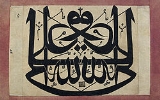
Islamic calligraphy, colloquially known as
Arabic calligraphy, is the art of artistic
handwritingPenmanship or handwriting is the art of writing with the hand and a writing instrument. Styles of handwriting are also called hands or scripts.-History:...
, or
calligraphyCalligraphy is a type of visual art. It is often called the art of writing . A contemporary definition of calligraphic practice is "the art of giving form to signs in an expressive, harmonious and skillful manner"...
, and by extension, of
bookmakingBookbinding is the process of physically assembling a book from a number of folded or unfolded sheets of paper or other material. It also usually involves attaching covers to the resulting text-block.- History :...
. This art, associated with
IslamIslam Islam Islam ( al-’islām,
[There are ten pronunciations of Islam in English, differing in whether the first or second syllable has the stress, whether the s is or , and whether the a is pronounced as in father, as in cat, or (when the stress is on the i) as in the a of sofa...]
, has most often employed the
Arabic scriptThe Arabic alphabet is the script used for writing several languages of Asia and Africa, such as Arabic and Urdu. After the Latin alphabet, it is the second-most widely used alphabet around the world....
, throughout many languages including
ArabicArabic is a Central Semitic language, thus related to and classified alongside other Semitic languages such as Hebrew and the Neo-Aramaic languages. In terms of speakers, the Arabic macrolanguage is the largest member of the Semitic language family. It is spoken by more than 280 million people as...
. Calligraphy is especially revered among
Islamic artIslamic art encompasses the visual arts produced from the 7th century onwards by people who lived within the territory that was inhabited by culturally Islamic populations...
s since it was the primary means for the preservation of the
Qur'anThe Qur’an is the central religious text of Islam...
. The work of calligraphers was collected and appreciated. Consideration of figurative art as
idolatrousIn an Islamic context, the Arabic word taghut refers to idolatry, considered impurity. This can be anything worshipped other than the one true God , such as deities of other religions, people claiming themselves to be holy outside of Islam's definition, or the worshipping of ideas or ideologies...
led to calligraphy and abstract depictions becoming the main forms of artistic expression in Islamic cultures.
Arabic,
PersianThe Persian people are the majority ethnic group in Iran. However, there are sub-groups who speak the Persian language as their mother tongue throughout the Iranian plateau. The term Persian has also a supra-ethnic significance and has been historically referred to a part of Iranian peoples...
and
Ottoman TurkishThe Ottoman Empire or Ottoman State , also known by its contemporaries as the Turkish Empire or Turkey , was an empire that lasted from 1299 to November 1, 1922 The Ottoman Empire or Ottoman State (Ottoman Turkish: دَوْلَتِ عَلِیَّهِ عُثْمَانِیَّه Dawlet-il ʿAliyyat-il ʿOs̠māniyye, Modern Turkish:...
calligraphy is associated with geometric Islamic art (the
ArabesqueThe arabesque is an elaborative application of repeating geometric forms that often echo the forms of plants and animals. Arabesques are an element of Islamic art usually found decorating the walls of mosques. The choice of which geometric forms are to be used and how they are to be formatted is...
) on the walls and ceilings of
mosqueA mosque is a place of worship for followers of Islam. Muslims often refer to the mosque by its Arabic name, masjid, —...
s as well as on the page.
Islamic calligraphy, colloquially known as
Arabic calligraphy, is the art of artistic
handwritingPenmanship or handwriting is the art of writing with the hand and a writing instrument. Styles of handwriting are also called hands or scripts.-History:...
, or
calligraphyCalligraphy is a type of visual art. It is often called the art of writing . A contemporary definition of calligraphic practice is "the art of giving form to signs in an expressive, harmonious and skillful manner"...
, and by extension, of
bookmakingBookbinding is the process of physically assembling a book from a number of folded or unfolded sheets of paper or other material. It also usually involves attaching covers to the resulting text-block.- History :...
. This art, associated with
IslamIslam Islam Islam ( al-’islām,
[There are ten pronunciations of Islam in English, differing in whether the first or second syllable has the stress, whether the s is or , and whether the a is pronounced as in father, as in cat, or (when the stress is on the i) as in the a of sofa...]
, has most often employed the
Arabic scriptThe Arabic alphabet is the script used for writing several languages of Asia and Africa, such as Arabic and Urdu. After the Latin alphabet, it is the second-most widely used alphabet around the world....
, throughout many languages including
ArabicArabic is a Central Semitic language, thus related to and classified alongside other Semitic languages such as Hebrew and the Neo-Aramaic languages. In terms of speakers, the Arabic macrolanguage is the largest member of the Semitic language family. It is spoken by more than 280 million people as...
. Calligraphy is especially revered among
Islamic artIslamic art encompasses the visual arts produced from the 7th century onwards by people who lived within the territory that was inhabited by culturally Islamic populations...
s since it was the primary means for the preservation of the
Qur'anThe Qur’an is the central religious text of Islam...
. The work of calligraphers was collected and appreciated. Consideration of figurative art as
idolatrousIn an Islamic context, the Arabic word taghut refers to idolatry, considered impurity. This can be anything worshipped other than the one true God , such as deities of other religions, people claiming themselves to be holy outside of Islam's definition, or the worshipping of ideas or ideologies...
led to calligraphy and abstract depictions becoming the main forms of artistic expression in Islamic cultures.
Arabic,
PersianThe Persian people are the majority ethnic group in Iran. However, there are sub-groups who speak the Persian language as their mother tongue throughout the Iranian plateau. The term Persian has also a supra-ethnic significance and has been historically referred to a part of Iranian peoples...
and
Ottoman TurkishThe Ottoman Empire or Ottoman State , also known by its contemporaries as the Turkish Empire or Turkey , was an empire that lasted from 1299 to November 1, 1922 The Ottoman Empire or Ottoman State (Ottoman Turkish: دَوْلَتِ عَلِیَّهِ عُثْمَانِیَّه Dawlet-il ʿAliyyat-il ʿOs̠māniyye, Modern Turkish:...
calligraphy is associated with geometric Islamic art (the
ArabesqueThe arabesque is an elaborative application of repeating geometric forms that often echo the forms of plants and animals. Arabesques are an element of Islamic art usually found decorating the walls of mosques. The choice of which geometric forms are to be used and how they are to be formatted is...
) on the walls and ceilings of
mosqueA mosque is a place of worship for followers of Islam. Muslims often refer to the mosque by its Arabic name, masjid, —...
s as well as on the page. Contemporary artists in the Islamic world draw on the heritage of calligraphy to use calligraphic inscriptions or abstractions in their work.
Role in Islamic culture
Calligraphy has arguably become the most venerated form of Islamic art because it provides a link between the
languages of the Muslims with the religion of Islam. The holy book of Islam, the
Qur'anThe Qur’an is the central religious text of Islam...
, has played an important role in the development and evolution of the
Arabic languageArabic is a Central Semitic language, thus related to and classified alongside other Semitic languages such as Hebrew and the Neo-Aramaic languages. In terms of speakers, the Arabic macrolanguage is the largest member of the Semitic language family. It is spoken by more than 280 million people as...
, and by extension, calligraphy in the Arabic alphabet.
ProverbA proverb , also called a byword or nayword, is a simple and concrete saying popularly known and repeated, which expresses a truth, based on common sense or the practical experience of humanity. They are often metaphorical. A proverb that describes a basic rule of conduct may also be known as a maxim...
s and complete passages from the Qur'an are still active sources for Islamic calligraphy. The
Arabic alphabetThe Arabic alphabet is the script used for writing several languages of Asia and Africa, such as Arabic and Urdu. After the Latin alphabet, it is the second-most widely used alphabet around the world....
consists of 28 letters and 18 different forms of writing.
The
DiwaniDiwani is a calligraphic variety of Arabic script, a cursive style developed during the reign of the early Ottoman Turks...
script is a cursive style of Arabic calligraphy developed during the reign of the early
OttomanThe Ottoman Empire or Ottoman State , also known by its contemporaries as the Turkish Empire or Turkey , was an empire that lasted from 1299 to November 1, 1922 The Ottoman Empire or Ottoman State (Ottoman Turkish: دَوْلَتِ عَلِیَّهِ عُثْمَانِیَّه Dawlet-il ʿAliyyat-il ʿOs̠māniyye, Modern Turkish:...
TurksTurkey , known officially as the Republic of Turkey
, is a Eurasian country that stretches across the Anatolian peninsula in Western Asia and Thrace in the Balkan region of southeastern Europe...
(16th and early 17th centuries). It was invented by Housam Roumi and reached its height of popularity under Süleyman I the Magnificent (1520–66). As decorative as it was communicative,
Diwani was distinguished by the complexity of the line within the letter and the close juxtaposition of the letters within the word. A variation of the
Diwani, the
Diwani Al Jali, is characterized by its abundance of diacritical and ornamental marks.
Finally, the most common script for everyday use is
Ruq'ahRuq'ah or Riq'a is a calligraphic variety of Arabic script. The Ruq`ah style of handwriting is one of the "modern" types of handwriting. It is known for its clipped letters composed of short, straight lines and simple curves, as well as its straight and even lines of text. It was probably derived...
(also known as
Riq'a). Simple and easy to write, its movements are small, without much amplitude. It is the one most commonly seen. It is considered a step up from
NaskhNaskh is a specific calligraphic style for writing in the Arabic alphabet, thought to be invented by Ibn Muqlah...
script, which children are taught first. In later grades they are introduced to
Ruq'ah.
In China, a calligraphic form called
SiniSini is a Chinese Islamic calligraphic form for the Arabic script. It can refer to any type of Chinese Islamic calligraphy, but is commonly used to refer to one with thick and tapered effects, much like Chinese calligraphy. It is used extensively in mosques in eastern China, and to a lesser extent...
has been developed. This form has evident influences from Chinese calligraphy, using a horsehair brush as opposed to the standard reed pen. A famous modern calligrapher in this tradition is
HajjiHajji , or El-Hajj, is an honorific title given to a Muslim person who has successfully completed the Hajj to Mecca, and is often used to refer to an elder, since it takes time to accumulate the wealth to fund the travel. The title is placed before a person's name...
Noor Deen Mi GuangjiangHajji Noor Deen Mi Guangjiang is an expert in Islamic calligraphy, specializing in the Sini style which originated from the Chinese Muslim tradition. Born in the province of Shandong, he is a lecturer at the Islamic College at Zhengzhou in the province of Henan, and is also a researcher of...
.
Calligrams
CalligraphyCalligraphy is a type of visual art. It is often called the art of writing . A contemporary definition of calligraphic practice is "the art of giving form to signs in an expressive, harmonious and skillful manner"...
, the most Islamic of arts in the Muslim world, has also its figurative sides. By interweaving written words, made from an "Allah", a "Muhammad", a "
BismillahThere are multiple uses of Bismillah :* Bismillah is first word of the Basmala phrase of Islam.* Bismillah , born in Oruzgan, Afghanistan, in 1952...
", etc., or using
micrographyMicrography , also called microcalligraphy, is a Jewish art form developed in the 9th century, with parallels in Christianity and Islam , utilizing minute Hebrew letters to form representational, geometric and abstract designs...
, calligraphers produced anthropomorphic figures ('Ali, the Ideal Human of mystics, a praying man, a face), zoomorphisms (symbolic creatures, most from the Shi'a iconography, like the lion (Duldul, horse of 'Ali, horse ('Ali's Duldul), fish, stork or other bird (the qur'anic Hudhud)) and inanimate representations (a sword (
Dhu al-FiqarZulfiqar "bifurcated"" is the sword of the Islamic leader ‘Alī. In Arabic the name is commonly transliterated as Dhu al-Fiqar, Thulfeqar, Dhulfiqar, Zoulfikar etc...
), a mosque, a ship (made from the letter
wawWaw is the sixth letter of many Semitic alphabets, including Phoenician, Aramaic, Hebrew, Syriac, and Arabic...
, a symbol of mystical union, literally meaning "and," in Arabic)). Calligrams are related to Muslim mysticism and popular with many leading calligraphers in
TurkeyTurkey , known officially as the Republic of Turkey
, is a Eurasian country that stretches across the Anatolian peninsula in Western Asia and Thrace in the Balkan region of southeastern Europe...
, Persia and
IndiaIndia, officially the Republic of India , is a country in South Asia. It is the seventh-largest country by geographical area, the second-most populous country, and the most populous democracy in the world. Bounded by the Indian Ocean on the south, the Arabian Sea on the west, and the Bay of Bengal...
from the 17th century onward.
In the teachings of calligraphy, figurative imagery is used to help visualize the shape of letters to trace, for example, the letter
ha' looks in
nasta'liq similar to two eyes, as its Persian name implies: "ha' two eyes"
he' do tcheshm). In literature and poetry seeing in letters a reflection of the natural world goes back to the
AbbasidThe Abbasid Caliphate was the third of the Islamic Caliphates of the Islamic Empire. It was ruled by the Abbasid dynasty of caliphs, who built their capital in Baghdad after overthrowing the Umayyad caliphs from all but Al Andalus....
times.
One of the contemporary masters of the calligram genre is
Hassan MassoudyHassan Massoudy is an Iraqi calligrapher who has published many collections of his work.He was born in 1944, in Najaf and currently lives in Paris, France.-Biography:Hassan Massoudy was born in 1944 in Najef, South of Iraq...
.
Good commercial examples are the logos of
Al JazeeraAl Jazeera , which means "The Island" or "The Peninsula" in Arabic, referring to the network's status as the only independent news network in the Middle East, is a television network headquartered in Doha, Qatar...
, an international news station based at
QatarQatar , also known as the State of Qatar or locally ', is an Arab emirate in the Middle East, occupying the small Qatar Peninsula on the northeasterly coast of the larger Arabian Peninsula...
, and the
Edinburgh Middle East ReportThe Edinburgh Middle East Report is Scotland's only publication dedicated to the Middle East...
, a Scottish academic journal on the
Middle EastThe Middle East is a region that spans southwestern Asia, southeastern Europe, and northeastern Africa. It has no clear boundaries, often used as a synonym to Near East, in opposition to Far East...
.
Instruments and media
The traditional instrument of the Arabic calligrapher is the
qalamA qalam is a type of pen made from a dried reed, used for Arabic calligraphy. The word derives from the Greek word κάλαμος, meaning reed. In modern Arabic, Persian, Turkish and Kurdish, the word simply means "pen" or "pencil", while in Hindi and Urdu, the word solely means "pen". It is also the...
, a
penA pen is a long, thin rounded device used to apply ink to a surface for the purpose of writing, usually paper. There are several different types, including ballpoint, rollerball, fountain, felt-tip. Historically, reed pens, quill pens, and dip pens were used. Modern day pens come in a varity of...
made of dried
reedPhragmites australis, the common reed, is a large perennial grass found in wetlands throughout temperate and tropical regions of the world. It is sometimes regarded as the sole species of the genus Phragmites, though some botanists divide Phragmites australis into three or four species and in...
or
bambooThe bamboos are a group of woody perennial evergreen plants in the true grass family Poaceae, subfamily Bambusoideae, tribe Bambuseae. Some are giant bamboos, the largest members of the grass family. Bamboos are the fastest growing woody plants in the world...
; the
inkAn ink is a liquid containing various pigments and/or dyes used for coloring a surface to produce an image, text, or design. Ink is used for drawing and/or writing with a pen, brush or quill...
is often in color, and chosen such that its intensity can vary greatly, so that the greater strokes of the compositions can be very dynamic in their effect.
A variety of media were employed for presenting calligraphy. Before the advent of paper, papyrus and parchment were used for writing. The advent of paper revolutionized calligraphy. While monasteries in Europe treasured a few dozen volumes, libraries in the
Muslim worldThe term Muslim world has several meanings. In a cultural sense it refers to the worldwide community of Muslims, adherents of Islam. This community numbers about 1.3-1.5 billion people, roughly one-fifth of the world population. This community is spread across many different nations and ethnic...
regularly contained hundreds and even thousands of volumes of books.
Another medium for calligraphy were coins. Beginning in 692, the Islamic caliphate reformed the coinage of the Near East by replacing visual depiction by words. This was especially true for
dinars, or gold coins of high value. Generally the coins were inscribed with quotes from the Qur'an.
By the tenth century, the Persians, who had converted to Islam, began weaving inscriptions on to elaborately patterned silks. So precious were calligraphic inscribed textile, that Crusaders brought them to Europe as prized possessions. A notable example is the Shroud of St. Josse, used to wrap the bones of St. Josse in the abbey of St. Josse-sur-Mer near Caen in northwestern France.
Mosque calligraphy
Islamic
Mosque calligraphy is a style of
calligraphyCalligraphy is a type of visual art. It is often called the art of writing . A contemporary definition of calligraphic practice is "the art of giving form to signs in an expressive, harmonious and skillful manner"...
that can be found in and out of any
mosqueA mosque is a place of worship for followers of Islam. Muslims often refer to the mosque by its Arabic name, masjid, —...
. It is considered to be part of
Islamic artIslamic art encompasses the visual arts produced from the 7th century onwards by people who lived within the territory that was inhabited by culturally Islamic populations...
, more specifically
ArabesqueThe arabesque is an elaborative application of repeating geometric forms that often echo the forms of plants and animals. Arabesques are an element of Islamic art usually found decorating the walls of mosques. The choice of which geometric forms are to be used and how they are to be formatted is...
. Arabesque is a form of Islamic art known for its repetitive geometric forms creating beautiful decorations. These geometric shapes often include Arabic calligraphy written on walls and ceilings inside and outside of mosques. The subject of these writings can be derived from different sources in Islam. It can be derived from the written words of
Qur'anThe Qur’an is the central religious text of Islam...
or from the oral traditions relating to the words and deeds of Islamic Prophet Muhammad.
Commonly used in mosques:
Bismillah ir-Rahman ir-Rahim
is the most common phrase found in mosques. It is a beautiful poetic Arabic phrase which offers both deep insight and brilliant inspiration. It has often been said that the phrase the true essence of the entire Quran, as well as the true essence of all religions. Its meaning is pure and spiritual. It means:
"In the name of God, most Gracious, most Compassionate"
Allah & Muhammad
AllahAllah is the standard Arabic word for God. While the term is best known in the West for its use by Muslims as a reference to God, it is used by Arabic-speakers of all Abrahamic faiths, including Christians and Jews, in reference to "God"...
is Arabic for one god and Muhammad is the last prophet in Islam. Both Allah and Muhammad are almost always found inside mosques as a reminder of the religion's main beliefs.
See also
- Persian calligraphy
Persian calligraphy is the calligraphy of Persian writing system. It has been one of the most revered arts throughout Persian history. It is considered to be one of the most eye catching and fascinating manifestations of Persian culture.-History:...
- Islamic architecture
Islamic architecture encompasses a wide range of both secular and religious styles from the foundation of Islam to the present day, influencing the design and construction of buildings and structures in Islamic culture....
- Islamic pottery
The era of Islamic pottery started around 622. From 633, Muslim armies moved rapidly towards Persia, Byzantium, Mesopotamia, Anatolia, Egypt and later Andalusia. The early history of Islamic pottery remains somewhat obscure and speculative as little evidence has survived...
- Islamic Golden Age
The Islamic Golden Age or the Islamic Renaissance, is traditionally dated from the 9th to 13th centuries for 400 years C.E., but has been extended to the 15th century by recent scholarship...
- Ottoman Turkish language
Ottoman Turkish is the variety of the Turkish language that was used as the administrative and literary language of the Ottoman Empire. It contains extensive borrowings from Arabic and Persian languages and was written in a variant of the Perso-Arabic script...
Calligraphers
Some classical calligraphers:
- Mir Emad Hassani
Mir Emad is perhaps the most celebrated Persian calligrapher. It is believed that the Nasta'liq style reached its highest elegance in Mir Emad's works...
(1544–1615)
Some contemporary calligraphers:
- Hamid al-Amidi (1891–1982)
- Ismail Gulgee
Ismail Gulgee Pride of Performance, Sitara-e-Imtiaz , Hilal-e-Imtiaz, was an award-winning, globally famous Pakistani artist born in Peshawar. He was a qualified engineer in the U.S. and self-taught abstract painter and portrait painter. Before 1959, as portraitist, he painted the entire Afghan...
(1926-2007)
- Sadequain
Syed Sadequain Ahmed Naqvi , Tamgha-e-Imtiaz, Pride of Performance, Sitara-e-Imtiaz, also often referred to as Sadequain Naqqash, was a world-renowned Pakistani artist, best known for his skills as a calligrapher and a painter...
(1930-1987)
- Hassan Massoudy
Hassan Massoudy is an Iraqi calligrapher who has published many collections of his work.He was born in 1944, in Najaf and currently lives in Paris, France.-Biography:Hassan Massoudy was born in 1944 in Najef, South of Iraq...
(born 1944)
- Khalil al-Zahawi
Khalil al-Zahawi was one of Iraq's most prominent Arabic calligraphers. An ethnic Kurd and a native of Diyala Governorate, he began studying calligraphy in 1959, and moved to Baghdad in 1963, where he gave his first exhibition in 1965...
(1946–2007)
- Garine Torosian (born 1954)
- M.J. Alhabeeb
M.J. Alhabeeb is an Iraqi American contemporary calligrapher who follows the original traditions in Arabic-Islamic calligraphy...
(born 1954)
- Muhammad Qasim Malik
Colonel Muhammad Qasim Malik S.I. is a Pakistani soldier and calligrapher. Qasim is noted for his Quranic calligraphy, which has been displayed at the Pakistan National Library in Islamabad...
(born 1957)
- Towhidi Tabari
Towhidi Tabari is an Iranian calligrapher, painter and Persian style illuminator. He was born in Babol, Iran and currently lives in Paris, France....
(born 1964)
- Hajji
Hajji , or El-Hajj, is an honorific title given to a Muslim person who has successfully completed the Hajj to Mecca, and is often used to refer to an elder, since it takes time to accumulate the wealth to fund the travel. The title is placed before a person's name...
Noor Deen Mi GuangjiangHajji Noor Deen Mi Guangjiang is an expert in Islamic calligraphy, specializing in the Sini style which originated from the Chinese Muslim tradition. Born in the province of Shandong, he is a lecturer at the Islamic College at Zhengzhou in the province of Henan, and is also a researcher of...
(born 1963)
External links
- Arabic Calligraphy
- "Major Calligraphic Styles", IslamicArt.com. Features examples of different text in different styles of Arabic calligraphy.
- "Arabic Calligraphy in Different Writing Styles", Horace Mann Academic Middle School: Medieval Islamic Cultures. Features the same text in different styles of Arabic calligraphy.
- "Calligraphy Gallery", ArtHafez.com: Unique Islamic Art with Spiritual Inspiration.
- "Arabic Calligraphy", Wareh Art: Aerosol Calligraphy.
- "The World of Kufic Art", Kufic Encyclopedia.
- Islamic Calligraphy & Islamic Calligraphers.
- "The Calligraphic Tradition in Islam", The Institute of Ismaili Studies (Gallery of images).
- "'Calligrapher' ile ilgili yazılar" ["Calligrapher's biographries"], Kalem Güzeli. Page in English but website mainly in Turkish.
- "Islamic Calligraphy In China", China Heritage Newsletter.
- CalligraphyIslamic.com.
- "Ottoman Calligraphy at the Sackler Museum", The Harvard University Gazette.
- "Islamic calligraphy", IslamiCity.com.
- "Selections of Arabic, Persian, and Ottoman Calligraphy", Global Gateway: World Culture & Resources.
- Art and Architecture of the Arab World, including Calligraphy
- "Arabic calligraphy", CreativeBits.org.
- "Baytulhabeeb", M.J. Alhabeeb's Arabic Calligraphy & Painting.
- "Calligraphy Collection", Sakıp Sabancı Müzesi [Sakıp Sabancı 'Museum'].