

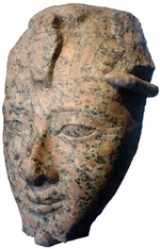
Amenhotep II

Encyclopedia
Amenhotep II was the seventh Pharaoh
of the 18th dynasty
of Egypt
. Amenhotep inherited a vast kingdom from his father Thutmose III
, and held it by means of a few military campaigns in Syria
; however, he fought much less than his father, and his reign saw the effective cessation of hostilities between Egypt and Mitanni
, the major kingdoms vying for power in Syria. His reign is usually dated from 1427 to 1400 BC.
. He was not, however, the firstborn son of this pharaoh; his elder brother Amenemhat, the son of the great king's chief wife Satiah
, was originally the intended heir to the throne since Amenemhat was designated the 'king's eldest son" and overseer of the cattle of Amun in Year 24 of Thutmose's reign. However, between Years 24 and 35 of Thutmose III, both queen Satiah and prince Amenemhat died, which prompted the pharaoh to marry the non-royal Merytre-Hatshepsut. She would bear Thutmose III a number of children including the future Amenhotep II. Amenhotep II was born and raised in Memphis in the north, instead of in Thebes, the traditional capital. While a prince, he oversaw deliveries of wood sent to the dockyard of Peru-nūfe in Memphis, and was made the Setem, the high priest over Lower Egypt. Amenhotep has left several inscriptions touting his athletic skills while he was a leader of the army before his crowning. Amenhotep was no less athletic than his powerful father. He claims to have been able to shoot an arrow through a copper target one palm thick, and that he was able to row his ship faster and farther than two hundred members of the navy could row theirs. Accordingly some skepticism concerning the truth of his claims has been expressed among Egyptologists.
Amenhotep acceded to the throne on the first day of the fourth month of Akhet, but his father died on the thirtieth day of the third month of Peret. If an Egyptian crown prince was proclaimed king but did not take the throne on the day after his father's death, it meant that he served as the junior coregent during his father's reign. A coregency with Thutmose III and Amenhotep II is believed to have lasted for two years and four months.
When he assumed power, Amenhotep II was 18 years old according to an inscription from his great Sphinx stela:
After becoming pharaoh, Amenhotep married a woman of uncertain parentage named Tiaa. As many as ten sons and one daughter have been attributed to him. Amenhotep's most important son was Thutmose IV, who succeeded him; however, there is significant evidence for him having many more children. Princes Amenhotep, Webensenu, Amenemopet, and Nedjem are all clearly attested, and Amenemhat, Khaemwaset, and Aakheperure as well as a daughter, Iaret, are also possible children.
Papyrus B.M. 10056, which dates to sometime after Amenhotep II's tenth year, refers to a king's son and setem-priest Amenhotep. This Amenhotep might also be attested in a stele from Amenhotep II's temple at Giza, however the stele's name has been defaced so that positive identification is impossible. Stele B may belong to another son, Webensenu. Webensenu's name is otherwise attested on a statue of Amenhotep's chief architect, Minmose, and his canopic jars and a funerary statue have been found in Amenhotep II's tomb. Another Giza stele, stele C, records the name of a Prince Amenemopet, whose name is otherwise unattested. The same statue with the name Webensenu on it is also inscribed with the name of prince Nedjem, who is otherwise unattested.
There are other references to king's sons from this period who may or may not be sons of Amenhotep II. Two graffiti from Sahel mention a king's son and stable master named Khaemwaset, but specifically which king is his father is unknown. A figure with the name Amenemhet is recorded behind a prince Amenhotep in Theban tomb 64, and assuming this Amenhotep is indeed the king's son from B.M. 10056, Amenemhat would also be Amenhotep II's son. Additionally, a prince Aakheperure is mentioned in a Konosso graffito alongside a prince Amenhotep, and if one again assumes that this Amenhotep was the same person as the one in B.M. 10056, Aakheperure would also have been Amenhotep II's son. However, in both these cases the figure identified as Amenhotep has been identified by some as possible references to the later King Amenhotep III
, which would make these two princes sons Thutmose IV. In addition to sons, Amenhotep II may have had a daughter named Iaret, but she could have also been the daughter of Thutmose IV.
Two more sons had been attributed to Amenhotep II in the past, however, they have since been proven to be of other parentage. Gauthier catalogued one Usersatet, the "King's son of Kush," (i.e. Viceroy of Nubia) as a son of Amenhotep II, as well as one Re, however, both are now known to be unrelated to the royal family.
Usersatet merely served as Amenhotep's chief official in Nubia and was not a blood relative of the king.
while crossing the Orontes river, but he emerged victorious and acquired rich booty, among which even the equipment of a Mitanni charioteer is mentioned. The king was well known for his physical prowess and is said to have singlehandedly killed 7 rebel Princes at Kadesh
, which successfully terminated his first Syrian campaign on a victorious note. After the campaign, the king ordered the bodies of the seven princes to be hung upside down on the prow of his ship. Upon reaching Thebes
all but one of the princes were mounted on the city walls. The other was taken to the often rebellious territory of Nubia
and hung on the city wall of Napata
, as an example of the consequence of rising against Pharaoh and to demoralise any Nubian opponents of Egyptian authority there. Amenhotep called this campaign his first in a Stele from Amada, however he also called his second campaign his first, causing some confusion. The most common solution for this, although not universally accepted, is that this was the first campaign he fought alone before the death of his father and thus before he was the sole king of Egypt, and he counted his second campaign as his first because it was the first that was his and his alone.
Amenhotep's first campaign was so successful that he is recorded as having captured a vast amount of war booty "consisting of 6,800 deben of gold and 500,000 deben of copper (about 1,643 and 120,833 pounds respectively), as well as 550 mariannu captives, 210 horses and 300 chariots."
In April of his seventh year, Amenhotep was faced with a major rebellion in Syria by the vassal states of Naharin and dispatched his army to the Levant to suppress it. This rebellion was likely instigated by Egypt's chief Near Eastern rival, Mitanni
. His stele of victory carved after this campaign records no major battles, which has been read a number of ways. It may be that this campaign was more similar to one of the tours of Syria which his father had fought, and he only engaged minor garrisons in battle and forced cities to swear allegiance to him–oaths immediately broken after his departure. Alternatively, it appears that the two weeks when Amenhotep would have been closest to Mitanni are omitted from the stele, thus it is possible that his army was defeated on this campaign. Amenhotep's last campaign took place in his ninth year, however it apparently did not proceed farther north than the Sea of Galilee
. According to the list of plunder from this campaign, Amenhotep took 101,128 slaves, which is an obviously exaggerated figure. Some of these slaves may have been recounted from the year 7 campaign, such as 15,070 citizens of Nukhash, since Amenhotep did not campaign anywhere near Nukhash on his year 9 campaign. However, even accounting for this recounting, the numbers still are too high to be realistic, and are probably just exaggerated.
After the campaign in Amenhotep's ninth year, Egyptian and Mitannian armies never fought again, and the two kingdoms seem to have reached some sort of peace. Amenhotep records that the kings of Babylon, the Hittites, and Mitanni came to make peace and pay tribute to him after his ninth year, although this may be outlandish boasting. However, a second passage appears on the walls of Karnak, saying that the princes of Mitanni came to seek peace with Amenhotep, and this cannot be so easily explained away. The rising power of the Hittites eventually persuaded Mitanni to seek an ally, and there was definitely a treaty of some sort between Egypt and Mitanni by the time of Amenhotep's successor, but it may be that it was enacted after Amenhotep's campaigns, to try to prevent any more of campaigns of mass deportations. Whenever formal peace was enacted, an informal peace was maintained between Amenhotep and the king of Mitanni. Thereafter, Amenhotep concentrated on domestic matters, with one possible exception. A shrine of Amenhotep's Nubian viceroy shows Amenhotep receiving tribute after a Nubian campaign, but it is not possible to date when this happened.
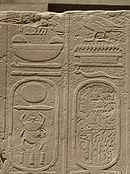 Since Thutmose III had devoted so much energy to expanding Karnak, Amenhotep's building projects were largely focused on enlarging smaller temples all over Egypt. In the Delta, his father's Overseer of Works, Minmose
, is attested from an inscription at Tura
as overseeing construction of more temples. He also built a temple to Horemakhet
near the Great Sphinx at Giza. In upper Egypt, small shrines are attested at Medamud
, el-Tod, and Armant. Karnak, despite not receiving the attention given it by his father, also was not totally neglected. He commissioned a column to stand in the courtyard between the fourth and fifth pylon
s commemorating the reception of tribute from Mitanni
. In Nubia, Amenhotep built at Qasr Ibrim and Semna, and ordered the decoration of the Temple at Kalabsha. However, his most famous Nubian temple was at Amada. Thutmose III had begun constructing a temple which, technically, was dedicated to Horus there, although the presence of Re-Harakhti and Amun-Re is easily observed. Amenhotep completed it and put in it the record of his year 3 campaign on a stele, which was until 1942 the source of most information about Amenhotep's wars.
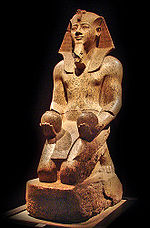 Amenhotep II, as kings before him, placed statues of himself both in front of and inside his temples. One shows him as an offering king in kneeling position with an altar (Cairo CG 42073). His statuary may be grouped on the basis of physiognomy and iconography. One can see a development from the statuary of Hatshepsut, Thutmoses III, Amenhotep II, Thutmoses IV, up to Amenhotep III. So the faces of the statues are not so much portraiture as an idealized face expressing artistic tradition and the contemporary ideal of beauty.
was discovered in March 1898 by Victor Loret
in his KV35
tomb in the Valley of the Kings
within his original sarcophagus
. He had a mortuary temple constructed at the edge of the cultivation in the Theban Necropolis
, close to where the Ramesseum
was later built, but it was destroyed in ancient times. Amenhotep II's KV35 tomb also proved to contain a mummy cache containing several New Kingdom Pharaohs including Thutmose IV
, Seti II
, Ramesses III
, Ramesses IV
, and Ramesses VI
. They had been re-buried in Amenhotep II's tomb by the 21st Dynasty High Priest of Amun, Pinedjem II
, during Siamun
's reign, to protect them from tomb robbers. The most detailed and balanced discussion on the chronology, events, and impact of Amenhotep II's reign was published by Peter Der Manuelian, in a 1987 book on this king.
Usersatet was so impressed (or fearful) of Amenhotep's message that he ordered a copy of it to be engraved on a stela "that was once [located] at the Second Cataract [in Nubia] and is now in Boston."
Amenhotep II did not openly record the names of his queens; some Egyptologists theorise that he felt that women had become too powerful under titles such as God's Wife of Amun
. They point to the fact that he participated in his father's removal of Hatshepsut
's name from her monuments and the destruction of her image.
The destruction of Hatshepsut's images began during the co-regency of Amenhotep when his father was very old, but stopped during his reign. However, the king may have harboured his father's concern that another woman would sit on the throne. Despite his efforts however it is possible that a female co-regent of Akhenaten
ruled as pharaoh before the end of his own 18th dynasty.
Pharaoh
Pharaoh is a title used in many modern discussions of the ancient Egyptian rulers of all periods. The title originates in the term "pr-aa" which means "great house" and describes the royal palace...
of the 18th dynasty
Eighteenth dynasty of Egypt
The eighteenth dynasty of ancient Egypt is perhaps the best known of all the dynasties of ancient Egypt...
of Egypt
History of Ancient Egypt
The History of Ancient Egypt spans the period from the early predynastic settlements of the northern Nile Valley to the Roman conquest in 30 BC...
. Amenhotep inherited a vast kingdom from his father Thutmose III
Thutmose III
Thutmose III was the sixth Pharaoh of the Eighteenth Dynasty. During the first twenty-two years of Thutmose's reign he was co-regent with his stepmother, Hatshepsut, who was named the pharaoh...
, and held it by means of a few military campaigns in Syria
Syria
Syria , officially the Syrian Arab Republic , is a country in Western Asia, bordering Lebanon and the Mediterranean Sea to the West, Turkey to the north, Iraq to the east, Jordan to the south, and Israel to the southwest....
; however, he fought much less than his father, and his reign saw the effective cessation of hostilities between Egypt and Mitanni
Mitanni
Mitanni or Hanigalbat was a loosely organized Hurrian-speaking state in northern Syria and south-east Anatolia from ca. 1500 BC–1300 BC...
, the major kingdoms vying for power in Syria. His reign is usually dated from 1427 to 1400 BC.
Family and early life
Amenhotep II was the son of Thutmose III and a minor wife of the king: Merytre-HatshepsutMerytre-Hatshepsut
Queen Merytre-Hatshepsut was the principal wife of Pharaoh Thutmose III and the mother of Amenhotep II.-Family:Merytre-Hatshepsut was of noble birth...
. He was not, however, the firstborn son of this pharaoh; his elder brother Amenemhat, the son of the great king's chief wife Satiah
Satiah
Satiah was an Ancient Egyptian queen, the Great Royal Wife of Thutmose III.-Family:Satiah was the daughter of the royal nurse Ipu. It is possible that her father was the important official Ahmose Pen-Nekhebet...
, was originally the intended heir to the throne since Amenemhat was designated the 'king's eldest son" and overseer of the cattle of Amun in Year 24 of Thutmose's reign. However, between Years 24 and 35 of Thutmose III, both queen Satiah and prince Amenemhat died, which prompted the pharaoh to marry the non-royal Merytre-Hatshepsut. She would bear Thutmose III a number of children including the future Amenhotep II. Amenhotep II was born and raised in Memphis in the north, instead of in Thebes, the traditional capital. While a prince, he oversaw deliveries of wood sent to the dockyard of Peru-nūfe in Memphis, and was made the Setem, the high priest over Lower Egypt. Amenhotep has left several inscriptions touting his athletic skills while he was a leader of the army before his crowning. Amenhotep was no less athletic than his powerful father. He claims to have been able to shoot an arrow through a copper target one palm thick, and that he was able to row his ship faster and farther than two hundred members of the navy could row theirs. Accordingly some skepticism concerning the truth of his claims has been expressed among Egyptologists.
Amenhotep acceded to the throne on the first day of the fourth month of Akhet, but his father died on the thirtieth day of the third month of Peret. If an Egyptian crown prince was proclaimed king but did not take the throne on the day after his father's death, it meant that he served as the junior coregent during his father's reign. A coregency with Thutmose III and Amenhotep II is believed to have lasted for two years and four months.
When he assumed power, Amenhotep II was 18 years old according to an inscription from his great Sphinx stela:
- "Now his Majesty appeared as king as a fine youth after he had become 'well developed', and had completed eighteen years in his strength and bravery."
After becoming pharaoh, Amenhotep married a woman of uncertain parentage named Tiaa. As many as ten sons and one daughter have been attributed to him. Amenhotep's most important son was Thutmose IV, who succeeded him; however, there is significant evidence for him having many more children. Princes Amenhotep, Webensenu, Amenemopet, and Nedjem are all clearly attested, and Amenemhat, Khaemwaset, and Aakheperure as well as a daughter, Iaret, are also possible children.
Papyrus B.M. 10056, which dates to sometime after Amenhotep II's tenth year, refers to a king's son and setem-priest Amenhotep. This Amenhotep might also be attested in a stele from Amenhotep II's temple at Giza, however the stele's name has been defaced so that positive identification is impossible. Stele B may belong to another son, Webensenu. Webensenu's name is otherwise attested on a statue of Amenhotep's chief architect, Minmose, and his canopic jars and a funerary statue have been found in Amenhotep II's tomb. Another Giza stele, stele C, records the name of a Prince Amenemopet, whose name is otherwise unattested. The same statue with the name Webensenu on it is also inscribed with the name of prince Nedjem, who is otherwise unattested.
There are other references to king's sons from this period who may or may not be sons of Amenhotep II. Two graffiti from Sahel mention a king's son and stable master named Khaemwaset, but specifically which king is his father is unknown. A figure with the name Amenemhet is recorded behind a prince Amenhotep in Theban tomb 64, and assuming this Amenhotep is indeed the king's son from B.M. 10056, Amenemhat would also be Amenhotep II's son. Additionally, a prince Aakheperure is mentioned in a Konosso graffito alongside a prince Amenhotep, and if one again assumes that this Amenhotep was the same person as the one in B.M. 10056, Aakheperure would also have been Amenhotep II's son. However, in both these cases the figure identified as Amenhotep has been identified by some as possible references to the later King Amenhotep III
Amenhotep III
Amenhotep III also known as Amenhotep the Magnificent was the ninth pharaoh of the Eighteenth dynasty. According to different authors, he ruled Egypt from June 1386 to 1349 BC or June 1388 BC to December 1351 BC/1350 BC after his father Thutmose IV died...
, which would make these two princes sons Thutmose IV. In addition to sons, Amenhotep II may have had a daughter named Iaret, but she could have also been the daughter of Thutmose IV.
Two more sons had been attributed to Amenhotep II in the past, however, they have since been proven to be of other parentage. Gauthier catalogued one Usersatet, the "King's son of Kush," (i.e. Viceroy of Nubia) as a son of Amenhotep II, as well as one Re, however, both are now known to be unrelated to the royal family.
Usersatet merely served as Amenhotep's chief official in Nubia and was not a blood relative of the king.
Dates and length of reign
Amenhotep's coronation can be dated without much difficulty because of a number of lunar dates in the reign of his father, Thutmose III. These sightings limit the date of Thutmose's accession to either 1504 or 1479 BC. Thutmose died after 54 years of reign, at which time Amenhotep would have acceded to the throne. Amenhotep's short coregency with his father would then move his accession two years and four months earlier, dating his accession to either 1427 BC in the low chronology, or in 1454 BC in the high chronology. The length of his reign is indicated by a wine jar inscribed with the king's prenomen found in Amenhotep II's funerary temple at Thebes; it is dated to this king's highest known date—his Year 26—and lists the name of the pharaoh's vintner, Panehsy. Mortuary temples were generally not stocked until the king died or was near death; therefore, Amenhotep could not have lived much later beyond his 26th year. There are alternate theories which attempt to assign him a reign of up to 35 years, which is the absolute maximum length he could have reigned. In this chronology, he reigned from 1454 to 1419. However, there are problems facing these theories which cannot be resolved. In particular, this would mean Amenhotep died when he was 52, but an X-ray analysis of his mummy has shown him to have been about 40 when he died. Accordingly, Amenhotep II is usually given a reign of 26 years and said to have reigned from 1427 to 1401 BC.Foreign affairs
Amenhotep's first campaign took place in his third regnal year. It is known that the pharaoh was attacked by the host of QatnaQatna
Qatna is an archaeological site in the Wadi il-Aswad, a tributary of the Orontes, 18 km northeast of Homs, Syria. It consists in a tell occupying 1 km², which makes it one of the largest Bronze Age towns in western Syria...
while crossing the Orontes river, but he emerged victorious and acquired rich booty, among which even the equipment of a Mitanni charioteer is mentioned. The king was well known for his physical prowess and is said to have singlehandedly killed 7 rebel Princes at Kadesh
Kadesh
This article is about Kadesh in the lands of the Amurru, bordering on Damascus Syria up to Hammath; see also Kadesh or Kedesh Kadesh was an ancient city of the Levant, located on or near the headwaters or ford of the Orontes River...
, which successfully terminated his first Syrian campaign on a victorious note. After the campaign, the king ordered the bodies of the seven princes to be hung upside down on the prow of his ship. Upon reaching Thebes
Thebes, Egypt
Thebes is the Greek name for a city in Ancient Egypt located about 800 km south of the Mediterranean, on the east bank of the river Nile within the modern city of Luxor. The Theban Necropolis is situated nearby on the west bank of the Nile.-History:...
all but one of the princes were mounted on the city walls. The other was taken to the often rebellious territory of Nubia
Nubia
Nubia is a region along the Nile river, which is located in northern Sudan and southern Egypt.There were a number of small Nubian kingdoms throughout the Middle Ages, the last of which collapsed in 1504, when Nubia became divided between Egypt and the Sennar sultanate resulting in the Arabization...
and hung on the city wall of Napata
Napata
Napata was a city-state of ancient Nubia on the west bank of the Nile River, at the site of modern Karima, Northern Sudan.During the 8th to 7th centuries BC, Napata was the capital of the Nubian kingdom of Kush, whence the 25th, or Nubian Dynasty conquered Egypt...
, as an example of the consequence of rising against Pharaoh and to demoralise any Nubian opponents of Egyptian authority there. Amenhotep called this campaign his first in a Stele from Amada, however he also called his second campaign his first, causing some confusion. The most common solution for this, although not universally accepted, is that this was the first campaign he fought alone before the death of his father and thus before he was the sole king of Egypt, and he counted his second campaign as his first because it was the first that was his and his alone.
Amenhotep's first campaign was so successful that he is recorded as having captured a vast amount of war booty "consisting of 6,800 deben of gold and 500,000 deben of copper (about 1,643 and 120,833 pounds respectively), as well as 550 mariannu captives, 210 horses and 300 chariots."
In April of his seventh year, Amenhotep was faced with a major rebellion in Syria by the vassal states of Naharin and dispatched his army to the Levant to suppress it. This rebellion was likely instigated by Egypt's chief Near Eastern rival, Mitanni
Mitanni
Mitanni or Hanigalbat was a loosely organized Hurrian-speaking state in northern Syria and south-east Anatolia from ca. 1500 BC–1300 BC...
. His stele of victory carved after this campaign records no major battles, which has been read a number of ways. It may be that this campaign was more similar to one of the tours of Syria which his father had fought, and he only engaged minor garrisons in battle and forced cities to swear allegiance to him–oaths immediately broken after his departure. Alternatively, it appears that the two weeks when Amenhotep would have been closest to Mitanni are omitted from the stele, thus it is possible that his army was defeated on this campaign. Amenhotep's last campaign took place in his ninth year, however it apparently did not proceed farther north than the Sea of Galilee
Sea of Galilee
The Sea of Galilee, also Kinneret, Lake of Gennesaret, or Lake Tiberias , is the largest freshwater lake in Israel, and it is approximately in circumference, about long, and wide. The lake has a total area of , and a maximum depth of approximately 43 m...
. According to the list of plunder from this campaign, Amenhotep took 101,128 slaves, which is an obviously exaggerated figure. Some of these slaves may have been recounted from the year 7 campaign, such as 15,070 citizens of Nukhash, since Amenhotep did not campaign anywhere near Nukhash on his year 9 campaign. However, even accounting for this recounting, the numbers still are too high to be realistic, and are probably just exaggerated.
After the campaign in Amenhotep's ninth year, Egyptian and Mitannian armies never fought again, and the two kingdoms seem to have reached some sort of peace. Amenhotep records that the kings of Babylon, the Hittites, and Mitanni came to make peace and pay tribute to him after his ninth year, although this may be outlandish boasting. However, a second passage appears on the walls of Karnak, saying that the princes of Mitanni came to seek peace with Amenhotep, and this cannot be so easily explained away. The rising power of the Hittites eventually persuaded Mitanni to seek an ally, and there was definitely a treaty of some sort between Egypt and Mitanni by the time of Amenhotep's successor, but it may be that it was enacted after Amenhotep's campaigns, to try to prevent any more of campaigns of mass deportations. Whenever formal peace was enacted, an informal peace was maintained between Amenhotep and the king of Mitanni. Thereafter, Amenhotep concentrated on domestic matters, with one possible exception. A shrine of Amenhotep's Nubian viceroy shows Amenhotep receiving tribute after a Nubian campaign, but it is not possible to date when this happened.
Construction projects
Minmose
Minmose was the overseer of works for pharaohs Thutmose III and Amenhotep II and took part in expeditions to Syria , Nubia and, as commander of the elite forces, in what was probably Amenhotep II's campaign in Takhsy...
, is attested from an inscription at Tura
Tura (Egypt)
Tura was a site in Ancient Egypt, located about halfway between modern Cairo and Helwan. It was Egypt's primary quarry for limestone. The limestone from Tura was the finest and whitest of all the Egyptian quarries, so it was used for facing stones for the richest tombs, as well as for the floors...
as overseeing construction of more temples. He also built a temple to Horemakhet
Sphinx
A sphinx is a mythical creature with a lion's body and a human head or a cat head.The sphinx, in Greek tradition, has the haunches of a lion, the wings of a great bird, and the face of a woman. She is mythicised as treacherous and merciless...
near the Great Sphinx at Giza. In upper Egypt, small shrines are attested at Medamud
Medamud
Medamud was a settlement in Ancient Egypt. Its present-day territory is located about 8 km east-north from Luxor. The temple was excavated by Fernand Bisson de la Roque in 1925, who identified several structures dedicated to the war-god Monthu....
, el-Tod, and Armant. Karnak, despite not receiving the attention given it by his father, also was not totally neglected. He commissioned a column to stand in the courtyard between the fourth and fifth pylon
Pylon (architecture)
Pylon is the Greek term for a monumental gateway of an Egyptian temple It consists of two tapering towers, each surmounted by a cornice, joined by a less elevated section which enclosed the entrance between them. The entrance was generally about half the height of the towers...
s commemorating the reception of tribute from Mitanni
Mitanni
Mitanni or Hanigalbat was a loosely organized Hurrian-speaking state in northern Syria and south-east Anatolia from ca. 1500 BC–1300 BC...
. In Nubia, Amenhotep built at Qasr Ibrim and Semna, and ordered the decoration of the Temple at Kalabsha. However, his most famous Nubian temple was at Amada. Thutmose III had begun constructing a temple which, technically, was dedicated to Horus there, although the presence of Re-Harakhti and Amun-Re is easily observed. Amenhotep completed it and put in it the record of his year 3 campaign on a stele, which was until 1942 the source of most information about Amenhotep's wars.
Reliefs and statues
Tomb
Amenhotep's mummyMummy
A mummy is a body, human or animal, whose skin and organs have been preserved by either intentional or incidental exposure to chemicals, extreme coldness , very low humidity, or lack of air when bodies are submerged in bogs, so that the recovered body will not decay further if kept in cool and dry...
was discovered in March 1898 by Victor Loret
Victor Loret
Victor Clement Georges Philippe Loret was a French Egyptologist.-Biography:Loret studied with Gaston Maspero at the École des Hautes Études. In 1897 he became the head of the Egyptian Antiquities Service. In March 1898, he discovered KV35, the tomb of Amenhotep II in the Valley of the Kings...
in his KV35
KV35
Tomb KV35 in the Valley of the Kings is the tomb of Amenhotep II.It was discovered by Victor Loret in March 1898.-Layout and history:...
tomb in the Valley of the Kings
Valley of the Kings
The Valley of the Kings , less often called the Valley of the Gates of the Kings , is a valley in Egypt where, for a period of nearly 500 years from the 16th to 11th century BC, tombs were constructed for the Pharaohs and powerful nobles of the New Kingdom .The valley stands on the west bank of...
within his original sarcophagus
Sarcophagus
A sarcophagus is a funeral receptacle for a corpse, most commonly carved or cut from stone. The word "sarcophagus" comes from the Greek σαρξ sarx meaning "flesh", and φαγειν phagein meaning "to eat", hence sarkophagus means "flesh-eating"; from the phrase lithos sarkophagos...
. He had a mortuary temple constructed at the edge of the cultivation in the Theban Necropolis
Theban Necropolis
The Theban Necropolis is an area of the west bank of the Nile, opposite Thebes in Egypt. It was used for ritual burials for much of Pharaonic times, especially in the New Kingdom of Egypt.-Mortuary Temples:* Deir el-Bahri** Mortuary temple of Hatshepsut...
, close to where the Ramesseum
Ramesseum
The Ramesseum is the memorial temple of Pharaoh Ramesses II . It is located in the Theban necropolis in Upper Egypt, across the River Nile from the modern city of Luxor...
was later built, but it was destroyed in ancient times. Amenhotep II's KV35 tomb also proved to contain a mummy cache containing several New Kingdom Pharaohs including Thutmose IV
Thutmose IV
Thutmose IV was the 8th Pharaoh of the 18th dynasty of Egypt, who ruled in approximately the 14th century BC...
, Seti II
Seti II
Seti II , was the fifth ruler of the Nineteenth dynasty of Egypt and reigned from 1203 BC to 1197 BC. His throne name, Userkheperure Setepenre, meant "Powerful are the Manifestations of Re, Chosen by Re.' He was the son of Merneptah and wife Isisnofret and sat on the throne during a...
, Ramesses III
Ramesses III
Usimare Ramesses III was the second Pharaoh of the Twentieth Dynasty and is considered to be the last great New Kingdom king to wield any substantial authority over Egypt. He was the son of Setnakhte and Queen Tiy-Merenese. Ramesses III is believed to have reigned from March 1186 to April 1155 BCE...
, Ramesses IV
Ramesses IV
Heqamaatre Ramesses IV was the third pharaoh of the Twentieth Dynasty of the New Kingdom of Ancient Egypt. His name prior to assuming the crown was Amonhirkhopshef...
, and Ramesses VI
Ramesses VI
Ramesses VI was the fifth ruler of the Twentieth dynasty of Egypt who reigned from 1145 BC to 1137 BC and a son of Ramesses III by Iset Ta-Hemdjert...
. They had been re-buried in Amenhotep II's tomb by the 21st Dynasty High Priest of Amun, Pinedjem II
Pinedjem II
Pinedjem II was a High Priest of Amun at Thebes in Ancient Egypt from 990 BC to 969 BC and was the de facto ruler of the south of the country. He was married to his sister Isetemkheb D and also to his niece Nesikhons, the daughter of his brother Smendes II...
, during Siamun
Siamun
Neterkheperre or Netjerkheperre-setepenamun Siamun was the sixth pharaoh of Egypt during the Twenty-first dynasty. He built extensively in Lower Egypt for a king of the Third Intermediate Period and is regarded as one of the most powerful rulers of this Dynasty after Psusennes I...
's reign, to protect them from tomb robbers. The most detailed and balanced discussion on the chronology, events, and impact of Amenhotep II's reign was published by Peter Der Manuelian, in a 1987 book on this king.
Personality and later life
A stela from this pharaoh's final years highlights his openly contemptuous attitude towards non-Egyptians. The document, which dates to "Year 23 IV Akhet [day] 1, the day of the festival" of Amenhotep II's accession to power, is a copy of a personal letter which the king composed himself to Usersatet, his viceroy of Kush (Nubia). In it, Amenhotep II reminded Usersatet of their military exploits together in Syria and proceeds to criticise the way this official conducted his office as Viceroy. Amenhotep writes:Usersatet was so impressed (or fearful) of Amenhotep's message that he ordered a copy of it to be engraved on a stela "that was once [located] at the Second Cataract [in Nubia] and is now in Boston."
Amenhotep II did not openly record the names of his queens; some Egyptologists theorise that he felt that women had become too powerful under titles such as God's Wife of Amun
God's Wife of Amun
God's Wife of Amun was the highest ranking priestess of the Amun cult, an important Ancient Egyptian religious institution centered in Thebes during the Egyptian 25th and 26th dynasties...
. They point to the fact that he participated in his father's removal of Hatshepsut
Hatshepsut
Hatshepsut also Hatchepsut; meaning Foremost of Noble Ladies;1508–1458 BC) was the fifth pharaoh of the eighteenth dynasty of Ancient Egypt...
's name from her monuments and the destruction of her image.
The destruction of Hatshepsut's images began during the co-regency of Amenhotep when his father was very old, but stopped during his reign. However, the king may have harboured his father's concern that another woman would sit on the throne. Despite his efforts however it is possible that a female co-regent of Akhenaten
Neferneferuaten
Ankhkheperure Neferneferuaten was a woman who reigned as pharaoh toward the end of the Amarna era during the Eighteenth Dynasty. The royal succession of this period is very unclear. Manetho's Epitome, an ancient historical source written in Egypt during the third century B.C., mentions a certain...
ruled as pharaoh before the end of his own 18th dynasty.