

Karnak

Encyclopedia
The Karnak Temple Complex—usually called Karnak—comprises a vast mix of decayed temples
, chapels, pylons, and other buildings, notably the Great Temple of Amun and a massive structure begun by Pharaoh Ramses II (ca. 1391–1351 BC). Sacred Lake is part of the site as well. It is located near Luxor
, some 500 km south of Cairo
, in Egypt
. The area around Karnak was the ancient Egyptian Ipet-isut ("The Most Selected of Places") and the main place of worship of the eighteenth dynasty Theban Triad
with the god Amun
as its head. It is part of the monumental city of Thebes
. The Karnak complex takes its name from the nearby, and partly surrounded, modern village of el-Karnak, some 2.5 km north of Luxor.
near Cairo. It consists of four main parts of which only the largest, the currently is open to the general public. The term Karnak often is understood as being the Precinct of Amun-Re only, because this is the only part most visitors normally see. The three other parts, the Precinct of Mut
, the Precinct of Montu
, and the dismantled Temple of Amenhotep IV, are closed to the public. There also are a few smaller temples and sanctuaries located outside the enclosing walls of the four main parts, as well as several avenues of goddess and ram-headed sphinx
es connecting the Precinct of Mut, the Precinct of Amun-Re, and the Luxor Temple
.
The Precinct of Mut is very ancient, being dedicated to an Earth and creation deity, but not yet restored. The original temple was destroyed and partially restored by Hatsheput, although another pharaoh built around it in order to change the focus or orientation of the sacred area. Many portions of it may have been carried away for use in other buildings.
The key difference between Karnak and most of the other temples and sites in Egypt is the length of time over which it was developed and used. Construction of temples started in the Middle Kingdom
and continued through to Ptolemaic
times. Approximately thirty pharaohs contributed to the buildings, enabling it to reach a size, complexity, and diversity not seen elsewhere. Few of the individual features of Karnak are unique, but the size and number of features are overwhelming. The deities represented range from some of the earliest worshiped to those worshiped much later in the history of the Ancient Egyptian culture. Although destroyed, it also contained an early temple built by Amenhotep IV (Akhenaten), the pharaoh who later would celebrate a near monotheistic religion he established that prompted him to move his court and religious center away from Thebes. It also contains evidence of adaptations, using buildings of the Ancient Egyptians by later cultures for their own religious purposes.
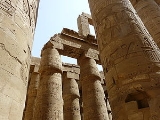
One famous aspect of Karnak, is the Hypostyle Hall
in the Precinct of Amun-Re, a hall area of 50000 sq ft (4,645.2 m²) with 134 massive columns arranged in 16 rows. 122 of these columns are 10 meters tall, and the other 12 are 21 meters tall with a diameter of over three meters.
The architrave
s on top of these columns are estimated to weigh 70 tons. These architraves may have been lifted to these heights using lever
s. This would be an extremely time-consuming process and also would require great balance to get to such great heights. A common alternative theory about how they were moved is that there were large ramps made of sand mud brick or stone and the stones were towed up the ramps. If they used stone for the ramps they would have been able to build the ramps with much less material. The top of the ramps presumably would have either wooden tracks or cobblestones for towing the megaliths.
There is an unfinished pillar in an out of the way location that indicated how it would have been finished. Final carving was executed after the drums were put in place so that it was not damaged while being placed. Several experiments moving megaliths with ancient technology were made at other locations – some of them are listed here.
In 2009 UCLA launched a website dedicated to virtual reality digital reconstructions of the Karnak complex and other resources.
and its changing role in the culture. Religious centers varied by region and with the establishment of the current capital of the unified culture that changed several times. The city of Thebes does not appear to have been of great significance before the Eleventh Dynasty
and previous temple building here would have been relatively small, with shrines being dedicated to the early deities of Thebes, the Earth goddess Mut
and Montu
. Early building was destroyed by invaders. The earliest known artifact found in the area of the temple is a small, eight-sided temple from the Eleventh Dynasty, which mentions Amun-Re. Amun (sometimes called Amen) was long the local tutelary deity of Thebes. He was identified with the Ram and the Goose
. The Egyptian meaning of Amen is, "hidden" or, the "hidden god".
Major construction work in the Precinct of Amun-Re took place during the Eighteenth
dynasty when Thebes became the capital of the unified Ancient Egypt.
Thutmose I erected an enclosure wall connecting the Fourth and Fifth pylons, which comprise the earliest part of the temple still standing in situ. Construction of the Hypostyle Hall
also may have begun during the eighteenth dynasty, although most new building was undertaken under Seti I and Ramesses II.
Almost every pharaoh of that dynasty has added something to the temple site. Merenptah commemorated his victories over the Sea Peoples
on the walls of the Cachette Court, the start of the processional route to the Luxor Temple
.
Hatshepsut
had monuments constructed and also restored the original Precinct of Mut
, the ancient great goddess of Egypt
, that had been ravaged by the foreign rulers during the Hyksos
occupation. She had twin obelisk
s, at the time the tallest in the world, erected at the entrance to the temple. One still stands, as the tallest surviving ancient obelisk on Earth; the other has broken in two and toppled. Another of her projects at the site, Karnak's Red Chapel, or Chapelle Rouge
, was intended as a barque
shrine and originally, may have stood between her two obelisks. She later ordered the construction of two more obelisks to celebrate her sixteenth year as pharaoh; one of the obelisks broke during construction, and thus, a third was constructed to replace it. The broken obelisk was left at its quarrying site in Aswan
, where it still remains. Known as The Unfinished Obelisk
, it demonstrates how obelisks were quarried.
The last major change to Precinct of Amun-Re's layout was the addition of the first pylon and the massive enclosure walls that surround the whole Precinct, both constructed by Nectanebo I.
In 323 AD, Constantine the Great
recognised the Christian
religion, and in 356 Constantius II
ordered the closing of pagan temples throughout the empire. Karnak was by this time mostly abandoned, and Christian churches were founded amongst the ruins, the most famous example of this is the reuse of the Festival Hall of Thutmose III's central hall, where painted decorations of saints and Coptic
inscriptions can still be seen.
and Strabo
give the exact location of Thebes and how long up the Nile
one must travel to reach it. Maps of Egypt, based on the 2nd century Claudius Ptolemaeus
' mammoth work Geographia, have been circling in Europe since the late 14th century, all of them showing Thebes' (Diospolis) location. Despite this, several European authors of the fifteenth and 16th century who visited only Lower Egypt
and published their travel accounts, such as Joos van Ghistele
or André Thévet
, put Thebes in or close to Memphis
.
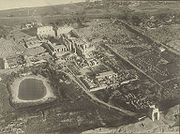 The Karnak temple complex is first described by an unknown Venetian in 1589, although his account relates no name for the complex. This account, housed in the Biblioteca Nazionale Centrale di Firenze, is the first known European mention, since ancient Greek and Roman writers, about a whole range of monuments in Upper Egypt
and Nubia
, including Karnak, Luxor temple, Colossi of Memnon
, Esna
, Edfu
, Kom Ombo
, Philae
, and others.
Karnak ("Carnac") as a village name, and name of the complex, is first attested in 1668, when two capuchin
missionary brothers Protais and Charles François d'Orléans travelled though the area. Protais' writing about their travel was published by Melchisédech Thévenot
(Relations de divers voyages curieux, 1670s–1696 editions) and Johann Michael Vansleb
(The Present State of Egypt, 1678).
The first drawing of Karnak is found in Paul Lucas
' travel account of 1704, (Voyage du Sieur paul Lucas au Levant). It is rather inaccurate, and can be quite confusing to modern eyes. Lucas travelled in Egypt during 1699–1703. The drawing shows a mixture of the Precinct of Amun-Re and the Precinct of Montu, based on a complex confined by the three huge Ptolemaic gateways of Ptolemy III Euergetes / Ptolemy IV Philopator, and the massive long, high and thick, first Pylon of the Precinct of Amun-Re.
Karnak was visited and described in succession by Claude Sicard
and his travel companion Pierre Laurent Pincia (1718 and 1720–21), Granger
(1731), Frederick Louis Norden (1737–38), Richard Pococke
(1738), James Bruce
(1769), Charles-Nicolas-Sigisbert Sonnini de Manoncourt
(1777), William George Browne
(1792–93), and finally by a number of scientists of the Napoleon expedition, including Vivant Denon, during 1798–1799. Claude-Étienne Savary
describes the complex rather detailed in his work of 1785; especially in light that it is a fictional account of a pretended journey to Upper Egypt, composed out of information from other travellers. Savary did visit Lower Egypt
in 1777–78, and published a work about that too.
. There are several colossal statues including the figure of Pinedjem I which is 10.5 meters tall. The sandstone for this temple, including all the columns, was transported from Gebel Silsila 100 miles south on the Nile river. It also has one of the largest obelisks weighing 328 tonnes and standing 29 meters tall.
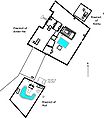 Located to the south of the newer Amen-Re complex, this precinct was dedicated to the mother goddess
, Mut
, who became identified as the wife of Amun-Re in the eighteenth dynasty Theban Triad. It has several smaller temples associated with it and has its own sacred lake, constructed in a crescent shape. This temple has been ravaged, many portions having been used in other structures. It is not open to the public. Six hundred black granite statues were found in the courtyard to her temple. It may be the oldest portion of the site.
In 2006, Betsy Bryan, an archaeologist with Johns Hopkins University excavating at the temple of Mut
presented her findings about one festival that included illustrations of the priestesses being served to excess and its adverse effects being ministered to by temple attendants. Participation in the festival was great, including the priestesses and the population. Historical records of tens of thousands attending the festival exist. These findings were made in the temple of Mut because when Thebes
rose to greater prominence, Mut absorbed the warrior goddesses, Sekhmet
and Bast, as some of her aspects. First, Mut became Mut-Wadjet
-Bast, then Mut-Sekhmet-Bast (Wadjet having merged into Bast), then Mut also assimilated Menhit
, another lioness goddess, and her adopted son's wife, becoming Mut-Sekhmet-Bast-Menhit, and finally becoming Mut-Nekhbet
.
Temple excavations at Luxor discovered a "porch of drunkenness" built onto the temple by the pharaoh Hatshepsut
, during the height of her twenty year reign. In a later myth developed around the annual drunken Sekhmet festival, Ra, by then the sun god
of Upper Egypt, created her from a fiery eye gained from his mother, to destroy mortals who conspired against him (Lower Egypt). In the myth, Sekhmet's blood-lust was not quelled at the end of battle and led to her destroying almost all of humanity, so Ra had tricked her by turning the Nile as red as blood (the Nile turns red every year when filled with silt during inundation) so that Sekhmet would drink it. The trick, however, was that the red liquid was not blood, but beer
mixed with pomegranate juice so that it resembled blood, making her so drunk that she gave up slaughter and became an aspect of the gentle Hathor
. The complex interweaving of deities occurred over the thousands of years of the culture.
, the war-god of the Theban Triad. It is located to the north of the Amun-Re complex and is much smaller in size. It is not open to the public.
(Amenhotep IV) constructed on the site was located east of the main complex, outside the walls of the Amun-Re precinct. It was destroyed immediately after the death of its builder, who had attempted to overcome the powerful priesthood who had gained control over Egypt before his reign. It was so thoroughly demolished that its full extent and layout is currently unknown. The priesthood of that temple regained their powerful position as soon as Akhenaten died, and were instrumental in destroying many records of his existence.
Egyptian temple
Egyptian temples were built for the official worship of the gods and commemoration of pharaohs in Ancient Egypt and in regions under Egyptian control. These temples were seen as houses for the gods or kings to whom they were dedicated...
, chapels, pylons, and other buildings, notably the Great Temple of Amun and a massive structure begun by Pharaoh Ramses II (ca. 1391–1351 BC). Sacred Lake is part of the site as well. It is located near Luxor
Luxor
Luxor is a city in Upper Egypt and the capital of Luxor Governorate. The population numbers 487,896 , with an area of approximately . As the site of the Ancient Egyptian city of Thebes, Luxor has frequently been characterized as the "world's greatest open air museum", as the ruins of the temple...
, some 500 km south of Cairo
Cairo
Cairo , is the capital of Egypt and the largest city in the Arab world and Africa, and the 16th largest metropolitan area in the world. Nicknamed "The City of a Thousand Minarets" for its preponderance of Islamic architecture, Cairo has long been a centre of the region's political and cultural life...
, in Egypt
Egypt
Egypt , officially the Arab Republic of Egypt, Arabic: , is a country mainly in North Africa, with the Sinai Peninsula forming a land bridge in Southwest Asia. Egypt is thus a transcontinental country, and a major power in Africa, the Mediterranean Basin, the Middle East and the Muslim world...
. The area around Karnak was the ancient Egyptian Ipet-isut ("The Most Selected of Places") and the main place of worship of the eighteenth dynasty Theban Triad
Theban Triad
The Theban Triad are three Egyptian gods that were the most popular in the area of Thebes, in Egypt.-History:The group consisted of Amun, his consort Mut and their son Khonsu. The eighteenth and twenty fifth dynasties of the New Kingdom favored the triad...
with the god Amun
Amun
Amun, reconstructed Egyptian Yamānu , was a god in Egyptian mythology who in the form of Amun-Ra became the focus of the most complex system of theology in Ancient Egypt...
as its head. It is part of the monumental city of Thebes
Thebes, Egypt
Thebes is the Greek name for a city in Ancient Egypt located about 800 km south of the Mediterranean, on the east bank of the river Nile within the modern city of Luxor. The Theban Necropolis is situated nearby on the west bank of the Nile.-History:...
. The Karnak complex takes its name from the nearby, and partly surrounded, modern village of el-Karnak, some 2.5 km north of Luxor.
Overview
The complex is a vast open-air museum and the largest ancient religious site in the world. It is believed to be the second most visited historical site in Egypt, second only to the Giza PyramidsGiza pyramid complex
The Giza Necropolis is an archaeological site on the Giza Plateau, on the outskirts of Cairo, Egypt. This complex of ancient monuments includes the three pyramid complexes known as the Great Pyramids, the massive sculpture known as the Great Sphinx, several cemeteries, a workers' village and an...
near Cairo. It consists of four main parts of which only the largest, the currently is open to the general public. The term Karnak often is understood as being the Precinct of Amun-Re only, because this is the only part most visitors normally see. The three other parts, the Precinct of Mut
Precinct of Mut
The Precinct of Mut, located near Luxor, Egypt, is one of the four main temple enclosures that make up the immense Karnak Temple Complex and occupies some 150,000 m². It is dedicated to the Egyptian goddess Mut, the mother goddess. The area in which the precinct is located, originally was known as...
, the Precinct of Montu
Precinct of Montu
The Precinct of Montu, located near Luxor, Egypt, is one of the four main temple enclosures that make up the immense Karnak Temple Complex. It is dedicated to the Egyptian god Montu, the child of Amun and Mut. The area covers about 20,000 m²...
, and the dismantled Temple of Amenhotep IV, are closed to the public. There also are a few smaller temples and sanctuaries located outside the enclosing walls of the four main parts, as well as several avenues of goddess and ram-headed sphinx
Sphinx
A sphinx is a mythical creature with a lion's body and a human head or a cat head.The sphinx, in Greek tradition, has the haunches of a lion, the wings of a great bird, and the face of a woman. She is mythicised as treacherous and merciless...
es connecting the Precinct of Mut, the Precinct of Amun-Re, and the Luxor Temple
Luxor Temple
Luxor Temple is a large Ancient Egyptian temple complex located on the east bank of the River Nile in the city today known as Luxor and was founded in 1400 BCE.,...
.
The Precinct of Mut is very ancient, being dedicated to an Earth and creation deity, but not yet restored. The original temple was destroyed and partially restored by Hatsheput, although another pharaoh built around it in order to change the focus or orientation of the sacred area. Many portions of it may have been carried away for use in other buildings.
The key difference between Karnak and most of the other temples and sites in Egypt is the length of time over which it was developed and used. Construction of temples started in the Middle Kingdom
Middle Kingdom of Egypt
The Middle Kingdom of Egypt is the period in the history of ancient Egypt stretching from the establishment of the Eleventh Dynasty to the end of the Fourteenth Dynasty, between 2055 BC and 1650 BC, although some writers include the Thirteenth and Fourteenth dynasties in the Second Intermediate...
and continued through to Ptolemaic
Ptolemaic dynasty
The Ptolemaic dynasty, was a Macedonian Greek royal family which ruled the Ptolemaic Empire in Egypt during the Hellenistic period. Their rule lasted for 275 years, from 305 BC to 30 BC...
times. Approximately thirty pharaohs contributed to the buildings, enabling it to reach a size, complexity, and diversity not seen elsewhere. Few of the individual features of Karnak are unique, but the size and number of features are overwhelming. The deities represented range from some of the earliest worshiped to those worshiped much later in the history of the Ancient Egyptian culture. Although destroyed, it also contained an early temple built by Amenhotep IV (Akhenaten), the pharaoh who later would celebrate a near monotheistic religion he established that prompted him to move his court and religious center away from Thebes. It also contains evidence of adaptations, using buildings of the Ancient Egyptians by later cultures for their own religious purposes.
One famous aspect of Karnak, is the Hypostyle Hall
Great Hypostyle Hall, Karnak
The Great Hypostyle Hall of Karnak, located within the Karnak temple complex, in the Precinct of Amon-Re, is one of the most visited monuments of Ancient Egypt. The design was initially instituted by Hatshepsut, at the North-west chapel to Amun in the upper terrace of Deir el-BahriThe hall covers...
in the Precinct of Amun-Re, a hall area of 50000 sq ft (4,645.2 m²) with 134 massive columns arranged in 16 rows. 122 of these columns are 10 meters tall, and the other 12 are 21 meters tall with a diameter of over three meters.
The architrave
Architrave
An architrave is the lintel or beam that rests on the capitals of the columns. It is an architectural element in Classical architecture.-Classical architecture:...
s on top of these columns are estimated to weigh 70 tons. These architraves may have been lifted to these heights using lever
Lever
In physics, a lever is a rigid object that is used with an appropriate fulcrum or pivot point to either multiply the mechanical force that can be applied to another object or resistance force , or multiply the distance and speed at which the opposite end of the rigid object travels.This leverage...
s. This would be an extremely time-consuming process and also would require great balance to get to such great heights. A common alternative theory about how they were moved is that there were large ramps made of sand mud brick or stone and the stones were towed up the ramps. If they used stone for the ramps they would have been able to build the ramps with much less material. The top of the ramps presumably would have either wooden tracks or cobblestones for towing the megaliths.
There is an unfinished pillar in an out of the way location that indicated how it would have been finished. Final carving was executed after the drums were put in place so that it was not damaged while being placed. Several experiments moving megaliths with ancient technology were made at other locations – some of them are listed here.
In 2009 UCLA launched a website dedicated to virtual reality digital reconstructions of the Karnak complex and other resources.
History
The history of the Karnak complex is largely the history of ThebesThebes, Egypt
Thebes is the Greek name for a city in Ancient Egypt located about 800 km south of the Mediterranean, on the east bank of the river Nile within the modern city of Luxor. The Theban Necropolis is situated nearby on the west bank of the Nile.-History:...
and its changing role in the culture. Religious centers varied by region and with the establishment of the current capital of the unified culture that changed several times. The city of Thebes does not appear to have been of great significance before the Eleventh Dynasty
Eleventh dynasty of Egypt
The eleventh dynasty of ancient Egypt was one group of rulers, whose earlier members are grouped with the four preceding dynasties to form the First Intermediate Period, while the later members are considered part of the Middle Kingdom...
and previous temple building here would have been relatively small, with shrines being dedicated to the early deities of Thebes, the Earth goddess Mut
Mut
Mut, which meant mother in the ancient Egyptian language, was an ancient Egyptian mother goddess with multiple aspects that changed over the thousands of years of the culture. Alternative spellings are Maut and Mout. She was considered a primal deity, associated with the waters from which...
and Montu
Mõntu
Mõntu is a village in Torgu Parish, Saare County in western Estonia....
. Early building was destroyed by invaders. The earliest known artifact found in the area of the temple is a small, eight-sided temple from the Eleventh Dynasty, which mentions Amun-Re. Amun (sometimes called Amen) was long the local tutelary deity of Thebes. He was identified with the Ram and the Goose
Goose
The word goose is the English name for a group of waterfowl, belonging to the family Anatidae. This family also includes swans, most of which are larger than true geese, and ducks, which are smaller....
. The Egyptian meaning of Amen is, "hidden" or, the "hidden god".
Major construction work in the Precinct of Amun-Re took place during the Eighteenth
Eighteenth dynasty of Egypt
The eighteenth dynasty of ancient Egypt is perhaps the best known of all the dynasties of ancient Egypt...
dynasty when Thebes became the capital of the unified Ancient Egypt.
Thutmose I erected an enclosure wall connecting the Fourth and Fifth pylons, which comprise the earliest part of the temple still standing in situ. Construction of the Hypostyle Hall
Great Hypostyle Hall, Karnak
The Great Hypostyle Hall of Karnak, located within the Karnak temple complex, in the Precinct of Amon-Re, is one of the most visited monuments of Ancient Egypt. The design was initially instituted by Hatshepsut, at the North-west chapel to Amun in the upper terrace of Deir el-BahriThe hall covers...
also may have begun during the eighteenth dynasty, although most new building was undertaken under Seti I and Ramesses II.
Almost every pharaoh of that dynasty has added something to the temple site. Merenptah commemorated his victories over the Sea Peoples
Sea Peoples
The Sea Peoples were a confederacy of seafaring raiders of the second millennium BC who sailed into the eastern Mediterranean, caused political unrest, and attempted to enter or control Egyptian territory during the late 19th dynasty and especially during year 8 of Ramesses III of the 20th Dynasty...
on the walls of the Cachette Court, the start of the processional route to the Luxor Temple
Luxor Temple
Luxor Temple is a large Ancient Egyptian temple complex located on the east bank of the River Nile in the city today known as Luxor and was founded in 1400 BCE.,...
.
Hatshepsut
Hatshepsut
Hatshepsut also Hatchepsut; meaning Foremost of Noble Ladies;1508–1458 BC) was the fifth pharaoh of the eighteenth dynasty of Ancient Egypt...
had monuments constructed and also restored the original Precinct of Mut
Precinct of Mut
The Precinct of Mut, located near Luxor, Egypt, is one of the four main temple enclosures that make up the immense Karnak Temple Complex and occupies some 150,000 m². It is dedicated to the Egyptian goddess Mut, the mother goddess. The area in which the precinct is located, originally was known as...
, the ancient great goddess of Egypt
Mut
Mut, which meant mother in the ancient Egyptian language, was an ancient Egyptian mother goddess with multiple aspects that changed over the thousands of years of the culture. Alternative spellings are Maut and Mout. She was considered a primal deity, associated with the waters from which...
, that had been ravaged by the foreign rulers during the Hyksos
Hyksos
The Hyksos were an Asiatic people who took over the eastern Nile Delta during the twelfth dynasty, initiating the Second Intermediate Period of ancient Egypt....
occupation. She had twin obelisk
Obelisk
An obelisk is a tall, four-sided, narrow tapering monument which ends in a pyramid-like shape at the top, and is said to resemble a petrified ray of the sun-disk. A pair of obelisks usually stood in front of a pylon...
s, at the time the tallest in the world, erected at the entrance to the temple. One still stands, as the tallest surviving ancient obelisk on Earth; the other has broken in two and toppled. Another of her projects at the site, Karnak's Red Chapel, or Chapelle Rouge
Chapelle Rouge
The Red Chapel of Hatshepsut or the Chapelle Rouge originally was constructed as a barque shrine during the reign of Hatshepsut. She was the fifth pharaoh of the eighteenth dynasty of Ancient Egypt and ruled from approximately 1479 to 1458 BC....
, was intended as a barque
Barque
A barque, barc, or bark is a type of sailing vessel with three or more masts.- History of the term :The word barque appears to have come from the Greek word baris, a term for an Egyptian boat. This entered Latin as barca, which gave rise to the Italian barca, Spanish barco, and the French barge and...
shrine and originally, may have stood between her two obelisks. She later ordered the construction of two more obelisks to celebrate her sixteenth year as pharaoh; one of the obelisks broke during construction, and thus, a third was constructed to replace it. The broken obelisk was left at its quarrying site in Aswan
Aswan
Aswan , formerly spelled Assuan, is a city in the south of Egypt, the capital of the Aswan Governorate.It stands on the east bank of the Nile at the first cataract and is a busy market and tourist centre...
, where it still remains. Known as The Unfinished Obelisk
Unfinished obelisk
The unfinished obelisk is the largest known ancient obelisk, located in the northern region of the stone quarries of ancient Egypt in Aswan , Egypt. It is unknown which pharaoh created this structure. It is nearly one third larger than any ancient Egyptian obelisk ever erected...
, it demonstrates how obelisks were quarried.
The last major change to Precinct of Amun-Re's layout was the addition of the first pylon and the massive enclosure walls that surround the whole Precinct, both constructed by Nectanebo I.
In 323 AD, Constantine the Great
Constantine I
Constantine the Great , also known as Constantine I or Saint Constantine, was Roman Emperor from 306 to 337. Well known for being the first Roman emperor to convert to Christianity, Constantine and co-Emperor Licinius issued the Edict of Milan in 313, which proclaimed religious tolerance of all...
recognised the Christian
Christian
A Christian is a person who adheres to Christianity, an Abrahamic, monotheistic religion based on the life and teachings of Jesus of Nazareth as recorded in the Canonical gospels and the letters of the New Testament...
religion, and in 356 Constantius II
Constantius II
Constantius II , was Roman Emperor from 337 to 361. The second son of Constantine I and Fausta, he ascended to the throne with his brothers Constantine II and Constans upon their father's death....
ordered the closing of pagan temples throughout the empire. Karnak was by this time mostly abandoned, and Christian churches were founded amongst the ruins, the most famous example of this is the reuse of the Festival Hall of Thutmose III's central hall, where painted decorations of saints and Coptic
Coptic language
Coptic or Coptic Egyptian is the current stage of the Egyptian language, a northern Afro-Asiatic language spoken in Egypt until at least the 17th century. Egyptian began to be written using the Greek alphabet in the 1st century...
inscriptions can still be seen.
European knowledge of Karnak
Thebes' exact placement was unknown in medieval Europe, though both HerodotusHerodotus
Herodotus was an ancient Greek historian who was born in Halicarnassus, Caria and lived in the 5th century BC . He has been called the "Father of History", and was the first historian known to collect his materials systematically, test their accuracy to a certain extent and arrange them in a...
and Strabo
Strabo
Strabo, also written Strabon was a Greek historian, geographer and philosopher.-Life:Strabo was born to an affluent family from Amaseia in Pontus , a city which he said was situated the approximate equivalent of 75 km from the Black Sea...
give the exact location of Thebes and how long up the Nile
Nile
The Nile is a major north-flowing river in North Africa, generally regarded as the longest river in the world. It is long. It runs through the ten countries of Sudan, South Sudan, Burundi, Rwanda, Democratic Republic of the Congo, Tanzania, Kenya, Ethiopia, Uganda and Egypt.The Nile has two major...
one must travel to reach it. Maps of Egypt, based on the 2nd century Claudius Ptolemaeus
Ptolemy
Claudius Ptolemy , was a Roman citizen of Egypt who wrote in Greek. He was a mathematician, astronomer, geographer, astrologer, and poet of a single epigram in the Greek Anthology. He lived in Egypt under Roman rule, and is believed to have been born in the town of Ptolemais Hermiou in the...
' mammoth work Geographia, have been circling in Europe since the late 14th century, all of them showing Thebes' (Diospolis) location. Despite this, several European authors of the fifteenth and 16th century who visited only Lower Egypt
Lower Egypt
Lower Egypt is the northern-most section of Egypt. It refers to the fertile Nile Delta region, which stretches from the area between El-Aiyat and Zawyet Dahshur, south of modern-day Cairo, and the Mediterranean Sea....
and published their travel accounts, such as Joos van Ghistele
Joos van Ghistele
Joos van Ghistele was a Flemish nobleman who spent four years travelling around in the Middle East and southern Europe, including Italy, Greece, the Balkans, Tunisia, the Levant, Egypt and the Red Sea all the way down to Aden.His accounts were edited by Ambrosius Zeebout Priestre and posthumously...
or André Thévet
André Thévet
André de Thevet was a French Franciscan priest, explorer, cosmographer and writer who travelled to Brazil in the 16th century...
, put Thebes in or close to Memphis
Memphis, Egypt
Memphis was the ancient capital of Aneb-Hetch, the first nome of Lower Egypt. Its ruins are located near the town of Helwan, south of Cairo.According to legend related by Manetho, the city was founded by the pharaoh Menes around 3000 BC. Capital of Egypt during the Old Kingdom, it remained an...
.
Upper Egypt
Upper Egypt is the strip of land, on both sides of the Nile valley, that extends from the cataract boundaries of modern-day Aswan north to the area between El-Ayait and Zawyet Dahshur . The northern section of Upper Egypt, between El-Ayait and Sohag is sometimes known as Middle Egypt...
and Nubia
Nubia
Nubia is a region along the Nile river, which is located in northern Sudan and southern Egypt.There were a number of small Nubian kingdoms throughout the Middle Ages, the last of which collapsed in 1504, when Nubia became divided between Egypt and the Sennar sultanate resulting in the Arabization...
, including Karnak, Luxor temple, Colossi of Memnon
Colossi of Memnon
The Colossi of Memnon are two massive stone statues of Pharaoh Amenhotep III. For the past 3400 years they have stood in the Theban necropolis, across the River Nile from the modern city of Luxor.-Description:The twin statues depict Amenhotep III The Colossi of Memnon (known to locals as...
, Esna
Esna
Esna , known to the ancient Egyptians as Egyptian: Iunyt or Ta-senet; Greek: or or ; Latin: Lato, is a city in Egypt. It is located on the west bank of the River Nile, some 55 km south of Luxor...
, Edfu
Edfu
Edfu is an Egyptian city, located on the west bank of the Nile River between Esna and Aswan, with a population of approximately sixty thousand people. For the ancient history of the city, see below...
, Kom Ombo
Kom Ombo
Kom Ombo or Ombos or Latin: Ambo and Ombi – is an agricultural town in Egypt famous for the Temple of Kom Ombo...
, Philae
Philae
Philae is an island in the Nile River and the previous site of an Ancient Egyptian temple complex in southern Egypt...
, and others.
Karnak ("Carnac") as a village name, and name of the complex, is first attested in 1668, when two capuchin
Order of Friars Minor Capuchin
The Order of Friars Minor Capuchin is an Order of friars in the Catholic Church, among the chief offshoots of the Franciscans. The worldwide head of the Order, called the Minister General, is currently Father Mauro Jöhri.-Origins :...
missionary brothers Protais and Charles François d'Orléans travelled though the area. Protais' writing about their travel was published by Melchisédech Thévenot
Melchisédech Thévenot
Melchisédech Thévenot was a French author, scientist, traveler, cartographer, orientalist, inventor, and diplomat...
(Relations de divers voyages curieux, 1670s–1696 editions) and Johann Michael Vansleb
Johann Michael Vansleb
Johann Michael Vansleb was a German theologian, linguist and Egypt traveller. He converted to Catholicism and was a member of the Dominican Order from 1666....
(The Present State of Egypt, 1678).
The first drawing of Karnak is found in Paul Lucas
Paul Lucas (traveller)
Paul Lucas was a French merchant, naturalist, physician and antiquarian to King Louis XIV. He travelled extensively in Greece, Turkey, the Levant and Egypt, in three major voyages , and ....
' travel account of 1704, (Voyage du Sieur paul Lucas au Levant). It is rather inaccurate, and can be quite confusing to modern eyes. Lucas travelled in Egypt during 1699–1703. The drawing shows a mixture of the Precinct of Amun-Re and the Precinct of Montu, based on a complex confined by the three huge Ptolemaic gateways of Ptolemy III Euergetes / Ptolemy IV Philopator, and the massive long, high and thick, first Pylon of the Precinct of Amun-Re.
Karnak was visited and described in succession by Claude Sicard
Claude Sicard
Father Claude Sicard was a French Jesuit priest, and an early modern visitor to Egypt, between 1708 and 1712, producing the earliest known map of the country. He was Supervisor of the Jesuit Mission in Cairo.-References:...
and his travel companion Pierre Laurent Pincia (1718 and 1720–21), Granger
Granger (Tourtechot)
Granger , was a French physician and traveller, with a major interest in natural history.According to the preface of the only work attributed to him, his real name was Tourtechot, and for reasons not explained he changed it to Granger. Granger or Tourtechot is presumably his surname...
(1731), Frederick Louis Norden (1737–38), Richard Pococke
Richard Pococke
Richard Pococke was an English prelate and anthropologist. He was Protestant Bishop of Ossory and Meath , both dioceses of the Church of Ireland...
(1738), James Bruce
James Bruce
James Bruce was a Scottish traveller and travel writer who spent more than a dozen years in North Africa and Ethiopia, where he traced the origins of the Blue Nile.-Youth:...
(1769), Charles-Nicolas-Sigisbert Sonnini de Manoncourt
Charles-Nicolas-Sigisbert Sonnini de Manoncourt
Charles-Nicolas-Sigisbert Sonnini de Manoncourt was a French naturalist. Between 1799 to 1808 he wrote 127 volumes of the Histoire naturelle. Noteworthy among these, especially for herpetologists, is Histoire naturelle des Reptiles, avec figures desinées d'après nature, in four volumes, which he...
(1777), William George Browne
William George Browne
William George Browne was an English traveller.Browne was born at Great Tower Hill, London. At seventeen he was sent to Oriel College, Oxford. Having had a moderate inheritance left him by his father, on quitting the university he applied himself entirely to literary pursuits...
(1792–93), and finally by a number of scientists of the Napoleon expedition, including Vivant Denon, during 1798–1799. Claude-Étienne Savary
Claude-Étienne Savary
Claude-Étienne Savary was an orientalist, pioneer of Egyptology and translator of the Qur'an....
describes the complex rather detailed in his work of 1785; especially in light that it is a fictional account of a pretended journey to Upper Egypt, composed out of information from other travellers. Savary did visit Lower Egypt
Lower Egypt
Lower Egypt is the northern-most section of Egypt. It refers to the fertile Nile Delta region, which stretches from the area between El-Aiyat and Zawyet Dahshur, south of modern-day Cairo, and the Mediterranean Sea....
in 1777–78, and published a work about that too.
Precinct of Amun-Re
This is the largest of the precincts of the temple complex, and is dedicated to Amun-Re, the chief deity of the Theban TriadTheban Triad
The Theban Triad are three Egyptian gods that were the most popular in the area of Thebes, in Egypt.-History:The group consisted of Amun, his consort Mut and their son Khonsu. The eighteenth and twenty fifth dynasties of the New Kingdom favored the triad...
. There are several colossal statues including the figure of Pinedjem I which is 10.5 meters tall. The sandstone for this temple, including all the columns, was transported from Gebel Silsila 100 miles south on the Nile river. It also has one of the largest obelisks weighing 328 tonnes and standing 29 meters tall.
Precinct of Mut
Mother goddess
Mother goddess is a term used to refer to a goddess who represents motherhood, fertility, creation or embodies the bounty of the Earth. When equated with the Earth or the natural world such goddesses are sometimes referred to as Mother Earth or as the Earth Mother.Many different goddesses have...
, Mut
Mut
Mut, which meant mother in the ancient Egyptian language, was an ancient Egyptian mother goddess with multiple aspects that changed over the thousands of years of the culture. Alternative spellings are Maut and Mout. She was considered a primal deity, associated with the waters from which...
, who became identified as the wife of Amun-Re in the eighteenth dynasty Theban Triad. It has several smaller temples associated with it and has its own sacred lake, constructed in a crescent shape. This temple has been ravaged, many portions having been used in other structures. It is not open to the public. Six hundred black granite statues were found in the courtyard to her temple. It may be the oldest portion of the site.
In 2006, Betsy Bryan, an archaeologist with Johns Hopkins University excavating at the temple of Mut
Mut
Mut, which meant mother in the ancient Egyptian language, was an ancient Egyptian mother goddess with multiple aspects that changed over the thousands of years of the culture. Alternative spellings are Maut and Mout. She was considered a primal deity, associated with the waters from which...
presented her findings about one festival that included illustrations of the priestesses being served to excess and its adverse effects being ministered to by temple attendants. Participation in the festival was great, including the priestesses and the population. Historical records of tens of thousands attending the festival exist. These findings were made in the temple of Mut because when Thebes
Thebes, Egypt
Thebes is the Greek name for a city in Ancient Egypt located about 800 km south of the Mediterranean, on the east bank of the river Nile within the modern city of Luxor. The Theban Necropolis is situated nearby on the west bank of the Nile.-History:...
rose to greater prominence, Mut absorbed the warrior goddesses, Sekhmet
Sekhmet
In Egyptian mythology, Sekhmet , was originally the warrior goddess as well as goddess of healing for Upper Egypt. She is depicted as a lioness, the fiercest hunter known to the Egyptians. It was said that her breath created the desert...
and Bast, as some of her aspects. First, Mut became Mut-Wadjet
Wadjet
In Egyptian mythology, Wadjet, or the Green One , was originally the ancient local goddess of the city of Dep , which became part of the city that the Egyptians named Per-Wadjet, House of...
-Bast, then Mut-Sekhmet-Bast (Wadjet having merged into Bast), then Mut also assimilated Menhit
Menhit
In Egyptian mythology, Menhit was originally a foreign war goddess. Her name depicts a warrior status, as it means massacres.When included among the Egyptian deities, she became the female counterpart of Anhur...
, another lioness goddess, and her adopted son's wife, becoming Mut-Sekhmet-Bast-Menhit, and finally becoming Mut-Nekhbet
Nekhbet
In Egyptian mythology, Nekhbet was an early predynastic local goddess who was the patron of the city of Nekheb, her name meaning of Nekheb...
.
Temple excavations at Luxor discovered a "porch of drunkenness" built onto the temple by the pharaoh Hatshepsut
Hatshepsut
Hatshepsut also Hatchepsut; meaning Foremost of Noble Ladies;1508–1458 BC) was the fifth pharaoh of the eighteenth dynasty of Ancient Egypt...
, during the height of her twenty year reign. In a later myth developed around the annual drunken Sekhmet festival, Ra, by then the sun god
Solar deity
A solar deity is a sky deity who represents the Sun, or an aspect of it, usually by its perceived power and strength. Solar deities and sun worship can be found throughout most of recorded history in various forms...
of Upper Egypt, created her from a fiery eye gained from his mother, to destroy mortals who conspired against him (Lower Egypt). In the myth, Sekhmet's blood-lust was not quelled at the end of battle and led to her destroying almost all of humanity, so Ra had tricked her by turning the Nile as red as blood (the Nile turns red every year when filled with silt during inundation) so that Sekhmet would drink it. The trick, however, was that the red liquid was not blood, but beer
Beer
Beer is the world's most widely consumed andprobably oldest alcoholic beverage; it is the third most popular drink overall, after water and tea. It is produced by the brewing and fermentation of sugars, mainly derived from malted cereal grains, most commonly malted barley and malted wheat...
mixed with pomegranate juice so that it resembled blood, making her so drunk that she gave up slaughter and became an aspect of the gentle Hathor
Hathor
Hathor , is an Ancient Egyptian goddess who personified the principles of love, beauty, music, motherhood and joy. She was one of the most important and popular deities throughout the history of Ancient Egypt...
. The complex interweaving of deities occurred over the thousands of years of the culture.
Precinct of Montu
This portion of the site is dedicated to the son of Mut and Amun-Re, MontuMõntu
Mõntu is a village in Torgu Parish, Saare County in western Estonia....
, the war-god of the Theban Triad. It is located to the north of the Amun-Re complex and is much smaller in size. It is not open to the public.
Temple of Amenhotep IV (deliberately dismantled)
The temple that AkhenatenAkhenaten
Akhenaten also spelled Echnaton,Ikhnaton,and Khuenaten;meaning "living spirit of Aten") known before the fifth year of his reign as Amenhotep IV , was a Pharaoh of the Eighteenth dynasty of Egypt who ruled for 17 years and died perhaps in 1336 BC or 1334 BC...
(Amenhotep IV) constructed on the site was located east of the main complex, outside the walls of the Amun-Re precinct. It was destroyed immediately after the death of its builder, who had attempted to overcome the powerful priesthood who had gained control over Egypt before his reign. It was so thoroughly demolished that its full extent and layout is currently unknown. The priesthood of that temple regained their powerful position as soon as Akhenaten died, and were instrumental in destroying many records of his existence.
In popular culture
- In Transformers: Revenge of the FallenTransformers: Revenge of the FallenTransformers: Revenge of the Fallen is a 2009 American science fiction-action film directed by Michael Bay and produced by Steven Spielberg. It is the sequel to the 2007 film Transformers and the second installment in the live-action Transformers series...
the final battle between Optimus Prime versus Megatron, The Fallen, and Starscream takes place in the hypostyle hall at Karnak. - The Egyptian-themed superhero OzymandiasOzymandias (comics)Ozymandias , is a fictional character and the main antagonist appearing in the comic book limited series Watchmen by Alan Moore and Dave Gibbons, published by DC Comics. Named Ozymandias in the manner of Ramesses II, he is a modified version of the comic book character Thunderbolt from Charlton...
from the graphic novel WatchmenWatchmenWatchmen is a twelve-issue comic book limited series created by writer Alan Moore, artist Dave Gibbons, and colourist John Higgins. The series was published by DC Comics during 1986 and 1987, and has been subsequently reprinted in collected form...
has a fortress in Antarctica called Karnak. - Agatha Christie's Death on the NileDeath on the NileDeath on the Nile is a work of detective fiction by Agatha Christie and first published in the UK by the Collins Crime Club on November 1, 1937 and in the US by Dodd, Mead and Company the following year. The UK edition retailed at seven shillings and sixpence and the US edition at $2.00.The book...
takes place mainly on the steamship S.S. Karnak as well as using the temple itself in one of its scenes. - Final Fantasy VFinal Fantasy Vis a medieval-fantasy role-playing video game developed and published by Square in 1992 as a part of the Final Fantasy series. The game first appeared only in Japan on Nintendo's Super Famicom . It has been ported with minor differences to Sony's PlayStation and Nintendo's Game Boy Advance...
features a kingdom called Karnak, where the Fire Crystal is housed. - Lara CroftLara CroftLara Croft is a fictional character and the protagonist of the Square Enix video game series Tomb Raider. She is presented as a beautiful, intelligent, and athletic British archaeologist-adventurer who ventures into ancient, hazardous tombs and ruins around the world...
visited Karnak for three levels in Tomb Raider: The Last RevelationTomb Raider: The Last RevelationTomb Raider: The Last Revelation is the fourth video game in the Tomb Raider series. It was developed by Core Design and published by Eidos Interactive. It was released on PC, PlayStation and eventually to the Sega Dreamcast with exclusive graphical and sound enhancements...
(Temple of Karnak, The Great Hypostyle Hall and Sacred Lake) and it was featured in the level editor package. - In the movie The Mummy ReturnsThe Mummy ReturnsThe Mummy Returns is a 2001 American adventure film written and directed by Stephen Sommers, starring Brendan Fraser, Rachel Weisz, John Hannah, Arnold Vosloo, Oded Fehr, Patricia Velásquez and Freddie Boath. The film is a sequel to the 1999 film The Mummy...
, Karnak is one of the places Rick O'Connell and the others must go to, in order to ultimately reach the Scorpion King. - The British symphonic metal band Bal-Sagoth have a song called 'Unfettering the Hoary Sentinels of Karnak'.
- The first person shooter PowerSlavePowerslavePowerslave is the fifth studio album by the English heavy metal band Iron Maiden, released on 3 September 1984 on EMI in Europe and its sister label Capitol Records in the US ....
is set in and around Karnak. - Karnak is the name of the spaceship in which Beelzebub travels the universe in G.I. Gurdjieff's Beelzebub's Tales To His Grandson.
- The first part of the modernist long poem, Trilogy, by H.D. is dedicated, "For Karnak 1923".
- Karnak is featured as a location for exploration in the PC game The Sims 3: World AdventuresThe Sims 3: World AdventuresDuring an interview, producer Lyndsay Pearson said that real-world locations were a draw for their players and that users had been creating famous buildings on the exchange. The expansion pack represented an extension of that desire...
. - Karnak is featured as a location in the PC game Serious SamSerious SamSerious Sam is the first game in the Serious Sam series. It is a first-person shooter created by the Croatian development house Croteam...
. - Karnak is featured in the James Bond movie The Spy Who Loved MeThe Spy Who Loved Me (film)The Spy Who Loved Me is a spy film, the tenth film in the James Bond series, and the third to star Roger Moore as the fictional secret agent James Bond. It was directed by Lewis Gilbert and the screenplay was written by Christopher Wood and Richard Maibaum...
.
External links
- CFEETK – Centre Franco-Égyptien d'Étude des Temples de Karnak (en)
- Karnak images
- Karnak: Temple of Amun Bible History Online, 2004.
- www.karnak3d.net :: "Web-book" The 3D reconstruction of the Great Temple of Amun in Karnak. Marc
- Virtual tour of the Karnak Temple
- Digital Karnak UCLA
- Karnak Temple picture gallery at Remains.se