

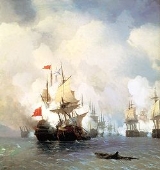
Battle of Chesma

Encyclopedia
The naval
Battle of Chesma took place on 5 -7 July 1770 near and in Çeşme
(Chesme or Chesma) Bay, in the area between the western tip of Anatolia
and the island of Chios
, which was the site of a number of past naval battles between the Ottoman Empire
and the Republic of Venice
. It was a part of the Orlov Revolt
of 1769, a precursor to the later Greek War of Independence
(1821-29), and the first of a number of disastrous fleet battles for the Ottomans against Russia
.
had begun in 1768, and Russia sent several squadrons from the Baltic Sea
to the Mediterranean Sea
to draw Ottoman
attention away from their Black Sea
fleet, then only 6 battleship
s (ships of the line) strong. Two Russian squadrons, commanded by Admiral
Grigory Spiridov
and Rear Admiral
John Elphinstone
, a British advisor, combined under the overall command of Count Alexei Orlov
, Commander-in-Chief of the Russian Fleet and went to look for the Ottoman fleet.
On 5 July 1770 they came across it anchored in line just north of Çeşme Bay, western Anatolia. Details of the Ottoman fleet are uncertain but it included 14-16 ships of the line including Real Mustafa of 84 guns, Rodos of 60 guns and a 100-gun flagship. In addition there were perhaps 6 frigate
s, 6 xebec
s, 13 galleys and 32 small craft, with about 1,300 guns in total. About 10 of the ships of the line, of 70-100 guns, were in the Ottoman main line with a further 6 or so ships of the line in the 2nd, arranged so that they could fire through the gaps in the first line. Behind that were the frigates, xebecs etc. The fleet was commanded by Kapudan Pasha Mandalzade Hüsameddin, in the fourth ship from the front (north end) of the line, with Hasan Pasha
in the first ship, Real Mustafa, and Cafer Bey in the seventh. Two further ships of the line, probably small, had left this fleet for Mytilene
the previous evening.
After organizing a plan of attack, the Russian battle line (see Table 1) sailed towards the south end of the Ottoman line and then turned north, coming alongside the Ottomans, with the tail end coming into action last (Elphinston had wanted to approach the northern end first, then follow the wind along the Ottoman line, attacking their ships one by one - the method used by Nelson
at the Battle of the Nile
in 1798).
Spiridov, in Sv. Evstafii, had a close-range battle with Hasan Pasha in Real Mustafa, before the latter was suddenly seen to be on fire. Her mainmast came down and landed on Sv. Evstafiis deck, causing the Russian ship to immediately blow up. Shortly later Real Mustafa blew up as well.
According to Elphinston, who claimed the Russians were almost useless, Spiridov and Count Feodor Orlov (brother of the commander), had left Sv. Evstafii before the fighting became close-range. Spiridov ended up on Tri Svyatitelya. Sv. Evstafiis captain, Kruse, survived too. At about 2pm the fighting ended, as the Ottomans cut their cables and moved south into the bay, forming themselves into a defensive line of 8 ships of the line, a 2nd line, and the rest beyond.
On 6 July the Russians bombarded the Ottoman ships and land positions, and at about 12:30 a.m. on the morning of 7 July Orlov sent Samuel Greig
, (who transferred to Rostislav) to attack with Evropa, Rostislav and Ne tron menya forming a south-north line facing the Ottomans, and with Saratov in reserve, Nadezhda attacking the batteries at the eastern side of the bay entrance, Afrika attacking the batteries on the western side, and Grom near Afrika. At about 1:30 a.m. or earlier (times were about 90 minutes earlier, according to Elphinston), fire from Grom and/or Ne tron menya caused an Ottoman ship of the line to blow up after her main topsail caught fire, and the fire quickly spread to other ships of the line. By 2 a.m. two Ottoman ships of the line had blown up and more were on fire, and Greig sent in three fireships (the fourth, seeing the danger, stayed out), which contributed in a small way to the burning of almost the entire Ottoman fleet. At about 4 a.m., boats were sent in to save two ships of the line which were not burning, but one of these caught fire while it was being towed. The other, Rodos 60, survived and was captured along with five galleys. Fighting ended at about 8 a.m. Russian casualties on 5 July were 14 killed, plus 636 killed in Sv. Evstafii, and about 30 wounded, and on 7 July 11 killed. Ottoman casualties were much higher. Hüsameddin, Hasan Pasha and Cafer Bey survived. Hüsameddin was removed from his position, which was given to Cafer Bey. This was the only significant fleet battle during the Russo-Turkish War.
. It was the greatest naval defeat suffered by Ottomans since the Battle of Lepanto (1571)
. This battle inspired great confidence in the Russian fleet and allowed the Russians to control the Aegean Sea for some time. The defeat of the Ottoman fleet also sped up rebellions by minority groups in the Ottoman Empire, especially the Orthodox Christian nations in the Balkan peninsula, who helped the Russian army in defeating the Ottoman Empire.
After this naval victory, the Russian fleet stayed in Aegean for the following five years. It came back to Ceşme twice more to bombard it during this time. Historians still debate the rationale for this Russian military focus on this small fort town while there were many other more strategic targets along the Aegean coast.
Catherine the Great commissioned four monuments to commemorate the victory: Chesma Palace and Church of Saint John at Chesme Palace in St Petersburg (1774-77), Chesma Obelisk in Gatchina
(1775), and Chesma Column in Tsarskoe Selo (1778).
Naval battle
A naval battle is a battle fought using boats, ships or other waterborne vessels. Most naval battles have occurred at sea, but a few have taken place on lakes or rivers. The earliest recorded naval battle took place in 1210 BC near Cyprus...
Battle of Chesma took place on 5 -7 July 1770 near and in Çeşme
Çesme
Çeşme is a coastal town and the center-town of the district of the same name in Turkey's western-most end, on a promontory on the tip of the peninsula which also carries the same name and which extends inland to form a whole with the wider Karaburun Peninsula...
(Chesme or Chesma) Bay, in the area between the western tip of Anatolia
Anatolia
Anatolia is a geographic and historical term denoting the westernmost protrusion of Asia, comprising the majority of the Republic of Turkey...
and the island of Chios
Chios
Chios is the fifth largest of the Greek islands, situated in the Aegean Sea, seven kilometres off the Asia Minor coast. The island is separated from Turkey by the Chios Strait. The island is noted for its strong merchant shipping community, its unique mastic gum and its medieval villages...
, which was the site of a number of past naval battles between the Ottoman Empire
Ottoman Empire
The Ottoman EmpireIt was usually referred to as the "Ottoman Empire", the "Turkish Empire", the "Ottoman Caliphate" or more commonly "Turkey" by its contemporaries...
and the Republic of Venice
Republic of Venice
The Republic of Venice or Venetian Republic was a state originating from the city of Venice in Northeastern Italy. It existed for over a millennium, from the late 7th century until 1797. It was formally known as the Most Serene Republic of Venice and is often referred to as La Serenissima, in...
. It was a part of the Orlov Revolt
Orlov Revolt
The Orlov Revolt was a precursor to the Greek War of Independence , which saw a Greek uprising in the Peloponnese at the instigation of Count Orlov, commander of the Russian Naval Forces of the Russo-Turkish War...
of 1769, a precursor to the later Greek War of Independence
Greek War of Independence
The Greek War of Independence, also known as the Greek Revolution was a successful war of independence waged by the Greek revolutionaries between...
(1821-29), and the first of a number of disastrous fleet battles for the Ottomans against Russia
Russian Empire
The Russian Empire was a state that existed from 1721 until the Russian Revolution of 1917. It was the successor to the Tsardom of Russia and the predecessor of the Soviet Union...
.
Prelude to the battle
The Russo-Turkish WarRusso-Turkish War, 1768-1774
The Russo-Turkish War of 1768–1774 was a decisive conflict that brought Southern Ukraine, Northern Caucasus, and Crimea within the orbit of the Russian Empire.-Background:...
had begun in 1768, and Russia sent several squadrons from the Baltic Sea
Baltic Sea
The Baltic Sea is a brackish mediterranean sea located in Northern Europe, from 53°N to 66°N latitude and from 20°E to 26°E longitude. It is bounded by the Scandinavian Peninsula, the mainland of Europe, and the Danish islands. It drains into the Kattegat by way of the Øresund, the Great Belt and...
to the Mediterranean Sea
Mediterranean Sea
The Mediterranean Sea is a sea connected to the Atlantic Ocean surrounded by the Mediterranean region and almost completely enclosed by land: on the north by Anatolia and Europe, on the south by North Africa, and on the east by the Levant...
to draw Ottoman
Ottoman Empire
The Ottoman EmpireIt was usually referred to as the "Ottoman Empire", the "Turkish Empire", the "Ottoman Caliphate" or more commonly "Turkey" by its contemporaries...
attention away from their Black Sea
Black Sea
The Black Sea is bounded by Europe, Anatolia and the Caucasus and is ultimately connected to the Atlantic Ocean via the Mediterranean and the Aegean seas and various straits. The Bosphorus strait connects it to the Sea of Marmara, and the strait of the Dardanelles connects that sea to the Aegean...
fleet, then only 6 battleship
Ship of the line
A ship of the line was a type of naval warship constructed from the 17th through the mid-19th century to take part in the naval tactic known as the line of battle, in which two columns of opposing warships would manoeuvre to bring the greatest weight of broadside guns to bear...
s (ships of the line) strong. Two Russian squadrons, commanded by Admiral
Admiral
Admiral is the rank, or part of the name of the ranks, of the highest naval officers. It is usually considered a full admiral and above vice admiral and below admiral of the fleet . It is usually abbreviated to "Adm" or "ADM"...
Grigory Spiridov
Grigory Spiridov
Grigory Andreyevich Spiridov was a leading Russian naval commander and admiral .Grigory Spiridov began his career in the Russian Navy in 1723. He was promoted to an officer rank in 1733. Spiridov had been commanding different ships of the Baltic Fleet since 1741...
and Rear Admiral
Rear Admiral
Rear admiral is a naval commissioned officer rank above that of a commodore and captain, and below that of a vice admiral. It is generally regarded as the lowest of the "admiral" ranks, which are also sometimes referred to as "flag officers" or "flag ranks"...
John Elphinstone
John Elphinstone
John Elphinstone, also known as John Elphinston, , was a senior British naval officer who worked closely with the Russian Navy after 1770, with approval from the Admiralty, during the period of naval reform under Russian Empress Catherine II...
, a British advisor, combined under the overall command of Count Alexei Orlov
Alexei Grigoryevich Orlov
Count Alexei Grigoryevich Orlov was a Russian soldier and statesman, who rose to prominence during the reign of Catherine the Great.Orlov served in the Imperial Russian Army, and through his connections with his brother, became one of the key conspirators in the plot to overthrow Tsar Peter III...
, Commander-in-Chief of the Russian Fleet and went to look for the Ottoman fleet.
On 5 July 1770 they came across it anchored in line just north of Çeşme Bay, western Anatolia. Details of the Ottoman fleet are uncertain but it included 14-16 ships of the line including Real Mustafa of 84 guns, Rodos of 60 guns and a 100-gun flagship. In addition there were perhaps 6 frigate
Frigate
A frigate is any of several types of warship, the term having been used for ships of various sizes and roles over the last few centuries.In the 17th century, the term was used for any warship built for speed and maneuverability, the description often used being "frigate-built"...
s, 6 xebec
Xebec
A xebec , also spelled zebec, was a Mediterranean sailing ship that was used mostly for trading. It would have a long overhanging bowsprit and protruding mizzen mast...
s, 13 galleys and 32 small craft, with about 1,300 guns in total. About 10 of the ships of the line, of 70-100 guns, were in the Ottoman main line with a further 6 or so ships of the line in the 2nd, arranged so that they could fire through the gaps in the first line. Behind that were the frigates, xebecs etc. The fleet was commanded by Kapudan Pasha Mandalzade Hüsameddin, in the fourth ship from the front (north end) of the line, with Hasan Pasha
Cezayirli Gazi Hasan Pasha
Cezayirli Gazi Hasan Pasha or Hasan Pasha of Algiers was an Ottoman captain, Grand Admiral , Grand Vizier and general of the late 18th century....
in the first ship, Real Mustafa, and Cafer Bey in the seventh. Two further ships of the line, probably small, had left this fleet for Mytilene
Mytilene
Mytilene is a town and a former municipality on the island of Lesbos, North Aegean, Greece. Since the 2011 local government reform it is part of the municipality Lesbos, of which it is a municipal unit. It is the capital of the island of Lesbos. Mytilene, whose name is pre-Greek, is built on the...
the previous evening.
After organizing a plan of attack, the Russian battle line (see Table 1) sailed towards the south end of the Ottoman line and then turned north, coming alongside the Ottomans, with the tail end coming into action last (Elphinston had wanted to approach the northern end first, then follow the wind along the Ottoman line, attacking their ships one by one - the method used by Nelson
Horatio Nelson, 1st Viscount Nelson
Horatio Nelson, 1st Viscount Nelson, 1st Duke of Bronté, KB was a flag officer famous for his service in the Royal Navy, particularly during the Napoleonic Wars. He was noted for his inspirational leadership and superb grasp of strategy and unconventional tactics, which resulted in a number of...
at the Battle of the Nile
Battle of the Nile
The Battle of the Nile was a major naval battle fought between British and French fleets at Aboukir Bay on the Mediterranean coast of Egypt from 1–3 August 1798...
in 1798).
Battle engagement
The Ottomans opened fire at about 11.45am, followed by the Russians slightly later. Three of the Russian ships of the line had trouble staying in position; Evropa turned around and came back behind Rostislav, Trech Svyatitelai circled the 2nd Ottoman vessel before coming back into the Russian line, being attacked in error by Trech Ierarchov as she did so, and Sv. Ianuarii turned around before coming back into the line.Spiridov, in Sv. Evstafii, had a close-range battle with Hasan Pasha in Real Mustafa, before the latter was suddenly seen to be on fire. Her mainmast came down and landed on Sv. Evstafiis deck, causing the Russian ship to immediately blow up. Shortly later Real Mustafa blew up as well.
According to Elphinston, who claimed the Russians were almost useless, Spiridov and Count Feodor Orlov (brother of the commander), had left Sv. Evstafii before the fighting became close-range. Spiridov ended up on Tri Svyatitelya. Sv. Evstafiis captain, Kruse, survived too. At about 2pm the fighting ended, as the Ottomans cut their cables and moved south into the bay, forming themselves into a defensive line of 8 ships of the line, a 2nd line, and the rest beyond.
On 6 July the Russians bombarded the Ottoman ships and land positions, and at about 12:30 a.m. on the morning of 7 July Orlov sent Samuel Greig
Samuel Greig
Samuel Greig, or Samuil Karlovich Greig , as he was known in Russia - Scottish-born Russian admiral who distinguished himself in the Battle of Chesma and the Battle of Hogland...
, (who transferred to Rostislav) to attack with Evropa, Rostislav and Ne tron menya forming a south-north line facing the Ottomans, and with Saratov in reserve, Nadezhda attacking the batteries at the eastern side of the bay entrance, Afrika attacking the batteries on the western side, and Grom near Afrika. At about 1:30 a.m. or earlier (times were about 90 minutes earlier, according to Elphinston), fire from Grom and/or Ne tron menya caused an Ottoman ship of the line to blow up after her main topsail caught fire, and the fire quickly spread to other ships of the line. By 2 a.m. two Ottoman ships of the line had blown up and more were on fire, and Greig sent in three fireships (the fourth, seeing the danger, stayed out), which contributed in a small way to the burning of almost the entire Ottoman fleet. At about 4 a.m., boats were sent in to save two ships of the line which were not burning, but one of these caught fire while it was being towed. The other, Rodos 60, survived and was captured along with five galleys. Fighting ended at about 8 a.m. Russian casualties on 5 July were 14 killed, plus 636 killed in Sv. Evstafii, and about 30 wounded, and on 7 July 11 killed. Ottoman casualties were much higher. Hüsameddin, Hasan Pasha and Cafer Bey survived. Hüsameddin was removed from his position, which was given to Cafer Bey. This was the only significant fleet battle during the Russo-Turkish War.
| Battle line | Guns | Type |
|---|---|---|
| Evropa (a) | 66 | Battleship (ship of the line) |
| Sv. Evstafii (b) | 68 | Battleship; blew up |
| Tri Svyatitelya | 66 | Battleship |
| Sv. Ianuarii | 66 | Battleship |
| Tri Ierarcha (c) | 66 | Battleship |
| Rostislav | 68 | Battleship |
| Ne tron menya | 66 | Battleship |
| Svyatoslav (d) | 84 | Battleship |
| Saratov | 66 | Battleship |
| Other ships | Guns | Type |
| Grom | 12 | Bomb ship |
| Sv. Nikolai | 26/38? | Frigate |
| Afrika | 32 | Frigate |
| Nadezhda | 32 | Frigate |
| Sv. Pavel (e) | 8 | Pink Pink (ship) A pink is one of two different types of ship.The first was a small, flat-bottomed ship with a narrow stern; the name derived from the Italian word pinco. It was used primarily in the Mediterranean Sea as a cargo ship.... (store ship) |
| Potchtalon (e) | 14 | Despatch vessel |
| Graf Tchernyshev (f) | 22 | Armed merchantman |
| Graf Panin (f) | 18 | Armed merchantman |
| Graf Orlov (f) | 18 | Armed merchantman |
| ? (captain Dugdale) | Fireship Fire ship A fire ship, used in the days of wooden rowed or sailing ships, was a ship filled with combustibles, deliberately set on fire and steered into an enemy fleet, in order to destroy ships, or to create panic and make the enemy break formation. Ships used as fire ships were usually old and worn out or... ; sunk |
|
| ? (captain Mackenzie) | Fireship; expended | |
| ? (captain Ilin) | Fireship; expended | |
| ? (captain Gagarin) | Fireship | |
Table 1: Russian ships. Battleships (ships of the line) are listed in the order they came into action. Orlov's squadron in pink, Spiridov's in blue and Elphinston's in yellow. Notes: (a) captain Klokatchev; (b) Spiridov's flagship, captain Kruse; (c) Orlov's flagship, captain Greig Samuel Greig Samuel Greig, or Samuil Karlovich Greig , as he was known in Russia - Scottish-born Russian admiral who distinguished himself in the Battle of Chesma and the Battle of Hogland... ; (d) Elphinston's flagship; (e) One or both of these were present; (f) Hired English ships that were supporting the fleet |
||
Significance
The Battle of Chesma was fought on the same day as the land Battle of LargaBattle of Larga
The Battle of Larga was fought between 65,000 Crimean Tatars cavalry and 15,000 Ottoman infantry under Kaplan Girey against 38,000 Russians under Field-Marshal Rumyantsev on the banks of the Larga River for eight hours on 7 July 1770. It was fought on the same day as Battle of Chesma, a key naval...
. It was the greatest naval defeat suffered by Ottomans since the Battle of Lepanto (1571)
Battle of Lepanto (1571)
The Battle of Lepanto took place on 7 October 1571 when a fleet of the Holy League, a coalition of Catholic maritime states, decisively defeated the main fleet of the Ottoman Empire in five hours of fighting on the northern edge of the Gulf of Patras, off western Greece...
. This battle inspired great confidence in the Russian fleet and allowed the Russians to control the Aegean Sea for some time. The defeat of the Ottoman fleet also sped up rebellions by minority groups in the Ottoman Empire, especially the Orthodox Christian nations in the Balkan peninsula, who helped the Russian army in defeating the Ottoman Empire.
After this naval victory, the Russian fleet stayed in Aegean for the following five years. It came back to Ceşme twice more to bombard it during this time. Historians still debate the rationale for this Russian military focus on this small fort town while there were many other more strategic targets along the Aegean coast.
Catherine the Great commissioned four monuments to commemorate the victory: Chesma Palace and Church of Saint John at Chesme Palace in St Petersburg (1774-77), Chesma Obelisk in Gatchina
Gatchina
Gatchina is a town and the administrative center of Gatchinsky District of Leningrad Oblast, Russia, located south of St. Petersburg by the road leading to Pskov...
(1775), and Chesma Column in Tsarskoe Selo (1778).
See also
- Action of 27 May 1770Action of 27 May 1770Fought during the Russo-Turkish War, 1768-1774, this indecisive battle took place on 27 and 28 May 1770 at the entrance to the Gulf of Nauplia, Greece, when a Russian fleet under John Elphinstone engaged a larger Ottoman fleet...
- Action of 6 November 1772Action of 6 November 1772This battle took place on 6, 7 and 8 November 1772, during the Russo-Turkish War in the entrance to the Gulf of Corinth, Greece, when a Russian fleet under Konyaev defeated an Ottoman force of frigates and xebecs, destroying all 9 frigates and 10 out of 16 xebecs and losing no ships.Konyaev had...
- Action of 4 July 1773Action of 4 July 1773Action of 4 July 1773 was an engagement of the first Russo-Turkish War, 1768-1774, between naval units of Russian Empire and the Ottoman Empire....
- Action of 3 September 1773Action of 3 September 1773This minor battle took place on 3 September 1773 between Russia and the Ottoman Empire during the Russo-Turkish War, 1768-1774.Alternative source : Cruising as part of a squadron under Kinsbergen, on August 23rd and September 5th twice spotted an Ottoman force, but apparently the Ottoman force did...
- Action of 20 June 1774Action of 20 June 1774These battles took place during the Russo-Turkish War, 1768-1774, on 20 June and 9 July 1774 south of Kerch, Ukraine.On 20 June an Ottoman force of 5 battleships, 9 frigates and 26 galleys and xebecs surprised a Russian force, under Vice-Admiral Senyavin, of 3 frigates, 4 16-gun vessels, 2 bombs...
- Istanbul Naval Museum Official Website
- BAŞ Ersan, Çeşme, Navarin, Sinop Baskınları ve Sonuçları (Çeşme, Navarin, Sinop Raids and the Results), Türk Deniz Harp Tarihinde İz Bırakan Gemiler, Olaylar ve Şahıslar Sayı: 8, Piri Reis Araştırma Merkezi Yayını, Deniz Basımevi, İstanbul, 2007, ISBN 975-409-452-7.