

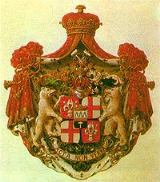
Demidov

Encyclopedia
The Demidov family, also Demidoff, were an influential Russian merchant, industrialist and later chivalry
family, possibly second only to the Tsar
himself in wealth during the late 18th and early 19th centuries.
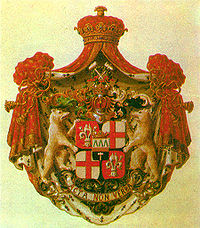 Their progenitor, Demid Antufiev, was a free blacksmith
from Tula
, where their family necropolis is preserved as a museum. His son Nikita Demidov
(March 26, 1656 - November 17, 1725) made his fortune by his skill in the manufacture of weapons, and established an iron foundry for the government. Peter the Great
, with whom he was a favorite, ennobled him in 1720. For two centuries, the Demidov plants produced a large portion of Russia's iron and steel. The Palace of Westminster
was one of many notable buildings constructed of Demidov metal products.
Nikita's son, Akinfiy Demidov
(1678–1745), increased his inherited wealth by the discovery and working of gold, silver and copper mines. He also founded the Siberia
n town of Barnaul
, whose central square still bears his name. He also commissioned the Leaning Tower of Nevyansk
. His fortune was inherited by his eldest son Prokofi Demidov
, whilst his younger son Nikita Akinfievitch Demidov (1724–1789) became an arts patron. Akinfiy's nephew, Pavel Grigoryevich Demidov
(1738–1821), was a great traveller and benefactor of Russian scientific education who befriended Carolus Linnaeus
and Pallas
. He established the Demidov Lyceum in Yaroslavl
, the Demidov chair in Natural history
at Moscow University, and founded an annual prize for Russian literature, awarded by the Academy of Sciences
. A bronze monument
to him was installed in Yaroslavl
in 1828.
Pavel's nephew, Nikolay Nikitich Demidov
(1774–1828), fought in the Napoleonic War with distinction, raised and commanded a regiment to oppose Napoleon's invasion of Russia, and carried on the accumulation of the family wealth from mining; he contributed liberally to the erection of four bridges in St Petersburg, and to the propagation of scientific culture in Moscow. He was created Count by the monarch of Tuscany.
Nikolay's son count Pavel Nikolayevich Demidov (1798–1840) fought as an officer in his father's regiment and received his baptism of fire at the battle of Borodino
in 1812. After the war he entered the Chevalier Guards regiment
. He received his discharge in 1831 with the rank of captain when he entered civil service as governor of the province of Kursk. In 1834 he entered service in the Ministry of the Exterior as court Huntsmaster, later State Councillor. Count Pavel Demidov is best known for his philanthropy, primarily for having founded the Demidov Prize
. He married the well-known society beauty and maid-of-honour to her majesty the Empress Alexandra Feodorovnya Aurore Stjernvall
(1808–1903) in 1836. Their son, Pavel Pavlovich Demidov
, Prince of San Donato, was the grandfather of Prince Paul of Yugoslavia
.
Nikolay's second son, Anatole Nikolayevich Demidov (1813–1870), was a well-known traveller and patron of art. In 1837, he acquired the Italian title of Prince de San Donato and married Princess Mathilde
, daughter of Jérôme Bonaparte
. His Villa Demidoff is a minor landmark of Florence
. Anatole's great grand nephew, Crown Prince Pavel
, was regent of Yugoslavia
between 1934 and 1941.
The second and last Prince Lopukhin, Paul, was granted the right to pass his title and name to his great-nephew, Nicolas Demidoff, a representative of another branch of this industrialist clan. The revolution impoverished the princes Lopukhin-Demidoff, who settled to Finland where they (for a while) owned the manor of Anttolanhovi near Mikkeli
. The dowager princess Natalie deceased in 1957. Their descendants (surname usually rendered as Demidoff) live in Finland.
 In 1798, Nikolay Nikitich Demidov (who was not a prince, despite of fervent desires of some scribblers to put that title in front of his name) was made a Family Commander of the Russian Grand Priory of the Order of Saint John
, by Czar Paul I
. Those favoured by Emperor Paul and his son Alexander I of Russia
, had been given beneficed Commanderies, and others were encouraged to use their wealth to create their own Commanderies; it is these which were known as Family or Ancestral Commanderies.
In 1811, a Ukase was enacted which brought this institution to an end. However by personal grant of the Emperor, the title of "Hereditary Commander" was held by some descendants who qualified. For a full discussion on the arguments which surround this institution consult the essay "The Foundation Deeds of Family Commanderies of the Order of Malta in Russia." http://www.orderstjohn.org/osj/sovereign.html
In 1928 a group of descendants of the original Family Commanders formed an Association. By 1958, the group was chaired by Grand Duke Vladimir (successor to the Russian Throne). This group regulated the claims of the descendants. On 14 April 1958, under his signature of Grand Duke Vladimir decided in favour of Paul Demidoff; "de faire droit à Votre requête et de confirmer Votre titre de Commandeur Héréditaire de l'Union des Descendants des Commandeurs Héréditaires et Chevaliers du Grand Prieuré Russe de l'Ordre de St. Jean de Jérusalem en tant que descendant direct de Demidoff Nicolas fils de Nicétas qui, par grâce de Mon trisaïeul, S.M. l'Empereur Paul I-r Grand Maître de l'Ordre de St. Jean de Jérusalem avait été élevé le 2I Jullet 1799" - in translation; "to grant Your request and to confirm Your title of Hereditary Commander of the Union of the Descendants of the Hereditary Commanders and Knights of the Russian Grand Priory about St John of Jerusalem as a direct descendant of Demidoff Nicholas son of Nicétas which, by grace of My great-great-grandfather, H.M. the Emperor Paul I Grand Master of the Order of St John of Jerusalem had been elevated 21 July 1799" http://www.orderstjohn.org/osj/dem1958.htm
Alexandre Tissot Demidoff (of Berkshire England) chairs an Association which seeks to continue the humanitarian tradition of the Russian Grand Priory, to which Alexander Demidoff (of Paris, and son of Paul Demidoff above) belongs.
The Family Commanderies established during the reigns of Paul I and Alexander I of Russia as part of the non-Catholic Grand Priory include those of:
Narychkine, Count Chéréméteff, Prince Youssoupoff †, Stroganov †, Count Samoiloif ‡, Prince Belosselsky, Prince Dolgoroukov, Davydov, Prince Barytinsky, Prince Démidoff, Prince Troubetzkoy, Count Worontzoff, Maruzzi †, Beklechev †, Prince Tioufiakine †, Count Olsoufieff, Gerebtzoff, Count Strogonoff †, Boutourline, Potemkine †, Tchirikoff †, Prince Khilkoff ‡, Prince Odoevsky †, and Prince Youssoupoff †.
Key. † Direct Male line from the first Commander extinct. ‡ Direct Male line is extinct, but the family was reinstated via the female line by the Imperium.
Chivalry
Chivalry is a term related to the medieval institution of knighthood which has an aristocratic military origin of individual training and service to others. Chivalry was also the term used to refer to a group of mounted men-at-arms as well as to martial valour...
family, possibly second only to the Tsar
Tsar
Tsar is a title used to designate certain European Slavic monarchs or supreme rulers. As a system of government in the Tsardom of Russia and Russian Empire, it is known as Tsarist autocracy, or Tsarism...
himself in wealth during the late 18th and early 19th centuries.
History
Blacksmith
A blacksmith is a person who creates objects from wrought iron or steel by forging the metal; that is, by using tools to hammer, bend, and cut...
from Tula
Tula, Russia
Tula is an industrial city and the administrative center of Tula Oblast, Russia. It is located south of Moscow, on the Upa River. Population: -History:...
, where their family necropolis is preserved as a museum. His son Nikita Demidov
Nikita Demidov
Nikita Demidov was a Russian industrialist who founded the Demidov industrial dynasty....
(March 26, 1656 - November 17, 1725) made his fortune by his skill in the manufacture of weapons, and established an iron foundry for the government. Peter the Great
Peter I of Russia
Peter the Great, Peter I or Pyotr Alexeyevich Romanov Dates indicated by the letters "O.S." are Old Style. All other dates in this article are New Style. ruled the Tsardom of Russia and later the Russian Empire from until his death, jointly ruling before 1696 with his half-brother, Ivan V...
, with whom he was a favorite, ennobled him in 1720. For two centuries, the Demidov plants produced a large portion of Russia's iron and steel. The Palace of Westminster
Palace of Westminster
The Palace of Westminster, also known as the Houses of Parliament or Westminster Palace, is the meeting place of the two houses of the Parliament of the United Kingdom—the House of Lords and the House of Commons...
was one of many notable buildings constructed of Demidov metal products.
Nikita's son, Akinfiy Demidov
Akinfiy Demidov
Akinfiy Nikitich Demidov was a Russian industrialist of the Demidov family.-Life:He was the eldest son of Nikita Demidov and increased the family fortune, raising it to one of Russia's most important industrial dynasties. He set up at least 9 steel foundries and munitions factories from 1717 to...
(1678–1745), increased his inherited wealth by the discovery and working of gold, silver and copper mines. He also founded the Siberia
Siberia
Siberia is an extensive region constituting almost all of Northern Asia. Comprising the central and eastern portion of the Russian Federation, it was part of the Soviet Union from its beginning, as its predecessor states, the Tsardom of Russia and the Russian Empire, conquered it during the 16th...
n town of Barnaul
Barnaul
-Russian Empire:Barnaul was one of the earlier cities established in Siberia. Originally chosen for its proximity to the mineral-rich Altai Mountains and its location on a major river, the site was founded by the wealthy Demidov family in the 1730s. In addition to the copper which had originally...
, whose central square still bears his name. He also commissioned the Leaning Tower of Nevyansk
Leaning Tower of Nevyansk
The Leaning Tower of Nevyansk is a tower in the town of Nevyansk in Sverdlovsk Oblast, Russia, built in the 18th century. Its construction was funded by Peter the Great’s associate and a famous Russian manufacturer Akinfiy Demidov .The height of the tower is 57.5 m from the ground and the...
. His fortune was inherited by his eldest son Prokofi Demidov
Prokofi Demidov
Prokofi Akinfiyevich Demidov was a Russian industrialist and philanthropist.The eldest son of Akinfiy Demidov, Prokofi inherited the enormous Demidov family fortune on his father's death in 1745...
, whilst his younger son Nikita Akinfievitch Demidov (1724–1789) became an arts patron. Akinfiy's nephew, Pavel Grigoryevich Demidov
Pavel Grigoryevich Demidov
Pavel Grigoryevich Demidov was a Russian traveller and patron of scientific education. He was from the Demidov family.-Life:A grandson of Nikita Demidov, in 1755 he created the mineralogical museum in Moscow , in 1803 the Demidov Lyceum at Yaroslavl, and in 1805 the Demidov Scientific...
(1738–1821), was a great traveller and benefactor of Russian scientific education who befriended Carolus Linnaeus
Carolus Linnaeus
Carl Linnaeus , also known after his ennoblement as , was a Swedish botanist, physician, and zoologist, who laid the foundations for the modern scheme of binomial nomenclature. He is known as the father of modern taxonomy, and is also considered one of the fathers of modern ecology...
and Pallas
Peter Simon Pallas
Peter Simon Pallas was a German zoologist and botanist who worked in Russia.- Life and work :Pallas was born in Berlin, the son of Professor of Surgery Simon Pallas. He studied with private tutors and took an interest in natural history, later attending the University of Halle and the University...
. He established the Demidov Lyceum in Yaroslavl
Yaroslavl
Yaroslavl is a city and the administrative center of Yaroslavl Oblast, Russia, located northeast of Moscow. The historical part of the city, a World Heritage Site, is located at the confluence of the Volga and the Kotorosl Rivers. It is one of the Golden Ring cities, a group of historic cities...
, the Demidov chair in Natural history
Natural history
Natural history is the scientific research of plants or animals, leaning more towards observational rather than experimental methods of study, and encompasses more research published in magazines than in academic journals. Grouped among the natural sciences, natural history is the systematic study...
at Moscow University, and founded an annual prize for Russian literature, awarded by the Academy of Sciences
Russian Academy of Sciences
The Russian Academy of Sciences consists of the national academy of Russia and a network of scientific research institutes from across the Russian Federation as well as auxiliary scientific and social units like libraries, publishers and hospitals....
. A bronze monument
Demidovsky Pillar, Yaroslavl
The Demidovsky Pillar in Yaroslavl is a bronze Doric column set up as a memorial to Pavel Grigoryevich Demidov - founder of the Yaroslavl Demidov School of Higher Sciences. It was set up on 6 March 1829 in Ilyinsky Square in Yaroslavl from funds given the town's inhabitants and other voluntary...
to him was installed in Yaroslavl
Yaroslavl
Yaroslavl is a city and the administrative center of Yaroslavl Oblast, Russia, located northeast of Moscow. The historical part of the city, a World Heritage Site, is located at the confluence of the Volga and the Kotorosl Rivers. It is one of the Golden Ring cities, a group of historic cities...
in 1828.
Pavel's nephew, Nikolay Nikitich Demidov
Nikolay Demidov
Count Nikolai Nikitich Demidov was a Russian industrialist, collector and arts patron of the Demidov family.-Life:...
(1774–1828), fought in the Napoleonic War with distinction, raised and commanded a regiment to oppose Napoleon's invasion of Russia, and carried on the accumulation of the family wealth from mining; he contributed liberally to the erection of four bridges in St Petersburg, and to the propagation of scientific culture in Moscow. He was created Count by the monarch of Tuscany.
Nikolay's son count Pavel Nikolayevich Demidov (1798–1840) fought as an officer in his father's regiment and received his baptism of fire at the battle of Borodino
Battle of Borodino
The Battle of Borodino , fought on September 7, 1812, was the largest and bloodiest single-day action of the French invasion of Russia and all Napoleonic Wars, involving more than 250,000 troops and resulting in at least 70,000 casualties...
in 1812. After the war he entered the Chevalier Guards regiment
Chevalier Guard
The Chevalier Guard regiment was a Russian heavy cavalry guard regiment, created in 1800 by the reformation of the Chevalier Guard corps, itself created in 1764 by Catherine the Great...
. He received his discharge in 1831 with the rank of captain when he entered civil service as governor of the province of Kursk. In 1834 he entered service in the Ministry of the Exterior as court Huntsmaster, later State Councillor. Count Pavel Demidov is best known for his philanthropy, primarily for having founded the Demidov Prize
Demidov Prize
The Demidov Prize was a national scientific prize in the Russian Empire awarded annually to the members of the Russian Academy of Sciences. One of the most prestigious and oldest scientific awards in the world, its traditions influenced other awards of this kind including the Nobel Prize...
. He married the well-known society beauty and maid-of-honour to her majesty the Empress Alexandra Feodorovnya Aurore Stjernvall
Aurora Stjernvall
Eva Aurora Charlotta Karamzin née Stjernvall, was a Finnish Swede philanthropist. She was the founder and supporter of various charities...
(1808–1903) in 1836. Their son, Pavel Pavlovich Demidov
Pavel Pavlovich Demidov
Count Pavel Pavlovich Demidov, 2nd Prince of San Donato was a Russian industrialist, jurist, philanthropist and nobleman of the Demidov family...
, Prince of San Donato, was the grandfather of Prince Paul of Yugoslavia
Prince Paul of Yugoslavia
Prince Paul of Yugoslavia, also known as Paul Karađorđević , was Regent of the Kingdom of Yugoslavia during the minority of King Peter II. Peter was the eldest son of his first cousin Alexander I...
.
Nikolay's second son, Anatole Nikolayevich Demidov (1813–1870), was a well-known traveller and patron of art. In 1837, he acquired the Italian title of Prince de San Donato and married Princess Mathilde
Mathilde Bonaparte
Mathilde Laetitia Wilhelmine Bonaparte, Princesse Française , was a French princess and Salon holder. She was a daughter of Napoleon's brother Jérôme Bonaparte and his second wife, Catharina of Württemberg, daughter of King Frederick I of Württemberg.- Biography :Born in Trieste, Mathilde Bonaparte...
, daughter of Jérôme Bonaparte
Jérôme Bonaparte
Jérôme-Napoléon Bonaparte, French Prince, King of Westphalia, 1st Prince of Montfort was the youngest brother of Napoleon, who made him king of Westphalia...
. His Villa Demidoff is a minor landmark of Florence
Florence
Florence is the capital city of the Italian region of Tuscany and of the province of Florence. It is the most populous city in Tuscany, with approximately 370,000 inhabitants, expanding to over 1.5 million in the metropolitan area....
. Anatole's great grand nephew, Crown Prince Pavel
Prince Paul of Yugoslavia
Prince Paul of Yugoslavia, also known as Paul Karađorđević , was Regent of the Kingdom of Yugoslavia during the minority of King Peter II. Peter was the eldest son of his first cousin Alexander I...
, was regent of Yugoslavia
Yugoslavia
Yugoslavia refers to three political entities that existed successively on the western part of the Balkans during most of the 20th century....
between 1934 and 1941.
The second and last Prince Lopukhin, Paul, was granted the right to pass his title and name to his great-nephew, Nicolas Demidoff, a representative of another branch of this industrialist clan. The revolution impoverished the princes Lopukhin-Demidoff, who settled to Finland where they (for a while) owned the manor of Anttolanhovi near Mikkeli
Mikkeli
Mikkeli is a town and municipality in Finland. It is located in what used to be the province of Eastern Finland and is part of the Southern Savonia region. The municipality has a population of and covers an area of of which is water...
. The dowager princess Natalie deceased in 1957. Their descendants (surname usually rendered as Demidoff) live in Finland.
Hereditary commanders of the Knights Hospitaller
Russian tradition of the Knights Hospitaller
The Russian Tradition of the The Hospitaller Knights emerged when the Mediterranean stronghold of Malta was captured by Napoleon in 1798 when he made his expedition to Egypt...
, by Czar Paul I
Paul I of Russia
Paul I was the Emperor of Russia between 1796 and 1801. He also was the 72nd Prince and Grand Master of the Order of Malta .-Childhood:...
. Those favoured by Emperor Paul and his son Alexander I of Russia
Alexander I of Russia
Alexander I of Russia , served as Emperor of Russia from 23 March 1801 to 1 December 1825 and the first Russian King of Poland from 1815 to 1825. He was also the first Russian Grand Duke of Finland and Lithuania....
, had been given beneficed Commanderies, and others were encouraged to use their wealth to create their own Commanderies; it is these which were known as Family or Ancestral Commanderies.
In 1811, a Ukase was enacted which brought this institution to an end. However by personal grant of the Emperor, the title of "Hereditary Commander" was held by some descendants who qualified. For a full discussion on the arguments which surround this institution consult the essay "The Foundation Deeds of Family Commanderies of the Order of Malta in Russia." http://www.orderstjohn.org/osj/sovereign.html
In 1928 a group of descendants of the original Family Commanders formed an Association. By 1958, the group was chaired by Grand Duke Vladimir (successor to the Russian Throne). This group regulated the claims of the descendants. On 14 April 1958, under his signature of Grand Duke Vladimir decided in favour of Paul Demidoff; "de faire droit à Votre requête et de confirmer Votre titre de Commandeur Héréditaire de l'Union des Descendants des Commandeurs Héréditaires et Chevaliers du Grand Prieuré Russe de l'Ordre de St. Jean de Jérusalem en tant que descendant direct de Demidoff Nicolas fils de Nicétas qui, par grâce de Mon trisaïeul, S.M. l'Empereur Paul I-r Grand Maître de l'Ordre de St. Jean de Jérusalem avait été élevé le 2I Jullet 1799" - in translation; "to grant Your request and to confirm Your title of Hereditary Commander of the Union of the Descendants of the Hereditary Commanders and Knights of the Russian Grand Priory about St John of Jerusalem as a direct descendant of Demidoff Nicholas son of Nicétas which, by grace of My great-great-grandfather, H.M. the Emperor Paul I Grand Master of the Order of St John of Jerusalem had been elevated 21 July 1799" http://www.orderstjohn.org/osj/dem1958.htm
Alexandre Tissot Demidoff (of Berkshire England) chairs an Association which seeks to continue the humanitarian tradition of the Russian Grand Priory, to which Alexander Demidoff (of Paris, and son of Paul Demidoff above) belongs.
The Family Commanderies established during the reigns of Paul I and Alexander I of Russia as part of the non-Catholic Grand Priory include those of:
Narychkine, Count Chéréméteff, Prince Youssoupoff †, Stroganov †, Count Samoiloif ‡, Prince Belosselsky, Prince Dolgoroukov, Davydov, Prince Barytinsky, Prince Démidoff, Prince Troubetzkoy, Count Worontzoff, Maruzzi †, Beklechev †, Prince Tioufiakine †, Count Olsoufieff, Gerebtzoff, Count Strogonoff †, Boutourline, Potemkine †, Tchirikoff †, Prince Khilkoff ‡, Prince Odoevsky †, and Prince Youssoupoff †.
Key. † Direct Male line from the first Commander extinct. ‡ Direct Male line is extinct, but the family was reinstated via the female line by the Imperium.
See also
- Demidov SquareDemidov SquareDemidov Square is a square in the Tsentralny City District of Barnaul in Russia, named after the Demidov dynasty. It is the site of the Demidovsky Pillar....
- Demidovsky Pillar, BarnaulDemidovsky Pillar, BarnaulThe Demidovsky Pillar is a modern obelisk on Demidov Square in the Central District of Barnaul, Russia. It is a memorial to 100 years of mining in the Altai Krai...
- Demidovsky Pillar, YaroslavlDemidovsky Pillar, YaroslavlThe Demidovsky Pillar in Yaroslavl is a bronze Doric column set up as a memorial to Pavel Grigoryevich Demidov - founder of the Yaroslavl Demidov School of Higher Sciences. It was set up on 6 March 1829 in Ilyinsky Square in Yaroslavl from funds given the town's inhabitants and other voluntary...
- Demidov collectionDemidov collectionThe Demidov collection was a collection of artworks gathered by the Russian industrialist Nikolay Demidov and considerably expanded by his second son Anatole. It was mainly on show at their Villa San Donato near Florence, in which a private museum of 14 rooms was devoted to them...
- Prokofi DemidovProkofi DemidovProkofi Akinfiyevich Demidov was a Russian industrialist and philanthropist.The eldest son of Akinfiy Demidov, Prokofi inherited the enormous Demidov family fortune on his father's death in 1745...
- Aurora DemidovAurora DemidovPrincess and Countess Aurora Pavlovna Demidova was a Russian noblewoman of the Demidov family...
- Pavel Grigoryevich DemidovPavel Grigoryevich DemidovPavel Grigoryevich Demidov was a Russian traveller and patron of scientific education. He was from the Demidov family.-Life:A grandson of Nikita Demidov, in 1755 he created the mineralogical museum in Moscow , in 1803 the Demidov Lyceum at Yaroslavl, and in 1805 the Demidov Scientific...
- Pavel DemidovPavel DemidovPrince and Count Pavel Nikolaievich Demidov was a Russian nobleman of the Demidov dynasty.-Life:The eldest son of Count Nikolai Nikitich Demidov and Baroness Elisabeta Alexandrovna Stroganova, he fought as an officer in his father's regiment and received his baptism of fire at the battle of...
- Pavel Pavlovitch Demidov
- Alla DemidovaAlla DemidovaAlla Sergeyevna Demidova is a Russian actress internationally acclaimed for the tragic parts in innovative plays staged by Yuri Lyubimov in the Taganka Theatre. She was awarded the USSR State Prize in 1977.- Biography :...
- Villa San DonatoVilla San DonatoThe Villa San Donato is a Palladian palace built by Russian industrialist Nikolay Demidov on 42 hectares of marshland to the north of Florence at Polverosa which he had bought from the Catholic church, after he was made Russia's ambassador to the court of Tuscany. The first stone was laid on 27...
Publications
- Anatole Demidoff, Travels in Southern Russia, and the Crimea; through Hungary, Wallachia, & Modavia, during the Year 1837, London, J. Mitchell, 1853,