
Home      Discussion      Topics      Dictionary      Almanac
Signup       Login
Senusret I

Senusret I

Overview
Senusret I was the second pharaoh
Pharaoh
Pharaoh is a title used in many modern discussions of the ancient Egyptian rulers of all periods. The title originates in the term "pr-aa" which means "great house" and describes the royal palace...

 of the Twelfth Dynasty
Twelfth dynasty of Egypt
The twelfth dynasty of ancient Egypt is often combined with Dynasties XI, XIII and XIV under the group title Middle Kingdom.-Rulers:Known rulers of the twelfth dynasty are as follows :...

 of Egypt
Ancient Egypt
Ancient Egypt was an ancient civilization of Northeastern Africa, concentrated along the lower reaches of the Nile River in what is now the modern country of Egypt. Egyptian civilization coalesced around 3150 BC with the political unification of Upper and Lower Egypt under the first pharaoh...

. He ruled from 1971 BC to 1926 BC, and was one of the most powerful kings of this Dynasty. He was the son of Amenemhat I
Amenemhat I
Amenemhat I, also Amenemhet I, was the first ruler of the Twelfth Dynasty . He ruled from 1991 BC to 1962 BC...

 and his wife Nefertitanen. His wife and sister was Neferu. She was also the mother of the successor Amenemhat II
Amenemhat II
Nubkhaure Amenemhat II was the third pharaoh of the Twelfth Dynasty of Ancient Egypt. Not much is known about his reign. He ruled Egypt for 35 years from 1929 BC to 1895 BC and was the son of Senusret I through the latter's chief wife, Queen Nefru. His queen is not known; although recently a...

. Senusret I was known by his prenomen, Kheperkare, which means "the Ka of Re is created."
Discussion
Ask a question about 'Senusret I'
Start a new discussion about 'Senusret I'
Answer questions from other users
Full Discussion Forum
 
Recent Discussions
Encyclopedia
Senusret I was the second pharaoh
Pharaoh
Pharaoh is a title used in many modern discussions of the ancient Egyptian rulers of all periods. The title originates in the term "pr-aa" which means "great house" and describes the royal palace...

 of the Twelfth Dynasty
Twelfth dynasty of Egypt
The twelfth dynasty of ancient Egypt is often combined with Dynasties XI, XIII and XIV under the group title Middle Kingdom.-Rulers:Known rulers of the twelfth dynasty are as follows :...

 of Egypt
Ancient Egypt
Ancient Egypt was an ancient civilization of Northeastern Africa, concentrated along the lower reaches of the Nile River in what is now the modern country of Egypt. Egyptian civilization coalesced around 3150 BC with the political unification of Upper and Lower Egypt under the first pharaoh...

. He ruled from 1971 BC to 1926 BC, and was one of the most powerful kings of this Dynasty. He was the son of Amenemhat I
Amenemhat I
Amenemhat I, also Amenemhet I, was the first ruler of the Twelfth Dynasty . He ruled from 1991 BC to 1962 BC...

 and his wife Nefertitanen. His wife and sister was Neferu. She was also the mother of the successor Amenemhat II
Amenemhat II
Nubkhaure Amenemhat II was the third pharaoh of the Twelfth Dynasty of Ancient Egypt. Not much is known about his reign. He ruled Egypt for 35 years from 1929 BC to 1895 BC and was the son of Senusret I through the latter's chief wife, Queen Nefru. His queen is not known; although recently a...

. Senusret I was known by his prenomen, Kheperkare, which means "the Ka of Re is created."

He continued his father's aggressive expansionist policies against Nubia
Nubia
Nubia is a region along the Nile river, which is located in northern Sudan and southern Egypt.There were a number of small Nubian kingdoms throughout the Middle Ages, the last of which collapsed in 1504, when Nubia became divided between Egypt and the Sennar sultanate resulting in the Arabization...

 by initiating two expeditions into this region in his 10th and 18th Years and established Egypt's formal southern border near the second cataract
Cataracts of the Nile
The cataracts of the Nile are shallow lengths of the Nile between Aswan and Khartoum where the surface of the water is broken by many small boulders and stones protruding out of the river bed, as well as many rocky islets. Aswan is also the Southern boundary of Upper Egypt...

 where he placed a garrison and a victory stele
Stele
A stele , also stela , is a stone or wooden slab, generally taller than it is wide, erected for funerals or commemorative purposes, most usually decorated with the names and titles of the deceased or living — inscribed, carved in relief , or painted onto the slab...

. He also organized an expedition to a Western Desert oasis
Oasis
In geography, an oasis or cienega is an isolated area of vegetation in a desert, typically surrounding a spring or similar water source...

 in the Libyan desert
Libyan Desert
The Libyan Desert covers an area of approximately 1,100,000 km2, it extends approximately 1100 km from east to west, and 1,000 km from north to south, in about the shape of a rectangle...

. Senusret I established diplomatic relations with some rulers of towns in Syria and Canaan
Canaan
Canaan is a historical region roughly corresponding to modern-day Israel, Palestine, Lebanon, and the western parts of Jordan...

. He also tried to centralize the country's political structure by supporting nomarchs who were loyal to him. His pyramid was constructed at el-Lisht
El-Lisht
Lisht or el-Lisht is an Egyptian village located south of Cairo. It is the site of Middle Kingdom royal and elite burials, including two pyramids built by Amenemhat I and Senusret I. The two main pyramids were surrounded by smaller pyramids of members of the royal family, and many mastaba tombs of...

. Senusret I is mentioned in the Story of Sinuhe
Story of Sinuhe
The Tale of Sinuhe is considered one of the finest works of Ancient Egyptian literature. It is a narrative set in the aftermath of the death of Pharaoh Amenemhat I, founder of the 12th dynasty of Egypt, in the early 20th century BC. It is likely that it was composed only shortly after this date,...

 where he is reported to have rushed back to the royal palace in Memphis from a military campaign in Asia after hearing about the assassination of his father, Amenemhat I
Amenemhat I
Amenemhat I, also Amenemhet I, was the first ruler of the Twelfth Dynasty . He ruled from 1991 BC to 1962 BC...

.

Building program


Senusret I dispatched several quarrying expeditions to the Sinai
Sinai Peninsula
The Sinai Peninsula or Sinai is a triangular peninsula in Egypt about in area. It is situated between the Mediterranean Sea to the north, and the Red Sea to the south, and is the only part of Egyptian territory located in Asia as opposed to Africa, effectively serving as a land bridge between two...

 and Wadi Hammamat
Wadi Hammamat
' is a dry river bed in Egypt's Eastern Desert, about halfway between Qusier and Qena. It was a major mining region and trade route east from the Nile Valley in ancient times, and three thousand years of rock carvings and graffiti make it a major scientific and tourist site today.-Trade...

 and built numerous shrines and temples throughout Egypt and Nubia during his long reign. He rebuilt the important temple of Re-Atum in Heliopolis which was the centre of the sun cult –. He erected 2 red granite obelisks there to celebrate his Year 30 Heb Sed Jubilee
Sed festival
The Sed festival was an ancient Egyptian ceremony that celebrated the continued rule of a pharaoh...

. One of the obelisks still remains and is the oldest standing obelisk in Egypt. It is now in the Al-Masalla (Obelisk in Arabic) area of Al-Matariyyah
Al-Matariyyah
Al-Matariyyah, Mataria or El Matariya is a district in the northern region of Greater Cairo, east of the Nile, in Egypt. The district is unrelated to the El Matareya coastal region in the Dakahlia Governorate...

 district near the Ain Shams
Ain Shams
Ain Shams or Ein Shams is a suburb of Cairo, Egypt. The name means "eye of the sun" in Arabic, with reference to the fact that Ain Shams is built on top of the ancient city of Heliopolis, once the spiritual centre of ancient Egyptian sun-worship.According to the 10th century Jewish biblical...

 district (Heliopolis
Heliopolis (ancient)
Heliopolis was one of the oldest cities of ancient Egypt, the capital of the 13th Lower Egyptian nome that was located five miles east of the Nile to the north of the apex of the Nile Delta...

). It is 67 feet tall and weighs 120 tons or 240,000 pounds.

Senusret I is attested to be the builder of a number of major temples in Ancient Egypt, including the temple of Min at Koptos, the Satet-Temple on Elephantine
Elephantine
Elephantine is an island in the River Nile, located just downstream of the First Cataract at the southern border of Ancient Egypt. This region is referred to as Upper Egypt because the land is higher than that near the Mediterranean coast. The island may have received its name because it was a...

, the Month-temple at Armant and the Month-temple at El-Tod, where a long inscription of the king is preserved.

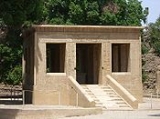
A shrine (known as the White Chapel
White Chapel
For other uses, see Whitechapel Currently reconstructed in the Karnak Open Air Museum, the White Chapel of Senusret II, also referred to as the Jubilee Chapel of Senusret I, was built during the Middle Kingdom of Egypt...

) with fine, high quality reliefs of Senusret I, was built at Karnak to commemorate his Year 30 jubilee. It has subsequently been successfully reconstructed from various stone blocks discovered by Henri Chevrier in 1926. Finally, Senusret remodelled the Temple of Khenti-Amentiu Osiris at Abydos
Abydos, Egypt
Abydos is one of the most ancient cities of Upper Egypt, and also of the eight Upper Nome, of which it was the capital city. It is located about 11 kilometres west of the Nile at latitude 26° 10' N, near the modern Egyptian towns of el-'Araba el Madfuna and al-Balyana...

, among his other major building projects.


The royal court


Some of the key members of the court of Senusret I are known. The vizier
Vizier (Ancient Egypt)
The vizier was the highest official in Ancient Egypt to serve the king, or pharaoh during the Old, Middle, and New Kingdoms. Vizier is the generally accepted rendering of ancient Egyptian tjati, tjaty etc, among Egyptologists...

 at the beginning of his reign was Intefiqer
Intefiqer
The Ancient Egyptian noble Intefiqer was overseer of the city and Vizier under Amenemhet I and Senusret I during the 12th Dynasty. He is known from several rock inscriptions in Lower Nubia, showing that he was part of a military mission into this region. He appears in an inscription found at the...

, who is known from many inscriptions and from his tomb next to the pyramid of Amenemhat I. He seems to have held this office for a long period of time and was followed by a vizier named Senusret
Senusret (vizier)
Senusret was an Ancient Egyptian official who was a vizier during the last years of king Senusret I's rule and in the first years of Amenemhet II. Senusret is known from a stela found in Abydos, which is dated to year 8 of Amenemhet II. He also appears in biographical inscriptions in the tomb of...

. Two treasurer
Treasurer
A treasurer is the person responsible for running the treasury of an organization. The adjective for a treasurer is normally "tresorial". The adjective "treasurial" normally means pertaining to a treasury, rather than the treasurer.-Government:...

s are known from the reign of the king: Sobekhotep (year 22) and Mentuhotep
Mentuhotep (treasurer)
Mentuhotep was an Ancient Egyptian official and treasurer under the 12th dynasty pharaoh Senusret I. Mentuhotep is one of the best attested officials of the Middle Kingdom period. There is a series of statues found at Karnak, showing him as a scribe...

. The latter had a huge tomb next to the pyramid of the king and he seems to have been the main architect of the Amun temple at Karnak.

Succession


Senusret was crowned coregent with his father, Amenemhat I, in his father's 20th regnal year. Towards the end of his own life, he appointed his son Amenemhat II
Amenemhat II
Nubkhaure Amenemhat II was the third pharaoh of the Twelfth Dynasty of Ancient Egypt. Not much is known about his reign. He ruled Egypt for 35 years from 1929 BC to 1895 BC and was the son of Senusret I through the latter's chief wife, Queen Nefru. His queen is not known; although recently a...

 as his coregent. The stele of Wepwawetō is dated to the 44th year of Senusret and to the 2nd year of Amenemhet, thus he would have appointed him some time in his 43rd year. Senusret is thought to have died during his 46th year on the throne since the Turin Canon
Turin King List
The Turin King List, also known as the Turin Royal Canon, is a hieratic papyrus thought to date from the reign of Ramesses II, now in the Museo Egizio at Turin...

ascribes him a reign of 45 Years.

External links