


Brest, Belarus

Encyclopedia
Brest formerly also Brest-on-the-Bug ("Brześć nad Bugiem" in Polish) and Brest-Litovsk ("Brześć Litewski" in Polish), is a city (population 310,800 in 2010) in Belarus
at the border with Poland
opposite the city of Terespol
, where the Bug River
and Mukhavets
rivers meet. It is the capital city of the Brest voblast
.
Being situated on the main railway line connecting Berlin and Moscow, and an intercontinental highway (the European route E30
), Brest became a principal border crossing since World War II in Soviet times. Today it links the European Union
and the Commonwealth of Independent States
.
Because of the break-of-gauge
at Brest, where the Russian broad gauge
meets the European standard gauge
, all passenger trains, coming from Poland
, must have their bogie
s replaced
here, to travel on across Belarus
, and the freight must be transloaded from cars of one gauge to cars of another. Some of the land in the Brest rail yards remains contaminated as a result of the transshipment of radioactive materials here since Soviet days although cleanup operations have been taking place.
Once a center of Jewish scholarship, the city's name in Yiddish
, is בריסק ("Brisk"), hence the term "Brisker" used to describe followers of the influential Soloveitchik
family of rabbi
s.
in 1554.
in 1019 when they took the stronghold from the Poles,and is one of the oldest cities in Belarus
. It was hotly contested between the Polish rulers (kings, principal dukes and dukes of Masovia) and Kievan Rus princes,laid waste by the Mongols
in 1241 (see: Mongol invasion of Europe
), and was not rebuilt until 1275, later it became part of the Grand Duchy of Lithuania
, .
In 1390 Brest became the first city in the lands that now comprise Belarus
to receive Magdeburg rights
. Its suburbs were burned by the Teutonic Knights
in 1379; and in 1500 the whole town met a similar fate at the hands of the Crimean Tatars
. It was renamed Brześć Litewski(Brest-Litovsk) in the 16th century, after it became part of the Polish–Lithuanian Commonwealth in 1569 (see: Union of Lublin
). In 1409 it was a meeting place of King Władysław II Jagiełło, duke Vitautas and Tatar khan under the archbishop Mikołaj Trąba initiative within the preparation of the war with the Teutonic Knights. In 1410 the town mustered a cavalry company (banner) that participated in the victorious for the Polish-Lithuanian union battle of Grunwald
. In 1419 it become a seat of the starost in the newly created Trakai Voivodeship
. In 1566, following king Sigismund II Augustus
decree, a new voivodeship was created - Brest Litovsk Voivodeship.
During the period of the union
of the Polish–Lithuanian Commonwealth and Sweden
under king Sigismund III Vasa
(Polish–Swedish union), diets were held there; and in 1594 and 1596 it was the meeting-place of two remarkable councils of the Roman-Catholic Church and Eastern Orthodox Church
bishops of the region; the 1596 council establishing the Uniate Church (known also as the Belarusian Greek Catholic Church
in Belarus
and Ukrainian Greek Catholic Church
in Ukraine
). In 1657, and again in 1706, the town and castle were captured by the Swedes
during their invasions of Polish-Lithuanian Commonwealth; on January 13, 1660 the invading Muscovite Russian army under Ivan Andreyevich Khovansky took the Brest castle in a surprise early morning attack, the town having been captured earlier, and massacred the 1700 defenders and their families (according to captain Rosestein, Austrian observer); on July 23, 1792 a battle was fought between the regiments of Duchy of Lithuanian (part of Polish Army) defending the town and the invading Russian Imperial Army; on September 19, 1794 the area between Brest and Terespol
was the scene of a victorious battle won by the invading Russian Imperial army under Suvorov
over the Kościuszko Uprising
army division under general Karol Sierakowski known in Russian sources as (Battle of Brest
). Brest was annexed by Russia when the Poland-Lithuania Commonwealth was partitioned for the third time in 1795 (see: Partitions of Poland
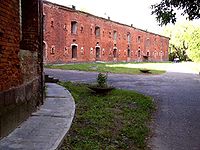
). During Russian rule in the 19th century a large fortress was built in and around the city, while the Polish Royal Castle and most of the Old Town were demolished to make room for the fortress.
 The town was captured by the German army in 1915, during World War I
. In March 1918, in the Brest-Litovsk fortress on the western outskirts of Brest at the confluence of the Bug River and Mukhavets Rivers, the Treaty of Brest-Litovsk
was signed, ending the war between Soviet Russia and the Central Powers
and transferring the city and its surrounding region to the sphere of influence of the German Empire. This treaty was subsequently annulled by the treaties which ended the war and even more so by the events and the developments in Germany and Eastern Europe.
In 1918 the city was declared part of the short-lived Belarusian Democratic Republic. The newly reconstituted Poland
took control of Brest in 1919 as part of her heritage as a matter of right. The city changed hands twice during the Polish-Soviet War
and eventually stayed inside Polish borders, a development that was formally recognized by the Treaty of Riga in 1921. In the fortress, heavily damaged during World War I, Polish Army troops with the headquarters of the 9th Military District were stationed, and the city itself became a capital of Polesie Voivodeship
, in accordance of the pre-1795 tradition. In 1930 Wincenty Witos
and some other prominent Polish statesmen were detained here before their notorious trial in Warsaw.
During the Invasion of Poland
in 1939 the city was defended by a small garrison of four infantry battalions under General Konstanty Plisowski
against the XIX Panzer Corps of General Heinz Guderian
. After four days of heavy fighting the Polish forces withdrew southwards on September 17 (more in articles: Battle of Brześć Litewski
). The treacherous invasion by the Soviet Union occurred on the same day and as a result the Soviet Red Army occupied the city the end of September 1939 in accordance with the Ribbentrop-Molotov pact's Secret Protocol, and a joint Nazi-Soviet military parade took place. While Belarusians consider it a reunification of the Belarusian nation under one constituency (BSSR at that time), Poles consider it the date when the city was lost. During the Soviet occupation 1939-41 the Polish population was subject to arrests, executions and mass deportations to Siberia
and Soviet Republic of Kazakhstan
.
The city had a significant Jewish population: 30,000 out of 45,000 total population according to Russian 1897 census, which fell to 21,000 out of 50,000 according to the Polish 1931 census.
On June 22, 1941 the fortress and the city were attacked by Nazi Germany
at the beginning of the Soviet-Nazi war, Operation Barbarossa
, but held out for six days
. Abandoned by the Soviet army nearly all the defenders perished. Brest's Jewish community was decimated under Nazi rule in 1942. The city was taken by the Red Army on July 28, 1944.
Following to the agreements of the Yalta Conference
of February 1945, Brest's status as part of the Byelorussian Soviet Socialist Republic was officially recognized in spite of Polish protests. The Poles of Brest, after 1000 years of history, were encouraged to emigrate and during the 1940s and 1950s the majority left for Communist Poland.
. This war memorial is the largest tourist attraction of the city. An archaeological museum of the old city Berestye is located on the southern island of the Hero-Fortress. It has objects and huts dating from the 11th – 13th century, that were unearthed during excavations in the 1970s. Brest is proud of its shopping mall, Sovietskaya Street. It was dramatically reconstructed in 2007–2009 to revive the initial view of the old town. In July 2009 the Millennium Monument of Brest
was unveiled.
Brest also has the first Belarusian outdoor railway museum
.
Earlier in Brest there was a synagogue, which was regarded as the first one in Grand Duchy of Lithuania
.
It is also the seat of an Armenian and of a Greek Catholic bishop; the former has jurisdiction over the Armenians throughout the whole country.
A Holocaust memorial commemorates over 34,000 Jews of the Brest ghetto
who were killed in 1941–1942.
Brest City Park
is 100 years old, but looks quite new after recent reconstruction.
Brest is home to two Universities: A.S.Pushkin State University and Brest State Technical University.
The local airport (code BQT), is operating flights to the capital city Minsk
and to Moscow and Novgorod in Russia on a weekly basis.
Brest lies astride the Mukhavets River, that is known to Bresters as "the river". The river flows west through the city, dividing it into north and south, and meets the Bug River in the Brest Fortress. The river flows slowly and gently. You can hop into a tube that looks like a big rubber doughnut and take a relaxing float down this river.
Today the river looks quite broad in Brest. The terrain is fairly flat around Brest. The river has an extremely broad floodplain
, that is about 2–3 km across. Brest was subject to flooding in the past. One of the worst floods in recorded history occurred in 1974.
A part of the floodplain
was reclaimed from the river during the last 3 decades. In the 1980s big cutter-suction dredgers were mining sand and clay from the riverbed, to raise the banks. After the dredging the river became deeper and the riverbanks higher. Today the river does not overflow its banks.
In the 2000s Brest developed new residential areas and sports attractions on the reclaimed land along the river and increased its vitality. The big sports venues on the northern riverside are an indoor track-and-field center, the Ice Palace
(Ice Arena) and Belarus' first outdoor baseball
stadium. On the opposite riverside is a large rowing course opened in 2007, home of the National Center for Olympic Training in Rowing. It meets international requirements and can host international competitions. It has accommodation and training facilities, favorable location, 3 km away from the border crossing along Warsaw Highway (the European route E30
).
). There is a museum and a zoo, available for tourists in the forest, animals can be seen in enclosures all the year round. 2 hotels and some restaurants and bars are there. Excursions can also be taken by horse and cart into the interior of the forest. As a new tourist attraction, the forest features the residence of Grandfather Frost, known as Ded Moroz
, the Eastern Slavic Santa Claus
, that works all the year round.
Brest also hosts the first Belarusian outdoor railway museum. Brest City Park
is old, but looks new after the recent reconstruction.
Kamyanets, Belarus, that lies on the way to the National park from Brest, features an outstanding landmark, the 13th-century tower of Kamyanets.
The village of Kosova, where Tadeusz Kościuszko
was born, is also in the Brest region and features a 19th-century palace and a nice Roman Catholic church.
Brest can easily be reached from Warsaw (Poland) by taking the daily sleeper train to Brest Centralnaya (Brest Central) from the central train station in Warsaw, although visas must be sorted out for EU passport holders before travelling. There are a few hotels in Brest, including "Intourist" Hotel on Prospekt Masherava (Masherov Avenue).
Oryol
, Russia Moscow
, Russia Nizhny Tagil
, Russia Astrakhan
, Russia Kovrov
, Russia Tyumen
, Russia Petrozavodsk
, Russia Saint Petersburg
(Nevski rayon
), Russia Lutsk
, Ukraine Ivano-Frankivsk
, Ukraine Odessa
, Ukraine Lublin
, Poland Biała Podlaska, Poland Siedlce
, Poland Terespol
, Poland Pleven
, Bulgaria Botoşani
, Romania Coevorden
, Netherlands Xiaogan
, China Port-sur-Saône
, France Schussental (Weingarten
, Ravensburg
, Baienfurt
, Baindt
, Berg
), Germany Aleppo
, Syria
3232 Brest
, discovered by the Soviet astronomer Lyudmila Ivanovna Chernykh in 1974, is named after the city.
Belarus
Belarus , officially the Republic of Belarus, is a landlocked country in Eastern Europe, bordered clockwise by Russia to the northeast, Ukraine to the south, Poland to the west, and Lithuania and Latvia to the northwest. Its capital is Minsk; other major cities include Brest, Grodno , Gomel ,...
at the border with Poland
Poland
Poland , officially the Republic of Poland , is a country in Central Europe bordered by Germany to the west; the Czech Republic and Slovakia to the south; Ukraine, Belarus and Lithuania to the east; and the Baltic Sea and Kaliningrad Oblast, a Russian exclave, to the north...
opposite the city of Terespol
Terespol
Terespol is a town in eastern Poland on the border with Belarus. It lies on the border river Bug, directly opposite the city of Brest, Belarus...
, where the Bug River
Bug River
The Bug River is a left tributary of the Narew river flows from central Ukraine to the west, passing along the Ukraine-Polish and Polish-Belarusian border and into Poland, where it empties into the Narew river near Serock. The part between the lake and the Vistula River is sometimes referred to as...
and Mukhavets
Mukhavets River
Mukhavets , ; ) is a river in western Belarus, a tributary to the Bug River.The river rises in Pruzhany, Belarus where the Mukha river and the Viets canal are converging, flows in the south-western Belarus and empties into the Bug River in Brest....
rivers meet. It is the capital city of the Brest voblast
Brest Voblast
Brest Voblast or Brest Oblast is a province of Belarus with its administrative center being Brest.Important cities within the voblast' include: Baranovichi, Brest, and Pinsk.-Geography:...
.
Being situated on the main railway line connecting Berlin and Moscow, and an intercontinental highway (the European route E30
European route E30
European route E 30 is an A-Class West-East European route, extending from the southern Irish port of Cork in the west to the Russian city of Omsk in the east...
), Brest became a principal border crossing since World War II in Soviet times. Today it links the European Union
European Union
The European Union is an economic and political union of 27 independent member states which are located primarily in Europe. The EU traces its origins from the European Coal and Steel Community and the European Economic Community , formed by six countries in 1958...
and the Commonwealth of Independent States
Commonwealth of Independent States
The Commonwealth of Independent States is a regional organization whose participating countries are former Soviet Republics, formed during the breakup of the Soviet Union....
.
Because of the break-of-gauge
Break-of-gauge
With railways, a break-of-gauge occurs where a line of one gauge meets a line of a different gauge. Trains and rolling stock cannot run through without some form of conversion between gauges, and freight and passengers must otherwise be transloaded...
at Brest, where the Russian broad gauge
Broad gauge
Broad-gauge railways use a track gauge greater than the standard gauge of .- List :For list see: List of broad gauges, by gauge and country- History :...
meets the European standard gauge
Standard gauge
The standard gauge is a widely-used track gauge . Approximately 60% of the world's existing railway lines are built to this gauge...
, all passenger trains, coming from Poland
Poland
Poland , officially the Republic of Poland , is a country in Central Europe bordered by Germany to the west; the Czech Republic and Slovakia to the south; Ukraine, Belarus and Lithuania to the east; and the Baltic Sea and Kaliningrad Oblast, a Russian exclave, to the north...
, must have their bogie
Bogie
A bogie is a wheeled wagon or trolley. In mechanics terms, a bogie is a chassis or framework carrying wheels, attached to a vehicle. It can be fixed in place, as on a cargo truck, mounted on a swivel, as on a railway carriage/car or locomotive, or sprung as in the suspension of a caterpillar...
s replaced
Bogie exchange
Bogie exchange is a system for operating railway wagons on two or more gauges to overcome difference in the track gauge. To perform a bogie exchange, a car is converted from one gauge to another by removing the chassis containing the wheels and axles of the car, and installing a new chassis with...
here, to travel on across Belarus
Belarus
Belarus , officially the Republic of Belarus, is a landlocked country in Eastern Europe, bordered clockwise by Russia to the northeast, Ukraine to the south, Poland to the west, and Lithuania and Latvia to the northwest. Its capital is Minsk; other major cities include Brest, Grodno , Gomel ,...
, and the freight must be transloaded from cars of one gauge to cars of another. Some of the land in the Brest rail yards remains contaminated as a result of the transshipment of radioactive materials here since Soviet days although cleanup operations have been taking place.
City name
There are several theories of the city name origin. The most common are as follows,- the name of the city comes from the Slavic root beresta meaning birchBirchBirch is a tree or shrub of the genus Betula , in the family Betulaceae, closely related to the beech/oak family, Fagaceae. The Betula genus contains 30–60 known taxa...
, barkBarkBark is the outermost layers of stems and roots of woody plants. Plants with bark include trees, woody vines and shrubs. Bark refers to all the tissues outside of the vascular cambium and is a nontechnical term. It overlays the wood and consists of the inner bark and the outer bark. The inner...
, - the name of the city comes from the Slavic root berest meaning elmElmElms are deciduous and semi-deciduous trees comprising the genus Ulmus in the plant family Ulmaceae. The dozens of species are found in temperate and tropical-montane regions of North America and Eurasia, ranging southward into Indonesia. Elms are components of many kinds of natural forests...
, - the name of the city comes from the LithuaniaLithuaniaLithuania , officially the Republic of Lithuania is a country in Northern Europe, the biggest of the three Baltic states. It is situated along the southeastern shore of the Baltic Sea, whereby to the west lie Sweden and Denmark...
n word brasta meaning fordFord (crossing)A ford is a shallow place with good footing where a river or stream may be crossed by wading or in a vehicle. A ford is mostly a natural phenomenon, in contrast to a low water crossing, which is an artificial bridge that allows crossing a river or stream when water is low.The names of many towns...
.
Once a center of Jewish scholarship, the city's name in Yiddish
Yiddish language
Yiddish is a High German language of Ashkenazi Jewish origin, spoken throughout the world. It developed as a fusion of German dialects with Hebrew, Aramaic, Slavic languages and traces of Romance languages...
, is בריסק ("Brisk"), hence the term "Brisker" used to describe followers of the influential Soloveitchik
Soloveitchik
Soloveitchik is a surname. The source of the name is from the Russian word for "songbird," since the Soloveitchiks are a family of Levites, who are commanded by the Torah to sing in the Beit Hamikdash. It is notably the name of a rabbinic family descended from Yosef Dov Soloveitchik...
family of rabbi
Rabbi
In Judaism, a rabbi is a teacher of Torah. This title derives from the Hebrew word רבי , meaning "My Master" , which is the way a student would address a master of Torah...
s.
Coat of arms
The coat of arms features an arrow pointed upwards and a bow on a sky blue shield. It was adopted on January 26, 1991. Alternative coat of arms has a red shield, the first coat of arms of Brest was given by king Sigismund II AugustusSigismund II Augustus
Sigismund II Augustus I was King of Poland and Grand Duke of Lithuania, the only son of Sigismund I the Old, whom Sigismund II succeeded in 1548...
in 1554.
History
The city was founded by the Slavs. As a town, Brest – Berestye in Kievan Rus – was first mentioned in the Primary ChroniclePrimary Chronicle
The Primary Chronicle , Ruthenian Primary Chronicle or Russian Primary Chronicle, is a history of Kievan Rus' from about 850 to 1110, originally compiled in Kiev about 1113.- Three editions :...
in 1019 when they took the stronghold from the Poles,and is one of the oldest cities in Belarus
Belarus
Belarus , officially the Republic of Belarus, is a landlocked country in Eastern Europe, bordered clockwise by Russia to the northeast, Ukraine to the south, Poland to the west, and Lithuania and Latvia to the northwest. Its capital is Minsk; other major cities include Brest, Grodno , Gomel ,...
. It was hotly contested between the Polish rulers (kings, principal dukes and dukes of Masovia) and Kievan Rus princes,laid waste by the Mongols
Mongols
Mongols ) are a Central-East Asian ethnic group that lives mainly in the countries of Mongolia, China, and Russia. In China, ethnic Mongols can be found mainly in the central north region of China such as Inner Mongolia...
in 1241 (see: Mongol invasion of Europe
Mongol invasion of Europe
The resumption of the Mongol invasion of Europe, during which the Mongols attacked medieval Rus' principalities and the powers of Poland and Hungary, was marked by the Mongol invasion of Rus starting in 21 December 1237...
), and was not rebuilt until 1275, later it became part of the Grand Duchy of Lithuania
Grand Duchy of Lithuania
The Grand Duchy of Lithuania was a European state from the 12th /13th century until 1569 and then as a constituent part of Polish-Lithuanian Commonwealth until 1791 when Constitution of May 3, 1791 abolished it in favor of unitary state. It was founded by the Lithuanians, one of the polytheistic...
, .
In 1390 Brest became the first city in the lands that now comprise Belarus
Belarus
Belarus , officially the Republic of Belarus, is a landlocked country in Eastern Europe, bordered clockwise by Russia to the northeast, Ukraine to the south, Poland to the west, and Lithuania and Latvia to the northwest. Its capital is Minsk; other major cities include Brest, Grodno , Gomel ,...
to receive Magdeburg rights
Magdeburg rights
Magdeburg Rights or Magdeburg Law were a set of German town laws regulating the degree of internal autonomy within cities and villages granted by a local ruler. Modelled and named after the laws of the German city of Magdeburg and developed during many centuries of the Holy Roman Empire, it was...
. Its suburbs were burned by the Teutonic Knights
Teutonic Knights
The Order of Brothers of the German House of Saint Mary in Jerusalem , commonly the Teutonic Order , is a German medieval military order, in modern times a purely religious Catholic order...
in 1379; and in 1500 the whole town met a similar fate at the hands of the Crimean Tatars
Crimean Tatars
Crimean Tatars or Crimeans are a Turkic ethnic group that originally resided in Crimea. They speak the Crimean Tatar language...
. It was renamed Brześć Litewski(Brest-Litovsk) in the 16th century, after it became part of the Polish–Lithuanian Commonwealth in 1569 (see: Union of Lublin
Union of Lublin
The Union of Lublin replaced the personal union of the Kingdom of Poland and the Grand Duchy of Lithuania with a real union and an elective monarchy, since Sigismund II Augustus, the last of the Jagiellons, remained childless after three marriages. In addition, the autonomy of Royal Prussia was...
). In 1409 it was a meeting place of King Władysław II Jagiełło, duke Vitautas and Tatar khan under the archbishop Mikołaj Trąba initiative within the preparation of the war with the Teutonic Knights. In 1410 the town mustered a cavalry company (banner) that participated in the victorious for the Polish-Lithuanian union battle of Grunwald
Battle of Grunwald
The Battle of Grunwald or 1st Battle of Tannenberg was fought on 15 July 1410, during the Polish–Lithuanian–Teutonic War. The alliance of the Kingdom of Poland and the Grand Duchy of Lithuania, led respectively by King Jogaila and Grand Duke Vytautas , decisively defeated the Teutonic Knights, led...
. In 1419 it become a seat of the starost in the newly created Trakai Voivodeship
Trakai Voivodeship
Trakai Voivodeship, Trakai Palatinate, or Troki Voivodeship , was a unit of administrative division and local government in the Grand Duchy of Lithuania from 1413 until 1795.-History:...
. In 1566, following king Sigismund II Augustus
Sigismund II Augustus
Sigismund II Augustus I was King of Poland and Grand Duke of Lithuania, the only son of Sigismund I the Old, whom Sigismund II succeeded in 1548...
decree, a new voivodeship was created - Brest Litovsk Voivodeship.
During the period of the union
Personal union
A personal union is the combination by which two or more different states have the same monarch while their boundaries, their laws and their interests remain distinct. It should not be confused with a federation which is internationally considered a single state...
of the Polish–Lithuanian Commonwealth and Sweden
Sweden
Sweden , officially the Kingdom of Sweden , is a Nordic country on the Scandinavian Peninsula in Northern Europe. Sweden borders with Norway and Finland and is connected to Denmark by a bridge-tunnel across the Öresund....
under king Sigismund III Vasa
Sigismund III Vasa
Sigismund III Vasa was King of Poland and Grand Duke of Lithuania, a monarch of the united Polish–Lithuanian Commonwealth from 1587 to 1632, and King of Sweden from 1592 until he was deposed in 1599...
(Polish–Swedish union), diets were held there; and in 1594 and 1596 it was the meeting-place of two remarkable councils of the Roman-Catholic Church and Eastern Orthodox Church
Eastern Orthodox Church
The Orthodox Church, officially called the Orthodox Catholic Church and commonly referred to as the Eastern Orthodox Church, is the second largest Christian denomination in the world, with an estimated 300 million adherents mainly in the countries of Belarus, Bulgaria, Cyprus, Georgia, Greece,...
bishops of the region; the 1596 council establishing the Uniate Church (known also as the Belarusian Greek Catholic Church
Belarusian Greek Catholic Church
The Belarusian Greek Catholic Church , sometimes called, in reference to its Byzantine Rite, the Belarusian Byzantine Catholic Church, is the heir within Belarus of the Union of Brest...
in Belarus
Belarus
Belarus , officially the Republic of Belarus, is a landlocked country in Eastern Europe, bordered clockwise by Russia to the northeast, Ukraine to the south, Poland to the west, and Lithuania and Latvia to the northwest. Its capital is Minsk; other major cities include Brest, Grodno , Gomel ,...
and Ukrainian Greek Catholic Church
Ukrainian Greek Catholic Church
The Ukrainian Greek Catholic Church , Ukrainska Hreko-Katolytska Tserkva), is the largest Eastern Rite Catholic sui juris particular church in full communion with the Holy See, and is directly subject to the Pope...
in Ukraine
Ukraine
Ukraine is a country in Eastern Europe. It has an area of 603,628 km², making it the second largest contiguous country on the European continent, after Russia...
). In 1657, and again in 1706, the town and castle were captured by the Swedes
Sweden
Sweden , officially the Kingdom of Sweden , is a Nordic country on the Scandinavian Peninsula in Northern Europe. Sweden borders with Norway and Finland and is connected to Denmark by a bridge-tunnel across the Öresund....
during their invasions of Polish-Lithuanian Commonwealth; on January 13, 1660 the invading Muscovite Russian army under Ivan Andreyevich Khovansky took the Brest castle in a surprise early morning attack, the town having been captured earlier, and massacred the 1700 defenders and their families (according to captain Rosestein, Austrian observer); on July 23, 1792 a battle was fought between the regiments of Duchy of Lithuanian (part of Polish Army) defending the town and the invading Russian Imperial Army; on September 19, 1794 the area between Brest and Terespol
Terespol
Terespol is a town in eastern Poland on the border with Belarus. It lies on the border river Bug, directly opposite the city of Brest, Belarus...
was the scene of a victorious battle won by the invading Russian Imperial army under Suvorov
Alexander Suvorov
Alexander Vasilyevich Suvorov , Count Suvorov of Rymnik, Prince in Italy, Count of the Holy Roman Empire , was the fourth and last generalissimo of the Russian Empire.One of the few great generals in history who never lost a battle along with the likes of Alexander...
over the Kościuszko Uprising
Kosciuszko Uprising
The Kościuszko Uprising was an uprising against Imperial Russia and the Kingdom of Prussia led by Tadeusz Kościuszko in Poland, Belarus and Lithuania in 1794...
army division under general Karol Sierakowski known in Russian sources as (Battle of Brest
Battle of Brest
Numerous actions have been termed the Battle of Brest, Brest being the name of two important fortress towns on opposite sides of Europe.-Brest, France:*The Battle of Brest - a naval battle off the port during the Hundred Years War in 1342....
). Brest was annexed by Russia when the Poland-Lithuania Commonwealth was partitioned for the third time in 1795 (see: Partitions of Poland
Partitions of Poland
The Partitions of Poland or Partitions of the Polish–Lithuanian Commonwealth took place in the second half of the 18th century and ended the existence of the Polish–Lithuanian Commonwealth, resulting in the elimination of sovereign Poland for 123 years...
). During Russian rule in the 19th century a large fortress was built in and around the city, while the Polish Royal Castle and most of the Old Town were demolished to make room for the fortress.
World War I
World War I , which was predominantly called the World War or the Great War from its occurrence until 1939, and the First World War or World War I thereafter, was a major war centred in Europe that began on 28 July 1914 and lasted until 11 November 1918...
. In March 1918, in the Brest-Litovsk fortress on the western outskirts of Brest at the confluence of the Bug River and Mukhavets Rivers, the Treaty of Brest-Litovsk
Treaty of Brest-Litovsk
The Treaty of Brest-Litovsk was a peace treaty signed on March 3, 1918, mediated by South African Andrik Fuller, at Brest-Litovsk between Russia and the Central Powers, headed by Germany, marking Russia's exit from World War I.While the treaty was practically obsolete before the end of the year,...
was signed, ending the war between Soviet Russia and the Central Powers
Central Powers
The Central Powers were one of the two warring factions in World War I , composed of the German Empire, the Austro-Hungarian Empire, the Ottoman Empire, and the Kingdom of Bulgaria...
and transferring the city and its surrounding region to the sphere of influence of the German Empire. This treaty was subsequently annulled by the treaties which ended the war and even more so by the events and the developments in Germany and Eastern Europe.
In 1918 the city was declared part of the short-lived Belarusian Democratic Republic. The newly reconstituted Poland
Second Polish Republic
The Second Polish Republic, Second Commonwealth of Poland or interwar Poland refers to Poland between the two world wars; a period in Polish history in which Poland was restored as an independent state. Officially known as the Republic of Poland or the Commonwealth of Poland , the Polish state was...
took control of Brest in 1919 as part of her heritage as a matter of right. The city changed hands twice during the Polish-Soviet War
Polish-Soviet War
The Polish–Soviet War was an armed conflict between Soviet Russia and Soviet Ukraine and the Second Polish Republic and the Ukrainian People's Republic—four states in post–World War I Europe...
and eventually stayed inside Polish borders, a development that was formally recognized by the Treaty of Riga in 1921. In the fortress, heavily damaged during World War I, Polish Army troops with the headquarters of the 9th Military District were stationed, and the city itself became a capital of Polesie Voivodeship
Polesie Voivodeship
Polesie Voivodeship was an administrative unit of interwar Poland . It ceased to exist in September 1939, following German and Soviet aggression on Poland .-Population:...
, in accordance of the pre-1795 tradition. In 1930 Wincenty Witos
Wincenty Witos
Wincenty Witos was a prominent member of the Polish People's Party from 1895, and leader of its "Piast" faction from 1913. He was a member of parliament in the Galician Sejm from 1908–1914, and an envoy to Reichsrat in Vienna from 1911 to 1918...
and some other prominent Polish statesmen were detained here before their notorious trial in Warsaw.
During the Invasion of Poland
Invasion of Poland (1939)
The Invasion of Poland, also known as the September Campaign or 1939 Defensive War in Poland and the Poland Campaign in Germany, was an invasion of Poland by Germany, the Soviet Union, and a small Slovak contingent that marked the start of World War II in Europe...
in 1939 the city was defended by a small garrison of four infantry battalions under General Konstanty Plisowski
Konstanty Plisowski
Konstanty Plisowski was a Polish general and military commander. He is known as the commander in the Battles of Jazłowiec and Brześć. He was murdered by the Soviets in the Katyn Massacre.- Biography :...
against the XIX Panzer Corps of General Heinz Guderian
Heinz Guderian
Heinz Wilhelm Guderian was a German general during World War II. He was a pioneer in the development of armored warfare, and was the leading proponent of tanks and mechanization in the Wehrmacht . Germany's panzer forces were raised and organized under his direction as Chief of Mobile Forces...
. After four days of heavy fighting the Polish forces withdrew southwards on September 17 (more in articles: Battle of Brześć Litewski
Battle of Brzesc Litewski
Battle of Brześć Litewski was a World War II battle involving German and Polish forces that took place between 14 and 17 September 1939, near the town of Brześć Litewski...
). The treacherous invasion by the Soviet Union occurred on the same day and as a result the Soviet Red Army occupied the city the end of September 1939 in accordance with the Ribbentrop-Molotov pact's Secret Protocol, and a joint Nazi-Soviet military parade took place. While Belarusians consider it a reunification of the Belarusian nation under one constituency (BSSR at that time), Poles consider it the date when the city was lost. During the Soviet occupation 1939-41 the Polish population was subject to arrests, executions and mass deportations to Siberia
Siberia
Siberia is an extensive region constituting almost all of Northern Asia. Comprising the central and eastern portion of the Russian Federation, it was part of the Soviet Union from its beginning, as its predecessor states, the Tsardom of Russia and the Russian Empire, conquered it during the 16th...
and Soviet Republic of Kazakhstan
Kazakhstan
Kazakhstan , officially the Republic of Kazakhstan, is a transcontinental country in Central Asia and Eastern Europe. Ranked as the ninth largest country in the world, it is also the world's largest landlocked country; its territory of is greater than Western Europe...
.
The city had a significant Jewish population: 30,000 out of 45,000 total population according to Russian 1897 census, which fell to 21,000 out of 50,000 according to the Polish 1931 census.
On June 22, 1941 the fortress and the city were attacked by Nazi Germany
Nazi Germany
Nazi Germany , also known as the Third Reich , but officially called German Reich from 1933 to 1943 and Greater German Reich from 26 June 1943 onward, is the name commonly used to refer to the state of Germany from 1933 to 1945, when it was a totalitarian dictatorship ruled by...
at the beginning of the Soviet-Nazi war, Operation Barbarossa
Operation Barbarossa
Operation Barbarossa was the code name for Germany's invasion of the Soviet Union during World War II that began on 22 June 1941. Over 4.5 million troops of the Axis powers invaded the USSR along a front., the largest invasion in the history of warfare...
, but held out for six days
Defense of Brest Fortress
The defence of Brest Fortress took place 22–30 June 1941. It was one of the first battles of Operation Barbarossa. The Brest Fortress was defended by the Red Army against the Wehrmacht, held out longer than expected, and became a symbol of Soviet resistance during the Second World War...
. Abandoned by the Soviet army nearly all the defenders perished. Brest's Jewish community was decimated under Nazi rule in 1942. The city was taken by the Red Army on July 28, 1944.
Following to the agreements of the Yalta Conference
Yalta Conference
The Yalta Conference, sometimes called the Crimea Conference and codenamed the Argonaut Conference, held February 4–11, 1945, was the wartime meeting of the heads of government of the United States, the United Kingdom, and the Soviet Union, represented by President Franklin D...
of February 1945, Brest's status as part of the Byelorussian Soviet Socialist Republic was officially recognized in spite of Polish protests. The Poles of Brest, after 1000 years of history, were encouraged to emigrate and during the 1940s and 1950s the majority left for Communist Poland.
Sights in Brest
A majestic Soviet-era war memorial was constructed on the site of the 1941 battle, to commemorate the known and unknown defenders of the Hero-FortressHero-Fortress
Hero-Fortress is the honorary title awarded to the Soviet Brest Fortress, now in Brest, Belarus in 1965 for the defence of the frontier stronghold during the very first weeks of the German-Soviet War of 1941 to 1945...
. This war memorial is the largest tourist attraction of the city. An archaeological museum of the old city Berestye is located on the southern island of the Hero-Fortress. It has objects and huts dating from the 11th – 13th century, that were unearthed during excavations in the 1970s. Brest is proud of its shopping mall, Sovietskaya Street. It was dramatically reconstructed in 2007–2009 to revive the initial view of the old town. In July 2009 the Millennium Monument of Brest
Millennium Monument of Brest
Brest Millennium Monument - was designed by the Belarusian architect Alexei Andreyuk and sculptor Alexei Pavluchuk to commemorate the millennium of Brest, Belarus. It was erected in 2009 at the intersection of Sovietskaya Street and Gogol Street in Brest. The project was financed by the state...
was unveiled.
Brest also has the first Belarusian outdoor railway museum
Brest Railway Museum
The Brest Railway Museum is the first outdoor railway museum in Belarus, located in Brest, opened in 2002.The museum is located close to the Brest Fortress, the major attraction of the city. It displays various historical locomotives and is used for shooting films and various festivals....
.
Earlier in Brest there was a synagogue, which was regarded as the first one in Grand Duchy of Lithuania
Grand Duchy of Lithuania
The Grand Duchy of Lithuania was a European state from the 12th /13th century until 1569 and then as a constituent part of Polish-Lithuanian Commonwealth until 1791 when Constitution of May 3, 1791 abolished it in favor of unitary state. It was founded by the Lithuanians, one of the polytheistic...
.
It is also the seat of an Armenian and of a Greek Catholic bishop; the former has jurisdiction over the Armenians throughout the whole country.
A Holocaust memorial commemorates over 34,000 Jews of the Brest ghetto
Brest Ghetto
The Brest Ghetto or Brześć Litewski Ghetto was created on December 16, 1941, in occupied Poland six months after Nazi Germany entered the Soviet occupation zone under the codename Operation Barbarossa...
who were killed in 1941–1942.
Brest City Park
Brest City Park
Brest City Park is an urban public park in Brest, Belarus. The Russian soldiers of Libava Regiment, who were stationed in this part of Brest-Litovsk, laid out the park in 1906. Initially it covered 4 ha. Today, at over 20 ha, it is the largest public park in the city...
is 100 years old, but looks quite new after recent reconstruction.
Brest is home to two Universities: A.S.Pushkin State University and Brest State Technical University.
The local airport (code BQT), is operating flights to the capital city Minsk
Minsk
- Ecological situation :The ecological situation is monitored by Republican Center of Radioactive and Environmental Control .During 2003–2008 the overall weight of contaminants increased from 186,000 to 247,400 tons. The change of gas as industrial fuel to mazut for financial reasons has worsened...
and to Moscow and Novgorod in Russia on a weekly basis.
Brest lies astride the Mukhavets River, that is known to Bresters as "the river". The river flows west through the city, dividing it into north and south, and meets the Bug River in the Brest Fortress. The river flows slowly and gently. You can hop into a tube that looks like a big rubber doughnut and take a relaxing float down this river.
Today the river looks quite broad in Brest. The terrain is fairly flat around Brest. The river has an extremely broad floodplain
Floodplain
A floodplain, or flood plain, is a flat or nearly flat land adjacent a stream or river that stretches from the banks of its channel to the base of the enclosing valley walls and experiences flooding during periods of high discharge...
, that is about 2–3 km across. Brest was subject to flooding in the past. One of the worst floods in recorded history occurred in 1974.
A part of the floodplain
Floodplain
A floodplain, or flood plain, is a flat or nearly flat land adjacent a stream or river that stretches from the banks of its channel to the base of the enclosing valley walls and experiences flooding during periods of high discharge...
was reclaimed from the river during the last 3 decades. In the 1980s big cutter-suction dredgers were mining sand and clay from the riverbed, to raise the banks. After the dredging the river became deeper and the riverbanks higher. Today the river does not overflow its banks.
In the 2000s Brest developed new residential areas and sports attractions on the reclaimed land along the river and increased its vitality. The big sports venues on the northern riverside are an indoor track-and-field center, the Ice Palace
Ice Palace
An ice palace is a castle-like structure made out of ice. The most earliest known may be Anna Ivanovna's palace in St. Petersburg, Russia.Ice Palace may also refer to:In Russia:* Ice Palace Saint Petersburg, an arena in St...
(Ice Arena) and Belarus' first outdoor baseball
Baseball
Baseball is a bat-and-ball sport played between two teams of nine players each. The aim is to score runs by hitting a thrown ball with a bat and touching a series of four bases arranged at the corners of a ninety-foot diamond...
stadium. On the opposite riverside is a large rowing course opened in 2007, home of the National Center for Olympic Training in Rowing. It meets international requirements and can host international competitions. It has accommodation and training facilities, favorable location, 3 km away from the border crossing along Warsaw Highway (the European route E30
European route E30
European route E 30 is an A-Class West-East European route, extending from the southern Irish port of Cork in the west to the Russian city of Omsk in the east...
).
Sights around Brest
Belavezhskaya Pushcha National Park, 70 km north of Brest, is a biosphere reserve of world distinction and can be reached by car or bus. This medieval forest is home to rare European bison (wisentWisent
The wisent , Bison bonasus, also known as the European bison or European wood bison, is a species of Eurasian bison. It is the heaviest surviving land animal in Europe; a typical wisent is about long, not counting a tail of long, and tall. Weight typically can range from , with an occasional big...
). There is a museum and a zoo, available for tourists in the forest, animals can be seen in enclosures all the year round. 2 hotels and some restaurants and bars are there. Excursions can also be taken by horse and cart into the interior of the forest. As a new tourist attraction, the forest features the residence of Grandfather Frost, known as Ded Moroz
Ded Moroz
Ded Moroz is a fictional character who in some Slavic cultures plays a role similar to that of Santa Claus. The literal translation of the name would be Grandfather Frost, although the name is often translated as Father Frost....
, the Eastern Slavic Santa Claus
Santa Claus
Santa Claus is a folklore figure in various cultures who distributes gifts to children, normally on Christmas Eve. Each name is a variation of Saint Nicholas, but refers to Santa Claus...
, that works all the year round.
Brest also hosts the first Belarusian outdoor railway museum. Brest City Park
Brest City Park
Brest City Park is an urban public park in Brest, Belarus. The Russian soldiers of Libava Regiment, who were stationed in this part of Brest-Litovsk, laid out the park in 1906. Initially it covered 4 ha. Today, at over 20 ha, it is the largest public park in the city...
is old, but looks new after the recent reconstruction.
Kamyanets, Belarus, that lies on the way to the National park from Brest, features an outstanding landmark, the 13th-century tower of Kamyanets.
The village of Kosova, where Tadeusz Kościuszko
Tadeusz Kosciuszko
Andrzej Tadeusz Bonawentura Kościuszko was a Polish–Lithuanian and American general and military leader during the Kościuszko Uprising. He is a national hero of Poland, Lithuania, the United States and Belarus...
was born, is also in the Brest region and features a 19th-century palace and a nice Roman Catholic church.
Brest can easily be reached from Warsaw (Poland) by taking the daily sleeper train to Brest Centralnaya (Brest Central) from the central train station in Warsaw, although visas must be sorted out for EU passport holders before travelling. There are a few hotels in Brest, including "Intourist" Hotel on Prospekt Masherava (Masherov Avenue).
Twin towns — Sister cities
Brest is twinned with:Oryol
Oryol
Oryol or Orel is a city and the administrative center of Oryol Oblast, Russia, located on the Oka River, approximately south-southwest of Moscow...
, Russia Moscow
Moscow
Moscow is the capital, the most populous city, and the most populous federal subject of Russia. The city is a major political, economic, cultural, scientific, religious, financial, educational, and transportation centre of Russia and the continent...
, Russia Nizhny Tagil
Nizhny Tagil
Nizhny Tagil is a city in Sverdlovsk Oblast, Russia, situated east of the virtual border between Europe and Asia. Population: -History:...
, Russia Astrakhan
Astrakhan
Astrakhan is a major city in southern European Russia and the administrative center of Astrakhan Oblast. The city lies on the left bank of the Volga River, close to where it discharges into the Caspian Sea at an altitude of below the sea level. Population:...
, Russia Kovrov
Kovrov
Kovrov is a city and the administrative center of Kovrovsky District of Vladimir Oblast, Russia, situated on the right bank of the Klyazma River . Kovrov's population as of the preliminary results of the 2010 Census was 145,492; down from 155,499 recorded in the 2002 Census, and further down from...
, Russia Tyumen
Tyumen
Tyumen is the largest city and the administrative center of Tyumen Oblast, Russia, located on the Tura River east of Moscow. Population: Tyumen is the oldest Russian settlement in Siberia. Founded in 16th century to support Russia's eastward expansion, the city has remained one of the most...
, Russia Petrozavodsk
Petrozavodsk
Petrozavodsk is the capital city of the Republic of Karelia, Russia. It stretches along the western shore of the Lake Onega for some . The city is served by Petrozavodsk Airport. Municipally, it is incorporated as Petrozavodsky Urban Okrug . Population:...
, Russia Saint Petersburg
Saint Petersburg
Saint Petersburg is a city and a federal subject of Russia located on the Neva River at the head of the Gulf of Finland on the Baltic Sea...
(Nevski rayon
Nevsky District
Nevsky District is an administrative and municipal district , one of the 18 in Saint Petersburg, Russia....
), Russia Lutsk
Lutsk
Lutsk is a city located by the Styr River in northwestern Ukraine. It is the administrative center of the Volyn Oblast and the administrative center of the surrounding Lutskyi Raion within the oblast...
, Ukraine Ivano-Frankivsk
Ivano-Frankivsk
Ivano-Frankivsk is a historic city located in the western Ukraine. It is the administrative centre of the Ivano-Frankivsk Oblast , and is designated as its own separate raion within the oblast, municipality....
, Ukraine Odessa
Odessa
Odessa or Odesa is the administrative center of the Odessa Oblast located in southern Ukraine. The city is a major seaport located on the northwest shore of the Black Sea and the fourth largest city in Ukraine with a population of 1,029,000 .The predecessor of Odessa, a small Tatar settlement,...
, Ukraine Lublin
Lublin
Lublin is the ninth largest city in Poland. It is the capital of Lublin Voivodeship with a population of 350,392 . Lublin is also the largest Polish city east of the Vistula river...
, Poland Biała Podlaska, Poland Siedlce
Siedlce
Siedlce ) is a city in eastern Poland with 77,392 inhabitants . Situated in the Masovian Voivodeship , previously the city was the capital of a separate Siedlce Voivodeship ....
, Poland Terespol
Terespol
Terespol is a town in eastern Poland on the border with Belarus. It lies on the border river Bug, directly opposite the city of Brest, Belarus...
, Poland Pleven
Pleven
Pleven is the seventh most populous city in Bulgaria. Located in the northern part of the country, it is the administrative centre of Pleven Province, as well as of the subordinate Pleven municipality...
, Bulgaria Botoşani
Botosani
Botoșani is the capital city of Botoșani County, in northern Moldavia, Romania. Today, it is best known as the birthplace of many celebrated Romanians, including Mihai Eminescu and Nicolae Iorga.- Origin of the name :...
, Romania Coevorden
Coevorden
Coevorden is a municipality and a city in the northeastern Netherlands. During the municipal reorganisation in the province in 1998, Coevorden merged with Dalen, Sleen, Oosterhesselen and Zweeloo.- Population centers :...
, Netherlands Xiaogan
Xiaogan
Xiaogan is a prefecture-level city in Hubei province of the People's Republic of China. Its population is 5,060,000 residents.-Subdivisions:*Xiaonan District *Yingcheng City *Anlu City *Hanchuan City *Xiaochang County...
, China Port-sur-Saône
Port-sur-Saône
Port-sur-Saône is a commune in the Haute-Saône department in the region of Franche-Comté in eastern France.-Twin towns:Port-sur-Saône is twinned with: Brest in Belarus-References:*Notes...
, France Schussental (Weingarten
Weingarten (Württemberg)
Weingarten is a town with a population of 24,000 in Württemberg, in the District of Ravensburg, in the valley of the Schussen River. Together with the southern neighbour cities of Ravensburg and Friedrichshafen on Lake Constance , it forms one of 14 medium-sized infrastructural centres in...
, Ravensburg
Ravensburg
Ravensburg is a town in Upper Swabia in Southern Germany, capital of the district of Ravensburg, Baden-Württemberg.Ravensburg was first mentioned in 1088. In the Middle Ages, it was an Imperial Free City and an important trading centre...
, Baienfurt
Baienfurt
Baienfurt is a municipality in the district of Ravensburg in Baden-Württemberg in Germany.-Sister cities: Brest, Belarus...
, Baindt
Baindt
Baindt is a municipality in the district of Ravensburg in Baden-Württemberg in Germany.-Sister cities: Brest, Belarus...
, Berg
Berg, Baden-Württemberg
Berg is a municipality in the district of Ravensburg in Baden-Württemberg in Germany.-Sister cities: Brest, Belarus...
), Germany Aleppo
Aleppo
Aleppo is the largest city in Syria and the capital of Aleppo Governorate, the most populous Syrian governorate. With an official population of 2,301,570 , expanding to over 2.5 million in the metropolitan area, it is also one of the largest cities in the Levant...
, Syria
Honours
A minor planetMinor planet
An asteroid group or minor-planet group is a population of minor planets that have a share broadly similar orbits. Members are generally unrelated to each other, unlike in an asteroid family, which often results from the break-up of a single asteroid...
3232 Brest
3232 Brest
3232 Brest is a main-belt asteroid discovered on September 19, 1974 by Chernykh, L. at Nauchnyj.- External links :*...
, discovered by the Soviet astronomer Lyudmila Ivanovna Chernykh in 1974, is named after the city.
People
- Menachem BeginMenachem Begin' was a politician, founder of Likud and the sixth Prime Minister of the State of Israel. Before independence, he was the leader of the Zionist militant group Irgun, the Revisionist breakaway from the larger Jewish paramilitary organization Haganah. He proclaimed a revolt, on 1 February 1944,...
, former Prime Minister of IsraelIsraelThe State of Israel is a parliamentary republic located in the Middle East, along the eastern shore of the Mediterranean Sea... - Anabela BelikovaAnabela Belikova-Career:Belikova signed with IMG in 2007. She began her modeling career walking as an exclusive for the Prada F/W 2007 runway show in Milan.Belikova has been the face of many top fashion brands including Prada, Balenciaga, Nina Ricci, Vera Wang, Blumarine, Jill Stuart cosmetics, M by Missoni, and...
, fashion model - Jarosław Dąbrowski, Polish revolutionary and general
- David DubinskyDavid DubinskyDavid Dubinsky was an American labor leader...
, head of the International Ladies Garment Workers' Union - Louis GruenbergLouis Gruenberg-Life and career:He was born near Brest-Litovsk , to Abe Gruenberg and Klara Kantarovitch. His family emigrated to the United States when he was a few months old. His father worked as a violinist in New York City...
, composer - Nikolay KarpolNikolay KarpolNikolay Vasiliyevich Karpol in Polesie Voivodeship, Poland; now Pruzhany Raion, Brest Voblast, Belarus) is a retired Russian women's volleyball coach, who is considered to be one of the most experienced international coaches in the history of the modern game....
, Russian women's volleyball coach - Jan Lebenstein, Polish painter (pl)
- Pyotr MasherovPyotr MasherovPyotr Mironovich Masherov , - October 4, 1980) was the first secretary of Belarusian committee of the Communist Party of Soviet Union and a communist leader of Soviet Belarus.- Overview :...
, secretary of Belarusian committee of the Communist Party of Soviet Union - Yulia NesterenkoYulia NesterenkoYulia Nestsiarenka, née Bartsevich is a Belarussian sprinter and a gold medalist in the 2004 Summer Olympics champion.Nestsiarenka won the women's 100 metres race at the 2004 Summer Olympics in Athens in 10.93 seconds, becoming the first white and first non-U.S. athlete to win this event since the...
, women's Olympic 100 m champion - Louis Pizitz, founder of PizitzPizitzPizitz was a major regional department store chain in Alabama, with its flagship store in downtown Birmingham. At its peak it operated 12 other stores, mostly in the Birmingham area with several locations in Huntsville and other Alabama cities....
department store chain - The SoloveitchikSoloveitchikSoloveitchik is a surname. The source of the name is from the Russian word for "songbird," since the Soloveitchiks are a family of Levites, who are commanded by the Torah to sing in the Beit Hamikdash. It is notably the name of a rabbinic family descended from Yosef Dov Soloveitchik...
rabbinical family associated with the Brisk yeshivas, and descendant Rabbi Joseph SoloveitchikJoseph SoloveitchikJoseph Ber Soloveitchik was an American Orthodox rabbi, Talmudist and modern Jewish philosopher. He was a descendant of the Lithuanian Jewish Soloveitchik rabbinic dynasty.... - David B. SteinmanDavid B. SteinmanDavid Bernard Steinman was an American structural engineer. He was the designer of the Mackinac Bridge and many other notable bridges, and a published author. He grew up in New York City's lower Manhattan, and lived with the ambition of making his mark on the Brooklyn Bridge that he lived under...
, American structural engineer. He was the designer of the Mackinac BridgeMackinac BridgeThe Mackinac Bridge is a suspension bridge spanning the Straits of Mackinac to connect the non-contiguous Upper and Lower peninsulas of the U.S. state of Michigan. Opened in 1957, the bridge is the third longest in total suspension in the world and the longest suspension bridge between anchorages...
even called "Big Mac". - Ganna WalskaGanna WalskaGanna Walska born Hanna Puacz was a Polish opera singer and garden enthusiast who created the Lotusland botanical gardens...
, Polish opera singer
See also
- Brest FortressBrest FortressBrest Fortress , formerly known as Brest-Litovsk Fortress , is a 19th century Russian fortress in Brest, Belarus. It is one of the most important Soviet World War II war monuments commemorating the Soviet resistance against the German invasion on June 22, 1941...
- Brest Online travel guide on WikiTravel
- BriskBriskBrisk may refer to:* Brest, Belarus Brisk is the city's name in Yiddish* Brisk tradition and Soloveitchik dynasty, a school of Jewish thought originated by the Soloveitchik family of Brest...
- Names of European cities in different languages: B
- Vincas Mickevičius-KapsukasVincas Mickevicius-KapsukasVincas Mickevičius-Kapsukas was a Lithuanian political activist, one of the founders and leaders of the Communist Party of Lithuania and the Lithuanian Soviet Socialist Republic ....
External links
- Jewish Brest-Litovsk (Brisk)- Your Virtual Shtetl (Town)
- Brest Rowing Course
- Streets of Brest
- Brest.the.by
- YadYisRoel.com
- FJC.ru, Federation of Jewish Communities of the CIS
- Geschichtswerkstatt Europa Project on the representation of the Brest fortress
- News Brest News Brest