

Brest Fortress

Encyclopedia
Polish language
Polish is a language of the Lechitic subgroup of West Slavic languages, used throughout Poland and by Polish minorities in other countries...
name of the city was Brześć Litewski), is a 19th century Russian fortress in Brest, Belarus
Brest, Belarus
Brest , formerly also Brest-on-the-Bug and Brest-Litovsk , is a city in Belarus at the border with Poland opposite the city of Terespol, where the Bug River and Mukhavets rivers meet...
. It is one of the most important Soviet World War II
World War II
World War II, or the Second World War , was a global conflict lasting from 1939 to 1945, involving most of the world's nations—including all of the great powers—eventually forming two opposing military alliances: the Allies and the Axis...
war monuments commemorating the Soviet resistance against the German invasion on June 22, 1941 (Operation Barbarossa
Operation Barbarossa
Operation Barbarossa was the code name for Germany's invasion of the Soviet Union during World War II that began on 22 June 1941. Over 4.5 million troops of the Axis powers invaded the USSR along a front., the largest invasion in the history of warfare...
). Following the war, in 1965 the title Hero-Fortress
Hero-Fortress
Hero-Fortress is the honorary title awarded to the Soviet Brest Fortress, now in Brest, Belarus in 1965 for the defence of the frontier stronghold during the very first weeks of the German-Soviet War of 1941 to 1945...
was given to the Fortress to commemorate the heroic defence of the frontier stronghold during the very first weeks of the German-Soviet War. It was then part of the Byelorussian SSR
Byelorussian SSR
The Byelorussian Soviet Socialist Republic was one of fifteen constituent republics of the Soviet Union. It was one of the four original founding members of the Soviet Union in 1922, together with the Ukrainian SSR, the Transcaucasian SFSR and the Russian Soviet Federative Socialist Republic...
. The title Hero-Fortress corresponds to the title Hero City
Hero City
Hero City is a Soviet honorary title awarded for outstanding heroism during the German-Soviet War of 1941 to 1945. It was awarded to twelve cities of the Soviet Union. In addition the Brest Fortress was awarded an equivalent title of Hero-Fortress...
, that has been awarded to the total of twelve Soviet cities.
History
Russian Empire
The Russian Empire was a state that existed from 1721 until the Russian Revolution of 1917. It was the successor to the Tsardom of Russia and the predecessor of the Soviet Union...
, one of the western Russian fortresses
Western Russian fortresses
During the 19th century, the Russian Empire built a system of permanent fortifications along its Western border, consisting of a chain of fortresses controlling strategic locations...
. It is located at the confluence of the Mukhavets and Bug
Bug River
The Bug River is a left tributary of the Narew river flows from central Ukraine to the west, passing along the Ukraine-Polish and Polish-Belarusian border and into Poland, where it empties into the Narew river near Serock. The part between the lake and the Vistula River is sometimes referred to as...
rivers with total area 4 km². Its layout was developed by Russian general K.I.Opperman in 1830 and the initial phase of the construction lasted from 1836 until 1842. The fortifications were then progressively modernized and expanded throughout the 19th century, with forts added around the original fortress. The final works were carried out in 1914, the first year of World War I
World War I
World War I , which was predominantly called the World War or the Great War from its occurrence until 1939, and the First World War or World War I thereafter, was a major war centred in Europe that began on 28 July 1914 and lasted until 11 November 1918...
, culminating in a fortified area 30 km in circumference.
The fortress was captured by the German army in August, 1915, after the Russian army abandoned it during its general withdrawal from Poland
Poland
Poland , officially the Republic of Poland , is a country in Central Europe bordered by Germany to the west; the Czech Republic and Slovakia to the south; Ukraine, Belarus and Lithuania to the east; and the Baltic Sea and Kaliningrad Oblast, a Russian exclave, to the north...
that summer. The fortress changed hands twice during the Polish-Soviet War
Polish-Soviet War
The Polish–Soviet War was an armed conflict between Soviet Russia and Soviet Ukraine and the Second Polish Republic and the Ukrainian People's Republic—four states in post–World War I Europe...
and eventually stayed within Polish borders, a development that was formally recognised by the Treaty of Riga in 1921. In 1930 the fortress became infamous in Poland as a prison in the aftermath of the so-called "Brest elections"
Polish legislative election, 1930
Polish legislative election, 1930, also known as the Brest elections , were the elections to the Sejm on 16 November 1930. The pro-Sanacja Bezpartyjny Blok Współpracy z Rządem party took 56% of the votes...
and the Brest trial. During the Invasion of Poland
Invasion of Poland (1939)
The Invasion of Poland, also known as the September Campaign or 1939 Defensive War in Poland and the Poland Campaign in Germany, was an invasion of Poland by Germany, the Soviet Union, and a small Slovak contingent that marked the start of World War II in Europe...
in 1939 the fortress was defended for four days by a small garrison of four infantry battalions and two tank companies under Gen. Konstanty Plisowski
Konstanty Plisowski
Konstanty Plisowski was a Polish general and military commander. He is known as the commander in the Battles of Jazłowiec and Brześć. He was murdered by the Soviets in the Katyn Massacre.- Biography :...
against the XIX Panzer Corps of Gen. Heinz Guderian
Heinz Guderian
Heinz Wilhelm Guderian was a German general during World War II. He was a pioneer in the development of armored warfare, and was the leading proponent of tanks and mechanization in the Wehrmacht . Germany's panzer forces were raised and organized under his direction as Chief of Mobile Forces...
. After four days of heavy fighting
Battle of Brzesc Litewski
Battle of Brześć Litewski was a World War II battle involving German and Polish forces that took place between 14 and 17 September 1939, near the town of Brześć Litewski...
, the Polish forces withdrew southwards on September 17.
On 17 September 1939 Russia invaded Poland and occupied the Eastern part of Poland including the Brest Fortress.
In the summer of 1941 it was defended by Soviet soldiers against the German Wehrmacht
Wehrmacht
The Wehrmacht – from , to defend and , the might/power) were the unified armed forces of Nazi Germany from 1935 to 1945. It consisted of the Heer , the Kriegsmarine and the Luftwaffe .-Origin and use of the term:...
in the first days of Operation Barbarossa
Operation Barbarossa
Operation Barbarossa was the code name for Germany's invasion of the Soviet Union during World War II that began on 22 June 1941. Over 4.5 million troops of the Axis powers invaded the USSR along a front., the largest invasion in the history of warfare...
, earning it the title of Hero Fortress. The fortress had become a symbol of the Soviet resistance during the German-Soviet War, along with Stalingrad and Kursk
Kursk
Kursk is a city and the administrative center of Kursk Oblast, Russia, located at the confluence of the Kur, Tuskar, and Seym Rivers. The area around Kursk was site of a turning point in the Russian-German struggle during World War II and the site of the largest tank battle in history...
.
Fortress layout
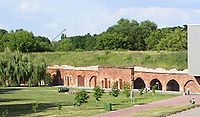
Star fort
A star fort, or trace italienne, is a fortification in the style that evolved during the age of gunpowder, when cannon came to dominate the battlefield, and was first seen in the mid-15th century in Italy....
. The core of the fortress, the Citadel
Citadel
A citadel is a fortress for protecting a town, sometimes incorporating a castle. The term derives from the same Latin root as the word "city", civis, meaning citizen....
, was a red-brick two-storied ring-shaped barrack (rondo), 1.8 km long, with 500 rooms, that was to accommodate 12,000 soldiers. It had originally 4 gates, 4 semi-towers. Today only Kholm Gate
Kholm Gate
The Kholm Gate was one of the 4 gates leading into the Citadel of the Russian Brest Fortress. It was designed in a classic style in the early 19th century. It faces the southern branch of the Mukhavets River...
and Terespol Gate
Terespol Gate
The Terespol Gate was one of the 4 gates leading into the Citadel of the Russian Brest Fortress. It was designed in a classic style in the early 19th century. It faces the Bug River. Before the war outbreak in 1941 the gate used to be a 3-storey structure with small turrets above.Inside there were...
can be seen.
The Citadel was on the island formed by the Bug River
Bug River
The Bug River is a left tributary of the Narew river flows from central Ukraine to the west, passing along the Ukraine-Polish and Polish-Belarusian border and into Poland, where it empties into the Narew river near Serock. The part between the lake and the Vistula River is sometimes referred to as...
and the two branches of the Mukhavets River. The Citadel was surrounded by 3 bridgehead
Bridgehead
A bridgehead is a High Middle Ages military term, which antedating the invention of cannons was in the original meaning expressly a referent term to the military fortification that protects the end of a bridge...
s, made up by the branches of the Mukhavets River and ditches, fortified by earthworks that were 10 m high with redbrick casemate
Casemate
A casemate, sometimes rendered casement, is a fortified gun emplacement or armored structure from which guns are fired. originally a vaulted chamber in a fortress.-Origin of the term:...
s inside. Those 3 fortifications were named after the towns:Kobrin, Terespol
Terespol
Terespol is a town in eastern Poland on the border with Belarus. It lies on the border river Bug, directly opposite the city of Brest, Belarus...
and Volyn. The Kobrin Fortification, the northeastern biggest bridgehead
Bridgehead
A bridgehead is a High Middle Ages military term, which antedating the invention of cannons was in the original meaning expressly a referent term to the military fortification that protects the end of a bridge...
, shaped like a horseshoe, featured 4 fortification curtains, 3 detached ravelin
Ravelin
A ravelin is a triangular fortification or detached outwork, located in front of the innerworks of a fortress...
s and a lunette
Lunette (fortification)
In fortification a lunette was originally an outwork of half-moon shape; later it became a redan with short flanks, in trace somewhat resembling a bastion standing by itself without curtains on either side...
in the western part. The Terespol Fortification was the western bridgehead
Bridgehead
A bridgehead is a High Middle Ages military term, which antedating the invention of cannons was in the original meaning expressly a referent term to the military fortification that protects the end of a bridge...
, featuring 4 detached lunettes. The Volyn Fortification was the southeastern bridgehead
Bridgehead
A bridgehead is a High Middle Ages military term, which antedating the invention of cannons was in the original meaning expressly a referent term to the military fortification that protects the end of a bridge...
, featuring 2 fortification curtains with 2 detached ravelin
Ravelin
A ravelin is a triangular fortification or detached outwork, located in front of the innerworks of a fortress...
s.
The outer ring of fortifications built later surrounds the old citadel. As the post-1945 border along the Bug river runs through the fortress area, many of the fortification works are now in Poland
Poland
Poland , officially the Republic of Poland , is a country in Central Europe bordered by Germany to the west; the Czech Republic and Slovakia to the south; Ukraine, Belarus and Lithuania to the east; and the Baltic Sea and Kaliningrad Oblast, a Russian exclave, to the north...
, around the town of Terespol
Terespol
Terespol is a town in eastern Poland on the border with Belarus. It lies on the border river Bug, directly opposite the city of Brest, Belarus...
.
External links
- Main fortress 52.082961°N 23.654251°W
- External forts
- 52.047516°N 23.673477°W
- 52.046090°N 23.618588°W
- 52.080172°N 23.595747°W
- 52.064457°N 23.549516°W
- 52.043306°N 23.554097°W
- 52.019365°N 23.603868°W