
All Topics  
Baalbek

 
Baalbek

   Email Print
   Bookmark   Link


Baalbek


Baalbek is a town in the Bekaa Valley of Lebanon
Lebanon

Lebanon , officially the Republic of Lebanon or Lebanese Republic , is a country in Western Asia, on the eastern shore of the Mediterranean Sea....
, altitude 1,170 m (3,850 ft), situated east of the Litani River
Litani River

The Litani River is an important waterway in southern Lebanon. It rises west of Baalbek in the fertile Beqaa Valley valley and empties in the Mediterranean Sea north of Tyre , one of Lebanon?s largest cities....
. It is famous for its exquisitely detailed yet monumentally scaled temple
Temple

A temple is a structure reserved for religious or spiritual activities, such as prayer and sacrifice, or analogous rites. A ??templum?? constituted a sacred precinct as defined by a priest, or augur....
 ruins
Ruins

Ruins is a term used to describe the remains of man-made architecture: structures that were once complete but which have fallen into a state of partial or complete disrepair, due to lack of Maintenance, repair and operations or deliberate acts of destruction....
 of the Roman
Roman Empire

The Roman Empire was the Roman Republic phase of the Ancient Rome, characterised by an autocracy form of government and large territorial holdings in Europe and around the Mediterranean....
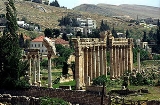
 period, when Baalbek, known as Heliopolis was one of the largest sanctuaries in the Empire. It is Lebanon's greatest Roman treasure, and it can be counted among the wonders of the ancient world. The largest and most noble Roman temples ever built, they are also among the best preserved.

Towering high above the Beqaa plain, their monumental proportions proclaimed the power and wealth of Imperial Rome.


Discussion
Ask a question about 'Baalbek'
Start a new discussion about 'Baalbek'
Answer questions from other users
Full Discussion Forum


Recent Posts


Encyclopedia


Baalbek is a town in the Bekaa Valley of Lebanon
Lebanon

Lebanon , officially the Republic of Lebanon or Lebanese Republic , is a country in Western Asia, on the eastern shore of the Mediterranean Sea....
, altitude 1,170 m (3,850 ft), situated east of the Litani River
Litani River

The Litani River is an important waterway in southern Lebanon. It rises west of Baalbek in the fertile Beqaa Valley valley and empties in the Mediterranean Sea north of Tyre , one of Lebanon?s largest cities....
. It is famous for its exquisitely detailed yet monumentally scaled temple
Temple

A temple is a structure reserved for religious or spiritual activities, such as prayer and sacrifice, or analogous rites. A ??templum?? constituted a sacred precinct as defined by a priest, or augur....
 ruins
Ruins

Ruins is a term used to describe the remains of man-made architecture: structures that were once complete but which have fallen into a state of partial or complete disrepair, due to lack of Maintenance, repair and operations or deliberate acts of destruction....
 of the Roman
Roman Empire

The Roman Empire was the Roman Republic phase of the Ancient Rome, characterised by an autocracy form of government and large territorial holdings in Europe and around the Mediterranean....
 period, when Baalbek, known as Heliopolis was one of the largest sanctuaries in the Empire. It is Lebanon's greatest Roman treasure, and it can be counted among the wonders of the ancient world. The largest and most noble Roman temples ever built, they are also among the best preserved.

Towering high above the Beqaa plain, their monumental proportions proclaimed the power and wealth of Imperial Rome. The gods worshipped here, the Triad of Jupiter, Venus and Mercury, were grafted onto the indigenous deities of Hadad, Atargatis and a young male god of fertility. Local influences are also seen in the planning and layout of the temples, which vary from the classic Roman design.

Baalbek is home to the annual Baalbeck International Festival
Baalbeck International Festival

The Baalbeck International Festival is the oldest and most known cultural event in the Middle East and the eastern Mediterranean. Since 1955, hundreds of thousands of people from around the world have flocked to the city of Baalbeck in the Beqaa Valley of Lebanon to attend the annual festival....
. The town is located about 85 km north east of Beirut
Beirut

Beirut is the Capital and largest city of Lebanon with a population of over 2.1 million as of 2007. Located on a peninsula at the midpoint of Lebanon's coastline with the Mediterranean sea, it serves as the country's largest and main seaport and also forms the Beirut District area, which consists of the city and its suburbs....
, and about 75 km north of Damascus
Damascus

Damascus is the capital and largest city of Syria. It is List of oldest continuously inhabited cities and its current population is estimated at about 4,000,000....
. It has a population of approximately 72.000.

History


Prehistory

The history of Baalbeck dates back around 5000 years. Excavations near the Jupiter temple have revealed the existence of ancient human habitation dating to the Early Bronze Age (2900-2300 BC). The Phoenician
Phoenician

Phoenician may refer to:*Phoenicia, the ancient civilization*Phoenician alphabet*Phoenician languagePhoenician may also be:*A native or resident of Phoenix, Arizona...
s settled in Baalbeck as early as 2000 BC and built their first temple dedicated to the God Baal, the Sun God, from whom the city gets its name.

19th century Bible archaeologists wanted to connect Baalbeck to the "Baalgad" mentioned in Joshua 11:17, but the assertion has not been taken up in modern times. In fact, this minor Phoenician city, named for the "Lord (Baal
Baal

Ba'al is a Northwest Semitic title and honorific meaning "master" or "lord" that is used for various gods who were patrons of cities in the Levant, cognate to East Semitic Bel ....
) of the Beqaa valley" lacked enough commercial or strategic importance to rate a mention in Assyrian or Egyptian records so far uncovered, according to Hélène Sader, professor of archaeology at the American University of Beirut. Nevertheless, it must have been the site of an oracle from earliest times, for oracles are not lightly founded, and retained such a function during Roman times.

Heliopolis, the City of the Sun


When Alexander the Great conquered the Near East in 334 BC, Baalbek was renamed Heliopolis, Helios Greek
Greek language

Greek is an Indo-European languages native to the southern Balkan peninsula, the language of the Greek people. It forms an independent branch within Indo-European....
 for sun and Polis Greek for city. The city retained its religious function during Greco-Roman times, when the sanctuary of the Heliopolitan Jupiter-Baal was a pilgrimage
Pilgrimage

File:Supplicating Pilgrim at Masjid Al Haram. Mecca, Saudi Arabia.jpgIn religion and spirituality, a pilgrimage is a long quest or search of great moral significance....
 site. Trajan
Trajan

Marcus Ulpius Nerva Traianus, commonly known as Trajan , was a Roman Emperors who reigned from 98 until his death in 117. Born Marcus Ulpius Traianus into a nonpatrician family in the Hispania Baetica province , Trajan rose to prominence during the reign of emperor Domitian, serving as a general in the Roman army along the Limes G...
's biographer records that the Emperor consulted the oracle
Oracle

An oracle is a person or agency considered to be a source of wise counsel or prophecy opinion; an infallible authority, usually Spirituality in nature....
 there. Trajan inquired of the Heliopolitan Jupiter whether he would return alive from his wars against the Parthia
Parthia

Parthia is a region of north-eastern Iran, best known for having been the political and cultural base of the Arsacid dynasty, after which the Arsacid Empire is then also known as the 'Parthian Empire'....
ns. In reply, the god presented him with a vine shoot cut into pieces. Theodosius Macrobius
Ambrosius Theodosius Macrobius

Ambrosius Theodosius Macrobius was a Roman Empire grammarian and Neoplatonist philosopher who flourished c. 430 AD....
, a Latin grammarian of the 5th century AD, mentioned Zeus Heliopolitanus and the temple, a place of oracular divination. Starting in the last quarter of the 1st century BC and over a period of two centuries, the Romans had built a temple complex in Baalbeck consisting of three temples: Jupiter, Bacchus and Venus. On a nearby hill, they built a fourth temple dedicated to Mercury.

The city, then known as Heliopolis (there was another Heliopolis
Heliopolis (ancient)

Heliopolis , meaning sun-city, was one of the most ancient cities of Egypt, and capital of the 13th Lower Egyptian Nome . Its name also refers to an unrelated Heliopolis of Cairo, also known as ??? ???????, Masr al-gidedah ....
 in Egypt), was made a colonia by the Roman Empire
Roman Empire

The Roman Empire was the Roman Republic phase of the Ancient Rome, characterised by an autocracy form of government and large territorial holdings in Europe and around the Mediterranean....
 in 15 BC and a legion was stationed there. Work on the religious complex there lasted over a century and a half and was never completed. The dedication of the present temple ruins, the largest religious building in the entire Roman empire, dates from the reign of Septimus Severus, whose coins first show the two temples. The great courts of approach were not finished before the reigns of Caracalla
Caracalla

Caracalla , born Lucius Septimius Bassianus and later called Marcus Aurelius Antoninus and Marcus Aurelius Severus Antoninus, was the eldest son of Septimius Severus and Roman Emperor from 211 – 217....
 and Philip. In commemoration, no doubt, of the dedication of the new sanctuaries, Severus conferred the rights of the ius Italicum
Ius Italicum

Ius Italicum was an honour conferred on particular cities of the Roman Empire by the Roman emperor. It did not describe any status of citizenship, but granted to communities outside Italy the legal fiction that it was on Italian soil....
 on the city. Today, only six Corinthian columns remain standing. Eight more were disassembled and shipped to Constantinople
Constantinople

Constantinople was the empire capital of the Roman Empire , the Byzantine Empire , the Latin Empire , and the Ottoman Empire . Strategically located between the Golden Horn and the Sea of Marmara at the point where Europe meets Asia, Byzantine Constantinople had been the capital of a Christendom empire, successor to ancient ancient Greece...
 under Justinian's orders, for his basilica of Hagia Sophia
Hagia Sophia

Hagia Sophia is a former Patriarchate basilica, later a mosque, now a museum in Istanbul, Turkey. Famous in particular for its massive dome, it is considered the epitome of Byzantine architecture....
.

The greatest of the three temples was sacred to Jupiter Baal, ("Heliopolitan Zeus"), identified here with the sun, and - constructed between the first century BC and 62 AD - was the largest temple in the empire. With it were associated a temple to Venus and a lesser temple in honor of Bacchus
Dionysus

In classical mythology, Dionysus or Dionysos , is the God of wine, the inspirer of ritual madness and ecstasy, and a major figure of Greek mythology, and one of the twelve Olympians, among whom Greek mythology treated Dionysus as a late arrival....
 (though it was traditionally referred to as the "Temple of the Sun" by Neoclassical visitors, who saw it as the best-preserved Roman temple
Roman temple

In the ancient religion of Roman paganism, practitioners often performed their worship at a temple....
 in the world - it is surrounded by forty-two columns nearly 20 meters in height). Thus three Eastern deities were worshipped in Roman guise: thundering Jove, the god of storms, stood in for Baal-Hadad
Hadad

Haddad ??? ??? was a very important northwest Semitic language storm and rain God , cognate in name and origin with the Akkadian language god Adad....
, Venus for ‘Ashtart (known in English as Astarte) and Bacchus for Anatolian Dionysus
Dionysus

In classical mythology, Dionysus or Dionysos , is the God of wine, the inspirer of ritual madness and ecstasy, and a major figure of Greek mythology, and one of the twelve Olympians, among whom Greek mythology treated Dionysus as a late arrival....
. The original number of jupiter columns was 54 columns . in the earliest 20th century an earthquake reduced the 10 left columns to six . The architrave
Architrave

The architrave is a moulded or ornamental band framing a rectangular opening. It is the lintel or beam that rests on the capital s of the columns....
s blocks weigh up to 60 tons each, and the corner cornices blocks even over 100 tons, all of them raised to a height of ca. 19 m above the ground. This was thought to have been done using Roman cranes
Crane (machine)

A crane is a lifting machine equipped with a winder , wire ropes or chains and Sheave that can be used both to lift and lower materials and to move them horizontally....
. Roman cranes were not capable of lifting stones this heavy; however, by combining multiple cranes they may have been able to lift them to this hieght. If necessary they may have used the cranes to lever one side up a little at a time and use shims to hold it while they did the other side. This would be very time consuming, though, so they probably wouldn't have done it this way unless they had to.

The Roman construction was built on top of earlier ruins and involved the creation of an immense raised plaza onto which the actual buildings were placed. The sloping terrain necessitated the creation of retaining walls on the north, south and west sides of the plaza. These walls are built of about 24 monoliths at their lowest level each weighing approximately 300 tons. The western, tallest retaining wall has a second course of monoliths containg the famous "trilithon"; a row of three stones, estimated of the weight of these stones are about 750 tons each. A fourth, still larger stone called "the stone of the south" (Hajar el Gouble) or "the stone of the pregnant woman" (Hajar el Hibla) lies unused in a nearby quarry 3 miles away. Had it been freed from the quarry, it would have been the largest stone ever moved, larger than the famous unfinished obelisk in Aswan. Another of the Roman ruins, the Great Court, has six 20 m-tall stone columns surviving, out of an original 128.

These stones represent the largest cut-stones from the ancient world. The unfinished stone is estimated to weigh 1500 tons.

Jupiter-Baal was represented locally (on coinage) as a beardless god in long scaly drapery, holding a whip
Flagellum

A flagellum is a tail-like structure that projects from the cell body of certain prokaryotic and eukaryotic cells, and it functions in locomotion....
 in his right hand and thunderbolt
Thunderbolt

A thunderbolt is a traditional expression for a discharge of lightning or a symbolic representation thereof. In its original usage the word may also have been a description of meteors, although this is not currently the case....
s and ears of wheat in his left. Two bulls supported him. In this guise he passed into European worship in the 3rd century and 4th century AD. The icon of Helipolitan Zeus (in A.B. Cook, Zeus, i:570-576) bore busts of the seven planetary powers on the front of the pillarlike term
Term (architecture)

In Classical architecture a term or terminal figure is a human head and bust that continues as a square tapering pillarlike form. If the bust is of Hermes as protector of boundaries in ancient Greek culture, with male genitals interrupting the plain base at the appropriate height, it may be called a herma or herm....
 in which he was encased. A bronze statuette of this Heliopolitan Zeus was discovered at Tortosa, Spain; another was found at Byblos
Byblos

Byblos is the Greek language name of the Phoenician city Gebal . It is a Mediterranean city in the Mount Lebanon Governorate of present-day Lebanon under the current Arabic language name of Jbeil and was also referred to as Gibelet during the Crusades....
 in Phoenicia. A comparable iconic image is the Lady of Ephesus
Temple of Artemis

The Temple of Artemis , also known less precisely as Temple of Diana , was a Greek temple dedicated to Artemis completed? in its most famous phase? around 550 BC at Ephesus under the Achaemenid Empire of the Persian Empire....
 (see illustration) (Robert Graves
Robert Graves

Robert Ranke Graves was an England poet, translator and novelist. During his long life, he produced more than 140 works. He was the son of the Anglo-Irish writer Alfred Perceval Graves and Amalie von Ranke, a niece of the famous German historian Leopold von Ranke....
, The Greek Myths I.4).

Other Emperors enriched the sanctuary of Heliopolitan Jupiter each in turn. Nero (54-68 AD) built the tower-altar opposite the Temple of Jupiter, Trajan added the forecourt to the Temple of Jupiter, with porticos of pink granite brought from Aswan
Aswan

Aswan , Egyptian language: Swenet , Coptic language: Swan; Greek language: Syene; ) is a city in the south of Egypt, the capital of the Aswan Governorate....
 in Egypt. Antoninus Pius
Antoninus Pius

Titus Aurelius Fulvus Boionius Arrius Antoninus , generally known in English as Antoninus Pius was Roman Emperors from 138 to 161. He was the fourth of the Five Good Emperors and a member of the Aurelii....
 built the Temple of Bacchus
Temple of Bacchus

The Temple of Bacchus was one of the three main temples at a large temple complex in Classical Antiquity, at Baalbek in Lebanon. The temple was dedicated to Bacchus , the Roman god of wine, but was traditionally referred to by Neoclassical architecture visitors as the "Temple of the Sun"....
, the best preserved of the sanctuary's structures, for it was protected by the very rubble of the site's ruins. It is enriched with refined reliefs and sculpture. Septimus Severus added a pentagonal Temple of Venus, who as Aphrodite
Aphrodite

Aphrodite is the classical Greek mythology goddess of love, sex, and beauty. According to Greek oral poet Hesiod, she was born when Uranus was castrated by his son Cronus....
 had enjoyed an early Syrian role with her consort Adonis
Adonis

Adonis is a figure of West Semitic origin, where he is a central cult figure in various mystery religions, who enters Greek mythology in Hellenistic culture....
 ("Lord", the Aramaic translation of "Baal."). Christian writers competed with one another to execrate her worship. Eusebius of Caesarea
Eusebius of Caesarea

Eusebius of Caesarea became the bishop of Caesarea Maritima c 314. He is often referred to as the Father of Church History because of his work in recording the history of the early Christianity church, especially Chronicon and Church_History_....
, down the coast, averred that 'men and women vie with one another to honour their shameless goddess; husbands and fathers let their wives and daughters publicly prostitute themselves to please Astarte
Astarte

Astarte is the name of a goddess as known from Northwestern Semitic languages regions, cognate in name, origin and functions with the goddess Ishtar in Mesopotamian texts....
'. Emperor Philip the Arab
Philip the Arab

Marcus Julius Philippus or Philippus I Arabs , known in English language as Philip the Arab or formerly in English as Philip the Arabian, was a Roman Emperor from 244 to 249....
 (244-249) was the last to add a monument at Heliopolis— the hexagonal forecourt. When he was finished Heliopolis and Praeneste in Italy were the two largest sanctuaries in the Western world.

The extreme licence of the Heliopolitan worship of Aphrodite was often commented upon by early Christian writers, and Constantine, making an effort to curb the Venus cult, built a basilica
Basilica

The Latin word basilica , was originally used to describe a ancient Rome public building , usually located in the Forum of a Roman town. In Hellenistic cities, public basilicas appeared in the 2nd century BC....
. Theodosius I
Theodosius I

Flavius Theodosius , also called Theodosius I and Theodosius the Great , was Roman Emperor from 379 to 395. Reuniting the eastern and western portions of the empire, Theodosius was the last emperor of both the Eastern Roman Empire and Western Roman Empire....
 erected another, with a western apse, occupying the main court of the Jupiter temple, as was Christian practice everywhere. The vast stone blocks of its walls were taken from the temple itself. Today nothing of the Theodosian basilica remains.

Theories about the Trilithon and other megaliths


Roger Hopkins and Vince Lee both theorized about how the megalithic stones were moved. They were both consulted about various megalithic moves around the world.

Roger Hopkins is a stone mason and sculptor; he was consulted to do experiments in Egypt (with Mark Lehrner) and other locations to move megaliths. He theorized that the trilithon stones and 300 ton blocks were all moved with wooden rollers. He demonstrated this by using steel rollers and levers to move a five to six thousand pound stone on a concrete platform by himself. He also participated in other experiments with larger stones including some that may have been over 10 tons. These experiments required much more people. For 2 ton stones he was able to tow them with as few as 10 people at times and for faster results up to 20 people. Most experiments which have been done by Roger Hopkins and others to move stones 10 tons or more required well over 100 people.

Vince Lee is an architech explorer and author. He theorized that these stones were moved by flipping them with levers. According to this theory a row of people would use 20 levers to pry up the trilithon blocks a little at a time. Each time they pried it up someone would put additional shims under the megalithic stones. After this was repeated enough times the stone would flip over on the next side. There would be a log on the other side that the stone would fall onto so that one side would already be lifted off the ground each time making it easier for the next flip. This would require over 1,000 flips for each of the trilithon stones and even more for the smaller 300 ton stones to cover the 3 mile distance from the quarry. Roger Hopkins and Mark Lehner also experimented with this technique on a smaller scale in Egypt during a NOVA pyramid building experiment
Egyptian pyramid construction techniques

There have been many hypotheses about the Egyptian pyramid construction techniques. The construction techniques seem to have developed over time; the earliest pyramids were built in different ways than later ones....
. They found that they could flip stones upto about 3/4 of a ton with only 4 or 5 men, and they successfuly flipped stones at least 2 and a 1/2 tons with more men; however, they found this was too slow to explain how the pyramids were built in so short a time.

Both Roger Hopkins and Vince Lee agreed that an earthen ramp would have been used to get the megaliths up the hill to the temple. They also agreed that the final placement would have involved flipping the megaliths and lowering it slowly by using sand to cushion the fall. The sand would have been placed where the trilithon stones were to be set and when the stones were flipped into place the sand would be slowly removed. Additional experiments moving megaliths with ancient technology were done at other locations some of which are listed here
List of megalithic sites

This is a list of ancient sites that moved megalithic stones, organized according to the size of the largest megalith on the site. A megalith is a large stone which has been used to construct a structure or monument, either alone or together with other stones....
.

Early Islamic period


In 637 A.D Muslim army
Rashidun army

The Rashidun Caliphate Army or Rashidun army was the primary military body of the Rashidun Empire's armed forces during the Muslim conquests of the 7th century, serving alongside the Rashidun Navy....
 under Abu Ubaida ibn al-Jarrah captured Baalbek after defeating the Byzantine army
Byzantine army

The Byzantine army was the primary military body of the Byzantine Empire armed forces, serving alongside the Byzantine navy. A direct descendant of the Roman army and older Hellenistic armies armies, the Byzantine army maintained a similar level of discipline, strategic prowess and organization....
 at Battle of Yarmouk
Battle of Yarmouk

The Battle of Yarmouk comprised a series of engagements between the Rashidun and the Byzantine Empire over six days in August 636, near the Yarmouk River, along what is today the border between Syria and Jordan, south-east of the Sea of Galilee....
, it was still an opulent city and yielded rich booty. It became a bone of contention between the various Syrian dynasties and the caliphs first of Damascus
Damascus

Damascus is the capital and largest city of Syria. It is List of oldest continuously inhabited cities and its current population is estimated at about 4,000,000....
, then of Egypt
Egypt

Egypt is a country mainly in North Africa, with the Sinai Peninsula forming a land bridge in Western Asia. Covering an area of about , Egypt borders the Mediterranean Sea to the north, the Gaza Strip and Israel to the northeast, the Red Sea to the east, Sudan to the south and Libya to the west....
. The place was fortified and took on the name al-Qala‘ ("fortress"; see Alcala
Alcalá

Alcal? is a Spanish placename originally from Arabic al-qalat"??????", "the castle", and may refer to:Places:*Alcala, Cagayan, a municipality in the Philippines...
) but in 748 was sacked again with great slaughter. The Byzantine emperor John Tzimisces sacked the city in 975. In 1090 it passed to the Seljuks and in 1134 to Zengi
Zengi

Imad ad-Din Atabeg Zengi was the son of Aq Sunqur al-Hajib, governor of Aleppo under Malik Shah I. His father was Decapitation for treason in 1094, and Zengi was brought up by Karbuqa, the governor of Mosul....
; but after 1145 it remained attached to Damascus and was captured by Saladin
Saladin

ala ad-Din Yusuf ibn Ayyub , better known as Saladin in medieval Europe, was the Sultan of Egypt and Greater Syria. He led the Islamic opposition to the Second Crusade and Third Crusade....
 in 1175. The Crusaders raided its valley more than once, but never took the city. Three times shaken by earthquakes in the 12th century, it was dismantled by 1260. But it revived, and most of its fine mosque and fortress architecture, still extant, belongs to the reign of Sultan Qalawun
Qalawun

Saif al-Din Qalawun Al-Salihi was the seventh Mamluk sultan of Egypt. He was in the Bahri dynasty line and ruled Egypt from 1279 to 1290....
 (1282) and the succeeding century, during which Abulfeda describes it as a very strong place. In 1400 Timur
Timur

Timur , among his other names, commonly known as Tamerlane in the West, was a 14th century Turko-Mongol conqueror of much of western and Central Asia, and founder of the Timurid dynasty in Central Asia, which survived until 1857 as the Mughal Empire of India....
 pillaged it.

Ottoman period


In 1517 it passed, with the rest of Syria, to the Ottoman Empire
Ottoman Empire

The Ottoman Empire , also known by its contemporaries as the Turkish Empire or Turkey , was an empire that lasted from 1299?1923. It was Treaty of Lausanne by the Republic of Turkey, which was officially proclaimed on October 29, 1923....
. But Ottoman jurisdiction was merely nominal in the Lebanon. Baalbeck, badly shaken in an earthquake in 1759 was really in the hands of the Metawali
Metawali

Metawali refers to the Shia Islam community with a significant presence in North Lebanon and in the south, in the Beqaa Valley and the coastal towns south of Beirut....
 (see Lebanon
Lebanon

Lebanon , officially the Republic of Lebanon or Lebanese Republic , is a country in Western Asia, on the eastern shore of the Mediterranean Sea....
), who retained it against other Lebanese tribes. The colossal and picturesque ruins attracted particularly intrepid Westerners since the 18th century. The English visitor, Robert Wood
Robert Wood (engraver)

Robert Wood was a British traveller, classical scholar, civil servant and politician.In 1750-1753 Wood travelled to Syria with his friends the Oxford scholars James Dawkins and John Bouverie and with the Italian architect Giovanni Battista Borra, who they had measure and draw the ancient ruins of Palmyra and Baalbek....
, with Dawson was not simply a tourist: his carefully measured drawings were engraved for The Ruins of Baalbeck (1757), which provided some excellent new detail in the Corinthian order
Corinthian order

The Corinthian order is one of the Classical orders of Greece and Rome architecture, characterized by a slender Fluting column and an ornate capital decorated with acanthus leaves and scrolls....
 that British and European Neoclassical
Neoclassicism

Neoclassicism is the name given to quite distinct Cultural movement in the Decorative art and visual arts, literature, theatre, music, and architecture that draw upon Western classical art and culture ....
 architects added to their vocabulary. Robert Adam
Robert Adam

Robert Adam was a Scotland neoclassicism architect, interior designer and furniture designer. He was the son of William Adam , Scotland's foremost architect of the time, and trained under him....
, for example, based a bed and one of the ceilings at Osterley House on the ceiling of the Temple of Bacchus, and the portico of St George's, Bloomsbury is based on that temple's portico.

Even after Jezzar Pasha, the rebel governor of Acre province, broke the power of the Metawali in the last half of the 18th century, Baalbeck was no destination for the traveller unaccompanied by an armed guard. The anarchy
Anarchy

Anarchy may refer to any of the following:* "No ruler ship or enforced authority." * "Absence of government; a state of lawlessness due to the absence or inefficiency of the supreme power; political disorder."...
 that succeeded his death in 1804 was ended only by the Egypt
Egypt

Egypt is a country mainly in North Africa, with the Sinai Peninsula forming a land bridge in Western Asia. Covering an area of about , Egypt borders the Mediterranean Sea to the north, the Gaza Strip and Israel to the northeast, the Red Sea to the east, Sudan to the south and Libya to the west....
ian occupation (1832). With the treaty of London
London

London is the capital of both England and the United Kingdom, and the most populous municipality in the European Union. An important settlement for two millennia, History of London goes back to its founding by the Roman Empire....
 (1840) Baalbeck became really Ottoman, the Encyclopaedia Britannica (1911) reported, and since about 1864 had attracted great numbers of tourists. In November 1898, the German Emperor Wilhelm II
William II, German Emperor

Wilhelm II was the last German Emperor and King of Prussia , ruling both the German Empire and the Prussia from 15 June 1888 to 9 November 1918....
 on his way to Jerusalem, and passing by Baalbeck was equally struck by the magnificence of the ruins projecting from the rubble, and the dreary condition. Within a month, the German archaeological team he dispatched was at work on the site. The campaign produced meticulously presented and illustrated series of volumes.

World Heritage Site

"Baalbeck, with its colossal structures, is one of the finest examples of Imperial Roman architecture at its apogee", UNESCO
UNESCO

United Nations Educational, Scientific and Cultural Organization is a specialized agency of the United Nations established on 16 November 1945....
 reported in making Baalbek a World Heritage Site
World Heritage Site

A UNESCO World Heritage Site is a site that is on the list maintained by the international World Heritage Programme administered by the UNESCO World Heritage Committee, composed of 21 Sovereign state which are elected by their General Assembly for a four-year term....
 in 1984. When the Committee inscribed the site, it expressed the wish that the protected area include the entire town within the Arab walls, as well as the south-western extramural quarter between Bastan-al-Khan, the Roman site and the Mameluk mosque of Ras-al-Ain. Lebanon's representative gave assurances that the Committee's wish would be honored.

Israel-Lebanon conflict

On August 4, 2006, Israel
Israel

Israel officially the State of Israel , is a country in the Middle East located on the eastern shore of the Mediterranean Sea. It borders Lebanon in the north, Syria in the northeast, Jordan in the east, and Egypt on the southwest, and contains geographically diverse features within its relatively small area....
i helicopter-borne soldiers supported by bombs from aircraft entered the Hikmeh Hospital in Baalbek to capture senior members of Hezbollah
Hezbollah

Hezbollah is a Shi'a Islamic political and paramilitary organisation based in Lebanon. It is a significant force in Politics of Lebanon, providing social services, which operate schools, hospitals, and agricultural services for thousands of Lebanese Shiites....
 who were considered to be responsible for the kidnapping of the two Israeli IDF soldiers on July 13, 2006 and who were believed to be residing in the building. The fighting between the fighters and Israeli forces caused minor damage to the hospital. Several gunmen were killed and weapons and ammunition were seized from inside the hospital building. No patients were hospitalized at the time. It has been reported that during the conflict, vibrations caused by bombs damaged the ruins. UNESCO offered help to coordinate restoration efforts.

Gallery


Sister cities

Bari
Bari

Bari is the capital city of the province of Bari and of the Apulia region, on the Adriatic sea, in Italy. It is the second economic centre of mainland Southern Italy and is well known as a port and university city, as well as the city of Saint Nicholas....
, Italy
Italy

Italy , officially the Italian Republic , is a country located on the Italian Peninsula in Southern Europe and on the two largest islands in the Mediterranean Sea, Sicily and Sardinia....
L'Aquila
L'Aquila

L'Aquila is a city in central Italy, both the capital city of the Abruzzo region and of the Province of L'Aquila. It has a population of 72,913 inhabitants, but has a daily presence in the territory of 100,000 people to study, tertiary activities, jobs and tourism....
, Italy
Italy

Italy , officially the Italian Republic , is a country located on the Italian Peninsula in Southern Europe and on the two largest islands in the Mediterranean Sea, Sicily and Sardinia....
Thraci, Greece
Greece

Greece , officially the Hellenic Republic , is a country in southeastern Europe, situated on the southern end of the Balkans. It has borders with Albania, Bulgaria and the former Yugoslav Republic of Macedonia to the north, and Turkey to the east....


See Also


  • List of megalithic sites
    List of megalithic sites

    This is a list of ancient sites that moved megalithic stones, organized according to the size of the largest megalith on the site. A megalith is a large stone which has been used to construct a structure or monument, either alone or together with other stones....
  • List Of Colossal Sculpture In Situ
    List of colossal sculpture in situ

    This is a list of colossal sculptures that were carved in situ or in place, sometimes referred to as "living rock". This list includes two colossal stones that were intended to be moved, however they were never broken free of the quarry they were carved in ,therefore they would be considered carved in situ....


External links