
All Topics  
Sunset

 
Sunset

   Email Print
   Bookmark   Link


Sunset


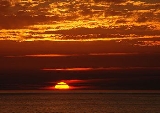
Sunset is the daily disappearance of the sun
Sun

The Sun , a G V star, is the star at the center of the Solar System. The Earth and other matter orbit the Sun, which by itself accounts for about 98.6% of the Solar System's mass....
 below the horizon
Horizon

The horizon is the apparent line that separates earth from sky.More precisely, it is the line that divides all of the directions one can possibly look into two categories: those which intersect the Earth's surface, and those which do not....
 as a result of the Earth's rotation. The atmospheric conditions created by the setting of the sun are also commonly referred to as "a sunset". These conditions often appear before and after the precise moment the sun disappears below the horizon, and as a result the term "sunset" in common usage has a substantially looser meaning than in scientific and technical applications.

In astronomy
Astronomy

Astronomy is the science of Astronomical object and Phenomenon that originate outside the Earth's atmosphere . It is concerned with the evolution, physics, chemistry, meteorology, and motion of celestial objects, as well as the physical cosmology....
 the time of sunset is defined as the moment the trailing edge of the sun's disk disappears below the horizon in the west.


Discussion
Ask a question about 'Sunset'
Start a new discussion about 'Sunset'
Answer questions from other users
Full Discussion Forum


Encyclopedia


Sunset is the daily disappearance of the sun
Sun

The Sun , a G V star, is the star at the center of the Solar System. The Earth and other matter orbit the Sun, which by itself accounts for about 98.6% of the Solar System's mass....
 below the horizon
Horizon

The horizon is the apparent line that separates earth from sky.More precisely, it is the line that divides all of the directions one can possibly look into two categories: those which intersect the Earth's surface, and those which do not....
 as a result of the Earth's rotation. The atmospheric conditions created by the setting of the sun are also commonly referred to as "a sunset". These conditions often appear before and after the precise moment the sun disappears below the horizon, and as a result the term "sunset" in common usage has a substantially looser meaning than in scientific and technical applications.

In astronomy
Astronomy

Astronomy is the science of Astronomical object and Phenomenon that originate outside the Earth's atmosphere . It is concerned with the evolution, physics, chemistry, meteorology, and motion of celestial objects, as well as the physical cosmology....
 the time of sunset is defined as the moment the trailing edge of the sun's disk disappears below the horizon in the west. Due to refraction
Atmospheric refraction

Atmospheric refraction is the deviation of light or other electromagnetic wave from a straight line as it passes through the atmosphere due to the variation in air density as a function of altitude....
 of light in the atmosphere, the ray path of the setting sun is highly distorted near the horizon making the apparent astronomical sunset occur when the sun’s disk is already about one diameter below the horizon. Sunset should not be confused with dusk
Dusk

Dusk is the beginning of darkness in the evening. It is often confused with sunset, which is the daily disappearance of the sun below the horizon....
, which is the moment at which darkness falls, when the sun is about eighteen degrees below the horizon. The period between the astronomical sunset and dusk is called twilight
Twilight

Twilight is the time between dawn and sunrise, and the time between sunset and dusk. Sunlight Scattering in the upper Earth's atmosphere illuminates the lower atmosphere, and the surface of the Earth is not completely lit or completely dark....
.

Occurrence

The timing of sunset varies with the time of year and the latitude
Latitude

Latitude, usually denoted symbolically by the Greek letter phi gives the location of a place on Earth north or south of the equator. Lines of Latitude are the horizontal lines shown running east-to-west on maps ....
 of the location from which it is viewed. The precise local time of sunset also depends upon each location's precise longitude
Longitude

Longitude , symbolized by the Greek character lambda , is the geographic coordinate most commonly used in cartography and global navigation for east-west measurement....
 within a given time zone. Small daily changes and noticeable semi-annual changes in timing of sunset are driven by the axial tilt
Axial tilt

In astronomy, axial tilt is the inclination angle of a planet axis of rotation in relation to its Orbital plane . It is also called axial inclination or obliquity....
 of Earth, the spherical shape of the Earth, and the planet's movement in its annual orbit around the sun. Some apparent anomalies exist however, the main one caused by the Earth's axial tilt and the Earth's elliptical orbit. In the Northern Hemisphere
Northern Hemisphere

The Northern Hemisphere is the half of a planet that is north of the equator?the word sphere literally means 'half sphere'. It is also that half of the celestial sphere north of the celestial equator....
, the earliest sunset does not fall on the winter solstice
Solstice

A solstice is an astronomical event that occurs twice each year, when the tilt of the Earth's Rotation is most inclined toward or away from the Sun, causing the Sun's apparent position in the sky to reach its north or south extreme....
 around December 21, but instead it occurs earlier in December. Likewise, the latest sunset does not fall on the summer solstice around June 21, but instead it happens later in June or in early July, depending on one's latitude. The same phenomenon exists in the Southern Hemisphere
Southern Hemisphere

The Southern Hemisphere is the half of a planet that is south of the equator?the word sphere literally means 'half ball'. It is also that half of the celestial sphere south of the celestial equator....
 except with the respective dates being some time before June 21 in winter and some time after December 21 in summer, possibly in January of the following year. For one or two weeks surrounding both solstices, both sunrise and sunset get slightly later or earlier each day. Even on the equator
Equator

The equator is the intersection of the Earth's surface with the Plane perpendicular to the Earth's rotation and containing the Earth's center of mass....
, sunrise and sunset shift several minutes back and forth through the year, along with solar noon. This effect is plotted by an analemma
Analemma

In astronomy, an analemma is a curve representing the angular offset of a celestial body from its mean position on the celestial sphere as viewed from another celestial body ....
.

Due to Earth's axial tilt, whenever and wherever sunset occurs, sunset is always to the northwest from the March equinox
Equinox

Equinoxes occur twice a year, when the tilt of the Earth's axis is inclined neither away from nor toward the Sun, causing the Sun to be located vertically above a point on the equator....
 to the September equinox, and to the southwest from the September equinox to the March equinox. Sunsets occur precisely due west on the equinoxes, and the duration of day and night are approximately equal on the equinoxes for all viewers on Earth (precisely 12 hours if measured from the geometric (unrefracted) centre of the sun).

As sunrise and sunset are calculated from the leading and trailing edges of the sun, and not the centre, the duration of "day" is slightly longer than "night". Further, because the light from the sun is bent by the atmospheric refraction
Atmospheric refraction

Atmospheric refraction is the deviation of light or other electromagnetic wave from a straight line as it passes through the atmosphere due to the variation in air density as a function of altitude....
, the sun is still visible after it is geometrically below the horizon. The sun also appears larger on the horizon, which is another optical illusion, similar to the moon illusion
Moon illusion

The Moon illusion is an optical illusion in which the Moon appears larger near the horizon than it does while higher up in the sky. This optical illusion also occurs with the sun and constellation....
.

Colors

Sunset colors are a result of scattering
Scattering

Scattering is a general physical process where some forms of radiation, such as light, sound, or moving particles,are forced to deviate from a straight trajectory by one or more localized non-uniformities in the medium through which they pass....
 off air molecules and small particles in the atmosphere. The scattering is wavelength-dependent; shorter wavelengths (violet and blue) are scattered out of the sun beam more strongly than are longer wavelengths (orange and red). This wavelength dependence produces two complementary effects: One, the scattered light from a clear sky is blue; and two, when the sun is low in the sky, the loss of blue light due to scattering leaves the remaining light orange or red. Clouds and other wavelength-independent (white) scatterers light up orange or red when illuminated by this light. A complete description of the light scattering in the atmosphere is given by Mie theory
Mie theory

Mie theory, also called Lorenz-Mie theory or Lorenz-Mie-Debye theory, is an analytical solution of Maxwell's equations for the scattering of electromagnetic radiation by spherical particles ....
 or the discrete dipole approximation
Discrete dipole approximation

The discrete dipole approximation - is a method for computing scattering of radiation by particles of arbitrary shape.The discrete-dipole approximation is a flexible technique for computing scattering and absorption by targets of arbitrary geometry....
.

While ash and soot from volcanic eruptions tends to mute sunset colors when trapped within the troposphere
Troposphere

The troposphere is the lowest portion of Earth's atmosphere. It contains approximately 75% of the atmosphere's mass and almost all of its water vapor and particulate....
, when lofted into the stratosphere
Stratosphere

The stratosphere is the second major layer of Earth's atmosphere, just above the troposphere, and below the mesosphere. It is stratified in temperature, with warmer layers higher up and cooler layers farther down....
, thin clouds of tiny sulfuric acid droplets from volcanoes can yield beautiful post-sunset colors called afterglow
Afterglow

An afterglow is a broad high arch of whitish or rosy light appearing in the sky due to very fine particles of dust suspended in the high regions of the earth's atmosphere....
s. A number of eruptions, including those of Mount Pinatubo
Mount Pinatubo

Mount Pinatubo is an active stratovolcano located on the island of Luzon, at the intersection of the borders of the Philippine provinces of Zambales, Tarlac, and Pampanga....
 in 1991 and Krakatoa
Krakatoa

Krakatoa , also spelled Krakatao, is a Island#Oceanic islands in the Sunda Strait between the islands of Java and Sumatra in Indonesia. The name is used for the island group, the main island , and the volcano as a whole....
 in 1883, have produced sufficiently high stratospheric sulfuric acid clouds to yield remarkable sunset afterglows (and pre-sunrise glows) around the world. The high altitude clouds serve to reflect strongly-reddened sunlight still striking the stratosphere after sunset, down to the surface.

Sometimes just before sunrise or after sunset a green flash
Green flash

Green flashes and green rays are optical phenomena that occur shortly after sunset or before sunrise, when a green spot is visible for a short period of time above the sun, or a green ray shoots up from the sunset point....
 can be seen.

Sunsets on other planets

Sunsets on other planets appear different because of the differences in the distance from the planet to the sun and in different atmospheric compositions.

Because Mars is farther from the Sun than the Earth is, the Sun appears only about two-thirds the size that it appears in a sunset seen from the Earth. Although Mars lacks oxygen and nitrogen, it is covered in red dust frequently hoisted into the atmosphere by fast but thin winds. At least some Martian days are capped by a sunset significantly longer and redder than typical on Earth. One study found that for up to two hours after twilight, sunlight continued to reflect off Martian dust high in the atmosphere, casting a diffuse glow.

See also

  • Afterglow
    Afterglow

    An afterglow is a broad high arch of whitish or rosy light appearing in the sky due to very fine particles of dust suspended in the high regions of the earth's atmosphere....
  • Astronomy on Mars
    Astronomy on Mars

    This article presents information and images about viewing astronomical phenomena from the planet Mars. In many cases these are the same or similar to those seen from Earth but sometimes they can be quite different....
  • Dawn
    Dawn

    Dawn is the twilight before sunrise. It is recognized by the presence of weak sunlight, while the sun itself is still below the horizon. Dawn should not be confused with sunrise, which is the moment when the leading edge of the sun itself appears above the horizon....
  • Day length
    Day length

    Day length, or length of day, or length of daytime, refers to the time each day from the moment the upper limb of the sun's disk appears above the horizon during sunrise to the moment when the upper limb disappears below the horizon during sunset....
  • Diffuse sky radiation
    Diffuse sky radiation

    Diffuse sky radiation is solar radiation reaching the Earth's surface after having been scattering from the direct solar beam by molecules or suspensoids in the Earth's atmosphere....
  • Noon
    Noon

    Noon is the hour of 12:00 in an observer's local time zone, or more loosely, a time near the middle of the day when workers in many countries take a meal break....
  • Sunrise
    Sunrise

    Sunrise is the instant at which the upper edge of the Sun appears above the horizon in the east. Sunrise should not be confused with dawn, which is the point at which the sky begins to lighten, some time before the sun itself appears, ending twilight....
  • Sunrise equation
    Sunrise equation

    The sunrise equation as follows can be used to derive the time of sunrise and sunset for any solar declination and latitude in terms of local solar time when sunrise and sunset actually occur:...
  • Twilight
    Twilight

    Twilight is the time between dawn and sunrise, and the time between sunset and dusk. Sunlight Scattering in the upper Earth's atmosphere illuminates the lower atmosphere, and the surface of the Earth is not completely lit or completely dark....


External links

  • (Wikimedia Commons gallery)
  • with VBA functions for sunrise, sunset, solar noon, twilight (dawn and dusk), and solar position (azimuth and elevation); by , translated from NOAA's online calculators for and
  • Online sunrise/sunset calendar with interactive location finder