

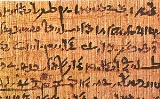
Papyrus

Encyclopedia
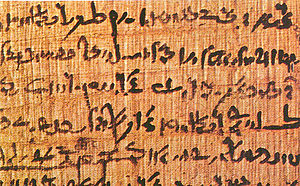
Paper
Paper is a thin material mainly used for writing upon, printing upon, drawing or for packaging. It is produced by pressing together moist fibers, typically cellulose pulp derived from wood, rags or grasses, and drying them into flexible sheets....
material produced from the pith
Pith
Pith, or medulla, is a tissue in the stems of vascular plants. Pith is composed of soft, spongy parenchyma cells, which store and transport nutrients throughout the plant. In eudicots, pith is located in the center of the stem. In monocots, it extends also into flowering stems and roots...
of the papyrus plant, Cyperus papyrus
Cyperus papyrus
Cyperus papyrus is a monocot belonging to the sedge family Cyperaceae. It is a herbaceous perennial native to Africa, and forms tall stands of reed-like swamp vegetation in shallow water....
, a wetland sedge
Cyperaceae
Cyperaceae are a family of monocotyledonous graminoid flowering plants known as sedges, which superficially resemble grasses or rushes. The family is large, with some 5,500 species described in about 109 genera. These species are widely distributed, with the centers of diversity for the group...
that was once abundant in the Nile Delta
Nile Delta
The Nile Delta is the delta formed in Northern Egypt where the Nile River spreads out and drains into the Mediterranean Sea. It is one of the world's largest river deltas—from Alexandria in the west to Port Said in the east, it covers some 240 km of Mediterranean coastline—and is a rich...
of Egypt
Egypt
Egypt , officially the Arab Republic of Egypt, Arabic: , is a country mainly in North Africa, with the Sinai Peninsula forming a land bridge in Southwest Asia. Egypt is thus a transcontinental country, and a major power in Africa, the Mediterranean Basin, the Middle East and the Muslim world...
.
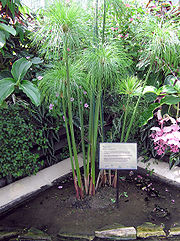
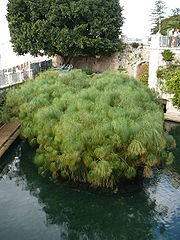
Papyrus usually grow 2–3 meters (5–9 ft) tall. Papyrus is first known to have been used in ancient Egypt
Ancient Egypt
Ancient Egypt was an ancient civilization of Northeastern Africa, concentrated along the lower reaches of the Nile River in what is now the modern country of Egypt. Egyptian civilization coalesced around 3150 BC with the political unification of Upper and Lower Egypt under the first pharaoh...
(at least as far back as the First dynasty
First dynasty of Egypt
The first dynasty of Ancient Egypt is often combined with the Dynasty II under the group title, Early Dynastic Period of Egypt...
), but it was also used throughout the Mediterranean region. Ancient Egypt used this plant as a writing material and for boats, mattresses, mats, rope, sandals, and baskets.
Chemically, papyrus is composed of: 57% cellulose, 27% lignin, 9% minerals, and 7% water.
History
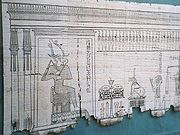
Scroll (parchment)
A scroll is a roll of papyrus, parchment, or paper which has been written, drawn or painted upon for the purpose of transmitting information or using as a decoration.-Structure:...
s gained a rival as a writing surface in the form of parchment
Parchment
Parchment is a thin material made from calfskin, sheepskin or goatskin, often split. Its most common use was as a material for writing on, for documents, notes, or the pages of a book, codex or manuscript. It is distinct from leather in that parchment is limed but not tanned; therefore, it is very...
, which was prepared from animal skins. Sheets of parchment were folded to form quires from which book-form codices
Codex
A codex is a book in the format used for modern books, with multiple quires or gatherings typically bound together and given a cover.Developed by the Romans from wooden writing tablets, its gradual replacement...
were fashioned. Early Christian writers soon adopted the codex form, and in the Græco-Roman world it became common to cut sheets from papyrus rolls to form codices.
Codices were an improvement on the papyrus scroll as the papyrus was not pliable enough to fold without cracking and a long roll, or scroll, was required to create large volume texts. Papyrus had the advantage of being relatively cheap and easy to produce, but it was fragile and susceptible to both moisture and excessive dryness. Unless the papyrus was of good quality, the writing surface was irregular, and the range of media that could be used was also limited.
Papyrus was replaced in Europe by the cheaper locally-produced products parchment
Parchment
Parchment is a thin material made from calfskin, sheepskin or goatskin, often split. Its most common use was as a material for writing on, for documents, notes, or the pages of a book, codex or manuscript. It is distinct from leather in that parchment is limed but not tanned; therefore, it is very...
and vellum
Vellum
Vellum is mammal skin prepared for writing or printing on, to produce single pages, scrolls, codices or books. It is generally smooth and durable, although there are great variations depending on preparation, the quality of the skin and the type of animal used...
, of significantly higher durability in moist climates, though Henri Pirenne
Henri Pirenne
Henri Pirenne was a Belgian historian. A medievalist of Walloon descent, he wrote a multivolume history of Belgium in French and became a national hero....
's connection of its disappearance with the Muslim overrunning of Egypt is contended. Its last appearance in the Merovingian chancery is with a document of 692, though it was known in Gaul
Gaul
Gaul was a region of Western Europe during the Iron Age and Roman era, encompassing present day France, Luxembourg and Belgium, most of Switzerland, the western part of Northern Italy, as well as the parts of the Netherlands and Germany on the left bank of the Rhine. The Gauls were the speakers of...
until the middle of the following century. The latest certain dates for the use of papyrus are 1057 for a papal decree (typically conservative, all papal "bulls" were on papyrus until 1022), under Pope Victor II
Pope Victor II
Pope Victor II , born Gebhard, Count of Calw, Tollenstein, and Hirschberg, was Pope from 1055 to 1057. He was one of a series of German reform Popes.-Life:...
, and 1087 for an Arabic document. Its use in Egypt continued until it was replaced by more inexpensive paper introduced by Arabs. Papyrus was documented as in use as late as the 12th century in the Byzantine Empire
Byzantine Empire
The Byzantine Empire was the Eastern Roman Empire during the periods of Late Antiquity and the Middle Ages, centred on the capital of Constantinople. Known simply as the Roman Empire or Romania to its inhabitants and neighbours, the Empire was the direct continuation of the Ancient Roman State...
, but there are no surviving examples. Although its uses had transferred to parchment, papyrus therefore just overlapped with the use of paper
Paper
Paper is a thin material mainly used for writing upon, printing upon, drawing or for packaging. It is produced by pressing together moist fibers, typically cellulose pulp derived from wood, rags or grasses, and drying them into flexible sheets....
in Europe, which began in the 11th century.
Papyrus came in several qualities and prices; these are listed, with minor differences, both by Pliny
Pliny the Elder
Gaius Plinius Secundus , better known as Pliny the Elder, was a Roman author, naturalist, and natural philosopher, as well as naval and army commander of the early Roman Empire, and personal friend of the emperor Vespasian...
and Isidore of Seville
Isidore of Seville
Saint Isidore of Seville served as Archbishop of Seville for more than three decades and is considered, as the historian Montalembert put it in an oft-quoted phrase, "le dernier savant du monde ancien"...
.
Until to the middle of the 19th century only some isolated documents written on papyrus were known. They did not contain literary works. The first discovery of papyri rolls in modern days was made at Herculaneum
Herculaneum
Herculaneum was an ancient Roman town destroyed by volcanic pyroclastic flows in AD 79, located in the territory of the current commune of Ercolano, in the Italian region of Campania in the shadow of Mt...
in 1752. Before that date the only papyri known were a few survivals from mediaeval times.
Etymology
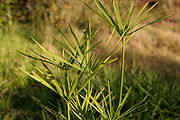
English language
English is a West Germanic language that arose in the Anglo-Saxon kingdoms of England and spread into what was to become south-east Scotland under the influence of the Anglian medieval kingdom of Northumbria...
word papyrus derives, via Latin
Latin
Latin is an Italic language originally spoken in Latium and Ancient Rome. It, along with most European languages, is a descendant of the ancient Proto-Indo-European language. Although it is considered a dead language, a number of scholars and members of the Christian clergy speak it fluently, and...
, from Greek
Greek language
Greek is an independent branch of the Indo-European family of languages. Native to the southern Balkans, it has the longest documented history of any Indo-European language, spanning 34 centuries of written records. Its writing system has been the Greek alphabet for the majority of its history;...
πάπυρος (papuros). Greek has a second word for papyrus, βύβλος (bublos, said to derive from the name of the Phoenicia
Phoenicia
Phoenicia , was an ancient civilization in Canaan which covered most of the western, coastal part of the Fertile Crescent. Several major Phoenician cities were built on the coastline of the Mediterranean. It was an enterprising maritime trading culture that spread across the Mediterranean from 1550...
n city of Byblos
Byblos
Byblos is the Greek name of the Phoenician city Gebal . It is a Mediterranean city in the Mount Lebanon Governorate of present-day Lebanon under the current Arabic name of Jubayl and was also referred to as Gibelet during the Crusades...
). The Greek writer Theophrastus
Theophrastus
Theophrastus , a Greek native of Eresos in Lesbos, was the successor to Aristotle in the Peripatetic school. He came to Athens at a young age, and initially studied in Plato's school. After Plato's death he attached himself to Aristotle. Aristotle bequeathed to Theophrastus his writings, and...
, who flourished during the 4th century BCE, uses papuros when referring to the plant used as a foodstuff and bublos for the same plant when used for non-food products, such as cordage, basketry, or a writing surface. The more specific term βίβλος biblos, which finds its way into English in such words as bibliography, bibliophile, and bible, refers to the inner bark of the papyrus plant. Papyrus is also the etymon of paper, a similar substance.
It is often claimed that Egyptians referred to papyrus as pa-per
Pr (hieroglyph)
Pr is the hieroglyph for 'house', the floor-plan of a walled building with an open doorway. While its original pronunciation is not known with certainty, modern Egyptology assigns it the value of per, but purely on the basis of a convention specific to the discipline...
-aa [p3y pr-ˁ3] (lit., "that which is of Pharaoh
Pharaoh
Pharaoh is a title used in many modern discussions of the ancient Egyptian rulers of all periods. The title originates in the term "pr-aa" which means "great house" and describes the royal palace...
"), apparently denoting that the Egyptian crown owned a monopoly on papyrus production. However no actual ancient text using this term is known. In the Egyptian language
Egyptian language
Egyptian is the oldest known indigenous language of Egypt and a branch of the Afroasiatic language family. Written records of the Egyptian language have been dated from about 3400 BC, making it one of the oldest recorded languages known. Egyptian was spoken until the late 17th century AD in the...
, papyrus was known by the terms wadj [w3ḏ], tjufy [ṯwfy], and djet [ḏt]. The Greek word papyros has no known relationship to any Egyptian word or phrase.
Documents written on papyrus
The word for the material papyrus is also used to designate documents written on sheets of it, often rolled up into scrolls. The plural for such documents is papyri. Historical papyri are given identifying names—generally the name of the discoverer, first owner or institution where it is kept—and numbered, such as "Papyrus Harris IPapyrus Harris I
Papyrus Harris I is also known as the Great Harris Papyrus and simply the Harris Papyrus . Its technical designation is Papyrus British Museum 9999...
". Often an abbreviated form is used such as "pHarris I". We owe to these documents some very important intelligences on the ancient word: they give us the only extant copy of Menander
Menander
Menander , Greek dramatist, the best-known representative of Athenian New Comedy, was the son of well-to-do parents; his father Diopeithes is identified by some with the Athenian general and governor of the Thracian Chersonese known from the speech of Demosthenes De Chersoneso...
, the Egyptian Book of the dead
Book of the Dead
The Book of the Dead is the modern name of an ancient Egyptian funerary text, used from the beginning of the New Kingdom to around 50 BC. The original Egyptian name for the text, transliterated rw nw prt m hrw is translated as "Book of Coming Forth by Day". Another translation would be "Book of...
, Egyptian treatises on medicine (the Ebers Papyrus
Ebers papyrus
The Ebers Papyrus, also known as Papyrus Ebers, is an Egyptian medical papyrus dating to circa 1550 BC. Among the oldest and most important medical papyri of ancient Egypt, it was purchased at Luxor, in the winter of 1873–74 by Georg Ebers...
) or on surgery (the Edwin Smith papyrus
Edwin Smith papyrus
The Edwin Smith Papyrus is an Ancient Egyptian medical text and the oldest known surgical treatise on trauma. It dates to Dynasties 16-17 of the Second Intermediate Period in Ancient Egypt, ca. 1500 BCE. The Edwin Smith papyrus is unique among the four principal medical papyri in existencethat...
), Egyptian mathematical treatises (the Rhind papyrus), Egyptian folk tales (the Westcar papyrus
Westcar Papyrus
The Westcar Papyrus is an ancient Egyptian text containing five stories about miracles performed by priests and magicians. Each of these tales are being told at the royal court of the King Cheops by his sons...
), etc... When, in the eighteenth century, a library of ancient papyri was found in Herculaneum
Herculaneum
Herculaneum was an ancient Roman town destroyed by volcanic pyroclastic flows in AD 79, located in the territory of the current commune of Ercolano, in the Italian region of Campania in the shadow of Mt...
, ripples of expectation spread among the learned men of the time. However, since these papyri were badly charred, their unscrolling and decyphering is still going on today.
Manufacture and use
Pith
Pith, or medulla, is a tissue in the stems of vascular plants. Pith is composed of soft, spongy parenchyma cells, which store and transport nutrients throughout the plant. In eudicots, pith is located in the center of the stem. In monocots, it extends also into flowering stems and roots...
is cut lengthwise into thin strips of about 40 cm (16 in) long. The strips are then placed side by side on a hard surface with their edges slightly overlapping, and then another layer of strips is laid on top at a right angle. The strips may have been soaked in water long enough for decomposition
Decomposition
Decomposition is the process by which organic material is broken down into simpler forms of matter. The process is essential for recycling the finite matter that occupies physical space in the biome. Bodies of living organisms begin to decompose shortly after death...
to begin, perhaps increasing adhesion, but this is not certain. It is also possible that the two layers were glued together. While still moist, the two layers are hammered together, mashing the layers into a single sheet. The sheet is then dried under pressure. After drying, the sheet of papyrus is polished with some rounded object, possibly a stone or seashell or round hard wood.
To form the long strip that a scroll required, a number of such sheets were united, placed so that all the horizontal fibres parallel with the roll's length were on one side and all the vertical fibres on the other. Normally, texts were first written on the recto
Recto
The recto and verso are respectively the "front" and "back" sides of a leaf of paper in a bound item such as a codex, book, broadsheet, or pamphlet. In languages written from left to right the recto is the right-hand page and the verso the left-hand page...
, the lines following the fibres, parallel to the long edges of the scroll. Secondarily, papyrus was often reused, writing across the fibres on the verso. Pliny the Elder
Pliny the Elder
Gaius Plinius Secundus , better known as Pliny the Elder, was a Roman author, naturalist, and natural philosopher, as well as naval and army commander of the early Roman Empire, and personal friend of the emperor Vespasian...
describes the methods of preparing papyrus in his Naturalis Historia
Naturalis Historia
The Natural History is an encyclopedia published circa AD 77–79 by Pliny the Elder. It is one of the largest single works to have survived from the Roman Empire to the modern day and purports to cover the entire field of ancient knowledge, based on the best authorities available to Pliny...
.
In a dry climate
Climate
Climate encompasses the statistics of temperature, humidity, atmospheric pressure, wind, rainfall, atmospheric particle count and other meteorological elemental measurements in a given region over long periods...
like that of Egypt, papyrus is stable, formed as it is of highly rot-resistant cellulose
Cellulose
Cellulose is an organic compound with the formula , a polysaccharide consisting of a linear chain of several hundred to over ten thousand β linked D-glucose units....
; but storage in humid conditions can result in mold
Mold
Molds are fungi that grow in the form of multicellular filaments called hyphae. Molds are not considered to be microbes but microscopic fungi that grow as single cells called yeasts...
s attacking and destroying the material. In European conditions, papyrus seems only to have lasted a matter of decades; a 200–year-old papyrus was considered extraordinary. Imported papyrus that was once commonplace in Greece
Greece
Greece , officially the Hellenic Republic , and historically Hellas or the Republic of Greece in English, is a country in southeastern Europe....
and Italy
Italy
Italy , officially the Italian Republic languages]] under the European Charter for Regional or Minority Languages. In each of these, Italy's official name is as follows:;;;;;;;;), is a unitary parliamentary republic in South-Central Europe. To the north it borders France, Switzerland, Austria and...
has since deteriorated beyond repair, but papyrus is still being found in Egypt; extraordinary examples include the Elephantine papyri
Elephantine papyri
The Elephantine Papyri are a collection of ancient Jewish manuscripts dating from the 5th century BC. They come from a Jewish community at Elephantine, then called Yeb, the island in the Nile at the border of Nubia, which was probably founded as a military installation in about 650 BC during...
and the famous finds at Oxyrhynchus
Oxyrhynchus
Oxyrhynchus is a city in Upper Egypt, located about 160 km south-southwest of Cairo, in the governorate of Al Minya. It is also an archaeological site, considered one of the most important ever discovered...
and Nag Hammadi
Nag Hammâdi
Nag Hammadi , is a city in Upper Egypt. Nag Hammadi was known as Chenoboskion in classical antiquity, meaning "geese grazing grounds". It is located on the west bank of the Nile in the Qena Governorate, about 80 kilometres north-west of Luxor....
. The Villa of the Papyri
Villa of the Papyri
The Villa of the Papyri is a private house in the ancient Roman city of Herculaneum . Situated north-west of the township, the residence sits halfway up the slope of the volcano Vesuvius without other buildings to obstruct the view. The villa suburbana was owned by Julius Caesar's father-in-law,...
at Herculaneum
Herculaneum
Herculaneum was an ancient Roman town destroyed by volcanic pyroclastic flows in AD 79, located in the territory of the current commune of Ercolano, in the Italian region of Campania in the shadow of Mt...
, containing the library of Lucius Calpurnius Piso Caesoninus, Julius Caesar
Julius Caesar
Gaius Julius Caesar was a Roman general and statesman and a distinguished writer of Latin prose. He played a critical role in the gradual transformation of the Roman Republic into the Roman Empire....
's father-in-law, was preserved by the eruption of Mount Vesuvius
Mount Vesuvius
Mount Vesuvius is a stratovolcano in the Gulf of Naples, Italy, about east of Naples and a short distance from the shore. It is the only volcano on the European mainland to have erupted within the last hundred years, although it is not currently erupting...
, but has only been partially excavated.
There have been sporadic attempts to revive the manufacture of papyrus during the past 250 years. The Scottish
Scotland
Scotland is a country that is part of the United Kingdom. Occupying the northern third of the island of Great Britain, it shares a border with England to the south and is bounded by the North Sea to the east, the Atlantic Ocean to the north and west, and the North Channel and Irish Sea to the...
explorer James Bruce
James Bruce
James Bruce was a Scottish traveller and travel writer who spent more than a dozen years in North Africa and Ethiopia, where he traced the origins of the Blue Nile.-Youth:...
experimented in the late 18th century with papyrus plants from the Sudan
Sudan
Sudan , officially the Republic of the Sudan , is a country in North Africa, sometimes considered part of the Middle East politically. It is bordered by Egypt to the north, the Red Sea to the northeast, Eritrea and Ethiopia to the east, South Sudan to the south, the Central African Republic to the...
, for papyrus had become extinct in Egypt. Also in the 18th century, a Sicilian
Sicily
Sicily is a region of Italy, and is the largest island in the Mediterranean Sea. Along with the surrounding minor islands, it constitutes an autonomous region of Italy, the Regione Autonoma Siciliana Sicily has a rich and unique culture, especially with regard to the arts, music, literature,...
named Saverio Landolina manufactured papyrus at Syracuse
Syracuse, Italy
Syracuse is a historic city in Sicily, the capital of the province of Syracuse. The city is notable for its rich Greek history, culture, amphitheatres, architecture, and as the birthplace of the preeminent mathematician and engineer Archimedes. This 2,700-year-old city played a key role in...
, where papyrus plants had continued to grow in the wild. The modern technique of papyrus production used in Egypt for the tourist trade was developed in 1962 by the Egyptian engineer Hassan Ragab using plants that had been reintroduced into Egypt in 1872 from France. Both Sicily and Egypt have centres of limited papyrus production.
Papyrus is still used by communities living in the vicinity of swamps, to the extent that rural householders derive up to 75% of their income from swamp goods (Maclean et al. 2003b; c). Particularly in East and Central Africa, people harvest papyrus, which is used to manufacture items that are sold or used locally. Examples include baskets, hats, fish traps, trays or winnowing mats and floor mats. Papyrus is also used to make roofs, ceilings, rope and fences. Although alternatives such as eucalyptus
Eucalyptus
Eucalyptus is a diverse genus of flowering trees in the myrtle family, Myrtaceae. Members of the genus dominate the tree flora of Australia...
are increasingly available, papyrus is still used as fuel.
Collections of papyri
- Amherst Papyri — This is a collection of Lord Amherst of Hackey. It includes biblical manuscripts, early church fragments, and classical documents from the Ptolemaic, Roman, and Byzantine eras. The collection was edited by Bernard Grenfell and Arthur HuntArthur HuntArthur Surridge Hunt was an English papyrologist.Hunt was born in Romford, Essex, England. Over the course of many years, Hunt, along with Bernard Grenfell, recovered many papyri from excavation sites in Egypt, including the Oxyrhynchus Papyri.-Publications:*B. P. Grenfell, A. S...
in 1900–1901. It is housed at the Pierpont Morgan Library (New York). - Archduke RainerArchduke Rainer Ferdinand of AustriaArchduke Rainer Ferdinand of Austria was an Austrian prime minister. He was a son of Archduke Rainer Joseph....
Papyri — One of the world's largest collection of papyri (about 180,000 objects) in the Austrian National Library. - BerlinBerlinBerlin is the capital city of Germany and is one of the 16 states of Germany. With a population of 3.45 million people, Berlin is Germany's largest city. It is the second most populous city proper and the seventh most populous urban area in the European Union...
Papyri — housed in the Egyptian Museum and Papyrus CollectionEgyptian Museum of BerlinThe Egyptian Museum of Berlin is home to one of the world's most important collections of Ancient Egyptian artifacts.The collection is part of the Neues Museum.-History:...
. - Bodmer PapyriBodmer PapyriThe Bodmer Papyri are a group of twenty-two papyri discovered in Egypt in 1952. They are named after Martin Bodmer who purchased them. The papyri contain segments from the Old and New Testaments, early Christian literature, Homer and Menander. The oldest, P66 dates to c. 200. The papyri are kept at...
— This collection was purchased by Martin BodmerMartin BodmerMartin Bodmer was a Swiss bibliophile, scholar and collector.- Biography :Martin Bodmer was the son of wealthy parents born in Zurich, Switzerland, where he lived until 1948. His father died in 1916 leaving a very large fortune. In 1918, Bodmer began studying German language, then gave up and took...
in 1955–1956. Currently it is housed in the Bibliotheca BodmerianaBodmer LibraryThe Bibliotheca Bodmeriana is located in Cologny, Switzerland just outside Geneva. It is a Swiss heritage site of national significance. The library was established by Martin Bodmer and is famous as the home of the Bodmer Papyri. Some of these papyri are among the oldest remaining copies of the...
in ColognyColognyCologny is a municipality in the Canton of Geneva, Switzerland.-Geography:Cologny has an area, , of . Of this area, or 17.7% is used for agricultural purposes, while or 4.1% is forested...
. It includes Greek and CoptCoptThe Copts are the native Egyptian Christians , a major ethnoreligious group in Egypt....
ic documents, classical texts, biblical books, and writing of the early churches. - Chester Beatty PapyriChester Beatty PapyriThe Chester Beatty Biblical Papyri or simply the Chester Beatty Papyri are a group of early papyrus manuscripts of biblical texts. The manuscripts are in Greek and are of Christian origin. There are eleven manuscripts in the group, seven consisting of portions of Old Testament books, three...
— collection of 11 codices acquired by Alfred Chester BeattyAlfred Chester BeattySir Alfred Chester Beatty Seanad 1985: "Chester Beatty died at the Princess Grace Clinic, Monte Carlo, on 19 January 1968, [...]" . was a mining magnate and millionaire, often called the "King of Copper". U.S.-born, he was naturalised British in 1933, and made an honorary citizen of Ireland in 1957...
in 1930–1931 and 1935. It is housed at the Chester Beatty LibraryChester Beatty LibraryThe Chester Beatty Library was established in Dublin, Ireland in 1950, to house the collections of mining magnate, Sir Alfred Chester Beatty. The present library, on the grounds of Dublin Castle, opened on February 7, 2000, the 125th anniversary of Sir Alfred's birth and was named European Museum...
. The collection was edited by Frederic G. KenyonFrederic G. KenyonSir Frederic George Kenyon GBE KCB TD FBA FSA was a British paleographer and biblical and classical scholar. He occupied from 1889 to 1931 a series of posts at the British Museum...
. - Colt Papyri — it is housed at the Pierpont Morgan Library (New York).
- The Herculaneum papyriHerculaneum papyriThe Herculaneum papyri are more than 1,800 papyri found in Herculaneum in the 18th century, carbonized by the eruption of Mount Vesuvius in AD 79. After various methods of manipulation, a method was found to unroll and to read them....
— These papyri were found in Herculaneum in the eighteenth century, carbonized by the eruption of Mount VesuviusMount VesuviusMount Vesuvius is a stratovolcano in the Gulf of Naples, Italy, about east of Naples and a short distance from the shore. It is the only volcano on the European mainland to have erupted within the last hundred years, although it is not currently erupting...
. After some tinkering, a method was found to unroll and to read them. Bulk of them are housed at the Naples National Archaeological MuseumNaples National Archaeological MuseumThe Naples National Archaeological Museum is a museum in Naples, southern Italy, at the northwest corner of the original Greek wall of the city of Neapolis. The museum contains a large collection of Roman artifacts from Pompeii, Stabiae and Herculaneum...
. - The Houghton's papyri — the collection at Houghton Library, Harvard UniversityHoughton LibraryHoughton Library is the primary repository for rare books and manuscripts at Harvard University. It is part of the Harvard College Library within the Harvard Faculty of Arts and Sciences. Houghton is located on the south side of Harvard Yard, next to Widener Library.- History :Harvard's first...
was acquired between 1901 and 1909 thanks to a donation from the Egypt Exploration Fund. - Martin Schøyen Collection — biblical manuscripts in Greek and Coptic, Dead Sea ScrollsDead Sea scrollsThe Dead Sea Scrolls are a collection of 972 texts from the Hebrew Bible and extra-biblical documents found between 1947 and 1956 on the northwest shore of the Dead Sea, from which they derive their name...
, classical documents - Michigan Papyrus CollectionUniversity of Michigan Papyrus CollectionThe Papyrology Collection of the University of Michigan Library is an internationally respected collection of ancient papyrus and a center for research on ancient culture, language, and history...
— this collection contains above 10 000 papyri fragments. It is housed at the University of MichiganUniversity of MichiganThe University of Michigan is a public research university located in Ann Arbor, Michigan in the United States. It is the state's oldest university and the flagship campus of the University of Michigan...
. - Oxyrhynchus PapyriOxyrhynchus PapyriThe Oxyrhynchus Papyri are a very numerous group of manuscripts discovered by archaeologists including Bernard Pyne Grenfell and Arthur Surridge Hunt at an ancient rubbish dump near Oxyrhynchus in Egypt . The manuscripts date from the 1st to the 6th century AD. They include thousands of Greek and...
— these numerous papyri fragments were discovered by Grenfell and Hunt in and around OxyrhynchusOxyrhynchusOxyrhynchus is a city in Upper Egypt, located about 160 km south-southwest of Cairo, in the governorate of Al Minya. It is also an archaeological site, considered one of the most important ever discovered...
. The publication of these papyri is still in progress. A large part of the Oxyrhynchus papyri are housed at the Ashmolean MuseumAshmolean MuseumThe Ashmolean Museum on Beaumont Street, Oxford, England, is the world's first university museum...
in OxfordOxfordThe city of Oxford is the county town of Oxfordshire, England. The city, made prominent by its medieval university, has a population of just under 165,000, with 153,900 living within the district boundary. It lies about 50 miles north-west of London. The rivers Cherwell and Thames run through...
, others in the British MuseumBritish MuseumThe British Museum is a museum of human history and culture in London. Its collections, which number more than seven million objects, are amongst the largest and most comprehensive in the world and originate from all continents, illustrating and documenting the story of human culture from its...
in LondonLondonLondon is the capital city of :England and the :United Kingdom, the largest metropolitan area in the United Kingdom, and the largest urban zone in the European Union by most measures. Located on the River Thames, London has been a major settlement for two millennia, its history going back to its...
, in the Egyptian MuseumEgyptian MuseumThe Museum of Egyptian Antiquities, known commonly as the Egyptian Museum, in Cairo, Egypt, is home to an extensive collection of ancient Egyptian antiquities. It has 120,000 items, with a representative amount on display, the remainder in storerooms....
in CairoCairoCairo , is the capital of Egypt and the largest city in the Arab world and Africa, and the 16th largest metropolitan area in the world. Nicknamed "The City of a Thousand Minarets" for its preponderance of Islamic architecture, Cairo has long been a centre of the region's political and cultural life...
, and many other places. - Princeton PapyriPrinceton PapyriThe Princeton University's collection of papyri, housed at the Princeton University, was compiled by Rosalie Cook and other papyrologists, working under the supervision of Don C. Skemer. The catalog contains 1529 inventory items, 648 of them belong to 'unidentified papyri', nearly 700 items in...
— it is housed at the Princeton UniversityPrinceton UniversityPrinceton University is a private research university located in Princeton, New Jersey, United States. The school is one of the eight universities of the Ivy League, and is one of the nine Colonial Colleges founded before the American Revolution.... - Rylands PapyriRylands PapyriThe Rylands Papyri are a collection of thousands of papyrus fragments and documents from North Africa and Greece housed at the John Rylands University Library, Manchester, UK...
— this collection contains above 700 papyri, with 31 ostraca and 54 codices. It is housed at the John Rylands University LibraryJohn Rylands University LibraryThe John Rylands University Library is the University of Manchester's library and information service. It was formed in July 1972 from the merger of the library of the Victoria University of Manchester with the John Rylands Library...
. - Washington University Papyri Collection — includes 445 manuscript fragments, dating from the first century BC to the eighth century AD. Housed at the Washington University LibrariesWashington University LibrariesWashington University Libraries is the library system of Washington University in St. Louis. With 14 libraries and over 4.2 million volumes, it is the largest library system in the state of Missouri. The John M...
. - Yale Papyrus Collection — numbers over six thousand inventoried items and is cataloged, digitally scanned, and accessible online for close study. It is housed at the Beinecke Library.
See also

- Pliny the ElderPliny the ElderGaius Plinius Secundus , better known as Pliny the Elder, was a Roman author, naturalist, and natural philosopher, as well as naval and army commander of the early Roman Empire, and personal friend of the emperor Vespasian...
- PapyrologyPapyrologyPapyrology is the study of ancient literature, correspondence, legal archives, etc., as preserved in manuscripts written on papyrus, the most common form of writing material in the ancient civilizations of Egypt, Greece, and Rome...
- Papyrus sanitary padPapyrus sanitary padA papyrus sanitary pad, or Makapad, is a sanitary napkin made from papyrus, a natural material. It is reported to be 75 percent cheaper than a conventional pad and thus an advantage to the poor, as well as being highly absorbent....
- PalimpsestPalimpsestA palimpsest is a manuscript page from a scroll or book from which the text has been scraped off and which can be used again. The word "palimpsest" comes through Latin palimpsēstus from Ancient Greek παλίμψηστος originally compounded from πάλιν and ψάω literally meaning “scraped...
- For Egyptian papyri:
- Other papyri:
- Elephantine papyriElephantine papyriThe Elephantine Papyri are a collection of ancient Jewish manuscripts dating from the 5th century BC. They come from a Jewish community at Elephantine, then called Yeb, the island in the Nile at the border of Nubia, which was probably founded as a military installation in about 650 BC during...
- Magdalen papyrusMagdalen papyrusThe "Magdalen" papyrus was purchased in Luxor, Egypt in 1901 by Reverend Charles Bousfield Huleatt , who identified the Greek fragments as portions of the Gospel of Matthew and presented them to Magdalen College, Oxford, where they are cataloged as P. Magdalen Greek 17 and whence they have their...
- Nag Hammadi libraryNag Hammadi libraryThe Nag Hammadi library is a collection of early Christian Gnostic texts discovered near the Upper Egyptian town of Nag Hammadi in 1945. That year, twelve leather-bound papyrus codices buried in a sealed jar were found by a local peasant named Mohammed Ali Samman...
- New Testament papyri
- Strasbourg papyrusStrasbourg papyrusThe Strasbourg papyrus is a papyrus made of six fragments on a single leaf written in Greek and conserved at the Strasbourg National University Library, cataloged Gr. 254. It was first edited in 1928. The Strasbourg papyrus contains an ancient Christian prayer, probably an Anaphora, that later...
- Elephantine papyri
- The papyrus plant in Egyptian art
- PalmettePalmetteThe palmette is a motif in decorative art which, in its most characteristic expression, resembles the fan-shaped leaves of a palm tree. It has an extremely long history, originating in Ancient Egypt with a subsequent development through the art of most of Eurasia, often in forms that bear...
- Palmette
Other ancient writing material
Writing material
Writing material refers to the materials that provide the surfaces on which humans use writing instruments to inscribe writings. The same materials can also be used for symbolic or representational drawings. Building material on which writings or drawings are produced are not included...
s:
- Palm leaf manuscriptPalm leaf manuscriptPalm leaf manuscripts are manuscripts made out of dried palm leaves. They served as the paper of the ancient world in parts of Asia as far back as the fifteenth century BCE. and possibly much earlier. They were used to record actual and mythical narratives in South Asia and in South East Asia...
India - Amate Mesoamerica
- PaperPaperPaper is a thin material mainly used for writing upon, printing upon, drawing or for packaging. It is produced by pressing together moist fibers, typically cellulose pulp derived from wood, rags or grasses, and drying them into flexible sheets....
- OstraconOstraconAn ostracon is a piece of pottery , usually broken off from a vase or other earthenware vessel. In archaeology, ostraca may contain scratched-in words or other forms of writing which may give clues as to the time when the piece was in use...
- Wax tabletWax tabletA wax tablet is a tablet made of wood and covered with a layer of wax, often linked loosely to a cover tablet, as a "double-leaved" diptych. It was used as a reusable and portable writing surface in Antiquity and throughout the Middle Ages...
s - Clay tabletClay tabletIn the Ancient Near East, clay tablets were used as a writing medium, especially for writing in cuneiform, throughout the Bronze Age and well into the Iron Age....
s - Birch bark documentBirch bark documentA birch bark document is a document written on pieces of birch bark. Such documents existed in several cultures. For instance, some Gandharan Buddhist texts have been found written on birch bark and preserved in clay jars....
- ParchmentParchmentParchment is a thin material made from calfskin, sheepskin or goatskin, often split. Its most common use was as a material for writing on, for documents, notes, or the pages of a book, codex or manuscript. It is distinct from leather in that parchment is limed but not tanned; therefore, it is very...
Further reading
- Horst Blanck: Das Buch in der Antike. Beck, München 1992, ISBN 3-406-36686-4
- Rosemarie Drenkhahn: Papyrus. In: Wolfgang Helck, Wolfhart Westendorf (Hrsg.): Lexikon der Ägyptologie. Bd. IV, Wiesbaden 1982, Spalte 667-670
- David Diringer, The Book before Printing: Ancient, Medieval and Oriental, Dover Publications, New York 1982, pp. 113–169, ISBN 0-486-24243-9.
- Victor Martin (Hrsg.): Ménandre. Le Dyscolos. Bibliotheca Bodmeriana, Cologny- Genève 1958
- Otto Mazal: Griechisch-römische Antike. Akademische Druck- und Verlagsanstalt, Graz 1999, ISBN 3-201-01716-7 (Geschichte der Buchkultur; Bd. 1)