
Home      Discussion      Topics      Dictionary      Almanac
Signup       Login
Aswan

Aswan

Overview
Aswan (ˌæsˈwɑːn , ʔɑˈsˁwɑːn, , Ancient Egyptian
Egyptian language
Egyptian is the oldest known indigenous language of Egypt and a branch of the Afroasiatic language family. Written records of the Egyptian language have been dated from about 3400 BC, making it one of the oldest recorded languages known. Egyptian was spoken until the late 17th century AD in the...

: Swenet, Coptic
Coptic language
Coptic or Coptic Egyptian is the current stage of the Egyptian language, a northern Afro-Asiatic language spoken in Egypt until at least the 17th century. Egyptian began to be written using the Greek alphabet in the 1st century...

: Swān, Syene), formerly spelled Assuan, is a city in the south of Egypt
Egypt
Egypt , officially the Arab Republic of Egypt, Arabic: , is a country mainly in North Africa, with the Sinai Peninsula forming a land bridge in Southwest Asia. Egypt is thus a transcontinental country, and a major power in Africa, the Mediterranean Basin, the Middle East and the Muslim world...

, the capital of the Aswan Governorate
Aswan Governorate
Aswan Governorate is one of the governorates of Egypt. The southernmost governorate in Upper Egypt, its capital is Aswan.The Aswan Governorate borders Qena Governorate to the north, Red Sea Governorate to the east, New Valley Governorate to the west, and Sudan to the south...

.
Discussion
Ask a question about 'Aswan'
Start a new discussion about 'Aswan'
Answer questions from other users
Full Discussion Forum
 
Unanswered Questions
Encyclopedia
Aswan (ˌæsˈwɑːn , ʔɑˈsˁwɑːn, , Ancient Egyptian
Egyptian language
Egyptian is the oldest known indigenous language of Egypt and a branch of the Afroasiatic language family. Written records of the Egyptian language have been dated from about 3400 BC, making it one of the oldest recorded languages known. Egyptian was spoken until the late 17th century AD in the...

: Swenet, Coptic
Coptic language
Coptic or Coptic Egyptian is the current stage of the Egyptian language, a northern Afro-Asiatic language spoken in Egypt until at least the 17th century. Egyptian began to be written using the Greek alphabet in the 1st century...

: Swān, Syene), formerly spelled Assuan, is a city in the south of Egypt
Egypt
Egypt , officially the Arab Republic of Egypt, Arabic: , is a country mainly in North Africa, with the Sinai Peninsula forming a land bridge in Southwest Asia. Egypt is thus a transcontinental country, and a major power in Africa, the Mediterranean Basin, the Middle East and the Muslim world...

, the capital of the Aswan Governorate
Aswan Governorate
Aswan Governorate is one of the governorates of Egypt. The southernmost governorate in Upper Egypt, its capital is Aswan.The Aswan Governorate borders Qena Governorate to the north, Red Sea Governorate to the east, New Valley Governorate to the west, and Sudan to the south...

.

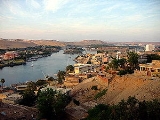
It stands on the east bank of the Nile
Nile
The Nile is a major north-flowing river in North Africa, generally regarded as the longest river in the world. It is long. It runs through the ten countries of Sudan, South Sudan, Burundi, Rwanda, Democratic Republic of the Congo, Tanzania, Kenya, Ethiopia, Uganda and Egypt.The Nile has two major...

 at the first cataract and is a busy market and tourist centre. The modern city has expanded and includes the formerly separate community on the island of Elephantine
Elephantine
Elephantine is an island in the River Nile, located just downstream of the First Cataract at the southern border of Ancient Egypt. This region is referred to as Upper Egypt because the land is higher than that near the Mediterranean coast. The island may have received its name because it was a...

.

History


Aswan is the ancient city of Swenet, which in antiquity was the frontier town of Ancient Egypt
Ancient Egypt
Ancient Egypt was an ancient civilization of Northeastern Africa, concentrated along the lower reaches of the Nile River in what is now the modern country of Egypt. Egyptian civilization coalesced around 3150 BC with the political unification of Upper and Lower Egypt under the first pharaoh...

 facing the south. Swenet is supposed to have derived its name from an Egyptian goddess
Goddess
A goddess is a female deity. In some cultures goddesses are associated with Earth, motherhood, love, and the household. In other cultures, goddesses also rule over war, death, and destruction as well as healing....

 with the same name. This goddess later was identified as Eileithyia by the Greeks and Lucina by the Romans during their occupation of Ancient Egypt because of the similar association of their goddesses with childbirth, and of which the import is "the opener". The ancient name of the city also is said to be derived from the Egyptian
Egyptian language
Egyptian is the oldest known indigenous language of Egypt and a branch of the Afroasiatic language family. Written records of the Egyptian language have been dated from about 3400 BC, making it one of the oldest recorded languages known. Egyptian was spoken until the late 17th century AD in the...

 symbol for trade.

Because the Ancient Egyptians oriented toward the origin of the life-giving waters of the Nile in the south, Swenet was the first town in the country, and Egypt
Egypt
Egypt , officially the Arab Republic of Egypt, Arabic: , is a country mainly in North Africa, with the Sinai Peninsula forming a land bridge in Southwest Asia. Egypt is thus a transcontinental country, and a major power in Africa, the Mediterranean Basin, the Middle East and the Muslim world...

 always was conceived to "open" or begin at Swenet. The city stood upon a peninsula on the right (east) bank of the Nile
Nile
The Nile is a major north-flowing river in North Africa, generally regarded as the longest river in the world. It is long. It runs through the ten countries of Sudan, South Sudan, Burundi, Rwanda, Democratic Republic of the Congo, Tanzania, Kenya, Ethiopia, Uganda and Egypt.The Nile has two major...

, immediately below (and north of) the first cataract of the flowing waters, which extend to it from Philae
Philae
Philae is an island in the Nile River and the previous site of an Ancient Egyptian temple complex in southern Egypt...

. Navigation to the delta was possible from this location without encountering a barrier.

The stone quarries of ancient Egypt
Stone quarries of ancient Egypt
The stone quarries of ancient Egypt once produced quality stone for the construction of decorative monuments such as sculptures and obelisks. These quarries are now recognised archaeological sites...

 located here were celebrated for their stone, and especially for the granitic rock called Syenite. They furnished the colossal statues, obelisk
Obelisk
An obelisk is a tall, four-sided, narrow tapering monument which ends in a pyramid-like shape at the top, and is said to resemble a petrified ray of the sun-disk. A pair of obelisks usually stood in front of a pylon...

s, and monolithal shrines that are found throughout Egypt, including the pyramids
Egyptian pyramids
The Egyptian pyramids are ancient pyramid-shaped masonry structures located in Egypt.There are 138 pyramids discovered in Egypt as of 2008. Most were built as tombs for the country's Pharaohs and their consorts during the Old and Middle Kingdom periods.The earliest known Egyptian pyramids are found...

; and the traces of the quarrymen who wrought in these 3,000 years ago are still visible in the native rock. They lie on either bank of the Nile
Nile
The Nile is a major north-flowing river in North Africa, generally regarded as the longest river in the world. It is long. It runs through the ten countries of Sudan, South Sudan, Burundi, Rwanda, Democratic Republic of the Congo, Tanzania, Kenya, Ethiopia, Uganda and Egypt.The Nile has two major...

, and a road, four miles (6 km) in length, was cut beside them from Syene to Philae
Philae
Philae is an island in the Nile River and the previous site of an Ancient Egyptian temple complex in southern Egypt...

.

Swenet was equally important as a military station as that of a place of traffic. Under every dynasty it was a garrison town; and here tolls and customs were levied on all boats passing southwards and northwards. Around AD 330, the legion stationed here received a bishop from Alexandria
Alexandria
Alexandria is the second-largest city of Egypt, with a population of 4.1 million, extending about along the coast of the Mediterranean Sea in the north central part of the country; it is also the largest city lying directly on the Mediterranean coast. It is Egypt's largest seaport, serving...

; this later became the Coptic Diocese of Syene
Coptic Diocese of Syene
The Diocese of Syene is an ancient see of the Coptic Church in Aswan, Egypt. As its first bishop Neilammon was not mentioned as a new one in the Festal Letter of 339, it is assumed the diocese was established in the early 330s...

. The city is mentioned by numerous ancient writers, including Herodotus
Herodotus
Herodotus was an ancient Greek historian who was born in Halicarnassus, Caria and lived in the 5th century BC . He has been called the "Father of History", and was the first historian known to collect his materials systematically, test their accuracy to a certain extent and arrange them in a...

, Strabo
Strabo
Strabo, also written Strabon was a Greek historian, geographer and philosopher.-Life:Strabo was born to an affluent family from Amaseia in Pontus , a city which he said was situated the approximate equivalent of 75 km from the Black Sea...

, Stephanus of Byzantium
Stephanus of Byzantium
Stephen of Byzantium, also known as Stephanus Byzantinus , was the author of an important geographical dictionary entitled Ethnica...

, Ptolemy
Ptolemy
Claudius Ptolemy , was a Roman citizen of Egypt who wrote in Greek. He was a mathematician, astronomer, geographer, astrologer, and poet of a single epigram in the Greek Anthology. He lived in Egypt under Roman rule, and is believed to have been born in the town of Ptolemais Hermiou in the...

, Pliny the Elder
Pliny the Elder
Gaius Plinius Secundus , better known as Pliny the Elder, was a Roman author, naturalist, and natural philosopher, as well as naval and army commander of the early Roman Empire, and personal friend of the emperor Vespasian...

, De architectura
De architectura
' is a treatise on architecture written by the Roman architect Vitruvius and dedicated to his patron, the emperor Caesar Augustus, as a guide for building projects...

, and it appears on the Antonine Itinerary
Antonine Itinerary
The Antonine Itinerary is a register of the stations and distances along the various roads of the Roman empire, containing directions how to get from one Roman settlement to another...

. It also is mentioned in the Book of Ezekiel
Book of Ezekiel
The Book of Ezekiel is the third of the Latter Prophets in the Hebrew Bible, following the books of Isaiah and Jeremiah and preceding the Book of the Twelve....

 and the Book of Isaiah
Book of Isaiah
The Book of Isaiah is the first of the Latter Prophets in the Hebrew Bible, preceding the books of Ezekiel, Jeremiah and the Book of the Twelve...

.

The latitude
Latitude
In geography, the latitude of a location on the Earth is the angular distance of that location south or north of the Equator. The latitude is an angle, and is usually measured in degrees . The equator has a latitude of 0°, the North pole has a latitude of 90° north , and the South pole has a...

 of the city that would become Aswan – located at 24° 5′ 23″ – was an object of great interest to the ancient geographers. They believed that it was seated immediately under the tropic
Tropic of Cancer
The Tropic of Cancer, also referred to as the Northern tropic, is the circle of latitude on the Earth that marks the most northerly position at which the Sun may appear directly overhead at its zenith...

, and that on the day of the summer solstice
Summer solstice
The summer solstice occurs exactly when the axial tilt of a planet's semi-axis in a given hemisphere is most inclined towards the star that it orbits. Earth's maximum axial tilt to our star, the Sun, during a solstice is 23° 26'. Though the summer solstice is an instant in time, the term is also...

, a vertical staff cast no shadow. They noted that the sun's disc was reflected in a well at noon. This statement is only approximately correct; at the summer solstice, the shadow was only 1/400th of the staff, and so could scarcely be discerned, and the northern limb of the Sun's disc would be nearly vertical.

Eratosthenes
Eratosthenes
Eratosthenes of Cyrene was a Greek mathematician, poet, athlete, geographer, astronomer, and music theorist.He was the first person to use the word "geography" and invented the discipline of geography as we understand it...

 used measurements at Aswan (Elephantine
Elephantine
Elephantine is an island in the River Nile, located just downstream of the First Cataract at the southern border of Ancient Egypt. This region is referred to as Upper Egypt because the land is higher than that near the Mediterranean coast. The island may have received its name because it was a...

) to determine the circumference
Circumference
The circumference is the distance around a closed curve. Circumference is a special perimeter.-Circumference of a circle:The circumference of a circle is the length around it....

 of Earth, using Syene as the originating point and Alexandria
Alexandria
Alexandria is the second-largest city of Egypt, with a population of 4.1 million, extending about along the coast of the Mediterranean Sea in the north central part of the country; it is also the largest city lying directly on the Mediterranean coast. It is Egypt's largest seaport, serving...

 as the terminal point of a measured arc (based on shadow length at the solstice).

The Nile
Nile
The Nile is a major north-flowing river in North Africa, generally regarded as the longest river in the world. It is long. It runs through the ten countries of Sudan, South Sudan, Burundi, Rwanda, Democratic Republic of the Congo, Tanzania, Kenya, Ethiopia, Uganda and Egypt.The Nile has two major...

 is nearly 3,000 yards wide above Aswan. From this frontier town to the northern extremity of Egypt, the river flows for more than 750 miles (1,207 km) without bar or cataract. The voyage from Aswan to Alexandria usually took 21 to 28 days in favourable weather.

Climate


Aswan is Egypt's hottest, driest inhabited city. Aswan's climate ranges from mild in the winter to very hot in the summer with absolutely no rain all year. Maybe 1 or 2 mm of rain every 5 years. Aswan is one of the driest inhabited places in the world; as of early 2001, the last rain there was seven years earlier. , the last rainfall was a thunderstorm on May 13, 2006. In Nubia
Nubia
Nubia is a region along the Nile river, which is located in northern Sudan and southern Egypt.There were a number of small Nubian kingdoms throughout the Middle Ages, the last of which collapsed in 1504, when Nubia became divided between Egypt and the Sennar sultanate resulting in the Arabization...

n settlements, they generally do not bother to roof all of the rooms in their houses.

In winter the temperatures average from 11ºC at night to 25ºC during the day. In summer the temperature averages 25ºC at night to 40ºC during the day

Education


In 1999, South Valley University
South Valley University
South Valley University is in Egypt and provides teaching and research facilities. It attracts students from every governorate of Egypt and some other countries....

 was inaugurated and it has three branches; Aswan, Qena
Qena
Qena is a city in Upper Egypt, and the capital of the Qena Governorate. Situated on the east bank of the Nile, it was known as Kaine during the Greco-Roman period and as Cainepolis in antiquity.- Overview :...

 and Hurghada
Hurghada
Hurghada is a city in the Red Sea Governorate of Egypt. It is a main tourist center and second largest city in Egypt located on the Red Sea coast.- Overview :...

. It was the first university in Upper Egypt and it was organized in departmental basis. The university grew steadily and now it is firmly established as a major institution of higher education in Upper Egypt. Aswan branch of Assiut University began in 1973 with the Faculty of Education and in 1975 the Faculty of Science was opened. Aswan branch has five faculties namely; Science, Education, Engineering, Arts, Social Works and Institute of Energy. The Faculty of Science in Aswan has six departments. Each department has one educational programme: Chemistry, Geology, Physics and Zoology. Except Botany Department, which has three educational programmes: Botany, Environmental Sciences and Microbiology; and Mathematics Department, which has two educational programmes: Mathematics and Computer Science. The Faculty of Science awards the following degrees: Bachelor of Science in nine educational programmes, Higher Diploma, Master of Science and Philosophy Doctor of Science. Over 100 academic staff members are employed in the faculty.

Transport


Aswan is served by the Aswan International Airport
Aswan International Airport
Aswan International Airport , also known as Daraw Airport, is an airport located in Aswan, Egypt.In 2009, the airport served 864,223 passengers .-Airlines and destinations:...

. Train and bus service is also available.Taxi and rickshaw are used for transport here.

See also


  • Abu Simbel
    Abu Simbel
    Abu Simbel temples refers to two massive rock temples in Abu Simbel in Nubia, southern Egypt on the western bank of Lake Nasser about 230 km southwest of Aswan...

  • Aswan Dam
    Aswan Dam
    The Aswan Dam is an embankment dam situated across the Nile River in Aswan, Egypt. Since the 1950s, the name commonly refers to the High Dam, which is larger and newer than the Aswan Low Dam, which was first completed in 1902...

  • Elephantine
    Elephantine
    Elephantine is an island in the River Nile, located just downstream of the First Cataract at the southern border of Ancient Egypt. This region is referred to as Upper Egypt because the land is higher than that near the Mediterranean coast. The island may have received its name because it was a...

  • Philae
    Philae
    Philae is an island in the Nile River and the previous site of an Ancient Egyptian temple complex in southern Egypt...

  • Luxor
    Luxor
    Luxor is a city in Upper Egypt and the capital of Luxor Governorate. The population numbers 487,896 , with an area of approximately . As the site of the Ancient Egyptian city of Thebes, Luxor has frequently been characterized as the "world's greatest open air museum", as the ruins of the temple...


  • Kitchener's Island
    Kitchener's Island
    Kitchener's Island is a small, oval-shaped island in the Nile at Aswan, Egypt.-History:...

  • Temple of Kalabsha
    Temple of Kalabsha
    The Temple of Kalabsha is an Ancient Egyptian temple that was originally located at Bab al-Kalabsha , approximately 50 kilometers south of Aswan. The temple was situated on the west bank of the Nile River, in Nubia, and was originally built around 30 BC during the early Roman era...

  • Nubia
    Nubia
    Nubia is a region along the Nile river, which is located in northern Sudan and southern Egypt.There were a number of small Nubian kingdoms throughout the Middle Ages, the last of which collapsed in 1504, when Nubia became divided between Egypt and the Sennar sultanate resulting in the Arabization...

  • Banu Kanz
    Banu Kanz
    The Banu Kanz were a group of Rabi'ah Arabs who emigrated to Egypt and Sudan, eventually dislocating the Beja and penetrating into the desert east of the Nile around Aswan...

  • Coptic Diocese of Syene
    Coptic Diocese of Syene
    The Diocese of Syene is an ancient see of the Coptic Church in Aswan, Egypt. As its first bishop Neilammon was not mentioned as a new one in the Festal Letter of 339, it is assumed the diocese was established in the early 330s...


External links