Trinity test

Encyclopedia
Trinity was the code name
of the first test of a nuclear weapon
. This test was conducted by the United States Army
on July 16, 1945, in the Jornada del Muerto
desert about 35 miles (56 km) southeast of Socorro, New Mexico
, at the new White Sands Proving Ground, which incorporated the Alamogordo Bombing and Gunnery Range
. (The site is now the White Sands Missile Range
.) The date of the test is usually considered to be the beginning of the Atomic Age
.
Trinity was a test of an implosion-design
plutonium
device. The weapon's informal nickname was "The Gadget".
Using the same conceptual design, the Fat Man
device was detonated
over Nagasaki
, Japan
, on August 9, 1945. The Trinity detonation produced an explosive power equivalent to the explosion of about 20 kilotons
of TNT.
was working on developing atomic bombs converged in the plans of the United States
, the United Kingdom
, and Canada
to develop powerful weapons using nuclear fission as their primary source of energy. The Manhattan Project
, as the American nuclear physics
effort was called, culminated in the test of a nuclear weapon at what is now called the Trinity Site on July 16, 1945, and the atomic bombings of Hiroshima and Nagasaki
just a few weeks later.
 While U.S. and British attempts to investigate the feasibility of nuclear weapons began as early as 1939, practical development began in earnest in 1942 when these efforts were transferred to the authority of the U.S. Army and became the Manhattan Project
. The weapons-development portion of this project was located at the Los Alamos Laboratory
in northern New Mexico
, though much other development and production work was carried out at the Clinton Engineer Works
near Oak Ridge, Tennessee
(the separation of uranium-235
); the Hanford Engineer Works near Hanford, Washington
(the production and separation of plutonium-239
); in and near Chicago, Illinois (at the University of Chicago
and at the Argonne National Laboratories); and at the University of California, Berkeley
.
These research, development, and production efforts focused both on the development of the necessary fissile
materials to power the nuclear chain reaction
s in the atomic bombs and on the design, testing, and manufacture of the bombs themselves.
From January 1944 until July 1945, large-scale production plants were set in operation, and the fissile material thus produced was then used to determine the features of the weapons. Multi-pronged research was undertaken to pursue several possibilities for bomb design. Early decisions about weapon design had been based on minute quantities of uranium-235
and plutonium
that had been created in pilot plants and in physics-laboratory cyclotron
s. From these experimental results, it was thought that the creation of a bomb was as simple as forming a critical mass of fissile material.
The productions of both uranium-235 and plutonium-239 were massive undertakings given the technology of the 1940s and accounted for 80% of the total costs of the project. Theoretically, enriching uranium was feasible through pre-existing techniques in physics (e.g., modifying particle accelerator
technology), though it proved difficult to scale to industrial levels and was extremely costly.
Plutonium, by contrast, could theoretically be produced most easily in nuclear reactor
s, but the technology and science involved was wholly new. The first experimental nuclear reactor had been developed and constructed by Enrico Fermi
and his team of co-workers by the end of 1942 at the University of Chicago
(CP-1), which proved that there were no obvious physical limitations to producing a slow-neutron nuclear chain reaction
. Work began on constructing massive plutonium-breeding reactors at Hanford, Washington
, in October 1943. The first reactor-bred plutonium was produced in the B-Reactor
, the first full-scale plutonium-production reactor in the world. The first large batch of plutonium was refined at Hanford in the "221-T plant", using the bismuth phosphate process
, from December 26, 1944, to February 2, 1945. This was delivered to Oppenheimer's team at the Los Alamos laboratory
on February 5, 1945. In the meantime, the X-10 Graphite Reactor
, a scaled-down version of the Hanford reactors, was built in Oak Ridge, Tennessee
, and went into operation in November 1943.
Plutonium is a synthetic element
not found in nature in appreciable quantities. It also has relatively complicated physics, chemistry, and metallurgy compared to most other elements in the periodic table
. The only prior plutonium isolated for the project had been produced in cyclotron
s in very minute amounts. In April 1944, Emilio Segrè received the first sample of reactor-bred plutonium from the X-10 reactor and discovered that reactor-grade plutonium was not as pure as cyclotron-produced plutonium by a significant degree. Specifically, the longer the plutonium remained irradiated inside the reactor — which is necessary for high yields of the metal — the greater its content of the isotope plutonium-240
. Pu-240 undergoes spontaneous fission
at an appreciable rate, and that releases plenty of excess thermal neutrons. These extra neutrons implied a high probability
that a gun-type bomb with plutonium would detonate too early, before a critical mass was formed, scattering the plutonium and producing a small "fizzle"
of a nuclear explosion
many times smaller than a full explosion. The practical result is that a simple gun-type atomic bomb
(the proposed Thin Man) would not work as had been hoped.
The impossibility of solving this problem of a gun-type bomb with plutonium was decided upon in a meeting in Los Alamos on June 17, 1944. This forced a search for a different, more practical design of a plutonium-fueled bomb, and an implosion-type atomic-bomb design (i.e., the Fat Man design) was selected as the most practical one at that time. However, even this notion required a great deal of research work and experimentation in engineering
and hydrodynamics before a practical design could be worked out.
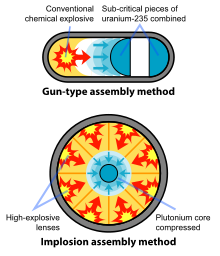
In an implosion bomb, a small spherical core of plutonium would be surrounded by high explosives that burned with different speeds. By alternating the faster and slower burning explosives in a carefully calculated spherical configuration, they would produce a compressive wave upon their simultaneous detonation. This "lensing
" effect focused the explosive force inward with enough force to physically compress the plutonium core to several times its original density. This would nearly instantly reduce the necessary size of the critical mass of the material, making it supercritical. It would also activate a small neutron source
kept at the center of the core, which would assure that the chain reaction began in earnest.
The advantage of the implosion method was that it was far more efficient in use of material — only 6.2 kg of plutonium would be needed for a full explosion, compared to the 64 kg of enriched uranium used in the "Little Boy" weapon. The engineering difficulties, though, were daunting. Though explosive lens
es had been pursued during the war, the art was still very new, and the tolerances required in terms of timing and symmetry were unprecedented. Should the timing or symmetry be off, the bomb would not detonate fully, and instead just disperse the plutonium into the surrounding area. The entire Los Alamos laboratory was reorganized in 1944 to focus on designing a workable implosion bomb.
The difficulty in designing the implosion weapon, and having confidence in its success, was so great that it was decided that a full-sized test would be required before any military use, even though it would sacrifice one of a very small number of possible bombs. Definite plans for a July 1945 implosion test were finalized in early 1944. The uranium weapon would not be tested; its success could be more or less guaranteed by measurements ahead of time.
The actual Fat Man
atomic bomb, which used the same design as in the Trinity test, was exploded over Nagasaki
on August 9, 1945, after the Trinity test had proven its operability in an atomic explosion.
. It was an implosion-type
plutonium
device, similar in design to the Fat Man
bomb used three weeks later in the atomic bombing of Nagasaki, Japan
.
A subcritical sphere of plutonium was placed in the center of a hollow sphere of high explosive. Numerous detonators
located on the surface of the high explosive were fired simultaneously to produce a powerful inward pressure
on the core, squeezing it and increasing its density, resulting in a supercritical condition and a nuclear explosion.
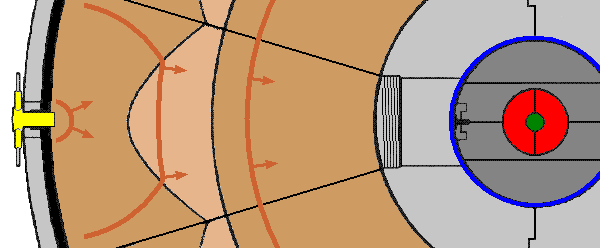 The initial design, based on work done using cyclotron-supplied plutonium, was envisioned as a gun-type device, akin to the Little Boy
uranium bomb. However, mass-produced plutonium emitted enough neutrons to make it likely that it would pre-detonate with low yield, making this design, known as "Thin Man", unusable.
Subsequently, an implosive design was selected, resulting in the design known as Fat Man. Both Fat Man and the gadget are not strictly "Fat Man type", as the design was modified into a production design, and both were strictly one-off prototypes.
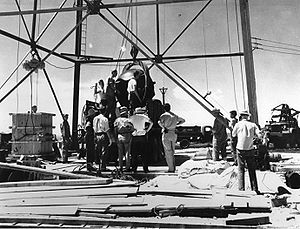
.jpg) The gadget was tested at Trinity Site, New Mexico
The gadget was tested at Trinity Site, New Mexico
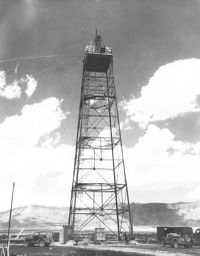
, near Alamogordo. For the test, the gadget was lifted to the top of a 100 feet (30.5 m) bomb tower
. It was feared by some that the Trinity test might "ignite" the earth's atmosphere, eliminating all life on the planet, although calculations had determined this was unlikely. Less wild estimates thought that New Mexico would be incinerated. Calculations showed that the yield of the device would be between 0 (if it did not work) and 20 kilotons (metric, equivalence of TNT). In the aftermath of the test, it appeared to have been a blast equivalent to 18 kt of TNT.
, a professor of physics at Harvard University
, working under explosives expert George Kistiakowsky
. A site had to be located that would guarantee secrecy of the project's goals even as a nuclear weapon of unknown strength was detonated. Proper scientific equipment had to be assembled for retrieving data from the test itself, and safety guidelines had to be developed to protect personnel from the unknown results of a highly dangerous experiment. Official test photographer Berlyn Brixner
set up dozens of cameras to capture the event on film.
 The heads of the project considered eight candidate sites, including San Nicolas Island
(California), Padre Island
(Texas), San Luis Valley
, El Malpais National Monument
, and other parts of New Mexico. A Mojave Desert
Army base near Rice, California
was considered the best location, but was opted against because General Leslie Groves
, military head of the project, did not wish to have any dealings with Gen. George S. Patton
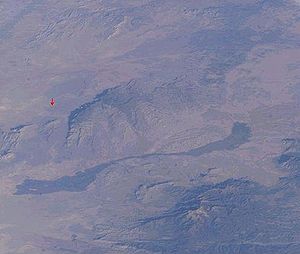
, commander of the base, whom he disliked. The site finally chosen was at the northern end of the White Sands Proving Ground
, in Socorro County
between the towns of Carrizozo
and San Antonio
, in the Jornada del Muerto
in the southwestern United States (33.6773°N 106.4754°W).
In the fall of 1944, soldiers started arriving at Trinity Site to prepare for the test. Sgt. Marvin Davis and his military police unit arrived at the site from Los Alamos
on December 30, 1944. This unit set up initial security checkpoints around the area, with plans to use horses for patrols. The distances around the site proved too great, so they resorted to using jeeps and trucks for transportation.
Throughout 1945, other personnel arrived at Trinity Site to help prepare for the bomb test. As the soldiers at Trinity Site settled in, they became familiar with Socorro County. They tried to use water out of the ranch wells, but found the water so alkaline they could not drink it. They were forced to use U.S. Navy saltwater soap and hauled drinking water in from the firehouse in Socorro
. Gasoline and diesel fuel were purchased from the Standard Oil
bulk plant in Socorro.
Two bunker
s were set up to observe the test. Oppenheimer and Brig. Gen. Thomas Farrell watched from a bunker ten miles (16 km) from the detonation, while Gen. Leslie Groves
watched at a bunker seventeen miles (27 km) away.
. In 1962, General Groves wrote to Oppenheimer about the origin of the name, asking if he had chosen it because it was a name common to rivers and peaks in the West and would not attract attention, and elicited this reply:
 The observers set up betting pool
s on the results of the test. Predictions ranged from zero (a complete dud
) to 45 kilotons of TNT, to destruction of the state of New Mexico
, to ignition of the atmosphere and incineration of the entire planet. This last result had been calculated to be almost impossible, although for a while it caused some of the scientists some anxiety. Physicist I. I. Rabi won the pool with a prediction of 18 kilotons.
.)
For the actual test, the plutonium-core nuclear device, nicknamed "the gadget", was hoisted to the top of a 100 feet (30.5 m) for detonation — the height would give a better indication of how the weapon would behave when dropped from an airplane, as detonation in the air would maximize the amount of energy applied directly to the target (as it expanded in a spherical shape) and would generate less nuclear fallout
.
 The gadget was assembled at the nearby McDonald Ranch House
on July 13, the components having arrived on July 12. After assembly, it was carefully winched up the tower the following day. General Groves had ordered the construction of a 214-ton
steel canister code-named "Jumbo" to recover valuable plutonium if the five tons of conventional explosives failed to compress it into a chain reaction. The container was constructed at great expense in Pittsburgh, Pennsylvania
, and brought to the test site by rail, but by the time it arrived, the confidence of the scientists was high enough that they decided not to use it. Instead, it was hoisted up in a steel tower 800 yards (730 m) from the gadget as a rough measure of how powerful the explosion would be. In the end, Jumbo survived, though its tower did not.
 The detonation was initially planned for 4:00 am but was postponed because of rain and lightning from early that morning. It was feared that the danger from radiation
and fallout
would be greatly increased by rain, and lightning had the scientists concerned about accidental detonation.
 At 4:45 am, a crucial weather report came in favorably, and, at 5:10 am, the twenty-minute countdown
began. Most top-level scientists and military officers were observing from a base camp ten miles (16 km) southwest of the test tower. Many other observers were around twenty miles (32 km) away, and some others were scattered at different distances, some in more informal situations (physicist Richard Feynman
claimed to be the only person to see the explosion without the dark glasses provided, relying on a truck windshield to screen out harmful ultraviolet
wavelengths). The final countdown was read by physicist Samuel K. Allison
.
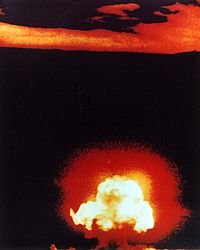
At 05:29:45 local time (Mountain War Time), the device exploded with an energy equivalent
to around 20 kilotons of TNT (90 TJ
). It left a crater
of radioactive glass
in the desert 10 feet (3 m) deep and 1,100 feet (330 m) wide. At the time of detonation, the surrounding mountains were illuminated "brighter than daytime" for one to two seconds, and the heat was reported as "being as hot as an oven" at the base camp. The observed colors of the illumination ranged from purple to green and eventually to white. The roar of the shock wave
took 40 seconds to reach the observers. The shock wave was felt over 100 miles (160 km) away, and the mushroom cloud
reached 7.5 miles (12 km) in height. After the initial euphoria of witnessing the explosion had passed, test director Kenneth Bainbridge
commented to Los Alamos
director J. Robert Oppenheimer, "Now we are all sons of bitches." Oppenheimer later stated that, while watching the test, he was reminded of a line from the Bhagavad Gita
, a Hindu scripture:
 In the official report on the test, General Farrell wrote, "The lighting effects beggared description. The whole country was lighted by a searing light with the intensity many times that of the midday sun. It was golden, purple, violet, gray, and blue. It lighted every peak, crevasse and ridge of the nearby mountain range with a clarity and beauty that cannot be described but must be seen to be imagined..."
News reports quoted a forest ranger 150 miles (240 km) west of the site as saying he saw "a flash of fire followed by an explosion and black smoke." A New Mexican 150 miles (240 km) north said, "The explosion lighted up the sky like the sun." Other reports remarked that windows were rattled and the sound of the explosion could be heard up to 200 miles (320 km) away.
John R. Lugo was flying a U.S. Navy transport at 10000 feet (3,048 m), 30 miles (48.3 km) east of Albuquerque, en route to the west coast. "My first impression was, like, the sun was coming up in the south. What a ball of fire! It was so bright it lit up the cockpit of the plane." Lugo radioed Albuquerque. He got no explanation for the blast but was told, "Don't fly south."
In the crater, the desert sand, which is largely made of silica, melted and became a mildly radioactive light green glass, which was named Trinitite
. The crater was filled in soon after the test.
The Alamogordo Air Base issued a 50-word press release in response to what it described as "several inquiries" that had been received concerning an explosion. The release explained that "a remotely located ammunitions magazine containing a considerable amount of high explosives and pyrotechnics exploded," but that "there was no loss of life or limb to anyone." A newspaper article published the same day stated that "the blast was seen and felt throughout an area extending from El Paso
to Silver City
, Gallup
, Socorro
, and Albuquerque
." The actual cause was not publicly acknowledged until after the August 6 bombing of Hiroshima
.
The Manhattan Project's official journalist, William L. Laurence
, had put multiple press releases on file with his office at The New York Times
to be released in case of an emergency, ranging from an account of a successful test (the one which was used) to more macabre scenarios explaining why all of the scientists had perished in a single freak accident.
Around 260 personnel were present, none closer than 5.6 miles (9 km). At the next test series, Operation Crossroads
in 1946, over 40,000 people were present.
The official technical report (LA-6300-H) on the history of the Trinity test was not released until May 1976.
, who was eagerly awaiting them at the Potsdam Conference
; the coded message ("Operated this morning. Diagnosis not complete but results seem satisfactory and already exceed expectations. . . . Dr. Groves pleased.") arrived at 7:30 p.m. on July 16 and was at once taken to the president and Secretary of State James F. Byrnes
at the "Little White House" in the Berlin suburb of Babelsberg by Secretary of War Henry L. Stimson
. Information about the Trinity test was made public shortly after the bombing of Hiroshima. The Smyth Report
, released on August 12, 1945, gave some information on the blast, and the hardbound edition released by Princeton University Press
a few weeks later contained the famous pictures of a "bulbous" Trinity fireball.
Oppenheimer and Groves posed for reporters near the remains of the mangled test tower shortly after the war. In the years after the test, the pictures have become a potent symbol of the beginning of the so-called Atomic Age
, and the test has often been featured in popular culture
.
during World War II
. The first, dropped on Hiroshima, Japan, on August 6, was code-named "Little Boy
", and used uranium-235
as its fission source. It was an untested design but was considered very likely to work and was considerably simpler than the implosion model. It could not be tested, because there was only enough uranium-235 for one bomb. The second bomb, dropped on Nagasaki, Japan, on August 9, was code-named "Fat Man
" and was a plutonium bomb of the type tested at Trinity. The atomic bombings of Hiroshima and Nagasaki
killed at least 148,000 people immediately and many more over time. By 1950, the death toll was over 340,000. They were followed days later by the surrender of Japan
. Debate
over the justification of the use of nuclear weapons against Japan persists to this day, both in scholarly and popular circles.
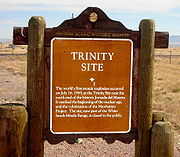 In 1952, the site of the explosion was bulldozed, and the remaining trinitite
was disposed of. On December 21, 1965, the 51500 acres (20,841.3 ha) area Trinity Site was declared a National Historic Landmark
district and, on October 15, 1966, was listed on the National Register of Historic Places
.
The landmark
includes the base camp, where the scientists and support group lived; ground zero
, where the bomb was placed for the explosion; and the Schmidt/McDonald ranch house
, where the plutonium
core to the bomb was assembled. Visitors to a Trinity Site open house are allowed to see the ground zero and ranch house areas. In addition, one of the old instrumentation
bunkers is visible beside the road just west of ground zero.
In September 1953, about 650 people attended the first Trinity Site open house. In recent years, the site has been opened for public visits twice each year, on the first Saturdays in April and October.
In 1967, the inner oblong fence was added. In 1972, the corridor barbed wire
fence that connects the outer fence to the inner one was completed. Jumbo was moved to the parking lot in 1979.
More than sixty years after the test, residual radiation
at the site measured about ten times higher than normal. The amount of radioactive exposure received during a one-hour visit to the site is about half of what a U.S. adult receives on an average day from natural and medical sources. The Trinity monument, a rough-sided, lava-rock obelisk
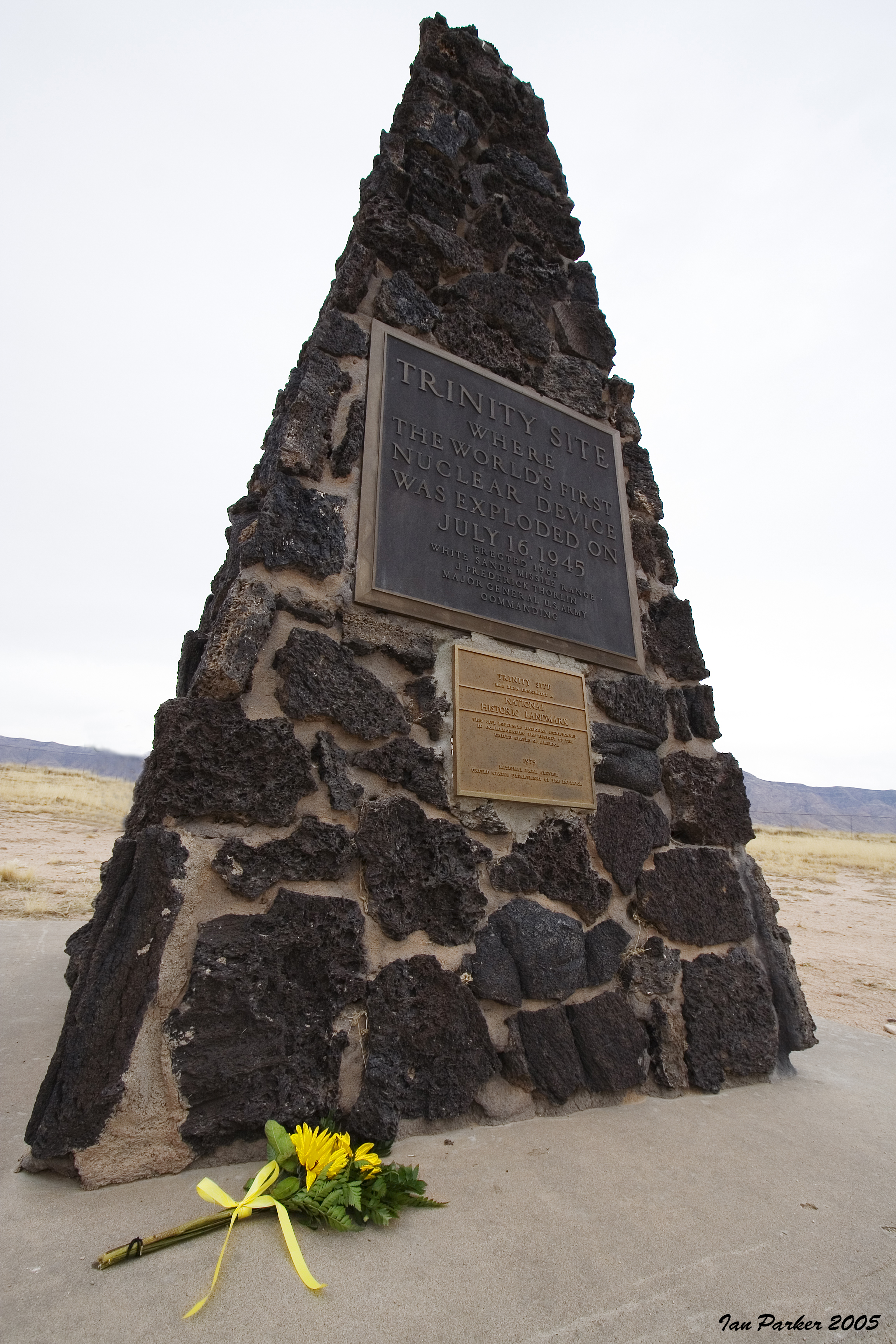
around 12 feet (3.65 m) high, marks the explosion's hypocenter
, and Jumbo is still kept nearby.
On July 16, 2005, a special tour of the site was conducted to mark the 60th anniversary of the Trinity test, and hundreds (some news sources reported thousands) of visitors arrived to commemorate the occasion. The site is still a popular destination for those interested in atomic tourism
, though it is only open to the public twice a year during open houses, on the first Saturdays of April and October. The Trinity Site Open House was free until 2011, when entrance fees were instated due to budget constraints. (Passenger Vehicle - $25, Buses - $100, Motorcycles - $10)
Code name
A code name or cryptonym is a word or name used clandestinely to refer to another name or word. Code names are often used for military purposes, or in espionage...
of the first test of a nuclear weapon
Nuclear weapon
A nuclear weapon is an explosive device that derives its destructive force from nuclear reactions, either fission or a combination of fission and fusion. Both reactions release vast quantities of energy from relatively small amounts of matter. The first fission bomb test released the same amount...
. This test was conducted by the United States Army
United States Army
The United States Army is the main branch of the United States Armed Forces responsible for land-based military operations. It is the largest and oldest established branch of the U.S. military, and is one of seven U.S. uniformed services...
on July 16, 1945, in the Jornada del Muerto
Jornada del Muerto
The Jornada del Muerto in the U.S. state of New Mexico was the name given by the Spanish conquistadors to the Jornada del Muerto Desert basin, and the particularly dry stretch of a route through it.The trail lead northward from central Spanish colonial New Spain, present-day Mexico, to the farthest...
desert about 35 miles (56 km) southeast of Socorro, New Mexico
Socorro, New Mexico
Socorro is a city in Socorro County in the U.S. state of New Mexico. It stands in the Rio Grande Valley at an elevation of . The population was 9,051 at the 2010 census...
, at the new White Sands Proving Ground, which incorporated the Alamogordo Bombing and Gunnery Range
Holloman Air Force Base
Holloman Air Force Base is a United States Air Force base located six miles southwest of the central business district of Alamogordo, a city in Otero County, New Mexico, United States. The base was named in honor of Col. George V. Holloman, a pioneer in guided missile research...
. (The site is now the White Sands Missile Range
White Sands Missile Range
White Sands Missile Range is a rocket range of almost in parts of five counties in southern New Mexico. The largest military installation in the United States, WSMR includes the and the WSMR Otera Mesa bombing range...
.) The date of the test is usually considered to be the beginning of the Atomic Age
Atomic Age
The Atomic Age, also known as the Atomic Era, is a phrase typically used to delineate the period of history following the detonation of the first nuclear bomb Trinity on July 16, 1945...
.
Trinity was a test of an implosion-design
Nuclear weapon design
Nuclear weapon designs are physical, chemical, and engineering arrangements that cause the physics package of a nuclear weapon to detonate. There are three basic design types...
plutonium
Plutonium
Plutonium is a transuranic radioactive chemical element with the chemical symbol Pu and atomic number 94. It is an actinide metal of silvery-gray appearance that tarnishes when exposed to air, forming a dull coating when oxidized. The element normally exhibits six allotropes and four oxidation...
device. The weapon's informal nickname was "The Gadget".
Using the same conceptual design, the Fat Man
Fat Man
"Fat Man" is the codename for the atomic bomb that was detonated over Nagasaki, Japan, by the United States on August 9, 1945. It was the second of the only two nuclear weapons to be used in warfare to date , and its detonation caused the third man-made nuclear explosion. The name also refers more...
device was detonated
Atomic bombings of Hiroshima and Nagasaki
During the final stages of World War II in 1945, the United States conducted two atomic bombings against the cities of Hiroshima and Nagasaki in Japan, the first on August 6, 1945, and the second on August 9, 1945. These two events are the only use of nuclear weapons in war to date.For six months...
over Nagasaki
Nagasaki
is the capital and the largest city of Nagasaki Prefecture on the island of Kyushu in Japan. Nagasaki was founded by the Portuguese in the second half of the 16th century on the site of a small fishing village, formerly part of Nishisonogi District...
, Japan
Japan
Japan is an island nation in East Asia. Located in the Pacific Ocean, it lies to the east of the Sea of Japan, China, North Korea, South Korea and Russia, stretching from the Sea of Okhotsk in the north to the East China Sea and Taiwan in the south...
, on August 9, 1945. The Trinity detonation produced an explosive power equivalent to the explosion of about 20 kilotons
TNT equivalent
TNT equivalent is a method of quantifying the energy released in explosions. The ton of TNT is a unit of energy equal to 4.184 gigajoules, which is approximately the amount of energy released in the detonation of one ton of TNT...
of TNT.
History
The creation of atomic weapons arose out of political and scientific developments of the late 1930s. The rise of fascist governments in Europe, new discoveries about the nature of atoms and the fear that Nazi GermanyNazi Germany
Nazi Germany , also known as the Third Reich , but officially called German Reich from 1933 to 1943 and Greater German Reich from 26 June 1943 onward, is the name commonly used to refer to the state of Germany from 1933 to 1945, when it was a totalitarian dictatorship ruled by...
was working on developing atomic bombs converged in the plans of the United States
United States
The United States of America is a federal constitutional republic comprising fifty states and a federal district...
, the United Kingdom
United Kingdom
The United Kingdom of Great Britain and Northern IrelandIn the United Kingdom and Dependencies, other languages have been officially recognised as legitimate autochthonous languages under the European Charter for Regional or Minority Languages...
, and Canada
Canada
Canada is a North American country consisting of ten provinces and three territories. Located in the northern part of the continent, it extends from the Atlantic Ocean in the east to the Pacific Ocean in the west, and northward into the Arctic Ocean...
to develop powerful weapons using nuclear fission as their primary source of energy. The Manhattan Project
Manhattan Project
The Manhattan Project was a research and development program, led by the United States with participation from the United Kingdom and Canada, that produced the first atomic bomb during World War II. From 1942 to 1946, the project was under the direction of Major General Leslie Groves of the US Army...
, as the American nuclear physics
Nuclear physics
Nuclear physics is the field of physics that studies the building blocks and interactions of atomic nuclei. The most commonly known applications of nuclear physics are nuclear power generation and nuclear weapons technology, but the research has provided application in many fields, including those...
effort was called, culminated in the test of a nuclear weapon at what is now called the Trinity Site on July 16, 1945, and the atomic bombings of Hiroshima and Nagasaki
Atomic bombings of Hiroshima and Nagasaki
During the final stages of World War II in 1945, the United States conducted two atomic bombings against the cities of Hiroshima and Nagasaki in Japan, the first on August 6, 1945, and the second on August 9, 1945. These two events are the only use of nuclear weapons in war to date.For six months...
just a few weeks later.
The Manhattan Project
Manhattan Project
The Manhattan Project was a research and development program, led by the United States with participation from the United Kingdom and Canada, that produced the first atomic bomb during World War II. From 1942 to 1946, the project was under the direction of Major General Leslie Groves of the US Army...
. The weapons-development portion of this project was located at the Los Alamos Laboratory
Los Alamos National Laboratory
Los Alamos National Laboratory is a United States Department of Energy national laboratory, managed and operated by Los Alamos National Security , located in Los Alamos, New Mexico...
in northern New Mexico
New Mexico
New Mexico is a state located in the southwest and western regions of the United States. New Mexico is also usually considered one of the Mountain States. With a population density of 16 per square mile, New Mexico is the sixth-most sparsely inhabited U.S...
, though much other development and production work was carried out at the Clinton Engineer Works
Clinton Engineer Works
The Clinton Engineer Works was the Army name for the Manhattan Project production facility in World War II for enriched uranium used in the Little Boy atomic bomb dropped on Hiroshima in 1945, and would have produced enough enriched uranium for a second Little Boy gun-type bomb by December 1945...
near Oak Ridge, Tennessee
Oak Ridge, Tennessee
Oak Ridge is a city in Anderson and Roane counties in the eastern part of the U.S. state of Tennessee, about west of Knoxville. Oak Ridge's population was 27,387 at the 2000 census...
(the separation of uranium-235
Uranium-235
- References :* .* DOE Fundamentals handbook: Nuclear Physics and Reactor theory , .* A piece of U-235 the size of a grain of rice can produce energy equal to that contained in three tons of coal or fourteen barrels of oil. -External links:* * * one of the earliest articles on U-235 for the...
); the Hanford Engineer Works near Hanford, Washington
Hanford, Washington
Hanford was a small agricultural community in Benton County, Washington, United States. It was evacuated in 1943 along with the town of White Bluffs in order to make room for the nuclear production facility known as the Hanford Site...
(the production and separation of plutonium-239
Plutonium-239
Plutonium-239 is an isotope of plutonium. Plutonium-239 is the primary fissile isotope used for the production of nuclear weapons, although uranium-235 has also been used and is currently the secondary isotope. Plutonium-239 is also one of the three main isotopes demonstrated usable as fuel in...
); in and near Chicago, Illinois (at the University of Chicago
University of Chicago
The University of Chicago is a private research university in Chicago, Illinois, USA. It was founded by the American Baptist Education Society with a donation from oil magnate and philanthropist John D. Rockefeller and incorporated in 1890...
and at the Argonne National Laboratories); and at the University of California, Berkeley
University of California, Berkeley
The University of California, Berkeley , is a teaching and research university established in 1868 and located in Berkeley, California, USA...
.
These research, development, and production efforts focused both on the development of the necessary fissile
Fissile
In nuclear engineering, a fissile material is one that is capable of sustaining a chain reaction of nuclear fission. By definition, fissile materials can sustain a chain reaction with neutrons of any energy. The predominant neutron energy may be typified by either slow neutrons or fast neutrons...
materials to power the nuclear chain reaction
Nuclear chain reaction
A nuclear chain reaction occurs when one nuclear reaction causes an average of one or more nuclear reactions, thus leading to a self-propagating number of these reactions. The specific nuclear reaction may be the fission of heavy isotopes or the fusion of light isotopes...
s in the atomic bombs and on the design, testing, and manufacture of the bombs themselves.
From January 1944 until July 1945, large-scale production plants were set in operation, and the fissile material thus produced was then used to determine the features of the weapons. Multi-pronged research was undertaken to pursue several possibilities for bomb design. Early decisions about weapon design had been based on minute quantities of uranium-235
Uranium-235
- References :* .* DOE Fundamentals handbook: Nuclear Physics and Reactor theory , .* A piece of U-235 the size of a grain of rice can produce energy equal to that contained in three tons of coal or fourteen barrels of oil. -External links:* * * one of the earliest articles on U-235 for the...
and plutonium
Plutonium
Plutonium is a transuranic radioactive chemical element with the chemical symbol Pu and atomic number 94. It is an actinide metal of silvery-gray appearance that tarnishes when exposed to air, forming a dull coating when oxidized. The element normally exhibits six allotropes and four oxidation...
that had been created in pilot plants and in physics-laboratory cyclotron
Cyclotron
In technology, a cyclotron is a type of particle accelerator. In physics, the cyclotron frequency or gyrofrequency is the frequency of a charged particle moving perpendicularly to the direction of a uniform magnetic field, i.e. a magnetic field of constant magnitude and direction...
s. From these experimental results, it was thought that the creation of a bomb was as simple as forming a critical mass of fissile material.
The productions of both uranium-235 and plutonium-239 were massive undertakings given the technology of the 1940s and accounted for 80% of the total costs of the project. Theoretically, enriching uranium was feasible through pre-existing techniques in physics (e.g., modifying particle accelerator
Particle accelerator
A particle accelerator is a device that uses electromagnetic fields to propel charged particles to high speeds and to contain them in well-defined beams. An ordinary CRT television set is a simple form of accelerator. There are two basic types: electrostatic and oscillating field accelerators.In...
technology), though it proved difficult to scale to industrial levels and was extremely costly.
Plutonium, by contrast, could theoretically be produced most easily in nuclear reactor
Nuclear reactor
A nuclear reactor is a device to initiate and control a sustained nuclear chain reaction. Most commonly they are used for generating electricity and for the propulsion of ships. Usually heat from nuclear fission is passed to a working fluid , which runs through turbines that power either ship's...
s, but the technology and science involved was wholly new. The first experimental nuclear reactor had been developed and constructed by Enrico Fermi
Enrico Fermi
Enrico Fermi was an Italian-born, naturalized American physicist particularly known for his work on the development of the first nuclear reactor, Chicago Pile-1, and for his contributions to the development of quantum theory, nuclear and particle physics, and statistical mechanics...
and his team of co-workers by the end of 1942 at the University of Chicago
University of Chicago
The University of Chicago is a private research university in Chicago, Illinois, USA. It was founded by the American Baptist Education Society with a donation from oil magnate and philanthropist John D. Rockefeller and incorporated in 1890...
(CP-1), which proved that there were no obvious physical limitations to producing a slow-neutron nuclear chain reaction
Nuclear chain reaction
A nuclear chain reaction occurs when one nuclear reaction causes an average of one or more nuclear reactions, thus leading to a self-propagating number of these reactions. The specific nuclear reaction may be the fission of heavy isotopes or the fusion of light isotopes...
. Work began on constructing massive plutonium-breeding reactors at Hanford, Washington
Hanford Site
The Hanford Site is a mostly decommissioned nuclear production complex on the Columbia River in the U.S. state of Washington, operated by the United States federal government. The site has been known by many names, including Hanford Works, Hanford Engineer Works or HEW, Hanford Nuclear Reservation...
, in October 1943. The first reactor-bred plutonium was produced in the B-Reactor
B-Reactor
The B Reactor at the Hanford Site, near Richland, Washington, USA, was the first large-scale nuclear reactor ever built. The project was commissioned to produce plutonium-239 by nuclear fission as part of the Manhattan Project, the United States nuclear weapons development program during World War II...
, the first full-scale plutonium-production reactor in the world. The first large batch of plutonium was refined at Hanford in the "221-T plant", using the bismuth phosphate process
Bismuth phosphate process
Bismuth-phosphate process was a process used to extract plutonium from used nuclear fuel taken from nuclear reactors. This process was used to produce all the plutonium of the atomic bomb dropped on Nagasaki in 1945. In 1952 this process was replaced by the Redox and PUREX processes.-References:*...
, from December 26, 1944, to February 2, 1945. This was delivered to Oppenheimer's team at the Los Alamos laboratory
Los Alamos National Laboratory
Los Alamos National Laboratory is a United States Department of Energy national laboratory, managed and operated by Los Alamos National Security , located in Los Alamos, New Mexico...
on February 5, 1945. In the meantime, the X-10 Graphite Reactor
X-10 Graphite Reactor
The X-10 Graphite Reactor at Oak Ridge National Laboratory in Oak Ridge, Tennessee, formerly known as the Clinton Pile and X-10 Pile, was the world's second artificial nuclear reactor and was the first reactor designed and built for continuous operation.When President Roosevelt in December 1942...
, a scaled-down version of the Hanford reactors, was built in Oak Ridge, Tennessee
Oak Ridge, Tennessee
Oak Ridge is a city in Anderson and Roane counties in the eastern part of the U.S. state of Tennessee, about west of Knoxville. Oak Ridge's population was 27,387 at the 2000 census...
, and went into operation in November 1943.
Plutonium is a synthetic element
Synthetic element
In chemistry, a synthetic element is a chemical element that is too unstable to occur naturally on Earth, and therefore has to be created artificially. So far 30 synthetic elements have been discovered—that is, synthesized...
not found in nature in appreciable quantities. It also has relatively complicated physics, chemistry, and metallurgy compared to most other elements in the periodic table
Periodic table
The periodic table of the chemical elements is a tabular display of the 118 known chemical elements organized by selected properties of their atomic structures. Elements are presented by increasing atomic number, the number of protons in an atom's atomic nucleus...
. The only prior plutonium isolated for the project had been produced in cyclotron
Cyclotron
In technology, a cyclotron is a type of particle accelerator. In physics, the cyclotron frequency or gyrofrequency is the frequency of a charged particle moving perpendicularly to the direction of a uniform magnetic field, i.e. a magnetic field of constant magnitude and direction...
s in very minute amounts. In April 1944, Emilio Segrè received the first sample of reactor-bred plutonium from the X-10 reactor and discovered that reactor-grade plutonium was not as pure as cyclotron-produced plutonium by a significant degree. Specifically, the longer the plutonium remained irradiated inside the reactor — which is necessary for high yields of the metal — the greater its content of the isotope plutonium-240
Plutonium-240
Plutonium-240 is an isotope of the metal plutonium formed when plutonium-239 captures a neutron. About 62% to 73% of the time when Pu-239 captures a neutron it undergoes fission; the rest of the time it forms Pu-240. The longer a nuclear fuel element remains in a nuclear reactor the greater the...
. Pu-240 undergoes spontaneous fission
Spontaneous fission
Spontaneous fission is a form of radioactive decay characteristic of very heavy isotopes. Because the nuclear binding energy reaches a maximum at a nuclear mass greater than about 60 atomic mass units , spontaneous breakdown into smaller nuclei and single particles becomes possible at heavier masses...
at an appreciable rate, and that releases plenty of excess thermal neutrons. These extra neutrons implied a high probability
Probability
Probability is ordinarily used to describe an attitude of mind towards some proposition of whose truth we arenot certain. The proposition of interest is usually of the form "Will a specific event occur?" The attitude of mind is of the form "How certain are we that the event will occur?" The...
that a gun-type bomb with plutonium would detonate too early, before a critical mass was formed, scattering the plutonium and producing a small "fizzle"
Fizzle (nuclear test)
In nuclear weapons, a fizzle occurs when the testing of a nuclear bomb fails to meet its expected yield. The reason for the failure can be linked to improper bomb design, poor construction, or lack of expertise. All countries that have had a nuclear weapons testing program have experienced fizzles...
of a nuclear explosion
Nuclear explosion
A nuclear explosion occurs as a result of the rapid release of energy from an intentionally high-speed nuclear reaction. The driving reaction may be nuclear fission, nuclear fusion or a multistage cascading combination of the two, though to date all fusion based weapons have used a fission device...
many times smaller than a full explosion. The practical result is that a simple gun-type atomic bomb
Gun-type fission weapon
Gun-type fission weapons are fission-based nuclear weapons whose design assembles their fissile material into a supercritical mass by the use of the "gun" method: shooting one piece of sub-critical material into another...
(the proposed Thin Man) would not work as had been hoped.
The impossibility of solving this problem of a gun-type bomb with plutonium was decided upon in a meeting in Los Alamos on June 17, 1944. This forced a search for a different, more practical design of a plutonium-fueled bomb, and an implosion-type atomic-bomb design (i.e., the Fat Man design) was selected as the most practical one at that time. However, even this notion required a great deal of research work and experimentation in engineering
Engineering
Engineering is the discipline, art, skill and profession of acquiring and applying scientific, mathematical, economic, social, and practical knowledge, in order to design and build structures, machines, devices, systems, materials and processes that safely realize improvements to the lives of...
and hydrodynamics before a practical design could be worked out.
In an implosion bomb, a small spherical core of plutonium would be surrounded by high explosives that burned with different speeds. By alternating the faster and slower burning explosives in a carefully calculated spherical configuration, they would produce a compressive wave upon their simultaneous detonation. This "lensing
Explosive lens
An explosive lens—as used, for example, in nuclear weapons—is a highly specialized explosive charge, a special type of a shaped charge. In general, it is a device composed of several explosive charges that are shaped in such a way as to change the shape of the detonation wave passing through it,...
" effect focused the explosive force inward with enough force to physically compress the plutonium core to several times its original density. This would nearly instantly reduce the necessary size of the critical mass of the material, making it supercritical. It would also activate a small neutron source
Neutron source
A Neutron source is a device that emits neutrons. There is a wide variety of different sources, ranging from hand-held radioactive sources to neutron research facilities operating research reactors and spallation sources...
kept at the center of the core, which would assure that the chain reaction began in earnest.
The advantage of the implosion method was that it was far more efficient in use of material — only 6.2 kg of plutonium would be needed for a full explosion, compared to the 64 kg of enriched uranium used in the "Little Boy" weapon. The engineering difficulties, though, were daunting. Though explosive lens
Explosive lens
An explosive lens—as used, for example, in nuclear weapons—is a highly specialized explosive charge, a special type of a shaped charge. In general, it is a device composed of several explosive charges that are shaped in such a way as to change the shape of the detonation wave passing through it,...
es had been pursued during the war, the art was still very new, and the tolerances required in terms of timing and symmetry were unprecedented. Should the timing or symmetry be off, the bomb would not detonate fully, and instead just disperse the plutonium into the surrounding area. The entire Los Alamos laboratory was reorganized in 1944 to focus on designing a workable implosion bomb.
The difficulty in designing the implosion weapon, and having confidence in its success, was so great that it was decided that a full-sized test would be required before any military use, even though it would sacrifice one of a very small number of possible bombs. Definite plans for a July 1945 implosion test were finalized in early 1944. The uranium weapon would not be tested; its success could be more or less guaranteed by measurements ahead of time.
The actual Fat Man
Fat Man
"Fat Man" is the codename for the atomic bomb that was detonated over Nagasaki, Japan, by the United States on August 9, 1945. It was the second of the only two nuclear weapons to be used in warfare to date , and its detonation caused the third man-made nuclear explosion. The name also refers more...
atomic bomb, which used the same design as in the Trinity test, was exploded over Nagasaki
Nagasaki
is the capital and the largest city of Nagasaki Prefecture on the island of Kyushu in Japan. Nagasaki was founded by the Portuguese in the second half of the 16th century on the site of a small fishing village, formerly part of Nishisonogi District...
on August 9, 1945, after the Trinity test had proven its operability in an atomic explosion.
The gadget
"The gadget" was the code name given to the first bomb tested. It was so called because it was not a deployable weapon and because revealing words like bomb were not used during the project for fear of espionageEspionage
Espionage or spying involves an individual obtaining information that is considered secret or confidential without the permission of the holder of the information. Espionage is inherently clandestine, lest the legitimate holder of the information change plans or take other countermeasures once it...
. It was an implosion-type
Nuclear weapon design
Nuclear weapon designs are physical, chemical, and engineering arrangements that cause the physics package of a nuclear weapon to detonate. There are three basic design types...
plutonium
Plutonium
Plutonium is a transuranic radioactive chemical element with the chemical symbol Pu and atomic number 94. It is an actinide metal of silvery-gray appearance that tarnishes when exposed to air, forming a dull coating when oxidized. The element normally exhibits six allotropes and four oxidation...
device, similar in design to the Fat Man
Fat Man
"Fat Man" is the codename for the atomic bomb that was detonated over Nagasaki, Japan, by the United States on August 9, 1945. It was the second of the only two nuclear weapons to be used in warfare to date , and its detonation caused the third man-made nuclear explosion. The name also refers more...
bomb used three weeks later in the atomic bombing of Nagasaki, Japan
Atomic bombings of Hiroshima and Nagasaki
During the final stages of World War II in 1945, the United States conducted two atomic bombings against the cities of Hiroshima and Nagasaki in Japan, the first on August 6, 1945, and the second on August 9, 1945. These two events are the only use of nuclear weapons in war to date.For six months...
.
A subcritical sphere of plutonium was placed in the center of a hollow sphere of high explosive. Numerous detonators
Exploding-bridgewire detonator
The exploding-bridgewire detonator is a type of detonator used to initiate the detonation reaction in explosive materials, similar to a blasting cap in that it is fired using an electric current...
located on the surface of the high explosive were fired simultaneously to produce a powerful inward pressure
Pressure
Pressure is the force per unit area applied in a direction perpendicular to the surface of an object. Gauge pressure is the pressure relative to the local atmospheric or ambient pressure.- Definition :...
on the core, squeezing it and increasing its density, resulting in a supercritical condition and a nuclear explosion.
Little Boy
"Little Boy" was the codename of the atomic bomb dropped on Hiroshima on August 6, 1945 by the Boeing B-29 Superfortress Enola Gay, piloted by Colonel Paul Tibbets of the 393rd Bombardment Squadron, Heavy, of the United States Army Air Forces. It was the first atomic bomb to be used as a weapon...
uranium bomb. However, mass-produced plutonium emitted enough neutrons to make it likely that it would pre-detonate with low yield, making this design, known as "Thin Man", unusable.
Subsequently, an implosive design was selected, resulting in the design known as Fat Man. Both Fat Man and the gadget are not strictly "Fat Man type", as the design was modified into a production design, and both were strictly one-off prototypes.
New Mexico
New Mexico is a state located in the southwest and western regions of the United States. New Mexico is also usually considered one of the Mountain States. With a population density of 16 per square mile, New Mexico is the sixth-most sparsely inhabited U.S...
, near Alamogordo. For the test, the gadget was lifted to the top of a 100 feet (30.5 m) bomb tower
Bomb tower
A bomb tower is a lightly constructed tower, often 100 to 700 feet high, built to hold a nuclear weapon for an above ground nuclear test. The tower holds the bomb for the purpose of the investigation of its destructive effects and for the adjustment of measuring instruments, such as high-speed...
. It was feared by some that the Trinity test might "ignite" the earth's atmosphere, eliminating all life on the planet, although calculations had determined this was unlikely. Less wild estimates thought that New Mexico would be incinerated. Calculations showed that the yield of the device would be between 0 (if it did not work) and 20 kilotons (metric, equivalence of TNT). In the aftermath of the test, it appeared to have been a blast equivalent to 18 kt of TNT.
Test planning
In March 1944, planning for the test was assigned to Kenneth BainbridgeKenneth Bainbridge
Kenneth Tompkins Bainbridge was an American physicist at Harvard University who did work on cyclotron research. His precise measurements of mass differences between nuclear isotopes allowed him to confirm Albert Einstein's mass-energy equivalence concept. He was the Director of the Trinity test of...
, a professor of physics at Harvard University
Harvard University
Harvard University is a private Ivy League university located in Cambridge, Massachusetts, United States, established in 1636 by the Massachusetts legislature. Harvard is the oldest institution of higher learning in the United States and the first corporation chartered in the country...
, working under explosives expert George Kistiakowsky
George Kistiakowsky
George Bogdan Kistiakowsky was a Ukrainian-American chemistry professor at Harvard who participated in the Manhattan Project and later served as President Eisenhower's Science Advisor...
. A site had to be located that would guarantee secrecy of the project's goals even as a nuclear weapon of unknown strength was detonated. Proper scientific equipment had to be assembled for retrieving data from the test itself, and safety guidelines had to be developed to protect personnel from the unknown results of a highly dangerous experiment. Official test photographer Berlyn Brixner
Berlyn Brixner
Berlyn B. Brixner was the head photographer for the Trinity test, the first detonation of a nuclear weapon in July 1945. Brixner was positioned away from the explosion and had 50 cameras of varying speeds running from different locations to capture the shot in full motion.-Early years:He was born...
set up dozens of cameras to capture the event on film.
Test site
San Nicolas Island
San Nicolas Island is the most remote of California's Channel Islands. It is part of Ventura County. The 14,562 acre island is currently controlled by the United States Navy and is used as a weapons testing and training facility, served by Naval Outlying Field San Nicolas Island...
(California), Padre Island
Padre Island
Padre Island is part of the U.S. state of Texas. The island is located on Texas' southern coast of the Gulf of Mexico and is famous for its white sandy beaches at the south end...
(Texas), San Luis Valley
San Luis Valley
The San Luis Valley is an extensive alpine valley in the U.S. states of Colorado and New Mexico covering approximately and sitting at an average elevation of above sea level. The valley sits atop the Rio Grande Rift and is drained to the south by the Rio Grande River, which rises in the San Juan...
, El Malpais National Monument
El Malpais National Monument
El Malpais National Monument is a National Monument located in western New Mexico, in the Southwestern United States. The name El Malpais is from the Spanish term Malpaís, meaning badlands, due to the extremely barren and dramatic volcanic field that covers much of the park's area.-Geography:The El...
, and other parts of New Mexico. A Mojave Desert
Mojave Desert
The Mojave Desert occupies a significant portion of southeastern California and smaller parts of central California, southern Nevada, southwestern Utah and northwestern Arizona, in the United States...
Army base near Rice, California
Rice, California
Rice, California is a vacant town site in the southern tip of the Mojave Desert in unincorporated San Bernardino County, California, United States.-History:...
was considered the best location, but was opted against because General Leslie Groves
Leslie Groves
Lieutenant General Leslie Richard Groves, Jr. was a United States Army Corps of Engineers officer who oversaw the construction of the Pentagon and directed the Manhattan Project that developed the atomic bomb during World War II. As the son of a United States Army chaplain, Groves lived at a...
, military head of the project, did not wish to have any dealings with Gen. George S. Patton
George S. Patton
George Smith Patton, Jr. was a United States Army officer best known for his leadership while commanding corps and armies as a general during World War II. He was also well known for his eccentricity and controversial outspokenness.Patton was commissioned in the U.S. Army after his graduation from...
, commander of the base, whom he disliked. The site finally chosen was at the northern end of the White Sands Proving Ground
White Sands Missile Range
White Sands Missile Range is a rocket range of almost in parts of five counties in southern New Mexico. The largest military installation in the United States, WSMR includes the and the WSMR Otera Mesa bombing range...
, in Socorro County
Socorro County, New Mexico
-2010:Whereas according to the 2010 U.S. Census Bureau:*75.1% White*1.1% Black*11.7% Native American*1.2% Asian*0.0% Native Hawaiian or Pacific Islander*2.8% Two or more races*8.1% Other races*48.5% Hispanic or Latino -2000:...
between the towns of Carrizozo
Carrizozo, New Mexico
Carrizozo is a town in and the county seat of Lincoln County, New Mexico, United States. The population was 1,036 at the 2000 census.-Geography:Carrizozo is located at ....
and San Antonio
San Antonio, New Mexico
San Antonio is an unincorporated community in Socorro County, New Mexico, United States, roughly in the center of the state. The entire population of the county is around 18,000; the population of San Antonio is hard to pin down because the area is somewhat ill-defined.San Antonio is nowadays...
, in the Jornada del Muerto
Jornada del Muerto
The Jornada del Muerto in the U.S. state of New Mexico was the name given by the Spanish conquistadors to the Jornada del Muerto Desert basin, and the particularly dry stretch of a route through it.The trail lead northward from central Spanish colonial New Spain, present-day Mexico, to the farthest...
in the southwestern United States (33.6773°N 106.4754°W).
In the fall of 1944, soldiers started arriving at Trinity Site to prepare for the test. Sgt. Marvin Davis and his military police unit arrived at the site from Los Alamos
Los Alamos National Laboratory
Los Alamos National Laboratory is a United States Department of Energy national laboratory, managed and operated by Los Alamos National Security , located in Los Alamos, New Mexico...
on December 30, 1944. This unit set up initial security checkpoints around the area, with plans to use horses for patrols. The distances around the site proved too great, so they resorted to using jeeps and trucks for transportation.
Throughout 1945, other personnel arrived at Trinity Site to help prepare for the bomb test. As the soldiers at Trinity Site settled in, they became familiar with Socorro County. They tried to use water out of the ranch wells, but found the water so alkaline they could not drink it. They were forced to use U.S. Navy saltwater soap and hauled drinking water in from the firehouse in Socorro
Socorro, New Mexico
Socorro is a city in Socorro County in the U.S. state of New Mexico. It stands in the Rio Grande Valley at an elevation of . The population was 9,051 at the 2010 census...
. Gasoline and diesel fuel were purchased from the Standard Oil
Standard Oil
Standard Oil was a predominant American integrated oil producing, transporting, refining, and marketing company. Established in 1870 as a corporation in Ohio, it was the largest oil refiner in the world and operated as a major company trust and was one of the world's first and largest multinational...
bulk plant in Socorro.
Two bunker
Bunker
A military bunker is a hardened shelter, often buried partly or fully underground, designed to protect the inhabitants from falling bombs or other attacks...
s were set up to observe the test. Oppenheimer and Brig. Gen. Thomas Farrell watched from a bunker ten miles (16 km) from the detonation, while Gen. Leslie Groves
Leslie Groves
Lieutenant General Leslie Richard Groves, Jr. was a United States Army Corps of Engineers officer who oversaw the construction of the Pentagon and directed the Manhattan Project that developed the atomic bomb during World War II. As the son of a United States Army chaplain, Groves lived at a...
watched at a bunker seventeen miles (27 km) away.
Name
The exact origin of the name is unknown, but it is often attributed to laboratory leader J. Robert Oppenheimer as a reference to the poetry of John DonneJohn Donne
John Donne 31 March 1631), English poet, satirist, lawyer, and priest, is now considered the preeminent representative of the metaphysical poets. His works are notable for their strong and sensual style and include sonnets, love poetry, religious poems, Latin translations, epigrams, elegies, songs,...
. In 1962, General Groves wrote to Oppenheimer about the origin of the name, asking if he had chosen it because it was a name common to rivers and peaks in the West and would not attract attention, and elicited this reply:
Test predictions
Betting pool
A betting pool, sports lottery, sweep or office pool if done at work, is a form of gambling, specifically a variant of parimutuel betting influenced by lotteries, where gamblers pay a fixed price into a pool , and then make a selection on some outcome, usually related to sport...
s on the results of the test. Predictions ranged from zero (a complete dud
Dud
A dud is an ammunition round or explosive that fails to fire or detonate, respectively, on time or on command.Duds are still dangerous and have to be deactivated and disposed of carefully. Poorly designed devices A dud is an ammunition round or explosive that fails to fire or detonate,...
) to 45 kilotons of TNT, to destruction of the state of New Mexico
New Mexico
New Mexico is a state located in the southwest and western regions of the United States. New Mexico is also usually considered one of the Mountain States. With a population density of 16 per square mile, New Mexico is the sixth-most sparsely inhabited U.S...
, to ignition of the atmosphere and incineration of the entire planet. This last result had been calculated to be almost impossible, although for a while it caused some of the scientists some anxiety. Physicist I. I. Rabi won the pool with a prediction of 18 kilotons.
Test preparation
There was a pretest explosion of 108 tons of TNT, spiked with 1000 Ci of fission products from the Hanford reactor, on May 7 to calibrate the instruments. (Nuclear detonation yields have always been measured by the equivalent in tons of TNTTNT equivalent
TNT equivalent is a method of quantifying the energy released in explosions. The ton of TNT is a unit of energy equal to 4.184 gigajoules, which is approximately the amount of energy released in the detonation of one ton of TNT...
.)
For the actual test, the plutonium-core nuclear device, nicknamed "the gadget", was hoisted to the top of a 100 feet (30.5 m) for detonation — the height would give a better indication of how the weapon would behave when dropped from an airplane, as detonation in the air would maximize the amount of energy applied directly to the target (as it expanded in a spherical shape) and would generate less nuclear fallout
Nuclear fallout
Fallout is the residual radioactive material propelled into the upper atmosphere following a nuclear blast, so called because it "falls out" of the sky after the explosion and shock wave have passed. It commonly refers to the radioactive dust and ash created when a nuclear weapon explodes...
.
McDonald Ranch House
The McDonald Ranch House was the location of assembly for the first tested nuclear weapon. The test occurred on July 16, 1945; a plutonium bomb was tested, the type of weapon later dropped on Nagasaki, Japan...
on July 13, the components having arrived on July 12. After assembly, it was carefully winched up the tower the following day. General Groves had ordered the construction of a 214-ton
Ton
The ton is a unit of measure. It has a long history and has acquired a number of meanings and uses over the years. It is used principally as a unit of weight, and as a unit of volume. It can also be used as a measure of energy, for truck classification, or as a colloquial term.It is derived from...
steel canister code-named "Jumbo" to recover valuable plutonium if the five tons of conventional explosives failed to compress it into a chain reaction. The container was constructed at great expense in Pittsburgh, Pennsylvania
Pittsburgh, Pennsylvania
Pittsburgh is the second-largest city in the US Commonwealth of Pennsylvania and the county seat of Allegheny County. Regionally, it anchors the largest urban area of Appalachia and the Ohio River Valley, and nationally, it is the 22nd-largest urban area in the United States...
, and brought to the test site by rail, but by the time it arrived, the confidence of the scientists was high enough that they decided not to use it. Instead, it was hoisted up in a steel tower 800 yards (730 m) from the gadget as a rough measure of how powerful the explosion would be. In the end, Jumbo survived, though its tower did not.
Radiation
In physics, radiation is a process in which energetic particles or energetic waves travel through a medium or space. There are two distinct types of radiation; ionizing and non-ionizing...
and fallout
Fallout
Fallout or nuclear fallout is the residual radiation hazard from a nuclear explosion.Fallout may also refer to:*Fallout , a 1997 post-apocalyptic computer role-playing game released by Interplay Entertainment...
would be greatly increased by rain, and lightning had the scientists concerned about accidental detonation.
Explosion
Countdown
A countdown is a sequence of counting backward to indicate the seconds, days, or other time units remaining before an event occurs or a deadline expires. Typical events for which a countdown is used include the launch of a rocket or spacecraft, the detonation of a bomb, the start of a race, and the...
began. Most top-level scientists and military officers were observing from a base camp ten miles (16 km) southwest of the test tower. Many other observers were around twenty miles (32 km) away, and some others were scattered at different distances, some in more informal situations (physicist Richard Feynman
Richard Feynman
Richard Phillips Feynman was an American physicist known for his work in the path integral formulation of quantum mechanics, the theory of quantum electrodynamics and the physics of the superfluidity of supercooled liquid helium, as well as in particle physics...
claimed to be the only person to see the explosion without the dark glasses provided, relying on a truck windshield to screen out harmful ultraviolet
Ultraviolet
Ultraviolet light is electromagnetic radiation with a wavelength shorter than that of visible light, but longer than X-rays, in the range 10 nm to 400 nm, and energies from 3 eV to 124 eV...
wavelengths). The final countdown was read by physicist Samuel K. Allison
Samuel King Allison
Samuel King Allison was an American physicist, most notable for his role in the Manhattan Project — where among other things he read the countdown for the detonation of the "Trinity" test — and his postwar work in the "scientists' movement".-Biography:Samuel K...
.
At 05:29:45 local time (Mountain War Time), the device exploded with an energy equivalent
TNT equivalent
TNT equivalent is a method of quantifying the energy released in explosions. The ton of TNT is a unit of energy equal to 4.184 gigajoules, which is approximately the amount of energy released in the detonation of one ton of TNT...
to around 20 kilotons of TNT (90 TJ
Joule
The joule ; symbol J) is a derived unit of energy or work in the International System of Units. It is equal to the energy expended in applying a force of one newton through a distance of one metre , or in passing an electric current of one ampere through a resistance of one ohm for one second...
). It left a crater
Subsidence crater
A subsidence crater is a hole or depression left on the surface of an area which has had an underground explosion. Many such craters are present at the Nevada Test Site, which is no longer in use for nuclear testing....
of radioactive glass
Trinitite
Trinitite, also known as Atomsite or Alamogordo Glass, is the name given to the glassy residue left on the desert floor after the plutonium-based Trinity nuclear bomb test on July 16, 1945, near Alamogordo, New Mexico...
in the desert 10 feet (3 m) deep and 1,100 feet (330 m) wide. At the time of detonation, the surrounding mountains were illuminated "brighter than daytime" for one to two seconds, and the heat was reported as "being as hot as an oven" at the base camp. The observed colors of the illumination ranged from purple to green and eventually to white. The roar of the shock wave
Shock wave
A shock wave is a type of propagating disturbance. Like an ordinary wave, it carries energy and can propagate through a medium or in some cases in the absence of a material medium, through a field such as the electromagnetic field...
took 40 seconds to reach the observers. The shock wave was felt over 100 miles (160 km) away, and the mushroom cloud
Mushroom cloud
A mushroom cloud is a distinctive pyrocumulus mushroom-shaped cloud of condensed water vapor or debris resulting from a very large explosion. They are most commonly associated with nuclear explosions, but any sufficiently large blast will produce the same sort of effect. They can be caused by...
reached 7.5 miles (12 km) in height. After the initial euphoria of witnessing the explosion had passed, test director Kenneth Bainbridge
Kenneth Bainbridge
Kenneth Tompkins Bainbridge was an American physicist at Harvard University who did work on cyclotron research. His precise measurements of mass differences between nuclear isotopes allowed him to confirm Albert Einstein's mass-energy equivalence concept. He was the Director of the Trinity test of...
commented to Los Alamos
Los Alamos National Laboratory
Los Alamos National Laboratory is a United States Department of Energy national laboratory, managed and operated by Los Alamos National Security , located in Los Alamos, New Mexico...
director J. Robert Oppenheimer, "Now we are all sons of bitches." Oppenheimer later stated that, while watching the test, he was reminded of a line from the Bhagavad Gita
Bhagavad Gita
The ' , also more simply known as Gita, is a 700-verse Hindu scripture that is part of the ancient Sanskrit epic, the Mahabharata, but is frequently treated as a freestanding text, and in particular, as an Upanishad in its own right, one of the several books that constitute general Vedic tradition...
, a Hindu scripture:
- Now I am become Death, the destroyer of worlds.
News reports quoted a forest ranger 150 miles (240 km) west of the site as saying he saw "a flash of fire followed by an explosion and black smoke." A New Mexican 150 miles (240 km) north said, "The explosion lighted up the sky like the sun." Other reports remarked that windows were rattled and the sound of the explosion could be heard up to 200 miles (320 km) away.
John R. Lugo was flying a U.S. Navy transport at 10000 feet (3,048 m), 30 miles (48.3 km) east of Albuquerque, en route to the west coast. "My first impression was, like, the sun was coming up in the south. What a ball of fire! It was so bright it lit up the cockpit of the plane." Lugo radioed Albuquerque. He got no explanation for the blast but was told, "Don't fly south."
In the crater, the desert sand, which is largely made of silica, melted and became a mildly radioactive light green glass, which was named Trinitite
Trinitite
Trinitite, also known as Atomsite or Alamogordo Glass, is the name given to the glassy residue left on the desert floor after the plutonium-based Trinity nuclear bomb test on July 16, 1945, near Alamogordo, New Mexico...
. The crater was filled in soon after the test.
The Alamogordo Air Base issued a 50-word press release in response to what it described as "several inquiries" that had been received concerning an explosion. The release explained that "a remotely located ammunitions magazine containing a considerable amount of high explosives and pyrotechnics exploded," but that "there was no loss of life or limb to anyone." A newspaper article published the same day stated that "the blast was seen and felt throughout an area extending from El Paso
El Paso, Texas
El Paso, is a city in and the county seat of El Paso County, Texas, United States, and lies in far West Texas. In the 2010 census, the city had a population of 649,121. It is the sixth largest city in Texas and the 19th largest city in the United States...
to Silver City
Silver City, New Mexico
Silver City is a town in Grant County, New Mexico, in the United States. As of the 2000 census, the town population was 10,545. It is the county seat of Grant County. The city is the home of Western New Mexico University.-History:...
, Gallup
Gallup, New Mexico
- Demographics :As of the census of 2000, there were 20,209 people, 6,810 households, and 4,869 families residing in the city. The population density was 1,513.7 people per square mile...
, Socorro
Socorro, New Mexico
Socorro is a city in Socorro County in the U.S. state of New Mexico. It stands in the Rio Grande Valley at an elevation of . The population was 9,051 at the 2010 census...
, and Albuquerque
Albuquerque, New Mexico
Albuquerque is the largest city in the state of New Mexico, United States. It is the county seat of Bernalillo County and is situated in the central part of the state, straddling the Rio Grande. The city population was 545,852 as of the 2010 Census and ranks as the 32nd-largest city in the U.S. As...
." The actual cause was not publicly acknowledged until after the August 6 bombing of Hiroshima
Hiroshima
is the capital of Hiroshima Prefecture, and the largest city in the Chūgoku region of western Honshu, the largest island of Japan. It became best known as the first city in history to be destroyed by a nuclear weapon when the United States Army Air Forces dropped an atomic bomb on it at 8:15 A.M...
.
The Manhattan Project's official journalist, William L. Laurence
William L. Laurence
William Leonard Laurence was a Jewish Lithuanian born American journalist known for his science journalism writing of the 1940s and 1950s while working for the New York Times...
, had put multiple press releases on file with his office at The New York Times
The New York Times
The New York Times is an American daily newspaper founded and continuously published in New York City since 1851. The New York Times has won 106 Pulitzer Prizes, the most of any news organization...
to be released in case of an emergency, ranging from an account of a successful test (the one which was used) to more macabre scenarios explaining why all of the scientists had perished in a single freak accident.
Around 260 personnel were present, none closer than 5.6 miles (9 km). At the next test series, Operation Crossroads
Operation Crossroads
Operation Crossroads was a series of nuclear weapon tests conducted by the United States at Bikini Atoll in mid-1946. It was the first test of a nuclear weapon after the Trinity nuclear test in July 1945...
in 1946, over 40,000 people were present.
The official technical report (LA-6300-H) on the history of the Trinity test was not released until May 1976.
Test results
The results of the test were conveyed to President Harry S. TrumanHarry S. Truman
Harry S. Truman was the 33rd President of the United States . As President Franklin D. Roosevelt's third vice president and the 34th Vice President of the United States , he succeeded to the presidency on April 12, 1945, when President Roosevelt died less than three months after beginning his...
, who was eagerly awaiting them at the Potsdam Conference
Potsdam Conference
The Potsdam Conference was held at Cecilienhof, the home of Crown Prince Wilhelm Hohenzollern, in Potsdam, occupied Germany, from 16 July to 2 August 1945. Participants were the Soviet Union, the United Kingdom, and the United States...
; the coded message ("Operated this morning. Diagnosis not complete but results seem satisfactory and already exceed expectations. . . . Dr. Groves pleased.") arrived at 7:30 p.m. on July 16 and was at once taken to the president and Secretary of State James F. Byrnes
James F. Byrnes
James Francis Byrnes was an American statesman from the state of South Carolina. During his career, Byrnes served as a member of the House of Representatives , as a Senator , as Justice of the Supreme Court , as Secretary of State , and as the 104th Governor of South Carolina...
at the "Little White House" in the Berlin suburb of Babelsberg by Secretary of War Henry L. Stimson
Henry L. Stimson
Henry Lewis Stimson was an American statesman, lawyer and Republican Party politician and spokesman on foreign policy. He twice served as Secretary of War 1911–1913 under Republican William Howard Taft and 1940–1945, under Democrat Franklin D. Roosevelt. In the latter role he was a leading hawk...
. Information about the Trinity test was made public shortly after the bombing of Hiroshima. The Smyth Report
Smyth Report
The Smyth Report was the common name given to an administrative history written by physicist Henry DeWolf Smyth about the Allied World War II effort to develop the atomic bomb, the Manhattan Project...
, released on August 12, 1945, gave some information on the blast, and the hardbound edition released by Princeton University Press
Princeton University Press
-Further reading:* "". Artforum International, 2005.-External links:* * * * *...
a few weeks later contained the famous pictures of a "bulbous" Trinity fireball.
Oppenheimer and Groves posed for reporters near the remains of the mangled test tower shortly after the war. In the years after the test, the pictures have become a potent symbol of the beginning of the so-called Atomic Age
Atomic Age
The Atomic Age, also known as the Atomic Era, is a phrase typically used to delineate the period of history following the detonation of the first nuclear bomb Trinity on July 16, 1945...
, and the test has often been featured in popular culture
Nuclear weapons in popular culture
Since their public debut in August 1945, nuclear weapons and their potential effects have been a recurring motif in popular culture, to the extent that the decades of the Cold War are often referred to as the "atomic age."-Images of nuclear weapons:...
.
First deployment
Following the success of the Trinity test, two bombs were prepared for use against JapanJapan
Japan is an island nation in East Asia. Located in the Pacific Ocean, it lies to the east of the Sea of Japan, China, North Korea, South Korea and Russia, stretching from the Sea of Okhotsk in the north to the East China Sea and Taiwan in the south...
during World War II
World War II
World War II, or the Second World War , was a global conflict lasting from 1939 to 1945, involving most of the world's nations—including all of the great powers—eventually forming two opposing military alliances: the Allies and the Axis...
. The first, dropped on Hiroshima, Japan, on August 6, was code-named "Little Boy
Little Boy
"Little Boy" was the codename of the atomic bomb dropped on Hiroshima on August 6, 1945 by the Boeing B-29 Superfortress Enola Gay, piloted by Colonel Paul Tibbets of the 393rd Bombardment Squadron, Heavy, of the United States Army Air Forces. It was the first atomic bomb to be used as a weapon...
", and used uranium-235
Uranium-235
- References :* .* DOE Fundamentals handbook: Nuclear Physics and Reactor theory , .* A piece of U-235 the size of a grain of rice can produce energy equal to that contained in three tons of coal or fourteen barrels of oil. -External links:* * * one of the earliest articles on U-235 for the...
as its fission source. It was an untested design but was considered very likely to work and was considerably simpler than the implosion model. It could not be tested, because there was only enough uranium-235 for one bomb. The second bomb, dropped on Nagasaki, Japan, on August 9, was code-named "Fat Man
Fat Man
"Fat Man" is the codename for the atomic bomb that was detonated over Nagasaki, Japan, by the United States on August 9, 1945. It was the second of the only two nuclear weapons to be used in warfare to date , and its detonation caused the third man-made nuclear explosion. The name also refers more...
" and was a plutonium bomb of the type tested at Trinity. The atomic bombings of Hiroshima and Nagasaki
Atomic bombings of Hiroshima and Nagasaki
During the final stages of World War II in 1945, the United States conducted two atomic bombings against the cities of Hiroshima and Nagasaki in Japan, the first on August 6, 1945, and the second on August 9, 1945. These two events are the only use of nuclear weapons in war to date.For six months...
killed at least 148,000 people immediately and many more over time. By 1950, the death toll was over 340,000. They were followed days later by the surrender of Japan
Surrender of Japan
The surrender of Japan in 1945 brought hostilities of World War II to a close. By the end of July 1945, the Imperial Japanese Navy was incapable of conducting operations and an Allied invasion of Japan was imminent...
. Debate
Debate over the atomic bombings of Hiroshima and Nagasaki
The debate over the atomic bombings of Hiroshima and Nagasaki concerns the ethical, legal and military controversies surrounding the United States' atomic bombings of Hiroshima and Nagasaki on 6 August and 9 August 1945 at the close of the Second World War...
over the justification of the use of nuclear weapons against Japan persists to this day, both in scholarly and popular circles.
Site today
Trinitite
Trinitite, also known as Atomsite or Alamogordo Glass, is the name given to the glassy residue left on the desert floor after the plutonium-based Trinity nuclear bomb test on July 16, 1945, near Alamogordo, New Mexico...
was disposed of. On December 21, 1965, the 51500 acres (20,841.3 ha) area Trinity Site was declared a National Historic Landmark
National Historic Landmark
A National Historic Landmark is a building, site, structure, object, or district, that is officially recognized by the United States government for its historical significance...
district and, on October 15, 1966, was listed on the National Register of Historic Places
National Register of Historic Places
The National Register of Historic Places is the United States government's official list of districts, sites, buildings, structures, and objects deemed worthy of preservation...
.
The landmark
Landmark
This is a list of landmarks around the world.Landmarks may be split into two categories - natural phenomena and man-made features, like buildings, bridges, statues, public squares and so forth...
includes the base camp, where the scientists and support group lived; ground zero
Ground zero
The term ground zero describes the point on the Earth's surface closest to a detonation...
, where the bomb was placed for the explosion; and the Schmidt/McDonald ranch house
McDonald Ranch House
The McDonald Ranch House was the location of assembly for the first tested nuclear weapon. The test occurred on July 16, 1945; a plutonium bomb was tested, the type of weapon later dropped on Nagasaki, Japan...
, where the plutonium
Plutonium
Plutonium is a transuranic radioactive chemical element with the chemical symbol Pu and atomic number 94. It is an actinide metal of silvery-gray appearance that tarnishes when exposed to air, forming a dull coating when oxidized. The element normally exhibits six allotropes and four oxidation...
core to the bomb was assembled. Visitors to a Trinity Site open house are allowed to see the ground zero and ranch house areas. In addition, one of the old instrumentation
Instrumentation
Instrumentation is defined as the art and science of measurement and control of process variables within a production, or manufacturing area....
bunkers is visible beside the road just west of ground zero.
In September 1953, about 650 people attended the first Trinity Site open house. In recent years, the site has been opened for public visits twice each year, on the first Saturdays in April and October.
In 1967, the inner oblong fence was added. In 1972, the corridor barbed wire
Barbed wire
Barbed wire, also known as barb wire , is a type of fencing wire constructed with sharp edges or points arranged at intervals along the strand. It is used to construct inexpensive fences and is used atop walls surrounding secured property...
fence that connects the outer fence to the inner one was completed. Jumbo was moved to the parking lot in 1979.
More than sixty years after the test, residual radiation
Radiation
In physics, radiation is a process in which energetic particles or energetic waves travel through a medium or space. There are two distinct types of radiation; ionizing and non-ionizing...
at the site measured about ten times higher than normal. The amount of radioactive exposure received during a one-hour visit to the site is about half of what a U.S. adult receives on an average day from natural and medical sources. The Trinity monument, a rough-sided, lava-rock obelisk
Obelisk
An obelisk is a tall, four-sided, narrow tapering monument which ends in a pyramid-like shape at the top, and is said to resemble a petrified ray of the sun-disk. A pair of obelisks usually stood in front of a pylon...
around 12 feet (3.65 m) high, marks the explosion's hypocenter
Hypocenter
The hypocenter refers to the site of an earthquake or a nuclear explosion...
, and Jumbo is still kept nearby.
On July 16, 2005, a special tour of the site was conducted to mark the 60th anniversary of the Trinity test, and hundreds (some news sources reported thousands) of visitors arrived to commemorate the occasion. The site is still a popular destination for those interested in atomic tourism
Atomic tourism
Atomic tourism is a relatively new style of tourism in which visitors learn about the Atomic Age by traveling to significant sites in atomic history such as museums with atomic weapons, vehicles that carried atomic weapons or sites where atomic weapons were detonated.-Research and production:* Los...
, though it is only open to the public twice a year during open houses, on the first Saturdays of April and October. The Trinity Site Open House was free until 2011, when entrance fees were instated due to budget constraints. (Passenger Vehicle - $25, Buses - $100, Motorcycles - $10)
See also
- First Lightning (RDS-1) (Joe-1): the first Soviet atomic bomb test (with a device modeled after the type used at the Trinity test)
- Atomic bombings of Hiroshima and NagasakiAtomic bombings of Hiroshima and NagasakiDuring the final stages of World War II in 1945, the United States conducted two atomic bombings against the cities of Hiroshima and Nagasaki in Japan, the first on August 6, 1945, and the second on August 9, 1945. These two events are the only use of nuclear weapons in war to date.For six months...
- Nuclear weapons and the United StatesNuclear weapons and the United StatesThe United States was the first country to develop nuclear weapons, and is the only country to have used them in warfare, with the separate bombings of Hiroshima and Nagasaki in World War II. Before and during the Cold War it conducted over a thousand nuclear tests and developed many long-range...
- List of nuclear tests
- The Day After TrinityThe Day After TrinityThe Day After Trinity is a 1980 documentary film directed and produced by Jon H. Else in association with KTEH public television in San Jose, California. The film tells the story of J...
, a 1980 documentary film - Trinity, a 1986 interactive fictionInteractive fictionInteractive fiction, often abbreviated IF, describes software simulating environments in which players use text commands to control characters and influence the environment. Works in this form can be understood as literary narratives and as video games. In common usage, the term refers to text...
InfocomInfocomInfocom was a software company, based in Cambridge, Massachusetts, that produced numerous works of interactive fiction. They also produced one notable business application, a relational database called Cornerstone....
computer game that centers around the Trinity test - Day OneDay One (film)Day One is a made-for-TV documentary-drama movie about The Manhattan Project, the research and development of the atomic bomb during World War II. It is based on the book by Peter Wyden. The movie was written by David W. Rintels and directed by Joseph Sargent. It starred Brian Dennehy as General...
, a 1989 film - Doctor AtomicDoctor AtomicDoctor Atomic is an opera by the contemporary American composer John Adams, with libretto by Peter Sellars. It premiered at the San Francisco Opera on 1 October 2005. The work focuses on the great stress and anxiety experienced by those at Los Alamos while the test of the first atomic bomb was...
, an opera about the Trinity test - Trinity and BeyondTrinity and BeyondTrinity and Beyond: The Atomic Bomb Movie is a 1995 American documentary film directed by Peter Kuran and narrated by William Shatner. Using restored archive footage, the film traces the development of nuclear weapons and their testing, from America's Trinity test of 1945 to the first Chinese...
, a 1995 documentary film - Ivy MikeIvy MikeIvy Mike was the codename given to the first United States test of a thermonuclear weapon, in which a major part of the explosive yield came from nuclear fusion. It was detonated on November 1, 1952 by the United States at on Enewetak, an atoll in the Pacific Ocean, as part of Operation Ivy...
, the codenameCode nameA code name or cryptonym is a word or name used clandestinely to refer to another name or word. Code names are often used for military purposes, or in espionage...
given to the first United StatesUnited StatesThe United States of America is a federal constitutional republic comprising fifty states and a federal district...
nuclear test of a fusion deviceNuclear weapon designNuclear weapon designs are physical, chemical, and engineering arrangements that cause the physics package of a nuclear weapon to detonate. There are three basic design types...
on November 1, 1952 - Above and BeyondAbove and Beyond (film)Above and Beyond is a 1952 film about Paul Tibbets, the pilot of the first aircraft to drop an atomic bomb. It starred Robert Taylor as Tibbets and Eleanor Parker as his wife. James Whitmore played security officer Major Bill Uanna.-Cast:...
, a 1952 film about the planning and dropping of the atomic bomb on HiroshimaHiroshimais the capital of Hiroshima Prefecture, and the largest city in the Chūgoku region of western Honshu, the largest island of Japan. It became best known as the first city in history to be destroyed by a nuclear weapon when the United States Army Air Forces dropped an atomic bomb on it at 8:15 A.M... - Fat Man and Little BoyFat Man and Little BoyFat Man and Little Boy is a 1989 film that reenacts the Manhattan Project, the secret Allied endeavor to develop the first nuclear weapons during World War II. The film is named after the nuclear weapons known by the code names "Fat Man" and "Little Boy". The code names can be taken for joking...
, a 1989 film that reenacts the Manhattan Project - CarnivàleCarnivàleCarnivàle is an American television series set in the United States during the Great Depression and Dust Bowl. In tracing the lives of two disparate groups of people, its overarching story depicts the battle between good and evil and the struggle between free will and destiny; the storyline mixes...
, an HBO television series in which the nuclear testing features prominently.
External links
- Official report LA-6300-H by Bainbridge, declassified as a "comprehensive record" in 1976 and containing "almost all the original text previously published as LA-1012".
- Very High Resolution Photograph of The Trinity Obelisk
- Trinity Remembered: 60th Anniversary
- BBC article on the 60th Anniversary
- Atomic tourism: Information for visitors
- The Trinity test on the Los Alamos National LaboratoryLos Alamos National LaboratoryLos Alamos National Laboratory is a United States Department of Energy national laboratory, managed and operated by Los Alamos National Security , located in Los Alamos, New Mexico...
website - Carey Sublette's Nuclear Weapon Archive Trinity page
- The Trinity test on the Sandia National LaboratoriesSandia National LaboratoriesThe Sandia National Laboratories, managed and operated by the Sandia Corporation , are two major United States Department of Energy research and development national laboratories....
website - The Trinity test on the White Sands Missile RangeWhite Sands Missile RangeWhite Sands Missile Range is a rocket range of almost in parts of five counties in southern New Mexico. The largest military installation in the United States, WSMR includes the and the WSMR Otera Mesa bombing range...
website - Richard FeynmanRichard FeynmanRichard Phillips Feynman was an American physicist known for his work in the path integral formulation of quantum mechanics, the theory of quantum electrodynamics and the physics of the superfluidity of supercooled liquid helium, as well as in particle physics...
, "Los Alamos from Below"; Surely, You're Joking, Mr. Feynman. - Trinity Test Fallout Pattern
- Trinity Test Photographs
- Trinity: First Test of the Atomic Bomb
- "My Radioactive Vacation", report of a visit to the Trinity site, with pictures comparing its past with its present state
- Visiting Trinity Short article by Ker Than at 3 Quarks Daily
- "War Department release on New Mexico test, July 16, 1945", from the Smyth ReportSmyth ReportThe Smyth Report was the common name given to an administrative history written by physicist Henry DeWolf Smyth about the Allied World War II effort to develop the atomic bomb, the Manhattan Project...
, with eyewitness reports from Gen. Groves and Gen. Farrell (1945) - Trinity Site National Historic Landmark
- Trinity A bomb test photos on The UK National Archives' website.
- Annotated bibliography for the Trinity Test from the Alsos Digital Library for Nuclear Issues
- Video of the Trinity Weapon Test at sonicbomb.com