

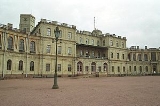
Gatchina

Encyclopedia
Gatchina is a town and the administrative center of Gatchinsky District
of Leningrad Oblast
, Russia
, located 45 kilometres (28 mi) south of St. Petersburg
by the road leading to Pskov
. Population:
It is a part of the World Heritage Site
Saint Petersburg and Related Groups of Monuments
.
, Russia. In the 17th century, in a series of wars, it passed to Livonia
, then to Sweden
, and was returned to Russia
during the Northern War
. At that time, Gatchina was a southern vicinity of the new Russian capital, St. Petersburg. In 1708 Gatchina was given by Peter the Great
. to his sister Natalia Alekseevna, and after her death, Peter founded an Imperial Hospital and Apothecary here. In 1765, Catherine the Great bought Gatchina with suburban 20 villages, then she granted it to her favourite General Count Orlov. Between 1766 and 1788 Count Orlov built a sombre castle with 600 rooms and laid out an extensive English landscape park over 7 square kilometres, with adjacent zoo and a horse farm. A triumphal arch
was erected to a design by the architect of Gatchina, Antonio Rinaldi (1771, built 1777-82), forming a monumental entrance, the gift of Catherine The Great to Count Orlov for his efforts during a recent outbreak of plague at Moscow.
The Gatchina Palace
was expanded several times by several imperial owners. Rococo
interiors were designed by Rinaldi and Vincenzo Brenna
and executed by Italian stuccoworkers and Russian craftsmen. Interiors were highlighted with parquetry floors, painted ceilings, and distinctly Italian furniture (illustrations, right).
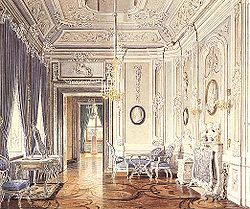
 The Empress took such a great liking of the Gatchina Palace and park that at Orlov's death in 1783 she bought it from his heirs and presented it to her son, the future Emperor Paul I
.
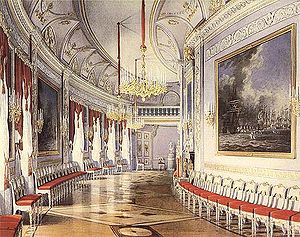
Paul I was the owner of Gatchina for eighteen years. He invested much resources as well as used his experience from his travels around Europe to make Gatchina an exemplary town and residence. During the 1790s, Paul expanded and rebuilt much of the palace, and renovated palatial interiors in the sumptuous Neoclassical
style (illustration, left). Paul I graced the park with numerous additions, bridges, gates, and pavilions, such as "The Isle of Love" , "The Private garden", "The Holland garden" and "The Labyrinth" among many other additions. In November 1796, following the death of his mother, Catherine the Great, Paul became Emperor Paul I of Russia, and granted Gatchina the status of the Imperial City - official residence of the Russian Emperors.
A remarkable monument of Paul's reign is Priory Palace
on the shore of the Black Lake. Constructed for the Russian Grand Priory of the Order of St John
, it was presented to the Order by a decree of Paul I of Russia
dated August 23, 1799.
After Paul's death the grand palace and park were owned by his widow, Maria Feodorovna, from 1801 to 1828. Then Emperor Nicholas I
was the owner from 1828 to 1855. He made the most significant expansion of the palaces and parks, adding the Arsenal Halls to the main palace. The Arsenal Halls served as the summer residence of Tsar Nicholas I and his court. In 1851, Tsar Nicholas I opened the monument to his grandfather, Paul I, in front of the Gatchina Palace. In 1854 the railroad between St. Petersburg and Gatchina was opened. At that time the city of Gatchina's territory was expanded by incorporation of several villages and vicinity.
Alexander II of Russia
used Gatchina Palace as his second residence. He built a hunting village and other additions for his Imperial Hunting Crew, and turned the areas south of Gatchina into his retreat, where the Tsar and his guests could indulge in living country-style among unspoiled wilderness and woods of north-western Russia. Alexander II made updates and renovations in the Main Gatchina Palace.
Alexander III of Russia
made Gatchina his prime residence, after experiencing a shock and stress of his father's assassination and the palace became known as 'The Citadel of Autocracy' after the Tsar's reactionary policies. He lived most of his time in Gatchina Palace. During his reign, Alexander III introduced major technological modernization in the Gatchina Palace and parks, such as electric lights, telephone network, non-freezing water pipes and modern sewage system.
Nicholas II
, the last Russian tsar, spent his youth in the Gatchina Palace. His mother, Empress Maria Fedorovna, widow of Alexander III, was the patron of the city of Gatchina and Gatchina Palace and parks.
). The quality of life, education, medical services and public safety in Gatchina were recognized as the best, and it was recommended as an example for other cities in Russia.
One of the first airfields in Russia was established in Gatchina at the beginning of the 20th century. The pilot Pyotr Nesterov
was trained at Gatchina airfield and made his first long-distance flight from Gatchina to Kiev
in the 1900s. At that time, an aviation industry was developing in Gatchina, eventually becoming one of the first centers of aviation and engine technology in Russia.
During the 1900s, Gatchina remained one of the official Imperial Residences of the Tsar Nicholas II, who was presiding over annual military parades and celebrations of the Imperial Russian Army garrisons, stationed in Gatchina until 1917.
During the WWI major medical hospitals in Gatchina were patronized by the Tsar Nicholas II and Empress Maria Fedorovna, the mother of Nicholas II, his wife the Empress Alexandra Fyodorovna, as well as their daughters: the Grand Duchess Olga
, the Grand Duchess Tatiana
, the Grand Duchess Maria
, and the Grand Duchess Anastasia
.
According to the some sources, "in May 1918, in the former imperial palace, one of the first museums in the country was opened for the victorious popular masses" of the Russian Revolution. From 1918 to 1941, the Gatchina Palace and parks were open to public as a national museum.
In 1923–1929, the town was called Trotsk after Leon Trotsky
. After Stalin became General Secretary
of the Communist Party and Trotsky was exiled, the town was called Krasnogvardeysk , or "Red Guard City" until 1944, when the original name was returned and the city has been called Gatchina ever since. During the German occupation, the city had the name Lindemannstadt after the Wehrmacht general Georg Lindemann
.
The Nazi Germans looted much of the Gatchina palace collections of art, while occupying the palace for almost three years during the German-Soviet War (World War II
). The Gatchina Palace and park was severely burnt, vandalized and destroyed by the retreating Germans. The extent of devastation was extraordinary, and initially was considered irreparable damage.
Restoration works continue over 60 years after the war, in order to restore some of the original handcrafted interiors of the Gatchina Palace. Some pieces of the art collection were recovered after WWII and returned to Gatchina. One section of the Gatchina Palace is partially completed and certain state rooms and the Arsenal Halls are now open to the public. Other areas of the Palace, including those of Tsar Alexander III, remain closed and unrestored.
In science, Gatchina is also renowned for being the site of the Petersburg Institute of Nuclear Science.
, Sweden
Espoo
, Finland
Ettlingen
, Germany
Coatbridge
, United Kingdom
Gatchinsky District
Gatchinsky District is an administrative and municipal district of Leningrad Oblast, Russia. Its administrative center is the town of Gatchina . District's population: Area: ....
of Leningrad Oblast
Leningrad Oblast
Leningrad Oblast is a federal subject of Russia . It was established on August 1, 1927, although it was not until 1946 that the oblast's borders had been mostly settled in their present position...
, Russia
Russia
Russia or , officially known as both Russia and the Russian Federation , is a country in northern Eurasia. It is a federal semi-presidential republic, comprising 83 federal subjects...
, located 45 kilometres (28 mi) south of St. Petersburg
Saint Petersburg
Saint Petersburg is a city and a federal subject of Russia located on the Neva River at the head of the Gulf of Finland on the Baltic Sea...
by the road leading to Pskov
Pskov
Pskov is an ancient city and the administrative center of Pskov Oblast, Russia, located in the northwest of Russia about east from the Estonian border, on the Velikaya River. Population: -Early history:...
. Population:
It is a part of the World Heritage Site
World Heritage Site
A UNESCO World Heritage Site is a place that is listed by the UNESCO as of special cultural or physical significance...
Saint Petersburg and Related Groups of Monuments
Historic Centre of Saint Petersburg and Related Groups of Monuments
Historic Centre of Saint Petersburg and Related Groups of Monuments is the name used by UNESCO when it collectively designated the historic core of the Russian city of St...
.
Early history
Khotchino (old name of Gatchina) was first documented in 1499, a village in possession of Novgorod the GreatVeliky Novgorod
Veliky Novgorod is one of Russia's most historic cities and the administrative center of Novgorod Oblast. It is situated on the M10 federal highway connecting Moscow and St. Petersburg. The city lies along the Volkhov River just below its outflow from Lake Ilmen...
, Russia. In the 17th century, in a series of wars, it passed to Livonia
Livonia
Livonia is a historic region along the eastern shores of the Baltic Sea. It was once the land of the Finnic Livonians inhabiting the principal ancient Livonian County Metsepole with its center at Turaida...
, then to Sweden
Sweden
Sweden , officially the Kingdom of Sweden , is a Nordic country on the Scandinavian Peninsula in Northern Europe. Sweden borders with Norway and Finland and is connected to Denmark by a bridge-tunnel across the Öresund....
, and was returned to Russia
Russia
Russia or , officially known as both Russia and the Russian Federation , is a country in northern Eurasia. It is a federal semi-presidential republic, comprising 83 federal subjects...
during the Northern War
Northern War
Northern War may refer to:*Northern Wars *Great Northern War *Flagstaff War *War in the North...
. At that time, Gatchina was a southern vicinity of the new Russian capital, St. Petersburg. In 1708 Gatchina was given by Peter the Great
Peter I of Russia
Peter the Great, Peter I or Pyotr Alexeyevich Romanov Dates indicated by the letters "O.S." are Old Style. All other dates in this article are New Style. ruled the Tsardom of Russia and later the Russian Empire from until his death, jointly ruling before 1696 with his half-brother, Ivan V...
. to his sister Natalia Alekseevna, and after her death, Peter founded an Imperial Hospital and Apothecary here. In 1765, Catherine the Great bought Gatchina with suburban 20 villages, then she granted it to her favourite General Count Orlov. Between 1766 and 1788 Count Orlov built a sombre castle with 600 rooms and laid out an extensive English landscape park over 7 square kilometres, with adjacent zoo and a horse farm. A triumphal arch
Triumphal arch
A triumphal arch is a monumental structure in the shape of an archway with one or more arched passageways, often designed to span a road. In its simplest form a triumphal arch consists of two massive piers connected by an arch, crowned with a flat entablature or attic on which a statue might be...
was erected to a design by the architect of Gatchina, Antonio Rinaldi (1771, built 1777-82), forming a monumental entrance, the gift of Catherine The Great to Count Orlov for his efforts during a recent outbreak of plague at Moscow.
The Gatchina Palace
Gatchina Palace
The Great Gatchina Palace was built in 1766–1781 in Gatchina town by Antonio Rinaldi for Count Grigori Grigoryevich Orlov who was a favourite of Ekaterina II. The Gatchina Palace is located on the hill above Lake Serebryannoe. It combines themes of a medieval castle and a country residence....
was expanded several times by several imperial owners. Rococo
Rococo
Rococo , also referred to as "Late Baroque", is an 18th-century style which developed as Baroque artists gave up their symmetry and became increasingly ornate, florid, and playful...
interiors were designed by Rinaldi and Vincenzo Brenna
Vincenzo Brenna
Vincenzo Brenna was an Italian architect and painter who was the house architect of Paul I of Russia. Brenna was hired by Paul and his spouse Maria Fyodorovna as interior decorator in 1781 and by the end of 1780s became the couple's leading architect...
and executed by Italian stuccoworkers and Russian craftsmen. Interiors were highlighted with parquetry floors, painted ceilings, and distinctly Italian furniture (illustrations, right).
Imperial residence
Paul I of Russia
Paul I was the Emperor of Russia between 1796 and 1801. He also was the 72nd Prince and Grand Master of the Order of Malta .-Childhood:...
.
Paul I was the owner of Gatchina for eighteen years. He invested much resources as well as used his experience from his travels around Europe to make Gatchina an exemplary town and residence. During the 1790s, Paul expanded and rebuilt much of the palace, and renovated palatial interiors in the sumptuous Neoclassical
Neoclassicism
Neoclassicism is the name given to Western movements in the decorative and visual arts, literature, theatre, music, and architecture that draw inspiration from the "classical" art and culture of Ancient Greece or Ancient Rome...
style (illustration, left). Paul I graced the park with numerous additions, bridges, gates, and pavilions, such as "The Isle of Love" , "The Private garden", "The Holland garden" and "The Labyrinth" among many other additions. In November 1796, following the death of his mother, Catherine the Great, Paul became Emperor Paul I of Russia, and granted Gatchina the status of the Imperial City - official residence of the Russian Emperors.
A remarkable monument of Paul's reign is Priory Palace
Priory Palace
Priory Palace is an original palace in Gatchina , Russia. It was built in 1799 by the architect N. A. Lvov on the shore of the Black Lake ...
on the shore of the Black Lake. Constructed for the Russian Grand Priory of the Order of St John
Russian tradition of the Knights Hospitaller
The Russian Tradition of the The Hospitaller Knights emerged when the Mediterranean stronghold of Malta was captured by Napoleon in 1798 when he made his expedition to Egypt...
, it was presented to the Order by a decree of Paul I of Russia
Paul I of Russia
Paul I was the Emperor of Russia between 1796 and 1801. He also was the 72nd Prince and Grand Master of the Order of Malta .-Childhood:...
dated August 23, 1799.
After Paul's death the grand palace and park were owned by his widow, Maria Feodorovna, from 1801 to 1828. Then Emperor Nicholas I
Nicholas I of Russia
Nicholas I , was the Emperor of Russia from 1825 until 1855, known as one of the most reactionary of the Russian monarchs. On the eve of his death, the Russian Empire reached its historical zenith spanning over 20 million square kilometers...
was the owner from 1828 to 1855. He made the most significant expansion of the palaces and parks, adding the Arsenal Halls to the main palace. The Arsenal Halls served as the summer residence of Tsar Nicholas I and his court. In 1851, Tsar Nicholas I opened the monument to his grandfather, Paul I, in front of the Gatchina Palace. In 1854 the railroad between St. Petersburg and Gatchina was opened. At that time the city of Gatchina's territory was expanded by incorporation of several villages and vicinity.
Alexander II of Russia
Alexander II of Russia
Alexander II , also known as Alexander the Liberator was the Emperor of the Russian Empire from 3 March 1855 until his assassination in 1881...
used Gatchina Palace as his second residence. He built a hunting village and other additions for his Imperial Hunting Crew, and turned the areas south of Gatchina into his retreat, where the Tsar and his guests could indulge in living country-style among unspoiled wilderness and woods of north-western Russia. Alexander II made updates and renovations in the Main Gatchina Palace.
Alexander III of Russia
Alexander III of Russia
Alexander Alexandrovich Romanov , historically remembered as Alexander III or Alexander the Peacemaker reigned as Emperor of Russia from until his death on .-Disposition:...
made Gatchina his prime residence, after experiencing a shock and stress of his father's assassination and the palace became known as 'The Citadel of Autocracy' after the Tsar's reactionary policies. He lived most of his time in Gatchina Palace. During his reign, Alexander III introduced major technological modernization in the Gatchina Palace and parks, such as electric lights, telephone network, non-freezing water pipes and modern sewage system.
Nicholas II
Nicholas II of Russia
Nicholas II was the last Emperor of Russia, Grand Prince of Finland, and titular King of Poland. His official short title was Nicholas II, Emperor and Autocrat of All the Russias and he is known as Saint Nicholas the Passion-Bearer by the Russian Orthodox Church.Nicholas II ruled from 1894 until...
, the last Russian tsar, spent his youth in the Gatchina Palace. His mother, Empress Maria Fedorovna, widow of Alexander III, was the patron of the city of Gatchina and Gatchina Palace and parks.
20th century history
Gatchina was honored as the best-kept city of Russia at the 1900 World's Fair in Paris (Exposition Universelle (1900)Exposition Universelle (1900)
The Exposition Universelle of 1900 was a world's fair held in Paris, France, from April 15 to November 12, 1900, to celebrate the achievements of the past century and to accelerate development into the next...
). The quality of life, education, medical services and public safety in Gatchina were recognized as the best, and it was recommended as an example for other cities in Russia.
One of the first airfields in Russia was established in Gatchina at the beginning of the 20th century. The pilot Pyotr Nesterov
Pyotr Nesterov
Pyotr Nikolayevich Nesterov was a Russian pilot, an aircraft technical designer and an aerobatics pioneer.-Life and career:The son of a military academy teacher, Pyotr Nesterov decided to choose a military career. In August 1904 he left the military school in Nizhny Novgorod and went to the...
was trained at Gatchina airfield and made his first long-distance flight from Gatchina to Kiev
Kiev
Kiev or Kyiv is the capital and the largest city of Ukraine, located in the north central part of the country on the Dnieper River. The population as of the 2001 census was 2,611,300. However, higher numbers have been cited in the press....
in the 1900s. At that time, an aviation industry was developing in Gatchina, eventually becoming one of the first centers of aviation and engine technology in Russia.
During the 1900s, Gatchina remained one of the official Imperial Residences of the Tsar Nicholas II, who was presiding over annual military parades and celebrations of the Imperial Russian Army garrisons, stationed in Gatchina until 1917.
During the WWI major medical hospitals in Gatchina were patronized by the Tsar Nicholas II and Empress Maria Fedorovna, the mother of Nicholas II, his wife the Empress Alexandra Fyodorovna, as well as their daughters: the Grand Duchess Olga
Grand Duchess Olga Nikolaevna of Russia
Grand Duchess Olga Nikolaevna of Russia ; , November 16 after 1900 – July 17, 1918) was the eldest daughter of the last autocratic ruler of the Russian Empire, Emperor Nicholas II, and of Empress Alexandra of Russia....
, the Grand Duchess Tatiana
Grand Duchess Tatiana Nikolaevna of Russia
Grand Duchess Tatiana Nikolaevna of Russia , , was the second daughter of Tsar Nicholas II, the last monarch of Russia, and of Tsarina Alexandra...
, the Grand Duchess Maria
Grand Duchess Maria Nikolaevna of Russia
Grand Duchess Maria Nikolaevna of Russia was the third daughter of Tsar Nicholas II of Russia and Tsarina Alexandra Fyodorovna...
, and the Grand Duchess Anastasia
Grand Duchess Anastasia Nikolaevna of Russia
Grand Duchess Anastasia Nikolaevna of Russia was the youngest daughter of Tsar Nicholas II of Russia, the last sovereign of Imperial Russia, and his wife Alexandra Fyodorovna....
.
According to the some sources, "in May 1918, in the former imperial palace, one of the first museums in the country was opened for the victorious popular masses" of the Russian Revolution. From 1918 to 1941, the Gatchina Palace and parks were open to public as a national museum.
In 1923–1929, the town was called Trotsk after Leon Trotsky
Leon Trotsky
Leon Trotsky , born Lev Davidovich Bronshtein, was a Russian Marxist revolutionary and theorist, Soviet politician, and the founder and first leader of the Red Army....
. After Stalin became General Secretary
General Secretary
The office of general secretary is staffed by the chief officer of:*The General Secretariat for Macedonia and Thrace, a government agency for the Greek regions of Macedonia and Thrace...
of the Communist Party and Trotsky was exiled, the town was called Krasnogvardeysk , or "Red Guard City" until 1944, when the original name was returned and the city has been called Gatchina ever since. During the German occupation, the city had the name Lindemannstadt after the Wehrmacht general Georg Lindemann
Georg Lindemann
Georg Heinrich Lindemann was a German cavalry officer and field commander who served in the German army during World War I and World War II . He was also a recipient of the Knight's Cross of the Iron Cross with Oak Leaves...
.
The Nazi Germans looted much of the Gatchina palace collections of art, while occupying the palace for almost three years during the German-Soviet War (World War II
World War II
World War II, or the Second World War , was a global conflict lasting from 1939 to 1945, involving most of the world's nations—including all of the great powers—eventually forming two opposing military alliances: the Allies and the Axis...
). The Gatchina Palace and park was severely burnt, vandalized and destroyed by the retreating Germans. The extent of devastation was extraordinary, and initially was considered irreparable damage.
Restoration works continue over 60 years after the war, in order to restore some of the original handcrafted interiors of the Gatchina Palace. Some pieces of the art collection were recovered after WWII and returned to Gatchina. One section of the Gatchina Palace is partially completed and certain state rooms and the Arsenal Halls are now open to the public. Other areas of the Palace, including those of Tsar Alexander III, remain closed and unrestored.
In science, Gatchina is also renowned for being the site of the Petersburg Institute of Nuclear Science.
Twin cities
EskilstunaEskilstuna
Eskilstuna is a city and the seat of Eskilstuna Municipality, Södermanland County, Sweden with 60,185 inhabitants in 2005. Eskilstuna has a large Sweden Finn population....
, Sweden
Sweden
Sweden , officially the Kingdom of Sweden , is a Nordic country on the Scandinavian Peninsula in Northern Europe. Sweden borders with Norway and Finland and is connected to Denmark by a bridge-tunnel across the Öresund....
Espoo
Espoo
Espoo is the second largest city and municipality in Finland. The population of the city of Espoo is . It is part of the Helsinki Metropolitan Area along with the cities of Helsinki, Vantaa, and Kauniainen. Espoo shares its eastern border with Helsinki and Vantaa, while enclosing Kauniainen....
, Finland
Finland
Finland , officially the Republic of Finland, is a Nordic country situated in the Fennoscandian region of Northern Europe. It is bordered by Sweden in the west, Norway in the north and Russia in the east, while Estonia lies to its south across the Gulf of Finland.Around 5.4 million people reside...
Ettlingen
Ettlingen
Ettlingen is a town in Baden-Württemberg, Germany, about south of the city of Karlsruhe. Ettlingen is the second largest town in the district of Karlsruhe, after Bruchsal.-Geography:...
, Germany
Germany
Germany , officially the Federal Republic of Germany , is a federal parliamentary republic in Europe. The country consists of 16 states while the capital and largest city is Berlin. Germany covers an area of 357,021 km2 and has a largely temperate seasonal climate...
Coatbridge
Coatbridge
Coatbridge is a town in North Lanarkshire, Scotland, about east of Glasgow city centre, set in the central Lowlands. The town, with neighbouring Airdrie, is part of the Greater Glasgow urban area. The first settlement of the area stretches back to the Stone Age era...
, United Kingdom
United Kingdom
The United Kingdom of Great Britain and Northern IrelandIn the United Kingdom and Dependencies, other languages have been officially recognised as legitimate autochthonous languages under the European Charter for Regional or Minority Languages...
Further reading
- St. Petersburg:Architecture of the Tsars. 360 pages. Abbeville Press, 1996. ISBN 0789202174
- Knopf Guide: St. Petersburg. New York: Knopf, 1995. ISBN 0679762027
- Eyewitness Guide: St. Petersburg.
- Glantz, David M. The Battle for Leningrad, 1941-1944. Lawrence: University Press of Kansas, 2002. ISBN 0700612084
- Edvard Radzinsky. Alexander II: The Last Great Tsar. New York: The Free Press, 2005. ISBN 074327332X
External links
- Art monuments & History of former residence of the Russian emperors
- Gatchina Over the Centuries
- Parks of Gatchina
- The October Revolution and Civil War in Gatchina (in Russian)
- The Wings of Gatchina
- Views of Gatchina Park
- 19th-century views of palacial interiors Cultural, public and scientific life of Gatchina
- Views of Gatchina Park
- Interiors of the Gatchina Palace
- Views of Gatchina
- Gatchina Humanitarian Portal
- Priory Palace in Gatchina
- Gatchina is Russia and the World
- Gatchina map
- Gatchina: catalogue of organizations, job, auto, history, the schedule of actions etc.