

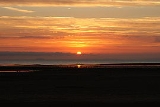
Sunrise

Encyclopedia
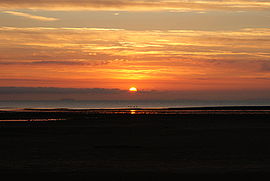
Sun
The Sun is the star at the center of the Solar System. It is almost perfectly spherical and consists of hot plasma interwoven with magnetic fields...
appears above the horizon
Horizon
The horizon is the apparent line that separates earth from sky, the line that divides all visible directions into two categories: those that intersect the Earth's surface, and those that do not. At many locations, the true horizon is obscured by trees, buildings, mountains, etc., and the resulting...
in the east
East
East is a noun, adjective, or adverb indicating direction or geography.East is one of the four cardinal directions or compass points. It is the opposite of west and is perpendicular to north and south.By convention, the right side of a map is east....
. Sunrise should not be confused with dawn
Dawn
Dawn is the time that marks the beginning of the twilight before sunrise. It is recognized by the presence of weak sunlight, while the sun itself is still below the horizon...
, which is the (variously defined) point at which the sky
Sky
The sky is the part of the atmosphere or outer space visible from the surface of any astronomical object. It is difficult to define precisely for several reasons. During daylight, the sky of Earth has the appearance of a pale blue surface because the air scatters the sunlight. The sky is sometimes...
begins to lighten, some time before the sun itself appears, ending twilight
Twilight
Twilight is the time between dawn and sunrise or between sunset and dusk, during which sunlight scattering in the upper atmosphere illuminates the lower atmosphere, and the surface of the earth is neither completely lit nor completely dark. The sun itself is not directly visible because it is below...
. Because atmospheric refraction
Atmospheric refraction
Atmospheric refraction is the deviation of light or other things like humanelectromagnetic wave from a straight line as it passes through the atmosphere due to the variation in air density as a function of altitude...
causes the sun to be seen while it is still below the horizon, both sunrise and sunset are, from one point of view, optical illusion
Optical illusion
An optical illusion is characterized by visually perceived images that differ from objective reality. The information gathered by the eye is processed in the brain to give a perception that does not tally with a physical measurement of the stimulus source...
s. The sun also exhibits an optical illusion at sunrise similar to the moon illusion
Moon illusion
The Moon illusion is an optical illusion in which the Moon appears larger near the horizon than it does while higher up in the sky. This optical illusion also occurs with the sun and star constellations. It has been known since ancient times, and recorded by numerous different cultures...
.
The apparent west
West
West is a noun, adjective, or adverb indicating direction or geography.West is one of the four cardinal directions or compass points. It is the opposite of east and is perpendicular to north and south.By convention, the left side of a map is west....
ward revolution of Sun around the earth
Earth
Earth is the third planet from the Sun, and the densest and fifth-largest of the eight planets in the Solar System. It is also the largest of the Solar System's four terrestrial planets...
after rising out of the horizon is due to Earth's eastward rotation, a counter-clockwise revolution when viewed from above the North Pole. This illusion is so convincing that most cultures had mythologies and religions built around the geocentric model
Geocentric model
In astronomy, the geocentric model , is the superseded theory that the Earth is the center of the universe, and that all other objects orbit around it. This geocentric model served as the predominant cosmological system in many ancient civilizations such as ancient Greece...
. This same effect can be seen with near-polar
Geographical pole
A geographical pole is either of the two points—the north pole and the south pole—on the surface of a rotating planet where the axis of rotation meets the surface of the body...
satellite
Satellite
In the context of spaceflight, a satellite is an object which has been placed into orbit by human endeavour. Such objects are sometimes called artificial satellites to distinguish them from natural satellites such as the Moon....
s as well.
Sunrise and sunset
Sunset
Sunset or sundown is the daily disappearance of the Sun below the horizon in the west as a result of Earth's rotation.The time of sunset is defined in astronomy as the moment the trailing edge of the Sun's disk disappears below the horizon in the west...
are calculated from the leading and trailing edges of the Sun, and not the center; this slightly increases the duration of "day
Daylight
Daylight or the light of day is the combination of all direct and indirect sunlight outdoors during the daytime. This includes direct sunlight, diffuse sky radiation, and both of these reflected from the Earth and terrestrial objects. Sunlight scattered or reflected from objects in outer space is...
" relative to "night
Night
Night or nighttime is the period of time when the sun is below the horizon. This occurs after dusk. The opposite of night is day...
". The sunrise equation
Sunrise equation
The sunrise equation as follows can be used to derive the time of sunrise and sunset for any solar declination and latitude in terms of local solar time when sunrise and sunset actually occur:...
, however, is based on the center of the sun
Sun
The Sun is the star at the center of the Solar System. It is almost perfectly spherical and consists of hot plasma interwoven with magnetic fields...
.
The timing of sunrise varies throughout the year and is also affected by the viewer's longitude and latitude, altitude, and time zone. Small daily changes and noticeable semi-annual changes in the timing of sunrises are driven by the axial tilt
Axial tilt
In astronomy, axial tilt is the angle between an object's rotational axis, and a line perpendicular to its orbital plane...
of Earth, daily rotation of the earth, the planet's movement in its annual elliptical
Ellipse
In geometry, an ellipse is a plane curve that results from the intersection of a cone by a plane in a way that produces a closed curve. Circles are special cases of ellipses, obtained when the cutting plane is orthogonal to the cone's axis...
orbit around the Sun, and the earth and moon's paired revolutions around each other. In the springtime, the days get longer and sunrises occur earlier every day until the day of the earliest sunrise, which occurs before the summer solstice. In the Northern Hemisphere
Northern Hemisphere
The Northern Hemisphere is the half of a planet that is north of its equator—the word hemisphere literally means “half sphere”. It is also that half of the celestial sphere north of the celestial equator...
, the earliest sunrise does not fall on the summer
Summer
Summer is the warmest of the four temperate seasons, between spring and autumn. At the summer solstice, the days are longest and the nights are shortest, with day-length decreasing as the season progresses after the solstice...
solstice around June 21, but occurs earlier in June. The precise date of the earliest sunrise depends on the viewer's latitude (connected with the slower Earth's movement around the aphelion around July 4). Likewise, the latest sunrise does not occur on the winter
Winter
Winter is the coldest season of the year in temperate climates, between autumn and spring. At the winter solstice, the days are shortest and the nights are longest, with days lengthening as the season progresses after the solstice.-Meteorology:...
solstice
Solstice
A solstice is an astronomical event that happens twice each year when the Sun's apparent position in the sky, as viewed from Earth, reaches its northernmost or southernmost extremes...
, but rather about two weeks later, again depending on the viewer's latitude. In the Northern Hemisphere, the latest sunrise occurs in early January (influence from the Earth's faster movement near the perihelion, which occurs around January 3). Likewise, the same phenomena exist in the Southern Hemisphere
Southern Hemisphere
The Southern Hemisphere is the part of Earth that lies south of the equator. The word hemisphere literally means 'half ball' or "half sphere"...
except with the respective dates reversed, with the latest sunrises occurring some time after June 21 in winter and earliest sunrises occurring some time before December 21 in summer, again depending on one's southern latitude. For one or two weeks surrounding both solstices, both sunrise and sunset get slightly later or earlier each day. Even on the equator, sunrise and sunset shift several minutes back and forth through the year, along with solar noon. These effects are plotted by an analemma
Analemma
In astronomy, an analemma is a curve representing the angular offset of a celestial body from its mean position on the celestial sphere as viewed from another celestial body relative to the viewing body's celestial equator...
.
Due to Earth's axial tilt, whenever and wherever sunrise occurs, it is always in the northeast quadrant from the March equinox to the September equinox and in the southeast quadrant from the September equinox to the March equinox. Sunrises occur due east on the March and September equinoxes for all viewers on Earth.
Colors
Aerosol
Technically, an aerosol is a suspension of fine solid particles or liquid droplets in a gas. Examples are clouds, and air pollution such as smog and smoke. In general conversation, aerosol usually refers to an aerosol spray can or the output of such a can...
via a combination of Rayleigh scattering
Rayleigh scattering
Rayleigh scattering, named after the British physicist Lord Rayleigh, is the elastic scattering of light or other electromagnetic radiation by particles much smaller than the wavelength of the light. The particles may be individual atoms or molecules. It can occur when light travels through...
and Mie scattering. At sunset
Sunset
Sunset or sundown is the daily disappearance of the Sun below the horizon in the west as a result of Earth's rotation.The time of sunset is defined in astronomy as the moment the trailing edge of the Sun's disk disappears below the horizon in the west...
and sunrise, sunlight's path through the atmosphere is much longer than during the daytime, which creates different colors. At sunrise and sunset
Sunset
Sunset or sundown is the daily disappearance of the Sun below the horizon in the west as a result of Earth's rotation.The time of sunset is defined in astronomy as the moment the trailing edge of the Sun's disk disappears below the horizon in the west...
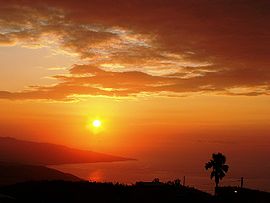
, there is more attenuation and light scattering by air molecules that remove violets, blues, and greens, relatively enhancing reds and oranges. Because the shorter wavelength light of violets, blues, and greens scatter more strongly by Rayleigh Scattering, violets, blues, and greens are removed almost completely from the incident beam, leaving mostly only longer-wavelength orange and red hue
Hue
Hue is one of the main properties of a color, defined technically , as "the degree to which a stimulus can be describedas similar to or different from stimuli that are described as red, green, blue, and yellow,"...
s at sunrise and sunset
Sunset
Sunset or sundown is the daily disappearance of the Sun below the horizon in the west as a result of Earth's rotation.The time of sunset is defined in astronomy as the moment the trailing edge of the Sun's disk disappears below the horizon in the west...
, which are further scattered by Mie scattering across the horizon to produce intense reds and oranges when there are soot, dust, or solid or liquid aerosols in the atmosphere. The removal of the shorter wavelengths of light is due to Rayleigh scattering
Rayleigh scattering
Rayleigh scattering, named after the British physicist Lord Rayleigh, is the elastic scattering of light or other electromagnetic radiation by particles much smaller than the wavelength of the light. The particles may be individual atoms or molecules. It can occur when light travels through...
by air molecules and small particles of sizes an order of magnitude smaller that the wavelength of visible light (typically particles and molecules smaller than 50 nm). The sun is actually white when observed without any air between the viewer and the sun, so, sunlight in outer space contains a mixture of violets, blues, greens, yellows, oranges, and reds. Due to Rayleigh scattering
Rayleigh scattering
Rayleigh scattering, named after the British physicist Lord Rayleigh, is the elastic scattering of light or other electromagnetic radiation by particles much smaller than the wavelength of the light. The particles may be individual atoms or molecules. It can occur when light travels through...
, the sun appears reddish or yellowish when we look at it from Earth, since the longer wavelengths of reds and yellow light are scattered the least, passing through the air to the viewer, while shorter wavelengths like violet, blue, and green light are in effect removed from direct sunlight by air molecules' Rayleigh scattering
Rayleigh scattering
Rayleigh scattering, named after the British physicist Lord Rayleigh, is the elastic scattering of light or other electromagnetic radiation by particles much smaller than the wavelength of the light. The particles may be individual atoms or molecules. It can occur when light travels through...
.
Rayleigh scattering
Rayleigh scattering
Rayleigh scattering, named after the British physicist Lord Rayleigh, is the elastic scattering of light or other electromagnetic radiation by particles much smaller than the wavelength of the light. The particles may be individual atoms or molecules. It can occur when light travels through...
is the elastic scattering
Elastic scattering
In scattering theory and in particular in particle physics, elastic scattering is one of the specific forms of scattering. In this process, the kinetic energy of the incident particles is conserved, only their direction of propagation is modified .-Electron elastic scattering:When an alpha particle...
of electromagnetic radiation due to the polarizability of the electron cloud in molecules and particles much smaller than the wavelength of visible light. Rayleigh scattering intensity is fairly omnidirectional and has a strong reciprocal 4th-power wavelength dependency, and, thus, the shorter wavelengths of violet and blue light are affected much more than the longer wavelengths of yellow to red light. During the day, this scattering results in the increasingly intense blue color of the sky away from the direct line of sight to the Sun, whereas, during sunrise and sunset, the much longer path length through the atmosphere results in the complete removal of violet, blue, and green light from the incident rays, leaving weak intensities of orange to red light.

Rayleigh scattering
Rayleigh scattering, named after the British physicist Lord Rayleigh, is the elastic scattering of light or other electromagnetic radiation by particles much smaller than the wavelength of the light. The particles may be individual atoms or molecules. It can occur when light travels through...
has removed the violets, blues, and greens, people's viewing of red and orange colors of sunsets and sunrises is then enhanced by the presence of particulate matter, dust, soot, water droplets (like clouds), or other aerosols in the atmosphere, (the notable one being sulfuric acid droplets from volcanic eruptions). Particles much smaller than the wavelength of the incident light efficiently enhance the blue colors for off-axis short path lengths through air (resulting in blue skies, since Rayleigh scattering intensity increases as the sixth power of the particle diameter). Larger particles as aerosols, however, with sizes comparable to and longer than the wavelength of light, scatter by mechanisms treated, for spherical shapes, by the Mie theory
Mie theory
The Mie solution to Maxwell's equations describes the scattering of electromagnetic radiation by a sphere...
. Mie scattering is largely wavelength-insensitive. Its spacial distribution is highly preferential in the forward direction of the incident light being scattered, thus having its largest effect when an observer views the light in the direction of the rising or setting Sun, rather than looking in other directions. During the daytime, Mie Scattering in general causes a diffuse white halo around the Sun, decreasing the perception of blue color in the direction toward the Sun, and it causes daytime clouds to appear white due to white sunlight. At sunset
Sunset
Sunset or sundown is the daily disappearance of the Sun below the horizon in the west as a result of Earth's rotation.The time of sunset is defined in astronomy as the moment the trailing edge of the Sun's disk disappears below the horizon in the west...
and sunrise, Mie scattering off of particles and aerosols across the horizon, then transmits the red and orange wavelengths that remain after Rayleigh scattering
Rayleigh scattering
Rayleigh scattering, named after the British physicist Lord Rayleigh, is the elastic scattering of light or other electromagnetic radiation by particles much smaller than the wavelength of the light. The particles may be individual atoms or molecules. It can occur when light travels through...
has depleted the blue light. This explains why sunsets without soot, dust, or aerosols are dull and fairly faint-red, while sunsets and sunrises are brilliantly intense when there are lots of soot, dust, or other aerosols in the air.
Sunset
Sunset
Sunset or sundown is the daily disappearance of the Sun below the horizon in the west as a result of Earth's rotation.The time of sunset is defined in astronomy as the moment the trailing edge of the Sun's disk disappears below the horizon in the west...
colors are typically more brilliant than sunrise colors, because, in general, the evening air contains more particles and aerosols and clouds than morning air. Cloud droplets are much larger than the wavelength of light, so they scatter all colors equally by Mie scattering, which makes them appear white when illuminated by white sunlight during the daytime. The clouds glow orange and red due to Mie scattering during sunsets and sunrises, because they are illuminated with the orange and red light that remains after multiple prior Rayleigh scattering events of the light from the setting/rising sun.
Ash from volcanic eruptions, trapped within the troposphere
Troposphere
The troposphere is the lowest portion of Earth's atmosphere. It contains approximately 80% of the atmosphere's mass and 99% of its water vapor and aerosols....
, tends to mute sunset and sunrise colors, whereas volcanic ejecta lofted into the stratosphere
Stratosphere
The stratosphere is the second major layer of Earth's atmosphere, just above the troposphere, and below the mesosphere. It is stratified in temperature, with warmer layers higher up and cooler layers farther down. This is in contrast to the troposphere near the Earth's surface, which is cooler...
(as thin clouds of tiny sulfuric acid droplets) can yield beautiful post-sunset colors called afterglow
Afterglow
An afterglow is a broad high arch of whitish or rosy light appearing in the sky due to very fine particles of dust suspended in the high regions of the atmosphere. An afterglow may appear above the highest clouds in the hour of deepening twilight, or reflected from the high snowfields in mountain...
s and pre-sunrise glows. A number of eruptions, including those of Mount Pinatubo
Mount Pinatubo
Mount Pinatubo is an active stratovolcano located on the island of Luzon, near the tripoint of the Philippine provinces of Zambales, Tarlac, and Pampanga. It is located in the Tri-Cabusilan Mountain range separating the west coast of Luzon from the central plains, and is west of the dormant and...
in 1991 and Krakatoa
Krakatoa
Krakatoa is a volcanic island made of a'a lava in the Sunda Strait between the islands of Java and Sumatra in Indonesia. The name is used for the island group, the main island , and the volcano as a whole. The island exploded in 1883, killing approximately 40,000 people, although some estimates...
in 1883, have produced sufficiently high stratospheric sulfuric acid clouds to yield remarkable sunset afterglows (and pre-sunrise glows) around the world. The high-altitude clouds serve to reflect strongly-reddened sunlight still striking the stratosphere after sunset, down to the surface.
Sometimes just before sunrise or after sunset a green flash
Green flash
Green flashes and green rays are optical phenomena that occur shortly after sunset or before sunrise, when a green spot is visible, usually for no more than a second or two, above the sun, or it may resemble a green ray shooting up from the sunset point. Green flashes are a group of phenomena...
can be seen.
See also
- DawnDawnDawn is the time that marks the beginning of the twilight before sunrise. It is recognized by the presence of weak sunlight, while the sun itself is still below the horizon...
- DuskDuskDusk is the beginning of darkness in the evening, and occurs after twilight, when the sky generally remains bright and blue. Civil dusk is when the earth has rotated enough that the center of the sun is at 6° below the local horizon...
- DayDayA day is a unit of time, commonly defined as an interval equal to 24 hours. It also can mean that portion of the full day during which a location is illuminated by the light of the sun...
- Day lengthDay lengthDay length, or length of day, or length of daytime, refers to the time each day from the moment the upper limb of the sun's disk appears above the horizon during sunrise to the moment when the upper limb disappears below the horizon during sunset...
- Daybreak
- Earth's shadowEarth's shadowThe Earth's shadow or Earth shadow are names for the shadow that the Earth itself casts on its atmosphere. This shadow is often visible from the surface of the Earth, as a dark band in the sky near the horizon...
, visible at sunrise - False sunriseFalse sunriseA false sunrise or dawn sundog is a very particular kind of parhelion, belonging to the optical phenomenon family of halos.It is an atmospheric optical phenomenon associated with the reflection or refraction of sunlight by small ice crystals making up cirrus or cirrostratus clouds in the very...
- NoonNoonNoon is usually defined as 12 o'clock in the daytime. The word noon is also used informally to mean midday regarding the location of the sun not the middle of a persons day. Although this is a time around the middle of the day when people in many countries take a lunch break...
- Sunrise equationSunrise equationThe sunrise equation as follows can be used to derive the time of sunrise and sunset for any solar declination and latitude in terms of local solar time when sunrise and sunset actually occur:...
- SunsetSunsetSunset or sundown is the daily disappearance of the Sun below the horizon in the west as a result of Earth's rotation.The time of sunset is defined in astronomy as the moment the trailing edge of the Sun's disk disappears below the horizon in the west...
- TwilightTwilightTwilight is the time between dawn and sunrise or between sunset and dusk, during which sunlight scattering in the upper atmosphere illuminates the lower atmosphere, and the surface of the earth is neither completely lit nor completely dark. The sun itself is not directly visible because it is below...
External links
- Sunrise Sunset Moonrise Moonset Calculation , utilizing Google Maps.
- Rise/Set Calculator. Find sun position for any time/location.
- Sunrise and sunset calculator
- SunRise_SunSet calculator
- Sun or Moon Rise/Set Table for one Year
- US Navy Sunrise and Sunset calculator
- Full physical explanation of sky color, in simple terms
- An Excel workbook with VBA functions for sunrise, sunset, solar noon, twilight (dawn and dusk), and solar position (azimuth and elevation); by Greg Pelletier, translated from NOAA's online calculators for solar position and sunrise/sunset
- Daily almanac including Sun rise/set/twillight for every location on Earth
- Monthly calendar with Sun/Moon rise/set times for every location on Earth
- A Video Of Sunrise
- A very easy to use and visual sunrise and sunset calculator
- Shows the hour and angle of sunrise, noon, and sunset drawn over a map.