
All Topics  
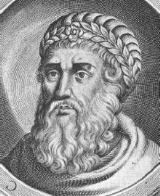
Herod the Great

 
Herod the Great

   Email Print
   Bookmark   Link


Herod the Great


Herod ( Horodos, Greek
Koine Greek

Koine Greek is the popular form of Greek which emerged in post-Classical antiquity . Other names are Alexandrian, Hellenistic, Common, or New Testament Greek....
: Herodes), also known as Herod I or Herod the Great (73 BC – 4 BC in Jericho
Jericho

Jericho is a city located near the Jordan River in the West Bank of the Palestinian territories. It is the capital of the Jericho Governorate, and has a population of over 20,000 Arabs....
), was a Roman
Roman Empire

The Roman Empire was the Roman Republic phase of the Ancient Rome, characterised by an autocracy form of government and large territorial holdings in Europe and around the Mediterranean....
 client king
Client state

Client state is one of several terms used to describe the subordination of one state to a more powerful state in international affairs. It is the least specific of these terms and may be treated as a broad category which includes satellite state, puppet state, neo-colony, protectorate, vassal state and tributary state....
 of Israel. Herod is known for his colossal building projects in Jerusalem and other parts of the ancient world, including the rebuilding of the Second Temple
Second Temple

The Second Temple was the reconstructed Temple in Jerusalem which stood between 516 BCE and 70 CE. During this time, it was the center of Judaism worship, which focused on the sacrifices known as the korbanot....
 in Jerusalem
Jerusalem

Jerusalem is the capital of Israel and its List of Israeli cities in both population and area, with a population of 747,600 residents over an area of if Positions on Jerusalem East Jerusalem is included....
, sometimes referred to as Herod's Temple
Herod's Temple

Herod's Temple in Jerusalem was a massive expansion of the Temple Mount and construction of a completely new and much larger Jewish Temple by King Herod the Great around 19 BCE....
. Some details of his biography can be gleaned from the works of the 1st century AD Roman-Jewish historian Josephus Flavius.

In Christian
Christianity

Christianity is a Monotheistic religion #Christian view religion centered on the life and teachings of Jesus as New Testament view on Jesus' life....
 scripture, Biblical belief
Early Christianity

Early Christianity is commonly defined as the Christianity of the three centuries between the Crucifixion of Jesus and the First Council of Nicaea ....
 has Herod perpetrating the Massacre of the Innocents
Massacre of the Innocents

File:Giotto-innocents.jpgThe Massacre of the Innocents is an episode of mass infanticide by the King of Iudaea Province, Herod the Great, that appears in the Gospel of Matthew ....
, described in Chapter 2 of the Gospel according to Matthew
Gospel of Matthew

The Gospel of Matthew is one of the four canonical gospels in the New Testament and is a synoptic gospel. It narrates an account of the New Testament view on Jesus' life and Ministry of Jesus of Jesus of Nazareth....
.


Discussion
Ask a question about 'Herod the Great'
Start a new discussion about 'Herod the Great'
Answer questions from other users
Full Discussion Forum


Recent Posts


Encyclopedia


Herod ( Horodos, Greek
Koine Greek

Koine Greek is the popular form of Greek which emerged in post-Classical antiquity . Other names are Alexandrian, Hellenistic, Common, or New Testament Greek....
: Herodes), also known as Herod I or Herod the Great (73 BC – 4 BC in Jericho
Jericho

Jericho is a city located near the Jordan River in the West Bank of the Palestinian territories. It is the capital of the Jericho Governorate, and has a population of over 20,000 Arabs....
), was a Roman
Roman Empire

The Roman Empire was the Roman Republic phase of the Ancient Rome, characterised by an autocracy form of government and large territorial holdings in Europe and around the Mediterranean....
 client king
Client state

Client state is one of several terms used to describe the subordination of one state to a more powerful state in international affairs. It is the least specific of these terms and may be treated as a broad category which includes satellite state, puppet state, neo-colony, protectorate, vassal state and tributary state....
 of Israel. Herod is known for his colossal building projects in Jerusalem and other parts of the ancient world, including the rebuilding of the Second Temple
Second Temple

The Second Temple was the reconstructed Temple in Jerusalem which stood between 516 BCE and 70 CE. During this time, it was the center of Judaism worship, which focused on the sacrifices known as the korbanot....
 in Jerusalem
Jerusalem

Jerusalem is the capital of Israel and its List of Israeli cities in both population and area, with a population of 747,600 residents over an area of if Positions on Jerusalem East Jerusalem is included....
, sometimes referred to as Herod's Temple
Herod's Temple

Herod's Temple in Jerusalem was a massive expansion of the Temple Mount and construction of a completely new and much larger Jewish Temple by King Herod the Great around 19 BCE....
. Some details of his biography can be gleaned from the works of the 1st century AD Roman-Jewish historian Josephus Flavius.

In Christian
Christianity

Christianity is a Monotheistic religion #Christian view religion centered on the life and teachings of Jesus as New Testament view on Jesus' life....
 scripture, Biblical belief
Early Christianity

Early Christianity is commonly defined as the Christianity of the three centuries between the Crucifixion of Jesus and the First Council of Nicaea ....
 has Herod perpetrating the Massacre of the Innocents
Massacre of the Innocents

File:Giotto-innocents.jpgThe Massacre of the Innocents is an episode of mass infanticide by the King of Iudaea Province, Herod the Great, that appears in the Gospel of Matthew ....
, described in Chapter 2 of the Gospel according to Matthew
Gospel of Matthew

The Gospel of Matthew is one of the four canonical gospels in the New Testament and is a synoptic gospel. It narrates an account of the New Testament view on Jesus' life and Ministry of Jesus of Jesus of Nazareth....
. However, no historical extra-biblical
List of Biblical figures identified in extra-Biblical sources

The following is a list of people who are mentioned in the Bible that have been identified in extra-biblical records or artifacts. For further reading see: The Bible and history and Biblical archeology....
 source exists supporting this claim of such a decree by Herod or any ruler of the time.

Biography

Herod Coin1
Herod was born around 74 BC. He was the second son of Antipater the Idumaean
Antipater the Idumaean

Antipater II the Idumaean was the founder of the Herodian Dynasty and father of Herod the Great. Other members of the family with the name Antipater were his father Antipater I, Governor of Idumaea, and grandson Antipater III....
, a high-ranked official under Ethnarch Hyrcanus II
Hyrcanus II

Hyrcanus II, a member of the Hasmonean dynasty, was the Jewish Kohen Gadol and King of Judea in the 1st century BCE....
, and Cypros, a Nabatean. A loyal supporter of Hyrcanus II, Antipater appointed Herod governor
Governor

A governor is a governing official, usually the Executive of a non-sovereign level of government, ranking under the head of state. In federations, a governor may be the title of each appointed or elected politician who governs a constitutive state....
 of Galilee
Galilee

Galilee , is a large region in northern Israel which overlaps with much of the administrative North District of the country. Traditionally divided into Upper Galilee , Lower Galilee , and Western Galilee , extending from Dan to the north, at the base of Mount Hermon, along Mount Lebanon to the ridges of Mount Carmel and Mount Gilboa t...
 at 25, and his older brother, Phasael
Phasael

Phasael was a prince from the Herodian Dynasty of Judea....
, governor of Jerusalem. He enjoyed the backing of Rome but his excessive brutality was condemned by the Sanhedrin
Sanhedrin

The Sanhedrin was an assembly of twenty-three judges appointed in every city in the Land of Israel.The Great Sanhedrin was the supreme court of ancient Israel....
.

In 43 BC, following the chaos caused by Antipater offering financial support to Caesar's murderers, Antipater was poisoned. Herod, backed by the Roman Army, executed his father's murderer. Afterwards, Antigonus
Antigonus the Hasmonean

Antigonus II Mattathias was the son of King Aristobulus II of Judea. In 40 BC he led, along with Barzapharnes, a Parthian-supported invasion of Judea, seized Jerusalem, and sent his uncle Hyrcanus II to Babylon in chains ....
, Hyrcanus' nephew, tried to take the throne from his uncle. Herod defeated him and then married his teenage niece, Mariamne (known as Mariamne I), which helped to secure him a claim to the throne and gain some Jewish favor. However, Herod already had a wife, Doris, and a three-year-old son, Antipater III, and chose to banish Doris and her child.

In 42 BC, he convinced Mark Antony
Mark Antony

Marcus Antonius , known in English as Marc Antony, was a Roman Republic politician and General. He was an important supporter and the best friend of Julius Caesar as a military commander and administrator, being Caesar's second cousin, once removed, by his mother Julia Antonia....
 and Octavian that his father had been forced to help Caesar's murderers. Herod was then named tetrarch
Tetrarch

Tetrarch is a Greek language term for a holder of Roman Emperor office under a Tetrarchy. It was applied earlier to rulers of minor principalities owing allegiance to Rome....
 of Galilee by the Romans. However, since Herod's family had converted to Judaism under duress, his Jewishness had come into question by some elements of Judean society. The Idumaean family, successors to the Edom
Edom

Edom is a name given to Esau in the Hebrew Bible, as well as to the nation descending from him. The nation's name in Assyrian language was Udumi; in Syriac language, ????; in Greek language, ?d???a?a ; in Latin, Idum?a or Idumea....
ites of the Hebrew Bible
Hebrew Bible

The term Hebrew Bible is a generic reference to those books of the Bible originally written mostly in Biblical Hebrew with some Biblical Aramaic....
, settled in Idumea (Biblical Edom
Edom

Edom is a name given to Esau in the Hebrew Bible, as well as to the nation descending from him. The nation's name in Assyrian language was Udumi; in Syriac language, ????; in Greek language, ?d???a?a ; in Latin, Idum?a or Idumea....
), in southern Israel. When the Maccabean
Maccabees

The Maccabees were a Jewish national liberation movement that fought for and won independence from Antiochus IV Epiphanes of the Hellenistic Seleucid dynasty, who was succeeded by his infant son Antiochus V Eupator....
 John Hyrcanus
John Hyrcanus

John Hyrcanus was a Hasmonean leader of the 2nd century BC. Apparently the name "Hyrcanus" was taken by him as a regnal name upon his accession to power....
 conquered Idumea in 140–130 BC, he required all Idumaeans to obey Jewish law or to leave; most Idumaeans thus converted to Judaism
Judaism

Judaism is a set of beliefs and practices originating in the Hebrew Bible , as later further explored and explained in the Talmud and other texts....
. While King Herod publicly identified himself as a Jew and was considered as such by some, this religious identification notwithstanding was undermined by the Hellenistic
Hellenistic civilization

File:Diadochen1.pngHellenistic civilization represents the zenith of Ancient Greece influence in the Classical Antiquity from 323 BC to about 146 BC ....
 cultural affinity of the Herodians
Herodians

The Herodians were a sect or party mentioned in the New Testament as having on two occasions ? once in Galilee, and again in Jerusalem ? manifested an unfriendly disposition towards Jesus ....
, which would have earned them the antipathy of observant Jews.

In 40 BC Antigonus tried to take the throne again with the help of the Parthians, this time succeeding. Herod fled to Rome to plead with the Romans to restore him to power. There he was elected "King of the Jews
King of the Jews

King of the Jews may refer to:History:Ruler of historic Jewish kingdoms and client states:* Kingdom of Israel * Kingdom of Judah * Hasmonean dynasty ...
" by the Roman Senate
Roman Senate

The Senate of the Roman Republic was a political institution in the ancient Roman Republic. According to the Greek historian Polybius, our principal source on the Constitution of the Roman Republic, the Roman Senate was the predominant branch of government....
. In 37 BC the Romans fully secured Israel and executed Antigonus. Herod took the role as sole ruler of Israel and took the title of basileus
Basileus

Basileus , signifies "Monarch" or "king". It is perhaps best known in English language as a title used by Byzantine Empire emperors, but also has a longer history of use for persons of authority in ancient Greece, as well as for the kings of modern Greece....
 (Gr. ?as??e??) for himself, ushering in the Herodian Dynasty
Herodian Dynasty

The Herodian Dynasty was a Jewish dynasty of Idumea descent, who ruled Iudaea Province between 37 BC - AD 92....
 and ending the Hasmonean Dynasty. He ruled for 34 years.
Templejerusalem

Architectural achievements

Main article: Herodian architecture
Herodian architecture

Herodian architecture is a style of classical architecture characteristic of the numerous building projects undertaken during the reign of Herod the Great, the Ancient Rome client king of Iudaea Province#The client kingdom of Judea....
Herod's most famous and ambitious project was the expansion of the Second Temple
Second Temple

The Second Temple was the reconstructed Temple in Jerusalem which stood between 516 BCE and 70 CE. During this time, it was the center of Judaism worship, which focused on the sacrifices known as the korbanot....
 in Jerusalem.

In the eighteenth year of his reign (20–19 BC), Herod rebuilt the Temple on "a more magnificent scale". The new Temple was finished in a year and a half, although work on out-buildings and courts continued another eighty years. To comply with religious law, Herod employed 1,000 priests as masons and carpenters in the rebuilding. The finished temple, which was destroyed in 70 AD, is sometimes referred to as Herod's Temple
Herod's Temple

Herod's Temple in Jerusalem was a massive expansion of the Temple Mount and construction of a completely new and much larger Jewish Temple by King Herod the Great around 19 BCE....
. The Wailing Wall or Western Wall in Jerusalem is currently the only visible section of the four retaining walls built by Herod, creating a flat platform (the Temple Mount) upon which the Temple was then constructed.

Some of Herod's other achievements include the development of water supplies for Jerusalem, building fortresses such as Masada
Masada

Masada is the name for a site of ancient palaces and fortifications in the South District of Israel on top of an isolated rock plateau, or large mesa, on the eastern edge of the Judean Desert overlooking the Dead Sea....
 and Herodium
Herodium

Herodium or Herodion is a hill shaped like a truncated cone , located in the West Bank, southeast of Bethlehem and under control of Israel, built as a fortress palace by King Herod the Great....
, and founding new cities such as Caesarea Maritima and the enclosures of Cave of the Patriarchs
Cave of the Patriarchs

The Cave of the Patriarchs is a series of subterranean caves located in a complex called by Muslims the Ibrahimi Mosque or Sanctuary of Abraham ....
 and Mamre
Mamre

Mamre , full Hebrew name Elonei Mamre , refers to a Canaanite cultic shrine dedicated to the supreme, sky god of the Canaanite Pantheon , El ....
 in Hebron
Hebron

Hebron is the largest city in the West Bank, located in the south, 30 kilometers south of Jerusalem. It is home to some 166,000 Palestinians, and over 500 Israelis....
. He and Cleopatra owned a monopoly over the extraction of asphalt from the Dead Sea, which was used in ship building. He leased copper
Copper

Copper is a chemical element with the symbol Cu and atomic number 29.It is a ductile metal with very high thermal and electrical conductivity....
 mines on Cyprus
Cyprus

Cyprus , officially the Republic of Cyprus , is an island country situated in the eastern Mediterranean Sea, east of Greece, west of Lebanon, Syria, and Israel, south of Turkey and north of Egypt....
 from the Roman emperor.

Discovery of quarry

On September 25, 2007, Yuval Baruch, archaeologist with the Israeli Antiquities Authority announced their discovery of a quarry
Quarry

A quarry is a type of open-pit mining from which rock or minerals are extracted. Quarries are generally used for extracting building materials, such as dimension stone....
 compound which provided King Herod with the stones to renovate the second Temple
Second Temple

The Second Temple was the reconstructed Temple in Jerusalem which stood between 516 BCE and 70 CE. During this time, it was the center of Judaism worship, which focused on the sacrifices known as the korbanot....
. It houses the Temple Mount
Temple Mount

The Temple Mount , also known as Mount Moriah and by Muslims as the Noble Sanctuary , is a religious site in the Old City of Jerusalem of Jerusalem....
. Coins, pottery and iron stake found proved the date of the quarrying to be about 19 BC. Archaeologist Ehud Netzer confirmed that the large outlines of the stone cuts is evidence that it was a massive public project worked on by hundreds of slaves.

New Testament references


Herod the Great appears in ancient Christian scriptures, in the Gospel according to Matthew (Ch. 2), which describes an event known as the Massacre of the Innocents
Massacre of the Innocents

File:Giotto-innocents.jpgThe Massacre of the Innocents is an episode of mass infanticide by the King of Iudaea Province, Herod the Great, that appears in the Gospel of Matthew ....
. No historical extra-biblical
List of Biblical figures identified in extra-Biblical sources

The following is a list of people who are mentioned in the Bible that have been identified in extra-biblical records or artifacts. For further reading see: The Bible and history and Biblical archeology....
 source exists supporting this claim of such a decree by Herod, or any ruler of the time.

According to Matthew, shortly after the birth of Jesus
Jesus

Jesus of Nazareth , also known as Jesus Christ, is the central figure of Christianity and is revered by most Christian churches as the Son of God and the Incarnation ....
, Magi
Magi

File:Adoracao_dos_magos_de_Vicente_Gil.jpgMagi is a term, used since at least the 4th century BCE, to denote a follower of Zoroaster, or rather, a follower of what the Hellenistic civilization associated Zoroaster with, which was – in the main – the ability to read the stars, and manipulate the fate that the stars foretold....
 from the East visited Herod to inquire the whereabouts of "the one having been born king of the Jews", because they had seen his star in the east and therefore wanted to pay him homage. Herod, who was himself King of Judea, was alarmed at the prospect of the newborn king usurping his rule.

In the story, Herod was advised by the assembled chief priests and scribes of the people that the Prophet had written that the "Anointed One" (Greek: ho christos) was to be born in Bethlehem of Judea
Bethlehem

Bethlehem is a Palestine city in the central West Bank, approximately south of Jerusalem, with a population of about 30,000 people. It is the capital of the Bethlehem Governorate of the Palestinian National Authority and a hub of Palestinian culture and tourism....
. Herod therefore sent the Magi to Bethlehem, instructing them to search for the child and, after they had found him, to "report to me, so that I too may go and worship him". However, after they had found Jesus, the Magi were warned in a dream not to report back to Herod. Similarly, Joseph
Saint Joseph

Joseph "of the House of David" is known from the New Testament as the husband of Mary, mother of Jesus and although according to Christian tradition he was not the biological father of Jesus, he acted as his foster-father and as head of the Holy Family....
 was warned in a dream that Herod intended to kill Jesus, so he and his family fled to Egypt. When Herod realized he had been outwitted by the Magi, he gave orders to kill all boys of the age of two and under in Bethlehem and its vicinity. Joseph and his family stayed in Egypt until Herod's death, then moved to Nazareth
Nazareth

Nazareth is the capital and largest Cities in Israel in the North District . It also serves as an unofficial Arab capital for Israel's Arab citizens of Israel who make up the vast majority of the population there....
 in Galilee in order to avoid living under Herod's son Archelaus.

The historical accuracy
Massacre of the Innocents

File:Giotto-innocents.jpgThe Massacre of the Innocents is an episode of mass infanticide by the King of Iudaea Province, Herod the Great, that appears in the Gospel of Matthew ....
 of this event has been questioned, since although Herod was certainly guilty of many brutal acts, including the killing of his wife and two of his sons, no other source from the period makes any reference to such a massacre. Rather, the New Testament account of Herod killing these children is meant to reflect the story of Moses as a typology
Typology

"Typology" is the study of types. More specifically, it may refer to:*Typology , division of culture by races*Typology , classification of things according to their characteristics...
 for Jesus.

Death


The scholarly consensus, based on Josephus
Josephus

Josephus , also known as Yosef Ben Matityahu and, after he became a Roman citizenship, as Titus Flavius Josephus, was a first-century Jewish historian and apologist of priestly and royal ancestry who survived and recorded the destruction of Jerusalem in AD 70....
' Antiquities of the Jews
Antiquities of the Jews

Antiquities of the Jews was a work published by the important Jewish historian Josephus about the year 93 or 94. Antiquities of the Jews is a Jewish history, written in Greek language for Josephus' gentile patrons....
 is that Herod died at the end of March or early April in 4 BC. Josephus wrote that Herod died 37 years after being named as King by the Romans, and 34 years after the death of Antigonus. This would imply that he died in 4 BC. This is confirmed by the fact that his three sons, between whom his kingdom was divided, dated their rule from 4 BC. For instance, he states that Herod Philip II
Herod Philip II

Herod Philip II, or Philip the Tetrarch, was son of Herod the Great and his fifth wife Cleopatra of Jerusalem and half-brother of Herod Antipas and Herod Archelaus....
's death took place after a 37-year reign in the 20th year of Tiberius
Tiberius

Tiberius Julius Caesar Augustus, born Tiberius Claudius Nero , was the second Roman Emperor, from the death of Augustus in AD 14 until his own death in 37....
, which would imply that he took over on Herod's death in 4 BC. In addition, Josephus wrote that Herod died after a lunar eclipse
Lunar eclipse

A lunar eclipse occurs whenever the Moon passes through some portion of the Earth's shadow. This can occur only when the Sun, Earth, and Moon are aligned exactly, or very closely so, with the Earth in the middle....
, and a partial eclipse took place in 4 BC. It has been suggested that 5 BC might be a more likely date there were two total eclipses in that year. However, the 4 B.C. date is almost universally accepted.

.]] Josephus wrote that Herod's final illness – sometimes named as "Herod's Evil" – was excruciating (). From Josephus' descriptions, some medical experts propose that Herod had chronic
Chronic

Chronic may refer to:* Chronic , a persistent and lasting disease or medical condition, or one that has developed slowly* Chronic toxicity,* The Chronic, a 1992 album by Dr....
 kidney
Kidney

The kidneys are Organ that have numerous biological roles. Their primary role is to maintain the homeostasis balance of bodily fluids by filtering and secreting Metabolomics#Metabolitess and minerals from the blood and excreting them, along with water , as urine....
 disease complicated by Fournier's gangrene. Modern scholars agree he suffered throughout his lifetime from depression and paranoia. More recently, others report that the visible worms and putrefaction described in his final days are likely to have been scabies
Scabies

Scabies is a contagious Parasitism skin infection characterized by superficial burrows, intense pruritus and secondary infection. It is etiology by the mite Sarcoptes scabiei....
. This can explain his death, but can also account for his psychiatric symptoms. Similar symptoms attended the death of his grandson Herod Agrippa in AD 44.

Josephus also stated that Herod was so concerned that no one would mourn his death, that he gave orders to have distinguished men killed at the time of his death so that the displays of grief that he craved would take place.

After Herod's death, his kingdom was divided among three of his sons, namely Herod Archelaus
Herod Archelaus

Herod Archelaus was the ethnarch of Samaria, Judea, and Edom from 4 BC to 6 AD. He was the son of Herod the Great and Malthace, the brother of Herod Antipas, and the half-brother of Herod Philip I....
, Herod Antipas
Herod Antipas

Herod Antipas After inheriting his territories when the kingdom of his father Herod the Great was divided upon his death in 4 BC, Antipas ruled them as a client state of the Roman Empire....
, and Herod Philip II
Herod Philip II

Herod Philip II, or Philip the Tetrarch, was son of Herod the Great and his fifth wife Cleopatra of Jerusalem and half-brother of Herod Antipas and Herod Archelaus....
, who ruled as tetrarchs
Tetrarchy (Judea)

The Tetrarchy of Judea was formed following the death of Herod the Great in 4 BCE, when his kingdom was divided between his sons as an inheritance....
 rather than kings.

Tomb discovery

The location of Herod's tomb is documented by Roman historian Flavius Josephus, who writes, "And the body was carried two hundred furlongs, to Herodium, where he had given order to be buried."

Flavius Josephus provides more clues about Herod's tomb which he calls Herod's monuments:
So they threw down all the hedges and walls which the inhabitants had made about their gardens and groves of trees, and cut down all the fruit trees that lay between them and the wall of the city, and filled up all the hollow places and the chasms, and demolished the rocky precipices with iron instruments; and thereby made all the place level from Scopus to Herod's monuments, which adjoined to the pool called the Serpent's Pool.


Professor Ehud Netzer
Ehud Netzer

Ehud Netzer is an Israeli archaeology and Professor emeritus at the Institute of Archaeology at the Hebrew University in Jerusalem. The subjects he teaches combine architecture and archaeology....
, an archaeologist from Hebrew University, read the writings of Josephus and focused his search on the vicinity of the pool and its surroundings at the Winter Palace of Herod in the Judean desert. An article of the New York Times states,
Lower Herodium consists of the remains of a large palace, a race track, service quarters, and a monumental building whose function is still a mystery. Perhaps, says Ehud Netzer, who excavated the site, it is Herod's mausoleum. Next to it is a pool, almost twice as large as modern Olympic-size pools.


It took 35 years for Netzer to identify the exact location, but on May 7, 2007, an Israel
Israel

Israel officially the State of Israel , is a country in the Middle East located on the eastern shore of the Mediterranean Sea. It borders Lebanon in the north, Syria in the northeast, Jordan in the east, and Egypt on the southwest, and contains geographically diverse features within its relatively small area....
i team of archaeologists of the Hebrew University led by Netzer, announced they had discovered the tomb. The site is located at the exact location given by Flavius Josephus, atop of tunnels and water pools, at a flattened desert site, halfway up the hill to Herodium
Herodium

Herodium or Herodion is a hill shaped like a truncated cone , located in the West Bank, southeast of Bethlehem and under control of Israel, built as a fortress palace by King Herod the Great....
, 12 kilometers (7.5 mi) south of Jerusalem.

Chronology


30s BC

  • 39–37 BC War against Antigonus
    Antigonus the Hasmonean

    Antigonus II Mattathias was the son of King Aristobulus II of Judea. In 40 BC he led, along with Barzapharnes, a Parthian-supported invasion of Judea, seized Jerusalem, and sent his uncle Hyrcanus II to Babylon in chains ....
    . After the conquest of Jerusalem
    Jerusalem

    Jerusalem is the capital of Israel and its List of Israeli cities in both population and area, with a population of 747,600 residents over an area of if Positions on Jerusalem East Jerusalem is included....
     and victory over Antigonus
    Antigonus the Hasmonean

    Antigonus II Mattathias was the son of King Aristobulus II of Judea. In 40 BC he led, along with Barzapharnes, a Parthian-supported invasion of Judea, seized Jerusalem, and sent his uncle Hyrcanus II to Babylon in chains ....
    , Mark Antony
    Mark Antony

    Marcus Antonius , known in English as Marc Antony, was a Roman Republic politician and General. He was an important supporter and the best friend of Julius Caesar as a military commander and administrator, being Caesar's second cousin, once removed, by his mother Julia Antonia....
     executes Antigonus
    Antigonus the Hasmonean

    Antigonus II Mattathias was the son of King Aristobulus II of Judea. In 40 BC he led, along with Barzapharnes, a Parthian-supported invasion of Judea, seized Jerusalem, and sent his uncle Hyrcanus II to Babylon in chains ....
    .


  • 36 BC Herod makes his 17-year-old brother-in-law, Aristobulus III of Judea
    Aristobulus III of Judea

    Aristobulus III of Judea was the last scion of the Hasmonean royal house, brother of Herod the Great's wife Mariamne , and paternal grandson of Aristobulus II....
    , high priest, fearing that the Jews would appoint Aristobulus III of Judea
    Aristobulus III of Judea

    Aristobulus III of Judea was the last scion of the Hasmonean royal house, brother of Herod the Great's wife Mariamne , and paternal grandson of Aristobulus II....
     "king of the Jews" in his place.


  • 35 BC Aristobulus III of Judea is drowned at a party, on Herod's orders.


  • 32 BC The war against Nabatea begins, with victory one year later.


  • 31 BC Judea suffers a devastating earthquake
    Earthquake

    An earthquake is the result of a sudden release of energy in the Earth's crust that creates seismic waves. Earthquakes are recorded with a seismometer, also known as a seismograph....
    . Octavian defeats Mark Antony
    Mark Antony

    Marcus Antonius , known in English as Marc Antony, was a Roman Republic politician and General. He was an important supporter and the best friend of Julius Caesar as a military commander and administrator, being Caesar's second cousin, once removed, by his mother Julia Antonia....
    , so Herod switches allegiance to Octavian, later known as Augustus.


  • 30 BC Herod is shown great favour by Octavian, who at Rhodes
    Rhodes

    Rhodes is a Greece List of islands of Greece approximately southwest of Turkey in eastern Aegean Sea. It is the largest of the Dodecanese islands in terms of both land area and population, with a population of 117,007 of which 53,709 resided in the Rhodes capital city of the island....
     confirms him as King of Judaea.


20s BC

  • 29 BC Josephus
    Josephus

    Josephus , also known as Yosef Ben Matityahu and, after he became a Roman citizenship, as Titus Flavius Josephus, was a first-century Jewish historian and apologist of priestly and royal ancestry who survived and recorded the destruction of Jerusalem in AD 70....
     writes that Herod had great passion and also great jealousy concerning his wife, Mariamne I. She learns of Herod's plans to murder her, and stops sleeping with him. Herod puts her on trial on a charge of adultery
    Adultery

    Adultery is the voluntary sexual intercourse between a marriage and another person who is not his or her spouse, though in many places it is only considered adultery when a married woman has sexual relations with someone who is not her husband and in others it is only considered adultery when a married woman has sexual relations with someon...
    . His sister, Salome I
    Salome I

    Salome I was the sister of Herod the Great and the mother of Berenice by her husband Costobarus, governor of Idumea.Berenice's children were Herodias, Agrippa I, king of Judea, Herod of Chalcis and Aristobulus V, and Mariamne III ....
    , was chief witness against her. Mariamne I's mother Alexandra made an appearance and incriminated her own daughter. Historians say her mother was next on Herod's list to be executed and did this only to save her own life. Mariamne was executed, and Alexandra declared herself Queen, stating that Herod was mentally unfit to serve. Josephus wrote that this was Alexandra's strategic mistake; Herod executed her without trial.


  • 28 BC Herod executed his brother-in-law Kostobar (husband of Salome, father to Berenice
    Berenice (daughter of Salome)

    Berenice was the daughter of Salome I, sister of Herod the Great. She married her cousin Aristobulus IV, who was executed by his father in 6 BC; she was accused of complicity in his murder....
    ) for conspiracy. Large festival in Jerusalem, as Herod had built a Theatre
    Theatre

    Theatre is the branch of the performing arts defined by Bernard Beckerman as what "occurs when one or more actor, isolated in time and/or Theater , present themselves to Audience." By this broad definition, theatre has existed since the dawn of man, as a result of human tendency for story telling....
     and an Amphitheatre
    Amphitheatre

    An amphitheatre is an open-air venue for spectator sports, concerts, rallies, or theatrical performances. There are two similar, but distinct types of amphitheatres: Ancient amphitheatres, built by the ancient Rome, were large central performance spaces surrounded by ascending seating, and were commonly used for spectator sports; these comp...
    .


  • 27 BC An assassination attempt on Herod was foiled. To honor Augustus, Herod rebuilt Samaria
    Samaria

    Samaria, or the Shomron is a term used for the mountainous region in northern Israel roughly corresponding to the northern part of the West Bank....
     and renamed it Sebaste.


  • 25 BC Herod imported grain from Egypt
    Egypt

    Egypt is a country mainly in North Africa, with the Sinai Peninsula forming a land bridge in Western Asia. Covering an area of about , Egypt borders the Mediterranean Sea to the north, the Gaza Strip and Israel to the northeast, the Red Sea to the east, Sudan to the south and Libya to the west....
     and started an aid program to combat the widespread hunger and disease that followed a massive drought
    Drought

    A drought is an extended period of months or years when a region notes a deficiency in its water supply. Generally, this occurs when a region receives consistently below average precipitation ....
    . He also waives a third of the taxes.


  • 23 BC Herod built a palace in Jerusalem and the fortress Herodion (Herodium) in Judea. He married his third wife, Mariamne II
    Mariamne (third wife of Herod)

    Mariamne II was the third wife of Herod the Great. She was the daughter of Boethusians the Kohen Gadol. Josephus recounts their wedding thus:...
    , the daughter of high priest Simon.


  • 22 BC Herod began construction on Caesarea Maritima and its harbor. The Roman emperor Augustus grants him the regions Trachonitis, Batanaea and Auranitis to the north-east of Judea.


  • Circa 20 BC Expansion started on the Second Temple
    Second Temple

    The Second Temple was the reconstructed Temple in Jerusalem which stood between 516 BCE and 70 CE. During this time, it was the center of Judaism worship, which focused on the sacrifices known as the korbanot....
    . (See Herod's Temple
    Herod's Temple

    Herod's Temple in Jerusalem was a massive expansion of the Temple Mount and construction of a completely new and much larger Jewish Temple by King Herod the Great around 19 BCE....
    )


10s BC

  • Circa 18 BC Herod traveled for the second time to Rome.


  • 14 BC Herod supported the Jews in Anatolia
    Anatolia

    Anatolia or Asia Minor is a region of Western Asia, comprising most of the modern Republic of Turkey. It is a geographic region bounded by the Black Sea to the north, the Caucasus to the northeast, the Aegean Sea to the west, the Mediterranean Sea to the south, and the Iranian plateau to the east and southeast....
     and Cyrene
    Cyrene, Libya

    Cyrene was an ancient Greece colony in present-day Libya, the oldest and most important of the five Greek cities in the region. It gave eastern Libya the classical name Cyrenaica that it has retained to modern times....
    . Owing to the prosperity in Judaea he waived a quarter of the taxes.


  • 13 BC Herod made his first-born son Antipater (his son by Doris) first heir in his will
    Will (law)

    In common law, a will or testament is a document by which a person regulates the rights of others over his or her property or family after death....
    .


  • 12 BC Herod suspected both his sons (from his marriage to Mariamne I) Alexander and Aristobulus of threatening his life. He took them to Aquileia
    Aquileia

    Aquileia is an ancient history Roman Republic city in what is now Italy, at the head of the Adriatic Sea at the edge of the lagoons, about 10 km from the sea, on the river Natiso , the course of which has changed somewhat since Roman times....
     to be tried. Augustus reconciled the three. Herod supported the financially strapped Olympic Games
    Olympic Games

    The Olympic Games are an international multi-sport event established for both summer and winter sports. There have been two generations of the Olympic Games; the first were the Ancient Olympic Games held at Olympia, Greece, Greece....
     and ensured their future. Herod amended his will so that Alexander and Aristobulus rose in the royal succession, but Antipater would be higher in the succession.


  • Circa 10 BC The newly expanded temple in Jerusalem was inaugurated. War against the Nabateans began.


0s BC

  • 9 BC Caesarea Maritima was inaugurated. Owing to the course of the war against the Nabateans, Herod fell into disgrace with Augustus. Herod again suspected Alexander of plotting to kill him.


  • 8 BC Herod accused his sons by Mariamne I of high treason
    Treason

    In law, treason is the crime that covers some of the more serious acts of loyalty to one's sovereignty or nation. Historically, treason also covered the murder of specific social superiors, such as the murder of a husband by his wife ....
    . Herod reconciled with Augustus, which also gave him the permission to proceed legally against his sons.


  • 7 BC The court hearing took place in Berytos (Beirut
    Beirut

    Beirut is the Capital and largest city of Lebanon with a population of over 2.1 million as of 2007. Located on a peninsula at the midpoint of Lebanon's coastline with the Mediterranean sea, it serves as the country's largest and main seaport and also forms the Beirut District area, which consists of the city and its suburbs....
    ) before a Roman court. Mariamne I's sons were found guilty and executed. The succession changed so that Antipater was the exclusive successor to the throne. In second place the succession incorporated (Herod) Philip, his son by Mariamne II.


  • 6 BC Herod proceeded against the Pharisees.


  • 5 BC Antipater was brought before the court charged with the intended murder of Herod. Herod, by now seriously ill, named his son (Herod) Antipas (from his fourth marriage with Malthace
    Malthace

    Malthace was a Samaritan woman who lived in the latter half of the first century BCE. She was one of the wives of Herod the Great and the mother by Herod of Herod Antipas, Archelaus and a daughter Olympias ....
    ) as his successor.


  • 4 BC Young disciples smashed the golden eagle over the main entrance of the Temple of Jerusalem after the Pharisee teachers claimed it was an idolatrous Roman symbol. Herod arrested them, brought them to court, and sentenced them. Augustus approved the death penalty for Antipater. Herod then executed his son, and again changed his will: Archelaus
    Herod Archelaus

    Herod Archelaus was the ethnarch of Samaria, Judea, and Edom from 4 BC to 6 AD. He was the son of Herod the Great and Malthace, the brother of Herod Antipas, and the half-brother of Herod Philip I....
     (from the marriage with Malthace) would rule as king over Herod's entire kingdom, while Antipas
    Herod Antipas

    Herod Antipas After inheriting his territories when the kingdom of his father Herod the Great was divided upon his death in 4 BC, Antipas ruled them as a client state of the Roman Empire....
     (by Malthace) and Philip (from the fifth marriage with Cleopatra of Jerusalem) would rule as Tetrarch
    Tetrarch

    Tetrarch is a Greek language term for a holder of Roman Emperor office under a Tetrarchy. It was applied earlier to rulers of minor principalities owing allegiance to Rome....
    s over Galilee and Peraea
    Perea (Holy Land)

    Perea , a portion of the kingdom of Herod the Great occupying the eastern side of the Jordan River valley, from about one third the way down from the Sea of Galilee to about one third the way down the eastern shore of the Dead Sea; it did not extend too far inland....
     (Transjordan), also over Gaulanitis (Golan
    Golan

    Golan or Gaulonitis is an ancient city in the Land of Israel. It was in the territory of Manasseh in the area of Bashan, and it was the most northerly of the three cities of refuge east of the Jordan River ....
    ), Trachonitis
    Trachonitis

    File:Iturea-Trachonitis.PNGTrachonitis was a region that once formed part of Herod Philip tetrarchy. It now lies within the boundaries of modern Syria....
     (Hebrew: Argob), Batanaea (now Ard-el-Bathanyeh) and Panias. As Augustus did not confirm his will, no one got the title of King; however, the three sons did get the stated territories.


Marriages and children


Herod's marriages and children
Wife Children
Doris
Doris

Doris may refer to:...
  • Son Antipater III
    Antipater (son of Herod I)

    Antipater was Herod the Great's first-born son, his only child by his first wife Doris. He was named after his paternal grandfather Antipater the Idumaean....
    , executed 4 BC
Mariamne I
Mariamne (second wife of Herod)

Mariamne I, also called Mariamne the Hasmonean was the second wife of Herod the Great. She was known for her great beauty, as was her brother Aristobulus....
, daughter of Hasmonean Alexandros
  • Son Alexander, executed 7 BC
  • Son Aristobulus IV
    Aristobulus IV

    Aristobulus IV was a prince of Judea from the :Category:Herodian dynasty, and was married to his cousin, Berenice , daughter of Costobar and Salome....
    , executed 7 BC
  • Daughter Salampsio
  • Daughter Cypros
  • Mariamne II
    Mariamne (third wife of Herod)

    Mariamne II was the third wife of Herod the Great. She was the daughter of Boethusians the Kohen Gadol. Josephus recounts their wedding thus:...
    , daughter of High-Priest
    Kohen Gadol

    Kohen Gadol or Kohen ha-Gadol is the title of wiktionary:High Priest of early Israelite religion and of Classical Age Judaism from the rise of the Israelite nation until the destruction of the Second Temple of Jerusalem....
     Simon
    Boethusians

    The Boethusians were a Jewish sect closely related to, if not a development of, the Sadducees....
  • Son Herod II Boethus
  • Malthace
    Malthace

    Malthace was a Samaritan woman who lived in the latter half of the first century BCE. She was one of the wives of Herod the Great and the mother by Herod of Herod Antipas, Archelaus and a daughter Olympias ....
  • Son Herod Archelaus
    Herod Archelaus

    Herod Archelaus was the ethnarch of Samaria, Judea, and Edom from 4 BC to 6 AD. He was the son of Herod the Great and Malthace, the brother of Herod Antipas, and the half-brother of Herod Philip I....
     - Ethnarch
  • Son Herod Antipas
    Herod Antipas

    Herod Antipas After inheriting his territories when the kingdom of his father Herod the Great was divided upon his death in 4 BC, Antipas ruled them as a client state of the Roman Empire....
     - Tetrarch
  • Daughter Olympias
  • Cleopatra of Jerusalem
    Cleopatra of Jerusalem

    Cleopatra of Jerusalem was a woman who lived in the 1st century BC during the Roman Empire. She is remembered as one of the wives of King of Judea Herod the Great....
  • Son Herod Philip II
    Herod Philip II

    Herod Philip II, or Philip the Tetrarch, was son of Herod the Great and his fifth wife Cleopatra of Jerusalem and half-brother of Herod Antipas and Herod Archelaus....
     - Tetrarch
  • Son Herod
  • Pallas
  • Son Phasael
  • Phaidra
  • Daughter Roxane
  • Elpis
  • Daughter Salome bat Herod I
  • A cousin (name unknown)
  • no known children
  • A niece (name unknown)
  • no known children
  • It is very probable that Herod had more children, especially with the last wives, and also that he had more daughters, as female births at that time were often not recorded.

    Family trees


    Marriages and descendants

    Herod the Great + Doris
    Doris

    Doris may refer to:...
    | Antipater
    Antipater (son of Herod I)

    Antipater was Herod the Great's first-born son, his only child by his first wife Doris. He was named after his paternal grandfather Antipater the Idumaean....
    d. 4 BC?

    Herod the Great + Mariamne I
    Mariamne (second wife of Herod)

    Mariamne I, also called Mariamne the Hasmonean was the second wife of Herod the Great. She was known for her great beauty, as was her brother Aristobulus....
    , d. 29 BC?, dt. of Alexandros. | ————————————————————————————————————————————— | | | | Aristobulus
    Aristobulus IV

    Aristobulus IV was a prince of Judea from the :Category:Herodian dynasty, and was married to his cousin, Berenice , daughter of Costobar and Salome....
      Alexander Salampsio + Phasael Cypros d. 7 BC? d. 7 BC?| m. Antipater(2) m. Berenice
    Berenice (daughter of Salome)

    Berenice was the daughter of Salome I, sister of Herod the Great. She married her cousin Aristobulus IV, who was executed by his father in 6 BC; she was accused of complicity in his murder....
      Cypros | ———————————————————————————————————————————————————————————————— || || | Mariamne III
    Mariamne III

    Mariamne III was a daughter of Aristobulus IV and Berenice . She had three brothers, Herod III, king of Chalcis, Syria, Herod Agrippa, king of Judea and Aristobulus V, and one sister, Herodias....
      Herod III
    Herod of Chalcis

    File:Herold_of_Chalcis_coin_showing_Herod_of_Chalcis_with_brother_Agrippa_of_Judaea_crowning_Roman_Emperor_Claudius_I.jpgHerod of Chalcis , was a son of Aristobulus IV, and the grandson of Herod the Great, Roman client king of Iudaea Province....
      Herodias
    Herodias

    Herodias was a Jewish princess of the Herodian Dynasty....
      Herod Agrippa
    Agrippa I

    Agrippa I also called the Great , King of the Jews, was the grandson of Herod the Great, and son of Aristobulus IV and Berenice . His original name was Marcus Julius Agrippa, and he is the king named Herod in the Acts of the Apostles, in the Bible, "Herod " ....
      Aristobulus V m. her uncle King of Chalcis
    Chalcis

    Chalcis or Chalkida, Halkida, Halkis or Chalkis , the chief town of the island of Euboea in Greece, is situated on the strait of the Euripus Strait at its narrowest point....
      + King of Judea
    Judea

    Judea or Jud?a is the name given to the mountainous southern part of the historic Land of Israel , an area now divided between Israel and the West Bank ....
    Archelaus
    Herod Archelaus

    Herod Archelaus was the ethnarch of Samaria, Judea, and Edom from 4 BC to 6 AD. He was the son of Herod the Great and Malthace, the brother of Herod Antipas, and the half-brother of Herod Philip I....
     ?
    m. 1. Herod II Boethus her uncle 2. Herod Antipas
    Herod Antipas

    Herod Antipas After inheriting his territories when the kingdom of his father Herod the Great was divided upon his death in 4 BC, Antipas ruled them as a client state of the Roman Empire....
    her uncle

    Herod the Great + Mariamne II
    Mariamne (third wife of Herod)

    Mariamne II was the third wife of Herod the Great. She was the daughter of Boethusians the Kohen Gadol. Josephus recounts their wedding thus:...
    , dt. of Simon the High-Priest
    Kohen Gadol

    Kohen Gadol or Kohen ha-Gadol is the title of wiktionary:High Priest of early Israelite religion and of Classical Age Judaism from the rise of the Israelite nation until the destruction of the Second Temple of Jerusalem....
    .
    | Herod II Boethus

    Herod the Great + Malthace
    Malthace

    Malthace was a Samaritan woman who lived in the latter half of the first century BCE. She was one of the wives of Herod the Great and the mother by Herod of Herod Antipas, Archelaus and a daughter Olympias ....
     (a Samaritan
    Samaritan

    The Samaritans , known in the Talmud as Cuthim , are an ethnoreligious group of the Levant. Ancestrally, they claim descent from a group of Israelite inhabitants who have connections to ancient Samaria from the beginning of the Babylonian Exile up to the beginning of the Common Era....
    ) | ———————————————————————————————————————————————— | | | Herod Antipas
    Herod Antipas

    Herod Antipas After inheriting his territories when the kingdom of his father Herod the Great was divided upon his death in 4 BC, Antipas ruled them as a client state of the Roman Empire....
      Archelaus
    Herod Archelaus

    Herod Archelaus was the ethnarch of Samaria, Judea, and Edom from 4 BC to 6 AD. He was the son of Herod the Great and Malthace, the brother of Herod Antipas, and the half-brother of Herod Philip I....
      Olympias b. 20 BC? + Phasaelis, dt. of Aretas IV
    Aretas IV Philopatris

    Aretas IV Philopatris was the Rulers of Nabatea from roughly 9 BC to AD 40.His full title, as given in the inscriptions, was "Aretas, King of the Nabataeans, Friend of his People." Being the most powerful neighbour of Judea, he frequently took part in the state affairs of that country, and was influential in shaping the destiny of its...
    , king of Arabia
    "divorced" to marry: + Herodias
    Herodias

    Herodias was a Jewish princess of the Herodian Dynasty....
    , dt. of Aristobulus
    Aristobulus IV

    Aristobulus IV was a prince of Judea from the :Category:Herodian dynasty, and was married to his cousin, Berenice , daughter of Costobar and Salome....
     (son of Herod the Great)


    Herod the Great + Cleopatra of Jerusalem
    Cleopatra of Jerusalem

    Cleopatra of Jerusalem was a woman who lived in the 1st century BC during the Roman Empire. She is remembered as one of the wives of King of Judea Herod the Great....
    | Philip the Tetrarch
    Herod Philip II

    Herod Philip II, or Philip the Tetrarch, was son of Herod the Great and his fifth wife Cleopatra of Jerusalem and half-brother of Herod Antipas and Herod Archelaus....
    d. AD 34
    Notes.
    • Antipater(2) was the son of Joseph and Salome
    • Dates with ? need verifying against modern findings


    Ancestors

    Antipater the Idumaean
    Antipater the Idumaean

    Antipater II the Idumaean was the founder of the Herodian Dynasty and father of Herod the Great. Other members of the family with the name Antipater were his father Antipater I, Governor of Idumaea, and grandson Antipater III....
     + Cypros, Arab princess from Petra, Jordan in Nabatea. | ————————————————————————————————————————————— | | ||| Phasael
    Phasael

    Phasael was a prince from the Herodian Dynasty of Judea....
     
    Herod the Great Joseph Pheroras Salome I
    Salome I

    Salome I was the sister of Herod the Great and the mother of Berenice by her husband Costobarus, governor of Idumea.Berenice's children were Herodias, Agrippa I, king of Judea, Herod of Chalcis and Aristobulus V, and Mariamne III ....
    (74-4 BC)
    Legend
    Sign & Meaning
    + = married
    > = descended from
    ../——— = sibling
    dt. = daughter
    b. = born
    d. = died
    m. = was married to
    ? = not included here or unknown
    Alexandros + Alexandra | ——————————————————————————————————— | | Aristobulus III of Judea
    Aristobulus III of Judea

    Aristobulus III of Judea was the last scion of the Hasmonean royal house, brother of Herod the Great's wife Mariamne , and paternal grandson of Aristobulus II....
      Mariamne
    Mariamne (second wife of Herod)

    Mariamne I, also called Mariamne the Hasmonean was the second wife of Herod the Great. She was known for her great beauty, as was her brother Aristobulus....
    , dt. (d. 35 BC) m.
    Herod the Great (last Hasmonean
    Hasmonean

    The Hasmoneans were the ruling dynasty of the Hasmonean Kingdom of Israel , an independent Jewish state. The Hasmonean dynasty was established under the leadership of Simon Maccabaeus, two decades after his brother Judas Maccabeus defeated the Seleucid army during the Maccabean Revolt in 165 BCE....
     scion; appointed high priest; drowned)


    Herod in later culture


    Further reading

    • Duane W. Roller, The Building Program of Herod the Great(Berkeley, 1998).
    • Robert Gree, Herod the Great
    • Michael Grant
      Michael Grant

      Michael Grant may refer to:* List of characters in Manhunt 2#Michael Grant, character in the 2007 video game Manhunt 2* Michael Grant, 12th Baron de Longueuil...
      ,
      Herod the Great
    • Adam Kolman Marshak, "The dated coins of Herod the great: Towards a new chronology," Journal for the Study of Judaism, 37,2 (2006), 212-240.
    • Linda-Marie Guenther (ed.), Herodes und Rom (Stuttgart: Franz Steiner Verlag, 2007), Pp. 121.
    • by Aryeh Kasher, King Herod: A Persecuted Persecutor: A Case Study in Psychohistory and Psychobiography (Berlin and New York, Walter de Gruyter, 2007), pp. 514.
    • Kokkinos, Nikos (ed.), The World of the Herods. Volume 1 of the International Conference The World of the Herods and the Nabataeans held at the British Museum, 17-19 April 2001 (Stuttgart: Franz Steiner Verlag, 2007), Pp. 327 (Oriens et Occidens, 14).


    External links

    • The Jewish History Resource Center - Project of the Dinur Center for Research in Jewish History, The Hebrew University of Jerusalem
      Hebrew University of Jerusalem

      The Hebrew University of Jerusalem is Israel's oldest university.The First Board of Governors included Albert Einstein, Sigmund Freud, Martin Buber, and Chaim Weizmann....
    • Magen Broshi, , review of "King Herod: A Persecuted Persecutor
    • : extracts from the works of Josephus
      Josephus

      Josephus , also known as Yosef Ben Matityahu and, after he became a Roman citizenship, as Titus Flavius Josephus, was a first-century Jewish historian and apologist of priestly and royal ancestry who survived and recorded the destruction of Jerusalem in AD 70....
    • in the 1911 Encyclopζdia Britannica
      Encyclopζdia Britannica

      The Encyclop?dia Britannica is a general English language encyclopedia published by Encyclop?dia Britannica, Inc., a privately held company....
    • Biblical Archaeology Review


    |- |-