
All Topics  
Battle of New Orleans


   Email Print
   Bookmark   Link


Battle of New Orleans


The Battle of New Orleans took place on January 8, 1815, and was the final major battle of the War of 1812War of 1812 Overview

The War of 1812 was fought between the United States of America and Britain and its colonies in British North America from ...
. AmericanUnited States Overview

The United States of America, also known as the United States, the U.S., the U.S.A., and America, is...
 forces, with General Andrew JacksonAndrew Jackson

Andrew Jackson was the seventh President of the United States , first governor of Florida , general of the Battle of New O...
 in command, defeated an invading British ArmyBritish Army

The British Army is the land armed forces branch of the British Armed Forces....
 intent on seizing New Orleans and America's vast western lands. The Treaty of GhentTreaty of Ghent Summary

The Treaty of Ghent, signed on December 24, 1814, in Ghent, Flanders, United Kingdom of the Netherlands, ended the War of 18...
 had been signed on 24 December 1814, but news of the peace would not reach New Orleans until February.
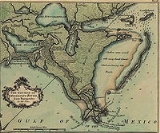
PreludeBy December 12, 1814 a large British fleetRoyal Navy

The Royal Navy of the United Kingdom is the oldest of the British armed services ....
 under the command of Sir Alexander CochraneAlexander Cochrane

Admiral Sir Alexander Cochrane was a senior Royal Navy commander during the Napoleonic Wars....
 and with more than 10,000 soldiers and sailors aboard, had anchored in the Gulf of MexicoFacts About Gulf of Mexico

The Gulf of Mexico is a major body of water bordered and nearly landlocked by North America....
 east of Lake PontchartrainLake Pontchartrain

Lake Pontchartrain is a brackish lake located in southeastern Louisiana....
 and Lake BorgneLake Borgne

Lake Borgne is a lagoon in eastern Louisiana of the Gulf of Mexico....
. Preventing access to the lakes was an American flotilla, commanded by Thomas ap Catesby JonesThomas ap Catesby Jones

Thomas ap Catesby Jones was a U.S....
, consisting of five gunboatGunboat

A gunboat is literally a boat carrying one or more guns....
s. On December 14, British sailors in rowing boatsLongboat

The longboat should not be confused with a Longship; nor with a narrowboat....
, each boat armed with a small cannonCannon

A cannon is any large tubular firearm designed to fire a heavy projectile over a considerable distance....
, captured the vastly outnumbered American gunboats in a brief but violent battle.


Discussion
Ask a question about 'Battle of New Orleans'
Start a new discussion about 'Battle of New Orleans'
Answer questions from other users
Full Discussion Forum


Timeline

1815   War of 1812: Battle of New Orleans


Encyclopedia


The Battle of New Orleans took place on January 8, 1815, and was the final major battle of the War of 1812War of 1812 Overview

The War of 1812 was fought between the United States of America and Britain and its colonies in British North America from ...
. AmericanUnited States Overview

The United States of America, also known as the United States, the U.S., the U.S.A., and America, is...
 forces, with General Andrew JacksonAndrew Jackson

Andrew Jackson was the seventh President of the United States , first governor of Florida , general of the Battle of New O...
 in command, defeated an invading British ArmyBritish Army

The British Army is the land armed forces branch of the British Armed Forces....
 intent on seizing New Orleans and America's vast western lands. The Treaty of GhentTreaty of Ghent Summary

The Treaty of Ghent, signed on December 24, 1814, in Ghent, Flanders, United Kingdom of the Netherlands, ended the War of 18...
 had been signed on 24 December 1814, but news of the peace would not reach New Orleans until February.

Prelude

By December 12, 1814 a large British fleetRoyal Navy

The Royal Navy of the United Kingdom is the oldest of the British armed services ....
 under the command of Sir Alexander CochraneAlexander Cochrane

Admiral Sir Alexander Cochrane was a senior Royal Navy commander during the Napoleonic Wars....
 and with more than 10,000 soldiers and sailors aboard, had anchored in the Gulf of MexicoFacts About Gulf of Mexico

The Gulf of Mexico is a major body of water bordered and nearly landlocked by North America....
 east of Lake PontchartrainLake Pontchartrain

Lake Pontchartrain is a brackish lake located in southeastern Louisiana....
 and Lake BorgneLake Borgne

Lake Borgne is a lagoon in eastern Louisiana of the Gulf of Mexico....
. Preventing access to the lakes was an American flotilla, commanded by Thomas ap Catesby JonesThomas ap Catesby Jones

Thomas ap Catesby Jones was a U.S....
, consisting of five gunboatGunboat

A gunboat is literally a boat carrying one or more guns....
s. On December 14, British sailors in rowing boatsLongboat

The longboat should not be confused with a Longship; nor with a narrowboat....
, each boat armed with a small cannonCannon

A cannon is any large tubular firearm designed to fire a heavy projectile over a considerable distance....
, captured the vastly outnumbered American gunboats in a brief but violent battle. Now free to navigate Lake Borgne, thousands of BritishBritish Army

The British Army is the land armed forces branch of the British Armed Forces....
 soldiers, under the command of General John Keane, were rowed to Pea Island, about east of New Orleans, where they established a garrisonGarrison

Garrison is the collective term for a body of troops stationed in a particular location, originally to guard it, but now oft...
.

On the morning of December 22, Keane led a vanguard of 1600 British soldiers from the island to the east bank of the Mississippi RiverMississippi River

The Mississippi River, derived from the old Ojibwe word misi-ziibi meaning 'great river' , is the longest river in the U...
, south of New Orleans. Keane could have attacked the city by advancing for a few hours up the river road, which was undefended all the way to New Orleans, but he made the fateful decision to wait for the arrival of reinforcements. Early that afternoon, when news of the British position reached Major General Andrew JacksonAndrew Jackson

Andrew Jackson was the seventh President of the United States , first governor of Florida , general of the Battle of New O...
 at New Orleans, he reportedly said, "Gentlemen, the British are below, we must fight them tonight." Jackson quickly sent about 2000 of his troops from New Orleans to a position immediately north of the British to block them from making any further advances toward the city. Jackson, because he needed time to get his artillery into position, decided to attack the British immediately. On the night of December 23, Jackson personally led a three-pronged attack on the British camp that lasted until the early morning hours of December 24. The Americans suffered a reported 24 killed, 115 wounded, and 74 missing or captured, while the British reported their losses as 46 killed, 167 wounded, and 64 missing or captured.

Jackson's troops quickly built an earthworksEarthworks (engineering)

In civil engineering, earthworks are engineering works created through the moving of massive quantities of soil or unformed ...
 and fortified it with heavy artillery. On ChristmasChristmas

Christmas is a holiday on the Christian calendar, celebrating the birth of Jesus....
 Day, General Edward PakenhamFacts About Edward Pakenham

Sir Edward Michael Pakenham was a British general who was killed at the Battle of New Orleans....
 arrived on the battlefield and ordered a reconnaissance-in-forceReconnaissance Overview

Reconnaissance is the military term for the active gathering of information about an enemy, or other conditions, by physical...
 on January 1, 1815 against the American earthworks protecting the advance to New Orleans. That evening, General Pakenham met with General Keane and Admiral Cochrane for an update on the situation, angry with the position that the army had been placed in. General Pakenham wanted to use Chef Menteur RoadChef Menteur Pass

The Chef Menteur Pass is a narrow natural waterway which, along with the Rigolets, connects Lake Pontchartrain and Lake Borg...
 as the invasion route but was over-ruled by Admiral Cochrane who insisted that his boats were providing everything that could be needed. Admiral Cochrane believing that the British Army would destroy a ramshackle American army and allegedly said that if the Army would not do so his sailors would. Whatever Pakenham's thoughts on the matter, the meeting settled the method and place of the attack. On December 28, groups of British troops made probing attacks against the American earthworks.

When the British troops withdrew, the Americans began construction of artillery batteries to protect the earthworks, which were then christened Line Jackson. The Americans installed eight batteries, which included one 32-pound gun, three 24-pounders, one 18-pounder, three 12-pounders, three 6-pounders, and a howitzer. Jackson also sent a detachment of men to the west bank of the Mississippi to man two 24-pounders and two 12-pounders from the grounded warship LouisianaUSS Louisiana Summary

Five commissioned ships of the United States Navy have borne the name USS Louisiana in honor of the 18th state....
.

The main British army arrived on New Year's Day, and attacked the earthworks using their artillery. An exchange of artillery fire began that lasted for three hours. Several of the American guns were destroyed or knocked out, including the 32-pounder, a 24-pounder, and a 12-pounder, and some damage was done to the earthworks. The British guns ran out of ammunition, which led Pakenham to cancel the attack. Unknown at the moment to Pakenham, the Americans on the left of Line Jackson near the swamp had broken and ran from the position. Pakenham decided to wait for his entire force of over 8000 men to assemble before launching his attack.

Battle of January 8


In the early morning of January 8, Pakenham ordered a two-pronged assault against Jackson's position: a small force on the west bank of the Mississippi and the main attack in three columns (along the river, along the swamp line, and in reserve) directly against the earthworks manned by the vast majority of American troops.

Preparations for the attack had foundered early, as a canal being dug by Cochrane's sailors collapsed and the dam made to divert the flow of the river into the canal failed leaving the sailors to drag the boats of Col. Thornton's west bank assault force through deep mud and left the force starting off just before daybreak 12 hours late.

The attack began under darkness and a heavy fog, but as the British neared the main enemy line, the fog lifted, exposing them to withering artillery fire. Lt-Col. Thomas MullinsThomas Mullins (British Army officer)

Thomas Mullins was a British Army officer of the 44th Regiment of Foot, best known for his misconduct at the Battle of New ...
, the British commander of the 44th (East Essex) Regiment of Foot, had forgotten the ladderLadder

A ladder is a vertical set of steps....
s and fascineFascine

A fascine is a rough bundle of brushwood used for strengthening an earthen structure, or making a path across uneven or wet ...
s needed to cross a canal and scale the earthworks, and confusion evolved in the dark and fog as the British tried to close the gap. Most of the senior officers were killed or wounded, and the British infantry either flung themselves to the ground, huddled in the canal, or were mown down by a combination of musket fire and grapeshotGrapeshot

Grapeshot is a type of anti-personnel ammunition used in cannons....
 from the Americans. A handful made it to the top of the parapetParapet

A parapet consists of a dwarf wall along the edge of a roof, or round a lead flat, terrace walk, etc., to prevent persons fr...
 but were either killed or captured. An American advance redoubtRedoubt Overview

A redoubt is a fort or fort system usually consisting of an enclosed defensive emplacement outside a larger fort....
 next to the river was overrun by British light infantry but without reinforcements they could neither hold the position nor storm the main American line behind.

The two large, main assaults on the American position were repulsed. Pakenham was fatally wounded, while on horseback, by grapeshot fired from the earthworks. General John Lambert assumed command and eventually ordered a withdrawal.

The only British success was on the west bank of the Mississippi River, where a 700-man detachment under the command of Colonel Thornton of the 85th light infantry attacked and overwhelmed the American line. However the attack came after the loss of the main battle. Though both Jackson and Patterson reported the retreating forces had spiked their cannon leaving no guns to turn on the American's main defense line, this is contradicted by Major Mitchell's diary which makes it clear this was not so, as he states he had "Commenced cleaning enemy's guns to form a battery to enfilade their lines on the left bank". General Lambert ordered his Chief of Artillery to assess the position, who reported back that no less than 2,000 men would be needed to hold the position. General Lambert issued orders to withdraw after the defeat of their main army on the east bank, and retreated taking a few American prisoners and cannons with them.

At the end of the day, the British had 2,037 casualties: 291 dead (including three senior generals), 1,262 wounded, and 484 captured or missing. The Americans had 71 casualties: 13 dead, 39 wounded, and 19 missing.

Aftermath

With the defeat of the British army and the death of Pakenham, Lambert decided that despite the arrival of reinforcements and a siege train for use against New Orleans, continuing the battle would be too costly. Within a week, all of the British troops had redeployed onto the ships and sailed away to Biloxi, MississippiBiloxi, Mississippi Overview

Biloxi is a city in Harrison County, Mississippi, in the United States....
, where the British army attacked and captured Fort BowyerBattle of Fort Bowyer

The Battle of Fort Bowyer was the last engagement between British and American forces in the War of 1812....
 on February 12. The British army was making preparations to attack MobileMobile, Alabama

Mobile is a city located in Mobile County, Alabama, US, along Mobile Bay....
 when news arrived of the peace treaty. The treaty had been ratified by the British Parliament but would not be ratified by Congress and the president until mid-February. It, however, did resolve that hostilities should cease, and the British sailed home. While the Battle of New Orleans had no influence on the terms of the Treaty of Ghent, the defeat at New Orleans did compel Britain to abide by the treaty. Also, since the Treaty of Ghent did not specifically mention the vast territory America had acquired with the Louisiana PurchaseLouisiana Purchase

The Louisiana Purchase was the acquisition by the United States of more than 530,000,000 acres of territory from France in...
, it only required both sides to give back those lands that had been taken from the other during the war.

Americans believed that a vastly powerful British fleet and army had sailed for New Orleans (Jackson himself thought 25,000 troops were coming), and most expected the worst. The news of victory, one man recalled, "came upon the country like a clap of thunder in the clear azure vault of the firmament, and traveled with electromagnetic velocity, throughout the confines of the land." The battle boosted the reputation of Andrew Jackson and helped to propel him to the White House. The anniversary of the battle was celebrated for many years.

A federal park was established in 1907 to preserve the battlefield; today it features a monument and is part of Jean Lafitte National Historical Park and PreserveJean Lafitte National Historical Park and Preserve Summary

Jean Lafitte National Historical Park and Preserve protects significant examples of the rich natural and cultural resources ...
.

The Battle of New OrleansThe Battle of New Orleans Overview

For other uses of the name, see Battle of New Orleans....
 is a song written by Jimmie Driftwood, detailing the battle from the perspective of an American volunteer fighting alongside Andrew Jackson, with a lighthearted tone. The version by Johnny HortonJohnny Horton

Johnny Horton was an American country music singer....
 topped the Billboard Hot 100 in 1959.

See also

  • Jackson's Military RoadJackson's Military Road Overview

    Jackson's Military Road was a route from Nashville, Tennessee to New Orleans, Louisiana....
  • Chalmette National CemeteryChalmette National Cemetery

    Chalmette National Cemetery is a United States National Cemetery located within Jean Lafitte National Historical Park and Pr...
  • Our Lady of Prompt SuccorOur Lady of Prompt Succor

    Our Lady of Prompt Succor is the religious title given to the Blessed Virgin Mary, the mother of Jesus, by the Roman Catholi...
  • The Battle of New OrleansThe Battle of New Orleans

    For other uses of the name, see Battle of New Orleans....
     (1959 song)
  • List of conflicts in the United StatesList of conflicts in the United States

    List of conflicts in the United States is a timeline of events that includes wars, battles, skirmishes, major terrorist atta...


External links

  • - detailed account by military historians
  • — summary account by the Louisiana State Museum, with photographs
  • - research collection by The Historic New Orleans CollectionThe Historic New Orleans Collection

    The Historic New Orleans Collection is a museum, research center, and publisher dedicated to the study and preservation of ...
  • — detailed account by Charles GayarréCharles Gayarré

    Charles Etienne Arthur Gayarre was an American historian born in New Orleans, Louisiana, on 9 January 1805....
  • — detailed account by John Smith Kendall
  • — colorful account by Grace KingGrace King

    Grace Elizabeth King was an American author of Louisiana stories, history, and biography, and a leader in historical and lit...
  • — account by Theodore RooseveltTheodore Roosevelt

    Theodore Roosevelt, Jr. , also known as T.R. and to the public as Teddy, was the 26th President of the United S...
  • — eyewitness accounts, as published in the Louisiana Historical Quarterly