


Obelisk of Buenos Aires

Encyclopedia
The Obelisk of Buenos Aires (Spanish
: Obelisco de Buenos Aires) is a national historic monument and icon
of Buenos Aires
. Located in the Plaza de la República
, in the intersection of avenues Corrientes
and 9 de Julio
, it was built to commemorate the fourth centenary of the first foundation of the city.
In order to enrich the surroundings of the iconic monument, the government of the city started the project Punto Obelisco
. Creating a zone full of LED
signs. Since the Obelisk of the city is always associated with the night and entertainment of Buenos Aires, this project creates a zone similar to Times Square
in New York
and Picadilly Circus in London
.
(one of the main architects of the Argentine modernism who also designed the Teatro Gran Rex
, in Corrientes and Suipacha) at the request of the mayor Mariano de Vedia y Mitre (appointed by president Agustín Pedro Justo
). For its construction, which cost 200,000 pesos moneda nacional
, 680 m³ of concrete and 1360 m² of Olaen white stone from Córdoba
were used.
The obelisk
was built by the German company G.E.O.P.E. - Siemens Bauunion - Grün & Bilfinger, which completed its work in a record time of 31 days, with 157 workers. The rapid hardening Incor cement was used and was built in sections of 2 meters to facilitate the dumping of concrete
.
Its height is 67.5 m, and 63 m of these are up to the initiation of the apex, which is 3.5 m by 3.5 m. The tip is blunt, measuring 40 cm and ends in a lightning rod
that can not be seen because of the height, whose cables run through the interior of the obelisk.
It has only one entrance (in its west side) and on its top there are four window
s, that can only be reached by a straight staircase of 206 steps with 7 breaks every 8–6 m.
On February 20, 1938, Roberto María Ortiz
succeeded Justo
and appointed Arturo Goyenche as the new mayor of the city. In June 1939 the City Council sanctioned the demolition of the Obelisco, citing economic, aesthetic and public safety reasons. However, the ordinance was vetoed by the municipal executive power, characterizing it as an act lacking of value and juridical content, because it alters the state of things emanated by the executive power, and that it was a monument under the jurisdiction and custody of the Nation whose heritage belongs to it.
Where the Obelisco stands, a church dedicated to St. Nicholas of Bari was previously demolished. In that church the Argentine flag
was officially hoisted for the first time in Buenos Aires
, 1812. That fact is noted in one of the inscriptions on the north side of the monument.
As a result of some detachments of stone cladding, which occurred on the night of June 20-21, 1938, the day after a public event with the presence of president Ortiz took place there, it was decided to remove such cladding in 1943 and was replaced by another one made of polished cement, making cracks to simulate the joints of the stones. When the slabs were removed, a lenged that said <> was also removed.
For some time during the 1970s, during the Peronist
government of Isabel Martínez de Perón
, a ring-shaped sign was hung around the obelisk, with the motto El silencio es salud (Silence is health). Although it was allegedly geared against motorists creating excessive noise
, it was widely interpreted as a statement calling Argentines to refrain from expressing their political views.
Throughout its history, the monument has suffered vandalism, especially politically-oriented graffiti
. In the 1980s, an activist group broke in and spilled paint from the top windows, causing the city government to erect a fence around its base. This move stirred controversy, but eventually proved effective in reducing the number of defacing incidents.
On 1 November 2005 it was announced that a comprehensive restoration, financed by the Argentine painting and restoration industry association (Ceprara), was finished. The monument was painted with 90-micrometre acrylic paint to a "Paris stone" hue, deemed more pleasant than the previously used white.
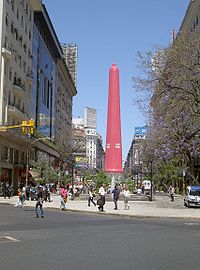
On December 1, 2005, the obelisk was covered by a giant pink "condom" to commemorate the World AIDS day
.
To commemorate the 30th anniversary of the La Noche de los Lápices
, the monument was converted into a giant pencil.
Lines B
, C
, and D
of the Buenos Aires Metro
have stations near the monument, and are connected by a number of underground passages with commercial galleries.
On the side facing south, in its base in a very small rectangle, this sonnet written by Baldomero Fernández Moreno during a tribute dinner in the Alvear Palace Hotel
to Prebisch:
Spanish language
Spanish , also known as Castilian , is a Romance language in the Ibero-Romance group that evolved from several languages and dialects in central-northern Iberia around the 9th century and gradually spread with the expansion of the Kingdom of Castile into central and southern Iberia during the...
: Obelisco de Buenos Aires) is a national historic monument and icon
Landmarks in Buenos Aires
There are many landmarks in Buenos Aires, Argentina some of which are of considerable historical or artistic interest.-Monumento de los Españoles:...
of Buenos Aires
Buenos Aires
Buenos Aires is the capital and largest city of Argentina, and the second-largest metropolitan area in South America, after São Paulo. It is located on the western shore of the estuary of the Río de la Plata, on the southeastern coast of the South American continent...
. Located in the Plaza de la República
Plaza de la República (Buenos Aires)
Plaza de la República is a vast city square in Buenos Aires, capital of Argentina. It is located in the San Nicolás quarter, at the intersection of the city's three main arteries : Ninth of July Avenue, Corrientes Avenue, and Diagonal Norte...
, in the intersection of avenues Corrientes
Corrientes Avenue
Avenida Corrientes is one of the principal thoroughfares of the Argentine capital of Buenos Aires. The street is intimately tied to the tango and the porteño sense of identity...
and 9 de Julio
9 de Julio Avenue
Avenida 9 de Julio is a wide avenue in the city of Buenos Aires, Argentina. Its name honors Argentina's Independence Day, July 9, 1816.The avenue runs roughly one kilometer to the west of the Río de la Plata waterfront, from the Retiro district in the north to Constitución station in the south...
, it was built to commemorate the fourth centenary of the first foundation of the city.
In order to enrich the surroundings of the iconic monument, the government of the city started the project Punto Obelisco
Punto Obelisco
Punto Obelisco is a zone around the Obelisk of Buenos Aires and the Plaza de la República. It is a project held by the city's government in order to enrich the surroundings of the monument and to make it the center of entertainment in the city...
. Creating a zone full of LED
LEd
LEd is a TeX/LaTeX editing software working under Microsoft Windows. It is a freeware product....
signs. Since the Obelisk of the city is always associated with the night and entertainment of Buenos Aires, this project creates a zone similar to Times Square
Times Square
Times Square is a major commercial intersection in the borough of Manhattan in New York City, at the junction of Broadway and Seventh Avenue and stretching from West 42nd to West 47th Streets...
in New York
New York City
New York is the most populous city in the United States and the center of the New York Metropolitan Area, one of the most populous metropolitan areas in the world. New York exerts a significant impact upon global commerce, finance, media, art, fashion, research, technology, education, and...
and Picadilly Circus in London
London
London is the capital city of :England and the :United Kingdom, the largest metropolitan area in the United Kingdom, and the largest urban zone in the European Union by most measures. Located on the River Thames, London has been a major settlement for two millennia, its history going back to its...
.
History
Construction began on March 20, 1936 and was inaugurated on May 23 of the same year. It was designed by architect Alberto PrebischAlberto Prebisch
Alberto Prebisch was a distinguished Argentine architect whose numerous works included private houses, apartment and office blocks, cinemas, shops and banks...
(one of the main architects of the Argentine modernism who also designed the Teatro Gran Rex
Teatro Gran Rex
The Teatro Gran Rex is an Art Deco style theatre in Buenos Aires, Argentina which opened on July 8, 1937, as the largest cinema in South America....
, in Corrientes and Suipacha) at the request of the mayor Mariano de Vedia y Mitre (appointed by president Agustín Pedro Justo
Agustín Pedro Justo
General Agustín Pedro Justo Rolón was President of Argentina from February 20, 1932, to February 20, 1938...
). For its construction, which cost 200,000 pesos moneda nacional
Argentine peso moneda nacional
The peso moneda nacional was the currency of Argentina between November 5, 1881 and December 31, 1969. It was subdivided into 100 centavos, with the argentino worth 5 pesos. Its symbol was m$n or $m/n. Its ISO 4217 code was ARM.-History:...
, 680 m³ of concrete and 1360 m² of Olaen white stone from Córdoba
Córdoba, Argentina
Córdoba is a city located near the geographical center of Argentina, in the foothills of the Sierras Chicas on the Suquía River, about northwest of Buenos Aires. It is the capital of Córdoba Province. Córdoba is the second-largest city in Argentina after the federal capital Buenos Aires, with...
were used.
The obelisk
Obelisk
An obelisk is a tall, four-sided, narrow tapering monument which ends in a pyramid-like shape at the top, and is said to resemble a petrified ray of the sun-disk. A pair of obelisks usually stood in front of a pylon...
was built by the German company G.E.O.P.E. - Siemens Bauunion - Grün & Bilfinger, which completed its work in a record time of 31 days, with 157 workers. The rapid hardening Incor cement was used and was built in sections of 2 meters to facilitate the dumping of concrete
Concrete
Concrete is a composite construction material, composed of cement and other cementitious materials such as fly ash and slag cement, aggregate , water and chemical admixtures.The word concrete comes from the Latin word...
.
Its height is 67.5 m, and 63 m of these are up to the initiation of the apex, which is 3.5 m by 3.5 m. The tip is blunt, measuring 40 cm and ends in a lightning rod
Lightning rod
A lightning rod or lightning conductor is a metal rod or conductor mounted on top of a building and electrically connected to the ground through a wire, to protect the building in the event of lightning...
that can not be seen because of the height, whose cables run through the interior of the obelisk.
It has only one entrance (in its west side) and on its top there are four window
Window
A window is a transparent or translucent opening in a wall or door that allows the passage of light and, if not closed or sealed, air and sound. Windows are usually glazed or covered in some other transparent or translucent material like float glass. Windows are held in place by frames, which...
s, that can only be reached by a straight staircase of 206 steps with 7 breaks every 8–6 m.
On February 20, 1938, Roberto María Ortiz
Roberto María Ortiz
Jaime Gerardo Roberto Marcelino María Ortiz Lizardi was President of Argentina from February 20, 1938 to June 27, 1942....
succeeded Justo
Agustín Pedro Justo
General Agustín Pedro Justo Rolón was President of Argentina from February 20, 1932, to February 20, 1938...
and appointed Arturo Goyenche as the new mayor of the city. In June 1939 the City Council sanctioned the demolition of the Obelisco, citing economic, aesthetic and public safety reasons. However, the ordinance was vetoed by the municipal executive power, characterizing it as an act lacking of value and juridical content, because it alters the state of things emanated by the executive power, and that it was a monument under the jurisdiction and custody of the Nation whose heritage belongs to it.
Where the Obelisco stands, a church dedicated to St. Nicholas of Bari was previously demolished. In that church the Argentine flag
Flag of Argentina
The national flag of Argentina is a triband, composed of three equally wide horizontal bands coloured light blue, white and light blue. There are multiple interpretations on the reasons for those colors...
was officially hoisted for the first time in Buenos Aires
Buenos Aires
Buenos Aires is the capital and largest city of Argentina, and the second-largest metropolitan area in South America, after São Paulo. It is located on the western shore of the estuary of the Río de la Plata, on the southeastern coast of the South American continent...
, 1812. That fact is noted in one of the inscriptions on the north side of the monument.
As a result of some detachments of stone cladding, which occurred on the night of June 20-21, 1938, the day after a public event with the presence of president Ortiz took place there, it was decided to remove such cladding in 1943 and was replaced by another one made of polished cement, making cracks to simulate the joints of the stones. When the slabs were removed, a lenged that said <
For some time during the 1970s, during the Peronist
Peronism
Peronism , or Justicialism , is an Argentine political movement based on the programmes associated with former President Juan Perón and his second wife, Eva Perón...
government of Isabel Martínez de Perón
Isabel Martínez de Perón
María Estela Martínez Cartas de Perón , better known as Isabel Martínez de Perón or Isabel Perón, is a former President of Argentina. She was also the third wife of another former President, Juan Perón...
, a ring-shaped sign was hung around the obelisk, with the motto El silencio es salud (Silence is health). Although it was allegedly geared against motorists creating excessive noise
Noise
In common use, the word noise means any unwanted sound. In both analog and digital electronics, noise is random unwanted perturbation to a wanted signal; it is called noise as a generalisation of the acoustic noise heard when listening to a weak radio transmission with significant electrical noise...
, it was widely interpreted as a statement calling Argentines to refrain from expressing their political views.
Throughout its history, the monument has suffered vandalism, especially politically-oriented graffiti
Graffiti
Graffiti is the name for images or lettering scratched, scrawled, painted or marked in any manner on property....
. In the 1980s, an activist group broke in and spilled paint from the top windows, causing the city government to erect a fence around its base. This move stirred controversy, but eventually proved effective in reducing the number of defacing incidents.
On 1 November 2005 it was announced that a comprehensive restoration, financed by the Argentine painting and restoration industry association (Ceprara), was finished. The monument was painted with 90-micrometre acrylic paint to a "Paris stone" hue, deemed more pleasant than the previously used white.
On December 1, 2005, the obelisk was covered by a giant pink "condom" to commemorate the World AIDS day
World AIDS Day
World AIDS Day, observed December 1 every year, is dedicated to raising awareness of the AIDS pandemic caused by the spread of HIV infection. Government and health officials observe the day, often with speeches or forums on the AIDS topics. Since 1995, the President of the United States has made an...
.
To commemorate the 30th anniversary of the La Noche de los Lápices
Night of the Pencils
The Night of the Pencils , was a series of kidnappings and forced disappearances, followed by the torture, rape, and murder of a number of young students during the last Argentine dictatorship...
, the monument was converted into a giant pencil.
Lines B
Line B (Buenos Aires)
Line B of the Buenos Aires Metro runs from Leandro N. Alem to Los Incas/Parque Chas . Line B opened to the public on 17 October 1930....
, C
Line C (Buenos Aires)
Line C of the Buenos Aires Metro that runs from Retiro to Constitución terminus, opened on 9 November 1934, and it has a length of 4.3 km.-Stations and connections:-Murals:...
, and D
Line D (Buenos Aires)
Line D of the Buenos Aires Metro runs from Catedral to Congreso de Tucumán. The D Line opened on 3 June 1937 and has been expanded to the north several times. The line is currently 10.41 km long and runs approximately parallel to the city's coastline....
of the Buenos Aires Metro
Buenos Aires Metro
The Buenos Aires Metro , locally known as Subte is a mass-transit system that serves the city of Buenos Aires, Argentina. The first station of this network opened in 1913, the first of its kind in South America, the Southern Hemisphere and the entire Spanish-speaking world...
have stations near the monument, and are connected by a number of underground passages with commercial galleries.
Inscriptions on its sides
| North side | West side | South side | East side | Poem |
|---|---|---|---|---|
| English: English language English is a West Germanic language that arose in the Anglo-Saxon kingdoms of England and spread into what was to become south-east Scotland under the influence of the Anglian medieval kingdom of Northumbria... On this site in the St. Nicholas tower the National Flag Flag of Argentina The national flag of Argentina is a triband, composed of three equally wide horizontal bands coloured light blue, white and light blue. There are multiple interpretations on the reasons for those colors... was hoisted for the first time in the city the XXIII of August of MDCCCXII. |
English: English language English is a West Germanic language that arose in the Anglo-Saxon kingdoms of England and spread into what was to become south-east Scotland under the influence of the Anglian medieval kingdom of Northumbria... Capital Federal Ley enacted by the National Congress the XX of September of MDCCCLXXX initiative of the President Nicolás Avellaneda Nicolás Avellaneda Nicolás Remigio Aurelio Avellaneda Silva was an Argentine politician and journalist, and president of Argentina from 1874 to 1880. Avellaneda's main projects while in office were banking and education reform, leading to Argentina's economic growth... Decree of the President Julio A. Roca Julio Argentino Roca Alejo Julio Argentino Roca Paz was an army general who served as President of Argentina from 12 October 1880 to 12 October 1886 and again from 12 October 1898 to 12 October 1904.-Upbringing and early career:... VI of December of MDCCCLXXX. |
English: English language English is a West Germanic language that arose in the Anglo-Saxon kingdoms of England and spread into what was to become south-east Scotland under the influence of the Anglian medieval kingdom of Northumbria... Second Foundation by Juan de Garay Juan de Garay Juan de Garay was a Spanish conquistador.Garay was born in Orduña, Spain. He served under the Spanish crown, in the Viceroyalty of Peru... XI of June of MDLXXX. |
English: English language English is a West Germanic language that arose in the Anglo-Saxon kingdoms of England and spread into what was to become south-east Scotland under the influence of the Anglian medieval kingdom of Northumbria... Buenos Aires to the Republic In the IV centenary of the foundation of the city by Don Pedro de Mendoza Pedro de Mendoza Pedro de Mendoza y Luján was a Spanish conquistador, soldier and explorer, and the first adelantado of the Río de la Plata.- Setting sail :... . II of February of MDXXXVI. |
Poem by Baldomero Fernández Moreno inscribed on the south side. |
On the side facing south, in its base in a very small rectangle, this sonnet written by Baldomero Fernández Moreno during a tribute dinner in the Alvear Palace Hotel
Alvear Palace Hotel
The Alvear Palace Hotel is a luxury hotel located in Avenida Alvear in Recoleta, an upscale neighbourhood in Buenos Aires, Argentina. The hotel was inaugurated in 1932 and, following extensive refurbishment, was reinaugurated in 1994.-Notable guests:...
to Prebisch:
-
-
-
- El Obelisco
-
-
-
-
-
- ¿Donde tenía la ciudad guardada
- esta espada de plata refulgente
- desenvainada repentinamente
- y a los cielos azules asestada?
-
-
-
-
-
- Ahora puede lanzarse la mirada
- harta de andar rastrera y penitente
- piedra arriba hacia el Sol omnipotente
- y descender espiritualizada.
-
-
-
-
-
- Rayo de luna o desgarrón de viento
- en símbolo cuajado y monumento
- índice, surtidor, llama, palmera.
-
-
-
-
-
- La estrella arriba y la centella abajo,
- que la idea, el ensueño y el trabajo
- giren a tus pies, devanadera.
-
-
Special occasions
| December 1, 2005 | September 20, 2007 | May 23, 2010 |
|---|---|---|
 |
||
| A giant condom on El Obelisco (for World AIDS Day World AIDS Day World AIDS Day, observed December 1 every year, is dedicated to raising awareness of the AIDS pandemic caused by the spread of HIV infection. Government and health officials observe the day, often with speeches or forums on the AIDS topics. Since 1995, the President of the United States has made an... ) |
El Obelisco covered with the colors of Argentina Argentina Argentina , officially the Argentine Republic , is the second largest country in South America by land area, after Brazil. It is constituted as a federation of 23 provinces and an autonomous city, Buenos Aires... and Germany Germany Germany , officially the Federal Republic of Germany , is a federal parliamentary republic in Europe. The country consists of 16 states while the capital and largest city is Berlin. Germany covers an area of 357,021 km2 and has a largely temperate seasonal climate... , celebrating 150 years of bilateral relations between these countries |
El Obelisco celebrating the Argentina Bicentennial Argentina Bicentennial The Argentina Bicentennial is a series of celebrations and observances celebrated on May 25, 2010, and throughout the year. They commemorated the 200th anniversary of the May Revolution, a sequence of historical events that led to the Viceroy Baltasar Hidalgo de Cisneros' being ousted from office... |