


Boboli Gardens

Encyclopedia

Florence
Florence is the capital city of the Italian region of Tuscany and of the province of Florence. It is the most populous city in Tuscany, with approximately 370,000 inhabitants, expanding to over 1.5 million in the metropolitan area....
, Italy
Italy
Italy , officially the Italian Republic languages]] under the European Charter for Regional or Minority Languages. In each of these, Italy's official name is as follows:;;;;;;;;), is a unitary parliamentary republic in South-Central Europe. To the north it borders France, Switzerland, Austria and...
, that is home to a collection of sculptures dating from the 16th through the 18th centuries, with some Roman antiquities.
History and layout
The Gardens, behind the Pitti Palace, the main seat of the MediciMedici
The House of Medici or Famiglia de' Medici was a political dynasty, banking family and later royal house that first began to gather prominence under Cosimo de' Medici in the Republic of Florence during the late 14th century. The family originated in the Mugello region of the Tuscan countryside,...
grand dukes of Tuscany
Tuscany
Tuscany is a region in Italy. It has an area of about 23,000 square kilometres and a population of about 3.75 million inhabitants. The regional capital is Florence ....
at Florence, are some of the first and most familiar formal 16th century Italian gardens. The mid-16th century garden style, as it was developed here, incorporated longer axial developments, wide gravel avenues, a considerable "built" element of stone, the lavish employment of statuary and fountains, and a proliferation of detail, coordinated in semi-private and public spaces that were informed by classical accents: grotto
Grotto
A grotto is any type of natural or artificial cave that is associated with modern, historic or prehistoric use by humans. When it is not an artificial garden feature, a grotto is often a small cave near water and often flooded or liable to flood at high tide...
s, nympheums, garden temples and the like. The openness of the garden, with an expansive view of the city, was unconventional for its time.

Eleonora di Toledo
Eleanor of Toledo Eleanor of Toledo Eleanor of Toledo (Italian: Eleonora di Toledo (1522 – 17 December 1562), born Doña Leonor Álvarez de Toledo y Osorio, was a Spanish noblewoman who was Duchess of Florence from 1539. She is credited with being the first modern first lady, or consort...
, the wife of Cosimo I de' Medici. The first stage was scarcely begun by Niccolò Tribolo
Niccolò Tribolo
Niccolò di Raffaello di Niccolò dei Pericoli, called "Il Tribolo" was an Italian Mannerist artist in the service of Cosimo I de' Medici in his natal city of Florence.-Life:...
before he died in 1550, then was continued by Bartolomeo Ammanati
Bartolomeo Ammanati
Bartolomeo Ammannati was an Italian architect and sculptor, born at Settignano, near Florence. He studied under Baccio Bandinelli and Jacopo Sansovino and closely imitated the style of Michelangelo.He was more distinguished in architecture than in sculpture...
, with contributions in planning from Giorgio Vasari
Giorgio Vasari
Giorgio Vasari was an Italian painter, writer, historian, and architect, who is famous today for his biographies of Italian artists, considered the ideological foundation of art-historical writing.-Biography:...
, who laid out the grottos, and in sculpture by Bernardo Buontalenti
Bernardo Buontalenti
Bernardo Buontalenti, byname of Bernardo Delle Girandole was an Italian stage designer, architect, theatrical designer, military engineer and artist.-Biography:Buontalenti was born in Florence....
. The elaborate architecture of the grotto in the courtyard that separates the palace from its garden is by Buontalenti.
The garden lacks a natural water source. To water the plants in the garden, a conduit was built from the nearby Arno River to feed water into an elaborate irrigation system.
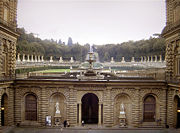
The primary axis, centered on the rear facade of the palace, rises on Boboli Hill from a deep amphitheater that is reminiscent in its shape of one half of a classical hippodrome
Hippodrome
A hippodrome was a Greek stadium for horse racing and chariot racing. The name is derived from the Greek words "hippos and "dromos"...
or racecourse. At the center of the amphitheater and rather dwarfed by its position is the Egyptian
Ancient Egypt
Ancient Egypt was an ancient civilization of Northeastern Africa, concentrated along the lower reaches of the Nile River in what is now the modern country of Egypt. Egyptian civilization coalesced around 3150 BC with the political unification of Upper and Lower Egypt under the first pharaoh...
obelisk
Obelisk
An obelisk is a tall, four-sided, narrow tapering monument which ends in a pyramid-like shape at the top, and is said to resemble a petrified ray of the sun-disk. A pair of obelisks usually stood in front of a pylon...
brought from the Villa Medici
Villa Medici
The Villa Medici is a mannerist villa and an architectural complex with a garden contiguous with the larger Borghese gardens, on the Pincian Hill next to Trinità dei Monti in Rome, Italy. The Villa Medici, founded by Ferdinando I de' Medici, Grand Duke of Tuscany and now property of the French...
at Rome. This primary axis terminates in a fountain of Neptune (known to the irreverent Florentines as the "Fountain of the Fork" for Neptune's trident), with the sculpture of Neptune by Stoldo Lorenzi
Stoldo Lorenzi
Stoldo Lorenzi was an Italian Mannerist sculptor.Born at Settignano, he studied in Florence and was influenced by artists such as Giambologna and Tribolo. Lorenzi mostly executed bronze sculptures. His masterwork in Florence is considered the Fountain of Neptune in the Boboli Gardens .Later he...
visible against the skyline as a visitor climbs the slope. At the top are the panoramic views of Florence, as painted by Camille Corot. Giulio Parigi
Giulio Parigi
Giulio Parigi was an Italian architect and designer. He was the main member of a family of architects and designers working for the Grand Ducal court of the Medici...
laid out the long secondary axis at a right angle to the main one, which leads down through a series of terraces and water features, with the bosquet
Bosquet
In the French formal garden, a bosquet is a formal plantation of trees, at least five of identical species planted as a quincunx, or set in strict regularity as to rank and file, so that the trunks line up as one passes along either face...
s on either side. In 1617 he constructed the Grotto of Vulcan (Grotticina di Vulcano).
The gardens have passed through several stages of enlargement and restructuring work. They were enlarged in the 17th century to their present extent of 45,000 meters² (11 acres). The Boboli Gardens have come to form an outdoor museum of garden sculpture that includes Roman antiquities as well as 16th and 17th century works.
In the first phase of building, the amphitheatre was excavated in the hillside behind the palace. Initially formed by clipped edges and greens, it was later formalized by rebuilding in stone decorated with statues based on Roman myths such as the Fountain of the Ocean sculpted by Giambologna
Giambologna
Giambologna, born as Jean Boulogne, incorrectly known as Giovanni da Bologna and Giovanni Bologna , was a sculptor, known for his marble and bronze statuary in a late Renaissance or Mannerist style.- Biography :...
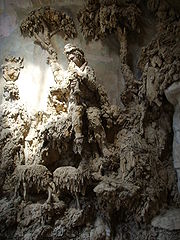
, then transferred to another location within the same garden. The small Grotto of Madama, and the Large Grotto, were begun by Vasari and completed by Ammannati and Buontalenti between 1583 and 1593.
Despite the fact that it is currently undergoing restoration work, the Large Grotto's statues continue to be remarkable examples of Mannerist
Mannerism
Mannerism is a period of European art that emerged from the later years of the Italian High Renaissance around 1520. It lasted until about 1580 in Italy, when a more Baroque style began to replace it, but Northern Mannerism continued into the early 17th century throughout much of Europe...
architecture and culture. Decorated internally and externally with stalactites and originally equipped with waterworks and luxuriant vegetation, the fountain is divided into three main sections. The first one was frescoed to create the illusion of a natural grotto, that is a natural refuge to allow shepherds to protect themselves from wild animals; it originally housed The Prisoners of Michelangelo
Michelangelo
Michelangelo di Lodovico Buonarroti Simoni , commonly known as Michelangelo, was an Italian Renaissance painter, sculptor, architect, poet, and engineer who exerted an unparalleled influence on the development of Western art...
(now replaced by copies), statues that were first intended for the tomb of the Pope Julius II
Pope Julius II
Pope Julius II , nicknamed "The Fearsome Pope" and "The Warrior Pope" , born Giuliano della Rovere, was Pope from 1503 to 1513...
. Other rooms in the Grotto contain Giambologna's famous Bathing Venus and an 18th-century group of Paris and Helen by Vincenzo de' Rossi.
