
|
|
|
|
Chukchi people
|
| |
|
| |
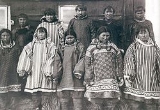
Chukchi, or Chukchee ( (plural), (singular)) are an indigenous people inhabiting the Chukchi Peninsula and the shores of the Chukchi Sea and the Bering Sea region of the Arctic Ocean within the Russian Federation. They speak the Chukchi language. The Chukchi originated from the people living around the Okhotsk Sea.
Cultural history The majority of Chukchi reside within Chukotka Autonomous Okrug, but some also reside in the neighboring Sakha Republic to the west, Magadan Oblast to the southwest, and Koryak Autonomous Okrug to the south.

Discussion
Ask a question about 'Chukchi people'
Start a new discussion about 'Chukchi people'
Answer questions from other users
|
Encyclopedia
Chukchi, or Chukchee ( (plural), (singular)) are an indigenous people inhabiting the Chukchi Peninsula and the shores of the Chukchi Sea and the Bering Sea region of the Arctic Ocean within the Russian Federation. They speak the Chukchi language. The Chukchi originated from the people living around the Okhotsk Sea.
Cultural history The majority of Chukchi reside within Chukotka Autonomous Okrug, but some also reside in the neighboring Sakha Republic to the west, Magadan Oblast to the southwest, and Koryak Autonomous Okrug to the south. Some Chukchi also reside in other parts of Russia, as well as in Europe and North America. The total number of Chukchi in the world slightly exceeds 15,000.
The Chukchi are traditionally divided into the Maritime Chukchi, who had settled homes on the coast and lived primarily from sea mammal hunting, and the Reindeer Chukchi, who nomadised in the inland tundra region with their herds of reindeer. The Russian name "Chukchi" is derived from the Chukchi word Chauchu ("rich in reindeer"), which was used by the 'Reindeer Chukchi' to distinguish themselves from the 'Maritime Chukchi,' called Anqallyt ("the sea people"). The indigenous name for a member of the Chukchi ethnic group as a whole is Luoravetlan (literally 'true person').
In Chukchi religion, every object, whether animate or inanimate, is assigned a spirit. This spirit can be either harmful or beneficial. Some of Chukchi myths reveal a dualistic cosmology. Chukchi religious practices were prohibited by the Soviet Union in the 1920s.
After the collapse of the Soviet Union, the state-run farms were reorganized and nominally privatized. This process was ultimately destructive to the village-based economy in Chukotka, and the region has still not fully recovered. Many rural Chukchi, as well as Russians in Chukotka's villages, have survived in recent years only with the help of direct humanitarian aid. Some Chukchi have attained university degrees, becoming poets, writers, politicians, teachers, and doctors.
Subsistence
In prehistoric times the Chukchi engaged in nomadic hunter gatherer modes of existence. In current times there continue to be some elements of subsistence hunting, including that of Polar Bears, marine mammals and reindeer. Beginning in the 1920s, the Soviets organized the economic activities of both coastal and inland Chukchi and eventually established 28 collectively run, state-owned enterprises in Chukotka. All of these were based on reindeer herding, with the addition of sea mammal hunting and walrus ivory carving in the coastal areas. Chukchi were educated in Soviet schools and today are almost 100% literate and fluent in the Russian language. Only a portion of them today work directly in reindeer herding or sea mammal hunting.
Chukchis and Russians
Russians first encountered the Chukchis on the Kolyma River in 1644. Exploration had started in 1633 when a group sailed down the Lena River from Yakutsk and explored the rivers flowing into the Arctic. In 1649 a band of Russians sailed down the Kolyma and up the west-flowing Anyui River, found a portage, and went down the Anadyr River which flows into the Pacific. In 1652, on the middle Anadyr they founded the fort of Anadyrsk, which would become their base for operations against the Chukchis. The overland journey from Yakutsk to Anadyrsk took about six months.
The Chukchis were generally ignored for the next fifty years. The first attempt to conquer them was made in 1701. Other expeditions were sent out in 1708, 1709 and 1711 with a fair amount of bloodshed but not much success. War was renewed in 1729 when an expedition from Okhotsk was defeated by the Chukchis and its commander killed. Command passed to Major Pavlyutsky who adopted very destructive tactics, burning, killing, driving off reindeer and capturing women and children. In 1742 Saint Petersburg ordered another war in which the Chukchis and Koryaks were to be ‘totally extirpated.’ The war (1744-7) was conducted with similar brutality and came to an end when Pavlyutsky was killed. It is said that the Chukchis kept his head as a trophy for a number of years. There was more war in the 1750s.
In 1762 Saint Petersburg adopted a different policy. Maintaining the fort at Anadyrsk had cost some 1,380,000 rubles, but the area had returned only 29,150 rubles in taxes. Anadyrsk was abandoned in 1764. The Chukchis, no longer provoked, entered into peaceful trade with the Russians. From 1788 there was an annual trade fair on the lower Kolyma. Another was established on the Angarka, a tributary of the Great Anyui in 1775. This trade declined in the late nineteenth century when American whalers and others began landing goods on the coast. The first Orthodox missionaries entered Chukchi territory some time after 1815.
Soviet Period
Apart from four Orthodox schools, there were no schools in the Chukchi land until the late 1920s. In 1926 there were 72 literate Chukchis. A Latin alphabet was introduced in 1932 and replaced with Cyrillic in 1937. In 1934 71 % of the Chukchis were still nomadic. By 1939, 95% of the coastal Chukchis were collectivized, but only 11% of the reindeer nomads. In the late 1930s several ‘reindeer kings’ had very large herds and employed hired labor. In 1941 90% of the reindeer were still privately owned. So-called kulaks still roamed with their private herds up into the 1950s. After 1990 there was a major exodus of Russians.
Population estimates from Forsyth: 1700: 6,000, 1800: 8-9,000, 1926: 13,100, 1930s:12,000, 1939: 13,900, 1959: 11,700, 1979: at least 13,169.
See also
External links
|
| |
|
|