
All Topics  
Medieval music

 
Medieval Music

   Email Print
   Bookmark   Link


Medieval music


The term medieval music encompasses European music written during the Middle Ages
Middle Ages

File:Karl 1 mit papst gelasius gregor1 sacramentar v karl d kahlen.jpgThe Middle Ages of European history are a period in history which lasted for roughly a millennium, commonly dated from the fall of the Roman Empire in the 5th century to the beginning of the Early Modern Period in the 16th century, marked by the division of Western Christi...
. This era begins with the fall of the Roman Empire and ends in approximately the middle of the fifteenth century. Establishing the end of the medieval era
Dates of classical music eras

Music history divide the European classical music repertory into various eras based on what style was most popular as taste changed. These eras and styles include Medieval music, Renaissance music, Baroque music, Classical music era, Romantic music, and 20th century music....
 and the beginning of the Renaissance
Renaissance

The Renaissance was a cultural movement that spanned roughly the 14th to the 17th century, beginning in Italy in the late Middle Ages and later spreading to the rest of Europe....
 is admittedly arbitrary; 1400 is used here.
only medieval music which can be studied is that which was written, and survived.


Discussion
Ask a question about 'Medieval music'
Start a new discussion about 'Medieval music'
Answer questions from other users
Full Discussion Forum


Recent Posts


Encyclopedia


The term medieval music encompasses European music written during the Middle Ages
Middle Ages

File:Karl 1 mit papst gelasius gregor1 sacramentar v karl d kahlen.jpgThe Middle Ages of European history are a period in history which lasted for roughly a millennium, commonly dated from the fall of the Roman Empire in the 5th century to the beginning of the Early Modern Period in the 16th century, marked by the division of Western Christi...
. This era begins with the fall of the Roman Empire and ends in approximately the middle of the fifteenth century. Establishing the end of the medieval era
Dates of classical music eras

Music history divide the European classical music repertory into various eras based on what style was most popular as taste changed. These eras and styles include Medieval music, Renaissance music, Baroque music, Classical music era, Romantic music, and 20th century music....
 and the beginning of the Renaissance
Renaissance

The Renaissance was a cultural movement that spanned roughly the 14th to the 17th century, beginning in Italy in the late Middle Ages and later spreading to the rest of Europe....
 is admittedly arbitrary; 1400 is used here.

Overview


Styles and trends

The only medieval music which can be studied is that which was written, and survived. Since creating musical manuscript
Manuscript

A manuscript is any document that is written by hand, as opposed to being printed or reproduced in some other way. The term may also be used for information that is hand-recorded in other ways than writing, for example inscriptions that are chiselled upon a hard material or scratched as with a knife point in plaster or with a stylus on a wa...
s was very expensive, due to the expense of parchment, and the huge amount of time necessary for a scribe to copy it all down, only wealthy institutions were able to create manuscripts which have survived to the present time. These institutions generally included the church and church institutions, such as monasteries
Monastery

Monastery , a term derived from the Greek language word ???ast?????, neut. of ???ast????? - monasterios denotes the building, or complex of buildings, that houses a room reserved for prayer as well as the domestic quarters and workplace of Monk, whether monks or nuns, and whether living in Cenobium or alone ....
; some secular music, as well as sacred music, was also preserved by these institutions. These surviving manuscripts do not reflect much of the popular music of the time. At the start of the era, the notated music is presumed to be monophonic
Monophony

In music, monophony is the simplest of texture , consisting of melody without accompanying harmony. This may be realized as just one note at a time, or with the same note duplicated at the octave ....
 and homorhythmic with what appears to be a unison sung text and no notated instrumental support. Earlier medieval notation had no way to specify rhythm, although neumatic notations gave clear phrasing ideas, and somewhat later notations indicated rhythmic mode
Rhythmic mode

In medieval music, the rhythmic modes were patterns of long and short durations imposed on written musical notation which otherwise appeared to be identical....
s.

The simplicity of chant
Chant

Chant is the rhythmic speaking or singing of words or sounds, often primarily on one or two pitch es called reciting tones. Chants may range from a simple melody involving a limited set of note s to highly complex musical structures, often including a great deal of repetition of musical subphrases, such as Great Responsories and Offertory o...
, with unison voice and natural declamation, is most common. The notation of polyphony
Polyphony

In music, polyphony is a texture consisting of two or more independent melodic voice , as opposed to music with just one voice or music with one dominant melodic voice accompanied by chord s ....
 develops, and the assumption is that formalized polyphonic practices first arose in this period. Harmony, in consonant intervals of perfect fifths, unisons, octaves, (and later, perfect fourths) begins to be notated. Rhythmic notation allows for complex interactions between multiple vocal lines in a repeatable fashion. The use of multiple texts and the notation of instrumental accompaniment developed by the end of the era.

Instruments

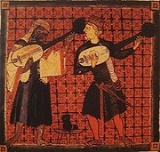
Vielle
Instruments used to perform medieval music still exist, though in different forms. The flute
Flute

The flute is a musical instrument of the woodwind family. Unlike other woodwind instruments, a flute is a reedless wind instrument that produces its sound from the flow of air against an edge....
 was once made of wood
Wood

Wood is an organic material; in the strict sense wood is produced as secondary xylem in the stems of woody plants, notably trees but also shrubs, etc....
 rather than silver
Silver

Silver is a chemical element with the chemical symbol Ag and atomic number 47. A soft, white, lustrous transition metal, it has the highest electrical conductivity of any element and the highest thermal conductivity of any metal....
 or other metal, and could be made as a side-blown or end-blown instrument. The recorder
Recorder

The recorder is a woodwind instrument musical instrument of the family known as fipple flutes or internal duct flutes — whistle-like instruments which include the tin whistle and ocarina....
, on the other hand, has more or less retained its past form. The gemshorn
Gemshorn

The gemshorn is an instrument of the ocarina family that was historically made from the horn of the chamois, goat, or other suitable animal. The gemshorn receives its name from the German language, and means a chamois horn....
 is similar to the recorder in having finger holes on its front, though it is really a member of the ocarina
Ocarina

The ocarina is an ancient flute-like wind instrument. While several variations exist, an ocarina is typified by an oval-shaped enclosed space with four to twelve finger holes and a mouth tube projecting out from the body....
 family. One of the flute's predecessors, the pan flute
Pan flute

The pan flute or pan pipe is an ancient musical instrument based on the principle of the Closed tube, consisting usually of five or more pipes of gradually increasing length ....
, was popular in medieval times, and is possibly of Hellenic
Ancient Greece

The term Ancient Greece refers to the period of History of Greece lasting from the Greek Dark Ages ca. 1100 BC and the Dorian invasion, to 146 BC and the Roman Republic conquest of Greece after the Battle of Corinth ....
 origin. This instrument's pipes were made of wood, and were graduated in length to produce different pitches.

Medieval music uses many plucked string instrument
String instrument

A string instrument is a musical instrument that produces sound by means of vibrating strings. In the Hornbostel-Sachs scheme of musical instrument classification, used in organology, they are called chordophones....
s, such as lute
Lute

Lute can refer generally to any plucked string instrument with a neck and a deep round back, or more specifically to an instrument from the family of European lutes....
, mandora
Mandora

The mandora or mandore, also known as the gallizona or gallichon, is a type of 6 or 8-course bass lute used mainly for basso continuo, in Germany, Austria and Czech lands, particularly during the 18th and early 19th centuries....
, gittern
Gittern

File:Wartburg-Laute.JPGThe gittern was a relatively small, quill-plucked, gut strung instrument that originated around the 13th century and came to Europe via Moorish Spain....
 and psaltery
Psaltery

A psaltery is a stringed instrument musical instrument of the harp or the zither family. The of Ancient Greece dates from at least 2800 BC, when it was a harp-like instrument....
. The dulcimer
Hammered dulcimer

The hammered dulcimer is a string instrument musical instrument with the strings stretched over a trapezoidal sounding board. Typically, the dulcimer is set on a stand, at an angle, before the musician, who holds small mallet hammers in each hand to strike the strings ....
s, similar in structure to the psaltery
Psaltery

A psaltery is a stringed instrument musical instrument of the harp or the zither family. The of Ancient Greece dates from at least 2800 BC, when it was a harp-like instrument....
 and zither
Zither

The zither is a musical string instrument, most commonly found in Slovenia, Austria, Hungary, the southern regions of Germany, alpine Europe and East Asian cultures....
, were originally plucked, but became struck in the 14th century, after the arrival of the new technology that made metal strings possible.

The bowed lyra
Byzantine lyra

The Byzantine lyra , or Byzantine lira, or lyra, or lira was a Medieval music Bow string musical instrument in the Byzantine Empire and is considered as the ancestor of most European bowed instruments....
 of the Byzantine Empire
Byzantine Empire

Byzantine Empire and Eastern Roman Empire are conventional names used to describe the Roman Empire during the Middle Ages, centered on its capital of Constantinople....
 was the first recorded European bowed string instrument. The Persian
Persian

Persian is of, from, or related to Iran , a country in the Middle East.* Persian people, an Iranian peoples ethno-linguistic community in Central and Southwest Asia....
 geographer Ibn Khurradadhbih
Ibn Khordadbeh

Abu'l Qasim Ubaid'Allah ibn Khordadbeh , author of the earliest surviving Arabic book of administrative geography, was a Persian geographer and bureaucrat of the 9th century....
 of the 9th century (d. 911) cited the Byzantine lyra
Byzantine lyra

The Byzantine lyra , or Byzantine lira, or lyra, or lira was a Medieval music Bow string musical instrument in the Byzantine Empire and is considered as the ancestor of most European bowed instruments....
, in his lexicographical discussion of instruments as a bowed instrument equivalent to the Arab rabab and typical instrument of the Byzantines along with the urghun (organ
Organ (music)

The organ is a keyboard instrument of one or more divisions, each played with its own keyboard played either Manual or Pedal clavier. The organ is one of the oldest musical instruments in the European classical music....
), shilyani (probably a type of harp
Harp

The 'harp' is a stringed instrument which has the plane of its strings positioned perpendicular to the Sounding board. It is also considered to be a percussion instrument....
 or lyre
Lyre

The lyre is a string instrument well known for its use in classical antiquity and later. The recitations of the Ancient Greece were accompanied by lyre playing....
) and the salandj (probably a bagpipe) . The hurdy-gurdy was (and still is) a mechanical violin using a rosined wooden wheel attached to a crank to "bow" its strings. Instruments without sound boxes such as the Jew's harp
Jew's harp

The Jew's harp, jaw harp, mouth harp, Ozark harp, marranzano pancake, or Omaha Flapjack is thought to be one of the oldest musical instruments in the world ; a musician apparently playing it can be seen in a Chinese drawing from the 3rd century BC ....
 were also popular in the time. Early versions of the organ
Organ (music)

The organ is a keyboard instrument of one or more divisions, each played with its own keyboard played either Manual or Pedal clavier. The organ is one of the oldest musical instruments in the European classical music....
, fiddle
Fiddle

The term fiddle refers to a violin; it is a colloquial term for the instrument used by players in all genres, including European classical music....
 (or vielle
Vielle

The vielle is a European bowed stringed instrument used in the Medieval music period, similar to a modern violin but with a somewhat longer and deeper body, five gut strings, and a leaf-shaped pegbox with frontal tuning pegs....
), and trombone
Trombone

The trombone is a musical instrument in the brass instrument family. Like all brass instruments, it is a lip-reed aerophone: sound is produced when the player?s vibrating lips cause the air column inside the instrument to vibrate....
 (called the sackbut
Sackbut

Sackbut refers to a trombone from the Renaissance and Baroque Eras. 'Sackbut' is often used in recent times to differentiate a historic trombone from a modern one....
) existed as well.

Genres

In this era, music was both sacred and secular
Secular music

Secular music is non-sacred music that developed in the Middle Ages and was used in the renaissance .renaissance musicians wrote a lot of secular music....
, although almost no early secular music has survived, and since notation
Musical notation

Music notation or musical notation is any system which represents aurally perceived music, through the use of written Modern musical symbols....
 was a relatively late development, reconstruction of this music, especially before the 12th century, is currently a matter of conjecture (see authentic performance).

Theory and notation

During the Medieval period the foundation was laid for the notational and theoretical practices that would shape western music into what it is today. The most obvious of these is the development of a comprehensive notational system, however the theoretical advances, particularly in regards to rhythm and polyphony, are equally important to the development of western music.

Notation
The earliest Medieval music did not have any kind of notational system. The tunes were primarily monophonic and transmitted by oral tradition. However, the need for some sort of notation became evident in the sacred chant tradition. As the Christian liturgy became more complex and varied, difficulties of memorization increased for the performer. Also, as Rome tried to centralize the various liturgies and establish the Roman rite as the primary tradition the need to effectively transmit these chant ideas across vast distances was equally glaring. The first step to fix this problem came with the introduction of various signs written above the chant texts, called neumes. The origin of neumes is unclear and subject to some debate, however, most scholars agree that their closest ancestors are the classic Greek and Roman grammatical signs that indicated important points of declamation by recording the rise and fall of the voice. The two basic signs of the classical grammarians were the actus, /, indicating a raising of the voice, and the gravis, \, indicating a lowering. These eventually evolved into the basic symbols for neumatic notation, the virga (or "rod") which indicates a higher note and still looked like the acutus from which it came; and the punctum (or "dot") which indicates a lower note and, as the name suggests, reduced the gravis symbol to a point. This kind of notation seems to have developed no earlier than the eighth century, but by the ninth it was firmly established as the primary method of musical notation. The basic notation of the virga and the punctum remained the symbols for individual notes, but other neumes soon developed which showed several notes joined together. These new neumes—called ligatures—are essentially combinations of the two original signs. It should be noted that this basic neumatic notation could only specify the number of notes and whether they moved up or down. There was no way to indicate exact pitch, any rhythm, or even the starting note. These limitations are further indication that the neumes were developed as tools to support the practice of oral tradition, rather than supplant it. But, though it started as merely a memory aid, the worth of having more specific notation soon became evident. The next development in musical notation were "heighted neumes", in which neumes were carefully placed at different heights in relation to each other. This allowed the neumes to roughly indicate the size of a given interval as well as the direction. This quickly led to one or two lines, each representing a particular note, being placed on the music with all the neumes relating back to them. At first these lines had no particular meaning and instead had a letter placed at the beginning indicating which note was represented. However, slowly the lines indicating middle C, and the F a fifth below, became most common. Having at first been merely scratched on the parchment, the lines now were drawn in two different colored inks: usually red for F, and yellow or green for C. This was the beginning of the musical staff as we know it today. The completion of the four-line staff is usually credited to Guido d’ Arezzo
Guido of Arezzo

Image:Statue of Guido of Arezzo.jpgGuido of Arezzo or Guido Aretinus or Guido da Arezzo or Guido Monaco or Guido D'Arezzo was a music theorist of the Medieval music era....
 (c. 1000-1050) one of the most important musical theorist of the Middle Ages. It should be noted that while older sources attribute the development of the staff to Guido, some modern scholars suggest that he acted more as a codifier of a system that was already in development. Either way, this new notation allowed a singer to learn pieces completely unknown to him in a much shorter amount of time. However, even though chant notation had progressed in many ways, one fundamental problem remained: rhythm. The neumatic notational system even in its fully developed state did not clearly define any kind of rhythm for the singing of notes.

Music theory
The music theory
Music theory

Music theory is the field of study that deals with how music works. It examines the language and notation of music. It identifies patterns that govern composer techniques....
 of the Medieval period saw several advances over previous practice both in regards to tonal material, texture, and rhythm. concerning rhythm
Rhythm

Rhythm is the variation of the length and accentuation of a series of sounds or other events....
 this period had several dramatic changes in both its conception and notation. During the early Medieval period there was no method to notate rhythm, and thus the rhythmical practice of this early music is subject to heated debate among scholars. The first kind of written rhythmic system developed during the 13th century and was based around a series of modes. This rhythmic plan was codified by the music theorist Johannes de Garlandia
Johannes de Garlandia

Johannes de Garlandia may refer to:* Johannes de Garlandia * Johannes de Garlandia ...
, author of the De mensurabili musica (c.1250), the treatise which defined and most completely elucidated these rhythmic mode
Rhythmic mode

In medieval music, the rhythmic modes were patterns of long and short durations imposed on written musical notation which otherwise appeared to be identical....
s. In his treatise Johannes de Garlandia describes six species of mode, or six different ways in which longs and breves can be arranged. Each mode establishes a rhythmic pattern in beats (or tempora) within a common unit of three tempora (a perfectio) that is repeated again and again. Furthermore, notation without text is based on chains of ligature
Ligature (music)

In music notation, a ligature is a graphic symbol that represents two or more notes that are written and sung in a single gesture, and on a single syllable, primarily in use ca....
s (the characteristic notations by which groups of notes are bound to on another). The rhythmic mode can generally be determined by the patterns of ligatures used. The melodic line, once it had its mode, would generally remain in it, although rhythmic adjustments could be indicated by changes in the expected pattern of ligatures, even to the extent of changing to another rhythmic mode. The next step forward concerning rhythm came from the German
Germany

Germany , officially the Federal Republic of Germany , is a country in Central Europe. It is bordered to the north by the North Sea, Denmark, and the Baltic Sea; to the east by Poland and the Czech Republic; to the south by Austria and Switzerland; and to the west by France, Luxembourg, Belgium, and the Netherlands....
 theorist Franco of Cologne
Franco of Cologne

Franco of Cologne was a Germany music theory and possibly composer. He was one of the most influential theorists of the late Medieval music era, and was the first to propose an idea which was to transform musical notation permanently: that the duration of any note should be determined by its appearance on the page, and not from context alo...
. In his treatise Ars Cantus Mensurabilis ("The Art of Mensurable Music"), written around 1280, he describes a system of notation in which differently shaped notes have entirely different rhythmic values. This is a striking change from the earlier system of de Garlandia. Whereas before the length of the individual note could only be gathered from the mode itself, this new inverted relationship made the mode dependent upon—and determined by—the individual notes or figurae that have incontrovertible durational values, an innovation which had a massive impact on the subsequent history of European music. Most of the surviving notated music of the 13th century uses the rhythmic modes as defined by Garlandia. The step in the evolution of rhythm came after the turn of the 13th century with the development of the Ars Nova style.

The theorist who is most well recognized in regards to this new style is Philippe de Vitry
Philippe de Vitry

Philippe de Vitry was a France composer, Music theory and poet. He was an accomplished, innovative, and influential composer, and may also have been the author of the ars nova treatise....
, famous for writing the Ars Nova
Ars nova

Ars nova was a stylistic period in music of the Late Middle Ages, centered in France, which encompassed the period roughly from the preparation of the Roman de Fauvel until the death of Guillaume de Machaut ....
 ("New Art") treatise around 1322. This treatise on music gave its name to the style of this entire era. Further more, his contributions to the notation of rhythm made possible the free and rhythmically complex music of the next hundred years. In some ways the modern system of rhythmic notation began with Vitry, who broke completely free from the older idea of the rhythmic modes. The notational predecessors of modern time meters also originate in the Ars Nova. This new style was clearly built upon the work of Franco of Cologne. In Franco's system, the relationship between a breve
Double whole note

In music, a double whole note or breve is a note lasting twice as long as a whole note . In medieval mensural notation, the brevis was one of the shortest note lengths , and could be either a half or a third as long as the Longa ....
 and a semibreve
Whole note

In music, a whole note or semibreve is a note represented by a hollow oval note head, like a half note , and no note stem . Its length is typically equal to four beats in 4/4 time signature....
s (that is, half breves) was equivalent to that between a breve and a long: and, since for him modus was always perfect (grouped in threes), the tempus or beat was also inherently perfect and therefore contained three semibreves. Sometimes the context of the mode would require a group of only two semibreves, however, these two semibreves would always be one of normal length and one of double length, thereby taking the same space of time, and thus preserving the perfect subdivision of the tempus. This ternary division held for all note values. In contrast, the Ars Nova period introduced two important changes, the first was an even smaller subdivision of notes (semibreves, could now be devided into minim) the second was the development of "mensuration." By the time of Ars Nova, the perfect division of the tempus was not the only option as duple divisions became more accepted. For Vitry the breve could be divided, for an entire composition, or section of one, into groups of two or three smaller semibreves This way, the tempus (the term that came to denote the division of the breve) could be either "perfect," (Tempus perfectus) with ternary subdivision, or "imperfect,"(Tempus imperfectus) with binary subdivision. In a similar fashion, the semibreve's division (termed prolation) could be divided into three minima (prolatio
Prolation

Prolation is a term used in the theory of medieval music to describe its rhythmic structure on a small scale. The term is derived from the Latin prolatio, first used by Philippe de Vitry in describing Ars Nova, a musical style that came about in 14th-century France....
 perfectus
or major prolation) or two minima (prolatio imperfectus or minor prolation) and, at the higher level, the longs
Longa (music)

A longa is a musical note twice as long as a Double whole note, four times as long as a semibreve/whole note, that appears in early music. It is equal to sixteen quarter notes, or four measures in common time....
 division (called modus) could be three or two breves (modus
Rhythmic mode

In medieval music, the rhythmic modes were patterns of long and short durations imposed on written musical notation which otherwise appeared to be identical....
 perfectus
or perfect mode, or modus imperfectus or imperfect mode respectively). Vitry took this a step further by indicating the proper division of a given piece at the beginning through the use of a "mensuration sign," equivalent to our modern "time signature.Tempus perfectus was indicated by a circle, while tempus imperfectus was denoted by a half-circle (our current "C" as a stand-in for the 4/4 time signature is actually a holdover from this practice, not an abbreviation for "common time", as popularly believed). It should be noted that while many of these innovations are ascribed to Vitry, and somewhat present in the Ars Nova treatise, it was a contemporary—and personal acquaintance—of de Vitry, named Johannes de Muris
Jean de Muris

Jean de Muris was a French people philosopher and mathematician, best known for his promotion of ars nova over ars antiqua.Jury is out whether or not he actually wrote the Speculum musicae....
 (Jehan des Mars)who offered the most comprehensive and systematic treatment of the new mensural innovations of the Ars Nova(for a brief explanation of the mensural notation in general, see the article Renaissance music
Renaissance music

Renaissance music is European music written during the Renaissance, approximately 1400 - 1600. Dates of classical music eras, given the lack of abrupt shifts in musical thinking during the 15th century....
)Many scholars, citing a lack of positive attributory evidence, now consider "Vitry's" treatise to be anonymous, but this does not diminish its importance for the history of rhythmic notation. However, this makes the first definitely identifiable scholar to accept and explain the mensural system to be de Muris, who can be said to have done for it what Garlandia did for the rhythmic modes.

For the duration of the medieval period, most music would be composed primarily in perfect tempus, with special effects created by sections of imperfect tempus; there is a great current controversy among musicologists as to whether such sections were performed with a breve of equal length or whether it changed, and if so, at what proportion. This Ars Nova style remained the primary rhythmical system until the the highly syncopated works of the Ars subtilior
Ars subtilior

Ars subtilior is a musical style characterized by rhythm and musical notation complexity, centered around Paris, Avignon in southern France, also in northern Spain at the end of the fourteenth century and England in the early fifteenth century....
 at the end of the 14th century. This sub-genera pushed the rhythmic freedom provided by Ars Nova to its limits, with some compositions having different voices written in different tempus signatures simultaneously. The rhythmic complexity that was realized in this music is comparable to that in the 20th century.

Of equal importance to the overall history of western music theory were the textural changes that came with the advent of polyphony. This practice shaped western music into the harmonically dominated music that we know today. The first accounts of this textual development were found in two anonymous yet widely-circulated treatises on music, the Musica
Musica enchiriadis

Musica enchiriadis is an Anonymity musical treatise from the 9th century. It is the first surviving attempt to establish a system of rules for polyphony in western music....
 and the Scolica enchiriadis
Scolica enchiriadis

Scolica enchiriadis is an Anonymous work ninth-century music theory treatise and commentary on its companion work, the Musica enchiriadis....
. These texts are dated to sometime within the last half of the ninth century. The treatises describe a technique that seemed to already be well established in practice. This early polyphony is based on three simple and three compound intervals. The first group comprises fourths, fifths, and octaves; while the second group has octave-plus-fourths, octave-plus-fifths, and double octaves. This new practice is given the name organum
Organum

Organum in general is a plainchant melody with at least one added voice to enhance the harmony, developed in the Middle Ages. Depending on the mode and form of the chant, a supporting bourdon may be sung on the same text, or the melody is followed in parallel motion or a combination thereof....
 by the author of the treatises. Organum can further be classified depending on at what time period it was written. The early organum as described in the enchiriadis can be termed "strict organum" Strict organum can, in turn, be subdivided into two types: diapente (organum at the interval of a fifth) and diatesseron (organum at the interval of a fourth). However, both of these kinds of strict organum had problems with the musical rules of the time. If either of them paralleled an original chant for too long (depending on the mode) a tritone
Tritone

The tritone is a musical interval that spans three major second. The tritone is the same as an augmented fourth, which in equal temperament is enharmonic to a diminished fifth....
 would result. This problem was somewhat overcome with the use of a second type of organumThis second style of organum was called "free organum". Its distinguishing factor is that the parts did not have to only move in parallel motion but could also move in oblique,or contrary fashion. This made it much easier to avoid the dreaded tritone The final style of organum that developed was known as "melismatic organum", which was a rather dramatic departure from the rest of the polyphonic music up to this point. This new style was not note against note, but was rather one sustained line accompanied by a florid melismatic line. This final kind of organum was also incorporated by the most famous polyphonic composer of this time—Léonin
Léonin

L?onin is the first known significant composer of polyphony organum. He was probably France, and he probably lived and worked in Paris at the Notre Dame de Paris, and was the earliest member of the Notre Dame school of polyphony who is known by name....
. He united this style with measured discant
Discant

Discant was a style of liturgy setting in the Middle Ages, associated with the development of the Notre Dame school of polyphony. It is a style of organum that includes a plainchant tenor part, with a "note against note" upper voice, moving in Counterpoint....
 passages, which used the rhythmic modes, to create the pinnacle of organum composition. It should be noted that this final stage of organum is sometimes referred to as Notre Dame school of polyphony since that was where Léonin (and his student Pérotin
Pérotin

P?rotin , also called Perotin the Great, was a European composer, believed to be France, who lived around the end of the 12th century and beginning of the 13th century....
) were stationed. Further more, this kind of polyphony influenced all subsequent styles, with the later polyphonic genera of motets starting as a trope of existing Notre Dame organums.

Another important element of Medieval music theory was the unique tonal system by which pitches were arranged and understood. During the Middle Ages this systematic arrangement of a series of whole steps and half steps, what we now call a scale
Musical scale

In music, a scale is a group of musical note collected in ascending and descending order that provides material for or is used to conveniently represent part or all of a musical work including melody and/or harmony....
, was known as a mode
Gregorian mode

A Gregorian mode is one of the eight systems of pitch organization used to describe Gregorian chant. They are grouped into four pairs, each pair comprising an authentic mode and a plagal mode....
. The modal system worked like the scales of today, insomuch that it provided the rules and material for melodic writing. The eight church modes are: Dorian
Dorian mode

Due to historical confusion, Dorian mode or Doric mode can refer to two very different musical modes or diatonic scales....
, Hypodorian, Phrygian
Phrygian mode

Modes are early forms of scales used in music. The Phrygian mode can refer to two different musical modes or diatonic scales: the ancient Greek Phrygian mode and the Medieval Phrygian mode....
, Hypophrygian
Hypophrygian mode

The Hypophrygian mode, literally meaning 'below Phrygian', is a musical mode or diatonic scale of ancient Greece that was based upon the Phrygian mode tetrachord: a series of rising intervals of a major second, followed by a semitone, followed by another whole tone....
, Lydian
Lydian mode

Due to historical confusion, Lydian mode can refer to two very different musical modes or diatonic scales....
, Hypolydian
Hypolydian mode

The Hypolydian mode, literally meaning 'below Lydian', is a musical mode or diatonic scale of ancient Greece that was based upon the Lydian mode tetrachord: descending , a series of falling intervals of a semitone followed by two major second....
, Mixolydian, and Hypomixolydian much of the information concerning these modes, as well as the practical application of them, was codified in the 11th century by the theorist Johannes Afflighemensis. In his work he describes that there are three defineing elements to each mode. The finalis, the reciting tone, and the range. The finalis is the tone that serves as the focal point for the mode. It is also almost always used as the final tone (hence the name) the reciting tone (sometimes referred to as the tenor or confinalis) is the tone that serves as the primary focal point in the melody (particularly internally) it generally is also the tone most often repeated in the piece, and finally the range (or ambitus) is the maximum proscribed tones for a given mode. The eight modes can be further divided into four categories based on their final (finalis). Medieval theorists called these pairs maneriae and labeled them according to the Greek ordinal numbers. Those modes that have d, e, f, and g as their final are put into the groups protus, deuterus, tritus, and tetrardus respectively. These can then be divided further based on whether the mode is "authentic" or "plagal." These distinctions deal with the range of the mode in relation to the final. the authentic modes have a range that is about an octave (one tone above or below is allowed) and starts on the final, whereas the plagal modes, while still covering about an octave, start a perfect fourth below the authentic. Another interesting aspect of the modal system is the universal allowance for altering B to Bb no matter what the mode.The inclusion of this tone has several uses, but one that seems particularly common is in order to avoid melodic difficulties caused, once again, by the tritone.

These ecclesiastical modes, although they have Greek names, have little relationship to the modes as set out by Greek theorists. Rather, most of the terminology seems to be a misappropriation on the part of the medieval theorists However, though the church modes have no relation to the ancient Greek modes, the overabundance of Greek terminology does point to an interesting possible origin in the liturgical melodies of the Byzantine
Byzantine music

Byzantine music is the music of the Byzantine Empire composed to Greek texts as ceremonial, festival, or church music. Greek and foreign historians agree that the ecclesiastical tones and in general the whole system of Byzantine music is closely related to the ancient Greek music....
 tradition. This system is called oktoechos and is also divided into eight categories, called echoi.

For specific medieval music theorists, see also: Isidore of Seville
Isidore of Seville

Saint Isidore of Seville was Archbishop of Seville for more than three decades and has the reputation of being one of the greatest scholars of the early Middle Ages....
, Aurelian of Réôme
Aurelian of Réôme

Aurelian of R??me was a Franks writer and music theory. He is the author of the Musica disciplina, the earliest extant treatise on medieval music from Middle Ages Europe....
, Odo of Cluny
Odo of Cluny

Saint Odo of Cluny , a saint of the Roman Catholic Church, was the second abbot of Cluny. He enacted various reforms in the Cluniac monastery system of France and Italy....
, Guido of Arezzo
Guido of Arezzo

Image:Statue of Guido of Arezzo.jpgGuido of Arezzo or Guido Aretinus or Guido da Arezzo or Guido Monaco or Guido D'Arezzo was a music theorist of the Medieval music era....
, Hermannus Contractus
Hermannus Contractus

Hermann of Reichenau was an 11th century scholar, composer, music theory, mathematician, and astronomer. Hermannus was a son of the duke of Altshausen....
, Johannes Cotto
Johannes Cotto

Johannes Cotto was a music theory, possibly of England origin, most likely working in southern Germany or Switzerland. He wrote one of the most influential treatises on music of the Medieval music, one which included unusually precise directions for composing Gregorian chant and organum....
 (Johannes Afflighemensis), Johannes de Muris, Franco of Cologne
Franco of Cologne

Franco of Cologne was a Germany music theory and possibly composer. He was one of the most influential theorists of the late Medieval music era, and was the first to propose an idea which was to transform musical notation permanently: that the duration of any note should be determined by its appearance on the page, and not from context alo...
, Johannes de Garlandia
Johannes de Garlandia

Johannes de Garlandia may refer to:* Johannes de Garlandia * Johannes de Garlandia ...
 (Johannes Gallicus), Anonymous IV
Anonymous IV

Anonymous IV is the designation given to the writer of an important treatise of Medieval music music theory. He was probably an England student working at Notre Dame de Paris in Paris, most likely in the 1270s or 1280s....
, Marchetto da Padova (Marchettus of Padua), Jacques of Liège
Jacob of Liège

Jacob of Li?ge, aka Jacobus Leodiensis or Jacques de Li?ge, is believed to have written the Speculum Musicae, The Mirror of Music, during the second quarter of the 14th century....
, Johannes de Grocheo, Petrus de Cruce
Petrus de Cruce

Petrus de Cruce was active as a cleric, composer and music theory in the late part of the 13th century. His main contribution was to the music notation....
 (Pierre de la Croix), and Philippe de Vitry
Philippe de Vitry

Philippe de Vitry was a France composer, Music theory and poet. He was an accomplished, innovative, and influential composer, and may also have been the author of the ars nova treatise....
.

Early medieval music (before 1150)


Early chant traditions

Chant
Gregorian chant

Gregorian chant is the central tradition of Western plainsong, a form of monophony liturgy chant in Western Christianity that accompanied the celebration of Mass and other ritual services....
 (or plainsong) is a monophonic
Texture (music)

Texture is one of the basic elements of music. People use texture to describe the amount of rhythms played at a specific time. In music, texture also means the overall quality of sound of a piece , most often indicated by the number of melody in the music and by the relationship between these voices ....
 sacred form which represents the earliest known music of the Christian church. The Jew
Jew

A Jew is a member of the Jewish people, an ethnoreligious group that traces its ancestry to the Israelites or Hebrews of the Ancient Near East....
ish Synagogue tradition of singing psalms
Psalms

Psalms is a book of the Hebrew Bible , included in the collected works known as the "Writings" or Ketuvim....
 was a strong influence on Christian chanting.

Chant developed separately in several European centres. The most important were Rome
Rome

Rome is the capital city of Italy and Lazio, and is Italy's largest and most populous city, with 2,724,347 residents in an urban area of some ....
, Spain
Spain

Spain or the Kingdom of Spain , is a country located in Southern Europe on the Iberian Peninsula.The Spanish constitution does not establish any official denomination of the country, even though Espa?a , Estado espa?ol and Naci?n espa?ola are used interchangeably....
, Gaul
Gaul

Gaul is the name used for the region of Western Europe comprising part of present day northern Italy, France, Belgium, western Switzerland and the parts of the Netherlands and Germany on the west bank of the River Rhine....
, Milan
Milan

Milan is the second largest city of Italy, located in the plains of Lombardy. It is the capital in the Province of Milan, as well as the Regions of Italy capital of Lombardy....
, and Ireland
Ireland

Ireland is the List of islands by area in Europe, and the twentieth-largest island in the world. It lies to the north-west of continental Europe and is surrounded by hundreds of islands and islet....
 but there were others as well. These chants were all developed to support the regional liturgies used when celebrating the Mass there. Each area developed its own chants and rules for celebration. In Spain, Mozarabic chant
Mozarabic chant

Mozarabic chant is the liturgical plainsong repertory of the Mozarabic rite of the Roman Catholic Church, related to but distinct from Gregorian chant....
 was used and shows the influence of North African music
Music of North Africa

North Africa has contributed much to popular music, especially Music of Egypt classical and el Gil, Algerian ra? and Morocco chaabi. The broad region is sometimes called the Maghreb , and the term Maghrebian music is in use....
. The Mozarabic liturgy even survived through Muslim
Muslim

:A Muslim , , is an adherent of the religion of Islam. The feminine form is Muslimah . Literally, the word means "one who submits "....
 rule, though this was an isolated strand and this music was later suppressed in an attempt to enforce conformity on the entire liturgy. In Milan, Ambrosian chant
Ambrosian chant

Ambrosian chant is the liturgical plainsong repertory of the Ambrosian rite of the Roman Catholic Church, related to but distinct from Gregorian chant....
, named after St. Ambrose, was the standard, while Beneventan chant
Beneventan chant

Beneventan chant is a liturgical plainsong repertory of the Roman Catholic Church, used primarily in the orbit of the Mezzogiorno ecclesiastical centers of Benevento and Montecassino, distinct from Gregorian chant and related to Ambrosian chant....
 developed around Benevento
Benevento

Benevento is a town and comune of Campania, Italy, capital of the province of Benevento, 50 km northeast of Naples. It is situated on a hill 130 m above sea-level at the confluence of the Calore Irpino and Sabato....
, another Italian liturgical center. Gallican chant
Gallican chant

Gallican chant refers to the liturgical plainsong repertory of the Gallican rite of the Roman Catholic Church in Gaul, prior to the introduction and development of elements of the Roman Rite from which Gregorian chant evolved....
 was used in Gaul, and Celtic chant
Celtic chant

Celtic chant is the liturgical plainsong repertory of the Celtic Rite of the Roman Catholic Church performed in the British Isles and Brittany, related to but distinct from the Gregorian chant of the Sarum Rite of the Roman Rite which officially supplanted it by the 12th century....
 in Ireland and Great Britain.

Around 1011 AD, the Roman Catholic Church
Roman Catholic Church

The Roman Catholic Church, officially known as the Catholic Church is the world's largest Christianity Ecclesia , representing over half of all Christians and one-sixth of the world population....
 wanted to standardize the Mass
Mass (liturgy)

The Mass is the Eucharistic celebration in the Latin liturgical rites of the Roman Catholic Church. The term is used also of similar celebrations in Old Catholic Churches, in the Anglo-Catholic tradition of Anglicanism, and in some largely High Church Lutheranism Lutheranism regions, including the Scandinavian and Baltic states countries....
 and chant. At this time, Rome was the religious centre of western Europe, and Paris was the political centre. The standardization effort consisted mainly of combining these two (Roman
Roman Rite

The liturgy of the Catholic Church of Rome is called the Roman Rite. The quite distinct term Latin Rite usually refers not to a liturgical rite but to the particular Church within the Roman Catholic Church that was sometimes referred to also as the Patriarchate of the West....
 and Gallican
Gallican rite

The Gallican Rite is a historical sub-grouping of the Roman Catholic liturgy in western Europe; it is not a single rite but actually a family of rites within the Catholic Church#Structure which comprised the majority use of most of Western Christianity in western Europe for the greater part of the 1st millennium AD....
) regional liturgies. This body of chant became known as Gregorian Chant. By the 12th and 13th centuries, Gregorian chant had superseded all the other Western chant traditions, with the exception of the Ambrosian chant in Milan, and the Mozarabic chant in a few specially designated Spanish chapels.


Early polyphony: organum

Around the end of the ninth century, singers in monasteries such as St. Gall
Abbey of St. Gall

The Abbey of Saint Gall was for many centuries one of the chief Benedictine abbeys in Europe. It is located in the city of St. Gallen in present-day Switzerland....
 in Switzerland
Switzerland

Switzerland is a landlocked Swiss Alps country of roughly 7.7 million people in Western Europe with an area of 41,285 km?. Switzerland is a federal republic consisting of 26 states called Cantons of Switzerland....
 began experimenting with adding another part to the chant, generally a voice
Human voice

The human voice consists of sound Voice production by a human being using the vocal folds for Speech communication, singing, Laughter, crying, screaming, etc....
 in parallel motion
Contrary motion

In music theory, contrary motion is the general movement of two melody in opposite directions. That is, when one of the lines moves up, the other line moves down....
, singing in mostly perfect fourths
Perfect fourth

The perfect fourth is a musical interval which spans four diatonic scale scale degree. It consists of the note and the note five semitones above it on the musical scale....
 or fifths
Perfect fifth

The perfect fifth is the musical interval between a note and the note seven semitones above it on the musical scale. For example, the note G lies a perfect fifth above C; D is a perfect fifth above G, C is a perfect fifth above F, and so on....
 with the original tune (see interval
Interval (music)

In music theory, the term interval describes the relationship between the pitch of two notes.Intervals may be described as:*vertical if the two notes sound simultaneously...
). This development is called organum
Organum

Organum in general is a plainchant melody with at least one added voice to enhance the harmony, developed in the Middle Ages. Depending on the mode and form of the chant, a supporting bourdon may be sung on the same text, or the melody is followed in parallel motion or a combination thereof....
, and represents the beginnings of harmony
Harmony

In Western music, harmony is the use of different pitches simultaneously, and chord s, actual or implied, in music. The word is related to the word "harmonic" which implies related wavelengths of waves....
 and, ultimately, counterpoint
Counterpoint

In music, counterpoint is the relationship between two or more Register that are independent in contour and rhythm, and interdependent in harmony....
. Over the next several centuries organum developed in several ways.

The most significant was the creation of "florid organum" around 1100, sometimes known as the school of St. Martial (named after a monastery in south-central France, which contains the best-preserved manuscript of this repertory). In "florid organum" the original tune would be sung in long notes while an accompanying voice would sing many notes to each one of the original, often in a highly elaborate fashion, all the while emphasizing the perfect consonance
Consonance

Consonance is a stylistic device, often used in poetry characterized by the repetition of two or more consonants using different vowels, for example, the "i" and "a" followed by the "tter" sound in "pitter patter." It repeats the consonant sounds but not vowel sounds....
s (fourths, fifths and octaves) as in the earlier organa. Later developments of organum occurred in England, where the interval of the third
Third

Third may refer to:*3 , such as the 3rd of something*Fraction , such as 1/3*The Third *Third World, economically underdeveloped nations*Third-class degree, type of British undergraduate degree classification...
 was particularly favoured, and where organa were likely improvised against an existing chant melody, and at Notre Dame
Notre Dame school

The group of composers working at or near the Notre Dame de Paris in Paris from about 1160 to 1250, along with the music they produced, is referred to as the Notre Dame school, or the Notre Dame School of Polyphony....
 in Paris, which was to be the centre of musical creative activity throughout the thirteenth century.

Much of the music from the early medieval period is anonymous
Anonymous work

Anonymous works are works, such as art or literature, that have an Anonymity, undisclosed, or unknown creator or author. In the United States it is legally defined as "a work on the copies or phonorecords of which no natural person is identified as author."...
. Some of the names may have been poets and lyric writers, and the tunes for which they wrote words may have been composed by others. Attribution of monophonic music of the medieval period is not always reliable. Surviving manuscripts from this period include the Musica Enchiriadis
Musica enchiriadis

Musica enchiriadis is an Anonymity musical treatise from the 9th century. It is the first surviving attempt to establish a system of rules for polyphony in western music....
, Codex Calixtinus
Codex Calixtinus

The Codex Calixtinus is a 12th century illuminated manuscript formerly attributed to Pope Callixtus II, though now believed to have been arranged by the French scholar Aymeric Picaud....
 of Santiago de Compostela
Santiago de Compostela

Santiago de Compostela is the capital of the autonomous communities of Spain of Galicia and a UNESCO World Heritage Site. Located in the north west of Spain in the A Coru?a , it was the "European City of Culture" for the year 2000....
, and the Winchester Troper
Winchester troper

The Winchester Troper includes perhaps the oldest large collections of two-part music in Europe, along with the Chartres Manuscript which is approximately contemporaneous or a little later....
.

For information about specific composers or poets writing during the early medieval period, see Pope Gregory I
Pope Gregory I

Pope Saint Gregory I or Gregory the Great was pope from 3 September 590 until his death.He is also known as Gregory the Dialogist in Eastern Orthodoxy because of his Dialogues....
, St. Godric
Godric of Finchale

Saint Godric of Finchale or Saint Goderic was an England hermit and popular medieval saint, although he was never formally canonized. He was born in Walpole, UK in Norfolk and died in Finchale Priory in County Durham, England....
, Hildegard of Bingen
Hildegard of Bingen

Hildegard of Bingen , also known as Blessed Hildegard and Saint Hildegard, was a German people abbess, author, counselor, Linguistics, naturalist, scientist, philosopher, physician, herbalist, poet, visionary and composer....
, Hucbald
Hucbald

Hucbald was a music theory, composer, teacher, writer, hagiographer, and Benedictine monk. Deeply influenced by Boethius' De Institutione Musica, he wrote the first systematic work on western music theory, aiming at reconciling through many notated examples ancient Greek music theory and the contemporary practice of the more recent so-...
, Notker Balbulus
Notker of St Gall

Notker the Stammerer , also called Notker the Poet or Notker of Saint Gall , was a musician, author, poet, and Benedictine monk at the Abbey of Saint Gall in modern Switzerland....
, Odo of Arezzo
Odo of Arezzo

Odo of Arezzo or Abbot Oddo was a Medieval composer and music theory who worked in Arezzo. Little is known about his life, except that he was an Abbot in Arezzo, working under Bishop Donatus of Arezzo....
, Odo of Cluny
Odo of Cluny

Saint Odo of Cluny , a saint of the Roman Catholic Church, was the second abbot of Cluny. He enacted various reforms in the Cluniac monastery system of France and Italy....
, and Tutilo
Tuotilo

Saint Tuotilo was a medieval monk and composer. Born in Ireland, he is said to have been a large and powerfully built man. He was educated at the Abbey of St....
.

Liturgical drama

Main article: Liturgical drama
Liturgical drama

Liturgical drama or religious drama, in its various Christian contexts, originates from the Mass itself, and usually presents a relatively complex ritual that includes theatre elements....
Another musical tradition of Europe originating during the early Middle Ages was the liturgical drama
Liturgical drama

Liturgical drama or religious drama, in its various Christian contexts, originates from the Mass itself, and usually presents a relatively complex ritual that includes theatre elements....
. In its original form, it may represent a survival of Roman
Ancient Rome

Ancient Rome was a civilization that grew out of a small agricultural community founded on the Italian Peninsula as early as the 10th century BC....
 drama with Christian stories - mainly the Gospel
Gospel

In Christianity, a gospel is generally one of the first four books of the New Testament that describe the birth, life, ministry, crucifixion, and resurrection of Jesus....
, the Passion
Passion (Christianity)

The Passion is the Christian theological term used for the events and suffering ? physical, spiritual, and mental ? of Jesus in the hours before and including his trial and execution by crucifixion....
, and the lives of the saints
Hagiography

Hagiography is the study of saints. A hagiography, from Greek ' and ' , refers literally to writings on the subject of such holy people, and specifically the biography of ecclesiastical and secular leaders....
 - grafted on. Every part of Europe had some sort of tradition of musical or semi-musical drama in the Middle Ages, involving acting, speaking, singing and instrumental accompaniment in some combination. Probably these dramas were performed by travelling actors and musicians. Many have been preserved sufficiently to allow modern reconstruction and performance (for example the Play of Daniel
Play of Daniel

The Play of Daniel, or Ludus Danielis, refers to either of two medieval Latin liturgical dramas, one of which is accompanied by monophony music....
, which has been recently recorded).

Goliards

The Goliard
Goliard

The Goliards were a group of clergy who wrote wikt:bibulous, satire Latin poetry in the twelfth century and thirteenth century. They were mainly clerical students at the university of France, Germany, Italy, and England who protested the growing contradictions within the Church, such as the failure of the Crusades and financial abuses, expre...
s were itinerant poet-musicians of Europe from the tenth to the middle of the thirteenth century. Most were scholars or ecclesiastics, and they wrote and sang in Latin. Although many of the poems have survived, very little of the music has. They were possibly influential — even decisively so — on the troubadour
Troubadour

A troubadour was a composer and performer of Occitan lyric poetry during the High Middle Ages .The troubadour school or tradition began in the eleventh century in Occitania, but it subsequently spread into Italy, Spain, and even Greece....
-trouvère
Trouvère

Trouv?re , sometimes spelled trouveur, is the Northern French language form of the word troubadour . It refers to poet-composers who were roughly contemporary with and influenced by the troubadours but who composed their works in the northern Languages of France....
 tradition which was to follow. Most of their poetry is secular and, while some of the songs celebrate religious ideals, others are frankly profane, dealing with drunkenness, debauchery and lechery.

High medieval music (1150-1300)


Ars antiqua

The flowering of the Notre Dame school
Notre Dame school

The group of composers working at or near the Notre Dame de Paris in Paris from about 1160 to 1250, along with the music they produced, is referred to as the Notre Dame school, or the Notre Dame School of Polyphony....
 of polyphony from around 1150 to 1250 corresponded to the equally impressive achievements in Gothic architecture
Gothic architecture

Gothic architecture is a style of architecture which flourished during the high and late Middle Ages. It evolved from Romanesque architecture and was succeeded by Renaissance architecture....
: indeed the centre of activity was at the cathedral of Notre Dame
Notre Dame de Paris

Notre Dame de Paris is a Gothic architecture cathedral on the eastern half of the ?le de la Cit? in the 4th arrondissement of Paris of Paris, France, with its main entrance to the west....
 itself. Sometimes the music of this period is called the Parisian school, or Parisian organum, and represents the beginning of what is conventionally known as Ars antiqua
Ars antiqua

Ars antiqua, also called ars veterum or ars vetus, refers to the music of Europe of the late Middle Ages between approximately 1170 and 1310, covering the period of the Notre Dame school of polyphony and the subsequent years which saw the early development of the motet....
. This was the period in which rhythm
Rhythm

Rhythm is the variation of the length and accentuation of a series of sounds or other events....
ic notation first appeared in western music, mainly a context-based method of rhythmic notation known as the rhythmic mode
Rhythmic mode

In medieval music, the rhythmic modes were patterns of long and short durations imposed on written musical notation which otherwise appeared to be identical....
s.

This was also the period in which concepts of formal
Musical form

The term musical form refers to two related concepts:*the type of composition *the structure of a particular musical piece .There is some overlap between musical form and musical genre....
 structure developed which were attentive to proportion, texture, and architectural effect. Composers of the period alternated florid and discant organum (more note-against-note, as opposed to the succession of many-note melismas against long-held notes found in the florid type), and created several new musical forms: clausula
Clausula

A clausula is a polyphonic composition performed as a musical alternative to the original plainchant passage that it is intended to replace.Clausulae came into being as a result of the composition practice of musicians in the Notre Dame school period, during the 1200's or Ars Antiqua....
e, which were melisma
Melisma

Melisma, in music, is the singing of a single syllable of text while moving between several different notes in succession. Music sung in this style is referred to as melismatic, as opposed to syllabic, where each syllable of text is matched to a single note....
tic sections of organa extracted and fitted with new words and further musical elaboration; conductus
Conductus

In medieval music, conductus is a type of sacred, but non-liturgical vocal composition for one or more voices. The word derives from Latin conducere , and the conductus was most likely sung while the lectionary was carried from its place of safekeeping to the place from which it was to be read....
, which was a song for one or more voices to be sung rhythmically, most likely in a procession of some sort; and tropes
Trope (music)

The term trope derives from Greek language "turn, turning", from - tropos "turn, direction, way" related to the root of - trepo, "to turn, to direct, to alter, to change"....
, which were rearrangements of older chants with new words and sometimes new music. All of these genres save one were based upon chant; that is, one of the voices, (usually three, though sometimes four) nearly always the lowest (the tenor at this point) sung a chant melody, though with freely composed note-lengths, over which the other voices sang organum. The exception to this method was the conductus, a two-voice composition that was freely composed in its entirety.

The motet
Motet

In Western music, motet is a word that is applied to a number of highly varied choir musical compositions.The name comes either from the Latin movere, or a Latinized version of Old French mot, "word" or "verbal utterance." The Medieval Latin for "motet" is "motectum", and the Italian mottetto was also used....
, one of the most important musical forms of the high Middle Ages and Renaissance, developed initially during the Notre Dame period out of the clausula, especially the form using multiple voices as elaborated by Pérotin
Pérotin

P?rotin , also called Perotin the Great, was a European composer, believed to be France, who lived around the end of the 12th century and beginning of the 13th century....
, who paved the way for this particularly by replacing many of his predecessor (as canon of the cathedral) Léonin
Léonin

L?onin is the first known significant composer of polyphony organum. He was probably France, and he probably lived and worked in Paris at the Notre Dame de Paris, and was the earliest member of the Notre Dame school of polyphony who is known by name....
's lengthy florid clausulae with substitutes in a discant style. Gradually, there came to be entire books of these substitutes, available to be fitted in and out of the various chants. Since, in fact, there were more than can possibly have been used in context, it is probable that the clausulae came to be performed independently, either in other parts of the mass, or in private devotions. The clausulae, thus practised, became the motet when troped with non-liturgical words, and was further developed into a form of great elaboration, sophistication and subtlety in the fourteenth century, the period of Ars nova.

Surviving manuscripts from this era include the Codex Montpellier, Codex Bamberg, and El Codex musical de Las Huelgas.

Composers of this time include Léonin
Léonin

L?onin is the first known significant composer of polyphony organum. He was probably France, and he probably lived and worked in Paris at the Notre Dame de Paris, and was the earliest member of the Notre Dame school of polyphony who is known by name....
, Pérotin
Pérotin

P?rotin , also called Perotin the Great, was a European composer, believed to be France, who lived around the end of the 12th century and beginning of the 13th century....
, W. de Wycombe
W. de Wycombe

W. de Wycombe was an England composer and copyist of the Medieval music era. He was precentor of the priory of Leominster in Herefordshire. He may have been the composer of the most famous tune from medieval England, Sumer is icumen in, though the identification is considered by most scholars to be tenuous....
, Adam de St. Victor, and Petrus de Cruce
Petrus de Cruce

Petrus de Cruce was active as a cleric, composer and music theory in the late part of the 13th century. His main contribution was to the music notation....
 (Pierre de la Croix). Petrus is credited with the innovation of writing more than three semibreves to fit the length of a breve. Coming before the innovation of imperfect tempus, this practice inaugurated the era of what are now called "Petronian" motets. These late 13th-century works are in three to four parts and have multiple texts sung simultaneously. These texts can be either sacred or secular in subject, and with Latin and French mixed. The Petronian motet is a highly complex genre, given its mixture of several semibreve breves with rhythmic modes and sometimes (with increasing frequency) substitution of secular songs for chant in the tenor. Indeed, ever-increasing rhythmic complexity would be a fundamental characteristic of the 14th century, though music in France, Italy, and England would take quite different paths during that time.

Troubadours and trouvères

The music of the troubadour
Troubadour

A troubadour was a composer and performer of Occitan lyric poetry during the High Middle Ages .The troubadour school or tradition began in the eleventh century in Occitania, but it subsequently spread into Italy, Spain, and even Greece....
s and trouvère
Trouvère

Trouv?re , sometimes spelled trouveur, is the Northern French language form of the word troubadour . It refers to poet-composers who were roughly contemporary with and influenced by the troubadours but who composed their works in the northern Languages of France....
s was a vernacular tradition of monophonic secular song, probably accompanied by instruments, sung by professional, occasionally itinerant, musicians who were as skilled as poets as they were singers and instrumentalists. The language of the troubadours was Occitan (also known as the langue d'oc, or Provençal
Provençal language

Proven?al is one of several dialects of Occitan spoken by a minority of people in southern France, mostly in Provence. In the English language-speaking world, "Proven?al" is often used to refer to all dialects of Occitan, but it actually refers specifically to the dialect spoken in Provence, as well as in the southern portion of the Dauphin?...
); the language of the trouvères was Old French (also known as langue d'oil). The period of the troubadours corresponded to the flowering of cultural life in Provence
Provence

Provence is a region of southeastern France on the Mediterranean adjacent to Italy. It is part of the administrative regions of France of Provence-Alpes-C?te d'Azur....
 which lasted through the twelfth century and into the first decade of the thirteenth. Typical subjects of troubadour song were war
War

...
, chivalry
Chivalry

Chivalry is a term relating to the medieval institution of knighthood. It is usually associated with ideals of knightly virtues, honor and courtly love....
 and courtly love
Courtly love

Courtly love was a medieval European conception of nobly and chivalry expressing love and admiration. Generally, courtly love was secret and between members of the nobility....
. The period of the troubadours wound down after the Albigensian Crusade
Albigensian Crusade

The Albigensian Crusade or Cathar Crusade was a 20-year military campaign initiated by the Roman Catholic Church to eliminate the Cathar heresy in Languedoc....
, the fierce campaign by Pope Innocent III
Pope Innocent III

Pope Innocent III was born in either 1160 or 1161, and died on July 16, 1216 at Perugia. He was born with the name Lotario de Conti, and he was pope from January 8, 1198 until his death....
 to eliminate the Cathar
Cathar

Catharism was a name given to a Christian religious sect with dualism and gnostic elements that appeared in the Languedoc region of France in the 11th century and flourished in the 12th and 13th centuries....
 heresy (and northern barons' desire to appropriate the wealth of the south). Surviving troubadours went either to Spain, northern Italy or northern France (where the trouvère tradition lived on), where their skills and techniques contributed to the later developments of secular musical culture in those places.

The music of the trouvères was similar to that of the troubadours, but was able to survive into the thirteenth century unaffected by the Albigensian Crusade. Most of the more than two thousand surviving trouvère songs include music, and show a sophistication as great as that of the poetry it accompanies.

The Minnesinger
Minnesang

Minnesang was the tradition of lyric and song writing in Germany which flourished in the 12th century and continued into the 14th century. People who wrote and performed Minnesang are known as Minnesingers ....
 tradition was the Germanic
Germany

Germany , officially the Federal Republic of Germany , is a country in Central Europe. It is bordered to the north by the North Sea, Denmark, and the Baltic Sea; to the east by Poland and the Czech Republic; to the south by Austria and Switzerland; and to the west by France, Luxembourg, Belgium, and the Netherlands....
 counterpart to the activity of the troubadours and trouvères to the west. Unfortunately, few sources survive from the time; the sources of Minnesang are mostly from two or three centuries after the peak of the movement, leading to some controversy over their accuracy. Among the Minnesingers with surviving music are Wolfram von Eschenbach
Wolfram von Eschenbach

Wolfram von Eschenbach was a Germany knight and poet, regarded as one of the greatest epic poetry poets of his time. As a Minnesang, he also wrote lyric poetry....
, Walther von der Vogelweide
Walther von der Vogelweide

Walther von der Vogelweide is the most celebrated of the Middle High German lyric poets....
, and Niedhart von Reuenthal.

Troubadours with surviving melodies
  • Aimeric de Belenoi
    Aimeric de Belenoi

    Aimeric de Belenoi was a Gascon troubadour. At least fifteen of his songs survive and there are seven which were attributed to him in some medieval manuscripts....
  • Aimeric de Peguilhan
    Aimeric de Peguilhan

    Aimeric or Aimery de Peguilhan, Peguillan, or P?gulhan was a troubadour , born in Peguilhan the son of a cloth merchant.Aimeric's first patron was Raimon V of Toulouse, followed by his son Raimon VI of Toulouse....
  • Albertet de Sestaro
    Albertet de Sestaro

    Albertet de Sestaro, Sestairo, Sestairon, Sestarron, Sisteron, or Terascon was a Proven?al jongleur and troubadour from the Gap, Hautes-Alpes ....
  • Arnaut Daniel
    Arnaut Daniel

    Arnaut Daniel de Riberac was an Occitan troubadour of the 12th century, praised by Dante Alighieri as "il miglior fabbro" and called "Grand Master of Love" by Petrarch....
  • Arnaut de Maruoill
  • Beatritz de Dia
    Beatritz de Dia

    Beatritz or Beatriz de Dia was the most famous of a small group of trobairitz, or female troubadours who wrote courtly songs of love during the twelfth and thirteenth centuries....
  • Berenguier de Palazol
    Berenguier de Palazol

    Berenguier de Palazol, Palol, or Palou was a Catalan people troubadour from Paillol in the County of Roussillon. Of his total output twelve Canso survive, and a relatively high proportion—eight—with melodies....
  • Bernart de Ventadorn
    Bernart de Ventadorn

    Bernart de Ventadorn , also known as Bernard de Ventadour or Bernat del Ventadorn, was a prominent troubador of the classical age of troubadour poetry....
  • Bertran de Born
    Bertran de Born

    Bertran de Born was a baron from the Limousin in France, and one of the major Occitan troubadours of the twelfth century....
  • Blacasset
    Blacasset

    Blacasset, Blacassetz, Blacssetz, or Blachessetz was a Proven?al troubadour of the noble family of the Blacas, lords of Aulps, in Holy Roman Empire....
  • Cadenet
    Cadenet (troubadour)

    Cadenet was a Proven?al troubadour who lived and wrote at the court of Raymond VI of Toulouse and eventually made a reputation in Spain. Of his twenty-five surviving songs, twenty-one are Canso , with one Alba , one partimen, one pastorela, and one religious piece represented....
  • Daude de Pradas
    Daude de Pradas

    Daude, Deude, Daurde, or Daud? de Pradas was a troubadour from Prades-Salars in the Rouergue not far from Rodez. He lived to an old age and left behind seventeen to nineteen Canso , including twelve on courtly love, three about sexual conquest, one tenso, one planh , and a religious song....
  • Folquet de Marselha
    Folquet de Marselha

    Folquet de Marselha, alternatively Folquet de Marseille, Foulques de Toulouse, Fulk of Toulouse came from a Genoese merchant family who lived in Marseille....
  • Gaucelm Faidit
    Gaucelm Faidit

    Gaucelm Faidit was a troubadour, born in Uzerche, in the Limousin , from a family of knights in service of the count of Turenne. He travelled widely in France, Spain, and Hungary....
  • Gui d'Ussel
    Gui d'Ussel

    Gui d'Ussel, d'Uss?l, or d'Uisel was a turn-of-the-thirteenth-century troubadour of the Limousin . Twenty of his poems survive: eight Canso , two pastorelas, two Cobla , and eight tensos, several with his relatives and including a partimen with Maria de Ventadorn....
  • Guilhem Ademar
    Guilhem Ademar

    Guilhem Ademar was a troubadour from the G?vaudan. Noble by birth, but very poor, he travelled between the courts of Albi, Toulouse, Narbonne, and Spain....
  • Guilhem Augier Novella
  • Guilhem Magret
  • Guilhem de Saint Leidier
  • Guiraut de Bornelh
  • Guiraut d'Espanha
    Guiraut d'Espanha

    Guiraut d'Espanha or de Tholoza was of the last generation of troubadours, working in Provence at the court of Charles of Anjou and Beatrice of Provence....
  • Guiraut Riquier
    Guiraut Riquier

    Guiraut Riquier is among the last of the Proven?al troubadours. He is well known because of his great care in writing out his works and keeping them together — the New Grove Encyclopedia considers him an "anthologist" of his own works....
  • Jaufre Rudel
    Jaufré Rudel

    Jaufre Rudel was the Prince of Blaye and a troubadour of the early–mid 12th century, who probably died during the Second Crusade, in or after 1147....
  • Jordan Bonel
  • Marcabru
    Marcabru

    Marcabru is one of the earliest troubadours whose poems are known. There is no certain information about him; the two vida s attached to his poems tell different stories, and both are evidently built on hints in the poems, not on independent information....
  • Monge de Montaudon
    Monge de Montaudon

    The Monge de Montaudo , born P?ire de Vic, was a nobleman, monk, and troubadour from the Auvergne , born at the castle of Vic-sur-C?re near Aurillac, where he became a Benedictine monk around 1180....
  • Peire d'Alvernhe
    Peire d'Alvernhe

    Peire d'Alvernhe or d'Alvernha was an Auvergnat troubadour , twenty-one or twenty-four of whose works survive. His style was "esoteric" and "formally complex" and among the early troubadours he stands out as the earliest mentioned by Dante....
  • Peire Cardenal
    Peire Cardenal

    Peire Cardenal or Cardinal was a troubadour known for his satirical sirventes and his dislike of the clergy. Ninety-six pieces of his remain, a number rarely matched by other poets of the age....
  • Peire Raimon de Tolosa
    Peire Raimon de Tolosa

    Peire Raimon de Tolosa or Toloza was a troubadour from the Bourgeoisie of Toulouse. He is variously referred to as lo Viellz and lo Gros , though these are thought by some to refer to two different persons....
  • Peire Vidal
    Peire Vidal

    Peire Vidal was a troubadour. According to his biography, he was the son of a furrier, and the greatest of singings.Peire started his career as a troubadour in the court of Raimon V of Toulouse and was also associated with Viscount Barral of Marseille, King Alfonso II of Aragon, Boniface of Montferrat, and Manfred I Lancia....
  • Peirol
    Peirol

    Peirol or Peir?l was an Auvergnat troubadour who wrote mostly canso s of courtly love in the late twelfth and early thirteenth centuries....
  • Perdigon
    Perdigon

    Perdigon or Perdigo was a troubadour from Lesp?ron in the Gabales, diocese of G?vaudan, modern Loz?re. Fourteen of his works survive, including three Canso with melodies....
  • Pistoleta
    Pistoleta

    Pistoleta was a Proven?al troubadour. His name means "little letter " in Occitan. He left behind eleven songs, comprising nine Canso and two tensos....
  • Pons d'Ortaffa
    Pons d'Ortaffa

    Pons d'Ortaffa/Ortafas or Pon? d'Ortaf? was a Catalan people nobleman and troubadour. He was the Seigneur of Ortaf?, between Perpignan and Elne, in County of Roussillon....
  • Pons de Capduoill
  • Raimbaut d'Aurenga
  • Raimbaut de Vaqueiras
    Raimbaut de Vaqueiras

    Raimbaut de Vaqueiras or Riambaut de Vaqueyras was a Proven?al troubadour and, later in his life, knight. His life was spent mainly in Italian courts until 1203, when he joined the Fourth Crusade....
  • Raimon Jordan
    Raimon Jordan

    Raimon Jordan was a County of Toulouse troubadour and the viscount of Saint-Antonin-Noble-Val in the Rouergue near the boundary with Quercy ....
  • Raimon de Miraval
    Raimon de Miraval

    Raimon de Miraval was a troubadour and, according to his Vida , "a poor knight from Carcassonne who owned less than a quarter of the castle of Miraval [Mireval]." Favoured by Raymond VI of Toulouse, he was also later associated with Peter II of Aragon and Alfonso VIII of Castile....
  • Rigaut de Berbezilh
    Rigaut de Berbezilh

    Rigaut de Berbezilh was a troubadour of the petty nobility of Saintonge. He was a great influence on the Sicilian School and is quoted in the Roman de la Rose....
  • Uc Brunet
    Uc Brunet

    Uc Brunet, Brunec, or Brunenc was a nobleman and troubadour from Rodez in the Rouergue. Six of his works survive.Outside of his own works and those of other troubadours, including a Vida , Uc is mentioned in only one document dated to around 1190....
  • Uc de Saint Circ
    Uc de Saint Circ

    Uc de Saint Circ or Hugues de Saint Circq was a troubadour from Quercy. Uc is perhaps most significant to modern historians as the probable author of several Vida and razos of other troubadours, though only one of Bernart de Ventadorn exists under his name....
  • William IX of Aquitaine
    William IX of Aquitaine

    William IX , called the Troubador, was the Duke of Aquitaine and Duke of Gascony and Count of Poitou between 1086 and his death. He was also one of the leaders of the Crusade of 1101 and the first troubadour, that is, vernacular lyric poet in the Occitan language....


  • Composers of the high and late medieval era

    Late medieval music (1300-1400)


    France: Ars nova

    The beginning of the Ars nova
    Ars nova

    Ars nova was a stylistic period in music of the Late Middle Ages, centered in France, which encompassed the period roughly from the preparation of the Roman de Fauvel until the death of Guillaume de Machaut ....
     is one of the few clean chronological divisions in medieval music, since it corresponds to the publication of the Roman de Fauvel
    Roman de Fauvel

    The Roman de Fauvel, translated as The Story of the Fawn-Colored Beast, is a 14th century French language poem accredited to French royal clerk Gervais du Bus, though probably best known for its musical arrangement by Philippe de Vitry in the Ars Nova style....
    , a huge compilation of poetry and music, in 1310 and 1314. The Roman de Fauvel is a satire on abuses in the medieval church, and is filled with medieval motets, lai
    Laï

    La? is a city in Chad, the capital of the regions of Chad of Tandjil? Region. The town is served by La? Airport....
    s, rondeau
    Rondeau

    Rondeau may mean:*Rondeau , a form of French poetry*Rondo, a musical form from the 18th century to the present, also spelt 'rondeau'*Rondeau , a medieval and early Renaissance musical form distinct from the 18th century rondo...
    x and other new secular forms. While most of the music is anonymous, it contains several pieces by Philippe de Vitry
    Philippe de Vitry

    Philippe de Vitry was a France composer, Music theory and poet. He was an accomplished, innovative, and influential composer, and may also have been the author of the ars nova treatise....
    , one of the first composers of the isorhythm
    Isorhythm

    Isorhythm is a musical technique that arranges a fixed pattern of pitch es with a repeating rhythmic pattern. It consists of an order of durations or rhythms, called a talea , which is repeated within a tenor melody whose pitch content or series, called the color , varied in the number of members from the talea....
    ic motet, a development which distinguishes the fourteenth century. The isorhythmic motet was perfected by Guillaume de Machaut
    Guillaume de Machaut

    Guillaume de Machaut, sometimes spelled Machault, , was an important Middle Ages France poet and composer. He is one of the earliest composers for whom significant biographical information is available....
    , the finest composer of the time.

    During the Ars nova era, secular music acquired a polyphonic sophistication formerly found only in sacred music, a development not surprising considering the secular character of the early Renaissance (and it should be noted that while this music is typically considered to be "medieval", the social forces that produced it were responsible for the beginning of the literary and artistic Renaissance in Italy—the distinction between Middle Ages and Renaissance is a blurry one, especially considering arts as different as music and painting). The term "Ars nova" (new art, or new technique) was coined by Philippe de Vitry in his treatise of that name (probably written in 1322), in order to distinguish the practice from the music of the immediately preceding age.

    The dominant secular genre of the Ars Nova was the chanson
    Chanson

    A chanson is in general any Lyrics-driven French song, usually polyphonic and secular. A singer specializing in chansons is known as a "chansonnier"; a collection of chansons, especially from the late Middle Ages and Renaissance, is also known as a chansonnier....
    , as it would continue to be in France for another two centuries. These chansons were composed in musical forms corresponding to the poetry they set, which were in the so-called formes fixes
    Formes fixes

    Formes fixes are French language poetry forms of the fourteenth and fifteenth centuries which were translated into musical forms, particularly the forms of songs....
     of rondeau, ballade, and virelai. These forms significantly affected the development of musical structure in ways that are felt even today; for example, the ouvert-clos rhyme-scheme shared by all three demanded a musical realization which contributed directly to the modern notion of antecedent and consequent phrases. It was in this period, too, in which began the long tradition of setting the mass ordinary. This tradition started around mid-century with isolated or paired settings of Kyries, Glorias, etc., but Machaut
    Guillaume de Machaut

    Guillaume de Machaut, sometimes spelled Machault, , was an important Middle Ages France poet and composer. He is one of the earliest composers for whom significant biographical information is available....
     composed what is thought to be the first complete mass conceived as one composition. The sound world of Ars Nova music is very much one of linear primacy and rhythmic complexity. "Resting" intervals are the fifth and octave, with thirds and sixths considered dissonances. Leaps of more than a sixth in individual voices are not uncommon, leading to speculation of instrumental participation at least in secular performance.

    Surviving French manuscripts include the Ivrea Codex
    Ivrea Codex

    The Ivrea Codex is a parchment manuscript containing a significant body of 14th century France polyphony music.The codex contains motets, mass movements, and a handful of virelais, chaces, and ballade s, composed in the middle of the 14th century....
     and the Apt Codex.

    For information about specific French composers writing in late medieval era, see Jehan de Lescurel
    Jehan de Lescurel

    Jehan de Lescurel was a Middle Ages poet and composer.Nothing is known of his life other than that he was the son of a merchant in Paris, and he probably received his musical training at the Notre Dame de Paris....
    , Philippe de Vitry
    Philippe de Vitry

    Philippe de Vitry was a France composer, Music theory and poet. He was an accomplished, innovative, and influential composer, and may also have been the author of the ars nova treatise....
    , Guillaume de Machaut
    Guillaume de Machaut

    Guillaume de Machaut, sometimes spelled Machault, , was an important Middle Ages France poet and composer. He is one of the earliest composers for whom significant biographical information is available....
    , Borlet
    Borlet

    Borlet was a 14th and 15th century composer whose life we know extremely little about. It is thought that his name is an anagram of trebol, a France composer who served Martin V of Aragon in 1409....
    , Solage
    Solage

    Solage was a France composer. He composed the most pieces in the Chantilly Codex, the principal source of music of the ars subtilior, the mannerism compositional school centered around Avignon at the end of the century....
    , and François Andrieu
    François Andrieu

    Fran?ois Andrieu was a composer, most likely France, of the late 14th century. Nothing is known about him except that he wrote an elegy on the death of Guillaume de Machaut , a four-voice ballade Armes amours / O flour des flours, which is contained in the Chantilly Codex....
    .

    Italy: Trecento

    Most of the music of Ars nova was French in origin; however, the term is often loosely applied to all of the music of the fourteenth century, especially to include the secular music in Italy. There this period was often referred to as Trecento
    Trecento

    The Trecento refers to the 14th century in Italian cultural history.Commonly the Trecento is considered to be the beginning of the Renaissance in art history....
    .

    Italian music has always, it seems, been known for its lyrical or melodic character, and this goes back to the 14th century in many respects. Italian secular music of this time (what little surviving liturgical music there is, is similar to the French except for somewhat different notation) featured what has been called the cantalina style, with a florid top voice supported by two (or even one; a fair amount of Italian Trecento music is for only two voices) that are more regular and slower moving. This type of texture remained a feature of Italian music in the popular 15th and 16th century secular genres as well, and was an important influence on the eventual development of the trio texture that revolutionized music in the 17th.

    There were three main forms for secular works in the Trecento. One was the madrigal, not the same as that of 150-250 years later, but with a verse/refrain-like form. Three-line stanzas, each with different words, alternated with a two-line ritornello
    Ritornello

    In Baroque music, ritornello was the word for a recurring passage for orchestra in the first or final movement of a solo concerto or aria . In ritornello form, the Musical terminology#T opens with a Theme called the ritornello ....
    , with the same text at each appearance. Perhaps we can see the seeds of the subsequent late-Renaissance and Baroque ritornello in this device; it too returns again and again, recognizable each time, in contrast with its surrounding disparate sections. Another form, the caccia ("chase,") was written for two voices in a canon at the unison. Sometimes, this form also featured a ritornello, which was occasionally also in a canonic style. Usually, the name of this genre provided a double meaning, since the texts of caccia were primarily about hunts and related outdoor activities, or at least action-filled scenes. The third main form was the ballata, which was roughly equivalent to the French virelai.

    Surviving Italian manuscripts include the Squarcialupi Codex
    Squarcialupi Codex

    The Squarcialupi Codex is an illuminated manuscript compiled in Florence, Italy in the early 15th century. It is the single largest primary source of music of the 14th-century Italian Trecento ....
     and the Rossi Codex
    Rossi Codex

    The Rossi Codex is a music manuscript collection of the 14th century. The manuscript is presently divided into two sections, one in the Vatican Library and another, smaller section in the Northern Italian town of Ostiglia....
    .

    For information about specific Italian composers writing in the late medieval era, see Francesco Landini
    Francesco Landini

    Francesco degli Organi, Francesco il Cieco, or Francesco da Firenze, called by later generations Francesco Landini or Landino was an Italy composer, organ , singer, poet and instrument maker....
    , Gherardello da Firenze
    Gherardello da Firenze

    Gherardello da Firenze was an Italian people composer of the Trecento. He was one of the first composers of the period sometimes known as the Music of the Trecento....
    , Andrea da Firenze
    Andrea da Firenze

    Andrea da Firenze can also refer to a Quattrocento painter, see Andrea da Bonaiuto.Andrea da Firenze was an Italy composer and organ of the late Medieval music era....
    , Lorenzo da Firenze
    Lorenzo da Firenze

    Lorenzo da Firenze was an Italy composer and music teacher of the Trecento. He was closely associated with Francesco Landini in Florence, and was one of the composers of the period known as the Italian ars nova....
    , Paolo da Firenze
    Paolo da Firenze

    Paolo da Firenze was an Italy composer and music theory of the late 14th and early 15th centuries, the transition from the musical medieval music era to the Renaissance music....
     (Paolo Tenorista), Giovanni da Firenze (aka Giovanni da Cascia), Bartolino da Padova
    Bartolino da Padova

    Bartolino da Padova was an Italy composer of the late 14th century. He is a representative of the stylistic period known as the Music of the Trecento, sometimes known as the "Italian ars nova", the transitional period between medieval music and Renaissance music music in Italy....
    , Jacopo da Bologna
    Jacopo da Bologna

    Jacopo da Bologna was an Italian composer of the Trecento, the period sometimes known as the Music of the Trecento. He was one of the first composers of this group, making him a contemporary of Gherardello da Firenze and Giovanni da Cascia....
    , Donato da Cascia
    Donato da Cascia

    Donato da Cascia was an Italy composer of the Trecento. All of his surviving music is secular, and the largest single source is the Squarcialupi Codex....
    , Lorenzo Masini, Niccolò da Perugia
    Niccolò da Perugia

    Niccol? da Perugia was an Italy composer of the Trecento, the musical period also known as the "Italian ars nova". He was a contemporary of Francesco Landini, and apparently was most active in Florence....
    , and Maestro Piero
    Maestro Piero

    Maestro Piero was an Italy composer of the late Medieval music era. He was one of the first composers of the Trecento who is known by name, and probably one of the oldest....
    .

    Germany: Geisslerlieder

    The Geisslerlieder
    Geisslerlieder

    In medieval music, the Geisslerlieder, or Flagellant songs, were the songs of the wandering bands of flagellants, who overspread medieval Europe during two periods of mass hysteria: the first during the middle of the 13th century, and the second during the Black Death in 1349....
     were the songs of wandering bands of flagellant
    Flagellant

    Flagellants are practitioners of an extreme form of mortification of the flesh by whipping it with various instruments....
    s, who sought to appease the wrath of an angry God by penitential music accompanied by mortification of their bodies. There were two separate periods of activity of Geisslerlied: one around the middle of the thirteenth century, from which, unfortunately, no music survives (although numerous lyrics do); and another from 1349, for which both words and music survive intact due to the attention of a single priest who wrote about the movement and recorded its music. This second period corresponds to the spread of the Black Death
    Black Death

    The Black Death, was one of the deadliest pandemics in human history, widely thought to have been caused by a bacterium named Yersinia pestis , but recently attributed by some factors to other diseases....
     in Europe, and documents one of the most terrible events in European history. Both periods of Geisslerlied activity were mainly in Germany.

    There was also French-influenced polyphony written in German areas at this time, but it was somewhat less sophisticated than its models. In fairness to the mostly anonymous composers of this repertoire, however, most of the surviving manuscripts seem to have been copied with extreme incompetence, and are filled with errors that make a truly thorough evaluation of the music's quality impossible.

    Mannerism and Ars subtilior

    As often seen at the end of any musical era, the end of the medieval era is marked by a highly manneristic style known as Ars subtilior
    Ars subtilior

    Ars subtilior is a musical style characterized by rhythm and musical notation complexity, centered around Paris, Avignon in southern France, also in northern Spain at the end of the fourteenth century and England in the early fifteenth century....
    . In some ways, this was an attempt to meld the French and Italian styles. This music was highly stylized, with a rhythmic complexity that was not matched until the 20th century. In fact, not only was the rhythmic complexity of this repertoire largely unmatched for five and a half centuries, with extreme syncopations, mensural trickery, and even examples of augenmusik (such as a chanson by Baude Cordier
    Baude Cordier

    Baude Cordier was a France composer from Rheims; it has been suggested that Cordier was the nom de plume of Baude Fresnel. Cordier's works are considered among the prime examples of ars subtilior....
     written out in manuscript in the shape of a heart), but also its melodic material was quite complex as well, particularly in its interaction with the rhythmic structures. Already discussed under Ars Nova has been the practice of isorhythm, which continued to develop through late-century and in fact did not achieve its highest degree of sophistication until early in the 15th century. Instead of using isorhythmic techniques in one or two voices, or trading them among voices, some works came to feature a pervading isorhythmic texture which rivals the integral serialism of the 20th century in its systematic ordering of rhythmic and tonal elements. The term "mannerism" was applied by later scholars, as it often is, in response to an impression of sophistication being practised for its own sake, a malady which some authors have felt infected the Ars subtilior.

    One of the most important extant sources of Ars Subtilior chansons is the Chantilly Codex
    Chantilly Codex

    The 'Chantilly Codex' is a manuscript of medieval music containing pieces from the style known as the Ars subtilior.Most of the compositions in the Chantilly Codex date from ca....
    .

    For information about specific composers writing music in Ars subtilior
    Ars subtilior

    Ars subtilior is a musical style characterized by rhythm and musical notation complexity, centered around Paris, Avignon in southern France, also in northern Spain at the end of the fourteenth century and England in the early fifteenth century....
     style, see Anthonello de Caserta, Philippus de Caserta
    Philippus de Caserta

    Philippus de Caserta, also Philipoctus or Filipoctus was a medieval music music theorist and composer associated with the style known as ars subtilior....
     (aka Philipoctus de Caserta), Johannes Ciconia
    Johannes Ciconia

    Johannes Ciconia was a late Medieval music composer and music theory. He has possibly been conflated with his father of the same name in some biographical accounts, hence the uncertainty over his date of birth....
    , Matteo da Perugia
    Matteo da Perugia

    Matteo da Perugia was a Medieval Italy composer, presumably from Perugia. From 1402-1407 he was the first magister cappellae of the Duomo di Milano; his duties included being Cantor and teaching three boys selected by the Cathedral deputies....
    , Lorenzo da Firenze
    Lorenzo da Firenze

    Lorenzo da Firenze was an Italy composer and music teacher of the Trecento. He was closely associated with Francesco Landini in Florence, and was one of the composers of the period known as the Italian ars nova....
    , Grimace
    Grimace (composer)

    Grimace was a France composer active in the mid-to-late 14th century.Grimace was active in the period of music history known as the ars nova and was probably a contemporary of Guillaume de Machaut, since his compositions lack the complicated rhythms of the Ars subtilior ....
    , Jacob Senleches
    Jacob Senleches

    Jacob Senleches was a Franco-Flemish composer and harpist of the late Middle Ages. He composed in a style commonly known as the ars subtilior....
    , and Baude Cordier
    Baude Cordier

    Baude Cordier was a France composer from Rheims; it has been suggested that Cordier was the nom de plume of Baude Fresnel. Cordier's works are considered among the prime examples of ars subtilior....
    .

    Transitioning to the Renaissance

    Demarcating the end of the medieval era and the beginning of the Renaissance, with regards to the composition of music, is problematic. While the music of the fourteenth century is fairly obviously medieval in conception, the music of the early fifteenth century is often conceived as belonging to a transitional period, not only retaining some of the ideals of the end of the Middle Ages (such as a type of polyphonic writing in which the parts differ widely from each other in character, as each has its specific textural function), but also showing some of the characteristic traits of the Renaissance (such as the international style developing through the diffusion of Franco-Flemish musicians throughout Europe, and in terms of texture an increasing equality of parts). The Renaissance began early in Italy, but musical innovation there lagged far behind that of France and England; the Renaissance came late to England, but musical innovation there was ahead of continental Europe.

    Music historians do not agree on when the Renaissance era began, but most historians agree that England was still a medieval society in the early fifteenth century (see a discussion of periodization issues
    Middle Ages

    File:Karl 1 mit papst gelasius gregor1 sacramentar v karl d kahlen.jpgThe Middle Ages of European history are a period in history which lasted for roughly a millennium, commonly dated from the fall of the Roman Empire in the 5th century to the beginning of the Early Modern Period in the 16th century, marked by the division of Western Christi...
     of the Middle Ages). While there is no consensus, 1400 is a useful marker, because it was around that time that the Renaissance came into full swing in Italy
    Italy

    Italy , officially the Italian Republic , is a country located on the Italian Peninsula in Southern Europe and on the two largest islands in the Mediterranean Sea, Sicily and Sardinia....
    .

    The increasing reliance on the interval of the third as a consonance is one of the most pronounced features of transition into the Renaissance. Polyphony, in use since the 12th century, became increasingly elaborate with highly independent voices throughout the 14th century. With John Dunstable
    John Dunstable

    John Dunstaple or Dunstable was an England composer of polyphony music of the late medieval music era and early Renaissance music. He was one of the most famous composers active in the early 15th century, a near-contemporary of Leonel Power, and was widely influential, not only in England but on the continent, especially in the develop...
     and other English composers, partly through the local technique of faburden
    Fauxbourdon

    Fauxbourdon – Music of France for false bass – is a technique of musical harmony used in the late Medieval music and early Renaissance music, particularly by composers of the Burgundian School....
     (an improvisatory process in which a chant melody and a written part predominantly in parallel sixths above it are ornamented by one sung in perfect fourths below the latter, and which later took hold on the continent as "fauxbordon"), the interval of the third emerges as an important musical development; because of this Contenance Angloise ("English countenance"), English composers' music is often regarded as the first to sound less truly bizarre to modern, unschooled audiences. English stylistic tendencies in this regard had come to fruition and began to influence continental composers as early as the 1420s, as can be seen in works of the young Dufay
    Guillaume Dufay

    Guillaume Dufay was a Franco-Flemish school composer of the early Renaissance music. As the central figure in the Burgundian School, he was the most famous and influential composer in Europe in the mid-15th century....
    , among others. While the Hundred Years' War
    Hundred Years' War

    The Hundred Years' War was a prolonged conflict lasting from 1337 to 1453 between two royal houses for the French throne, which was vacant with the extinction of the senior House of Capet line of French kings....
     continued, English nobles, armies, their chapels and retinues, and therefore some of their composers, travelled in France and performed their music there; it must also of course be remembered that the English controlled portions of northern France at this time.

    English manuscripts include the Worcester Fragments
    Worcester fragments

    The Worcester Fragments are a collection of medieval music associated with the English town of Worcester.The Worcester Fragments comprise 25 short pieces of vocal music....
    , the Old St. Andrews Music Book, the Old Hall Manuscript
    Old Hall Manuscript

    The Old Hall Manuscript is the largest, most complete, and most significant source of England sacred music of the late 14th and early 15th centuries, and as such represents the best source for late Medieval music English music....
    , and Egerton Manuscript.

    For information about specific composers who are considered transitional between the medieval and the Renaissance, see Roy Henry
    Roy Henry

    Roy Henry was an England composer, almost certainly a king of England, probably Henry V of England, but also possibly Henry IV of England. His music, two compositions in all, appears in a position of prominence in the Old Hall Manuscript....
    , Arnold de Lantins
    Arnold de Lantins

    Arnold de Lantins was a Dutch School composer of the late Medieval era and early Renaissance. He is one of a few composers who shows aspects of both medieval and Renaissance style, and was a contemporary of Guillaume Dufay during that composer's sojourn in Italy....
    , Leonel Power
    Leonel Power

    Leonel Power was an England composer of the late Medieval music and early Renaissance music eras. Along with John Dunstaple, he was one of the major figures in English music in the early 15th century....
    , John Dunstaple, Guillaume Dufay
    Guillaume Dufay

    Guillaume Dufay was a Franco-Flemish school composer of the early Renaissance music. As the central figure in the Burgundian School, he was the most famous and influential composer in Europe in the mid-15th century....
    , and Gilles Binchois
    Gilles Binchois

    Gilles Binchois, also known as Gilles de Binche or Gilles de Bins , was a Franco-Flemish School composer, one of the earliest members of the Burgundian School, and one of the three most famous composers of the early 15th century....
    .

    Study and vocational training

    The Schola Cantorum Basiliensis
    Schola Cantorum Basiliensis

    Schola Cantorum Basiliensis is a music academy and research institution located in Basel, Switzerland, and focusing on early music and historically informed performance....
    , university for old music in Basel
    Basel

    Basel is Switzerland's third most populous city . With 731,000 inhabitants in the tri-national metropolitan area , Basel is Switzerland's third-largest urban area....
    , Switzerland
    Switzerland

    Switzerland is a landlocked Swiss Alps country of roughly 7.7 million people in Western Europe with an area of 41,285 km?. Switzerland is a federal republic consisting of 26 states called Cantons of Switzerland....
    , provides the only full-time practical study course for the music of the Middle Ages. A two-year vocational training for musicians is offered at the academy in Germany
    Germany

    Germany , officially the Federal Republic of Germany , is a country in Central Europe. It is bordered to the north by the North Sea, Denmark, and the Baltic Sea; to the east by Poland and the Czech Republic; to the south by Austria and Switzerland; and to the west by France, Luxembourg, Belgium, and the Netherlands....
    .

    See also

    • List of Medieval composers
      List of Medieval composers

      Note on the ListComposers whose names are italicised have no known surviving music, although in some cases texts to songs attributed to them survive without music....
      .
    • List of early music ensembles
      List of early music ensembles

      An early music ensemble is one that specializes in performing music of the European european classical music tradition from the Baroque music era and before, i.e....
      .
    • Bauska Castle
      Bauska castle

      Bauska Castle is a complex consisting of the ruins of an earlier castle and a later palace on the outskirts of the Latvia city of Bauska....
       - location of Medieval Music festival.


    External links

    • (online radio featuring medieval and renaissance music)
    • (scans of medieval musical notation
      Musical notation

      Music notation or musical notation is any system which represents aurally perceived music, through the use of written Modern musical symbols....
      )
    • photos, descriptions, and sounds of early musical instruments
    • , trans. John Addington Symons (1884).