


Organology

Encyclopedia
Organology is the science of musical instrument
s and their classification. It embraces study of instruments' history, instruments used in different cultures, technical aspects of how instruments produce sound, and musical instrument classification
. There is a degree of overlap between organology, ethnomusicology
(being subsets of musicology
) and the branch of the acoustics
devoted to musical instruments.
A number of ancient cultures left documents detailing the musical instruments used and their role in society; these documents sometimes included a classification system. The first major documents on the subjects from the west, however, date from the 16th century, with works such as Sebastian Virdung
's Musica getuscht und ausgezogen (1511), and Martin Agricola
's Musica instrumentalis deudsch (1529).
One of the most important organologists of the 17th century is Michael Praetorius
. His Syntagma musicum (1618) is one of the most quoted works from that time on the subject, and is the source of much of what we know about renaissance
musical instruments. Praetorius's Theatrum instrumentorium (1620) contains possibly the first pictures of Africa
n instruments in a European publication.
For much of the 18th and 19th centuries, little work was done on organology. Explorers returned to Europe with instruments from different cultures, however, so that by the end of the 19th century, some musical instrument collections were quite large. This led to a renewed interest in the subject.
One of the most important organologists of the 20th century was Curt Sachs
, who, as well as writing Real-Lexicon der Musikinstrumente (1913) and The History of Musical Instruments (1942), devised with Erich von Hornbostel
the Hornbostel-Sachs
scheme of instrument classification, published in 1914. This remains the most common classification scheme used by organologists today, despite some criticism. Andre Schaeffner introduced a system based on state-of-matter of the sound-producing mechanism, giving rise to two top-level categories: solid (containing strings and percussion), and gas (containing woodwind and brass). With the invention of hydraulophone
, the physics-based organology has been expanded to use solid, liquid, and gas, wherein the top-level category is the state-of-matter of the material that makes the sound. Reference to Kartomi's book, page 173.
A number of societies exist dedicated to the study of musical instruments. Among the more prominent are the Galpin Society
, based in the United Kingdom
; and the American Musical Instrument Society
, based in the United States
.
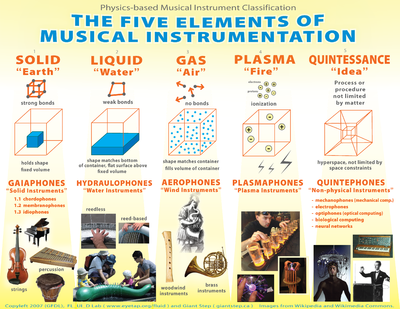
The Elementary Organology map can be traced to Kartomi, Schaeffner, Yamaguchi, and others, as well as to the Greek and Roman concepts of Elementary classification of all objects, not just musical instruments.
Thus "elementary" refers to "element" (i.e. state-of-matter) as well as to something that is fundamental or innate (physical).
Elementary organology (physical organology) categorizes musical instruments by their Classical Element
, i.e.
----
Less commonly, organology can refer to the study of anatomical
organs
.
Musical instrument
A musical instrument is a device created or adapted for the purpose of making musical sounds. In principle, any object that produces sound can serve as a musical instrument—it is through purpose that the object becomes a musical instrument. The history of musical instruments dates back to the...
s and their classification. It embraces study of instruments' history, instruments used in different cultures, technical aspects of how instruments produce sound, and musical instrument classification
Musical instrument classification
At various times, and in various cultures, various schemes of musical instrument classification have been used.The most commonly used system in use in the west today divides instruments into string instruments, wind instruments and percussion instruments...
. There is a degree of overlap between organology, ethnomusicology
Ethnomusicology
Ethnomusicology is defined as "the study of social and cultural aspects of music and dance in local and global contexts."Coined by the musician Jaap Kunst from the Greek words ἔθνος ethnos and μουσική mousike , it is often considered the anthropology or ethnography of music...
(being subsets of musicology
Musicology
Musicology is the scholarly study of music. The word is used in narrow, broad and intermediate senses. In the narrow sense, musicology is confined to the music history of Western culture...
) and the branch of the acoustics
Acoustics
Acoustics is the interdisciplinary science that deals with the study of all mechanical waves in gases, liquids, and solids including vibration, sound, ultrasound and infrasound. A scientist who works in the field of acoustics is an acoustician while someone working in the field of acoustics...
devoted to musical instruments.
A number of ancient cultures left documents detailing the musical instruments used and their role in society; these documents sometimes included a classification system. The first major documents on the subjects from the west, however, date from the 16th century, with works such as Sebastian Virdung
Sebastian Virdung
Sebastian Virdung was a German composer and theorist on musical instruments. He is grouped among the composers known as the Colorists. He studied in Heidelberg as a scholar of Johannes von Soest at the chapel of the ducal court. After being ordained, he became chaplain at the court in Heidelberg....
's Musica getuscht und ausgezogen (1511), and Martin Agricola
Martin Agricola
Martin Agricola was a German composer of Renaissance music and a music theorist.He was born in Schwiebus in Lower Silesia. His German name was Sohr or Sore....
's Musica instrumentalis deudsch (1529).
One of the most important organologists of the 17th century is Michael Praetorius
Michael Praetorius
Michael Praetorius was a German composer, organist, and music theorist. He was one of the most versatile composers of his age, being particularly significant in the development of musical forms based on Protestant hymns, many of which reflect an effort to make better the relationship between...
. His Syntagma musicum (1618) is one of the most quoted works from that time on the subject, and is the source of much of what we know about renaissance
Renaissance music
Renaissance music is European music written during the Renaissance. Defining the beginning of the musical era is difficult, given that its defining characteristics were adopted only gradually; musicologists have placed its beginnings from as early as 1300 to as late as the 1470s.Literally meaning...
musical instruments. Praetorius's Theatrum instrumentorium (1620) contains possibly the first pictures of Africa
Africa
Africa is the world's second largest and second most populous continent, after Asia. At about 30.2 million km² including adjacent islands, it covers 6% of the Earth's total surface area and 20.4% of the total land area...
n instruments in a European publication.
For much of the 18th and 19th centuries, little work was done on organology. Explorers returned to Europe with instruments from different cultures, however, so that by the end of the 19th century, some musical instrument collections were quite large. This led to a renewed interest in the subject.
One of the most important organologists of the 20th century was Curt Sachs
Curt Sachs
Curt Sachs was a German-born but American-domiciled musicologist. He was one of the founders of modern organology , and is probably best remembered today for co-authoring the Sachs-Hornbostel scheme of musical instrument classification with his fellow scholar Erich von Hornbostel.Born in Berlin,...
, who, as well as writing Real-Lexicon der Musikinstrumente (1913) and The History of Musical Instruments (1942), devised with Erich von Hornbostel
Erich von Hornbostel
Erich Moritz von Hornbostel was an Austrian ethnomusicologist and scholar of music. He is remembered for his pioneering work in the field of ethnomusicology, and for the Sachs–Hornbostel system of musical instrument classification which he co-authored with Curt Sachs.-Life:Hornbostel was born in...
the Hornbostel-Sachs
Hornbostel-Sachs
Hornbostel–Sachs is a system of musical instrument classification devised by Erich Moritz von Hornbostel and Curt Sachs, and first published in the Zeitschrift für Ethnologie in 1914. An English translation was published in the Galpin Society Journal in 1961...
scheme of instrument classification, published in 1914. This remains the most common classification scheme used by organologists today, despite some criticism. Andre Schaeffner introduced a system based on state-of-matter of the sound-producing mechanism, giving rise to two top-level categories: solid (containing strings and percussion), and gas (containing woodwind and brass). With the invention of hydraulophone
Hydraulophone
A hydraulophone is a tonal acoustic musical instrument played by direct physical contact with water where sound is generated or affected hydraulically. Typically sound is produced by the same hydraulic fluid in contact with the player's fingers...
, the physics-based organology has been expanded to use solid, liquid, and gas, wherein the top-level category is the state-of-matter of the material that makes the sound. Reference to Kartomi's book, page 173.
A number of societies exist dedicated to the study of musical instruments. Among the more prominent are the Galpin Society
Galpin Society
The Galpin Society was formed in October 1946 to further research into the history, construction, development and use of musical instruments...
, based in the United Kingdom
United Kingdom
The United Kingdom of Great Britain and Northern IrelandIn the United Kingdom and Dependencies, other languages have been officially recognised as legitimate autochthonous languages under the European Charter for Regional or Minority Languages...
; and the American Musical Instrument Society
American Musical Instrument Society
The American Musical Instrument Society was formed in 1971 "to promote better understanding of all aspects of the history, design, construction, restoration, and usage of musical instruments in all cultures and from all periods"...
, based in the United States
United States
The United States of America is a federal constitutional republic comprising fifty states and a federal district...
.
Elementary organology
Elementary organology (also known as physical organology) is a classification scheme based on the Elements (i.e. state-of-matter), in which sound production takes placeThe Elementary Organology map can be traced to Kartomi, Schaeffner, Yamaguchi, and others, as well as to the Greek and Roman concepts of Elementary classification of all objects, not just musical instruments.
Thus "elementary" refers to "element" (i.e. state-of-matter) as well as to something that is fundamental or innate (physical).
Elementary organology (physical organology) categorizes musical instruments by their Classical Element
Classical element
Many philosophies and worldviews have a set of classical elements believed to reflect the simplest essential parts and principles of which anything consists or upon which the constitution and fundamental powers of anything are based. Most frequently, classical elements refer to ancient beliefs...
, i.e.
| Element | State | Category | ||
| 1 | Earth | solids | Gaiaphones | the first category proposed by Andre Schaeffner; |
| 2 | Water | liquids | hydraulophone Hydraulophone A hydraulophone is a tonal acoustic musical instrument played by direct physical contact with water where sound is generated or affected hydraulically. Typically sound is produced by the same hydraulic fluid in contact with the player's fingers... s |
|
| 3 | Air | gases | aerophone Aerophone An aerophone is any musical instrument which produces sound primarily by causing a body of air to vibrate, without the use of strings or membranes, and without the vibration of the instrument itself adding considerably to the sound... s |
the second category proposed by Andre Schaeffner; |
| 4 | Fire | plasmas | plasmaphone Plasmaphone A plasmaphone is a musical instrument that produces sound in plasma, or ionized gas, with or without later amplification, processing, or the like.... s |
|
| 5 | Quintessence/Idea | informatics | quintephone Quintephone In the classification proposed by Steve Mann, a Quintephone is a musical instrument that generates sound informatically .For Mann, electronic instruments, i.e... s |
Prominent Organologists
- Ivor DarregIvor DarregIvor Darreg was a leading proponent of and composer of microtonal or "xenharmonic" music. He also created a series of experimental musical instruments.Darreg, a contemporary of Harry Partch and a close colleague of John H...
, microtonal instrument builder - Leo FenderLeo FenderClarence Leonidas "Leo" Fender was an American inventor who founded Fender Electric Instrument Manufacturing Company, or "Fender" for short...
, innovator of several electric guitar constructions (bridges and electronic configurations) - Bart HopkinBart HopkinBart Hopkin is a builder of experimental musical instruments and a writer and publisher about the subject.Hopkin published the magazine Experimental Musical Instruments for 15 years and published several books and CDs specialized in a specialisation of certain types of instruments, such as wind...
, founder of Experimental Musical InstrumentsExperimental Musical InstrumentsExperimental Musical Instruments was a periodical edited and published by Bart Hopkin, a leader in 20th century experimental music design and custom made instrument construction. Though no longer in print, back issues are still available. The material and approach of EMI can now be found...
magazine - Erich von HornbostelErich von HornbostelErich Moritz von Hornbostel was an Austrian ethnomusicologist and scholar of music. He is remembered for his pioneering work in the field of ethnomusicology, and for the Sachs–Hornbostel system of musical instrument classification which he co-authored with Curt Sachs.-Life:Hornbostel was born in...
, co-creator of the Hornbostel-Sachs musical instrument classification system - Victor-Charles MahillonVictor-Charles MahillonVictor-Charles Mahillon was a Belgian musician and writer on musical topics. He built, collected, and described more than 1500 musical instruments....
, organologist and museum curator - Bob Moog
- Harry PartchHarry PartchHarry Partch was an American composer and instrument creator. He was one of the first twentieth-century composers to work extensively and systematically with microtonal scales, writing much of his music for custom-made instruments that he built himself, tuned in 11-limit just intonation.-Early...
, microtonal string division musical theorist - Curt SachsCurt SachsCurt Sachs was a German-born but American-domiciled musicologist. He was one of the founders of modern organology , and is probably best remembered today for co-authoring the Sachs-Hornbostel scheme of musical instrument classification with his fellow scholar Erich von Hornbostel.Born in Berlin,...
, musicologist and organologist - Andre Schaeffner
- Leon ThereminLéon ThereminLéon Theremin was a Russian and Soviet inventor. He is most famous for his invention of the theremin, one of the first electronic musical instruments. He is also the inventor of interlace, a technique of improving the picture quality of a video signal, widely used in video and television technology...
- Anthony BainesAnthony BainesAnthony Cuthbert Baines was an English organologist who produced a wide variety of works on the history of musical instruments, and was a founding member of the Galpin Society.-Partial bibliography:...
, historical organologist and early authority on bagpipes
Ethno-organologists
- Mark Cherkasky - contemporary Ukrainian ethno-organologist, curator of the Museum of Ukrainian folk instruments in Kiev.
- Adolf Chybinski - Polish organologist
- Andriy Humeniuk - Ukrainian musicologist and ethno-organologist
- Mykhailo Khai - Ukrainian folklorist and ethno-organologist
- Hnat KhotkevychHnat KhotkevychHnat Martynovych Khotkevych December 31, 1877 in Kharkiv, Russian Empire – October 8, 1938 in Kharkiv, in the Ukrainian SSR of the Soviet Union) was a Ukrainian writer, ethnographer, playwright, composer, musicologist, and bandurist....
- Ukrainian engineer and musicologist. - Filaret KolessaFilaret KolessaFilaret Mykhailovych Kolessa was a Ukrainian ethnographer, folklorist, composer, musicologist and literary critic. He was a member of the Shevchenko Scientific Society from 1909, The Free Ukrainian Academy of Sciences from 1929, and the founder of Ukrainian ethnographic musicology.- Biography...
- Ukrainian folklorist and ethno-organologist. - Volodymyr KushpetVolodymyr KushpetVolodymyr Kushpet is an influentian Ukrainian baritone singer, and player on torban, kobza, bandura and lira, noted reconstruction of traditional playing techniques on these instruments....
- contemporary Ukrainian ethno-organologist - Klyment Kvitka - Russian and Ukrainian ethno-organologist
- Mykola LysenkoMykola LysenkoMykola Vitaliiovych Lysenko was a Ukrainian composer, pianist, conductor and ethnomusicologist.- Biography :Lysenko was born in Hrynky, Kremenchuk Povit, Poltava Governorate, the son of Vitaliy Romanovich Lysenko . From childhood he became very interested in the folksongs of Ukrainian peasants and...
- Ukrainian composer and founder of Ukrainian organology - Igor MatsiyevskyIgor MatsiyevskyIgor Vladimirovych Matsiyevsky is a Ukrainian film music composer and music ethnographer....
- Russian and Ukrainian ethno-organologist - Kevin Dawe - British ethnomusicologist and organologist
External links
- The Galpin Society
- The American Musical Instrument Society
- Experimental Musical Instruments
- Department of Musical Instruments at The Metropolitan Museum of Art home to a large collection of historic musical instruments
----
Less commonly, organology can refer to the study of anatomical
Anatomy
Anatomy is a branch of biology and medicine that is the consideration of the structure of living things. It is a general term that includes human anatomy, animal anatomy , and plant anatomy...
organs
Organ (anatomy)
In biology, an organ is a collection of tissues joined in structural unit to serve a common function. Usually there is a main tissue and sporadic tissues . The main tissue is the one that is unique for the specific organ. For example, main tissue in the heart is the myocardium, while sporadic are...
.