
All Topics  
Hurdy gurdy

 
Hurdy Gurdy

   Email Print
   Bookmark   Link


Hurdy gurdy


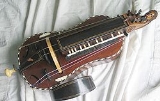
The hurdy gurdy (also known as a wheel fiddle) is a stringed musical instrument
Musical instrument

A musical instrument is an object constructed or used for the purpose of making music. In principle, anything that produces sound can serve as a musical instrument....
 in which the strings are sounded by means of a rosin
Rosin

Rosin, formerly called colophony or Greek pitch , is a solid form of resin obtained from pines and some other plants, mostly Pinophyta, produced by heating fresh liquid resin to vaporize the volatile liquid terpene components....
ed wheel which the strings of the instrument pass over. This wheel, turned with a crank, functions much like a violin bow, making the instrument essentially a mechanical violin. Melodies are played on a keyboard
Musical keyboard

A musical keyboard is the set of adjacent depressible levers or keys on a musical instrument, particularly the piano. Keyboards typically contain keys for playing the twelve notes of the Western musical scale, with a combination of larger, longer keys and smaller, shorter keys that repeats at the interval of an octave....
 that presses tangents (small wedges, usually made of wood) against one or more of these strings to change their pitch.


Discussion
Ask a question about 'Hurdy gurdy'
Start a new discussion about 'Hurdy gurdy'
Answer questions from other users
Full Discussion Forum


Encyclopedia


The hurdy gurdy (also known as a wheel fiddle) is a stringed musical instrument
Musical instrument

A musical instrument is an object constructed or used for the purpose of making music. In principle, anything that produces sound can serve as a musical instrument....
 in which the strings are sounded by means of a rosin
Rosin

Rosin, formerly called colophony or Greek pitch , is a solid form of resin obtained from pines and some other plants, mostly Pinophyta, produced by heating fresh liquid resin to vaporize the volatile liquid terpene components....
ed wheel which the strings of the instrument pass over. This wheel, turned with a crank, functions much like a violin bow, making the instrument essentially a mechanical violin. Melodies are played on a keyboard
Musical keyboard

A musical keyboard is the set of adjacent depressible levers or keys on a musical instrument, particularly the piano. Keyboards typically contain keys for playing the twelve notes of the Western musical scale, with a combination of larger, longer keys and smaller, shorter keys that repeats at the interval of an octave....
 that presses tangents (small wedges, usually made of wood) against one or more of these strings to change their pitch. Like most other acoustic string instruments, it has a soundboard
Sounding board

The sounding board or soundboard is the part of a string instrument that transmits the vibrations of the strings to the air, greatly increasing the loudness of sound over that of the string alone....
 to make the vibration of the strings audible.

Most hurdy gurdies have multiple "drone
Drone (music)

In music, a drone is a harmony or monophony effect or accompaniment where a note or chord is continuously sounded throughout much or all of a piece, sustain or repetition , and most often establishing a tonality upon which the rest of the piece is built....
 strings" which provide a constant pitch accompaniment to the melody, resulting in a sound similar to that of bagpipes
Bagpipes

Bagpipes are a class of musical instrument, aerophones using enclosed reed fed from a constant reservoir of air in the form of a bag. Though the Scottish Great Highland Bagpipe and Irish uilleann pipes have the greatest international visibility, bagpipes have historically been found throughout Europe, and into Northern Africa, the Persian...
. For this reason, the hurdy gurdy is often used interchangeably with or along with bagpipes, particularly in French
French folk music

As Europe experienced a wave of roots revivals, France found its regional cultures reviving traditional music. Brittany, Limousin , Gascony, Corsica and Auvergne were among the regions that underwent a popularization of folk music....
 and contemporary Hungarian
Hungarian music

The term Hungarian music may refer to:*The music of Hungary, which includes many kinds of music associated with Serbian people, Roma people and Hungarian people people...
 folk music.

Many folk music festivals in Europe feature music groups with hurdy gurdy players, but the most famous annual festival is at Saint-Chartier
Saint-Chartier

Saint-Chartier is a Communes of France in the Indre departments of France in central France....
, in the Indre département, in central France, during the week nearest July 14 (Bastille Day
Bastille Day

Bastille Day is the France National Day, celebrated on 14 July each year . In France, it is called F?te Nationale in official parlance, or more commonly le quatorze juillet ....
).

Origins and history

Organistrumsantiago20060414
The hurdy gurdy is thought to have originated from fiddles
Fiddle

The term fiddle refers to a violin; it is a colloquial term for the instrument used by players in all genres, including European classical music....
 in either Western Europe
Western Europe

Western Europe refers to the countries in the western most half of Europe. This concept has had different meanings, political and cultural as well as geographical issues have influenced the area....
 (e.g. the Byzantine lira) or the Middle East
Middle East

File:GreaterMiddleEast1.pngThe Middle East is a region that spans southwestern Asia, western Asia, and northeastern Africa. It has no clear boundaries, often used as a synonym to Near East, in opposition to Far East....
 (e.g. rebab
Rebab

The rebab , also rebap, rabab, rebeb, rababah, or al-rababa) is a type of string instrument so named no later than the 8th century and spread via Islamic trading routes over much of North Africa, the Middle East, parts of Europe, and the Far East....
) some time prior to the eleventh century A.D.. The first recorded reference to fiddles in Europe was in the 9th century by the Persian
Persian

Persian is of, from, or related to Iran , a country in the Middle East.* Persian people, an Iranian peoples ethno-linguistic community in Central and Southwest Asia....
 geographer Ibn Khurradadhbih
Ibn Khordadbeh

Abu'l Qasim Ubaid'Allah ibn Khordadbeh , author of the earliest surviving Arabic book of administrative geography, was a Persian geographer and bureaucrat of the 9th century....
 (d. 911) describing the lira (lura) as a typical instrument within the Byzantine Empire
Byzantine Empire

Byzantine Empire and Eastern Roman Empire are conventional names used to describe the Roman Empire during the Middle Ages, centered on its capital of Constantinople....
. One of the earliest forms of the hurdy gurdy was the organistrum
Organistrum

The organistrum is an early form of hurdy gurdy that originated in northern Spain as an instrument used for singing instruction in monastic settings....
, a large instrument with a guitar
Guitar

The guitar is a musical instrument with ancient roots that is used in a wide variety of musical styles. It typically has six Strings , but Tenor guitar, Seven-string guitar, Eight-string guitar, Ten-string guitar, Eleven-string guitar, Twelve-string guitar, Thirteen-string guitar and doubleneck guitar string guitars also exist....
-shaped body and a long neck in which the keys were set (covering one diatonic octave). The organistrum had a single melody string and two drone strings which ran over a common bridge and a relatively small wheel. Due to its size, the organistrum was played by two people, one of whom turned the crank while the other pulled the keys upward. Pulling keys upward is a cumbersome playing technique, and as a result only slow tunes could be played on the organistrum. The pitches on the organistrum were set according to Pythagorean temperament
Pythagorean tuning

Pythagorean tuning is a system of musical tuning in which the frequency relationships of all interval are based on the ratio sesquialterum. Its name comes from medieval texts which attribute its discovery to Pythagoras, but its use has been documented as long ago as 3500 B.C....
 and the instrument was primarily used in monastic and church settings to accompany choral music. The abbot Odo of Cluny
Odo of Cluny

Saint Odo of Cluny , a saint of the Roman Catholic Church, was the second abbot of Cluny. He enacted various reforms in the Cluniac monastery system of France and Italy....
 (died 942) is supposed to have written a short description of the construction of the organistrum entitled Quomodo organistrum construatur (How the Organistrum Is Made), known through a much-later copy, but its authenticity is very doubtful. Another 10th century treatise thought to have mentioned an instrument similar to the hurdy gurdy is an Arabic musical compendium written by Al Zirikli. One of the earliest visual depictions of the organistrum is from the twelfth-century ´Pórtico de la Gloria (Portal of Glory) on the cathedral at Santiago de Compostela
Santiago de Compostela

Santiago de Compostela is the capital of the autonomous communities of Spain of Galicia and a UNESCO World Heritage Site. Located in the north west of Spain in the A Coru?a , it was the "European City of Culture" for the year 2000....
, Galicia, Spain, which includes a carving of two musicians playing an organistrum.

Later on the organistrum was reduced in size to allow a single player to both turn the crank and manipulate the keys. The solo organistrum was known from Spain and France, but was largely replaced by the symphonia, a small box-shaped version of the hurdy gurdy with three strings and a diatonic keyboard. At about the same time as the symphonia
Symphonia

Symphonia , a much discussed word, applied at different times to the bagpipe, to the drum, to the hurdy-gurdy, and finally to a kind of clavichord....
 was developed, a new form of key pressed from beneath were developed. These keys were much more practical in faster music and easier to handle and eventually completely replaced keys pulled up from above. Medieval depictions of the symphonia show both types of keys.

During the Renaissance
Renaissance

The Renaissance was a cultural movement that spanned roughly the 14th to the 17th century, beginning in Italy in the late Middle Ages and later spreading to the rest of Europe....
, the hurdy gurdy was a very popular instrument, along with the bagpipe, and a characteristic form with a short neck and a boxy body with a curved tail end developed. It was about this time that buzzing bridges first appear in depictions of the instrument. The buzzing bridge (commonly called the dog) is an asymmetrical bridge that rests under a drone string on the sound board. When the wheel is accelerated, one foot of the bridge lifts up from the soundboard and vibrates, creating a buzzing sound. The buzzing bridge is thought to have been borrowed from the tromba marina
Tromba marina

A tromba marina, or marine trumpet is a triangular bow string instrument used in medieval and Renaissance Europe that was highly popular in the 15th century in England and survived into the 18th century....
(monochord
Monochord

A monochord is an ancient Musical instrument and scientific laboratory instrument. The word "monochord" comes from the Greek language and means literally "one string." In the monochord, a single Strings is stretched over a sound box....
), a bowed string instrument.

During the late Renaissance, two characteristic shapes of hurdy gurdies developed. The first was guitar-shaped and the second had a rounded lute
Lute

Lute can refer generally to any plucked string instrument with a neck and a deep round back, or more specifically to an instrument from the family of European lutes....
-type body made of staves. The lute body is especially characteristic of French instruments.

By the end of the 17th century changing musical tastes that demanded greater polyphonic capabilities than the hurdy gurdy could offer had pushed the instrument to the lowest social classes; as a result it acquired names like the German Bauernleier ‘peasant’s lyre’ and Bettlerleier ‘beggar’s lyre.’ During the 18th century, however, French Rococo
Rococo

Rococo is a style of 18th century French art and interior design. Rococo rooms were designed as total works of art with elegant and ornate furniture, small sculptures, ornamental mirrors, and tapestry complementing architecture, reliefs, and wall paintings....
 tastes for rustic diversions brought the hurdy gurdy back to the attention of the upper classes, where it acquired tremendous popularity among the nobility, with famous composers writing works for the hurdy gurdy (the most famous of which is Nicolas Chédeville
Nicolas Chédeville

Nicolas Ch?deville was a France composer, musette de cour player and musette maker....
’s Il pastor Fido, attributed to Vivaldi
Antonio Vivaldi

Antonio Lucio Vivaldi , nicknamed il Prete Rosso , was a Baroque music composer and Venice priest, as well as a famous virtuoso violinist, born and raised in the Republic of Venice....
). At this time the most common style of hurdy gurdy developed, the six-string vielle à roue. This instrument has two melody strings and four drones tuned such that by turning drones on or off, the instrument can be played in multiple keys (e.g., C and G or G and D).

During this time the hurdy gurdy also spread further east, where further variations developed in western Slavic countries, German-speaking areas and Hungary (see the list of types below for more information on these). Most types of hurdy gurdy were essentially extinct by the early twentieth century, but a few sorts have survived to the present day, the best-known of which are the French vielle à roue, the Hungarian tekerolant, and the Spanish zanfona. In Ukraine
Ukraine

Ukraine is a country in Eastern Europe. It is bordered by Russia to the east; Belarus to the north; Poland, Slovakia, and Hungary to the west; Romania and Moldova to the southwest; and the Black Sea and Sea of Azov to the south....
, a variety called the lira was widely used by blind street musicians, most of whom were purged by Stalin
Joseph Stalin

Joseph Stalin was the General Secretary of the Communist Party of the Soviet Union's Central Committee of the Communist Party of the Soviet Union from 1922 until his death in 1953....
 in the 1930s. Revivals have been underway for many years in Sweden
Sweden

Sweden , officially the Kingdom of Sweden , is a Nordic countries on the Scandinavian Peninsula in Northern Europe. Sweden has land borders with Norway to the west and Finland to the northeast, and it is connected to Denmark by the ?resund Bridge in the south....
, Germany
Germany

Germany , officially the Federal Republic of Germany , is a country in Central Europe. It is bordered to the north by the North Sea, Denmark, and the Baltic Sea; to the east by Poland and the Czech Republic; to the south by Austria and Switzerland; and to the west by France, Luxembourg, Belgium, and the Netherlands....
, Austria
Austria

Austria , officially the Republic of Austria , is a landlocked country in Central Europe. It borders both Germany and the Czech Republic to the north, Slovakia and Hungary to the east, Slovenia and Italy to the south, and Switzerland and Liechtenstein to the west....
, Czech Republic
Czech Republic

The Czech Republic , is a landlocked country in Central Europe. The country borders Poland to the northeast, Germany to the west, Austria to the south and Slovakia to the east....
, Poland
Poland

Poland , officially the Republic of Poland , is a country in Central Europe. Poland is bordered by Germany to the west; the Czech Republic and Slovakia to the south; Ukraine, Belarus and Lithuania to the east; and the Baltic Sea and Kaliningrad Oblast, a Russian Enclave and exclave, to the north....
, Russia
Russia

Russia , or the Russian Federation , is a list of countries spanning more than one continent country extending over much of northern Eurasia....
, Italy
Italy

Italy , officially the Italian Republic , is a country located on the Italian Peninsula in Southern Europe and on the two largest islands in the Mediterranean Sea, Sicily and Sardinia....
, and Portugal
Portugal

Portugal , officially the Portuguese Republic , is a country on the Iberian Peninsula. Located in southwestern Europe, Portugal is the westernmost country of mainland Europe and is bordered by the Atlantic Ocean to the west and south and by Spain to the north and east....
. The revival of hurdy gurdies has resulted in the instrument’s use in a variety of styles of music (see the list of recordings that use hurdy gurdy
Recordings featuring the hurdy gurdy

The following recordings utilize the hurdy gurdy.* The group Blowzabella feature hurdy-gurdies together with bagpipes and an array of acoustic instruments "to produce an inimitable, driving drone-based sound influenced by British and European traditional dance music."...
), including contemporary forms not typically associated with the hurdy gurdy.

The hurdy-gurdy appears to tbe the instrument played by Der Leiermann, the melancholy last song of Schubert's Winterreise
Winterreise

Winterreise is a cycle of 24 poems by Wilhelm M?ller, best known as the song cycle set for male voice and piano by Franz Schubert . It is the second of Schubert's two great song cycles on M?ller's poems, the earlier being Die sch?ne M?llerin ....
 .

The hurdy gurdy is featured and played prominently in the film Captains Courageous
Captains Courageous (film)

Captains Courageous is a 1937 in film Metro-Goldwyn-Mayer film, based on the Captains Courageous by Rudyard Kipling. The movie was produced by Louis D....
 (1937) as the instrument belonging to the character Manuel, acted by Spencer Tracy
Spencer Tracy

Spencer Tracy was a two-time Academy Award winning actor of theatre and film, who appeared in 74 films from 1930 in film to 1967 in film. He is generally regarded as one of the finest actors in motion picture history....
.

The instrument came into a new public consciousness when Donovan released his hit rock song, "Hurdy Gurdy Man" in 1968. Although the song didn't feature an actual hurdy gurdy in the mix (but did feature three members of the later rock group Led Zeppelin), the repeated reference to the Hurdy Gurdy in the song's lyrics sparked a new curiosity and interest about the instrument by the youth at the time, eventually resulting in an annual hurdy gurdy music festival in the Olympic Peninsula area of the state of Washington each September.

Other instruments called hurdy gurdies
In the eighteenth century the term hurdy gurdy was also applied to a small, portable "barrel organ
Barrel organ

A barrel organ is a mechanical musical instrument consisting of bellows and one or more ranks of organ pipe housed in a case, usually of wood, and often highly decorated....
" (a cranked box instrument with a number of organ pipes, a bellows and a barrel with pins that rotated and programmed the tunes) that was frequently played by poor buskers
Busking

Busking is the practice of performance in public places for tips and gratuities. People engaging in this practice are called buskers. Busking performances are widely varied, and can include acrobatics, animal tricks, balloon modeling, card tricks, clowning, comedy, contortionist & escapologist, dance, Fire eater, fortune-telling, juggl...
 (street musicians). Barrel organs require only the turning of the crank, and the music is played automatically by pinned barrels, perforated paper rolls, and more recently by electronic modules.

This confusion over what the name hurdy gurdy means is particular to English, although similar confusion over other terms for the instrument occurs in German and Hungarian due to unfamiliarity with the hurdy gurdy. The French call the barrel organ the Orgue de Barbarie ("Barbary organ"), and the Germans Drehorgel ("turned organ"), instead of Drehleier ("turning lyre").

The hurdy gurdy in Eastern Europe
The hurdy-gurdy has a well developed tradition in Eastern Europe, in particular in Hungary
Hungary

Hungary , officially in English the Republic of Hungary , is a landlocked country in the Carpathian Basin of Central Europe, bordered by Austria, Slovakia, Ukraine, Romania, Serbia, Croatia, and Slovenia....
, Poland
Poland

Poland , officially the Republic of Poland , is a country in Central Europe. Poland is bordered by Germany to the west; the Czech Republic and Slovakia to the south; Ukraine, Belarus and Lithuania to the east; and the Baltic Sea and Kaliningrad Oblast, a Russian Enclave and exclave, to the north....
, Belarus
Belarus

Belarus is a landlocked country in Eastern Europe, bordered by Russia to the north and east, Ukraine to the south, Poland to the west, and Lithuania and Latvia to the north....
 and Ukraine
Ukraine

Ukraine is a country in Eastern Europe. It is bordered by Russia to the east; Belarus to the north; Poland, Slovakia, and Hungary to the west; Romania and Moldova to the southwest; and the Black Sea and Sea of Azov to the south....
. In Ukraine it is known as the lira
Lira (instrument)

The lira, or relia, is a variant of the hurdy-gurdy, an instrument which can trace its history back to the 10th century. Regarding the origins of the lira in the region there are two schools of thought:...
 or relia was played by professional, often blind, itinerant musicians known as lirnyky. Their repertoire was primarily para-religious in theme, although it included many historic epics known as Dumy
Dumy

Dumy is a village in the administrative district of Gmina Wielkie Oczy, within Lubacz?w County, Subcarpathian Voivodeship, in south-eastern Poland, close to the border with Ukraine....
 and folk dances. In the 1930s this tradition was almost eradicated by the Soviet authorities when some 250-300 lirnyky were executed as a socially undesirable element in Soviet society. Today the instrument is undergoing a revival and is also being used in various ethnographic ensembles.

Terminology

A person who plays the hurdy gurdy is called a hurdy gurdyist, hurdy gurdy player, or (particularly for players of French instruments) viellist.

Due to the prominence of the French tradition, many instrument and performance terms used in English are commonly taken from the French, and players generally need to know these terms to read relevant literature. Such common terms include the following:

  • trompette: the highest-pitched drone string that features the buzzing bridge
  • mouche: the drone string pitched a fourth or fifth below the trompette
  • petit bourdon: the drone string pitched an octave below the trompette
  • gros bourdon: the drone string pitched an octave below the mouche
  • chanterelle(s): melody string(s), also called chanters or chanter strings in English
  • chien: (literally "dog"), the buzzing bridge
  • tirant: a small peg set in the instrument’s tailpiece that is used to control the sensitivity of the buzzing bridge


Names of the instrument


According to the Oxford English Dictionary
Oxford English Dictionary

The Oxford English Dictionary , published by the Oxford University Press , is a comprehensive dictionary of the English language. Two fully-bound print editions of the OED have been published under its current name, in 1928 and 1989; as of December 2008 the dictionary's current editors have completed a quarter of the third edition....
, the origin of the term hurdy gurdy is onomatopoetic
Onomatopoeia

Onomatopoeia is a word or a grouping of words that imitates the sound it is describing, such as animal noises like "oink" or "meow", or suggesting its source object, such as "boom", "zoom", "click", "bunk", "clang", "buzz", "zap", or "bang"....
 in origin, after the repetitive warble in pitch that characterizes instruments with solid wooden wheels that have warped due to changes in humidity or after the sound of the buzzing-bridge.

Some have suggested other origins for the term, including the following folk etymology:
hurdy = a person's backside + gurdy = a reel with a crank, used to reel in fishing nets on a boat. This pejorative name was applied to the French instrument in England, during the eighteenth century.
(There are a number of problems with this putative etymology. Among them are (1) hurdy is not known as an English term, and (2) the term for the crank (hurdy gurdy, not gurdy) was first recorded in 1883, based on the term for the instrument.)

An alternative folk etymology suggests that the term comes from an anglicized form of the French harpe de gourde.

The instrument is sometimes more descriptively called a wheel fiddle in English, but this term is not in general use among players of the instrument. The Hungarian name tekerolant and the alternate forgólant both mean "turning lute." An alternate German name, Bauernleier, means "peasant's lyre". (Leier, lant, and related terms today are generally used to refer to members of the lute
Lute

Lute can refer generally to any plucked string instrument with a neck and a deep round back, or more specifically to an instrument from the family of European lutes....
 or lyre
Lyre

The lyre is a string instrument well known for its use in classical antiquity and later. The recitations of the Ancient Greece were accompanied by lyre playing....
 family, but historically had a broader range of meaning and were used for many types of stringed instruments.)

Another Hungarian name for the instrument is nyenyere, which is thought to be an onomatopoeic reference to the repetitive warble produced by a wheel that is not even. Note that this term was considered derogatory in the Hungarian lowlands, but was the normal term for the instrument on Csepel island directly south of Budapest.

Design

Wheeltangents
Frenchbuzzingbridgesystem
There is no standardized design for the hurdy gurdy today, although the six-stringed French vielle a roue is the best known and most common sort. A number of regional forms developed, but outside of France the instrument was considered a folk instrument
Folk instrument

A folk instrument is an instrument that developed among common people and usually doesn't have a known inventor. It can be made from wood, metal or other material....
 and there were no schools of construction that could have determined a standard form.

There are two primary body styles for contemporary instruments: guitar-bodied and lute-backed. Both forms are found in French-speaking areas, while guitar-bodied instruments are the general form elsewhere. The box form of the simphonia is also commonly found among players of early music and historical reenactors.

Strings

Historically, strings were made of gut
Catgut

Catgut is a type of cord usually prepared from the intestines of sheep or goat. It can also be made using the intestines of a Hog , horse, mule, pig or donkey....
, which is still a preferred material today, but metal strings have become common in the twentieth century, especially for the heavier drone strings or for lower melody strings if octave tuning is used. Nylon is also used, but is frowned upon by many players.

The drone strings produce steady sounds at fixed pitches. The melody string(s) (French chanterelle(s), Hungarian dallamhúr(ok)) are stopped with tangents attached to keys that change the vibration length of the string, much as a guitarist uses his or her fingers on the fretboard of a guitar. In the earliest hurdy gurdies these keys were arranged to provide a Pythagorean temperament
Pythagorean tuning

Pythagorean tuning is a system of musical tuning in which the frequency relationships of all interval are based on the ratio sesquialterum. Its name comes from medieval texts which attribute its discovery to Pythagoras, but its use has been documented as long ago as 3500 B.C....
, but in later instruments the tunings have varied widely, with equal temperament
Equal temperament

Equal temperament is a musical temperament, or a system of Musical tuning in which every pair of adjacent notes has an identical frequency ratios....
 most common in order to allow for easier blending with other instruments. However, because the tangents can be adjusted to tune individual notes, it is possible to tune hurdy gurdies to almost any temperament as needed. Most contemporary hurdy gurdies have 24 keys that cover a range of two chromatic octaves.

In order to achieve proper intonation and sound quality, each string of a hurdy gurdy must be wrapped with cotton or similar fibers. The cotton on melody strings tends to be quite light, while drone strings have heavier cotton. Improper cottoning results in a raspy tone, especially at higher pitches. In addition, individual strings (in particular the melody strings) often have to have their height above the wheel surface adjusted by having small pieces of paper placed between the strings and the bridge, a process called shimming. Shimming and cottoning are connected processes since either one can affect the geometry of the instrument’s strings.

Buzzing bridge

In some types of hurdy gurdy, notably the French vielle à roue ('fiddle with a wheel') and the Hungarian tekerolant (tekero for short) have added a buzzing bridge, chien (French for dog) or recsego (Hungarian for buzzer) on one drone string; modern makers have increased the number of buzzing bridges on French-style instruments to as many as four. This mechanism consists of a loose bridge under a drone string. The tail of this buzzing bridge is inserted into a narrow vertical slot (or held by a peg in Hungarian instruments) that holds the buzzing bridge in place (and also serves as a bridge for additional drone strings on some instruments). The free end of the dog (called the hammer) rests on the soundboard of the hurdy gurdy and is more or less free to vibrate. When the wheel is turned slowly the pressure on the string (called the trompette on French instruments) holds the bridge in place, sounding a drone. When the crank is accelerated, the hammer lifts up and vibrates against the soundboard, producing a characteristic rhythmic buzz that is used as an articulation or to provide percussive effect, especially in dance pieces.

On French-style instruments, the sensitivity of the buzzing bridge can be altered by turning a peg called a tirant in the tailpiece of the instrument that is connected by a wire or thread to the trompette. The tirant adjusts the lateral pressure on the trompette and thereby sets the sensitivity of the buzzing bridge to changes in wheel velocity. There are various stylistic techniques that are used as the player turns the crank, speeding up the wheel at various points in its revolution. Each sped-up "hit" produces a distinct buzzing sound. These hits are under the control of the player, and are not automatic, having to be put in with each complete turn of the wheel.

On the Hungarian tekero the same control is achieved by using a wedge called the recsegoék (control wedge (literally "buzzer wedge") that pushes the drone string downward. In traditional tekero playing, the buzzing bridge is controlled entirely by the wrist of the player and has a very different sound and rhythmic possibilities from those available on French instruments.

Comparison of French and Hungarian buzzing bridges

Regional types

Regional types of hurdy gurdies since the Renaissance can also be classified based on wheel size and the presence or absence (and type) of a buzzing bridge.

Small wheel
Small-wheeled (wheel diameter less than 14 cm, or about 5.5 inches) instruments are traditionally found in Central and Eastern Europe. They feature a broad keybox and the drone strings run within the keybox. Because of the small size of the wheel these instruments most commonly have three strings: one melody string, one tenor drone and one bass drone. They sometimes have up to five strings.
  • String-adjusted buzzing bridge
    • German pear-shaped Drehleier. Two to three drone strings and one or two chromatic melody strings. Characteristic V-shaped pegbox. Often extensively decorated. The type of buzzing bridge found on this instrument usually has the adjustment peg set in a block next to the string, rather than in the tailpiece (as is typical of French instruments).
  • Wedge-adjusted buzzing bridge
    • tekerolant (Hungarian). Usually two drones (sometimes three) + one or two chromatic melody strings. The broad keybox is often carved or decorated extensively.
    • Tyrolian Drehleier (Austria). Very similar to the tekerolant, but usually has a diatonic keyboard. May be the historical source for the tekero.
  • No buzzing bridge
    • lira korbowa (Poland). Guitar-shaped. Two drones + one diatonic melody string.
    • lira/???? (Russia). Guitar-shaped. Two drones + one diatonic melody string. Evenly-spaced keyboard.
    • lira/???? (Ukraine). Guitar-shaped. Two drones + one diatonic melody string. Two body types: carved from a single piece of wood and guitar-shaped with transverse pegs and mult-piece construction with vertical pegs. Evenly spaced keyboard.
    • ninera
      Ninera

      Ninera is the unique Slovakia version of the hurdy-gurdy. One well-known ninera player in Slovakia is Tibor Koblicek, born in a small village of Turicky, near Cinobana in southern Slovakia....
      /kolovratec
      (Slovakia). Guitar-shaped. Two drones + one diatonic melody string. Broad keybox. Superficially similar to the tekero, but lacks the buzzing bridge.
    • lira/vevlira (Sweden). Revived in the twentieth century based on historical examples. Two body forms: an elongated boxy shape and a long pear shape. Usually diatonic, but has been extended with a chromatic range with the additional keys placed below the normal diatonic range (the opposite of most chromatic hurdy gurdy keyboards)
    • German tulip-shaped Drehleier. Three drones + one diatonic melody string


Large wheel
Large-wheeled instruments (wheel diameters between 14 and 17 cm, or about 5.5 - 6.6 inches) traditionally are found in Western Europe. These instruments generally have a narrow keybox with drone strings that run outside of the keybox. They also generally have more strings and doubling or tripling of the melody string is common. Some modern instruments have as many as fifteen strings played by the wheel, although the most common number is six.
  • String-adjusted buzzing bridge
    • vielle à roue (French). Usually four drones + two melody strings, but often extended to have more strings. Two body forms: guitar-bodied and lute-backed (vielle en luth). French instruments generally have a narrow key box with drone strings that run on the outside of the key box. Traditional French instruments have two melody strings and four drone strings with one buzzing bridge. Contemporary instruments often have more: the instrument of well-known player Gilles Chabenat has four melody strings fixed to a viola tailpiece, and four drone strings on a cello tailpiece. This instrument also has 3 trompette strings.
    • Ninera (Czech). Guitar-shaped. Two forms: one has a standard drone-melody arrangement, while the other runs the drone strings between the melody strings in the keybox. Both diatonic and chromatic forms are found. Other mechanisms for adjusting the amount of "Buzz" on the trompette string.


  • No buzzing bridge
    • Zanfona (Spain). Typically guitar-shaped body, with three melody strings, and two drone strings. Some older examples had a diatonic keyboard, and most modern models have a chromatic keyboard. Zanfonas are tuned to the key of C major, the melody strings are in a unison on the middle-C on the piano. The drones are a baritone C (1 octave lower) and a bass drone C (2 octaves lower). The drones can be wound up to a higher tension to tune to D, while the melody strings remain the same. This allows for both minor and major lead tones (C and C sharp) to be played below the D keynote on the melody strings.
    • ninera (Czech). Guitar-shaped. Two forms: one has a standard drone-melody arrangement, while the other runs the drone strings between the melody strings in the keybox. Both diatonic and chromatic forms are found.

See also

  • Notable recordings featuring the hurdy gurdy
    Recordings featuring the hurdy gurdy

    The following recordings utilize the hurdy gurdy.* The group Blowzabella feature hurdy-gurdies together with bagpipes and an array of acoustic instruments "to produce an inimitable, driving drone-based sound influenced by British and European traditional dance music."...


External links

  • - detailed collection of information and links related to the hurdy gurdy.
  • - explanation of the hurdy gurdy in sound and photos.
  • - page with instructions for constructing a cheap rectangular hurdy gurdy.
  • - information about a special hurdy gurdy, pictures of other hurdy gurdies. Text in English, German and French.
  • - interesting historical note concerning a scandalous practice related to the hurdy gurdy.
  • - A little video of a player of hurdy gurdy
  • History, sounds, and photos
  • - A Diary of building a lute back Hurdy Gurdy.