

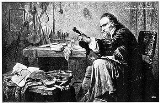
Luthier

Encyclopedia
A luthier is someone who makes or repairs lute
s and other string instrument
s. In the United States, the term is used interchangeably with a term for the specialty of each maker, such as violinmaker
, guitar maker
, lute maker, etc. The word luthier comes from the French
word luth, which means "lute
".
The craft
of making string instruments, or lutherie, is commonly divided into two main categories: makers of stringed instruments that are plucked
or strummed and makers of stringed instruments that are bowed
. Since bowed instruments require a bow, the second category includes a subtype known as a bow maker or archetier.
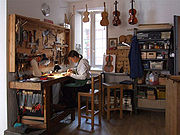
family (lutes, archlute
s, theorbo
s, vihuela
s etc.):
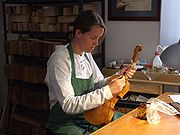 and in our time:
families. Antonio Torres Jurado
is credited with developing the form of classical guitar
that is still in use today, and Christian Frederick Martin
of Germany who developed a form that evolved into the modern steel-string acoustic guitar.
The American luthier Orville Gibson
specialized in mandolins, and is credited with creating the archtop guitar
. The important 20th Century American luthiers John D'Angelico
and Jimmy D'Aquisto
made archtop guitars. Lloyd Loar
worked briefly for the Gibson Guitar Corporation
making mandolins and guitars. His designs for a family of archtop instruments (mandolin, mandola, guitar, et cetera) are held in high esteem by today's luthiers, who seek to reproduce their sound. Paul Bigsby
's innovation of the tremolo arm
for archtop and electric guitar
s is still in use today and may have influenced Leo Fender's design for the Stratocaster solid body electric guitar
, as well as the Jaguar
and Jazzmaster. Concurrent with Fender's work, guitarist Les Paul
independently developed a solid body electric guitar. These were the first fretted solid body electric guitars—though they were preceded by the cast aluminum "frying pan
," a solid body electric lap steel guitar
developed and eventually patented by George Beauchamp
, and built by Adolph Rickenbacher
.
A company founded by luthier Friedrich Gretsch
and continued by his son and grandson, Fred and Fred Jr., originally made banjos, but is more famous today for its electric guitars.
Vintage guitars are often sought by collectors.
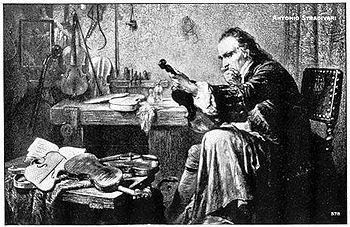
Bowed instruments include: cello
, crwth
, double bass
, erhu
, fiddle
, hudok, mouthbow
, nyckelharpa
, hurdy gurdy
, rabab, rebec
, sarangi
, viol
, viola
, viola da braccio, viola d'amore
, viola da gamba and violin
.
The purported "inventor" of the violin is Andrea Amati
. Amati was originally a lute maker but turned to the new instrument form of violin in the mid 16th century. He was the progenitor of the famous Amati family of luthiers active in Cremona
, Italy
until the 18th century. Andrea Amati had two sons. His eldest was Antonio Amati (c.1537,1540–1607), and the younger, Girolamo Amati (c.1561-1630). Girolamo is better known as Hieronymus, and together with his brother produced many violins with labels inside the instrument reading "A&H." Antonio died having no known offspring, however Hieronymus became a father. His son Nicolò (1596–1684), was himself an important master luthier who had several apprentices of note including Andrea Guarneri
, Bartolomeo Cristofori, Bartolomeo Pasta, Jacob Railich, Giovanni Battista Rogeri, Matthias Klotz
and possibly Jacob Stainer
.
Two other important early luthiers of the violin family were the double bass player, son and nephew of the two violin players Gasparo da Salò
of Brescia
, Italy and Gasparo Duiffopruggar
of Austria
who were each originally credited with invention of the first violin. However, this attribute has since been removed but is still often incorrectly cited. Da Salò had at least five apprentices: his son Francesco, and helper named Battista, the French Alexander of Marsiglia, Giacomo Lafranchini and, last, the most important is–Giovanni Paolo Maggini
who inherited da Salò's business in Brescia upon da Salò's death. Valentino Siani
worked with Giovanni Paolo Maggini. In 1620 he moved to Florence.
Of those luthiers born in the mid 17th century, there are Giovanni Grancino
, Carlo Giuseppe Testore
and son Carlo Antonio Testore, all from Milan
. From Venice
the luthiers Matteo Goffriller
, Domenico Montagnana
, Sanctus Seraphin
and Carlo Annibale Tononi
were principals in the Venetian school of violin making (although the latter began his career in Bologna
). The Bergonzi
family of luthiers were the successors to the Amati family in Cremona. David Tecchler
who was born in Austria later worked in both Venice and Rome
.
Important luthiers from the early 18th century include Nicolò Gagliano
of Naples
, Italy, Carlo Ferdinando Landolfi
of Milan and Giovanni Battista Guadagnini
who roamed throughout Italy during his lifetime. From Austria originally, Leopold Widhalm
later established himself in Nürnberg
, Germany
.
The early 19th century luthiers of the Mirecourt
school of violin making in France
were the Vuillaume family, Charles Jean Baptiste Collin-Mezin
, and Collin-Mezin's son, Charles Collin-Mezin, Jr.
.
The Jérôme-Thibouville-Lamy firm started making wind instruments around 1730 at La Couture-Boussey, then moved to Mirecourt around 1760 and started making violins, guitars, mandolins, and musical accessories.
Lute
Lute can refer generally to any plucked string instrument with a neck and a deep round back, or more specifically to an instrument from the family of European lutes....
s and other string instrument
String instrument
A string instrument is a musical instrument that produces sound by means of vibrating strings. In the Hornbostel-Sachs scheme of musical instrument classification, used in organology, they are called chordophones...
s. In the United States, the term is used interchangeably with a term for the specialty of each maker, such as violinmaker
Violin making and maintenance
Making an instrument of the violin family may be done in different ways, many of which have changed very little in nearly 500 years since the first violins were made. Some violins, called "bench-made" instruments, are made by a single individual, either a master maker, or an amateur working alone...
, guitar maker
Classical guitar making
A person who is specialized in the making of stringed instruments such as guitars, lutes and violins is called a luthier.-Skills:In general one can distinguish three main aspects of guitar making:...
, lute maker, etc. The word luthier comes from the French
French language
French is a Romance language spoken as a first language in France, the Romandy region in Switzerland, Wallonia and Brussels in Belgium, Monaco, the regions of Quebec and Acadia in Canada, and by various communities elsewhere. Second-language speakers of French are distributed throughout many parts...
word luth, which means "lute
Lute
Lute can refer generally to any plucked string instrument with a neck and a deep round back, or more specifically to an instrument from the family of European lutes....
".
The craft
Craft
A craft is a branch of a profession that requires some particular kind of skilled work. In historical sense, particularly as pertinent to the Medieval history and earlier, the term is usually applied towards people occupied in small-scale production of goods.-Development from the past until...
of making string instruments, or lutherie, is commonly divided into two main categories: makers of stringed instruments that are plucked
Plucked string instrument
Plucked string instruments are a subcategory of string instruments that are played by plucking the strings. Plucking is a way of pulling and releasing the string in such as way as to give it an impulse that causes the string to vibrate...
or strummed and makers of stringed instruments that are bowed
Bow (music)
In music, a bow is moved across some part of a musical instrument, causing vibration which the instrument emits as sound. The vast majority of bows are used with string instruments, although some bows are used with musical saws and other bowed idiophones....
. Since bowed instruments require a bow, the second category includes a subtype known as a bow maker or archetier.
Lutes
Important luthiers who specialized in the instruments of the luteLute
Lute can refer generally to any plucked string instrument with a neck and a deep round back, or more specifically to an instrument from the family of European lutes....
family (lutes, archlute
Archlute
The archlute is a European plucked string instrument developed around 1600 as a compromise between the very large theorbo, the size and re-entrant tuning of which made for difficulties in the performance of solo music, and the Renaissance tenor lute, which lacked the bass range of the theorbo...
s, theorbo
Theorbo
A theorbo is a plucked string instrument. As a name, theorbo signifies a number of long-necked lutes with second pegboxes, such as the liuto attiorbato, the French théorbe des pièces, the English theorbo, the archlute, the German baroque lute, the angélique or angelica. The etymology of the name...
s, vihuela
Vihuela
Vihuela is a name given to two different guitar-like string instruments: one from 15th and 16th century Spain, usually with 12 paired strings, and the other, the Mexican vihuela, from 19th century Mexico with five strings and typically played in Mariachi bands.-History:The vihuela, as it was known...
s etc.):
- TieffenbruckerTieffenbruckerTieffenbrucker is a large multigenerational family of luthiers, originally from Bavaria, active in Venice and Padua, Italy.-References:*Lundberg, Robert . "Historical Lute Construction"...
family - Martin HoffmannMartin Hoffmann (luthier)Martin Hoffmann was an important German luthier, based in Leipzig. He was the father of Johann Christian Hoffmann , an important luthier, violin maker, and a friend and associate of Johann Sebastian Bach.-References:...
- Joachim TielkeJoachim TielkeJoachim Tielke was a German maker of musical instruments. He was born in Königsberg, Prussia, and died in Hamburg.A publication was dedicated to him by Günther Hellwig...
- Leopold WidhalmLeopold WidhalmMartin Leopold Widhalm was an Austrian luthier.Born near Vienna, he worked on many old Bologna lutes that inspired his later work in his manufacture of lutes, violins and violoncellos in Nuremberg, Germany between 1746 and 1776...
,
- Andrew Rutherford
- Cezar MateusCezar MateusCezar Mateus is an American lutenist, composer and luthier working in Princeton, New Jersey. He specializes in lutes, archlutes, theorbos and other related instruments...
- Gilberto GrácioGilberto GrácioGilberto Grácio is a famous Portuguese guitar maker, born in Lisbon on 12 May 1936. He is the son of João Pedro Grácio Junior and the grandson of João Pedro Grácio, both renowned luthiers...
- Peter ObergPeter ObergBorn in 1953, Peter Oberg is a musician, composer, and luthier living in San Diego, California. He has been playing and composing for the classical guitar for over 40 years.-Musical style:...
Guitars
Two important early luthiers in the guitar category were Panormo and StaufferStauffer
Stauffer is a German surname whose origin is the occupational name for a maker or seller of beakers or mugsStauffer may refer to:* Stauffer Chemical, a chemical company of the United States which manufactured herbicides...
families. Antonio Torres Jurado
Antonio Torres Jurado
Antonio de Torres Jurado was a Spanish guitarist and luthier, and "the most important Spanish guitar maker of the 19th century."...
is credited with developing the form of classical guitar
Classical guitar
The classical guitar is a 6-stringed plucked string instrument from the family of instruments called chordophones...
that is still in use today, and Christian Frederick Martin
Christian Frederick Martin
Christian Frederick Martin, Sr. was a luthier who specialized in guitars.Born in Markneukirchen, Germany to a family of cabinet makers, Martin became an apprentice of the guitar maker Johann Georg Stauffer of Vienna, Austria....
of Germany who developed a form that evolved into the modern steel-string acoustic guitar.
The American luthier Orville Gibson
Orville Gibson
Orville H. Gibson was a luthier who founded the Gibson Guitar Company in Kalamazoo, Michigan in 1896, makers of guitars, mandolins and other instruments....
specialized in mandolins, and is credited with creating the archtop guitar
Archtop guitar
An archtop guitar is a steel-stringed acoustic or semi-acoustic guitar with a full body and a distinctive arched top, whose sound is particularly popular with blues and jazz players.Typically, an archtop guitar has:* 6 strings...
. The important 20th Century American luthiers John D'Angelico
John D'Angelico
John D'Angelico was a luthier from New York City, noted for his handmade archtop guitars and mandolins.In 1952, he hired Jimmy D'Aquisto as an apprentice, who would eventually buy the business from the D'Angelico family...
and Jimmy D'Aquisto
Jimmy D'Aquisto
James L. D'Aquisto was an American guitar maker best known as the premier maker of custom guitars. He served as an apprentice to John D'Angelico from 1952 and was considered his successor after the latter's death in 1964....
made archtop guitars. Lloyd Loar
Lloyd Loar
Lloyd Allayre Loar was a Gibson sound engineer and master luthier in the early part of the 20th century. He is most famous for his F5 model mandolin, L5 guitar, H5 mandola, K5 mandocello, and A5 mandolin....
worked briefly for the Gibson Guitar Corporation
Gibson Guitar Corporation
The Gibson Guitar Corporation, formerly of Kalamazoo, Michigan and currently of Nashville, Tennessee, manufactures guitars and other instruments which sell under a variety of brand names...
making mandolins and guitars. His designs for a family of archtop instruments (mandolin, mandola, guitar, et cetera) are held in high esteem by today's luthiers, who seek to reproduce their sound. Paul Bigsby
Paul Bigsby
Paul Adelburt Bigsby was the designer of the Bigsby vibrato tailpiece and proprietor of Bigsby Guitars...
's innovation of the tremolo arm
Tremolo arm
A whammy bar, tremolo arm/bar, or vibrato arm/bar is a component of a guitar, used to add vibrato to the sound by changing the tension of the strings, typically at the bridge or tailpiece...
for archtop and electric guitar
Electric guitar
An electric guitar is a guitar that uses the principle of direct electromagnetic induction to convert vibrations of its metal strings into electric audio signals. The signal generated by an electric guitar is too weak to drive a loudspeaker, so it is amplified before sending it to a loudspeaker...
s is still in use today and may have influenced Leo Fender's design for the Stratocaster solid body electric guitar
Electric guitar
An electric guitar is a guitar that uses the principle of direct electromagnetic induction to convert vibrations of its metal strings into electric audio signals. The signal generated by an electric guitar is too weak to drive a loudspeaker, so it is amplified before sending it to a loudspeaker...
, as well as the Jaguar
Fender Jaguar
The Fender Jaguar is an electric guitar introduced in 1962. A descendant of the Jazzmaster, the Jaguar quickly caught on in the emerging Surf music scene...
and Jazzmaster. Concurrent with Fender's work, guitarist Les Paul
Les Paul
Lester William Polsfuss —known as Les Paul—was an American jazz and country guitarist, songwriter and inventor. He was a pioneer in the development of the solid-body electric guitar which made the sound of rock and roll possible. He is credited with many recording innovations...
independently developed a solid body electric guitar. These were the first fretted solid body electric guitars—though they were preceded by the cast aluminum "frying pan
Frying pan (guitar)
The "frying pan" was the first electric lap steel guitar ever produced. George Beauchamp created the instrument in 1931, and it was subsequently manufactured by Rickenbacker Electro...
," a solid body electric lap steel guitar
Lap steel guitar
The lap steel guitar is a type of steel guitar, an instrument derived from and similar to the guitar. The player changes pitch by pressing a metal or glass bar against the strings instead of by pressing strings against the fingerboard....
developed and eventually patented by George Beauchamp
George Beauchamp
George Delmetia Beauchamp was an inventor of musical instruments and a co-founder of National Stringed Instrument Corporation and Rickenbacker guitars....
, and built by Adolph Rickenbacher
Adolph Rickenbacher
Adolph Rickenbacker was a Swiss-American who founded the Rickenbacker guitar company.Adolf Rickenbacker was born in Switzerland....
.
A company founded by luthier Friedrich Gretsch
Gretsch
The Gretsch Company was founded in 1883 by Friedrich Gretsch, a twenty-seven year old German immigrant recently arrived in the US. Friedrich Gretsch manufactured banjos, tambourines, and drums, until his death in 1895. His son, Fred, moved operations to Brooklyn, New York in 1916...
and continued by his son and grandson, Fred and Fred Jr., originally made banjos, but is more famous today for its electric guitars.
Vintage guitars are often sought by collectors.
Bowed strings
Bowed instruments include: cello
Cello
The cello is a bowed string instrument with four strings tuned in perfect fifths. It is a member of the violin family of musical instruments, which also includes the violin, viola, and double bass. Old forms of the instrument in the Baroque era are baryton and viol .A person who plays a cello is...
, crwth
Crwth
The crwth is an archaic stringed musical instrument, associated particularly with Welsh music, once widely-played in Europe.-Origin of the name:...
, double bass
Double bass
The double bass, also called the string bass, upright bass, standup bass or contrabass, is the largest and lowest-pitched bowed string instrument in the modern symphony orchestra, with strings usually tuned to E1, A1, D2 and G2...
, erhu
Erhu
The erhu is a two-stringed bowed musical instrument, more specifically a spike fiddle, which may also be called a "southern fiddle", and sometimes known in the Western world as the "Chinese violin" or a "Chinese two-stringed fiddle". It is used as a solo instrument as well as in small ensembles...
, fiddle
Fiddle
The term fiddle may refer to any bowed string musical instrument, most often the violin. It is also a colloquial term for the instrument used by players in all genres, including classical music...
, hudok, mouthbow
Musical bow
The musical bow is a simple string musical instrument most archaic cultures as well as in many in the present day. It consisting of a string supported by a flexible stick 1.5 to 10 feet long, and strung end to end with a taut cord. Usually made out of wood...
, nyckelharpa
Nyckelharpa
A nyckelharpa , sometimes called a keyed fiddle, is a traditional Swedish musical instrument. It is a string instrument or chordophone. Its keys are attached to tangents which, when a key is depressed, serve as frets to change the pitch of the string.The nyckelharpa is similar in appearance to a...
, hurdy gurdy
Hurdy gurdy
The hurdy gurdy or hurdy-gurdy is a stringed musical instrument that produces sound by a crank-turned rosined wheel rubbing against the strings. The wheel functions much like a violin bow, and single notes played on the instrument sound similar to a violin...
, rabab, rebec
Rebec
The rebecha is a bowed string musical instrument. In its most common form, it has a narrow boat-shaped body and 1-5 strings and is played on the arm or under the chin, like a violin.- Origins :The rebec dates back to the Middle Ages and was particularly popular in the 15th and 16th centuries...
, sarangi
Sarangi
The Sārangī is a bowed, short-necked string instrument of India which is originated from Rajasthani folk instruments. It plays an important role in India's Hindustani classical music tradition...
, viol
Viol
The viol is any one of a family of bowed, fretted and stringed musical instruments developed in the mid-late 15th century and used primarily in the Renaissance and Baroque periods. The family is related to and descends primarily from the Renaissance vihuela, a plucked instrument that preceded the...
, viola
Viola
The viola is a bowed string instrument. It is the middle voice of the violin family, between the violin and the cello.- Form :The viola is similar in material and construction to the violin. A full-size viola's body is between and longer than the body of a full-size violin , with an average...
, viola da braccio, viola d'amore
Viola d'amore
The viola d'amore is a 7- or 6-stringed musical instrument with sympathetic strings used chiefly in the baroque period. It is played under the chin in the same manner as the violin.- Structure and sound :...
, viola da gamba and violin
Violin
The violin is a string instrument, usually with four strings tuned in perfect fifths. It is the smallest, highest-pitched member of the violin family of string instruments, which includes the viola and cello....
.
The purported "inventor" of the violin is Andrea Amati
Amati
Amati is the name of a family of Italian violin makers, who flourished at Cremona from about 1549 to 1740.-Andrea Amati:Andrea Amati was not the earliest maker of violins whose instruments still survive today...
. Amati was originally a lute maker but turned to the new instrument form of violin in the mid 16th century. He was the progenitor of the famous Amati family of luthiers active in Cremona
Cremona
Cremona is a city and comune in northern Italy, situated in Lombardy, on the left bank of the Po River in the middle of the Pianura Padana . It is the capital of the province of Cremona and the seat of the local City and Province governments...
, Italy
Italy
Italy , officially the Italian Republic languages]] under the European Charter for Regional or Minority Languages. In each of these, Italy's official name is as follows:;;;;;;;;), is a unitary parliamentary republic in South-Central Europe. To the north it borders France, Switzerland, Austria and...
until the 18th century. Andrea Amati had two sons. His eldest was Antonio Amati (c.1537,1540–1607), and the younger, Girolamo Amati (c.1561-1630). Girolamo is better known as Hieronymus, and together with his brother produced many violins with labels inside the instrument reading "A&H." Antonio died having no known offspring, however Hieronymus became a father. His son Nicolò (1596–1684), was himself an important master luthier who had several apprentices of note including Andrea Guarneri
Guarneri
The Guarneri is the family name of a group of distinguished luthiers from Cremona in Italy in the 17th and 18th centuries, whose standing is considered comparable to those of the Amati and Stradivari families...
, Bartolomeo Cristofori, Bartolomeo Pasta, Jacob Railich, Giovanni Battista Rogeri, Matthias Klotz
Klotz (violin makers)
Klotz is a family of violin makers. Members of the Klotz family have made violins in Mittenwald, Germany from the mid-17th century to the present. Dictionaries of violin makers list more than 25 artisans by this name...
and possibly Jacob Stainer
Jacob Stainer
Jacob Stainer was the earliest and best known Austrian luthier.Stainer was born in Absam, Austria. His designs influenced instrument construction in Germany, the United Kingdom, the Netherlands, parts of Italy, and several other countries....
.
Two other important early luthiers of the violin family were the double bass player, son and nephew of the two violin players Gasparo da Salò
Gasparo da Salò
Gasparo da Salò is the name given to Gasparo di Bertolotti, one of the earliest violin makers and expert double bass player of which many and very detailed historical records exist.He was born in Salò on Lake Garda, in a family with legal, artistic, musical and craft interests...
of Brescia
Brescia
Brescia is a city and comune in the region of Lombardy in northern Italy. It is situated at the foot of the Alps, between the Mella and the Naviglio, with a population of around 197,000. It is the second largest city in Lombardy, after the capital, Milan...
, Italy and Gasparo Duiffopruggar
Gasparo Duiffopruggar
Gasparo Duiffopruggar is the name given to instrument maker Kaspar Tieffenbrucker. It is believed that Duiffopruggar was born in Bavaria and had moved to Lyon, where he did most of his work, by 1553...
of Austria
Austria
Austria , officially the Republic of Austria , is a landlocked country of roughly 8.4 million people in Central Europe. It is bordered by the Czech Republic and Germany to the north, Slovakia and Hungary to the east, Slovenia and Italy to the south, and Switzerland and Liechtenstein to the...
who were each originally credited with invention of the first violin. However, this attribute has since been removed but is still often incorrectly cited. Da Salò had at least five apprentices: his son Francesco, and helper named Battista, the French Alexander of Marsiglia, Giacomo Lafranchini and, last, the most important is–Giovanni Paolo Maggini
Giovanni Paolo Maggini
Giovanni Paolo Maggini , was a string maker born in Botticino , Italy. Maggini was a pupil of the most important violin maker of the Brescian school, Gasparo da Salò....
who inherited da Salò's business in Brescia upon da Salò's death. Valentino Siani
Valentino Siani
Valentino Siani was an Italian violinmaker who worked in Brescia and Florence.He was a pupil of Giovanni Paolo Maggini in Brescia before he moved to Florence in c.1620 where he worked c.1620–1670....
worked with Giovanni Paolo Maggini. In 1620 he moved to Florence.
Of those luthiers born in the mid 17th century, there are Giovanni Grancino
Giovanni Grancino
Giovanni Grancino , son of Andrea Grancino, was one of the early Milanese luthiers, and may have worked with his brother, Francesco.Grancino's workshops were all located on Contrada Larga, now Via Larga in Milan...
, Carlo Giuseppe Testore
Carlo Giuseppe Testore
Carlo Giuseppe Testore was an Italian luthier, who worked in his later life in Milan. He was born at Novara.Testore, a student of Giovanni Grancino's, went to Milan in 1687 and had his workshop at the sign of the eagle in the Contrada larga...
and son Carlo Antonio Testore, all from Milan
Milan
Milan is the second-largest city in Italy and the capital city of the region of Lombardy and of the province of Milan. The city proper has a population of about 1.3 million, while its urban area, roughly coinciding with its administrative province and the bordering Province of Monza and Brianza ,...
. From Venice
Venice
Venice is a city in northern Italy which is renowned for the beauty of its setting, its architecture and its artworks. It is the capital of the Veneto region...
the luthiers Matteo Goffriller
Matteo Goffriller
Matteo Goffriller was an Venetian luthier, particularly noted for the quality of his cellos.Although it is known that Goffriller was born in Brixen, little else is known of him prior to his days in Venice before 1685...
, Domenico Montagnana
Domenico Montagnana
Domenico Montagnana was an Italian master luthier based in Venice, Italy. He is regarded as one of the world's finest violin and cello makers of his time....
, Sanctus Seraphin
Sanctus Seraphin
Sanctus Seraphin , also known as Santo Serafin, Serafino, was a financially successful luthier , working first in Udine Italy, and then in his later life in Venice...
and Carlo Annibale Tononi
Carlo Annibale Tononi
Carlo Annibale Tononi was a luthier who trained and worked with his father in the Tononi family workshop in Bologna Italy until his father, Johannes Tononi, died in 1713....
were principals in the Venetian school of violin making (although the latter began his career in Bologna
Bologna
Bologna is the capital city of Emilia-Romagna, in the Po Valley of Northern Italy. The city lies between the Po River and the Apennine Mountains, more specifically, between the Reno River and the Savena River. Bologna is a lively and cosmopolitan Italian college city, with spectacular history,...
). The Bergonzi
Bergonzi
Carlo Bergonzi was an Italian luthier who apprenticed with Hieronymus Amati, collaborated with Joseph Guarneri, and is considered the greatest pupil of Antonio Stradivari....
family of luthiers were the successors to the Amati family in Cremona. David Tecchler
David Tecchler
David Tecchler was an Austrian luthier, best known for his cellos and double basses.Tecchler was born in Salzburg, Austria, where he worked for a time. He also lived and worked in Venice and in Rome, Italy...
who was born in Austria later worked in both Venice and Rome
Rome
Rome is the capital of Italy and the country's largest and most populated city and comune, with over 2.7 million residents in . The city is located in the central-western portion of the Italian Peninsula, on the Tiber River within the Lazio region of Italy.Rome's history spans two and a half...
.
Important luthiers from the early 18th century include Nicolò Gagliano
Nicolò Gagliano
Nicolo Gagliano was an Italian violin-maker, the eldest son of Alessandro Gagliano. He made many admirable instruments; often imitated. Some have been mistaken for those of Stradivari.Typical labels:Nicolaii Gagliano fecitin Napoli 1711...
of Naples
Naples
Naples is a city in Southern Italy, situated on the country's west coast by the Gulf of Naples. Lying between two notable volcanic regions, Mount Vesuvius and the Phlegraean Fields, it is the capital of the region of Campania and of the province of Naples...
, Italy, Carlo Ferdinando Landolfi
Carlo Ferdinando Landolfi
-Personal History:Carlo Ferdinando Landolfi was a legendary, individual master luthier who was active in the Italian 18th century during the golden age of stringed instrument making....
of Milan and Giovanni Battista Guadagnini
Giovanni Battista Guadagnini
Giovanni Battista Guadagnini ; was an emiliano luthier, regarded as one of the finest craftsmen of string instruments in history.-Biography:...
who roamed throughout Italy during his lifetime. From Austria originally, Leopold Widhalm
Leopold Widhalm
Martin Leopold Widhalm was an Austrian luthier.Born near Vienna, he worked on many old Bologna lutes that inspired his later work in his manufacture of lutes, violins and violoncellos in Nuremberg, Germany between 1746 and 1776...
later established himself in Nürnberg
Nuremberg
Nuremberg[p] is a city in the German state of Bavaria, in the administrative region of Middle Franconia. Situated on the Pegnitz river and the Rhine–Main–Danube Canal, it is located about north of Munich and is Franconia's largest city. The population is 505,664...
, Germany
Germany
Germany , officially the Federal Republic of Germany , is a federal parliamentary republic in Europe. The country consists of 16 states while the capital and largest city is Berlin. Germany covers an area of 357,021 km2 and has a largely temperate seasonal climate...
.
The early 19th century luthiers of the Mirecourt
Mirecourt
Mirecourt is a commune in the Vosges department in Lorraine in northeastern France. Mirecourt is known for lace-making and the manufacture of musical instruments, particularly those of the violin family...
school of violin making in France
France
The French Republic , The French Republic , The French Republic , (commonly known as France , is a unitary semi-presidential republic in Western Europe with several overseas territories and islands located on other continents and in the Indian, Pacific, and Atlantic oceans. Metropolitan France...
were the Vuillaume family, Charles Jean Baptiste Collin-Mezin
Charles Jean Baptiste Collin-Mezin
Charles Jean Baptiste Collin-Mezin was a distinguished French maker of violins, violas, cellos, basses and bows. He was an Officier de l'Académie des Beaux-Arts and won gold and silver medals at the Paris Exhibitions in 1878, 1889, and 1900....
, and Collin-Mezin's son, Charles Collin-Mezin, Jr.
Charles Collin-Mezin, Jr.
Charles Collin-Mezin, Jr. was a French violin maker, and an Officier de l'Académie des Beaux-Arts.He collaborated with his father Charles Jean Baptiste Collin-Mezin, a famous Parisian luthier....
.
The Jérôme-Thibouville-Lamy firm started making wind instruments around 1730 at La Couture-Boussey, then moved to Mirecourt around 1760 and started making violins, guitars, mandolins, and musical accessories.
Other sources
- Historical Lute Construction by Robert Lundberg, Guild of American Luthiers (2002) ISBN 0962644749
- The Complete Luthier's Library. A Useful International Critical Bibliography for the Maker and the Connoisseur of Stringed and Plucked Instruments. Bologna, Florenus Edizioni 1990. ISBN 88-85250-01-7
- Guild of American Luthiers
- Guitar Museum Classical Guitar Museum,(UK)
- Guild of Argentine Instrument Makers
- Luthier Interviews Guitarbench.com archive of Luthier Interviews.
- The Consortium of Violinmakers "Antonio Stradivari" CREMONA
- LuthierBuilt.net Connecting musicians with independent musical instrument artisans.