
The
double bass, also called the
string bass,
upright bass,
standup bass or
contrabass, is the largest and lowest-pitched
bowedIn music, a bow is moved across some part of a musical instrument, causing vibration which the instrument emits as sound. The vast majority of bows are used with string instruments, although some bows are used with musical saws and other bowed idiophones....
string instrumentA string instrument is a musical instrument that produces sound by means of vibrating strings. In the Hornbostel-Sachs scheme of musical instrument classification, used in organology, they are called chordophones...
in the modern
symphony orchestraAn orchestra is a sizable instrumental ensemble that contains sections of string, brass, woodwind, and percussion instruments. The term orchestra derives from the Greek ορχήστρα, the name for the area in front of an ancient Greek stage reserved for the Greek chorus...
, with strings usually tuned to E1, A1, D2 and G2 (see
standard tuningIn music, standard tuning refers to the typical tuning of a string instrument. This notion is contrary to that of scordatura, i.e. an alternate tuning designated to modify either the timbre or technical capabilities of the desired instrument.-Bowed strings:...
). The double bass is a standard member of the string section of the
symphony orchestraAn orchestra is a sizable instrumental ensemble that contains sections of string, brass, woodwind, and percussion instruments. The term orchestra derives from the Greek ορχήστρα, the name for the area in front of an ancient Greek stage reserved for the Greek chorus...
and smaller string ensembles in Western classical music. In addition, it is used in other genres such as
jazzJazz is a musical style that originated at the beginning of the 20th century in African American communities in the Southern United States. It was born out of a mix of African and European music traditions. From its early development until the present, jazz has incorporated music from 19th and 20th...
, 1950s-style
bluesBlues is the name given to both a musical form and a music genre that originated in African-American communities of primarily the "Deep South" of the United States at the end of the 19th century from spirituals, work songs, field hollers, shouts and chants, and rhymed simple narrative ballads...
and
rock and rollRock and roll is a genre of popular music that originated and evolved in the United States during the late 1940s and early 1950s, primarily from a combination of African American blues, country, jazz, and gospel music...
,
rockabillyRockabilly is one of the earliest styles of rock and roll music, dating to the early 1950s.The term rockabilly is a portmanteau of rock and hillbilly, the latter a reference to the country music that contributed strongly to the style's development...
/
psychobillyPsychobilly is a fusion genre of rock music that mixes elements of punk rock, rockabilly, and other genres. It is one of several subgenres of rockabilly which also include thrashabilly, trashabilly, punkabilly, surfabilly and gothabilly...
, traditional
country musicCountry music is a popular American musical style that began in the rural Southern United States in the 1920s. It takes its roots from Western cowboy and folk music...
,
bluegrassBluegrass music is a form of American roots music, and a sub-genre of country music. It has mixed roots in Scottish, English, Welsh and Irish traditional music...
,
tangoTango is a style of ballroom dance music in 2/4 or 4/4 time that originated among European immigrant populations of Argentina and Uruguay . It is traditionally played by a sextet, known as the orquesta típica, which includes two violins, piano, double bass, and two bandoneons...
and many types of
folk musicFolk music is an English term encompassing both traditional folk music and contemporary folk music. The term originated in the 19th century. Traditional folk music has been defined in several ways: as music transmitted by mouth, as music of the lower classes, and as music with unknown composers....
. A person who plays the double bass is usually referred to as a bassist.
The double bass stands around 180 cm (six feet) from scroll to endpin, and is typically constructed from several types of wood, including maple for the back, spruce for the top, and ebony for the fingerboard. It is uncertain whether the instrument is a descendant of the viola da gamba or of the violin, but it is traditionally aligned with the
violin familyThe violin family of musical instruments was developed in Italy in the sixteenth century. The standard modern violin family consists of the violin, viola, cello, and double bass....
. While the double bass is nearly identical in construction to other violin family instruments, it also embodies features found in the older
violThe viol is any one of a family of bowed, fretted and stringed musical instruments developed in the mid-late 15th century and used primarily in the Renaissance and Baroque periods. The family is related to and descends primarily from the Renaissance vihuela, a plucked instrument that preceded the...
family.
Like many other
string instrumentA string instrument is a musical instrument that produces sound by means of vibrating strings. In the Hornbostel-Sachs scheme of musical instrument classification, used in organology, they are called chordophones...
s, the double bass is played either with a bow (arco) or by plucking the strings (
pizzicatoPizzicato is a playing technique that involves plucking the strings of a string instrument. The exact technique varies somewhat depending on the type of stringed instrument....
). In orchestral repertoire and tango music, both arco and pizzicato are employed. In jazz, pizzicato is the norm, except for some solos and also occasional written parts in modern jazz that call for bowing. In most other genres, such as blues and rockabilly, the bass is plucked.
When playing the double bass, the bassist either stands or sits on a high stool and leans the instrument against the bassist's body with the bass turned slightly inwards in order to more easily reach the strings. This stance is also a key reason for the bass' sloped shoulders, which mark it apart from the other members of the violin family, as the narrower shoulders facilitate playing of the strings in their higher registers.
The double bass is a
transposing instrumentA transposing instrument is a musical instrument for which written notes are read at a pitch different from the corresponding concert pitch, which a non-transposing instrument, such as a piano, would play. Playing a written C on a transposing instrument will produce a note other than concert C...
and sounds one
octaveIn music, an octave is the interval between one musical pitch and another with half or double its frequency. The octave relationship is a natural phenomenon that has been referred to as the "basic miracle of music", the use of which is "common in most musical systems"...
lower than notated.
History
The double bass is generally regarded as a modern descendant of the string family of instruments that originated in Europe in the 15th century, and as such it has been described as a "bass violin." Before the 20th century many double basses had only three strings, in contrast to the five to six strings typical of instruments in the string family or the four strings of instruments in the violin family. Some existing instruments, such as those by
Gasparo da SalòGasparo da Salò is the name given to Gasparo di Bertolotti, one of the earliest violin makers and expert double bass player of which many and very detailed historical records exist.He was born in Salò on Lake Garda, in a family with legal, artistic, musical and craft interests...
, were converted from 16th-century six-string contrabass
violoniThe term violone can refer to several distinct large, bowed musical instruments which belong to either the viol or violin family. The violone is sometimes a fretted instrument, and may have six, five, four, or even only three strings. The violone is also not always a contrabass instrument...
.
The double bass's proportions are dissimilar to those of the violin and cello; for example, it is deeper (the distance from top to back is proportionally much greater than the violin). In addition, while the violin has bulging shoulders, most double basses have shoulders carved with a more acute slope, like members of the viol family. Many very old double basses have had their shoulders cut or sloped to aid playing with modern techniques. Before these modifications, the design of their shoulders was closer to instruments of the violin family.
The double bass is the only modern bowed string instrument that is tuned in fourths (like a viol), rather than fifths (see Tuning, below). The issue of the instrument's exact lineage is still a matter of some debate, and the supposition that the double bass is a direct descendant of the
violThe viol is any one of a family of bowed, fretted and stringed musical instruments developed in the mid-late 15th century and used primarily in the Renaissance and Baroque periods. The family is related to and descends primarily from the Renaissance vihuela, a plucked instrument that preceded the...
family is one that has not been entirely resolved.
In his A New History of the Double Bass, Paul Brun asserts, with many references, that the double bass has origins as the true bass of the
violin familyThe violin family of musical instruments was developed in Italy in the sixteenth century. The standard modern violin family consists of the violin, viola, cello, and double bass....
. He states that, while the exterior of the double bass may resemble the viola da gamba, the internal construction of the double bass is nearly identical to instruments in the
violin familyThe violin family of musical instruments was developed in Italy in the sixteenth century. The standard modern violin family consists of the violin, viola, cello, and double bass....
, and very different from the internal structure of viols.
Terminology
A person who plays this instrument is called a bassist, double bassist, double bass player, contrabassist, contrabass player, or bass player. The names
contrabass and
double bass refer the instrument's range and use in the contra octave below the cello, also called the 16' octave relative to the church organ. The terms for the instrument among classical performers are
contrabass (which comes from the instrument's Italian name, contrabbasso),
string bass (to distinguish it from a brass bass instrument in a concert band), or simply
bass.
In
jazzJazz is a musical style that originated at the beginning of the 20th century in African American communities in the Southern United States. It was born out of a mix of African and European music traditions. From its early development until the present, jazz has incorporated music from 19th and 20th...
and other genres outside of classical music, this instrument is commonly called the
upright bass or
acoustic bass to distinguish it from the electric
bass guitarThe bass guitar is a stringed instrument played primarily with the fingers or thumb , or by using a pick....
. In
folkFolk music is an English term encompassing both traditional folk music and contemporary folk music. The term originated in the 19th century. Traditional folk music has been defined in several ways: as music transmitted by mouth, as music of the lower classes, and as music with unknown composers....
and
bluegrass musicBluegrass music is a form of American roots music, and a sub-genre of country music. It has mixed roots in Scottish, English, Welsh and Irish traditional music...
, the instrument is also referred to as a bass fiddle or bass violin (or more rarely as doghouse bass or bull fiddle). Other colourful nicknames are found in other languages; in Hungarian, for instance, the double bass is sometimes called nagy bőgő, which roughly translates as "big crier", referring to its large voice.
Design
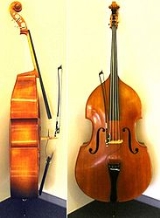
In general there are two major approaches to the design outline shape of the double bass, these being the violin form (shown in the labelled picture to the right), and the viol da gamba form (shown in the header picture). A third less common design called the busetto shape can also be found, as can the even more rare guitar or pear shape. The back of the instrument can vary from being a round, carved back similar to that of the violin, or a flat and angled back similar to the viol family.
The double bass features many parts that are similar to members of the violin family including a bridge, f-holes, a
tailpieceA tailpiece is a component on many stringed musical instruments that anchors one end of the strings, usually the end opposite the end with the tuning mechanism the scroll, headstock, peghead, etc.-Function and construction:...
, a
scrollA scroll is the decoratively carved end of the neck of certain stringed instruments, mainly members of the violin family. The scroll is typically carved in the shape of a volute according to a canonical pattern, although some violins are adorned with carved heads, human and animal. The quality of...
and a
sound postIn a string instrument, the sound post is a small dowel inside the instrument under the treble end of the bridge, spanning the space between the top and back plates and held in place by friction...
. Unlike the rest of the violin family, the double bass still reflects influence and can be considered partly derived from the
violThe viol is any one of a family of bowed, fretted and stringed musical instruments developed in the mid-late 15th century and used primarily in the Renaissance and Baroque periods. The family is related to and descends primarily from the Renaissance vihuela, a plucked instrument that preceded the...
family of instruments, in particular the
violoneThe term violone can refer to several distinct large, bowed musical instruments which belong to either the viol or violin family. The violone is sometimes a fretted instrument, and may have six, five, four, or even only three strings. The violone is also not always a contrabass instrument...
, the bass member of the viol family.
The double bass also differs from members of the violin family in that the shoulders are typically sloped, the back is often angled (both to allow easier access to the instrument, particularly in the upper range), and
machine tunersA machine head is part of a string instrument ranging from guitars to double basses, a geared apparatus for applying tension and thereby tuning a string, usually located at the headstock. A headstock has several machine heads, one per string...
are always fitted. Lack of standardization in design means that one double bass can sound and look very different from another.
Construction
The double bass is closest in construction to violins, but has some notable similarities to the violone (literally "large viol"), the largest and lowest member of the viola da gamba family. Unlike the violone, however, the fingerboard of the double bass is
unfrettedA fret is a raised portion on the neck of a stringed instrument, that extends generally across the full width of the neck. On most modern western instruments, frets are metal strips inserted into the fingerboard...
, and the double bass has fewer strings (the violone, like most viols, generally had six strings, although some specimens had five or four).
An important distinction between the double bass and other members of the violin family is the construction of the
pegboxA pegbox is the part of certain stringed musical instruments that houses the tuning pegs....
. While the violin,
violaThe viola is a bowed string instrument. It is the middle voice of the violin family, between the violin and the cello.- Form :The viola is similar in material and construction to the violin. A full-size viola's body is between and longer than the body of a full-size violin , with an average...
, and cello all use friction
pegsA tuning peg is used to hold a string in the pegbox of a stringed instrument. It may be made of ebony, rosewood, boxwood or other material. Some tuning pegs are ornamented with shell, metal, or plastic inlays, beads or rings....
for gross tuning adjustments, the double bass has metal
machine headA machine head is part of a string instrument ranging from guitars to double basses, a geared apparatus for applying tension and thereby tuning a string, usually located at the headstock. A headstock has several machine heads, one per string...
s. The key on the tuning machine turns a metal "worm", which drives a worm gear that winds the string. While this development makes fine tuners unnecessary, a very small number of bassists use them nevertheless. At the base of the double bass is a metal rod with a spiked end called the endpin, which rests on the floor. This
endpinThe endpin or spike is the component of a cello or double bass that makes contact with the floor to support the instrument's weight. It is made of metal, or in some cases wood or carbon fiber, and is extensible from the bottom of the instrument, and secured with a thumbscrew...
is generally more robust than that of a cello, because of the greater mass of the double bass.
The materials most often used in double-bass construction are maple (back, neck, ribs), spruce (top), and ebony (fingerboard, tailpiece). Exceptions to this include less-expensive basses that have
laminateA laminate is a material that can be constructed by uniting two or more layers of material together. The process of creating a laminate is lamination, which in common parlance refers to the placing of something between layers of plastic and gluing them with heat and/or pressure, usually with an...
d (
plywoodPlywood is a type of manufactured timber made from thin sheets of wood veneer. It is one of the most widely used wood products. It is flexible, inexpensive, workable, re-usable, and can usually be locally manufactured...
) tops, backs, and ribs, and some newer mid-range basses made of
willowWillows, sallows, and osiers form the genus Salix, around 400 species of deciduous trees and shrubs, found primarily on moist soils in cold and temperate regions of the Northern Hemisphere...
. These basses are resistant to changes in heat and humidity, which can cause cracks in spruce tops. Plywood laminate basses, which are used in music schools, youth orchestras, and in popular and folk music settings, are very resistant to humidity and heat, as well to the physical abuse they are apt to encounter in a school environment (or, for blues and folk musicians, to the hazards of touring and performing in bars).
The soundpost and bass bar are components of the internal construction. All the parts of a double bass are glued together, except the soundpost, bridge and tailpiece, which are held in place by string tension, although the soundpost usually remains in place when the instrument's strings are loosened or removed. The metal tuning machines are attached to the sides of the pegbox with metal screws. While tuning mechanisms generally differ from the higher-pitched orchestral stringed instruments, some basses have non-functional, ornamental tuning pegs projecting from the side of the pegbox, in imitation of the tuning pegs on a cello or violin.
Famous double bass makers come from around the world and often represent varied national characteristics. The most highly sought (and expensive) instruments come from Italy and include basses made by Giovanni Paolo Maggini, Gaspar da Salo, the Testore family (Carlo Antonio, Carlo Giuseppe, Gennaro, Giovanni, Paulo Antonio), Celestino Puolotti, and Matteo Gofriller. French and English basses are also sought by players of the highest caliber.
Strings
The history of the double bass is tightly coupled to the development of string technology, as it was the advent of overwound gut strings which first rendered the instrument more generally practicable, as wound strings attain low notes within a smaller overall string diameter than unwound strings.
Prior to the mid-20th century, double bass strings were usually made of
gutCatgut is a type of cord that is prepared from the natural fibre found in the walls of animal intestines. Usually sheep or goat intestines are used, but it is occasionally made from the intestines of cattle, hogs, horses, mules, or donkeys.-Etymology:...
, but since that time, steel strings have largely replaced gut strings, because steel strings hold their pitch better and yield more volume when played with the bow. Gut strings are also more vulnerable to changes of humidity and temperature, and they break much more easily than steel strings. Gut strings are nowadays mostly used by bassists who perform in
baroqueBaroque music describes a style of Western Classical music approximately extending from 1600 to 1760. This era follows the Renaissance and was followed in turn by the Classical era...
ensembles,
rockabillyRockabilly is one of the earliest styles of rock and roll music, dating to the early 1950s.The term rockabilly is a portmanteau of rock and hillbilly, the latter a reference to the country music that contributed strongly to the style's development...
bands, traditional
bluesBlues is the name given to both a musical form and a music genre that originated in African-American communities of primarily the "Deep South" of the United States at the end of the 19th century from spirituals, work songs, field hollers, shouts and chants, and rhymed simple narrative ballads...
bands, and bluegrass bands. Gut strings provide the dark, "thumpy" sound heard on 1940s and 1950s recordings. The late Jeff Sarli, a blues upright bassist, stated that "starting in the 1950s, they began to reset the necks on basses for steel strings", and double bass players switched from gut strings to steel strings. Rockabilly and bluegrass bassists also prefer gut because it is much easier to perform the "slapping" upright bass style (in which the strings are percussively slapped and clicked against the fingerboard) with gut strings than with steel strings. (For more information on slapping, see the sections below on Modern playing styles, Double bass in bluegrass music, Double bass in jazz, and Double bass in popular music).
The change from gut to steel has also affected the instrument's playing technique over the last hundred years, because playing with steel strings allows the strings to be set up closer to the fingerboard, and, additionally, steel strings can be played in higher positions on the lower strings and still produce clear tone. The classic 19th century
Franz SimandlFranz Simandl was a double-bassist and pedagogue most remembered for his book New Method for the Double Bass, known as the Simandl book, which is to this day used as a standard study of double bass technique and hand positions.His approach uses the first, second, and fourth fingers of the left...
method does not utilize the low E string in higher positions because with older gut strings set up high over the fingerboard, the tone was not clear in these higher positions. However, with modern steel strings, bassists can play with clear tone in higher positions on the low E and A strings, particularly when modern lighter-gauge, lower-tension steel strings are used.
Bows
The double bass
bowIn music, a bow is moved across some part of a musical instrument, causing vibration which the instrument emits as sound. The vast majority of bows are used with string instruments, although some bows are used with musical saws and other bowed idiophones....
comes in two distinct forms (shown below). The "French" or "overhand" bow is similar in shape and implementation to the bow used on the other members of the orchestral string instrument family, while the "German" or "Butler" bow is typically broader and shorter, and is held in a "hand shake" position.
These two bows provide different ways of moving the arm and distributing force on the strings. Proponents of the French bow argue that it is more maneuverable, due to the angle at which the player holds the bow. Advocates of the German bow claim that it allows the player to apply more arm weight on the strings. The differences between the two, however, are minute for a proficient player, and both bows are used by modern players in major orchestras.
German bow
The German bow (sometimes called the Butler bow) is the older of the two designs. The design of the bow and the manner of holding it are descended from the older viol family of instruments. With older viols, before screw threads were used to tighten the bow, players held the bow with two fingers between the stick and the hair to maintain tension of the hair. Proponents of the use of German bow claim that the German bow is easier to use for heavy strokes that require a lot of power.
In comparison with the French bow, the German bow has a taller
frogIn music, a bow is moved across some part of a musical instrument, causing vibration which the instrument emits as sound. The vast majority of bows are used with string instruments, although some bows are used with musical saws and other bowed idiophones....
, and it is held with the palm angled upwards, as is done for the upright members of the
violThe viol is any one of a family of bowed, fretted and stringed musical instruments developed in the mid-late 15th century and used primarily in the Renaissance and Baroque periods. The family is related to and descends primarily from the Renaissance vihuela, a plucked instrument that preceded the...
family. When held in correct manner, the thumb applies the necessary power to generate the desired sound. The index finger meets the bow at the point where the frog meets the stick. The index finger is also used to apply an upward torque to the frog when tilting the bow. The little finger (or "pinky") supports the frog from underneath, while the ring finger and middle finger rest in the space between the hair and the shaft.
French bow
The French bow was not widely popular until its adoption by 19th-century virtuoso
Giovanni BottesiniGiovanni Bottesini was an Italian Romantic composer, conductor, and a double bass virtuoso.-Biography:Born in Crema, Lombardy, he was taught the rudiments of music by his father, an accomplished clarinetist and composer, at a young age and had played timpani in Crema with the Teatro Sociale before...
. This style is more similar to the traditional bows of the smaller string family instruments. It is held as if the hand is resting by the side of the performer with the palm facing toward the bass. The thumb rests on the shaft of the bow, next to the frog while the other fingers drape on the other side of the bow. Various styles dictate the curve of the fingers and thumb, as do the style of piece; a more pronounced curve and lighter hold on the bow is used for virtuoso or more delicate pieces, while a flatter curve and sturdier grip on the bow sacrifices some power for easier control in strokes such as detaché, spiccato, and staccato.
Bow construction and materials
Double bass bows vary in length, ranging from 60 cm (24") to 75 cm (30").
PernambucoCaesalpinia echinata is a species of Brazilian timber tree in the pea family, Fabaceae. Common names include Brazilwood, Pau-Brasil, Pau de Pernambuco and Ibirapitanga . This plant has a dense, orange-red heartwood that takes a high shine, and it is the premier wood used for making bows for...
, also known as Brazilwood, is regarded as an excellent quality stick material, but due to its scarcity and expense, other materials are increasingly being used. Less expensive student bows may be constructed of solid
fiberglassFiberglass , is a fiber reinforced polymer made of a plastic matrix reinforced by fine fibers of glass. It is also known as GFK ....
, or of less valuable varieties of brazilwood.
SnakewoodSnakewood is a common name of three different plants:* Acacia xiphophylla in Australia* Brosimum guianense in South America* Colubrina species in North America...
and carbon fiber are also used in bows of a variety of different qualities. The frog of the double bass bow is usually made out of
ebonyEbony is a dense black wood, most commonly yielded by several species in the genus Diospyros, but ebony may also refer to other heavy, black woods from unrelated species. Ebony is dense enough to sink in water. Its fine texture, and very smooth finish when polished, make it valuable as an...
, although Snakewood and
buffaloThe biological subfamily Bovinae includes a diverse group of 10 genera of medium to large sized ungulates, including domestic cattle, the bison, African buffalo, the water buffalo, the yak, and the four-horned and spiral-horned antelopes...
horn are used by some luthiers. The wire wrapping is
goldGold is a chemical element with the symbol Au and an atomic number of 79. Gold is a dense, soft, shiny, malleable and ductile metal. Pure gold has a bright yellow color and luster traditionally considered attractive, which it maintains without oxidizing in air or water. Chemically, gold is a...
or
silverSilver is a metallic chemical element with the chemical symbol Ag and atomic number 47. A soft, white, lustrous transition metal, it has the highest electrical conductivity of any element and the highest thermal conductivity of any metal...
in many quality bows, and the hair is usually
horsehairHorsehair is the long, coarse hair growing on the manes and tails of horses. It is used for various purposes, including upholstery, brushes, the bows of musical instruments, a hard-wearing fabric called haircloth, and for horsehair plaster, a wallcovering material formerly used in the construction...
.
The double bass bow is strung with either white or black horsehair, or a combination of the two (known as "salt and pepper"), as opposed to the customary white horsehair used on the bows of other string instruments. Some bassists argue that the slightly rougher black hair "grabs" the heavier, lower strings better. As well, some bassists and luthiers believe that it is easier to produce a smoother sound with the white variety. Red hair (chestnut) is also used by some bassists. Some of the lowest-quality student bows are made with synthetic "hair".
Rosin
String players apply
rosin.Rosin, also called colophony or Greek pitch , is a solid form of resin obtained from pines and some other plants, mostly conifers, produced by heating fresh liquid resin to vaporize the volatile liquid terpene components. It is semi-transparent and varies in color from yellow to black...
to the bow hair so it will "grip" the string and make it vibrate. Double bass rosin is generally softer and stickier than violin rosin to allow the hair to grab the thicker strings better, but players use a wide variety of rosins that vary from quite hard (like violin rosin) to quite soft, depending on the weather, the humidity, and the preference of the player. The amount used generally depends on the type of music being performed as well as the personal preferences of the player. Bassists may apply more rosin in works for large orchestra (e.g., Brahms symphonies) than for delicate chamber works. Some brands of rosin, such as Pop's double bass rosin, are softer and more prone to melting in hot weather. Other brands, such as Carlsson or Nyman Harts double bass rosin, are harder and less prone to melting.
Pitch
The lowest note of a double bass is an E
1 (on standard four-string basses) at approximately 41 Hz or a B0 (when five strings are used) at approximately 31 Hz, within about an octave above the
lowest frequencyFor more detail on human hearing see Audiogram, Equal loudness contours and Hearing impairment.Hearing range usually describes the range of frequencies that can be heard by an animal or human, though it can also refer to the range of levels...
that the average human ear can perceive as a distinctive pitch. The top of the instrument's fingerboard range is typically near the D two octaves and a fifth above the open pitch of the G string (G4) as shown in the range illustration found at the head of this article. Playing beyond the end of the fingerboard can be accomplished by pulling the string slightly to the side.
Many double bass symphony parts and virtuoso concertos employ harmonics (also called flageolet tones). Both natural harmonics and
artificial harmonicTo produce an artificial harmonic, a stringed instrument player holds down a note on the neck with the non-dominant hand, thereby shortening the vibrational length of the string, uses a finger to lightly touch a point on the string that is an integer divisor of its vibrational length, and plucks or...
s, where the thumb stops the note and the octave or other harmonic is activated by lightly touching the string at the relative node point, extend the instrument's range considerably.
Orchestral parts rarely demand the double bass exceed a two-octave range (an example of an exception to this rule is
Orff's Carmina BuranaCarmina Burana is a scenic cantata composed by Carl Orff in 1935 and 1936. It is based on 24 of the poems found in the medieval collection Carmina Burana...
, which calls for three octaves and a perfect fourth). However, there is no hard limit to the upper range a
virtuosoA virtuoso is an individual who possesses outstanding technical ability in the fine arts, at singing or playing a musical instrument. The plural form is either virtuosi or the Anglicisation, virtuosos, and the feminine form sometimes used is virtuosa...
solo player can achieve using natural and artificial harmonics. The high harmonic in the range illustration found at the head of this article may be taken as representative rather than normative.
Five-string instruments have an additional string typically tuned to a low B or low C below the E string. (Orchestral five-string basses are generally tuned to a low C on the fifth string, because the sympathetic resonance from the low C against the higher strings increases the bass' projection more than the low B tuning). Occasionally, a higher string is added instead, tuned to the C above the G string.
Four-string instruments may feature the C extension extending the range of the E string downwards to C.
Traditionally, the double bass is a
transposing instrumentA transposing instrument is a musical instrument for which written notes are read at a pitch different from the corresponding concert pitch, which a non-transposing instrument, such as a piano, would play. Playing a written C on a transposing instrument will produce a note other than concert C...
. Since much of the double bass' range lies below the standard bass clef, it is notated an octave higher than it sounds. This transposition applies even when reading the tenor and treble clef, which are used to avoid excessive ledger lines when notating the instrument's upper range. Other notational traditions do exist; Italian solo music is typically written at the sounding pitch, and the "old" German method sounded an octave below where notation except in the treble clef, where the music was written at pitch.
Tuning
The double bass is generally tuned in
fourthsIn music, the subdominant is the technical name for the fourth tonal degree of the diatonic scale. It is so called because it is the same distance "below" the tonic as the dominant is above the tonic - in other words, the tonic is the dominant of the subdominant. It is also the note immediately...
, in contrast to members of the
orchestral string familyThe violin family of musical instruments was developed in Italy in the sixteenth century. The standard modern violin family consists of the violin, viola, cello, and double bass....
, which are tuned in
fifths.In classical music from Western culture, a fifth is a musical interval encompassing five staff positions , and the perfect fifth is a fifth spanning seven semitones, or in meantone, four diatonic semitones and three chromatic semitones...
The standard tuning (low to high) is E-A-D-G, starting from E below second low C (
concert pitchConcert pitch refers to the pitch reference to which a group of musical instruments are tuned for a performance. Concert pitch may vary from ensemble to ensemble, and has varied widely over musical history...
). This is the same as the standard tuning of a bass guitar and is one
octaveIn music, an octave is the interval between one musical pitch and another with half or double its frequency. The octave relationship is a natural phenomenon that has been referred to as the "basic miracle of music", the use of which is "common in most musical systems"...
lower than the four lowest-pitched strings of standard guitar tuning.
Throughout
classicalClassical music is the art music produced in, or rooted in, the traditions of Western liturgical and secular music, encompassing a broad period from roughly the 11th century to present times...
repertoire, there are notes that fall below the range of a standard double bass. Notes below low E appear regularly in the double bass parts found in later arrangements and interpretations of
Baroque musicBaroque music describes a style of Western Classical music approximately extending from 1600 to 1760. This era follows the Renaissance and was followed in turn by the Classical era...
. These parts are transpositions of parts written for other bass instruments used before the modern double bass became common and may actually lower the part an octave.
In the
ClassicalThe dates of the Classical Period in Western music are generally accepted as being between about 1750 and 1830. However, the term classical music is used colloquially to describe a variety of Western musical styles from the ninth century to the present, and especially from the sixteenth or...
era, the double bass typically doubled the cello part an octave below, occasionally requiring descent to C below the E of the four-string double bass. In the
RomanticRomantic music or music in the Romantic Period is a musicological and artistic term referring to a particular period, theory, compositional practice, and canon in Western music history, from 1810 to 1900....
era and the 20th century, composers such as
WagnerWilhelm Richard Wagner was a German composer, conductor, theatre director, philosopher, music theorist, poet, essayist and writer primarily known for his operas...
,
MahlerGustav Mahler was a late-Romantic Austrian composer and one of the leading conductors of his generation. He was born in the village of Kalischt, Bohemia, in what was then Austria-Hungary, now Kaliště in the Czech Republic...
, Beethoven,
BusoniThe Piano Concerto in C major, Op. 39 , by Ferruccio Busoni, is one of the largest works ever written in this particular genre. The concerto is in five movements, the last of which also utilizes a male chorus singing words from the final scene of the verse drama Aladdin by Adam Oehlenschläger.The...
, and
ProkofievSergei Sergeyevich Prokofiev was a Russian composer, pianist and conductor who mastered numerous musical genres and is regarded as one of the major composers of the 20th century...
also requested notes below the low E. There are two common methods for making these notes available to the player. Major European orchestras generally use basses with a fifth string, tuned to B three
octaveIn music, an octave is the interval between one musical pitch and another with half or double its frequency. The octave relationship is a natural phenomenon that has been referred to as the "basic miracle of music", the use of which is "common in most musical systems"...
s and a
semitoneA semitone, also called a half step or a half tone, is the smallest musical interval commonly used in Western tonal music, and it is considered the most dissonant when sounded harmonically....
below
middle CC or Do is the first note of the fixed-Do solfège scale. Its enharmonic is B.-Middle C:Middle C is designated C4 in scientific pitch notation because of the note's position as the fourth C key on a standard 88-key piano keyboard...
. Players with standard double basses (E-A-D-G) typically play the notes below "E" an octave higher.
In the United States, Canada and United Kingdom, most professional orchestral players use four-string double basses with a "C extension", which extends the lowest string down as far as low C, an octave below the lowest note on the cello (more rarely, this string may be tuned to a low B). The extension is an extra section of fingerboard mounted up over the head of the bass. There are several varieties of extensions.
In the simplest mechanical extensions, there are no mechanical aids attached to the fingerboard extension except a locking nut for the "E" note. To play the extension notes, the player reaches back over the pegs to press the string to the fingerboard. The advantage of this "fingered" extension is that the player can adjust the intonation of all of the
stopped note-Bowed strings:On bowed string instruments, a stopped note is a played note that is fingered with the left hand, i.e. not an open string, on the string being bowed by the right hand...
s on the extension, and there are no mechanical noises from metal keys and levers. The disadvantage of the "fingered" extension is that it can be hard to perform rapid alternations between low notes on the extension and notes on the regular fingerboard, such as a bassline that quickly alternates between "G" and the low "D".
The simplest type of mechanical aid is the use of wooden "fingers" that can be closed to press the string down and fret the C#, D, Eb, or E notes. This system is particularly useful for basslines that have a repeating
pedal pointIn tonal music, a pedal point is a sustained tone, typically in the bass, during which at least one foreign, i.e., dissonant harmony is sounded in the other parts. A pedal point sometimes functions as a "non-chord tone", placing it in the categories alongside suspensions, retardations, and passing...
such as a low D, because once the note is locked in place with the mechanical "finger", the lowest string then sounds a different note when it is played "open" (e.g., a low D).
The most complicated mechanical aid for use with extensions are mechanical lever systems nicknamed "machines". These lever systems, which superficially resemble the mechanisms of reed instruments such as the bassoon, include levers mounted beside the regular fingerboard (near the nut, on the "E" string side), which remotely activate metal "fingers" on the extension fingerboard. The most expensive metal lever systems also give the player the ability to "lock" down notes on the extension fingerboard, as with the wooden "finger" system. One criticism of these devices is that they may lead to unwanted metallic clicking noises.
A small number of bass players tune their strings in
fifthsFifths tuning is a non-standard tuning for the double bass, used primarily in classical and jazz music. In this tuning, the double bass is tuned like a cello but an octave lower ....
, like a cello but an octave lower (C-G-D-A low to high). This tuning was used by the jazz player
Red MitchellKeith Moore "Red" Mitchell Keith Moore "Red" Mitchell Keith Moore "Red" Mitchell (September 20, 1927, New York City - November 8, 1992, Salem, Oregon, was an American jazz double-bassist, composer, lyricist, and poet. He was the brother of Whitey Mitchell....
and is increasingly used by classical players, notably the Canadian bassist
Joel QuarringtonJoel Quarrington , is a Canadian double bass player, soloist and teacher.He was born in Toronto, and began playing the double bass at the age of eleven in order to complete a bluegrass trio with his brothers, Paul Quarrington and Tony Quarrington...
. In classical solo playing the double bass is usually tuned a whole tone higher (F-B-E-A). This higher tuning is called "solo tuning", whereas the regular tuning is known as "orchestral tuning." String tension differs so much between solo and orchestral tuning that a different set of strings is often employed that has a lighter gauge. Strings are always labelled for either solo or orchestral tuning, and published solo music is arranged for either solo or orchestral tuning. Some popular solos and concerti, such as the Koussevitsky Concerto are available in both solo and orchestral tuning arrangements.
Many contemporary composers specify highly specialized scordatura.
BerioLuciano Berio, Cavaliere di Gran Croce OMRI was an Italian composer. He is noted for his experimental work and also for his pioneering work in electronic music.-Biography:Berio was born at Oneglia Luciano Berio, Cavaliere di Gran Croce OMRI (October 24, 1925 – May 27, 2003) was an Italian...
, for example, asks the player to tune his strings E-G#-A-G in Sequenza XIVb and
ScelsiGiacinto Scelsi , Count of Ayala Valva was an Italian composer who also wrote surrealist poetry in French....
asks for both F-A-D-E and F-A-F-E in Nuits.
A variant and much less-commonly used form of solo tuning used in some Eastern European countries is (A-D-G-C), which uses three of the strings from orchestral tuning (A-D-G) and then adds a high "C" string. Some bassists with five-string basses use a high "C" string as the fifth string, instead of a low "B" string. Adding the high "C" string facilitates the performance of solo repertoire with a high tessitura (range). Another option is to utilize both a low C (or B) extension and a high C string.
When choosing a bass with a fifth string, the player must decide between adding a higher or lower-tuned string. Six-stringed instruments are generally regarded as impractical. To accommodate the additional string, the fingerboard is usually slightly wider, and the top slightly thicker to handle the increased tension. Some five-stringed instruments are converted four-string instruments. Because these don't have wider fingerboards, some players find them more difficult to finger and bow. Converted four-string basses usually require either a new, thicker top, or lighter strings to compensate for the increased tension.
Body and hand position
Double bassists either stand or sit to play the instrument. The instrument height is set by adjusting the endpin such that the player can reach the desired playing zones of the strings with bow or plucking hand.
Bassists who stand and bow sometimes set the endpin by aligning the first finger in either first or half position with eye level, although there is little standardization in this regard.
Players who sit generally use a stool about the height of the player's pants inseam length.
Traditionally, double bassists stood when playing solo and sat when they played in the orchestra or opera pit. Now, playing styles have become specialized to the point where one player rarely can satisfactorily perform both standing and sitting. Consequently, now many soloists sit (as with Joel Quarrington, Jeff Bradetich, Thierry Barbé and others) and orchestras often employ standing bassists.
When playing in the instrument's upper range (above the G below middle C), the player shifts their hand out from behind the neck and flattens it out, using the side of the thumb to press down the string. This technique—also used on the cello—is called thumb position. While playing in thumb position, few players use the fourth (little) finger, as it is too weak to produce a reliable tone (this is also true for cellists), although some extreme chords or extended techniques, especially in contemporary music, may necessitate its use.
Physical considerations
Performing on bass can be physically demanding because the strings are large and thick. Also, the space between notes on the fingerboard is large due to the scale length and string spacing, so players have to shift positions frequently. The bass is usually discouraged for people with shorter arms and smaller hands due to the big note gaps and the thick strings. The increased use of playing techniques such as thumb position and modifications to the bass, such as the use of lighter-gauge strings at lower tension, have eased the difficulty of playing the instrument. Bass parts have relatively fewer fast passages, double stops, or large jumps in range. These parts are usually given to the cello section because it is a smaller instrument and are typically tuned together.
As with all non-fretted
string instrumentA string instrument is a musical instrument that produces sound by means of vibrating strings. In the Hornbostel-Sachs scheme of musical instrument classification, used in organology, they are called chordophones...
s, performers must learn to place their fingers precisely to produce the correct pitch. The more frequent hand movement required by the instrument's size increases the likelihood of intonation errors. For bassists with smaller hands, the large spaces between pitches may present a significant challenge, especially in the lowest range, where the spaces between notes are largest.
Until the 1990s, child-sized double basses were not widely available, and the large size of the bass meant that children were not able to start playing the instrument until their hand size and height would allow them to play a 3/4-size model (the most commonly available size). Starting in the 1990s, smaller half, quarter, eighth and even sixteenth-sized instruments became more widely available, which meant that children could start at a younger age.
Volume
Despite the size of the instrument, it is not as loud as many other instruments due to its low range. In a large orchestra, usually between four and eight bassists play in unison. In the largest orchestras, bass sections may have as many as ten or twelve players, but modern budget constraints make bass sections this large unusual.
When writing solo passages for the bass in orchestral or chamber music, composers typically ensure the
orchestrationOrchestration is the study or practice of writing music for an orchestra or of adapting for orchestra music composed for another medium...
is light so it doesn't obscure the bass. While amplification is rarely used in classical music, in some cases where a bass soloist performs a concerto with a full orchestra, subtle amplification called
acoustic enhancementAcoustic enhancement is a subtle type of sound reinforcement system used to augment direct, reflected, or reverberant sound. While sound reinforcement systems are usually used to increase the sound level of the sound source , acoustic enhancement systems are typically used to increase the...
may be used. The use of microphones and amplifiers in a classical setting has led to debate within the classical community, as "...purists maintain that the natural acoustic sound of [Classical] voices [or] instruments in a given hall should not be altered."
In many non-orchestral settings, such as jazz and blues, amplification via a
specialized amplifierBass instrument amplification, used for the bass guitar, double bass and similar instruments, is distinct from other types of amplification systems due to the particular challenges associated with low-frequency sound reproduction. This distinction affects the design of the loudspeakers, the speaker...
and loudspeakers is employed. Bluegrass and jazz players typically use less amplification than blues,
psychobillyPsychobilly is a fusion genre of rock music that mixes elements of punk rock, rockabilly, and other genres. It is one of several subgenres of rockabilly which also include thrashabilly, trashabilly, punkabilly, surfabilly and gothabilly...
, or
jam band-Ambiguity:By the late 1990s use of the term jam band also became ambiguous. An editorial at jamband.com suggested that any band of which a primary band such as Phish has done a cover of be included as jam band. The example was including New York post-punk band Talking Heads after Phish performed...
players. In the latter cases, the high overall volume due to other amplifiers and instruments may lead to
acoustic feedbackAudio feedback is a special kind of positive feedback which occurs when a sound loop exists between an audio input and an audio output...
, a problem exacerbated by the bass's large surface area and interior volume. The feedback problem has led to the development of instruments like the
electric upright bassThe electric upright bass is an electronically amplified version of the double bass that has a minimal or 'skeleton' body, which greatly reduces the size and weight of the instrument. The EUB retains enough of the features of the double bass so that double bass players are comfortable performing...
, whose playing characteristics mimic that of the double bass.
Transportation
The double bass's large size and relative fragility make it cumbersome to handle and transport. Most bassists use soft cases, referred to as gig bags, to protect the instrument during transport. Basic, unpadded gig bags used by students cost under 100 USD, while thickly padded gig bags for professional players typically cost as much as 500 USD. Some more feature-filled examples with backpack straps retail for over 1000 USD. Some bassists carry their bow in a hard bow case. Players also may use a small cart or gig bag and end pin-attached wheels to move the bass.
Hard flight cases have cushioned interiors and tough exteriors of
carbon fiberCarbon fiber, alternatively graphite fiber, carbon graphite or CF, is a material consisting of fibers about 5–10 μm in diameter and composed mostly of carbon atoms. The carbon atoms are bonded together in crystals that are more or less aligned parallel to the long axis of the fiber...
,
graphiteThe mineral graphite is one of the allotropes of carbon. It was named by Abraham Gottlob Werner in 1789 from the Ancient Greek γράφω , "to draw/write", for its use in pencils, where it is commonly called lead . Unlike diamond , graphite is an electrical conductor, a semimetal...
,
fiberglassGlass fiber is a material consisting of numerous extremely fine fibers of glass.Glassmakers throughout history have experimented with glass fibers, but mass manufacture of glass fiber was only made possible with the invention of finer machine tooling...
, or
KevlarKevlar is the registered trademark for a para-aramid synthetic fiber, related to other aramids such as Nomex and Technora. Developed at DuPont in 1965, this high strength material was first commercially used in the early 1970s as a replacement for steel in racing tires...
. The cost of good hard cases—USD 500 to over USD 2500—tends to limit their use to touring professionals.
1700s
The double bass as a solo instrument enjoyed a period of popularity during the 18th century and many of the most popular composers from that era wrote pieces for the double bass. The double bass, then often referred to as the
VioloneThe term violone can refer to several distinct large, bowed musical instruments which belong to either the viol or violin family. The violone is sometimes a fretted instrument, and may have six, five, four, or even only three strings. The violone is also not always a contrabass instrument...
used different tunings from region to region. The "Viennese tuning" (A
1-D-F-A) was popular, and in some cases a fifth string or even sixth string was added (F
1-A
1-D-F-A). The popularity of the instrument is documented in
Leopold MozartJohann Georg Leopold Mozart was a German composer, conductor, teacher, and violinist. Mozart is best known today as the father and teacher of Wolfgang Amadeus Mozart, and for his violin textbook Versuch einer gründlichen Violinschule.-Childhood and student years:He was born in Augsburg, son of...
's second edition of his Violinschule, where he writes "One can bring forth difficult passages easier with the five-string violone, and I heard unusually beautiful performances of concertos, trios, solos, etc."
The earliest known concerto for double bass was written by
Joseph HaydnFranz Joseph Haydn , known as Joseph Haydn , was an Austrian composer, one of the most prolific and prominent composers of the Classical period. He is often called the "Father of the Symphony" and "Father of the String Quartet" because of his important contributions to these forms...
ca.1763, and is presumed lost in a fire at the Eisenstadt library. The earliest known existing concertos are by Karl Ditters von Dittersdorf, who composed two concertos for the double bass and a
Sinfonia ConcertanteSinfonia concertante is a musical form that emerged during the Classical period of Western music. It is essentially a mixture of the symphony and the concerto genres: a concerto in that one or more soloists are on prominent display, and a symphony in that the soloists are nonetheless discernibly a...
for viola and double bass. Other composers that have written concertos from this period include
Johann Baptist VanhalJohann Baptist Vanhal also spelled Wanhal, Waṅhall or Wanhall was an important classical music composer born in Nechanice, Bohemia to a Czech family.- Biography :...
,
Franz Anton HoffmeisterFranz Anton Hoffmeister was a German composer and music publisher.Born in Rottenburg am Neckar, he went to Vienna at the age of fourteen to study law...
(3 concertos),
Leopold KozeluchLeopold Kozeluch was a Czech composer and teacher of classical music. He was born in the town of Velvary, in Bohemia .-Life:...
, Anton Zimmermann, Antonio Capuzzi,
Wenzel PichlWenzel Pichl was a classical Czech composer of the 18th Century. He was also a violinist, music director and writer....
(2 concertos), and
Johannes Matthias SpergerJohannes Matthias Sperger, also often Johann, was an Austrian contrabassist and composer....
(18 concertos). While many of these names were leading figures to the music public of their time, they are generally unknown by contemporary audiences.
Wolfgang Amadeus MozartWolfgang Amadeus Mozart , baptismal name Johannes Chrysostomus Wolfgangus Theophilus Mozart , was a prolific and influential composer of the Classical era. He composed over 600 works, many acknowledged as pinnacles of symphonic, concertante, chamber, piano, operatic, and choral music...
's concert aria, "Per Questa Bella Mano", K.612 for bass, double bass
obbligatoIn classical music obbligato usually describes a musical line that is in some way indispensable in performance. Its opposite is the marking ad libitum. It can also be used, more specifically, to indicate that a passage of music was to be played exactly as written, or only by the specified...
, and orchestra contains impressive writing for solo double bass of that period. It remains popular among both singers and double bassists today.
The double bass eventually evolved to fit the needs of orchestras that required lower notes and a louder sound. The leading double bassists from the mid-to-late 18th century, such as Josef Kämpfer, Friedrich Pischelberger, and Johannes Mathias Sperger employed the "Viennese" tuning. Bassist Johann Hindle (1792–1862), who composed a concerto for the double bass, pioneered tuning the bass in fourths, which marked a turning point for the double bass and its role in solo works. Bassist
Domenico DragonettiDomenico Carlo Maria Dragonetti was an Italian double bass virtuoso and composer. He stayed for thirty years in his hometown of Venice, Italy and worked at the Opera Buffa, at the Chapel of San Marco and at the Grand Opera in Vicenza...
was a prominent musical figure and an acquaintance of Haydn and
Ludwig van BeethovenLudwig van Beethoven was a German composer and pianist. A crucial figure in the transition between the Classical and Romantic eras in Western art music, he remains one of the most famous and influential composers of all time.Born in Bonn, then the capital of the Electorate of Cologne and part of...
. His playing was known all the way from his homeland Italy to the Tsardom of Russia and he found a prominent place performing in concerts with the Philharmonic Society of London.

Beethoven's friendship with Dragonetti may have inspired him to write difficult, separate parts for the double bass in his symphonies, such as the impressive passages in the third movement of the Fifth Symphony, the second movement of the Seventh Symphony, and last movement of the Ninth Symphony. These parts do not double the cello part. Dragonetti wrote ten concertos for the double bass and many solo works for bass and piano. During Rossini's stay in London in the summer of 1824, he composed his Duetto for cello and double bass for Dragonetti and the cellist David Salomons. Dragonetti frequently played on a three string double bass tuned G-D-A from top to bottom. The use of only the top three strings was popular for bass soloists and Principal bassists in orchestras in the 19th century, because it reduced the pressure on the wooden top of the bass, which was thought to create a more resonant sound. As well, the low "E" strings used during the 19th century were thick cords made of gut, which were difficult to tune and play.
1800s
In the 19th century, the opera conductor, composer, and bassist
Giovanni BottesiniGiovanni Bottesini was an Italian Romantic composer, conductor, and a double bass virtuoso.-Biography:Born in Crema, Lombardy, he was taught the rudiments of music by his father, an accomplished clarinetist and composer, at a young age and had played timpani in Crema with the Teatro Sociale before...
was considered the "Paganini of the double bass" of his time. His compositions were written in the popular Italian opera style of the 19th century, which exploit the double bass in a way that was not seen beforehand. They require virtuosic runs and great leaps to the highest registers of the instrument, even into the realm of harmonics. These compositions were considered to be unplayable by many bassists in the early part of the 20th century, but are now frequently performed. During the same time, a prominent school of bass players in the
Czech regionCzech lands is an auxiliary term used mainly to describe the combination of Bohemia, Moravia and Czech Silesia. Today, those three historic provinces compose the Czech Republic. The Czech lands had been settled by the Celts , then later by various Germanic tribes until the beginning of 7th...
arose, which included
Franz SimandlFranz Simandl was a double-bassist and pedagogue most remembered for his book New Method for the Double Bass, known as the Simandl book, which is to this day used as a standard study of double bass technique and hand positions.His approach uses the first, second, and fourth fingers of the left...
, Theodore Albin Findeisen, Josef Hrabe,
Ludwig ManolyLudwig Manoly was a Hungarian-born double bassist who studied in Vienna and upon completing his studies, spent his life in the United States...
, and
Adolf MišekAdolf Mišek was a Czech double bassist and composer of the late romantic era.Born in Modletín , he left for Vienna at the age of 15 to study with Franz Simandl at the Vienna Conservatory...
. Simandl and Hrabe were also pedagogues whose method books and studies continue to be used in modern times.
1900s-present
The leading figure of the double bass in the early 20th century was
Serge KoussevitzkySerge Koussevitzky , was a Russian-born Jewish conductor, composer and double-bassist, known for his long tenure as music director of the Boston Symphony Orchestra from 1924 to 1949.-Early career:...
, best known as conductor of the
Boston Symphony OrchestraThe Boston Symphony Orchestra is an orchestra based in Boston, Massachusetts. It is one of the five American orchestras commonly referred to as the "Big Five". Founded in 1881, the BSO plays most of its concerts at Boston's Symphony Hall and in the summer performs at the Tanglewood Music Center...
, who popularized the double bass in modern times as a solo instrument. Because of improvements to the double bass with steel strings and better set-ups, the bass is now played at a more advanced level than ever before and more and more composers have written works for the double bass. In the mid-century and in the following decades, many new concerti were written for the double bass, including
Nikolaos SkalkottasNikos Skalkottas was one of the most important Greek composers of 20th-century music. A member of the Second Viennese School, he drew his influences from both the classical repertoire and the Greek tradition....
's Concerto (1942),
Eduard Tubin-Life:Tubin was born in Torila, Governorate of Livonia, Estonia. Both his parents were music lovers, and his father played trumpet and trombone in the village band. His first taste of music came at school where he learned flute and balalaika. Later, his father swapped a cow for a piano, and the...
's Concerto (1948),
Lars-Erik LarssonLars-Erik Larsson was a notable Swedish composer of the 20th century.-Biography:Lars-Erik Vilner Larsson was born in Åkarp in 1908...
's Concertino (1957),
Gunther SchullerGunther Schuller is an American composer, conductor, horn player, author, historian, and jazz musician.- Biography and works :...
's Concerto (1962), and
Hans Werner HenzeHans Werner Henze is a German composer of prodigious output best known for "his consistent cultivation of music for the theatre throughout his life"...
's Concerto (1966).
From the 1960s through the end of the century
Gary KarrGary Karr b. November 20, 1941 in Los Angeles, California, is an American classical double bass virtuoso and teacher.- Biography :Although he comes from seven generations of bassists, he was not encouraged by them to go into music...
was the leading proponent of the double bass as a solo instrument and was active in commissioning or having hundreds of new works and concerti written especially for him. Karr was given Koussevitzky's famous solo doublebass by Olga Koussevitsky and played it in concerts around the world for 40 years before, in turn, giving the instrument to the International Society of Bassists for talented soloists to use in concert. Another important performer in this period,
Bertram TuretzkyBertram Turetzky is a contemporary American double bass soloist, teacher, and author of The Contemporary Contrabass , a book that looked at a number of new and interesting ways of playing the double bass including featuring it as a solo performance vehicle with no other instrumental...
, commissioned and premiered more than 300 double bass works.
In the 1970s and 1980s, new concerti included
Nino RotaNino Rota was an Italian composer and academic who is best known for his film scores, notably for the films of Federico Fellini and Luchino Visconti...
's Divertimento for Double Bass and Orchestra (1973),
Jean FrançaixJean René Désiré Françaix was a French neoclassical composer, pianist, and orchestrator, known for his prolific output and vibrant style.-Life:...
's Concerto (1975),
Einojuhani RautavaaraEinojuhani Rautavaara is a Finnish composer of contemporary classical music, and is one of the most notable Finnish composers after Jean Sibelius.-Life:...
's Angel Of Dusk (1980),
Gian Carlo MenottiGian Carlo Menotti was an Italian-American composer and librettist. Although he often referred to himself as an American composer, he kept his Italian citizenship. He wrote the classic Christmas opera, Amahl and the Night Visitors, among about two dozen other operas intended to appeal to popular...
's Concerto (1983), Christopher Rouse's Concerto (1985), and
Henry BrantHenry Dreyfuss Brant was a Canadian-born American composer. An expert orchestrator with a flair for experimentation, many of Brant's works featured spatialization techniques.- Biography :...
's Ghost Nets (1988). In the first decade of the 21st century, new concerti include
Kalevi AhoKalevi Aho is a Finnish composer.- Career :Born in Forssa, he studied composition at the Sibelius Academy under Einojuhani Rautavaara, receiving a diploma in 1971. He continued his studies for a year in Berlin with Boris Blacher...
's Concerto (2005),
John HarbisonJohn Harris Harbison is an American composer, best known for his operas and large choral works.-Life:...
's Concerto for Bass Viol (2006), and
André PrevinAndré George Previn, KBE is an American pianist, conductor, and composer. He is considered one of the most versatile musicians in the world, and is the winner of four Academy Awards for his film work and ten Grammy Awards for his recordings. -Early Life:Previn was born in...
's Double Concerto for violin, double bass, and orchestra (2007).
Reinhold GlièreReinhold Moritzevich Glière was a Russian and Soviet composer of German–Polish descent.- Biography :Glière was born in Kiev, Ukraine...
wrote an Intermezzo and Tarantella for double bass and piano, Op. 9, No. 1 and No. 2 and a Praeludium and Scherzo for double bass and piano, Op. 32 No.1 and No.2.
Paul HindemithPaul Hindemith was a German composer, violist, violinist, teacher, music theorist and conductor.- Biography :Born in Hanau, near Frankfurt, Hindemith was taught the violin as a child...
wrote a rhythmically challenging Double Bass Sonata in 1949. In the Soviet Union, Mieczysław Weinberg wrote his Sonata No. 1 for double bass solo in 1971.
Giacinto ScelsiGiacinto Scelsi , Count of Ayala Valva was an Italian composer who also wrote surrealist poetry in French....
wrote two double bass pieces called Nuits in 1972, and then in 1976, he wrote Maknongan, a piece for any low-voiced instrument, such as double bass, contrabassoon, or tuba.
Vincent PersichettiVincent Ludwig Persichetti was an American composer, teacher, and pianist. An important musical educator and writer, Persichetti was a native of Philadelphia...
wrote solo works—which he called "Parables"—for many instruments. He wrote Parable XVII for Double Bass, Op. 131 in 1974.
Sofia GubaidulinaSofia Asgatovna Gubaidulina, is a Russian composer of half Russian, half Tatar ethnicity.Gubaidulina's music is marked by the use of unusual instrumental combinations...
penned a Sonata for double bass and piano in 1975. In 1977 Dutch-Hungarian composer
Geza FridGéza Frid , was a Hungarian/Dutch composer and pianist.-Early years:Géza Frid was born in Máramarossziget in the Máramaros region of Hungary and studied piano and composition in Budapest with a.o. Zoltán Kodály and Béla Bartók. He settled in Amsterdam in 1929 and became a Dutch citizen in 1948...
wrote a set of variations on The Elephant from Saint-Saëns' Le Carnaval des Animaux for
scordaturaA scordatura , also called cross-tuning, is an alternative tuning used for the open strings of a string instrument, in which the notes indicated in the score would represent the finger position as if played in regular tuning, while the actual pitch is altered...
Double Bass and string orchestra. In 1987
Lowell LiebermannLowell Liebermann is an American composer, pianist and conductor.At the age of sixteen, Liebermann performed at Carnegie Hall, playing his Piano Sonata, op. 1...
wrote his Sonata for Contrabass and Piano Op.24. Fernando Grillo wrote the "Suite No.1" for double bass (1983/2005).
Jacob DruckmanJacob Druckman was an American composer born in Philadelphia. A graduate of the Juilliard School, Druckman studied with Vincent Persichetti, Peter Mennin, and Bernard Wagenaar. In 1949 and 1950 he studied with Aaron Copland at Tanglewood and later continued his studies at the École Normale de...
wrote a piece for solo double bass entitled Valentine. US double bass soloist and composer
Bertram TuretzkyBertram Turetzky is a contemporary American double bass soloist, teacher, and author of The Contemporary Contrabass , a book that looked at a number of new and interesting ways of playing the double bass including featuring it as a solo performance vehicle with no other instrumental...
(born 1933) has performed and recorded more than 300 pieces written by and for him. He writes chamber music, baroque music, classical, jazz, renaissance music, improvisational music and world music
US minimalist composer
Philip GlassPhilip Glass is an American composer. He is considered to be one of the most influential composers of the late 20th century and is widely acknowledged as a composer who has brought art music to the public .His music is often described as minimalist, along with...
wrote a prelude focused on the lower register that he scored for timpani and double bass. Italian composer
Sylvano BussottiSylvano Bussotti is an Italian composer of contemporary music whose work is unusually notated and often creates special problems of interpretation.Born in Florence, Bussotti learned to play the violin as a child, becoming a prodigy...
, whose composing career spans from the 1930s to the first decade of the 21st century, wrote a solo work for bass in 1983 entitled Naked Angel Face per contrabbasso. Fellow Italian composer
Franco DonatoniFranco Donatoni was an Italian composer.Born in Verona, he started studying violin at the age of seven, and frequented the local Music Academy...
wrote a piece called Lem for contrabbasso in the same year. In 1989, French composer
Pascal DusapinPascal Dusapin , is a French composer born in Nancy. He is one of France's best-known living composers; his works have been performed worldwide....
(born 1955) wrote a solo piece called In et Out for double bass. In 1996, the Sorbonne-trained Lebanese composer
Karim HaddadKarim Haddad Composer of contemporary music Born on January 22, 1962 in Dar-el Mraisseh, Beirut, Lebanon.-Education:He achieved his first musical studies at the National Conservatory of Beirut. He received B.A. of Philosophy and literature at the American University of Beirut.He left his war torn...
composed Ce qui dort dans l'ombre sacrée ("He who sleeps in the sacred shadows") for Radio France's Presence Festival.
Renaud Garcia-FonsRenaud Garcia-Fons is a French double-bass player and composer, notable for his customised 5-stringed bass.-Career:Garcia-Fons' father is the painter Pierre Garcia-Fons, and his family is of Catalonian origin...
(born 1962) is a French double-bass player and composer, notable for drawing on jazz, folk, and Asian music for recordings of his pieces like Oriental Bass (1997). Two significant recent works written for solo bass include,
Mario DavidovskyMario Davidovsky is an Argentine-American composer. Born in Argentina, he emigrated in 1960 to the US, where he lives today...
's Synchronisms No.11 for double bass and electronic sounds and
Elliott CarterElliott Cook Carter, Jr. is a two-time Pulitzer Prize-winning American composer born and living in New York City. He studied with Nadia Boulanger in Paris in the 1930s, and then returned to the United States. After a neoclassical phase, he went on to write atonal, rhythmically complex music...
's Figment III, for solo double bass. The German composer
Gerhard StäblerGerhard Stäbler is a German contemporary composer.In 1968 he enrolled in the composition program at the Nordwestdeutsche Musikakademie in Detmold and continued his education at the Folkwang Hochschule in Essen, where he studied with Nicolaus A. Huber and Gerd Zacher...
wrote Co-wie Kobalt (1989–90), "a music for double bass solo and grand orchestra".
Charles WuorinenCharles Peter Wuorinen is a prolific Pulitzer Prize-winning American composer born and living in New York City. His catalog of more than 250 compositions includes works for orchestra, opera, chamber music, as well as solo instrumental and vocal works...
added several important works to the repertoire, Spinoff trio for double bass, violin and conga drums, and Trio for Bass Instruments doublebass, tuba and bass trombone, and in 2007 Synaxis for double bass, horn, oboe and clarinet with timpani and strings.
Chamber music with double bass
Since there is no established instrumental ensemble that includes the double bass, its use in chamber music has not been as exhaustive as the literature for ensembles such as the string quartet or piano trio. Despite this, there is a substantial number of chamber works that incorporate the double bass in both small and large ensembles.
There is a small body of works written for
piano quintetIn European classical music, a piano quintet is a work of chamber music written for piano and four other instruments, most commonly piano, two violins, viola, and cello . Among the most frequently performed piano quintets are those by Robert Schumann, Johannes Brahms, César Franck, Antonín Dvořák...
with the instrumentation of piano, violin, viola, cello, and double bass. The most famous is
Franz SchubertFranz Peter Schubert was an Austrian composer.Although he died at an early age, Schubert was tremendously prolific. He wrote some 600 Lieder, nine symphonies , liturgical music, operas, some incidental music, and a large body of chamber and solo piano music...
's Piano Quintet in A major, known as "The
Trout QuintetThe Trout Quintet is the popular name for the Piano Quintet in A major by Franz Schubert. In Otto Erich Deutsch's catalogue of Schubert's works, it is D. 667...
" for its set of variations in the fourth movement of Schubert's "
Die ForelleFranz Schubert composed his lively lied "Die Forelle" in early 1817 for solo voice and piano. The text is from a poem by Christian Friedrich Daniel Schubart. In the Deutsch catalog of Schubert's works it is number 550, or D550...
". Other works for this instrumentation written from roughly the same period include those by
Johann Nepomuk HummelJohann Nepomuk Hummel or Jan Nepomuk Hummel was an Austrian composer and virtuoso pianist. His music reflects the transition from the Classical to the Romantic musical era.- Life :...
, George Onslow,
Jan Ladislav DussekJan Ladislav Dussek was a Czech composer and pianist. He was an important representative of Czech music abroad in the second half of 18th century and the beginning of 19th century...
,
Louise FarrencLouise Farrenc was a French composer, virtuosa pianist and teacher. Born Jeanne-Louise Dumont in Paris, she was the daughter of Jacques-Edme Dumont, a successful sculptor, and sister to Auguste Dumont.-Biography:...
,
Ferdinand RiesFerdinand Ries was a German composer.- Life :Born into a musical family of Bonn, Ries was a friend and pupil of Beethoven who published in 1838 a collection of reminiscences of his teacher, co-written with Franz Wegeler...
,
Franz LimmerFranz Limmer , was an Austrian composer, conductor and musical performer.He was born in Matzleinsdorf, a suburb of Vienna, and died in Temeswar, the present-day Timişoara in the Banat district of Romania which was then part of Hungary, which in turn was a part of the Habsburg empire.- Life :Franz...
,
Johann Baptist CramerJohann Baptist Cramer was an English musician of German origin. He was the son of Wilhelm Cramer, a famous London violinist and musical conductor, one of a numerous family who were identified with the progress of music during the 18th and 19th centuries.-Biography:Johann Baptist Cramer was born in...
, and
Hermann GoetzHermann Gustav Goetz was a German composer.After studying in Berlin, he moved to Switzerland in 1863. After ten years spent as a critic, pianist and conductor as well, he spent the last three years of his life composing...
. Later composers who wrote chamber works for this quintet include
Ralph Vaughan WilliamsRalph Vaughan Williams OM was an English composer of symphonies, chamber music, opera, choral music, and film scores. He was also a collector of English folk music and song: this activity both influenced his editorial approach to the English Hymnal, beginning in 1904, in which he included many...
,
Colin MatthewsColin Matthews OBE is an English composer of classical music.-Early life and education:Matthews was born in London in 1946; his older brother is the composer David Matthews. He read classics at the University of Nottingham, and then studied composition there with Arnold Whittall, and with Nicholas...
,
Jon DeakJon Deak is a Hungarian American double bassist and composer. He is currently associate principal bass of the New York Philharmonic, a position he's held since 1973 after joining the Philharmonic in 1969 under Pierre Boulez, and a prominent contemporary composer of orchestral and chamber works...
,
Frank ProtoFrank Proto American composer and bassist. Proto was born on July 18, 1941, Brooklyn, New York. Double Bass student of Fred Zimmermann and David Walter. Graduate of the Manhattan School of Music 1966 Master of Music. Self-taught composer...
, and
John WoolrichJohn Woolrich is a British composer. He was BBC Radio 3 'Composer of the Week' in March 2008, involving the broadcast of over 4 hours of his music in one week.-External links:**...
. Slightly larger sextets written for piano, string quartet, and double bass have been written by
Felix MendelssohnJakob Ludwig Felix Mendelssohn Barthóldy , use the form 'Mendelssohn' and not 'Mendelssohn Bartholdy'. The Grove Dictionary of Music and Musicians gives ' Felix Mendelssohn' as the entry, with 'Mendelssohn' used in the body text...
,
Mikhail GlinkaMikhail Ivanovich Glinka , was the first Russian composer to gain wide recognition within his own country, and is often regarded as the father of Russian classical music...
,
Richard WernickRichard Wernick in Boston, Massachusetts is a US composer. He is best known for his composition "Visions of Terror and Wonder," which won the 1977 Pulitzer Prize for Music.-Career:...
, and
Charles IvesCharles Edward Ives was an American modernist composer. He is one of the first American composers of international renown, though Ives' music was largely ignored during his life, and many of his works went unperformed for many years. Over time, Ives came to be regarded as an "American Original"...
.
In the genre of string quintets, there are a few works for string quartet with double bass.
Antonín DvořákAntonín Leopold Dvořák was a Czech composer of late Romantic music, who employed the idioms of the folk music of Moravia and his native Bohemia. Dvořák’s own style is sometimes called "romantic-classicist synthesis". His works include symphonic, choral and chamber music, concerti, operas and many...
's String Quintet in G major, Op.77 and
Wolfgang Amadeus MozartWolfgang Amadeus Mozart , baptismal name Johannes Chrysostomus Wolfgangus Theophilus Mozart , was a prolific and influential composer of the Classical era. He composed over 600 works, many acknowledged as pinnacles of symphonic, concertante, chamber, piano, operatic, and choral music...
's Serenade in G major, K.525 ("
Eine kleine NachtmusikThe Serenade No. 13 for strings in G major, K. 525 was written by Wolfgang Amadeus Mozart in 1787. The work is more commonly known by the title Eine kleine Nachtmusik. The German title means "a little serenade", though it is often rendered more literally but less accurately as "a little night music"...
") are the most popular pieces in this repertoire, along with works by
Darius MilhaudDarius Milhaud was a French composer and teacher. He was a member of Les Six—also known as The Group of Six—and one of the most prolific composers of the 20th century. His compositions are influenced by jazz and make use of polytonality...
,
Luigi BoccheriniLuigi Rodolfo Boccherini was an Italian classical era composer and cellist whose music retained a courtly and galante style while he matured somewhat apart from the major European musical centers. Boccherini is most widely known for one particular minuet from his String Quintet in E, Op. 11, No...
(3 quintets),
Harold ShaperoHarold Samuel Shapero is an American composer.-Early years:Born in Lynn, Massachusetts, Shapero and his family later moved to nearby Newton. He learned to play the piano as a child, and for some years was a pianist in dance orchestras. With a friend, he founded the Hal Kenny Orchestra, a swing-era...
, and
Paul HindemithPaul Hindemith was a German composer, violist, violinist, teacher, music theorist and conductor.- Biography :Born in Hanau, near Frankfurt, Hindemith was taught the violin as a child...
.
Slightly smaller string works with the double bass include six string sonatas by Gioachino Rossini, for two violins, cello, and double bass written at the age of twelve over the course of three days in 1804. These remain his most famous instrumental works and have also been adapted for wind quartet.
Franz Anton HoffmeisterFranz Anton Hoffmeister was a German composer and music publisher.Born in Rottenburg am Neckar, he went to Vienna at the age of fourteen to study law...
wrote four String Quartets for Solo Double Bass, Violin, Viola, and Cello in D Major.
Larger works that incorporate the double bass include Beethoven's Septet in E-flat major, Op.20, one of his most famous pieces during his lifetime, which consists of clarinet, horn, bassoon, violin, viola, cello, and bass. When the clarinetist
Ferdinand TroyerCount Ferdinand Troyer was an Austrian noble, philanthropist, and amateur clarinettist.Born in Brünn , Moravia, Troyer became the chief steward to Archduke Rudolf of Austria-Tuscany. It was noted that on 2 March 1817, Troyer played the obbligato to Wolfgang Amadeus Mozart's Parto for the Vienna...
commissioned a work from
Franz SchubertFranz Peter Schubert was an Austrian composer.Although he died at an early age, Schubert was tremendously prolific. He wrote some 600 Lieder, nine symphonies , liturgical music, operas, some incidental music, and a large body of chamber and solo piano music...
for similar forces, he added one more violin for his Octet in F major, D.803.
Paul HindemithPaul Hindemith was a German composer, violist, violinist, teacher, music theorist and conductor.- Biography :Born in Hanau, near Frankfurt, Hindemith was taught the violin as a child...
used the same instrumentation as Schubert for his own Octet. In the realm of even larger works, Mozart included the double bass in addition to 12 wind instruments for his "Gran Partita" Serenade, K.361 and
MartinůBohuslav Martinů was a prolific Czech composer of modern classical music. He was of Czech and Rumanian ancestry. Martinů wrote six symphonies, 15 operas, 14 ballet scores and a large body of orchestral, chamber, vocal and instrumental works. Martinů became a violinist in the Czech Philharmonic...
used the double bass in his
nonetA nonet refers to a group of nine.*In music, a nonet is a composition which requires nine musicians for a performance. Spohr and Martinu composed nonets....
for wind quintet, violin, viola, cello and double bass.
Other examples of chamber works that use the double bass in mixed ensembles include Serge Prokofiev's Quintet in G minor, Op.39 for oboe, clarinet, violin, viola, and double bass;
Erwin SchulhoffErwin Schulhoff was a Czech composer and pianist.-Life:Born in Prague of Jewish-German origin, Schulhoff was one of the brightest figures in a generation of European musicians whose successful careers were prematurely terminated by the rise of the Nazi regime in Germany...
's Concertino for flute/piccolo, viola, and double bass;
Fred LerdahlAlfred Whitford Lerdahl is the Fritz Reiner Professor of Musical Composition at Columbia University, and a composer and music theorist best known for his work on pitch space and cognitive constraints on compositional systems or "musical grammar[s]." He has written many orchestral and chamber...
's Waltzes for violin, viola, cello, and double bass;
Mohammed FairouzMohammed Fairouz is an Arab American composer.Having fulfilling many commissions and created a substantial body of frequently performed works, he is considered one of the most sought after composers of the young generation. Fairouz began composing at an early age and studied at the New England...
's Litany for double bass and wind quartet;
Mario DavidovskyMario Davidovsky is an Argentine-American composer. Born in Argentina, he emigrated in 1960 to the US, where he lives today...
's Festino for guitar, viola, cello, and double bass; and
Iannis XenakisIannis Xenakis was a Romanian-born Greek ethnic, naturalized French composer, music theorist, and architect-engineer. He is commonly recognized as one of the most important post-war avant-garde composers...
's Morsima-Amorsima for piano, violin, cello, and double bass. There are also new music ensembles that utilize the double bass such as Time for Three and
PROJECT TrioProject Trio is a chamber music ensemble based in Brooklyn, New York. It consists of Greg Pattillo , Eric Stephenson , and Peter Seymour...
.
Orchestral passages and solos
The double bass in the baroque and classical periods would typically double the cello part in orchestral passages. A notable exception would be Haydn, who composed solo passages for the double bass in his Symphonies No.6 "Le Matin", No.7 "Le midi", No.8 "Le Soir", No. 31 "Horn Signal", and No. 45 "Farewell", but who otherwise would group the bass and cello parts together. Beethoven paved the way for separate double bass parts, which became more common in the romantic era. The
scherzoA scherzo is a piece of music, often a movement from a larger piece such as a symphony or a sonata. The scherzo's precise definition has varied over the years, but it often refers to a movement which replaces the minuet as the third movement in a four-movement work, such as a symphony, sonata, or...
and
trioTrio is generally used in any of the following ways:* A group of three musicians playing the same or different musical instrument.* The performance of a piece of music by three people.* The contrasting section of a piece in ternary form...
from
Beethoven'sLudwig van Beethoven was a German composer and pianist. A crucial figure in the transition between the Classical and Romantic eras in Western art music, he remains one of the most famous and influential composers of all time.Born in Bonn, then the capital of the Electorate of Cologne and part of...
Fifth Symphony are famous orchestral excerpts, as is the recitative at the beginning of the fourth movement of Beethoven's Ninth Symphony.
While orchestral bass solos are somewhat rare, there are some notable examples.
Johannes BrahmsJohannes Brahms was a German composer and pianist, and one of the leading musicians of the Romantic period. Born in Hamburg, Brahms spent much of his professional life in Vienna, Austria, where he was a leader of the musical scene...
, whose father was a double bass player, wrote many difficult and prominent parts for the double bass in his symphonies.
Richard StraussRichard Georg Strauss was a leading German composer of the late Romantic and early modern eras. He is known for his operas, which include Der Rosenkavalier and Salome; his Lieder, especially his Four Last Songs; and his tone poems and orchestral works, such as Death and Transfiguration, Till...
assigned the double bass daring parts, and his symphonic poems and operas stretch the instrument to its limits. "The Elephant" from
Camille Saint-SaënsCharles-Camille Saint-Saëns was a French Late-Romantic composer, organist, conductor, and pianist. He is known especially for The Carnival of the Animals, Danse macabre, Samson and Delilah, Piano Concerto No. 2, Cello Concerto No. 1, Havanaise, Introduction and Rondo Capriccioso, and his Symphony...
'
The Carnival of the AnimalsLe carnaval des animaux is a musical suite of fourteen movements by the French Romantic composer Camille Saint-Saëns. The orchestral work has a duration between 22 and 30 minutes.-History:...
is a satirical portrait of the double bass, and American virtuoso
Gary KarrGary Karr b. November 20, 1941 in Los Angeles, California, is an American classical double bass virtuoso and teacher.- Biography :Although he comes from seven generations of bassists, he was not encouraged by them to go into music...
made his televised debut playing "The Swan" (originally written for the cello) with the
New York PhilharmonicThe New York Philharmonic is a symphony orchestra based in New York City in the United States. It is one of the American orchestras commonly referred to as the "Big Five"...
conducted by
Leonard BernsteinLeonard Bernstein August 25, 1918 – October 14, 1990) was an American conductor, composer, author, music lecturer and pianist. He was among the first conductors born and educated in the United States of America to receive worldwide acclaim...
. The third movement of
Gustav MahlerGustav Mahler was a late-Romantic Austrian composer and one of the leading conductors of his generation. He was born in the village of Kalischt, Bohemia, in what was then Austria-Hungary, now Kaliště in the Czech Republic...
's
first symphonyThe Symphony No. 1 in D major by Gustav Mahler was mainly composed between late 1887 and March 1888, though it incorporates music Mahler had composed for previous works. It was composed while Mahler was second conductor at the Leipzig Opera, Germany...
features a solo for the double bass that quotes the children's song "Frere Jacques", transposed into a minor key.
Sergei ProkofievSergei Sergeyevich Prokofiev was a Russian composer, pianist and conductor who mastered numerous musical genres and is regarded as one of the major composers of the 20th century...
's "
Lieutenant KijéLieutenant Kijé is the score composed by Sergei Prokofiev for the 1934 Soviet film Lieutenant Kijé directed by Aleksandr Faintsimmer based on the novel of the same title by Yury Tynyanov.-Suite from Lieutenant Kijé:...
Suite" features a difficult and very high double bass solo in the "Romance" movement.
Benjamin BrittenEdward Benjamin Britten, Baron Britten, OM CH was an English composer, conductor, and pianist. He showed talent from an early age, and first came to public attention with the a cappella choral work A Boy Was Born in 1934. With the premiere of his opera Peter Grimes in 1945, he leapt to...
's
The Young Person's Guide to the OrchestraThe Young Person's Guide to the Orchestra, Op. 34, is a musical composition by Benjamin Britten in 1946 with a subtitle "Variations and Fugue on a Theme of Purcell"...
contains a prominent passage for the double bass section.
Double bass ensembles
Ensembles made up entirely of double basses, though relatively rare, also exist, and several composers have written or arranged for such ensembles. Compositions for four double basses exist by
Gunther SchullerGunther Schuller is an American composer, conductor, horn player, author, historian, and jazz musician.- Biography and works :...
,
Jacob DruckmanJacob Druckman was an American composer born in Philadelphia. A graduate of the Juilliard School, Druckman studied with Vincent Persichetti, Peter Mennin, and Bernard Wagenaar. In 1949 and 1950 he studied with Aaron Copland at Tanglewood and later continued his studies at the École Normale de...
,
James TenneyJames Tenney was an American composer and influential music theorist.-Biography:Tenney was born in Silver City, New Mexico, and grew up in Arizona and Colorado. He attended the University of Denver, the Juilliard School of Music, Bennington College and the University of Illinois...
, Robert Ceely,
Jan Alm, Bernhard Alt, Norman Ludwin,
Frank ProtoFrank Proto American composer and bassist. Proto was born on July 18, 1941, Brooklyn, New York. Double Bass student of Fred Zimmermann and David Walter. Graduate of the Manhattan School of Music 1966 Master of Music. Self-taught composer...
, Joseph Lauber,
Erich HartmannErich Alfred Hartmann , nicknamed "Bubi" by his comrades and "The Black Devil" by his Soviet enemies, was a German World War II fighter pilot and is the highest-scoring fighter ace in the history of aerial warfare...
,
Colin BrumbyColin Brumby is an Australian composer and conductor.He was born in Melbourne and studied at the University of Melbourne Conservatorium of Music, from which he graduated in 1957. He went to Spain to study advanced composition with Philipp Jarnach, and to London to study with Alexander Goehr...
, Miloslav Gajdos and Theodore Albin Findeisen.
Bertold HummelBertold Hummel was a German composer of modern classical music.- Life :Bertold Hummel was born November 27, 1925 in Hüfingen . He studied at the Academy of Music in Freiburg from 1947 to 1954, taking composition with Harald Genzmer, and cello with Atis Teichmanis...
wrote a Sinfonia piccola
http://www.bertoldhummel.de/english/commentaries/opus_66.html for eight double basses. Larger ensemble works include
Galina UstvolskayaGalina Ivanovna Ustvolskaya, also Ustwolskaja or Oustvolskaia was a Russian composer of classical music.-Early years:From 1937 to 1947 she studied at the college attached to the Leningrad Conservatory . She subsequently became a postgraduate student and taught composition at the college...
's Composition No. 2, "Dies Irae" (1973), for eight double basses, piano, and wooden cube,
Jose SerebrierJosé Serebrier is a Uruguayan conductor and composer. He married American soprano Carole Farley in 1969.- Youth :Serebrier was born in Montevideo, and first conducted an orchestra at the age of eleven, while at school. The school orchestra toured the country, which meant he was able to notch up...
's George and Muriel (1986), for solo bass, double bass ensemble, and chorus, and Gerhard Samuel's What of my music! (1979), for soprano, percussion, and 30 double basses.
Active double bass ensembles include L'Orchestre de Contrebasses (6 members), Bass Instinct (6 members), Bassiona Amorosa (6 members), the Chicago Bass Ensemble (4+ members), The Bass Gang (4 members), the
London Double Bass EnsembleThe London Double Bass Ensemble was established by members of the Philharmonia Orchestra of London in 1981. The ensemble has performed on television and radio and at venues including the South Bank and Wigmore Hall, giving many first performances of double-bass repertoire, including Quintet for...
(6 members) founded by members of the Philharmonia Orchestra of London who produced the LP
Music Interludes by London Double Bass Ensemble on Bruton Music records, Brno Double Bass Orchestra (14 members) founded by the double bass professor at
Janáček Academy of Music and Performing ArtsJanáček Academy of Music and Performing Arts is a university-level school in Brno in the Czech Republic.The Janáček Academy of Music and Performing Arts is one of two academies of music and the dramatic arts in the Czech Republic...
and principal double bass player at
Brno Philharmonic OrchestraBrno Philharmonic Orchestra is an orchestra based in Brno, the Czech Republic. Its predecessor was the Czech Symphony Orchestra, dating from the 1870's. The current Brno Philharmonic was formed in 1956 with the merger of the Radio Orchestra and the Brno Region Symphony Orchestra, with Břetislav...
- Miloslav Jelinek, and the ensembles of
Ball State UniversityBall State University is a state-run research university located in Muncie, Indiana. It is also known as Ball State or simply BSU.Located on the northwest side of the city, Ball State's campus spans and includes 106 buildings...
(12 members), Shenandoah Conservatory, and the Hartt School of Music. The Amarillo Bass Base of
Amarillo, TexasAmarillo is the 14th-largest city, by population, in the state of Texas, the largest in the Texas Panhandle, and the seat of Potter County. A portion of the city extends into Randall County. The population was 190,695 at the 2010 census...
once featured 52 double bassists, and The London Double Bass Sound, who have released a CD on Cala Records, have 10 players.
In addition, the double bass sections of some orchestras perform as an ensemble, such as the
Chicago Symphony OrchestraThe Chicago Symphony Orchestra is an American orchestra based in Chicago, Illinois. It is one of the five American orchestras commonly referred to as the "Big Five". Founded in 1891, the Symphony makes its home at Orchestra Hall in Chicago and plays a summer season at the Ravinia Festival...
's Wacker Consort. There is an increasing number of published compositions and arrangements for double bass ensembles, and the
International Society of BassistsThe International Society of Bassists is a 501 not-for-profit organization for anybody who enjoys the double bass. The society was founded in 1967 by Gary Karr as the International Institute for String Bass...
regularly features double bass ensembles (both smaller ensembles as well as very large "mass bass" ensembles) at its conferences, and sponsors the biennial David Walter Composition Competition, which includes a division for double bass ensemble works.
Use in jazz
See also
List of jazz bassists (which includes both upright bass and electric bass guitar players)
Beginning around 1890, the early New Orleans
jazzJazz is a musical style that originated at the beginning of the 20th century in African American communities in the Southern United States. It was born out of a mix of African and European music traditions. From its early development until the present, jazz has incorporated music from 19th and 20th...
ensemble (which played a mixture of marches,
ragtimeRagtime is an original musical genre which enjoyed its peak popularity between 1897 and 1918. Its main characteristic trait is its syncopated, or "ragged," rhythm. It began as dance music in the red-light districts of American cities such as St. Louis and New Orleans years before being published...
, and
DixielandDixieland music, sometimes referred to as Hot jazz, Early Jazz or New Orleans jazz, is a style of jazz music which developed in New Orleans at the start of the 20th century, and was spread to Chicago and New York City by New Orleans bands in the 1910s.Well-known jazz standard songs from the...
) was initially a marching band with a
tubaThe tuba is the largest and lowest-pitched brass instrument. Sound is produced by vibrating or "buzzing" the lips into a large cupped mouthpiece. It is one of the most recent additions to the modern symphony orchestra, first appearing in the mid-19th century, when it largely replaced the...
or
sousaphoneThe sousaphone is a type of tuba that is widely employed in marching bands. Designed so that it fits around the body of the musician and is supported by the left shoulder, the sousaphone may be readily played while being carried...
(or occasionally
bass saxophoneThe bass saxophone is the second largest member of the saxophone family. Its design is similar to that of the baritone saxophone, with a loop of tubing near the mouthpiece. It was the first type of saxophone presented to the public, when Adolphe Sax exhibited a bass saxophone in C at an exhibition...
) supplying the bass line. As the music moved into bars and brothels, the upright bass gradually replaced these wind instruments. Many early bassists doubled on both the "brass bass" and "string bass", as the instruments were then often referred to. Bassists played "walking" bass lines—scale-based lines that outlined the harmony.
Because an unamplified upright bass is generally the quietest instrument in a jazz band, many players of the 1920s and 1930s used the slap style, slapping and pulling the strings so that they make a rhythmic "slap" sound against the fingerboard. The slap style cuts through the sound of a band better than simply plucking the strings, and allowed the bass to be more easily heard on early sound recordings, as the recording equipment of that time did not favor low frequencies. For more about the slap style, see "Modern playing styles", below.
Many upright bass players have contributed to the evolution of jazz. Examples include swing era players such as
Jimmy BlantonJimmie Blanton was an influential American jazz double bassist. Blanton is credited with being the originator of pizzicato and bowed bass solos....
, who played with
Duke EllingtonEdward Kennedy "Duke" Ellington was an American composer, pianist, and big band leader. Ellington wrote over 1,000 compositions...
, and
Oscar PettifordOscar Pettiford was an American jazz double bassist, cellist and composer known particularly for his pioneering work in bebop.-Biography:...
, who pioneered the instrument's use in
bebopBebop differed drastically from the straightforward compositions of the swing era, and was instead characterized by fast tempos, asymmetrical phrasing, intricate melodies, and rhythm sections that expanded on their role as tempo-keepers...
.
Paul ChambersPaul Laurence Dunbar Chambers, Jr. was a jazz bassist. A fixture of rhythm sections during the 1950s and 1960s, his importance in the development of jazz bass can be measured not only by the length and breadth of his work in this short period but also his impeccable time, intonation, and virtuosic...
(who worked with
Miles DavisMiles Dewey Davis III was an American jazz musician, trumpeter, bandleader, and composer. Widely considered one of the most influential musicians of the 20th century, Miles Davis was, with his musical groups, at the forefront of several major developments in jazz music, including bebop, cool jazz,...
on the famous
Kind of BlueKind of Blue is a studio album by American jazz musician Miles Davis, released August 17, 1959, on Columbia Records in the United States. Recording sessions for the album took place at Columbia's 30th Street Studio in New York City on March 2 and April 22, 1959...
album) achieved renown for being one of the first jazz bassists to play bebop solos with the bow.
Terry PlumeriTerry Plumeri is an American classical composer, film composer, conductor, double bassist, lecturer, and producer.-Selected discography:* He Who Lives in Many Places...
furthered the development of arco (bowed) solos, achieving horn-like technical freedom and a clear, vocal bowed tone, while
Charlie HadenCharles Edward Haden is an American jazz musician. He is a double bassist, probably best known for his long association with saxophonist Ornette Coleman...
, best known for his work with
Ornette ColemanOrnette Coleman is an American saxophonist, violinist, trumpeter and composer. He was one of the major innovators of the free jazz movement of the 1960s....
, defined the role of the bass in
Free JazzFree jazz is an approach to jazz music that was first developed in the 1950s and 1960s. Though the music produced by free jazz pioneers varied widely, the common feature was a dissatisfaction with the limitations of bebop, hard bop, and modal jazz, which had developed in the 1940s and 1950s...
.
A number of other bassists, such as
Ray BrownRaymond Matthews Brown was an American jazz double bassist.-Biography:Ray Brown was born in Pittsburgh, Pennsylvania, and had piano lessons from the age of eight. After noticing how many pianists attended his high school, he thought of taking up the trombone, but was unable to afford one...
and
Slam StewartLeroy Eliot "Slam" Stewart was an African American jazz bass player whose trademark style was his ability to bow the bass and simultaneously hum or sing an octave higher. He was originally a violin player before switching to bass at the age of 20.-Biography:Stewart was born in Englewood, New...
, were central to the history of jazz. Notably,
Charles MingusCharles Mingus Jr. was an American jazz musician, composer, bandleader, and civil rights activist.Mingus's compositions retained the hot and soulful feel of hard bop and drew heavily from black gospel music while sometimes drawing on elements of Third stream, free jazz, and classical music...
was a highly regarded composer as well as a bassist noted for his technical virtuosity and powerful sound.
Scott LaFaroRocco Scott LaFaro was an influential jazz bassist, perhaps best known for his work with the Bill Evans Trio.-Biography:...
influenced a generation of musicians by liberating the bass from contrapuntal "walking" behind soloists instead favoring interactive, conversational melodies.
While the electric bass guitar was used intermittently in jazz as early as 1951, beginning in the 1970s bassist
Bob CranshawMelbourne R. "Bob" Cranshaw is an American jazz bassist. His career spans the heyday of Blue Note Records to his recent involvement with the Musicians Union. He is perhaps best known for his long association with Sonny Rollins...
, playing with saxophonist
Sonny RollinsTheodore Walter "Sonny" Rollins is a Grammy-winning American jazz tenor saxophonist. Rollins is widely recognized as one of the most important and influential jazz musicians. A number of his compositions, including "St...
, and fusion pioneers
Jaco PastoriusJohn Francis Anthony Pastorius III , known as Jaco Pastorius, was an American jazz musician and composer widely acknowledged as a virtuoso electric bass player....
and
Stanley ClarkeStanley Clarke is an American jazz musician and composer known for his innovative and influential work on double bass and electric bass guitar as well as for his numerous film and television scores...
began to commonly substitute the bass guitar for the upright bass. Apart from the jazz styles of jazz fusion and Latin-influenced jazz however, the upright bass is still the dominant bass instrument in jazz. The sound and tone of the plucked upright bass is distinct from that of the fretted bass guitar. The upright bass produces a different sound than the bass guitar, because its strings are not stopped by metal
fretA fret is a raised portion on the neck of a stringed instrument, that extends generally across the full width of the neck. On most modern western instruments, frets are metal strips inserted into the fingerboard...
s, instead having a continuous tonal range on the uninterrupted fingerboard. As well, bass guitars usually have a solid wood body, which means that their sound is produced by electronic amplification of the vibration of the strings, instead of the upright bass' acoustic reverberation.
Use in bluegrass and related genres
The string bass is the most commonly used bass instrument in
bluegrass musicBluegrass music is a form of American roots music, and a sub-genre of country music. It has mixed roots in Scottish, English, Welsh and Irish traditional music...
and is almost always plucked, though some modern bluegrass bassists have also used a bow. The bluegrass bassist is part of the rhythm section, and is responsible for keeping a steady beat, whether fast, slow, in 4/4 time, 2/4 or 3/4 time. The Engelhardt-Link (formerly
KayKay Musical Instrument Company was a prolific American manufacturer of musical instruments that operated from the 1930s through the 1960s. Although Kay's first electric guitar was offered in 1936 , Kay is known as an electric guitar pioneer because their past company Stromberg-Voisinet...
) brands of laminate basses have long been popular choices for bluegrass bassists. Most bluegrass bassists use the 3/4 size bass, but the full-size and 5/8 size basses are also used.
Early pre-bluegrass traditional music was often accompanied by the cello. The cellist Natalie Haas points out that in the US, you can find "... old photographs, and even old recordings, of American string bands with cello." However, "the cello dropped out of sight in folk music and became associated with the orchestra". The cello did not reappear in bluegrass until the 1990s and first decade of the 21st century. Some contemporary bluegrass bands favor the electric bass, because it is easier to transport than the large and somewhat fragile upright bass. However, the bass guitar has a different musical sound. Many musicians feel the slower attack and percussive, woody tone of the upright bass gives it a more "earthy" or "natural" sound than an electric bass, particularly when gut strings are used.
Common rhythms in bluegrass bass playing involve (with some exceptions) plucking on beats 1 and 3 in 4/4 time; beats 1 and 2 in 2/4 time, and on the downbeat in 3/4 time (waltz time). Bluegrass bass lines are usually simple, typically staying on the root and fifth of each chord throughout most of a song. There are two main exceptions to this "rule". Bluegrass bassists often do a diatonic "walkup" or "walkdown" in which they play every beat of a bar for one or two bars, typically when there is a chord change. In addition, if a bass player is given a solo, they may play a walking bass line with a note on every beat or play a pentatonic scale-influenced bassline.
An early bluegrass bassist to rise to prominence was Howard Watts (also known as Cedric Rainwater), who played with
Bill MonroeWilliam Smith Monroe was an American musician who created the style of music known as bluegrass, which takes its name from his band, the "Blue Grass Boys," named for Monroe's home state of Kentucky. Monroe's performing career spanned 60 years as a singer, instrumentalist, composer and bandleader...
's Blue Grass Boys beginning in 1944. The classical bassist
Edgar MeyerEdgar Meyer is a prominent contemporary bassist and composer. His styles include classical, bluegrass, newgrass, and jazz. Meyer has worked as a session musician in Nashville, part of various chamber groups, a composer, and an arranger...
has frequently branched out into
newgrassProgressive bluegrass is one of two major subgenres of bluegrass music. It is also known as newgrass, a term attributed to New Grass Revival member Ebo Walker. Musicians and bands John Hartford, New Grass Revival, J.D. Crowe and the New South, The Dillards, Boone Creek, Country Gazette, and the...
, old-time, jazz, and other genres.
"My all-time favorite is
Todd PhillipsTodd Phillips is an American double bassist. He is the bassist of choice for many of the most innovative, as well as traditional, acoustic instrumental and bluegrass recordings made since the mid-1970s...
", proclaimed Union Station bassist Barry Bales in April 2005. "He brought a completely different way of thinking about and playing bluegrass.
An upright bass was the standard bass instrument in traditional country western music. While the upright bass is still occasionally used in
country musicCountry music is a popular American musical style that began in the rural Southern United States in the 1920s. It takes its roots from Western cowboy and folk music...
, the electric bass has largely replaced its bigger cousin in country music, especially in the more pop-infused country styles of the 1990s and 2000s, such as
new countryThe Movement for a New Country is a political party in Argentina founded by Élida Vigo and made up of left-wingers and dissident peronists in Misiones Province....
.
Slap-style bass
Slap-style bass is sometimes used in bluegrass bass playing. When bluegrass bass players slap the string by pulling it until it hits the fingerboard or hit the strings against the fingerboard, it adds the high-pitched percussive "clack" or "slap" sound to the low-pitched bass notes, sounding much like the clacks of a tap dancer. Slapping is a subject of minor controversy in the bluegrass scene. Even slapping experts such as Mike Bub say, "...don't slap on every gig" or in songs where it is "not appropriate." As well, bluegrass bassists who play slap-style on live shows often slap less on records. Bub and his mentor Jerry McCoury rarely do slap bass on recordings. While bassists such as Jack Cook slap bass "...on the occasional faster Clinch Mountain boys song", bassists such as "...Gene Libbea,
Missy RainesMissy Raines is a bassist. She has achieved acclaim in the world of bluegrass, including seven International Bluegrass Music Association Bass Player of the Year awards...
, Jenny Keel, or
Barry BalesBarry Turner Bales is the bass player and harmony vocalist for Alison Krauss and Union Station....
[rarely] slap bass."
Bluegrass bassist Mark Schatz, who teaches slap bass in his Intermediate Bluegrass Bass DVD acknowledges that slap bass "...has not been stylistically very predominant in the music I have recorded." He notes that "Even in traditional bluegrass slap bass only appears sporadically and most of what I've done has been on the more contemporary side of that (Tony Rice, Tim O'Brien)." Schatz states that he would be "... more likely to use it [slap] in a live situation than on a recording – for a solo or to punctuate a particular place in a song or tune where I wouldn't be obliterating someone's solo.". Another bluegrass method, Learn to Play Bluegrass Bass, by Earl Gately, also teaches bluegrass slap bass technique.
Use in popular music
In 1952, the upright bass was a standard instrument in
rock and rollRock and roll is a genre of popular music that originated and evolved in the United States during the late 1940s and early 1950s, primarily from a combination of African American blues, country, jazz, and gospel music...
music,
Marshall LytleMarshall Lytle , who also goes by the name Tommy Page, is an American rock and roll musician, best known for his work with the groups Bill Haley & His Comets and The Jodimars in the 1950s.-Career:...
of
Bill Haley & His CometsBill Haley & His Comets was an American rock and roll band that was founded in 1952 and continued until Haley's death in 1981. The band, also known by the names Bill Haley and The Comets and Bill Haley's Comets , was the earliest group of white musicians to bring rock and roll to the attention of...
being but one example.
In the 1940s, a new style of dance music called
rhythm and bluesRhythm and blues, often abbreviated to R&B, is a genre of popular African American music that originated in the 1940s. The term was originally used by record companies to describe recordings marketed predominantly to urban African Americans, at a time when "urbane, rocking, jazz based music with a...
developed, incorporating elements of the earlier styles of blues and swing.
Louis JordanLouis Thomas Jordan was a pioneering American jazz, blues and rhythm & blues musician, songwriter and bandleader who enjoyed his greatest popularity from the late 1930s to the early 1950s. Known as "The King of the Jukebox", Jordan was highly popular with both black and white audiences in the...
, the first innovator of this style, featured a upright bass in his group, the
Tympany FiveTympany Five was a successful rhythm and blues and jazz dance band founded by Louis Jordan in 1938. The group was composed of a horn section of three to five different pieces and also drums, double bass, guitar and piano. After playing in Chicago at the Capitol Lounge in 1941, Jordan and his band...
. The upright bass remained an integral part of pop lineups throughout the 1950s, as the new genre of
rock and rollRock and roll is a genre of popular music that originated and evolved in the United States during the late 1940s and early 1950s, primarily from a combination of African American blues, country, jazz, and gospel music...
was built largely upon the model of rhythm and blues, with strong elements also derived from jazz, country, and bluegrass. However, upright bass players using their instruments in these contexts faced inherent problems. They were forced to compete with louder horn instruments (and later amplified electric guitars), making bass parts difficult to hear. The upright bass is difficult to amplify in loud concert venue settings, because it can be prone to
feedbackAudio feedback is a special kind of positive feedback which occurs when a sound loop exists between an audio input and an audio output...
"howls". The upright bass is large and awkward to transport, which also created transportation problems for touring bands. In some groups, the slap bass was utilized as band percussion in lieu of a drummer; such was the case with Bill Haley & His Saddlemen (the forerunner group to the Comets), which did not use drummers on recordings and live performances until late 1952; prior to this the slap bass was relied on for percussion, including on recordings such as Haley's versions of
Rock the Joint"Rock the Joint", also known as "We're Gonna Rock This Joint Tonight", is a boogie song recorded by various proto-rock and roll singers, notably Jimmy Preston and early rock and roll singers, most notably Bill Haley...
and
Rocket 88"Rocket 88" is a rhythm and blues song that was first recorded at Sam Phillips' recording studio in Memphis, Tennessee, on 3 March or 5 March 1951...
.
In 1951,
Leo FenderClarence Leonidas "Leo" Fender was an American inventor who founded Fender Electric Instrument Manufacturing Company, or "Fender" for short...
independently released his Precision Bass, the first commercially successful electric bass guitar. The electric bass was easily amplified with its built-in pickups, easily portable (less than a foot longer than an electric guitar), and easier to play in tune, thanks to the metal frets. In the 1960s and 1970s bands were playing at louder volumes and performing in larger venues. The electric bass was able to provide the huge, highly amplified stadium-filling bass tone that the pop and rock music of this era demanded, and the upright bass receded from the limelight of the popular music scene.
The upright bass began making a modest comeback in popular music in the mid-1980s, in part due to a renewed interest in earlier forms of rock and country music. In the 1990s, improvements in pickups and amplifier designs for electro-acoustic horizontal and upright basses made it easier for bassists to get a good, clear amplified tone from an acoustic instrument. Some popular bands decided to anchor their sound with an upright bass instead of an electric bass. A trend for "unplugged" performances further helped to enhance the public's interest in the upright bass and acoustic bass guitars.
Peter SteelePeter Thomas Ratajczyk , better known by his stage name Peter Steele, was the lead singer, bassist, and composer for the gothic metal band Type O Negative...
, bassist/vocalist for the gothic metal band
Type O NegativeType O Negative was a gothic metal band from Brooklyn, New York City. The band also incorporated elements of doom metal and thrash metal. Their dramatic lyrical emphasis on themes of romance, depression, and death resulted in the nickname "The Drab Four"...
, was renowned for occasionally playing an upright bass held like a guitar. This feat was made possible only by his considerable height (6'8").
The upright bass is also favored over the electric bass guitar in many
rockabillyRockabilly is one of the earliest styles of rock and roll music, dating to the early 1950s.The term rockabilly is a portmanteau of rock and hillbilly, the latter a reference to the country music that contributed strongly to the style's development...
and
psychobillyPsychobilly is a fusion genre of rock music that mixes elements of punk rock, rockabilly, and other genres. It is one of several subgenres of rockabilly which also include thrashabilly, trashabilly, punkabilly, surfabilly and gothabilly...
bands. In such bands the bassist often plays with great showmanship, using slapping technique, sometimes spinning the bass around or even physically climbing onto the instrument while performing; this style was pioneered c. 1953 by
Marshall LytleMarshall Lytle , who also goes by the name Tommy Page, is an American rock and roll musician, best known for his work with the groups Bill Haley & His Comets and The Jodimars in the 1950s.-Career:...
, the bassist for
Bill Haley & His CometsBill Haley & His Comets was an American rock and roll band that was founded in 1952 and continued until Haley's death in 1981. The band, also known by the names Bill Haley and The Comets and Bill Haley's Comets , was the earliest group of white musicians to bring rock and roll to the attention of...
, and modern performers of such stunts include
Lee RockerLee Rocker is an American rockabilly double bass player. He is the son of the classical clarinetists Stanley Drucker and Naomi Drucker. His sister Roseanne is a country music singer-songwriter...
of the
Stray Cats Stray Cats are an American Rockabilly band formed in 1980 by guitarist/vocalist Brian Setzer , upright bassist Lee Rocker and Slim Jim Phantom in the Long Island town of Massapequa, New York. The group had numerous hit singles in the UK, Australia and the U.S...
, Phil Bloomberg of
The Polecats-Career:The Polecats are a rockabilly band formed in 1977 in North London. The original line-up was Tim Worman , Martin "Boz" Boorer, , Phil Bloomberg, , and Chris Hawkes , who originally played under the name "Cult Heroes." Finding difficulty persuading promoters to book them on the rockabilly...
,
Scott OwenScott Bradley Owen plays the double bass in the Australian rock band The Living End. After playing the piano for many years, he decided that the keys would not work for a rockabilly band, so at age 17 he purchased and taught himself double bass, letting him play rockabilly with best friend and...
from
The Living EndThe Living End are an Australian rock band from Melbourne, Victoria, formed in 1994. The current lineup consists of Chris Cheney , Scott Owen and Andy Strachan...
and Jimbo Wallace from
The Reverend Horton HeatThe Reverend Horton Heat is the stage name of American musician Jim Heath as well as the name of his Dallas, Texas-based psychobilly trio. Heath is a singer, songwriter and guitarist....
.
PrimusPrimus is an American rock band based in San Francisco, California, currently composed of bassist/vocalist Les Claypool, guitarist Larry "Ler" LaLonde and drummer Jay Lane. Primus originally formed in 1984 with Claypool and guitarist Todd Huth, later joined by Lane, though the latter two departed...
's
Les ClaypoolLeslie Edward "Les" Claypool is an American musician and writer, best known as the lead vocalist and bassist in the band Primus. Claypool's playing style on the electric bass mixes tapping, flamenco-like strumming, whammy bar bends and slapping.Claypool has also self produced and engineered his...
used an upright bass for the song "Mr. Krinkle", from
Pork Soda-Personnel:Primus*Les Claypool – basses, mandolin, vocals*Larry LaLonde – guitar, six-string banjo*Tim "Herb" Alexander – drumsProduction*Derek Featherstone – engineer*Leslie Gerard-Smith – project coordinator...
, and for the song "Over the Falls", from the Brown Album.
Athol GuyAthol Guy , is a member of the Australian pop music-folk music group The Seekers. Guy played the double bass. He was characterised by his wearing of black horn-rimmed glasses...
of the Australian folk/pop group
The SeekersThe Seekers are an Australian folk-influenced pop music group which were originally formed in 1962. They were the first Australian popular music group to achieve major chart and sales success in the United Kingdom and the United States...
plays an upright bass. Shannon Burchell, of the Australian folk-rock group The John Butler Trio, makes extensive use of upright basses, performing extended live solos in songs such as Betterman. On the 2008 album
In Ear Park-Chart positions:- Department of Eagles :*Daniel Rossen: vocals, guitars, banjo, pianos, samples*Fred Nicolaus: vocals, aux percussion, piano, samples- Guest musicians :*Chris Taylor: electric bass, flute, woodwinds, effects*Christopher Bear: drums, samples...
by the indie/pop band
Department of EaglesDepartment of Eagles is a band formed in 2000 by friends and New York University roommates Daniel Rossen and Fred Nicolaus...
, a bowed upright bass is featured quite prominently on the songs "Teenagers" and "In Ear Park". Norwegian ompa-rock band
Kaizers OrchestraKaizers Orchestra is a Norwegian alternative rock group formed on January 1, 2000. The two leading members, vocalist Janove Ottesen and guitarist Geir Zahl, had known each other for years, and first played together in a band called Blod, Snått & Juling in 1989.Kaizers Orchestra are notable for...
use the upright bass exclusively both live and on their recordings.
Hank Williams IIIShelton Hank Williams, known as Hank 3 , is a neotraditional country and punk metal singer, drummer, bassist, and guitarist. In addition to his honky tonk recordings, Williams' style alternates among country, punk and metal...
's bass players (
Joe BuckJoseph Francis "Joe" Buck is an American sportscaster and the son of legendary sportscaster Jack Buck. He has won numerous Sports Emmy Awards for his play-by-play work with Fox Sports.-Education:...
and Zach Shedd, most notably) have used upright basses for recording as well as during the country and Hellbilly sets of Hank III's live performances before switching to electric bass for the
AssjackAssjack is an American punk metal band led by Hank Williams III and Garrett Bremer . Assjack is one of the three features of Williams's live show, and they started off playing psychobilly material throughout 2008 to 2010, until they evolved into a strictly metal/punk band.-Career:For Assjack's long...
set.
Modern playing styles
In popular music genres, the instrument is usually played with amplification and almost exclusively played with the fingers,
pizzicatoPizzicato is a playing technique that involves plucking the strings of a string instrument. The exact technique varies somewhat depending on the type of stringed instrument....
style. The pizzicato style varies between different players and genres. Some players perform with the sides of one, two, or three fingers, especially for walking basslines and slow tempo ballads, because this is purported to create a stronger and more solid tone. Some players use the more nimble tips of the fingers to play fast-moving solo passages or to pluck lightly for quiet tunes.The use of amplification allows the player to have more control over the tone of the instrument, because amplifiers have equalization controls that allow the bassist to accentuate certain frequencies (often the bass frequencies) while de-accentuating some frequencies (often the high frequencies, so that there is less finger noise).
An unamplified acoustic bass' tone is limited by the frequency responsiveness of the instrument's hollow body, which means that the very low pitches may not be as loud as the higher pitches. With an amplifier and equalization devices, a bass player can boost the low frequencies, which evens out the frequency response. In addition, the use of an amplifier can increase the sustain of the instrument, which is particularly useful for accompaniment during ballads and for melodic solos with held notes.
In traditional jazz,
swingSwing music, also known as swing jazz or simply swing, is a form of jazz music that developed in the early 1930s and became a distinctive style by 1935 in the United States...
,
polkaThe polka is a Central European dance and also a genre of dance music familiar throughout Europe and the Americas. It originated in the middle of the 19th century in Bohemia...
, rockabilly, and psychobilly music, it is sometimes played in the
slap styleIn music, the term slapping is often used to refer to two different playing techniques used on the double bass and on the bass guitar.-Double bass:...
. This is a vigorous version of pizzicato where the strings are "slapped" against the fingerboard between the main notes of the bass line, producing a
snare drumThe snare drum or side drum is a melodic percussion instrument with strands of snares made of curled metal wire, metal cable, plastic cable, or gut cords stretched across the drumhead, typically the bottom. Pipe and tabor and some military snare drums often have a second set of snares on the bottom...
-like percussive sound. The main notes are either played normally or by pulling the string away from the fingerboard and releasing it so that it bounces off the fingerboard, producing a distinctive percussive attack in addition to the expected pitch. Notable slap style bass players, whose use of the technique was often highly syncopated and virtuosic, sometimes interpolated two, three, four, or more slaps in between notes of the bass line.
"Slap style" may have influenced electric bass guitar players who from the mid-sixties (particularly Larry Graham of Sly and the Family Stone) developed a technique called "slap and pop", where the thumb of the plucking hand is used to hit the string, making a slapping sound but still allowing the note to ring, and the index or middle finger of the plucking hand is used to pull the string back so it hits the fretboard, achieving the pop sound described above.
Historical
- Domenico Dragonetti
Domenico Carlo Maria Dragonetti was an Italian double bass virtuoso and composer. He stayed for thirty years in his hometown of Venice, Italy and worked at the Opera Buffa, at the Chapel of San Marco and at the Grand Opera in Vicenza...
(1763–1846) VirtuosoA virtuoso is an individual who possesses outstanding technical ability in the fine arts, at singing or playing a musical instrument. The plural form is either virtuosi or the Anglicisation, virtuosos, and the feminine form sometimes used is virtuosa...
, composer, conductor
- Giovanni Bottesini
Giovanni Bottesini was an Italian Romantic composer, conductor, and a double bass virtuoso.-Biography:Born in Crema, Lombardy, he was taught the rudiments of music by his father, an accomplished clarinetist and composer, at a young age and had played timpani in Crema with the Teatro Sociale before...
(1821–1889) Virtuoso, composer, conductor
- Franz Simandl
Franz Simandl was a double-bassist and pedagogue most remembered for his book New Method for the Double Bass, known as the Simandl book, which is to this day used as a standard study of double bass technique and hand positions.His approach uses the first, second, and fourth fingers of the left...
(1840–1912) Virtuoso, composer, pedagogue
- Edouard Nanny
Edouard Nanny was an important French double bass player, teacher, and composer. He was a longtime professor of double bass at the Paris Conservatory.-Career:...
(1872–1943) Virtuoso, composer
- Serge Koussevitzky
Serge Koussevitzky , was a Russian-born Jewish conductor, composer and double-bassist, known for his long tenure as music director of the Boston Symphony Orchestra from 1924 to 1949.-Early career:...
(1874–1951) Virtuoso, composer, conductor
Classical
Some of the most influential contemporary classical double bass players are known as much for their contributions to pedagogy than for their performing skills, such as US bassist
Oscar G. ZimmermanOscar G. Zimmerman was an American musician, teacher and double-bass player.-Biography:Born in Philadelphia, Pennsylvania in 1910, Oscar Zimmerman was the double bassist with the Rochester Philharmonic for 36 years and professor emeritus at Eastman, was a member of the first graduating class of...
(1910–1987), known for his teaching at the
Eastman School of MusicThe Eastman School of Music is a music conservatory located in Rochester, New York. The Eastman School is a professional school within the University of Rochester...
and, for 44 summers at the Interlochen National Music Camp in
MichiganMichigan is a U.S. state located in the Great Lakes Region of the United States of America. The name Michigan is the French form of the Ojibwa word mishigamaa, meaning "large water" or "large lake"....
and French bassist
François RabbathFrançois Rabbath is a contemporary French double-bass player, soloist, and composer.He was born into a Syrian family of musicians but his only instruction came from a book written by a Parisian bassist Edouard Nanny...
(b. 1931) who developed a new bass method that divided the entire fingerboard into six positions. Bassists noted for their virtuoso solo skills include Canadian player
Gary KarrGary Karr b. November 20, 1941 in Los Angeles, California, is an American classical double bass virtuoso and teacher.- Biography :Although he comes from seven generations of bassists, he was not encouraged by them to go into music...
(b. 1941), Finnish composer
Teppo Hauta-AhoTeppo Hauta-Aho is a Finnish double bassist and composer.One of the most prominent jazz and classical double bassist in the Finland area, he resides in Helsinki. One of his most famous pieces, Kadenza, has been played at many music festivals worldwide, and for many competitions...
(b. 1941), Italian composer Fernando Grillo, and US player-composer
Edgar MeyerEdgar Meyer is a prominent contemporary bassist and composer. His styles include classical, bluegrass, newgrass, and jazz. Meyer has worked as a session musician in Nashville, part of various chamber groups, a composer, and an arranger...
. For a longer list, see the
List of contemporary classical double bass players.
Jazz
Notable jazz bassists from the 1940s to the 1950s included bassist
Jimmy BlantonJimmie Blanton was an influential American jazz double bassist. Blanton is credited with being the originator of pizzicato and bowed bass solos....
(1918–1942) whose short tenure in the
Duke EllingtonEdward Kennedy "Duke" Ellington was an American composer, pianist, and big band leader. Ellington wrote over 1,000 compositions...
Swing band (cut short by his death from
tuberculosisTuberculosis, MTB, or TB is a common, and in many cases lethal, infectious disease caused by various strains of mycobacteria, usually Mycobacterium tuberculosis. Tuberculosis usually attacks the lungs but can also affect other parts of the body...
) introduced new melodic and harmonic solo ideas for the instrument; bassist
Ray BrownRaymond Matthews Brown was an American jazz double bassist.-Biography:Ray Brown was born in Pittsburgh, Pennsylvania, and had piano lessons from the age of eight. After noticing how many pianists attended his high school, he thought of taking up the trombone, but was unable to afford one...
(1926–2002), known for backing Beboppers
Dizzy GillespieJohn Birks "Dizzy" Gillespie was an American jazz trumpet player, bandleader, singer, and composer dubbed "the sound of surprise".Together with Charlie Parker, he was a major figure in the development of bebop and modern jazz...
,
Oscar PetersonOscar Emmanuel Peterson was a Canadian jazz pianist and composer. He was called the "Maharaja of the keyboard" by Duke Ellington, "O.P." by his friends. He released over 200 recordings, won seven Grammy Awards, and received other numerous awards and honours over the course of his career...
,
Art TatumArthur "Art" Tatum, Jr. was an American jazz pianist and virtuoso who played with phenomenal facility despite being nearly blind.Tatum is widely acknowledged as one of the greatest jazz pianists of all time...
and
Charlie ParkerCharles Parker, Jr. , famously called Bird or Yardbird, was an American jazz saxophonist and composer....
, and forming the
Modern Jazz QuartetThe Modern Jazz Quartet was established in 1952 by Milt Jackson , John Lewis , Percy Heath , and Kenny Clarke . Connie Kay replaced Clarke in 1955...
;
hard bopHard bop is a style of jazz that is an extension of bebop music. Journalists and record companies began using the term in the mid-1950s to describe a new current within jazz which incorporated influences from rhythm and blues, gospel music, and blues, especially in the saxophone and piano...
bassist
Ron CarterRon Carter is an American jazz double-bassist. His appearances on over 2,500 albums make him one of the most-recorded bassists in jazz history, along with Milt Hinton, Ray Brown and Leroy Vinnegar. Carter is also an acclaimed cellist who has recorded numerous times on that...
(born 1937), who has appeared on 3,500 albums make him one of the most-recorded bassists in jazz history, including LPs by
Thelonious MonkThelonious Sphere Monk was an American jazz pianist and composer considered "one of the giants of American music". Monk had a unique improvisational style and made numerous contributions to the standard jazz repertoire, including "Epistrophy", "'Round Midnight", "Blue Monk", "Straight, No Chaser"...
and
Wes MontgomeryJohn Leslie "Wes" Montgomery was an American jazz guitarist. He is widely considered one of the major jazz guitarists, emerging after such seminal figures as Django Reinhardt and Charlie Christian and influencing countless others, including Pat Martino, George Benson, Russell Malone, Emily...
and many
Blue Note RecordsBlue Note Records is a jazz record label, established in 1939 by Alfred Lion and Max Margulis. Francis Wolff became involved shortly afterwards. It derives its name from the characteristic "blue notes" of jazz and the blues. At the end of the 1950s, and in the early 1960s, Blue Note headquarters...
artists; and
Paul ChambersPaul Laurence Dunbar Chambers, Jr. was a jazz bassist. A fixture of rhythm sections during the 1950s and 1960s, his importance in the development of jazz bass can be measured not only by the length and breadth of his work in this short period but also his impeccable time, intonation, and virtuosic...
(1935–1969), a member of the
Miles Davis QuintetThe Miles Davis Quintet was an American jazz band from 1955 to early 1969 led by Miles Davis. The quintet underwent frequent personnel changes toward its metamorphosis into a different ensemble in 1969...
(including the landmark modal jazz recording
Kind of BlueKind of Blue is a studio album by American jazz musician Miles Davis, released August 17, 1959, on Columbia Records in the United States. Recording sessions for the album took place at Columbia's 30th Street Studio in New York City on March 2 and April 22, 1959...
) and many other 1950s and 1960s rhythm sections, was known for his virtuosic
improvisationImprovisation is the practice of acting, singing, talking and reacting, of making and creating, in the moment and in response to the stimulus of one's immediate environment and inner feelings. This can result in the invention of new thought patterns, new practices, new structures or symbols, and/or...
s.
In the experimental post 1960s eras, which saw the development of free jazz and jazz-rock fusion, some of the influential bassists included
Charles MingusCharles Mingus Jr. was an American jazz musician, composer, bandleader, and civil rights activist.Mingus's compositions retained the hot and soulful feel of hard bop and drew heavily from black gospel music while sometimes drawing on elements of Third stream, free jazz, and classical music...
(1922–1979), who was also a composer and
bandleaderA bandleader is the leader of a band of musicians. The term is most commonly, though not exclusively, used with a group that plays popular music as a small combo or a big band, such as one which plays jazz, blues, rhythm and blues or rock and roll music....
whose music fused
hard bopHard bop is a style of jazz that is an extension of bebop music. Journalists and record companies began using the term in the mid-1950s to describe a new current within jazz which incorporated influences from rhythm and blues, gospel music, and blues, especially in the saxophone and piano...
with black
gospel musicGospel music is music that is written to express either personal, spiritual or a communal belief regarding Christian life, as well as to give a Christian alternative to mainstream secular music....
,
free jazzFree jazz is an approach to jazz music that was first developed in the 1950s and 1960s. Though the music produced by free jazz pioneers varied widely, the common feature was a dissatisfaction with the limitations of bebop, hard bop, and modal jazz, which had developed in the 1940s and 1950s...
and classical music;
free jazzFree jazz is an approach to jazz music that was first developed in the 1950s and 1960s. Though the music produced by free jazz pioneers varied widely, the common feature was a dissatisfaction with the limitations of bebop, hard bop, and modal jazz, which had developed in the 1940s and 1950s...
and post-bop bassist
Charlie HadenCharles Edward Haden is an American jazz musician. He is a double bassist, probably best known for his long association with saxophonist Ornette Coleman...
(born 1937) is best known for his long association with saxophonist
Ornette ColemanOrnette Coleman is an American saxophonist, violinist, trumpeter and composer. He was one of the major innovators of the free jazz movement of the 1960s....
and for his role in the 1970s-era
Liberation Music OrchestraLiberation Music Orchestra is a jazz album by Charlie Haden, released in 1969 . It was Haden's first album as leader.The inspiration for the album came when Haden heard songs from the Spanish Civil War...
, an experimental group;
Eddie GomezEdgar "Eddie" Gómez is a Puerto Rican jazz double bassist born in Santurce, Puerto Rico, perhaps most notable for his work done with the Bill Evans trio from 1966 to 1977.-Biography:...
and
George MrazGeorge Mraz is a jazz bassist and alto saxophonist. He was a member of Oscar Peterson's group, and has worked with Stan Getz, Tommy Flanagan, Chet Baker and many other important jazz musicians...
, who played with
Bill EvansWilliam John Evans, known as Bill Evans was an American jazz pianist. His use of impressionist harmony, inventive interpretation of traditional jazz repertoire, and trademark rhythmically independent, "singing" melodic lines influenced a generation of pianists including: Chick Corea, Herbie...
and
Oscar PetersonOscar Emmanuel Peterson was a Canadian jazz pianist and composer. He was called the "Maharaja of the keyboard" by Duke Ellington, "O.P." by his friends. He released over 200 recordings, won seven Grammy Awards, and received other numerous awards and honours over the course of his career...
, respectively, and are both acknowledged to have furthered expectations of pizzicato fluency and melodic phrasing,
fusionJazz fusion is a musical fusion genre that developed from mixing funk and R&B rhythms and the amplification and electronic effects of rock, complex time signatures derived from non-Western music and extended, typically instrumental compositions with a jazz approach to lengthy group improvisations,...
virtuoso
Stanley ClarkeStanley Clarke is an American jazz musician and composer known for his innovative and influential work on double bass and electric bass guitar as well as for his numerous film and television scores...
(born 1951) is notable for his dexterity on both the upright bass and the electric bass, and
Terry PlumeriTerry Plumeri is an American classical composer, film composer, conductor, double bassist, lecturer, and producer.-Selected discography:* He Who Lives in Many Places...
, noted for his horn-like arco fluency and vocal tone. In the 1990s and first decade of the 21st century, one of the new "young lions" was
Christian McBrideChristian McBride is an American jazz bassist. His father, Lee Smith, and his great uncle, Howard Cooper, are well known Philadelphia bassists who served as McBride's early mentors...
(born 1972), who has performed with a range of veterans ranging from
McCoy TynerMcCoy Tyner is a jazz pianist from Philadelphia, Pennsylvania, known for his work with the John Coltrane Quartet and a long solo career.-Early life:...
to fusion gurus
Herbie HancockHerbert Jeffrey "Herbie" Hancock is an American pianist, bandleader and composer. As part of Miles Davis's "second great quintet," Hancock helped to redefine the role of a jazz rhythm section and was one of the primary architects of the "post-bop" sound...
and
Chick CoreaArmando Anthony "Chick" Corea is an American jazz pianist, keyboardist, and composer.Many of his compositions are considered jazz standards. As a member of Miles Davis' band in the 1960s, he participated in the birth of the electric jazz fusion movement. In the 1970s he formed Return to Forever...
, and who has released albums such as 2003's Vertical Vision. For a longer list, see the
List of jazz bassists, which includes both double bass and electric bass players.
Other popular genres
In addition to being a noted classical player,
Edgar MeyerEdgar Meyer is a prominent contemporary bassist and composer. His styles include classical, bluegrass, newgrass, and jazz. Meyer has worked as a session musician in Nashville, part of various chamber groups, a composer, and an arranger...
is well known in
bluegrassBluegrass music is a form of American roots music, and a sub-genre of country music. It has mixed roots in Scottish, English, Welsh and Irish traditional music...
and
newgrassProgressive bluegrass is one of two major subgenres of bluegrass music. It is also known as newgrass, a term attributed to New Grass Revival member Ebo Walker. Musicians and bands John Hartford, New Grass Revival, J.D. Crowe and the New South, The Dillards, Boone Creek, Country Gazette, and the...
circles.
Todd PhillipsTodd Phillips is an American screenwriter and film director. He is best known for directing the comedy films Road Trip, Old School, The Hangover, and Due Date.-Early life:...
is another prominent bluegrass player. Well-known
rockabillyRockabilly is one of the earliest styles of rock and roll music, dating to the early 1950s.The term rockabilly is a portmanteau of rock and hillbilly, the latter a reference to the country music that contributed strongly to the style's development...
bassists include
Bill BlackWilliam Patton "Bill" Black, Jr. was an American musician who is noted as one of the pioneers of rockabilly music. Black was the bassist in Elvis Presley's early trio and the leader of Bill Black's Combo....
,
Marshall LytleMarshall Lytle , who also goes by the name Tommy Page, is an American rock and roll musician, best known for his work with the groups Bill Haley & His Comets and The Jodimars in the 1950s.-Career:...
(with
Bill Haley & His CometsBill Haley & His Comets was an American rock and roll band that was founded in 1952 and continued until Haley's death in 1981. The band, also known by the names Bill Haley and The Comets and Bill Haley's Comets , was the earliest group of white musicians to bring rock and roll to the attention of...
) and
Lee RockerLee Rocker is an American rockabilly double bass player. He is the son of the classical clarinetists Stanley Drucker and Naomi Drucker. His sister Roseanne is a country music singer-songwriter...
(with 1980s-era rockabilly revivalists the
Stray Cats Stray Cats are an American Rockabilly band formed in 1980 by guitarist/vocalist Brian Setzer , upright bassist Lee Rocker and Slim Jim Phantom in the Long Island town of Massapequa, New York. The group had numerous hit singles in the UK, Australia and the U.S...
). Notable rockabilly revivalists and
psychobillyPsychobilly is a fusion genre of rock music that mixes elements of punk rock, rockabilly, and other genres. It is one of several subgenres of rockabilly which also include thrashabilly, trashabilly, punkabilly, surfabilly and gothabilly...
performers from the 1990s and first decade of the 21st century include
Scott OwenScott Bradley Owen plays the double bass in the Australian rock band The Living End. After playing the piano for many years, he decided that the keys would not work for a rockabilly band, so at age 17 he purchased and taught himself double bass, letting him play rockabilly with best friend and...
(from the Australian band
The Living EndThe Living End are an Australian rock band from Melbourne, Victoria, formed in 1994. The current lineup consists of Chris Cheney , Scott Owen and Andy Strachan...
), Jimbo Wallace (from the US band Reverend Horton Heat),
Kim NekromanKim Nekroman is the bassist and lead singer for the psychobilly band Nekromantix and the lead guitarist of HorrorPops. He is married to Patricia Day, lead singer and bassist for HorrorPops.-On tour:...
(
NekromantixThe Nekromantix are a Danish-American psychobilly band formed in 1989 in Copenhagen, Denmark. Their music is generally structured around monster and horror themes. A central icon of the band's image is founder and frontman Kim Nekroman's "coffinbass", a custom-built double bass with a body in the...
),
Patricia DayPatricia Day is the bassist and lead singer for the Danish rockabilly band HorrorPops.-Biography:Patricia Day, originally from Copenhagen originally performed with punk rock band Peanut Pump Gun. She met Nekromantix singer and bassist, Kim Nekroman, at the 1996 POPKOMM festival in Cologne, Germany....
(
HorrorPopsHorrorPops are a Danish punk band that formed in 1996. The band's sound is rooted in psychobilly, pop punk, rockabilly, and new wave.-History:...
),
Geoff KresgeGeoff Kresge is a songwriter, guitarist, bassist, who played with AFI for most of their early career, from 1992 through 1997, and co-wrote the majority of their early material alongside frontman Davey Havok. During an AFI hiatus in 1993, he briefly moved to New York to join Blanks 77...
(
Tiger ArmyTiger Army is an American psychobilly band that was formed in 1995 in Berkeley, California. Its constant member and lead song writer is Nick 13. The band have released a total of four studio albums.-History:...
, ex-
AFIAFI is an American alternative rock band from Ukiah, California that formed in 1991. They have consisted of the same lineup since 1998: lead vocalist Davey Havok, drummer and backup vocalist Adam Carson, with bassist Hunter Burgan and guitarist Jade Puget, who both play keyboard and contribute...
).
Willie DixonWilliam James "Willie" Dixon was an American blues musician, vocalist, songwriter, arranger and record producer. A Grammy Award winner who was proficient on both the Upright bass and the guitar, as well as his own singing voice, Dixon is arguably best known as one of the most prolific songwriters...
(1915–1992) was one of the most notable figures in the history of
rhythm and bluesRhythm and blues, often abbreviated to R&B, is a genre of popular African American music that originated in the 1940s. The term was originally used by record companies to describe recordings marketed predominantly to urban African Americans, at a time when "urbane, rocking, jazz based music with a...
. In addition to being an upright bassist, he wrote dozens of R&B hits and worked as a producer. He also plays bass on numerous
Chuck BerryCharles Edward Anderson "Chuck" Berry is an American guitarist, singer, and songwriter, and one of the pioneers of rock and roll music. With songs such as "Maybellene" , "Roll Over Beethoven" , "Rock and Roll Music" and "Johnny B...
's rock and roll hits. Many other
rockabillyRockabilly is one of the earliest styles of rock and roll music, dating to the early 1950s.The term rockabilly is a portmanteau of rock and hillbilly, the latter a reference to the country music that contributed strongly to the style's development...
bands like El Rio Trio (from the Netherlands) also use this instrument in their work.
Pedagogy and training
The pedagogy and training for the double bass varies widely by genre and country. Classical double bass has a history of pedagogy dating back several centuries, including teaching manuals, studies, and progressive exercises that help students to develop the endurance and accuracy of the left hand, and control for the bowing hand. Classical training methods vary by country: many of the major European countries are associated with specific methods (e.g., the
Edouard NannyEdouard Nanny was an important French double bass player, teacher, and composer. He was a longtime professor of double bass at the Paris Conservatory.-Career:...
method in France or the
Franz SimandlFranz Simandl was a double-bassist and pedagogue most remembered for his book New Method for the Double Bass, known as the Simandl book, which is to this day used as a standard study of double bass technique and hand positions.His approach uses the first, second, and fourth fingers of the left...
method in Germany). In classical training, the majority of the instruction for the right hand focuses on the production of bowing tone; little time is spent studying the varieties of pizzicato tone.
In contrast, in genres that mainly or exclusively use pizzicato (plucking), such as jazz and blues, a great deal of time and effort is focused on learning the varieties of different pizzicato styles used for music of different styles of tempi. For example, in jazz, aspiring bassists have to learn how to perform a wide range of pizzicato tones, including using the sides of the fingers to create a full, deep sound for ballads, using the tips of the fingers for fast walking basslines or solos, and performing a variety of percussive "ghost notes" by "raking" muted or partially muted strings.
Formal training
Of all of the genres, classical and jazz have the most established and comprehensive systems of instruction and training. In the classical milieu, children can begin taking private lessons on the instrument and performing in children's or youth orchestras. Teens who aspire to becoming professional classical bassists can continue their studies in a variety of formal training settings, including colleges, conservatories, and universities. Colleges offer certificates and diplomas in bass performance.
ConservatoriesThe term music school refers to an educational institution specialized in the study, training and research of music.Different terms refer to this concept such as school of music, music academy, music faculty, college of music, music department or conservatory.Music instruction can be provided...
, which are the standard musical training system in France and in Quebec (Canada) provide lessons and amateur orchestral experience for double bass players. Universities offer a range of double bass programs, including Bachelor's degrees, Master of Music degrees, and
Doctor of Musical ArtsThe Doctor of Musical Arts degree is a doctoral academic degree in music. The D.M.A. combines advanced studies in an applied area of specialization with graduate-level academic study in subjects such as music history, music theory, or music pedagogy. The D.M.A...
degrees. As well, there are a variety of other training programs such as classical summer camps and orchestral, opera, or chamber music training festivals, which give students the opportunity to play a wide range of music.
Bachelor's degrees in bass performance (referred to as B.Mus. or B.M) are four-year programs that include individual bass lessons, amateur orchestra experience, and a sequence of courses in music history, music theory, and liberal arts courses (e.g., English literature), which give the student a more well-rounded education. Usually, bass performance students perform several recitals of solo double bass music, such as concertos, sonatas, and Baroque suites.
Master of music degrees in double bass performance consist of private lessons, ensemble experience, coaching in playing orchestral double bass parts, and graduate courses in music history and music theory, along with one or two solo recitals. A Master's degree in music (referred to as an M.Mus. or M.M.) is often a required credential for people who wish to become a professor of double bass at a university or conservatory.
Doctor of Musical Arts (referred to as D.M.A., DMA, D.Mus.A. or A.Mus.D) degrees in double bass performance provide an opportunity for advanced study at the highest artistic and pedagogical level, requiring usually an additional 54+ credit hours beyond a Master's degree (which is about 30+ credits beyond a Bachelor's degree). For this reason, admission to candidacy is highly selective. Examinations in music history, music theory, ear training/dictation, plus an entrance examination/recital, are required to enter such a program of study. A number of recitals (around six), including a lecture-recital for which an accompanying doctoral dissertation is submitted, advanced coursework and a minimum B average are other typical requirements of a D.M.A program.
Throughout the early history of jazz, double bass players either learned the instrument informally, or from getting classical training early on, as in the case of Ron Carter and Charles Mingus. In the 1980s and 1990s, colleges and universities began to introduce diplomas and degrees in jazz performance. Students in jazz diploma or Bachelor of Music programs take individual bass lessons, get experience in small jazz combos with coaching from an experienced player, and play in jazz big bands. As with classical training programs, jazz programs also include classroom courses in music history and music theory. In a jazz program, these courses focus on the different eras of jazz history. such as Swing, Bebop, and fusion. The theory courses focus on the musical skills used in jazz improvisation and in jazz "comping" (accompanying) and the composition of jazz tunes. There are also jazz summer camps and training festivals/seminars, which offer students the chance to learn new skills and styles.
Informal training
In other genres, such as blues, rockabilly, and psychobilly, the pedagogical systems and training sequences are not as formalized and institutionalized. There are not degrees in blues bass performance, or conservatories offering multiple-year diplomas in rockabilly bass. However, there are a range of books, playing methods, and, since the 1990s, instructional DVDs (e.g., on how to play rockabilly-style slap bass). As such, performers in these other genres tend to come from a variety of routes, including informal learning by using bass method books or DVDs, taking private lessons and coaching, and learning from records and CDs. In some cases, blues or rockabilly bassists may have obtained some initial training through the classical or jazz pedagogy systems (e.g., youth orchestra or high school big band). In genres such as tango, which use a lot of bowed passages and jazz-style pizzicato lines. the bassists tend to come from classical or jazz training routes.
Careers
Careers in double bass vary widely by genre and by region or country. Most bassists earn their living from a mixture of performance and teaching jobs. The first step to getting most performance jobs is by playing at an
auditionAn audition is a sample performance by an actor, singer, musician, dancer or other performing artist.Audition may also refer to:* The sense of hearing* Adobe Audition, audio editing software...
. In some styles of music, such as jazz-oriented stage bands, bassists may be asked to
sight readSight-reading is the reading and performing of a piece of written music, specifically when the performer has not seen it before. Sight-singing is often used to describe a singer who is sight-reading.-Sight-reading:...
printed music or perform standard pieces (e.g., a
jazz standardJazz standards are musical compositions which are an important part of the musical repertoire of jazz musicians, in that they are widely known, performed, and recorded by jazz musicians, and widely known by listeners. There is no definitive list of jazz standards, and the list of songs deemed to be...
such as "Now's the Time") with an ensemble. Similarly, in a rock or blues band, auditionees may be asked to play various rock or blues standards. An upright bassist auditioning for a blues band might be asked to play in a Swing-style walking
basslineA bassline is the term used in many styles of popular music, such as jazz, blues, funk, dub and electronic music for the low-pitched instrumental part or line played by a rhythm section instrument such as the electric bass, double bass, tuba or keyboard...
, a rockabilly-style "slapping" bassline (in which the strings are percussively struck against the fingerboard) and a 1950s ballad with long held notes. A person auditioning for a role as a bassist in some styles of pop or rock music may be expected to be able to demonstrate the ability to perform harmony vocals as a backup singer.
In classical music, bassists do auditions to get playing jobs in orchestras and to get into university or Conservatory programs or degrees. At a classical bass audition, the performer typically plays a movement from a Bach suite or a movement from a bass concerto and a variety of excerpts from the orchestral literature. Orchestral bass auditions are typically held in front of a panel that includes the conductor, the
ConcertmasterThe concertmaster/mistress is the spalla or leader, of the first violin section of an orchestra. In the UK, the term commonly used is leader...
, the Principal bass player, and possibly other principal players such as the Principal cellist. The most promising candidates are invited to return for a second or third round of auditions, which allows the conductor and the panel to compare the best candidates. Performers may be asked to sight read orchestral music. The final stage of the audition process in some orchestras is a "test week", in which the performer plays with the orchestra for a week or two, which allows the conductor and Principal players to see if the individual can function well in an actual performance setting.
Performance jobs include playing as a freelancer in small groups, large ensembles, or performing solo music, either live onstage or as a "session player" for radio or TV broadcasts or for recordings; and working as the employee of an orchestra, big band, or recording studio (as the studio's "house bassist"). Many bass players find extra work by substituting ("subbing") for bassists who are double-booked or ill. It is hard for bass players to be able to find full-time, full-year work at a single job. About the closest that a bass player can come to this is in the case of classical bass players who win an audition at a professional orchestra or the tiny number of top session pros that are hired by recording studios. Even full-time orchestra jobs do not usually last for the entire year. When the orchestra stops playing (which is often in the summer), orchestral bassists have to find other work, either as a teacher or coach, or in another group.

Teaching work for double bassist includes giving private lessons in the home or at colleges and universities; coaching bass players who are preparing for recordings or auditions; doing group coaching at music camps or for youth ensembles; and working as a high school music teacher.
In jazz, blues, rockabilly and other genres, most bassists cannot earn a living from playing in a single group (with the exception of a the small number of bassists in top touring bands or groups with recording contracts), so they work in different bands, and supplement their income with session playing and teaching. Due to the limited number of full-time orchestral jobs, many classical bassists are similarly not able to find full-time work with a single orchestra. Some bassists increase their employability by learning several different styles, such as classical and jazz or rockabilly and bluegrass.
In some cases, bassists supplement their performing and teaching income with other related music jobs, such as working as a bass repairer (luthier); acting as a contractor who hires musicians for orchestras or big bands. composing music (e.g.,
Dave HollandDave Holland is an English jazz double bassist, composer and bandleader who has been performing and recording for five decades. He has lived in the United States for 40 years....
), songwriting, conducting (e.g.,
David CurrieDavid Currie is a Canadian conductor who is the music director and conductor for the Ottawa Symphony Orchestra. Currie is also an assisant professor at the University of Ottawa, where he teaches double bass and conducting, and conducts the university orchestra....
), or acting as a bandleader (e.g.,
Charles MingusCharles Mingus Jr. was an American jazz musician, composer, bandleader, and civil rights activist.Mingus's compositions retained the hot and soulful feel of hard bop and drew heavily from black gospel music while sometimes drawing on elements of Third stream, free jazz, and classical music...
). In some regions, there may not be enough work in music to make a living, even if a bassist can play several styles and he or she does recordings and teaching. As such, in some regions, bassists may have to supplement their musical work with income from another field outside of music.
See also
- Electric upright bass
The electric upright bass is an electronically amplified version of the double bass that has a minimal or 'skeleton' body, which greatly reduces the size and weight of the instrument. The EUB retains enough of the features of the double bass so that double bass players are comfortable performing...
- List of jazz bassists
- List of historical classical double bass players
- List of contemporary classical double bass players
- List of double bass concerti
A double bass concerto is a piece of music for solo double bass with an orchestra. The first concerti for solo bass were written in the late classical period by Domenico Dragonetti and Johannes Matthias Sperger. Several concerti were also written by Johann Baptist Vanhal, Carl Ditters von...
- Octobass
The octobass is an extremely large bowed string instrument constructed about 1850 in Paris by the French luthier Jean Baptiste Vuillaume...
- Piccolo bass
Piccolo bass can refer to two string instruments, the acoustic piccolo bass and the electric piccolo bass.Carl Thompson and Stanley Clarke collaborated on the electric piccolo bass and Ron Carter invented the first upright piccolo bass....
- Bach: Unaccompanied Cello Suites Performed on Double Bass
Bach: Unaccompanied Cello Suites Performed on Double Bass is a contemporary classical album released by the double bass virtuoso Edgar Meyer. Throughout the album, Meyer plays 3 of JS Bach's famous Cello Suites...
- International Society of Bassists
The International Society of Bassists is a 501 not-for-profit organization for anybody who enjoys the double bass. The society was founded in 1967 by Gary Karr as the International Institute for String Bass...
- Bazantar
The bazantar is a custom made string instrument invented by musician Mark Deutsch, who worked on the design between 1993 and 1997 .The bazantar is a five string double bass with 29 sympathetic and 4 drone strings and has a melodic range of five octaves...
- Cello
The cello is a bowed string instrument with four strings tuned in perfect fifths. It is a member of the violin family of musical instruments, which also includes the violin, viola, and double bass. Old forms of the instrument in the Baroque era are baryton and viol .A person who plays a cello is...
, the second largest bowed string instrument
External links