Indus script

Encyclopedia
Indus Valley Civilization
The Indus Valley Civilization was a Bronze Age civilization that was located in the northwestern region of the Indian subcontinent, consisting of what is now mainly modern-day Pakistan and northwest India...
, in use during the Early Harappan and Mature Harappan period, between the 35th
35th century BC
The 35th century BC in the Near East sees the gradual transition from the Chalcolithic to the Early Bronze Age. Proto-writing enters transitional stage, developing towards writing proper...
and 20th
20th century BC
The 20th century BC is a century which lasted from the year 2000 BC to 1901 BC.-Events:* 2000 BC: Arrival of the ancestors of the Latins in Italy.* 2000 BC: Town of Mantua was presumably founded.* 2000 BC: Stonehenge is believed to have been completed....
centuries BC. In spite of many attempts at decipherments and claims, it is as yet undeciphered. The underlying language has not been identified, primarily due to the lack of a bilingual inscription
Bilingual inscription
In epigraphy, a bilingual is an inscription that is extant in two languages . Bilinguals are important for the decipherment of ancient writing systems.Important bilinguals include:...
.
The first publication of a Harappan seal dates to 1873, in a drawing by Alexander Cunningham
Alexander Cunningham
Sir Alexander Cunningham KCIE CSI was a British archaeologist and army engineer, known as the father of the Archaeological Survey of India...
. Since then, over 4000 symbol-bearing objects have been discovered, some as far afield as Mesopotamia
Mesopotamia
Mesopotamia is a toponym for the area of the Tigris–Euphrates river system, largely corresponding to modern-day Iraq, northeastern Syria, southeastern Turkey and southwestern Iran.Widely considered to be the cradle of civilization, Bronze Age Mesopotamia included Sumer and the...
. In the early 1970s, Iravatham Mahadevan
Iravatham Mahadevan
Iravatham Mahadevan is an Indian epigraphist, specializing on the Indus script and Early Tamil epigraphy.-Biography:Iravatham Mahadevan was born in 1930 in a Smartha Tamil Brahmin family of Thanjavur district. He was born in British Burma where his father Iravatham was practising as a...
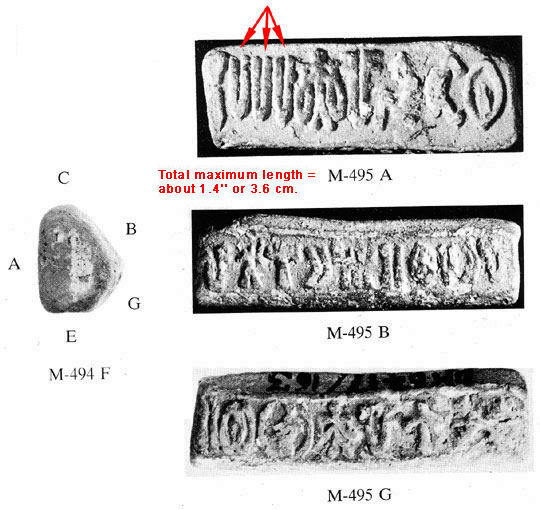
published a corpus and concordance of Indus writing listing about 3700 seals and about 417 distinct signs in specific patterns. The average inscription contains five signs, and the longest inscription is only 17 signs long. He also established the direction of writing as right to left.
Some early scholars, starting with Cunningham in 1877, thought that the script was the archetype of the Brāhmī script
Brāhmī script
Brāhmī is the modern name given to the oldest members of the Brahmic family of scripts. The best-known Brāhmī inscriptions are the rock-cut edicts of Ashoka in north-central India, dated to the 3rd century BCE. These are traditionally considered to be early known examples of Brāhmī writing...
. Cunningham's ideas were supported by G.R. Hunter, Mahadevan and a minority of scholars, who continue to argue for the Indus script as the predecessor of the Brahmic family
Brahmic family
The Brahmic or Indic scripts are a family of abugida writing systems. They are used throughout South Asia , Southeast Asia, and parts of Central and East Asia, and are descended from the Brāhmī script of the ancient Indian subcontinent...
. However most scholars disagree, claiming instead that the Brahmi script derived from the Aramaic script.
Early Harappan
The script generally refers to that used in the mature Harappan phase, which perhaps evolved from a few signs found in early Harappa after 3500 BC. However, the early date and the interpretation given in the BBC report have been challenged by the long-term excavator of Harappa, Richard Meadow. The use of early pottery marks and incipient Indus signs was followed by the mature Harappan script.Mature Harappan
Strings of Indus signs are most commonly found on flat, rectangular stamp sealStamp seal
The stamp seal is a carved object, usually stone, first made in the 4th millennium BC, and probably earlier. They were used to impress their picture or inscription into soft, prepared clay....
s, but they are also found on at least a dozen other materials including tools, miniature tablets, copper plates, and pottery.
Late Harappan
After 1900 BC, the systematic use of the symbols ended, after the final stage of the Mature Harappan civilization.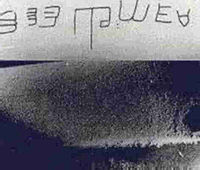
Onshore explorations near Bet Dwarka in Gujarat revealed the presence of late Indus seals depicting a 3-headed animal, earthen vessel inscribed in what is claimed to be a late Harappan script, and a large quantity of pottery similar to Lustrous Red Ware bowl and Red Ware dishes, dish-on-stand, perforated jar and incurved bowls which are datable to the 16th century BC in Dwarka
Dwarka
Dwarka also spelled Dvarka, Dwaraka, and Dvaraka, is a city and a municipality of Jamnagar district in the Gujarat state in India. Dwarka , also known as Dwarawati in Sanskrit literature is rated as one of the seven most ancient cities in the country...
, Rangpur
Rangpur, Bangladesh
Rangpur is one of the major cities in Bangladesh. Rangpur is considered as the centre of northwestern Bangladesh. Recently established public university of Bangladesh named as "Begum Rokeya University, Rangpur" is situated in the southern part of the city. Earlier Rangpur was the headquarter of...
and Prabhas. The thermoluminescence date
Thermoluminescence dating
Thermoluminescence dating is the determination, by means of measuring the accumulated radiation dose, of the time elapsed since material containing crystalline minerals was either heated or exposed to sunlight...
for the pottery in Bet Dwaraka is 1528 BC. This evidence has been used to claim that a late Harappan script was used until around 1500 BC. Other excavations in India at Vaisali, Bihar
Bihar
Bihar is a state in eastern India. It is the 12th largest state in terms of geographical size at and 3rd largest by population. Almost 58% of Biharis are below the age of 25, which is the highest proportion in India....
and Mayiladuthurai
Mayiladuthurai
Mayiladuthurai , formerly known by its Sanskrit names Māyavaram and Mayūram is a town in the Nagapattinam District of the Indian state of Tamil Nadu. It is the headquarters of the Mayiladuthurai taluk of Nagapattinam district and is the second-largest town in the district...
, Tamil Nadu
Tamil Nadu
Tamil Nadu is one of the 28 states of India. Its capital and largest city is Chennai. Tamil Nadu lies in the southernmost part of the Indian Peninsula and is bordered by the union territory of Pondicherry, and the states of Kerala, Karnataka, and Andhra Pradesh...
have been claimed to contain Indus symbols being used as late as 1100 BC.
In May 2007, the Tamil Nadu Archaeological Department found pots with arrow-head symbols during an excavation in Melaperumpallam near Poompuhar. These symbols are claimed to have a striking resemblance to seals unearthed in Mohenjo-daro
Mohenjo-daro
Mohenjo-daro is an archeological site situated in what is now the province of Sindh, Pakistan. Built around 2600 BC, it was one of the largest settlements of the ancient Indus Valley Civilization, and one of the world's earliest major urban settlements, existing at the same time as the...
in the 1920s.
In 1960, B.B. Lal of the Archaeological Survey of India wrote a paper in the journal Ancient India. It carried a photographic catalog of megalithic and chalcolithic pottery which Lal compares with the Ancient Indus script. Ancient inscriptions that are claimed to bear a striking resemblance to those found in Indus Valley sites have been found in Sanur near Tindivanam in Tamil Nadu, Musiri in Kerala and Sulur near Coimbatore.
In one alleged "decipherment" of the script, the Indian archeologist S. R. Rao argued that the late phase of the script represented the beginning of the alphabet. He notes a number of striking similarities in shape and form between the late Harappan characters and the Phoenician letters, arguing than the Phoenician script evolved from the Harappan script, challenging the classical theory that the first alphabet was Proto-Sinaitic.Robinson, Andrew. Lost Languages: The Enigma of the World's Undeciphered Scripts. 2002
Script characteristics
The writing system is largely pictorial but includes many abstract signs as well. The script is written from right to left, and sometimes follows a boustrophedonic style. Since the number of principal signs is about 400-600, midway between typical logographic and syllabic scripts, many scholars accept the script to be logo-syllabic (typically syllabic scripts have about 50-100 signs whereas logographic scripts have a very large number of principal signs). The prevailing scholarly view maintains that structural analysis indicates that the language is agglutinativeAgglutinative language
An agglutinative language is a language that uses agglutination extensively: most words are formed by joining morphemes together. This term was introduced by Wilhelm von Humboldt in 1836 to classify languages from a morphological point of view...
, like the Dravidian languages
Dravidian languages
The Dravidian language family includes approximately 85 genetically related languages, spoken by about 217 million people. They are mainly spoken in southern India and parts of eastern and central India as well as in northeastern Sri Lanka, Pakistan, Nepal, Bangladesh, Afghanistan, Iran, and...
. However, this is contradicted by the occurrence of signs supposedly representing prefixes and infixes, features more typical of a fusional language like the Indo-European
Indo-European
Indo-European may refer to:* Indo-European languages** Aryan race, a 19th century and early 20th century term for those peoples who are the native speakers of Indo-European languages...
languages.
Attempts at decipherment
Over the years, numerous deciphermentDecipherment
Decipherment is the analysis of documents written in ancient languages, where the language is unknown, or knowledge of the language has been lost....
s have been proposed, but none has been accepted by the scientific community at large. The following factors are usually regarded as the biggest obstacles for a successful decipherment:
- The underlying language has not been identified though some 300 loanwords in the Rigveda are a good starting point for comparison.
- The average length of the inscriptions is less than five signs, the longest being only 17 signs (and a sealing of combined inscriptions of just 27 signs).
- No bilingual texts (like a Rosetta StoneRosetta StoneThe Rosetta Stone is an ancient Egyptian granodiorite stele inscribed with a decree issued at Memphis in 196 BC on behalf of King Ptolemy V. The decree appears in three scripts: the upper text is Ancient Egyptian hieroglyphs, the middle portion Demotic script, and the lowest Ancient Greek...
) have been found.
The topic is popular among amateur researchers, and there have been various (mutually exclusive) decipherment claims. None of these suggestions has found academic recognition.
Indo-European hypothesis
Shikaripura Ranganatha RaoShikaripura Ranganatha Rao
Shikaripura Ranganatha Rao is an Indian archeologist who led teams credited with the discovery of a number of Harappan sites including the famous port city of Lothal in Gujarat. He also discovered the ancient city of Dwarka....
(Kannada: ಶಿಕಾರಿಪುರ ರಂಗನಾಥ ರಾವ್) (born 1922) is an Indian archeologist who led teams credited with the discovery of a number of Harappan sites including the port city of Lothal
Lothal
Lothal is one of the most prominent cities of the ancient Indus valley civilization. Located in Bhāl region of the modern state of Gujarāt and dating from 2400 BCE. Discovered in 1954, Lothal was excavated from February 13, 1955 to May 19, 1960 by the Archaeological Survey of India...
in Gujarat. He also discovered the ancient city of Dwarka. Rao (1992) claimed to have deciphered the Indus script. Postulating uniformity of the script over the full extent of Indus-era civilization, he compared it to the Phoenician Alphabet
Phoenician alphabet
The Phoenician alphabet, called by convention the Proto-Canaanite alphabet for inscriptions older than around 1050 BC, was a non-pictographic consonantal alphabet, or abjad. It was used for the writing of Phoenician, a Northern Semitic language, used by the civilization of Phoenicia...
, and assigned sound values based on this comparison. His decipherment results in an "Sanskritic
Indo-Aryan languages
The Indo-Aryan languages constitutes a branch of the Indo-Iranian languages, itself a branch of the Indo-European language family...
" reading, including the numerals aeka, tra, chatus, panta, happta/sapta, dasa, dvadasa, sata (1, 3, 4, 5, 7, 10, 12, 100).
While mainstream scholarship is generally in agreement with Rao's approach of comparison, the details of his decipherment have not been accepted, and the script is still generally considered undeciphered.
John E. Mitchiner, after dismissing some more fanciful attempts at decipherment, mentions that "a more soundly-based but still greatly subjective and unconvincing attempt to discern an Indo-European basis in the script has been that of Rao".
In a 2002 interview with The Hindu
The Hindu
The Hindu is an Indian English-language daily newspaper founded and continuously published in Chennai since 1878. According to the Audit Bureau of Circulations, it has a circulation of 1.46 million copies as of December 2009. The enterprise employed over 1,600 workers and gross income reached $40...
, Rao asserted his faith in his decipherment, saying that "Recently we have confirmed that it is definitely an Indo-Aryan language and deciphered. Prof. W. W. Grummond of Florida State University has written in his article that I have already deciphered it."
Dravidian hypothesis
The Russian scholar Yuri Knorozov surmised that the symbols represent a logosyllabic script and suggested, based on computer analysis, an underlying agglutinative DravidianDravidian languages
The Dravidian language family includes approximately 85 genetically related languages, spoken by about 217 million people. They are mainly spoken in southern India and parts of eastern and central India as well as in northeastern Sri Lanka, Pakistan, Nepal, Bangladesh, Afghanistan, Iran, and...
language as the most likely candidate for the underlying language. Knorozov's suggestion was preceded by the work of Henry Heras
Henry Heras
Henry Heras was a Spanish Jesuit priest, archeologist and historian in India.-Education:...
, who suggested several readings of signs based on a proto-Dravidian assumption.
The Finnish scholar Asko Parpola led a Finnish team in the 1960s-80s that vied with Knorozov's Soviet team in investigating the script using computer analysis. Based on a proto-Dravidian assumption, they proposed readings of many signs, some agreeing with the suggested readings of Heras and Knorozov (such as equating the "fish" sign with the Dravidian word for fish "min") but disagreeing on several other readings. A comprehensive description of Parpola's work until 1994 is given in his book Deciphering the Indus Script.
The discovery in Tamil Nadu of a late Neolithic (early 2nd millennium BC, i.e. post-dating Harappan decline) stone celt
Celt (tool)
Celt is an archaeological term used to describe long thin prehistoric stone or bronze adzes, other axe-like tools, and hoes.-Etymology:The term "celt" came about from what was very probably a copyist's error in many medieval manuscript copies of Job 19:24 in the Latin Vulgate Bible, which became...
allegedly marked with Indus script signs has been considered by some to be significant for the Dravidian identification. However, their identification as Indus signs has been disputed.
Iravatham Mahadevan
Iravatham Mahadevan
Iravatham Mahadevan is an Indian epigraphist, specializing on the Indus script and Early Tamil epigraphy.-Biography:Iravatham Mahadevan was born in 1930 in a Smartha Tamil Brahmin family of Thanjavur district. He was born in British Burma where his father Iravatham was practising as a...
, who supports the Dravidian hypothesis, says, "we may hopefully find that the proto-Dravidian roots of the Harappan language and South Indian Dravidian languages are similar. This is a hypothesis [...] But I have no illusions that I will decipher the Indus script, nor do I have any regret."
Massimo Vidale says, "I actually think that the Indus script was probably a protohistoric script, somehow conveying the sounds and words of one or more still unidentified languages".
Controversy about decipherability
In a 2004 article, Farmer, Sproat, and Witzel presented a number of arguments in support of their thesis that the Indus script is nonlinguistic, principal among them being the extreme brevity of the inscriptions, the existence of too many rare signs increasing over the 700-year period of the Mature Harappan civilization, and the lack of random-looking sign repetition typical for representations of actual spoken language (whether syllabic-based or letter-based), as seen, for example, in Egyptian cartoucheCartouche
In Egyptian hieroglyphs, a cartouche is an ellipse with a horizontal line at one end, indicating that the text enclosed is a royal name, coming into use during the beginning of the Fourth Dynasty under Pharaoh Sneferu, replacing the earlier serekh...
s.
Asko Parpola, reviewing the Farmer, Sproat, and Witzel thesis in 2005, states that their arguments "can be easily controverted". He cites the presence of a large number of rare signs in Chinese, and emphasizes that there is "little reason for sign repetition in short seal texts written in an early logo-syllabic script". Revisiting the question in a 2007 lecture, Parpola takes on each of the 10 main arguments of Farmer et al., presenting counterarguments for each. He states that "even short noun phrases and incomplete sentences qualify as full writing if the script uses the rebus principle to phonetize some of its signs".
A computational study conducted by a joint Indo-US team led by Rajesh P N Rao of the University of Washington
University of Washington
University of Washington is a public research university, founded in 1861 in Seattle, Washington, United States. The UW is the largest university in the Northwest and the oldest public university on the West Coast. The university has three campuses, with its largest campus in the University...
, consisting of Iravatham Mahadevan
Iravatham Mahadevan
Iravatham Mahadevan is an Indian epigraphist, specializing on the Indus script and Early Tamil epigraphy.-Biography:Iravatham Mahadevan was born in 1930 in a Smartha Tamil Brahmin family of Thanjavur district. He was born in British Burma where his father Iravatham was practising as a...
and others from the Tata Institute of Fundamental Research
Tata Institute of Fundamental Research
The Tata Institute of Fundamental Research is a research institution in India dedicated to basic research in mathematics and the sciences. It is a Deemed University and works under the umbrella of the Department of Atomic Energy of the Government of India. It is located at Navy Nagar, Colaba, Mumbai...
and the Institute of Mathematical Sciences
Institute of Mathematical Sciences
The Institute of Mathematical Sciences is a research centre located in Chennai, India.IMSc is a national institute for fundamental research in frontier disciplines of the mathematical and physical sciences: theoretical computer science, mathematics, and theoretical physics...
, was published in April 2009 in Science
Science (journal)
Science is the academic journal of the American Association for the Advancement of Science and is one of the world's top scientific journals....
. They conclude that "given the prior evidence for syntactic structure in the Indus script, (their) results increase the probability that the script represents language". Farmer, Sproat, and Witzel have disputed this finding, pointing out that Rao et al. did not actually compare the Indus signs with "real-world non-linguistic systems" but rather with "two wholly artificial systems invented by the authors". In response, Rao et al. point out that the two artificial systems “simply represent controls, necessary in any scientific investigation, to delineate the limits of what is possible.” They state that real-world non-linguistic systems were indeed included in their analysis (“DNA and protein sequences, FORTRAN computer code”). Farmer et al. have also compared a non-linguistic system (medieval heraldic signs
Heraldry
Heraldry is the profession, study, or art of creating, granting, and blazoning arms and ruling on questions of rank or protocol, as exercised by an officer of arms. Heraldry comes from Anglo-Norman herald, from the Germanic compound harja-waldaz, "army commander"...
) with natural language
Natural language
In the philosophy of language, a natural language is any language which arises in an unpremeditated fashion as the result of the innate facility for language possessed by the human intellect. A natural language is typically used for communication, and may be spoken, signed, or written...
s using Rao et al.'s method and conclude that the method cannot distinguish linguistic systems from non-linguistic ones. Rao et al. have clarified that their method is inductive
Inductive reasoning
Inductive reasoning, also known as induction or inductive logic, is a kind of reasoning that constructs or evaluates propositions that are abstractions of observations. It is commonly construed as a form of reasoning that makes generalizations based on individual instances...
, not deductive
Deductive reasoning
Deductive reasoning, also called deductive logic, is reasoning which constructs or evaluates deductive arguments. Deductive arguments are attempts to show that a conclusion necessarily follows from a set of premises or hypothesis...
as presumed by Farmer et al., and their result, together with other known attributes of the script, increases the evidence that the script is linguistic, though it does not prove it.A book (2010) refutes 'illiteracy' conjectures and decodes the script as hieroglyphic, read rebus in mleccha (meluhha) language -- Indus Script Cipher - Hieroglyphs of Indian Linguistic Area
In a follow-up study published in IEEE Computer, Rao et al. present data which strengthen their original conditional entropy
Conditional entropy
In information theory, the conditional entropy quantifies the remaining entropy of a random variable Y given that the value of another random variable X is known. It is referred to as the entropy of Y conditional on X, and is written H...
result, which involved analysis of pairs of symbols. They show that the Indus script is similar to linguistic systems in terms of block entropies, involving sequences up to 6 symbols in length.
A discussion of the linguistic versus nonlinguistic question by Sproat, Rao, and others was published in the journal Computational Linguistics
Computational Linguistics (journal)
Computational Linguistics is a peer-reviewed academic journal in the field of computational linguistics. It is published quarterly by MIT Press for the Association for Computational Linguistics...
in December 2010.
In computing
The Indus script has been assigned the ISO 15924ISO 15924
ISO 15924, Codes for the representation of names of scripts, defines two sets of codes for a number of writing systems . Each script is given both a four-letter code and a numeric one....
code "Inds". It was proposed for encoding in Unicode's Supplementary Multilingual Plane in 1999; however, the Unicode Consortium
Unicode Consortium
The Unicode Consortium is a non-profit organization that coordinates the development of the Unicode standard. Its stated goal is to eventually replace existing character encoding schemes with Unicode and its standard Unicode Transformation Format schemes, claiming that many of the existing...
still list the proposal in pending status.
See also
- Proto-Elamite script
- Undeciphered scripts
- Bronze Age writing
- SanskritSanskritSanskrit , is a historical Indo-Aryan language and the primary liturgical language of Hinduism, Jainism and Buddhism.Buddhism: besides Pali, see Buddhist Hybrid Sanskrit Today, it is listed as one of the 22 scheduled languages of India and is an official language of the state of Uttarakhand...
External links
- Indus Script (ancientscripts.com)
- Indus Script (http://www.shangrilagifts.org/hp/indus.html - Comparison of Indus Valley Harappan 哈拉帕 and Ancient Chinese Jia-Gu-wen 甲骨文 "Bone Script")
- "Discovery of a century" in Tamil Nadu ("Discovery of a century" in Tamil Nadu )
- The Indus Script (From harappa.com)
- BBC - 'Earliest writing' found
- How come we can't decipher the Indus script? (from The Straight Dope)
- Iravatham Mahadevan, Towards a scientific study of the Indus Script
- Script Image;Article
- Collection of essays about the Indus script (Steve Farmer)
- WIRED.com (WIRED.com).