

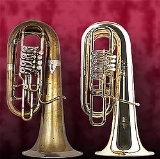
Tuba

Encyclopedia
The tuba is the largest and lowest-pitched brass instrument
. Sound is produced by vibrating or "buzzing" the lips into a large cupped mouthpiece
. It is one of the most recent additions to the modern symphony orchestra, first appearing in the mid-19th century, when it largely replaced the ophicleide
. Tuba is Latin
for trumpet
or horn. The horn referred to would most likely resemble what is known as a baroque trumpet
.
n Patent No. 19 was granted to Wilhelm Friedrich Wieprecht
and Carl Moritz on September 12, 1835 for a "basstuba" in F1. The original Wieprecht and Moritz instrument used five valves of the Berlinerpumpen type that were the forerunners of the modern rotary valve.
The addition of valves made it possible to play low in the harmonic series of the instrument and still have a complete selection of notes. Prior to the invention of valves, brass instruments were limited to notes in the harmonic series, and were thus generally played very high with respect to their fundamental pitch. Harmonics starting three octaves above the fundamental pitch are about a whole step apart, making a useful variety of notes possible.
The ophicleide used a cup-shaped brass instrument mouthpiece but employed keys and tone holes similar to those of a modern saxophone. Another forerunner to the tuba was the serpent
, a bass brass instrument that was shaped in a wavy form to make the tone holes accessible to the player. Tone holes changed the pitch by providing an intentional leak in the bugle of the instrument. While this changed the pitch, it also had a pronounced effect on the timbre. By using valves to adjust the length of the bugle the tuba produced a smoother tone that eventually led to its popularity.
Adolphe Sax, like Wieprecht, was interested in marketing systems of instruments from soprano to bass, and developed a series of brass instruments known as saxhorns. The instruments developed by Sax were generally pitched in E and B, while the Wieprecht "basstuba" and the subsequent Cerveny contrabass tuba were pitched in F and C (see below on pitch systems). Sax's instruments gained dominance in France, and later in Britain and America, as a result of the popularity and movements of instrument makers such as Gustave Auguste Besson
(who moved from France to Britain) and Henry Distin (who found his way eventually to America).
usually has a single tuba, though an additional tuba may be asked for. It is the principal bass instrument in symphonic and military bands, and those ensembles generally have more. It serves as the bass of the brass
section and of brass quintets and choirs, as well as reinforcement for the bass voices of the strings
and woodwinds, and as a solo instrument.
Well known and influential parts for the tuba include:
Concerto
s have been written for the tuba by many notable composers, including Ralph Vaughan Williams
, Edward Gregson
, John Williams
, Alexander Arutiunian
, Eric Ewazen
, James Barnes
, Martin Ellerby
, Philip Sparke
, Kalevi Aho
, Arild Plau, James Woodward, Victor Davies, Josef Tal and Bruce Broughton
. Joseph Hallman's Concerto for tuba and chamber orchestra was written for and premiered by the Philadelphia Orchestra
's tubist, Carol Jantsch
in May 2007.
Tubas are also used in concert bands, marching bands, drum and bugle corps
, drum and brass corps, and in many jazz bands (see below). In British style brass bands
, both E and B tubas are used and are normally referred to as basses.
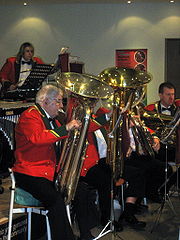 Tubas are found in various pitches, most commonly in F, E, C, or B. The main tube of a B tuba is approximately 18 feet long, while that of a C tuba is 16 feet, of an E tuba 13 feet, and of an F tuba 12 feet. The instrument has a conical
bore, meaning the bore diameter increases as a function of the tubing length from the mouthpiece to the bell. The conical bore causes the instrument to produce a preponderance of even-order harmonic
s.
A tuba with its tubing wrapped for placing the instrument on the player's lap is usually called a concert tuba or simply a tuba. Tubas with the bell pointing forward (pavillon tournant) instead of upward are often called recording tubas because of their popularity in the early days of recorded music, as their sound could more easily be directed at the recording instrument. When wrapped to surround the body for marching, it is traditionally known as a hélicon
. The modern sousaphone
, named after American bandmaster John Philip Sousa
, resembles a hélicon with the bell pointed up and then curved to point forward. Some ancestors of the tuba, such as the military bombardon, had unusual valve and bore arrangements compared to modern tubas. During the American Civil War, most brass bands used a branch of the brass family known as 'Saxhorns', which by today's standards have a narrower bore taper than tubas (being the same as true cornets and baritones, but being distinct from trumpet, euphoniums and others with wider or narrower (or no) bore tapers). Starting around the time of the start of the Civil War, Saxhorns manufactured for military use in the USA were commonly wrapped with the bell pointing backwards over the player's shoulder, and these were known as "over-the-shoulder saxhorns", and they came in all sizes from cornets down to E basses. However, the E bass, even though it shared the same tube length as a modern E tuba, has a narrower bore and as such cannot be called by the name 'tuba' except as a convenience when comparing it to other sizes of Saxhorn.
Most music for tuba is written in bass clef in concert pitch, so tuba players must know the correct fingerings for their specific instrument. Traditional British-style brass band
parts for the tuba are usually written in treble clef, with the B tuba sounding two octaves and one step below and the E tuba sounding one octave and a major sixth below the written pitch. This allows musicians to change instruments without learning new fingerings for the same written music. Consequently, when its music is written in treble clef, the tuba is a transposing instrument
, but not when the music is in bass clef.
The lowest pitched tubas are the contrabass tubas, pitched in C or B; (referred to as CC and BB tubas respectively, based on a traditional distortion of a now-obsolete octave naming convention). The fundamental pitch of a CC tuba is 32 Hz, and for a BB tuba, 29 Hz. The CC tuba is used as an orchestral instrument in the U.S., but BB tubas are the contrabass tuba of choice in German, Austrian, and Russian orchestras. In the United States the BB tuba is the most common in schools (largely due to the use of BBb sousaphone
s in high school
marching bands) and for adult amateurs. Most professionals in the U.S. play CC tubas, with BBb also common, and many train in the use of all four pitches of tubas.
The next smaller tubas are the bass tubas, pitched in F or E (a fourth above the contrabass tubas). The E tuba often plays an octave above the contrabass tubas in brass bands, and the F tuba is commonly used by professional players as a solo instrument and, in America, to play higher parts in the classical repertoire (or parts that were originally written for the F tuba, as is the case with Berlioz). In most of Europe, the F tuba is the standard orchestral instrument, supplemented by the CC or BB only when the extra weight is desired. Wagner, for example, specifically notates the low tuba parts for "Kontrabasstuba," which are played on CC or BB tubas in most regions. In the United Kingdom, the E is the standard orchestral tuba.
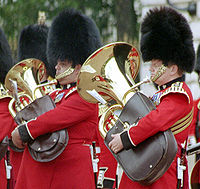 The euphonium
is sometimes referred to as a tenor tuba and is pitched in B, one octave higher than the BB contrabass tuba. The term "tenor tuba" is often used more specifically to refer to B rotary-valved tubas pitched in the same octave as euphoniums. The "Small French Tuba in C" is a tenor tuba pitched in C, and provided with 6 valves to make the lower notes in the orchestral repertoire possible. The French C tuba was the standard instrument in French orchestras until overtaken by F and C tubas since the Second World War
. One popular example of the use of the French C tuba is the Bydło movement in Ravel's orchestration of Mussorgsky
's Pictures at an Exhibition
, though the rest of the work is scored for this instrument as well.
Larger BBB subcontrabass tubas exist, but are extremely rare (there are at least four known examples). The first two were built by the Gustav Besson in BBB, one octave below the BB Contrabass tuba, on the suggestion of John Philip Sousa. The monster instruments were not completed until just after Sousa's death. Later, in the 1950s, British musician Gerard Hoffnung
commissioned the London firm of Paxman to create a subcontrabass tuba in EEE for use in his comedic music festivals. Also, a tuba pitched in FFF was made in Kraslice by Bohland & Fuchs probably during 1910 or 1911 and was destined for the World Exhibition in New York in 1913. Two players are needed; one to operate the valves and one to blow into the mouthpiece.
family of instruments promoted by Adolphe Sax
around the same time. Pistons may either be oriented to point to the top of the instrument (top-action, as pictured in the figure at the top of the article) or out the front of the instrument (front-action or side-action). There are advantages and disadvantages to each valve style, but assertions concerning sound, speed, and clarity are difficult to quantify. German players generally prefer rotary valves while British and American players favor piston valves - the choice of valve type remains up to the performer.
Piston valves require more maintenance than rotary valves — they require daily oiling to keep them freely operating, while rotary valves are sealed and seldom require oiling. Piston valves are easy to disassemble and re-assemble, while rotary valve disassembly and re-assembly is much more difficult and is generally left to qualified instrument repair persons.
Tubas generally have from three to six valves, though some rare exceptions exist. Three-valve tubas are generally the least expensive and are almost exclusively used by beginners and amateurs, and the sousaphone
(a marching version of a BB tuba) almost always has three valves. Among advanced players, four and five valve tubas are by far the most common choices, with six-valve tubas being relatively rare except among F tubas, which mostly have five or six valves.
The valves add tubing to the main tube of the instrument, thus lowering its fundamental pitch. The first valve lowers the pitch by a whole step (two semitones), the second valve by a semitone, and the third valve by three semitones. Used in combination, the valves are too short and the resulting pitch tends to be sharp. For example, a BB tuba becomes (in effect) an A tuba when the first valve is depressed. The third valve is long enough to lower the pitch of a BB tuba by three semitones, but it is not long enough to lower the pitch of an A tuba by three semitones. Thus, the first and third valves used in combination lower the pitch by something just short of five semitones, and the first three valves used in combination are nearly a quarter tone sharp.
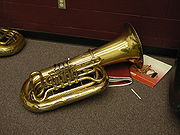 The fourth valve is used in place of combinations of the first and third valves, and the second and fourth used in combination are used in place of the first three valves in combination. The fourth valve can be tuned to lower the pitch of the main tube accurately by five semitones, and thus its use corrects the main problem of combinations being too sharp. By using the fourth valve by itself to replace the first and third combination, or the fourth and second valves in place of the first, second and third valve combinations, the notes requiring these fingerings are more in tune.
The fifth and sixth valves are used to provide alternative fingering possibilities to improve intonation, and are also used to reach into the low register of the instrument where all the valves will be used in combination to fill the first octave between the fundamental pitch and the next available note on the open tube. The fifth and sixth valves also give the musician the ability to trill more smoothly or to use alternative fingerings for ease of playing.
The bass tuba in F is pitched a fifth above the BB tuba and a fourth above the CC tuba, so it needs additional tubing length beyond that provided by four valves to play securely down to a low F as required in much tuba music. The fifth valve is commonly tuned to a flat whole step, so that when used with the fourth valve, it gives an in-tune low B. The sixth valve is commonly tuned as a flat half step, allowing the F tuba to play low G as 1-4-5-6 and low G as 1-2-4-5-6. In CC tubas with five valves, the fifth valve may be tuned as a flat whole step or as a minor third depending on the instrument.
and its overtones define the pitch in the listener's ear.
The most convincing explanation for false-tones is that the horn is acting as a 'third of a pipe' rather than as a half-pipe. The bell remains an anti-node, but there would then be a node 1/3 of the way back to the mouthpiece. If so, it seems that the fundamental would be missing entirely, and would only be inferred from the overtones. However, the node and the anti-node collide in the same spot and cancel out the fundamental.
Some tubas have a compensating system to allow accurate tuning when using several valves in combination, simplifying fingering and removing the need to constantly adjust slide positions. The most popular of the automatic compensation systems was invented by Blaikley (Bevan, 1978) and was patented by Boosey (later, Boosey and Hawkes, which also, later still, produced Besson instruments). The patent on the system limited its application outside of Britain, and to this day tubas with compensating valves are primarily popular in the United Kingdom and countries of the former British Empire. The Blaikley design plumbs the instrument so that if the fourth valve is used, the air is sent back through a second set of branches in the first three valves to compensate for the combination of valves. This does have the disadvantage of making the instrument significantly more 'stuffy' or resistant to air flow when compared to a non-compensating tuba. This is due to the need for the air to flow through the valves twice. It also makes the instrument heavier. But many prefer this approach to additional valves or to manipulation of tuning slides while playing to achieve improved intonation within an ensemble. Most modern professional-grade euphoniums now feature Blaikley-style compensating valves.
, which is either unfinished, lacquered or electro-plated
with nickel
, gold
or silver
. Unfinished brass will eventually tarnish
and thus must be periodically polished
to maintain its appearance. There is some belief that the external finish of the tuba can play an important role in the tone production, which has never been scientifically proved. Performers have individual preferences on the finish that they select, and will sometimes have horns in more than one finish for different musical settings.
style, known as "marching tubas". A leadpipe
can be manually screwed on next to the valves. The tuba is then usually rested on the left shoulder (although some tubas allow use of the right shoulder), with the bell facing directly in front of the player. Some marching tubas are made only for marching, and cannot be converted into a concert model. Most marching bands opt for the sousaphone
, an instrument that is easier to carry and almost always cheaper than a true marching tuba. Drum and bugle corps
players, however, generally use marching tubas, which, in this context, are called contra
s. Standard tubas can also be played whilst standing, with the use of a strap joined to the tuba with two rings. The strap goes over the player's shoulder like a sash, allowing the instrument to be played in the same position as when sitting.
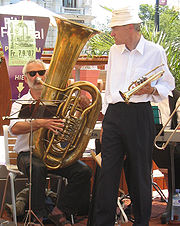 The tuba has been used in jazz
since the genre's inception. In the earliest years, bands often used a tuba for outdoor playing and a double bass
for indoor performances. In this context, the tuba was sometimes called "brass bass", as opposed to the double bass, which was called "string bass"; it was not uncommon for players to double on both instruments.
When used in modern jazz, tubas usually fill the traditional bass role, although it is not uncommon for them to take solos. New Orleans style Brass Band
s like Dirty Dozen Brass Band
, Rebirth Brass Band
, and Nightcrawlers Brass Band feature a sousaphone as the bass instrument. Miles Davis
made use of a tuba, played by Bill Barber
, in his album Birth of the Cool
, released in June, 1950. One of the most prominent tubists specializing in jazz is the New York City-based Marcus Rojas
, who has performed frequently with bandleader Henry Threadgill
. Another notable group is the Modern Jazz Tuba Project, founded by R. Winston Morris
, which consists entirely of tubas and euphoniums with rhythm section.
The tuba has also played a large role in ragtime
music and in big band
music.
Brass instrument
A brass instrument is a musical instrument whose sound is produced by sympathetic vibration of air in a tubular resonator in sympathy with the vibration of the player's lips...
. Sound is produced by vibrating or "buzzing" the lips into a large cupped mouthpiece
Mouthpiece (brass)
On brass instruments the mouthpiece is the part of the instrument which is placed upon the player's lips. The purpose of the mouthpiece is a resonator, which passes vibration from the lips to the column of air contained within the instrument, giving rise to the standing wave pattern of vibration in...
. It is one of the most recent additions to the modern symphony orchestra, first appearing in the mid-19th century, when it largely replaced the ophicleide
Ophicleide
The ophicleide is a family of conical bore, brass keyed-bugles. It has a similar shape to the sudrophone.- History :The ophicleide was invented in 1817 and patented in 1821 by French instrument maker Jean Hilaire Asté as an extension to the keyed bugle or Royal Kent bugle family...
. Tuba is Latin
Latin
Latin is an Italic language originally spoken in Latium and Ancient Rome. It, along with most European languages, is a descendant of the ancient Proto-Indo-European language. Although it is considered a dead language, a number of scholars and members of the Christian clergy speak it fluently, and...
for trumpet
Trumpet
The trumpet is the musical instrument with the highest register in the brass family. Trumpets are among the oldest musical instruments, dating back to at least 1500 BCE. They are played by blowing air through closed lips, producing a "buzzing" sound which starts a standing wave vibration in the air...
or horn. The horn referred to would most likely resemble what is known as a baroque trumpet
Baroque trumpet
The baroque trumpet is a musical instrument in the brass family. It was invented in the mid-20th century based on ideas from the natural trumpet of the 16th to 18th centuries and designed to allow modern performers to imitate the earlier instrument for music of that time...
.
History
PrussiaPrussia
Prussia was a German kingdom and historic state originating out of the Duchy of Prussia and the Margraviate of Brandenburg. For centuries, the House of Hohenzollern ruled Prussia, successfully expanding its size by way of an unusually well-organized and effective army. Prussia shaped the history...
n Patent No. 19 was granted to Wilhelm Friedrich Wieprecht
Wilhelm Friedrich Wieprecht
Wilhelm Friedrich Wieprecht was a German musical conductor, composer and inventor.-Early life and career:Wieprecht was born at Aschersleben, where his father was town musician....
and Carl Moritz on September 12, 1835 for a "basstuba" in F1. The original Wieprecht and Moritz instrument used five valves of the Berlinerpumpen type that were the forerunners of the modern rotary valve.
The addition of valves made it possible to play low in the harmonic series of the instrument and still have a complete selection of notes. Prior to the invention of valves, brass instruments were limited to notes in the harmonic series, and were thus generally played very high with respect to their fundamental pitch. Harmonics starting three octaves above the fundamental pitch are about a whole step apart, making a useful variety of notes possible.
The ophicleide used a cup-shaped brass instrument mouthpiece but employed keys and tone holes similar to those of a modern saxophone. Another forerunner to the tuba was the serpent
Serpent (instrument)
A serpent is a bass wind instrument, descended from the cornett, and a distant ancestor of the tuba, with a mouthpiece like a brass instrument but side holes like a woodwind. It is usually a long cone bent into a snakelike shape, hence the name. The serpent is closely related to the cornett,...
, a bass brass instrument that was shaped in a wavy form to make the tone holes accessible to the player. Tone holes changed the pitch by providing an intentional leak in the bugle of the instrument. While this changed the pitch, it also had a pronounced effect on the timbre. By using valves to adjust the length of the bugle the tuba produced a smoother tone that eventually led to its popularity.
Adolphe Sax, like Wieprecht, was interested in marketing systems of instruments from soprano to bass, and developed a series of brass instruments known as saxhorns. The instruments developed by Sax were generally pitched in E and B, while the Wieprecht "basstuba" and the subsequent Cerveny contrabass tuba were pitched in F and C (see below on pitch systems). Sax's instruments gained dominance in France, and later in Britain and America, as a result of the popularity and movements of instrument makers such as Gustave Auguste Besson
Gustave Auguste Besson
Gustave-Auguste Besson was a musical instrument manufacturer and innovator. He created the Besson brand in Paris, France, in 1837. Besson is credited with more than 50 original inventions. His alterations to the cornet were particularly notable....
(who moved from France to Britain) and Henry Distin (who found his way eventually to America).
Roles
An orchestraOrchestra
An orchestra is a sizable instrumental ensemble that contains sections of string, brass, woodwind, and percussion instruments. The term orchestra derives from the Greek ορχήστρα, the name for the area in front of an ancient Greek stage reserved for the Greek chorus...
usually has a single tuba, though an additional tuba may be asked for. It is the principal bass instrument in symphonic and military bands, and those ensembles generally have more. It serves as the bass of the brass
Brass instrument
A brass instrument is a musical instrument whose sound is produced by sympathetic vibration of air in a tubular resonator in sympathy with the vibration of the player's lips...
section and of brass quintets and choirs, as well as reinforcement for the bass voices of the strings
String instrument
A string instrument is a musical instrument that produces sound by means of vibrating strings. In the Hornbostel-Sachs scheme of musical instrument classification, used in organology, they are called chordophones...
and woodwinds, and as a solo instrument.
Well known and influential parts for the tuba include:
- Modest MussorgskyModest MussorgskyModest Petrovich Mussorgsky was a Russian composer, one of the group known as 'The Five'. He was an innovator of Russian music in the romantic period...
(orch. RavelMaurice RavelJoseph-Maurice Ravel was a French composer known especially for his melodies, orchestral and instrumental textures and effects...
): Pictures at an ExhibitionPictures at an ExhibitionPictures at an Exhibition is a suite in ten movements composed for piano by Russian composer Modest Mussorgsky in 1874.The suite is Mussorgsky's most famous piano composition, and has become a showpiece for virtuoso pianists...
- Bydlo, Night On Bald MountainNight on Bald MountainNight on Bald Mountain is a composition by Modest Mussorgsky that exists in, at least, two versions—a seldom performed 1867 version or a later and very popular "fantasy for orchestra" arranged by Nikolai Rimsky-Korsakov, A Night on the Bare Mountain , based on the vocal score of the "Dream Vision... - Richard StraussRichard StraussRichard Georg Strauss was a leading German composer of the late Romantic and early modern eras. He is known for his operas, which include Der Rosenkavalier and Salome; his Lieder, especially his Four Last Songs; and his tone poems and orchestral works, such as Death and Transfiguration, Till...
: Also sprach Zarathustra, Eine AlpensinfonieEine AlpensinfonieEine Alpensinfonie , Op. 64, is a tone poem written by German composer Richard Strauss in 1915. Though labelled as a symphony by the composer, this piece forgoes the conventions of the traditional multi-movement symphony and consists of twenty-two continuous sections of music... - ShostakovichDmitri ShostakovichDmitri Dmitriyevich Shostakovich was a Soviet Russian composer and one of the most celebrated composers of the 20th century....
: Fifth symphonySymphony No. 5 (Shostakovich)The Symphony No. 5 in D minor, Op. 47, by Dmitri Shostakovich is a work for orchestra composed between April and July 1937. Its first performance was on November 21, 1937, in Leningrad by the Leningrad Philharmonic Orchestra under Yevgeny Mravinsky... - StravinskyIgor StravinskyIgor Fyodorovich Stravinsky ; 6 April 1971) was a Russian, later naturalized French, and then naturalized American composer, pianist, and conductor....
: The Rite of SpringThe Rite of SpringThe Rite of Spring, original French title Le sacre du printemps , is a ballet with music by Igor Stravinsky; choreography by Vaslav Nijinsky; and concept, set design and costumes by Nicholas Roerich... - Edgard VarèseEdgard VarèseEdgard Victor Achille Charles Varèse, , whose name was also spelled Edgar Varèse , was an innovative French-born composer who spent the greater part of his career in the United States....
: DésertsDésertsDéserts is a piece by Edgard Varèse for brass , percussion , piano, and tape. Percussion instruments are exploited for their resonant potential, rather than used solely as accompaniment... - Richard WagnerRichard WagnerWilhelm Richard Wagner was a German composer, conductor, theatre director, philosopher, music theorist, poet, essayist and writer primarily known for his operas...
: Die Meistersinger von NürnbergDie Meistersinger von NürnbergDie Meistersinger von Nürnberg is an opera in three acts, written and composed by Richard Wagner. It is among the longest operas still commonly performed today, usually taking around four and a half hours. It was first performed at the Königliches Hof- und National-Theater in Munich, on June 21,...
, Lohengrin, Ride of the ValkyriesRide of the ValkyriesThe Ride of the Valkyries is the popular term for the beginning of Act III of Die Walküre, the second of the four operas by Richard Wagner that comprise Der Ring des Nibelungen. The main theme of the Ride, the leitmotif labelled Walkürenritt, was first written down by the composer on 23 July 1851... - Sergei ProkofievSergei ProkofievSergei Sergeyevich Prokofiev was a Russian composer, pianist and conductor who mastered numerous musical genres and is regarded as one of the major composers of the 20th century...
: Fifth SymphonySymphony No. 5 (Prokofiev)Sergei Prokofiev wrote his Symphony No. 5 in B-flat major in Soviet Russia in one month in the summer of 1944.-Background:Fourteen years had passed since Prokofiev's last symphony.... - George GershwinGeorge GershwinGeorge Gershwin was an American composer and pianist. Gershwin's compositions spanned both popular and classical genres, and his most popular melodies are widely known...
: An American in ParisAn American in ParisAn American in Paris is a symphonic tone poem by the American composer George Gershwin, written in 1928. Inspired by the time Gershwin had spent in Paris, it evokes the sights and energy of the French capital in the 1920s. It is one of Gershwin's best-known compositions.Gershwin composed the piece... - Silvestre RevueltasSilvestre RevueltasSilvestre Revueltas Sánchez was a Mexican composer of classical music, a violinist and a conductor.-Life:...
: SensemayáSensemayáSensemayá is a poem by the Cuban poet Nicolás Guillén, adapted as an orchestral work by the Mexican composer Silvestre Revueltas. It is one of Revueltas's most famous compositions....
, Noche de los mayas, Homenaje a Federico García LorcaHomenaje a Federico García LorcaIn 1936, the poet Federico García Lorca was executed by a Fascist firing squad. Homenaje a Federico García Lorca premiered in Madrid in 1937 during a Fascist bombing of the city.-Homenaje a Federico García Lorca Music:...
Concerto
Concerto
A concerto is a musical work usually composed in three parts or movements, in which one solo instrument is accompanied by an orchestra.The etymology is uncertain, but the word seems to have originated from the conjunction of the two Latin words...
s have been written for the tuba by many notable composers, including Ralph Vaughan Williams
Ralph Vaughan Williams
Ralph Vaughan Williams OM was an English composer of symphonies, chamber music, opera, choral music, and film scores. He was also a collector of English folk music and song: this activity both influenced his editorial approach to the English Hymnal, beginning in 1904, in which he included many...
, Edward Gregson
Edward Gregson
Edward Gregson is an English composer of international standing, whose music has been performed, broadcast, and recorded worldwide. He was born in Sunderland, England, in 1945. He studied composition and piano at the Royal Academy of Music from 1963-7, winning five prizes for composition...
, John Williams
John Williams
John Towner Williams is an American composer, conductor, and pianist. In a career spanning almost six decades, he has composed some of the most recognizable film scores in the history of motion pictures, including the Star Wars saga, Jaws, Superman, the Indiana Jones films, E.T...
, Alexander Arutiunian
Alexander Arutiunian
Alexander Grigorevich Arutiunian , also known as Arutunian, Arutyunyan, Arutjunjan or Harutiunian Alexander Grigorevich Arutiunian (Arm. Ալեքսանդր Գրիգորի Հարությունյան), also known as Arutunian, Arutyunyan, Arutjunjan or Harutiunian Alexander Grigorevich Arutiunian (Arm. Ալեքսանդր Գրիգորի...
, Eric Ewazen
Eric Ewazen
Eric Ewazen is an American composer and teacher. Ewazen studied composition under Samuel Adler, Milton Babbitt, Gunther Schuller, Joseph Schwantner, Warren Benson, and Eugene Kurtz at the Eastman School of Music and The Juilliard School...
, James Barnes
James Barnes (composer)
James Charles Barnes is an American composer.Barnes studied composition and music theory at the University of Kansas, earning a Bachelor of Music in 1974, and Master of Music in 1975. He studied conducting privately with Zuohuang Chen...
, Martin Ellerby
Martin Ellerby
Martin Ellerby is an English composer. He was educated at the Royal College of Music, London, where he was taught by Joseph Horovitz....
, Philip Sparke
Philip Sparke
Philip Sparke is a British composer and musician. He is noted for his concert band and brass band music.- Music for Winds :* 1973/1976 Gaudium* 1975 The Prizewinners for Brass-Band* 1978/1995 Fantasy for Euphonium...
, Kalevi Aho
Kalevi Aho
Kalevi Aho is a Finnish composer.- Career :Born in Forssa, he studied composition at the Sibelius Academy under Einojuhani Rautavaara, receiving a diploma in 1971. He continued his studies for a year in Berlin with Boris Blacher...
, Arild Plau, James Woodward, Victor Davies, Josef Tal and Bruce Broughton
Bruce Broughton
Bruce Broughton is a film, video game, and television soundtrack composer who has composed several highly acclaimed soundtracks over his extensive career, including American music classics such as "Homeward Bound," "Silverado", "Tombstone," and wonderfully lyric music for "Miracle on 34th...
. Joseph Hallman's Concerto for tuba and chamber orchestra was written for and premiered by the Philadelphia Orchestra
Philadelphia Orchestra
The Philadelphia Orchestra is a symphony orchestra based in Philadelphia, Pennsylvania, in the United States. One of the "Big Five" American orchestras, it was founded in 1900...
's tubist, Carol Jantsch
Carol Jantsch
Carol Jantsch is an American tuba player. She is the daughter of a medical doctor and a Kenyon College vocal-music teacher, Nancy Jantsch. She began to study piano at age 6, and the euphonium at age 9...
in May 2007.
Tubas are also used in concert bands, marching bands, drum and bugle corps
Drum and bugle corps (modern)
A drum and bugle corps, also known as a drum corps, is a musical marching unit consisting of brass instruments, percussion instruments, and color guard. Typically operating as independent non-profit organizations, drum corps perform in competitions, parades, festivals, and other civic functions...
, drum and brass corps, and in many jazz bands (see below). In British style brass bands
Brass band (British style)
A British-style brass band is a musical ensemble comprising a standardised range of brass and percussion instruments. The modern form of the brass band in the United Kingdom dates back to the 19th century, with a vibrant tradition of competition based around local industry and communities...
, both E and B tubas are used and are normally referred to as basses.
Types and construction
Cone (geometry)
A cone is an n-dimensional geometric shape that tapers smoothly from a base to a point called the apex or vertex. Formally, it is the solid figure formed by the locus of all straight line segments that join the apex to the base...
bore, meaning the bore diameter increases as a function of the tubing length from the mouthpiece to the bell. The conical bore causes the instrument to produce a preponderance of even-order harmonic
Harmonic
A harmonic of a wave is a component frequency of the signal that is an integer multiple of the fundamental frequency, i.e. if the fundamental frequency is f, the harmonics have frequencies 2f, 3f, 4f, . . . etc. The harmonics have the property that they are all periodic at the fundamental...
s.
A tuba with its tubing wrapped for placing the instrument on the player's lap is usually called a concert tuba or simply a tuba. Tubas with the bell pointing forward (pavillon tournant) instead of upward are often called recording tubas because of their popularity in the early days of recorded music, as their sound could more easily be directed at the recording instrument. When wrapped to surround the body for marching, it is traditionally known as a hélicon
Helicon
Mount Helicon is a mountain in the region of Thespiai in Boeotia, Greece, celebrated in Greek mythology. With an elevation of , it is located just off the Gulf of Corinth.-Greek mythology:...
. The modern sousaphone
Sousaphone
The sousaphone is a type of tuba that is widely employed in marching bands. Designed so that it fits around the body of the musician and is supported by the left shoulder, the sousaphone may be readily played while being carried...
, named after American bandmaster John Philip Sousa
John Philip Sousa
John Philip Sousa was an American composer and conductor of the late Romantic era, known particularly for American military and patriotic marches. Because of his mastery of march composition, he is known as "The March King" or the "American March King" due to his British counterpart Kenneth J....
, resembles a hélicon with the bell pointed up and then curved to point forward. Some ancestors of the tuba, such as the military bombardon, had unusual valve and bore arrangements compared to modern tubas. During the American Civil War, most brass bands used a branch of the brass family known as 'Saxhorns', which by today's standards have a narrower bore taper than tubas (being the same as true cornets and baritones, but being distinct from trumpet, euphoniums and others with wider or narrower (or no) bore tapers). Starting around the time of the start of the Civil War, Saxhorns manufactured for military use in the USA were commonly wrapped with the bell pointing backwards over the player's shoulder, and these were known as "over-the-shoulder saxhorns", and they came in all sizes from cornets down to E basses. However, the E bass, even though it shared the same tube length as a modern E tuba, has a narrower bore and as such cannot be called by the name 'tuba' except as a convenience when comparing it to other sizes of Saxhorn.
Most music for tuba is written in bass clef in concert pitch, so tuba players must know the correct fingerings for their specific instrument. Traditional British-style brass band
Brass band (British style)
A British-style brass band is a musical ensemble comprising a standardised range of brass and percussion instruments. The modern form of the brass band in the United Kingdom dates back to the 19th century, with a vibrant tradition of competition based around local industry and communities...
parts for the tuba are usually written in treble clef, with the B tuba sounding two octaves and one step below and the E tuba sounding one octave and a major sixth below the written pitch. This allows musicians to change instruments without learning new fingerings for the same written music. Consequently, when its music is written in treble clef, the tuba is a transposing instrument
Transposing instrument
A transposing instrument is a musical instrument for which written notes are read at a pitch different from the corresponding concert pitch, which a non-transposing instrument, such as a piano, would play. Playing a written C on a transposing instrument will produce a note other than concert C...
, but not when the music is in bass clef.
The lowest pitched tubas are the contrabass tubas, pitched in C or B; (referred to as CC and BB tubas respectively, based on a traditional distortion of a now-obsolete octave naming convention). The fundamental pitch of a CC tuba is 32 Hz, and for a BB tuba, 29 Hz. The CC tuba is used as an orchestral instrument in the U.S., but BB tubas are the contrabass tuba of choice in German, Austrian, and Russian orchestras. In the United States the BB tuba is the most common in schools (largely due to the use of BBb sousaphone
Sousaphone
The sousaphone is a type of tuba that is widely employed in marching bands. Designed so that it fits around the body of the musician and is supported by the left shoulder, the sousaphone may be readily played while being carried...
s in high school
High school
High school is a term used in parts of the English speaking world to describe institutions which provide all or part of secondary education. The term is often incorporated into the name of such institutions....
marching bands) and for adult amateurs. Most professionals in the U.S. play CC tubas, with BBb also common, and many train in the use of all four pitches of tubas.
The next smaller tubas are the bass tubas, pitched in F or E (a fourth above the contrabass tubas). The E tuba often plays an octave above the contrabass tubas in brass bands, and the F tuba is commonly used by professional players as a solo instrument and, in America, to play higher parts in the classical repertoire (or parts that were originally written for the F tuba, as is the case with Berlioz). In most of Europe, the F tuba is the standard orchestral instrument, supplemented by the CC or BB only when the extra weight is desired. Wagner, for example, specifically notates the low tuba parts for "Kontrabasstuba," which are played on CC or BB tubas in most regions. In the United Kingdom, the E is the standard orchestral tuba.
Euphonium
The euphonium is a conical-bore, tenor-voiced brass instrument. It derives its name from the Greek word euphonos, meaning "well-sounding" or "sweet-voiced"...
is sometimes referred to as a tenor tuba and is pitched in B, one octave higher than the BB contrabass tuba. The term "tenor tuba" is often used more specifically to refer to B rotary-valved tubas pitched in the same octave as euphoniums. The "Small French Tuba in C" is a tenor tuba pitched in C, and provided with 6 valves to make the lower notes in the orchestral repertoire possible. The French C tuba was the standard instrument in French orchestras until overtaken by F and C tubas since the Second World War
World War II
World War II, or the Second World War , was a global conflict lasting from 1939 to 1945, involving most of the world's nations—including all of the great powers—eventually forming two opposing military alliances: the Allies and the Axis...
. One popular example of the use of the French C tuba is the Bydło movement in Ravel's orchestration of Mussorgsky
Modest Mussorgsky
Modest Petrovich Mussorgsky was a Russian composer, one of the group known as 'The Five'. He was an innovator of Russian music in the romantic period...
's Pictures at an Exhibition
Pictures at an Exhibition
Pictures at an Exhibition is a suite in ten movements composed for piano by Russian composer Modest Mussorgsky in 1874.The suite is Mussorgsky's most famous piano composition, and has become a showpiece for virtuoso pianists...
, though the rest of the work is scored for this instrument as well.
Larger BBB subcontrabass tubas exist, but are extremely rare (there are at least four known examples). The first two were built by the Gustav Besson in BBB, one octave below the BB Contrabass tuba, on the suggestion of John Philip Sousa. The monster instruments were not completed until just after Sousa's death. Later, in the 1950s, British musician Gerard Hoffnung
Gerard Hoffnung
Gerard Hoffnung was an artist and musician, best known for his humorous works.- Early years :Born in Berlin, and named Gerhard, he was the only child of a well-to-do Jewish couple, Hildegard and Ludwig Hoffnung...
commissioned the London firm of Paxman to create a subcontrabass tuba in EEE for use in his comedic music festivals. Also, a tuba pitched in FFF was made in Kraslice by Bohland & Fuchs probably during 1910 or 1911 and was destined for the World Exhibition in New York in 1913. Two players are needed; one to operate the valves and one to blow into the mouthpiece.
Size vs. pitch
In addition to the length of the instrument, which dictates the fundamental pitch, tubas also vary in overall width of the tubing sections. Tuba sizes are usually denoted by a quarter system, with 4/4 designating a normal, full-size tuba. Larger rotary instruments are known as kaisertubas and are often denoted 5/4. Larger piston tubas, particularly those with front action, are sometimes known as grand orchestral tubas (examples: The Conn 36J Orchestra Grand Bass from the 1930s, and the current model Hirsbrunner HB-50 "Grand Orchestral," which is a replica of the large York tubas owned by the Chicago Symphony Orchestra). Grand orchestral tubas are generally described as 6/4 tubas. Smaller instruments may be described as 3/4 instruments. No standards exist for these designations, and their use is up to manufacturers who usually use them to distinguish among the instruments in their own product line. The size designation is related to the larger outer branches, and not to the bore of the tubing at the valves, though the bore is usually reported in instrument specifications. The quarter system is also not related to bell size, at least across manufacturers.Valves
Tubas are made with either piston or rotary valves. Rotary valves, invented by Joseph Riedl, are based on a design included in the original valve patents by Friedrich Blühmel and Heinrich Stölzel in 1818. Červeny of Graslitz was the first to use true rotary valves, starting in the 1840s or 1850s. Modern Piston valves were developed by Perinet for the saxhornSaxhorn
The saxhorn is a valved brass instrument with a conical bore and deep cup-shaped mouthpiece. The sound has a characteristic mellow quality, and blends well with other brass.-The saxhorn family:...
family of instruments promoted by Adolphe Sax
Adolphe Sax
Antoine-Joseph "Adolphe" Sax was a Belgian musical instrument designer and musician who played the flute and clarinet, and is best known for having invented the saxophone.-Biography:...
around the same time. Pistons may either be oriented to point to the top of the instrument (top-action, as pictured in the figure at the top of the article) or out the front of the instrument (front-action or side-action). There are advantages and disadvantages to each valve style, but assertions concerning sound, speed, and clarity are difficult to quantify. German players generally prefer rotary valves while British and American players favor piston valves - the choice of valve type remains up to the performer.
Piston valves require more maintenance than rotary valves — they require daily oiling to keep them freely operating, while rotary valves are sealed and seldom require oiling. Piston valves are easy to disassemble and re-assemble, while rotary valve disassembly and re-assembly is much more difficult and is generally left to qualified instrument repair persons.
Tubas generally have from three to six valves, though some rare exceptions exist. Three-valve tubas are generally the least expensive and are almost exclusively used by beginners and amateurs, and the sousaphone
Sousaphone
The sousaphone is a type of tuba that is widely employed in marching bands. Designed so that it fits around the body of the musician and is supported by the left shoulder, the sousaphone may be readily played while being carried...
(a marching version of a BB tuba) almost always has three valves. Among advanced players, four and five valve tubas are by far the most common choices, with six-valve tubas being relatively rare except among F tubas, which mostly have five or six valves.
The valves add tubing to the main tube of the instrument, thus lowering its fundamental pitch. The first valve lowers the pitch by a whole step (two semitones), the second valve by a semitone, and the third valve by three semitones. Used in combination, the valves are too short and the resulting pitch tends to be sharp. For example, a BB tuba becomes (in effect) an A tuba when the first valve is depressed. The third valve is long enough to lower the pitch of a BB tuba by three semitones, but it is not long enough to lower the pitch of an A tuba by three semitones. Thus, the first and third valves used in combination lower the pitch by something just short of five semitones, and the first three valves used in combination are nearly a quarter tone sharp.
The fifth and sixth valves are used to provide alternative fingering possibilities to improve intonation, and are also used to reach into the low register of the instrument where all the valves will be used in combination to fill the first octave between the fundamental pitch and the next available note on the open tube. The fifth and sixth valves also give the musician the ability to trill more smoothly or to use alternative fingerings for ease of playing.
The bass tuba in F is pitched a fifth above the BB tuba and a fourth above the CC tuba, so it needs additional tubing length beyond that provided by four valves to play securely down to a low F as required in much tuba music. The fifth valve is commonly tuned to a flat whole step, so that when used with the fourth valve, it gives an in-tune low B. The sixth valve is commonly tuned as a flat half step, allowing the F tuba to play low G as 1-4-5-6 and low G as 1-2-4-5-6. In CC tubas with five valves, the fifth valve may be tuned as a flat whole step or as a minor third depending on the instrument.
Resonance and false tones
Some tubas have a strong and useful resonance that is not in the well-known harmonic series. For example, most large B tubas have a strong resonance at low E (E1, 39 Hz), which is between the fundamental and the second harmonic (an octave higher than the fundamental). These alternative resonances are often known as false tones or privileged tones. Adding the six semitones provided by the three valves, these alternative resonances allow the instrument to be played chromatically down to the fundamental of the open bugle, (which is a 29 Hz B). The addition of valves below that note can lower the instrument a further six semitones to a 20 Hz E0. Thus, even three-valved instruments with good alternative resonances can produce very low sounds in the hands of skilled players; instruments with four valves can play even lower. The lowest note in the widely known repertoire is a 16 Hz double-pedal C in the William Kraft piece Encounters II, which is often played using a timed flutter tongue rather than by buzzing the lips. The fundamental of this pitch borders on infrasoundInfrasound
Infrasound is sound that is lower in frequency than 20 Hz or cycles per second, the "normal" limit of human hearing. Hearing becomes gradually less sensitive as frequency decreases, so for humans to perceive infrasound, the sound pressure must be sufficiently high...
and its overtones define the pitch in the listener's ear.
The most convincing explanation for false-tones is that the horn is acting as a 'third of a pipe' rather than as a half-pipe. The bell remains an anti-node, but there would then be a node 1/3 of the way back to the mouthpiece. If so, it seems that the fundamental would be missing entirely, and would only be inferred from the overtones. However, the node and the anti-node collide in the same spot and cancel out the fundamental.
Some tubas have a compensating system to allow accurate tuning when using several valves in combination, simplifying fingering and removing the need to constantly adjust slide positions. The most popular of the automatic compensation systems was invented by Blaikley (Bevan, 1978) and was patented by Boosey (later, Boosey and Hawkes, which also, later still, produced Besson instruments). The patent on the system limited its application outside of Britain, and to this day tubas with compensating valves are primarily popular in the United Kingdom and countries of the former British Empire. The Blaikley design plumbs the instrument so that if the fourth valve is used, the air is sent back through a second set of branches in the first three valves to compensate for the combination of valves. This does have the disadvantage of making the instrument significantly more 'stuffy' or resistant to air flow when compared to a non-compensating tuba. This is due to the need for the air to flow through the valves twice. It also makes the instrument heavier. But many prefer this approach to additional valves or to manipulation of tuning slides while playing to achieve improved intonation within an ensemble. Most modern professional-grade euphoniums now feature Blaikley-style compensating valves.
Materials and finish
The tuba is generally constructed of brassBrass
Brass is an alloy of copper and zinc; the proportions of zinc and copper can be varied to create a range of brasses with varying properties.In comparison, bronze is principally an alloy of copper and tin...
, which is either unfinished, lacquered or electro-plated
Electroplating
Electroplating is a plating process in which metal ions in a solution are moved by an electric field to coat an electrode. The process uses electrical current to reduce cations of a desired material from a solution and coat a conductive object with a thin layer of the material, such as a metal...
with nickel
Nickel
Nickel is a chemical element with the chemical symbol Ni and atomic number 28. It is a silvery-white lustrous metal with a slight golden tinge. Nickel belongs to the transition metals and is hard and ductile...
, gold
Gold
Gold is a chemical element with the symbol Au and an atomic number of 79. Gold is a dense, soft, shiny, malleable and ductile metal. Pure gold has a bright yellow color and luster traditionally considered attractive, which it maintains without oxidizing in air or water. Chemically, gold is a...
or silver
Silver
Silver is a metallic chemical element with the chemical symbol Ag and atomic number 47. A soft, white, lustrous transition metal, it has the highest electrical conductivity of any element and the highest thermal conductivity of any metal...
. Unfinished brass will eventually tarnish
Tarnish
Tarnish is a thin layer of corrosion that forms over copper, brass, silver, aluminum, and other similar metals as their outermost layer undergoes a chemical reaction. Tarnish does not always result from the sole effects of oxygen in the air. For example, silver needs hydrogen sulfide to tarnish; it...
and thus must be periodically polished
Polishing
Polishing is the process of creating a smooth and shiny surface by rubbing it or using a chemical action, leaving a surface with a significant specular reflection In some materials polishing is also able to reduce diffuse reflection to...
to maintain its appearance. There is some belief that the external finish of the tuba can play an important role in the tone production, which has never been scientifically proved. Performers have individual preferences on the finish that they select, and will sometimes have horns in more than one finish for different musical settings.
Variations
Some tubas are capable of being converted into a marchingMarching band
Marching band is a physical activity in which a group of instrumental musicians generally perform outdoors and incorporate some type of marching with their musical performance. Instrumentation typically includes brass, woodwinds, and percussion instruments...
style, known as "marching tubas". A leadpipe
Leadpipe
In a brass instrument, a leadpipe is the pipe or tube into which the mouthpiece is placed.For example, on the illustration of a trombone, the leadpipe would be between #3 and #4, the mouthpiece and the slide lock ring. In the illustration of a French horn, the leadpipe is #2.Some instruments have a...
can be manually screwed on next to the valves. The tuba is then usually rested on the left shoulder (although some tubas allow use of the right shoulder), with the bell facing directly in front of the player. Some marching tubas are made only for marching, and cannot be converted into a concert model. Most marching bands opt for the sousaphone
Sousaphone
The sousaphone is a type of tuba that is widely employed in marching bands. Designed so that it fits around the body of the musician and is supported by the left shoulder, the sousaphone may be readily played while being carried...
, an instrument that is easier to carry and almost always cheaper than a true marching tuba. Drum and bugle corps
Drum and bugle corps (modern)
A drum and bugle corps, also known as a drum corps, is a musical marching unit consisting of brass instruments, percussion instruments, and color guard. Typically operating as independent non-profit organizations, drum corps perform in competitions, parades, festivals, and other civic functions...
players, however, generally use marching tubas, which, in this context, are called contra
Contrabass Bugle
The contrabass bugle, usually shortened to contra, is the lowest-pitched instrument in the drum and bugle corps hornline. It is essentially the drum corps' counterpart to the marching band's sousaphone: the lowest-pitched member of the hornline, and a replacement for the concert tuba on the...
s. Standard tubas can also be played whilst standing, with the use of a strap joined to the tuba with two rings. The strap goes over the player's shoulder like a sash, allowing the instrument to be played in the same position as when sitting.
Jazz
Jazz
Jazz is a musical style that originated at the beginning of the 20th century in African American communities in the Southern United States. It was born out of a mix of African and European music traditions. From its early development until the present, jazz has incorporated music from 19th and 20th...
since the genre's inception. In the earliest years, bands often used a tuba for outdoor playing and a double bass
Double bass
The double bass, also called the string bass, upright bass, standup bass or contrabass, is the largest and lowest-pitched bowed string instrument in the modern symphony orchestra, with strings usually tuned to E1, A1, D2 and G2...
for indoor performances. In this context, the tuba was sometimes called "brass bass", as opposed to the double bass, which was called "string bass"; it was not uncommon for players to double on both instruments.
When used in modern jazz, tubas usually fill the traditional bass role, although it is not uncommon for them to take solos. New Orleans style Brass Band
Brass band
A brass band is a musical ensemble generally consisting entirely of brass instruments, most often with a percussion section. Ensembles that include brass and woodwind instruments can in certain traditions also be termed brass bands , but are usually more correctly termed military bands, concert...
s like Dirty Dozen Brass Band
Dirty Dozen Brass Band
The Dirty Dozen Brass Band is a New Orleans, Louisiana, brass band. The ensemble was established in 1977 by Benny Jones together with members of the Tornado Brass Band...
, Rebirth Brass Band
Rebirth Brass Band
The Rebirth Brass Band is a New Orleans brass band. The group was founded in 1982 by tuba/sousaphone player Philip Frazier, his brother, bass drummer, Keith Frazier and trumpeter Kermit Ruffins, and other school marching band members from Joseph S. Clark Senior High School in New Orleans’ Tremé...
, and Nightcrawlers Brass Band feature a sousaphone as the bass instrument. Miles Davis
Miles Davis
Miles Dewey Davis III was an American jazz musician, trumpeter, bandleader, and composer. Widely considered one of the most influential musicians of the 20th century, Miles Davis was, with his musical groups, at the forefront of several major developments in jazz music, including bebop, cool jazz,...
made use of a tuba, played by Bill Barber
Bill Barber (musician)
John William Barber, known as Bill Barber or Billy Barber is considered by many to be the first person to play tuba in modern jazz. He is best known for his work with Miles Davis on albums such as Birth of the Cool, Sketches of Spain and Miles Ahead...
, in his album Birth of the Cool
Birth of the Cool
Birth of the Cool is a compilation album by American jazz musician Miles Davis, released in 1957 on Capitol Records. It compiles twelve songs recorded by Davis's nonet for the label over the course of three sessions during 1949 and 1950...
, released in June, 1950. One of the most prominent tubists specializing in jazz is the New York City-based Marcus Rojas
Marcus Rojas
Marcus Rojas is a tubist from New York City, best known for his work in jazz.He is a graduate of New York City's Fiorello H. LaGuardia High School of Music & Art and Performing Arts and holds a B.M. degree from the New England Conservatory of Music.A longtime member of Spanish Fly, he has played...
, who has performed frequently with bandleader Henry Threadgill
Henry Threadgill
Henry Threadgill is an American composer, saxophonist and flautist. Threadgill came to prominence in the 1970s leading ensembles with unusual instrumentation and often incorporating a range of non-jazz genres....
. Another notable group is the Modern Jazz Tuba Project, founded by R. Winston Morris
R. Winston Morris
South Carolinian Ralph Winston Morris , known for his signature "soul patch", is the professor of Tuba and Euphonium at Tennessee Tech University in Cookeville, Tennessee. He is editor of The Tuba Source Book and the Euphonium Source Book...
, which consists entirely of tubas and euphoniums with rhythm section.
The tuba has also played a large role in ragtime
Ragtime
Ragtime is an original musical genre which enjoyed its peak popularity between 1897 and 1918. Its main characteristic trait is its syncopated, or "ragged," rhythm. It began as dance music in the red-light districts of American cities such as St. Louis and New Orleans years before being published...
music and in big band
Big band
A big band is a type of musical ensemble associated with jazz and the Swing Era typically consisting of rhythm, brass, and woodwind instruments totaling approximately twelve to twenty-five musicians...
music.
See also
- Roman tubaRoman tubaThe tuba of ancient Rome is a military signal trumpet, quite different from the modern tuba. The tuba was produced around 500 BC. Its shape was straight, in contrast to the military buccina or cornu, which was more like the modern tuba in curving around the body. Its origin is thought to be...
- Wagner tubaWagner tubaThe Wagner tuba is a comparatively rare brass instrument that combines elements of both the French horn and the tuba. Also referred to as the "Bayreuth Tuba", it was originally created for Richard Wagner's operatic cycle Der Ring des Nibelungen. Since then, other composers have written for it, most...
- EuphoniumEuphoniumThe euphonium is a conical-bore, tenor-voiced brass instrument. It derives its name from the Greek word euphonos, meaning "well-sounding" or "sweet-voiced"...
- TubachristmasTubachristmasTubachristmas is a music concert in cities worldwide that celebrates those who play, teach, and compose music for instruments in the tuba family...
(music event) - Contrabass BugleContrabass BugleThe contrabass bugle, usually shortened to contra, is the lowest-pitched instrument in the drum and bugle corps hornline. It is essentially the drum corps' counterpart to the marching band's sousaphone: the lowest-pitched member of the hornline, and a replacement for the concert tuba on the...
- SousaphoneSousaphoneThe sousaphone is a type of tuba that is widely employed in marching bands. Designed so that it fits around the body of the musician and is supported by the left shoulder, the sousaphone may be readily played while being carried...
- Brass Instrument Valves
External links
- The International Tuba-Euphonium Association.
- Tuba News, a free monthly online publication for tuba and euphonium players.
- International Tuba Day
- Tubenet Sean Chisham's popular Tubenet discussion forum.
- Brass-Forum.co.uk UK based brass discussion forum.
- Brassmusic.Ru — Russian Brass Community
- The Wagner tuba
- Acoustics of Brass Instruments from Music Acoustics at the University of New South Wales.
- Tuba/Sousaphone as blues instruments
- More Thoughts on Tuba
- Official site for the annual TubaChristmas concerts in the US, Victoria BC and Switzerland
- Paul Haugan Historical Tuba Collection
- The Four-Valve Compensating System