
|
|
|
|
Piccolo
|
| |
|
| |
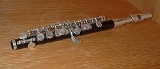
The piccolo (from Italian Small ) is a small flute. The piccolo has the same fingerings as its larger component, the flute, but the sound it produces is an octave higher than written. The piccolo is the highest instrument in the orchestra or band.
Now only manufactured in C, piccolos were once made in D, as well. It was for that instrument that John Philip Sousa wrote his famous march, "Stars and Stripes Forever."
In the orchestral setting, the piccolo player is often designated as Piccolo/Flute III or even Assistant Principal.

Discussion
Ask a question about 'Piccolo'
Start a new discussion about 'Piccolo'
Answer questions from other users
|
Recent Posts

Encyclopedia
The piccolo (from Italian Small ) is a small flute. The piccolo has the same fingerings as its larger component, the flute, but the sound it produces is an octave higher than written. The piccolo is the highest instrument in the orchestra or band.
Now only manufactured in C, piccolos were once made in D, as well. It was for that instrument that John Philip Sousa wrote his famous march, "Stars and Stripes Forever."
In the orchestral setting, the piccolo player is often designated as Piccolo/Flute III or even Assistant Principal. The larger orchestras have designated this position as a Solo position due to the demands of the literature.
A few composers have composed concertos for piccolo, including Lowell Liebermann, Sir Peter Maxwell Davies and Daniel Pinkham.
Major Passages in Symphonic and Operatic Works
- Bartók: Concerto for Orchestra; Movement III, "Eligia"
- Beethoven: Symphony No. 9 in D minor
- Carlisle Floyd: The Sojourner and Mollie Sinclair
- Puccini: Suor Angelica (opening scene)
- Rossini: Overtures to Semiramide, La gazza ladra, La scala di seta
- Shostakovich: Symphony Nos. 5, 6, 7, 8, 9 ,10
- Tchaikovsky: Symphony No. 4 in F minor
Traditional use
Historically the piccolo had no keys, but does today, and should not be confused with the fife, or classical piccolo, which has a smaller bore and is therefore more strident. The piccolo is used in conjunction with marching drums in traditional formations at the Carnival of Basel, Switzerland.
The piccolo was originally made out of wood and was featured in many prominent composers' works. One of the earliest pieces to use the piccolo was Beethoven's Symphony No. 5 in C Minor, only playing during the final (IV) movement. Today, the piccolo can be found made from a range of materials, from plastic (or resin), to silver, to wood. Finely made piccolos often come with a similar variety of options as the flute, such as the split-E mechanism.
Bibliography
- The Complete Piccolo, compiled and edited by Jan Gippo, Theodore Presser Company, 2007/08. ISBN 1-59806-111-9
|
| |
|
|