


Synthesizer

Encyclopedia
A synthesizer is an electronic instrument capable of producing sounds by generating electrical signals of different frequencies
. These electrical signals are played through a loudspeaker
or set of headphones
. Synthesizers can usually produce a wide range of sounds, which may either imitate other instruments ("imitative synthesis") or generate new timbres.
Synthesizers use a number of different technologies or programmed algorithms, each with their own strengths and weaknesses. Among the most popular waveform synthesis techniques are subtractive synthesis
, additive synthesis
, wavetable synthesis
, frequency modulation synthesis
, phase distortion synthesis
, physical modeling synthesis and sample-based synthesis
. Other sound synthesis methods, like subharmonic synthesis
or granular synthesis
, are not commonly found in hardware music synthesizers.
Synthesizers are often controlled with a piano-style keyboard
, leading such instruments to be referred to simply as "keyboards". Several other forms of controller have been devised to resemble violins, guitars (see guitar synthesizer) and wind instruments. Synthesizers without controllers are often called "modules", and they can be controlled using MIDI or CV/Gate
methods.
/electronic musical instrument
s, however, the former is distinguished from the latter by the capability of imitating sound/generating new timbre. Also the origin of sound synthesizer is often confused with the origin of electric/electronic musical instruments.
For example, one of the earlier electric musical instrument
was invented in 1876 by American electrical engineer Elisha Gray
who accidentally discovered that he could control sound from a self vibrating electromagnetic circuit and in doing so, invented a basic single note oscillator. This musical telegraph
used steel reeds
whose oscillations were created and transmitted, over a telegraphy
line
, by electromagnets. Gray also built a simple loudspeaker
device in later models consisting of a vibrating diaphragm in a magnetic field
to make the oscillator audible.
Frankly, this instrument was a remote electric-mechanical musical instrument using telegraphy
and electric buzzer
s without any other sound synthesis function. However, some people tend to call it "the first synthesizer", without any definition of the term "synthesizer".
In 1920s, Arseny Avraamov
developed various systems of graphic sonic art.
In 1930s-1940s, fundamental elements required for modern analog synthesizer
s — audio oscillators, filters, envelop controllers for expression, and various effects unit
s — were already appeared and utilized on several electronic instruments, and even earliest polyphonic synthesizers went into commercial productions in the United States and Germany. The Hammond Novachord
released in 1939 was a forerunner of later polyphonic synthesizers and electronic organs, but discontinued due to World War II, and commercially not successful (only 1,069 units were built in the three years).
In 1949, Japanese composer Minao Shibata discussed the concept of "a musical instrument with very high performance" that can "synthesize any kind of sound waves" and is "operated very easily," predicting that with such an instrument, "the music scene will be changed drastically."
In 1958, USSR's engineer Yevgeny Murzin made one of the first synthesizers, called the ANS
.
Although RCA
had produced a machine called the Electronic Music Synthesizer in 1951–52, it would be better classified as a "composition machine", because the sounds were not produced in real time. RCA later developed the RCA Mark II Sound Synthesizer
and installed to Columbia-Princeton Electronic Music Center, the first programmable synthesizer, which was inaugurated in 1957. Prominent composers such as Vladimir Ussachevsky
, Otto Luening
, Milton Babbitt
, Halim El-Dabh
, Bülent Arel
, Charles Wuorinen
and Mario Davidovsky
used the RCA Synthesizer extensively in various compositions.
developed modular synthesizer
and sound processor, and in 1961, he wrote a paper exploring the concept of self-contained portable modular synthesizer using newly emerging transistor technology; also he served as AES
session chairman on music and electronic for the fall conventions in 1962 and 1964; after then, his ideas were adopted by Robert Moog
, Donald Buchla
and others.
Robert Moog
introduced the first commercially available modern synthesizer in 1964. In the 1970s the development of miniaturized solid-state components allowed synthesizers to become self-contained, portable instruments. By the early 1980s companies were selling compact, modestly priced synthesizers to the public. This, along with the development of Musical Instrument Digital Interface
(MIDI), made it easier to integrate and synchronize synthesizers and other electronic instruments for use in musical composition. In the 1990s, synthesizers began to appear as computer software, known as software synthesizer
s.Later, VST and other plugins are able to emulate these classic synthesizers.
The synthesizer had a considerable impact on 20th century music. Micky Dolenz
of The Monkees
bought one of the first Moog synthesizers. The band was the first to release an album featuring a Moog with Pisces, Aquarius, Capricorn & Jones Ltd. in 1967. It reached #1 on the charts. A few months later, both the Rolling Stones' "2000 Light Years from Home
" and the title track of the Doors
' 1967 album Strange Days
would also feature a Moog, played by Brian Jones
and Paul Beaver respectively. Wendy Carlos
's Switched-On Bach
(1968), recorded using Moog synthesizer
s, also influenced numerous musicians of that era and is one of the most popular recordings of classical music ever made, alongside the records of Isao Tomita
(particularly Snowflakes are Dancing
in 1974), who in the early 1970s utilized synthesizers to create new artificial sounds (rather than simply mimicking real instruments) and made significant advances in analog synthesizer programming.
The sound of the Moog also reached the mass market with Simon and Garfunkel
's Bookends
in 1968 and The Beatles
' Abbey Road
the following year, and hundreds of other popular recordings subsequently used synthesizers. Electronic music albums by Beaver and Krause, Tonto's Expanding Head Band
, The United States of America
and White Noise
reached a sizeable cult audience and progressive rock
musicians such as Richard Wright
of Pink Floyd
and Rick Wakeman
of Yes
were soon using the new portable synthesizers extensively. Other early users included Emerson, Lake & Palmer
's Keith Emerson
, Pete Townshend
and The Crazy World of Arthur Brown
's Vincent Crane
.
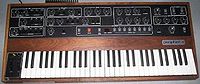 During the 1970s, Jean Michel Jarre
, Larry Fast
and Vangelis
released successful electronic instrumental albums. The emergence of Synthpop
, a sub-genre of New Wave
, in the late 1970s can be largely credited to synthesizer technology. The ground-breaking work of all-electronic German bands such as Kraftwerk
and Tangerine Dream
, via David Bowie
during his Berlin period (1976–77), as well as the pioneering work of the Japanese Yellow Magic Orchestra
and British Gary Numan
, were crucial in the development of the genre. Nick Rhodes
, keyboardist of Duran Duran
, used various synthesizers including Roland Jupiter-4
and Jupiter-8
. OMD's "Enola Gay
" (1980) used a distinctive electronic percussion and synthesized melody. Soft Cell
used a synthesized melody on their 1981 hit "Tainted Love". Other chart hits include Depeche Mode
's "Just Can't Get Enough" (1981), and The Human League
's "Don't You Want Me
". English musician Gary Numan
's 1979 hits "Are 'Friends' Electric?
" and "Cars
" used synthesizers heavily
Other notable synthpop groups included Visage
, Japan
, Ultravox
, Spandau Ballet
, Culture Club
, Eurythmics
and Blancmange
, and synthesizers became one of the most important instruments in the music industry. Other notable users include Giorgio Moroder
, Howard Jones
, Kitaro
, Stevie Wonder
, Peter Gabriel
, Thomas Dolby
, Kate Bush
, Frank Zappa
, A Flock Of Seagulls
and Devo
.
builds sounds by adding together waveforms (which are usually harmonically related). An early analog example of an additive synthesizer is the Hammond organ
. Additive synthesis is also the principle of Wavetable synthesis
, which is used to implement real-time synthesis with minimum hardware, commonly used in low-end MIDI instruments such as educational keyboards, and low-end sound card
s.
Subtractive synthesis
is based on filtering harmonically rich waveforms. Due to its simplicity, it is the basis of early synthesizers such as the Moog synthesizer
. Subtractive synthesizers use a simple acoustic model that assumes an instrument can be approximated by a simple signal generator (producing sawtooth wave
s, square wave
s, etc.) followed by a filter
. The combination of simple modulation routings (such as pulse width modulation and oscillator sync
), along with the physically unrealistic lowpass filters, is responsible for the "classic synthesizer" sound commonly associated with "analog synthesis" and often mistakenly used when referring to software synthesizer
s using subtractive synthesis.
FM synthesis (frequency modulation synthesis) is a process that usually involves the use of at least two signal generators (sine-wave oscillators, commonly referred to as "operators" in FM-only synthesizers) to create and modify a voice. Often, this is done through the analog or digital generation of a signal that modulates the tonal and amplitude characteristics of a base carrier signal. FM synthesis was pioneered by Chowning
, who patented the idea and sold it to Yamaha. Unlike the exponential relationship between voltage-in-to-frequency-out and multiple waveforms in classical 1-volt-per-octave synthesizer oscillators, Chowning-style FM synthesis uses a linear voltage-in-to-frequency-out relationship and sine-wave oscillators. The resulting complex waveform may have many component frequencies, and there is no requirement that they all bear a harmonic relationship. Sophisticated FM synths such as the Yamaha DX-7 series can have 6 operators per voice; some synths with FM can also often use filters and variable amplifier types to alter the signal's characteristics into a sonic voice that either roughly imitates acoustic instruments or creates sounds that are unique. FM synthesis is especially valuable for metallic or clangorous noises such as bells, cymbals, or other percussion.
Phase distortion synthesis
is a method implemented on Casio CZ synthesizers
. It is quite similar to FM synthesis but avoids infringing on the Chowning FM patent.
Granular synthesis
is a type of synthesis based on manipulating very small sample slices.
Physical modeling synthesis is the synthesis of sound by using a set of equations and algorithms to simulate a real instrument, or some other physical source of sound. This involves taking up models of components of musical objects and creating systems which define action, filters, envelopes and other parameters over time. The definition of such instruments is virtually
limitless, as one can combine any given models available with any amount of sources of modulation in terms of pitch, frequency and contour. For example, the model of a violin with characteristics of a pedal steel guitar and perhaps the action of piano hammer. When an initial set of parameters is run through the physical simulation, the simulated sound is generated. Although physical modeling was not a new concept in acoustics and synthesis, it wasn't until the development of the Karplus-Strong algorithm and the increase in DSP power
in the late 1980s that commercial implementations became feasible. Physical modeling on computers gets better and faster with higher processing.
Sample-based synthesis One of the easiest synthesis systems is to record a real instrument as a digitized waveform, and then play back its recordings at different speeds to produce different tones. This is the technique used in "sampling". Most samplers designate a part of the sample for each component of the ADSR envelope, and then repeat that section while changing the volume for that segment of the envelope. This lets the sampler have a persuasively different envelope using the same note.
Analysis/resynthesis is a form of synthesis that uses a series of bandpass filters or Fourier transforms to analyze the harmonic content of a sound. The resulting analysis data is then used in a second stage to resynthesize the sound using a band of oscillators. The vocoder
, linear predictive coding
, and some forms of speech synthesis
are based on analysis/resynthesis.
and digital
techniques. Early synthesizers were analog hardware based but many modern synthesizers use a combination of DSP
software and hardware or else are purely software-based (see softsynth). Digital synthesizers often emulate classic analog designs. Sound is controllable by the operator by means of circuits or virtual stages which may include:
 When an acoustic musical instrument
produces sound, the loudness and spectral content of the sound change over time in ways that vary from instrument to instrument. The "attack" and "decay" of a sound have a great effect on the instrument's sonic character. Sound synthesis techniques often employ an envelope generator that controls a sound's parameters at any point in its duration. Most often this is an "ADSR" (Attack Decay Sustain Release) envelope, which may be applied to overall amplitude control, filter frequency, etc. The envelope may be a discrete circuit or module, or implemented in software. The contour of an ADSR envelope is specified using four parameters:
An early implementation of ADSR can be found on the polyphonic 1938 Hammond Novachord
(which predates the first Moog synthesizer by over 25 years). A seven-position rotary knob set ADS for all 72 notes; a footpedal controlled release. The ADSR was specified by Vladimir Ussachevsky
(then head of the Columbia-Princeton Electronic Music Center) in 1965 while suggesting improvements for Bob Moog's pioneering work on synthesizers.
A common variation of the ADSR on some synthesizers, such as the Korg MS-20
, was ADSHR (attack, decay, sustain, hold, release). By adding a "hold" parameter, the system allowed notes to be held at the sustain level for a fixed length of time before decaying. The General Instruments AY-3-8912 sound chip
included a hold time parameter only; the sustain level was not programmable. Another common variation in the same vein is the AHDSR (attack, hold, decay, sustain, release) envelope, in which the "hold" parameter controls how long the envelope stays at full volume before entering the decay phase. Multiple attack, decay and release settings may be found on more sophisticated models.
Certain synthesizers also allow for a "delay" parameter, which would come before the "attack". Modern synthesizers like the Dave Smith Instruments Prophet '08 have DADSR (delay, attack, decay, sustain, release) envelopes. The delay setting determines how long there is silence after a note is hit, before the attack is heard. Some software synthesizers such as Image-Line's 3xOSC (included for free with their DAW
FL Studio
) have DAHDSR (delay, attack, hold, decay, sustain, release) envelopes.
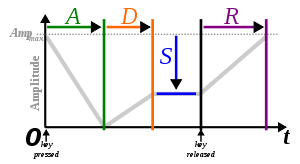 Some electronic musical instruments allow the ADSR envelope to be inverted, which results in opposite behavior compared to the normal ADSR envelope. During the attack phase, the modulated sound parameter fades from the maximum amplitude
to zero then, during the decay phase, rises to the value specified by the sustain parameter. After the key has been released the sound parameter rises from sustain amplitude back to maximum amplitude.
, being designed to pass some frequency regions through unattenuated
while significantly attenuating ("subtracting") others. The low-pass filter
is most frequently used, but band-pass filter
s, band-reject filters and high-pass filter
s are also sometimes available.
The filter may be controlled with a second ADSR envelope. An "envelope modulation" ("env mod") parameter on many synthesizers with filter envelopes determines how much the envelope affects the filter. If turned all the way down, the filter will produce a flat sound with no envelope. When turned up the envelope becomes more noticeable, expanding the minimum and maximum range of the filter.
. LFO signals create a rhythmic pulse or sweep, often used to in vibrato
, tremolo
and other effects. In certain genres of electronic music, the LFO signal can control the cutoff frequency of a VCF
to make a rhythmic wah-wah sound, or the signature dubstep
wobble bass.
's 1928 Ondes Martenot
(sliding a metal ring),, improved upon by Robert Moog
(finger pressure). The ribbon controller has no moving parts. Instead, a finger pressed down and moved along it creates an electrical contact at some point along a pair of thin, flexible longitudinal strips whose electric potential
varies from one end to the other. Older fingerboards used a long wire pressed to a resistive plate. A ribbon controller is similar to a touchpad
, but a ribbon controller only registers linear
motion. Although it may be used to operate any parameter that is affected by control voltages, a ribbon controller is most commonly associated with pitch bending
.
Fingerboard-controlled instruments include the Hellertion, Heliophon, Trautonium
, Electro-Theremin
, Perspehone and the Swarmatron
. A ribbon controller is used as an additional controller in the Yamaha CS-80
and CS-60, the Korg Prophecy
and Korg Trinity
series, the Kurzweil
synthesizers, Moog synthesizer
s and others.
Rock musician Keith Emerson
used it with the Moog modular synthesizer
from 1970 onward. In the late 1980s, keyboards in the synth lab at Berklee College of Music were equipped with membrane thin ribbon style controllers that output MIDI. They functioned as MIDI managers, with their programming language printed on their surface, and as expression/performance tools. Designed by Jeff Tripp of Perfect Fretworks Co., they were known as Tripp Strips. Such ribbon controllers can serve as a main MIDI controller instead of a keyboard, as with the Continuum
instrument.
s are convenient for woodwind or brass players or emulation, being designed along the lines of those instruments. These may be analog or MIDI controllers or may include built-in synthesizers. In addition to a key arrangement the controller has breath-operated pressure transducers, and may have gate extractors, velocity sensors and bite sensors. Saxophone
style controllers have included the Lyricon
, and products by Yamaha
, Akai
and Casio
. The mouthpieces range from alto clarinet to alto saxophone sizes. Melodica
or recorder
style controllers have included the Variophon, Martinetta, Tubophon and Joseph Zawinul's custom Korg Pepe. A Harmonica
style interfaces was the Millionizer.
Trumpet
style controllers have included products by Steiner, Yamaha, Morrison and Akai. A breath controller may be used as an adjunct to a conventional synthesizer. The Steiner Master's Touch and products which interface to the Yamaha Breath Controller are examples. Several controllers also provide breath-like articulation capabilities.
control touche d’intensité, Theremin
, footpedal and lightbeam controllers are examples. Envelope following systems, the most sophisticated being the vocoder
, follow the power or amplitude of an audio signial, rather than using pressure transducers. Various companies make accordion
controllers that use pressure transducers on bellows for articulation. More direct articulation using the vocal tract without breath is the Talk box
.
(MIDI) in 1983. First proposed in 1981 by engineer Dave Smith
of Sequential Circuits
, the MIDI standard was developed by a consortium now known as the MIDI Manufacturers Association. MIDI is an opto-isolated
serial interface
and communication protocol
. It provides for the transmission from one device or instrument to another of real-time performance data. This data includes note events, commands for the selection of instrument presets (i.e. sounds, or programs or patches, previously stored in the instrument's memory), the control of performance-related parameters such as volume, effects levels and the like, as well as synchronization, transport control and other types of data. MIDI interfaces are now almost ubiquitous on music equipment and are commonly available on personal computer
s (PCs).
The General MIDI
(GM) software standard was devised in 1991 to serve as a consistent way of describing a set of over 200 tones (including percussion) available to a PC for playback of musical scores. For the first time, a given MIDI preset would consistently produce an instrumental sound on any GM-conforming device. The Standard MIDI File (SMF) format (extension
Open Sound Control (OSC) is another music data specification designed for online networking. In contrast with MIDI, OSC allows thousands of synthesizers or computers to share music performance data over the Internet in realtime
.
, thus creating an arpeggio
. The notes can often be transmitted to a MIDI sequencer for recording and further editing. An arpeggiator may have controls to manipulate the order and speed in which the notes play; upwards, downwards, or in a random order. More advanced arpeggiators allow the user to step through a complex sequence of notes or play several arpeggios at once. Some allow a pattern to be sustained even if the keys are released: in this way an arpeggiated pattern may be built up over time by pressing several keys one after the other. Arpeggiators are also commonly found in sequencing
software. Some sequencers expand this into a full phrase sequencer
, which allows the user to trigger complex, multi-track blocks of sequenced data from a keyboard or input device, typically synchronised with the tempo of the master clock.
Arpeggiators grew from hardware sequencer
s of the late 1960s and early 1970s, such as the 16-step ARP
Sequencer, and the sequencers of modular synthesizer
s and were commonly fitted to keyboard instruments through the late 1970s and early 1980s. Notable examples are the Roland Jupiter 8, Oberheim OB-Xa
, Roland SH-101
, Sequential Circuits Six-Trak
and Korg Polysix
. A famous example can be heard on Duran Duran
's song "Rio
", in which the arpeggiator on a Roland Jupiter-4
is heard playing a C minor chord in random mode. They fell out of favour by the latter part of the 1980s and early 1990s and were absent from the most popular synthesizers of the period but a resurgence of interest in analog synthesizer
s during the 1990s, and the use of rapid-fire arpeggios in several popular dance
hits, brought with it a resurgence.
or harmonic, and any number of partials. Synthesis may attempt to mimic the amplitude and pitch of the partials in an acoustic sound source.
When natural sounds are analyzed in the frequency domain
(as on a spectrum analyzer), the spectra
of their sounds will exhibit amplitude
spikes at each of the fundamental tone's harmonics
corresponding to resonant properties of the instruments (spectral peaks that are also referred to as formant
s). Some harmonics may have higher amplitudes than others. The specific set of harmonic-vs-amplitude pairs is known as a sound's harmonic content. A synthesized sound requires accurate reproduction of the original sound in both the frequency domain and the time domain. A sound does not necessarily have the same harmonic content throughout the duration of the sound. Typically, high-frequency harmonics will die out more quickly than the lower harmonics.
In most conventional synthesizers, for purposes of re-synthesis, recordings of real instruments are composed of several components representing the acoustic responses of different parts of the instrument, the sounds produced by the instrument during different parts of a performance, or the behavior of the instrument under different playing conditions (pitch, intensity of playing, fingering, etc.)
s used cables ("patch cords") to connect the different sound modules together. Since these machines had no memory to save settings, musicians wrote down the locations of the patch cables and knob positions on a "patch sheet" (which usually showed a diagram of the synthesizer). Ever since, an overall sound setting for any type of synthesizer has been known as a patch.
By 1978, patch memory (allowing storage and loading of 'patches' or 'programs') began to appear in synths like the Sequential Circuits Prophet-5. After MIDI was introduced in 1983, more and more synthesizers could import or export patches via MIDI SYSEX commands. When a synthesizer patch is uploaded to a personal computer which has patch editing software installed, the user can alter the parameters of the patch and download it back to the synthesizer. Because there can be no standard patch language it is rare that a patch generated on one synthesizer can be used on a different model. However sometimes manufacturers will design a family of synthesizers to be compatible.
. Much popular music in the 1980s employed synth pads, this being the time of polyphonic synthesizers
, as did the then-new styles of smooth jazz
and New Age music
. One of many well-known songs from the era to incorporate a synth pad is "West End Girls
" by the Pet Shop Boys
, who were noted users of the technique.
The main feature of a synth pad is very long attack and decay time with extended sustains. In some instances pulse-width modulation
(PWM) using a square wave oscillator can be added to create a "vibrating" sound.
in Snap Yo Fingas and Usher
in "Yeah!" as representative of the Crunk music genre.
or double bass
to distorted, buzz-saw-like artificial bass sounds, by generating and combining signals of different frequencies
. Bass synth patches may incorporate a range of sounds and tones, including wavetable-style, analog, and FM-style bass sounds, delay effects, distortion effects, envelope filters. A modern digital synthesizer uses a frequency synthesizer
microprocessor
component to generate signals of different frequencies. While most bass synths are controlled by electronic keyboards or pedalboards, some performers use an electric bass with MIDI pickups to trigger a bass synthesizer.
In the 1970s miniaturized solid-state components allowed self-contained, portable instruments such as the Moog Taurus, a 13-note pedal keyboard which was played by the feet. The Moog Taurus was used in live performances by a range of pop, rock, and blues-rock bands. An early use of bass synthesizer was in 1972, on a solo album by John Entwistle
(the bassist for The Who
), entitled Whistle Rymes
. Stevie Wonder
introduced synth bass to a wider audience in the early 1970s, notably on Superstition
(1972) and Boogie On Reggae Woman
(1974). In 1977 Parliament
's funk
single Flashlight
used the bass synthesizer. Lou Reed
, widely considered a pioneer of electric guitar
textures, played bass synthesizer on "Families", from his 1979 album The Bells
.
When the programmable music sequencer
became widely available in the 1980s (e.g., the synclavier
), bass synths were used to create highly syncopated rhythms and complex, rapid basslines. Bass synth patches incorporate a range of sounds and tones, including wavetable-style, analog, and FM-style bass sounds, delay effects, distortion effects, envelope filters. A particularly influential bass synthesizer was the Roland TB-303
, featuring a built-in sequencer and released in late 1981, and which would later become synonymous with acid house
music. One of the first to utilize it was Charanjit Singh
in 1982, though it wouldn't be popularized until Phuture
's "Acid Tracks" in 1987.
In the 2000s, several companies such as Boss and Akai
produced bass synthesizer effect pedals for electric bass players, which simulate the sound of an analog or digital bass synth. With these devices, a bass guitar is used to generate synth bass sounds. The BOSS SYB-3 was one of the early bass synthesizer pedals. The SYB-3 reproduces sounds of analog synthesizers with Digital Signal Processing saw, square, and pulse synth waves and user-adjustable filter cutoff. The Akai bass synth pedal contains a four-oscillator synthesizer with user selectable parameters (attack, decay, envelope depth, dynamics, cutoff, resonance). Bass synthesizer software allows performers to use MIDI to integrate the bass sounds with other synthesizers or drum machines. Bass synthesizers often provide samples from vintage 1970s and 1980s bass synths. Some bass synths are built into an organ style pedalboard
or button board.
Frequency
Frequency is the number of occurrences of a repeating event per unit time. It is also referred to as temporal frequency.The period is the duration of one cycle in a repeating event, so the period is the reciprocal of the frequency...
. These electrical signals are played through a loudspeaker
Loudspeaker
A loudspeaker is an electroacoustic transducer that produces sound in response to an electrical audio signal input. Non-electrical loudspeakers were developed as accessories to telephone systems, but electronic amplification by vacuum tube made loudspeakers more generally useful...
or set of headphones
Headphones
Headphones are a pair of small loudspeakers, or less commonly a single speaker, held close to a user's ears and connected to a signal source such as an audio amplifier, radio, CD player or portable Media Player. They are also known as stereophones, headsets or, colloquially, cans. The in-ear...
. Synthesizers can usually produce a wide range of sounds, which may either imitate other instruments ("imitative synthesis") or generate new timbres.
Synthesizers use a number of different technologies or programmed algorithms, each with their own strengths and weaknesses. Among the most popular waveform synthesis techniques are subtractive synthesis
Subtractive synthesis
Subtractive synthesis is a method of sound synthesis in which partials of an audio signal are attenuated by a filter to alter the timbre of the sound...
, additive synthesis
Additive synthesis
Additive synthesis is a technique of sound synthesis that creates musical timbre by explicitly adding sinusoidal overtones together.The timbre of an instrument is composed of multiple harmonic or inharmonic partials , of different frequencies and amplitudes, that change over time...
, wavetable synthesis
Wavetable synthesis
Wavetable synthesis is used in certain digital music synthesizers to implement a restricted form of real-time additive synthesis. The technique was first developed by Wolfgang Palm of PPG in the late 1970s and published in 1979, and has since been used as the primary synthesis method in...
, frequency modulation synthesis
Frequency modulation synthesis
A 220 Hz carrier tone modulated by a 440 Hz modulating tone with various choices of modulation index, β. The time domain signals are illustrated above, and the corresponding spectra are shown below ....
, phase distortion synthesis
Phase distortion synthesis
NOTE: any readers who are struggling to understand this text, here are links to the missing Figures A and B:NOTE: any readers who are struggling to understand this text, here are links to the missing Figures A and B:...
, physical modeling synthesis and sample-based synthesis
Sample-based synthesis
Sample-based synthesis is a form of audio synthesis that can be contrasted to either subtractive synthesis or additive synthesis. The principal difference with sample-based synthesis is that the seed waveforms are sampled sounds or instruments instead of fundamental waveforms such as the saw waves...
. Other sound synthesis methods, like subharmonic synthesis
Subharmonic synthesizer
A subharmonic synthesizer is a device or system that generates subharmonics of an input signal. The nth subharmonic of a signal of fundamental frequency F is a signal with frequency F/n...
or granular synthesis
Granular synthesis
Granular synthesis is a basic sound synthesis method that operates on the microsound time scale.It is based on the same principle as sampling. However, the samples are not played back conventionally, but are instead split into small pieces of around 1 to 50ms. These small pieces are called grains...
, are not commonly found in hardware music synthesizers.
Synthesizers are often controlled with a piano-style keyboard
Musical keyboard
A musical keyboard is the set of adjacent depressible levers or keys on a musical instrument, particularly the piano. Keyboards typically contain keys for playing the twelve notes of the Western musical scale, with a combination of larger, longer keys and smaller, shorter keys that repeats at the...
, leading such instruments to be referred to simply as "keyboards". Several other forms of controller have been devised to resemble violins, guitars (see guitar synthesizer) and wind instruments. Synthesizers without controllers are often called "modules", and they can be controlled using MIDI or CV/Gate
CV/Gate
CV/Gate is an analog method of controlling synthesizers, drum machines and other similar equipment with external sequencers. The Control Voltage typically controls pitch and the Gate signal controls note on/off....
methods.
History
The beginning of a synthesizer may vary with the definition of "synthesizer". Some people tend to confuse sound synthesizers with electricElectric instrument
An electric musical instrument is one in which the use of electric devices determines or affects the sound produced by an instrument. It is also known as an amplified musical instrument due to the common utilization of an electronic instrument amplifier to project the intended sound as determined...
/electronic musical instrument
Electronic musical instrument
An electronic musical instrument is a musical instrument that produces its sounds using electronics. Such an instrument sounds by outputting an electrical audio signal that ultimately drives a loudspeaker....
s, however, the former is distinguished from the latter by the capability of imitating sound/generating new timbre. Also the origin of sound synthesizer is often confused with the origin of electric/electronic musical instruments.
For example, one of the earlier electric musical instrument
Electric instrument
An electric musical instrument is one in which the use of electric devices determines or affects the sound produced by an instrument. It is also known as an amplified musical instrument due to the common utilization of an electronic instrument amplifier to project the intended sound as determined...
was invented in 1876 by American electrical engineer Elisha Gray
Elisha Gray
Elisha Gray was an American electrical engineer who co-founded the Western Electric Manufacturing Company...
who accidentally discovered that he could control sound from a self vibrating electromagnetic circuit and in doing so, invented a basic single note oscillator. This musical telegraph
Musical instrument
A musical instrument is a device created or adapted for the purpose of making musical sounds. In principle, any object that produces sound can serve as a musical instrument—it is through purpose that the object becomes a musical instrument. The history of musical instruments dates back to the...
used steel reeds
Reed (instrument)
A reed is a thin strip of material which vibrates to produce a sound on a musical instrument. The reeds of most Woodwind instruments are made from Arundo donax or synthetic material; tuned reeds are made of metal or synthetics.-Single reeds:Single reeds are used on the mouthpieces of clarinets...
whose oscillations were created and transmitted, over a telegraphy
Telegraphy
Telegraphy is the long-distance transmission of messages via some form of signalling technology. Telegraphy requires messages to be converted to a code which is known to both sender and receiver...
line
Telephone line
A telephone line or telephone circuit is a single-user circuit on a telephone communication system...
, by electromagnets. Gray also built a simple loudspeaker
Loudspeaker
A loudspeaker is an electroacoustic transducer that produces sound in response to an electrical audio signal input. Non-electrical loudspeakers were developed as accessories to telephone systems, but electronic amplification by vacuum tube made loudspeakers more generally useful...
device in later models consisting of a vibrating diaphragm in a magnetic field
Magnetic field
A magnetic field is a mathematical description of the magnetic influence of electric currents and magnetic materials. The magnetic field at any given point is specified by both a direction and a magnitude ; as such it is a vector field.Technically, a magnetic field is a pseudo vector;...
to make the oscillator audible.
Frankly, this instrument was a remote electric-mechanical musical instrument using telegraphy
Telegraphy
Telegraphy is the long-distance transmission of messages via some form of signalling technology. Telegraphy requires messages to be converted to a code which is known to both sender and receiver...
and electric buzzer
Buzzer
A buzzer or beeper is an audio signaling device, which may be mechanical, electromechanical, or piezoelectric. Typical uses of buzzers and beepers include alarm devices, timers and confirmation of user input such as a mouse click or keystroke....
s without any other sound synthesis function. However, some people tend to call it "the first synthesizer", without any definition of the term "synthesizer".
In 1920s, Arseny Avraamov
Arseny Avraamov
Arseny Mikhailovich Avraamov , was an avant-garde Russian composer and theorist. He studied at the music school of the Moscow Philharmonic Society, with private composition lessons from Sergey Taneyev. He refused to fight in World War I, and fled the country to work, among other things, as a...
developed various systems of graphic sonic art.
In 1930s-1940s, fundamental elements required for modern analog synthesizer
Analog synthesizer
An analog or analogue synthesizer is a synthesizer that uses analog circuits and analog computer techniques to generate sound electronically. The earliest analog synthesizers in the 1920s and 1930s such as the Trautonium were built with a variety of vacuum-tube and electro-mechanical technologies...
s — audio oscillators, filters, envelop controllers for expression, and various effects unit
Effects unit
Effects units are electronic devices that alter how a musical instrument or other audio source sounds. Some effects subtly "color" a sound, while others transform it dramatically. Effects are used during live performances or in the studio, typically with electric guitar, keyboard and bass...
s — were already appeared and utilized on several electronic instruments, and even earliest polyphonic synthesizers went into commercial productions in the United States and Germany. The Hammond Novachord
Novachord
The Novachord is often considered to be the world's first commercial polyphonic synthesizer. All-electronic, incorporating many circuit and control elements found in modern synths, and using subtractive synthesis to generate tones, it was designed by John M. Hanert, Laurens Hammond and C. N....
released in 1939 was a forerunner of later polyphonic synthesizers and electronic organs, but discontinued due to World War II, and commercially not successful (only 1,069 units were built in the three years).
In 1949, Japanese composer Minao Shibata discussed the concept of "a musical instrument with very high performance" that can "synthesize any kind of sound waves" and is "operated very easily," predicting that with such an instrument, "the music scene will be changed drastically."
In 1958, USSR's engineer Yevgeny Murzin made one of the first synthesizers, called the ANS
ANS synthesizer
The ANS synthesizer is a photoelectronic musical instrument created by Russian engineer Evgeny Murzin from 1937 to 1957. The technological basis of his invention was the method of graphical sound recording used in cinematography , which made it possible to obtain a visible image of a sound wave, as...
.
Although RCA
RCA
RCA Corporation, founded as the Radio Corporation of America, was an American electronics company in existence from 1919 to 1986. The RCA trademark is currently owned by the French conglomerate Technicolor SA through RCA Trademark Management S.A., a company owned by Technicolor...
had produced a machine called the Electronic Music Synthesizer in 1951–52, it would be better classified as a "composition machine", because the sounds were not produced in real time. RCA later developed the RCA Mark II Sound Synthesizer
RCA Mark II Sound Synthesizer
The RCA Mark II Sound Synthesizer was the first programmable electronic music synthesizer and the flagship piece of equipment at the Columbia-Princeton Electronic Music Center. Designed by Herbert Belar and Harry Olson at RCA, it was installed at Columbia University in 1957...
and installed to Columbia-Princeton Electronic Music Center, the first programmable synthesizer, which was inaugurated in 1957. Prominent composers such as Vladimir Ussachevsky
Vladimir Ussachevsky
Vladimir Kirilovitch Ussachevsky was a composer, particularly known for his work in electronic music.-Biography:...
, Otto Luening
Otto Luening
Otto Clarence Luening was a German-American composer and conductor, and an early pioneer of tape music and electronic music....
, Milton Babbitt
Milton Babbitt
Milton Byron Babbitt was an American composer, music theorist, and teacher. He is particularly noted for his serial and electronic music.-Biography:...
, Halim El-Dabh
Halim El-Dabh
Halim Abdul Messieh El-Dabh is an Egyptian-born American composer, performer, ethnomusicologist, and educator, who has had a career spanning six decades...
, Bülent Arel
Bülent Arel
Bülent Arel was a Turkish-born composer of contemporary classical music and electronic music.He was born in Istanbul, and studied composition at the Ankara Conservatory and sound engineering in Paris...
, Charles Wuorinen
Charles Wuorinen
Charles Peter Wuorinen is a prolific Pulitzer Prize-winning American composer born and living in New York City. His catalog of more than 250 compositions includes works for orchestra, opera, chamber music, as well as solo instrumental and vocal works...
and Mario Davidovsky
Mario Davidovsky
Mario Davidovsky is an Argentine-American composer. Born in Argentina, he emigrated in 1960 to the US, where he lives today...
used the RCA Synthesizer extensively in various compositions.
Modular synthesizer
In 1959-60, Harald BodeHarald Bode
Harald Bode was a German engineer and pioneer in the development of electronic music instruments.- Biography :...
developed modular synthesizer
Modular synthesizer
The modular synthesizer is a type of synthesizer consisting of separate specialized modules connected by wires to create a so-called patch. Every output generates a signal – an electric voltage of variable strength...
and sound processor, and in 1961, he wrote a paper exploring the concept of self-contained portable modular synthesizer using newly emerging transistor technology; also he served as AES
Audio Engineering Society
Established in 1948, the Audio Engineering Society draws its membership from amongst engineers, scientists, other individuals with an interest or involvement in the professional audio industry. The membership largely comprises engineers developing devices or products for audio, and persons working...
session chairman on music and electronic for the fall conventions in 1962 and 1964; after then, his ideas were adopted by Robert Moog
Robert Moog
Robert Arthur Moog , commonly called Bob Moog was an American pioneer of electronic music, best known as the inventor of the Moog synthesizer.-Life:...
, Donald Buchla
Don Buchla
Don Buchla is a pioneer in the field of sound synthesizers, releasing his first units months after Robert Moog's first synthesizers...
and others.
Robert Moog
Robert Moog
Robert Arthur Moog , commonly called Bob Moog was an American pioneer of electronic music, best known as the inventor of the Moog synthesizer.-Life:...
introduced the first commercially available modern synthesizer in 1964. In the 1970s the development of miniaturized solid-state components allowed synthesizers to become self-contained, portable instruments. By the early 1980s companies were selling compact, modestly priced synthesizers to the public. This, along with the development of Musical Instrument Digital Interface
Musical Instrument Digital Interface
MIDI is an industry-standard protocol, first defined in 1982 by Gordon Hall, that enables electronic musical instruments , computers and other electronic equipment to communicate and synchronize with each other...
(MIDI), made it easier to integrate and synchronize synthesizers and other electronic instruments for use in musical composition. In the 1990s, synthesizers began to appear as computer software, known as software synthesizer
Software synthesizer
A software synthesizer, also known as a softsynth is a computer program or plug-in for digital audio generation. Computer software which can create sounds or music is not new, but advances in processing speed are allowing softsynths to accomplish the same tasks that previously required dedicated...
s.Later, VST and other plugins are able to emulate these classic synthesizers.
The synthesizer had a considerable impact on 20th century music. Micky Dolenz
Micky Dolenz
George Michael "Micky" Dolenz, Jr. is an American actor, musician, television director, radio personality and theater director, best known as a member of the 1960s made-for-television band The Monkees.-Biography:...
of The Monkees
The Monkees
The Monkees are an American pop rock group. Assembled in Los Angeles in 1966 by Robert "Bob" Rafelson and Bert Schneider for the American television series The Monkees, which aired from 1966 to 1968, the musical acting quartet was composed of Americans Micky Dolenz, Michael Nesmith and Peter Tork,...
bought one of the first Moog synthesizers. The band was the first to release an album featuring a Moog with Pisces, Aquarius, Capricorn & Jones Ltd. in 1967. It reached #1 on the charts. A few months later, both the Rolling Stones' "2000 Light Years from Home
2000 Light Years from Home
"2000 Light Years From Home" is a song from The Rolling Stones' 1967 psychedelic rock album Their Satanic Majesties Request. Written by Mick Jagger and Keith Richards, it also appeared as the B-side to the U.S. single "She's a Rainbow". Jagger reportedly wrote the lyrics in Brixton prison following...
" and the title track of the Doors
The Doors
The Doors were an American rock band formed in 1965 in Los Angeles, California, with vocalist Jim Morrison, keyboardist Ray Manzarek, drummer John Densmore, and guitarist Robby Krieger...
' 1967 album Strange Days
Strange Days (album)
Strange Days is the second album released by American rock band The Doors. The album was a commercial success, earning a gold record and reaching No. 3 on the Billboard 200 albums chart. Despite this, the album's producer, Paul Rothchild, considered it a commercial failure, even if it was an...
would also feature a Moog, played by Brian Jones
Brian Jones
Lewis Brian Hopkins Jones , known as Brian Jones, was an English musician and a founding member of the Rolling Stones....
and Paul Beaver respectively. Wendy Carlos
Wendy Carlos
Wendy Carlos is an American composer and electronic musician. Carlos first came to notice in the late 1960s with recordings made on the Moog synthesizer, then a relatively new and unknown instrument; most notable were LPs of synthesized Bach and the soundtrack for Stanley Kubrick's film A...
's Switched-On Bach
Switched-On Bach
-Details:The album consists of pieces by Johann Sebastian Bach, performed on a Moog synthesizer, a modular synthesizer system, one of which can be seen at the back of the room on the album cover. "Switched-On Bach," or "S-OB" as Carlos referred to it, was recorded on a custom-built 8 track recorder...
(1968), recorded using Moog synthesizer
Moog synthesizer
Moog synthesizer may refer to any number of analog synthesizers designed by Dr. Robert Moog or manufactured by Moog Music, and is commonly used as a generic term for older-generation analog music synthesizers. The Moog company pioneered the commercial manufacture of modular voltage-controlled...
s, also influenced numerous musicians of that era and is one of the most popular recordings of classical music ever made, alongside the records of Isao Tomita
Isao Tomita
, often known simply as Tomita, is a Japanese music composer, regarded as one of the pioneers of electronic music and space music, and as one of the most famous producers of analog synthesizer arrangements...
(particularly Snowflakes are Dancing
Snowflakes are Dancing
Snowflakes Are Dancing is an electronic music album by Isao Tomita, recorded in 1974 and first released as a Quadradisc in April. The album consists entirely of Tomita's arrangements of Claude Debussy's "tone paintings", performed by Tomita on a Moog synthesizer...
in 1974), who in the early 1970s utilized synthesizers to create new artificial sounds (rather than simply mimicking real instruments) and made significant advances in analog synthesizer programming.
The sound of the Moog also reached the mass market with Simon and Garfunkel
Simon and Garfunkel
Simon & Garfunkel are an American duo consisting of singer-songwriter Paul Simon and singer Art Garfunkel. They formed the group Tom & Jerry in 1957 and had their first success with the minor hit "Hey, Schoolgirl". As Simon & Garfunkel, the duo rose to fame in 1965, largely on the strength of the...
's Bookends
Bookends
-Charts:-Personnel:*Paul Simon - Vocals, Guitar, Producer*Art Garfunkel - Vocals, Producer*Hal Blaine - Drums, Percussion*Joe Osborn - Bass*Larry Knechtel - Piano, Keyboards*John Simon - Production Assistant...
in 1968 and The Beatles
The Beatles
The Beatles were an English rock band, active throughout the 1960s and one of the most commercially successful and critically acclaimed acts in the history of popular music. Formed in Liverpool, by 1962 the group consisted of John Lennon , Paul McCartney , George Harrison and Ringo Starr...
' Abbey Road
Abbey Road (album)
Abbey Road is the eleventh studio album released by the English rock band The Beatles and their last recorded. Though Let It Be was the last album released before the band's dissolution in 1970, work on Abbey Road began in April 1969...
the following year, and hundreds of other popular recordings subsequently used synthesizers. Electronic music albums by Beaver and Krause, Tonto's Expanding Head Band
Tonto's Expanding Head Band
Tonto's Expanding Head Band was a British electronic music duo consisting of Malcolm Cecil and Robert Margouleff. Despite releasing only two albums in the early 1970s, the duo were influential because of their session work for other musicians , extensive commercial advertising work and the unique...
, The United States of America
The United States of America (band)
The United States of America was an American experimental rock and psychedelic band whose works are an example of early electronic music in rock and roll.-History:...
and White Noise
White Noise (band)
White Noise is an experimental electronic music band formed in London, England, in 1968 by American-born David Vorhaus, a classical bass player with a background in both physics and electronic engineering...
reached a sizeable cult audience and progressive rock
Progressive rock
Progressive rock is a subgenre of rock music that developed in the late 1960s and early 1970s as part of a "mostly British attempt to elevate rock music to new levels of artistic credibility." John Covach, in Contemporary Music Review, says that many thought it would not just "succeed the pop of...
musicians such as Richard Wright
Richard Wright (musician)
Richard William Wright was an English pianist, keyboardist and songwriter, best known for his career with Pink Floyd. Wright's richly textured keyboard layers were a vital ingredient and a distinctive characteristic of Pink Floyd's sound...
of Pink Floyd
Pink Floyd
Pink Floyd were an English rock band that achieved worldwide success with their progressive and psychedelic rock music. Their work is marked by the use of philosophical lyrics, sonic experimentation, innovative album art, and elaborate live shows. Pink Floyd are one of the most commercially...
and Rick Wakeman
Rick Wakeman
Richard Christopher Wakeman is an English keyboard player, composer and songwriter best known for being the former keyboardist in the progressive rock band Yes...
of Yes
Yes (band)
Yes are an English rock band who achieved worldwide success with their progressive, art, and symphonic style of rock music. Regarded as one of the pioneers of the progressive genre, Yes are known for their lengthy songs, mystical lyrics, elaborate album art, and live stage sets...
were soon using the new portable synthesizers extensively. Other early users included Emerson, Lake & Palmer
Emerson, Lake & Palmer
Emerson, Lake & Palmer, also known as ELP, are an English progressive rock supergroup. They found success in the 1970s and sold over forty million albums and headlined large stadium concerts. The band consists of Keith Emerson , Greg Lake and Carl Palmer...
's Keith Emerson
Keith Emerson
Keith Noel Emerson is an English keyboard player and composer. Formerly a member of the Keith Emerson Trio, John Brown's Bodies, The T-Bones, V.I.P.s, P.P. Arnold's backing band, and The Nice , he was a founder of Emerson, Lake & Palmer , one of the early supergroups, in 1970...
, Pete Townshend
Pete Townshend
Peter Dennis Blandford "Pete" Townshend is an English rock guitarist, vocalist, songwriter and author, known principally as the guitarist and songwriter for the rock group The Who, as well as for his own solo career...
and The Crazy World of Arthur Brown
The Crazy World of Arthur Brown
The Crazy World of Arthur Brown is a psychedelic rock album by Arthur Brown and his band The Crazy World of Arthur Brown, released in 1968. Considered a classic of the late-1960s psychedelic scene and a significant influence on progressive rock, The Crazy World of Arthur Brown includes covers of...
's Vincent Crane
Vincent Crane
Vincent Crane was a self-taught pianist, who studied theory and composition at Trinity College of Music, and graduated in 1964...
.
Synthpop
Jean Michel Jarre
Jean Michel André Jarre is a French composer, performer and music producer. He is a pioneer in the electronic, ambient and New Age genres, and known as an organiser of outdoor spectacles of his music featuring lights, laser displays, and fireworks.Jarre was raised in Lyon by his mother and...
, Larry Fast
Larry Fast
Lawrence Roger 'Larry' Fast is a synthesizer expert and composer. He is best known for Synergy, his 1975–1987 series of synthesizer music albums, and for his contribution to a number of popular music acts, including Peter Gabriel, Foreigner, and Hall and Oates.- Biography :Fast grew up in...
and Vangelis
Vangelis
Evangelos Odysseas Papathanassiou is a Greek composer of electronic, progressive, ambient, jazz, pop rock and orchestral music, under the artist name Vangelis...
released successful electronic instrumental albums. The emergence of Synthpop
Synthpop
Synthpop is a genre of popular music that first became prominent in the 1980s, in which the synthesizer is the dominant musical instrument. It was prefigured in the 1960s and early 1970s by the use of synthesizers in progressive rock, electronic art rock, disco and particularly the "Kraut rock" of...
, a sub-genre of New Wave
New Wave music
New Wave is a subgenre of :rock music that emerged in the mid to late 1970s alongside punk rock. The term at first generally was synonymous with punk rock before being considered a genre in its own right that incorporated aspects of electronic and experimental music, mod subculture, disco and 1960s...
, in the late 1970s can be largely credited to synthesizer technology. The ground-breaking work of all-electronic German bands such as Kraftwerk
Kraftwerk
Kraftwerk is an influential electronic music band from Düsseldorf, Germany. The group was formed by Ralf Hütter and Florian Schneider in 1970, and was fronted by them until Schneider's departure in 2008...
and Tangerine Dream
Tangerine Dream
Tangerine Dream is a German electronic music group founded in 1967 by Edgar Froese. The band has undergone many personnel changes over the years, with Froese being the only continuous member...
, via David Bowie
David Bowie
David Bowie is an English musician, actor, record producer and arranger. A major figure for over four decades in the world of popular music, Bowie is widely regarded as an innovator, particularly for his work in the 1970s...
during his Berlin period (1976–77), as well as the pioneering work of the Japanese Yellow Magic Orchestra
Yellow Magic Orchestra
Sakamoto first worked with Hosono as a member of his live band in 1976, while Takahashi recruited Sakamoto to produce his debut solo recording in 1977 following the split of the Sadistic Mika Band...
and British Gary Numan
Gary Numan
Gary Numan is an English singer, composer, and musician, most widely known for his chart-topping 1979 hits "Are 'Friends' Electric?" and "Cars". His signature sound consisted of heavy synthesizer hooks fed through guitar effects pedals.Numan is considered a pioneer of commercial electronic music...
, were crucial in the development of the genre. Nick Rhodes
Nick Rhodes
Nick Rhodes is an English musician, is best known as the keyboardist of the pop rock band Duran Duran...
, keyboardist of Duran Duran
Duran Duran
Duran Duran are an English band, formed in Birmingham in 1978. They were one of the most successful bands of the 1980s and a leading band in the MTV-driven "Second British Invasion" of the United States...
, used various synthesizers including Roland Jupiter-4
Roland Jupiter-4
The Roland Jupiter 4 was an analog synthesizer manufactured by the Roland Corporation of Japan between 1978 and 1981. It was notable as the company's first self-contained polyphonic synthesizer, and for containing digital control of analog circuits , allowing for such features as programmable...
and Jupiter-8
Roland Jupiter-8
The Jupiter-8 is an eight-voice polyphonic analog subtractive synthesizer introduced by Roland Corporation in 1981.The Jupiter-8, or JP-8, was Roland's flagship synthesizer for the first half of the 1980's...
. OMD's "Enola Gay
Enola Gay (song)
"Enola Gay" is a song by British synthpop band Orchestral Manoeuvres in the Dark . It was written by frontman Andy McCluskey, and appears on the band's second album, Organisation . It was released as a 7" single on 26 September 1980...
" (1980) used a distinctive electronic percussion and synthesized melody. Soft Cell
Soft Cell
Soft Cell are an English synthpop duo who came to prominence in the early 1980s. They consist of vocalist Marc Almond and instrumentalist David Ball. The duo is most widely known for their 1981 worldwide hit version of "Tainted Love" and platinum debut Non-Stop Erotic Cabaret...
used a synthesized melody on their 1981 hit "Tainted Love". Other chart hits include Depeche Mode
Depeche Mode
Depeche Mode are an English electronic music band formed in 1980 in Basildon, Essex. The group's original line-up consisted of Dave Gahan , Martin Gore , Andy Fletcher and Vince Clarke...
's "Just Can't Get Enough" (1981), and The Human League
The Human League
The Human League are an English electronic New Wave band formed in Sheffield in 1977. They achieved popularity after a key change in line-up in the early 1980s and have continued recording and performing with moderate commercial success throughout the 1980s up to the present day.The only constant...
's "Don't You Want Me
Don't You Want Me
"Don't You Want Me" is a single by British synthpop group Human League, released from their album: Dare on 27 November 1981.It is the band's best known and most commercially successful recording to date, and was the Christmas number one in the UK, in 1981, where it sold over 1,400,000 copies,...
". English musician Gary Numan
Gary Numan
Gary Numan is an English singer, composer, and musician, most widely known for his chart-topping 1979 hits "Are 'Friends' Electric?" and "Cars". His signature sound consisted of heavy synthesizer hooks fed through guitar effects pedals.Numan is considered a pioneer of commercial electronic music...
's 1979 hits "Are 'Friends' Electric?
Are 'Friends' Electric?
"Are 'Friends' Electric?" is a 1979 song written by Gary Numan, released under the name of his then-band Tubeway Army as a single and on the album Replicas...
" and "Cars
Cars (song)
Fear Factory, an American industrial metal band, recorded a version of "Cars" and released it as the second single from their third studio album, Obsolete. The song was only included as a bonus track on the limited edition digipak re-release of Obsolete and would be instrumental in breaking Fear...
" used synthesizers heavily
Other notable synthpop groups included Visage
Visage
Visage are a British New Wave rock band. Formed in 1978, the band became closely linked to the burgeoning New Romantic fashion movement of the early 1980s, and are best known for their 1980 hit "Fade to Grey".-New Wave years :...
, Japan
Japan (band)
Japan were a British New Wave group, formed in 1974 in Catford, South London. The band achieved success in the late 1970s and early 1980s, when they were often associated with the burgeoning New Romantic fashion movement .- History :The band began as a group of friends...
, Ultravox
Ultravox
Ultravox is a British New Wave rock band. They were one of the primary exponents of the British electronic pop music movement of the late 1970s/early 1980s. The band was particularly associated with the New Romantic and New Wave movements....
, Spandau Ballet
Spandau Ballet
Spandau Ballet are a British band formed in London in the late 1970s. Initially inspired by, and an integral part of, the New Romantic fashion, their music has featured a mixture of funk, jazz, soul and synthpop. They were one of the most successful bands of the 1980s, achieving ten Top Ten singles...
, Culture Club
Culture Club
Culture Club are a British rock band who were part of the 1980s New Romantic movement. The original band consisted of Boy George , Mikey Craig , Roy Hay and Jon Moss...
, Eurythmics
Eurythmics
Eurythmics were a British pop rock duo, formed in 1980, currently disbanded, but known to reunite from time to time. Consisting of members Annie Lennox and David A...
and Blancmange
Blancmange
Blancmange is a sweet dessert commonly made with milk or cream and sugar thickened with gelatin, cornstarch or Irish moss, and often flavored with almonds. It is usually set in a mould and served cold. Although traditionally white, blancmanges are frequently given a pink color as well...
, and synthesizers became one of the most important instruments in the music industry. Other notable users include Giorgio Moroder
Giorgio Moroder
Hansjörg "Giorgio" Moroder is an Italian record producer, songwriter and performer based in Los Angeles. When in Munich in the 1970s, he started his own record label called Oasis Records, which several years later became a subdivision of Casablanca Records...
, Howard Jones
Howard Jones (musician)
Howard Jones is a musician, singer and songwriter. According to the Guinness Book of British Hit Singles & Albums, "Jones is an accomplished singer-songwriter who was a regular chart visitor in the mid 1980s with his brand of synthpop. Jones, who was equally popular in the U.S., appeared at Live...
, Kitaro
Kitaro
, better known as , is an award winning Japanese musician, composer and multi-instrumentalist who is regarded as one of the pioneers of new age music.-Early life:...
, Stevie Wonder
Stevie Wonder
Stevland Hardaway Morris , better known by his stage name Stevie Wonder, is an American singer-songwriter, multi-instrumentalist, record producer and activist...
, Peter Gabriel
Peter Gabriel
Peter Brian Gabriel is an English singer, musician, and songwriter who rose to fame as the lead vocalist and flautist of the progressive rock group Genesis. After leaving Genesis, Gabriel went on to a successful solo career...
, Thomas Dolby
Thomas Dolby
Thomas Dolby is an English musician and producer. Best known for his 1982 hit "She Blinded Me with Science", and 1984 single "Hyperactive!", he has also worked extensively in production and as a session musician.-Early life:Dolby was born in London, England, contrary to information in early 1980s...
, Kate Bush
Kate Bush
Kate Bush is an English singer-songwriter, musician and record producer. Her eclectic musical style and idiosyncratic vocal style have made her one of the United Kingdom's most successful solo female performers of the past 30 years.In 1978, at the age of 19, Bush topped the UK Singles Chart...
, Frank Zappa
Frank Zappa
Frank Vincent Zappa was an American composer, singer-songwriter, electric guitarist, record producer and film director. In a career spanning more than 30 years, Zappa wrote rock, jazz, orchestral and musique concrète works. He also directed feature-length films and music videos, and designed...
, A Flock Of Seagulls
A Flock of Seagulls
A Flock of Seagulls are an English New Wave band originally formed by brothers Michael "Mike" Score and Alister "Ali" James Score , with Frank Maudsley , Michael Kuby , H.J...
and Devo
Devo
Devo is an American band formed in 1973 consisting of members from Kent and Akron, Ohio. The classic line-up of the band includes two sets of brothers, the Mothersbaughs and the Casales . The band had a #14 Billboard chart hit in 1980 with the single "Whip It", and has maintained a cult...
.
Types of synthesis
Additive synthesisAdditive synthesis
Additive synthesis is a technique of sound synthesis that creates musical timbre by explicitly adding sinusoidal overtones together.The timbre of an instrument is composed of multiple harmonic or inharmonic partials , of different frequencies and amplitudes, that change over time...
builds sounds by adding together waveforms (which are usually harmonically related). An early analog example of an additive synthesizer is the Hammond organ
Hammond organ
The Hammond organ is an electric organ invented by Laurens Hammond in 1934 and manufactured by the Hammond Organ Company. While the Hammond organ was originally sold to churches as a lower-cost alternative to the wind-driven pipe organ, in the 1960s and 1970s it became a standard keyboard...
. Additive synthesis is also the principle of Wavetable synthesis
Wavetable synthesis
Wavetable synthesis is used in certain digital music synthesizers to implement a restricted form of real-time additive synthesis. The technique was first developed by Wolfgang Palm of PPG in the late 1970s and published in 1979, and has since been used as the primary synthesis method in...
, which is used to implement real-time synthesis with minimum hardware, commonly used in low-end MIDI instruments such as educational keyboards, and low-end sound card
Sound card
A sound card is an internal computer expansion card that facilitates the input and output of audio signals to and from a computer under control of computer programs. The term sound card is also applied to external audio interfaces that use software to generate sound, as opposed to using hardware...
s.
Subtractive synthesis
Subtractive synthesis
Subtractive synthesis is a method of sound synthesis in which partials of an audio signal are attenuated by a filter to alter the timbre of the sound...
is based on filtering harmonically rich waveforms. Due to its simplicity, it is the basis of early synthesizers such as the Moog synthesizer
Moog synthesizer
Moog synthesizer may refer to any number of analog synthesizers designed by Dr. Robert Moog or manufactured by Moog Music, and is commonly used as a generic term for older-generation analog music synthesizers. The Moog company pioneered the commercial manufacture of modular voltage-controlled...
. Subtractive synthesizers use a simple acoustic model that assumes an instrument can be approximated by a simple signal generator (producing sawtooth wave
Sawtooth wave
The sawtooth wave is a kind of non-sinusoidal waveform. It is named a sawtooth based on its resemblance to the teeth on the blade of a saw....
s, square wave
Square wave
A square wave is a kind of non-sinusoidal waveform, most typically encountered in electronics and signal processing. An ideal square wave alternates regularly and instantaneously between two levels...
s, etc.) followed by a filter
Audio filter
An audio filter is a frequency dependent amplifier circuit, working in the audio frequency range, 0 Hz to beyond 20 kHz. Many types of filters exist for applications including graphic equalizers, synthesizers, sound effects, CD players and virtual reality systems.Being a frequency dependent...
. The combination of simple modulation routings (such as pulse width modulation and oscillator sync
Oscillator sync
Oscillator sync is a feature in some synthesizers with two or more VCOs . One oscillator will restart the period of another oscillator, so that they will have the same base frequency...
), along with the physically unrealistic lowpass filters, is responsible for the "classic synthesizer" sound commonly associated with "analog synthesis" and often mistakenly used when referring to software synthesizer
Software synthesizer
A software synthesizer, also known as a softsynth is a computer program or plug-in for digital audio generation. Computer software which can create sounds or music is not new, but advances in processing speed are allowing softsynths to accomplish the same tasks that previously required dedicated...
s using subtractive synthesis.
FM synthesis (frequency modulation synthesis) is a process that usually involves the use of at least two signal generators (sine-wave oscillators, commonly referred to as "operators" in FM-only synthesizers) to create and modify a voice. Often, this is done through the analog or digital generation of a signal that modulates the tonal and amplitude characteristics of a base carrier signal. FM synthesis was pioneered by Chowning
Chowning
Chowning is a surname. It may refer to:* Ann Chowning - American anthropologist in West New Britain and other areas of the Pacific* James Chowning Davies - American sociologist* John Chowning - American inventor and musician...
, who patented the idea and sold it to Yamaha. Unlike the exponential relationship between voltage-in-to-frequency-out and multiple waveforms in classical 1-volt-per-octave synthesizer oscillators, Chowning-style FM synthesis uses a linear voltage-in-to-frequency-out relationship and sine-wave oscillators. The resulting complex waveform may have many component frequencies, and there is no requirement that they all bear a harmonic relationship. Sophisticated FM synths such as the Yamaha DX-7 series can have 6 operators per voice; some synths with FM can also often use filters and variable amplifier types to alter the signal's characteristics into a sonic voice that either roughly imitates acoustic instruments or creates sounds that are unique. FM synthesis is especially valuable for metallic or clangorous noises such as bells, cymbals, or other percussion.
Phase distortion synthesis
Phase distortion synthesis
NOTE: any readers who are struggling to understand this text, here are links to the missing Figures A and B:NOTE: any readers who are struggling to understand this text, here are links to the missing Figures A and B:...
is a method implemented on Casio CZ synthesizers
Casio CZ synthesizers
The CZ series were a family of low-cost Phase distortion synthesizers produced by Casio mid-1980s. There were eight models of CZ synthesizers released: the CZ-101, CZ-230S, CZ-1000, CZ-2000S, CZ-2600S, CZ-3000, CZ-5000, and the CZ-1. Additionally the home-keyboard model CT-6500 used 48...
. It is quite similar to FM synthesis but avoids infringing on the Chowning FM patent.
Granular synthesis
Granular synthesis
Granular synthesis is a basic sound synthesis method that operates on the microsound time scale.It is based on the same principle as sampling. However, the samples are not played back conventionally, but are instead split into small pieces of around 1 to 50ms. These small pieces are called grains...
is a type of synthesis based on manipulating very small sample slices.
Physical modeling synthesis is the synthesis of sound by using a set of equations and algorithms to simulate a real instrument, or some other physical source of sound. This involves taking up models of components of musical objects and creating systems which define action, filters, envelopes and other parameters over time. The definition of such instruments is virtually
limitless, as one can combine any given models available with any amount of sources of modulation in terms of pitch, frequency and contour. For example, the model of a violin with characteristics of a pedal steel guitar and perhaps the action of piano hammer. When an initial set of parameters is run through the physical simulation, the simulated sound is generated. Although physical modeling was not a new concept in acoustics and synthesis, it wasn't until the development of the Karplus-Strong algorithm and the increase in DSP power
Digital signal processing
Digital signal processing is concerned with the representation of discrete time signals by a sequence of numbers or symbols and the processing of these signals. Digital signal processing and analog signal processing are subfields of signal processing...
in the late 1980s that commercial implementations became feasible. Physical modeling on computers gets better and faster with higher processing.
Sample-based synthesis One of the easiest synthesis systems is to record a real instrument as a digitized waveform, and then play back its recordings at different speeds to produce different tones. This is the technique used in "sampling". Most samplers designate a part of the sample for each component of the ADSR envelope, and then repeat that section while changing the volume for that segment of the envelope. This lets the sampler have a persuasively different envelope using the same note.
Analysis/resynthesis is a form of synthesis that uses a series of bandpass filters or Fourier transforms to analyze the harmonic content of a sound. The resulting analysis data is then used in a second stage to resynthesize the sound using a band of oscillators. The vocoder
Vocoder
A vocoder is an analysis/synthesis system, mostly used for speech. In the encoder, the input is passed through a multiband filter, each band is passed through an envelope follower, and the control signals from the envelope followers are communicated to the decoder...
, linear predictive coding
Linear predictive coding
Linear predictive coding is a tool used mostly in audio signal processing and speech processing for representing the spectral envelope of a digital signal of speech in compressed form, using the information of a linear predictive model...
, and some forms of speech synthesis
Speech synthesis
Speech synthesis is the artificial production of human speech. A computer system used for this purpose is called a speech synthesizer, and can be implemented in software or hardware...
are based on analysis/resynthesis.
Components
Synthesizers generate sound through various analogueAnalog synthesizer
An analog or analogue synthesizer is a synthesizer that uses analog circuits and analog computer techniques to generate sound electronically. The earliest analog synthesizers in the 1920s and 1930s such as the Trautonium were built with a variety of vacuum-tube and electro-mechanical technologies...
and digital
Digital synthesizer
A digital synthesizer is a synthesizer that uses digital signal processing techniques to make musical sounds.Electronic keyboards make music through sound waves.-History:...
techniques. Early synthesizers were analog hardware based but many modern synthesizers use a combination of DSP
Digital signal processing
Digital signal processing is concerned with the representation of discrete time signals by a sequence of numbers or symbols and the processing of these signals. Digital signal processing and analog signal processing are subfields of signal processing...
software and hardware or else are purely software-based (see softsynth). Digital synthesizers often emulate classic analog designs. Sound is controllable by the operator by means of circuits or virtual stages which may include:
- Electronic oscillators – create raw sounds with a timbreTimbreIn music, timbre is the quality of a musical note or sound or tone that distinguishes different types of sound production, such as voices and musical instruments, such as string instruments, wind instruments, and percussion instruments. The physical characteristics of sound that determine the...
that depends upon the waveformWaveformWaveform means the shape and form of a signal such as a wave moving in a physical medium or an abstract representation.In many cases the medium in which the wave is being propagated does not permit a direct visual image of the form. In these cases, the term 'waveform' refers to the shape of a graph...
generated. Voltage-controlled oscillatorVoltage-controlled oscillatorA voltage-controlled oscillator or VCO is an electronic oscillator designed to be controlled in oscillation frequency by a voltage input. The frequency of oscillation is varied by the applied DC voltage, while modulating signals may also be fed into the VCO to cause frequency modulation or phase...
s (VCOs) and digital oscillators may be used. Additive synthesis models sounds directly from pure sine waveSine waveThe sine wave or sinusoid is a mathematical function that describes a smooth repetitive oscillation. It occurs often in pure mathematics, as well as physics, signal processing, electrical engineering and many other fields...
s, somewhat in the manner of an organOrgan (music)The organ , is a keyboard instrument of one or more divisions, each played with its own keyboard operated either with the hands or with the feet. The organ is a relatively old musical instrument in the Western musical tradition, dating from the time of Ctesibius of Alexandria who is credited with...
, while Frequency modulation and Phase distortion synthesis use one oscillator to modulate another. Subtractive synthesis depends upon filtering a harmonically rich oscillator waveform. Sample-based and Granular synthesis use one or more digitally recorded sounds in place of an oscillator.
- ADSR envelopes - provide envelope modulation to "shape" the volume or harmonic content of the produced note in the time domain with the principle parameters being attack, decay, sustain and release. These are used in most forms of synthesis. ADSR control is provided by Envelope Generators.
- Voltage-controlled filterVoltage-controlled filterA voltage-controlled filter is a filter whose operating characteristics can be controlled by means of a control voltage applied to one or more inputs...
(VCF) – "shape" the sound generated by the oscillators in the frequency domain, often under the control of an envelope or LFO. These are essential to subtractive synthesis.
- Low frequency oscillator (LFO) – an oscillator of adjustable frequency that can be used to modulate the sound rhythmically, for example to create tremoloTremoloTremolo, or tremolando, is a musical term that describes various trembling effects, falling roughly into two types. The first is a rapid reiteration...
or vibratoVibratoVibrato is a musical effect consisting of a regular, pulsating change of pitch. It is used to add expression to vocal and instrumental music. Vibrato is typically characterised in terms of two factors: the amount of pitch variation and the speed with which the pitch is varied .-Vibrato and...
or to control a filter's operating frequency. LFOs are used in most forms of synthesis.
- Other sound processing effects such as ring modulatorsRing modulationRing modulation is a signal-processing effect in electronics, an implementation of amplitude modulation or frequency mixing, performed by multiplying two signals, where one is typically a sine-wave or another simple waveform. It is referred to as "ring" modulation because the analog circuit of...
may be encountered.
- Voltage-controlled amplifier (VCA) – After the signal generated by one (or a mix of more Voltage-controlled oscillatorVoltage-controlled oscillatorA voltage-controlled oscillator or VCO is an electronic oscillator designed to be controlled in oscillation frequency by a voltage input. The frequency of oscillation is varied by the applied DC voltage, while modulating signals may also be fed into the VCO to cause frequency modulation or phase...
s), modified by filters and LFOs, and the signal's waveformWaveformWaveform means the shape and form of a signal such as a wave moving in a physical medium or an abstract representation.In many cases the medium in which the wave is being propagated does not permit a direct visual image of the form. In these cases, the term 'waveform' refers to the shape of a graph...
is shaped (contoured) by an ADSR Envelope Generator, it then passes on to one or more voltage-controlled amplifiers (VCA) where. The VCA is a preamp that boosts (amplifies) the electronic signal before passing on to an external or built-in power amplifier, as well as a means to control its volume using an attenuator that affects a control voltage (coming from the keyboard or other trigger source), which affects the gain of the VCA.
ADSR envelope
Musical instrument
A musical instrument is a device created or adapted for the purpose of making musical sounds. In principle, any object that produces sound can serve as a musical instrument—it is through purpose that the object becomes a musical instrument. The history of musical instruments dates back to the...
produces sound, the loudness and spectral content of the sound change over time in ways that vary from instrument to instrument. The "attack" and "decay" of a sound have a great effect on the instrument's sonic character. Sound synthesis techniques often employ an envelope generator that controls a sound's parameters at any point in its duration. Most often this is an "ADSR" (Attack Decay Sustain Release) envelope, which may be applied to overall amplitude control, filter frequency, etc. The envelope may be a discrete circuit or module, or implemented in software. The contour of an ADSR envelope is specified using four parameters:
- Attack time is the time taken for initial run-up of level from nil to peak, beginning when the key is first pressed.
- Decay time is the time taken for the subsequent run down from the attack level to the designated sustain level.
- Sustain level is the level during the main sequence of the sound's duration, until the key is released.
- Release time is the time taken for the level to decay from the sustain level to zero after the key is released.
An early implementation of ADSR can be found on the polyphonic 1938 Hammond Novachord
Novachord
The Novachord is often considered to be the world's first commercial polyphonic synthesizer. All-electronic, incorporating many circuit and control elements found in modern synths, and using subtractive synthesis to generate tones, it was designed by John M. Hanert, Laurens Hammond and C. N....
(which predates the first Moog synthesizer by over 25 years). A seven-position rotary knob set ADS for all 72 notes; a footpedal controlled release. The ADSR was specified by Vladimir Ussachevsky
Vladimir Ussachevsky
Vladimir Kirilovitch Ussachevsky was a composer, particularly known for his work in electronic music.-Biography:...
(then head of the Columbia-Princeton Electronic Music Center) in 1965 while suggesting improvements for Bob Moog's pioneering work on synthesizers.
A common variation of the ADSR on some synthesizers, such as the Korg MS-20
Korg MS-20
The Korg MS-20 is a patchable semi-modular monophonic synthesizer which Korg released in 1978 and which was in production until 1983. It was part of Korg's MS series of instruments, which also included the single oscillator MS-10, the keyboardless MS-50 module, and the SQ-10 sequencer...
, was ADSHR (attack, decay, sustain, hold, release). By adding a "hold" parameter, the system allowed notes to be held at the sustain level for a fixed length of time before decaying. The General Instruments AY-3-8912 sound chip
Sound chip
A sound chip is an integrated circuit designed to produce sound . It might be doing this through digital, analog or mixed-mode electronics...
included a hold time parameter only; the sustain level was not programmable. Another common variation in the same vein is the AHDSR (attack, hold, decay, sustain, release) envelope, in which the "hold" parameter controls how long the envelope stays at full volume before entering the decay phase. Multiple attack, decay and release settings may be found on more sophisticated models.
Certain synthesizers also allow for a "delay" parameter, which would come before the "attack". Modern synthesizers like the Dave Smith Instruments Prophet '08 have DADSR (delay, attack, decay, sustain, release) envelopes. The delay setting determines how long there is silence after a note is hit, before the attack is heard. Some software synthesizers such as Image-Line's 3xOSC (included for free with their DAW
Digital audio workstation
A digital audio workstation is an electronic system designed solely or primarily for recording, editing and playing back digital audio. DAWs were originally tape-less, microprocessor-based systems such as the Synclavier and Fairlight CMI...
FL Studio
FL Studio
FL Studio is a digital audio workstation developed by the Belgian company Image-Line. FL Studio features a graphical user interface based on a pattern-based music sequencer...
) have DAHDSR (delay, attack, hold, decay, sustain, release) envelopes.
Amplitude
Amplitude is the magnitude of change in the oscillating variable with each oscillation within an oscillating system. For example, sound waves in air are oscillations in atmospheric pressure and their amplitudes are proportional to the change in pressure during one oscillation...
to zero then, during the decay phase, rises to the value specified by the sustain parameter. After the key has been released the sound parameter rises from sustain amplitude back to maximum amplitude.
Filter
Electronic filters are particularly important in subtractive synthesisSubtractive synthesis
Subtractive synthesis is a method of sound synthesis in which partials of an audio signal are attenuated by a filter to alter the timbre of the sound...
, being designed to pass some frequency regions through unattenuated
Attenuation
In physics, attenuation is the gradual loss in intensity of any kind of flux through a medium. For instance, sunlight is attenuated by dark glasses, X-rays are attenuated by lead, and light and sound are attenuated by water.In electrical engineering and telecommunications, attenuation affects the...
while significantly attenuating ("subtracting") others. The low-pass filter
Low-pass filter
A low-pass filter is an electronic filter that passes low-frequency signals but attenuates signals with frequencies higher than the cutoff frequency. The actual amount of attenuation for each frequency varies from filter to filter. It is sometimes called a high-cut filter, or treble cut filter...
is most frequently used, but band-pass filter
Band-pass filter
A band-pass filter is a device that passes frequencies within a certain range and rejects frequencies outside that range.Optical band-pass filters are of common usage....
s, band-reject filters and high-pass filter
High-pass filter
A high-pass filter is a device that passes high frequencies and attenuates frequencies lower than its cutoff frequency. A high-pass filter is usually modeled as a linear time-invariant system...
s are also sometimes available.
The filter may be controlled with a second ADSR envelope. An "envelope modulation" ("env mod") parameter on many synthesizers with filter envelopes determines how much the envelope affects the filter. If turned all the way down, the filter will produce a flat sound with no envelope. When turned up the envelope becomes more noticeable, expanding the minimum and maximum range of the filter.
LFO
A low-frequency oscillator (LFO) generates an electronic signal, usually below 20 HzHertz
The hertz is the SI unit of frequency defined as the number of cycles per second of a periodic phenomenon. One of its most common uses is the description of the sine wave, particularly those used in radio and audio applications....
. LFO signals create a rhythmic pulse or sweep, often used to in vibrato
Vibrato
Vibrato is a musical effect consisting of a regular, pulsating change of pitch. It is used to add expression to vocal and instrumental music. Vibrato is typically characterised in terms of two factors: the amount of pitch variation and the speed with which the pitch is varied .-Vibrato and...
, tremolo
Tremolo
Tremolo, or tremolando, is a musical term that describes various trembling effects, falling roughly into two types. The first is a rapid reiteration...
and other effects. In certain genres of electronic music, the LFO signal can control the cutoff frequency of a VCF
Voltage-controlled filter
A voltage-controlled filter is a filter whose operating characteristics can be controlled by means of a control voltage applied to one or more inputs...
to make a rhythmic wah-wah sound, or the signature dubstep
Dubstep
Dubstep is a genre of electronic dance music that originated in south London, England. Its overall sound has been described as "tightly coiled productions with overwhelming bass lines and reverberant drum patterns, clipped samples, and occasional vocals"....
wobble bass.
Control interfaces
Modern synthesizers often look like small pianos, though with many additional knob and button controls. These are integrated controllers, where the sound synthesis electronics are integrated into the same package as the controller. However many early synthesizers were modular and keyboardless, while most modern synthesizers may be controlled via MIDI, allowing other means of playing such as;- Fingerboards and touchpadTouchpadA touchpad is a pointing device featuring a tactile sensor, a specialized surface that can translate the motion and position of a user's fingers to a relative position on screen. Touch pads are a common feature of laptop computers, and they are also used as a substitute for a mouse where desk...
s - Wind controllerWind controllerA wind controller, sometimes referred to as a "wind synth", or "wind synthesizer", can be defined as a wind instrument capable of controlling one or more music synthesizers or other devices. Wind controllers are most commonly played and fingered like a woodwind instrument, usually the saxophone,...
s - Guitar-style interfaces
- Drum padsElectronic drumAn electronic drum is an electronic synthesizer which mimics an acoustic drum kit.The electronic drum usually consists of a set of pads mounted on a stand in a disposition similar to an acoustic drum kit. The pads are discs with a rubber or cloth-like coating. Each pad has a sensor which generates...
- Music sequencerMusic sequencerThe music sequencer is a device or computer software to record, edit, play back the music, by handling note and performance information in several forms, typically :...
s - Non-contact interfaces akin to thereminThereminThe theremin , originally known as the aetherphone/etherophone, thereminophone or termenvox/thereminvox is an early electronic musical instrument controlled without discernible physical contact from the player. It is named after its Russian inventor, Professor Léon Theremin, who patented the device...
s
Fingerboard controller
A ribbon controller or other violin-like user interface may be used to control synthesizer parameters. The concept dates to Maurice MartenotMaurice Martenot
Maurice Martenot was a French cellist, a radio telegrapher during the first World War, and an inventor.Born in Paris, he is best known for his invention of the ondes Martenot, an instrument he first realized in 1928 and spent decades improving. He unveiled a microtonal model in 1938...
's 1928 Ondes Martenot
Ondes Martenot
The ondes Martenot , also known as the ondium Martenot, Martenot and ondes musicales, is an early electronic musical instrument invented in 1928 by Maurice Martenot. The original design was similar in sound to the theremin...
(sliding a metal ring),, improved upon by Robert Moog
Robert Moog
Robert Arthur Moog , commonly called Bob Moog was an American pioneer of electronic music, best known as the inventor of the Moog synthesizer.-Life:...
(finger pressure). The ribbon controller has no moving parts. Instead, a finger pressed down and moved along it creates an electrical contact at some point along a pair of thin, flexible longitudinal strips whose electric potential
Electric potential
In classical electromagnetism, the electric potential at a point within a defined space is equal to the electric potential energy at that location divided by the charge there...
varies from one end to the other. Older fingerboards used a long wire pressed to a resistive plate. A ribbon controller is similar to a touchpad
Touchpad
A touchpad is a pointing device featuring a tactile sensor, a specialized surface that can translate the motion and position of a user's fingers to a relative position on screen. Touch pads are a common feature of laptop computers, and they are also used as a substitute for a mouse where desk...
, but a ribbon controller only registers linear
Linear
In mathematics, a linear map or function f is a function which satisfies the following two properties:* Additivity : f = f + f...
motion. Although it may be used to operate any parameter that is affected by control voltages, a ribbon controller is most commonly associated with pitch bending
Portamento
Portamento is a musical term originated from the Italian expression "portamento della voce" , denoting from the beginning of the 17th century a vocal slide between two pitches and its emulation by members of the violin family and certain wind instruments, and is sometimes used...
.
Fingerboard-controlled instruments include the Hellertion, Heliophon, Trautonium
Trautonium
The trautonium is a monophonic electronic musical instrument invented about 1929 by Friedrich Trautwein in Berlin at the Musikhochschule's music and radio lab, the Rundfunkversuchstelle. Soon Oskar Sala joined him, continuing development until Sala's death in 2002. Instead of a keyboard, its manual...
, Electro-Theremin
Electro-Theremin
The Electro-Theremin, often called the Tannerin, is an electronic musical instrument developed by trombonist Paul Tanner and amateur inventor Bob Whitsell in the late 1950s to produce a sound to mimic that of the theremin. The instrument features a tone and portamento similar to that of the...
, Perspehone and the Swarmatron
Swarmatron
The Swarmatron is an analogue synthesizer or electronic musical instrument that uses a ribbon controller rather than a keyboard. It is noted for its use of multiple oscillators that are linked through a 'swarm' control, giving its distinctive sound and method of playing.- Operation :The Swarmatron...
. A ribbon controller is used as an additional controller in the Yamaha CS-80
Yamaha CS-80
The Yamaha CS-80 was a polyphonic analog synthesizer released in 1977. It supports true 8-voice polyphony as well as a primitive settings memory based on a bank of micropotentiometers , and exceptionally complete performer expression features, such...
and CS-60, the Korg Prophecy
Korg Prophecy
The Korg Prophecy is considered one of the earliest "virtual analog" synthesizers, although its synthesis capabilities went beyond many of its VA contemporaries....
and Korg Trinity
Korg Trinity
Korg Trinity is a commercially successful synthesizer music workstation released by Korg in 1996. It was also the first workstation to offer modular expansion for not only sounds, but also studio-grade feature such as SCSI, ADAT, various sound engine processors, audio recording capability, and more...
series, the Kurzweil
Kurzweil Music Systems
Kurzweil Music Systems is a company that produces electronic musical instruments for professionals and home users. Founded in 1982 by Raymond Kurzweil, a developer of reading machines for the blind, the company made use of many of the technologies originally designed for reading machines and...
synthesizers, Moog synthesizer
Moog synthesizer
Moog synthesizer may refer to any number of analog synthesizers designed by Dr. Robert Moog or manufactured by Moog Music, and is commonly used as a generic term for older-generation analog music synthesizers. The Moog company pioneered the commercial manufacture of modular voltage-controlled...
s and others.
Rock musician Keith Emerson
Keith Emerson
Keith Noel Emerson is an English keyboard player and composer. Formerly a member of the Keith Emerson Trio, John Brown's Bodies, The T-Bones, V.I.P.s, P.P. Arnold's backing band, and The Nice , he was a founder of Emerson, Lake & Palmer , one of the early supergroups, in 1970...
used it with the Moog modular synthesizer
Moog modular synthesizer
Moog modular synthesizer refers to any of a number of monophonic analog modular synthesizers designed by the late electronic instrument pioneer Dr. Robert Moog and manufactured by R.A Moog Co...
from 1970 onward. In the late 1980s, keyboards in the synth lab at Berklee College of Music were equipped with membrane thin ribbon style controllers that output MIDI. They functioned as MIDI managers, with their programming language printed on their surface, and as expression/performance tools. Designed by Jeff Tripp of Perfect Fretworks Co., they were known as Tripp Strips. Such ribbon controllers can serve as a main MIDI controller instead of a keyboard, as with the Continuum
Continuum (instrument)
The Continuum Fingerboard or Haken Continuum is a music performance controller developed by Lippold Haken, a professor of Electrical and Computer Engineering at the University of Illinois, and sold by Haken Audio, located in Champaign, Illinois....
instrument.
Wind controllers
Wind controllerWind controller
A wind controller, sometimes referred to as a "wind synth", or "wind synthesizer", can be defined as a wind instrument capable of controlling one or more music synthesizers or other devices. Wind controllers are most commonly played and fingered like a woodwind instrument, usually the saxophone,...
s are convenient for woodwind or brass players or emulation, being designed along the lines of those instruments. These may be analog or MIDI controllers or may include built-in synthesizers. In addition to a key arrangement the controller has breath-operated pressure transducers, and may have gate extractors, velocity sensors and bite sensors. Saxophone
Saxophone
The saxophone is a conical-bore transposing musical instrument that is a member of the woodwind family. Saxophones are usually made of brass and played with a single-reed mouthpiece similar to that of the clarinet. The saxophone was invented by the Belgian instrument maker Adolphe Sax in 1846...
style controllers have included the Lyricon
Lyricon
The Lyricon is an electronic wind instrument, the first wind controller to be constructed.Invented by Bill Bernardi , it was manufactured by a company called Computone Inc in Massachusetts...
, and products by Yamaha
Yamaha WX5
The Yamaha WX5/WX11/WX7 are models of monophonic MIDI wind controller musical instruments manufactured by the Yamaha Corporation. They have fingering similar to a flute, clarinet or saxophone. Like a keyboard controller, wind controllers send MIDI note information electronically to an external...
, Akai
EWI
EWI is the name of AKAI's wind controller, an electronic musical instrument invented by Nyle Steiner. The early models consisted of two parts: a wind controller and a synthesizer. The current model, EWI4000S, combines the two parts into one, placing the synthesizer in the lower section of the...
and Casio
Zanzithophone
The zanzithophone is the name given to an electronic MIDI saxophone, formerly produced by Casio as the Casio DH-100 or DH-200 . It produces a piercing, unearthly nasal tone. This instrument is most notably used by The Elephant 6 Recording Company based in Athens, Georgia. It looks like a whitish...
. The mouthpieces range from alto clarinet to alto saxophone sizes. Melodica
Melodica
The melodica, also known as the "blow-organ" or "key-flute", is a free-reed instrument similar to the melodeon and harmonica. It has a musical keyboard on top, and is played by blowing air through a mouthpiece that fits into a hole in the side of the instrument. Pressing a key opens a hole,...
or recorder
Recorder
The recorder is a woodwind musical instrument of the family known as fipple flutes or internal duct flutes—whistle-like instruments which include the tin whistle. The recorder is end-blown and the mouth of the instrument is constricted by a wooden plug, known as a block or fipple...
style controllers have included the Variophon, Martinetta, Tubophon and Joseph Zawinul's custom Korg Pepe. A Harmonica
Harmonica
The harmonica, also called harp, French harp, blues harp, and mouth organ, is a free reed wind instrument used primarily in blues and American folk music, jazz, country, and rock and roll. It is played by blowing air into it or drawing air out by placing lips over individual holes or multiple holes...
style interfaces was the Millionizer.
Trumpet
Trumpet
The trumpet is the musical instrument with the highest register in the brass family. Trumpets are among the oldest musical instruments, dating back to at least 1500 BCE. They are played by blowing air through closed lips, producing a "buzzing" sound which starts a standing wave vibration in the air...
style controllers have included products by Steiner, Yamaha, Morrison and Akai. A breath controller may be used as an adjunct to a conventional synthesizer. The Steiner Master's Touch and products which interface to the Yamaha Breath Controller are examples. Several controllers also provide breath-like articulation capabilities.
Others
The Ondes MartenotOndes Martenot
The ondes Martenot , also known as the ondium Martenot, Martenot and ondes musicales, is an early electronic musical instrument invented in 1928 by Maurice Martenot. The original design was similar in sound to the theremin...
control touche d’intensité, Theremin
Theremin
The theremin , originally known as the aetherphone/etherophone, thereminophone or termenvox/thereminvox is an early electronic musical instrument controlled without discernible physical contact from the player. It is named after its Russian inventor, Professor Léon Theremin, who patented the device...
, footpedal and lightbeam controllers are examples. Envelope following systems, the most sophisticated being the vocoder
Vocoder
A vocoder is an analysis/synthesis system, mostly used for speech. In the encoder, the input is passed through a multiband filter, each band is passed through an envelope follower, and the control signals from the envelope followers are communicated to the decoder...
, follow the power or amplitude of an audio signial, rather than using pressure transducers. Various companies make accordion
Accordion
The accordion is a box-shaped musical instrument of the bellows-driven free-reed aerophone family, sometimes referred to as a squeezebox. A person who plays the accordion is called an accordionist....
controllers that use pressure transducers on bellows for articulation. More direct articulation using the vocal tract without breath is the Talk box
Talk box
A talk box is an effects unit that allows a musician to modify the sound of a musical instrument. The musician controls the modification by lip syncing, or by changing the shape of the mouth...
.
MIDI control
Synthesizers became easier to integrate and synchronize with other electronic instruments and controllers with the introduction of Musical Instrument Digital InterfaceMusical Instrument Digital Interface
MIDI is an industry-standard protocol, first defined in 1982 by Gordon Hall, that enables electronic musical instruments , computers and other electronic equipment to communicate and synchronize with each other...
(MIDI) in 1983. First proposed in 1981 by engineer Dave Smith
Dave Smith (engineer)
Dave Smith is an engineer and guitarist who pioneered many groundbreaking technologies in music technology. Smith was responsible for the first polyphonic and microprocessor-controlled synthesizer, the Prophet 5...
of Sequential Circuits
Sequential Circuits
Sequential Circuits Inc. was a California-based synthesizer company that was founded in the early 1970s by Dave Smith and sold to Yamaha Corporation in 1987. The company, throughout its lifespan, pioneered many groundbreaking technologies and design principles that are often taken for granted in...
, the MIDI standard was developed by a consortium now known as the MIDI Manufacturers Association. MIDI is an opto-isolated
Opto-isolator
In electronics, an opto-isolator, also called an optocoupler, photocoupler, or optical isolator, is "an electronic device designed to transfer electrical signals by utilizing light waves to provide coupling with electrical isolation between its input and output"...
serial interface
Serial communications
In telecommunication and computer science, serial communication is the process of sending data one bit at a time, sequentially, over a communication channel or computer bus. This is in contrast to parallel communication, where several bits are sent as a whole, on a link with several parallel channels...
and communication protocol
Communications protocol
A communications protocol is a system of digital message formats and rules for exchanging those messages in or between computing systems and in telecommunications...
. It provides for the transmission from one device or instrument to another of real-time performance data. This data includes note events, commands for the selection of instrument presets (i.e. sounds, or programs or patches, previously stored in the instrument's memory), the control of performance-related parameters such as volume, effects levels and the like, as well as synchronization, transport control and other types of data. MIDI interfaces are now almost ubiquitous on music equipment and are commonly available on personal computer
Personal computer
A personal computer is any general-purpose computer whose size, capabilities, and original sales price make it useful for individuals, and which is intended to be operated directly by an end-user with no intervening computer operator...
s (PCs).
The General MIDI
General MIDI
General MIDI or GM is a standardized specification for music synthesizers that respond to MIDI messages. GM was developed by the MIDI Manufacturers Association and the Japan MIDI Standards Committee and first published in 1991...
(GM) software standard was devised in 1991 to serve as a consistent way of describing a set of over 200 tones (including percussion) available to a PC for playback of musical scores. For the first time, a given MIDI preset would consistently produce an instrumental sound on any GM-conforming device. The Standard MIDI File (SMF) format (extension
Filename extension
A filename extension is a suffix to the name of a computer file applied to indicate the encoding of its contents or usage....
.mid) combined MIDI events with delta times - a form of time-stamping - and became a popular standard for exchange of music scores between computers. In the case of SMF playback using integrated synthesizers (as in computers and cell phones), the hardware component of the MIDI interface design is often unneeded.Open Sound Control (OSC) is another music data specification designed for online networking. In contrast with MIDI, OSC allows thousands of synthesizers or computers to share music performance data over the Internet in realtime
Real-time computing
In computer science, real-time computing , or reactive computing, is the study of hardware and software systems that are subject to a "real-time constraint"— e.g. operational deadlines from event to system response. Real-time programs must guarantee response within strict time constraints...
.
Arpeggiator
An arpeggiator is a feature available on some synthesizers that automatically steps through a sequence of notes based on an input chordChord (music)
A chord in music is any harmonic set of two–three or more notes that is heard as if sounding simultaneously. These need not actually be played together: arpeggios and broken chords may for many practical and theoretical purposes be understood as chords...
, thus creating an arpeggio
Arpeggio
An arpeggio is a musical technique where notes in a chord are played or sung in sequence, one after the other, rather than ringing out simultaneously...
. The notes can often be transmitted to a MIDI sequencer for recording and further editing. An arpeggiator may have controls to manipulate the order and speed in which the notes play; upwards, downwards, or in a random order. More advanced arpeggiators allow the user to step through a complex sequence of notes or play several arpeggios at once. Some allow a pattern to be sustained even if the keys are released: in this way an arpeggiated pattern may be built up over time by pressing several keys one after the other. Arpeggiators are also commonly found in sequencing
Music sequencer
The music sequencer is a device or computer software to record, edit, play back the music, by handling note and performance information in several forms, typically :...
software. Some sequencers expand this into a full phrase sequencer
Music sequencer
The music sequencer is a device or computer software to record, edit, play back the music, by handling note and performance information in several forms, typically :...
, which allows the user to trigger complex, multi-track blocks of sequenced data from a keyboard or input device, typically synchronised with the tempo of the master clock.
Arpeggiators grew from hardware sequencer
Music sequencer
The music sequencer is a device or computer software to record, edit, play back the music, by handling note and performance information in several forms, typically :...
s of the late 1960s and early 1970s, such as the 16-step ARP
ARP Instruments, Inc.
ARP Instruments, Inc. was an American manufacturer of electronic musical instruments, founded by Alan Robert Pearlman in 1969. Best known for its line of synthesizers that emerged in the early 1970s, ARP closed its doors in 1981 due to financial difficulties...
Sequencer, and the sequencers of modular synthesizer
Modular synthesizer
The modular synthesizer is a type of synthesizer consisting of separate specialized modules connected by wires to create a so-called patch. Every output generates a signal – an electric voltage of variable strength...
s and were commonly fitted to keyboard instruments through the late 1970s and early 1980s. Notable examples are the Roland Jupiter 8, Oberheim OB-Xa
Oberheim OB-Xa
The Oberheim OB-Xa was Oberheim's overhaul of their first compact synthesizer, the OB-X. The OB-Xa was released in 1980, a year after the OB-X was released. Instead of discrete circuits for oscillators and filters, the OB-Xa switched to Curtis integrated circuits...
, Roland SH-101
Roland SH-101
Roland SH-101 is a synthesizer from the early 1980s, manufactured by Roland. It is a small, 32 key, monophonic analog synthesizer. It features one oscillator with 3 simultaneous waveforms, an 'octave-divided' square sub-oscillator, triangle and square/pwm waveform. It has a low-pass filter/VCF...
, Sequential Circuits Six-Trak
Sequential Circuits Six-Trak
The Six-Trak was an analogue synthesizer manufactured by Sequential Circuits in San Jose, California and released in January 1984. It is notable for being one of the first multi-timbral synthesizers, equipped with MIDI and an on-board six-track digital sequencer, hence the name. It was designed as...
and Korg Polysix
Korg Polysix
The Korg Polysix is a six voice programmable polyphonic synthesizer released by Korg in 1981.- Features :The synthesizer's main features are six-voice polyphony , 32 memory slots for patches and cassette port for backing up patches, and an arpeggiator.On its release it was, along with the Roland...
. A famous example can be heard on Duran Duran
Duran Duran
Duran Duran are an English band, formed in Birmingham in 1978. They were one of the most successful bands of the 1980s and a leading band in the MTV-driven "Second British Invasion" of the United States...
's song "Rio
Rio (song)
"Rio" is the seventh single by Duran Duran, released on 1 November 1982.The song was the fourth, final, and title single lifted from the band's album of the same name, and was edited for its release...
", in which the arpeggiator on a Roland Jupiter-4
Roland Jupiter-4
The Roland Jupiter 4 was an analog synthesizer manufactured by the Roland Corporation of Japan between 1978 and 1981. It was notable as the company's first self-contained polyphonic synthesizer, and for containing digital control of analog circuits , allowing for such features as programmable...
is heard playing a C minor chord in random mode. They fell out of favour by the latter part of the 1980s and early 1990s and were absent from the most popular synthesizers of the period but a resurgence of interest in analog synthesizer
Analog synthesizer
An analog or analogue synthesizer is a synthesizer that uses analog circuits and analog computer techniques to generate sound electronically. The earliest analog synthesizers in the 1920s and 1930s such as the Trautonium were built with a variety of vacuum-tube and electro-mechanical technologies...
s during the 1990s, and the use of rapid-fire arpeggios in several popular dance
Dance music
Dance music is music composed specifically to facilitate or accompany dancing. It can be either a whole musical piece or part of a larger musical arrangement...
hits, brought with it a resurgence.
Imitative synthesis
Sound synthesis can be used to mimic acoustic sound sources. Generally, a sound that does not change over time will include a fundamental partialFundamental frequency
The fundamental frequency, often referred to simply as the fundamental and abbreviated f0, is defined as the lowest frequency of a periodic waveform. In terms of a superposition of sinusoids The fundamental frequency, often referred to simply as the fundamental and abbreviated f0, is defined as the...
or harmonic, and any number of partials. Synthesis may attempt to mimic the amplitude and pitch of the partials in an acoustic sound source.
When natural sounds are analyzed in the frequency domain
Frequency domain
In electronics, control systems engineering, and statistics, frequency domain is a term used to describe the domain for analysis of mathematical functions or signals with respect to frequency, rather than time....
(as on a spectrum analyzer), the spectra
Frequency spectrum
The frequency spectrum of a time-domain signal is a representation of that signal in the frequency domain. The frequency spectrum can be generated via a Fourier transform of the signal, and the resulting values are usually presented as amplitude and phase, both plotted versus frequency.Any signal...
of their sounds will exhibit amplitude
Amplitude
Amplitude is the magnitude of change in the oscillating variable with each oscillation within an oscillating system. For example, sound waves in air are oscillations in atmospheric pressure and their amplitudes are proportional to the change in pressure during one oscillation...
spikes at each of the fundamental tone's harmonics
Harmonic series (music)
Pitched musical instruments are often based on an approximate harmonic oscillator such as a string or a column of air, which oscillates at numerous frequencies simultaneously. At these resonant frequencies, waves travel in both directions along the string or air column, reinforcing and canceling...
corresponding to resonant properties of the instruments (spectral peaks that are also referred to as formant
Formant
Formants are defined by Gunnar Fant as 'the spectral peaks of the sound spectrum |P|' of the voice. In speech science and phonetics, formant is also used to mean an acoustic resonance of the human vocal tract...
s). Some harmonics may have higher amplitudes than others. The specific set of harmonic-vs-amplitude pairs is known as a sound's harmonic content. A synthesized sound requires accurate reproduction of the original sound in both the frequency domain and the time domain. A sound does not necessarily have the same harmonic content throughout the duration of the sound. Typically, high-frequency harmonics will die out more quickly than the lower harmonics.
In most conventional synthesizers, for purposes of re-synthesis, recordings of real instruments are composed of several components representing the acoustic responses of different parts of the instrument, the sounds produced by the instrument during different parts of a performance, or the behavior of the instrument under different playing conditions (pitch, intensity of playing, fingering, etc.)
Patch
A synthesizer patch (some manufacturers chose the term program) is a sound setting. Modular synthesizerModular synthesizer
The modular synthesizer is a type of synthesizer consisting of separate specialized modules connected by wires to create a so-called patch. Every output generates a signal – an electric voltage of variable strength...
s used cables ("patch cords") to connect the different sound modules together. Since these machines had no memory to save settings, musicians wrote down the locations of the patch cables and knob positions on a "patch sheet" (which usually showed a diagram of the synthesizer). Ever since, an overall sound setting for any type of synthesizer has been known as a patch.
By 1978, patch memory (allowing storage and loading of 'patches' or 'programs') began to appear in synths like the Sequential Circuits Prophet-5. After MIDI was introduced in 1983, more and more synthesizers could import or export patches via MIDI SYSEX commands. When a synthesizer patch is uploaded to a personal computer which has patch editing software installed, the user can alter the parameters of the patch and download it back to the synthesizer. Because there can be no standard patch language it is rare that a patch generated on one synthesizer can be used on a different model. However sometimes manufacturers will design a family of synthesizers to be compatible.
Synth pad
A synth pad is a sustained chord or tone generated by a synthesizer, often employed for background harmony and atmosphere in much the same fashion that a string section is often used in acoustic music. Typically, a synth pad plays many whole or half notes, sometimes holding the same note while a lead voice sings or plays an entire musical phrase. Often, the sounds used for synth pads have a vaguely organ, string, or vocal timbreTimbre
In music, timbre is the quality of a musical note or sound or tone that distinguishes different types of sound production, such as voices and musical instruments, such as string instruments, wind instruments, and percussion instruments. The physical characteristics of sound that determine the...
. Much popular music in the 1980s employed synth pads, this being the time of polyphonic synthesizers
Polyphony (instrument)
Polyphony Instruments that are not capable of polyphony are monophonic.-Synthesizer:Most of early synthesizers were monophonic musical instruments which can play only one note at a time, and are often called monosynth as opposed to polysynth...
, as did the then-new styles of smooth jazz
Smooth jazz
Smooth jazz is a genre of music that grew out of jazz fusion and is influenced by R&B, funk, rock, and pop music styles ....
and New Age music
New Age music
New Age music is music of various styles intended to create artistic inspiration, relaxation, and optimism. It is used by listeners for yoga, massage, meditation, and reading as a method of stress management or to create a peaceful atmosphere in their home or other environments, and is often...
. One of many well-known songs from the era to incorporate a synth pad is "West End Girls
West End Girls
"West End Girls" is a song by British pop duo Pet Shop Boys. Written by Neil Tennant and Chris Lowe, the song was released twice as a single. It is a synthpop song, influenced by hip hop music. The lyrics focus on class, and inner-city pressure, and were inspired by T.S. Eliot's poem The Waste Land...
" by the Pet Shop Boys
Pet Shop Boys
Pet Shop Boys are an English electronic dance music duo, consisting of Neil Tennant, who provides main vocals, keyboards and occasional guitar, and Chris Lowe on keyboards....
, who were noted users of the technique.
The main feature of a synth pad is very long attack and decay time with extended sustains. In some instances pulse-width modulation
Pulse-width modulation
Pulse-width modulation , or pulse-duration modulation , is a commonly used technique for controlling power to inertial electrical devices, made practical by modern electronic power switches....
(PWM) using a square wave oscillator can be added to create a "vibrating" sound.
Synth lead
In popular music, a synth lead is generally used for playing the main melody of a song, but it is also often used for creating rhythmic or bass effects. Although most commonly heard in electronic dance music, synth leads have been used extensively in hip-hop since the 1980s and rock songs since the 1970s. Most modern music relies heavily on the synth lead to provide a musical hook to sustain the listener's interest throughout an entire song. Heavy use of synth lead is used by artists such as Lil JonLil Jon
Jonathan Mortimer Smith , better known by his stage name Lil Jon, is an American rapper, music producer, entrepreneur, and occasional disc jockey who was a member of the group Lil Jon & The East Side Boyz. Lil Jon formed the group in 1997, and the group released several albums between then and 2004...
in Snap Yo Fingas and Usher
Usher (entertainer)
Usher Terry Raymond IV , who performs under the mononym Usher, is an American singer-songwriter, and actor. He is considered around the world to be the reigning King of R&B. Usher rose to fame in the late 1990s with the release of his second album My Way, which spawned his first Billboard Hot 100...
in "Yeah!" as representative of the Crunk music genre.
Bass synthesizer
The bass synthesizer (or "bass synth") is used to create sounds in the bass range, from simulations of the electric bassElectric Bass
Electric bass can mean:*Electric upright bass, the electric version of a double bass*Electric bass guitar*Bass synthesizer*Big Mouth Billy Bass, a battery-powered singing fish...
or double bass
Double bass
The double bass, also called the string bass, upright bass, standup bass or contrabass, is the largest and lowest-pitched bowed string instrument in the modern symphony orchestra, with strings usually tuned to E1, A1, D2 and G2...
to distorted, buzz-saw-like artificial bass sounds, by generating and combining signals of different frequencies
Frequency
Frequency is the number of occurrences of a repeating event per unit time. It is also referred to as temporal frequency.The period is the duration of one cycle in a repeating event, so the period is the reciprocal of the frequency...
. Bass synth patches may incorporate a range of sounds and tones, including wavetable-style, analog, and FM-style bass sounds, delay effects, distortion effects, envelope filters. A modern digital synthesizer uses a frequency synthesizer
Frequency synthesizer
A frequency synthesizer is an electronic system for generating any of a range of frequencies from a single fixed timebase or oscillator. They are found in many modern devices, including radio receivers, mobile telephones, radiotelephones, walkie-talkies, CB radios, satellite receivers, GPS systems,...
microprocessor
Microprocessor
A microprocessor incorporates the functions of a computer's central processing unit on a single integrated circuit, or at most a few integrated circuits. It is a multipurpose, programmable device that accepts digital data as input, processes it according to instructions stored in its memory, and...
component to generate signals of different frequencies. While most bass synths are controlled by electronic keyboards or pedalboards, some performers use an electric bass with MIDI pickups to trigger a bass synthesizer.
In the 1970s miniaturized solid-state components allowed self-contained, portable instruments such as the Moog Taurus, a 13-note pedal keyboard which was played by the feet. The Moog Taurus was used in live performances by a range of pop, rock, and blues-rock bands. An early use of bass synthesizer was in 1972, on a solo album by John Entwistle
John Entwistle
John Alec Entwistle was an English bass guitarist, songwriter, singer, horn player, and film and record producer who was best known as the bass player for the rock band The Who. His aggressive lead sound influenced many rock bass players...
(the bassist for The Who
The Who
The Who are an English rock band formed in 1964 by Roger Daltrey , Pete Townshend , John Entwistle and Keith Moon . They became known for energetic live performances which often included instrument destruction...
), entitled Whistle Rymes
Whistle Rymes
Whistle Rymes is the second solo album by John Entwistle, bassist for The Who. The album, his most successful solo output, features work by a then lesser known Peter Frampton and Jimmy McCulloch. The album title itself is a play on how his last name is often misspelled...
. Stevie Wonder
Stevie Wonder
Stevland Hardaway Morris , better known by his stage name Stevie Wonder, is an American singer-songwriter, multi-instrumentalist, record producer and activist...
introduced synth bass to a wider audience in the early 1970s, notably on Superstition
Superstition (song)
"Superstition" is a popular song written, produced, arranged, and performed by Stevie Wonder for Motown Records in 1972, when Wonder was 22 years old. It was the lead single for Wonder's Talking Book album, and released in many countries. It reached number one in the USA, and number one on the soul...
(1972) and Boogie On Reggae Woman
Boogie On Reggae Woman
"Boogie On Reggae Woman" is a 1974 funk single by American Motown artist Stevie Wonder, from the album Fulfillingness' First Finale. The song, which was not in the reggae style, continued Wonder's successful Top Ten streak on the pop charts, reaching number three and also spent two weeks at number...
(1974). In 1977 Parliament
Parliament (band)
Parliament was a funk band most prominent during the 1970s. It and its sister act Funkadelic, both led by George Clinton, began the funk music culture of that decade.-History:...
's funk
Funk
Funk is a music genre that originated in the mid-late 1960s when African American musicians blended soul music, jazz and R&B into a rhythmic, danceable new form of music. Funk de-emphasizes melody and harmony and brings a strong rhythmic groove of electric bass and drums to the foreground...
single Flashlight
Flashlight (song)
"Flash Light" is a song by funk band Parliament, released in December 1977 on the album Funkentelechy Vs. the Placebo Syndrome. It was the first #1 R&B hit by any of the P-Funk groups and reached #16 on the Pop charts. The song is frequently played at United States sporting events...
used the bass synthesizer. Lou Reed
Lou Reed
Lewis Allan "Lou" Reed is an American rock musician, songwriter, and photographer. He is best known as guitarist, vocalist, and principal songwriter of The Velvet Underground, and for his successful solo career, which has spanned several decades...
, widely considered a pioneer of electric guitar
Electric guitar
An electric guitar is a guitar that uses the principle of direct electromagnetic induction to convert vibrations of its metal strings into electric audio signals. The signal generated by an electric guitar is too weak to drive a loudspeaker, so it is amplified before sending it to a loudspeaker...
textures, played bass synthesizer on "Families", from his 1979 album The Bells
The Bells (album)
The Bells is the ninth album by Lou Reed, released through Arista Records in 1979. It is recorded in binaural sound. "City Lights" is a tribute to Charlie Chaplin. "Disco Mystic" is indeed played in a disco style, and the lyrics consist of those two words repeated...
.
When the programmable music sequencer
Music sequencer
The music sequencer is a device or computer software to record, edit, play back the music, by handling note and performance information in several forms, typically :...
became widely available in the 1980s (e.g., the synclavier
Synclavier
The Synclavier System was an early digital synthesizer, polyphonic digital sampling system, and music workstation, manufactured by New England Digital Corporation, Norwich, VT. The original design and development of the Synclavier prototype occurred at Dartmouth College with the collaboration of...
), bass synths were used to create highly syncopated rhythms and complex, rapid basslines. Bass synth patches incorporate a range of sounds and tones, including wavetable-style, analog, and FM-style bass sounds, delay effects, distortion effects, envelope filters. A particularly influential bass synthesizer was the Roland TB-303
Roland TB-303
The Roland TB-303 Bass Line is a bass synthesizer with built-in sequencer manufactured by the Roland corporation from late 1981 to 1984 that had a defining role in the development of contemporary electronic music.-History:...
, featuring a built-in sequencer and released in late 1981, and which would later become synonymous with acid house
Acid house
Acid house is a sub-genre of house music that emphasizes a repetitive, hypnotic and trance-like style, often with samples or spoken lines rather than sung lyrics. Acid house's core electronic squelch sounds were developed around the mid-1980s, particularly by DJs from Chicago who experimented with...
music. One of the first to utilize it was Charanjit Singh
Charanjit Singh (musician)
Charanjit Singh is a musician from Mumbai, India, who performed in numerous Bollywood soundtrack orchestras in the 1960s and 1970s. He led a wedding band and recorded and released a number of albums covering popular film songs...
in 1982, though it wouldn't be popularized until Phuture
Phuture
Phuture is a Chicago-based acid house group founded in 1985 by Spanky, DJ Pierre and Herb J.The group's 12-minute track "Acid Tracks" is one of several recordings that lay claim to being the first-ever acid house record....
's "Acid Tracks" in 1987.
In the 2000s, several companies such as Boss and Akai
Akai
Akai is a consumer electronics brand, founded by Saburo Akai as , a Japanese manufacturer in 1929. It is now headquartered in Singapore as a subsidiary of Grande Holdings, a Hong Kong-based conglomerate, which also owns the formerly Japanese brands Nakamichi and Sansui. The Akai brand is now used...
produced bass synthesizer effect pedals for electric bass players, which simulate the sound of an analog or digital bass synth. With these devices, a bass guitar is used to generate synth bass sounds. The BOSS SYB-3 was one of the early bass synthesizer pedals. The SYB-3 reproduces sounds of analog synthesizers with Digital Signal Processing saw, square, and pulse synth waves and user-adjustable filter cutoff. The Akai bass synth pedal contains a four-oscillator synthesizer with user selectable parameters (attack, decay, envelope depth, dynamics, cutoff, resonance). Bass synthesizer software allows performers to use MIDI to integrate the bass sounds with other synthesizers or drum machines. Bass synthesizers often provide samples from vintage 1970s and 1980s bass synths. Some bass synths are built into an organ style pedalboard
Pedalboard
A pedalboard is a keyboard played with the feet that is usually used to produce the low-pitched bass line of a piece of music...
or button board.
See also
- Analytic signalAnalytic signalIn mathematics and signal processing, the analytic representation of a real-valued function or signal facilitates many mathematical manipulations of the signal. The basic idea is that the negative frequency components of the Fourier transform of a real-valued function are superfluous, due to the...
- Beauty in the BeastBeauty in the BeastBeauty in the Beast is an album by Wendy Carlos using alternate tunings and scales and influenced by jazz and world music. On the back she includes a quote by Van Gogh: "I am always doing what I cannot do yet, in order to learn how to do it."...
- Computer musicComputer musicComputer music is a term that was originally used within academia to describe a field of study relating to the applications of computing technology in music composition; particularly that stemming from the Western art music tradition...
- Electronic keyboardElectronic keyboardAn electronic keyboard is an electronic or digital keyboard instrument.The major components of a typical modern electronic keyboard are:...
- Electronic oscillatorElectronic oscillatorAn electronic oscillator is an electronic circuit that produces a repetitive electronic signal, often a sine wave or a square wave. They are widely used in innumerable electronic devices...
- Envelope detectorEnvelope detectorAn envelope detector is an electronic circuit that takes a high-frequency signal as input and provides an output which is the "envelope" of the original signal. The capacitor in the circuit stores up charge on the rising edge, and releases it slowly through the resistor when the signal falls...
- Guitar synthesizer
- KeytarKeytarA keytar is a relatively lightweight keyboard that is supported by a strap around the neck and shoulders, similar to the way a guitar is supported by a strap. Keytars allow players a greater range of movement compared to conventional keyboards, which are placed on stands...
- List of classic synthesizers
- List of synthesizer manufacturers
- Low-frequency oscillation
- Modular synthesizerModular synthesizerThe modular synthesizer is a type of synthesizer consisting of separate specialized modules connected by wires to create a so-called patch. Every output generates a signal – an electric voltage of variable strength...
- Musical instrumentMusical instrumentA musical instrument is a device created or adapted for the purpose of making musical sounds. In principle, any object that produces sound can serve as a musical instrument—it is through purpose that the object becomes a musical instrument. The history of musical instruments dates back to the...
- Musitron
- Sampler (musical instrument)Sampler (musical instrument)A sampler is an electronic musical instrument similar in some respects to a synthesizer but, instead of generating sounds, it uses recordings of sounds that are loaded or recorded into it by the user and then played back by means of a keyboard, sequencer or other triggering device to perform or...
- Software synthesizerSoftware synthesizerA software synthesizer, also known as a softsynth is a computer program or plug-in for digital audio generation. Computer software which can create sounds or music is not new, but advances in processing speed are allowing softsynths to accomplish the same tasks that previously required dedicated...
- VocaloidVocaloidis a singing synthesizer application, with its signal processing part developed through a joint research project between the Pompeu Fabra University in Spain and Japan's Yamaha Corporation, who backed the development financially—and later developed the software into the commercial product...
Further reading
- Gorges, Peter (2005). Programming Synthesizers, Wizoobooks, Germany, Bremen, ISBN 978-3-934903-48-7.
- Schmitz, Reinhard (2005). Analog Synthesis, Wizoobooks, Germany, Bremen, ISBN 978-3-934903-01-2.
- Shapiro, Peter (2000). Modulations: A History of Electronic Music: Throbbing Words on Sound, ISBN 1-891024-06-X.
External links
- Sound Synthesis Theory wikibook
- Vintagesynth — Vintage Synth Explorer
- Synth Museum — Vintage Synth Resource
- SoundProgramming.Net - Synthesizer Manual Repository
- 120 years of Electronic Music — Machines used from 1870–1990
- Principles of Sound Synthesis at Salford University
- From "Home Sweet Home" to "Karn Evil 9" : Hagley Library Documents the Origins of the Synthesizer