

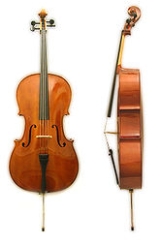
Cello

Encyclopedia
The cello is a bowed
string instrument
with four strings tuned in perfect fifths. It is a member of the violin family
of musical instruments, which also includes the violin
, viola
, and double bass
. Old forms of the instrument in the Baroque
era are baryton
and viol
(viola da gamba).
A person who plays a cello is called a cellist. The cello is used as a solo instrument, in chamber music
, in a string orchestra
and as a member of the string section
of an orchestra
. It is the second largest bowed
string instrument
in the modern symphony orchestra
, the double bass
being the largest.
Cellos were derived from other mid- to large-sized bowed instruments in the 16th century, such as the viola da gamba, and the generally smaller and squarer viola da braccio, and such instruments made by members of the Amati
family of luthier
s. The invention of wire-wrapped strings in Bologna gave the cello greater versatility. By the 18th century the cello had largely replaced other mid-sized bowed instruments.
violoncello, which means "little violone
", referring to the violone
("big viol"), the lowest-pitched instrument of the viol
family, the group of string instruments that went out of fashion around the end of the 17th century in most countries except France, where they survived another half-century or so before the louder violin
family came into greater favour in that country too. Thus, the name carries both an augmentative
"-one" ("big") and a diminutive
"-cello" ("little"). By the turn of the 20th century, it had grown customary to abbreviate the name violoncello to 'cello, with the apostrophe indicating the six missing prefix letters. It is now customary to use the name "cello" without the apostrophe and as a full designation. The word derives ultimately from vitula, meaning a stringed instrument.
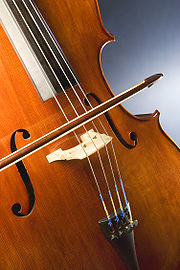 Cellos are tuned in fifths, starting with C2
(two octave
s below middle C
) as the lowest string, followed by G2, D3, and A3. It is tuned in same intervals as the viola
, but an octave lower. Unlike the violin
or viola
but similar to the double bass
, the cello has a endpin
resting on the floor in order to support its heavy weight. The cellist Paul Tortelier
is credited with inventing a bent pin, enabling the instrument to lie more horizontally than vertically.
The cello is most closely associated with European classical music, and has been described as the closest sounding instrument to the male human voice. The instrument is a part of the standard orchestra
and is the bass voice of the string quartet
, as well as being part of many other chamber
groups. A large number of concertos and sonatas
have been written for the cello.
Among the most well-known Baroque
works for the cello are Johann Sebastian Bach
's six unaccompanied Suites
. The Prelude from the First Suite is particularly famous. From the Classical era, the two concertos by Joseph Haydn
in C major and D major
stand out, as do the five sonatas for cello and pianoforte of Ludwig van Beethoven
, which span the important three periods of his compositional evolution. Romantic era repertoire includes the Robert Schumann
Concerto
, the Antonín Dvořák
Concerto
as well as the two sonatas and the Double Concerto
by Johannes Brahms
. Compositions from the early 20th century include Edward Elgar
's Cello Concerto in E minor
, Claude Debussy
's Sonata for Cello and Piano
and unaccompanied cello sonatas by Zoltán Kodály
and Paul Hindemith
. The cello's versatility made it popular with composers in the mid- to late 20th century such as Sergei Prokofiev
, Dmitri Shostakovich
, Benjamin Britten
, György Ligeti
and Henri Dutilleux
, encouraged by soloists who specialized in contemporary music (such as Siegfried Palm
and Mstislav Rostropovich
) commissioning from and collaborating with composers.
Today the instrument is less common in popular music
, but was commonly used in 1970's pop and disco
music. Today it is still sometimes featured in pop
and rock
recordings, examples of which are noted later in this article. The cello has also recently appeared in major hip-hop and R & B performances, such as singers Rihanna
and Ne-Yo
's performance at the American Music Awards
. The instrument has also been modified for Indian classical music
by Nancy Lesh and Saskia Rao-de Haas
.
string musical instrument
s in Europe dates back to the 9th century with the lira
(Greek: λύρα, Latin: lūrā), the bowed instrument of the Byzantine Empire
, equivalent to the rabāb of the Islamic Empires. The Persian
geographer Ibn Khurradadhbih
(d. 911) of the 9th century, in his lexicographical discussion of instruments, cited the Byzantine lira
as a typical instrument of the Byzantines along with the urghun (organ), shilyani (probably a type of harp or lyre) and the salandj. The Byzantine
lira
spread through Europe westward and in the 11th and 12th centuries European writers use the terms fiddle
and lira interchangeably when referring to bowed instruments (Encyclopædia Britannica. 2009). In the meantime the Arab rabāb was introduced to the Western Europe possibly through the Iberian Peninsula
and both bowed instruments spread widely throughout Europe giving birth to various European bowed instruments.
Over the centuries that followed, Europe continued to have two distinct types of bowed instruments: one, relatively square-shaped, held in the arms, known with the Italian term Lira da braccio (or Viola da braccio, meaning viol for the arm), family of the modern violin
; the other, with sloping shoulders and held between the knees, known with the Italian term Lira da gamba (or viola da gamba, meaning viol for the leg), family of the Byzantine lyra
and the modern Cello. During the Renaissance
, the gambas were important and elegant instruments; they eventually lost ground to the louder (and originally less aristocratic) lira da braccio
. However, the a gamba playing position remained popular to larger instruments that could not be played with a braccio position.
The violoncello da spalla (sometimes "violoncello piccolo da spalla" or "violoncello da span") was the first cello referred to in print (by Jambe de Fer
in 1556). "Violone
" means a larger
"viola" (viol
), while "-cello" in Italian is a diminutive and spalla means "shoulder" in Italian so that violoncello da spalla suggest a "little big violin" that may be held on the shoulder so that the player could perform while walking or that the early, short-necked instrument was hung across the shoulder by a strap.
Monteverdi referred to the instrument as "basso de viola da braccio" in Orfeo (1607). Although the first bass violin, possibly invented as early as 1538, was most likely inspired by the viol, it was created to be used in consorts with the violin. The bass violin was actually often referred to as a "violone," or "large viola," as were the viols of the same period. Instruments that share features with both the bass violin and the viola de gamba appear in Italian art of the early 16th century.
The invention of wire-wound strings
(fine wire around a thin gut core), around 1660 in Bologna
, allowed for a finer bass sound than was possible with purely gut strings on such a short body. Bolognese makers exploited this new technology to create the cello, a somewhat smaller instrument suitable for solo repertoire due to both the timbre of the instrument and the fact that the smaller size made it easier to play virtuosic
passages. This instrument had disadvantages as well, however. The cello's light sound was not as suitable for church and ensemble playing, so it had to be doubled by basses
or violone
s.
Around 1700, Italian players popularized the cello in northern Europe, although the bass violin (basse de violon) continued to be used for another two decades in France. Many existing bass violins were literally cut down in size to convert them into cellos according to the smaller pattern developed by Stradivarius
, who also made a number of old pattern large cellos (the 'Servais'). The bass violin remained the "most used" instrument in England as late as 1740, where the violoncello was still "not common." The sizes, names, and tunings of the cello varied widely by geography and time. The size was not standardized until around 1750.
Despite similarities to the viola da gamba
, the cello is actually part of the viola da braccio family, meaning "viol of the arm," which includes, among others, the violin
and viola
. Though paintings like Bruegel
's "The Rustic Wedding" and de Fer in his Epitome Musical suggest that the bass violin had alternate playing positions, these were short-lived and the more practical and ergonomic a gamba position eventually replaced them entirely.
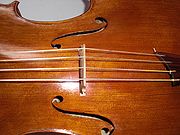 Baroque
era cellos differed from the modern instrument in several ways. The neck has a different form and angle, which matches the baroque bass-bar and stringing. Modern cellos have an endpin at the bottom to support the instrument (and transmit some of the sound through the floor), while Baroque cellos are held only by the calves of the player. Modern bows curve in and are held at the frog; Baroque bows curve out and are held closer to the bow's point of balance. Modern strings normally have a metal core, although some use a synthetic core; Baroque strings are made of gut
, with the G and C strings wire-wound. Modern cellos often have fine-tuners connecting the strings to the tailpiece, which make it much easier to tune the instrument, but such pins are rendered ineffective by the flexibility of the gut strings used on Baroque cellos. Overall, the modern instrument has much higher string tension than the Baroque cello, resulting in a louder, more projecting tone, with fewer overtones.
No educational works specifically devoted to the cello existed before the 18th century, and those that do exist contain little value to the performer beyond simple accounts of instrumental technique. The earliest cello manual is Michel Corrette
's Méthode, thèorique et pratique pour apprendre en peu de temps le violoncelle dans sa perfection (Paris, 1741).
The cellos are a critical part of orchestral music; all symphonic works involve the cello section, and many pieces require cello soli or solos. Much of the time, cellos provide part of the harmony for the orchestra. On many occasions, the cello section will play the melody for a brief period of time, before returning to the harmony. There are also cello concerto
s, which are orchestral pieces in which a featured, solo cellist is accompanied by an entire orchestra.
- notably 25 by Vivaldi, 12 by Boccherini, 2 by Haydn, 3 by C.P.E. Bach, 2 by Saint-Saëns
, 1 by Dvořák
, and one each by Schumann
, Lalo
, and Elgar. Beethoven
's Triple Concerto
for Cello, Violin and Piano and Brahms
' Double Concerto
for Cello and Violin are also part of the concertante repertoire although in both cases the cello shares solo duties with at least one other instrument. Moreover, several composers wrote large-scale pieces for cello and orchestra, which are concertos in all but name. Some familiar "concertos" are Strauss
' tone poem Don Quixote
, Tchaikovsky's Variations on a Rococo Theme
, Bloch
's Schelomo
and Bruch
's Kol Nidrei.
In the 20th century, the cello repertoire grew immensely. This was partly due to the influence of virtuoso cellist Mstislav Rostropovich
who inspired, commissioned and/or premiered dozens of new works. Among these, Prokofiev
's Symphonia Concertante, Britten
's Cello Symphony and the concertos of Shostakovich
, Lutosławski and Dutilleux
have already become part of the standard repertoire. Other major composers who wrote concertante works for him include Messiaen
, Berio
and Penderecki
. In addition, Arnold
, Barber
, Glass
, Hindemith
, Honegger
, Ligeti
, Myaskovsky
, Penderecki
, Rodrigo
, Villa-Lobos
and Walton
also wrote major concertos for other cellists, notably for Gaspar Cassadó
, Gregor Piatigorsky
, Siegfried Palm
and Julian Lloyd Webber
.
There are also many sonatas
for cello and piano
. Those written by Beethoven, Mendelssohn
, Chopin
, Brahms, Grieg
, Rachmaninoff
, Debussy
, Fauré
, Shostakovich, Prokofiev, Poulenc
, Carter, and Britten
are the most famous. Other important pieces for cello and piano include Schumann
's five Stücke im Volkston and transcriptions like Schubert
's sonata in a minor (originally for arpeggione
and piano), Stravinsky
's Suite Italienne (transcribed by the composer from his ballet Pulcinella) and Bartók
's first rhapsody (also transcribed by the composer, originally for violin and piano)
Finally, there are several pieces for cello solo, most importantly J.S. Bach
's six Suites for Cello
(arguably the most important cello pieces), Kodály
's Sonata for Solo Cello and Britten's three Cello Suites
. Other notable examples include Hindemith
's and Ysaÿe's Sonatas for Solo Cello, Dutilleux
' Trois Strophes sur le Nom de Sacher, Berio
's Les Mots Sont Allés (both part of a series of twelve compositions for solo cello commissioned by Rostropovich for Swiss conductor Paul Sacher
's 70th birthday), Cassado
's "Suite for Solo Cello", Ligeti
's Sonata
, Carter's two Figments and Xenakis
' Nomos Alpha
and Kottos.
as well as string quintets, sextet
or trios
and other mixed ensembles.
There are also pieces written for two, three, four or more cellos; this type of ensemble is also called a "cello choir" and its sound is familiar from the introduction to Rossini's William Tell Overture
as well as Zaccharias' prayer scene in Verdi's Nabucco
. As a self-sufficient ensemble, its most famous repertoire is Villa-Lobos' first of his Bachianas Brasileiras
for cello ensemble (the fifth is for soprano and 8 cellos). Other examples are Offenbach
's cello duets, quartet, and sextet, Pärt
's Fratres
for 8 cellos and Boulez
' Messagesquisse for 7 cellos, or even Villa-Lobos' rarely played Fantasia Concertante (1958) for 32 cellos. The Twelve Cellists
of the Berlin Philharmonic Orchestra
(or "the Twelve" as they have since taken to being called) specialize in this repertoire and have commissioned many works, including arrangements of well-known popular songs.
than in classical music, it is sometimes featured in pop
and rock
recordings. The cello is rarely part of a group's standard lineup but like its cousin the violin
it is becoming more common in mainstream pop (e.g. the baroque rock band Arcade Fire uses the cello in their songs).
In the 1960s, artists such as the Beatles
and Cher
used the cello in popular music, in songs such as "Bang Bang (My Baby Shot Me Down)
", "Eleanor Rigby
" and "Strawberry Fields Forever
". Bass guitarist Jack Bruce
, who had originally studied music on a performance scholarship for cello, played a prominent cello part in "As You Said" on Cream
's Wheels of Fire
studio album (1968). In the 1970s, the Electric Light Orchestra
enjoyed great commercial success taking inspiration from so-called "Beatlesque" arrangements, adding the cello (and violin) to the standard rock combo line-up and in 1978 the UK based rock band, Colosseum II
, collaborated with cellist Julian Lloyd Webber on the recording Variations. Most notably, Pink Floyd
included a cello solo in their 1970 epic instrumental "Atom Heart Mother
". Bass guitarist Mike Rutherford
of Genesis
was originally a cellist and included some cello parts in their Foxtrot
album.
Established non-traditional cello groups include Apocalyptica
, a group of Finnish cellists best known for their versions of Metallica
songs, Rasputina, a group of cellists committed to an intricate cello style intermingled with Gothic music, Von Cello, a cello fronted rock power trio, Break of Reality
who mix elements of classical music with the more modern rock and metal genre, and Jelloslave (http://www.jelloslave.com) a Minneapolis based Cello duo with two percussionists. These groups are examples of a style that has become known as cello rock
. The crossover string quartet bond
also includes a cellist. Silenzium and Vivacello are Russian
(Novosibirsk) groups playing rock and metal and having more and more popularity in Siberia
. Cold Fairyland
from Shanghai
, China
is using a cello along a Pipa
as the main solo instrument to create East meets West progressive (folk) rock.
More recent bands using the cello are Aerosmith
, The Auteurs
, Nirvana
, Oasis
, Murder by Death
, Cursive
, A Genuine Freakshow
, Ra Ra Riot
, Smashing Pumpkins, James
, and OneRepublic
. An Atlanta-based trio, King Richard's Sunday Best, also uses a cellist in their lineup. So-called "chamber pop" artists like Kronos Quartet
, The Vitamin String Quartet and Margot and the Nuclear So and So's
have also recently made cello common in modern alternative rock. Heavy metal band System of a Down
has also made use of the cello's rich sound. The indie rock band The Stiletto Formal
are known for using a cello as a major staple of their sound, similarly, the indie rock band Canada
employs two cello players in their lineup. The orch-rock group, The Polyphonic Spree
, which has pioneered the use of stringed and symphonic instruments, employs the cello in very creative ways for many of their "psychedelic-esque" melodies. The first wave screamo
band I Would Set Myself On Fire For You featured a cello as well as a viola to create a more folk
-oriented sound. The band, Panic! At the Disco
uses a cello in their song, "Build God, Then We'll Talk." The lead vocalist of the band, Brendon Urie
, also did the recording of the cello solo.
In jazz
, bassists Oscar Pettiford
and Harry Babasin
were among the first to use the cello as a solo instrument; both tuned their instrument in fourths, an octave above the double bass. Fred Katz (who was not a bassist) was one of the first notable jazz cellists to use the instrument's standard tuning and arco technique. Contemporary jazz cellists include Abdul Wadud
, Diedre Murray
, Ron Carter
, Dave Holland
, David Darling
, Lucio Amanti
, Akua Dixon, Ernst Reijseger
, Fred Lonberg-Holm
, Tom Cora
, Vincent Courtois, Jean-Charles Capon, Erik Friedlander
, and James Hinkley of jazz combo Billet-Deux.
Modern musical theatre pieces like Jason Robert Brown's The Last Five Years
, Duncan Sheik's Spring Awakening, Adam Guettel's Floyd Collins
, and Ricky Ian Gordon's My Life with Albertine
use small string ensembles (including solo cellos) to a prominent extent.
The cello can also be used in bluegrass
and folk music
, with notable players including Ben Sollee
of the Sparrow Quartet
and the "Cajun cellist" Sean Grissom as well as Damien Rice
. Lindsay Mac
is becoming well known for playing the cello like a guitar, with her cover of The Beatles
' "Blackbird
" a big hit on The Bob & Tom Show
.
or aluminum may be used. A traditional cello has a spruce
top, with maple
for the back, sides, and neck. Other woods, such as poplar
or willow
, are sometimes used for the back and sides. Less expensive cellos frequently have tops and backs made of laminated wood
.
The top and back are traditionally hand-carved, though less expensive cellos are often machine-produced. The sides, or ribs, are made by heating the wood and bending it around forms. The cello body has a wide top bout, narrow middle formed by two C-bouts, and wide bottom bout, with the bridge
and F holes just below the middle.
The top and back of the cello has decorative border inlay known as purfling
. While purfling is attractive, it is also functional: if the instrument is struck, the purfling can prevent cracking of the wood. A crack may form at the rim of the instrument, but will spread no further. Without purfling, cracks can spread up or down the top or back. Playing, traveling and the weather all affect the cello and can increase a crack if purfling is not in place. Less expensive instruments typically have painted purfling.
constructs cellos from carbon fibre. Carbon fibre instruments are particularly suitable for outdoor playing because of the strength of the material and its resistance to humidity and temperature fluctuations. Luis & Clark has produced over 600 such cellos, some of which are owned by cellists such as Yo-Yo Ma
and Josephine van Lier
.
In the late 1920s and early 1930s, the Aluminum Company of America (Alcoa) as well as German luthier G.A. Pfretzschner produced an unknown number of aluminum cellos (in addition to aluminum double basses and violins). An advertisement published in N.Y. Music Service catalogue (1930) reads: "...made entirely of aluminum with the exception of the fingerboard. They have many advantages over the wood basses and violoncellos, as they cannot crack, split or warp and are made to last forever ... possessing a tone quality that is deep, resonant and responsive to the utmost degree. Violoncello $150." Only a handful of aluminum cellos exist today including a Pfretzschner played by modern classical cellist Frances-Marie Uitti
, another played by bluegrass cellist Stan Young.
and the scroll
. The neck, pegbox, and scroll are normally carved out of a single piece of wood. Attached to the neck and extending over the body of the instrument is the fingerboard. The nut
is a raised piece of wood, where the fingerboard meets the pegbox, which the strings rest on. The pegbox houses four tuning peg
s, one for each string. The pegs are used to tune the cello by either tightening or loosening the string. The scroll is a traditional part of the cello and all other members of the violin family
. Ebony
is usually used for the tuning pegs, fingerboard, and nut, but other hard woods, such as boxwood
or rosewood
, can be used.
(sheep or goat), metal, or synthetic materials, such as Perlon
. Most modern strings used today are also wound with metallic materials like aluminum, titanium and chromium. Cellists may mix different types of strings on their instruments. The pitches of the open strings are C, G, D, and A (black note heads in the playing range figure above), unless alternative tuning (scordatura
) is used.
and endpin
are found in the lower part of the cello. The tailpiece is traditionally made of ebony
or another hard wood, but can also be made of plastic
or steel
. It attaches the strings to the lower end of the cello, and can have one or more fine tuners. The endpin or spike is made of wood, metal or rigid carbon fibre and supports the cello in playing position. In the Baroque period the cello was held between the calves. Around the 1830s, the Belgian cellist Auguste Adrien Servais introduced the endpin and propagated its use. Modern endpins are retractable and adjustable; older ones were removed when not in use. (The word "endpin" sometimes also refers to the button of wood located at this place in all instruments in the violin family, but this is usually called "tailpin".) The sharp tip of the cello's endpin is sometimes capped with a rubber tip that protects the tip from dulling and prevents the cello from slipping on the floor.
holds the strings above the cello and transfers their vibrations to the top of the instrument and the soundpost inside (see below). The bridge is not glued, but rather held in place by the tension of the strings. The f-holes, named for their shape, are located on either side of the bridge, and allow air to move in and out of the instrument as part of the sound-production process. The f-holes also act as access points to the interior of the cello for repairs or maintenance. Sometimes a small hose containing a water-soaked sponge, called a Dampit
, is inserted through the f-holes, and serves as a humidifier.
, which is glued to the underside of the top of the instrument, and a round wooden sound post
, which is wedged between the top and bottom plates. The bass bar, found under the bass foot of the bridge, serves to support the cello's top and distribute the vibrations. The sound post, found under the treble side of the bridge, connects the back and front of the cello. Like the bridge, the sound post is not glued, but is kept in place by the tensions of the bridge and strings. Together, the bass bar and sound post transfer the strings' vibrations to the top (front) of the instrument (and to a lesser extent the back), acting as a diaphragm
to produce the instrument's sound.
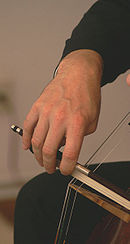 Traditionally, bows
are made from pernambuco or brazilwood
. Both come from the same species of tree (Caesalpina echinata), but pernambuco, used for higher-quality bows, is the heartwood of the tree and is darker in color than brazilwood (which is sometimes stained to compensate). Pernambuco is a heavy, resinous wood with great elasticity, which makes it an ideal wood for instrument bows.
Bows are also made from other materials, such as carbon-fibre—stronger than wood—and fiberglass (often used to make inexpensive, low-quality student bows). An average cello bow is 73 cm long (shorter than a violin or viola bow) 3 cm high (from the frog to the stick) and 1.5 cm wide. The frog of a cello bow typically has a rounded corner like that of a viola bow, but is wider. A cello bow is roughly 10 grams heavier than a viola bow, which in turn is roughly 10 grams heavier than a violin bow.
Bow hair is traditionally horsehair
, though synthetic hair, in varying colors, is also used. Prior to playing, the musician tightens the bow by turning a screw to pull the frog (the part of the bow under the hand) back, and increase the tension of the hair. Rosin
is applied by the player to make the hairs sticky. Bows need to be re-haired periodically.
Baroque
style (1600–1750) cello bows were much thicker and were formed with a larger outward arch when compared to modern cello bows. The inward arch of a modern cello bow produces greater tension, which in turn gives off a louder sound.
The cello bow, though not made conventionally for the use, has also been used to play guitar
s. The post-rock
Icelandic
band Sigur Rós
' lead singer often plays a guitar using a cello bow, as did Jimmy Page on tracks such as "Dazed and Confused".
A string’s fundamental pitch can be adjusted by changing its stiffness, which depends on tension and length. Tightening a string stiffens it by increasing both the outward forces along its length and the net forces it experiences during a distortion. A cello can be tuned by adjusting the tension in its strings using pegs in its neck and tension adjusters (fine tuners) on the tail piece.
A string’s length also affects its fundamental pitch. Shortening a string stiffens it by increasing its curvature during a distortion and subjecting it to larger net forces. Shortening the string also reduces its mass. Since a stiffer string with a smaller mass vibrates faster, shortening a string increases the pitch. Because of this effect, you can raise and change the pitch of a string by pressing it against the fingerboard in the cello’s neck and effectively shortening it.
For the cello, the main wood resonance generally appears very close to the note F#2, often with serious consequences. When the cellist plays the note F#2, the main wood resonance vibrates at its frequency as the cello sounds the frequency of the note F#2. A loud beating sound results between these nearby frequencies; this is known as the “wolf tone” because it is an unpleasant growling sound. The wood resonance appears to be split into two frequencies by the driving force of the sounding string. These two periodic resonances beat with each other. This wolf tone must be eliminated or significantly reduced for the cello to play the nearby notes with a pleasant tone. This can be accomplished by modifying the cello front plate, attaching a wolf eliminator, or moving the sound post.
For a repeating wave, the velocity, v, equals the wavelength, λ, times the frequency, f.
v = λf
On a cello string, waves reflect from both ends. The superposition of reflecting waves results in a standing wave pattern, but only for wavelengths λ = 2L, L, L/2, … = 2L/n, where L is the length of the string. Therefore the only frequencies produced on a single string are f = nv/(2L). Timbre is largely determined by the content of these harmonics. Different instruments have different harmonic content for the same pitch. A real string vibrates at harmonics that are not perfect multiples of the fundamental. This results in a little in-harmonicity, which gives richness to the tone and covers up slight de-tunings of different notes in a chord.
or spike, which rests on the floor. The cello is steadied on the lower bout between the knees of the seated player, and on the upper bout against the upper chest. The neck of the cello is above the player's left shoulder, and the C-String tuning peg is just behind the left ear. The bow
is drawn horizontally across the strings. In early times, female cellists sometimes played side-saddle, since it was considered improper for a lady to part her knees in public. A player's handedness
does not alter the way the cello is held or used. In rare cases, a player has used a mirror-image posture—usually because of a physical disability of the arm or hand that makes the required technique impossible for that side of the body. In such a situation, the player must decide whether or not to reverse the set-up of the cello (the string positions, bass-bar, sound post, fingerboard shape, and bridge carving are all asymmetrical).
(a general name for notes on the remainder of the fingerboard) the thumb usually rests alongside the fingers on the string and the side of the thumb is used to play notes. The fingers are normally held curved with each knuckle bent, with the fingertips in contact with the string. If a finger is required on two (or more) strings at once to play perfect fifths (in double stops or chords) it is used flat. In slower, or more expressive playing, the contact point can move slightly away from the nail to the pad of the finger, allowing a fuller vibrato.
is a small oscillation in the pitch of a note, usually considered expressive. It is not created by an upper arm motion; rather, it is more of forearm motion. The fixed point of contact of the fingertip on the string absorbs this motion by rocking back and forth. This change in the attitude of the fingertip to the string varies the pitch. Since vibrato is usually considered a key expressive device, a well-developed vibrato technique is an essential element of a modern cellist's skill. In some styles of music, such as that of the Romantic
period, vibrato may be used on almost every note. However, in other styles, such as Baroque
repertoire, vibrato is used only rarely, as an ornament. In any case, the choice of whether to use vibrato, and how much, is normally a stylistic decision on the part of the player. Typically, the lower the pitch of the note played, the wider and slower the vibrato.
on a particular string. Artificial harmonics (also called false harmonics or stopped harmonics), in which the player depresses the string fully with one finger while touching the same string lightly with another finger, can produce any note above middle C. They usually appear with the touching note a perfect fourth above the stopped note
, which produces a sound two octaves above the stopped note, although other intervals are available. All harmonics produce a distinctive flute-like sound, and are usually performed without vibrato.
(Italian for "sliding") is an effect played by sliding the finger up or down the fingerboard without releasing the string. This causes the pitch to rise and fall smoothly, without separate, discernible steps.
player. Arguably, it is the major determinant in the expressiveness of the playing. The right hand holds the bow and controls the duration and character of the notes. The bow is drawn across the strings roughly halfway between the end of the fingerboard
and the bridge, in a direction perpendicular to the strings. The bow is held with all five fingers of the right hand, the thumb opposite the fingers and closer to the cellist's body. The shape of the hand should resemble that of its relaxed state, with all fingers curved, including the thumb. The transmission of weight from the arm to the bow happens through the pronation
(inward rotation) of the forearm, which pushes the index finger and to a lesser degree the middle finger onto the bow. The necessary counterforce is provided by the thumb. Depending upon the school of training, the other two fingers are used in various degrees to help maintain the angle of the bow to the string and are critical to controlling the bow when it is off the string. (See also spiccato).
In English, the terminology for bow direction (up and down) can be misleading. A downbow is drawn to the right of the player, and an upbow to the left. A downbow is drawn by first using the upper arm, then the forearm, then the wrist (turning slightly inward) to maintain a straight stroke. An upbow is drawn by moving first the forearm, then the upper arm, then the wrist (pushing slightly upward). The bow is mostly used perpendicular to the strings. To perform string changes the whole arm is either lowered or lifted, with as little wrist movement as possible to maintain the angle to the string. However, flexibility of the wrist is necessary when changing the bow direction from up-bow to down-bow and vice versa. For very fast bow movements, the wrist is used to accomplish the horizontal movement of the bow. For longer strokes, the arm is used as well as the wrist.
Tone production and volume of sound depend on a combination of several factors. The three most important ones are: bow speed, weight applied to the string, and point of contact of the bow hair with the string. A good player will be capable of a very even tone, and will counter the natural tendency to play with the most force with the part of the bow nearest to the frog or heel, and the least force near the tip. The closer to the bridge the string is bowed, the more projecting and brighter the tone, with the extreme (sul ponticello) producing a metallic, shimmery sound. If bowing closer to the fingerboard (sul tasto), the sound produced will be softer, more mellow, and less defined.
s involve the playing of two notes at the same time. Two strings are fingered simultaneously, and the bow is drawn so as to sound them both at once. Triple and quadruple stops may also be played (in a "broken" fashion), but are difficult to sustain because of the change in slope of the bridge. To extend the technique in this area, Frances-Marie Uitti
has invented a two-bow system: one bow plays above the strings and one below, allowing for sustained triple and quadruple stops. However, this technique is very rarely seen or used.
playing, the string is plucked directly with the fingers or thumb. Position of the hand is slightly over the finger board and away from the bridge. Usually this is done with the right hand, while the bow is held away from the strings by the rest of the hand or (for extended passages) set down. A single string can be played pizzicato, or double, triple, or quadruple stops can be played. Occasionally, a player must bow one string with the right hand and simultaneously pluck another with the left. This is marked by a "+" above the note. Strumming of chords is also possible, in guitar fashion.
technique rubs the strings with the wood of the bow rather than the hair. There are two forms, col legno battuto and col legno tratto. Col legno battuto is performed as a percussive technique with no sustaining of the sound. The much less common alternative is col legno tratto, wherein the wood is drawn across the string as the hair is in a normal bow stroke. Some players refuse to use this technique because of potential damage to the bow.
, the player moves the bow a small distance and stops it on the string, making a short sound, the rest of the written duration being taken up by silence.
is a technique where the notes are smoothly connected without accents or breaks.
, which is placed on the bridge to mellow or soften the tone, or to take it off.
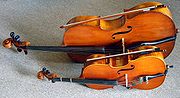 Standard-sized cellos are referred to as "full-size". However, cellos come in smaller (fractional) sizes, from "7/8" and "3/4" down to "1/16" sized cellos (e.g. 7/8, 3/4, 1/2, 1/4, 1/8, 1/10, 1/16). The smaller-sized cellos are identical to standard cellos in construction, range, and usage, but are simply 'scaled-down' for the benefit of children and shorter adults. Note that a "half-size" cello is half the volume
of a full-size, not half the length
(i.e., the 1/8-size cello would be "half-size" in terms of length). A 1/10-size cello, for example, which is meant to be used by small children, is only slightly larger than a violin
(and as such can be played by an adult player like one), but about twice as thick, and the C string tends to be quite slack due to the difficulty for such a small string to produce a sound that low. Many smaller cellists prefer to play a "7/8" cello as the hand stretches in the lower positions are less demanding. Although rare, cellos in sizes larger than 4/4 do exist. Cellists with unusually large hands may play a slightly larger than full-sized cello. Cellos made before approximately 1700 tended to be considerably larger than those made and commonly played today.
Around 1680, string-making technology made lower pitches on shorter strings possible. The cellos of Stradivari, for example, can be clearly divided into two models, the style made before 1702 characterized by larger instruments (of which only three exist in their original size and configuration), and the style made during and after 1702, when Stradivari, presumably in response to the "new" strings, began making smaller cellos. This later model is the one most commonly used by modern luthiers.
s, specialists in building and repairing stringed instruments, ranging from guitars to violins. The following luthiers are notable for the cellos they have produced:
, which is currently in the possession of one of the most widely known living cellists, Yo-Yo Ma
, is actually owned by the Vuitton Foundation.)
Some notable cellos:
Bow (music)
In music, a bow is moved across some part of a musical instrument, causing vibration which the instrument emits as sound. The vast majority of bows are used with string instruments, although some bows are used with musical saws and other bowed idiophones....
string instrument
String instrument
A string instrument is a musical instrument that produces sound by means of vibrating strings. In the Hornbostel-Sachs scheme of musical instrument classification, used in organology, they are called chordophones...
with four strings tuned in perfect fifths. It is a member of the violin family
Violin family
The violin family of musical instruments was developed in Italy in the sixteenth century. The standard modern violin family consists of the violin, viola, cello, and double bass....
of musical instruments, which also includes the violin
Violin
The violin is a string instrument, usually with four strings tuned in perfect fifths. It is the smallest, highest-pitched member of the violin family of string instruments, which includes the viola and cello....
, viola
Viola
The viola is a bowed string instrument. It is the middle voice of the violin family, between the violin and the cello.- Form :The viola is similar in material and construction to the violin. A full-size viola's body is between and longer than the body of a full-size violin , with an average...
, and double bass
Double bass
The double bass, also called the string bass, upright bass, standup bass or contrabass, is the largest and lowest-pitched bowed string instrument in the modern symphony orchestra, with strings usually tuned to E1, A1, D2 and G2...
. Old forms of the instrument in the Baroque
Baroque
The Baroque is a period and the style that used exaggerated motion and clear, easily interpreted detail to produce drama, tension, exuberance, and grandeur in sculpture, painting, literature, dance, and music...
era are baryton
Baryton
The baryton is a bowed string instrument in the viol family, in regular use in Europe up until the end of the 18th century. In London a performance at Marylebone Gardens was announced in 1744, when Mr Ferrand was to perform on "the Pariton, an instrument never played on in publick before." It most...
and viol
Viol
The viol is any one of a family of bowed, fretted and stringed musical instruments developed in the mid-late 15th century and used primarily in the Renaissance and Baroque periods. The family is related to and descends primarily from the Renaissance vihuela, a plucked instrument that preceded the...
(viola da gamba).
A person who plays a cello is called a cellist. The cello is used as a solo instrument, in chamber music
Chamber music
Chamber music is a form of classical music, written for a small group of instruments which traditionally could be accommodated in a palace chamber. Most broadly, it includes any art music that is performed by a small number of performers with one performer to a part...
, in a string orchestra
String orchestra
A string orchestra is an orchestra composed solely or primarily of instruments from the string family. These instruments are the violin, the viola, the cello, the double bass , the piano, the harp, and sometimes percussion...
and as a member of the string section
String section
The string section is the largest body of the standard orchestra and consists of bowed string instruments of the violin family.It normally comprises five sections: the first violins, the second violins, the violas, the cellos, and the double basses...
of an orchestra
Orchestra
An orchestra is a sizable instrumental ensemble that contains sections of string, brass, woodwind, and percussion instruments. The term orchestra derives from the Greek ορχήστρα, the name for the area in front of an ancient Greek stage reserved for the Greek chorus...
. It is the second largest bowed
Bow (music)
In music, a bow is moved across some part of a musical instrument, causing vibration which the instrument emits as sound. The vast majority of bows are used with string instruments, although some bows are used with musical saws and other bowed idiophones....
string instrument
String instrument
A string instrument is a musical instrument that produces sound by means of vibrating strings. In the Hornbostel-Sachs scheme of musical instrument classification, used in organology, they are called chordophones...
in the modern symphony orchestra
Orchestra
An orchestra is a sizable instrumental ensemble that contains sections of string, brass, woodwind, and percussion instruments. The term orchestra derives from the Greek ορχήστρα, the name for the area in front of an ancient Greek stage reserved for the Greek chorus...
, the double bass
Double bass
The double bass, also called the string bass, upright bass, standup bass or contrabass, is the largest and lowest-pitched bowed string instrument in the modern symphony orchestra, with strings usually tuned to E1, A1, D2 and G2...
being the largest.
Cellos were derived from other mid- to large-sized bowed instruments in the 16th century, such as the viola da gamba, and the generally smaller and squarer viola da braccio, and such instruments made by members of the Amati
Amati
Amati is the name of a family of Italian violin makers, who flourished at Cremona from about 1549 to 1740.-Andrea Amati:Andrea Amati was not the earliest maker of violins whose instruments still survive today...
family of luthier
Luthier
A luthier is someone who makes or repairs lutes and other string instruments. In the United States, the term is used interchangeably with a term for the specialty of each maker, such as violinmaker, guitar maker, lute maker, etc...
s. The invention of wire-wrapped strings in Bologna gave the cello greater versatility. By the 18th century the cello had largely replaced other mid-sized bowed instruments.
Etymology
The name cello is an abbreviation of the ItalianItalian language
Italian is a Romance language spoken mainly in Europe: Italy, Switzerland, San Marino, Vatican City, by minorities in Malta, Monaco, Croatia, Slovenia, France, Libya, Eritrea, and Somalia, and by immigrant communities in the Americas and Australia...
violoncello, which means "little violone
Violone
The term violone can refer to several distinct large, bowed musical instruments which belong to either the viol or violin family. The violone is sometimes a fretted instrument, and may have six, five, four, or even only three strings. The violone is also not always a contrabass instrument...
", referring to the violone
Violone
The term violone can refer to several distinct large, bowed musical instruments which belong to either the viol or violin family. The violone is sometimes a fretted instrument, and may have six, five, four, or even only three strings. The violone is also not always a contrabass instrument...
("big viol"), the lowest-pitched instrument of the viol
Viol
The viol is any one of a family of bowed, fretted and stringed musical instruments developed in the mid-late 15th century and used primarily in the Renaissance and Baroque periods. The family is related to and descends primarily from the Renaissance vihuela, a plucked instrument that preceded the...
family, the group of string instruments that went out of fashion around the end of the 17th century in most countries except France, where they survived another half-century or so before the louder violin
Violin
The violin is a string instrument, usually with four strings tuned in perfect fifths. It is the smallest, highest-pitched member of the violin family of string instruments, which includes the viola and cello....
family came into greater favour in that country too. Thus, the name carries both an augmentative
Augmentative
An augmentative is a morphological form of a word which expresses greater intensity, often in size, but also in other attributes...
"-one" ("big") and a diminutive
Diminutive
In language structure, a diminutive, or diminutive form , is a formation of a word used to convey a slight degree of the root meaning, smallness of the object or quality named, encapsulation, intimacy, or endearment...
"-cello" ("little"). By the turn of the 20th century, it had grown customary to abbreviate the name violoncello to 'cello, with the apostrophe indicating the six missing prefix letters. It is now customary to use the name "cello" without the apostrophe and as a full designation. The word derives ultimately from vitula, meaning a stringed instrument.
Description
Scientific pitch notation
Scientific pitch notation is one of several methods that name the notes of the standard Western chromatic scale by combining a letter-name, accidentals, and a number identifying the pitch's octave...
(two octave
Octave
In music, an octave is the interval between one musical pitch and another with half or double its frequency. The octave relationship is a natural phenomenon that has been referred to as the "basic miracle of music", the use of which is "common in most musical systems"...
s below middle C
Middle C
C or Do is the first note of the fixed-Do solfège scale. Its enharmonic is B.-Middle C:Middle C is designated C4 in scientific pitch notation because of the note's position as the fourth C key on a standard 88-key piano keyboard...
) as the lowest string, followed by G2, D3, and A3. It is tuned in same intervals as the viola
Viola
The viola is a bowed string instrument. It is the middle voice of the violin family, between the violin and the cello.- Form :The viola is similar in material and construction to the violin. A full-size viola's body is between and longer than the body of a full-size violin , with an average...
, but an octave lower. Unlike the violin
Violin
The violin is a string instrument, usually with four strings tuned in perfect fifths. It is the smallest, highest-pitched member of the violin family of string instruments, which includes the viola and cello....
or viola
Viola
The viola is a bowed string instrument. It is the middle voice of the violin family, between the violin and the cello.- Form :The viola is similar in material and construction to the violin. A full-size viola's body is between and longer than the body of a full-size violin , with an average...
but similar to the double bass
Double bass
The double bass, also called the string bass, upright bass, standup bass or contrabass, is the largest and lowest-pitched bowed string instrument in the modern symphony orchestra, with strings usually tuned to E1, A1, D2 and G2...
, the cello has a endpin
Endpin
The endpin or spike is the component of a cello or double bass that makes contact with the floor to support the instrument's weight. It is made of metal, or in some cases wood or carbon fiber, and is extensible from the bottom of the instrument, and secured with a thumbscrew...
resting on the floor in order to support its heavy weight. The cellist Paul Tortelier
Paul Tortelier
Paul Tortelier was a French cellist and composer.Tortelier was born in Paris, the son of a cabinet maker with Breton roots. He was encouraged to play the cello by his father Joseph and mother Marguerite , and at 12 he entered the Paris Conservatoire. He studied the cello there with Gérard Hekking...
is credited with inventing a bent pin, enabling the instrument to lie more horizontally than vertically.
The cello is most closely associated with European classical music, and has been described as the closest sounding instrument to the male human voice. The instrument is a part of the standard orchestra
Orchestra
An orchestra is a sizable instrumental ensemble that contains sections of string, brass, woodwind, and percussion instruments. The term orchestra derives from the Greek ορχήστρα, the name for the area in front of an ancient Greek stage reserved for the Greek chorus...
and is the bass voice of the string quartet
String quartet
A string quartet is a musical ensemble of four string players – usually two violin players, a violist and a cellist – or a piece written to be performed by such a group...
, as well as being part of many other chamber
Chamber music
Chamber music is a form of classical music, written for a small group of instruments which traditionally could be accommodated in a palace chamber. Most broadly, it includes any art music that is performed by a small number of performers with one performer to a part...
groups. A large number of concertos and sonatas
Cello sonata
A cello sonata is usually a sonata written for cello and piano, though other instrumentations are used, such as solo cello. The most famous Romantic-era cellos sonatas are those written by Johannes Brahms and Ludwig van Beethoven...
have been written for the cello.
Among the most well-known Baroque
Baroque
The Baroque is a period and the style that used exaggerated motion and clear, easily interpreted detail to produce drama, tension, exuberance, and grandeur in sculpture, painting, literature, dance, and music...
works for the cello are Johann Sebastian Bach
Johann Sebastian Bach
Johann Sebastian Bach was a German composer, organist, harpsichordist, violist, and violinist whose sacred and secular works for choir, orchestra, and solo instruments drew together the strands of the Baroque period and brought it to its ultimate maturity...
's six unaccompanied Suites
Cello Suites (Bach)
The Six Suites for Unaccompanied Cello by Johann Sebastian Bach are some of the most performed and recognizable solo compositions ever written for cello...
. The Prelude from the First Suite is particularly famous. From the Classical era, the two concertos by Joseph Haydn
Joseph Haydn
Franz Joseph Haydn , known as Joseph Haydn , was an Austrian composer, one of the most prolific and prominent composers of the Classical period. He is often called the "Father of the Symphony" and "Father of the String Quartet" because of his important contributions to these forms...
in C major and D major
Cello Concerto No. 2 (Haydn)
Joseph Haydn's Concerto No. 2 in D Major, Hob. VIIb/2, for cello and orchestra was composed in 1783 for Antonín Kraft, a cellist of Prince Nikolaus's Esterházy Orchestra....
stand out, as do the five sonatas for cello and pianoforte of Ludwig van Beethoven
Ludwig van Beethoven
Ludwig van Beethoven was a German composer and pianist. A crucial figure in the transition between the Classical and Romantic eras in Western art music, he remains one of the most famous and influential composers of all time.Born in Bonn, then the capital of the Electorate of Cologne and part of...
, which span the important three periods of his compositional evolution. Romantic era repertoire includes the Robert Schumann
Robert Schumann
Robert Schumann, sometimes known as Robert Alexander Schumann, was a German composer, aesthete and influential music critic. He is regarded as one of the greatest and most representative composers of the Romantic era....
Concerto
Cello Concerto (Schumann)
The Cello Concerto in A minor, Op. 129, by Robert Schumann was completed in a period of only two weeks, between 10 October and 24 October 1850, shortly after Schumann became the music director at Düsseldorf.The concerto was never played in Schumann's lifetime...
, the Antonín Dvořák
Antonín Dvorák
Antonín Leopold Dvořák was a Czech composer of late Romantic music, who employed the idioms of the folk music of Moravia and his native Bohemia. Dvořák’s own style is sometimes called "romantic-classicist synthesis". His works include symphonic, choral and chamber music, concerti, operas and many...
Concerto
Cello Concerto (Dvorák)
The Cello Concerto in B minor, Op. 104, B. 191, by Antonín Dvořák was the composer's last solo concerto, and was written in 1894–1895 for his friend, the cellist Hanuš Wihan, but premiered by the English cellist Leo Stern.- Structure :...
as well as the two sonatas and the Double Concerto
Double Concerto (Brahms)
The Double Concerto in A minor, Op. 102, by Johannes Brahms is a concerto for violin, cello and orchestra.- Origin of the work :The Double Concerto was Brahms' final work for orchestra. It was composed in the summer of 1887, and first performed on 18 October of that year in the Gürzenich in Köln,...
by Johannes Brahms
Johannes Brahms
Johannes Brahms was a German composer and pianist, and one of the leading musicians of the Romantic period. Born in Hamburg, Brahms spent much of his professional life in Vienna, Austria, where he was a leader of the musical scene...
. Compositions from the early 20th century include Edward Elgar
Edward Elgar
Sir Edward William Elgar, 1st Baronet OM, GCVO was an English composer, many of whose works have entered the British and international classical concert repertoire. Among his best-known compositions are orchestral works including the Enigma Variations, the Pomp and Circumstance Marches, concertos...
's Cello Concerto in E minor
Cello Concerto (Elgar)
Edward Elgar's Cello Concerto in E minor, Op. 85, his last notable work, is a cornerstone of the solo cello repertoire. Elgar composed it in the aftermath of the First World War, by which time his music had gone out of fashion with the concert-going public...
, Claude Debussy
Claude Debussy
Claude-Achille Debussy was a French composer. Along with Maurice Ravel, he was one of the most prominent figures working within the field of impressionist music, though he himself intensely disliked the term when applied to his compositions...
's Sonata for Cello and Piano
Cello Sonata (Debussy)
The Cello Sonata is a late work by the French composer Claude Debussy. It was the first of a planned series of 'Six sonates pour divers instruments', however Debussy only completed two others, the sonata for violin and the sonata for flute, viola and harp. The sonata for cello and piano was written...
and unaccompanied cello sonatas by Zoltán Kodály
Zoltán Kodály
Zoltán Kodály was a Hungarian composer, ethnomusicologist, pedagogue, linguist, and philosopher. He is best known internationally as the creator of the Kodály Method.-Life:Born in Kecskemét, Kodály learned to play the violin as a child....
and Paul Hindemith
Paul Hindemith
Paul Hindemith was a German composer, violist, violinist, teacher, music theorist and conductor.- Biography :Born in Hanau, near Frankfurt, Hindemith was taught the violin as a child...
. The cello's versatility made it popular with composers in the mid- to late 20th century such as Sergei Prokofiev
Sergei Prokofiev
Sergei Sergeyevich Prokofiev was a Russian composer, pianist and conductor who mastered numerous musical genres and is regarded as one of the major composers of the 20th century...
, Dmitri Shostakovich
Dmitri Shostakovich
Dmitri Dmitriyevich Shostakovich was a Soviet Russian composer and one of the most celebrated composers of the 20th century....
, Benjamin Britten
Benjamin Britten
Edward Benjamin Britten, Baron Britten, OM CH was an English composer, conductor, and pianist. He showed talent from an early age, and first came to public attention with the a cappella choral work A Boy Was Born in 1934. With the premiere of his opera Peter Grimes in 1945, he leapt to...
, György Ligeti
György Ligeti
György Sándor Ligeti was a composer of contemporary classical music. Born in a Hungarian Jewish family in Transylvania, Romania, he briefly lived in Hungary before becoming an Austrian citizen.-Early life:...
and Henri Dutilleux
Henri Dutilleux
Henri Dutilleux is one of the most important French composers of the second half of the 20th century, producing work in the tradition of Maurice Ravel, Claude Debussy, and Albert Roussel, but in a style distinctly his own...
, encouraged by soloists who specialized in contemporary music (such as Siegfried Palm
Siegfried Palm
Siegfried Palm was a German cellist who is known worldwide for his interpretations of contemporary music. Many 20th-century composers like Kagel, Ligeti, Xenakis, Penderecki and Zimmermann wrote music for him....
and Mstislav Rostropovich
Mstislav Rostropovich
Mstislav Leopoldovich Rostropovich, KBE , known to close friends as Slava, was a Soviet and Russian cellist and conductor. He was married to the soprano Galina Vishnevskaya. He is widely considered to have been the greatest cellist of the second half of the 20th century, and one of the greatest of...
) commissioning from and collaborating with composers.
Today the instrument is less common in popular music
Popular music
Popular music belongs to any of a number of musical genres "having wide appeal" and is typically distributed to large audiences through the music industry. It stands in contrast to both art music and traditional music, which are typically disseminated academically or orally to smaller, local...
, but was commonly used in 1970's pop and disco
Disco
Disco is a genre of dance music. Disco acts charted high during the mid-1970s, and the genre's popularity peaked during the late 1970s. It had its roots in clubs that catered to African American, gay, psychedelic, and other communities in New York City and Philadelphia during the late 1960s and...
music. Today it is still sometimes featured in pop
Pop music
Pop music is usually understood to be commercially recorded music, often oriented toward a youth market, usually consisting of relatively short, simple songs utilizing technological innovations to produce new variations on existing themes.- Definitions :David Hatch and Stephen Millward define pop...
and rock
Rock music
Rock music is a genre of popular music that developed during and after the 1960s, particularly in the United Kingdom and the United States. It has its roots in 1940s and 1950s rock and roll, itself heavily influenced by rhythm and blues and country music...
recordings, examples of which are noted later in this article. The cello has also recently appeared in major hip-hop and R & B performances, such as singers Rihanna
Rihanna
Robyn Rihanna Fenty , better known as simply Rihanna, is a Barbadian recording artist. Born in Saint Michael, Barbados, Rihanna moved to the United States at the age of 16 to pursue a recording career under the guidance of record producer Evan Rogers...
and Ne-Yo
Ne-Yo
Shaffer Chimere Smith, Jr. , better known by his stage name Ne-Yo, is an American pop and R&B singer-songwriter, record producer, dancer and actor. Beginning his career as a songwriter, Ne-Yo penned the hit "Let Me Love You" for singer Mario...
's performance at the American Music Awards
American Music Awards
-Conception:The AMAs were created by Dick Clark in 1973 to compete with the Grammys after the move of that year's show to Nashville, Tennessee led to CBS picking up the Grammy telecasts after its first two in 1971 and 1972 were broadcast on ABC...
. The instrument has also been modified for Indian classical music
Indian classical music
The origins of Indian classical music can be found in the Vedas, which are the oldest scriptures in the Hindu tradition. Indian classical music has also been significantly influenced by, or syncretised with, Indian folk music and Persian music. The Samaveda, one of the four Vedas, describes music...
by Nancy Lesh and Saskia Rao-de Haas
Saskia Rao-de Haas
Saskia Rao-de Haas is a Dutch cellist based in Delhi, India. She is the first performer to adapt the cello to the performance of North Indian classical music and uses a specially constructed cello, the Indian Cello made by violinbuilder Eduard van Tongeren for this purpose, with five playing...
.
History
The history of bowedBow (music)
In music, a bow is moved across some part of a musical instrument, causing vibration which the instrument emits as sound. The vast majority of bows are used with string instruments, although some bows are used with musical saws and other bowed idiophones....
string musical instrument
Musical instrument
A musical instrument is a device created or adapted for the purpose of making musical sounds. In principle, any object that produces sound can serve as a musical instrument—it is through purpose that the object becomes a musical instrument. The history of musical instruments dates back to the...
s in Europe dates back to the 9th century with the lira
Byzantine lyra
The Byzantine lyra or lira , was a medieval bowed string musical instrument in the Byzantine Empire and is an ancestor of most European bowed instruments, including the violin. In its popular form the lyra was a pear-shaped instrument with three to five strings, held upright and played by stopping...
(Greek: λύρα, Latin: lūrā), the bowed instrument of the Byzantine Empire
Byzantine Empire
The Byzantine Empire was the Eastern Roman Empire during the periods of Late Antiquity and the Middle Ages, centred on the capital of Constantinople. Known simply as the Roman Empire or Romania to its inhabitants and neighbours, the Empire was the direct continuation of the Ancient Roman State...
, equivalent to the rabāb of the Islamic Empires. The Persian
Persian people
The Persian people are part of the Iranian peoples who speak the modern Persian language and closely akin Iranian dialects and languages. The origin of the ethnic Iranian/Persian peoples are traced to the Ancient Iranian peoples, who were part of the ancient Indo-Iranians and themselves part of...
geographer Ibn Khurradadhbih
Ibn Khordadbeh
Abu'l Qasim Ubaid'Allah ibn Khordadbeh , author of the earliest surviving Arabic book of administrative geography, was a Persian geographer and bureaucrat of the 9th century...
(d. 911) of the 9th century, in his lexicographical discussion of instruments, cited the Byzantine lira
Byzantine lyra
The Byzantine lyra or lira , was a medieval bowed string musical instrument in the Byzantine Empire and is an ancestor of most European bowed instruments, including the violin. In its popular form the lyra was a pear-shaped instrument with three to five strings, held upright and played by stopping...
as a typical instrument of the Byzantines along with the urghun (organ), shilyani (probably a type of harp or lyre) and the salandj. The Byzantine
Byzantine Empire
The Byzantine Empire was the Eastern Roman Empire during the periods of Late Antiquity and the Middle Ages, centred on the capital of Constantinople. Known simply as the Roman Empire or Romania to its inhabitants and neighbours, the Empire was the direct continuation of the Ancient Roman State...
lira
Byzantine lyra
The Byzantine lyra or lira , was a medieval bowed string musical instrument in the Byzantine Empire and is an ancestor of most European bowed instruments, including the violin. In its popular form the lyra was a pear-shaped instrument with three to five strings, held upright and played by stopping...
spread through Europe westward and in the 11th and 12th centuries European writers use the terms fiddle
Fiddle
The term fiddle may refer to any bowed string musical instrument, most often the violin. It is also a colloquial term for the instrument used by players in all genres, including classical music...
and lira interchangeably when referring to bowed instruments (Encyclopædia Britannica. 2009). In the meantime the Arab rabāb was introduced to the Western Europe possibly through the Iberian Peninsula
Iberian Peninsula
The Iberian Peninsula , sometimes called Iberia, is located in the extreme southwest of Europe and includes the modern-day sovereign states of Spain, Portugal and Andorra, as well as the British Overseas Territory of Gibraltar...
and both bowed instruments spread widely throughout Europe giving birth to various European bowed instruments.
Over the centuries that followed, Europe continued to have two distinct types of bowed instruments: one, relatively square-shaped, held in the arms, known with the Italian term Lira da braccio (or Viola da braccio, meaning viol for the arm), family of the modern violin
Violin
The violin is a string instrument, usually with four strings tuned in perfect fifths. It is the smallest, highest-pitched member of the violin family of string instruments, which includes the viola and cello....
; the other, with sloping shoulders and held between the knees, known with the Italian term Lira da gamba (or viola da gamba, meaning viol for the leg), family of the Byzantine lyra
Byzantine lyra
The Byzantine lyra or lira , was a medieval bowed string musical instrument in the Byzantine Empire and is an ancestor of most European bowed instruments, including the violin. In its popular form the lyra was a pear-shaped instrument with three to five strings, held upright and played by stopping...
and the modern Cello. During the Renaissance
Renaissance
The Renaissance was a cultural movement that spanned roughly the 14th to the 17th century, beginning in Italy in the Late Middle Ages and later spreading to the rest of Europe. The term is also used more loosely to refer to the historical era, but since the changes of the Renaissance were not...
, the gambas were important and elegant instruments; they eventually lost ground to the louder (and originally less aristocratic) lira da braccio
Lira da braccio
The lira da braccio was a European bowed string instrument of the Renaissance. It was used by Italian poet-musicians in court in the 15th and 16th centuries to accompany their improvised recitations of lyric and narrative poetry. It is most closely related to the medieval fiddle, or vielle, and...
. However, the a gamba playing position remained popular to larger instruments that could not be played with a braccio position.
The violoncello da spalla (sometimes "violoncello piccolo da spalla" or "violoncello da span") was the first cello referred to in print (by Jambe de Fer
Philibert Jambe de Fer
Philibert Jambe de Fer was a French Renaissance composer of religious music.This composer is only known from his publications. The first known publication is a chanson for 4 voices , which dates from 1548. It appeared in print in Lyon, just like his last known composition...
in 1556). "Violone
Violone
The term violone can refer to several distinct large, bowed musical instruments which belong to either the viol or violin family. The violone is sometimes a fretted instrument, and may have six, five, four, or even only three strings. The violone is also not always a contrabass instrument...
" means a larger
Augmentative
An augmentative is a morphological form of a word which expresses greater intensity, often in size, but also in other attributes...
"viola" (viol
Viol
The viol is any one of a family of bowed, fretted and stringed musical instruments developed in the mid-late 15th century and used primarily in the Renaissance and Baroque periods. The family is related to and descends primarily from the Renaissance vihuela, a plucked instrument that preceded the...
), while "-cello" in Italian is a diminutive and spalla means "shoulder" in Italian so that violoncello da spalla suggest a "little big violin" that may be held on the shoulder so that the player could perform while walking or that the early, short-necked instrument was hung across the shoulder by a strap.
Monteverdi referred to the instrument as "basso de viola da braccio" in Orfeo (1607). Although the first bass violin, possibly invented as early as 1538, was most likely inspired by the viol, it was created to be used in consorts with the violin. The bass violin was actually often referred to as a "violone," or "large viola," as were the viols of the same period. Instruments that share features with both the bass violin and the viola de gamba appear in Italian art of the early 16th century.
The invention of wire-wound strings
Strings (music)
A string is the vibrating element that produces sound in string instruments, such as the guitar, harp, piano, and members of the violin family. Strings are lengths of a flexible material kept under tension so that they may vibrate freely, but controllably. Strings may be "plain"...
(fine wire around a thin gut core), around 1660 in Bologna
Bologna
Bologna is the capital city of Emilia-Romagna, in the Po Valley of Northern Italy. The city lies between the Po River and the Apennine Mountains, more specifically, between the Reno River and the Savena River. Bologna is a lively and cosmopolitan Italian college city, with spectacular history,...
, allowed for a finer bass sound than was possible with purely gut strings on such a short body. Bolognese makers exploited this new technology to create the cello, a somewhat smaller instrument suitable for solo repertoire due to both the timbre of the instrument and the fact that the smaller size made it easier to play virtuosic
Virtuoso
A virtuoso is an individual who possesses outstanding technical ability in the fine arts, at singing or playing a musical instrument. The plural form is either virtuosi or the Anglicisation, virtuosos, and the feminine form sometimes used is virtuosa...
passages. This instrument had disadvantages as well, however. The cello's light sound was not as suitable for church and ensemble playing, so it had to be doubled by basses
Double bass
The double bass, also called the string bass, upright bass, standup bass or contrabass, is the largest and lowest-pitched bowed string instrument in the modern symphony orchestra, with strings usually tuned to E1, A1, D2 and G2...
or violone
Violone
The term violone can refer to several distinct large, bowed musical instruments which belong to either the viol or violin family. The violone is sometimes a fretted instrument, and may have six, five, four, or even only three strings. The violone is also not always a contrabass instrument...
s.
Around 1700, Italian players popularized the cello in northern Europe, although the bass violin (basse de violon) continued to be used for another two decades in France. Many existing bass violins were literally cut down in size to convert them into cellos according to the smaller pattern developed by Stradivarius
Stradivarius
The name Stradivarius is associated with violins built by members of the Stradivari family, particularly Antonio Stradivari. According to their reputation, the quality of their sound has defied attempts to explain or reproduce, though this belief is controversial...
, who also made a number of old pattern large cellos (the 'Servais'). The bass violin remained the "most used" instrument in England as late as 1740, where the violoncello was still "not common." The sizes, names, and tunings of the cello varied widely by geography and time. The size was not standardized until around 1750.
Despite similarities to the viola da gamba
Viol
The viol is any one of a family of bowed, fretted and stringed musical instruments developed in the mid-late 15th century and used primarily in the Renaissance and Baroque periods. The family is related to and descends primarily from the Renaissance vihuela, a plucked instrument that preceded the...
, the cello is actually part of the viola da braccio family, meaning "viol of the arm," which includes, among others, the violin
Violin
The violin is a string instrument, usually with four strings tuned in perfect fifths. It is the smallest, highest-pitched member of the violin family of string instruments, which includes the viola and cello....
and viola
Viola
The viola is a bowed string instrument. It is the middle voice of the violin family, between the violin and the cello.- Form :The viola is similar in material and construction to the violin. A full-size viola's body is between and longer than the body of a full-size violin , with an average...
. Though paintings like Bruegel
Jan Brueghel the Elder
Jan Brueghel the Elder was a Flemish painter, son of Pieter Bruegel the Elder and father of Jan Brueghel the Younger. Nicknamed "Velvet" Brueghel, "Flower" Brueghel, and "Paradise" Brueghel, of which the latter two were derived from his floral still lifes which were his favored subjects, while the...
's "The Rustic Wedding" and de Fer in his Epitome Musical suggest that the bass violin had alternate playing positions, these were short-lived and the more practical and ergonomic a gamba position eventually replaced them entirely.
Baroque
The Baroque is a period and the style that used exaggerated motion and clear, easily interpreted detail to produce drama, tension, exuberance, and grandeur in sculpture, painting, literature, dance, and music...
era cellos differed from the modern instrument in several ways. The neck has a different form and angle, which matches the baroque bass-bar and stringing. Modern cellos have an endpin at the bottom to support the instrument (and transmit some of the sound through the floor), while Baroque cellos are held only by the calves of the player. Modern bows curve in and are held at the frog; Baroque bows curve out and are held closer to the bow's point of balance. Modern strings normally have a metal core, although some use a synthetic core; Baroque strings are made of gut
Catgut
Catgut is a type of cord that is prepared from the natural fibre found in the walls of animal intestines. Usually sheep or goat intestines are used, but it is occasionally made from the intestines of cattle, hogs, horses, mules, or donkeys.-Etymology:...
, with the G and C strings wire-wound. Modern cellos often have fine-tuners connecting the strings to the tailpiece, which make it much easier to tune the instrument, but such pins are rendered ineffective by the flexibility of the gut strings used on Baroque cellos. Overall, the modern instrument has much higher string tension than the Baroque cello, resulting in a louder, more projecting tone, with fewer overtones.
No educational works specifically devoted to the cello existed before the 18th century, and those that do exist contain little value to the performer beyond simple accounts of instrumental technique. The earliest cello manual is Michel Corrette
Michel Corrette
Michel Corrette was a French organist, composer and author of musical method books.-Life:Corrette was born in Rouen, Normandy. His father, Gaspard Corrette, was an organist and composer. Corrette served as organist at the Jesuit College in Paris from about 1737 to 1780. It is also known that he...
's Méthode, thèorique et pratique pour apprendre en peu de temps le violoncelle dans sa perfection (Paris, 1741).
Orchestral
Cellos are part of the standard symphony orchestra, which usually includes eight to twelve players. The cello section, in standard orchestral seating, is located on stage left (the audience's right) in the front, opposite the first violin section. However, some orchestras and conductors prefer switching the positioning of the viola and cello sections. The principal cellist is the section leader, determining bowings for the section in conjunction with other string principals, and playing solos. Principal players always sit closest to the audience.The cellos are a critical part of orchestral music; all symphonic works involve the cello section, and many pieces require cello soli or solos. Much of the time, cellos provide part of the harmony for the orchestra. On many occasions, the cello section will play the melody for a brief period of time, before returning to the harmony. There are also cello concerto
Concerto
A concerto is a musical work usually composed in three parts or movements, in which one solo instrument is accompanied by an orchestra.The etymology is uncertain, but the word seems to have originated from the conjunction of the two Latin words...
s, which are orchestral pieces in which a featured, solo cellist is accompanied by an entire orchestra.
Solo
There are numerous cello concertos - where a solo cello is accompanied by an orchestraOrchestra
An orchestra is a sizable instrumental ensemble that contains sections of string, brass, woodwind, and percussion instruments. The term orchestra derives from the Greek ορχήστρα, the name for the area in front of an ancient Greek stage reserved for the Greek chorus...
- notably 25 by Vivaldi, 12 by Boccherini, 2 by Haydn, 3 by C.P.E. Bach, 2 by Saint-Saëns
Camille Saint-Saëns
Charles-Camille Saint-Saëns was a French Late-Romantic composer, organist, conductor, and pianist. He is known especially for The Carnival of the Animals, Danse macabre, Samson and Delilah, Piano Concerto No. 2, Cello Concerto No. 1, Havanaise, Introduction and Rondo Capriccioso, and his Symphony...
, 1 by Dvořák
Antonín Dvorák
Antonín Leopold Dvořák was a Czech composer of late Romantic music, who employed the idioms of the folk music of Moravia and his native Bohemia. Dvořák’s own style is sometimes called "romantic-classicist synthesis". His works include symphonic, choral and chamber music, concerti, operas and many...
, and one each by Schumann
Robert Schumann
Robert Schumann, sometimes known as Robert Alexander Schumann, was a German composer, aesthete and influential music critic. He is regarded as one of the greatest and most representative composers of the Romantic era....
, Lalo
Édouard Lalo
Édouard-Victoire-Antoine Lalo was a French composer.-Biography:Lalo was born in Lille , in northernmost France. He attended that city's music conservatory in his youth. Then, beginning at age 16, Lalo studied at the Paris Conservatoire under Berlioz's old enemy François Antoine Habeneck...
, and Elgar. Beethoven
Ludwig van Beethoven
Ludwig van Beethoven was a German composer and pianist. A crucial figure in the transition between the Classical and Romantic eras in Western art music, he remains one of the most famous and influential composers of all time.Born in Bonn, then the capital of the Electorate of Cologne and part of...
's Triple Concerto
Triple Concerto (Beethoven)
Ludwig van Beethoven's Concerto for Violin, Cello, and Piano in C Major, Op. 56, more commonly known as the Triple Concerto, was composed in 1803 and later published in 1804 under Breitkopf & Hartel. The choice of the three solo instruments effectively makes this a concerto for piano trio and the...
for Cello, Violin and Piano and Brahms
Johannes Brahms
Johannes Brahms was a German composer and pianist, and one of the leading musicians of the Romantic period. Born in Hamburg, Brahms spent much of his professional life in Vienna, Austria, where he was a leader of the musical scene...
' Double Concerto
Double Concerto (Brahms)
The Double Concerto in A minor, Op. 102, by Johannes Brahms is a concerto for violin, cello and orchestra.- Origin of the work :The Double Concerto was Brahms' final work for orchestra. It was composed in the summer of 1887, and first performed on 18 October of that year in the Gürzenich in Köln,...
for Cello and Violin are also part of the concertante repertoire although in both cases the cello shares solo duties with at least one other instrument. Moreover, several composers wrote large-scale pieces for cello and orchestra, which are concertos in all but name. Some familiar "concertos" are Strauss
Richard Strauss
Richard Georg Strauss was a leading German composer of the late Romantic and early modern eras. He is known for his operas, which include Der Rosenkavalier and Salome; his Lieder, especially his Four Last Songs; and his tone poems and orchestral works, such as Death and Transfiguration, Till...
' tone poem Don Quixote
Don Quixote (Strauss)
Don Quixote, Op. 35, is a composition by Richard Strauss for cello, viola and large orchestra. Subtitled Phantastische Variationen über ein Thema ritterlichen Charakters , the work is based on the novel Don Quixote de la Mancha by Miguel de Cervantes. Strauss composed this work in Munich in 1897...
, Tchaikovsky's Variations on a Rococo Theme
Variations on a Rococo Theme
The Variations on a Rococo Theme, Op. 33, for cello and orchestra was the closest Pyotr Ilyich Tchaikovsky ever came to writing a full concerto for cello and orchestra. The style was inspired by Mozart, Tchaikovsky's role model, and makes it clear that Tchaikovsky admired the Classical style very...
, Bloch
Ernest Bloch
Ernest Bloch was a Swiss-born American composer.-Life:Bloch was born in Geneva and began playing the violin at age 9. He began composing soon afterwards. He studied music at the conservatory in Brussels, where his teachers included the celebrated Belgian violinist Eugène Ysaÿe...
's Schelomo
Schelomo
Schelomo is a cello concerto written by Ernest Bloch, first published in 1916 and receiving its first premiere on May 3, 1917 in Carnegie Hall, New York City. This Rhapsodie hébraïque pour violoncelle et grand orchestre was completed during Bloch's "Jewish Cycle," which lasted from 1912 to 1926...
and Bruch
Max Bruch
Max Christian Friedrich Bruch , also known as Max Karl August Bruch, was a German Romantic composer and conductor who wrote over 200 works, including three violin concertos, the first of which has become a staple of the violin repertoire.-Life:Bruch was born in Cologne, Rhine Province, where he...
's Kol Nidrei.
In the 20th century, the cello repertoire grew immensely. This was partly due to the influence of virtuoso cellist Mstislav Rostropovich
Mstislav Rostropovich
Mstislav Leopoldovich Rostropovich, KBE , known to close friends as Slava, was a Soviet and Russian cellist and conductor. He was married to the soprano Galina Vishnevskaya. He is widely considered to have been the greatest cellist of the second half of the 20th century, and one of the greatest of...
who inspired, commissioned and/or premiered dozens of new works. Among these, Prokofiev
Sergei Prokofiev
Sergei Sergeyevich Prokofiev was a Russian composer, pianist and conductor who mastered numerous musical genres and is regarded as one of the major composers of the 20th century...
's Symphonia Concertante, Britten
Benjamin Britten
Edward Benjamin Britten, Baron Britten, OM CH was an English composer, conductor, and pianist. He showed talent from an early age, and first came to public attention with the a cappella choral work A Boy Was Born in 1934. With the premiere of his opera Peter Grimes in 1945, he leapt to...
's Cello Symphony and the concertos of Shostakovich
Dmitri Shostakovich
Dmitri Dmitriyevich Shostakovich was a Soviet Russian composer and one of the most celebrated composers of the 20th century....
, Lutosławski and Dutilleux
Henri Dutilleux
Henri Dutilleux is one of the most important French composers of the second half of the 20th century, producing work in the tradition of Maurice Ravel, Claude Debussy, and Albert Roussel, but in a style distinctly his own...
have already become part of the standard repertoire. Other major composers who wrote concertante works for him include Messiaen
Olivier Messiaen
Olivier Messiaen was a French composer, organist and ornithologist, one of the major composers of the 20th century. His music is rhythmically complex ; harmonically and melodically it is based on modes of limited transposition, which he abstracted from his early compositions and improvisations...
, Berio
Luciano Berio
Luciano Berio, Cavaliere di Gran Croce OMRI was an Italian composer. He is noted for his experimental work and also for his pioneering work in electronic music.-Biography:Berio was born at Oneglia Luciano Berio, Cavaliere di Gran Croce OMRI (October 24, 1925 – May 27, 2003) was an Italian...
and Penderecki
Krzysztof Penderecki
Krzysztof Penderecki , born November 23, 1933 in Dębica) is a Polish composer and conductor. His 1960 avant-garde Threnody to the Victims of Hiroshima for string orchestra brought him to international attention, and this success was followed by acclaim for his choral St. Luke Passion. Both these...
. In addition, Arnold
Malcolm Arnold
Sir Malcolm Henry Arnold, CBE was an English composer and symphonist.Malcolm Arnold began his career playing trumpet professionally, but by age thirty his life was devoted to composition. He was ranked with Benjamin Britten as one of the most sought-after composers in Britain...
, Barber
Samuel Barber
Samuel Osborne Barber II was an American composer of orchestral, opera, choral, and piano music. His Adagio for Strings is his most popular composition and widely considered a masterpiece of modern classical music...
, Glass
Philip Glass
Philip Glass is an American composer. He is considered to be one of the most influential composers of the late 20th century and is widely acknowledged as a composer who has brought art music to the public .His music is often described as minimalist, along with...
, Hindemith
Paul Hindemith
Paul Hindemith was a German composer, violist, violinist, teacher, music theorist and conductor.- Biography :Born in Hanau, near Frankfurt, Hindemith was taught the violin as a child...
, Honegger
Arthur Honegger
Arthur Honegger was a Swiss composer, who was born in France and lived a large part of his life in Paris. He was a member of Les six. His most frequently performed work is probably the orchestral work Pacific 231, which is interpreted as imitating the sound of a steam locomotive.-Biography:Born...
, Ligeti
György Ligeti
György Sándor Ligeti was a composer of contemporary classical music. Born in a Hungarian Jewish family in Transylvania, Romania, he briefly lived in Hungary before becoming an Austrian citizen.-Early life:...
, Myaskovsky
Nikolai Myaskovsky
Nikolai Yakovlevich Myaskovsky was a Russian and Soviet composer. He is sometimes referred to as the "father of the Soviet symphony".-Early years and first important works:...
, Penderecki
Krzysztof Penderecki
Krzysztof Penderecki , born November 23, 1933 in Dębica) is a Polish composer and conductor. His 1960 avant-garde Threnody to the Victims of Hiroshima for string orchestra brought him to international attention, and this success was followed by acclaim for his choral St. Luke Passion. Both these...
, Rodrigo
Joaquín Rodrigo
Joaquín Rodrigo Vidre, 1st Marquis of the Gardens of Aranjuez , commonly known as Joaquín Rodrigo, was a composer of classical music and a virtuoso pianist. Despite being nearly blind from an early age, he achieved great success...
, Villa-Lobos
Heitor Villa-Lobos
Heitor Villa-Lobos was a Brazilian composer, described as "the single most significant creative figure in 20th-century Brazilian art music". Villa-Lobos has become the best-known and most significant Latin American composer to date. He wrote numerous orchestral, chamber, instrumental and vocal works...
and Walton
William Walton
Sir William Turner Walton OM was an English composer. During a sixty-year career, he wrote music in several classical genres and styles, from film scores to opera...
also wrote major concertos for other cellists, notably for Gaspar Cassadó
Gaspar Cassadó
Gaspar Cassadó i Moreu was a Spanish cellist and composer of the early 20th century. He was born in Barcelona to a church musician father and began taking cello lessons at age seven. When he was nine, he played in a recital where Pablo Casals was in the audience; Casals immediately offered to...
, Gregor Piatigorsky
Gregor Piatigorsky
Gregor Piatigorsky was a Russian-born American cellist.-Early life:...
, Siegfried Palm
Siegfried Palm
Siegfried Palm was a German cellist who is known worldwide for his interpretations of contemporary music. Many 20th-century composers like Kagel, Ligeti, Xenakis, Penderecki and Zimmermann wrote music for him....
and Julian Lloyd Webber
Julian Lloyd Webber
Julian Lloyd Webber is a British solo cellist who has been described as the "doyen of British cellists".-Early life:Julian Lloyd Webber is the second son of the composer William Lloyd Webber and his wife Jean Johnstone . He is the younger brother of the composer Andrew Lloyd Webber...
.
There are also many sonatas
Cello sonata
A cello sonata is usually a sonata written for cello and piano, though other instrumentations are used, such as solo cello. The most famous Romantic-era cellos sonatas are those written by Johannes Brahms and Ludwig van Beethoven...
for cello and piano
Piano
The piano is a musical instrument played by means of a keyboard. It is one of the most popular instruments in the world. Widely used in classical and jazz music for solo performances, ensemble use, chamber music and accompaniment, the piano is also very popular as an aid to composing and rehearsal...
. Those written by Beethoven, Mendelssohn
Felix Mendelssohn
Jakob Ludwig Felix Mendelssohn Barthóldy , use the form 'Mendelssohn' and not 'Mendelssohn Bartholdy'. The Grove Dictionary of Music and Musicians gives ' Felix Mendelssohn' as the entry, with 'Mendelssohn' used in the body text...
, Chopin
Frédéric Chopin
Frédéric François Chopin was a Polish composer and virtuoso pianist. He is considered one of the great masters of Romantic music and has been called "the poet of the piano"....
, Brahms, Grieg
Edvard Grieg
Edvard Hagerup Grieg was a Norwegian composer and pianist. He is best known for his Piano Concerto in A minor, for his incidental music to Henrik Ibsen's play Peer Gynt , and for his collection of piano miniatures Lyric Pieces.-Biography:Edvard Hagerup Grieg was born in...
, Rachmaninoff
Sergei Rachmaninoff
Sergei Vasilievich Rachmaninoff was a Russian composer, pianist, and conductor. Rachmaninoff is widely considered one of the finest pianists of his day and, as a composer, one of the last great representatives of Romanticism in Russian classical music...
, Debussy
Claude Debussy
Claude-Achille Debussy was a French composer. Along with Maurice Ravel, he was one of the most prominent figures working within the field of impressionist music, though he himself intensely disliked the term when applied to his compositions...
, Fauré
Faure
Faure or Fauré is a French family name and may refer to:People:* Edgar Faure, French politician* Élie Faure, French art historian and essayist* Émile Alphonse Faure, lead battery pioneer* Cédric Fauré, French football striker...
, Shostakovich, Prokofiev, Poulenc
Francis Poulenc
Francis Jean Marcel Poulenc was a French composer and a member of the French group Les six. He composed solo piano music, chamber music, oratorio, choral music, opera, ballet music, and orchestral music...
, Carter, and Britten
Benjamin Britten
Edward Benjamin Britten, Baron Britten, OM CH was an English composer, conductor, and pianist. He showed talent from an early age, and first came to public attention with the a cappella choral work A Boy Was Born in 1934. With the premiere of his opera Peter Grimes in 1945, he leapt to...
are the most famous. Other important pieces for cello and piano include Schumann
Robert Schumann
Robert Schumann, sometimes known as Robert Alexander Schumann, was a German composer, aesthete and influential music critic. He is regarded as one of the greatest and most representative composers of the Romantic era....
's five Stücke im Volkston and transcriptions like Schubert
Franz Schubert
Franz Peter Schubert was an Austrian composer.Although he died at an early age, Schubert was tremendously prolific. He wrote some 600 Lieder, nine symphonies , liturgical music, operas, some incidental music, and a large body of chamber and solo piano music...
's sonata in a minor (originally for arpeggione
Arpeggione
The arpeggione is a six-stringed musical instrument, fretted and tuned like a guitar, but bowed like a cello, and thus similar to the bass viola da gamba...
and piano), Stravinsky
Igor Stravinsky
Igor Fyodorovich Stravinsky ; 6 April 1971) was a Russian, later naturalized French, and then naturalized American composer, pianist, and conductor....
's Suite Italienne (transcribed by the composer from his ballet Pulcinella) and Bartók
Béla Bartók
Béla Viktor János Bartók was a Hungarian composer and pianist. He is considered one of the most important composers of the 20th century and is regarded, along with Liszt, as Hungary's greatest composer...
's first rhapsody (also transcribed by the composer, originally for violin and piano)
Finally, there are several pieces for cello solo, most importantly J.S. Bach
Johann Sebastian Bach
Johann Sebastian Bach was a German composer, organist, harpsichordist, violist, and violinist whose sacred and secular works for choir, orchestra, and solo instruments drew together the strands of the Baroque period and brought it to its ultimate maturity...
's six Suites for Cello
Cello Suites (Bach)
The Six Suites for Unaccompanied Cello by Johann Sebastian Bach are some of the most performed and recognizable solo compositions ever written for cello...
(arguably the most important cello pieces), Kodály
Zoltán Kodály
Zoltán Kodály was a Hungarian composer, ethnomusicologist, pedagogue, linguist, and philosopher. He is best known internationally as the creator of the Kodály Method.-Life:Born in Kecskemét, Kodály learned to play the violin as a child....
's Sonata for Solo Cello and Britten's three Cello Suites
Cello Suites (Britten)
The Cello Suites by Benjamin Britten are a series of three compositions for solo cello, dedicated to Mstislav Rostropovich. The suites were the first original solo instrumental music that Britten wrote for and dedicated to Rostropovich, but Britten had earlier composed a cadenza for Joseph...
. Other notable examples include Hindemith
Paul Hindemith
Paul Hindemith was a German composer, violist, violinist, teacher, music theorist and conductor.- Biography :Born in Hanau, near Frankfurt, Hindemith was taught the violin as a child...
's and Ysaÿe's Sonatas for Solo Cello, Dutilleux
Henri Dutilleux
Henri Dutilleux is one of the most important French composers of the second half of the 20th century, producing work in the tradition of Maurice Ravel, Claude Debussy, and Albert Roussel, but in a style distinctly his own...
' Trois Strophes sur le Nom de Sacher, Berio
Luciano Berio
Luciano Berio, Cavaliere di Gran Croce OMRI was an Italian composer. He is noted for his experimental work and also for his pioneering work in electronic music.-Biography:Berio was born at Oneglia Luciano Berio, Cavaliere di Gran Croce OMRI (October 24, 1925 – May 27, 2003) was an Italian...
's Les Mots Sont Allés (both part of a series of twelve compositions for solo cello commissioned by Rostropovich for Swiss conductor Paul Sacher
Paul Sacher
Paul Sacher was a Swiss conductor, patron and impresario.-Biography:He studied under Felix Weingartner, among others. In 1926 he founded the Basel Chamber Orchestra to play works written before the classical period and modern works...
's 70th birthday), Cassado
Gaspar Cassadó
Gaspar Cassadó i Moreu was a Spanish cellist and composer of the early 20th century. He was born in Barcelona to a church musician father and began taking cello lessons at age seven. When he was nine, he played in a recital where Pablo Casals was in the audience; Casals immediately offered to...
's "Suite for Solo Cello", Ligeti
György Ligeti
György Sándor Ligeti was a composer of contemporary classical music. Born in a Hungarian Jewish family in Transylvania, Romania, he briefly lived in Hungary before becoming an Austrian citizen.-Early life:...
's Sonata
Solo Cello Sonata (Ligeti)
The Sonata for Solo Cello is an unaccompanied cello sonata written by György Ligeti between 1948 and 1953. The piece was initially received poorly by the Soviet-run Composer's Union and was not allowed to be published or performed...
, Carter's two Figments and Xenakis
Iannis Xenakis
Iannis Xenakis was a Romanian-born Greek ethnic, naturalized French composer, music theorist, and architect-engineer. He is commonly recognized as one of the most important post-war avant-garde composers...
' Nomos Alpha
Nomos Alpha
Nomos Alpha is a piece for solo cello composed by Iannis Xenakis in 1965, commissioned by Radio Bremen for cellist Siegfried Palm, and dedicated to mathematicians Aristoxenus of Tarentum, Évariste Galois, and Felix Klein...
and Kottos.
Quartets and other ensembles
The cello is a member of the traditional string quartetString quartet
A string quartet is a musical ensemble of four string players – usually two violin players, a violist and a cellist – or a piece written to be performed by such a group...
as well as string quintets, sextet
String sextet
In classical music, a string sextet is a composition written for six string instruments, or a group of six musicians who perform such a composition. Most string sextets have been written for an ensemble consisting of two violins, two violas, and two cellos....
or trios
String trio
A string trio is a group of three string instruments or a piece written for such a group. The term is generally used with reference to works of chamber music from the Classical period to the present.-History:...
and other mixed ensembles.
There are also pieces written for two, three, four or more cellos; this type of ensemble is also called a "cello choir" and its sound is familiar from the introduction to Rossini's William Tell Overture
William Tell Overture
The William Tell Overture is the instrumental introduction to the opera Guillaume Tell by Gioachino Rossini. William Tell premiered in 1829 and was the last of Rossini's 39 operas, after which he went into semi-retirement, although he continued to compose cantatas, sacred music and secular vocal...
as well as Zaccharias' prayer scene in Verdi's Nabucco
Nabucco
Nabucco is an opera in four acts by Giuseppe Verdi to an Italian libretto by Temistocle Solera, based on the Biblical story and the 1836 play by Auguste Anicet-Bourgeois and Francis Cornue...
. As a self-sufficient ensemble, its most famous repertoire is Villa-Lobos' first of his Bachianas Brasileiras
Bachianas Brasileiras
The Bachianas Brasileiras constitute a series of nine suites by the Brazilian composer Heitor Villa-Lobos, written for various combinations of instruments and voices between 1930 and 1945...
for cello ensemble (the fifth is for soprano and 8 cellos). Other examples are Offenbach
Jacques Offenbach
Jacques Offenbach was a Prussian-born French composer, cellist and impresario. He is remembered for his nearly 100 operettas of the 1850s–1870s and his uncompleted opera The Tales of Hoffmann. He was a powerful influence on later composers of the operetta genre, particularly Johann Strauss, Jr....
's cello duets, quartet, and sextet, Pärt
Part
Part may refer to:*Part *Part , a relation in mereology*Part , the music played or sung by an individual instrument or voice*Parts , a 1997 children's book by Tedd Arnold...
's Fratres
Fratres
Fratres is a composition by the Estonian composer Arvo Pärt, existing in versions for a wide variety of instrumentations and exemplifying Pärt's tintinnabuli style of composition. Structurally, the piece consists of a set of eight or nine chord sequences, separated by a recurring percussion motif...
for 8 cellos and Boulez
Pierre Boulez
Pierre Boulez is a French composer of contemporary classical music, a pianist, and a conductor.-Early years:Boulez was born in Montbrison, Loire, France. As a child he began piano lessons and demonstrated aptitude in both music and mathematics...
' Messagesquisse for 7 cellos, or even Villa-Lobos' rarely played Fantasia Concertante (1958) for 32 cellos. The Twelve Cellists
The 12 cellists of the Berlin Philharmonic
The 12 cellists of the Berlin Philharmonic are 14 cellists, members of the Berlin Philharmonic as the name implies, who perform and record as an all-cello ensemble....
of the Berlin Philharmonic Orchestra
Berlin Philharmonic Orchestra
The Berlin Philharmonic, German: , formerly Berliner Philharmonisches Orchester , is an orchestra based in Berlin, Germany. In 2006, a group of ten European media outlets voted the Berlin Philharmonic number three on a list of "top ten European Orchestras", after the Vienna Philharmonic and the...
(or "the Twelve" as they have since taken to being called) specialize in this repertoire and have commissioned many works, including arrangements of well-known popular songs.
Popular music, jazz and neoclassical
Though the cello is less common in popular musicPopular music
Popular music belongs to any of a number of musical genres "having wide appeal" and is typically distributed to large audiences through the music industry. It stands in contrast to both art music and traditional music, which are typically disseminated academically or orally to smaller, local...
than in classical music, it is sometimes featured in pop
Pop music
Pop music is usually understood to be commercially recorded music, often oriented toward a youth market, usually consisting of relatively short, simple songs utilizing technological innovations to produce new variations on existing themes.- Definitions :David Hatch and Stephen Millward define pop...
and rock
Rock music
Rock music is a genre of popular music that developed during and after the 1960s, particularly in the United Kingdom and the United States. It has its roots in 1940s and 1950s rock and roll, itself heavily influenced by rhythm and blues and country music...
recordings. The cello is rarely part of a group's standard lineup but like its cousin the violin
Violin
The violin is a string instrument, usually with four strings tuned in perfect fifths. It is the smallest, highest-pitched member of the violin family of string instruments, which includes the viola and cello....
it is becoming more common in mainstream pop (e.g. the baroque rock band Arcade Fire uses the cello in their songs).
In the 1960s, artists such as the Beatles
The Beatles
The Beatles were an English rock band, active throughout the 1960s and one of the most commercially successful and critically acclaimed acts in the history of popular music. Formed in Liverpool, by 1962 the group consisted of John Lennon , Paul McCartney , George Harrison and Ringo Starr...
and Cher
Cher
Cher is an American recording artist, television personality, actress, director, record producer and philanthropist. Referred to as the Goddess of Pop, she has won an Academy Award, a Grammy Award, an Emmy Award, three Golden Globes and a Cannes Film Festival Award among others for her work in...
used the cello in popular music, in songs such as "Bang Bang (My Baby Shot Me Down)
Bang Bang (My Baby Shot Me Down)
"Bang Bang " is the second single by singer-actress Cher from her second studio album The Sonny Side of Chér. The song was written by Sonny Bono and released in 1966. The song reached number three in the UK Singles Chart and number two on the Billboard Hot 100...
", "Eleanor Rigby
Eleanor Rigby
"Eleanor Rigby" is a song by The Beatles, simultaneously released on the 1966 album Revolver and on a 45 rpm single. The song was written primarily by Paul McCartney and credited to Lennon–McCartney...
" and "Strawberry Fields Forever
Strawberry Fields Forever
"Strawberry Fields Forever" is a song by The Beatles, written by John Lennon and attributed to the Lennon–McCartney songwriting partnership. It was inspired by Lennon's memories of playing in the garden of a Salvation Army house named "Strawberry Field" near his childhood home."Strawberry Fields...
". Bass guitarist Jack Bruce
Jack Bruce
John Symon Asher "Jack" Bruce is a Scottish musician and songwriter, respected as a founding member of the British psychedelic rock power trio, Cream, for a solo career that spans several decades, and for his participation in several well-known musical ensembles...
, who had originally studied music on a performance scholarship for cello, played a prominent cello part in "As You Said" on Cream
Cream (band)
Cream were a 1960s British rock supergroup consisting of bassist/vocalist Jack Bruce, guitarist/vocalist Eric Clapton, and drummer Ginger Baker...
's Wheels of Fire
Wheels of Fire
Wheels of Fire is the name of a double album recorded by Cream. The release was largely successful, scoring the band a #3 peak in the United Kingdom and a #1 in the United States, and became the world's first platinum-selling double album....
studio album (1968). In the 1970s, the Electric Light Orchestra
Electric Light Orchestra
Electric Light Orchestra were a British rock group from Birmingham who released eleven studio albums between 1971 and 1986 and another album in 2001. ELO were formed to accommodate Roy Wood and Jeff Lynne's desire to create modern rock and pop songs with classical overtones...
enjoyed great commercial success taking inspiration from so-called "Beatlesque" arrangements, adding the cello (and violin) to the standard rock combo line-up and in 1978 the UK based rock band, Colosseum II
Colosseum II
Colosseum II was a British band formed in 1975 by the former Colosseum drummer and leader, Jon Hiseman, following the 1974 demise of his band Tempest. Hiseman announced his plan to form the band eventually named Colosseum II in November 1974, but only Gary Moore was named. Rehearsals were due to...
, collaborated with cellist Julian Lloyd Webber on the recording Variations. Most notably, Pink Floyd
Pink Floyd
Pink Floyd were an English rock band that achieved worldwide success with their progressive and psychedelic rock music. Their work is marked by the use of philosophical lyrics, sonic experimentation, innovative album art, and elaborate live shows. Pink Floyd are one of the most commercially...
included a cello solo in their 1970 epic instrumental "Atom Heart Mother
Atom Heart Mother
Atom Heart Mother is the fifth studio album by English progressive rock band Pink Floyd, released in 1970 by Harvest and EMI Records in the United Kingdom and Harvest and Capitol in the United States. It was recorded at Abbey Road Studios, London, England, and reached number one in the United...
". Bass guitarist Mike Rutherford
Mike Rutherford
Michael John Cleote Crawford Rutherford is an English musician. He is a founding member of Genesis, initially as a bassist and backup vocalist. In later incarnations of Genesis, he assumed the role of lead guitarist. He is one of only two constant members in Genesis . He also fronts Mike + The...
of Genesis
Genesis (band)
Genesis are an English rock band that formed in 1967. The band currently comprises the longest-tenured members Tony Banks , Mike Rutherford and Phil Collins . Past members Peter Gabriel , Steve Hackett and Anthony Phillips , also played major roles in the band in its early years...
was originally a cellist and included some cello parts in their Foxtrot
Foxtrot (album)
Foxtrot is the fourth studio album by English progressive rock band Genesis and the second from the band line-up which included Peter Gabriel, Tony Banks, Mike Rutherford, Phil Collins, and Steve Hackett.-History:...
album.
Established non-traditional cello groups include Apocalyptica
Apocalyptica
Apocalyptica is a band from Helsinki, Finland, formed in 1993. The band is composed of classically trained cellists Eicca Toppinen, Paavo Lötjönen, and Perttu Kivilaakso and drummer Mikko Sirén...
, a group of Finnish cellists best known for their versions of Metallica
Metallica
Metallica is an American heavy metal band from Los Angeles, California. Formed in 1981 when James Hetfield responded to an advertisement that drummer Lars Ulrich had posted in a local newspaper. The current line-up features long-time lead guitarist Kirk Hammett and bassist Robert Trujillo ...
songs, Rasputina, a group of cellists committed to an intricate cello style intermingled with Gothic music, Von Cello, a cello fronted rock power trio, Break of Reality
Break of Reality
Break of Reality is an American instrumental rock band consisting of three cellists and a percussionist. The group is associated with the terms “cinematic rock”, “cello rock”, and “heavy cello thunder”. Break of Reality's current members are Patrick Laird, Martin Torch-Ishii, Ivan Trevino and...
who mix elements of classical music with the more modern rock and metal genre, and Jelloslave (http://www.jelloslave.com) a Minneapolis based Cello duo with two percussionists. These groups are examples of a style that has become known as cello rock
Cello rock
Cello rock and cello metal are subgenres of rock music and heavy metal characterized by the use of cellos as primary instruments, alongside or in place of more traditional rock instruments such as electric guitars, electric bass guitar, and drum set.Cellos, often in groups of three or more, are...
. The crossover string quartet bond
Bond (band)
Bond is an Australian/British string quartet that specialises in classical crossover music...
also includes a cellist. Silenzium and Vivacello are Russian
Russia
Russia or , officially known as both Russia and the Russian Federation , is a country in northern Eurasia. It is a federal semi-presidential republic, comprising 83 federal subjects...
(Novosibirsk) groups playing rock and metal and having more and more popularity in Siberia
Siberia
Siberia is an extensive region constituting almost all of Northern Asia. Comprising the central and eastern portion of the Russian Federation, it was part of the Soviet Union from its beginning, as its predecessor states, the Tsardom of Russia and the Russian Empire, conquered it during the 16th...
. Cold Fairyland
Cold Fairyland
Cold Fairyland, is a C-rock music group based in Shanghai, China. Their style combines Eastern melodies and rhythms with Western symphonic rock and classical music. The band has two sides; classical and rock, which allows them to play in concert halls as well as in rock clubs...
from Shanghai
Shanghai
Shanghai is the largest city by population in China and the largest city proper in the world. It is one of the four province-level municipalities in the People's Republic of China, with a total population of over 23 million as of 2010...
, China
China
Chinese civilization may refer to:* China for more general discussion of the country.* Chinese culture* Greater China, the transnational community of ethnic Chinese.* History of China* Sinosphere, the area historically affected by Chinese culture...
is using a cello along a Pipa
Pipa
The pipa is a four-stringed Chinese musical instrument, belonging to the plucked category of instruments . Sometimes called the Chinese lute, the instrument has a pear-shaped wooden body with a varying number of frets ranging from 12–26...
as the main solo instrument to create East meets West progressive (folk) rock.
More recent bands using the cello are Aerosmith
Aerosmith
Aerosmith is an American rock band, sometimes referred to as "The Bad Boys from Boston" and "America's Greatest Rock and Roll Band". Their style, which is rooted in blues-based hard rock, has come to also incorporate elements of pop, heavy metal, and rhythm and blues, and has inspired many...
, The Auteurs
The Auteurs
The Auteurs were a British alternative rock band of the 1990s, and a vehicle for the songwriting talents of Luke Haines .-Career:...
, Nirvana
Nirvana (band)
Nirvana was an American rock band that was formed by singer/guitarist Kurt Cobain and bassist Krist Novoselic in Aberdeen, Washington in 1987...
, Oasis
Oasis (band)
Oasis were an English rock band formed in Manchester in 1991. Originally known as The Rain, the group was formed by Liam Gallagher , Paul "Bonehead" Arthurs , Paul "Guigsy" McGuigan and Tony McCarroll , who were soon joined by Liam's older brother Noel Gallagher...
, Murder by Death
Murder by Death (band)
Murder by Death is an American five-piece indie rock band from Bloomington, Indiana. Their name is derived from the 1976 Robert Moore film of the same name.- Early years :...
, Cursive
Cursive (band)
Cursive is an American indie rock band from Omaha, Nebraska, on Saddle Creek Records.-History:The band was formed in 1995 by Tim Kasher, Matt Maginn, Steve Pedersen , and drummer Clint Schnase. In 1997, they released Such Blinding Stars for Starving Eyes. After a couple years of touring, the band...
, A Genuine Freakshow
A Genuine Freakshow
A Genuine Freakshow are a baroque pop band originating from Reading in the United Kingdom. They were formed in 2005, settling on their current 7-piece permanent line-up in 2008...
, Ra Ra Riot
Ra Ra Riot
Ra Ra Riot is an American indie rock band from Syracuse, New York, consisting of vocalist Wes Miles, bassist Mathieu Santos, guitarist Milo Bonacci, cellist Alexandra Lawn , violinist Rebecca Zeller, and drummer Kenny Bernard.-History:...
, Smashing Pumpkins, James
James (band)
James are a British rock band from Manchester, England. They formed in 1982 and were active throughout the 1980s, but most successful during the 1990s. Their hit singles include "Come Home", "Sit Down", and "She's a Star" as well as their American College Radio hit "Laid"...
, and OneRepublic
OneRepublic
OneRepublic is an American pop rock band from Colorado Springs, Colorado. Formed in 2002 by Ryan Tedder and Zach Filkins, the band achieved massive success on MySpace, becoming the most prominent unsigned act on the website then...
. An Atlanta-based trio, King Richard's Sunday Best, also uses a cellist in their lineup. So-called "chamber pop" artists like Kronos Quartet
Kronos Quartet
Kronos Quartet is a string quartet founded by violinist David Harrington in 1973 in Seattle, Washington. Since 1978, the quartet has been based in San Francisco, California. The longest-running combination of performers had Harrington and John Sherba on violin, Hank Dutt on viola, and Joan...
, The Vitamin String Quartet and Margot and the Nuclear So and So's
Margot and the Nuclear So and So's
Margot & the Nuclear So and So’s are a band from Indianapolis, Indiana. Their style has been described as "cinematic chamber pop" that "both the casual music fan and music perfectionist will enjoy"...
have also recently made cello common in modern alternative rock. Heavy metal band System of a Down
System of a Down
System of a Down, also known by the acronym SOAD and often shortened to System, is a rock band from Southern California. The band was formed in 1994. It consists of Serj Tankian , Daron Malakian , Shavo Odadjian and John Dolmayan...
has also made use of the cello's rich sound. The indie rock band The Stiletto Formal
The Stiletto Formal
The Stiletto Formal was a self-proclaimed "eccentric rock and roll" band from Phoenix, Arizona, and were one of the few rock bands featuring a cello and other exotic instruments and effects as an integral part of their sound. In addition, unusual time signatures, and Kyle Howard's falsetto provided...
are known for using a cello as a major staple of their sound, similarly, the indie rock band Canada
Canada (music group)
Canada is an American indie folk-pop music group from Ann Arbor, Michigan. Its songs are generally acoustic and feature guitars, drums, cellos, glockenspiels, melodicas, rhodes piano, organ and accordions...
employs two cello players in their lineup. The orch-rock group, The Polyphonic Spree
The Polyphonic Spree
The Polyphonic Spree is a choral symphonic pop rock band from Dallas, Texas that was formed in 2000 by Tim DeLaughter. The band's sound relies on a variety of vocal and instrumental color by featuring a choir, flute, trumpet, trombone, violin, viola, cello, percussion, piano, guitars, bass, drums,...
, which has pioneered the use of stringed and symphonic instruments, employs the cello in very creative ways for many of their "psychedelic-esque" melodies. The first wave screamo
Screamo
Screamo, though used loosely to generally describe music that features screamed vocals, is actually a musical subgenre of hardcore punk which predominantly evolved from emo, among other genres, in the early 1990s...
band I Would Set Myself On Fire For You featured a cello as well as a viola to create a more folk
Folk music
Folk music is an English term encompassing both traditional folk music and contemporary folk music. The term originated in the 19th century. Traditional folk music has been defined in several ways: as music transmitted by mouth, as music of the lower classes, and as music with unknown composers....
-oriented sound. The band, Panic! At the Disco
Panic! at the Disco
Panic! at the Disco is an American alternative rock duo, formed in Las Vegas, Nevada in 2005. Since its split, the band's line-up includes Brendon Urie and Spencer Smith . Former members Ryan Ross and Jon Walker left the group in 2009...
uses a cello in their song, "Build God, Then We'll Talk." The lead vocalist of the band, Brendon Urie
Brendon Urie
Brendon Boyd Urie is an American musician and the lead vocalist, rhythm guitarist, pianist and singer-songwriter of Panic! at the Disco. He also plays drums, bass guitar, accordion, organ, cello, violin, and trumpet.-Early life:...
, also did the recording of the cello solo.
In jazz
Jazz
Jazz is a musical style that originated at the beginning of the 20th century in African American communities in the Southern United States. It was born out of a mix of African and European music traditions. From its early development until the present, jazz has incorporated music from 19th and 20th...
, bassists Oscar Pettiford
Oscar Pettiford
Oscar Pettiford was an American jazz double bassist, cellist and composer known particularly for his pioneering work in bebop.-Biography:...
and Harry Babasin
Harry Babasin
Harry Babasin was an American jazz bassist. His nickname was "The Bear".-Biography:...
were among the first to use the cello as a solo instrument; both tuned their instrument in fourths, an octave above the double bass. Fred Katz (who was not a bassist) was one of the first notable jazz cellists to use the instrument's standard tuning and arco technique. Contemporary jazz cellists include Abdul Wadud
Abdul Wadud (musician)
Abdul Wadud , is an American cellist known for his work in jazz and classical settings.His son Is R&B Singer Raheem DeVaughn.-As leader:*1977: By Myself Bishara...
, Diedre Murray
Diedre Murray
Diedre Murray is an American cellist and composer specializing in jazz, improvised music, opera, and contemporary classical music. She is also active as a producer, and curator...
, Ron Carter
Ron Carter
Ron Carter is an American jazz double-bassist. His appearances on over 2,500 albums make him one of the most-recorded bassists in jazz history, along with Milt Hinton, Ray Brown and Leroy Vinnegar. Carter is also an acclaimed cellist who has recorded numerous times on that...
, Dave Holland
Dave Holland
Dave Holland is an English jazz double bassist, composer and bandleader who has been performing and recording for five decades. He has lived in the United States for 40 years....
, David Darling
David Darling (musician)
David Darling is an American cellist and composer. He won the Grammy award for Best New Age Album in 2010. He has performed and recorded with artists such as Bobby McFerrin and Spyro Gyra in addition to putting out several solo and small ensemble albums as well as albums of his...
, Lucio Amanti
Lucio Amanti
Lucio Amanti is a Canadian cellist. He grew up and begun his studies in Cello and composition in Naples then in France and finally in USA with Janos Starker....
, Akua Dixon, Ernst Reijseger
Ernst Reijseger
ERNST REIJSEGER Cellist and composer Ernst Reijseger plays the cello from the age of seven and began as a performing cellist and improviser in 1969. From that time on he developed his own musical vocabulary...
, Fred Lonberg-Holm
Fred Lonberg-Holm
Fred Lonberg-Holm is an American cellist based in Chicago. He relocated from New York City to Chicago in 1995.Lonberg-Holm is most identified with playing free improvisation and free jazz. He is also a composer of concert works...
, Tom Cora
Tom Cora
Thomas Henry Corra , better known as Tom Cora, was a United States cellist and composer, best known for his improvisational performances in the field of experimental jazz and rock...
, Vincent Courtois, Jean-Charles Capon, Erik Friedlander
Erik Friedlander
Erik Friedlander is an American cellist and composer based in New York City.A veteran of NYC's experimental downtown scene, Friedlander has worked in many contexts, but is perhaps best known for his frequent collaborations with saxophonist/composer John Zorn...
, and James Hinkley of jazz combo Billet-Deux.
Modern musical theatre pieces like Jason Robert Brown's The Last Five Years
The Last Five Years
The Last Five Years is a one-act musical written by Jason Robert Brown. It premiered in Chicago in 2001 and was then produced off-Broadway in March 2002. Since then it has had numerous productions both in the United States and internationally....
, Duncan Sheik's Spring Awakening, Adam Guettel's Floyd Collins
Floyd Collins (musical)
Floyd Collins is a musical based on the death of Floyd Collins near Cave City, Kentucky in the winter of 1925. The book is by Tina Landau, with music and lyrics by Adam Guettel and additional lyrics by Landau.-Productions:...
, and Ricky Ian Gordon's My Life with Albertine
My Life With Albertine
My Life with Albertine is an Off-Broadway musical with book by Richard Nelson, music by Ricky Ian Gordon, and lyrics by both. The 2003 musical is an adaptation of the semi-autobiographical novel by Marcel Proust, entitled In Search of Lost Time....
use small string ensembles (including solo cellos) to a prominent extent.
The cello can also be used in bluegrass
Bluegrass music
Bluegrass music is a form of American roots music, and a sub-genre of country music. It has mixed roots in Scottish, English, Welsh and Irish traditional music...
and folk music
Folk music
Folk music is an English term encompassing both traditional folk music and contemporary folk music. The term originated in the 19th century. Traditional folk music has been defined in several ways: as music transmitted by mouth, as music of the lower classes, and as music with unknown composers....
, with notable players including Ben Sollee
Ben Sollee
Ben Sollee is a cellist and vocalist known for his percussive playing style, genre hopping songwriting, wide appeal, and political activism. His music incorporates banjo, guitar, percussion and unusual cello techniques to create a unique mix of folk, bluegrass, jazz and R&B.-Musical career:Raised...
of the Sparrow Quartet
Sparrow Quartet
The Sparrow Quartet is an American acoustic music group that formed in 2005. Its members include Abigail Washburn , Béla Fleck , Casey Driessen , and Ben Sollee...
and the "Cajun cellist" Sean Grissom as well as Damien Rice
Damien Rice
Damien Rice is an Irish singer-songwriter, musician and record producer who plays guitar, piano, clarinet and percussion....
. Lindsay Mac
Lindsay Mac
Lindsay Mac is a singer/songwriter/cellist raised in Iowa City, Iowa and based in Cambridge, Massachusetts.-Biography:Mac began playing the cello at the age of nine. She attended Dartmouth College, and her interest in becoming a classical cellist led her to study abroad at the Royal College of...
is becoming well known for playing the cello like a guitar, with her cover of The Beatles
The Beatles
The Beatles were an English rock band, active throughout the 1960s and one of the most commercially successful and critically acclaimed acts in the history of popular music. Formed in Liverpool, by 1962 the group consisted of John Lennon , Paul McCartney , George Harrison and Ringo Starr...
' "Blackbird
Blackbird (song)
"Blackbird" is a Beatles song from the double-disc album The Beatles . Blackbird was written by Paul McCartney, but credited to Lennon–McCartney.-Origins:...
" a big hit on The Bob & Tom Show
The Bob & Tom Show
The Bob & Tom Show is a syndicated US radio program established by Bob Kevoian and Tom Griswold at radio station WFBQ in Indianapolis, Indiana, March 7, 1983, and syndicated nationally since January 6, 1995....
.
Construction
The cello is typically made from wood, although other materials such as carbon fiberCarbon fiber
Carbon fiber, alternatively graphite fiber, carbon graphite or CF, is a material consisting of fibers about 5–10 μm in diameter and composed mostly of carbon atoms. The carbon atoms are bonded together in crystals that are more or less aligned parallel to the long axis of the fiber...
or aluminum may be used. A traditional cello has a spruce
Spruce
A spruce is a tree of the genus Picea , a genus of about 35 species of coniferous evergreen trees in the Family Pinaceae, found in the northern temperate and boreal regions of the earth. Spruces are large trees, from tall when mature, and can be distinguished by their whorled branches and conical...
top, with maple
Maple
Acer is a genus of trees or shrubs commonly known as maple.Maples are variously classified in a family of their own, the Aceraceae, or together with the Hippocastanaceae included in the family Sapindaceae. Modern classifications, including the Angiosperm Phylogeny Group system, favour inclusion in...
for the back, sides, and neck. Other woods, such as poplar
Poplar
Populus is a genus of 25–35 species of deciduous flowering plants in the family Salicaceae, native to most of the Northern Hemisphere. English names variously applied to different species include poplar , aspen, and cottonwood....
or willow
Willow
Willows, sallows, and osiers form the genus Salix, around 400 species of deciduous trees and shrubs, found primarily on moist soils in cold and temperate regions of the Northern Hemisphere...
, are sometimes used for the back and sides. Less expensive cellos frequently have tops and backs made of laminated wood
Plywood
Plywood is a type of manufactured timber made from thin sheets of wood veneer. It is one of the most widely used wood products. It is flexible, inexpensive, workable, re-usable, and can usually be locally manufactured...
.
The top and back are traditionally hand-carved, though less expensive cellos are often machine-produced. The sides, or ribs, are made by heating the wood and bending it around forms. The cello body has a wide top bout, narrow middle formed by two C-bouts, and wide bottom bout, with the bridge
Bridge (instrument)
A bridge is a device for supporting the strings on a stringed instrument and transmitting the vibration of those strings to some other structural component of the instrument in order to transfer the sound to the surrounding air.- Explanation :...
and F holes just below the middle.
The top and back of the cello has decorative border inlay known as purfling
Purfling
Purfling is a narrow binding inlaid into the edges of the top and often bottom plates of stringed instruments. Purfling serves to reinforce the plates and prevent cracking along their edges....
. While purfling is attractive, it is also functional: if the instrument is struck, the purfling can prevent cracking of the wood. A crack may form at the rim of the instrument, but will spread no further. Without purfling, cracks can spread up or down the top or back. Playing, traveling and the weather all affect the cello and can increase a crack if purfling is not in place. Less expensive instruments typically have painted purfling.
Alternative materials
Cello manufacturer Luis & ClarkLuis and Clark
Luis and Clark is a line of carbon fiber stringed instruments designed by cellist Luis Leguía of the Boston Symphony Orchestra. The line currently consists of a violin, viola, cello and double bass, all of which are fabricated by Matt Dunham, a Rhode Island boat maker...
constructs cellos from carbon fibre. Carbon fibre instruments are particularly suitable for outdoor playing because of the strength of the material and its resistance to humidity and temperature fluctuations. Luis & Clark has produced over 600 such cellos, some of which are owned by cellists such as Yo-Yo Ma
Yo-Yo Ma
Yo-Yo Ma is an American cellist, virtuoso, and orchestral composer. He has received multiple Grammy Awards, the National Medal of Arts in 2001 and the Presidential Medal of Freedom in 2011...
and Josephine van Lier
Josephine van Lier
Josephine van Lier is a performing cellist specialized in both baroque and contemporary cello residing in Canada.-Biography:...
.
In the late 1920s and early 1930s, the Aluminum Company of America (Alcoa) as well as German luthier G.A. Pfretzschner produced an unknown number of aluminum cellos (in addition to aluminum double basses and violins). An advertisement published in N.Y. Music Service catalogue (1930) reads: "...made entirely of aluminum with the exception of the fingerboard. They have many advantages over the wood basses and violoncellos, as they cannot crack, split or warp and are made to last forever ... possessing a tone quality that is deep, resonant and responsive to the utmost degree. Violoncello $150." Only a handful of aluminum cellos exist today including a Pfretzschner played by modern classical cellist Frances-Marie Uitti
Frances-Marie Uitti
Frances-Marie Uitti is composer and cellist known for her performances of the most esoteric and virtuoso contemporary classical music. She was born in Chicago to Finnish parents, and she studied classical music at Meadowmount with Ronald Leonard and Josef Gingold, Boston University with Leslie...
, another played by bluegrass cellist Stan Young.
Neck, pegbox, and scroll
Above the main body is the carved neck, which leads to a pegboxPegbox
A pegbox is the part of certain stringed musical instruments that houses the tuning pegs....
and the scroll
Scroll (music)
A scroll is the decoratively carved end of the neck of certain stringed instruments, mainly members of the violin family. The scroll is typically carved in the shape of a volute according to a canonical pattern, although some violins are adorned with carved heads, human and animal. The quality of...
. The neck, pegbox, and scroll are normally carved out of a single piece of wood. Attached to the neck and extending over the body of the instrument is the fingerboard. The nut
Nut (instrumental)
The nut of a string instrument is a small piece of hard material which supports the strings at the end closest to the headstock or scroll. The nut marks one end of the speaking length of each open string, sets the spacing of the strings across the neck, and usually holds the strings at the proper...
is a raised piece of wood, where the fingerboard meets the pegbox, which the strings rest on. The pegbox houses four tuning peg
Tuning peg
A tuning peg is used to hold a string in the pegbox of a stringed instrument. It may be made of ebony, rosewood, boxwood or other material. Some tuning pegs are ornamented with shell, metal, or plastic inlays, beads or rings....
s, one for each string. The pegs are used to tune the cello by either tightening or loosening the string. The scroll is a traditional part of the cello and all other members of the violin family
Violin family
The violin family of musical instruments was developed in Italy in the sixteenth century. The standard modern violin family consists of the violin, viola, cello, and double bass....
. Ebony
Ebony
Ebony is a dense black wood, most commonly yielded by several species in the genus Diospyros, but ebony may also refer to other heavy, black woods from unrelated species. Ebony is dense enough to sink in water. Its fine texture, and very smooth finish when polished, make it valuable as an...
is usually used for the tuning pegs, fingerboard, and nut, but other hard woods, such as boxwood
Buxus
Buxus is a genus of about 70 species in the family Buxaceae. Common names include box or boxwood ....
or rosewood
Rosewood
Rosewood refers to any of a number of richly hued timbers, often brownish with darker veining, but found in many different hues. All rosewoods are strong and heavy, taking an excellent polish, being suitable for guitars, marimbas, turnery , handles, furniture, luxury flooring, etc.In general,...
, can be used.
Strings
Strings on a cello have cores made out of gutCatgut
Catgut is a type of cord that is prepared from the natural fibre found in the walls of animal intestines. Usually sheep or goat intestines are used, but it is occasionally made from the intestines of cattle, hogs, horses, mules, or donkeys.-Etymology:...
(sheep or goat), metal, or synthetic materials, such as Perlon
Nylon
Nylon is a generic designation for a family of synthetic polymers known generically as polyamides, first produced on February 28, 1935, by Wallace Carothers at DuPont's research facility at the DuPont Experimental Station...
. Most modern strings used today are also wound with metallic materials like aluminum, titanium and chromium. Cellists may mix different types of strings on their instruments. The pitches of the open strings are C, G, D, and A (black note heads in the playing range figure above), unless alternative tuning (scordatura
Scordatura
A scordatura , also called cross-tuning, is an alternative tuning used for the open strings of a string instrument, in which the notes indicated in the score would represent the finger position as if played in regular tuning, while the actual pitch is altered...
) is used.
Tailpiece and endpin
The tailpieceTailpiece
A tailpiece is a component on many stringed musical instruments that anchors one end of the strings, usually the end opposite the end with the tuning mechanism the scroll, headstock, peghead, etc.-Function and construction:...
and endpin
Endpin
The endpin or spike is the component of a cello or double bass that makes contact with the floor to support the instrument's weight. It is made of metal, or in some cases wood or carbon fiber, and is extensible from the bottom of the instrument, and secured with a thumbscrew...
are found in the lower part of the cello. The tailpiece is traditionally made of ebony
Ebony
Ebony is a dense black wood, most commonly yielded by several species in the genus Diospyros, but ebony may also refer to other heavy, black woods from unrelated species. Ebony is dense enough to sink in water. Its fine texture, and very smooth finish when polished, make it valuable as an...
or another hard wood, but can also be made of plastic
Plastic
A plastic material is any of a wide range of synthetic or semi-synthetic organic solids used in the manufacture of industrial products. Plastics are typically polymers of high molecular mass, and may contain other substances to improve performance and/or reduce production costs...
or steel
Steel
Steel is an alloy that consists mostly of iron and has a carbon content between 0.2% and 2.1% by weight, depending on the grade. Carbon is the most common alloying material for iron, but various other alloying elements are used, such as manganese, chromium, vanadium, and tungsten...
. It attaches the strings to the lower end of the cello, and can have one or more fine tuners. The endpin or spike is made of wood, metal or rigid carbon fibre and supports the cello in playing position. In the Baroque period the cello was held between the calves. Around the 1830s, the Belgian cellist Auguste Adrien Servais introduced the endpin and propagated its use. Modern endpins are retractable and adjustable; older ones were removed when not in use. (The word "endpin" sometimes also refers to the button of wood located at this place in all instruments in the violin family, but this is usually called "tailpin".) The sharp tip of the cello's endpin is sometimes capped with a rubber tip that protects the tip from dulling and prevents the cello from slipping on the floor.
Bridge and f-holes
The bridgeBridge (instrument)
A bridge is a device for supporting the strings on a stringed instrument and transmitting the vibration of those strings to some other structural component of the instrument in order to transfer the sound to the surrounding air.- Explanation :...
holds the strings above the cello and transfers their vibrations to the top of the instrument and the soundpost inside (see below). The bridge is not glued, but rather held in place by the tension of the strings. The f-holes, named for their shape, are located on either side of the bridge, and allow air to move in and out of the instrument as part of the sound-production process. The f-holes also act as access points to the interior of the cello for repairs or maintenance. Sometimes a small hose containing a water-soaked sponge, called a Dampit
Dampit
A Dampit is a trade name for a humidifier which can be placed inside a musical instrument to avoid possible damage caused by dryness. Musical instruments in dry environments can develop warped or cracked wood and unglued seams. Dampits come in several different sizes for different instruments,...
, is inserted through the f-holes, and serves as a humidifier.
Internal features
Internally, the cello has two important features: a bass barBass bar
In a string instrument, the bass bar is a brace running from the foot of the neck to a position under the bridge, which bears much of the tension of the strings. Bass bars are used:* In all members of the violin family;* In some archtop guitars;...
, which is glued to the underside of the top of the instrument, and a round wooden sound post
Sound post
In a string instrument, the sound post is a small dowel inside the instrument under the treble end of the bridge, spanning the space between the top and back plates and held in place by friction...
, which is wedged between the top and bottom plates. The bass bar, found under the bass foot of the bridge, serves to support the cello's top and distribute the vibrations. The sound post, found under the treble side of the bridge, connects the back and front of the cello. Like the bridge, the sound post is not glued, but is kept in place by the tensions of the bridge and strings. Together, the bass bar and sound post transfer the strings' vibrations to the top (front) of the instrument (and to a lesser extent the back), acting as a diaphragm
Diaphragm (acoustics)
In the field of acoustics, a diaphragm is a transducer intended to faithfully inter-convert mechanical motion and sound. It is commonly constructed of a thin membrane or sheet of various materials. The varying air pressure of the sound waves imparts vibrations onto the diaphragm which can then be...
to produce the instrument's sound.
Glue
Cellos are constructed and repaired using hide glue, which is strong but reversible, allowing for disassembly when needed. Tops may be glued on with diluted glue, since some repairs call for the removal of the top. Theoretically, hide glue is weaker than the body's wood, so as the top or back shrinks side-to-side, the glue holding it will let go, avoiding a crack in the plate.Bow
Bow (music)
In music, a bow is moved across some part of a musical instrument, causing vibration which the instrument emits as sound. The vast majority of bows are used with string instruments, although some bows are used with musical saws and other bowed idiophones....
are made from pernambuco or brazilwood
Brazilwood
Caesalpinia echinata is a species of Brazilian timber tree in the pea family, Fabaceae. Common names include Brazilwood, Pau-Brasil, Pau de Pernambuco and Ibirapitanga . This plant has a dense, orange-red heartwood that takes a high shine, and it is the premier wood used for making bows for...
. Both come from the same species of tree (Caesalpina echinata), but pernambuco, used for higher-quality bows, is the heartwood of the tree and is darker in color than brazilwood (which is sometimes stained to compensate). Pernambuco is a heavy, resinous wood with great elasticity, which makes it an ideal wood for instrument bows.
Bows are also made from other materials, such as carbon-fibre—stronger than wood—and fiberglass (often used to make inexpensive, low-quality student bows). An average cello bow is 73 cm long (shorter than a violin or viola bow) 3 cm high (from the frog to the stick) and 1.5 cm wide. The frog of a cello bow typically has a rounded corner like that of a viola bow, but is wider. A cello bow is roughly 10 grams heavier than a viola bow, which in turn is roughly 10 grams heavier than a violin bow.
Bow hair is traditionally horsehair
Horsehair
Horsehair is the long, coarse hair growing on the manes and tails of horses. It is used for various purposes, including upholstery, brushes, the bows of musical instruments, a hard-wearing fabric called haircloth, and for horsehair plaster, a wallcovering material formerly used in the construction...
, though synthetic hair, in varying colors, is also used. Prior to playing, the musician tightens the bow by turning a screw to pull the frog (the part of the bow under the hand) back, and increase the tension of the hair. Rosin
Rosin
.Rosin, also called colophony or Greek pitch , is a solid form of resin obtained from pines and some other plants, mostly conifers, produced by heating fresh liquid resin to vaporize the volatile liquid terpene components. It is semi-transparent and varies in color from yellow to black...
is applied by the player to make the hairs sticky. Bows need to be re-haired periodically.
Baroque
Baroque
The Baroque is a period and the style that used exaggerated motion and clear, easily interpreted detail to produce drama, tension, exuberance, and grandeur in sculpture, painting, literature, dance, and music...
style (1600–1750) cello bows were much thicker and were formed with a larger outward arch when compared to modern cello bows. The inward arch of a modern cello bow produces greater tension, which in turn gives off a louder sound.
The cello bow, though not made conventionally for the use, has also been used to play guitar
Guitar
The guitar is a plucked string instrument, usually played with fingers or a pick. The guitar consists of a body with a rigid neck to which the strings, generally six in number, are attached. Guitars are traditionally constructed of various woods and strung with animal gut or, more recently, with...
s. The post-rock
Post-rock
Post-rock is a subgenre of rock music characterized by the influence and use of instruments commonly associated with rock, but using rhythms and "guitars as facilitators of timbre and textures" not traditionally found in rock...
Icelandic
Icelanders
Icelanders are a Scandinavian ethnic group and a nation, native to Iceland.On 17 June 1944, when an Icelandic republic was founded the Icelanders became independent from the Danish monarchy. The language spoken is Icelandic, a North Germanic language, and Lutheranism is the predominant religion...
band Sigur Rós
Sigur Rós
Sigur Rós is an Icelandic post-rock band with classicaland minimalist elements. The band is known for its ethereal sound, and frontman Jónsi Birgisson's falsetto vocals and use of bowed guitar. In January 2010, the band announced that they will be on hiatus. Since then, it has since been announced...
' lead singer often plays a guitar using a cello bow, as did Jimmy Page on tracks such as "Dazed and Confused".
Physical aspects
When a string is bowed or plucked, it vibrates, or moves the air around it, producing sound waves. Because the string is quite thin, not as much air is moved, and consequently the sound is weak. In acoustic stringed instruments such as the cello, this lack of volume is solved by mounting the vibrating string on a larger body. The vibrations are transmitted to the larger body, which can move more air and produce a louder sound. The design of the instrument produces variations in the instrument’s vibrational patterns and thus changes the character of the sound produced.A string’s fundamental pitch can be adjusted by changing its stiffness, which depends on tension and length. Tightening a string stiffens it by increasing both the outward forces along its length and the net forces it experiences during a distortion. A cello can be tuned by adjusting the tension in its strings using pegs in its neck and tension adjusters (fine tuners) on the tail piece.
A string’s length also affects its fundamental pitch. Shortening a string stiffens it by increasing its curvature during a distortion and subjecting it to larger net forces. Shortening the string also reduces its mass. Since a stiffer string with a smaller mass vibrates faster, shortening a string increases the pitch. Because of this effect, you can raise and change the pitch of a string by pressing it against the fingerboard in the cello’s neck and effectively shortening it.
Subjective aspects
When a string is bowed or plucked to produce a note, the fundamental note is accompanied by other higher, overtone frequencies. Each sound has a particular recipe of frequencies that combine to make the total sound.For the cello, the main wood resonance generally appears very close to the note F#2, often with serious consequences. When the cellist plays the note F#2, the main wood resonance vibrates at its frequency as the cello sounds the frequency of the note F#2. A loud beating sound results between these nearby frequencies; this is known as the “wolf tone” because it is an unpleasant growling sound. The wood resonance appears to be split into two frequencies by the driving force of the sounding string. These two periodic resonances beat with each other. This wolf tone must be eliminated or significantly reduced for the cello to play the nearby notes with a pleasant tone. This can be accomplished by modifying the cello front plate, attaching a wolf eliminator, or moving the sound post.
Harmonics
A vibrating string subdivides itself into many parts vibrating at the same time. Each part produces a pitch of its own, called a partial. A vibrating string has one fundamental and a series of partials. The most pure combination of two pitches is when one is double the frequency of the other.For a repeating wave, the velocity, v, equals the wavelength, λ, times the frequency, f.
v = λf
On a cello string, waves reflect from both ends. The superposition of reflecting waves results in a standing wave pattern, but only for wavelengths λ = 2L, L, L/2, … = 2L/n, where L is the length of the string. Therefore the only frequencies produced on a single string are f = nv/(2L). Timbre is largely determined by the content of these harmonics. Different instruments have different harmonic content for the same pitch. A real string vibrates at harmonics that are not perfect multiples of the fundamental. This results in a little in-harmonicity, which gives richness to the tone and covers up slight de-tunings of different notes in a chord.
Body position
The cello is played while seated. Its weight is supported mainly by its endpinEndpin
The endpin or spike is the component of a cello or double bass that makes contact with the floor to support the instrument's weight. It is made of metal, or in some cases wood or carbon fiber, and is extensible from the bottom of the instrument, and secured with a thumbscrew...
or spike, which rests on the floor. The cello is steadied on the lower bout between the knees of the seated player, and on the upper bout against the upper chest. The neck of the cello is above the player's left shoulder, and the C-String tuning peg is just behind the left ear. The bow
Bow (music)
In music, a bow is moved across some part of a musical instrument, causing vibration which the instrument emits as sound. The vast majority of bows are used with string instruments, although some bows are used with musical saws and other bowed idiophones....
is drawn horizontally across the strings. In early times, female cellists sometimes played side-saddle, since it was considered improper for a lady to part her knees in public. A player's handedness
Handedness
Handedness is a human attribute defined by unequal distribution of fine motor skills between the left and right hands. An individual who is more dexterous with the right hand is called right-handed and one who is more skilled with the left is said to be left-handed...
does not alter the way the cello is held or used. In rare cases, a player has used a mirror-image posture—usually because of a physical disability of the arm or hand that makes the required technique impossible for that side of the body. In such a situation, the player must decide whether or not to reverse the set-up of the cello (the string positions, bass-bar, sound post, fingerboard shape, and bridge carving are all asymmetrical).
Left hand technique
The left hand fingertips stop the strings along their length, determining the pitch of each fingered note. Stopping the string closer to the bridge results in higher-pitched sound, because the vibrating string length has been shortened. In the neck positions (which use just less than half of the fingerboard, nearest the top of the instrument), the thumb rests on the back of the neck; in thumb positionThumb position
In music performance and education, thumb position, not a traditional position, is a stringed instrument playing technique used to facilitate playing in the upper register of the double bass, cello, and related instruments, such as the electric upright bass...
(a general name for notes on the remainder of the fingerboard) the thumb usually rests alongside the fingers on the string and the side of the thumb is used to play notes. The fingers are normally held curved with each knuckle bent, with the fingertips in contact with the string. If a finger is required on two (or more) strings at once to play perfect fifths (in double stops or chords) it is used flat. In slower, or more expressive playing, the contact point can move slightly away from the nail to the pad of the finger, allowing a fuller vibrato.
Vibrato
VibratoVibrato
Vibrato is a musical effect consisting of a regular, pulsating change of pitch. It is used to add expression to vocal and instrumental music. Vibrato is typically characterised in terms of two factors: the amount of pitch variation and the speed with which the pitch is varied .-Vibrato and...
is a small oscillation in the pitch of a note, usually considered expressive. It is not created by an upper arm motion; rather, it is more of forearm motion. The fixed point of contact of the fingertip on the string absorbs this motion by rocking back and forth. This change in the attitude of the fingertip to the string varies the pitch. Since vibrato is usually considered a key expressive device, a well-developed vibrato technique is an essential element of a modern cellist's skill. In some styles of music, such as that of the Romantic
Romantic music
Romantic music or music in the Romantic Period is a musicological and artistic term referring to a particular period, theory, compositional practice, and canon in Western music history, from 1810 to 1900....
period, vibrato may be used on almost every note. However, in other styles, such as Baroque
Baroque
The Baroque is a period and the style that used exaggerated motion and clear, easily interpreted detail to produce drama, tension, exuberance, and grandeur in sculpture, painting, literature, dance, and music...
repertoire, vibrato is used only rarely, as an ornament. In any case, the choice of whether to use vibrato, and how much, is normally a stylistic decision on the part of the player. Typically, the lower the pitch of the note played, the wider and slower the vibrato.
Harmonics
Harmonics played on the cello fall into two classes; natural and artificial. Natural harmonics are produced by lightly touching (but not depressing) the string with the finger at certain places, and then bowing (or, rarely, plucking) the string. For example, the halfway point of the string will produce a harmonic that is one octave above the unfingered (open) string. Natural harmonics only produce notes that are part of the harmonic seriesHarmonic series (music)
Pitched musical instruments are often based on an approximate harmonic oscillator such as a string or a column of air, which oscillates at numerous frequencies simultaneously. At these resonant frequencies, waves travel in both directions along the string or air column, reinforcing and canceling...
on a particular string. Artificial harmonics (also called false harmonics or stopped harmonics), in which the player depresses the string fully with one finger while touching the same string lightly with another finger, can produce any note above middle C. They usually appear with the touching note a perfect fourth above the stopped note
Stopped note
-Bowed strings:On bowed string instruments, a stopped note is a played note that is fingered with the left hand, i.e. not an open string, on the string being bowed by the right hand...
, which produces a sound two octaves above the stopped note, although other intervals are available. All harmonics produce a distinctive flute-like sound, and are usually performed without vibrato.
Glissando
GlissandoGlissando
In music, a glissando is a glide from one pitch to another. It is an Italianized musical term derived from the French glisser, to glide. In some contexts it is distinguished from the continuous portamento...
(Italian for "sliding") is an effect played by sliding the finger up or down the fingerboard without releasing the string. This causes the pitch to rise and fall smoothly, without separate, discernible steps.
Right hand technique
In cello playing, the bow is much like the breath of a wind instrumentWind instrument
A wind instrument is a musical instrument that contains some type of resonator , in which a column of air is set into vibration by the player blowing into a mouthpiece set at the end of the resonator. The pitch of the vibration is determined by the length of the tube and by manual modifications of...
player. Arguably, it is the major determinant in the expressiveness of the playing. The right hand holds the bow and controls the duration and character of the notes. The bow is drawn across the strings roughly halfway between the end of the fingerboard
Fingerboard
The fingerboard is a part of most stringed instruments. It is a thin, long strip of material, usually wood, that is laminated to the front of the neck of an instrument and above which the strings run...
and the bridge, in a direction perpendicular to the strings. The bow is held with all five fingers of the right hand, the thumb opposite the fingers and closer to the cellist's body. The shape of the hand should resemble that of its relaxed state, with all fingers curved, including the thumb. The transmission of weight from the arm to the bow happens through the pronation
Pronation
In anatomy, pronation is a rotational movement of the forearm at the radioulnar joint, or of the foot at the subtalar and talocalcaneonavicular joints. For the forearm, when standing in the anatomical position, pronation will move the palm of the hand from an anterior-facing position to a...
(inward rotation) of the forearm, which pushes the index finger and to a lesser degree the middle finger onto the bow. The necessary counterforce is provided by the thumb. Depending upon the school of training, the other two fingers are used in various degrees to help maintain the angle of the bow to the string and are critical to controlling the bow when it is off the string. (See also spiccato).
In English, the terminology for bow direction (up and down) can be misleading. A downbow is drawn to the right of the player, and an upbow to the left. A downbow is drawn by first using the upper arm, then the forearm, then the wrist (turning slightly inward) to maintain a straight stroke. An upbow is drawn by moving first the forearm, then the upper arm, then the wrist (pushing slightly upward). The bow is mostly used perpendicular to the strings. To perform string changes the whole arm is either lowered or lifted, with as little wrist movement as possible to maintain the angle to the string. However, flexibility of the wrist is necessary when changing the bow direction from up-bow to down-bow and vice versa. For very fast bow movements, the wrist is used to accomplish the horizontal movement of the bow. For longer strokes, the arm is used as well as the wrist.
Tone production and volume of sound depend on a combination of several factors. The three most important ones are: bow speed, weight applied to the string, and point of contact of the bow hair with the string. A good player will be capable of a very even tone, and will counter the natural tendency to play with the most force with the part of the bow nearest to the frog or heel, and the least force near the tip. The closer to the bridge the string is bowed, the more projecting and brighter the tone, with the extreme (sul ponticello) producing a metallic, shimmery sound. If bowing closer to the fingerboard (sul tasto), the sound produced will be softer, more mellow, and less defined.
Double stops
Double stopDouble stop
A double stop, in music terminology, is the act of playing two notes simultaneously on a melodic percussion instrument or stringed instrument...
s involve the playing of two notes at the same time. Two strings are fingered simultaneously, and the bow is drawn so as to sound them both at once. Triple and quadruple stops may also be played (in a "broken" fashion), but are difficult to sustain because of the change in slope of the bridge. To extend the technique in this area, Frances-Marie Uitti
Frances-Marie Uitti
Frances-Marie Uitti is composer and cellist known for her performances of the most esoteric and virtuoso contemporary classical music. She was born in Chicago to Finnish parents, and she studied classical music at Meadowmount with Ronald Leonard and Josef Gingold, Boston University with Leslie...
has invented a two-bow system: one bow plays above the strings and one below, allowing for sustained triple and quadruple stops. However, this technique is very rarely seen or used.
Pizzicato
In pizzicatoPizzicato
Pizzicato is a playing technique that involves plucking the strings of a string instrument. The exact technique varies somewhat depending on the type of stringed instrument....
playing, the string is plucked directly with the fingers or thumb. Position of the hand is slightly over the finger board and away from the bridge. Usually this is done with the right hand, while the bow is held away from the strings by the rest of the hand or (for extended passages) set down. A single string can be played pizzicato, or double, triple, or quadruple stops can be played. Occasionally, a player must bow one string with the right hand and simultaneously pluck another with the left. This is marked by a "+" above the note. Strumming of chords is also possible, in guitar fashion.
Col legno
A player using the Col legnoCol legno
In music for bowed string instruments, col legno, or more precisely col legno battuto , is an instruction to strike the string with the stick of the bow, rather than by drawing the hair of the bow across the strings. This results in a quiet but eerie percussive sound.Col legno is used in the final...
technique rubs the strings with the wood of the bow rather than the hair. There are two forms, col legno battuto and col legno tratto. Col legno battuto is performed as a percussive technique with no sustaining of the sound. The much less common alternative is col legno tratto, wherein the wood is drawn across the string as the hair is in a normal bow stroke. Some players refuse to use this technique because of potential damage to the bow.
Spiccato
In spiccato playing, the strings are not "drawn" by the bow hair but struck by it, while still retaining some horizontal motion, to generate a more percussive, crisp sound. It may be performed by using the wrist to "dip" the bow into the strings. Spiccato is usually associated with lively playing. On a violin, spiccato bowing comes off the string, but on a cello, the wood of the bow may rise briskly up without the hair actually leaving the string. While playing spiccato, the bow is literally bouncing off the string. Cello players simply "dip" the bow into the string, and touch it very fast, and then lift the bow off the string.Staccato
In staccatoStaccato
Staccato is a form of musical articulation. In modern notation it signifies a note of shortened duration and separated from the note that may follow by silence...
, the player moves the bow a small distance and stops it on the string, making a short sound, the rest of the written duration being taken up by silence.
Legato
LegatoLegato
In musical notation the Italian word legato indicates that musical notes are played or sung smoothly and connected. That is, in transitioning from note to note, there should be no intervening silence...
is a technique where the notes are smoothly connected without accents or breaks.
Sul ponticello/sul tasto
Sul ponticello ("on the bridge") refers to bowing closer to the bridge, while sul tasto ("on the fingerboard") calls for bowing nearer the end of the fingerboard. (While reading music, "tasto" can also mean to play with the bow in normal postiton when having been playing "ponticello") Ponticello calls for more bow weight and slower bow speed, and produces a "harder" sound, with strong overtone content. Sul tasto, in extreme cases called "flautando," produces a more flute-like sound, with more emphasis on the fundamental frequency of the note, and softer overtones.Con/Senza sord.
This refers to using a mute, or sordinoSordino
Sordino, with alternative forms sordono and sordun, etc., is an Italian term somewhat promiscuously applied by various writers:#to contrivances for damping or muting wind, string and percussion instruments ;...
, which is placed on the bridge to mellow or soften the tone, or to take it off.
Sizes
Volume
Volume is the quantity of three-dimensional space enclosed by some closed boundary, for example, the space that a substance or shape occupies or contains....
of a full-size, not half the length
Length
In geometric measurements, length most commonly refers to the longest dimension of an object.In certain contexts, the term "length" is reserved for a certain dimension of an object along which the length is measured. For example it is possible to cut a length of a wire which is shorter than wire...
(i.e., the 1/8-size cello would be "half-size" in terms of length). A 1/10-size cello, for example, which is meant to be used by small children, is only slightly larger than a violin
Violin
The violin is a string instrument, usually with four strings tuned in perfect fifths. It is the smallest, highest-pitched member of the violin family of string instruments, which includes the viola and cello....
(and as such can be played by an adult player like one), but about twice as thick, and the C string tends to be quite slack due to the difficulty for such a small string to produce a sound that low. Many smaller cellists prefer to play a "7/8" cello as the hand stretches in the lower positions are less demanding. Although rare, cellos in sizes larger than 4/4 do exist. Cellists with unusually large hands may play a slightly larger than full-sized cello. Cellos made before approximately 1700 tended to be considerably larger than those made and commonly played today.
Around 1680, string-making technology made lower pitches on shorter strings possible. The cellos of Stradivari, for example, can be clearly divided into two models, the style made before 1702 characterized by larger instruments (of which only three exist in their original size and configuration), and the style made during and after 1702, when Stradivari, presumably in response to the "new" strings, began making smaller cellos. This later model is the one most commonly used by modern luthiers.
| Approximate dimensions for 4/4 size cello | Average size (cm) | Average size (in) |
|---|---|---|
| Approximate width horizontally from A peg to C peg ends | 16 | 6 - 5/16 |
| Back length excluding half round where neck joins | 75.5 | 29 - 3/4 |
| Upper bouts (shoulders) | 34 | 13 - 3/8 |
| Lower bouts (hips) | 44 | 17 - 3/8 |
| Bridge height | 9 | 3 - 9/16 |
| Rib depth at shoulders including edges of front and back | 12.5 | 4 - 15/16 |
| Rib depth at hips including edges | 12.8 | 5 - 1/16 |
| Distance beneath fingerboard to surface of belly at neck join | 2.2 | 7/8 |
| Bridge to back total depth | 26.7 | 10 - 1/2 |
| Overall height excluding end pin | 121 | 47 - 10/16 |
| End pin unit and spike | 5.5 | 2 - 5/8 |
Accessories
There are many accessories for the cello.- Cases are used to protect the cello and bow (or multiple bows) when traveling and for safe storage. They are often made of carbon fiber, fiber-glass, and less commonly wood.
- RosinRosin.Rosin, also called colophony or Greek pitch , is a solid form of resin obtained from pines and some other plants, mostly conifers, produced by heating fresh liquid resin to vaporize the volatile liquid terpene components. It is semi-transparent and varies in color from yellow to black...
, made from coniferPinophytaThe conifers, division Pinophyta, also known as division Coniferophyta or Coniferae, are one of 13 or 14 division level taxa within the Kingdom Plantae. Pinophytes are gymnosperms. They are cone-bearing seed plants with vascular tissue; all extant conifers are woody plants, the great majority being...
resinResinResin in the most specific use of the term is a hydrocarbon secretion of many plants, particularly coniferous trees. Resins are valued for their chemical properties and associated uses, such as the production of varnishes, adhesives, and food glazing agents; as an important source of raw materials...
, is applied to the bow hairs to increase the effectiveness of the friction, grip or bite, and allow proper sound production. Rosin may have additives to modify the friction such as beeswax, gold, silver or tin. Commonly, rosins are classified as either Dark or Light. Dark rosins increase the friction more than Light rosins. - EndpinEndpinThe endpin or spike is the component of a cello or double bass that makes contact with the floor to support the instrument's weight. It is made of metal, or in some cases wood or carbon fiber, and is extensible from the bottom of the instrument, and secured with a thumbscrew...
stops or straps (tradenames include Rockstop and Black Hole) keep the cello from sliding if the end pin does not have a rubber piece on the end (used on wood floors) though in many cases a rubber piece will not suffice on even a wood floor. Many Cellists often use a square or rectangle of carpet that can be secured under the front two legs of the chair as an endpin stop. This is however less likely to be seen in a professional arena and more used in rehearsal or in private.
- Wolf tone eliminators are often placed on cello strings between the tailpiece and the bridge to eliminate acoustic anomalies known as wolf toneWolf toneA wolf tone, or simply a "wolf", is produced when a played note matches the natural resonating frequency of the body of a musical instrument, producing a sustaining sympathetic artificial overtone that amplifies and expands the frequencies of the original note, frequently accompanied by an...
s or "wolfs". - Mutes are used to change the sound of the cello by reducing overtones. Practice mutes (made of metal) significantly reduce the instrument's volume (they are also referred to as "hotel mutes"). The most common mute is a rubber disc with two holes to fit the two middle strings. It sits just after the bridge and has a flap that can be placed over the top of the bridge to mute the vibrations travelling down it to the sound post inside the cello. These are especially used due to their simplicity and can be taken off or put on very quickly because they can be stored on the strings past the bridge.
- MetronomeMetronomeA metronome is any device that produces regular, metrical ticks — settable in beats per minute. These ticks represent a fixed, regular aural pulse; some metronomes also include synchronized visual motion...
s provide a steady tempoTempoIn musical terminology, tempo is the speed or pace of a given piece. Tempo is a crucial element of any musical composition, as it can affect the mood and difficulty of a piece.-Measuring tempo:...
by sounding out a certain number of beats per minute. They are adjustable to fit the tempo of the piece. Many models can also produce a tuningMusical tuningIn music, there are two common meanings for tuning:* Tuning practice, the act of tuning an instrument or voice.* Tuning systems, the various systems of pitches used to tune an instrument, and their theoretical bases.-Tuning practice:...
pitch of A4 (440 Hz), among others. These can, of course, be used for all instruments. - HumidifierHumidifierA humidifier is a household appliance that increases humidity in a single room or in the entire house. There are point-of-use humidifiers, which are commonly used to humidify a single room, and whole-house or furnace humidifiers, which connect to a home's HVAC system to provide humidity to the...
s are used to control and stabilize the humidity around and inside the cello and are popular with traveling cellists. Often, these are placed inside the cello itself or inside the case. Some players will not use humidifiers inside their cellos because they have the potential to drip, which may cause damage to the cello. - Electronic tunerElectronic tunerThe term electronic tuner can refer to a number of different things, depending which discipline you wish to study.In the Discipline of radio frequency electronics an electronic tuner is a device which tunes across a part of the radio frequency spectrum by the application of a voltage or appropriate...
s are sometimes used to tuneMusical tuningIn music, there are two common meanings for tuning:* Tuning practice, the act of tuning an instrument or voice.* Tuning systems, the various systems of pitches used to tune an instrument, and their theoretical bases.-Tuning practice:...
the instrument. A tuner indicates if a played note is sharp or flat.
Instrument makers
Cellos are made by luthierLuthier
A luthier is someone who makes or repairs lutes and other string instruments. In the United States, the term is used interchangeably with a term for the specialty of each maker, such as violinmaker, guitar maker, lute maker, etc...
s, specialists in building and repairing stringed instruments, ranging from guitars to violins. The following luthiers are notable for the cellos they have produced:
- Nicolò AmatiNicolò AmatiNiccolò Amati was an Italian luthier from Cremona.-Biography:Nicolò Amati was the fifth son of Girolamo Amati and the grandson of Andrea Amati, the founder of the Amati Family of violin makers. Of all the Amati Family violins, those of Nicolò are often considered most suitable for modern playing...
and others in the Amati family - William Forster
- Nicolò GaglianoNicolò GaglianoNicolo Gagliano was an Italian violin-maker, the eldest son of Alessandro Gagliano. He made many admirable instruments; often imitated. Some have been mistaken for those of Stradivari.Typical labels:Nicolaii Gagliano fecitin Napoli 1711...
- Matteo GoffrillerMatteo GoffrillerMatteo Goffriller was an Venetian luthier, particularly noted for the quality of his cellos.Although it is known that Goffriller was born in Brixen, little else is known of him prior to his days in Venice before 1685...
- Giovanni Battista GuadagniniGiovanni Battista GuadagniniGiovanni Battista Guadagnini ; was an emiliano luthier, regarded as one of the finest craftsmen of string instruments in history.-Biography:...
- Giuseppe GuarneriGiuseppe GuarneriBartolomeo Giuseppe Antonio Guarneri, del Gesù was an Italian luthier from the Guarneri house of Cremona. He rivals Antonio Stradivari with regard to the respect and reverence accorded his instruments, and he has been called the finest violin maker of the Amati line...
- Domenico MontagnanaDomenico MontagnanaDomenico Montagnana was an Italian master luthier based in Venice, Italy. He is regarded as one of the world's finest violin and cello makers of his time....
- Giovanni Battista RogeriGiovanni Battista RogeriGiovanni Battista Rogeri was an Italian luthier, who for much of his mature life worked in Brescia. Together with Gasparo da Salo and Giovanni Paolo Maggini, Rogeri was one of the major makers of the Brescan school.-Quotes:...
- Francesco RuggieriFrancesco RuggieriFrancesco Ruggieri was perhaps an apprentice of Nicolò Amati, another important luthier in Cremona Italy, although other sources call this association into question....
- Stefano ScarampellaStefano ScarampellaStefano Scarampella was an Italian violin and cello maker. He is considered to be one of the best 20th century violin makers.. His works are worth over $200,000. The tonal quality of his instruments have been compared to those of Giovanni Battista Guadagnini. He did not start making violins and...
- Antonio StradivariAntonio StradivariAntonio Stradivari was an Italian luthier and a crafter of string instruments such as violins, cellos, guitars, violas, and harps. Stradivari is generally considered the most significant artisan in this field. The Latinized form of his surname, Stradivarius, as well as the colloquial, "Strad", is...
- David TecchlerDavid TecchlerDavid Tecchler was an Austrian luthier, best known for his cellos and double basses.Tecchler was born in Salzburg, Austria, where he worked for a time. He also lived and worked in Venice and in Rome, Italy...
- Carlo Giuseppe TestoreCarlo Giuseppe TestoreCarlo Giuseppe Testore was an Italian luthier, who worked in his later life in Milan. He was born at Novara.Testore, a student of Giovanni Grancino's, went to Milan in 1687 and had his workshop at the sign of the eagle in the Contrada larga...
- Jean Baptiste VuillaumeJean Baptiste VuillaumeJean Baptiste Vuillaume was an illustrious French violin maker. He made over 3,000 instruments and was also a fine businessman and an inventor.-Early life:...
Cellists
A person who plays the cello is called a cellist. For a list of notable cellists, see the list of cellists and :Category:Cellists.Famous cellos
Specific instruments are, or become, famous, for a variety of reasons. An instrument's notability may arise from its age, the fame of its maker, its physical appearance, its acoustic properties, and its use by notable performers. The most famous instruments are generally known for all of these things. The most highly prized instruments are now collector's items, and are priced beyond the reach of most musicians. These instruments are typically owned by some kind of organization or investment group, which loans the instrument to a performer. (For example, the Davidov StradivariusDavidov Stradivarius
The Davidov Stradivarius , is an antique cello fabricated in 1712 by Italian luthier Antonio Stradivari of Cremona, Italy. It is very similar in construction and form to the equally famed Duport Stradivarius built a year earlier and played by Mstislav Rostropovich until his death in 2007...
, which is currently in the possession of one of the most widely known living cellists, Yo-Yo Ma
Yo-Yo Ma
Yo-Yo Ma is an American cellist, virtuoso, and orchestral composer. He has received multiple Grammy Awards, the National Medal of Arts in 2001 and the Presidential Medal of Freedom in 2011...
, is actually owned by the Vuitton Foundation.)
Some notable cellos:
- the "King", by Andrea Amati, is one of the oldest known cellos, built between 1538 and 1560. It is in the collection of the National Music MuseumNational Music MuseumThe National Music Museum: America's Shrine to Music & Center for Study of the History of Musical Instruments is a musical instrument museum in Vermillion, South Dakota, USA. It was founded in 1973 on the campus of the University of South Dakota...
in South DakotaSouth DakotaSouth Dakota is a state located in the Midwestern region of the United States. It is named after the Lakota and Dakota Sioux American Indian tribes. Once a part of Dakota Territory, South Dakota became a state on November 2, 1889. The state has an area of and an estimated population of just over...
. - Servais StradivariusServais StradivariusThe Servais Stradivarius is an antique cello crafted in 1701 by Italian luthier Antonio Stradivari of Cremona . It is one of only sixty-three extant cellos attributed to his handicraft...
is in the collection of the Smithsonian InstitutionSmithsonian InstitutionThe Smithsonian Institution is an educational and research institute and associated museum complex, administered and funded by the government of the United States and by funds from its endowment, contributions, and profits from its retail operations, concessions, licensing activities, and magazines...
, Washington DC - Davidov StradivariusDavidov StradivariusThe Davidov Stradivarius , is an antique cello fabricated in 1712 by Italian luthier Antonio Stradivari of Cremona, Italy. It is very similar in construction and form to the equally famed Duport Stradivarius built a year earlier and played by Mstislav Rostropovich until his death in 2007...
, played by Jacqueline du PréJacqueline du PréJacqueline Mary du Pré OBE was a British cellist. She is particularly associated with Elgar's Cello Concerto in E Minor; her interpretation has been described as "definitive" and "legendary." Her career was cut short by multiple sclerosis, which forced her to stop performing at 28 and led to her...
, currently played by Yo-Yo MaYo-Yo MaYo-Yo Ma is an American cellist, virtuoso, and orchestral composer. He has received multiple Grammy Awards, the National Medal of Arts in 2001 and the Presidential Medal of Freedom in 2011... - Barjansky StradivariusBarjansky StradivariusThe Barjansky Stradivarius of c.1690 is an antique cello fabricated by the Italian Cremonese luthier Antonio Stradivari . The Barjansky is named after Russian cellist Alexandre Barjansky, who played the instrument during the first half of the twentieth century...
, played by Julian Lloyd WebberJulian Lloyd WebberJulian Lloyd Webber is a British solo cellist who has been described as the "doyen of British cellists".-Early life:Julian Lloyd Webber is the second son of the composer William Lloyd Webber and his wife Jean Johnstone . He is the younger brother of the composer Andrew Lloyd Webber... - Bonjour StradivariusBonjour StradivariusThe Bonjour Stradivari cello was made by famous luthier Antonio Stradivari 1692. The instrument is named after the amateur 19th-century Parisian cellist Abel Bonjour....
, played by Soo BaeSoo BaeSoo Bae is a Korean-Canadian cellist who currently resides in New York. She was born in Seoul, Korea, and began her cello studies at six years of age. She then moved to Toronto, where she studied at the Royal Conservatory of Music. She continued her cello studies at The Curtis Institute of Music... - Paganini-Ladenburg StradivariusPaganini QuartetThe Paganini Quartet was a virtuoso string quartet founded by its first violinist, Henri Temianka, in 1946. The quartet drew its name from the fact that all four of its instruments, made by Antonio Stradivari , had once been owned by the great Italian violinist and composer Niccolo Paganini...
, played by Clive Greensmith of the Tokyo String QuartetTokyo String QuartetThe is an international string quartet.The group formed in 1969 at the Juilliard School of Music. The founding members attended the Toho Gakuen School of Music in Tokyo, where they studied with Professor Hideo Saito. Soon after its formation the Quartet won First Prizes at the Coleman Competition,... - Duport StradivariusDuport StradivariusThe Duport Stradivarius is a cello made in 1711 by Italian luthier Antonio Stradivari of Cremona. The instrument is named after Jean-Louis Duport, who played it around 1800. In 1812, Duport permitted Napoleon Bonaparte to handle it; a dent, still visible on the instrument, is said to have resulted...
, until recently played by the late Mstislav RostropovichMstislav RostropovichMstislav Leopoldovich Rostropovich, KBE , known to close friends as Slava, was a Soviet and Russian cellist and conductor. He was married to the soprano Galina Vishnevskaya. He is widely considered to have been the greatest cellist of the second half of the 20th century, and one of the greatest of... - Piatti Stradivarius, 1720, played by Carlos Prieto
Media
See also
:Category:Composers for cello- ApocalypticaApocalypticaApocalyptica is a band from Helsinki, Finland, formed in 1993. The band is composed of classically trained cellists Eicca Toppinen, Paavo Lötjönen, and Perttu Kivilaakso and drummer Mikko Sirén...
- Brahms guitarBrahms guitarCommonly referred to as the Cello-Guitar, the Brahms guitar was invented in 1994 by classical guitarist Paul Galbraith in conjunction with the luthier David Rubio. It was originally conceived in order to perform Johannes Brahms' Theme and Variations Opus 21a.The instrument is an eight string...
- Cello RockCello rockCello rock and cello metal are subgenres of rock music and heavy metal characterized by the use of cellos as primary instruments, alongside or in place of more traditional rock instruments such as electric guitars, electric bass guitar, and drum set.Cellos, often in groups of three or more, are...
- Double Concerto for Violin and CelloDouble Concerto for Violin and CelloThis is a list of musical compositions for violin, cello and orchestra, ordered by surname of composerPlease see the related entries for concerto, cello and cello concerto for discussion of typical forms and topics....
- Electric celloElectric celloThe electric cello is a type of cello that relies on electronic amplification to produce sound. An acoustic cello can be fitted with a bridge or body mounted contact pickup providing an electric signal, or a built-in pickup can be installed...
- List of compositions for cello and orchestra
- List of compositions for cello and organ
- List of compositions for cello and piano
- List of solo cello pieces
- Rasputina
- String Instrument RepertoireString instrument repertoire-Solo instruments:*Violin:**Violin solo**Violin and piano**Violin concertos**Two violins*Viola:**Viola solo**Viola and piano**Viola concertos*Cello:**Cello solo**Cello and piano**Cello ensemble pieces**Cello concertos*Double bass:**Double bass solo...
- Triple concerto for violin, cello, and pianoTriple concerto for violin, cello, and pianoA triple concerto is a concerto for piano trio and orchestra.Below is a list of concertos for piano trio and orchestra. Please see the related entries for violin concerto, cello concerto, piano concerto and double concerto for violin and cello...
Further reading
- Machover, TodTod MachoverTod Machover , is a composer and an innovator in the application of technology in music. He is the son of Wilma Machover, a pianist and Carl Machover, a computer scientist....
, "My Cello" in Turkle, SherrySherry TurkleSherry Turkle is Abby Rockefeller Mauze Professor of the Social Studies of Science and Technology at the Massachusetts Institute of Technology and a sociologist...
(editor), Evocative objects : things we think with, Cambridge, Mass. : MIT Press, 2007. ISBN 978-0-262-20168-1
External links
- CelloBello - Online Cello Resource Center (Educational)
- The Internet Cello Society
- Sources for the prescribed sheet music for the ABRSM practical Cello exams
- cellist.nl: An international register of professional cellists, teachers, and students.
- Cello History: A brief history of the cello