
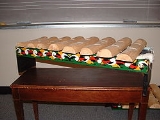
The
xylophone is a
musical instrumentA musical instrument is a device created or adapted for the purpose of making musical sounds. In principle, any object that produces sound can serve as a musical instrument—it is through purpose that the object becomes a musical instrument. The history of musical instruments dates back to the...
in the
percussionA percussion instrument is any object which produces a sound when hit with an implement or when it is shaken, rubbed, scraped, or otherwise acted upon in a way that sets the object into vibration...
family that consists of wooden (not steel) bars struck by mallets. Each bar is an
idiophoneAn idiophone is any musical instrument which creates sound primarily by way of the instrument's vibrating, without the use of strings or membranes. It is the first of the four main divisions in the original Hornbostel-Sachs scheme of musical instrument classification...
tuned to a pitch of a
musical scaleIn music, a scale is a sequence of musical notes in ascending and descending order. Most commonly, especially in the context of the common practice period, the notes of a scale will belong to a single key, thus providing material for or being used to conveniently represent part or all of a musical...
, whether
pentatonicA pentatonic scale is a musical scale with five notes per octave in contrast to a heptatonic scale such as the major scale and minor scale...
or
heptatonicA heptatonic scale is a musical scale with seven pitches per octave. Among the most famous of these are the major scale, C D E F G A B C; the melodic minor scale, C D E F G A B C ascending, C B A G F E D C descending; the harmonic minor scale, C D E F G A B C; and a scale variously known as the...
in the case of many African and Asian instruments,
diatonicIn music theory, a diatonic scale is a seven note, octave-repeating musical scale comprising five whole steps and two half steps for each octave, in which the two half steps are separated from each other by either two or three whole steps...
in many western children's instruments, or
chromaticThe chromatic scale is a musical scale with twelve pitches, each a semitone apart. On a modern piano or other equal-tempered instrument, all the half steps are the same size...
for orchestral use. The term may be used generally, to include all such instruments, such as the
marimbaThe marimba is a musical instrument in the percussion family. It consists of a set of wooden keys or bars with resonators. The bars are struck with mallets to produce musical tones. The keys are arranged as those of a piano, with the accidentals raised vertically and overlapping the natural keys ...
and
balafonThe balafon is a resonated frame, wooden keyed percussion idiophone of West Africa; part of the idiophone family of tuned percussion instruments that includes the xylophone, marimba, glockenspiel, and the vibraphone...
or, more specifically, to refer to an orchestral instrument of somewhat higher pitch range than the chromatic marimba. It is sometimes mistakenly used of similar lithophones and
metallophoneA metallophone is any musical instrument consisting of tuned metal bars which are struck to make sound, usually with a mallet.Metallophones have been used in music for hundreds of years. There are several different types used in Balinese and Javanese gamelan ensembles, including the gendér, gangsa...
instruments of the
glockenspielA glockenspiel is a percussion instrument composed of a set of tuned keys arranged in the fashion of the keyboard of a piano. In this way, it is similar to the xylophone; however, the xylophone's bars are made of wood, while the glockenspiel's are metal plates or tubes, and making it a metallophone...
type such as the pixiphone.
Description
The modern western xylophone has bars of
rosewoodRosewood refers to any of a number of richly hued timbers, often brownish with darker veining, but found in many different hues. All rosewoods are strong and heavy, taking an excellent polish, being suitable for guitars, marimbas, turnery , handles, furniture, luxury flooring, etc.In general,...
, padak, or various synthetic materials such as fiberglass or fiberglass-reinforced plastic which allows a louder sound. Some can be as small a range as 2½ octaves but concert xylophones are typically 3½ or 4 octaves. The xylophone is a
transposing instrumentA transposing instrument is a musical instrument for which written notes are read at a pitch different from the corresponding concert pitch, which a non-transposing instrument, such as a piano, would play. Playing a written C on a transposing instrument will produce a note other than concert C...
: its parts are written one octave below the sounding notes. Xylophones should be played with very hard rubber, polyball, or acrylic mallets. Sometimes medium to hard rubber mallets, very hard core, or yarn mallets are used for softer effects. Lighter tones can be created on xylophones by using wooden-headed mallets made from rosewood, ebony, birch, or other hard woods.
Concert xylophones have tube resonators below the bars to enhance the tone and sustain. Frames are made of wood or cheap steel tubing: more expensive xylophones feature height adjustment and more stability in the stand. In other music cultures some versions have
gourdA gourd is a plant of the family Cucurbitaceae. Gourd is occasionally used to describe crops like cucumbers, squash, luffas, and melons. The term 'gourd' however, can more specifically, refer to the plants of the two Cucurbitaceae genera Lagenaria and Cucurbita or also to their hollow dried out shell...
s that act as Helmholtz resonators. Others are "trough" xylophones with a single hollow body that acts as a resonator for all the bars. Old methods consisted of arranging the bars on tied bundles of straw, and, as still practiced today, placing the bars adjacent to each other in a ladder-like layout. Ancient mallets were made of willow wood with spoon-like bowls on the beaten ends.
History
The instrument has obscure, ancient origins. It is sometimes asserted that it was invented independently in both Africa and Asia. According to Nettl, however, it originated in southeast Asia and came to Africa c. 500 AD when a group of Malayo-Polynesian speaking peoples migrated to Africa. One piece of evidence for this is the similarity between East African xylophone orchestras and Javanese and Balinese gamelan orchestras.
The Asian xylophone
The earliest evidence of a xylophone is from the 9th Century in
southeast AsiaSoutheast Asia, South-East Asia, South East Asia or Southeastern Asia is a subregion of Asia, consisting of the countries that are geographically south of China, east of India, west of New Guinea and north of Australia. The region lies on the intersection of geological plates, with heavy seismic...
according to the
Vienna Symphonic LibraryThe Vienna Symphonic Library is a producer of samples of orchestral instruments recorded by members of the Vienna Philharmonic. For recording the samples, VSL uses the Silent Stage, a recording studio specially constructed for this purpose. The number of recorded samples currently is about 1.3...
, and there is a model of a similar hanging wood instrument, dated to ca. 2000 BC in China. The xylophone-like
ranatRanat is the generic name for keyboard percussion instruments used in the music of Thailand. The bars of the various types of ranat may be made from hardwood or bamboo , metal , or, much more rarely, glass .-External...
was used in
HinduHindu refers to an identity associated with the philosophical, religious and cultural systems that are indigenous to the Indian subcontinent. As used in the Constitution of India, the word "Hindu" is also attributed to all persons professing any Indian religion...
regions. Another type of xylophone used in India was the kashta tharang.
JavaJava is an island of Indonesia. With a population of 135 million , it is the world's most populous island, and one of the most densely populated regions in the world. It is home to 60% of Indonesia's population. The Indonesian capital city, Jakarta, is in west Java...
and
BaliBali is an Indonesian island located in the westernmost end of the Lesser Sunda Islands, lying between Java to the west and Lombok to the east...
use xylophones (called
gambangA gambang, properly called a gambang kayu is a xylophone-like instrument used among peoples of Indonesia and the southern Philippines in gamelan and kulintang, with wooden bars as opposed to the metallic ones of the more typical metallophones in a gamelan...
) in
gamelanA gamelan is a musical ensemble from Indonesia, typically from the islands of Bali or Java, featuring a variety of instruments such as metallophones, xylophones, drums and gongs; bamboo flutes, bowed and plucked strings. Vocalists may also be included....
ensembles. They still have traditional significance in Africa,
Malaysia,
MelanesiaMelanesia is a subregion of Oceania extending from the western end of the Pacific Ocean to the Arafura Sea, and eastward to Fiji. The region comprises most of the islands immediately north and northeast of Australia...
,
IndonesiaIndonesia , officially the Republic of Indonesia , is a country in Southeast Asia and Oceania. Indonesia is an archipelago comprising approximately 13,000 islands. It has 33 provinces with over 238 million people, and is the world's fourth most populous country. Indonesia is a republic, with an...
, and regions of the Americas. From Africa, the instrument was imported to South America by Africans, where it developed into the
marimbaThe marimba is a musical instrument in the percussion family. It consists of a set of wooden keys or bars with resonators. The bars are struck with mallets to produce musical tones. The keys are arranged as those of a piano, with the accidentals raised vertically and overlapping the natural keys ...
.
The African xylophone
The term
marimba is also applied to various traditional folk instruments such as the
West AfricaWest Africa or Western Africa is the westernmost region of the African continent. Geopolitically, the UN definition of Western Africa includes the following 16 countries and an area of approximately 5 million square km:-Flags of West Africa:...
balafonThe balafon is a resonated frame, wooden keyed percussion idiophone of West Africa; part of the idiophone family of tuned percussion instruments that includes the xylophone, marimba, glockenspiel, and the vibraphone...
. Early forms were constructed of bars atop a
gourdA gourd is a plant of the family Cucurbitaceae. Gourd is occasionally used to describe crops like cucumbers, squash, luffas, and melons. The term 'gourd' however, can more specifically, refer to the plants of the two Cucurbitaceae genera Lagenaria and Cucurbita or also to their hollow dried out shell...
. The wood is first roasted around a fire before shaping the key to achieve the desired tone. The resonator is tuned to the key through careful choice of size of resonator, adjustment of the diameter of the mouth of the resonator using wasp wax and adjustment of the height of the key above the resonator. A skilled maker can produce startling amplification. The mallets used to play
dibinda and
mbila have heads made from natural rubber taken from a wild creeping plant. "Interlocking" or alternating rhythm features in Eastern African xylophone music such as that of the Makonde
dimbila, the Yao
mangolongondo or the Shirima
mangwilo in which the
opachera, the initial caller, is responded to by another player, the
wakulela. This usually doubles an already rapid
rhythmic pulseIn music and music theory, the pulse or tactus consists of beats in a series of identical yet distinct periodic short-duration stimuli perceived as points in time occurring at the mensural level...
that may also co-exist with a
counter-rhythmIn music, a cross-beat or cross-rhythm is a form of polyrhythm.Cross-rhythm. A rhythm in which the regular pattern of accents of the prevailing meter is contradicted by a conflicting pattern and not merely a momentary displacement that leaves the prevailing meter fundamentally unchallenged.—New...
.
Mbila
The Mbila (plural "Timbila") is associated with the
ChopiThe Chopi are an ethnic group of Mozambique. They have traditionally lived primarily in the Zavala region of southern Mozambique, in the Inhambane Province. They traditionally lived a life of subsistence agriculture, traditionally living a rural existence, although many were displaced or killed in...
people of the
Inhambane ProvinceInhambane is a province of Mozambique located on the coast in the southern part of the country. It has an area of 68,615 km² and a population of 1.412.349 . The provincial capital is also called Inhambane....
, in southern Mozambique. It is not to be confused with the
mbiraIn African music, the mbira is a musical instrument that consists of a wooden board to which staggered metal keys have been attached. It is often fitted into a resonator...
. The style of music played with it "is believed to be the most sophisticated method of composition yet found among preliterate peoples." The gourd-resonated, equal-ratio heptatonic-tuned mbila of
MozambiqueMozambique, officially the Republic of Mozambique , is a country in southeastern Africa bordered by the Indian Ocean to the east, Tanzania to the north, Malawi and Zambia to the northwest, Zimbabwe to the west and Swaziland and South Africa to the southwest...
is typically played in large ensembles in a choreographed dance, perhaps depicting a historical drama. Ensembles consist of around ten xylophones of three or four sizes. A full orchestra would have two bass instruments called
gulu with three or four wooden keys played standing up using heavy mallets with solid rubber heads, three tenor
dibinda, with ten keys and played seated, and the mbila itself, which has up to nineteen keys of which up to eight may be played simultaneously. The
gulu uses gourds and the
mbila and
dibinda Masala apple shells as resonators. They accompany the dance with long compositions called
ngomi or
mgodo and consist of about 10 pieces of music grouped into 4 separate movements, with an overture, in different
tempoIn musical terminology, tempo is the speed or pace of a given piece. Tempo is a crucial element of any musical composition, as it can affect the mood and difficulty of a piece.-Measuring tempo:...
s and styles. The ensemble leader serves as
poetA poet is a person who writes poetry. A poet's work can be literal, meaning that his work is derived from a specific event, or metaphorical, meaning that his work can take on many meanings and forms. Poets have existed since antiquity, in nearly all languages, and have produced works that vary...
,
composerA composer is a person who creates music, either by musical notation or oral tradition, for interpretation and performance, or through direct manipulation of sonic material through electronic media...
,
conductorConducting is the art of directing a musical performance by way of visible gestures. The primary duties of the conductor are to unify performers, set the tempo, execute clear preparations and beats, and to listen critically and shape the sound of the ensemble...
and performer, creating a text, improvising a
melodyA melody , also tune, voice, or line, is a linear succession of musical tones which is perceived as a single entity...
partially based on the features of the Chopi tone language and composing a second
countrapuntalIn music, counterpoint is the relationship between two or more voices that are independent in contour and rhythm and are harmonically interdependent . It has been most commonly identified in classical music, developing strongly during the Renaissance and in much of the common practice period,...
line. The musicians of the ensemble partially
improviseImprovisation is the practice of acting, singing, talking and reacting, of making and creating, in the moment and in response to the stimulus of one's immediate environment and inner feelings. This can result in the invention of new thought patterns, new practices, new structures or symbols, and/or...
their parts. The composer then consults with the choreographer of the ceremony and adjustments are made. The longest and most important of these is the "Mzeno" which will include a song telling of an issue of local importance or even making fun of a prominent figure in the community. Performers include Eduardo Durão and Venancio Mbande.
Gyil
The
gyil (lang or ˈ) is a pentatonic instrument common to the
Gur-People:*Mordechai Gur , Israeli politician and the 10th Chief of Staff of the Israeli Defense Forces-Places:*A village in Tibet, see Gur, Tibet*Gur place name in ancient Israel near Megiddo*Guernsey, one of the Channel Islands-Other:...
-speaking populations in
GhanaGhana , officially the Republic of Ghana, is a country located in West Africa. It is bordered by Côte d'Ivoire to the west, Burkina Faso to the north, Togo to the east, and the Gulf of Guinea to the south...
,
Burkina FasoBurkina Faso – also known by its short-form name Burkina – is a landlocked country in west Africa. It is surrounded by six countries: Mali to the north, Niger to the east, Benin to the southeast, Togo and Ghana to the south, and Côte d'Ivoire to the southwest.Its size is with an estimated...
and
Côte d'IvoireThe Republic of Côte d'Ivoire or Ivory Coast is a country in West Africa. It has an area of , and borders the countries Liberia, Guinea, Mali, Burkina Faso and Ghana; its southern boundary is along the Gulf of Guinea. The country's population was 15,366,672 in 1998 and was estimated to be...
. The Gyil is the primary traditional instrument of the
Dagara peopleThe Dagaaba people ) are an ethnic group in the West African nations of Ghana and Burkina Faso. They speak the Dagaare language, made up of the related Northern Dagaare language, Southern Dagaare language, a number of sub dialects. They are related to the Birifor people and the Dagaare Diola...
of northern Ghana and Burkina Faso, and of the
LobiThe Lobi are an ethnic group that originated in what is today Ghana. Starting around 1770 many of the Lobi migrated into southern Burkina Faso and later into Côte d'Ivoire. Currently the group consists of around 160,000 people...
of Ghana, southern Burkina Faso, and
Côte d'IvoireThe Republic of Côte d'Ivoire or Ivory Coast is a country in West Africa. It has an area of , and borders the countries Liberia, Guinea, Mali, Burkina Faso and Ghana; its southern boundary is along the Gulf of Guinea. The country's population was 15,366,672 in 1998 and was estimated to be...
. The gyil is usually played in pairs, accompanied by a calabash gourd drum called a
kuor. It can also be played by one person with the drum and the stick part as accompaniment, or by a soloist. Gyil duets are the traditional music of
DagaraDagara may refer to:* Dagara people, an African ethnic group** Dagara language, their language* Dagara, Baleswar, a vilage in India* A district, or barangay, in Kabugao, Apayao, the Philippines* A Bosnian dish...
funerals. The instrument is generally played by men, who learn to play while young, however, there is no restriction on gender.
The Gyil's design is similar to the
Balaba or
BalafonThe balafon is a resonated frame, wooden keyed percussion idiophone of West Africa; part of the idiophone family of tuned percussion instruments that includes the xylophone, marimba, glockenspiel, and the vibraphone...
used by the
MandeMande may refer to:* Mandé peoples of western Africa* Mande languages* Manding, a term covering a subgroup of Mande peoples, and sometimes used for one of them, Mandinka* Garo people of northeastern India and northern Bangladesh...
-speaking Bambara,
DyulaThe Dyula are a Mande ethnic group inhabiting several West African countries, including the Mali, Burkina Faso, Senegal and Guinea-Bissau....
and
SossoThe Sosso Empire was a twelfth-century Kaniaga kingdom of West Africa.-Medieval Sosso:The modern Sosso people trace their history to a 12th- and 13th-century Kaniaga kingdom known as the "Sosso." With the fall of the Ghana Empire, the Sosso expanded into a number of its former holdings, including...
peoples further west in southern
MaliMali , officially the Republic of Mali , is a landlocked country in Western Africa. Mali borders Algeria on the north, Niger on the east, Burkina Faso and the Côte d'Ivoire on the south, Guinea on the south-west, and Senegal and Mauritania on the west. Its size is just over 1,240,000 km² with...
and western
Burkina FasoBurkina Faso – also known by its short-form name Burkina – is a landlocked country in west Africa. It is surrounded by six countries: Mali to the north, Niger to the east, Benin to the southeast, Togo and Ghana to the south, and Côte d'Ivoire to the southwest.Its size is with an estimated...
, a region that shares many musical traditions with those of northern Côte d'Ivoire and Ghana. It is made with 14 wooden keys of an African hardwood called liga attached to a wooden frame, below which hang
calabashLagenaria siceraria , bottle gourd, opo squash or long melon is a vine grown for its fruit, which can either be harvested young and used as a vegetable, or harvested mature, dried, and used as a bottle, utensil, or pipe. For this reason, the calabash is widely known as the bottle gourd...
gourds. Spider web silk covers small holes in the gourds to produce a buzzing sound and antelope sinew and leather are used for the fastenings. The instrument is played with rubber-headed wooden mallets.
Silimba
The
silimba is a xylophone developed by the
Lozi peopleThe Lozi people are an ethnic group primarily of western Zambia, inhabiting the region of Barotseland. Lozi are also found in Namibia , Angola and Botswana.-Name:...
in
BarotselandBarotseland is a region in the western part of Zambia, and is the homeland of the Lozi people or Barotse who were previously known as Luyi or Aluyi. Its heartland is the Barotse Floodplain on the upper Zambezi River, also known as Bulozi or Lyondo, but it includes the surrounding higher ground of...
, western
ZambiaZambia , officially the Republic of Zambia, is a landlocked country in Southern Africa. The neighbouring countries are the Democratic Republic of the Congo to the north, Tanzania to the north-east, Malawi to the east, Mozambique, Zimbabwe, Botswana and Namibia to the south, and Angola to the west....
. The tuned keys are tied atop resonating gourds. The silimba, or shinjimba, is used by the
Nkoya peopleThe Nkoya people are a Bantu people native to Zambia, mostly found in the Western and Southern provinces and the Mankoya area.Their language is a member of zone L of the Bantu languages.As of 2006, they were estimated to number 146,000 people....
of Western
ZambiaZambia , officially the Republic of Zambia, is a landlocked country in Southern Africa. The neighbouring countries are the Democratic Republic of the Congo to the north, Tanzania to the north-east, Malawi to the east, Mozambique, Zimbabwe, Botswana and Namibia to the south, and Angola to the west....
at traditional royal ceremonies like the Kazanga Nkoya. The shilimba is now used in most parts of Zambia.
Akadinda and Amdadinda
The
akadinda and the
amadinda are xylophone-like instruments originating in
BugandaBuganda is a subnational kingdom within Uganda. The kingdom of the Ganda people, Buganda is the largest of the traditional kingdoms in present-day Uganda, comprising all of Uganda's Central Region, including the Ugandan capital Kampala, with the exception of the disputed eastern Kayunga District...
, in modern-day
UgandaUganda , officially the Republic of Uganda, is a landlocked country in East Africa. Uganda is also known as the "Pearl of Africa". It is bordered on the east by Kenya, on the north by South Sudan, on the west by the Democratic Republic of the Congo, on the southwest by Rwanda, and on the south by...
. The amadinda is made of twelve logs which are tuned in a pentatonic scale. It is played by three players. Two players sit opposite of each other and play the same logs in an interlocking technique in a fast tempo. It has no gourd resonators or buzzing tone, two characteristics of many other African xylophones.
The amadinda was an important instrument at the royal court in
BugandaBuganda is a subnational kingdom within Uganda. The kingdom of the Ganda people, Buganda is the largest of the traditional kingdoms in present-day Uganda, comprising all of Uganda's Central Region, including the Ugandan capital Kampala, with the exception of the disputed eastern Kayunga District...
, the kingdom which gave
UgandaUganda , officially the Republic of Uganda, is a landlocked country in East Africa. Uganda is also known as the "Pearl of Africa". It is bordered on the east by Kenya, on the north by South Sudan, on the west by the Democratic Republic of the Congo, on the southwest by Rwanda, and on the south by...
its name. A special type of
notationMusic notation or musical notation is any system that represents aurally perceived music, through the use of written symbols.-History:...
is now used for this xylophone, consisting of numbers and periods. as is also the case with the
embaire, a type of xylophone originating in southern
UgandaUganda , officially the Republic of Uganda, is a landlocked country in East Africa. Uganda is also known as the "Pearl of Africa". It is bordered on the east by Kenya, on the north by South Sudan, on the west by the Democratic Republic of the Congo, on the southwest by Rwanda, and on the south by...
.
Balo
The
balo (
balenjeh,
behlanjeh) is used among the
Mandinka peopleThe Mandinka, Malinke are one of the largest ethnic groups in West Africa with an estimated population of eleven million ....
of West Africa. Its keys are mounted on gourds, and struck with mallets with rubber tips. The players typically wear iron cylinders and rings attached to their hands so that they jingle as they play.
The western xylophone
The first use of the term is comparatively recent: it came into use in Europe in the 1860s. The first use of a European orchestral xylophone was in
Camille Saint-SaënsCharles-Camille Saint-Saëns was a French Late-Romantic composer, organist, conductor, and pianist. He is known especially for The Carnival of the Animals, Danse macabre, Samson and Delilah, Piano Concerto No. 2, Cello Concerto No. 1, Havanaise, Introduction and Rondo Capriccioso, and his Symphony...
' "
Danse MacabreDanse macabre, Op. 40, is a tone poem for orchestra, written in 1874 by French composer Camille Saint-Saëns. It started out in 1872 as an art song for voice and piano with a French text by the poet Henri Cazalis, which is based in an old French superstition...
", in 1874. The instrument had already been popularized to some extent by
Michael Josef Gusikovthumb|right|Joseph Gusikov, from Lewald's 'Europa' . Engraving by [[Josef Kriehuber]]Michal Josef Gusikov was a klezmer who gave the first performances of klezmer music to West European concert audiences on his 'wood and straw instrument'.- Gusikov and his instrument :thumb|left|Gusikow's...
, whose instrument was the five-row xylophone made of 28 crude wooden bars arranged in semitones in the form of a trapezoid and resting on straw supports. There were no resonators and it was played with spoon-shaped sticks. According to the musicologist
Curt SachsCurt Sachs was a German-born but American-domiciled musicologist. He was one of the founders of modern organology , and is probably best remembered today for co-authoring the Sachs-Hornbostel scheme of musical instrument classification with his fellow scholar Erich von Hornbostel.Born in Berlin,...
Gusikov performed in garden concerts, variety shows, and as a novelty at symphony concerts. The instrument was associated largely with the folk music of Eastern Europe, notably Poland and eastern Germany. An early version appeared in
SlovakiaThe Slovak Republic is a landlocked state in Central Europe. It has a population of over five million and an area of about . Slovakia is bordered by the Czech Republic and Austria to the west, Poland to the north, Ukraine to the east and Hungary to the south...
and the earliest reference to a similar instrument came in the 14th century. German organist Arnold Schlick's 16th-century
Spiegel der Orgelmacher und Organisten also mentions one.
The xylophone was used by early jazz bands and in
vaudevilleVaudeville was a theatrical genre of variety entertainment in the United States and Canada from the early 1880s until the early 1930s. Each performance was made up of a series of separate, unrelated acts grouped together on a common bill...
. Its bright, lively sound worked well the syncopated dance music of the 1920s and 1930s.
Red NorvoRed Norvo was one of jazz's early vibraphonists, known as "Mr. Swing". He helped establish the xylophone, marimba and later the vibraphone as viable jazz instruments...
,
George CaryGeorge Cary was a United States Representative from Georgia. He was born near Allens Fresh, Charles County, Maryland. He received a classical education and studied law. He was admitted to the bar and commenced practice in Frederick, Maryland. He was also engaged in agricultural pursuits.Cary...
,
George Hamilton GreenGeorge Hamilton Green, Jr. was a xylophonist, composer, and cartoonist born in Omaha, Nebraska. He was born into a musical family, both his grandfather and his father being composers, arrangers, and conductors for bands in Omaha. From age four G.H...
, and Harry Breuer were well-known users. As time passed, the xylophone was exceeded in popularity by the vibraphone. The xylophone is a precursor to the
vibraphoneThe vibraphone, sometimes called the vibraharp or simply the vibes, is a musical instrument in the struck idiophone subfamily of the percussion family....
, which was developed in the 1920s. A xylophone with a range extending downwards into the marimba range is called a
xylorimbaThe xylorimba is a pitched percussion instrument corresponding to a xylophone with an extended range ....
.
ShostakovichDmitri Dmitriyevich Shostakovich was a Soviet Russian composer and one of the most celebrated composers of the 20th century....
was particularly fond of the instrument; it has prominent roles in much of his work, including most of his
symphoniesA symphony is an extended musical composition in Western classical music, scored almost always for orchestra. A symphony usually contains at least one movement or episode composed according to the sonata principle...
and his
Cello Concerto No. 2The Cello Concerto No. 2, Opus 126, was written by Dmitri Shostakovich in the spring of 1966 in the Crimea. Like the first concerto, it was written for Mstislav Rostropovich, who gave the premiere in Moscow under Yevgeny Svetlanov on 25 September 1966 at the composer's 60th birthday concert...
. Modern xylophone players include Bob Becker,
Evelyn GlennieDame Evelyn Elizabeth Ann Glennie, DBE is a Scottish virtuoso percussionist. She was the first full-time solo percussionist in 20th-century western society.-Early life:Glennie was born and raised in Aberdeenshire...
and Ian Finkel.
In the U.S., there are Zimbabwean marimba bands in particularly high concentration in the Pacific Northwest, Colorado, and New Mexico, but bands exist from the East Coast through California and even to Hawaii and Alaska. The main event for this community is ZimFest, the annual Zimbabwean Music Festival. The bands are composed of instruments from high sopranos, through to lower soprano, tenor, baritone, and bass. Resonators are usually made with holes covered by thin cellophane (similar to the
balafonThe balafon is a resonated frame, wooden keyed percussion idiophone of West Africa; part of the idiophone family of tuned percussion instruments that includes the xylophone, marimba, glockenspiel, and the vibraphone...
) to achieve the characteristic buzzing sound. As of 2006, the repertoires of U. S. bands tends to have a great overlap, due to the common source of the Zimbabwean musician
Dumisani MaraireAbraham Dumisani Maraire , known to friends as "Dumi," was a master performer of the mbira, a traditional instrument of the Shona ethnic group of Zimbabwe. He specialized in the form of mbira called nyunga nyunga, as well as the Zimbabwean marimba...
, who was the key person who first brought Zimbawean music to the West, coming to the University of Washington in 1968.
Use in elementary education
Many music educators use xylophones as a classroom resource to assist children's musical development. One method noted for its use of xylophones is Orff-Schulwerk, which combines the use of instruments, movement, singing and speech to develop children's musical abilities. Xylophones used in American general music classrooms are smaller, at about 1½ octaves, than the 2½ or more octave range of performance xylophones. The bass xylophone ranges are written from middle C to A an octave higher but sound one octave lower than written. The alto ranges are written from middle C to A an octave higher and sound as written. The soprano ranges are written from middle C to A an octave higher but sound one octave higher than written.
According to Professor Andrew Tracey, marimbas were introduced to Zimbabwe in 1960.
ZimbabweanZimbabwean music includes folk and pop styles, much of it based on the well-known instrument the mbira which is also popular in many other African countries. An annual Zimbabwe Music Festival is held each year in the Pacific Northwest of the United States. People from all over the world attend...
marimba based upon
Shona musicShona music is the music of the Shona people of Zimbabwe. There are several different types of traditional Shona music including mbira, singing, hosho and drumming. Very often, this music will be accompanied by dancing, and participation by the audience...
has also become popular in the West, which adopted the original use of these instruments to play transcriptions of
mbiraIn African music, the mbira is a musical instrument that consists of a wooden board to which staggered metal keys have been attached. It is often fitted into a resonator...
dzavadzimu (as well as
nyunga nyunga and
matepe) music. The first of these transcriptions had originally been used for music education in Zimbabwe. Zimbabwean instruments are often in a diatonic C major scale, which allows them to be played with a 'western-tuned' mbira (G nyamaropa), sometimes with an added F# key placed inline.
See also
- Balafon
The balafon is a resonated frame, wooden keyed percussion idiophone of West Africa; part of the idiophone family of tuned percussion instruments that includes the xylophone, marimba, glockenspiel, and the vibraphone...
- Timpani
The modern timpani evolved in the 18th and 19th centuries from the simple 12th century membranophone of the Naker to a complex instrument, consisting of a suspended kettle with a foot operated clutch, capable of rapid tuning...
- Glockenspiel
A glockenspiel is a percussion instrument composed of a set of tuned keys arranged in the fashion of the keyboard of a piano. In this way, it is similar to the xylophone; however, the xylophone's bars are made of wood, while the glockenspiel's are metal plates or tubes, and making it a metallophone...
- Lamellophone
- Lithophone
A lithophone is a musical instrument consisting of a rock or pieces of rock which are struck to produce musical notes. Notes may be sounded in combination or in succession...
- Marimba
The marimba is a musical instrument in the percussion family. It consists of a set of wooden keys or bars with resonators. The bars are struck with mallets to produce musical tones. The keys are arranged as those of a piano, with the accidentals raised vertically and overlapping the natural keys ...
- Metallophone
A metallophone is any musical instrument consisting of tuned metal bars which are struck to make sound, usually with a mallet.Metallophones have been used in music for hundreds of years. There are several different types used in Balinese and Javanese gamelan ensembles, including the gendér, gangsa...
- Musical Stones of Skiddaw
The Musical Stones of Skiddaw is a lithophone made of a type of hornfels rock found in Cumbria, England. Constructed between 1827 and 1840, the instrument has entertained royalty; it is now housed at the Keswick Museum and Art Gallery in Cumbria....
- Thongophone
A thongophone is a musical instrument classified as a percussion instrument. Playing the thongophone is somewhat rare in Western music for solo performance, but was brought to prominence by the music of Yanni and Blue Man Group, among others...
- Vibraphone
The vibraphone, sometimes called the vibraharp or simply the vibes, is a musical instrument in the struck idiophone subfamily of the percussion family....
- Music of Mozambique
The native folk music of Mozambique has been highly influenced by Portuguese forms. The most popular style of modern dance music is marrabenta. Mozambican music also influenced another Lusophone music in Brazil, like maxixe , and Cuban music like Mozambique.Culture was an integral part of the...
- Music of Zambia
The music of Zambia has a rich heritage which falls roughly into three categories: traditional, popular and Christian.- Traditional music :Traditional Zambian music is rooted in the beliefs and practices of Zambia's various ethnic groups and has suffered some decline in the last three decades...
Sources
- Nettl, Bruno (1956). Music in Primitive Culture. Harvard University Press.
- Paco, Celso. "A Luta Continua". 2000. In Broughton, Simon and Ellingham, Mark with McConnachie, James and Duane, Orla (Ed.), World Music, Vol. 1: Africa, Europe and the Middle East, pp 579–584. Rough Guides Ltd, Penguin Books. ISBN 1-85828-636-0
- Tracey, Hugh
Hugh Tracey was an important twentieth century ethnomusicologist. He and his wife collected and archived music from Southern and Central Africa. He began making field recordings of music in the early 20's, through the 70's....
. (1948, reprinted 1970). Chopi Musicians: their Music, Poetry, and Instruments. London: International African Institute and Oxford University Press. SBN 19 724182 4.
- Hallis, Ron and Hallis, Ophera. (1987). Chopi Music of Mozambique. 28 minutes. 16 mm Video.
External links