
All Topics  
Munda languages


   Email Print
   Bookmark   Link


Munda languages


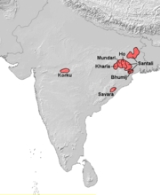
The Munda languages are a language family
Language family

A language family is a group of languages related Genetic from a common ancestor, called the proto-language of that family.As with Alpha taxonomy, the evidence of relationship is observable shared characteristics....
 spoken by about nine million people in central and eastern India
India

India, officially the Republic of India , is a country in South Asia. It is the List of countries and outlying territories by total area country by geographical area, the List of countries by population country, and the most populous liberal democracy in the world....
 and Bangladesh
Bangladesh

, officially the People's Republic of Bangladesh is a country in South Asia. It is bordered by India on all sides except for a small border with Burma to the far southeast and by the Bay of Bengal to the south....
. They constitute a branch of the Austroasiatic language family, generally placed in opposition to the Mon-Khmer languages
Mon-Khmer languages

The Mon-Khmer languages are the Autochthonous language language family of Southeast Asia. Together with the Munda languages of India, they are one of the two traditional primary branches of the Austroasiatic languages family....
 of Southeast Asia
Southeast Asia

Southeast Asia or Southeastern Asia is a subregion of Asia, consisting of the countries that are geographically south of China, east of India and north of Australia....
, which means they are distantly related to Vietnamese
Vietnamese language

Vietnamese , formerly known under French colonization as Annamese , is the national language and official language language of Vietnam. It is the mother tongue of the Vietnamese people , who constitute 86% of Demographics of Vietnam, and of about three million overseas Vietnamese, most of whom live in the United States....
 and Khmer
Khmer language

Khmer , or Cambodian, is the language of the Khmer people and the official language of Cambodia. It is the second most widely spoken Austro-Asiatic languages, with speakers in the tens of millions....
. The origins of the Munda languages are not known, though it is generally thought that they are autochthonous languages of eastern India.


Discussion
Ask a question about 'Munda languages'
Start a new discussion about 'Munda languages'
Answer questions from other users
Full Discussion Forum


Encyclopedia


The Munda languages are a language family
Language family

A language family is a group of languages related Genetic from a common ancestor, called the proto-language of that family.As with Alpha taxonomy, the evidence of relationship is observable shared characteristics....
 spoken by about nine million people in central and eastern India
India

India, officially the Republic of India , is a country in South Asia. It is the List of countries and outlying territories by total area country by geographical area, the List of countries by population country, and the most populous liberal democracy in the world....
 and Bangladesh
Bangladesh

, officially the People's Republic of Bangladesh is a country in South Asia. It is bordered by India on all sides except for a small border with Burma to the far southeast and by the Bay of Bengal to the south....
. They constitute a branch of the Austroasiatic language family, generally placed in opposition to the Mon-Khmer languages
Mon-Khmer languages

The Mon-Khmer languages are the Autochthonous language language family of Southeast Asia. Together with the Munda languages of India, they are one of the two traditional primary branches of the Austroasiatic languages family....
 of Southeast Asia
Southeast Asia

Southeast Asia or Southeastern Asia is a subregion of Asia, consisting of the countries that are geographically south of China, east of India and north of Australia....
, which means they are distantly related to Vietnamese
Vietnamese language

Vietnamese , formerly known under French colonization as Annamese , is the national language and official language language of Vietnam. It is the mother tongue of the Vietnamese people , who constitute 86% of Demographics of Vietnam, and of about three million overseas Vietnamese, most of whom live in the United States....
 and Khmer
Khmer language

Khmer , or Cambodian, is the language of the Khmer people and the official language of Cambodia. It is the second most widely spoken Austro-Asiatic languages, with speakers in the tens of millions....
. The origins of the Munda languages are not known, though it is generally thought that they are autochthonous languages of eastern India. Ho
Ho language

Ho is a Munda languages of the Austroasiatic languages spoken primarily in India by about 1,077,000 people. It is written with the Devanagari and the Varang Kshiti scripts....
, Mundari
Mundari language

The Mundari are a small nilotic tribe of cattle herders and agriculturalists native to Southern Sudan. Mandari language is also the name of the language spoken by that people and they are among the Bari people Speakers like the Kuku, Kakaw,Pojulu People and Nyangwara....
, and Santali
Santali language

Santali is a language in the Santali subfamily of Austroasiatic languages, related to Ho language and Mundari language. It is spoken by about six million people in India, Bangladesh, Nepal, and Bhutan ....
 are notable languages of this group.

The family is generally divided into two branches: North Munda, spoken in the Chota Nagpur Plateau
Chota Nagpur Plateau

The Chota Nagpur Plateau is a plateau in eastern India, which covers much of Jharkhand state as well as adjacent parts of Orissa, Bihar, and Chhattisgarh....
 of Jharkhand
Jharkhand

Jharkhand is a States and territories of India in eastern India. It was carved out of the southern part of Bihar state on 15 November 2000. Jharkhand shares its border with the states of Bihar to the north, Uttar Pradesh and Chhattisgarh to the west, Orissa to the south, and West Bengal to the east....
, Chhattisgarh
Chhattisgarh

Chhattisgarh , a States and territories of India in central India, formed when the sixteen Chhattisgarhi-speaking southeastern districts of Madhya Pradesh gained statehood on November 1, 2000....
, Bengal
Bengal

Bengal , is a historical and geographical region in the northeast of South Asia. Today it is mainly divided between the independent sovereign nation of the Bangladesh and the state of West Bengal in India, although some regions of the previous kingdoms of Bengal are now part of the neighboring Indian states of Bihar, Assam, Tripura and Oris...
, and Orissa
Orissa

Orissa , is a states and territories of India located on the east coast of India, by the Bay of Bengal. It was established on 1 April 1936 as a province in British India, and consists, predominantly of Oriya language speakers....
, and South Munda, spoken in central Orissa and along the border between Andhra Pradesh
Andhra Pradesh

Andhra Pradesh , abbreviated A.P.,is a state situated on eastern coast of India. It is India's List of states of India by area and List of states of India by population....
 and Orissa. However, it is widely suspected that this is an oversimplification.

North Munda, of which Santali is the chief language, is the larger of the two groups; its languages are spoken by about nine-tenths of Munda speakers. After Santhali, the Mundari and Ho languages rank next in number of speakers, followed by Korku and Sora. The remaining Munda languages are spoken by small, isolated groups of people and are little known.

Characteristics of the Munda languages include three grammatical number
Grammatical number

In linguistics, grammatical number is a grammatical category of nouns, pronouns, and adjective and verb agreement that expresses count distinctions ....
s (singular, dual, and plural), two gender
Grammatical gender

In linguistics, grammatical genders, sometimes also called noun classes, are classes of nouns reflected in the behavior of associated words; every noun must belong to one of the classes and there should be very few which belong to several classes at once....
s (animate and inanimate), a distinction between inclusive and exclusive first person plural pronouns, and the use of either suffixes or auxiliaries to indicate tense
Tense

Tense may refer to:*Grammatical tense, a temporal linguistic quality expressing the time at, during, or over which a state or action denoted by a verb occurs...
. In Munda sound systems, consonant sequences are infrequent except in the middle of a word. Other than in Korku, where syllables show a distinction between high and low tone, accent is predictable in the Munda languages.

Classification


Diffloth
Gérard Diffloth

G?rard Diffloth is a retired Austro-Asiatic Languages professor, formerly of the University of Chicago, Chicago, Illinois, and Cornell University, Ithaca, New York....
 (1974)

The bipartite Diffloth (1974) classification is widely cited:

  • North Munda
    • Korku
    • Kherwarian
      • Kherwari branch: Agariya
        Agariya language

        The Agariya language is spoken by the Agariya especially in Madhya Pradesh in India. It is an Austro-Asiatic language.In 1981 there were over 55,000 speakers of Agariya....
        , Bijori, Koraku
      • Mundari branch: Mundari
        Mundari language

        The Mundari are a small nilotic tribe of cattle herders and agriculturalists native to Southern Sudan. Mandari language is also the name of the language spoken by that people and they are among the Bari people Speakers like the Kuku, Kakaw,Pojulu People and Nyangwara....
        , Bhumij, Asuri, Koda, Ho
        Ho language

        Ho is a Munda languages of the Austroasiatic languages spoken primarily in India by about 1,077,000 people. It is written with the Devanagari and the Varang Kshiti scripts....
        , Birhor
      • Santali branch: Santali
        Santali language

        Santali is a language in the Santali subfamily of Austroasiatic languages, related to Ho language and Mundari language. It is spoken by about six million people in India, Bangladesh, Nepal, and Bhutan ....
        , Mahali, Turi
  • South Munda
    • Kharia-Juang: Kharia
      Kharia language

      The Kharia language is an Austro-Asiatic languages language that is primarily spoken by adivasi Kharia people of eastern India....
      , Juang
      Juang language

      The Juang language is a language spoken primarily by the Juang of eastern India....
    • Koraput Munda
      • Remo branch: Gata (Gta), Bondo (Remo), Bodo Gadaba (Gutob)
      • Savara branch[Sora-Juray-Gorum] : Parengi (Gorum) [in Koraput District] , Sora
        Sora language

        Sora is a Munda languages languages of India, spoken by some 288,000 native speakers in South Orissa in eastern India, mainly in the Ganjam District, but also in the Koraput District and Phulbani District districts; other communities exist in Andhra Pradesh , Madhya Pradesh, Bihar, Tamil Nadu, West Bengal, and the Plains Division of Assam....
         (Savara), Juray, Lodhi


Diffloth
Gérard Diffloth

G?rard Diffloth is a retired Austro-Asiatic Languages professor, formerly of the University of Chicago, Chicago, Illinois, and Cornell University, Ithaca, New York....
 (2005)

Diffloth (2005) shows a somewhat more complex picture:

Anderson (2001)

Contrary to either of Diffloth's classifications, Gregory D. S. Anderson (2001) rejects the existence of the "Koraput" clade and proposes, on the basis of morphological comparisons, that Proto-South Munda split directly into three sister groups: Kharia-Juang, Sora-Gorum, and Gutob-Remo-Gta.

Further reading


External links