
All Topics  
Harpsichord


   Email Print
   Bookmark   Link


Harpsichord


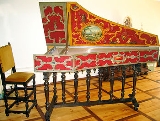
A harpsichord is a musical instrument
Musical instrument

A musical instrument is an object constructed or used for the purpose of making music. In principle, anything that produces sound can serve as a musical instrument....
 played by means of a keyboard
Musical keyboard

A musical keyboard is the set of adjacent depressible levers or keys on a musical instrument, particularly the piano. Keyboards typically contain keys for playing the twelve notes of the Western musical scale, with a combination of larger, longer keys and smaller, shorter keys that repeats at the interval of an octave....
. It produces sound by plucking a string when each key
Key (instrument)

A key is a specific part of a musical instrument. The purpose and function of the part in question depends on the instrument.On instruments equipped with tuning machines, violins and guitars, for example, a key is part of a tuning machine....
 is pressed.

Also in the harpsichord family are the smaller virginals
Virginals

The virginals or virginal is a keyboard instrument of the harpsichord family. It was popular in northern Europe and Italy during the Late Middle Ages and Renaissance periods....
, the muselar or muselaar virginals
Virginals

The virginals or virginal is a keyboard instrument of the harpsichord family. It was popular in northern Europe and Italy during the Late Middle Ages and Renaissance periods....
 and the spinet
Spinet

A spinet is a smaller type of harpsichord or other keyboard instrument, such as a piano or organ ....
 (but not the clavichord
Clavichord

The clavichord is a European stringed keyboard instrument known from the late Medieval music, through the Renaissance music, Baroque music and Classical music era eras....
 which is a hammered instrument).

The harpsichord was widely used in baroque music
Baroque music

Baroque music describes a period or style of European classical music approximately extending from Dates of classical music eras. This era is said to begin in music after the Renaissance music and was followed by the Classical music era....
. It became less popular following the invention of the piano
Piano

The piano is a musical instrument played by means of a keyboard instrument. Widely used in Western music for solo performance, ensemble use, chamber music, and accompaniment, the piano is also very popular as an aid to musical composition and rehearsal....
, but its distinctive sound is still used in contemporary music.

Mechanism
Harpsichords vary in size and shape, but they all have the same basic functional arrangement.


Discussion
Ask a question about 'Harpsichord'
Start a new discussion about 'Harpsichord'
Answer questions from other users
Full Discussion Forum


Encyclopedia


A harpsichord is a musical instrument
Musical instrument

A musical instrument is an object constructed or used for the purpose of making music. In principle, anything that produces sound can serve as a musical instrument....
 played by means of a keyboard
Musical keyboard

A musical keyboard is the set of adjacent depressible levers or keys on a musical instrument, particularly the piano. Keyboards typically contain keys for playing the twelve notes of the Western musical scale, with a combination of larger, longer keys and smaller, shorter keys that repeats at the interval of an octave....
. It produces sound by plucking a string when each key
Key (instrument)

A key is a specific part of a musical instrument. The purpose and function of the part in question depends on the instrument.On instruments equipped with tuning machines, violins and guitars, for example, a key is part of a tuning machine....
 is pressed.

Also in the harpsichord family are the smaller virginals
Virginals

The virginals or virginal is a keyboard instrument of the harpsichord family. It was popular in northern Europe and Italy during the Late Middle Ages and Renaissance periods....
, the muselar or muselaar virginals
Virginals

The virginals or virginal is a keyboard instrument of the harpsichord family. It was popular in northern Europe and Italy during the Late Middle Ages and Renaissance periods....
 and the spinet
Spinet

A spinet is a smaller type of harpsichord or other keyboard instrument, such as a piano or organ ....
 (but not the clavichord
Clavichord

The clavichord is a European stringed keyboard instrument known from the late Medieval music, through the Renaissance music, Baroque music and Classical music era eras....
 which is a hammered instrument).

The harpsichord was widely used in baroque music
Baroque music

Baroque music describes a period or style of European classical music approximately extending from Dates of classical music eras. This era is said to begin in music after the Renaissance music and was followed by the Classical music era....
. It became less popular following the invention of the piano
Piano

The piano is a musical instrument played by means of a keyboard instrument. Widely used in Western music for solo performance, ensemble use, chamber music, and accompaniment, the piano is also very popular as an aid to musical composition and rehearsal....
, but its distinctive sound is still used in contemporary music.

Mechanism


Harpsichords vary in size and shape, but they all have the same basic functional arrangement. The player presses a key, which causes the far end of the key to rise. This lifts a jack, a long strip of wood, to which is attached a small plectrum
Plectrum

A plectrum is a small flat tool used to pluck or strum a string instrument. For guitars and similar instruments, the plectrum is a separate tool held in the player's hand....
 (a bit of quill or plastic), which plucks the string. When the key is released by the player, the far end returns to its rest position and the jack falls back. The plectrum, mounted on a tongue that can swivel backwards away from the string, passes the string without plucking it again. As the key reaches its rest position, the string's vibrations are halted by the damper, a bit of felt attached to the top of the jack.

These basic principles are explained in more detail below.

  • The keylever is a simple pivot, which rocks on a balance pin passing through a hole drilled through it.
  • The jack is a thin, rectangular piece of wood which sits upright on the end of the keylever, held in place by the registers (the upper movable, the lower fixed) which are two long strips of wood running in the gap from spine to cheek with rectangular mortises through which the jacks can move up and down.

  • In the jack, a plectrum
    Plectrum

    A plectrum is a small flat tool used to pluck or strum a string instrument. For guitars and similar instruments, the plectrum is a separate tool held in the player's hand....
     juts out almost horizontally (normally the plectrum is angled upwards a tiny amount) and passes just under the string. Historically, plectra were normally made of crow
    Crow

    The true crows are large passerine birds that form the genus Corvus in the family Corvidae. Ranging in size from the relatively small dove-sized jackdaws to the Common Raven of the Holarctic region and Thick-billed Raven of the highlands of Ethiopia, the 40 or so members of this genus occur on all temperate continents and several offsh...
     quill or leather; most modern harpsichords based on historic instruments have plastic (delrin or celcon) quills.
  • When the front of the key is pressed, the back of the key rises, the jack is lifted, and the plectrum plucks the string.

  • When the key is lowered, the jack falls back down under its own weight, and the plectrum pivots backwards to allow it to pass the string. This is made possible by having the plectrum held in a tongue which is attached with a pivot and a spring to the body of the jack.
  • At the top of the jack, the felt damper keeps the string from vibrating when the key is not depressed.
  • The vertical rise of the jacks is stopped by the jackrail, which is covered with soft felt to muffle the jack's impact. The key-dip, which is the maximum depth the key may be pressed down, is usually set at the length of the jack. If the key-dip is too deep, which hinders quick repetition of notes and the execution of fast passages, the length of the corresponding jacks should be extended (by means of a pilot screw or other means).


Strings and soundboard


Simply plucking strings produces a feeble sound: the sonority of the harpsichord arises from its design to amplify it. The strings pass over a bridge
Bridge (instrument)

A bridge is a device for supporting the strings on a stringed instrument and transmitting the vibration of those strings to some other structural component of the instrument in order to transfer the sound to the surrounding air....
-like nut, a sharp edge supporting one end of their vibrating length, which is firmly attached to a soundboard, a thin panel of wood usually made of spruce
Spruce

A spruce is a tree of the genus Picea, a genus of about 35 species of coniferous evergreen trees in the Family Pinaceae, found in the northern temperate and boreal regions of the earth....
 or (in Italian harpsichords) cedar
Cedar

Cedar is a genus of coniferous trees in the plant family Pinaceae. They are most closely related to the Firs , sharing a very similar cone structure....
. The soundboard and case-construction efficiently transduces the vibrations of the strings into vibrations in the air. Also, in harpsichords with more than one choir of strings the vibrations of one string will invite its adjacent twin string to resonate in sympathy as long as the key is pressed. Some harpsichords have a 'damper off' position so that one choir of strings is undamped and may resonate freely in response to the tones played on the other choir(s).

Each string is held at the proper tension to sound the correct note. At one end, generally closest to the keyboard, each string is wound around a tuning pin, so that its tension may be adjusted by rotating the pin with a wrench (or tuning hammer). The tuning pins are held tightly in holes drilled in the pinblock or wrestplank, an oblong hard-wood plank. The other ends of the strings are fitted with twisted loopholes that pass over the hitchpins which are driven into the liner.

Multiple choirs of strings


Many harpsichords have exactly one string per note. There are several reasons why it is sometimes an advantage to have more. When there are two choirs of strings at the same length, it is possible to arrange for them to give different tonal qualities, and thus to increase the variety of sound produced by the instrument. This is done by having one set of strings plucked closer to the nut (the bridge-like device that terminates the sounding length of the strings) than the other. Plucking close to the nut emphasizes the higher harmonic
Harmonic

In acoustics and telecommunication, a harmonic of a wave is a component frequency of the Signalling that is an integer multiple of the fundamental frequency....
s, and produces a "nasal" sound quality. When two strings tuned to be the same pitch, or to an octave
Octave

In music, an octave The octave is occasionally referred to as a diapason.The octave above an indicated note is sometimes abbreviated 8va, and the octave below 8vb....
 apart, are plucked simultaneously by a single keystroke, the note is louder and richer than one produced by a single string. The qualitative distinction is particularly noticeable when the strings are tuned an octave apart.

When describing a harpsichord it is customary to specify its choirs of strings, often called its disposition
Disposition (harpsichord)

The disposition of a harpsichord is the set of choirs of strings it contains. This article describes various dispositions and gives the standard notation for describing them....
. Strings at eight foot pitch
Eight foot pitch

Eight-foot pitch is a term common to the Pipe organ and the harpsichord. An organ pipe, or a harpsichord string, designated as eight-foot pitch is sounded at standard, ordinary pitch....
 sound at the normal expected pitch, strings at four foot pitch sound an octave higher, and sometimes harpsichords have the rare 16-foot pitch (one octave lower than eight-foot) or two-foot pitch (two octaves higher).

When there are multiple choirs of strings, the player is often able to control which choirs sound. This is usually done by having a set of jacks for each choir, and a mechanism for "turning off" each set, often by moving the upper register (through which the jacks slide) sideways a short distance, so that their plectra miss the strings. In simpler instruments this is done by manually moving the registers, but as the harpsichord evolved levers, knee levers and pedal mechanisms were invented that made it easier to change registration.

More flexibility in selecting which strings play is available in harpsichords having more than one keyboard or manual, since each manual can control the plucking of a different set of strings. In addition, such harpsichords often have a mechanism to couple manuals together, so that two can be used while actually playing on only one. The most flexible system is the French shove coupler, in which the lower manual can slide forward and backward, so that in the backward position "dogs" attached to the upper surface of the lower manual engage the lower surface of the upper manual's keys. Depending on choice of keyboard and coupler position, the player can select any of the sets of jacks labeled in figure 4 as A, or B and C, or all three.

The English dogleg jack system is less flexible, in that the manuals are immobile. The dogleg shape of the set of jacks labeled A in figure 5 permits A to be played by either keyboard, but the lower manual necessarily plays all three sets, and the player cannot select just B and C as in the French shove coupler.

The use of multiple manuals in a harpsichord was not originally provided for the flexibility in choosing which strings would sound, but rather for transposition
Transposition (music)

In music transposition refers to the process of moving a collection of notes up or down in pitch by a constant interval . For example, one might transpose an entire piece of music into another Key ....
; for discussion see History below.

Harpsichords with pedal keyboards, to be played with the feet, were also manufactured, mostly as practice instruments for organists.

Jan Vermeer Van Delft 024

The case


The case holds in position all of the important structural members: pinblock, soundboard, hitchpins, keyboard, and the jack action. It usually includes a solid bottom, and also internal bracing to maintain its form without warping under the tension of the strings. Cases vary greatly in weight and sturdiness: Italian harpsichords are often of light construction; heavier construction is found in the later Flemish instruments and those derived from them (see History, below).

The case also gives the harpsichord its external appearance and protects the instrument. A large harpsichord is, in a sense, a piece of furniture, as it stands alone on legs and may be styled in the manner of other furniture of its place and period. Early Italian instruments, on the other hand, were so light in construction that they were treated rather like a violin: kept for storage in a protective outer case, and played after taking it out of its case and placing it on a table. Such tables were often quite high - until the late 18th century people usually played standing up. Eventually, harpsichords came to be built with just a single case, though an intermediate stage also existed: the "false inner-outer", which for purely aesthetic reasons was built to look as if the outer case contained an inner one, in the old style.. Even after harpsichords became self-encased objects, they often were supported by separate stands, and some modern harpsichords have separate legs for improved portability.

Many harpsichords have a lid that can be raised, a cover for the keyboard, and a stand for music.

Harpsichords have been decorated in a great many different ways: with plain buff paint (e.g. some Flemish instruments), with paper printed with patterns, with leather or velvet coverings, with chinoiserie
Chinoiserie

Chinoiserie, a French term, signifying "Chinese-esque", refers to a recurring theme in European Art styles, periods and movementss since the seventeenth century, which reflect Chinese art influences....
, or occasionally with highly elaborate painted artwork.

Variants


The terms used to denote the various members of the harpsichord family are now standardized. This was not so in the harpsichord's heyday.

Harpsichord


In modern usage, "harpsichord" can mean any member of the family of instruments. More often, though, it specifically denotes a grand-piano-shaped instrument with a roughly triangular case accommodating long bass
Bass (musical term)

Bass , when used as an adjective, is used to describe Pitch s of low frequency or range . Played in an musical ensemble/orchestra, such notes are frequently used to provide a counterpoint or counter-melody, in a harmony context either to outline or juxtapose the progression of the chord s, or with Percussion instrument to underline the rhyth...
 strings at the left and short treble
Treble

Treble, a Doublet_%28linguistics%29 of "triple" or "threefold" , is used in several contexts:Music:*As a term applied in music to the high or acute part of the musical system; see clef....
 strings at the right. The characteristic profile of such a harpsichord is more elongated than a modern piano, with a sharper curve to the bentside.

Virginals


The virginals is a smaller and simpler rectangular form of the harpsichord having only one string per note; the strings run parallel to the keyboard which is on the long side of the case.

Spinet


A spinet is a harpsichord with the strings set at an angle (usually about 30 degrees) to the keyboard. The strings are too close together for the jacks to fit between them. Instead, the strings are arranged in pairs, and the jacks are in the larger gaps between the pairs. The two jacks in each gap face in opposite directions, and each plucks a string adjacent to a gap.

Clavicytherium

A clavicytherium is a harpsichord with the soundboard and strings mounted vertically facing the player, the same space-saving principle as an upright piano.

Since the strings run vertically, the jacks move horizontally, making the action of clavicytheria more involved than in a harpsichord.

Some of the earliest harpsichords for which we have evidence are clavicytheria. One surviving example from the late 15th century is kept at the Royal College of Music
Royal College of Music

The Royal College of Music is a college or university school of music located in the South Kensington district of London, England, and historically one of the most influential music institutions in Europe....
 in London
London

London is the capital of both England and the United Kingdom, and the most populous municipality in the European Union. An important settlement for two millennia, History of London goes back to its founding by the Roman Empire....
. The clavicytherium may have been one branch of the early development of the harpsichord action (see below, History), that was almost entirely surpassed by the horizontal harpsichord which has the advantage of being able to rely on gravity to return the jacks to their rest position.

Clavicytheria were occasionally made throughout the historical period. In the 18th century particularly fine clavicytheria were made by Albertus Delin, a Flemish builder..

Ottavino

Ottavini are small spinets or virginals at 4' pitch. It is thought that harpsichords at octave pitch were more common in the late mediæval and early renaissance, but lessened in popularity in the later renaissance. However, ottavini remained very popular as domestic instruments in Italian states. In England, Pepys makes many mentions of his "tryangle" in his diary, which references the usual shape of these instruments. In the Low Countries, ottavini were commonly paired with 8' virginals. Encased in a small cubb under the soundboard. The ottavino could be removed and placed on top of the larger virginal, making an effect like unto a double manual instrument. These are usually called 'mother-and-child' or 'double' virginals.

Other


Several harpsichords with unusual keyboard layouts, such as the archicembalo
Archicembalo

The Archicembalo was a musical instrument constructed by Nicola Vicentino in 1555. This was a harpsichord built with many extra keys and strings, enabling experimentation in microtonality and just intonation....
, were built in the 16th century to accommodate variant tuning systems
Musical tuning

In music, there are two common meanings for tuning:* #Tuning practice, the act of tuning an instrument or voice.* #Tuning systems, the various systems of Pitch used to tune an instrument, and their theoretical basis....
 demanded by compositional practice and theoretical experimentation.

Compass and pitch range


On the whole, earlier harpsichords have smaller ranges
Range (music)

In music, the range of a musical instrument is the distance from the lowest to the highest pitch it can play. For a singing register , this is known as vocal range....
 and later ones larger, though there are many exceptions. The largest harpsichords have a range of just over five octave
Octave

In music, an octave The octave is occasionally referred to as a diapason.The octave above an indicated note is sometimes abbreviated 8va, and the octave below 8vb....
s and the smallest have under four. Usually, the shortest keyboards were given extended range in the bass with a "short octave
Short octave

The short octave was a method of assigning notes to keys in earlykeyboard instruments , for the purpose of giving the instrument an extended range in the bass....
".

Tuning pitch is often taken to be a=415 Hz, roughly a semitone lower than the modern standard concert pitch of a=440 Hz. An accepted exception is for French baroque repertoire which is often performed with a=392 Hz, approximately a semitone lower again. Tuning an instrument nowadays usually starts with setting an A; historically it would commence from a C or an F.

History

Clavecinruckerstaskin
:Main article: History of the harpsichord
History of the harpsichord

The harpsichord was an important keyboard instrument in Europe from the 15th through the 18th centuries, and as revived in the 20th, is widely played today....


The harpsichord was most probably invented in the late Middle Ages. By the 1500s, harpsichord makers in Italy were making lightweight instruments with low string tension. A different approach was taken in Flanders starting in the late 1500s, notably by the Ruckers
Ruckers

The Ruckers family were Flanders harpsichord and Virginals makers based in Antwerp in the 16th and 17th century whose influence stretched well into the 18th and to the harpsichord revival of the 20th....
 family. Their harpsichords used a heavier construction and produced a more powerful and distinctive tone. They included the first harpsichords with two keyboards, used for transposition
Transposition (music)

In music transposition refers to the process of moving a collection of notes up or down in pitch by a constant interval . For example, one might transpose an entire piece of music into another Key ....
.

The Flemish instruments served as the model for 18th century harpsichord construction in other nations. In France, the double keyboards were adapted to control different choirs of strings, making a musically more flexible instrument. Instruments from the peak of the French tradition, by makers such as the Blanchet
Blanchet

Blanchet is a French surname and may refer to:*Blanchet , a family of harpsichord and piano makers*Abb? Fran?ois Blanchet , French litt?rateur...
 family and Pascal Taskin
Pascal Taskin

Pascal Joseph Taskin was a French harpsichord and piano maker. Born in Theux, near Li?ge, he lived most of his life in Paris.Biography...
, are among the most widely admired of all harpsichords, and are frequently used as models for the construction of modern instruments. In England, the Kirkman
Kirkman (harpsichord makers)

The Kirkman family were England harpsichord and later piano makers of Alsace origin....
 and Shudi
Burkat Shudi

Burkat Shudi was an England harpsichord maker of Switzerland origin....
 firms produced sophisticated harpsichords of great power and sonority. German builders extended the sound repertoire of the instrument by adding sixteen foot
Eight foot pitch

Eight-foot pitch is a term common to the Pipe organ and the harpsichord. An organ pipe, or a harpsichord string, designated as eight-foot pitch is sounded at standard, ordinary pitch....
 and two foot
Eight foot pitch

Eight-foot pitch is a term common to the Pipe organ and the harpsichord. An organ pipe, or a harpsichord string, designated as eight-foot pitch is sounded at standard, ordinary pitch....
 choirs; these instruments have recently served as models for modern builders.

In the late 18th century the harpsichord was supplanted by the piano
Piano

The piano is a musical instrument played by means of a keyboard instrument. Widely used in Western music for solo performance, ensemble use, chamber music, and accompaniment, the piano is also very popular as an aid to musical composition and rehearsal....
 and almost disappeared from view for most of the 19th century: an exception was its continued use in opera for accompanying recitative
Recitative

Recitative is a style of delivery in which a singer is allowed to adopt the rhythms of ordinary speech. The mostly syllabic recitativo secco is at one end of a spectrum through recitativo accompagnato , the more melismatic arioso, and finally the full blown aria or ensemble, where the pulse is entirely governed by the mus...
, but the piano sometimes displaced it even there. 20th century efforts to revive the harpsichord began with instruments that used piano technology, with heavy strings and metal frames. Starting in the middle of the 20th century, ideas about harpsichord making underwent a major change, when builders such as David Bergmark Ley, Frank Hubbard
Frank Hubbard

Frank Twombly Hubbard was an United States of America harpsichord maker, a pioneer in the revival of historically informed performance of harpsichord building....
, William Dowd
William Dowd

William Richmond Dowd was an United States harpsichord maker and one of the most important pioneers of the historical harpsichord movement.Born in Newark, New Jersey, he studied English literature at Harvard, graduating with AB in 1948....
, and Martin Skowroneck sought to re-establish the building traditions of the Baroque period. Harpsichords of this type of historically informed building practice dominate the current scene.

Music for the harpsichord


From the 16th century to the Baroque


The first music written specifically for solo harpsichord was published around the early 16th century. Composers who wrote solo harpsichord music were numerous during the whole Baroque
Baroque music

Baroque music describes a period or style of European classical music approximately extending from Dates of classical music eras. This era is said to begin in music after the Renaissance music and was followed by the Classical music era....
 era in European countries including Italy, Germany, England and France. Solo harpsichord compositions included dance suite
Suite

In music, a suite is an ordered set of instrumental or orchestral pieces normally performed in a concert setting rather than as accompaniment; they may be extracts from an opera, ballet, or incidental music to a play or film , or they may be entirely original movements ....
s, fantasias
Fantasia (music)

The fantasia is a musical composition with its roots in the art of improvisation. Because of this, it seldom approximates the textbook rules of any strict musical form ....
, and fugue
Fugue

In music, a fugue is a type of counterpoint composition or technique of composition for a fixed number of melody, normally referred to as "voices"....
s. Besides solo works, the harpsichord was widely used for accompaniment in the basso continuo style (a function it maintained in opera
Opera

Opera is an Performing arts in which singers and musicians perform a dramatic work which combines a text and a musical score. Opera is part of the Western classical music tradition....
tic recitative
Recitative

Recitative is a style of delivery in which a singer is allowed to adopt the rhythms of ordinary speech. The mostly syllabic recitativo secco is at one end of a spectrum through recitativo accompagnato , the more melismatic arioso, and finally the full blown aria or ensemble, where the pulse is entirely governed by the mus...
 even into the 19th century). Well into the 18th century, the harpsichord was considered to have some advantages over the piano.

After the Baroque

Through the 19th century, the harpsichord was almost completely supplanted by the piano. In the 20th century composers returned to the instrument, as they sought out variation in the sounds available to them. Under the influence of Arnold Dolmetsch
Arnold Dolmetsch

Arnold Dolmetsch , was a France-born musician and instrument maker who spent much of his working life in England and established an instrument-making workshop in Haslemere, Surrey....
, Violet Gordon-Woodhouse
Violet Gordon-Woodhouse

Violet Gordon-Woodhouse was an acclaimed British harpsichord and clavichord, highly influential in bringing both instruments back into fashion....
 (1872-1951) and in France, Wanda Landowska
Wanda Landowska

Wanda Landowska , was a Poland harpsichordist whose performances, teaching, recordings and writings played a large role in reviving the popularity of the harpsichord in the early 20th century....
 (1879-1959), were at the forefront of the instrument's renaissance.

Concertos
Harpsichord concerto

A harpsichord concerto is a piece of music for an orchestra with the harpsichord in a solo role Sometimes these works are played on the modern piano; see piano concerto....
 for the instrument were written by Francis Poulenc
Francis Poulenc

Francis Jean Marcel Poulenc was a France composer and a member of the French group Les Six. He composed music in all major genres, including art song, chamber music, oratorio, opera, ballet music, and orchestral music....
 (the
Concert champêtre, 1927-28), Manuel de Falla
Manuel de Falla

Manuel de Falla y Matheu was a Spain composer of European classical music....
, Bertold Hummel
Bertold Hummel

Bertold Hummel was a German composer of modern classical music....
, Henryk Mikolaj Górecki, Philip Glass
Philip Glass

Philip Glass is an American music composer. He is considered one of the most influential composers of the late-20th century and is widely acknowledged as a composer who has brought art music to the public ....
 and Roberto Carnevale. Bohuslav Martinu
Bohuslav Martinu

Bohuslav Martinu He became a violinist in the Czech Philharmonic Orchestra, and taught music in his home town. In 1923 Martinu left Czechoslovakia for Paris, and deliberately withdrew from the Romantic style in which he had been trained....
 wrote both a concerto
Concerto

The term Concerto usually refers to a three-part musical work in which one solo instrument is accompanied by an orchestra. The concerto, as understood in this modern way, arose in the Baroque period side by side with the concerto grosso, which contrasted a small group of instruments with the rest of the orchestra....
 and a sonata for the instrument, and Elliott Carter
Elliott Carter

Elliott Cook Carter, Jr. is a two-time Pulitzer Prize for Music-winning American composer born and living in New York City. He studied with Nadia Boulanger in Paris in the 1930s, and then returned to the United States....
's
Double Concerto is scored for harpsichord, piano and two chamber orchestra
Orchestra

An orchestra is an Musical ensemble, usually fairly large with string, brass, woodwind sections, and possibly a percussion section as well. The term orchestra derives from the name for the area in front of an theatre of ancient Greece reserved for the Greek chorus....
s.

In chamber music, György Ligeti
György Ligeti

Gy?rgy S?ndor Ligeti was a composer, born in a Hungarian History of the Jews in Romania family in Transylvania, Romania. He briefly lived in Hungary before later becoming an Austrian citizen....
 wrote a small number of solo works for the instrument (including
"Continuum"), and Henri Dutilleux
Henri Dutilleux

Henri Dutilleux is one of the most important French composers of the second half of the 20th century, producing work in the tradition of Maurice Ravel, Claude Debussy, and Albert Roussel, but in a style distinctly his own....
's
"Les Citations" (1991) is scored for harpsichord, oboe, double bass and percussions. Both Dmitri Shostakovich
Dmitri Shostakovich

Dmitri Dmitriyevich Shostakovich was a List of Russian composers of the Soviet Union period.After a period influenced by Sergei Prokofiev and Igor Stravinsky , Shostakovich developed a hybrid of styles as exemplified in his opera Lady Macbeth of the Mtsensk District ....
 (
Hamlet, 1964) and Alfred Schnittke
Alfred Schnittke

Alfred Garyevich Schnittke was a Russian and Soviet Union composer. Schnittke's early music shows the strong influence of Dmitri Shostakovich....
 (Symphony No.8, 1998) wrote works that use the harpsichord as part of the orchestral texture.

Harpsichordist Hendrik Bouman
Hendrik Bouman

Hendrik "Henk" Bouman is a Netherlands harpsichordist, Conductor and composer of music written in the Baroque music and Classical music era idioms of the 17th & 18th Century....
 has composed pieces in the 17th and 18th century style, including works for solo harpsichord, harpsichord concerti, and other works that call for harpsichord continuo. Other contemporary composers writing new harpsichord music in period styles include Grant Colburn
Grant Colburn

Grant Colburn is an American harpsichordist, organist and composer.He studied harpsichord with Igor Kipnis.He is the author of five published collections of harpsichord music, of which there are recordings by Fernando de Luca, Ernst Stolz and Simone Stella....
, Miguel Robaina, Fernando de Luca and Gianluca Bersanetti.

Popular music


In modern times, the harpsichord has been used in popular music
Popular music

Popular music is music that is accessible to the mainstream and disseminated by one or more of the mass media. It belongs to any of a number of musical genres, and stands in contrast to classical music, which historically was the music of the elite and upper strata of society, and traditional music which was disseminated orally....
. Examples include The Stranglers
The Stranglers

The Stranglers are an England Rock and roll group, formed on 11 September 1974 in Guildford, Surrey.Scoring a string of UK top ten hits, including "Golden Brown", "No More Heroes " and "Peaches " and UK top forty hits spanning four decades, the Stranglers originally built a following alongside the mid-'70s pub rock scene....
' "Golden Brown
Golden Brown

"Golden Brown" is a song by the England rock band The Stranglers. It was released as a 7" single in December 1981, on Liberty Records. ...
", Van Morrison
Van Morrison

George Ivan Morrison Order of the British Empire is a Grammy Award-winning singer, songwriter, author, poet and multi-instrumentalist, who has been a professional musician since the late 1950s....
's "Everyone," Yes
Yes

Yes may refer to:* Affirmative particle in English language* One of a pair of English words, yes and no...
' "Siberian Khatru," The Rolling Stones
The Rolling Stones

The Rolling Stones are an English rock music band formed in 1962 in London when multi-instrumentalist Brian Jones and pianist Ian Stewart were joined by vocalist Mick Jagger and guitarist Keith Richards....
' "Yesterday's Papers
Yesterday's Papers

Yesterday's Papers is a song by The Rolling Stones from their 1967 album, Between the Buttons. It was the opening track on the UK version of that album, and was included on the US version....
." and R.E.M.
R.E.M.

R.E.M. is an American Rock music band formed in Athens, Georgia, Georgia , in 1980 by Michael Stipe , Peter Buck , Mike Mills , and Bill Berry ....
's "Half a World Away". Emilie Autumn
Emilie Autumn

Emilie Autumn is an United States singer-songwriter, poet, and violinist currently living in Chicago who is best known for her wide range of musical styles, especially her usage of theatrics....
 is also known for the use of this instrument in her compositions, as is Bat for Lashes
Bat for Lashes

Bat For Lashes is the pseudonym of England musician Natasha Khan , a Brighton-based songwriter....
' Natasha Khan. Additionally, Tori Amos
Tori Amos

Tori Amos is a pianist and singer-songwriter of dual United Kingdom and United States citizenship. She is married to England sound engineer Mark Hawley, with whom she has one child, Natashya "Tash" L?rien Hawley, born on September 5, 2000....
's 1996 album Boys for Pele
Boys for Pele

Boys for Pele is the third studio album by American singer and song-writer Tori Amos. Preceded by the first single, "Caught a Lite Sneeze", by three weeks, the album was released on 22 January 1996, in the United Kingdom and on 23 January, in the United States....
 was known for its extensive use of harpsichord instead of her usual piano. The harpsichord is used frequently in the music of The Beach Boys
The Beach Boys

The Beach Boys are an American rock band. Formed in 1961, the group gained popularity for its close harmony and lyrics reflecting a California youth culture of cars and surfing....
, especially during their Pet Sounds
Pet Sounds

Pet Sounds is a 1966 in music recorded by United States popular music group The Beach Boys. The group's eleventh album, it has been widely ranked as one of the most influential records ever released in western pop music and has been ranked at number #1 in several music magazines' lists of greatest albums of all time, including New Musical...
/SMiLE
Smile

A smile is a facial expression formed by flexing those muscles most notably near both ends of the mouth. The smile can also be found around the eyes ....
/Smiley Smile
Smiley Smile

Smiley Smile is the tenth studio album by The Beach Boys, issued in 1967. Released in the place of the much-touted Smile , Smiley Smile is widely considered to be under-produced, and it was received with indifference and confusion upon its unveiling....
 period, and other Baroque pop bands of the period. The band Panic at the Disco also uses the harpsichord in the song, "She Had the World".

Nomenclature


The type of instrument now usually called harpsichord in English is generally called a clavicembalo (sometimes in the corrupt form gravicembalo, both masculine) or simply cembalo in Italian, and this last word is generally used in German as well (Cembalo, neuter). The Dutch word is klavecimbel (neuter). The typical French word is clavecin (masculine), though in French historical sources the word épinette (feminine, cognate with English
spinet
Spinet

A spinet is a smaller type of harpsichord or other keyboard instrument, such as a piano or organ ....
) is sometimes used, in a global sense, meaning any instrument with a harpsichord-like action. The standard Spanish word is clavecín (masculine), with clavicémbalo as an alternative (along with the rarer forms clavicímbalo and clavicímbano; all masculine). The Portuguese words are espineta (feminine) and cravo (masculine, cognate with the element clav- in the Italian words for the instrument). And, finally, in Polish it is klawesyn (masculine), clearly a derivative of French version.

External links

  • by Shortridge