

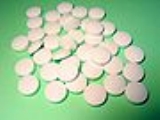
Tablet

Encyclopedia

Pharmacy
Pharmacy is the health profession that links the health sciences with the chemical sciences and it is charged with ensuring the safe and effective use of pharmaceutical drugs...
dosage form. It comprises a mixture of active substances and excipient
Excipient
An excipient is generally a pharmacologically inactive substance used as a carrier for the active ingredients of a medication. In many cases, an "active" substance may not be easily administered and absorbed by the human body; in such cases the substance in question may be dissolved into or...
s, usually in powder
Powder (substance)
A powder is a dry,thick bulk solid composed of a large number of very fine particles that may flow freely when shaken or tilted. Powders are a special sub-class of granular materials, although the terms powder and granular are sometimes used to distinguish separate classes of material...
form, pressed or compacted from a powder into a solid dose. The excipients can include diluents, binders or granulating agents, glidants (flow aids) and lubricants to ensure efficient tabletting; disintegrants to promote tablet break-up in the digestive tract; sweeteners or flavours to enhance taste; and pigments to make the tablets visually attractive. A polymer coating is often applied to make the tablet smoother and easier to swallow, to control the release rate of the active ingredient, to make it more resistant to the environment (extending its shelf life), or to enhance the tablet's appearance.
The compressed tablet is the most popular dosage
Effective dose
Effective dose may refer to:*Effective dose the dose of pharmacologic agent which will have a therapeutic effect in some fraction of the population receiving the drug...
form in use today. About two-thirds of all prescription
Medical prescription
A prescription is a health-care program implemented by a physician or other medical practitioner in the form of instructions that govern the plan of care for an individual patient. Prescriptions may include orders to be performed by a patient, caretaker, nurse, pharmacist or other therapist....
s are dispensed as solid dosage forms, and half of these are compressed tablets. A tablet can be formulated to deliver an accurate dosage to a specific site; it is usually taken orally, but can be administered sublingually, buccally, rectally
Rectum
The rectum is the final straight portion of the large intestine in some mammals, and the gut in others, terminating in the anus. The human rectum is about 12 cm long...
or intravaginally
Vagina
The vagina is a fibromuscular tubular tract leading from the uterus to the exterior of the body in female placental mammals and marsupials, or to the cloaca in female birds, monotremes, and some reptiles. Female insects and other invertebrates also have a vagina, which is the terminal part of the...
. The tablet is just one of the many forms that an oral drug can take such as syrup
Syrup
In cooking, a syrup is a thick, viscous liquid consisting primarily of a solution of sugar in water, containing a large amount of dissolved sugars but showing little tendency to deposit crystals...
s, elixir
Elixir
An elixir is a clear, sweet-flavored liquid used for medicinal purposes, to be taken orally and intended to cure one's ills. When used as a pharmaceutical preparation, an elixir contains at least one active ingredient designed to be taken orally....
s, suspension
Suspension (chemistry)
In chemistry, a suspension is a heterogeneous fluid containing solid particles that are sufficiently large for sedimentation. Usually they must be larger than 1 micrometer. The internal phase is dispersed throughout the external phase through mechanical agitation, with the use of certain...
s, and emulsion
Emulsion
An emulsion is a mixture of two or more liquids that are normally immiscible . Emulsions are part of a more general class of two-phase systems of matter called colloids. Although the terms colloid and emulsion are sometimes used interchangeably, emulsion is used when both the dispersed and the...
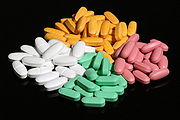
s. Medicinal tablets were originally made in the shape of a disk of whatever color their components determined, but are now made in many shapes and colors to help distinguish different medicines. Tablets are often stamped with symbols, letters, and numbers, which enable them to be identified. Sizes of tablets to be swallowed range from a few millimeters to about a centimeter. Some tablets are in the shape of capsules, and are called "caplets". Medicinal tablets and capsules are often called pills. This is technically incorrect, since tablets are made by compression, whereas pills are ancient solid dose forms prepared by rolling a soft mass into a round shape. Other products are manufactured in the form of tablets which are designed to dissolve or disintegrate; e.g. cleaning and deodorizing products.
Tabletting formulations
In the tablet-pressing process, it is important that all ingredients be fairly dry, powdered or granular, somewhat uniform in particle size, and freely flowing. Mixed particle sized powders can segregate during manufacturing operations due to different densities, which can result in tablets with poor drug or active pharmaceutical ingredient (API) content uniformity but granulationGranulation (making of granules)
Granulation is the act or process of forming or crystallizing into grains. Granules typically have a size range between 0.2 to 4.0 mm depending on their subsequent use....
should prevent this. Content uniformity ensures that the same API dose is delivered with each tablet.
Some APIs may be tableted as pure substances, but this is rarely the case; most formulations include excipient
Excipient
An excipient is generally a pharmacologically inactive substance used as a carrier for the active ingredients of a medication. In many cases, an "active" substance may not be easily administered and absorbed by the human body; in such cases the substance in question may be dissolved into or...
s. Normally, an pharmacologically inactive ingredient (excipient) termed a binder is added to help hold the tablet together and give it strength. A wide variety of binders may be used, some common ones including lactose
Lactose
Lactose is a disaccharide sugar that is found most notably in milk and is formed from galactose and glucose. Lactose makes up around 2~8% of milk , although the amount varies among species and individuals. It is extracted from sweet or sour whey. The name comes from or , the Latin word for milk,...
, dibasic calcium phosphate, sucrose
Sucrose
Sucrose is the organic compound commonly known as table sugar and sometimes called saccharose. A white, odorless, crystalline powder with a sweet taste, it is best known for its role in human nutrition. The molecule is a disaccharide composed of glucose and fructose with the molecular formula...
, corn (maize) starch, microcrystalline cellulose
Cellulose
Cellulose is an organic compound with the formula , a polysaccharide consisting of a linear chain of several hundred to over ten thousand β linked D-glucose units....
, povidone polyvinylpyrrolidone and modified cellulose (for example hydroxypropyl methylcellulose and hydroxyethylcellulose).
Often, an ingredient is also needed to act as a disintegrant to aid tablet dispersion once swallowed, releasing the API for absorption. Some binders, such as starch and cellulose, are also excellent disintegrants.
Small amounts of lubricants are usually added, as well. The most common of these is magnesium stearate and calcium stearate.
Advantages and disadvantages
Some drugs may be unsuitable for administration by the oral route. For example, protein drugs such as insulin may be denatured by stomach acids. Such drugs cannot be made into tablets. Some drugs may be deactivated by the liver
Liver
The liver is a vital organ present in vertebrates and some other animals. It has a wide range of functions, including detoxification, protein synthesis, and production of biochemicals necessary for digestion...
when they are carried there from the gastrointestinal tract by the hepatic portal vein
Hepatic portal vein
The hepatic portal vein is not a true vein, because it does not conduct blood directly to the heart. It is a vessel in the abdominal cavity that drains blood from the gastrointestinal tract and spleen to capillary beds in the liver...
(the "first pass effect"), making them unsuitable for oral use. Drugs which can be taken sublingually are absorbed through the oral mucosae
Mucous membrane
The mucous membranes are linings of mostly endodermal origin, covered in epithelium, which are involved in absorption and secretion. They line cavities that are exposed to the external environment and internal organs...
, so that they bypass the liver and are less susceptible to the first pass effect. The oral bioavailability of some drugs may be low due to poor absorption from the gastrointestinal tract. Such drugs may need to be given in very high doses or by injection. For drugs that need to have rapid onset, or that have severe side effects, the oral route may not be suitable. For example salbutamol
Salbutamol
Salbutamol or albuterol is a short-acting β2-adrenergic receptor agonist used for the relief of bronchospasm in conditions such as asthma and chronic obstructive pulmonary disease. It is marketed as Ventolin among other brand names....
, used to treat problems in the pulmonary system, can have effects on the heart and circulation if taken orally; these effects are greatly reduced by inhaling smaller doses direct to the required site of action.
Tablet properties
Tablets can be made in virtually any shape, although requirements of patients and tableting machines mean that most are round, oval or capsule shaped. More unusual shapes have been manufactured but patients find these harder to swallow, and they are more vulnerable to chipping or manufacturing problems.Tablet diameter and shape are determined by the machine tooling used to produce them - a die plus an upper and a lower punch are required. This is called a station of tooling. The thickness is determined by the amount of tablet material and the position of the punches in relation to each other during compression. Once this is done, we can measure the corresponding pressure applied during compression. The shorter the distance between the punches, thickness, the greater the pressure applied during compression, and sometimes the harder the tablet. Tablets need to be hard enough that they don't break up in the bottle, yet friable enough that they disintegrate in the gastric tract.
Tablets need to be strong enough to resist the stresses of packaging, shipping and handling by the pharmacist and patient. The mechanical strength of tablets is assessed using a combination of (i) simple failure and erosion tests, and (ii) more sophisticated engineering tests. The simpler tests are often used for quality control purposes, whereas the more complex tests are used during the design of the formulation and manufacturing process in the research and development phase. Standards for tablet properties are published in the various international pharmacopeias (USP/NF, EP, JP, etc.). The hardness of tablets is the principle measure of mechanical strength. Hardness is tested using a hardness tester. The units for hardness have evolved since the 1930s.
Lubricants prevent ingredients from clumping together and from sticking to the tablet punches or capsule filling machine. Lubricants also ensure that tablet formation and ejection can occur with low friction between the solid and die wall.
Common minerals like talc or silica, and fats, e.g. vegetable stearin, magnesium stearate or stearic acid are the most frequently used lubricants in tablets or hard gelatin capsules.
Manufacture of the tableting blend
In the tablet pressing process, the main guideline is to ensure that the appropriate amount of active ingredient is in each tablet. Hence, all the ingredients should be well-mixed. If a sufficiently homogenous mix of the components cannot be obtained with simple blending processes, the ingredients must be granulated prior to compression to assure an even distribution of the active compound in the final tablet. Two basic techniques are used to granulate powders for compression into a tablet: wet granulation and dry granulation. Powders that can be mixed well do not require granulation and can be compressed into tablets through direct compression.Wet granulation
Wet granulation is a process of using a liquid binder to lightly agglomerate the powder mixture. The amount of liquid has to be properly controlled, as over-wetting will cause the granules to be too hard and under-wetting will cause them to be too soft and friable. Aqueous solutions have the advantage of being safer to deal with than solvent-based systems but may not be suitable for drugs which are degraded by hydrolysis.- Procedure
- Step 1: The active ingredient and excipients are weighed and mixed.
- Step 2: The wet granulate is prepared by adding the liquid binder–adhesive to the powder blend and mixing thoroughly. Examples of binders/adhesives include aqueous preparations of cornstarch, natural gums such as acacia, cellulose derivatives such as methyl cellulose, gelatinGelatinGelatin is a translucent, colorless, brittle , flavorless solid substance, derived from the collagen inside animals' skin and bones. It is commonly used as a gelling agent in food, pharmaceuticals, photography, and cosmetic manufacturing. Substances containing gelatin or functioning in a similar...
, and povidone. - Step 3: Screening the damp mass through a mesh to form pellets or granules.
- Step 4: Drying the granulation. A conventional tray-dryer or fluid-bed dryer are most commonly used.
- Step 5: After the granules are dried, they are passed through a screen of smaller size than the one used for the wet mass to create granules of uniform size.
Low shear wet granulation processes use very simple mixing equipment, and can take a considerable time to achieve a uniformly mixed state. High shear wet granulation processes use equipment that mixes the powder and liquid at a very fast rate, and thus speeds up the manufacturing process. Fluid bed granulation is a multiple-step wet granulation process performed in the same vessel to pre-heat, granulate, and dry the powders. It is used because it allows close control of the granulation process.
Dry granulation
Dry granulation processes create granules by light compaction of the powder blend under low pressures. The compacts so-formed are broken up gently to produce granules (agglomerates). This process is often used when the product to be granulated is sensitive to moisture and heat. Dry granulation can be conducted on a tablet press using slugging tooling or on a roll press called a roller compactor. Dry granulation equipment offers a wide range of pressures to attain proper densification and granule formation. Dry granulation is simpler than wet granulation, therefore the cost is reduced. However, dry granulation often produces a higher percentage of fine granules, which can compromise the quality or create yield problems for the tablet. Dry granulation requires drugs or excipients with cohesive properties, and a 'dry binder' may need to be added to the formulation to facilitate the formation of granules.Granule lubrication
After granulation, a final lubrication step is used to ensure that the tableting blend does not stick to the equipment during the tableting process. This usually involves low shear blending of the granules with a powdered lubricant, such as magnesium stearateMagnesium stearate
Magnesium stearate, also called octadecanoic acid, magnesium salt, is a white substance which is solid at room temperature. It has the chemical formula . It is a salt containing two equivalents of stearate and one magnesium cation...
or stearic acid
Stearic acid
Stearic acid is the saturated fatty acid with an 18 carbon chain and has the IUPAC name octadecanoic acid. It is a waxy solid, and its chemical formula is CH316CO2H. Its name comes from the Greek word στέαρ "stéatos", which means tallow. The salts and esters of stearic acid are called stearates...
.
Manufacture of the tablets
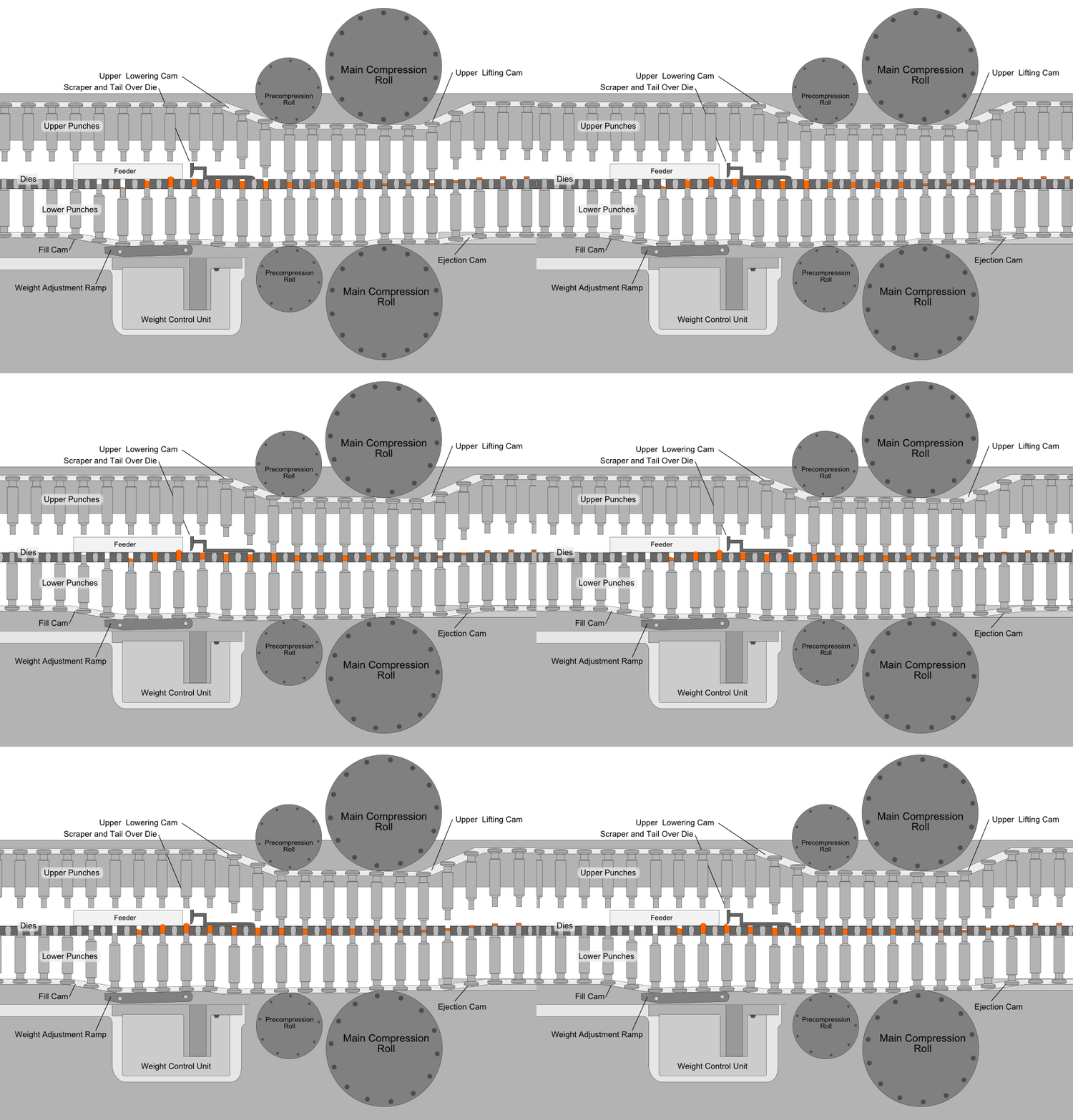
Whatever process is used to make the tableting blend, the process of making a tablet by powder compaction is very similar. First, the powder is filled into the die from above. The mass of powder is determined by the position of the lower punch in the die, the cross-sectional area of the die, and the powder density. At this stage, adjustments to the tablet weight are normally made by repositioning the lower punch. After die filling, the upper punch is lowered into the die and the powder is uniaxially compressed to a porosity of between 5 and 20%. The compression can take place in one or two stages (main compression, and, sometimes, pre-compression or tamping) and for commercial production occurs very fast (500–50 msec per tablet). Finally, the upper punch is pulled up and out of the die (decompression), and the tablet is ejected from the die by lifting the lower punch until its upper surface is flush with the top face of the die. This process is simply repeated many times to manufacture multiple tablets.Common problems encountered during tablet manufacturing operations include:
- poor (low) weight uniformity, usually caused by uneven powder flow into the die
- poor (low) content uniformity, caused by uneven distribution of the API in the tableting blend
- sticking of the powder blend to the tablet tooling, due to inadequate lubrication, worn or dirty tooling, and sub-optimal material properties
- capping, lamination or chipping. Such mechanical failure is due to improper formulation design or faulty equipment operation.
- capping is also occurred due to high moisture content.
Tablet compaction simulator
Tablet formulations are designed and tested using a laboratory machine called a Tablet Compaction Simulator or Powder Compaction Simulator. This is a computer controlled device that can measure the punch positions, punch pressures, friction forces, die wall pressures, and sometimes the tablet internal temperature during the compaction event. Numerous experiments with small quantities of different mixtures can be performed to optimise a formulation.Mathematically corrected punch motions can be programmed to simulate any type and model of production tablet press. Initial quantities of active pharmaceutical ingredients are very expensive to produce, and using a Compaction Simulator reduces the amount of powder required for product development.
Tablet presses
Tablet press
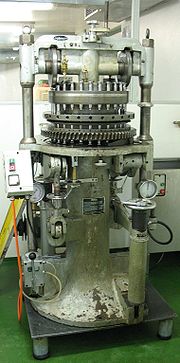
A tablet press is a mechanical device that compresses powder into tablets of uniform size and weight. A press can be used to manufacture tablets of a wide variety of materials, including pharmaceuticals, illicit drugs such as MDMA, cleaning products, and cosmetics...
es, also called tableting machines, range from small, inexpensive bench-top models that make one tablet at a time (single-station presses), with only around a half-ton pressure, to large, computerized, industrial models (multi-station rotary presses) that can make hundreds of thousands to millions of tablets an hour with much greater pressure. The tablet press is an essential piece of machinery for any pharmaceutical and nutraceutical manufacturer. Common manufacturers of tablet presses include Fette, Korsch, Kikusui, Manesty, IMA and Courtoy. Tablet presses must allow the operator to adjust the position of the lower and upper punches accurately, so that the tablet weight, thickness and density can each be controlled. This is achieved using a series of cams, rollers, and/or tracks that act on the tablet tooling (punches). Mechanical systems are also incorporated for die filling, and for ejecting and removing the tablets from the press after compression. Pharmaceutical tablet presses are required to be easy to clean and quick to reconfigure with different tooling, because they are usually used to manufacture many different products.
Tablet coating
Many tablets today are coated after being pressed. Although sugar-coating was popular in the past, the process has many drawbacks. Modern tablet coatings are polymerPolymer
A polymer is a large molecule composed of repeating structural units. These subunits are typically connected by covalent chemical bonds...
and polysaccharide
Polysaccharide
Polysaccharides are long carbohydrate molecules, of repeated monomer units joined together by glycosidic bonds. They range in structure from linear to highly branched. Polysaccharides are often quite heterogeneous, containing slight modifications of the repeating unit. Depending on the structure,...
based, with plasticizer
Plasticizer
Plasticizers or dispersants are additives that increase the plasticity or fluidity of the material to which they are added; these include plastics, cement, concrete, wallboard, and clay. Although the same compounds are often used for both plastics and concretes the desired effects and results are...
s and pigment
Pigment
A pigment is a material that changes the color of reflected or transmitted light as the result of wavelength-selective absorption. This physical process differs from fluorescence, phosphorescence, and other forms of luminescence, in which a material emits light.Many materials selectively absorb...
s included. Tablet coatings must be stable and strong enough to survive the handling of the tablet, must not make tablets stick together during the coating process, and must follow the fine contours of embossed characters or logos on tablets. Coatings are necessary for tablets that have an unpleasant taste, and a smoother finish makes large tablets easier to swallow. Tablet coatings are also useful to extend the shelf-life of components that are sensitive to moisture or oxidation. Special coatings (for example with pearlescent effects) can enhance brand recognition.
If the active ingredient of a tablet is sensitive to acid, or is irritant to the stomach lining, an enteric coating
Enteric coating
An enteric coating is a barrier applied to oral medication that controls the location in the digestive system, where it is absorbed. Enteric refers to the small intestine, therefore enteric coatings prevent release of medication before it reaches the small intestine.Most enteric coatings work by...
can be used, which is resistant to stomach
Stomach
The stomach is a muscular, hollow, dilated part of the alimentary canal which functions as an important organ of the digestive tract in some animals, including vertebrates, echinoderms, insects , and molluscs. It is involved in the second phase of digestion, following mastication .The stomach is...
acid, and dissolves in the less acidic area of the intestines. Enteric coatings are also used for medicines that can be negatively affected by taking a long time to reach the small intestine
Small intestine
The small intestine is the part of the gastrointestinal tract following the stomach and followed by the large intestine, and is where much of the digestion and absorption of food takes place. In invertebrates such as worms, the terms "gastrointestinal tract" and "large intestine" are often used to...
, where they are absorbed. Coatings are often chosen to control the rate of dissolution of the drug in the gastrointestinal tract. Some drugs will be absorbed better at different points in the digestive system. If the highest percentage of absorption of a drug takes place in the stomach, a coating that dissolves quickly and easily in acid will be selected. If the rate of absorption is best in the large intestine or colon, then a coating that is acid resistant and dissolves slowly would be used to ensure it reached that point before dispersing.
There are two types of coating machines used in the pharmaceutical industry: coating pans and automatic coaters. Coating pans are used mostly for sugar coating of pellets. Automatic coaters are used for all kinds of coatings; they can be equipped with remote control panel, dehumidifier, dust collectors. The explosion-proof design is required for alcohol containing coatings.