


Mbira

Encyclopedia
In African music
, the mbira (also known as Likembe, Mbila, Thumb piano
, Mbira Huru, Mbira Njari, Mbira Nyunga Nyunga, Karimbao or Kalimba) is a musical instrument
that consists of a wooden board to which staggered metal keys have been attached. It is often fitted into a resonator
. In Eastern and Southern Africa there are many kinds of mbira, usually accompanied by the hosho
. Among the Shona people there are three that are very popular (see Shona music
). The Mbira is usually classified as part of the lamellaphone
family. It is also part of the idiophones family of musical instruments. In some places it is also known as a sanza or sansa.
In the late 1960s to early 70s sanza was the generic term used to describe these members of the lamellophone family. Mbira has now become so well known due to the worldwide stage performance and recordings of Thomas Mapfumo
whose music is based on and includes the mbira, and the work of Dumisani Maraire
who brought marimba and karimba music to the US Pacific Northwest, Ephat Mujuru
who was one of the pioneer teachers of mbira in the US, and the writings and recordings of Zimbabwean musicians made by Paul Berliner
. Mbira has now replaced sanza as the generic term. Dr. Joseph H. Howard
, owner of the largest collection of drums and ancillary folk instruments in the Americas, often stated it is "the instrument most typical of Africa." By this he meant that the instruments were only found in areas populated by Africans or their descendants. Babatunde Olatunji
made a similar statement in his book "Musical Instruments of Africa." He states the mbira "a finger xylophone
, is native to Africa and is common throughout the continent. It is known nowhere else except in parts of the Americas where it was taken by Africans."

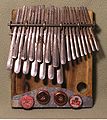
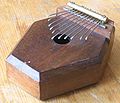
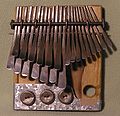
 In Shona music
, the mbira dzavadzimu ("voice of the ancestors", national instrument of Zimbabwe) is a musical instrument that has been played by the Shona people
of Zimbabwe
for thousands of years. The mbira dzavadzimu is frequently played at religious ceremonies and social gatherings called mabira (sing. "bira
").
A typical mbira dzavadzimu consists of between 22 and 28 keys constructed from hot- or cold-forged
metal affixed to a hardwood soundboard
(gwariva) in three different registers—two on the left, one on the right.
While playing, the little finger
of the right hand is placed through a hole in the bottom right corner of the soundboard, stabilizing the instrument and leaving thumb and index finger of the right hand open to stroke
the keys in the right register from above and below. The fingers of the left hand stabilize the left side of the instrument, with most fingers reaching behind the instrument. Both registers on the left side of the instrument are played with the left thumb and sometimes the left forefinger.
Bottle cap
s, shells, or other objects ("machachara") are often affixed to the soundboard to create a buzzing sound when the instrument is played. In a traditional setting, this sound is considered extremely important, as it is believed to attract the ancestral spirits.
During a public performance, an mbira dzavadzimu is frequently placed in a deze
(calabash
resonator) to amplify its sound.
The mbira dza vadzimu is very significant in Shona
religion and culture, considered a sacred instrument by natives. It is usually played to facilitate communication with ancestral spirits. Within the Shona tradition, the mbira may be played with paired performers in which the kushaura, the caller, leads the performed piece as the kutsinhira, the responder, "interlocks" a subsequent part.
. Names may also vary between different families. For example, Garikayi Tirikoti
has developed a "mbira orchestra" that has seven different tunings, each starting on a different interval of the same seven-note scale, where it is possible to play all instruments in a single performance. The seven tunings that Garikayi uses are: Bangiza, Nyabango, Nhemamusasa, Chakwi, Taireva, Mahororo, and Mavembe (all of which are also names of traditional songs save for Mavembe and Nyabango). The closest to what is commonly named "Nyamaropa" is his "Nhemamusasa" tuning.
Historically, mbira tunings have not mapped exactly onto Western scales; it is not unusual for a seven-note sequence on a mbira to be "stretched" over a greater range of frequencies than a Western octave and for the intervals between notes to be different from those in a Western scale. Tunings have often been idiosyncratic with variations over time and from one player to another. A mbira key produces a rich complex of overtones that varies from one instrument to another depending on its maker's intentions and accidents of fabrication, such that some instruments simply sound better when some notes of a familiar tuning are pushed. With the increased popularity of the mbira in North America, Europe, and Japan in recent decades, Zimbabwean mbira makers have tended to tune their instruments more uniformly for export, but much variation is still found among mbira in their homeland.
Common names for tunings are
Zimbabwe's Dumisani Maraire
originated mbira nyunga nyunga number notation. The upper row keys (from left) are keys 2, 4, 6, 8, 10, 12, and 14 while the bottom row keys are notated as 1, 3, 5, 7, 9, 11, 13, and 15. Maraire brought awareness of this instrument to the United States when he came to the University of Washington as a visiting artist from 1968-1972.
Recently a Midlands State University
(Gweru
, Zimbabwe) lecturer in the department of music and musicology has suggested a letter notation; the upper keys as (from first left upper key) E, D, C, F, C, D, and E and the lower or bottom keys as (from the first lower key) A, G, F, A, F, C, D, and E. But the Maraire number notation has remained the internationally accepted system (Chirimumimba, 2007).
Mark Holdaway of Kalimba Magic has introduced a graphic form of tablature for the karimba, and traditional karimba tunes as well as modern songs and new compositions and exercises are available in this tablature.
Music of Africa
Africa is a vast continent and its regions and nations have distinct musical traditions. The music of North Africa for the most part has a different history from sub-Saharan African music traditions....
, the mbira (also known as Likembe, Mbila, Thumb piano
Thumb piano
The thumb piano is an African musical instrument, a type of plucked idiophone common throughout Sub-Saharan Africa.-Description:Each note of a kalimba, mbira, etc. is a separate idiophone, and in orchestral terms, the instrument as a whole belongs in the bar percussion family...
, Mbira Huru, Mbira Njari, Mbira Nyunga Nyunga, Karimbao or Kalimba) is a musical instrument
Musical instrument
A musical instrument is a device created or adapted for the purpose of making musical sounds. In principle, any object that produces sound can serve as a musical instrument—it is through purpose that the object becomes a musical instrument. The history of musical instruments dates back to the...
that consists of a wooden board to which staggered metal keys have been attached. It is often fitted into a resonator
Resonator
A resonator is a device or system that exhibits resonance or resonant behavior, that is, it naturally oscillates at some frequencies, called its resonant frequencies, with greater amplitude than at others. The oscillations in a resonator can be either electromagnetic or mechanical...
. In Eastern and Southern Africa there are many kinds of mbira, usually accompanied by the hosho
Hosho (instrument)
The hosho are Zimbabwean musical instruments consisting of a pair of Maranka gourds with seeds. They typically contain hota seeds inside them. The hosho are used to accompany Shona music, especially mbira music. They make a rattling sound that western ears may be unaccustomed to hearing...
. Among the Shona people there are three that are very popular (see Shona music
Shona music
Shona music is the music of the Shona people of Zimbabwe. There are several different types of traditional Shona music including mbira, singing, hosho and drumming. Very often, this music will be accompanied by dancing, and participation by the audience...
). The Mbira is usually classified as part of the lamellaphone
Lamellaphone
A lamellophone is any of a family of musical instruments. The name comes from the Latin word "lamella" for "plate" and the Greek root "phonos" for "sound"...
family. It is also part of the idiophones family of musical instruments. In some places it is also known as a sanza or sansa.
In the late 1960s to early 70s sanza was the generic term used to describe these members of the lamellophone family. Mbira has now become so well known due to the worldwide stage performance and recordings of Thomas Mapfumo
Thomas Mapfumo
Thomas Tafirenyika Mapfumo is a Zimbabwean musician known as "The Lion of Zimbabwe" and "Mukanya" for his immense popularity and for the political influence he wields through his music, including his sharp criticism of the government of President Robert Mugabe...
whose music is based on and includes the mbira, and the work of Dumisani Maraire
Dumisani Maraire
Abraham Dumisani Maraire , known to friends as "Dumi," was a master performer of the mbira, a traditional instrument of the Shona ethnic group of Zimbabwe. He specialized in the form of mbira called nyunga nyunga, as well as the Zimbabwean marimba...
who brought marimba and karimba music to the US Pacific Northwest, Ephat Mujuru
Ephat Mujuru
Ephat Mujuru , a Zimbabwean musician, was one of the 20th century's finest players of the mbira, a traditional instrument of the Shona ethnic group of Zimbabwe.-Biography:...
who was one of the pioneer teachers of mbira in the US, and the writings and recordings of Zimbabwean musicians made by Paul Berliner
Paul Berliner
Paul Franklin Berliner is an American ethnomusicologist, best known for specializing in African music as well as jazz and other improvisational systems. He is best known for his popular ethnomusicology book on the Zimbabwean mbira, The Soul of Mbira: music and traditions of the Shona people of...
. Mbira has now replaced sanza as the generic term. Dr. Joseph H. Howard
Joseph H. Howard
Dr. Joseph H. Howard was born in Venezuela and raised in Chicago, Illinois. Dr. Howard was an oral surgeon by profession who collected drums from around the world in his spare time. Over the years he amassed the largest collection of authentic drums in the Americas...
, owner of the largest collection of drums and ancillary folk instruments in the Americas, often stated it is "the instrument most typical of Africa." By this he meant that the instruments were only found in areas populated by Africans or their descendants. Babatunde Olatunji
Babatunde Olatunji
Babatunde Olatunji was a Nigerian drummer, educator, social activist and recording artist.- Biography :Olatunji was born in the village of Ajido, a small town near Badagry, Lagos State, in southwestern Nigeria. A member of the Yoruba people, Olatunji was introduced to traditional African music at...
made a similar statement in his book "Musical Instruments of Africa." He states the mbira "a finger xylophone
Xylophone
The xylophone is a musical instrument in the percussion family that consists of wooden bars struck by mallets...
, is native to Africa and is common throughout the continent. It is known nowhere else except in parts of the Americas where it was taken by Africans."
Mbira Dzavadzimu
Shona music
Shona music is the music of the Shona people of Zimbabwe. There are several different types of traditional Shona music including mbira, singing, hosho and drumming. Very often, this music will be accompanied by dancing, and participation by the audience...
, the mbira dzavadzimu ("voice of the ancestors", national instrument of Zimbabwe) is a musical instrument that has been played by the Shona people
Shona people
Shona is the name collectively given to two groups of people in the east and southwest of Zimbabwe, north eastern Botswana and southern Mozambique.-Shona Regional Classification:...
of Zimbabwe
Zimbabwe
Zimbabwe is a landlocked country located in the southern part of the African continent, between the Zambezi and Limpopo rivers. It is bordered by South Africa to the south, Botswana to the southwest, Zambia and a tip of Namibia to the northwest and Mozambique to the east. Zimbabwe has three...
for thousands of years. The mbira dzavadzimu is frequently played at religious ceremonies and social gatherings called mabira (sing. "bira
Bira
Bira may refer to:*Prince Bira , motor racing driver*Boura , an ancient city of Achaea, Greece*Bira, Russia, an urban-type settlement in the Jewish Autonomous Oblast, Russia...
").
A typical mbira dzavadzimu consists of between 22 and 28 keys constructed from hot- or cold-forged
Forged
Forged is a book written by biblical scholar, Bart D. Ehrman which attempts to analyze the historical accuracy of the Christian Bible. The book posits that 11 or more books out of the 27 books of the Christian New Testament canon were written as certain types of forgeries related to the politics...
metal affixed to a hardwood soundboard
Sounding board
A sound board, or soundboard, is the surface of a string instrument that the strings vibrate against, usually via some sort of bridge. The resonant properties of the sound board and the interior of the instrument greatly increase loudness over the string alone.The sound board operates by the...
(gwariva) in three different registers—two on the left, one on the right.
While playing, the little finger
Little finger
The little finger, often called the pinky in American English, pinkie in Scottish English , or small finger in medicine, is the most ulnar and usually smallest finger of the human hand, opposite the thumb, next to the ring finger.-Muscles:There are four muscles that...
of the right hand is placed through a hole in the bottom right corner of the soundboard, stabilizing the instrument and leaving thumb and index finger of the right hand open to stroke
Pizzicato
Pizzicato is a playing technique that involves plucking the strings of a string instrument. The exact technique varies somewhat depending on the type of stringed instrument....
the keys in the right register from above and below. The fingers of the left hand stabilize the left side of the instrument, with most fingers reaching behind the instrument. Both registers on the left side of the instrument are played with the left thumb and sometimes the left forefinger.
Bottle cap
Bottle cap
Bottle caps are a type of closure used to seal the openings of bottles of many types. They can be small circular pieces of metal, usually steel, with plastic backings, and for plastic bottles a plastic cap is used instead. A bottle cap is typically colorfully decorated with the logo of the brand...
s, shells, or other objects ("machachara") are often affixed to the soundboard to create a buzzing sound when the instrument is played. In a traditional setting, this sound is considered extremely important, as it is believed to attract the ancestral spirits.
During a public performance, an mbira dzavadzimu is frequently placed in a deze
Deze
In Zimbabwean Shona music, a deze is a halved calabash gourd in which an Mbira is placed in order to amplify its sound. It is typically round in shape and has bottle caps, shells or other objects strung around its perimeter which vibrate with the Mbira, creating a buzzing sound. Cracked deze...
(calabash
Calabash
Lagenaria siceraria , bottle gourd, opo squash or long melon is a vine grown for its fruit, which can either be harvested young and used as a vegetable, or harvested mature, dried, and used as a bottle, utensil, or pipe. For this reason, the calabash is widely known as the bottle gourd...
resonator) to amplify its sound.
The mbira dza vadzimu is very significant in Shona
Shona people
Shona is the name collectively given to two groups of people in the east and southwest of Zimbabwe, north eastern Botswana and southern Mozambique.-Shona Regional Classification:...
religion and culture, considered a sacred instrument by natives. It is usually played to facilitate communication with ancestral spirits. Within the Shona tradition, the mbira may be played with paired performers in which the kushaura, the caller, leads the performed piece as the kutsinhira, the responder, "interlocks" a subsequent part.
Tuning
Tunings vary from family to family, referring to relative interval relationships and not to absolute pitches. The most common tuning is Nyamaropa, similar to the western Mixolydian modeMixolydian mode
Mixolydian mode may refer to one of three things: the name applied to one of the ancient Greek harmoniai or tonoi, based on a particular octave species or scale; one of the medieval church modes; a modern musical mode or diatonic scale, related to the medieval mode.-Greek Mixolydian:The idea of a...
. Names may also vary between different families. For example, Garikayi Tirikoti
Garikayi Tirikoti
Garikayi Tirikoti is a Zimbabwean Mbira player, instrument maker, composer, arranger and teacher of mbira music. He was the first to develop the ‘mbira orchestra’ where differently pitched and differently tuned mbiras are combined in a single performance...
has developed a "mbira orchestra" that has seven different tunings, each starting on a different interval of the same seven-note scale, where it is possible to play all instruments in a single performance. The seven tunings that Garikayi uses are: Bangiza, Nyabango, Nhemamusasa, Chakwi, Taireva, Mahororo, and Mavembe (all of which are also names of traditional songs save for Mavembe and Nyabango). The closest to what is commonly named "Nyamaropa" is his "Nhemamusasa" tuning.
Historically, mbira tunings have not mapped exactly onto Western scales; it is not unusual for a seven-note sequence on a mbira to be "stretched" over a greater range of frequencies than a Western octave and for the intervals between notes to be different from those in a Western scale. Tunings have often been idiosyncratic with variations over time and from one player to another. A mbira key produces a rich complex of overtones that varies from one instrument to another depending on its maker's intentions and accidents of fabrication, such that some instruments simply sound better when some notes of a familiar tuning are pushed. With the increased popularity of the mbira in North America, Europe, and Japan in recent decades, Zimbabwean mbira makers have tended to tune their instruments more uniformly for export, but much variation is still found among mbira in their homeland.
Common names for tunings are
- Dambatsoko (Ionian modeIonian modeIonian mode is the name assigned by Heinrich Glarean in 1547 to his new authentic mode on C , which uses the diatonic octave species from C to the C an octave higher, divided at G into a fourth species of perfect fifth plus a third species of perfect fourth : C D...
), played by the Mujuru family. The name refers to their ancestral burial grounds. - Dongonda, usually a Nyamaropa tuned mbira with the right side notes the same octave as the left (an octave lower than usual).
- Katsanzaira (Dorian modeDorian modeDue to historical confusion, Dorian mode or Doric mode can refer to three very different musical modes or diatonic scales, the Greek, the medieval, and the modern.- Greek Dorian mode :...
), the highest pitch of the traditional mbira tunings. The name means "the gentle rain before the storm hits". - Mavembe (also: Gandanga) (Phrygian modePhrygian modeThe Phrygian mode can refer to three different musical modes: the ancient Greek tonos or harmonia sometimes called Phrygian, formed on a particular set octave species or scales; the Medieval Phrygian mode, and the modern conception of the Phrygian mode as a diatonic scale, based on the latter...
), Sekuru Gora claims to have invented this tuning at a funeral ceremony. The mourners were singing a familiar song with an unfamiliar melody and he went outside the hut and tuned his mbira to match the vocal lines. Other mbira players dispute that he invented it. - Nemakonde (Phrygian mode), same musical relationship as the mavembe, but the nemakonde tuning is a very low pitched version.
- Saungweme (flattened whole tone, approaching 7 tone equal temperament).
Mbira Nyunga Nyunga
Jeke (Jack) Tapera introduced the Mbira Nyunga Nyunga in the 1960s from Tete province of Mozambique to Kwanongoma College of African music (now United College of Music) in Bulawayo. Two keys were then added to make fifteen (Chirimumimba, 2007), in two rows. The mbira nyunga nyunga is similar in construction to the Mbira Dzavadzimu, but has no hole in the soundboard. Key pitch radiates out from the center, rather than from left to right.Zimbabwe's Dumisani Maraire
Dumisani Maraire
Abraham Dumisani Maraire , known to friends as "Dumi," was a master performer of the mbira, a traditional instrument of the Shona ethnic group of Zimbabwe. He specialized in the form of mbira called nyunga nyunga, as well as the Zimbabwean marimba...
originated mbira nyunga nyunga number notation. The upper row keys (from left) are keys 2, 4, 6, 8, 10, 12, and 14 while the bottom row keys are notated as 1, 3, 5, 7, 9, 11, 13, and 15. Maraire brought awareness of this instrument to the United States when he came to the University of Washington as a visiting artist from 1968-1972.
Recently a Midlands State University
Midlands State University
Midlands State University is a University in Zimbabwe offering different courses mainly in the commercial and arts sector. The University was previously called Gweru Teachers' College, which was primarily a teacher training college under the University of Zimbabwe...
(Gweru
Gweru
Gweru is a city near the centre of Zimbabwe at . It has a population of about 146,073 , making it the third largest city in the nation. Gweru is the capital of Midlands Province. Gweru was founded in 1894 by Dr. Leander Starr Jameson. The first bank opened in Gweru in 1896, and the stock exchange...
, Zimbabwe) lecturer in the department of music and musicology has suggested a letter notation; the upper keys as (from first left upper key) E, D, C, F, C, D, and E and the lower or bottom keys as (from the first lower key) A, G, F, A, F, C, D, and E. But the Maraire number notation has remained the internationally accepted system (Chirimumimba, 2007).
Mark Holdaway of Kalimba Magic has introduced a graphic form of tablature for the karimba, and traditional karimba tunes as well as modern songs and new compositions and exercises are available in this tablature.
Traditional Zimbabwean Mbira Masters
- Ephat MujuruEphat MujuruEphat Mujuru , a Zimbabwean musician, was one of the 20th century's finest players of the mbira, a traditional instrument of the Shona ethnic group of Zimbabwe.-Biography:...
- Cosmas MagayaCosmas MagayaCosmas Magaya is a renowned Zimbabwean mbira player and teacher. Raised in the rural areas surrounging Mhondoro, he appears in the recordings of longime friend and musicologist Paul Berliner's The Soul of Mbira released by Nonesuch Records....
- Sekuru Gora
- Matemai
- Forward KwendaForward KwendaForward Kwenda is a mbira performer from Zimbabwe. He was born in the rural Buhera area in Manicaland, an area known for its fierce resistance to colonial rulers and respect for Shona tradition. As a young boy, Forward excelled in traditional dance and recitation of ancient poetry...
- Garikayi TirikotiGarikayi TirikotiGarikayi Tirikoti is a Zimbabwean Mbira player, instrument maker, composer, arranger and teacher of mbira music. He was the first to develop the ‘mbira orchestra’ where differently pitched and differently tuned mbiras are combined in a single performance...
- Mbira dzeNharira
- Mhuri yekwaRwizi
- Musekiwa ChingodzaMusekiwa ChingodzaMusekiwa Chingodza is a Zimbabwean mbira and marimba player and teacher. He was born in 1970 in Zimbabwe.- Biography :Musekiwa Chingodza was born in Mwangara village, Murewa, Zimbabwe, in 1970. He began playing mbira at the age of five and is self-taught. Through listening to other gwenyambira, or...
- Stella ChiwesheStella ChiwesheStella Chiweshe is a Zimbabwean musician. She is internationally known for her singing and playing of the mbira dzavadzimu, a traditional instrument of the Shona people of Zimbabwe...
- Chartwell DutiroChartwell DutiroChartwell Shorayi Dutiro started playing mbira when he was four at the protected village, Kagande, about two hours drive from Harare where his family was moved by the Salvation Army missionaries during the Chimurenga. Even though the missionaries had banned traditional music, he learned to play...
- Mhuri yekwaMuchena
- DumisaniDumisani MaraireAbraham Dumisani Maraire , known to friends as "Dumi," was a master performer of the mbira, a traditional instrument of the Shona ethnic group of Zimbabwe. He specialized in the form of mbira called nyunga nyunga, as well as the Zimbabwean marimba...
and Chiwoniso MaraireChiwoniso MaraireChiwoniso Maraire is an accomplished singer, songwriter, and exponent of Zimbabwean mbira music. She is the daughter of famed mbira master Dumisani Maraire.... - Jimmy Chifamba and Cypren Vambe
- Nyamasvisva and Mawungira eNharira
Other Mbira players
- Erica AzimErica AzimErica Azim is one of the leading western authorities on and practitioners of Zimbabwean mbira music. She is currently based in Berkeley, California, and makes frequent trips to Zimbabwe to record music, as well as visits around the US to teach mbira, particularly to areas in the Pacific Northwest...
- Chris BerryChris BerryChris Berry is a master of both mbira and the ngoma drum, from the Shona people of Southern Africa. He has earned the title of gwenyambira , a distinction reserved only for those who have achieved the highest fusion of the technical and the magical in Shona music...
- Imogen HeapImogen HeapImogen Jennifer Jane Heap is a Grammy Award-winning English singer, composer and songwriter from Havering, Essex. She is known for her work as part of the musical duo Frou Frou and her solo albums, which she writes, produces, and mixes...
- Glenn KotcheGlenn KotcheGlenn Kotche is an American drummer and composer, best known for his involvement in the band Wilco. He was named the 41st greatest drummer of all time by Gigwise in 2008.Prior to working with Wilco, Kotche released a four-track album...
of WilcoWilcoWilco is an American alternative rock band based in Chicago, Illinois. The band was formed in 1994 by the remaining members of alternative country group Uncle Tupelo following singer Jay Farrar's departure. Wilco's lineup has changed frequently, with only singer Jeff Tweedy and bassist John... - Lulendo
- Jamie MuirJamie MuirJamie Muir is a UK painter and former percussionist, best known for his work in King Crimson.-Biography:Muir attended Edinburgh College of Art during the 1960s and began playing jazz on trombone before settling on percussion....
of King CrimsonKing CrimsonKing Crimson are a rock band founded in London, England in 1969. Often categorised as a foundational progressive rock group, the band have incorporated diverse influences and instrumentation during their history... - Konono No.1
- Trent ReznorTrent ReznorMichael Trent Reznor is an American multi-instrumentalist, composer, record producer, and leader of industrial rock band Nine Inch Nails. Reznor is also a member of How to Destroy Angels alongside his wife, Mariqueen Maandig, and Atticus Ross. He was previously associated with bands Option 30,...
of Nine Inch NailsNine Inch NailsNine Inch Nails is an American industrial rock project, founded in 1988 by Trent Reznor in Cleveland, Ohio. As its main producer, singer, songwriter, and instrumentalist, Reznor is the only official member of Nine Inch Nails and remains solely responsible for its direction... - Mal WebbMal WebbMal Webb is a multi-instrumentalist and has performed in various groups in the Australian music scene. Webb is known for an eclectic range of musical styles, techniques and his vocal talents, which include sideways yodeling, a variety of overtone singing styles, extensive use of falsetto and...
- Maurice WhiteMaurice WhiteMaurice White is a Grammy Award–winning American singer, songwriter, musician, record producer, arranger. He is the older brother of Verdine White and Fred White and the leader and founder of the band Earth, Wind & Fire...
of Earth, Wind, & Fire - TinashéTinasheTinashé is a Zimbabwe-born British singer-songwriter, born in Zimbabwe 4 April 1984, known for his synth-pop sound and his African influences.-Biography:Tinashé was born in the township of Highfield, birthplace to Zimbabwean President Robert Mugabe...
- Steve HackettSteve HackettStephen Richard Hackett is a British singer-songwriter and guitarist. He gained prominence as a member of the British progressive rock group Genesis, which he joined in 1970 and left in 1977 to pursue a solo career...
- Rumbidzai Chipendo
- Okay Machisa
- Tendai Muparutsa
- Felix Simba Machiridza Gudo Guru
- Malvern Potwayo Yotinhira Arts
- Taku Mafika Mob Entertainment
- War Musambasi Yotinhira Arts
- Fidelis Mherembi Yotinhira Arts
- icha Muzav
- Emily Bryant of The Beautiful Word
- Ticha Muzavazi
- Spencer Muzipasi (Zim Afrostics)
Recordings
- Nonesuch Explorer Series 79703-2, Zimbabwe: The African Mbira: Music of the Shona People (2002). Liner notes by Robert Garfias (1971).
- Nonesuch Explorer Series 79704 Zimbabwe: The Soul of Mbira: Traditions of the Shona People (1973). Produced by Paul BerlinerPaul BerlinerPaul Franklin Berliner is an American ethnomusicologist, best known for specializing in African music as well as jazz and other improvisational systems. He is best known for his popular ethnomusicology book on the Zimbabwean mbira, The Soul of Mbira: music and traditions of the Shona people of...
- Konono N°1Konono N°1Konono Nº1 is a Grammy nominated musical group from Kinshasa, Democratic Republic of the Congo. They combine three electric likembé with voices, dancers, and percussion instruments that are made out of items salvaged from a junkyard...
Congotronics (2004). See also the corresponding Amazon listing. Contemporary recording of traditional Congolese sanza mbira (i.e. likembe) from Kinshasa, played with [diy] amplification, and gained the attention of the western world musicWorld musicWorld music is a term with widely varying definitions, often encompassing music which is primarily identified as another genre. This is evidenced by world music definitions such as "all of the music in the world" or "somebody else's local music"...
press in 2005. - Musical instruments 2: (LP) Reeds (Mbira). (1972) The Music of Africa series. 1 LP disc. 33⅓ rpm. mono. 12 in. Recorded by Hugh TraceyHugh TraceyHugh Tracey was an important twentieth century ethnomusicologist. He and his wife collected and archived music from Southern and Central Africa. He began making field recordings of music in the early 20's, through the 70's....
. Kaleidophone, KMA 2. - Mbira Music of Rhodesia, Performed by Abram Dumisani MaraireDumisani MaraireAbraham Dumisani Maraire , known to friends as "Dumi," was a master performer of the mbira, a traditional instrument of the Shona ethnic group of Zimbabwe. He specialized in the form of mbira called nyunga nyunga, as well as the Zimbabwean marimba...
. (1972). Seattle: University of Washington Press, Ethnic Music Series. Garfias, R. (Ed.). 1 LP disc. 33⅓ rpm. mono. 12 in. UWP-1001. This disc features Maraire exclusively on Nyunga Nyunga mbira. A 12-page booklet by Maraire is included, describing the background, composition, and performance of nyunga-nyunga mbira music. - A mbira was played by Jamie MuirJamie MuirJamie Muir is a UK painter and former percussionist, best known for his work in King Crimson.-Biography:Muir attended Edinburgh College of Art during the 1960s and began playing jazz on trombone before settling on percussion....
in the introduction of King CrimsonKing CrimsonKing Crimson are a rock band founded in London, England in 1969. Often categorised as a foundational progressive rock group, the band have incorporated diverse influences and instrumentation during their history...
's "Larks' Tongues in AspicLarks' Tongues in AspicLarks' Tongues in Aspic is the fifth studio album by the English progressive rock group King Crimson, originally released in 1973. This album is the debut of King Crimson's third incarnation - arguably their most forward-thinking thinking version yet, featuring original member and guitarist Robert...
Part One" - Penguin Cafe OrchestraPenguin Cafe OrchestraThe Penguin Cafe Orchestra was a collective of performing musicians created by classically trained British guitarist, composer and arranger Simon Jeffes...
used an mbira in a cover of the traditional "Nhemamusasa" titled as "Cutting Branches For a Temporary Shelter" which is the English translation. - Njuzu Mbira: Traditional Music of Zimbabwe (30. May 2003) released by Njuzu Mbira / CD Baby
- Stella ChiwesheStella ChiwesheStella Chiweshe is a Zimbabwean musician. She is internationally known for her singing and playing of the mbira dzavadzimu, a traditional instrument of the Shona people of Zimbabwe...
: Through Mbira (16. November 2009) release by Anhrefn Records / Cadiz - Stella ChiwesheStella ChiwesheStella Chiweshe is a Zimbabwean musician. She is internationally known for her singing and playing of the mbira dzavadzimu, a traditional instrument of the Shona people of Zimbabwe...
: Talking Mbira (11. June 2002) released by Piranha / Zebralution - Tinashe Chidanyika: Sounds of the African Mbira(1. January 2009) released by ARCMUSIC / RoyaltyShare
- Mawungira eNharira:Chinamanenji(2006)released by Record & Tape Promotions (RTP) / CD and Cassette
- Mawungira eNharira:Ndodyiwa Nemakava(May 2010)released by Gramma Records / CD
See also
- Electric lamellophoneElectric lamellophoneElectric lamellophones are lamellophones that have been electrified with an electro-magnetic pickup or contact piezo pickup.-Piezo pickup lamellophones:...
- Music of AfricaMusic of AfricaAfrica is a vast continent and its regions and nations have distinct musical traditions. The music of North Africa for the most part has a different history from sub-Saharan African music traditions....
- PolyrhythmPolyrhythmPolyrhythm is the simultaneous sounding of two or more independent rhythms.Polyrhythm in general is a nonspecific term for the simultaneous occurrence of two or more conflicting rhythms, of which cross-rhythm is a specific and definable subset.—Novotney Polyrhythms can be distinguished from...
- Kalimba
- GravikordGravikordThe gravikord is an electric double bridge-harp invented by Robert Grawi in 1986.- Description :The gravikord is a new instrument developed on the basis of the West African kora. It is made of welded stainless steel tubing, with 24 nylon strings but no resonating gourd or skin. The bridge is made...
External links
- The Mbira Page, Solomon Murungu's Shona music site
- Tinotenda An introduction and guide to the mbira and mbira music
- Mbira players list, from N. Scott Robinson site
- The Mbira Oracle The Mbira Oracle Instructional web channel posting videos for Mbira dzaVadzimu.
- Dandemutande, non-profit organization devoted to Shona music
- MBIRA, non-profit organization devoted to Shona mbira music directed by Erica AzimErica AzimErica Azim is one of the leading western authorities on and practitioners of Zimbabwean mbira music. She is currently based in Berkeley, California, and makes frequent trips to Zimbabwe to record music, as well as visits around the US to teach mbira, particularly to areas in the Pacific Northwest...
and based in BerkeleyBerkeley, CaliforniaBerkeley is a city on the east shore of the San Francisco Bay in Northern California, United States. Its neighbors to the south are the cities of Oakland and Emeryville. To the north is the city of Albany and the unincorporated community of Kensington...
, California - Serevende, Zimbabwean mbira centre in Belgium
- Mhumhi Records, non-profit record company devoted to Shona music
- Zimbabwean Music Festival (Zimfest), annual Zimbabwean music festival in North America
- http://www.music.vt.edu/musicdictionary/textm/Mbira.html
- Mbira article by N. Scott Robinson
- Mbira tunings page, by N. Scott Robinson
- Thesis paper on improvisation on Mbira dzaVadzimu by Adrian Wagner
- Measurements of the Acoustics of the Kalimba from the Journal of the Acoustical Society of AmericaAcoustical Society of AmericaThe Acoustical Society of America is an international scientific society dedicated to increasing and diffusing the knowledge of acoustics and its practical applications.-History:...
- Yeshe, German-born Australian mbira players
- Adamaduma, an Afro-Yemen-Canaanite Fusion Ensemble, With mbira as a main melodic instrument
- Imogen HeapImogen HeapImogen Jennifer Jane Heap is a Grammy Award-winning English singer, composer and songwriter from Havering, Essex. She is known for her work as part of the musical duo Frou Frou and her solo albums, which she writes, produces, and mixes...
, a London singer-songwriter pop star, with an array mbiraArray mbiraThe Array mbira is a hand-crafted modern musical instrument with a unique harp or bell-like sound. It is made in the United States by its inventor Bill Wesley and manufactured by Wesley with Patrick Hadley in San Diego, California, United States. It is a radical redesign of the African mbira and is...
commonly accompanying a piano. - Award Winning Zimbabwean Mbira Music and Cultural Ensemble
- Information on forthcoming Mbira music projects and shows round the globe