
|
|
|
|
Bagpipes
|
| |
|
| |
Bagpipes are a class of musical instrument, aerophones using enclosed reeds fed from a constant reservoir of air in the form of a bag. Though the Scottish Great Highland Bagpipe and Irish uilleann pipes have the greatest international visibility, bagpipes have historically been found throughout Europe, and into Northern Africa, the Persian Gulf, and the Caucasus. (See: List of bagpipes)
The term is equally correct in the singular or plural, although in the English language pipers most commonly talk of "pipes"
OverviewA bagpipe minimally consists on an air supply, a bag, a chanter, and usually a drone. Some bagpipes also have additional drones (and sometimes chanters) in various combinations, held in place in stocks—connectors with which the various pipes are attached to the bag.
Air supplyThe most common method of supplying air to the bag is by blowing into a blowpipe, or blowstick. In some pipes the player must cover the tip of the blowpipe with his tongue while inhaling, but modern blowpipes are usually fitted with a non-return valve which eliminates this need.
An innovation, dating from the 16th or 17th centuries, is the use of a bellows to supply air. In these pipes, (sometimes called coldpipes) air is not heated or moistened by the player's breathing, so bellows-driven bagpipes can use more refined and/or delicate reeds. The most famous of these pipes are the Irish uilleann pipes and the Northumbrian smallpipes.
The possibility of using an artificial air supply, such as an air compressor, is occasionally discussed by pipers, and although have been made in this direction, widespread adoption seems unlikely for the time.
BagThe bag is simply an airtight reservoir which can hold air and regulate its flow while the player breathes or pumps with a bellows, enabling the player to maintain continuous sound for some time. Materials used for bags vary widely, but the most common are the skins of local animals such as goats, sheep, and cows. More recently, bags made of synthetic materials including Gore-Tex have become common.
Bags cut from larger materials are usually saddle-stitched with an extra strip folded over the seam and stitched (for skin bags) or glued (for synthetic bags) to reduce leaks. Holes are cut to accommodate the stocks. In the case of bags made from largely-intact animal skins the stocks are typically tied into the points where limbs and the head joined the body of the living animal, a construction technique common in Central and Eastern Europe.
DroneMost bagpipes have at least one drone. A drone is most commonly a cylindrical tube with a single reed, although drones with double reeds exist. The drone is generally designed in two or more parts, with a sliding joint ("bridle") so that the pitch of the drone can be manipulated. Drones are traditionally made of wood, often a local hardwood, but nowadays often from tropical hardwoods such as rosewood, ebony, or African Blackwood. Some modern variants of the pipes have brass or plastic drones.
Depending on the type of pipes, the drones may lay over the shoulder, across the arm opposite the bag, or may run parallel to the chanter. Some drones have a tuning screw, which effectively alters the length of the drone by opening a hole, allowing the drone to be tuned to two or more distinct pitches. The tuning screw may also shut off the drone altogether. In general, where there is one drone it is pitched two octaves below the tonic of the chanter, and further additions often add the octave below and then a drone consonant with the fifth of the chanter. This is, however, a very approximate rule of thumb. In the Uilleann pipes, there are three drones (which can be switched off via a switch); these are tuned as follows, Tenor (shortest) plays the same note as the bottom of the chanter, Baritone (middle length) is tuned an octave below and the bass (longest) is tuned two octaves below. There are some indications that there may have been cases of a fourth drone, shorter than the tenor, which played a perfect 5th - e.g. on a "d" set of pipes (the bottom note is 'd') the normal three drones play a 'd' and this 'extra' drone would play 'g'.
HistoryAncient originsEvidence of pre-medieval bagpipes is controversial, but several textual and visual clues may possibly indicate ancient forms of bagpipes. The earliest known representations of a bagpipe come from the Mediterranean island of Corsica where we can see a piper made on bronze figurines. A possible representation of a bagpipe has been found on a Hittite slab dating from about 1,300 BC at Eyuk. Similarly, a possible textual reference to a bagpipe is found in 425 BC, in the play The Acharnians by the Greek playwright Aristophanes:
Several hundred years later, Suetonius described the Roman Emperor Nero as a player of the tibia utricularis.. Dio Chrysostom, who also flourished in the first century, wrote about a contemporary sovereign (possibly Nero) who could play a pipe ("aulein") with his mouth as well as with his "armpit". From this account, some believe that the tibia utricularis was a bagpipe.
Spread and development in Europe In the early part of the second millennium, bagpipes began to appear with frequency in European art and iconography. The Cantigas de Santa Maria, compiled in Castile in the mid-13th Century, depict several types of bagpipes. Though evidence of bagpipes in the British Isles prior to the 14th Century is contested, bagpipes are explicitly mentioned in The Canterbury Tales (written around 1380): "A baggepype wel coude he blowe and sowne, /And ther-with-al he broghte us out of towne."
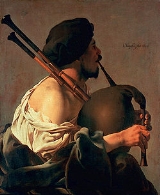
Actual examples of bagpipes from before the 18th century are extremely rare; however, a substantial number of paintings, carvings, engravings, manuscript illuminations, and so on survive. They make it clear that bagpipes varied hugely throughout Europe, and even within individual regions. Many examples of early folk bagpipes in Continental Europe can be found in the paintings of Brueghel, Teniers, Jordaens and Durer.
Evidence of the bagpipe in Ireland occurs in 1581, when John Derrick's "The Image of Irelande" clearly depicts a bagpiper falling in battle. Derrick's illustrations are considered to be reasonably faithful depictions of the attire and equipment of the English and Irish population of the 16th Century In 1760, the first serious study of the Scottish Highland bagpipe and its music was attempted, in Joseph MacDonald's 'Compleat Theory'. Further south, a manuscript from the 1730s by a William Dixon from Northumberland contains music which fits the Border pipes, a nine-note bellows-blown bagpipe whose chanter is similar to that of the modern Great Highland Bagpipe. However the music in Dixon's manuscript varied greatly from modern Highland bagpipe tunes, consisting mostly of extended variation sets of common dance tunes. Some of the tunes in the Dixon manuscript correspond to tunes found in early 19th century published and MS sources of Northumbrian smallpipe tunes, notably the rare book of 50 tunes, many with variations, by John Peacock.
As Western classical music developed, both in terms of musical sophistication and instrumental technology, bagpipes in many regions fell out of favour due to their limited range and function. This triggered a long (but slow) decline which continued in most cases into the 20th century.
Extensive and documented collections of traditional bagpipes can be found in the Musical Instrument section of the Metropolitan Museum of Art in New York City, and at the International Bagpipe Museum in Gijón, Spain, and Pitt Rivers Museum in England.
Recent historyDuring the expansion of the British Empire, spearheaded by British military forces which included Highland regiments, the Scottish Great Highland Bagpipe was diffused and has become well-known world-wide. This surge in popularity was boosted by large numbers of pipers trained for military service in the two World Wars. The surge coincided with a decline in the popularity of many traditional forms of bagpipe throughout Europe, which began to be displaced by instruments from the classical tradition and later by gramophone and radio. Police forces in Scotland, Canada, Australia, Hong Kong, and the USA (although not as commonly widespread) have also formed pipe bands. The Tayside Police Pipe band, still in existence, was founded in 1905. In the United Kingdom and Commonwealth Nations such as Canada and New Zealand, the bagpipe is commonly used in the military and is often played in formal ceremonies. Foreign militaries patterned after the British Army have also taken the Highland bagpipe into use, including but not restricted to Uganda, Pakistan, Sri Lanka, and Oman, effectively spreading official military use to Africa, Asia and the Middle East, respectively.
In more recent years, often driven by revivals of native folk music and dance, many types of bagpipes have resurged in popularity, and in many cases instruments that were on the brink of extinction have become extremely popular. In Brittany, the concept of the pipe band was appropriated, the Great Highland Bagpipe was imported and the bagad was created, a showcase ensemble for Breton folk music. The pipe band idiom has also been adopted and applied to the Spanish gaita as well.
Bagpipes have often been used in various films depicting moments from Scottish and Irish history. Riverdance served to make the Uilleann pipes more commonly known. There have also been recent experimentation with various forms of rock (usually progressive rock) and even heavy metal bands have used bagpipes as guest instruments on their albums, for example, Finnish 'symphonic metal' band Nightwish used Uilleann pipes player Troy Donockley on several songs on their Dark Passion Play album.
In the late 20th century, various models of electronic bagpipes have been invented. The first custom-built MIDI bagpipes were developed by the Asturian piper José Ángel Hevia Velasco (generally known simply as Hevia). Some models allow the player to select the sound of several different bagpipes as well as switch keys. As yet they are not widely used due to technical limitations, but they have found a useful niche as a practice instrument (particularly with headphones).
Terminology and grammarIn English-speaking regions, a bagpipe player is known as a "bagpiper" or "piper," and the surname Piper derives from the latter term. Other European surnames, such as Pfeiffer or Pfeifer (German), Gaiteiro (Portuguese-Galician), Gaiteru (Asturian), Gaitero (Spanish), Dudák or Gajdar (Czech), Dudás, Sipos, or Gajdos (Hungarian), Zampognaro (Italian), Cimpoieru (Romania), Tsambounieris (Greek), Gaidar (Bulgarian: ??????; derivated from ?????, Gayda - bagpipe), Gaidar (Russian), Duda, and Dudziak (Polish) may also signify that an ancestor was a player of the pipes.
Modern usageTypes of bagpipesDozens of types of bagpipes today are widely spread across Europe and the Middle East, as well as through much of the former British Empire. The name bagpipe has almost become synonymous with its best-known form, the Great Highland Bagpipe related to the Irish war pipes, overshadowing the great number and variety of traditional forms of bagpipe. Despite the decline of these other types of pipes over the last few centuries, in recent years many of these pipes have seen a resurgence or even revival as traditional musicians have sought them out; for example, the Irish piping tradition, which by the mid 20th century had declined to a handful of master players is today alive, well, and flourishing a situation similar to that of the Asturian gaita, the Galician gaita, the Aragonese Gaita de boto, Northumbrian smallpipes, the Breton Biniou, the Balkan Gaida, the Turkish Tulum, the Scottish smallpipes and Pastoral pipes, as well as other varieties.
Traditionally, one of the main purposes of the bagpipe in most traditions was to provide music for dancing. In most countries this has declined with the growth of professional dance bands, recordings, and the decline of traditional dance. In turn, this has led to many types of pipes developing a performance-led tradition, and indeed much modern music based on the dance music tradition played on bagpipes is no longer suitable for use as dance music.
PlayershipThere is no reliable way to estimate the number of bagpipe players in the world today. However, in there are hundreds of pipe bands playing the Great Highland Pipes registered with pipe band associations world wide, mostly averaging ten or twelve pipers. There are many more pipers who do not play with bands. Estimates for the number of Great Highland Pipe players worldwide usually suggest a figure between ten and fifty thousand players worldwide. Numbers for other types of bagpipe are much smaller, but many have a substantial worldwide following, and there are many types of bagpipe who have full time makers, teachers, and professional players, supported by a large base of players.
Royal pipersSince 1843, the British Sovereign has retained an official piper, bearing the title "Personal Piper to the Sovereign". Queen Victoria was the first monarch to have a piper, after hearing bagpipe music on a trip to Scotland in 1842. It has since been tradition that a serving soldier and experienced army Pipe Major is taken on secondment to Buckingham Palace. The Piper is a member of the Royal Household whose principal duty is to play every weekday at 9am for about fifteen minutes under The Queen's window when she is in residence at Buckingham Palace, Windsor Castle, the Palace of Holyroodhouse or Balmoral Castle.
He is responsible for the co-ordination of the twelve Army pipers who play around the table after State Banquets.
Usage in non-traditional musicSince the 1960s, bagpipes have also made appearances in other forms of music, including rock, jazz, hip-hop and classical music, for example with Paul McCartney's "Mull of Kintyre", AC/DC's "It's A Long Way To The Top", Korn's "Shoots and Ladders", and Peter Maxwell Davies's composition Orkney Wedding, With Sunrise. The American musician Rufus Harley was the first to use the bagpipes as a primary instrument in jazz.
The futureAround the world, many piping traditions are undergoing strong revivals. Pipe band associations report continued growth and the number of commercial recordings of bagpipes continues to grow year on year. Performance styles continue to evolve and advances in pipemaking knowledge have created instruments capable of playing styles of music previously unheard-of.
Publications about the bagpipes Periodicals - Chanter, published by The Bagpipes Society
- Common Stock, Journal of the Lowland and Borders Pipers Society
- produced independent of any association
- (since 1948)
- published by the EUSPBA.
- Na Piobairi Uilleann publishes a magazine
- The Northumbrian Pipers' Society publish a magazine
- produced by
- New Zealand Pipe band, published by RNZPBA.
- not-for-profit online daily news and features from the Highland piping world. Published by GHB Communications.
Sexual Reference The slang term "bagpiping" refers to axillary intercourse.
See also
External links
|
| |
|
|