


Józef Pilsudski

Encyclopedia
Poland
Poland , officially the Republic of Poland , is a country in Central Europe bordered by Germany to the west; the Czech Republic and Slovakia to the south; Ukraine, Belarus and Lithuania to the east; and the Baltic Sea and Kaliningrad Oblast, a Russian exclave, to the north...
statesman
Statesman
A statesman is usually a politician or other notable public figure who has had a long and respected career in politics or government at the national and international level. As a term of respect, it is usually left to supporters or commentators to use the term...
—Chief of State
Naczelnik panstwa
Naczelnik Państwa was the title of Poland's head of state in the early years of the Second Polish Republic. This office was held only by Józef Piłsudski, from 1918 to 1922. Until 1919 it was called tymczasowy naczelnik państwa...
(1918–22), "First Marshal
Marshal of Poland
Marshal of Poland is the highest rank in the Polish Army. It has been granted to only six officers. At present, this rank is equivalent to a Field Marshal or General of the Army in other NATO armies.-History:...
" (from 1920), and authoritarian
Dictatorship
A dictatorship is defined as an autocratic form of government in which the government is ruled by an individual, the dictator. It has three possible meanings:...
leader (1926–35) of the Second Polish Republic
Second Polish Republic
The Second Polish Republic, Second Commonwealth of Poland or interwar Poland refers to Poland between the two world wars; a period in Polish history in which Poland was restored as an independent state. Officially known as the Republic of Poland or the Commonwealth of Poland , the Polish state was...
. From mid-World War I he had a major influence in Poland's politics
Politics of Poland
The politics of Poland take place in the framework of a parliamentary representative democratic republic, whereby the Prime Minister is the head of government of a multi-party system and the President is the head of state....
, and was an important figure on the European political scene. He is considered largely responsible for Poland's regaining its independence in 1918, after 123 years of partitions
Partitions of Poland
The Partitions of Poland or Partitions of the Polish–Lithuanian Commonwealth took place in the second half of the 18th century and ended the existence of the Polish–Lithuanian Commonwealth, resulting in the elimination of sovereign Poland for 123 years...
. Piłsudski successfully annexed Vilnius
Vilnius
Vilnius is the capital of Lithuania, and its largest city, with a population of 560,190 as of 2010. It is the seat of the Vilnius city municipality and of the Vilnius district municipality. It is also the capital of Vilnius County...
from Lithuania
Lithuania
Lithuania , officially the Republic of Lithuania is a country in Northern Europe, the biggest of the three Baltic states. It is situated along the southeastern shore of the Baltic Sea, whereby to the west lie Sweden and Denmark...
following Żeligowski's Mutiny
Zeligowski's Mutiny
Żeligowski's Mutiny was a sham mutiny led by Polish General Lucjan Żeligowski in October 1920, which resulted in the creation of the short-lived Republic of Central Lithuania. Polish Chief of State Józef Piłsudski had surreptitiously ordered Żeligowski to carry out the operation, and revealed the...
but was unable to incorporate most of his Lithuanian homeland into the newly resurrected Polish State.
Early in his political career, Piłsudski became a leader of the Polish Socialist Party
Polish Socialist Party
The Polish Socialist Party was one of the most important Polish left-wing political parties from its inception in 1892 until 1948...
. Concluding, however, that Poland's independence would have to be won by force of arms, he created the Polish Legions
Polish Legions in World War I
Polish Legions was the name of Polish armed forces created in August 1914 in Galicia. Thanks to the efforts of KSSN and the Polish members of the Austrian parliament, the unit became an independent formation of the Austro-Hungarian Army...
. In 1914 he anticipated the outbreak of a European war, the Russian Empire
Russian Empire
The Russian Empire was a state that existed from 1721 until the Russian Revolution of 1917. It was the successor to the Tsardom of Russia and the predecessor of the Soviet Union...
's defeat by the Central Powers
Central Powers
The Central Powers were one of the two warring factions in World War I , composed of the German Empire, the Austro-Hungarian Empire, the Ottoman Empire, and the Kingdom of Bulgaria...
, and the Central Powers' defeat by the western powers. When World War I broke out, he and his Legions fought alongside the Austro-Hungarian
Austria-Hungary
Austria-Hungary , more formally known as the Kingdoms and Lands Represented in the Imperial Council and the Lands of the Holy Hungarian Crown of Saint Stephen, was a constitutional monarchic union between the crowns of the Austrian Empire and the Kingdom of Hungary in...
and German Empire
German Empire
The German Empire refers to Germany during the "Second Reich" period from the unification of Germany and proclamation of Wilhelm I as German Emperor on 18 January 1871, to 1918, when it became a federal republic after defeat in World War I and the abdication of the Emperor, Wilhelm II.The German...
s to ensure Russia's defeat. In 1917, with Russia faring badly in the war, he withdrew his support from the Central Powers.
From November 1918, when Poland regained independence, until 1922 Piłsudski was Poland's Chief of State
Naczelnik panstwa
Naczelnik Państwa was the title of Poland's head of state in the early years of the Second Polish Republic. This office was held only by Józef Piłsudski, from 1918 to 1922. Until 1919 it was called tymczasowy naczelnik państwa...
. In 1919–21 he commanded Poland's forces in the Polish-Soviet War
Polish-Soviet War
The Polish–Soviet War was an armed conflict between Soviet Russia and Soviet Ukraine and the Second Polish Republic and the Ukrainian People's Republic—four states in post–World War I Europe...
. In 1923, with the Polish government dominated by his opponents, particularly the National Democrats, he withdrew from active politics. Three years later, he returned to power with the May 1926 coup d'état, and became the de facto dictator of Poland. An Italian fascist
Italian Fascism
Italian Fascism also known as Fascism with a capital "F" refers to the original fascist ideology in Italy. This ideology is associated with the National Fascist Party which under Benito Mussolini ruled the Kingdom of Italy from 1922 until 1943, the Republican Fascist Party which ruled the Italian...
ambassador to Warsaw described him as "a liberal democrat in the clothes of an old-world knight". From then until his death in 1935, he concerned himself primarily with military and foreign affairs
Foreign Affairs
Foreign Affairs is an American magazine and website on international relations and U.S. foreign policy published since 1922 by the Council on Foreign Relations six times annually...
.
For at least thirty years until his death, Piłsudski pursued, with varying degrees of intensity, two complementary strategies, intended to enhance Poland's security: "Prometheism
Prometheism
Prometheism or Prometheanism was a political project initiated by Poland's Józef Piłsudski. Its aim was to weaken the Russian Empire and its successor states, including the Soviet Union, by supporting nationalist independence movements among the major non-Russian peoples that lived within the...
", which aimed at breaking up, successively, Imperial Russia and the Soviet Union
Soviet Union
The Soviet Union , officially the Union of Soviet Socialist Republics , was a constitutionally socialist state that existed in Eurasia between 1922 and 1991....
into their constituent nations; and the creation of an Intermarum
Miedzymorze
Międzymorze was a plan, pursued after World War I by Polish leader Józef Piłsudski, for a federation, under Poland's aegis, of Central and Eastern European countries...
federation, comprising Poland and several of her neighbors. Though a number of his political acts remain controversial, Piłsudski's memory is held in high esteem by his compatriots.
Early life
Józef Piłsudski was born on 5 December 1867 to a Polish noble family at their family'sPilsudski (family)
The Piłsudski family is a family of nobility that originated in the Grand Duchy of Lithuania and increased in notability under the Polish-Lithuanian Commonwealth and the Second Polish Republic....
manor in the village of Zalavas
Zalavas
Zalavas is a small village in Švenčionys district municipality, Lithuania. It is located on the Mera river near the Lithuanian state border with Belarus. According to the 2001 census, it had 173 residents. It is the birthplace of Marshal Józef Piłsudski, who later became Chief of State of...
in Lithuania
Lithuania
Lithuania , officially the Republic of Lithuania is a country in Northern Europe, the biggest of the three Baltic states. It is situated along the southeastern shore of the Baltic Sea, whereby to the west lie Sweden and Denmark...
. At the time of his birth it was a part of the Russian Empire as a result of partitions
Partitions of Poland
The Partitions of Poland or Partitions of the Polish–Lithuanian Commonwealth took place in the second half of the 18th century and ended the existence of the Polish–Lithuanian Commonwealth, resulting in the elimination of sovereign Poland for 123 years...
by the Austrian Empire
Austrian Empire
The Austrian Empire was a modern era successor empire, which was centered on what is today's Austria and which officially lasted from 1804 to 1867. It was followed by the Empire of Austria-Hungary, whose proclamation was a diplomatic move that elevated Hungary's status within the Austrian Empire...
, the Russian Empire
Russian Empire
The Russian Empire was a state that existed from 1721 until the Russian Revolution of 1917. It was the successor to the Tsardom of Russia and the predecessor of the Soviet Union...
and the Kingdom of Prussia
Kingdom of Prussia
The Kingdom of Prussia was a German kingdom from 1701 to 1918. Until the defeat of Germany in World War I, it comprised almost two-thirds of the area of the German Empire...
at the end of the 18th century. Currently it is part of the Švenčionys district municipality
Švencionys district municipality
-Twin towns — Sister cities:Švenčionys district municipality is twinned with the following towns: Świdnica, Poland...
of Lithuania
Lithuania
Lithuania , officially the Republic of Lithuania is a country in Northern Europe, the biggest of the three Baltic states. It is situated along the southeastern shore of the Baltic Sea, whereby to the west lie Sweden and Denmark...
. The Piłsudski family, impoverished szlachta
Szlachta
The szlachta was a legally privileged noble class with origins in the Kingdom of Poland. It gained considerable institutional privileges during the 1333-1370 reign of Casimir the Great. In 1413, following a series of tentative personal unions between the Grand Duchy of Lithuania and the Kingdom of...
, cherished Polish patriotic traditions and has been characterized either as Polish or as Polonized-Lithuanian
Lithuanians
Lithuanians are the Baltic ethnic group native to Lithuania, where they number around 2,765,600 people. Another million or more make up the Lithuanian diaspora, largely found in countries such as the United States, Brazil, Canada, Colombia, Russia, United Kingdom and Ireland. Their native language...
. Young Józef was the second son born to the family.
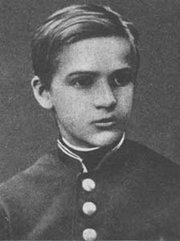
Gymnasium (school)
A gymnasium is a type of school providing secondary education in some parts of Europe, comparable to English grammar schools or sixth form colleges and U.S. college preparatory high schools. The word γυμνάσιον was used in Ancient Greece, meaning a locality for both physical and intellectual...
at Vilnius, was not an especially diligent student. Ironically, one of the younger students at this gymnasium was the future communist Felix Dzerzhinsky, who later would become Piłsudski's archenemy.
Along with his brothers Adam, Bronisław
Bronisław Piłsudski
Bronisław Piotr Piłsudski , brother of Józef Piłsudski, was a Polish cultural anthropologist who conducted outstanding research on the Ainu ethnic group, which then inhabited Sakhalin Island, but now live mostly on the Japanese island of Hokkaidō, with only a small minority left on...
and Jan, Józef was introduced by his mother Maria, née Billewicz, to Polish history and literature, which were suppressed by the Russian authorities. His father, likewise named Józef, had fought in the January 1863 Uprising
January Uprising
The January Uprising was an uprising in the former Polish-Lithuanian Commonwealth against the Russian Empire...
against Russian rule of Poland.
The family resented the Russian government's Russification
Russification
Russification is an adoption of the Russian language or some other Russian attributes by non-Russian communities...
policies. Young Józef profoundly disliked having to attend Russian Orthodox Church
Russian Orthodox Church
The Russian Orthodox Church or, alternatively, the Moscow Patriarchate The ROC is often said to be the largest of the Eastern Orthodox churches in the world; including all the autocephalous churches under its umbrella, its adherents number over 150 million worldwide—about half of the 300 million...
service and left school with an aversion not only for the Russian Tsar and the Russian Empire, but for the culture, which he knew well.
In 1885 Piłsudski started medical studies
Medical school
A medical school is a tertiary educational institution—or part of such an institution—that teaches medicine. Degree programs offered at medical schools often include Doctor of Osteopathic Medicine, Bachelor/Doctor of Medicine, Doctor of Philosophy, master's degree, or other post-secondary...
at Kharkov University, where he became involved with Narodnaya Volya, part of the Russian Narodnik
Narodnik
Narodniks was the name for Russian socially conscious members of the middle class in the 1860s and 1870s. Their ideas and actions were known as Narodnichestvo which can be translated as "Peopleism", though is more commonly rendered "populism"...
i revolutionary movement. In 1886 he was suspended for participating in student demonstrations. He was rejected by the University of Dorpat (Tartu
Tartu
Tartu is the second largest city of Estonia. In contrast to Estonia's political and financial capital Tallinn, Tartu is often considered the intellectual and cultural hub, especially since it is home to Estonia's oldest and most renowned university. Situated 186 km southeast of Tallinn, the...
, Estonia), whose authorities had been informed of his political affiliation. On 22 March 1887 he was arrested by Tsarist authorities on a charge of plotting with Vilnius
Vilnius
Vilnius is the capital of Lithuania, and its largest city, with a population of 560,190 as of 2010. It is the seat of the Vilnius city municipality and of the Vilnius district municipality. It is also the capital of Vilnius County...
socialists to assassinate Tsar
Tsar
Tsar is a title used to designate certain European Slavic monarchs or supreme rulers. As a system of government in the Tsardom of Russia and Russian Empire, it is known as Tsarist autocracy, or Tsarism...
Alexander III
Alexander III of Russia
Alexander Alexandrovich Romanov , historically remembered as Alexander III or Alexander the Peacemaker reigned as Emperor of Russia from until his death on .-Disposition:...
. In fact Piłsudski's main connection to the plot was the involvement in it of his elder brother, Bronisław. Bronisław was sentenced to fifteen years' hard labor
Hard Labor
Hard Labor is the eleventh album by American rock band Three Dog Night, released in 1974 .- Cover Artwork :The original album cover, depicting of the birth of a record album , was deemed too controversial and was soon reworked with a huge bandage covering the "birth". The cover also includes an...
(katorga
Katorga
Katorga was a system of penal servitude of the prison farm type in Tsarist Russia...
) in eastern Siberia.
Józef received a milder sentence: five years' exile in Siberia
Siberia
Siberia is an extensive region constituting almost all of Northern Asia. Comprising the central and eastern portion of the Russian Federation, it was part of the Soviet Union from its beginning, as its predecessor states, the Tsardom of Russia and the Russian Empire, conquered it during the 16th...
, first at Kirensk
Kirensk
Kirensk is a town and the administrative center of Kirensky District of Irkutsk Oblast, Russia, located at the confluence of the Kirenga and the Lena Rivers, north of Irkutsk, north-northwest of the northern tip of Lake Baikal, and northeast of Ust-Kut...
on the Lena River
Lena River
The Lena is the easternmost of the three great Siberian rivers that flow into the Arctic Ocean . It is the 11th longest river in the world and has the 9th largest watershed...
, then at Tunka
Tunka
Tunka is a village in Tunkinsky District of the Buryat Republic, Russia, located east of Baikal in the Tunka Valley.In the 19th century, it served as a settlement to where a large number of political prisoners were forcibly resettled. Among them was a group of all Catholic priests arrested during...
. While being transported in a prisoners' convoy to Siberia, Piłsudski was held for several weeks at a prison in Irkutsk
Irkutsk
Irkutsk is a city and the administrative center of Irkutsk Oblast, Russia, one of the largest cities in Siberia. Population: .-History:In 1652, Ivan Pokhabov built a zimovye near the site of Irkutsk for gold trading and for the collection of fur taxes from the Buryats. In 1661, Yakov Pokhabov...
. There he took part in what the authorities viewed as a revolt: after one of the inmates had insulted a guard and refused to apologize, he and other political prisoners were beaten by the guards for their defiance; Piłsudski lost two teeth and took part in a subsequent hunger strike until the authorities reinstated political prisoners' privileges that had been suspended after the incident. For his involvement, he was sentenced in 1888 to six months' imprisonment. He had to spend the first night of his incarceration in 40-degree-below-zero Siberian cold; this led to an illness that nearly killed him and to health problems that would plague him throughout life.
During his years of exile in Siberia, Piłsudski met many Sybiraks
Sybiraks
The Polish term sybirak is synonymous to the Russian counterpart sibiryak and generally refers to all people resettled to Siberia, it is in most cases used to refer to Poles who have been imprisoned or exiled to Siberia-History:Many Poles were exiled to Siberia, starting with the 18th-century...
, including Bronisław Szwarce, who had almost become a leader of the January 1863 Uprising
January Uprising
The January Uprising was an uprising in the former Polish-Lithuanian Commonwealth against the Russian Empire...
. He was allowed to work in an occupation of his own choosing, and earned his living tutoring local children in mathematics and foreign languages (he knew French, German and Lithuanian in addition to Russian and his native Polish; he would later learn English). Local officials decided that as a Polish noble he was not entitled to the 10-ruble
Russian ruble
The ruble or rouble is the currency of the Russian Federation and the two partially recognized republics of Abkhazia and South Ossetia. Formerly, the ruble was also the currency of the Russian Empire and the Soviet Union prior to their breakups. Belarus and Transnistria also use currencies with...
pension received by most other exiles.
In 1892 Piłsudski returned from exile and settled in Adomavas Manor near Teneniai (now in Šilalė district). In 1893 he joined the Polish Socialist Party
Polish Socialist Party
The Polish Socialist Party was one of the most important Polish left-wing political parties from its inception in 1892 until 1948...
(PPS) and helped organize its Lithuanian branch. Initially he sided with the Socialists' more radical wing, but despite the socialist movement's ostensible internationalism
Proletarian internationalism
Proletarian internationalism, sometimes referred to as international socialism, is a Marxist social class concept based on the view that capitalism is now a global system, and therefore the working class must act as a global class if it is to defeat it...
he remained a Polish nationalist. In 1894, as its chief editor, he began publishing an underground socialist newspaper, Robotnik
Robotnik (1894–1939)
Robotnik was the bibuła newspaper published by the Polish Socialist Party , and distributed in most major cities and towns in Poland under Partitions.....
(The Worker); he would also be one of its chief writers, and, initially, a typesetter. In 1895 he became a PPS leader, and took the position that doctrinal issues were of minor importance and that socialist ideology should be merged with nationalist ideology, since that combination offered the greatest chance of restoring Polish independence.

Vilnius
Vilnius is the capital of Lithuania, and its largest city, with a population of 560,190 as of 2010. It is the seat of the Vilnius city municipality and of the Vilnius district municipality. It is also the capital of Vilnius County...
, than in Łódź. Having a pretext of regular family life made their accommodation safer from suspicion. The Russian law also protected the wife from prosecution of illegal activities of the husband. The marriage deteriorated when, several years later, Piłsudski began an affair with a younger socialist, Aleksandra Szczerbińska. Maria died in 1921, and in October that year Piłsudski married Aleksandra. By then the pair had two little daughters, Wanda and Jadwiga.
In February 1900, after Russian authorities found Robotniks underground printing press in Łódź, Piłsudski was imprisoned at the Warsaw Citadel
Warsaw Citadel
Cytadela is a 19th-century fortress in Warsaw, Poland. It was built by order of Tsar Nicholas I after the suppression of the 1830 November Uprising in order to bolster imperial Russian control of the city. It served as a prison into the late 1930s.- History :The Citadel was built by personal...
. But, after feigning mental illness in May 1901, he managed to escape from a mental hospital at Saint Petersburg
Saint Petersburg
Saint Petersburg is a city and a federal subject of Russia located on the Neva River at the head of the Gulf of Finland on the Baltic Sea...
with the help of a Polish physician, Władysław Mazurkiewicz, and others, fleeing to Galicia, then part of Austria-Hungary
Austria-Hungary
Austria-Hungary , more formally known as the Kingdoms and Lands Represented in the Imperial Council and the Lands of the Holy Hungarian Crown of Saint Stephen, was a constitutional monarchic union between the crowns of the Austrian Empire and the Kingdom of Hungary in...
.
At the time, when almost all parties in Russian Poland and Lithuania took a conciliatory position toward the Russian Empire and aimed at negotiating within it a limited autonomy for Poland, Piłsudski's PPS was the only political force that was prepared to fight the Empire for Polish independence and to resort to violence in order to achieve that goal.
On the outbreak of the Russo-Japanese War
Russo-Japanese War
The Russo-Japanese War was "the first great war of the 20th century." It grew out of rival imperial ambitions of the Russian Empire and Japanese Empire over Manchuria and Korea...
(1904–1905), in the summer of 1904, Piłsudski traveled to Tokyo, Japan, where he tried unsuccessfully to obtain that country's assistance for an uprising in Poland. He offered to supply Japan with intelligence
Intelligence (information gathering)
Intelligence assessment is the development of forecasts of behaviour or recommended courses of action to the leadership of an organization, based on a wide range of available information sources both overt and covert. Assessments are developed in response to requirements declared by the leadership...
in support of its war with Russia and proposed the creation of a Polish Legion from Poles, conscripted into the Russian Army, who had been captured by Japan. He also suggested a "Promethean" project directed at breaking up the Russian Empire—a goal that he later continued to pursue.
Another notable Pole, Roman Dmowski
Roman Dmowski
Roman Stanisław Dmowski was a Polish politician, statesman, and chief ideologue and co-founder of the National Democracy political movement, which was one of the strongest political camps of interwar Poland.Though a controversial personality throughout his life, Dmowski was instrumental in...
, also traveled to Japan, where he argued against Piłsudski's plan, endeavoring to discourage the Japanese government from supporting at this time a Polish revolution which Dmowski felt would be doomed to failure. Dmowski, himself a Polish patriot, would remain Piłsudski's political arch-enemy to the end of Piłsudski's life. In the end, the Japanese offered Piłsudski much less than he had hoped for; he received Japan's help in purchasing weapons and ammunition for the PPS and its combat organisation, while the Japanese declined the Legion proposal.
In the fall of 1904 Piłsudski formed a paramilitary unit (the Combat Organization of the Polish Socialist Party
Combat Organization of the Polish Socialist Party
The Combat Organization of the Polish Socialist Party , also translated as Fighting Organization of the Polish Socialist Party; also known as bojówki ; Organizacja Spiskowo-Bojowa PPS ; Koła Bojowe Samoobrony Robotniczej and Koła Techniczno-Bojowe The Combat Organization of the Polish Socialist...
, or bojówki) aiming to create an armed resistance movement
Resistance movement
A resistance movement is a group or collection of individual groups, dedicated to opposing an invader in an occupied country or the government of a sovereign state. It may seek to achieve its objects through either the use of nonviolent resistance or the use of armed force...
against the Russian authorities. The PPS organized an increasing numbers of demonstrations, mainly in Warsaw
Warsaw
Warsaw is the capital and largest city of Poland. It is located on the Vistula River, roughly from the Baltic Sea and from the Carpathian Mountains. Its population in 2010 was estimated at 1,716,855 residents with a greater metropolitan area of 2,631,902 residents, making Warsaw the 10th most...
; on 28 October 1904, Russian Cossack
Cossack
Cossacks are a group of predominantly East Slavic people who originally were members of democratic, semi-military communities in what is today Ukraine and Southern Russia inhabiting sparsely populated areas and islands in the lower Dnieper and Don basins and who played an important role in the...
cavalry
Cavalry
Cavalry or horsemen were soldiers or warriors who fought mounted on horseback. Cavalry were historically the third oldest and the most mobile of the combat arms...
attacked a demonstration, and in reprisal, during a demonstration on 13 November Piłsudski's paramilitary opened fire on Russian police and military. Initially concentrating their attention on spies and informers, in March 1905 the paramilitary began using bombs to assassinate selected Russian police officers.
During the 1905 Russian Revolution
Russian Revolution of 1905
The 1905 Russian Revolution was a wave of mass political and social unrest that spread through vast areas of the Russian Empire. Some of it was directed against the government, while some was undirected. It included worker strikes, peasant unrest, and military mutinies...
, Piłsudski played a leading role in events in Congress Poland
Congress Poland
The Kingdom of Poland , informally known as Congress Poland , created in 1815 by the Congress of Vienna, was a personal union of the Russian parcel of Poland with the Russian Empire...
. In early 1905 he ordered the PPS to launch a general strike there; it involved some 400,000 workers and lasted two months until it was broken by the Russian authorities. In June 1905, Piłsudski sent paramilitary aid to an uprising in Łódź. During the "June Days", as the Łódź uprising came to be known, armed clashes broke out between Piłsudski's paramilitaries and gunmen loyal to Dmowski and his National Democrats. On 22 December 1905, Piłsudski called for all Polish workers to rise up; the call went largely unheeded.
Unlike the National Democrats, Piłsudski instructed the PPS to boycott the elections to the First Duma. This decision, and his resolve to try to win Polish independence through uprisings, caused tensions within the PPS, and in November 1906 the party fractured over Piłsudski's leadership. His faction came to be called the "Old Faction" or "Revolutionary Faction" ("Starzy" or "Frakcja Rewolucyjna"), while their opponents were known as the "Young Faction", "Moderate Faction" or "Left Wing" ("Młodzi", "Frakcja Umiarkowana", "Lewica"). The "Young" sympathized with the Social Democrats of the Kingdom of Poland and Lithuania
Social Democracy of the Kingdom of Poland and Lithuania
The Social Democracy of the Kingdom of Poland and Lithuania was a Marxist political party founded in 1893. Its original name was the "Social Democracy of the Kingdom of Poland" and it eventually became part of the Communist Workers Party of Poland...
and believed that priority should be given to cooperation with Russian revolutionaries in toppling the Tsarist regime and creating a socialist utopia
Utopia
Utopia is an ideal community or society possessing a perfect socio-politico-legal system. The word was imported from Greek by Sir Thomas More for his 1516 book Utopia, describing a fictional island in the Atlantic Ocean. The term has been used to describe both intentional communities that attempt...
that would facilitate negotiations for independence.
Piłsudski and his supporters in the Revolutionary Faction continued to plot a revolution against Tsarist Russia that would secure Polish independence. By 1909 his faction would again be the majority in the PPS, and Piłsudski would remain one of the most important PPS leaders up to the outbreak of the First World War.
Piłsudski anticipated a coming European war and the need to organize the nucleus of a future Polish Army which could help win Poland's independence from the three empires that had partitioned her out of political existence in the late 18th century. In 1906 Piłsudski, with the connivance of Austrian authorities, founded a military school in Kraków
Kraków
Kraków also Krakow, or Cracow , is the second largest and one of the oldest cities in Poland. Situated on the Vistula River in the Lesser Poland region, the city dates back to the 7th century. Kraków has traditionally been one of the leading centres of Polish academic, cultural, and artistic life...
for the training of paramilitary units. In 1906 alone, the 800-strong paramilitaries, operating in five-man teams in Congress Poland, killed 336 Russian officials; in subsequent years, the number of their casualties declined, while the paramilitaries' numbers increased to some 2,000 in 1908.
The paramilitaries also held up Russian currency transports leaving Polish territories. On the night of 26/27 September 1908, they robbed a Russian mail train carrying tax revenues from Warsaw to Saint Petersburg. Piłsudski, who took part in this Bezdany raid
Bezdany raid
Bezdany raid was a train robbery carried out on the night of 26/27 September 1908 in the vicinity of Bezdany near Vilna on a Russian Empire passenger and mail train by a group of Polish revolutionaries, led by future Polish national hero and dictator, Józef Piłsudski.- Background :Piłsudski...
near Vilnius, used the funds thus "expropriated" to finance his secret military organization. The take from that single raid (200,812 rubles) was a fortune for the time and equaled the paramilitaries' entire takes of the two preceding years.
In 1908 Piłsudski transformed his paramilitary units into an "Association for Active Struggle" (Związek Walki Czynnej
Zwiazek Walki Czynnej
Związek Walki Czynnej was a Polish secret military organization founded in 1908 by Józef Piłsudski, Marian Kukiel, Kazimierz Sosnkowski and Władysław Sikorski, all members of the Combat Organization of the Polish Socialist Party's Revolutionary...
, or ZWC), headed by three of his associates, Władysław Sikorski, Marian Kukiel
Marian Kukiel
Marian Włodzimierz Kukiel pseudonym: Marek Kąkol, Stach Zawierucha was a Polish general, historian, social and political activist....
and Kazimierz Sosnkowski
Kazimierz Sosnkowski
Kazimierz Sosnkowski was a Polish independence fighter, politician and Polish Army general.-Life:Sosnkowski served successively as founder and first commander of Związek Walki Czynnej , chief of staff of the 1st Brigade of the Polish Legions, Polish minister of military affairs, vice-president of...
. One of the ZWCs main purposes was to train officers and noncommissioned officers for a future Polish Army.
In 1910 two legal paramilitary organizations were created in the Austrian zone of Poland – one in Lwów (now Lviv
Lviv
Lviv is a city in western Ukraine. The city is regarded as one of the main cultural centres of today's Ukraine and historically has also been a major Polish and Jewish cultural center, as Poles and Jews were the two main ethnicities of the city until the outbreak of World War II and the following...
, Ukraine) and one in Kraków
Kraków
Kraków also Krakow, or Cracow , is the second largest and one of the oldest cities in Poland. Situated on the Vistula River in the Lesser Poland region, the city dates back to the 7th century. Kraków has traditionally been one of the leading centres of Polish academic, cultural, and artistic life...
– to conduct training in military science
Military science
Military science is the process of translating national defence policy to produce military capability by employing military scientists, including theorists, researchers, experimental scientists, applied scientists, designers, engineers, test technicians, and military personnel responsible for...
. With the permission of the Austrian authorities, Piłsudski founded a series of "sporting clubs", then the Riflemen's Association
Zwiazek Strzelecki
Związek Strzelecki "Strzelec" was a Polish paramilitary cultural and educational organization created in 1910 in Lwów as a legal front of Związek Walki Czynnej, and revived in Poland in 1991....
, which served as cover to train a Polish military force. In 1912 Piłsudski (using the nom de guerre, "Mieczysław") became commander-in-chief of a Riflemen's Association (Związek Strzelecki) that grew by 1914 to 12,000 men. In 1914, Piłsudski declared that "Only the sword now carries any weight in the balance for the destiny of a nation."
World War I
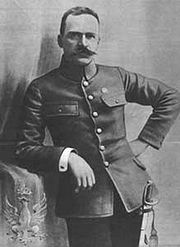
At a meeting in Paris in 1914, Piłsudski presciently declared that in the impending war, for Poland to regain independence, Russia must be beaten by the Central Powers (the Austro-Hungarian and German Empires), and the latter powers must in their turn be beaten by France
French Third Republic
The French Third Republic was the republican government of France from 1870, when the Second French Empire collapsed due to the French defeat in the Franco-Prussian War, to 1940, when France was overrun by Nazi Germany during World War II, resulting in the German and Italian occupations of France...
, Britain
United Kingdom of Great Britain and Ireland
The United Kingdom of Great Britain and Ireland was the formal name of the United Kingdom during the period when what is now the Republic of Ireland formed a part of it....
and the United States. By contrast, Roman Dmowski
Roman Dmowski
Roman Stanisław Dmowski was a Polish politician, statesman, and chief ideologue and co-founder of the National Democracy political movement, which was one of the strongest political camps of interwar Poland.Though a controversial personality throughout his life, Dmowski was instrumental in...
, Piłsudski's rival, believed that the best way to achieve a unified and independent Poland was to support the Triple Entente
Triple Entente
The Triple Entente was the name given to the alliance among Britain, France and Russia after the signing of the Anglo-Russian Entente in 1907....
against the Central Powers.
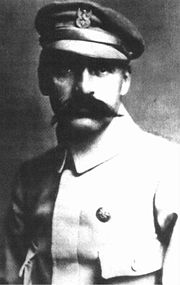
Kraków
Kraków also Krakow, or Cracow , is the second largest and one of the oldest cities in Poland. Situated on the Vistula River in the Lesser Poland region, the city dates back to the 7th century. Kraków has traditionally been one of the leading centres of Polish academic, cultural, and artistic life...
, Piłsudski formed a small cadre military unit, the First Cadre Company
First Cadre Company
First Cadre Company was a military formation created by Józef Piłsudski at the outbreak of World War I, on August 3, 1914 in Kraków, from members of the Riflemen's Association and the Polish Rifle Squads. The company numbered 144 soldiers under command of Tadeusz Kasprzycki. The formation...
, from members of the Riflemen's Association and Polish Rifle Squads
Polish Rifle Squads
The Polish Rifle Squads was a Polish pro-independence paramilitary organization, founded in 1911 by the Youth Independence Organization Zarzewie in the Austro-Hungarian sector of partitioned Poland....
. That same day, a cavalry unit under Władysław Belina-Prażmowski was sent to reconnoitre across the Russian border, even before the official declaration of war
Declaration of war
A declaration of war is a formal act by which one nation goes to war against another. The declaration is a performative speech act by an authorized party of a national government in order to create a state of war between two or more states.The legality of who is competent to declare war varies...
between Austria-Hungary and Russia, which ensued on 6 August.
Piłsudski's strategy was to send his forces north across the border into Russian Poland
Congress Poland
The Kingdom of Poland , informally known as Congress Poland , created in 1815 by the Congress of Vienna, was a personal union of the Russian parcel of Poland with the Russian Empire...
, into an area which the Russian Army
Military history of Imperial Russia
The Military history of the Russian Empire encompasses the history of armed conflict in which the Empire participated. This history stretches from its creation in 1721 by Peter the Great, until the Russian Revolution , which led to the establishment of the Soviet Union...
had evacuated, in the hope of breaking through to Warsaw and sparking a national uprising. Using his limited forces, in those early days he backed his orders with the sanction of a fictitious "National Government in Warsaw", and bent and stretched Austrian orders to the utmost, taking initiatives, moving forward and establishing Polish institutions in liberated towns, while the Austrians saw his forces as good only for scouting or for supporting main Austrian formations. On 12 August 1914 Piłsudski's forces took the town of Kielce
Kielce
Kielce ) is a city in central Poland with 204,891 inhabitants . It is also the capital city of the Świętokrzyskie Voivodeship since 1999, previously in Kielce Voivodeship...
, of Kielce Governorate
Kielce Governorate
Kielce Governorate was an administrative unit of the Congress Poland.-History:It was created in 1841 from the Kraków Governorate, both with capital in Kielce...
, but Piłsudski found the populace less supportive than he had expected.
Soon afterward he officially established the Polish Legions
Polish Legions in World War I
Polish Legions was the name of Polish armed forces created in August 1914 in Galicia. Thanks to the efforts of KSSN and the Polish members of the Austrian parliament, the unit became an independent formation of the Austro-Hungarian Army...
, taking personal command of their First Brigade
I Brigade of the Polish Legions
Brigade I of the Polish Legions was a unit of Austro-Hungarian Army, manned by Austrian Poles, part of the Polish Legions in World War I, existing from 1914 to 1917.-History:...
, which he would lead successfully into several victorious battles. He also secretly informed the British government in the fall of 1914 that his Legions would never fight France or Britain, only Russia.
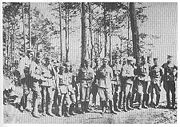
French Revolution
The French Revolution , sometimes distinguished as the 'Great French Revolution' , was a period of radical social and political upheaval in France and Europe. The absolute monarchy that had ruled France for centuries collapsed in three years...
-inspired "Citizen" (Obywatel), and he himself was referred to as "the Commandant" ("Komendant"). Piłsudski enjoyed extreme respect and loyalty from his men which would remain for years to come. The Polish Legions fought against Russia at the side of the Central Powers until 1917.
Soon after forming the Legions, also in 1914, Piłsudski set up another organization, the Polish Military Organisation
Polish Military Organisation
Polish Military Organisation, PMO was a secret military organization created by Józef Piłsudski in August 1914, and officially named in November 1914, during World War I. Its tasks were to gather intelligence and sabotage the enemies of the Polish people...
(Polska Organizacja Wojskowa), which served as a precursor Polish intelligence agency and was designed to perform espionage and sabotage missions.

Battle of Kostiuchnówka
The Battle of Kostiuchnówka took place from July 4 to July 6, 1916, near the village of Kostiuchnówka and the Styr River, in the Volhynia region of modern Ukraine, then part of the Russian Empire...
(4–6 July 1916), in which the Polish Legions delayed a Russian offensive at a cost of over 2,000 casualties, Piłsudski demanded that the Central Powers issue a guarantee of independence for Poland. He backed this demand with his own proffered resignation
Resignation
A resignation is the formal act of giving up or quitting one's office or position. It can also refer to the act of admitting defeat in a game like chess, indicated by the resigning player declaring "I resign", turning his king on its side, extending his hand, or stopping the chess clock...
and that of many of the Legions' officers. On 5 November 1916 the Central Powers proclaimed the "independence" of Poland, hoping to increase the number of Polish troops that could be sent to the eastern front
Eastern Front (World War I)
The Eastern Front was a theatre of war during World War I in Central and, primarily, Eastern Europe. The term is in contrast to the Western Front. Despite the geographical separation, the events in the two theatres strongly influenced each other...
against Russia, thereby relieving German forces to bolster the western front
Western Front (World War I)
Following the outbreak of World War I in 1914, the German Army opened the Western Front by first invading Luxembourg and Belgium, then gaining military control of important industrial regions in France. The tide of the advance was dramatically turned with the Battle of the Marne...
.
Piłsudski agreed to serve in the Regency Kingdom of Poland
Kingdom of Poland (1916–1918)
The Kingdom of Poland, also informally called the Regency Kingdom of Poland , was a proposed puppet state during World War I by Germany and Austria-Hungary in 1916 after their conquest of the former Congress Poland from Russia...
created by the Central Powers, and acted as minister of war in the newly formed Polish Regency government; as such he was responsible for the Polnische Wehrmacht
Polnische Wehrmacht
Polska Siła Zbrojna, was a military formation created by Imperial Germany during World War I, as the armed forces of their puppet Kingdom of Poland. Polska Siła Zbrojna was established a part of the German Army, under German command...
. After the Russian Revolution in early 1917
February Revolution
The February Revolution of 1917 was the first of two revolutions in Russia in 1917. Centered around the then capital Petrograd in March . Its immediate result was the abdication of Tsar Nicholas II, the end of the Romanov dynasty, and the end of the Russian Empire...
, and in view of the worsening situation of the Central Powers, Piłsudski took an increasingly uncompromising stance, insisting that his men no longer be treated as "German colonial troops
Colonial troops
Colonial troops or colonial army refers to various military units recruited from, or used as garrison troops in, colonial territories.- Colonial background :...
" and only be used to fight Russia. Anticipating the Central Powers' defeat in the war, he did not wish to be allied with the losing side. In the aftermath of a July 1917 "Oath Crisis
Oath crisis
The Oath crisis was a World War I political conflict between the Imperial German Army command and the Józef Piłsudski-led Polish Legions.Initially supporting the Central Powers against Imperial Russia, Piłsudski wanted to defeat one of the partitioning powers with the hands of the two remaining...
" when Piłsudski forbade Polish soldiers to swear an oath of loyalty
Loyalty oath
A loyalty oath is an oath of loyalty to an organization, institution, or state of which an individual is a member.In this context, a loyalty oath is distinct from pledge or oath of allegiance...
to the Central Powers, he was arrested and imprisoned at Magdeburg
Magdeburg
Magdeburg , is the largest city and the capital city of the Bundesland of Saxony-Anhalt, Germany. Magdeburg is situated on the Elbe River and was one of the most important medieval cities of Europe....
; the Polish units were disbanded, and the men were incorporated into the Austro-Hungarian Army
Austro-Hungarian Army
The Austro-Hungarian Army was the ground force of the Austro-Hungarian Dual Monarchy from 1867 to 1918. It was composed of three parts: the joint army , the Austrian Landwehr , and the Hungarian Honvédség .In the wake of fighting between the...
, while the Polish Military Organization began attacking German targets. Piłsudski's arrest greatly enhanced his reputation among Poles, many of whom began to see him as the most determined Polish leader, willing to take on all the partitioning powers.
On 8 November 1918, three days before the Armistice
Armistice with Germany (Compiègne)
The armistice between the Allies and Germany was an agreement that ended the fighting in the First World War. It was signed in a railway carriage in Compiègne Forest on 11 November 1918 and marked a victory for the Allies and a complete defeat for Germany, although not technically a surrender...
, Piłsudski and his colleague, Colonel Kazimierz Sosnkowski
Kazimierz Sosnkowski
Kazimierz Sosnkowski was a Polish independence fighter, politician and Polish Army general.-Life:Sosnkowski served successively as founder and first commander of Związek Walki Czynnej , chief of staff of the 1st Brigade of the Polish Legions, Polish minister of military affairs, vice-president of...
, were released by the Germans from Magdeburg and soon—like Lenin before them—placed on a private train, bound for their national capital, as the collapsing Germans hoped that Piłsudski would create a force friendly to them.
Rebuilding Poland
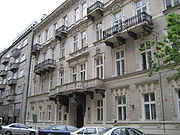
Regency Council
right|thumb|Regency Council: Ostrowski, Kakowski, LubomirskiThe Regency Council of the Kingdom of Poland was a semi-independent and temporary highest authority during World War I, formed by Germany and Austria-Hungary in the occupied Polish territories in September 1917. It was supposed to stay...
and was entrusted with creating a national government for the newly independent country. On that very day (which would become Poland's Independence Day), he proclaimed an independent Polish state.
That week, too, Piłsudski also negotiated the evacuation of the German garrison from Warsaw and of other German troops from the "Ober Ost
Ober Ost
Ober Ost is short for Oberbefehlshaber der gesamten Deutschen Streitkräfte im Osten, which is a German term meaning "Supreme Commander of All German Forces in the East" during World War I. In practice it refers not only to said commander, but also to his governing military staff and the district...
" authority. Over 55,000 Germans would peacefully depart Poland, leaving their weapons to the Poles. In coming months, over 400,000 total would depart Polish territories.
On 14 November 1918 Piłsudski was asked to provisionally supervise the running of the country. On 22 November he officially received, from the new government of Jędrzej Moraczewski
Jedrzej Moraczewski
Jędrzej Moraczewski was a Polish socialist politician who served as first Prime Minister of Poland , from November 1918 to January 1919....
, the title of Provisional Chief of State (Naczelnik Państwa) of renascent Poland.
Various Polish military organizations and provisional governments (the Regency Council
Regency Council
right|thumb|Regency Council: Ostrowski, Kakowski, LubomirskiThe Regency Council of the Kingdom of Poland was a semi-independent and temporary highest authority during World War I, formed by Germany and Austria-Hungary in the occupied Polish territories in September 1917. It was supposed to stay...
in Warsaw; Ignacy Daszyński
Ignacy Daszynski
Ignacy Ewaryst Daszyński was a Polish politician, journalist and Prime Minister of the Polish government created in Lublin in 1918....
's government in Lublin
Lublin
Lublin is the ninth largest city in Poland. It is the capital of Lublin Voivodeship with a population of 350,392 . Lublin is also the largest Polish city east of the Vistula river...
; and the Polish Liquidation Committee
Polish Liquidation Committee
The Polish Liquidation Committee was a temporary Polish government body in Galicia formed towards the end of World War I. Created on October 28, 1918, with its seat in Kraków, the Committee was headed by Wincenty Witos and Ignacy Daszyński...
in Kraków
Kraków
Kraków also Krakow, or Cracow , is the second largest and one of the oldest cities in Poland. Situated on the Vistula River in the Lesser Poland region, the city dates back to the 7th century. Kraków has traditionally been one of the leading centres of Polish academic, cultural, and artistic life...
) bowed to Piłsudski, who set about forming a new coalition government. It was predominantly socialist and introduced many reforms long proclaimed as necessary by the Polish Socialist Party, such as the eight-hour day
Eight-hour day
The eight-hour day movement or 40-hour week movement, also known as the short-time movement, had its origins in the Industrial Revolution in Britain, where industrial production in large factories transformed working life and imposed long hours and poor working conditions. With working conditions...
, free school education, and women's suffrage
Women's suffrage
Women's suffrage or woman suffrage is the right of women to vote and to run for office. The expression is also used for the economic and political reform movement aimed at extending these rights to women and without any restrictions or qualifications such as property ownership, payment of tax, or...
. This was necessary to avoid major unrest.
However, Piłsudski believed that as head of state he must be above partisan politics. The day after his arrival in Warsaw, he met with old colleagues from underground days, who addressed him socialist-style as "Comrade
Comrade
Comrade means "friend", "colleague", or "ally". The word comes from French camarade. The term is frequently used by left-wing organizations around the globe. "Comrade" has often become a stock phrase and form of address. This word has its regional equivalents available in many...
" ("Towarzysz") and asked his support for their revolutionary policies; he refused it and answered: "Comrades, I took the red streetcar
Tram
A tram is a passenger rail vehicle which runs on tracks along public urban streets and also sometimes on separate rights of way. It may also run between cities and/or towns , and/or partially grade separated even in the cities...
of socialism to the stop called Independence, and that's where I got off. You may keep on to the final stop if you wish, but from now on let's address each other as 'Mister'
Mr.
Mister, usually written in its abbreviated form Mr or Mr. , is a commonly used English honorific for men under the rank of knighthood. The title derived from master, as the equivalent female titles, Mrs., Miss, and Ms, all derived from the archaic mistress...
[rather than continue using the socialist term of address, 'Comrade']!" He declined to support any one party and did not form any political organization of his own; instead, he advocated creating a coalition government. He also set about organizing a Polish army out of Polish veterans of the German, Russian and Austrian armies.
In the days immediately after World War I, Piłsudski attempted to build a government in a shattered country. Much of former Russian Poland had been destroyed in the war, and systematic looting by the Germans had reduced the region's wealth by at least 10%. A British diplomat who visited Warsaw in January 1919 reported: "I have nowhere seen anything like the evidences of extreme poverty and wretchedness that meet one's eye at almost every turn".
In addition, the country had to unify the disparate systems of law, economics, and administration
Administration (government)
The term administration, as used in the context of government, differs according to jurisdiction.-United States:In United States usage, the term refers to the executive branch under a specific president , for example: the "Barack Obama administration." It can also mean an executive branch agency...
in the former German, Austrian and Russian sectors of Poland. There were nine legal systems, five currencies, 66 types of rail systems (with 165 models of locomotives), which all had to be consolidated on an expedited basis.
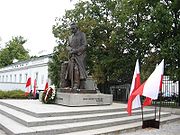
Sparta
Sparta or Lacedaemon, was a prominent city-state in ancient Greece, situated on the banks of the River Eurotas in Laconia, in south-eastern Peloponnese. It emerged as a political entity around the 10th century BC, when the invading Dorians subjugated the local, non-Dorian population. From c...
n lifestyle, eating plain meals alone at an inexpensive restaurant. Though Piłsudski was popular with much of the Polish public, his reputation as a loner (the result of many years' underground work), as a man who distrusted almost everyone, led to strained relations with other Polish politicians.
Piłsudski and the first Polish government were distrusted in the West because Piłsudski had cooperated with the Central Powers in 1914–17 and because the governments of Daszyński and Jędrzej Moraczewski were primarily socialist. It was not until January 1919, when the world-famous pianist and composer Ignacy Paderewski
Ignacy Jan Paderewski
Ignacy Jan Paderewski GBE was a Polish pianist, composer, diplomat, politician, and the second Prime Minister of the Republic of Poland.-Biography:...
became prime minister and foreign minister of a new government, that it was recognized in the West.
That still left two separate governments claiming to be Poland's legitimate government: Piłsudski's in Warsaw, and Dmowski's in Paris. To ensure that Poland have a single government and to avert civil war, Paderewski met with Dmowski and Piłsudski and persuaded them to join forces, with Piłsudski acting as Provisional Chief of State and Commander-in-Chief
Commander-in-Chief
A commander-in-chief is the commander of a nation's military forces or significant element of those forces. In the latter case, the force element may be defined as those forces within a particular region or those forces which are associated by function. As a practical term it refers to the military...
while Dmowski and Paderewski represented Poland at the Paris Peace Conference. Articles 87–93 of the Versailles Treaty
Treaty of Versailles
The Treaty of Versailles was one of the peace treaties at the end of World War I. It ended the state of war between Germany and the Allied Powers. It was signed on 28 June 1919, exactly five years after the assassination of Archduke Franz Ferdinand. The other Central Powers on the German side of...
and the Little Treaty of Versailles
Little Treaty of Versailles
Little Treaty of Versailles or the Polish Minority Treaty was one of the bilateral Minority Treaties signed between minor powers and the League of Nations in the aftermath of the First World War. The Polish treaty was signed on 28 June 1919, the same day as the main Treaty of Versailles was signed...
, signed on 28 June 1919, formally established Poland as an independent and sovereign state in the international arena.
Piłsudski often clashed with Dmowski, at variance with the latter's vision of the Poles as the dominant nationality in renascent Poland, and irked by Dmowski's attempt to send the Blue Army to Poland through Danzig, Germany (now Gdańsk
Gdansk
Gdańsk is a Polish city on the Baltic coast, at the centre of the country's fourth-largest metropolitan area.The city lies on the southern edge of Gdańsk Bay , in a conurbation with the city of Gdynia, spa town of Sopot, and suburban communities, which together form a metropolitan area called the...
, Poland). On 5 January 1919, some of Dmowski's supporters (Marian Januszajtis-Żegota
Marian Januszajtis-Zegota
Marian Józef Januszajtis-Żegota was a Polish military commander and politician...
and Eustachy Sapieha
Eustachy Sapieha
Eustachy Kajetan Sapieha was a Polish nobleman, prince of the Sapieha family, politician, Polish Minister of Foreign Affairs, and deputy to the Polish parliament ....
) attempted a coup against Piłsudski and Prime Minister Moraczewski, but failed.
On 20 February 1919 Piłsudski declared that he would return his powers to the newly elected Polish parliament (Sejm
Sejm
The Sejm is the lower house of the Polish parliament. The Sejm is made up of 460 deputies, or Poseł in Polish . It is elected by universal ballot and is presided over by a speaker called the Marshal of the Sejm ....
). However, the Sejm reinstated his office in the Little Constitution of 1919. The word "Provisional" was struck from his title, and Piłsudski would hold the office until 9 December 1922, when Gabriel Narutowicz
Gabriel Narutowicz
Gabriel Narutowicz was a Lithuanian-born professor of hydroelectric engineering at Switzerland's Zurich Polytechnic, and Poland's Minister of Public Works , Minister of Foreign Affairs , and the first president of the Second Polish Republic....
was elected the first president of Poland.
Piłsudski's major foreign-policy initiative at this time was a proposed federation (to be called "Międzymorze
Miedzymorze
Międzymorze was a plan, pursued after World War I by Polish leader Józef Piłsudski, for a federation, under Poland's aegis, of Central and Eastern European countries...
", Polish
Polish language
Polish is a language of the Lechitic subgroup of West Slavic languages, used throughout Poland and by Polish minorities in other countries...
for "Between-Seas", and also known from the Latin
Latin
Latin is an Italic language originally spoken in Latium and Ancient Rome. It, along with most European languages, is a descendant of the ancient Proto-Indo-European language. Although it is considered a dead language, a number of scholars and members of the Christian clergy speak it fluently, and...
as "Intermarum", stretching from the Baltic
Baltic Sea
The Baltic Sea is a brackish mediterranean sea located in Northern Europe, from 53°N to 66°N latitude and from 20°E to 26°E longitude. It is bounded by the Scandinavian Peninsula, the mainland of Europe, and the Danish islands. It drains into the Kattegat by way of the Øresund, the Great Belt and...
to the Black Sea
Black Sea
The Black Sea is bounded by Europe, Anatolia and the Caucasus and is ultimately connected to the Atlantic Ocean via the Mediterranean and the Aegean seas and various straits. The Bosphorus strait connects it to the Sea of Marmara, and the strait of the Dardanelles connects that sea to the Aegean...
) of Poland with the independent Baltic states
Baltic states
The term Baltic states refers to the Baltic territories which gained independence from the Russian Empire in the wake of World War I: primarily the contiguous trio of Estonia, Latvia, Lithuania ; Finland also fell within the scope of the term after initially gaining independence in the 1920s.The...
and Belarus
Belarus
Belarus , officially the Republic of Belarus, is a landlocked country in Eastern Europe, bordered clockwise by Russia to the northeast, Ukraine to the south, Poland to the west, and Lithuania and Latvia to the northwest. Its capital is Minsk; other major cities include Brest, Grodno , Gomel ,...
and Ukraine
Ukraine
Ukraine is a country in Eastern Europe. It has an area of 603,628 km², making it the second largest contiguous country on the European continent, after Russia...
, somewhat in emulation of the pre-partition
Partitions of Poland
The Partitions of Poland or Partitions of the Polish–Lithuanian Commonwealth took place in the second half of the 18th century and ended the existence of the Polish–Lithuanian Commonwealth, resulting in the elimination of sovereign Poland for 123 years...
Polish-Lithuanian Commonwealth
Polish-Lithuanian Commonwealth
The Polish–Lithuanian Commonwealth was a dualistic state of Poland and Lithuania ruled by a common monarch. It was the largest and one of the most populous countries of 16th- and 17th‑century Europe with some and a multi-ethnic population of 11 million at its peak in the early 17th century...
.
Piłsudski's plan met with opposition from most of the prospective member states—who refused to relinquish any of their hard-won independence—as well as from the Allied powers, for whom it would be too bold a change to the existing balance-of-power
Balance of power in international relations
In international relations, a balance of power exists when there is parity or stability between competing forces. The concept describes a state of affairs in the international system and explains the behavior of states in that system...
structure. According to historian George Sanford
George Sanford (scholar)
George Sanford is a former professor of politics at the University of Bristol, England. He specializes in Polish and East European studies. On several occasions he has been interviewed on Polish affairs in the mass media.-Publications:...
, around 1920 Piłsudski came to realize the infeasibility of this version of his Intermarum project.
Instead of a Central- and East-European alliance, there soon appeared a series of border conflicts, including the Polish-Ukrainian War
Polish-Ukrainian War
The Polish–Ukrainian War of 1918 and 1919 was a conflict between the forces of the Second Polish Republic and West Ukrainian People's Republic for the control over Eastern Galicia after the dissolution of Austria-Hungary.-Background:...
(1918–19), the Polish-Lithuanian War
Polish-Lithuanian War
The Polish–Lithuanian War was an armed conflict between newly independent Lithuania and Poland in the aftermath of World War I. The conflict primarily concerned territorial control of the Vilnius Region, including Vilnius , and the Suwałki Region, including the towns of Suwałki, Augustów, and Sejny...
(1920, culminating in Żeligowski's Mutiny
Zeligowski's Mutiny
Żeligowski's Mutiny was a sham mutiny led by Polish General Lucjan Żeligowski in October 1920, which resulted in the creation of the short-lived Republic of Central Lithuania. Polish Chief of State Józef Piłsudski had surreptitiously ordered Żeligowski to carry out the operation, and revealed the...
), Polish-Czechoslovak border conflicts (beginning in 1918), and most notably the Polish-Soviet War (1919–21). Winston Churchill
Winston Churchill
Sir Winston Leonard Spencer-Churchill, was a predominantly Conservative British politician and statesman known for his leadership of the United Kingdom during the Second World War. He is widely regarded as one of the greatest wartime leaders of the century and served as Prime Minister twice...
commented: "The war of giants has ended, the wars of the pygmies begun."
Polish-Soviet War
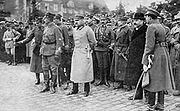
Aftermath of World War I
The fighting in World War I ended in western Europe when the Armistice took effect at 11:00 am GMT on November 11, 1918, and in eastern Europe by the early 1920s. During and in the aftermath of the war the political, cultural, and social order was drastically changed in Europe, Asia and Africa,...
, there was unrest on all Polish borders. Regarding Poland's future frontiers, Piłsudski said, "All that we can gain in the west depends on the Entente—on the extent to which it may wish to squeeze Germany", while in the east "there are doors that open and close, and it depends on who forces them open and how far." In 1918 in the east, Polish forces clashed with Ukrainian forces in the Polish-Ukrainian War, and Piłsudski's first orders as Commander-in-Chief of the Polish Army, on 12 November 1918, were to provide support for the Polish struggle in Lviv
Battle of Lwów (1918)
Battle of Lviv begun on 1 November 1918 and lasted till May 1919 and was a six months long conflict between the forces of the West Ukrainian People's Republic and local Polish civilian population assisted later by regular Polish Army forces for the control...
.
Piłsudski was aware that the Bolsheviks were no friends of independent Poland, and that war with them was inevitable. He viewed their advance west as a major problem, but also considered the Bolsheviks less dangerous for Poland than their Russian Civil War opponents
White movement
The White movement and its military arm the White Army - known as the White Guard or the Whites - was a loose confederation of Anti-Communist forces.The movement comprised one of the politico-military Russian forces who fought...
. These "White Russians"—representative of the old Russian Empire—were willing to accept only limited independence for Poland, probably within borders similar to those of the former Congress Poland
Congress Poland
The Kingdom of Poland , informally known as Congress Poland , created in 1815 by the Congress of Vienna, was a personal union of the Russian parcel of Poland with the Russian Empire...
, and clearly objected to Polish control of Ukraine, which was crucial for Piłsudski's Intermarum project.
This was in contrast to the Bolsheviks, who proclaimed the partitions of Poland null and void. Piłsudski thus speculated that Poland would be better off with the Bolsheviks, alienated from the Western powers, than with a restored Russian Empire. By ignoring the strong pressures from the Entente Cordiale
Entente Cordiale
The Entente Cordiale was a series of agreements signed on 8 April 1904 between the United Kingdom and the French Republic. Beyond the immediate concerns of colonial expansion addressed by the agreement, the signing of the Entente Cordiale marked the end of almost a millennium of intermittent...
to join the attack on Vladimir Lenin
Vladimir Lenin
Vladimir Ilyich Lenin was a Russian Marxist revolutionary and communist politician who led the October Revolution of 1917. As leader of the Bolsheviks, he headed the Soviet state during its initial years , as it fought to establish control of Russia in the Russian Civil War and worked to create a...
's struggling Soviet
Soviet Union
The Soviet Union , officially the Union of Soviet Socialist Republics , was a constitutionally socialist state that existed in Eurasia between 1922 and 1991....
government, Piłsudski probably saved the Bolshevik government in the summer and fall of 1919.
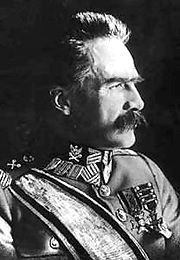
Marshal
Marshal , is a word used in several official titles of various branches of society. The word is an ancient loan word from Old French, cf...
Piłsudski (as his rank had been since March 1920) signed a military alliance (the Treaty of Warsaw
Treaty of Warsaw (1920)
The Treaty of Warsaw of April 1920 was an alliance between the Second Polish Republic, represented by Józef Piłsudski, and the Ukrainian People's Republic, represented by Symon Petlura, against Bolshevik Russia...
) with Ukrainian leader Symon Petliura to conduct joint operations against Soviet Russia. The goal of the Polish-Ukrainian treaty was to establish an independent Ukraine in alliance with Poland. In return, Petliura gave up Ukrainian claims to eastern Galicia, for which he was denounced by eastern-Galician Ukrainian leaders.
The Polish and Ukrainian armies, under Piłsudski's command, launched a successful offensive against the Russian forces in Ukraine. On 7 May 1920, with remarkably little fighting, they captured Kiev
Kiev
Kiev or Kyiv is the capital and the largest city of Ukraine, located in the north central part of the country on the Dnieper River. The population as of the 2001 census was 2,611,300. However, higher numbers have been cited in the press....
.
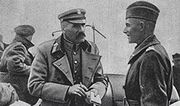
Belarus
Belarus , officially the Republic of Belarus, is a landlocked country in Eastern Europe, bordered clockwise by Russia to the northeast, Ukraine to the south, Poland to the west, and Lithuania and Latvia to the northwest. Its capital is Minsk; other major cities include Brest, Grodno , Gomel ,...
and counter-attack
Counter-Attack
Counter-Attack is a 1945 war film starring Paul Muni and Marguerite Chapman as two Russians trapped in a collapsed building with seven enemy German soldiers during World War II...
ed in Ukraine, advancing into Poland in a drive toward Germany to encourage the German Communist Party
Communist Party of Germany
The Communist Party of Germany was a major political party in Germany between 1918 and 1933, and a minor party in West Germany in the postwar period until it was banned in 1956...
in its struggle to take power. Soviet confidence soared. The Soviets announced their plans to invade western Europe; Soviet communist theoretician Nikolai Bukharin, writing in Pravda
Pravda
Pravda was a leading newspaper of the Soviet Union and an official organ of the Central Committee of the Communist Party between 1912 and 1991....
, hoped for the resources to carry the campaign beyond Warsaw "straight to London and Paris". Soviet General Mikhail Tukhachevsky
Mikhail Tukhachevsky
Mikhail Nikolayevich Tukhachevsky was a Marshal of the Soviet Union, commander in chief of the Red Army , and one of the most prominent victims of Joseph Stalin's Great Purge.-Early life:...
's order of the day for 2 July 1920, read: "To the West! Over the corpse of White Poland lies the road to worldwide conflagration. March upon Vilnius
Vilnius
Vilnius is the capital of Lithuania, and its largest city, with a population of 560,190 as of 2010. It is the seat of the Vilnius city municipality and of the Vilnius district municipality. It is also the capital of Vilnius County...
, Minsk
Minsk
- Ecological situation :The ecological situation is monitored by Republican Center of Radioactive and Environmental Control .During 2003–2008 the overall weight of contaminants increased from 186,000 to 247,400 tons. The change of gas as industrial fuel to mazut for financial reasons has worsened...
, Warsaw!" and "onward to Berlin over the corpse of Poland!"
On 1 July 1920, in view of the rapidly advancing Soviet offensive, Poland's parliament, the Sejm
Sejm
The Sejm is the lower house of the Polish parliament. The Sejm is made up of 460 deputies, or Poseł in Polish . It is elected by universal ballot and is presided over by a speaker called the Marshal of the Sejm ....
, formed a Council for Defense of the Nation. It was chaired by Piłsudski and was to provide expeditious decision-making and temporarily supplant the fractious Sejm
Sejm
The Sejm is the lower house of the Polish parliament. The Sejm is made up of 460 deputies, or Poseł in Polish . It is elected by universal ballot and is presided over by a speaker called the Marshal of the Sejm ....
. The National Democrats, however, contended that the string of Bolshevik victories had been Piłsudski's fault and demanded that he resign; some even accused him of treason. Their 19 July failure to carry a vote of no-confidence in the council led to Roman Dmowski
Roman Dmowski
Roman Stanisław Dmowski was a Polish politician, statesman, and chief ideologue and co-founder of the National Democracy political movement, which was one of the strongest political camps of interwar Poland.Though a controversial personality throughout his life, Dmowski was instrumental in...
's withdrawal from it. On 12 August Piłsudski tendered his resignation to Prime Minister Wincenty Witos
Wincenty Witos
Wincenty Witos was a prominent member of the Polish People's Party from 1895, and leader of its "Piast" faction from 1913. He was a member of parliament in the Galician Sejm from 1908–1914, and an envoy to Reichsrat in Vienna from 1911 to 1918...
, offering to be the scapegoat if the military solution failed, but Witos refused to accept his resignation. The Entente
Triple Entente
The Triple Entente was the name given to the alliance among Britain, France and Russia after the signing of the Anglo-Russian Entente in 1907....
pressured Poland to surrender and enter into negotiations with the Bolsheviks. Piłsudski, however, was a staunch advocate of continuing the fight. As Norman Davies
Norman Davies
Professor Ivor Norman Richard Davies FBA, FRHistS is a leading English historian of Welsh descent, noted for his publications on the history of Europe, Poland, and the United Kingdom.- Academic career :...
noted, at that time, especially abroad, "Piłsudski had nothing of his later prestige. As a pre-war revolutionary he led his party to splits and quarrels; as a general in World War I he led his legions to internment and disbanding; as a marshal of the Polish Army he led it to Kiev and Vilnius, both now lost to Poles. He left the Polish Socialist Party and his Austro-German allies; refused to ally himself with Entente. In France and England he was considered a treasonous ally who leads Poland into destruction; in Russia he was seen as a false servant of the allies, who will lead imperialism to ruin. All – from Lenin to Lloyd George
David Lloyd George
David Lloyd George, 1st Earl Lloyd-George of Dwyfor OM, PC was a British Liberal politician and statesman...
, from Pravda
Pravda
Pravda was a leading newspaper of the Soviet Union and an official organ of the Central Committee of the Communist Party between 1912 and 1991....
to Morning Star – considered him a military and political failure. In August 1920 all were in agreement that his catastrophic career will be crowned with the fall of Warsaw."
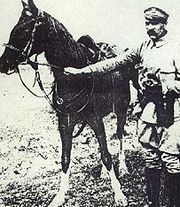
Battle of Warsaw (1920)
The Battle of Warsaw sometimes referred to as the Miracle at the Vistula, was the decisive battle of the Polish–Soviet War. That war began soon after the end of World War I in 1918 and lasted until the Treaty of Riga resulted in the end of the hostilities between Poland and Russia in 1921.The...
halted the Soviet advance. The Polish plan was developed by Piłsudski and others, including Tadeusz Rozwadowski. Later, some supporters of Piłsudski would seek to portray him as the sole author of the Polish strategy, while opponents would seek to minimize his role. In the West for a long time a myth persisted that it was General Maxime Weygand
Maxime Weygand
Maxime Weygand was a French military commander in World War I and World War II.Weygand initially fought against the Germans during the invasion of France in 1940, but then surrendered to and collaborated with the Germans as part of the Vichy France regime.-Early years:Weygand was born in Brussels...
of the French military mission to Poland
French Military Mission to Poland
The French Military Mission to Poland was an effort by France to aid the nascent Second Polish Republic after it achieved its independence in November, 1918, at the end of the First World War. The aim was to provide aid during the Polish-Soviet War , and to create a strong Polish military to serve...
who had saved Poland; modern scholars, however, are in agreement that Weygand's role was minimal at best.
Piłsudski's plan called for Polish forces to withdraw across the Vistula River and defend the bridgeheads at Warsaw and on the Wieprz River
Wieprz River
The Wieprz is a river in central-eastern Poland, a tributary of the Vistula. It is the country's ninth longest river, with a total length of 303 km and a catchment area of 10,415 km², all within Poland...
, while some 25% of available divisions
Division (military)
A division is a large military unit or formation usually consisting of between 10,000 and 20,000 soldiers. In most armies, a division is composed of several regiments or brigades, and in turn several divisions typically make up a corps...
concentrated to the south for a strategic counter-offensive. The plan next required two armies under General Józef Haller
Józef Haller de Hallenburg
Józef Haller de Hallenburg was a Lieutenant General of the Polish Army, legionary in Polish Legions, harcmistrz , the President of The Polish Scouting and Guiding Association , political and social activist, Stanisław Haller de Hallenburg's cousin.Haller was born in Jurczyce...
, facing Soviet frontal attack on Warsaw from the east, to hold their entrenched
Trench
A trench is a type of excavation or depression in the ground. Trenches are generally defined by being deeper than they are wide , and by being narrow compared to their length ....
positions at all costs. At the same time, an army under General Władysław Sikorski was to strike north from outside Warsaw, cutting off Soviet forces that sought to envelope the Polish capital from that direction. The most important role, however, was assigned to a relatively small, approximately 20,000-man, newly assembled "Reserve Army" (also known as the "Strike Group", "Grupa Uderzeniowa"), comprising the most determined, battle-hardened Polish units and commanded personally by Piłsudski. Their task was to spearhead a lightning northward offensive, from the Vistula-Wieprz triangle south of Warsaw, through a weak spot identified by Polish intelligence between the Soviet Western and Southwestern Fronts
Front (Soviet Army)
A front was a major military organization in the Soviet Army during many wars. It was roughly equivalent to an army group in the militaries of most other countries except Germany...
. That offensive would separate the Soviet Western Front from its reserves and disorganize its movements. Eventually, the gap between Sikorski's army and the "Strike Group" would close near the East Prussia
East Prussia
East Prussia is the main part of the region of Prussia along the southeastern Baltic Coast from the 13th century to the end of World War II in May 1945. From 1772–1829 and 1878–1945, the Province of East Prussia was part of the German state of Prussia. The capital city was Königsberg.East Prussia...
n border, bringing about the destruction of the encircled Soviet forces.
At the time Piłsudski's plan was strongly criticized, and only the desperate situation of the Polish forces persuaded other commanders to go along with it. Though based on reliable intelligence, including decrypted Soviet radio communications, the plan was termed "amateurish" by high-ranking army officers and military experts who were quick to point out Piłsudski's lack of formal military education. When a copy of the plan fell into Soviet hands, Soviet commander Mikhail Tukhachevsky
Mikhail Tukhachevsky
Mikhail Nikolayevich Tukhachevsky was a Marshal of the Soviet Union, commander in chief of the Red Army , and one of the most prominent victims of Joseph Stalin's Great Purge.-Early life:...
thought it a ruse and disregarded it. Days later, the Soviets paid dearly for this when, during the Battle of Warsaw
Battle of Warsaw (1920)
The Battle of Warsaw sometimes referred to as the Miracle at the Vistula, was the decisive battle of the Polish–Soviet War. That war began soon after the end of World War I in 1918 and lasted until the Treaty of Riga resulted in the end of the hostilities between Poland and Russia in 1921.The...
, the overconfident Red Army
Red Army
The Workers' and Peasants' Red Army started out as the Soviet Union's revolutionary communist combat groups during the Russian Civil War of 1918-1922. It grew into the national army of the Soviet Union. By the 1930s the Red Army was among the largest armies in history.The "Red Army" name refers to...
suffered one of its greatest defeats ever.
A National Democrat Sejm
Sejm
The Sejm is the lower house of the Polish parliament. The Sejm is made up of 460 deputies, or Poseł in Polish . It is elected by universal ballot and is presided over by a speaker called the Marshal of the Sejm ....
deputy, Stanisław Stroński, coined the phrase, "Miracle at the Vistula" ("Cud nad Wisłą"), to express his disapproval of Piłsudski's "Ukrainian adventure". Stroński's phrase was adopted as praise for Piłsudski by some patriotically or piously minded Poles, who were unaware of Stroński's ironic intent. A junior member of the French military mission, Charles de Gaulle
Charles de Gaulle
Charles André Joseph Marie de Gaulle was a French general and statesman who led the Free French Forces during World War II. He later founded the French Fifth Republic in 1958 and served as its first President from 1959 to 1969....
, would later adopt some lessons from the Polish-Soviet War as well as from Piłsudski's career.
In February 1921 Piłsudski visited Paris, where in negotiations with French president Alexandre Millerand
Alexandre Millerand
Alexandre Millerand was a French socialist politician. He was President of France from 23 September 1920 to 11 June 1924 and Prime Minister of France 20 January to 23 September 1920...
he laid the foundations for the Franco-Polish Military Alliance
Franco-Polish Military Alliance
The Franco-Polish alliance was the military alliance between Poland and France that was active between 1921 and 1940.-Background:Already during the France-Habsburg rivalry that started in the 16th century, France had tried to find allies to the east of Austria, namely hoping to ally with Poland...
that would be signed later that year. The Treaty of Riga, which ended the Polish-Soviet War in March 1921, partitioned Belarus
Belarus
Belarus , officially the Republic of Belarus, is a landlocked country in Eastern Europe, bordered clockwise by Russia to the northeast, Ukraine to the south, Poland to the west, and Lithuania and Latvia to the northwest. Its capital is Minsk; other major cities include Brest, Grodno , Gomel ,...
and Ukraine
Ukraine
Ukraine is a country in Eastern Europe. It has an area of 603,628 km², making it the second largest contiguous country on the European continent, after Russia...
between Poland and Russia. Piłsudski called the treaty an "act of cowardice". The treaty, and Piłsudski-approved General Lucjan Żeligowski
Lucjan Zeligowski
Lucjan Żeligowski , was a Polish general, and veteran of World War I, the Polish-Soviet War and World War II. He is mostly remembered for his role in Żeligowski's Mutiny and as head of a short-lived Republic of Central Lithuania.-Biography:...
's capture of Vilnius
Zeligowski's Mutiny
Żeligowski's Mutiny was a sham mutiny led by Polish General Lucjan Żeligowski in October 1920, which resulted in the creation of the short-lived Republic of Central Lithuania. Polish Chief of State Józef Piłsudski had surreptitiously ordered Żeligowski to carry out the operation, and revealed the...
from the Lithuanians, marked an end to this incarnation of Piłsudski's federalist Intermarum plan.
On 25 September 1921, when Piłsudski visited Lwów (now Lviv
Lviv
Lviv is a city in western Ukraine. The city is regarded as one of the main cultural centres of today's Ukraine and historically has also been a major Polish and Jewish cultural center, as Poles and Jews were the two main ethnicities of the city until the outbreak of World War II and the following...
) for the opening of the first Eastern Trade Fair (Targi Wschodnie), he was the target of an unsuccessful assassination attempt by Stepan Fedak
Stepan Fedak
Stepan Fedak was a Ukrainian independence activist who, on September 25, 1921, attempted to assassinate Poland's Chief of State, Marshal Józef Piłsudski, as the latter visited Lwów for the opening of that city's first Eastern Trade Fair.-Early life:Stepan Fedak was the son of a prominent Lwów...
, acting on behalf of Ukrainian-independence organizations, including the Ukrainian Military Organization
Ukrainian Military Organization
The Ukrainian Military Organization was a Ukrainian resistance and sabotage movement active in Poland's Eastern Lesser Poland during the years between the world wars...
.
Retirement and coup
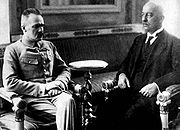
Presidency
The word presidency is often used to describe the administration or the executive, the collective administrative and governmental entity that exists around an office of president of a state or nation...
(intentionally, to prevent a President Piłsudski from waging war), Piłsudski declined to run for the office. On 9 December 1922 the Polish National Assembly elected Gabriel Narutowicz
Gabriel Narutowicz
Gabriel Narutowicz was a Lithuanian-born professor of hydroelectric engineering at Switzerland's Zurich Polytechnic, and Poland's Minister of Public Works , Minister of Foreign Affairs , and the first president of the Second Polish Republic....
of PSL Wyzwolenie; his election, opposed by the right-wing parties, caused public unrest. On 14 December at the Belweder Palace
Belweder
Belweder is a palace in Warsaw, a few kilometers south of the Royal Castle. The President of the Republic of Poland, Bronisław Komorowski, resides at Belweder.-History:...
, Piłsudski officially transferred his powers as Chief of State to his friend Narutowicz; the Naczelnik was replaced by the President.
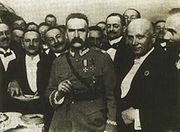
Eligiusz Niewiadomski
Eligiusz Niewiadomski was a Polish modernist painter and art critic who belonged to the right-wing National Democratic Party till 1904 and later continued supporting it. In 1922 he assassinated Poland's first President, Gabriel Narutowicz.-Life:Niewiadomski was born into a family of gentry descent...
, who had originally wanted to kill Piłsudski but had changed his target, influenced by National-Democrat anti-Narutowicz propaganda.
For Piłsudski this was a major shock, an event that shook his belief that Poland could function as a democracy and made him favor government by a strong hand. He became Chief of the General Staff and, together with Minister of Military Affairs Władysław Sikorski, managed to stabilize the situation, quelling unrest with a brief state of emergency
State of emergency
A state of emergency is a governmental declaration that may suspend some normal functions of the executive, legislative and judicial powers, alert citizens to change their normal behaviours, or order government agencies to implement emergency preparedness plans. It can also be used as a rationale...
.
Stanisław Wojciechowski of PSL Piast, another of Piłsudski's old colleagues, was elected the new president, and Wincenty Witos
Wincenty Witos
Wincenty Witos was a prominent member of the Polish People's Party from 1895, and leader of its "Piast" faction from 1913. He was a member of parliament in the Galician Sejm from 1908–1914, and an envoy to Reichsrat in Vienna from 1911 to 1918...
, also of PSL Piast, became prime minister. But the new government—pursuant to the Lanckorona Pact
Lanckorona Pact
Lanckorona Pact was an agreement between Polish center and right wing parties on 17 May 1923 in Warsaw.The politicians of those parties agreed to pursue stricter polonization policies and to...
, an alliance among the centrist PSL Piast and the right-wing National Populist Union
National Populist Union
Związek Ludowo-Narodowy was a Polish political party of the National Democracy political camp, which functioned in the Second Polish Republic. It gathered right-wing politicians with conservative and nationalist opinions....
and Christian Democrat parties—contained right-wing enemies of Piłsudski, people whom he held morally responsible for Narutowicz's death and whom he found it impossible to work with. On 30 May 1923, Piłsudski resigned as Chief of the General Staff.
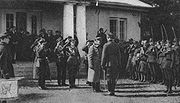
Sulejówek
Sulejówek is a town in Poland, about 18 km east of Warsaw city centre and part of its metropolitan area. It is located in Masovian Voivodeship, in Mińsk County...
, outside Warsaw, at his country manor, "Milusin", which had been presented to him by his former soldiers. There he settled down to supporting his family by writing a series of political and military memoirs, including Rok 1920 (The Year 1920).
Meanwhile Poland's economy was in shambles. Hyperinflation
Hyperinflation
In economics, hyperinflation is inflation that is very high or out of control. While the real values of the specific economic items generally stay the same in terms of relatively stable foreign currencies, in hyperinflationary conditions the general price level within a specific economy increases...
fueled public unrest, and the government was unable to find a quick solution to the mounting unemployment and economic crisis. Piłsudski's allies and supporters repeatedly asked him to return to politics, and he began to create a new power base, centered around former members of the Polish Legions
Polish Legions in World War I
Polish Legions was the name of Polish armed forces created in August 1914 in Galicia. Thanks to the efforts of KSSN and the Polish members of the Austrian parliament, the unit became an independent formation of the Austro-Hungarian Army...
and the Polish Military Organization as well as some left-wing and intelligentsia
Intelligentsia
The intelligentsia is a social class of people engaged in complex, mental and creative labor directed to the development and dissemination of culture, encompassing intellectuals and social groups close to them...
parties. In 1925, after several governments had resigned in short order and the political scene was becoming increasingly chaotic, Piłsudski became more and more critical of the government, eventually issuing statements demanding the resignation of the Witos cabinet.
When the Chjeno-Piast
Chjeno-Piast
Chjeno-Piast was an unofficial name of a coalition of Polish political parties formed in 1923. It included the Polish Peasant Party "Piast" and an older coalition 1922 Christian Association of National Unity . The merger was passed during a meeting in the manor of senator L...
coalition, which Piłsudski had strongly criticized, formed a new government, on 12–14 May 1926, Piłsudski returned to power in a coup d'état (the May Coup), supported by the Polish Socialist Party, Liberation, the Peasant Party, and even the Polish Communist Party
Communist Party of Poland
The Communist Party of Poland is a historical communist party in Poland. It was a result of the fusion of Social Democracy of the Kingdom of Poland and Lithuania and the Polish Socialist Party-Left in the Communist Workers Party of Poland .-1918-1921:The KPRP was founded on 16 December 1918 as...
. Piłsudski had hoped for a bloodless coup, but the government had refused to back down; 215 soldiers and 164 civilians had been killed, and over 900 persons had been wounded.
On 31 May the Sejm
Sejm
The Sejm is the lower house of the Polish parliament. The Sejm is made up of 460 deputies, or Poseł in Polish . It is elected by universal ballot and is presided over by a speaker called the Marshal of the Sejm ....
elected Piłsudski president of the Republic. Piłsudski, however, aware of the presidency's limited powers, refused the office. Another of his old friends, Ignacy Mościcki
Ignacy Moscicki
Ignacy Mościcki was a Polish chemist, politician, and President of Poland . He was the longest-serving President of Poland .-Life:...
, was elected in his stead. Piłsudski's formal offices—apart from two terms as prime minister in 1926–28 and 1930—would for the most part remain limited to those of Minister of Military Affairs
Ministry of National Defence of the Republic of Poland
Ministry of National Defence is the office of government in Poland under the Minister of Defence. During the Second Polish Republic and World War II it was called the Ministry of Military Affairs...
, General Inspector of the Armed Forces
General Inspector of the Armed Forces
General Inspector of the Armed Forces was an office created in Poland in 1926. The General Inspector reported directly to the President, and was not responsible to the Sejm or the government. In the event of war, the General Inspector was to become the Commander-in-Chief.-See also:*Captain...
, and Chairman of The War Council.
Dictatorship
Piłsudski had no plans for major reforms; he quickly distanced himself from the most radical of his left-wing supporters, declaring that his coup was to be a "revolution without revolutionary consequences". His goals were to stabilize the country, reduce the influence of political parties, which he blamed for corruption and inefficiency, and strengthen the army.Internal politics
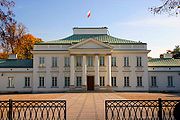
Sanacja
Sanation was a Polish political movement that came to power after Józef Piłsudski's May 1926 Coup d'État. Sanation took its name from his watchword—the moral "sanation" of the Polish body politic...
regime (1926–1939)—at times employing authoritarian methods—sought to "restore public life to moral health". From 1928 the Sanation authorities were represented in the sphere of practical politics by the Non-partisan Bloc for Cooperation with the Government (BBWR). Popular support and an effective propaganda apparatus allowed Piłsudski to maintain his authoritarian powers, which could not be overruled by the president, who was appointed by Piłsudski, not by the Sejm
Sejm
The Sejm is the lower house of the Polish parliament. The Sejm is made up of 460 deputies, or Poseł in Polish . It is elected by universal ballot and is presided over by a speaker called the Marshal of the Sejm ....
. The powers of the Sejm were curtailed by constitutional amendments
August Novelization
The August Novelization of 2 August 1926 was a set of amendments to the 1921 March Constitution of Poland.These amendments were proposed and adopted by national plebiscite after Józef Piłsudski took power in the May Coup....
introduced soon after the coup, on 2 August 1926. From 1926 to 1930, Piłsudski relied chiefly on propaganda to weaken the influence of opposition leaders.
The culmination of his dictatorial and supralegal policies came in the 1930s with the imprisonment and trial of certain political opponents (the Brest trials) on the eve of the 1930 legislative elections
Polish legislative election, 1930
Polish legislative election, 1930, also known as the Brest elections , were the elections to the Sejm on 16 November 1930. The pro-Sanacja Bezpartyjny Blok Współpracy z Rządem party took 56% of the votes...
, and with the 1934 establishment of a prison for political prisoners at Bereza Kartuska (today Biaroza
Biaroza
Biaroza is a town of 31 000 inhabitants in Western Belarus in Brest voblast, center of the Biaroza rayon.- History :The village of Biaroza was first mentioned in 1477 as part of the Slonim paviet. In the 15th century, the village probably received the town charter. Between 1538 and 1600 it was...
), where some prisoners were brutally mistreated. After the BBWRs 1930 victory, Piłsudski left most internal matters in the hands of his "colonels"
The colonels
Piłsudski's colonels, or the colonels' regime , dominated the government of the Second Polish Republic from 1926 to 1939...
, while he himself concentrated on military and foreign affairs. He came under considerable criticism for his treatment of political opponents, and their 1930 arrest and imprisonment was internationally condemned and damaged Poland's reputation.
Piłsudski became increasingly disillusioned with democracy in Poland. His intemperate public utterances—he called the Sejm
Sejm
The Sejm is the lower house of the Polish parliament. The Sejm is made up of 460 deputies, or Poseł in Polish . It is elected by universal ballot and is presided over by a speaker called the Marshal of the Sejm ....
a "prostitute"–and his sending ninety armed officers into the Sejm building in response to an impending vote of no-confidence, caused concern in contemporary and modern-day observers who have seen his actions as setting precedents for authoritarian responses to political challenges.
One of Piłsudski's main goals was to transform the parliamentary system
Parliamentary system
A parliamentary system is a system of government in which the ministers of the executive branch get their democratic legitimacy from the legislature and are accountable to that body, such that the executive and legislative branches are intertwined....
into a presidential system
Presidential system
A presidential system is a system of government where an executive branch exists and presides separately from the legislature, to which it is not responsible and which cannot, in normal circumstances, dismiss it....
; however, he opposed the introduction of totalitarianism
Totalitarianism
Totalitarianism is a political system where the state recognizes no limits to its authority and strives to regulate every aspect of public and private life wherever feasible...
. The adoption of a new Polish constitution in April 1935, tailored by Piłsudski's supporters to his specifications—providing for a strong presidency—came too late for Piłsudski to seek that office; but the April Constitution would serve Poland up to the outbreak of World War II and would carry its Government in Exile
Polish government in Exile
The Polish government-in-exile, formally known as the Government of the Republic of Poland in Exile , was the government in exile of Poland formed in the aftermath of the Invasion of Poland of September 1939, and the subsequent occupation of Poland by Nazi Germany and the Soviet Union, which...
through to the end of the war and beyond.
Nonetheless, Piłsudski's government depended more on his charismatic authority
Charismatic authority
The sociologist Max Weber defined charismatic authority as "resting on devotion to the exceptional sanctity, heroism or exemplary character of an individual person, and of the normative patterns or order revealed or ordained by him." Charismatic authority is one of three forms of authority laid out...
than on rational-legal authority
Rational-legal authority
Rational-legal authority is a form of leadership in which the authority of an organization or a ruling regime is largely tied to legal rationality, legal legitimacy and bureaucracy...
. None of his followers could claim to be his legitimate heir, and after his death the Sanation
Sanacja
Sanation was a Polish political movement that came to power after Józef Piłsudski's May 1926 Coup d'État. Sanation took its name from his watchword—the moral "sanation" of the Polish body politic...
structure would quickly fracture, returning Poland to the pre-Piłsudski era of parliamentary political contention.
Piłsudski's regime began a period of national stabilization and of improvement in the situation of ethnic minorities, which formed about a third of the Second Republic's population. Piłsudski replaced the National Democrats' "ethnic-assimilation
Polonization
Polonization was the acquisition or imposition of elements of Polish culture, in particular, Polish language, as experienced in some historic periods by non-Polish populations of territories controlled or substantially influenced by Poland...
" with a "state-assimilation" policy: citizens were judged not by their ethnicity but by their loyalty to the state. Widely recognized for his opposition to the National Democrats antisemitic policies, he extended his policy of "state-assimilation" to Polish Jews. The years 1926–35, and Piłsudski himself, were favorably viewed by many Polish Jews whose situation improved especially under Piłsudski-appointed Prime Minister Kazimierz Bartel
Kazimierz Bartel
Kazimierz Władysław Bartel was a Polish mathematician and politician who served as Prime Minister of Poland three times between 1926 and 1930....
. Many Jews saw Piłsudski as their only hope for restraining antisemitic currents in Poland and for maintaining public order; he was seen as a guarantor of stability and a friend of the Jewish people, who voted for him and actively participated in his political bloc. Piłsudski's death in 1935 brought a deterioration in the quality of life of Poland's Jews.
During the 1930s, a combination of developments, from the Great Depression
Great Depression
The Great Depression was a severe worldwide economic depression in the decade preceding World War II. The timing of the Great Depression varied across nations, but in most countries it started in about 1929 and lasted until the late 1930s or early 1940s...
to the vicious spiral of OUN
Organization of Ukrainian Nationalists
The Organization of Ukrainian Nationalists is a Ukrainian political organization which as a movement originally was created in 1929 in Western Ukraine . The OUN accepted violence as an acceptable tool in the fight against foreign and domestic enemies particularly Poland and Russia...
terrorist attacks and government pacifications, caused government relations with the national minorities to deteriorate. Unrest among national minorities was also related to foreign policy. Troubles followed repressions in largely Ukrainian-populated eastern Galicia, where nearly 1,800 persons were arrested. Tension also arose between the government and Poland's German minority, particularly in Upper Silesia
Upper Silesia
Upper Silesia is the southeastern part of the historical and geographical region of Silesia. Since the 9th century, Upper Silesia has been part of Greater Moravia, the Duchy of Bohemia, the Piast Kingdom of Poland, again of the Lands of the Bohemian Crown and the Holy Roman Empire, as well as of...
. The government did not yield to calls for antisemitic measures; but the Jews (8.6% of Poland's population) grew discontented for economic reasons that were connected with the depression. Overall, by the end of Piłsudski's life, his government's relations with national minorities were increasingly problematic.
In the military sphere, Piłsudski, who had shown himself an accomplished military strategist in engineering the "Miracle at the Vistula", has been criticized by some for subsequently concentrating on personnel management and allegedly neglecting modernization of military strategy and equipment. His experiences in the Polish-Soviet War (1919–21) may have led him to overestimate the importance of cavalry and to neglect the development of armored and air forces. Others, however, contend that, particularly from the late 1920s, he did support the development of these military branches. The limitations on Poland's military modernization in this period may have been less doctrinal than financial.
Foreign policy

Kingdom of Romania
The Kingdom of Romania was the Romanian state based on a form of parliamentary monarchy between 13 March 1881 and 30 December 1947, specified by the first three Constitutions of Romania...
, Hungary and Latvia
Latvia
Latvia , officially the Republic of Latvia , is a country in the Baltic region of Northern Europe. It is bordered to the north by Estonia , to the south by Lithuania , to the east by the Russian Federation , to the southeast by Belarus and shares maritime borders to the west with Sweden...
. Relations were strained with Czechoslovakia
Czechoslovakia
Czechoslovakia or Czecho-Slovakia was a sovereign state in Central Europe which existed from October 1918, when it declared its independence from the Austro-Hungarian Empire, until 1992...
, however, and were still worse with Lithuania
Lithuania
Lithuania , officially the Republic of Lithuania is a country in Northern Europe, the biggest of the three Baltic states. It is situated along the southeastern shore of the Baltic Sea, whereby to the west lie Sweden and Denmark...
. Relations with Weimar Germany
Weimar Republic
The Weimar Republic is the name given by historians to the parliamentary republic established in 1919 in Germany to replace the imperial form of government...
and the Soviet Union
Soviet Union
The Soviet Union , officially the Union of Soviet Socialist Republics , was a constitutionally socialist state that existed in Eurasia between 1922 and 1991....
varied over time, but during Piłsudski's tenure could for the most part be described as neutral.
Piłsudski's Promethean
Prometheism
Prometheism or Prometheanism was a political project initiated by Poland's Józef Piłsudski. Its aim was to weaken the Russian Empire and its successor states, including the Soviet Union, by supporting nationalist independence movements among the major non-Russian peoples that lived within the...
program, designed to weaken the Russian Empire and its successor state, the Soviet Union
Soviet Union
The Soviet Union , officially the Union of Soviet Socialist Republics , was a constitutionally socialist state that existed in Eurasia between 1922 and 1991....
, by supporting nationalist independence movements of major non-Russian peoples dwelling in Russia and the Soviet Union, was coordinated from 1927 to the 1939 outbreak of World War II in Europe by the military intelligence
Military intelligence
Military intelligence is a military discipline that exploits a number of information collection and analysis approaches to provide guidance and direction to commanders in support of their decisions....
officer, Edmund Charaszkiewicz
Edmund Charaszkiewicz
Edmund Kalikst Eugeniusz Charaszkiewicz was a Polish military intelligence officer who specialized in clandestine warfare. Between the World Wars, he helped establish Poland's interbellum borders in conflicts over territory with Poland's neighbors....
. In the Interbellum, the Prometheist movement yielded few tangible results.
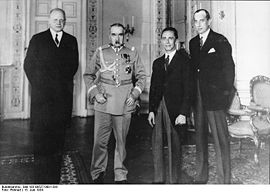
Józef Beck
' was a Polish statesman, diplomat, military officer, and close associate of Józef Piłsudski...
, he sought support for Poland in alliances with western powers such as France and the United Kingdom, and with friendly, if less powerful, neighbors such as Romania and Hungary.
A supporter of the Franco-Polish Military Alliance and the Polish-Romanian Alliance
Polish-Romanian Alliance
The Polish–Romanian Alliance was a series of treaties signed in the interwar period by the Second Polish Republic and the Kingdom of Romania. The first of them was signed in 1921 and, together, the treaties formed a basis for good foreign relations between the two countries that lasted until World...
(part of the Little Entente
Little Entente
The Little Entente was an alliance formed in 1920 and 1921 by Czechoslovakia, Romania and Yugoslavia with the purpose of common defense against Hungarian revision and the prevention of a Habsburg restoration...
), Piłsudski was disappointed by the French and British policy of appeasement
Appeasement
The term appeasement is commonly understood to refer to a diplomatic policy aimed at avoiding war by making concessions to another power. Historian Paul Kennedy defines it as "the policy of settling international quarrels by admitting and satisfying grievances through rational negotiation and...
evident in those countries' signing of the Locarno Treaties
Locarno Treaties
The Locarno Treaties were seven agreements negotiated at Locarno, Switzerland, on 5 October – 16 October 1925 and formally signed in London on 3 December, in which the First World War Western European Allied powers and the new states of central and Eastern Europe sought to secure the post-war...
. Piłsudski therefore aimed also to maintain good relations with the Soviet Union and Germany; hence Poland signed non-aggression pact
Non-aggression pact
A non-aggression pact is an international treaty between two or more states/countries agreeing to avoid war or armed conflict between them and resolve their disputes through peaceful negotiations...
s with both its powerful neighbors: the 1932 Soviet-Polish Non-Aggression Pact
Soviet-Polish Non-Aggression Pact
The Soviet–Polish Non-Aggression Pact ) was an international treaty of non-aggression signed in 1932 by representatives of Poland and the USSR. The pact was unilaterally broken by the Soviet Union on September 17, 1939, during the Nazi and Soviet invasion of Poland.-Background:After the...
, and the 1934 German-Polish Non-Aggression Pact
German-Polish Non-Aggression Pact
The German–Polish Non-Aggression Pact was an international treaty between Nazi Germany and the Second Polish Republic signed on January 26, 1934. In it, both countries pledged to resolve their problems through bilateral negotiations and to forgo armed conflict for a period of ten years...
. The two treaties were meant to strengthen Poland's position in the eyes of its allies and neighbors.
Piłsudski himself was acutely aware of the shakiness of the pacts, and commented: "Having these pacts, we are straddling two stools. This cannot last long. We have to know from which stool we will tumble first, and when that will be." Critics of the two non-aggression pacts have accused Piłsudski of underestimating Hitler's aggressiveness and of giving Germany time to rearm; and of allowing Stalin to eliminate opposition—primarily in Ukraine—that had been supported by Piłsudski's Promethean
Prometheism
Prometheism or Prometheanism was a political project initiated by Poland's Józef Piłsudski. Its aim was to weaken the Russian Empire and its successor states, including the Soviet Union, by supporting nationalist independence movements among the major non-Russian peoples that lived within the...
program.
After Adolf Hitler
Adolf Hitler
Adolf Hitler was an Austrian-born German politician and the leader of the National Socialist German Workers Party , commonly referred to as the Nazi Party). He was Chancellor of Germany from 1933 to 1945, and head of state from 1934 to 1945...
came to power
Machtergreifung
Machtergreifung is a German word meaning "seizure of power". It is normally used specifically to refer to the Nazi takeover of power in the democratic Weimar Republic on 30 January 1933, the day Hitler was sworn in as Chancellor of Germany, turning it into the Nazi German dictatorship.-Term:The...
in January 1933, Piłsudski is rumored to have proposed to France a preventive war
Preventive war
A preventive war or preventative war is a war initiated to prevent another party from attacking, when an attack by that party is not imminent or known to be planned. Preventive war aims to forestall a shift in the balance of power by strategically attacking before the balance of power has a chance...
against Germany. It has been argued that Piłsudski may have been sounding out France regarding possible joint military action against Germany. Lack of French interest may have been a reason why Poland signed the German-Polish Non-Aggression Pact
German-Polish Non-Aggression Pact
The German–Polish Non-Aggression Pact was an international treaty between Nazi Germany and the Second Polish Republic signed on January 26, 1934. In it, both countries pledged to resolve their problems through bilateral negotiations and to forgo armed conflict for a period of ten years...
of January 1934. Little evidence has, however, been found in French or Polish diplomatic archives that such a proposal for preventive war was ever actually advanced.
Hitler repeatedly suggested a German-Polish alliance against the Soviet Union, but Piłsudski declined, instead seeking precious time to prepare for potential war with Germany or with the Soviet Union. Hitler, who admired Piłsudski's leadership and his successful coup, also kept hoping to meet personally with Piłsudski, but again was rebuffed.
Just before his death, Piłsudski told Józef Beck
Józef Beck
' was a Polish statesman, diplomat, military officer, and close associate of Józef Piłsudski...
that it must be Poland's policy to maintain neutral relations with Germany and keep up the Polish alliance with France, and to improve relations with the United Kingdom.
Death

Hepatocellular carcinoma
Hepatocellular carcinoma is the most common type of liver cancer. Most cases of HCC are secondary to either a viral hepatitide infection or cirrhosis .Compared to other cancers, HCC is quite a rare tumor in the United States...
at Warsaw's Belweder Palace
Belweder
Belweder is a palace in Warsaw, a few kilometers south of the Royal Castle. The President of the Republic of Poland, Bronisław Komorowski, resides at Belweder.-History:...
. The celebration of his life had begun spontaneously within half an hour after his death had been announced. It was led by military personnel—former Legionnaires
Polish Legions in World War I
Polish Legions was the name of Polish armed forces created in August 1914 in Galicia. Thanks to the efforts of KSSN and the Polish members of the Austrian parliament, the unit became an independent formation of the Austro-Hungarian Army...
, members of the Polish Military Organization, veterans of the wars of 1919–21, and his political collaborators from his time as Chief of State and, later, prime minister and the general inspector.
The Polish Communist Party
Communist Party of Poland
The Communist Party of Poland is a historical communist party in Poland. It was a result of the fusion of Social Democracy of the Kingdom of Poland and Lithuania and the Polish Socialist Party-Left in the Communist Workers Party of Poland .-1918-1921:The KPRP was founded on 16 December 1918 as...
immediately attacked Piłsudski as a fascist and capitalist, despite the fact that fascists themselves did not see him this way. Other opponents of the Sanation
Sanacja
Sanation was a Polish political movement that came to power after Józef Piłsudski's May 1926 Coup d'État. Sanation took its name from his watchword—the moral "sanation" of the Polish body politic...
regime, however, were more civil; socialists (such as Ignacy Daszyński
Ignacy Daszynski
Ignacy Ewaryst Daszyński was a Polish politician, journalist and Prime Minister of the Polish government created in Lublin in 1918....
and Tomasz Arciszewski
Tomasz Arciszewski
Tomasz Arciszewski was a Polish socialist politician, a member of the Polish Socialist Party and the Prime Minister of the Polish government-in-exile in London from 1944 to 1947, presiding over the period when the government lost the recognition of the Western powers.-Early life:Tomasz Arciszewski...
) and Christian Democrats
Polish Christian Democratic Party
Polish Christian Democratic Party , was a political party of Polish right wing christian democracy faction existing in the first year of the Second Polish Republic. It leader and main activist was Wojciech Korfanty....
(represented by Ignacy Paderewski, Stanisław Wojciechowski and Władysław Grabski) expressed condolences. The peasant parties split in their reactions (Wincenty Witos
Wincenty Witos
Wincenty Witos was a prominent member of the Polish People's Party from 1895, and leader of its "Piast" faction from 1913. He was a member of parliament in the Galician Sejm from 1908–1914, and an envoy to Reichsrat in Vienna from 1911 to 1918...
voicing criticism of Piłsudski, but Maciej Rataj
Maciej Rataj
Maciej Rataj was a Polish politician, socialist activist and writer.Born in the village of Chłopy near Lwów on 19 February 1884, he attended a gymnasium in Lwów and studied classical linguistics at the University of Lwów...
and Stanisław Thugutt being supportive), while Roman Dmowski
Roman Dmowski
Roman Stanisław Dmowski was a Polish politician, statesman, and chief ideologue and co-founder of the National Democracy political movement, which was one of the strongest political camps of interwar Poland.Though a controversial personality throughout his life, Dmowski was instrumental in...
's National Democrats expressed a toned-down criticism.
Condolences were expressed by Polish Catholic clergy—by Poland's Primate August Hlond—as well as by Pope Pius XI
Pope Pius XI
Pope Pius XI , born Ambrogio Damiano Achille Ratti, was Pope from 6 February 1922, and sovereign of Vatican City from its creation as an independent state on 11 February 1929 until his death on 10 February 1939...
, who called himself a "personal friend" of the Marshal. Notable appreciation for Piłsudski was expressed by Poland's ethnic and religious minorities. Eastern Orthodox, Greek Orthodox, Protestant, Judaic
Judaism
Judaism ) is the "religion, philosophy, and way of life" of the Jewish people...
and Islamic organizations expressed condolences, praising Piłsudski for his policies of religious tolerance. His death was a shock to members of the Jewish minority, who even years after remembered him as a very good man who protected Jews.
Mainstream organizations of ethnic minorities similarly expressed their support for his policies of ethnic tolerance, though he was criticized by, in addition to the Polish communists, by the Jewish Labour Bund
General Jewish Labour Bund in Poland
The General Jewish Labour Bund in Poland was a Jewish socialist party in Poland which promoted the political, cultural and social autonomy of Jewish workers, sought to combat antisemitism and was generally opposed to Zionism.-Creation of the Polish Bund:...
, and by Ukrainian, German and Lithuanian extremists.
On the international scene, Pope Pius XI held a special ceremony 18 May in the Holy See
Holy See
The Holy See is the episcopal jurisdiction of the Catholic Church in Rome, in which its Bishop is commonly known as the Pope. It is the preeminent episcopal see of the Catholic Church, forming the central government of the Church. As such, diplomatically, and in other spheres the Holy See acts and...
, a commemoration was conducted at League of Nations
League of Nations
The League of Nations was an intergovernmental organization founded as a result of the Paris Peace Conference that ended the First World War. It was the first permanent international organization whose principal mission was to maintain world peace...
Geneva
Geneva
Geneva In the national languages of Switzerland the city is known as Genf , Ginevra and Genevra is the second-most-populous city in Switzerland and is the most populous city of Romandie, the French-speaking part of Switzerland...
headquarters, and dozens of messages of condolence arrived in Poland from heads of state
Head of State
A head of state is the individual that serves as the chief public representative of a monarchy, republic, federation, commonwealth or other kind of state. His or her role generally includes legitimizing the state and exercising the political powers, functions, and duties granted to the head of...
across the world, including Germany's Adolf Hitler, the Soviet Union's Joseph Stalin
Joseph Stalin
Joseph Vissarionovich Stalin was the Premier of the Soviet Union from 6 May 1941 to 5 March 1953. He was among the Bolshevik revolutionaries who brought about the October Revolution and had held the position of first General Secretary of the Communist Party of the Soviet Union's Central Committee...
, Italy's Benito Mussolini
Benito Mussolini
Benito Amilcare Andrea Mussolini was an Italian politician who led the National Fascist Party and is credited with being one of the key figures in the creation of Fascism....
and King Victor Emmanuel III
Victor Emmanuel III of Italy
Victor Emmanuel III was a member of the House of Savoy and King of Italy . In addition, he claimed the crowns of Ethiopia and Albania and claimed the titles Emperor of Ethiopia and King of Albania , which were unrecognised by the Great Powers...
, France's Albert Lebrun
Albert Lebrun
Albert François Lebrun was a French politician, President of France from 1932 to 1940. He was the last president of the Third Republic. He was a member of the center-right Democratic Republican Alliance .-Biography:...
and Pierre-Étienne Flandin, Austria's Wilhelm Miklas
Wilhelm Miklas
Wilhelm Miklas was an Austrian politician who served as the third President of Austria, from 1928 until its annexation by Nazi Germany in the Anschluss 1938.-Early life:...
, Japan's Emperor Hirohito
Hirohito
, posthumously in Japan officially called Emperor Shōwa or , was the 124th Emperor of Japan according to the traditional order, reigning from December 25, 1926, until his death in 1989. Although better known outside of Japan by his personal name Hirohito, in Japan he is now referred to...
, and Britain's King George V
George V of the United Kingdom
George V was King of the United Kingdom and the British Dominions, and Emperor of India, from 6 May 1910 through the First World War until his death in 1936....
.
Ceremonies, masses
Mass (liturgy)
"Mass" is one of the names by which the sacrament of the Eucharist is called in the Roman Catholic Church: others are "Eucharist", the "Lord's Supper", the "Breaking of Bread", the "Eucharistic assembly ", the "memorial of the Lord's Passion and Resurrection", the "Holy Sacrifice", the "Holy and...
and an enormous funeral were held; a funeral train
Funeral train
A funeral train is a train specially chartered in order to carry a coffin or coffins to a resting place. Funeral trains today are often reserved for leaders and national heroes, as part of a state funeral, but in the past were sometimes the chief means of transporting coffins and mourners to...
toured Poland. The Polish mint issued a silver 10-złoty commemorative coin featuring the Marshal's profile. A series of postcards, stamps and postmarks was also released. After a two-year display at St. Leonard's Crypt
St. Leonard's Crypt
St. Leonard's Crypt under the Wawel Castle in Kraków, Poland, is a Romanesque crypt founded in the 11th century by Casimir I the Restorer who made Kraków his royal residence as the capital....
in Kraków
Kraków
Kraków also Krakow, or Cracow , is the second largest and one of the oldest cities in Poland. Situated on the Vistula River in the Lesser Poland region, the city dates back to the 7th century. Kraków has traditionally been one of the leading centres of Polish academic, cultural, and artistic life...
's Wawel Cathedral
Wawel Cathedral
The Wawel Cathedral, also known as the Cathedral Basilica of Sts. Stanisław and Vaclav, is a church located on Wawel Hill in Kraków–Poland's national sanctuary. It has a 1,000-year history and was the traditional coronation site of Polish monarchs. It is the Cathedral of the Archdiocese of Kraków...
, Piłsudski's body was laid to rest in the Cathedral's Crypt under the Silver Bells, except for his brain, which he had willed for study to Stefan Batory University
Vilnius University
Vilnius University is the oldest university in the Baltic states and one of the oldest in Eastern Europe. It is also the largest university in Lithuania....
, and his heart, which was interred in his mother's grave at Vilnius
Vilnius
Vilnius is the capital of Lithuania, and its largest city, with a population of 560,190 as of 2010. It is the seat of the Vilnius city municipality and of the Vilnius district municipality. It is also the capital of Vilnius County...
' Rasos Cemetery
Rasos Cemetery
Rasos Cemetery is the oldest and most famous cemetery in the city of Vilnius, Lithuania. It is named after the Rasos district where it is located. It is separated into two parts, the old and the new cemeteries, by a narrow Sukilėliai Street. The total area is 10.8 ha...
, where it remains. The 1937 relocation of his remains, made by his long-standing adversary Adam Sapieha, then Archbishop of Krakow, incited widespread protests that included calls for Sapieha's removal.
Legacy
—Piłsudski, 1908On 13 May 1935, in accordance with Piłsudski's last wishes, Edward Rydz-Śmigły was named by Poland's president and government to be Inspector-General of the Polish Armed Forces
Polish Armed Forces
Siły Zbrojne Rzeczypospolitej Polskiej are the national defense forces of Poland...
, and on 10 November 1936, he was elevated to Marshal of Poland
Marshal of Poland
Marshal of Poland is the highest rank in the Polish Army. It has been granted to only six officers. At present, this rank is equivalent to a Field Marshal or General of the Army in other NATO armies.-History:...
. Rydz was now one of the most powerful people in Poland—the "second man in the state after the President". While many saw Rydz-Śmigły as a successor to Piłsudski, he never became as influential.
As the Polish government became increasingly authoritarian and conservative, the Rydz-Śmigły faction was opposed by that of the more moderate Ignacy Mościcki
Ignacy Moscicki
Ignacy Mościcki was a Polish chemist, politician, and President of Poland . He was the longest-serving President of Poland .-Life:...
, who remained President. After 1938 Rydz-Śmigły reconciled with the President, but the ruling group remained divided into the "President's Men", mostly civilians (the "Castle Group", after the President's official residence, Warsaw's Royal Castle), and the "Marshal's Men" ("Piłsudski's Colonels
The colonels
Piłsudski's colonels, or the colonels' regime , dominated the government of the Second Polish Republic from 1926 to 1939...
"), professional military officers and old comrades-in-arms of Piłsudski's. After the German invasion of Poland in 1939
Invasion of Poland (1939)
The Invasion of Poland, also known as the September Campaign or 1939 Defensive War in Poland and the Poland Campaign in Germany, was an invasion of Poland by Germany, the Soviet Union, and a small Slovak contingent that marked the start of World War II in Europe...
, some of this political division would survive within the Polish government in exile
Polish government in Exile
The Polish government-in-exile, formally known as the Government of the Republic of Poland in Exile , was the government in exile of Poland formed in the aftermath of the Invasion of Poland of September 1939, and the subsequent occupation of Poland by Nazi Germany and the Soviet Union, which...
.
Piłsudski had given Poland something akin to what Henryk Sienkiewicz
Henryk Sienkiewicz
Henryk Adam Aleksander Pius Sienkiewicz was a Polish journalist and Nobel Prize-winning novelist. A Polish szlachcic of the Oszyk coat of arms, he was one of the most popular Polish writers at the turn of the 19th and 20th centuries, and received the Nobel Prize in Literature in 1905 for his...
's Onufry Zagłoba had mused about: a Polish Oliver Cromwell
Oliver Cromwell
Oliver Cromwell was an English military and political leader who overthrew the English monarchy and temporarily turned England into a republican Commonwealth, and served as Lord Protector of England, Scotland, and Ireland....
. As such, the Marshal had inevitably drawn both intense loyalty and intense vilification.
In 1935, at Piłsudski's funeral, President Mościcki had eulogized
Eulogy
A eulogy is a speech or writing in praise of a person or thing, especially one recently deceased or retired. Eulogies may be given as part of funeral services. However, some denominations either discourage or do not permit eulogies at services to maintain respect for traditions...
the Marshal: "He was the king of our hearts and the sovereign of our will. During a half-century of his life's travails, he captured heart after heart, soul after soul, until he had drawn the whole of Poland within the purple of his royal spirit ... He gave Poland freedom, boundaries, power and respect."
After World War II, little of Piłsudski's thought influenced the policies of the Polish People's Republic, a de facto satellite
Satellite state
A satellite state is a political term that refers to a country that is formally independent, but under heavy political and economic influence or control by another country...
of the Soviet Union
Soviet Union
The Soviet Union , officially the Union of Soviet Socialist Republics , was a constitutionally socialist state that existed in Eurasia between 1922 and 1991....
. In particular, Poland was in no position to resume Piłsudski's effort to build an Intermarum federation
Miedzymorze
Międzymorze was a plan, pursued after World War I by Polish leader Józef Piłsudski, for a federation, under Poland's aegis, of Central and Eastern European countries...
of Poland and some of its neighbors; and a "Promethean
Prometheism
Prometheism or Prometheanism was a political project initiated by Poland's Józef Piłsudski. Its aim was to weaken the Russian Empire and its successor states, including the Soviet Union, by supporting nationalist independence movements among the major non-Russian peoples that lived within the...
" endeavor to "break up the Russian state into its main constituents and emancipate the countries that have been forcibly incorporated into that empire."
For a decade after World War II, Piłsudski was either ignored or condemned by Poland's communist government, along with the entire interwar Second Polish Republic
Second Polish Republic
The Second Polish Republic, Second Commonwealth of Poland or interwar Poland refers to Poland between the two world wars; a period in Polish history in which Poland was restored as an independent state. Officially known as the Republic of Poland or the Commonwealth of Poland , the Polish state was...
. This began to change, however, particularly after de-Stalinization
De-Stalinization
De-Stalinization refers to the process of eliminating the cult of personality, Stalinist political system and the Gulag labour-camp system created by Soviet leader Joseph Stalin. Stalin was succeeded by a collective leadership after his death in March 1953...
and the Polish October
Polish October
Polish October, also known as October 1956, Polish thaw, or Gomułka's thaw, marked a change in the Polish internal political scene in the second half of 1956...
(1956), and historiography in Poland gradually moved away from a purely negative view of Piłsudski toward a more balanced and neutral assessment.
After the fall of communism
Revolutions of 1989
The Revolutions of 1989 were the revolutions which overthrew the communist regimes in various Central and Eastern European countries.The events began in Poland in 1989, and continued in Hungary, East Germany, Bulgaria, Czechoslovakia and...
and the 1991 disintegration of the Soviet Union
Soviet Union
The Soviet Union , officially the Union of Soviet Socialist Republics , was a constitutionally socialist state that existed in Eurasia between 1922 and 1991....
, Piłsudski once again came to be publicly acknowledged as a Polish national hero. On the sixtieth anniversary of his death, on 12 May 1995, Poland's Sejm
Sejm
The Sejm is the lower house of the Polish parliament. The Sejm is made up of 460 deputies, or Poseł in Polish . It is elected by universal ballot and is presided over by a speaker called the Marshal of the Sejm ....
adopted a resolution: "Józef Piłsudski will remain, in our nation's memory, the founder of its independence and the victorious leader who fended off a foreign assault that threatened the whole of Europe and its civilization. Józef Piłsudski served his country well and has entered our history forever."
While some of Piłsudski's political moves remain controversial—particularly the May 1926 Coup d'état, the Brest trials (1931–32), the 1934 establishment of the Bereza Kartuska detention camp, and successive Polish governments' failure to formulate consistent, constructive policies toward the national minorities—Piłsudski continues to be viewed by most Poles as a providential figure in the country's 20th-century history.
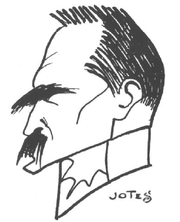
Polish 1st Legions Infantry Division
Polish 1st Legions Infantry Division was a tactical unit of the Polish Army between the World Wars. Formed on February 20, 1919, partially of veterans of the I Brigade of the Polish Legions, the unit saw extensive action during the Polish-Bolshevik War and World War II.As one of the most...
and armored train No. 51 ("I Marszałek"—"the First Marshal").
Also named for Piłsudski have been Piłsudski's Mound, one of four man-made mound
Mound
A mound is a general term for an artificial heaped pile of earth, gravel, sand, rocks, or debris. The most common use is in reference to natural earthen formation such as hills and mountains, particularly if they appear artificial. The term may also be applied to any rounded area of topographically...
s at Kraków
Kraków
Kraków also Krakow, or Cracow , is the second largest and one of the oldest cities in Poland. Situated on the Vistula River in the Lesser Poland region, the city dates back to the 7th century. Kraków has traditionally been one of the leading centres of Polish academic, cultural, and artistic life...
; the Józef Piłsudski Institute of America, a New York City research center and museum on the modern history of Poland
History of Poland
The History of Poland is rooted in the arrival of the Slavs, who gave rise to permanent settlement and historic development on Polish lands. During the Piast dynasty Christianity was adopted in 966 and medieval monarchy established...
; the Józef Piłsudski University of Physical Education in Warsaw; a passenger ship, MS Piłsudski; a gunboat, ORP Komendant Piłsudski; and a racehorse, Pilsudski
Pilsudski (horse)
Pilsudski is a retired Thoroughbred racehorse and active sire who was bred in Ireland, but trained in the United Kingdom during a racing career which lasted from 1994 to 1997. In a four season career he progressed from winning modest handicap races to become regarded as one of the best racehorses...
. Virtually every Polish city has its "Piłsudski Street". (There are, by contrast, few if any streets named after Piłsudski's National-Democrat arch-rival, Roman Dmowski
Roman Dmowski
Roman Stanisław Dmowski was a Polish politician, statesman, and chief ideologue and co-founder of the National Democracy political movement, which was one of the strongest political camps of interwar Poland.Though a controversial personality throughout his life, Dmowski was instrumental in...
—even in Dmowski's old Greater-Poland
Greater Poland
Greater Poland or Great Poland, often known by its Polish name Wielkopolska is a historical region of west-central Poland. Its chief city is Poznań.The boundaries of Greater Poland have varied somewhat throughout history...
political stronghold). There are statues of Piłsudski in many Polish cities; the highest density of such statuary memorials is found in Warsaw, which has three over the span of little more than a mile joining the Belweder Palace
Belweder
Belweder is a palace in Warsaw, a few kilometers south of the Royal Castle. The President of the Republic of Poland, Bronisław Komorowski, resides at Belweder.-History:...
, Piłsudski's residence, with Piłsudski Square.
He was the subject of paintings by renowned artists such as Jacek Malczewski
Jacek Malczewski
Jacek Malczewski was one of the most famous painters of Polish Symbolism. In his creativity he successfully joins the predominant style of his times with motifs of Polish martyrdom.-See also:...
(1916) and Wojciech Kossak
Wojciech Kossak
Wojciech Kossak was a Polish painter and member of the celebrated Kossak family of painters and writers...
(leaning on his sword, 1928; and astride his horse, Kasztanka
Kasztanka
Kasztanka was the famous mare that belonged to interwar Poland's leader, Marshal Józef Piłsudski.-Life:Kasztanka is the Polish word for the chestnut color in horses, and Piłsudski so named his horse due to her color....
, 1928), as well as the subject of numerous caricatures and photos.
Piłsudski has been a character in numerous works of fiction, such as the 1922 novel Generał Barcz (General Barcz) by Juliusz Kaden-Bandrowski
Juliusz Kaden-Bandrowski
Juliusz Kaden-Bandrowski was a Polish journalist and novelist.-Life:Juliusz Kazimierz Kaden-Bandrowski studied piano at conservatories in Lwów, Kraków and Leipzig...
and the 2007 novel Ice
Ice (Dukaj novel)
Ice is a Janusz A. Zajdel and Kościelski awards-winning novel written in 2007 by the Polish science fiction writer Jacek Dukaj, published in Poland by Wydawnictwo Literackie...
(Lód) by Jacek Dukaj
Jacek Dukaj
Jacek Dukaj is a Polish science fiction writer. Winner of the Janusz A. Zajdel Award , Śląkfa , Żuławski Award , Kościelski Award and the European Union Prize for Literature .-Career:Dukaj studied philosophy at the Jagiellonian University...
. Poland's National Library
National Library of Poland
The National Library of Poland is the central Polish library, subject directly to the Ministry of Culture and National Heritage of the Republic of Poland....
lists over 500 publications related to Piłsudski; the U.S. Library of Congress
Library of Congress
The Library of Congress is the research library of the United States Congress, de facto national library of the United States, and the oldest federal cultural institution in the United States. Located in three buildings in Washington, D.C., it is the largest library in the world by shelf space and...
, over 300. Piłsudski's life was the subject of a 2001 Polish television documentary, Marszałek Piłsudski, directed by Andrzej Trzos-Rastawiecki.
Plans are being considered to turn Piłsudski's official residence, the Belweder Palace
Belweder
Belweder is a palace in Warsaw, a few kilometers south of the Royal Castle. The President of the Republic of Poland, Bronisław Komorowski, resides at Belweder.-History:...
, which currently houses a small exhibit about him, into a full-fledged museum devoted to his memory.
Ancestry
Descendants
Both daughters of Marshal Piłsudski returned to Poland in 1990, after the fall of communist system there. Daughter of Jadwiga Piłsudska, Joanna Jaraczewska returned to Poland in 1979. There, she married in a political prison a Polish "Solidarity" activist Janusz OnyszkiewiczJanusz Onyszkiewicz
Janusz Adam Onyszkiewicz is a Polish mathematician, alpinist, politician and was a vice-president of the European Parliament's Foreign Affairs Committee from January 2007 until mid-2009.-Biographical note:...
in 1983. Both were very involved in the anticommunist struggle of Poles in the 1979–89 decade.
Poland
- Order of the White Eagle (1921)
- Order of Virtuti Militari, classes I, II, IV and V
- Cross of Independence with Swords (6 November 1930)
- Order of Polonia Restituta, Class I and II
- Cross of Valour (four times)
- Gold Cross of Merit (Poland) (four times, including in 1931)
- Merit Forces Central Lithuania
- Cross on Silesian Ribbon of Merit and valor
- Mark officers "Parasol" (1912)
- Badge "for faithful service" (1916)
- Scouting CrossScouting CrossKrzyż harcerski is the emblem of Polish Scouting, awarded to Polish Scouts, Senior Scouts and Rangers. It was first used by an underground Scouting organization in Warsaw in 1912. The initial design by Kazimierz Lutosławski has not been modified substantially since then...
(1920) - "Gold trade union" Chief Fire Brigades Union [78]
- Cross Kaniowski (1929) [79]
- Badge "Józef Piłsudski Polish Legion Commander" (1916) [80]
- Commemorative Badge of former prisoners from the years 1914–1921 Ideological (1928) [81]
Foreign
- Order of the Blue Cloak (Afghanistan)
- Order of the Iron CrownOrder of the Iron Crown (Austria)The Austrian Imperial Order of the Iron Crown , was restablished in 1815 by Emperor Franz I. The Order of the Iron Crown had previously been an order of the Napoleanic Kingdom of Italy.-History:...
, Class III (Austria-Hungary) - Grand Cross of the Order of Leopold (Belgium)
- Insignia of Alexander the Great Ribbons of the Holy Sword (Bulgaria)
- Order of the Southern CrossOrder of the Southern CrossThe National Order of the Southern Cross is a Brazilian order of chivalry founded by Emperor Pedro I on 1 December 1822. This order was intended to commemorate the independence of Brazil and the coronation of Pedro I...
Class I (Brazil) - Cross of Valor 1918 (Czechoslovakia)
- Order of the Cross of the EagleOrder of the Cross of the EagleThe Order of the Cross of the Eagle was instituted in 1928 by the Estonian Defence League to commemorate the tenth anniversary of Estonian independence. It was adopted as a state order in 1936.The Order of the Cross of the Eagle is bestowed to give recognition for military services and services...
, Class I (Estonia, 1930) - Grand Cross with Star Kaitesliid, the Cross of Valour and the Cross of Liberty, class I (Estonia)
- Order of the White Rose of Finland, Class I
- Grand Croix of the Legion of Honour, No. 25864 (continuous numbering) and the Médaille militaireMédaille militaireThe Médaille militaire is a decoration of the French Republic which was first instituted in 1852.-History:The creator of the médaille was the emperor Napoléon III, who may have taken his inspiration in a medal issued by his father, Louis Bonaparte, King of Holland...
(France) - Order of Military Merit (Spain)
- Order of the Rising SunOrder of the Rising SunThe is a Japanese order, established in 1875 by Emperor Meiji of Japan. The Order was the first national decoration awarded by the Japanese Government, created on April 10, 1875 by decree of the Council of State. The badge features rays of sunlight from the rising sun...
, Class I (Japan) - Order of the Karađorđe's Star (Yugoslavia)
- Order of LāčplēsisOrder of LacplesisThe Order of Lāčplēsis, the first and the highest Latvian military award, was established in 1919 on the initiative of the Commander of Latvian Army, during the Latvian War of Independence, Jānis Balodis. The Lāčplēsis Order is awarded in the first, second and third class. Initially, a holder of...
, Class I (Latvia) - Sovereign Military Order of St. John of Jerusalem, Class IV
- Grand Cross of the Order of the Tower and SwordOrder of the Tower and SwordThe Military Order of the Tower and of the Sword, of Valour, Loyalty and Merit is a Portuguese order of knighthood and the pinnacle of the Portuguese honours system. It was created by King Afonso V in 1459....
– Portugal - Order of Carol IOrder of Carol IThe Order of Carol I is a chivalric order of the Kingdom of Romania instituted on the 10 May 1909 by King Carol I of Romania to celebrate his jubilee of 40 years of reign. Until the fall of the monarchy in 1947, the order was the highest ranking order of the kingdom...
, class I and the Order of Michael the BraveOrder of Michael the BraveThe Order of Michael the Brave is Romania's highest military decoration, instituted by King Ferdinand I during the early stages of the Romanian Campaign of World War I, and was again awarded in World War II...
, Classes I, II and III (Romania) - Grand Cross of Merit (Hungary) [100]
- Order of Saints Maurice and LazarusOrder of Saints Maurice and LazarusThe Order of Saints Maurice and Lazarus is an order of chivalry awarded by the House of Savoy, the heads of which were formerly Kings of Italy...
, Class I of Military Order of SavoyOld Military Order of SavoyThe Military Order of Savoy was a military honorary order of the Kingdom of Sardinia first, and of the Kingdom of Italy later.-History:The origin of the Military Order of Savoy is be traced back to the first honorary degrees granted by Victor Amadeus III of Sardinia to its soldiers, later this...
, First Class (Italy)
Honorary doctorates
- Jagiellonian UniversityJagiellonian UniversityThe Jagiellonian University was established in 1364 by Casimir III the Great in Kazimierz . It is the oldest university in Poland, the second oldest university in Central Europe and one of the oldest universities in the world....
(28 April 1920) [102] - Adam Mickiewicz University (11 November 1933)
- University of WarsawUniversity of WarsawThe University of Warsaw is the largest university in Poland and one of the most prestigious, ranked as best Polish university in 2010 and 2011...
(2 May 1921) [103] - Stefan Batory University in Vilnius (September 1921)
See also
- List of people on the cover of Time Magazine: 1920s – 7 June 1926
- MiędzymorzeMiedzymorzeMiędzymorze was a plan, pursued after World War I by Polish leader Józef Piłsudski, for a federation, under Poland's aegis, of Central and Eastern European countries...
- Piłsudski (family)
- Piłsudskiite (Piłsudczyk)
Citations
Further reading
- This is only a small selection. See also National Library in Warsaw lists.
External links
- Best site dedicated to Józef Piłsudski and the prewar Poland
- Dole, Patryk, Marshal Józef Piłsudski. Messiah and Central European Federalist
- Józef Piłsudski Institute of America /
- Abbreviated version of biography
- Bibuła – Book by Józef Piłsudski
- Historical media – Recording of short speech by Piłsudski from 1924