


Sanacja

Encyclopedia
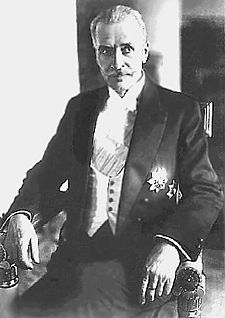
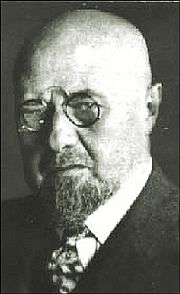
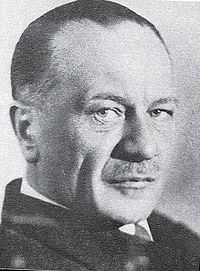

Sanation was a Polish
Poland
Poland , officially the Republic of Poland , is a country in Central Europe bordered by Germany to the west; the Czech Republic and Slovakia to the south; Ukraine, Belarus and Lithuania to the east; and the Baltic Sea and Kaliningrad Oblast, a Russian exclave, to the north...
political movement
Political movement
A political movement is a social movement in the area of politics. A political movement may be organized around a single issue or set of issues, or around a set of shared concerns of a social group...
that came to power after Józef Piłsudski's May 1926 Coup d'État. Sanation took its name from his watchword
Slogan
A slogan is a memorable motto or phrase used in a political, commercial, religious and other context as a repetitive expression of an idea or purpose. The word slogan is derived from slogorn which was an Anglicisation of the Scottish Gaelic sluagh-ghairm . Slogans vary from the written and the...
—the moral "sanation" (healing) of the Polish body politic
Body politic
A polity is a state or one of its subordinate civil authorities, such as a province, prefecture, county, municipality, city, or district. It is generally understood to mean a geographic area with a corresponding government. Thomas Hobbes considered bodies politic in this sense in Leviathan...
. The movement rested on a circle of Piłsudski's close associates, including Walery Sławek, Aleksander Prystor
Aleksander Prystor
Aleksander Błażej Prystor was a Polish politician, soldier and activist who served as Prime Minister of Poland from 1931 to 1933.He was a member of the Combat Organization of the Polish Socialist Party and in 1908 took part in the Bezdany raid....
, Kazimierz Świtalski
Kazimierz Switalski
Col. Kazimierz Stanisław Świtalski was a Polish officer, politician, and a Prime Minister of Poland.-Biographical note:Before the World War I he joined the Związek Walki Czynnej, an underground organisation formed by Józef Piłsudski. In 1914 Świtalski joined the Polish Legions and in 1918 the...
, Janusz Jędrzejewicz
Janusz Jedrzejewicz
Janusz Jędrzejewicz was a Polish politician and educator, a leader of the Sanacja political group, and Prime Minister of Poland from 1933 to 1934.-Life:...
, Adam Koc
Adam Koc
Adam Ignacy Koc was a Polish politician, soldier and journalist.-Honours and awards:...
, Józef Beck
Józef Beck
' was a Polish statesman, diplomat, military officer, and close associate of Józef Piłsudski...
, Tadeusz Hołówko, Bogusław Miedziński and Edward Rydz-Śmigły."
Sanation preached the primacy of the national interest
National interest
The national interest, often referred to by the French expression raison d'État , is a country's goals and ambitions whether economic, military, or cultural. The concept is an important one in international relations where pursuit of the national interest is the foundation of the realist...
, contended against the system of parliamentary democracy, and supported authoritarian government. In 1928, in an effort to broaden its influence, Sanation created a "Nonpartisan Bloc for Cooperation with the Government," which existed until Piłsudski's death in 1935. Sanation then broke up into several factions, including "the Castle."
History
Named after the LatinLatin
Latin is an Italic language originally spoken in Latium and Ancient Rome. It, along with most European languages, is a descendant of the ancient Proto-Indo-European language. Although it is considered a dead language, a number of scholars and members of the Christian clergy speak it fluently, and...
word for "healing" ("sanatio"), the Sanation movement mainly comprised former military officers who were disgusted with the corruption in Polish politics. Sanation was a coalition of rightists, leftists and centrists whose main focus was the elimination of corruption
Political corruption
Political corruption is the use of legislated powers by government officials for illegitimate private gain. Misuse of government power for other purposes, such as repression of political opponents and general police brutality, is not considered political corruption. Neither are illegal acts by...
and the reduction of inflation
Inflation
In economics, inflation is a rise in the general level of prices of goods and services in an economy over a period of time.When the general price level rises, each unit of currency buys fewer goods and services. Consequently, inflation also reflects an erosion in the purchasing power of money – a...
.
Sanation appeared prior to the May 1926 Coup d'État and lasted until World War II but was never formalized. Since Piłsudski disapproved of political parties
Political party
A political party is a political organization that typically seeks to influence government policy, usually by nominating their own candidates and trying to seat them in political office. Parties participate in electoral campaigns, educational outreach or protest actions...
, which he saw as promoting their own interests rather than supporting the state and the people, the Sanation movement never led to the creation of a political party. Instead, in 1928 Sanation members created a Bezpartyjny Blok Współpracy z Rządem ("Nonpartisan Bloc for Cooperation with the Government"), a coalition
Coalition
A coalition is a pact or treaty among individuals or groups, during which they cooperate in joint action, each in their own self-interest, joining forces together for a common cause. This alliance may be temporary or a matter of convenience. A coalition thus differs from a more formal covenant...
political party
Political party
A political party is a political organization that typically seeks to influence government policy, usually by nominating their own candidates and trying to seat them in political office. Parties participate in electoral campaigns, educational outreach or protest actions...
that denied being a political party.
Although Piłsudski never claimed personal power, he exercised extensive influence over Polish politics after Sanation took power in 1926. For the next decade, he dominated Polish affairs as strongman
Strongman (politics)
A strongman is a political leader who rules by force and runs an authoritarian regime. The term is often used interchangeably with "dictator," but differs from a "warlord".A strongman is not necessarily always a formal head of government, however...
of a generally popular centrist regime. Kazimierz Bartel
Kazimierz Bartel
Kazimierz Władysław Bartel was a Polish mathematician and politician who served as Prime Minister of Poland three times between 1926 and 1930....
's government and all subsequent governments were first unofficially approved by Piłsudski before they could be confirmed by the President.
Piłsudski mixed democratic and dictatorial elements while pursuing "sanation." Poland's internal stability was enhanced, while economic stagnation
Economic stagnation
Economic stagnation or economic immobilism, often called simply stagnation or immobilism, is a prolonged period of slow economic growth , usually accompanied by high unemployment. Under some definitions, "slow" means significantly slower than potential growth as estimated by experts in macroeconomics...
was ended by Eugeniusz Kwiatkowski
Eugeniusz Kwiatkowski
Eugeniusz Kwiatkowski was a Polish politician and economist, Deputy Prime Minister of Poland, government minister and manager of the Second Polish Republic....
's reforms. At the same time, the Sanation regime prosecuted communist parties (on the ostensible formal grounds that they had failed to legally register as political parties), and sought to limit the influence of opposition
Opposition (politics)
In politics, the opposition comprises one or more political parties or other organized groups that are opposed to the government , party or group in political control of a city, region, state or country...
parties by splitting their forces.
A distinguishing feature of the regime was that, unlike the situation in most of non-democratic Europe, it never tranformed itself into a full-scale dictatorship. Freedom of speech and press and political parties were never legally abolished, elections (except those of 1930) were basically free, opponents were usually dealt with via "unidentified perpetrators" rather than court sentences. Józef Piłsudski's personal cult stemmed from his general popularity among the nation rather than from top-down propaganda; this is notable, considering Piłsudski's disdain for democracy. Sanation's ideology never went beyond populist calls to clean up the country's politics and economy; it did not occupy itself with society, as was the case with contemporary fascist regimes.
From 1929, the semi-official newspaper of Sanation, and thus of the Polish government, was Gazeta Polska (the Polish Gazette).
The Sanation government invalidated the May 1930 election results by disbanding the parliament in August and with increasing pressure on the opposition started a new campaign, the new elections being scheduled to November. Using the anti-government demonstrations
Demonstration (people)
A demonstration or street protest is action by a mass group or collection of groups of people in favor of a political or other cause; it normally consists of walking in a mass march formation and either beginning with or meeting at a designated endpoint, or rally, to hear speakers.Actions such as...
as a pretext, 20 members of the oppositions, including most of the leaders of Centrolew
Centrolew
The Centrolew was a coalition of several Polish political parties after the 1928 Sejm elections...
alliance (from Polska Partia Socjalistyczna, PSL "Piast" and PSL "Wyzwolenie" parties) were arrested in September without a warrant
Warrant (law)
Most often, the term warrant refers to a specific type of authorization; a writ issued by a competent officer, usually a judge or magistrate, which permits an otherwise illegal act that would violate individual rights and affords the person executing the writ protection from damages if the act is...
, only on the order of Józef Piłsudski and then-Minister of Internal Security, Felicjan Sławoj Składkowski, accusing them of plotting an anti-government coup. The opposition members (who included the former prime minister Wincenty Witos
Wincenty Witos
Wincenty Witos was a prominent member of the Polish People's Party from 1895, and leader of its "Piast" faction from 1913. He was a member of parliament in the Galician Sejm from 1908–1914, and an envoy to Reichsrat in Vienna from 1911 to 1918...
, and Wojciech Korfanty
Wojciech Korfanty
Wojciech Korfanty , born Adalbert Korfanty, was a Polish nationalist activist, journalist and politician, serving as member of the German parliaments Reichstag and Prussian Landtag, and later on, in the Polish Sejm...
) were imprisoned in the Brest Fortress
Brest Fortress
Brest Fortress , formerly known as Brest-Litovsk Fortress , is a 19th century Russian fortress in Brest, Belarus. It is one of the most important Soviet World War II war monuments commemorating the Soviet resistance against the German invasion on June 22, 1941...
, where their trial took place (thus the popular name for the election: the 'Brest election'). A number of less known activists were arrested throughout the country. They were released after the end of the election in the same month. The Brest trial ended in January 1932, with 10 accused receiving sentences up to 3 years of imprisonment; the appeal
Appeal
An appeal is a petition for review of a case that has been decided by a court of law. The petition is made to a higher court for the purpose of overturning the lower court's decision....
s of 1933 confirmed the sentences. The government however gave the accused choice of emigrating: five of them took it, the other five to serve the prison term instead.
In April 1935, shortly before Piłsudski's death, a new constitution (the "April Constitution") was adopted, which supported Sanation's principal ideas: a strong centralized state with a presidential system of government. Piłsudski died soon after, however, and Sanation faced some serious internal problems. Eventually it devolved into three separate movements:
- the Sanation Left (Lewica sanacyjna, formed around Walery Sławek), which sought a modus vivendiModus vivendiModus vivendi is a Latin phrase signifying an agreement between those whose opinions differ, such that they agree to disagree.Modus means mode, way. Vivendi means of living. Together, way of living, implies an accommodation between disputing parties to allow life to go on. It usually describes...
with the opposition); - the Castle (Zamek, formed around President Ignacy MościckiIgnacy MoscickiIgnacy Mościcki was a Polish chemist, politician, and President of Poland . He was the longest-serving President of Poland .-Life:...
, who resided in the Warsaw Castle — hence the movement's name), which became the center; and - the Sanation Right (Prawica sanacyjna, formed around Edward Rydz-Śmigły), which soon became virtually indistinguishable from the Camp of National Unity.
The first of these Sanation movements soon lost much of its importance, but the other two continued the ideological struggle over the shape of the country until the outbreak of war.
During the 1939 invasion of Poland
Invasion of Poland (1939)
The Invasion of Poland, also known as the September Campaign or 1939 Defensive War in Poland and the Poland Campaign in Germany, was an invasion of Poland by Germany, the Soviet Union, and a small Slovak contingent that marked the start of World War II in Europe...
, many Sanation members were taken prisoner-of-war by the Germans
Germany
Germany , officially the Federal Republic of Germany , is a federal parliamentary republic in Europe. The country consists of 16 states while the capital and largest city is Berlin. Germany covers an area of 357,021 km2 and has a largely temperate seasonal climate...
, while others evacuated to Romania
Romania
Romania is a country located at the crossroads of Central and Southeastern Europe, on the Lower Danube, within and outside the Carpathian arch, bordering on the Black Sea...
, where they remained to war's end or managed to reach France
France
The French Republic , The French Republic , The French Republic , (commonly known as France , is a unitary semi-presidential republic in Western Europe with several overseas territories and islands located on other continents and in the Indian, Pacific, and Atlantic oceans. Metropolitan France...
and Britain
United Kingdom
The United Kingdom of Great Britain and Northern IrelandIn the United Kingdom and Dependencies, other languages have been officially recognised as legitimate autochthonous languages under the European Charter for Regional or Minority Languages...
.
Though France insisted on excluding Sanationists from the Polish Government in Exile
Polish government in Exile
The Polish government-in-exile, formally known as the Government of the Republic of Poland in Exile , was the government in exile of Poland formed in the aftermath of the Invasion of Poland of September 1939, and the subsequent occupation of Poland by Nazi Germany and the Soviet Union, which...
, many remained highly influential. During the war, Sanation members created several resistance organizations, including in 1942 the Fighting Poland Movement (Obóz Polski Walczącej) and the Convention of Independence Organizations (Konwent Organizacji Niepodległościowych), which in 1943 became subordinate to the Home Army and in 1944 merged into the Union of Independence Organizations (Zjednoczenie Organizacji Niepodległościowych).
After World War II
World War II
World War II, or the Second World War , was a global conflict lasting from 1939 to 1945, involving most of the world's nations—including all of the great powers—eventually forming two opposing military alliances: the Allies and the Axis...
, the forced exile of many Sanationists was made permanent by the communist regime, which branded them enemies of the state
Enemy of the state
An enemy of the state is a person accused of certain crimes against the state, such as treason. Describing individuals in this way is sometimes a manifestation of political repression. For example, an authoritarian regime may purport to maintain national security by describing social or political...
.
Notables
- Józef BeckJózef Beck' was a Polish statesman, diplomat, military officer, and close associate of Józef Piłsudski...
- Tadeusz Hołówko
- Janusz JędrzejewiczJanusz JedrzejewiczJanusz Jędrzejewicz was a Polish politician and educator, a leader of the Sanacja political group, and Prime Minister of Poland from 1933 to 1934.-Life:...
- Wacław Jędrzejewicz
- Adam KocAdam KocAdam Ignacy Koc was a Polish politician, soldier and journalist.-Honours and awards:...
- Leon Kozłowski
- Ignacy Matuszewski
- Bogusław Miedziński
- Bronisław Pieracki
- Aleksander PrystorAleksander PrystorAleksander Błażej Prystor was a Polish politician, soldier and activist who served as Prime Minister of Poland from 1931 to 1933.He was a member of the Combat Organization of the Polish Socialist Party and in 1908 took part in the Bezdany raid....
- Adam Skwarczyński
- Walery Sławek
- Kazimierz ŚwitalskiKazimierz SwitalskiCol. Kazimierz Stanisław Świtalski was a Polish officer, politician, and a Prime Minister of Poland.-Biographical note:Before the World War I he joined the Związek Walki Czynnej, an underground organisation formed by Józef Piłsudski. In 1914 Świtalski joined the Polish Legions and in 1918 the...
Today
The Confederation of Independent PolandConfederation of Independent Poland
Konfederacja Polski Niepodległej was a political party founded on 1 September 1979 by Leszek Moczulski and others declaring support for the pre-war traditions of Sanacja and Józef Piłsudski...
, founded in 1979, is the principal sanationist political party in Poland today.
See also
- Social hygieneSocial hygieneThe social or mental hygiene movement of the late 19th and early 20th centuries was an attempt by Progressive-era reformers to control venereal disease, regulate prostitution and vice, and disseminate sexual education through the use of scientific research methods and modern media techniques.The...
- Bereza Kartuska prisonBereza Kartuska prisonThe Bereza Kartuska detention camp was a Polish prison, principally for political prisoners of the sanacja regime, that was operated in 1934–39 at Bereza Kartuska in the former Polesie Province ....
- Piłsudski's colonels
- Intermarium
- PrometheismPrometheismPrometheism or Prometheanism was a political project initiated by Poland's Józef Piłsudski. Its aim was to weaken the Russian Empire and its successor states, including the Soviet Union, by supporting nationalist independence movements among the major non-Russian peoples that lived within the...