

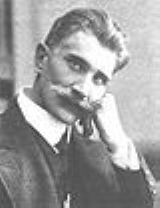
Ignacy Daszynski

Encyclopedia
Ignacy Ewaryst Daszyński AUD (26 October 1866, Zbarazh
– 31 October 1936) was a Polish politician, journalist and Prime Minister of the Polish government created in Lublin
in 1918.
He co-founded the Polish Social Democratic Party (Polish abbreviation: PPSD), which later became the Polish Socialist Party
(PPS). He was also a founder in 1929 of the Centrolew
(“Center-Left”). Although he supported Józef Piłsudski during the May 1926 Coup, he later joined the opposition to Piłsudski. From 1928 to 1930, he was Marshal of the Sejm.
As a journalist and underground activist, he used the pseudonyms Daszek, Żegota and Ignis.
in the Podolia
region (now in Ternopil Oblast
), which, following the Partitions of Poland
, was then a part of the Austrian Empire. He came from a not very wealthy family of the gentry, one that cherished patriotic traditions. He was the son of Ferdynand Daszyński (1816–1875), an Austrian clerk, and Kamila, née Mierzewska (1834–1895). He had three brothers, one sister, and older half siblings from his father's first marriage.
In 1872, Daszyński started his education in a school run by Franciscans in Zbarazh. He was a very good student because he already knew how to read and write and, as he grew up in a multicultural environment, he knew several languages. From childhood, he could speak Ukrainian and Yiddish and understood German. On 6 December 1875, his father died and the family moved to Stanislaviv. To improve their financial situation, his mother leased flats to secondary school students. Two years later, he entered secondary school. During this time he earned money by giving his colleagues private lessons.
At that time, he was under the strong influence of his older brother, Feliks, who taught him how to be a good Polish patriot. Together they performed minor subversive actions. Feliks wrote an anniversary poem in honour of Maurycy Gosławski, a poet who fought in the November Uprising
. Ignacy made copies of the poem and scattered them around the poet's grave. The Austrian police started an investigation and Feliks was arrested, while Ignacy was released pending trial. However, they were both acquitted. Feliks still did not abandon his subversive activity. He created a conspiratorial group that drew Polish and Ukrainian teenagers from the Stanislaviv area. Ignacy contributed to the group by establishing its rules.
In 1882, Ignacy Daszyński gave a patriotic speech to students during the long school break. This led him to being expelled from the school and brought an end to his family's easy life in Stanislaviv. Their financial situation collapsed and they had to move to Lwow. Feliks started to study chemistry at the Lwow Polytechnic. Soon, Ignacy and his mother had to move again. They went to Drohobych
where he began his first job, as a lawyer’s secretary (no school was willing to enrol him). During this time he came into contact with the working class for the first time. Soon he started to write for the leftist biweekly Gazeta Naddniestrzańska ("Trans-Nistrian News"), in which he wrote about the hard conditions of workers employed by petroleum industries in Stanislaviv and Drohobych.
In September 1884, when his mother moved to Przemyśl
, Ignacy was left alone in Lwow. Again he was refused enrollment at school, and so studied at home.
(school leavers' examinations) without attending the classes. He received his diploma on 22 September 1888 and went on to study philosophy at the Jagiellonian University
in Kraków
. Thanks to his brother Feliks, he was in touch with socialists in Kraków. In 1889, he met Ludwik Kulczycki, whom he helped in delivering socialist brochures in Congress Poland
.
Daszyński soon had to abandon his studies because of financial problems. He became a tutor again, working under a false name for the Gniazdowski family from Czarnostaw. On the night of 2–3 May 1889, he was arrested by the Russian police and spent six months in jail in Pułtusk because he was mistaken for his older brother Feliks, who was engaged in the socialist movement abroad (he attended the Congress of the Second International
in Paris). When Ignacy was released from jail he was expelled from Congress Poland and returned to Kraków. While there, he was accused of engaging in illegal political activities, but was acquitted under a statute of limitations
. He returned to university, but had to give up his studies after taking part in a demonstration.
After these events, Daszyński decided to emigrate to Argentina. However, before leaving Europe he went to Switzerland to visit his brother Feliks, who had tuberculosis and was taking a cure in Davos
. After meeting his brother, he went to Paris to buy a ticket to sail to Argentina, but on 9 April 1890 he was informed of Feliks’s death. After this, Stanisław Mendelson
and Aleksander Dębski persuaded him not to emigrate. He decided to study in Switzerland and was admitted to the University of Zurich
. During his studies there, he was supported by Mendelson, who gave him 60 pounds per month.
In Switzerland, Daszyński continued his brother’s socialist activity. He was one of the founders of the Polish Working Class Association "Zgoda" (Stowarzyszenie Robotników Polskich "Zgoda"). He collaborated with Julian Marchlewski
, Rosa Luxemburg
and Gabriel Narutowicz
. His greatest achievement at that time was the creation of order-keeping services that protected socialist demonstrations. The ceremony of moving Adam Mickiewicz’s ashes to Poland turned into such a demonstration, during which Marchlewski gave a speech.
Daszyński returned to Poland in October 1890. First he stayed in Kraków, then moved to Lwow, where he created a management center for the socialist movement in Galicia. He collaborated with Ukrainian socialist activists and attended the founding meeting of the Russian-Ukrainian Radical Party (Rusko-Ukraińska Partia Radykalna), where he met the poet Ivan Franko
.
; he himself was a Praca journalist. At a meeting on 7 November 1890 in Lwow, socialist activists decided to create an official and legal Labour Party
. The next step was to establish a new socialist educational-relief association, Siła ("strength" or "force"), on 15 February 1891. When the organization grew bigger, its presence reached Stanislaviv and Kraków. At that time, he was very active as a journalist and politician. He delivered speeches at many rallies, such as the election rally on 1 May 1891 in Lwow, and he published a political brochure, O partiach politycznych w Galicji ("On the Political Parties in Galicia"), under the pseudonym Żegota on 30 April 1891. After its publication, he was charged with affiliation with an underground organization, but, since the Socialist Party was legal, the charge was dismissed. In June he became a Galician delegate at the Congress of the Social Democratic Workers' Party of Austria in Vienna.
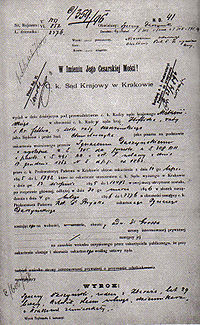 From 16 to 23 April 1891, Daszyński led a delegation of Polish socialists to the Congress of the Second International in Brussels. He then went to Berlin, where he became editor-in-chief of the Polish newspaper Gazeta Robotnicza ("Workers' Gazette"). He worked there for six months. When he was leaving Berlin, he was arrested by the German authorities on charges of publishing seditious articles. However, since they could not prove that he was in fact their author, he was released.
In early 1892 he went to Lwow, where he played an important role in the first convention of the Polish Social Democratic Party of Galicia (I Zjazd Galicyjskiej Partii Socjalno-Demokratycznej). He delivered a speech about the party's political program and tactics. On his way back, he was arrested again and spent ten days in jail in Kraków. On his release, he returned to Lwow.
At the Third Congress of Austrian Socialists he argued for the separation of the Polish Social Democratic Party from the Austrian organizations, emphasizing pro-independence clauses in the party's Marxist political program, which aimed to put socialism into practice by abolishing private property. The first steps to achieve this aim were to be democratization of the election procedures (liquidation of privileges of the bourgeoisie) and introduction of an eight-hour working day. His dream of a separate Polish party partially came true when, in 1892, the Polish Socialist Party
(Polska Partia Socjalistyczna or PPS) was created.
Daszyński met and fell in love with Felicja Nossig-Próchnik, with whom he allegedly had a son, Adam Próchnik
. Between 1892 and 1893, Daszyński lived in the Carpathian Mountains
, where he was resting. In 1893 he moved to Kraków, where he became editor of the socialist newspaper Naprzód ("Forward"). In March 1893 he attended the Second Socialist Congress in Kraków. The police broke up the meeting, and he spent five days in jail. In October he moved to Lwow again, where he published the brochure Krótka historia rozwoju partii socjalistycznej w Galicji (od maja 1890 do 1 maja 1894) ("A Short History of the Development of the Galician Socialist Party (from May 1890 to May 1894)"). Meanwhile, he returned to Kraków and resumed editorship of Naprzód. Later he attended the Third Socialist Congress of Galicia and Silesia and published another brochure, Bankructwo demokracji galicyjskiej ("The Bankruptcy of Galician Democracy"), in which he strongly criticized the bourgeoisie.
In 1895 Daszyński’s mother died. In 1896 he attended the International Congress in London. In the autumn of 1896, the Polish Minister-President
of Austria, Count Kazimierz Badeni, introduced a partial reform of the electoral law, such that 72 members of parliament were to be elected through a form of universal male suffrage
. Daszyński believed that this gave a chance for socialist ideology to become more popular, as well as a chance to fight for his ideology in parliament. Constituencies were divided in such way that they included towns and villages. He was a candidate in the Kraków constituency, where he received 75% of the vote (22,214 out of 29,758 votes). He was supported by workers, peasants, students and many Jews. In 1897, he became a member of parliament and in the same year he married the actress Maria Paszkowska in Vienna.
In 1898, authorities introduced a state of emergency in part of western Galicia. Its aim was to weaken the workers' movement. Most liberties, such as freedom of assembly, were restricted. Daszyński fought against it, for example by giving a famous speech on 22 November, in which he protested against the government's actions. Later, he supported workers' strikes; however, he emphasized that they needed to be held legally. He also engaged in the democratization of the electoral law in parliament; among other things, he called for abolition of curial voting.
Daszyńki was a great speaker whose speeches attracted large crowds. He attacked conservatives and President-Minister Badeni. In 1898 he took part in huge demonstrations in Vienna, which resulted in Badeni being dismissed from his position by the Emperor.
In 1900, Daszyński was again elected to the Council of State
. He focused his activities on circumventing censorship because, as a publicist, he was subjected to limitations on his freedom of speech.
 On 12 May 1902, Daszyński became a member of the Kraków City Council. While on it, he focused on struggling against conservative and royalist members of the council.
Daszyński was also engaged in social matters and issues connected with Kraków's infrastructure. He was a member of municipal committees dealing with industrial affairs, coal and canals. On 2 February 1905, after the outbreak of the 1905 Russian Revolution, he took part in a demonstration on Kraków's Market Square
, during which he burned a portrait of the Tsar. Police tried to disperse the demonstrators but failed to seize the council. In 1907, parliament passed a new electoral law allowing all men above 24 to vote in elections for the Council of State. In May of the same year, socialists achieved considerable electoral success while conservatives lost a significant number of parliamentary representatives.
, which could lead to the creation of a unified Austria-Hungary-Poland. Daszyński co-authored the PPSD resolution, which stated that:
Daszyński recommended members of socialist parties to join Polish paramilitary troops. Thanks to this, these organizations were recognized as legal by the Austrian authorities. In November 1912, the PPS Revolutionary Faction and the PPSD joined the Temporary Commission of Confederated Independence Parties (Tymczasowa Komicja Skonfederowanych Stronnictw Niepodległościowych). Galician socialists were hoping to provoke an uprising after the outbreak of war in the Kingdom of Poland
.
In August 1914, when World War I started, Daszyński became the deputy military commissioner in Miechów
for a few days. He tried to urge the population to fight against Russia, but was unsuccessful and quickly returned to politics. After the creation of the Supreme National Committee
by parliamentarian Koło Polskie, Daszyński became one of the members of the Executive Department. This unit decided to form the Polish Legions
.
In Daszyński's opinion, Poland should seek support from Austria-Hungary
. He could not form a clear opinion of the Act of 5 November, which would guarantee the creation of an independent Kingdom of Poland. On the one hand, he was pleased that the act proclaimed Polish statehood; on the other, he felt angry that it ignored the issue of the Russian partition of Galicia. However, he participated in work on a future constitution. On 28 May 1917, he voted in the Austrian parliament in favour of a proposal from the Polish People's Party "Piast" (PSL “Piast"), claiming that "the only desire of the Polish nation is to regain an independent and united Poland with access to the sea". Influenced by the crisis and the imprisonment of Piłsudski in Magdeburg
in July 1917, Daszyński became more firmly opposed to the Austria-Hungary monarchy. On 22 January 1918, he stated in parliament that Galicia wanted to become part of a united and independent Poland.
At the end of September 1918, on Daszyński's initiative, Polish members of parliament prepared and negotiated with the National Democracy movement a proposal which was introduced to the Austrian parliament on 2 October 1918, demanding restoration of an independent Polish state composed of areas from the three partitions, their own coast, and Silesia
. They also recognized that the Poland issue was an international matter and called for Poland's participation in a peace conference "to decide Polish question". Daszyński gave his last speech on 3 October 1918, stating that:
, headed by Wincenty Witos
and headquartered first in Kraków and then in Lwow.
On 6 November, Daszyński and others proclaimed the "Polish People's Republic" (Tymczasowy Rząd Ludowy Republiki Polskiej), based in Lublin, with Daszyński as Prime Minister. Other members of the government included Wincenty Witos, Tomasz Arciszewski
, Jędrzej Moraczewski
, Stanisław Thugutt, and Colonel Edward Rydz-Śmigły as military commander. The government's manifesto called upon workers and peasants to take power into their own hands and build "the edifice of an independent and united People's Republic of Poland", in which all citizens would enjoy equal political and civil rights, especially freedom of conscience, speech and assembly. Within the framework of improving social conditions, there were promises of an eight-hour working day in industry, trade and craft, and of the nationalization of mines and large estates. The future country was intended to be a democratic parliamentary republic.
Setting itself up as the legitimate representative of the Polish people, Daszyński's government declared the Regency Council at Warsaw, installed in 1917 with German and Austrian support, to be deposed. This move was repudiated by moderate forces in Warsaw, who now hoped for a return of Józef Piłsudski, who was still in custody in Germany. Already in October, the Regency Council had requested Piłsudski's release, and after deliberations mediated by Harry Graf Kessler
, Piłsudski was allowed to return to Warsaw, where he arrived on 10 November. The following day – the day Germany signed the armistice – German troops in Warsaw were disarmed as they refused to fire on Polish insurgents. Both the Regency Council and the Daszyński government ceded all authority to Piłsudski.
Piłsudski asked Daszyński to form a government, but stressed the need to "strengthen the effectiveness of his cabinet's work through participation of eminent forces, regardless of political beliefs" and forbade him to prejudice the legislative work of the Sejm
by radical social reforms or other legislative changes. Daszyński failed to form a government and resigned on 14 November. In a letter published the next day, Piłsudski thanked Daszyński for his "truly civic work" in helping to create the first Polish government and for not hesitating "to sacrifice himself for the good of the cause in order to reach an agreement among divergent factors".
 Daszyński campaigned in the first post-war elections to the Polish Sejm, proclaiming: "The first legislative Sejm is the first administrator of Poland, its builder, the source of law and authority [in] a free, independent and united Poland." 36 members of the PPSD and PPS entered the Sejm and created a parliamentary group named Związek Polskich Posłów Socjalistycznych ("Union of Polish Socialist MPs"). Daszyński became its president.
He focused on promoting a socialist program. He advocated nationalizing some industrial sectors, for example creating state monopolies in coal and spirits. He proposed improvements in working conditions and protected workers' rights, as well as supporting development of the cooperative movement and education of peasants and workers.
On 26 April 1919, the PPSD, the PPS and the PPS Prussian Section united to form a unitary PPS. Daszyński joined its General Council and became one of its chairmen. He also edited its French-language publication Bulletin Official du Parti Socialiste Polonaise and the weekly magazine Trybuna. After the outbreak of the Polish-Soviet War
, Daszyński was for concluding peace as fast as possible. He was opposed to the creaion of the Council of National Defense, calling it an "abbreviation of the Sejm". However, on 24 July he joined the Government of National Defense (Rząd Obrony Narodowej) as Deputy Prime Minister (Witos was Prime Minister). He thought that this step (including peasant and socialist leaders) would increase the number of recruits. After victory in the Battle of the Niemen River
, Daszyński was more and more in conflict with the rest of the government, especially with the Ministry of Foreign Affairs. He criticized diplomatic staff and Polish policy towards the East, in particular Tadeusz Rozwadowski's plans for an offensive. On 15 December, the PPS General Council asked the Prime Minister to dismiss Daszyński, but he resigned himself on 18 December. The Prime Minister accepted it very unwillingly, delaying till 4 January 1921.
After leaving government, Daszyński concentrated on working for the adoption of a new constitution. On 17 March 1921, the Sejm adopted the March Constitution of Poland
, after which it dissolved itself. The socialist leader contributed to the democratic character of the constitution, for example by resisting the proposal of the conservatives that members could be appointed to the Polish Senate according to their position, without being elected.
, Chrzanów
, Oświęcim
, Olkusz
and Miechów
. On 9 December Daszyński's party put him forward as a candidate for President, but he received only 49 votes. Gabriel Narutowicz
was elected President, to the disappointment of the right wing (Narutowicz was elected by members who represented national minorities). On the inauguration day of the president-elect
, Daszyński and Bolesław Limanowski were attacked on their way to the ceremony by right wing fighting squads, and forced to barricade themselves inside a house. Daszyński later demanded an explanation for those events. He wrote:
After the assassination of President Narutowicz by Eligiusz Niewiadomski
, a supporter of the National Democracy movement, the socialists planned to take revenge on right wing activists. Daszyński objected to their reasoning and forbade further escalation of the violence.
On 21 December 1922, at a meeting of the General Council, the PPS tabled a proposal to set up a nationwide worker's educational organization, the Towarzystwo Uniwersytetu Robotniczego (TUR) ("Association of University Workers"). On 21 January 1923, the Board of Directors of the TUR was established, headed by Daszyński. He held this position until his death. The creation of the TUR was one of his most important personal achievements. As he later described:
In February 1923, Daszyński fainted while making a speech in the Sejm, resulting in his withdrawal from ongoing operations. (In September 1926 he took the floor in the Sejm again). While staying in a sanatorium, he focused on journalism and writing memoirs. Despite the state of his health, during the 19th Congress of the PPS (30 December 1923 – 1 January 1924) Daszyński was re-elected Chairman of the PPS General Council. At the 20th Congress of the PPS (31 December 1925 – 3 January 1926) he was elected yet again.
On 26 November 1925, after Jędrzej Moraczewski joined the government of Aleksander Skrzyński
, Daszyński succeeded Moraczewski as Vice-Speaker of the Sejm. At first, Daszyński supported the participation of PPS in Skrzyński’s government, but Skrzyński’s policies (increasing unemployment, hyperinflation) and plans resulted in sharp criticism. On 20 April 1926 the PPS withdrew from the government, which soon led to its collapse. On 10 May 1926, in place of Skrzyński’s government, the right-wing government of Wincenty Witos was established, to which PPS stood in opposition.
On 12 May 1926, Józef Piłsudski carried out an armed coup d'état, later known as the "May Coup". Just a month after the coup, Daszyński attacked the new government, especially its project for a new constitution that aimed to reduce the role of the legislature. Later, he published a pamlet in which he stated:
On 10 November 1926, at the suggestion of Daszyński, CKW PPS took a "factual-oppositional" position towards the Piłsudski government. On 20 December 1926, after a stormy debate, the PPS General Council took a similar position, indicating that:
The PPS had specific objections to the appointment of Vilnius conservatives Aleksander Meysztowicz and Karol Niezabytowski to the government.
At this time, Daszyński headed the editorial board of the new PPS magazine Pobudka ("Reveille").
On 28 November 1927, President Ignacy Mościcki
dissolved the Sejm and the Senate.
On 27 March 1928, at the first meeting of the parliament, Daszyński defeated Kazimierz Bartel
, the representative of the Nonpartisan Bloc for Cooperation with the Government (BBWR), and Aleksander Zwierzyński of the National Populist Union
in the election for the Speaker of the Sejm. He received 177 votes in the first round and 206 in the second (54.4%). After his election, Daszyński renounced his party functions as chairman of the PPS General Council and editor-in-chief of Pobudka, but continued as head of the Board of the TUR.
The choice of Daszyński as Speaker of the Sejm aggravated relations between the government and parliament. The reason for the conflict was the "Czechowicz case", named after Treasury Minister Gabriel Czechowicz
, who was accused of overdrawing the budget for 1928. Some money came from the disposable fund of the Prime Minister. However, it was used by the BBWR during the election campaign. The Sejm passed a proposal to bring Czechowicz before the Polish State Tribunal, but did not venture to bring Piłsudski himself to account for it. Despite this, in June 1928 Daszyński met Piłsudski with a proposal to form a coalition of the BBWR, the PPS and the Polish People's Party "Wyzwolenie" (PSL "Liberation"). However, Piłsudski rejected this offer. As a result, in mid-September 1929, the Centrolew
, an alliance of six parliamentary groups opposing rehabilitation was created.
 On 31 October 1929 there was open conflict between Józef Piłsudski and the Parliament at a meeting of the Sejm's budget session. Instead of Prime Minister Kazimierz Świtalski
, Minister of Military Affairs Józef Pilsudski
turned up with over a hundred army officers. The Sejm deputies thought that Piłsudski had sent the soldiers to arrest them. After the convention had assembled, Daszyński, as Speaker of the Sejm, refused to open the session. A sharp exchange between Piłsudski and Daszyński took place, which, according to General Felicjan Sławoj-Składkowski, ran as follows:
Versions of the conversation differ depending on the source. However, on the evening of 31 October, Daszyński issued a statement to all deputies, saying: "Under the threat of officers' sabers, I cancel today's session."
The November session of the Sejm was postponed by President Ignacy Mościcki. On 5 December 1929 the members of the newly created Centrolew
passed a vote of no confidence in the government of Prime Minister Kazimierz Świtalski
by 243 votes to 119.
On 29 March 1930, under pressure from members of the BBWR, Daszyński withdrew the Czechowicz case from debate in order not to escalate the conflict with Piłsudski.
On 29 June 1930, a congress on Defense of the Law and People's Freedom took place in Kraków. Daszyński sent a telegram to the congress as "the Speaker of the Sejm, condemned to inactivity".
On 29 August 1930, President Mościcki dissolved the Sejm and proclaimed new elections. Before the elections, many members were arrested and intimidated. Daszyński stood up for the detainees, sending an open letter to Irena Kosmowska, an ex-member of PSL "Liberation" who was being held in Lublin Castle
.
Daszyński was a candidate for the districts of Kraków, Chrzanów, Oświęcim and Miechów. He was also the first on the national list of Centrolew. Although he got 80,000 votes, the Kraków election was annulled. Thus Daszyński was chosen as the member of parliament from the national list. After the election, his health deteriorated. After the conference of the PPS General Council on 18 January 1931, he went to the sanatorium in Bystra Śląska
. He withdrew temporarily from the 12th PPS Congress (23–25 May 1931 in Kraków), but was nevertheless re-elected chairman of the PPS General Council. At the 13th PPS Congress (2–5 February 1934), he was elected honorary chairman of Polish Socialist Party. In spite of his stay in the sanatorium, he organized a “fund to fight seizures” for Robotnik.
He died on 31 October 1936 in Bystra Śląska.
Many thousands came to the funeral, which took place on the 3 November 1936 in Rakowicki Cemetery
, Kraków. There was a special train from Warsaw and the Ministry of Transport granted free return tickets to those who went to the funeral. On the day of the funeral, everybody in every workplace stopped work for five minutes.
On 22 November, Daszyński's last letter was published:
Ignacy Daszyński and his wife Maria Paszkowska had five children:
Daszyński is alleged to have had an extramarital son, Adam Próchnik
(born 1894), with Felicja Nossig-Próchnik.
Zbarazh
Zbarazh is a city in the Ternopil Oblast of western Ukraine. It is the administrative center of the Zbarazh Raion , and is located in the historic region of Galicia....
– 31 October 1936) was a Polish politician, journalist and Prime Minister of the Polish government created in Lublin
Lublin
Lublin is the ninth largest city in Poland. It is the capital of Lublin Voivodeship with a population of 350,392 . Lublin is also the largest Polish city east of the Vistula river...
in 1918.
He co-founded the Polish Social Democratic Party (Polish abbreviation: PPSD), which later became the Polish Socialist Party
Polish Socialist Party
The Polish Socialist Party was one of the most important Polish left-wing political parties from its inception in 1892 until 1948...
(PPS). He was also a founder in 1929 of the Centrolew
Centrolew
The Centrolew was a coalition of several Polish political parties after the 1928 Sejm elections...
(“Center-Left”). Although he supported Józef Piłsudski during the May 1926 Coup, he later joined the opposition to Piłsudski. From 1928 to 1930, he was Marshal of the Sejm.
As a journalist and underground activist, he used the pseudonyms Daszek, Żegota and Ignis.
Early life
Ignacy Daszyński was born on 26 October 1866 in ZbarazhZbarazh
Zbarazh is a city in the Ternopil Oblast of western Ukraine. It is the administrative center of the Zbarazh Raion , and is located in the historic region of Galicia....
in the Podolia
Podolia
The region of Podolia is an historical region in the west-central and south-west portions of present-day Ukraine, corresponding to Khmelnytskyi Oblast and Vinnytsia Oblast. Northern Transnistria, in Moldova, is also a part of Podolia...
region (now in Ternopil Oblast
Ternopil Oblast
Ternopil Oblast is an oblast' of Ukraine. Its administrative center is Ternopil, through which flows the Seret River, a tributary of the Dnister.-Geography:...
), which, following the Partitions of Poland
Partitions of Poland
The Partitions of Poland or Partitions of the Polish–Lithuanian Commonwealth took place in the second half of the 18th century and ended the existence of the Polish–Lithuanian Commonwealth, resulting in the elimination of sovereign Poland for 123 years...
, was then a part of the Austrian Empire. He came from a not very wealthy family of the gentry, one that cherished patriotic traditions. He was the son of Ferdynand Daszyński (1816–1875), an Austrian clerk, and Kamila, née Mierzewska (1834–1895). He had three brothers, one sister, and older half siblings from his father's first marriage.
In 1872, Daszyński started his education in a school run by Franciscans in Zbarazh. He was a very good student because he already knew how to read and write and, as he grew up in a multicultural environment, he knew several languages. From childhood, he could speak Ukrainian and Yiddish and understood German. On 6 December 1875, his father died and the family moved to Stanislaviv. To improve their financial situation, his mother leased flats to secondary school students. Two years later, he entered secondary school. During this time he earned money by giving his colleagues private lessons.
At that time, he was under the strong influence of his older brother, Feliks, who taught him how to be a good Polish patriot. Together they performed minor subversive actions. Feliks wrote an anniversary poem in honour of Maurycy Gosławski, a poet who fought in the November Uprising
November Uprising
The November Uprising , Polish–Russian War 1830–31 also known as the Cadet Revolution, was an armed rebellion in the heartland of partitioned Poland against the Russian Empire. The uprising began on 29 November 1830 in Warsaw when the young Polish officers from the local Army of the Congress...
. Ignacy made copies of the poem and scattered them around the poet's grave. The Austrian police started an investigation and Feliks was arrested, while Ignacy was released pending trial. However, they were both acquitted. Feliks still did not abandon his subversive activity. He created a conspiratorial group that drew Polish and Ukrainian teenagers from the Stanislaviv area. Ignacy contributed to the group by establishing its rules.
In 1882, Ignacy Daszyński gave a patriotic speech to students during the long school break. This led him to being expelled from the school and brought an end to his family's easy life in Stanislaviv. Their financial situation collapsed and they had to move to Lwow. Feliks started to study chemistry at the Lwow Polytechnic. Soon, Ignacy and his mother had to move again. They went to Drohobych
Drohobych
Drohobych is a city located at the confluence of the Tysmenytsia River and Seret, a tributary of the former, in the Lviv Oblast , in western Ukraine...
where he began his first job, as a lawyer’s secretary (no school was willing to enrol him). During this time he came into contact with the working class for the first time. Soon he started to write for the leftist biweekly Gazeta Naddniestrzańska ("Trans-Nistrian News"), in which he wrote about the hard conditions of workers employed by petroleum industries in Stanislaviv and Drohobych.
The atmosphere of Drohobych was calling me to rebel. The brutality of the sinister rascals who were then making their careers in Drohobych was so evident and public that you did not have to be a socialist to hate their felonious "production" based on the natural treasures of Mother Earth and on the unbridled exploitation of several thousand peasants who dug up the mineral wax in BoryslavBoryslavBoryslav is a city located on the Tysmenytsia River , in the Lviv Oblast of western Ukraine. The city is designated as a separate raion within the oblast....
.
In September 1884, when his mother moved to Przemyśl
Przemysl
Przemyśl is a city in south-eastern Poland with 66,756 inhabitants, as of June 2009. In 1999, it became part of the Podkarpackie Voivodeship; it was previously the capital of Przemyśl Voivodeship....
, Ignacy was left alone in Lwow. Again he was refused enrollment at school, and so studied at home.
Political activity
At that time, Daszyński's socialist political views were already taking shape. In 1886, he became a tutor to some friends of his parents. On 8 April 1888, he was allowed to pass the MaturaMatura
Matura or a similar term is the common name for the high-school leaving exam or "maturity exam" in various countries, including Albania, Austria, Bosnia and Herzegovina, Bulgaria, Croatia, the Czech Republic, Hungary, Italy, Kosovo, Liechtenstein, Macedonia, Montenegro, Poland, Serbia,...
(school leavers' examinations) without attending the classes. He received his diploma on 22 September 1888 and went on to study philosophy at the Jagiellonian University
Jagiellonian University
The Jagiellonian University was established in 1364 by Casimir III the Great in Kazimierz . It is the oldest university in Poland, the second oldest university in Central Europe and one of the oldest universities in the world....
in Kraków
Kraków
Kraków also Krakow, or Cracow , is the second largest and one of the oldest cities in Poland. Situated on the Vistula River in the Lesser Poland region, the city dates back to the 7th century. Kraków has traditionally been one of the leading centres of Polish academic, cultural, and artistic life...
. Thanks to his brother Feliks, he was in touch with socialists in Kraków. In 1889, he met Ludwik Kulczycki, whom he helped in delivering socialist brochures in Congress Poland
Congress Poland
The Kingdom of Poland , informally known as Congress Poland , created in 1815 by the Congress of Vienna, was a personal union of the Russian parcel of Poland with the Russian Empire...
.
Daszyński soon had to abandon his studies because of financial problems. He became a tutor again, working under a false name for the Gniazdowski family from Czarnostaw. On the night of 2–3 May 1889, he was arrested by the Russian police and spent six months in jail in Pułtusk because he was mistaken for his older brother Feliks, who was engaged in the socialist movement abroad (he attended the Congress of the Second International
Second International
The Second International , the original Socialist International, was an organization of socialist and labour parties formed in Paris on July 14, 1889. At the Paris meeting delegations from 20 countries participated...
in Paris). When Ignacy was released from jail he was expelled from Congress Poland and returned to Kraków. While there, he was accused of engaging in illegal political activities, but was acquitted under a statute of limitations
Statute of limitations
A statute of limitations is an enactment in a common law legal system that sets the maximum time after an event that legal proceedings based on that event may be initiated...
. He returned to university, but had to give up his studies after taking part in a demonstration.
After these events, Daszyński decided to emigrate to Argentina. However, before leaving Europe he went to Switzerland to visit his brother Feliks, who had tuberculosis and was taking a cure in Davos
Davos
Davos is a municipality in the district of Prättigau/Davos in the canton of Graubünden, Switzerland. It has a permanent population of 11,248 . Davos is located on the Landwasser River, in the Swiss Alps, between the Plessur and Albula Range...
. After meeting his brother, he went to Paris to buy a ticket to sail to Argentina, but on 9 April 1890 he was informed of Feliks’s death. After this, Stanisław Mendelson
Stanisław Mendelson
Stanisław Mendelson was a Polish socialist politician and publicist of Jewish descent. He was an activist of Polish and international workers' movement....
and Aleksander Dębski persuaded him not to emigrate. He decided to study in Switzerland and was admitted to the University of Zurich
University of Zurich
The University of Zurich , located in the city of Zurich, is the largest university in Switzerland, with over 25,000 students. It was founded in 1833 from the existing colleges of theology, law, medicine and a new faculty of philosophy....
. During his studies there, he was supported by Mendelson, who gave him 60 pounds per month.
In Switzerland, Daszyński continued his brother’s socialist activity. He was one of the founders of the Polish Working Class Association "Zgoda" (Stowarzyszenie Robotników Polskich "Zgoda"). He collaborated with Julian Marchlewski
Julian Marchlewski
Julian Baltazar Marchlewski was a Polish communist. He was also known under the aliases Karski and Kujawiak....
, Rosa Luxemburg
Rosa Luxemburg
Rosa Luxemburg was a Marxist theorist, philosopher, economist and activist of Polish Jewish descent who became a naturalized German citizen...
and Gabriel Narutowicz
Gabriel Narutowicz
Gabriel Narutowicz was a Lithuanian-born professor of hydroelectric engineering at Switzerland's Zurich Polytechnic, and Poland's Minister of Public Works , Minister of Foreign Affairs , and the first president of the Second Polish Republic....
. His greatest achievement at that time was the creation of order-keeping services that protected socialist demonstrations. The ceremony of moving Adam Mickiewicz’s ashes to Poland turned into such a demonstration, during which Marchlewski gave a speech.
Daszyński returned to Poland in October 1890. First he stayed in Kraków, then moved to Lwow, where he created a management center for the socialist movement in Galicia. He collaborated with Ukrainian socialist activists and attended the founding meeting of the Russian-Ukrainian Radical Party (Rusko-Ukraińska Partia Radykalna), where he met the poet Ivan Franko
Ivan Franko
Ivan Yakovych Franko was a Ukrainian poet, writer, social and literary critic, journalist, interpreter, economist, political activist, doctor of philosophy, the author of the first detective novels and modern poetry in the Ukrainian language....
.
Social Democratic Party
Daszyński wanted to unite all the working-class movements of Galicia. Particular groups were connected with two newspapers, Praca and RobotnikRobotnik (1894–1939)
Robotnik was the bibuła newspaper published by the Polish Socialist Party , and distributed in most major cities and towns in Poland under Partitions.....
; he himself was a Praca journalist. At a meeting on 7 November 1890 in Lwow, socialist activists decided to create an official and legal Labour Party
Labour movement
The term labour movement or labor movement is a broad term for the development of a collective organization of working people, to campaign in their own interest for better treatment from their employers and governments, in particular through the implementation of specific laws governing labour...
. The next step was to establish a new socialist educational-relief association, Siła ("strength" or "force"), on 15 February 1891. When the organization grew bigger, its presence reached Stanislaviv and Kraków. At that time, he was very active as a journalist and politician. He delivered speeches at many rallies, such as the election rally on 1 May 1891 in Lwow, and he published a political brochure, O partiach politycznych w Galicji ("On the Political Parties in Galicia"), under the pseudonym Żegota on 30 April 1891. After its publication, he was charged with affiliation with an underground organization, but, since the Socialist Party was legal, the charge was dismissed. In June he became a Galician delegate at the Congress of the Social Democratic Workers' Party of Austria in Vienna.
In early 1892 he went to Lwow, where he played an important role in the first convention of the Polish Social Democratic Party of Galicia (I Zjazd Galicyjskiej Partii Socjalno-Demokratycznej). He delivered a speech about the party's political program and tactics. On his way back, he was arrested again and spent ten days in jail in Kraków. On his release, he returned to Lwow.
At the Third Congress of Austrian Socialists he argued for the separation of the Polish Social Democratic Party from the Austrian organizations, emphasizing pro-independence clauses in the party's Marxist political program, which aimed to put socialism into practice by abolishing private property. The first steps to achieve this aim were to be democratization of the election procedures (liquidation of privileges of the bourgeoisie) and introduction of an eight-hour working day. His dream of a separate Polish party partially came true when, in 1892, the Polish Socialist Party
Polish Socialist Party
The Polish Socialist Party was one of the most important Polish left-wing political parties from its inception in 1892 until 1948...
(Polska Partia Socjalistyczna or PPS) was created.
Daszyński met and fell in love with Felicja Nossig-Próchnik, with whom he allegedly had a son, Adam Próchnik
Adam Próchnik
Adam Feliks Próchnik was a Polish socialist activist, politician and historian.-Life:Próchnik was born in Lwów, Austrian partition on 21 August 1892 to a middle class Jewish family...
. Between 1892 and 1893, Daszyński lived in the Carpathian Mountains
Carpathian Mountains
The Carpathian Mountains or Carpathians are a range of mountains forming an arc roughly long across Central and Eastern Europe, making them the second-longest mountain range in Europe...
, where he was resting. In 1893 he moved to Kraków, where he became editor of the socialist newspaper Naprzód ("Forward"). In March 1893 he attended the Second Socialist Congress in Kraków. The police broke up the meeting, and he spent five days in jail. In October he moved to Lwow again, where he published the brochure Krótka historia rozwoju partii socjalistycznej w Galicji (od maja 1890 do 1 maja 1894) ("A Short History of the Development of the Galician Socialist Party (from May 1890 to May 1894)"). Meanwhile, he returned to Kraków and resumed editorship of Naprzód. Later he attended the Third Socialist Congress of Galicia and Silesia and published another brochure, Bankructwo demokracji galicyjskiej ("The Bankruptcy of Galician Democracy"), in which he strongly criticized the bourgeoisie.
In 1895 Daszyński’s mother died. In 1896 he attended the International Congress in London. In the autumn of 1896, the Polish Minister-President
Minister-President
A minister-president is the head of government in a number of European countries or subnational governments, in which a parliamentary or semi-presidential system of government prevails, who presides over the council of ministers...
of Austria, Count Kazimierz Badeni, introduced a partial reform of the electoral law, such that 72 members of parliament were to be elected through a form of universal male suffrage
Universal suffrage
Universal suffrage consists of the extension of the right to vote to adult citizens as a whole, though it may also mean extending said right to minors and non-citizens...
. Daszyński believed that this gave a chance for socialist ideology to become more popular, as well as a chance to fight for his ideology in parliament. Constituencies were divided in such way that they included towns and villages. He was a candidate in the Kraków constituency, where he received 75% of the vote (22,214 out of 29,758 votes). He was supported by workers, peasants, students and many Jews. In 1897, he became a member of parliament and in the same year he married the actress Maria Paszkowska in Vienna.
Austrian Parliament
After entering parliament, Daszyński became chairman of a parliamentarian club which numbered 15 members.In 1898, authorities introduced a state of emergency in part of western Galicia. Its aim was to weaken the workers' movement. Most liberties, such as freedom of assembly, were restricted. Daszyński fought against it, for example by giving a famous speech on 22 November, in which he protested against the government's actions. Later, he supported workers' strikes; however, he emphasized that they needed to be held legally. He also engaged in the democratization of the electoral law in parliament; among other things, he called for abolition of curial voting.
Daszyńki was a great speaker whose speeches attracted large crowds. He attacked conservatives and President-Minister Badeni. In 1898 he took part in huge demonstrations in Vienna, which resulted in Badeni being dismissed from his position by the Emperor.
In 1900, Daszyński was again elected to the Council of State
Council of State (Kingdom of Poland)
Council of State of Congress Kingdom of Poland was an important state institution of Poland that existed in the 18th century. It was also known as Council of State of Kingdom of Poland ....
. He focused his activities on circumventing censorship because, as a publicist, he was subjected to limitations on his freedom of speech.
Kraków City Council
Daszyński was also engaged in social matters and issues connected with Kraków's infrastructure. He was a member of municipal committees dealing with industrial affairs, coal and canals. On 2 February 1905, after the outbreak of the 1905 Russian Revolution, he took part in a demonstration on Kraków's Market Square
Main Market Square, Kraków
The Main Market Square in Kraków is the most important market square of the Old Town in Kraków, Poland and a principal urban space located at the center of the city...
, during which he burned a portrait of the Tsar. Police tried to disperse the demonstrators but failed to seize the council. In 1907, parliament passed a new electoral law allowing all men above 24 to vote in elections for the Council of State. In May of the same year, socialists achieved considerable electoral success while conservatives lost a significant number of parliamentary representatives.
1912–18
Just before World War I, the Polish Social Democratic Party (PPSD) came to an agreement with Józef Piłsudski's Polish Socialist Party – Revolutionary Faction (PPS – Frakcja Rewolucyjna). They decided that, in the coming conflict, Poles should support the Central PowersCentral Powers
The Central Powers were one of the two warring factions in World War I , composed of the German Empire, the Austro-Hungarian Empire, the Ottoman Empire, and the Kingdom of Bulgaria...
, which could lead to the creation of a unified Austria-Hungary-Poland. Daszyński co-authored the PPSD resolution, which stated that:
As the true representatives of the Polish nation, we declare our conviction that in a prospective conflict between Austro-Hungary and Russia, whose outbreak is beyond our control, all the forces of the Polish nation should be directed against the Russian emperor, who is the irreconcilable and cruel oppressor of the great majority of our nation.
Daszyński recommended members of socialist parties to join Polish paramilitary troops. Thanks to this, these organizations were recognized as legal by the Austrian authorities. In November 1912, the PPS Revolutionary Faction and the PPSD joined the Temporary Commission of Confederated Independence Parties (Tymczasowa Komicja Skonfederowanych Stronnictw Niepodległościowych). Galician socialists were hoping to provoke an uprising after the outbreak of war in the Kingdom of Poland
Congress Poland
The Kingdom of Poland , informally known as Congress Poland , created in 1815 by the Congress of Vienna, was a personal union of the Russian parcel of Poland with the Russian Empire...
.
In August 1914, when World War I started, Daszyński became the deputy military commissioner in Miechów
Miechów
Miechów is a town in Poland, in Lesser Poland Voivodeship, about 40 km north of Kraków. It is the capital of Miechów County. Population is 11,852 ....
for a few days. He tried to urge the population to fight against Russia, but was unsuccessful and quickly returned to politics. After the creation of the Supreme National Committee
Supreme National Committee
Naczelny Komitet Narodowy was a quasi-government for the Poles in Galicia, Austro-Hungarian Empire, from 1914-1917...
by parliamentarian Koło Polskie, Daszyński became one of the members of the Executive Department. This unit decided to form the Polish Legions
Polish Legions in World War I
Polish Legions was the name of Polish armed forces created in August 1914 in Galicia. Thanks to the efforts of KSSN and the Polish members of the Austrian parliament, the unit became an independent formation of the Austro-Hungarian Army...
.
In Daszyński's opinion, Poland should seek support from Austria-Hungary
Austria-Hungary
Austria-Hungary , more formally known as the Kingdoms and Lands Represented in the Imperial Council and the Lands of the Holy Hungarian Crown of Saint Stephen, was a constitutional monarchic union between the crowns of the Austrian Empire and the Kingdom of Hungary in...
. He could not form a clear opinion of the Act of 5 November, which would guarantee the creation of an independent Kingdom of Poland. On the one hand, he was pleased that the act proclaimed Polish statehood; on the other, he felt angry that it ignored the issue of the Russian partition of Galicia. However, he participated in work on a future constitution. On 28 May 1917, he voted in the Austrian parliament in favour of a proposal from the Polish People's Party "Piast" (PSL “Piast"), claiming that "the only desire of the Polish nation is to regain an independent and united Poland with access to the sea". Influenced by the crisis and the imprisonment of Piłsudski in Magdeburg
Magdeburg
Magdeburg , is the largest city and the capital city of the Bundesland of Saxony-Anhalt, Germany. Magdeburg is situated on the Elbe River and was one of the most important medieval cities of Europe....
in July 1917, Daszyński became more firmly opposed to the Austria-Hungary monarchy. On 22 January 1918, he stated in parliament that Galicia wanted to become part of a united and independent Poland.
At the end of September 1918, on Daszyński's initiative, Polish members of parliament prepared and negotiated with the National Democracy movement a proposal which was introduced to the Austrian parliament on 2 October 1918, demanding restoration of an independent Polish state composed of areas from the three partitions, their own coast, and Silesia
Silesia
Silesia is a historical region of Central Europe located mostly in Poland, with smaller parts also in the Czech Republic, and Germany.Silesia is rich in mineral and natural resources, and includes several important industrial areas. Silesia's largest city and historical capital is Wrocław...
. They also recognized that the Poland issue was an international matter and called for Poland's participation in a peace conference "to decide Polish question". Daszyński gave his last speech on 3 October 1918, stating that:
All Poles declare that they want sovereignty over all three partitions brought about by the rape of Poland: all three partitions should be joined and announced as an independent country, but this unification and this independence needs to be achieved in accordance with international law in an international peace convention.
Prime Minister of the Polish People's Republic
On 15 October 1918 Daszyński and other Polish deputies to the Austrian parliament adopted a document in which they declared themselves to be Polish citizens. Late October brought the first signs of Austro-Hungarian collapse. On 28 October Daszyński became a member of the Polish Liquidation CommitteePolish Liquidation Committee
The Polish Liquidation Committee was a temporary Polish government body in Galicia formed towards the end of World War I. Created on October 28, 1918, with its seat in Kraków, the Committee was headed by Wincenty Witos and Ignacy Daszyński...
, headed by Wincenty Witos
Wincenty Witos
Wincenty Witos was a prominent member of the Polish People's Party from 1895, and leader of its "Piast" faction from 1913. He was a member of parliament in the Galician Sejm from 1908–1914, and an envoy to Reichsrat in Vienna from 1911 to 1918...
and headquartered first in Kraków and then in Lwow.
On 6 November, Daszyński and others proclaimed the "Polish People's Republic" (Tymczasowy Rząd Ludowy Republiki Polskiej), based in Lublin, with Daszyński as Prime Minister. Other members of the government included Wincenty Witos, Tomasz Arciszewski
Tomasz Arciszewski
Tomasz Arciszewski was a Polish socialist politician, a member of the Polish Socialist Party and the Prime Minister of the Polish government-in-exile in London from 1944 to 1947, presiding over the period when the government lost the recognition of the Western powers.-Early life:Tomasz Arciszewski...
, Jędrzej Moraczewski
Jedrzej Moraczewski
Jędrzej Moraczewski was a Polish socialist politician who served as first Prime Minister of Poland , from November 1918 to January 1919....
, Stanisław Thugutt, and Colonel Edward Rydz-Śmigły as military commander. The government's manifesto called upon workers and peasants to take power into their own hands and build "the edifice of an independent and united People's Republic of Poland", in which all citizens would enjoy equal political and civil rights, especially freedom of conscience, speech and assembly. Within the framework of improving social conditions, there were promises of an eight-hour working day in industry, trade and craft, and of the nationalization of mines and large estates. The future country was intended to be a democratic parliamentary republic.
Setting itself up as the legitimate representative of the Polish people, Daszyński's government declared the Regency Council at Warsaw, installed in 1917 with German and Austrian support, to be deposed. This move was repudiated by moderate forces in Warsaw, who now hoped for a return of Józef Piłsudski, who was still in custody in Germany. Already in October, the Regency Council had requested Piłsudski's release, and after deliberations mediated by Harry Graf Kessler
Harry Graf Kessler
Harry Clément Ulrich Kessler was an Anglo-German count, diplomat, writer, and patron of modern art. His diaries "Berlin in Lights" published in 1971 revealed anecdotes and details of the artistic and theatrical life in Europe, mostly in Germany, from the collapse of Germany at the end of World War...
, Piłsudski was allowed to return to Warsaw, where he arrived on 10 November. The following day – the day Germany signed the armistice – German troops in Warsaw were disarmed as they refused to fire on Polish insurgents. Both the Regency Council and the Daszyński government ceded all authority to Piłsudski.
Piłsudski asked Daszyński to form a government, but stressed the need to "strengthen the effectiveness of his cabinet's work through participation of eminent forces, regardless of political beliefs" and forbade him to prejudice the legislative work of the Sejm
Sejm
The Sejm is the lower house of the Polish parliament. The Sejm is made up of 460 deputies, or Poseł in Polish . It is elected by universal ballot and is presided over by a speaker called the Marshal of the Sejm ....
by radical social reforms or other legislative changes. Daszyński failed to form a government and resigned on 14 November. In a letter published the next day, Piłsudski thanked Daszyński for his "truly civic work" in helping to create the first Polish government and for not hesitating "to sacrifice himself for the good of the cause in order to reach an agreement among divergent factors".
Deputy to the Sejm
He focused on promoting a socialist program. He advocated nationalizing some industrial sectors, for example creating state monopolies in coal and spirits. He proposed improvements in working conditions and protected workers' rights, as well as supporting development of the cooperative movement and education of peasants and workers.
On 26 April 1919, the PPSD, the PPS and the PPS Prussian Section united to form a unitary PPS. Daszyński joined its General Council and became one of its chairmen. He also edited its French-language publication Bulletin Official du Parti Socialiste Polonaise and the weekly magazine Trybuna. After the outbreak of the Polish-Soviet War
Polish-Soviet War
The Polish–Soviet War was an armed conflict between Soviet Russia and Soviet Ukraine and the Second Polish Republic and the Ukrainian People's Republic—four states in post–World War I Europe...
, Daszyński was for concluding peace as fast as possible. He was opposed to the creaion of the Council of National Defense, calling it an "abbreviation of the Sejm". However, on 24 July he joined the Government of National Defense (Rząd Obrony Narodowej) as Deputy Prime Minister (Witos was Prime Minister). He thought that this step (including peasant and socialist leaders) would increase the number of recruits. After victory in the Battle of the Niemen River
Battle of the Niemen River
The Battle of the Niemen River was the second-greatest battle of the Polish-Soviet War. It took place near the middle Neman River between the cities of Suwałki, Grodno and Białystok...
, Daszyński was more and more in conflict with the rest of the government, especially with the Ministry of Foreign Affairs. He criticized diplomatic staff and Polish policy towards the East, in particular Tadeusz Rozwadowski's plans for an offensive. On 15 December, the PPS General Council asked the Prime Minister to dismiss Daszyński, but he resigned himself on 18 December. The Prime Minister accepted it very unwillingly, delaying till 4 January 1921.
After leaving government, Daszyński concentrated on working for the adoption of a new constitution. On 17 March 1921, the Sejm adopted the March Constitution of Poland
March Constitution of Poland
The Second Polish Republic adopted the March Constitution on 17 March 1921, after ousting the occupation of the German/Prussian forces in the 1918 Greater Poland Uprising, and avoiding conquest by the Soviets in the 1920 Polish-Soviet War. The Constitution, based on the French one, was regarded as...
, after which it dissolved itself. The socialist leader contributed to the democratic character of the constitution, for example by resisting the proposal of the conservatives that members could be appointed to the Polish Senate according to their position, without being elected.
Vice Speaker (1922–27)
On 5 November 1922, Daszyński was again elected to the Sejm. He received 52,874 votes in the constituencies of Kraków CountyKraków County
Kraków County is a unit of territorial administration and local government in Lesser Poland Voivodeship, southern Poland. It came into being on January 1, 1999, as a result of the Polish local government reforms passed in 1998. Its administrative seat is the city of Kraków, although the city is...
, Chrzanów
Chrzanów
Chrzanów is a town in south Poland with 39,704 inhabitants . It is situated in the Lesser Poland Voivodeship and is the capital of Chrzanów County.- To 1809:...
, Oświęcim
Oswiecim
Oświęcim is a town in the Lesser Poland province of southern Poland, situated west of Kraków, near the confluence of the rivers Vistula and Soła.- History :...
, Olkusz
Olkusz
Olkusz is a town in south Poland with 37,696 inhabitants . Situated in the Lesser Poland Voivodeship , previously in Katowice Voivodeship , it is the capital of Olkusz County...
and Miechów
Miechów
Miechów is a town in Poland, in Lesser Poland Voivodeship, about 40 km north of Kraków. It is the capital of Miechów County. Population is 11,852 ....
. On 9 December Daszyński's party put him forward as a candidate for President, but he received only 49 votes. Gabriel Narutowicz
Gabriel Narutowicz
Gabriel Narutowicz was a Lithuanian-born professor of hydroelectric engineering at Switzerland's Zurich Polytechnic, and Poland's Minister of Public Works , Minister of Foreign Affairs , and the first president of the Second Polish Republic....
was elected President, to the disappointment of the right wing (Narutowicz was elected by members who represented national minorities). On the inauguration day of the president-elect
President-elect
An -elect is a political candidate who has been elected to an office but who has not yet been sworn in or officially taken office. These may include an incoming president, senator, representative, governor and mayor.Analogously, the term "designate" An -elect is a political candidate who has been...
, Daszyński and Bolesław Limanowski were attacked on their way to the ceremony by right wing fighting squads, and forced to barricade themselves inside a house. Daszyński later demanded an explanation for those events. He wrote:
Polish political life cannot be an African jungle, prowled by a dozen of kinds of rogue ... Either your fascism will die smashing its head against Polish democracy, or Poland will boil with civil war.
After the assassination of President Narutowicz by Eligiusz Niewiadomski
Eligiusz Niewiadomski
Eligiusz Niewiadomski was a Polish modernist painter and art critic who belonged to the right-wing National Democratic Party till 1904 and later continued supporting it. In 1922 he assassinated Poland's first President, Gabriel Narutowicz.-Life:Niewiadomski was born into a family of gentry descent...
, a supporter of the National Democracy movement, the socialists planned to take revenge on right wing activists. Daszyński objected to their reasoning and forbade further escalation of the violence.
On 21 December 1922, at a meeting of the General Council, the PPS tabled a proposal to set up a nationwide worker's educational organization, the Towarzystwo Uniwersytetu Robotniczego (TUR) ("Association of University Workers"). On 21 January 1923, the Board of Directors of the TUR was established, headed by Daszyński. He held this position until his death. The creation of the TUR was one of his most important personal achievements. As he later described:
At the moment of Polish independence, there appeared an imbalance between preparing the masses for civil life and the possibility of adequate use of the laws that resulted in the first weeks of Polish independence. This imbalance led to the tragedy of the murder of the first President of the Republic of PolandPresident of the Republic of PolandThe President of the Republic of Poland is the Polish head of state. His or her rights and obligations are determined in the Constitution of Poland....
... At that time, the TUR came into being ... It was connected with the idea that the working class has reached such a degree of development as to be able to confront ignorance. We do not practice a party campaign (within TUR) protecting ourselves from anything that would deter our members from peaceful acquisition of knowledge.
In February 1923, Daszyński fainted while making a speech in the Sejm, resulting in his withdrawal from ongoing operations. (In September 1926 he took the floor in the Sejm again). While staying in a sanatorium, he focused on journalism and writing memoirs. Despite the state of his health, during the 19th Congress of the PPS (30 December 1923 – 1 January 1924) Daszyński was re-elected Chairman of the PPS General Council. At the 20th Congress of the PPS (31 December 1925 – 3 January 1926) he was elected yet again.
On 26 November 1925, after Jędrzej Moraczewski joined the government of Aleksander Skrzyński
Aleksander Skrzynski
Aleksander Józef Skrzyński |Galicia]] – 25 September 1931 in Łąkociny near Ostrów Wielkopolski, Poland) was a Polish politician who served as the country's prime minister from 1925 to 1926...
, Daszyński succeeded Moraczewski as Vice-Speaker of the Sejm. At first, Daszyński supported the participation of PPS in Skrzyński’s government, but Skrzyński’s policies (increasing unemployment, hyperinflation) and plans resulted in sharp criticism. On 20 April 1926 the PPS withdrew from the government, which soon led to its collapse. On 10 May 1926, in place of Skrzyński’s government, the right-wing government of Wincenty Witos was established, to which PPS stood in opposition.
On 12 May 1926, Józef Piłsudski carried out an armed coup d'état, later known as the "May Coup". Just a month after the coup, Daszyński attacked the new government, especially its project for a new constitution that aimed to reduce the role of the legislature. Later, he published a pamlet in which he stated:
After a few years, the omnipotence of the Polish Parliament led to the collapse of the Sejm and contributed to the supremacy of the government (...) The days of May became the starting point of the growing strength and power of the government, while weakening the legislature (...) The state teeters between two abnormal and harmful statuses. It is high time we brought it to balanced and harmonious cooperation between the legislature and the executive
On 10 November 1926, at the suggestion of Daszyński, CKW PPS took a "factual-oppositional" position towards the Piłsudski government. On 20 December 1926, after a stormy debate, the PPS General Council took a similar position, indicating that:
The PPS opposition does not aim to overthrow Prime Minister Pilsudski but to reconstruct his cabinet by removing monarchist and reactionary elements and to change economic policy, which is the demand of the working class; moreover, to change internal policy, especially as far as national minorities are concerned. The future change of position of the government will be factually judged by the PPS.
The PPS had specific objections to the appointment of Vilnius conservatives Aleksander Meysztowicz and Karol Niezabytowski to the government.
At this time, Daszyński headed the editorial board of the new PPS magazine Pobudka ("Reveille").
On 28 November 1927, President Ignacy Mościcki
Ignacy Moscicki
Ignacy Mościcki was a Polish chemist, politician, and President of Poland . He was the longest-serving President of Poland .-Life:...
dissolved the Sejm and the Senate.
1927–36
In March 1928, the PPS obtained 14% of the votes and 64 seats in the parliamentary elections. Daszyński received 77,470 votes in his constituency (Kraków, Chrzanów, Oświęcim, Olkusz, Miechów), an increase of 50% over 1922.On 27 March 1928, at the first meeting of the parliament, Daszyński defeated Kazimierz Bartel
Kazimierz Bartel
Kazimierz Władysław Bartel was a Polish mathematician and politician who served as Prime Minister of Poland three times between 1926 and 1930....
, the representative of the Nonpartisan Bloc for Cooperation with the Government (BBWR), and Aleksander Zwierzyński of the National Populist Union
National Populist Union
Związek Ludowo-Narodowy was a Polish political party of the National Democracy political camp, which functioned in the Second Polish Republic. It gathered right-wing politicians with conservative and nationalist opinions....
in the election for the Speaker of the Sejm. He received 177 votes in the first round and 206 in the second (54.4%). After his election, Daszyński renounced his party functions as chairman of the PPS General Council and editor-in-chief of Pobudka, but continued as head of the Board of the TUR.
The choice of Daszyński as Speaker of the Sejm aggravated relations between the government and parliament. The reason for the conflict was the "Czechowicz case", named after Treasury Minister Gabriel Czechowicz
Gabriel Czechowicz
Gabriel Czechowicz was a Polish lawyer, economist and politician. He was the Polish Treasury Minister from 1926 to 1929. Accused of misuse of government funds, Czechowicz was the only Polish politician of the interwar period that faced the State Tribunal of the Republic of Poland; the case was...
, who was accused of overdrawing the budget for 1928. Some money came from the disposable fund of the Prime Minister. However, it was used by the BBWR during the election campaign. The Sejm passed a proposal to bring Czechowicz before the Polish State Tribunal, but did not venture to bring Piłsudski himself to account for it. Despite this, in June 1928 Daszyński met Piłsudski with a proposal to form a coalition of the BBWR, the PPS and the Polish People's Party "Wyzwolenie" (PSL "Liberation"). However, Piłsudski rejected this offer. As a result, in mid-September 1929, the Centrolew
Centrolew
The Centrolew was a coalition of several Polish political parties after the 1928 Sejm elections...
, an alliance of six parliamentary groups opposing rehabilitation was created.
Kazimierz Switalski
Col. Kazimierz Stanisław Świtalski was a Polish officer, politician, and a Prime Minister of Poland.-Biographical note:Before the World War I he joined the Związek Walki Czynnej, an underground organisation formed by Józef Piłsudski. In 1914 Świtalski joined the Polish Legions and in 1918 the...
, Minister of Military Affairs Józef Pilsudski
Józef Pilsudski
Józef Klemens Piłsudski was a Polish statesman—Chief of State , "First Marshal" , and authoritarian leader of the Second Polish Republic. From mid-World War I he had a major influence in Poland's politics, and was an important figure on the European political scene...
turned up with over a hundred army officers. The Sejm deputies thought that Piłsudski had sent the soldiers to arrest them. After the convention had assembled, Daszyński, as Speaker of the Sejm, refused to open the session. A sharp exchange between Piłsudski and Daszyński took place, which, according to General Felicjan Sławoj-Składkowski, ran as follows:
Piłsudski: Hold your tongue, please. [slams the table] I am asking whether you intend to open the session?
Daszyński: Under threat of use of bayonets, revolvers and sabers, I will not open it.
Piłsudski: Is that your final word?
Daszyński: Yes, sir.
Piłsudski: That is your final word?
Daszyński: Yes, sir.
Piłsudski: [makes a small bow and, without shaking hands with Daszyński, leaves the room. Passing through the Sejm foyer, he says loudly:] What a fool.
Versions of the conversation differ depending on the source. However, on the evening of 31 October, Daszyński issued a statement to all deputies, saying: "Under the threat of officers' sabers, I cancel today's session."
The November session of the Sejm was postponed by President Ignacy Mościcki. On 5 December 1929 the members of the newly created Centrolew
Centrolew
The Centrolew was a coalition of several Polish political parties after the 1928 Sejm elections...
passed a vote of no confidence in the government of Prime Minister Kazimierz Świtalski
Kazimierz Switalski
Col. Kazimierz Stanisław Świtalski was a Polish officer, politician, and a Prime Minister of Poland.-Biographical note:Before the World War I he joined the Związek Walki Czynnej, an underground organisation formed by Józef Piłsudski. In 1914 Świtalski joined the Polish Legions and in 1918 the...
by 243 votes to 119.
On 29 March 1930, under pressure from members of the BBWR, Daszyński withdrew the Czechowicz case from debate in order not to escalate the conflict with Piłsudski.
On 29 June 1930, a congress on Defense of the Law and People's Freedom took place in Kraków. Daszyński sent a telegram to the congress as "the Speaker of the Sejm, condemned to inactivity".
On 29 August 1930, President Mościcki dissolved the Sejm and proclaimed new elections. Before the elections, many members were arrested and intimidated. Daszyński stood up for the detainees, sending an open letter to Irena Kosmowska, an ex-member of PSL "Liberation" who was being held in Lublin Castle
Lublin Castle
The Lublin Castle is a medieval castle situated in Lublin, Poland, adjacent to the Old Town district and close to the city center. It is one of the oldest preseved Royal residencies in Poland, established by king Casimir II the Just.-History:...
.
Daszyński was a candidate for the districts of Kraków, Chrzanów, Oświęcim and Miechów. He was also the first on the national list of Centrolew. Although he got 80,000 votes, the Kraków election was annulled. Thus Daszyński was chosen as the member of parliament from the national list. After the election, his health deteriorated. After the conference of the PPS General Council on 18 January 1931, he went to the sanatorium in Bystra Śląska
Bystra, Bielsko County
Bystra is a village in the administrative district of Gmina Wilkowice, within Bielsko County, Silesian Voivodeship, in southern Poland. The village has a population of 3,887....
. He withdrew temporarily from the 12th PPS Congress (23–25 May 1931 in Kraków), but was nevertheless re-elected chairman of the PPS General Council. At the 13th PPS Congress (2–5 February 1934), he was elected honorary chairman of Polish Socialist Party. In spite of his stay in the sanatorium, he organized a “fund to fight seizures” for Robotnik.
He died on 31 October 1936 in Bystra Śląska.
Many thousands came to the funeral, which took place on the 3 November 1936 in Rakowicki Cemetery
Rakowicki Cemetery
Rakowicki Cemetery is one of the best known cemeteries of Poland, located in the centre of Kraków. It lies within the Administrative District No. 1 Stare Miasto meaning "Old Town" – not to be confused with the historic Kraków Old Town further west...
, Kraków. There was a special train from Warsaw and the Ministry of Transport granted free return tickets to those who went to the funeral. On the day of the funeral, everybody in every workplace stopped work for five minutes.
On 22 November, Daszyński's last letter was published:
All my life I’ve worked with workers. To them I owe the fact that my work did not come to nothing. To them with my last thought I say goodbye. I hope that their life will be better, that they will be strong and morally healthy, that they will make their common ideals come true. I say goodbye to my companions and friends with whom I have worked and I ask them to remember that time with kindness. I ask everybody to forgive me my mistakes and forget the pain that I caused. The thought of death has long been for me the beginning of freedom.
Family
Felix Daszyński (1863–90), brother of Ignacy, was a journalist and social activist who married women's rights activist and senator, Zofia Daszyńska Galińska.Ignacy Daszyński and his wife Maria Paszkowska had five children:
- Felix, (a 2nd lieutenant in the reserves, imprisoned after 1939 in Starobielsk and probably murdered in the Katyn massacreKatyn massacreThe Katyn massacre, also known as the Katyn Forest massacre , was a mass execution of Polish nationals carried out by the People's Commissariat for Internal Affairs , the Soviet secret police, in April and May 1940. The massacre was prompted by Lavrentiy Beria's proposal to execute all members of...
); - Stefan (emigrated to the United States; died 1958);
- Jan (died 15 May 1940 of tuberculosis);
- Helena Rummel (died 1984 in London);
- Hanna Borkowska (secretary to Tomasz ArciszewskiTomasz ArciszewskiTomasz Arciszewski was a Polish socialist politician, a member of the Polish Socialist Party and the Prime Minister of the Polish government-in-exile in London from 1944 to 1947, presiding over the period when the government lost the recognition of the Western powers.-Early life:Tomasz Arciszewski...
; died 1953 in London);
Daszyński is alleged to have had an extramarital son, Adam Próchnik
Adam Próchnik
Adam Feliks Próchnik was a Polish socialist activist, politician and historian.-Life:Próchnik was born in Lwów, Austrian partition on 21 August 1892 to a middle class Jewish family...
(born 1894), with Felicja Nossig-Próchnik.
Selected publications
- Szlachetczyzna i odrodzenie Galicji, Lwów, 1899
- O formach rządu. Szkic socjologiczny, Kraków, 1902
- Polityka proletariatu. Kilka uwag o taktyce rewolucji w Polsce, Warsaw, 1907
- Mowa o sprawie polsko-ruskiej, wygłoszona w Izbie Posłów d. 21 maja 1908 r., Kraków, 1908
- Cztery lata wojny. Szkice z dziejów polityki Polskiej Partii Socjalistycznej Galicji i Śląska, Kraków, 1918
- Z burzliwej doby. Mowy sejmowe wygłoszone w czasie od października 1918 do sierpnia 1919 roku, Lwow, 1920
- Wielki człowiek w Polsce. Szkic polityczno-psychologiczny, Warsaw, 1925
- Pamiętniki, vol. I Kraków, 1925; vol. II Kraków, 1926
- Sejm, rząd, król, dyktator, Warsaw, 1926
- W obronie praw przedstawicielstwa ludowego. Przemówienie sejmowe tow. Daszyńskiego, Warsaw, 1926
- W pierwszą rocznicę przewrotu majowego, 1927
- Czy socjaliści moga uznać dyktaturę proletariatu, Lublin, 1927
Further reading
- Próchnik, AdamAdam PróchnikAdam Feliks Próchnik was a Polish socialist activist, politician and historian.-Life:Próchnik was born in Lwów, Austrian partition on 21 August 1892 to a middle class Jewish family...
(1934). Ignacy Daszyński. Życie, praca, walka. Warsaw. - Ignacy Daszyński, wielki trybun ludu. W 70 rocznicę urodzin. Garść wspomnień, Kraków, 1936.
- Winnicki, Wiesław (1946). Ignacy Daszyński na tle historii Polskiej Partii Socjalistycznej. Wydane w X rocznice śmierci nakładem stołecznego komitetu PPS w Warszawie. Warsaw.