


Congress Poland

Encyclopedia
Congress of Vienna
The Congress of Vienna was a conference of ambassadors of European states chaired by Klemens Wenzel von Metternich, and held in Vienna from September, 1814 to June, 1815. The objective of the Congress was to settle the many issues arising from the French Revolutionary Wars, the Napoleonic Wars,...
, was a personal union
Personal union
A personal union is the combination by which two or more different states have the same monarch while their boundaries, their laws and their interests remain distinct. It should not be confused with a federation which is internationally considered a single state...
of the Russian parcel of Poland
Poland
Poland , officially the Republic of Poland , is a country in Central Europe bordered by Germany to the west; the Czech Republic and Slovakia to the south; Ukraine, Belarus and Lithuania to the east; and the Baltic Sea and Kaliningrad Oblast, a Russian exclave, to the north...
with the Russian Empire
Russian Empire
The Russian Empire was a state that existed from 1721 until the Russian Revolution of 1917. It was the successor to the Tsardom of Russia and the predecessor of the Soviet Union...
. It was gradually politically integrated into Russia over the course of the 19th century, made an official part of the Russian Empire in 1867, and finally replaced during the Great War by the Central Powers
Central Powers
The Central Powers were one of the two warring factions in World War I , composed of the German Empire, the Austro-Hungarian Empire, the Ottoman Empire, and the Kingdom of Bulgaria...
in 1915 with the theoretically existing Regency Kingdom of Poland
Kingdom of Poland (1916–1918)
The Kingdom of Poland, also informally called the Regency Kingdom of Poland , was a proposed puppet state during World War I by Germany and Austria-Hungary in 1916 after their conquest of the former Congress Poland from Russia...
.
Though officially the Kingdom of Poland was a state with considerable political autonomy guaranteed by a liberal constitution
Constitution of the Kingdom of Poland
The Constitution of the Kingdom of Poland was granted to the 'Congress' Kingdom of Poland by the King of Poland, Alexander I of Russia, who was obliged to issue a constitution to the newly recreated Polish state under his domain as specified by the Congress of Vienna...
, its rulers, the Russian Emperors, generally disregarded any restrictions on their power. Thus effectively it was little more than a puppet state
Puppet state
A puppet state is a nominal sovereign of a state who is de facto controlled by a foreign power. The term refers to a government controlled by the government of another country like a puppeteer controls the strings of a marionette...
of the Russian Empire. The autonomy was severely curtailed following uprisings in 1830–31
November Uprising
The November Uprising , Polish–Russian War 1830–31 also known as the Cadet Revolution, was an armed rebellion in the heartland of partitioned Poland against the Russian Empire. The uprising began on 29 November 1830 in Warsaw when the young Polish officers from the local Army of the Congress...
and 1863
January Uprising
The January Uprising was an uprising in the former Polish-Lithuanian Commonwealth against the Russian Empire...
, as the country became governed by namestniks, and later divided into guberniya
Guberniya
A guberniya was a major administrative subdivision of the Russian Empire usually translated as government, governorate, or province. Such administrative division was preserved for sometime upon the collapse of the empire in 1917. A guberniya was ruled by a governor , a word borrowed from Latin ,...
(provinces). Thus from the start, Polish autonomy remained little more than fiction.
The territory of the Kingdom of Poland roughly corresponds to the Kalisz Region
Kalisz Region
Kalisz Region is a historical and ethnographical area of Poland, located in central Poland mainly in the Greater Poland Lakes Area and South Greater Poland Plain. It forms the eastern part of Greater Poland proper....
and the Lublin
Lublin Voivodeship
- Administrative division :Lublin Voivodeship is divided into 24 counties : 4 city counties and 20 land counties. These are further divided into 213 gminas....
, Łódź, Masovia
Masovian Voivodeship
-Administrative division:Masovian Voivodeship is divided into 42 counties : 5 city counties and 37 "land counties"...
and Świętokrzyskie
Swietokrzyskie Voivodeship
Świętokrzyskie Voivodeship, or Świętokrzyskie Province , is one of the 16 voivodeships into which Poland is presently divided. It is situated in central Poland, in the historical province of Lesser Poland, and takes its name from the Świętokrzyskie mountain range...
voivodeships of Poland
Voivodeships of Poland
The voivodeship, or province, called in Polish województwo , has been a high-level administrative subdivision of Poland since the 14th century....
.
Naming
Although the official name of the state was the Kingdom of Poland, in order to distinguish it from other Kingdoms of PolandHistory of Poland
The History of Poland is rooted in the arrival of the Slavs, who gave rise to permanent settlement and historic development on Polish lands. During the Piast dynasty Christianity was adopted in 966 and medieval monarchy established...
, it was sometimes referred to as "Congress Poland".
History
The Kingdom of Poland was created out of the Duchy of WarsawDuchy of Warsaw
The Duchy of Warsaw was a Polish state established by Napoleon I in 1807 from the Polish lands ceded by the Kingdom of Prussia under the terms of the Treaties of Tilsit. The duchy was held in personal union by one of Napoleon's allies, King Frederick Augustus I of Saxony...
, a French client state, at the Congress of Vienna
Congress of Vienna
The Congress of Vienna was a conference of ambassadors of European states chaired by Klemens Wenzel von Metternich, and held in Vienna from September, 1814 to June, 1815. The objective of the Congress was to settle the many issues arising from the French Revolutionary Wars, the Napoleonic Wars,...
in 1815 when the great power
Great power
A great power is a nation or state that has the ability to exert its influence on a global scale. Great powers characteristically possess military and economic strength and diplomatic and cultural influence which may cause small powers to consider the opinions of great powers before taking actions...
s reorganized Europe following the Napoleonic wars. The creation of the Kingdom created a partition of Polish lands in which the state was divided and ruled between Russia
Russian Empire
The Russian Empire was a state that existed from 1721 until the Russian Revolution of 1917. It was the successor to the Tsardom of Russia and the predecessor of the Soviet Union...
, Austria
Austrian Empire
The Austrian Empire was a modern era successor empire, which was centered on what is today's Austria and which officially lasted from 1804 to 1867. It was followed by the Empire of Austria-Hungary, whose proclamation was a diplomatic move that elevated Hungary's status within the Austrian Empire...
and Prussia
Kingdom of Prussia
The Kingdom of Prussia was a German kingdom from 1701 to 1918. Until the defeat of Germany in World War I, it comprised almost two-thirds of the area of the German Empire...
. The Congress
Congress
A congress is a formal meeting of the representatives of different nations, constituent states, independent organizations , or groups....
was important enough in the creation of the state to cause the new country to be named for it. The Kingdom lost its status as a sovereign
Sovereignty
Sovereignty is the quality of having supreme, independent authority over a geographic area, such as a territory. It can be found in a power to rule and make law that rests on a political fact for which no purely legal explanation can be provided...
state in 1831 and the administrative divisions were reorganized. It was sufficiently distinct that its name remained in official Russian use, although in the later years of Russian rule it was replaced with the Privislinsky Krai (Russian: Привислинский Край). Following the defeat of the November Uprising
November Uprising
The November Uprising , Polish–Russian War 1830–31 also known as the Cadet Revolution, was an armed rebellion in the heartland of partitioned Poland against the Russian Empire. The uprising began on 29 November 1830 in Warsaw when the young Polish officers from the local Army of the Congress...
its separate institutions and administrative arrangements were abolished as part of increased Russification
Russification
Russification is an adoption of the Russian language or some other Russian attributes by non-Russian communities...
to be more closely integrated with the Russian Empire
Russian Empire
The Russian Empire was a state that existed from 1721 until the Russian Revolution of 1917. It was the successor to the Tsardom of Russia and the predecessor of the Soviet Union...
. However, even after this formalized annexation, the territory retained some degree of distinctiveness and continued to be referred to informally as Congress Poland until the Russian rule there ended as a result of the advance by the armies of the Central Powers
Central Powers
The Central Powers were one of the two warring factions in World War I , composed of the German Empire, the Austro-Hungarian Empire, the Ottoman Empire, and the Kingdom of Bulgaria...
in 1915 during World War I
World War I
World War I , which was predominantly called the World War or the Great War from its occurrence until 1939, and the First World War or World War I thereafter, was a major war centred in Europe that began on 28 July 1914 and lasted until 11 November 1918...
.
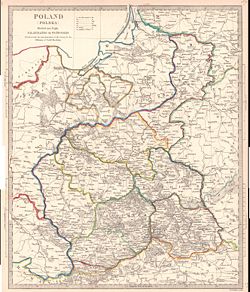
Originally, the Kingdom had an area of roughly 128,500 km2 and a population of approximately 3.3 million. The new state would be one of the smallest Polish states ever, smaller than the preceding Duchy of Warsaw
Duchy of Warsaw
The Duchy of Warsaw was a Polish state established by Napoleon I in 1807 from the Polish lands ceded by the Kingdom of Prussia under the terms of the Treaties of Tilsit. The duchy was held in personal union by one of Napoleon's allies, King Frederick Augustus I of Saxony...
and much smaller than the Polish-Lithuanian Commonwealth
Polish-Lithuanian Commonwealth
The Polish–Lithuanian Commonwealth was a dualistic state of Poland and Lithuania ruled by a common monarch. It was the largest and one of the most populous countries of 16th- and 17th‑century Europe with some and a multi-ethnic population of 11 million at its peak in the early 17th century...
which had a population of 10 million and an area of 1 million km2. Its population reached 6.1 million by 1870 and 10 million by 1900. Most of the ethnic Poles
Poles
thumb|right|180px|The state flag of [[Poland]] as used by Polish government and diplomatic authoritiesThe Polish people, or Poles , are a nation indigenous to Poland. They are united by the Polish language, which belongs to the historical Lechitic subgroup of West Slavic languages of Central Europe...
in the Russian Empire
Russian Empire
The Russian Empire was a state that existed from 1721 until the Russian Revolution of 1917. It was the successor to the Tsardom of Russia and the predecessor of the Soviet Union...
lived in the Congress Kingdom, although some areas outside it also contained Polish majority.
The Kingdom of Poland largely re-emerged as a result of the efforts of Adam Jerzy Czartoryski
Adam Jerzy Czartoryski
Prince Adam Jerzy Czartoryski was a Polish-Lithuanian noble, statesman and author. He was the son of Prince Adam Kazimierz Czartoryski and Izabela Fleming....
, a Pole who aimed to resurrect the Polish state in alliance with Russia
Russia
Russia or , officially known as both Russia and the Russian Federation , is a country in northern Eurasia. It is a federal semi-presidential republic, comprising 83 federal subjects...
. The Kingdom of Poland was one of the few contemporary constitutional monarchies
Constitutional monarchy
Constitutional monarchy is a form of government in which a monarch acts as head of state within the parameters of a constitution, whether it be a written, uncodified or blended constitution...
in Europe, with the Emperor of Russia serving as the Polish King. His title as chief of Poland in Russian, was Tsar
Tsar
Tsar is a title used to designate certain European Slavic monarchs or supreme rulers. As a system of government in the Tsardom of Russia and Russian Empire, it is known as Tsarist autocracy, or Tsarism...
, similar to usage in the fully integrated states within the Empire (Georgia
Georgia (country)
Georgia is a sovereign state in the Caucasus region of Eurasia. Located at the crossroads of Western Asia and Eastern Europe, it is bounded to the west by the Black Sea, to the north by Russia, to the southwest by Turkey, to the south by Armenia, and to the southeast by Azerbaijan. The capital of...
, Kazan
Kazan
Kazan is the capital and largest city of the Republic of Tatarstan, Russia. With a population of 1,143,546 , it is the eighth most populous city in Russia. Kazan lies at the confluence of the Volga and Kazanka Rivers in European Russia. In April 2009, the Russian Patent Office granted Kazan the...
, Siberia
Siberia
Siberia is an extensive region constituting almost all of Northern Asia. Comprising the central and eastern portion of the Russian Federation, it was part of the Soviet Union from its beginning, as its predecessor states, the Tsardom of Russia and the Russian Empire, conquered it during the 16th...
).
Initial independence
Theoretically the Polish Kingdom in its 1815 form was a semi-autonomous state in personal unionPersonal union
A personal union is the combination by which two or more different states have the same monarch while their boundaries, their laws and their interests remain distinct. It should not be confused with a federation which is internationally considered a single state...
with Russia through the rule of the Russian Emperor. The state possessed the Constitution of the Kingdom of Poland
Constitution of the Kingdom of Poland
The Constitution of the Kingdom of Poland was granted to the 'Congress' Kingdom of Poland by the King of Poland, Alexander I of Russia, who was obliged to issue a constitution to the newly recreated Polish state under his domain as specified by the Congress of Vienna...
, one of the most liberal in 19th century Europe, a Sejm (parliament) responsible to the King capable of voting laws, an independent army, currency, budget
Budget
A budget is a financial plan and a list of all planned expenses and revenues. It is a plan for saving, borrowing and spending. A budget is an important concept in microeconomics, which uses a budget line to illustrate the trade-offs between two or more goods...
, penal code and a customs
Customs
Customs is an authority or agency in a country responsible for collecting and safeguarding customs duties and for controlling the flow of goods including animals, transports, personal effects and hazardous items in and out of a country...
boundary separating it from the rest of Russian lands. Poland also had democratic traditions (Golden Liberty
Golden Liberty
Golden Liberty , sometimes referred to as Golden Freedoms, Nobles' Democracy or Nobles' Commonwealth refers to a unique aristocratic political system in the Kingdom of Poland and later, after the Union of Lublin , in the Polish-Lithuanian Commonwealth...
) and the Polish nobility
Szlachta
The szlachta was a legally privileged noble class with origins in the Kingdom of Poland. It gained considerable institutional privileges during the 1333-1370 reign of Casimir the Great. In 1413, following a series of tentative personal unions between the Grand Duchy of Lithuania and the Kingdom of...
deeply valued personal freedom. In reality, the Kings had absolute power and the formal title of Autocrat, and wanted no restrictions on their rule. All opposition to the Emperor of Russia was suppressed and the law was disregarded at will by Russian officials. Though the absolute rule demanded by Russia was difficult to establish due Poland's liberal traditions and institutions, the independence of the Kingdom lasted only 15 years; initially Alexander I
Alexander I of Russia
Alexander I of Russia , served as Emperor of Russia from 23 March 1801 to 1 December 1825 and the first Russian King of Poland from 1815 to 1825. He was also the first Russian Grand Duke of Finland and Lithuania....
used the title of the King of Poland and was obligated to observe resolutions of the constitution. However, in time the situation changed and he granted the viceroy, Grand Duke Konstantin Pavlovich
Grand Duke Constantine Pavlovich of Russia
Constantine Pavlovich was a grand duke of Russia and the second son of Emperor Paul I. He was the Tsesarevich of Russia throughout the reign of his elder brother Alexander I, but had secretly renounced his claim to the throne in 1823...
, almost dictatorial powers. Very soon after Congress of Vienna
Congress of Vienna
The Congress of Vienna was a conference of ambassadors of European states chaired by Klemens Wenzel von Metternich, and held in Vienna from September, 1814 to June, 1815. The objective of the Congress was to settle the many issues arising from the French Revolutionary Wars, the Napoleonic Wars,...
resolutions were signed, Russia ceased to respect them. In 1819, Alexander I abolished freedom of the press and introduced preventory censorship
Censorship
thumb|[[Book burning]] following the [[1973 Chilean coup d'état|1973 coup]] that installed the [[Military government of Chile |Pinochet regime]] in Chile...
. Resistance to Russian control began in 1820s. Russian secret police commanded by Nikolay Nikolayevich Novosiltsev
Nikolay Nikolayevich Novosiltsev
Count Nikolay Nikolayevich Novosiltsev was a Russian statesman and a close aide to Alexander I of Russia.He was a natural son of a wealthy nobleman, married to the aunt of Count Pavel Stroganov. This relationship secured for him a place in the Privy Committee that outlined the Government reform...
started persecution of Polish secret organizations and in 1821 the King ordered the abolition of Freemasonry
Freemasonry
Freemasonry is a fraternal organisation that arose from obscure origins in the late 16th to early 17th century. Freemasonry now exists in various forms all over the world, with a membership estimated at around six million, including approximately 150,000 under the jurisdictions of the Grand Lodge...
which represented patriotic traditions of Poland. Beginning in 1825 the sessions of the Sejm were held in secret.
Uprisings and loss of autonomy
Alexander I's successor, Nicholas INicholas I of Russia
Nicholas I , was the Emperor of Russia from 1825 until 1855, known as one of the most reactionary of the Russian monarchs. On the eve of his death, the Russian Empire reached its historical zenith spanning over 20 million square kilometers...
was crowned King of Poland on 24 May 1829 in Warsaw, but he declined to swear to abide by the Constitution and continued to limit the independence of the Polish Kingdom. Nicholas' rule promoted the idea of Official Nationality, consisting of Orthodoxy, Autocracy, and Nationality. In relation to Poles, those ideas meant assimilation: turning them into loyal Orthodox Russians. The principle of Orthodoxy was the result of the special role it played in Russian Empire, as the Church was in fact becoming a department of state, and other religions discriminated against; for instance, Papal bulls could not be read in the Kingdom of Poland without agreement from the Russian government.
The rule of Nicholas also meant end of political traditions in Poland; democratic institutions were removed, an appointed - rather than elected - centralized administration was put in place, and efforts were made to change the relations between the state and the individual. All of this led to discontent and resistance among the Polish population. In January 1831, the Sejm deposed Nicholas I as King of Poland in response to his repeated curtailing of its constitutional rights. Nicholas reacted by sending Russian troops into Poland, resulting in the November Uprising
November Uprising
The November Uprising , Polish–Russian War 1830–31 also known as the Cadet Revolution, was an armed rebellion in the heartland of partitioned Poland against the Russian Empire. The uprising began on 29 November 1830 in Warsaw when the young Polish officers from the local Army of the Congress...
.
Following an 11-month military campaign, the Kingdom of Poland lost its semi-independence and was subsequently integrated much more closely with the Russian Empire. This was formalized through the issuing of the Organic Statute of the Kingdom of Poland
Organic Statute of the Kingdom of Poland
The Organic Statute of the Kingdom of Poland was a quasi-constitution replacing the Constitution of the Kingdom of Poland in the aftermath of the November Uprising in 1832....
by the Emperor in 1832, which abolished the constitution, army and legislative assembly. Over the next 30 years a series of measures bound Congress Poland ever more closely to Russia. In 1863 the January Uprising
January Uprising
The January Uprising was an uprising in the former Polish-Lithuanian Commonwealth against the Russian Empire...
broke out, but lasted only two years before being crushed. As a direct result, any remaining separate status of the Kingdom was removed and the political entity was directly incorporated into the Russian Empire. The formerly unofficial name of Privislinsky Krai , i.e. 'Vistula Land', replaced 'Kingdom of Poland' as the area's official name and the area became a namestnichestvo under the control of a namestnik until 1875, when it became a Guberniya
Guberniya
A guberniya was a major administrative subdivision of the Russian Empire usually translated as government, governorate, or province. Such administrative division was preserved for sometime upon the collapse of the empire in 1917. A guberniya was ruled by a governor , a word borrowed from Latin ,...
.
Government
The government of the Congress of Poland was outlined in the Constitution of the Kingdom of PolandConstitution of the Kingdom of Poland
The Constitution of the Kingdom of Poland was granted to the 'Congress' Kingdom of Poland by the King of Poland, Alexander I of Russia, who was obliged to issue a constitution to the newly recreated Polish state under his domain as specified by the Congress of Vienna...
in 1815. The Emperor of Russia was the official head of state, considered the King of Poland, with the local government headed by the Viceroy of the Kingdom of Poland , Council of State
Council of State (Kingdom of Poland)
Council of State of Congress Kingdom of Poland was an important state institution of Poland that existed in the 18th century. It was also known as Council of State of Kingdom of Poland ....
and Administrative Council
Administrative Council
Administrative Council was a part of Council of State of the Congress Poland. Introduced by the Constitution of the Kingdom of Poland in 1815, it was composed of 5 ministers, special nominees of the King and the Namestnik of the Kingdom of Poland...
, in addition to the Sejm.
In theory, Congress Poland possessed one of the most liberal governments of the time in Europe
Europe
Europe is, by convention, one of the world's seven continents. Comprising the westernmost peninsula of Eurasia, Europe is generally 'divided' from Asia to its east by the watershed divides of the Ural and Caucasus Mountains, the Ural River, the Caspian and Black Seas, and the waterways connecting...
, but in practice the area was a puppet state
Puppet state
A puppet state is a nominal sovereign of a state who is de facto controlled by a foreign power. The term refers to a government controlled by the government of another country like a puppeteer controls the strings of a marionette...
of the Russian Empire. The liberal provisions of the constitution, and the scope of the autonomy, were often disregarded by the Russian officials.
Executive Leadership
The office of "Namestnik" was introduced in Poland by the 1815 constitution of Congress Poland. The Viceroy was chosen by the King from among the noble citizens of the Russian Empire or the Kingdom of Poland. The Viceroy supervised the entire public administrationPublic administration
Public Administration houses the implementation of government policy and an academic discipline that studies this implementation and that prepares civil servants for this work. As a "field of inquiry with a diverse scope" its "fundamental goal.....
and, in the monarch's absence, chaired the Council of State
Council of State (Kingdom of Poland)
Council of State of Congress Kingdom of Poland was an important state institution of Poland that existed in the 18th century. It was also known as Council of State of Kingdom of Poland ....
, as well as the Administrative Council
Administrative Council
Administrative Council was a part of Council of State of the Congress Poland. Introduced by the Constitution of the Kingdom of Poland in 1815, it was composed of 5 ministers, special nominees of the King and the Namestnik of the Kingdom of Poland...
. He could veto
Veto
A veto, Latin for "I forbid", is the power of an officer of the state to unilaterally stop an official action, especially enactment of a piece of legislation...
the councils' decisions; other than that, his decisions had to be countersign
Countersign (legal)
Countersigning means writing a second signature onto a document. For example, a contract or other official document signed by the representative of a company may be countersigned by his supervisor to verify the authority of the representative...
ed by the appropriate government minister
Minister (government)
A minister is a politician who holds significant public office in a national or regional government. Senior ministers are members of the cabinet....
. The Viceroy exercised broad powers and could nominate candidates for most senior government posts (ministers, senators, judges of the High Tribunal, councilors of state, referendaries
Referendary
Referendary is the English form or rendering of a number of administrative positions, of various rank, in chanceries and other official organisations.-Secular:...
, as well as bishop
Bishop
A bishop is an ordained or consecrated member of the Christian clergy who is generally entrusted with a position of authority and oversight. Within the Catholic Church, Eastern Orthodox, Oriental Orthodox Churches, in the Assyrian Church of the East, in the Independent Catholic Churches, and in the...
s and archbishop
Archbishop
An archbishop is a bishop of higher rank, but not of higher sacramental order above that of the three orders of deacon, priest , and bishop...
s). He had no competence in the realms of finances and foreign policy; his military competence varied.
The office of "namestnik" or Viceroy was never officially abolished; however, after the January 1863 Uprising
January Uprising
The January Uprising was an uprising in the former Polish-Lithuanian Commonwealth against the Russian Empire...
it disappeared. The last namestnik was Friedrich Wilhelm Rembert von Berg
Friedrich Wilhelm Rembert von Berg
Count Friedrich Wilhelm Rembert von Berg was a Russian Field Marshal, and the Governor-General of Finland from 1855 to 1861....
, who served from 1863 to his death in 1874. No namestnik was named to replace him; however, the role of namestnik—viceroy
Viceroy
A viceroy is a royal official who runs a country, colony, or province in the name of and as representative of the monarch. The term derives from the Latin prefix vice-, meaning "in the place of" and the French word roi, meaning king. A viceroy's province or larger territory is called a viceroyalty...
of the former Kingdom passed to the Governor-General
Governor-General
A Governor-General, is a vice-regal person of a monarch in an independent realm or a major colonial circonscription. Depending on the political arrangement of the territory, a Governor General can be a governor of high rank, or a principal governor ranking above "ordinary" governors.- Current uses...
of Warsaw
Warsaw
Warsaw is the capital and largest city of Poland. It is located on the Vistula River, roughly from the Baltic Sea and from the Carpathian Mountains. Its population in 2010 was estimated at 1,716,855 residents with a greater metropolitan area of 2,631,902 residents, making Warsaw the 10th most...
—or, to be more specific, of the Warsaw Military District .
The governor-general answered directly to the Emperor and exercised much broader powers than had the namestnik. In particular, he controlled all the military forces in the region and oversaw the judicial systems (he could impose death sentence
Death Sentence
Death Sentence is a short story by the American science-fiction writer Isaac Asimov. It was first published in the November 1943 issue of Astounding Science Fiction and reprinted in the 1972 collection The Early Asimov.-Plot summary:...
s without trial). He could also issue "declaration
Declaration
Declaration may refer to:* Declaration , specifies the identifier, type, and other aspects of language elements* Declaration , when the captain of a cricket team declares its innings closed...
s with the force of law," which could alter existing laws.
Administrative Council
The Administrative Council was a part of Council of StateCouncil of State (Kingdom of Poland)
Council of State of Congress Kingdom of Poland was an important state institution of Poland that existed in the 18th century. It was also known as Council of State of Kingdom of Poland ....
of the Kingdom. Introduced by the Constitution of the Kingdom of Poland
Constitution of the Kingdom of Poland
The Constitution of the Kingdom of Poland was granted to the 'Congress' Kingdom of Poland by the King of Poland, Alexander I of Russia, who was obliged to issue a constitution to the newly recreated Polish state under his domain as specified by the Congress of Vienna...
in 1815, it was composed of 5 ministers, special nominees of the King and the Viceroy of the Kingdom of Poland. The Council executed the King's will and ruled in the cases outside the ministers competence and prepared projects for the Council of State.
Administrative divisions
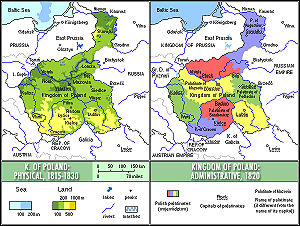
The administrative divisions of the Kingdom changed several times over its history. Over the next several decades, various smaller reforms were carried out, either changing the smaller administrative units or merging/splitting various subdivisions.Immediately after its creation in 1815–1816, the Kingdom of Poland was divided into departments, a relic
Administrative division of Duchy of Warsaw
Administrative division of Duchy of Warsaw was based on departments. Headed by a prefect, it was a solution adopted based on the French model, as entire Duchy was in fact created by Napoleon and based on French ideas, although departaments were divided into Polish powiats .There were 6 initial...
from the times of the French-dominated Duchy of Warsaw
Duchy of Warsaw
The Duchy of Warsaw was a Polish state established by Napoleon I in 1807 from the Polish lands ceded by the Kingdom of Prussia under the terms of the Treaties of Tilsit. The duchy was held in personal union by one of Napoleon's allies, King Frederick Augustus I of Saxony...
.
On January 16, 1816 the administrative division was reformed from the departments of the Duchy of Warsaw
Duchy of Warsaw
The Duchy of Warsaw was a Polish state established by Napoleon I in 1807 from the Polish lands ceded by the Kingdom of Prussia under the terms of the Treaties of Tilsit. The duchy was held in personal union by one of Napoleon's allies, King Frederick Augustus I of Saxony...
into the more traditionally Polish voivodeship
Voivodeship
Voivodship is a term denoting the position of, or more commonly the area administered by, a voivod. Voivodeships have existed since medieval times in Poland, Romania, Hungary, Lithuania, Latvia, Russia and Serbia....
s, obwód
Obwód
Obwód is a term used in Polish to denote administrative districts in various countries, particularly as a translation of the Russian oblast...
s and powiat
Powiat
A powiat is the second-level unit of local government and administration in Poland, equivalent to a county, district or prefecture in other countries. The term powiat is most often translated into English as "county", although other terms are also sometimes used...
s. There were 8 voivodeships. On 7 March 1837, in the aftermath of the November Uprising
November Uprising
The November Uprising , Polish–Russian War 1830–31 also known as the Cadet Revolution, was an armed rebellion in the heartland of partitioned Poland against the Russian Empire. The uprising began on 29 November 1830 in Warsaw when the young Polish officers from the local Army of the Congress...
earlier that decade, the administrative division was reformed once again, bringing Congress Poland closer to the structure of the Russian Empire
Russian Empire
The Russian Empire was a state that existed from 1721 until the Russian Revolution of 1917. It was the successor to the Tsardom of Russia and the predecessor of the Soviet Union...
, with the introduction of guberniya
Guberniya
A guberniya was a major administrative subdivision of the Russian Empire usually translated as government, governorate, or province. Such administrative division was preserved for sometime upon the collapse of the empire in 1917. A guberniya was ruled by a governor , a word borrowed from Latin ,...
s (governorate
Governorate
A governorate is an administrative division of a country. It is headed by a governor. As English-speaking nations tend to call regions administered by governors either states, provinces, or colonies, the term governorate is often used in translation from non-English-speaking administrations.The...
, Polish spelling gubernia). In 1842 powiat
Powiat
A powiat is the second-level unit of local government and administration in Poland, equivalent to a county, district or prefecture in other countries. The term powiat is most often translated into English as "county", although other terms are also sometimes used...
s were renamed okręg
Okreg
Okręg is a term used in Polish to denote regions and jurisdictions of various types, including electoral constituencies. As historical administrative subdivisions of Poland, okręgi existed in the later part of the Congress Poland period, from 1842, when the name was applied to the former powiats...
s, and obwód
Obwód
Obwód is a term used in Polish to denote administrative districts in various countries, particularly as a translation of the Russian oblast...
s were renamed powiats. In 1844 several governorates were merged with others, and some others renamed. 5 governorates remained.
The 1867 reform, initiated after the failure of the January Uprising
January Uprising
The January Uprising was an uprising in the former Polish-Lithuanian Commonwealth against the Russian Empire...
, was designed to tie the Congress Kingdom (now de facto the Vistulan Country
Vistulan Country
Vistula Land or Vistula Country was the name applied to the lands of the Kingdom of Poland following the defeats of the November Uprising and January Uprising as it was increasingly stripped of autonomy and incorporated into Imperial Russia...
) more tightly to the administration structure of the Russian Empire. It divided larger governorates into smaller ones. A new lower level entity, gmina
Gmina
The gmina is the principal unit of administrative division of Poland at its lowest uniform level. It is often translated as "commune" or "municipality." As of 2010 there were 2,479 gminas throughout the country...
, was introduced. The existing 5 governorates were restructured inti 10. The 1912 reform created a new governorate - Kholm Governorate
Kholm Governorate
Kholm Governorate or Chełm Governorate was an administrative unit of the Russian Empire. Its capital was in Chełm ....
- from parts of the Sedlets and Lublin Governorate
Lublin Governorate
Lublin Governorate ) was an administrative unit of the Congress Poland.-History:It was created in 1837 from the Lublin Voivodeship, and had the same borders and capital as the voivodeship....
s. It was split off from the Vistulan Country and made part of the Southwestern Krai
Southwestern Krai
Southwestern Krai , also known as Kiev General Governorate or Kiev, Podolia, and Volhynia General Governorate was a subdivision of the Russian Empire that included much of the territory of modern-day Ukraine covering both banks of the Dnieper River.The Governorate General consisted of several...
of the Russian Empire
Russian Empire
The Russian Empire was a state that existed from 1721 until the Russian Revolution of 1917. It was the successor to the Tsardom of Russia and the predecessor of the Soviet Union...
.
See also
- Geographical Dictionary of the Kingdom of Poland
- Grand Duchy of Posen
- History of Poland (1795–1918)
- Grand Duchy of FinlandGrand Duchy of FinlandThe Grand Duchy of Finland was the predecessor state of modern Finland. It existed 1809–1917 as part of the Russian Empire and was ruled by the Russian czar as Grand Prince.- History :...
(1809–1917) - Pale of SettlementPale of SettlementThe Pale of Settlement was the term given to a region of Imperial Russia, in which permanent residency by Jews was allowed, and beyond which Jewish permanent residency was generally prohibited...
- Great RetreatGreat Retreat (Russian)The Great Retreat was a Russian retreat from Galicia and Poland during World War I.-Background:During this period, the buildup of forces generally favored the Central Powers. Four new German armies, the Eleventh, Twelfth, Army of the Niemen and Army Bug, were being formed up, dramatically shifting...
- the withdrawal of Russian forces from Poland, in 1915.