

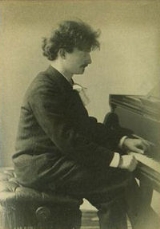
Ignacy Jan Paderewski

Encyclopedia
Ignacy Jan Paderewski GBE (iɡˈnat͡sɨ ˈjan padɛˈrɛfskʲi; 29 June 1941) was a Polish
pianist, composer, diplomat, politician, and the second Prime Minister of the Republic of Poland
.
, the Russian Empire
. Today the village is part of the Khmilnyk
raion
of Vinnytsia Oblast
, Ukraine. His father, Jan Paderewski, was an administrator of large estates. His mother, Poliksena (née Nowicka), died several months after Paderewski was born, and he was brought up by his distant relatives.
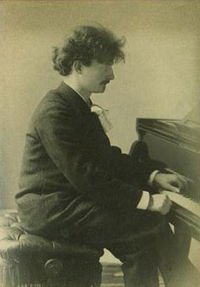 From his early childhood, Paderewski was interested in music while living at the private estate near Zhytomyr
where he moved with his father. However soon after his father's arrest in connections with the January Uprising
(1863), he was adopted by his aunt. After being released, Paderewski's father married again and moved to the city of Sudylkov near Shepetovka
.
Initially he took piano lessons with a private tutor. At the age of 12, in 1872, he went to Warsaw
and was admitted to the Warsaw Conservatorium. After graduating in 1878, he was asked to become a tutor of piano classes at his alma mater, which he accepted. In 1880 Paderewski married Antonina Korsakówna, and soon afterwards, their first child was born. The following year, they discovered that the son was handicapped; soon afterward, Antonina died. Paderewski decided to devote himself to music, and in 1881 he went to Berlin to study music composition with Friedrich Kiel
and Heinrich Urban. In 1884 he moved to Vienna
, where he was a pupil of Theodor Leschetizky. It was in Vienna that he made his musical debut in 1887. He soon gained great popularity and his subsequent appearances (in Paris in 1889, and in London in 1890) were major successes. His brilliant playing created a furore which reached to almost extravagant lengths of admiration; and his triumphs were repeated in the United States in 1891. His name at once became synonymous with the highest level of piano virtuosity. However, not everyone was impressed. After hearing Paderewski for the first time, Moriz Rosenthal
said: "Yes, he plays well, I suppose, but he's no Paderewski".
In 1899 he married Baroness de Rosen.
He was also a substantial composer, including many pieces for piano. He became world famous for the Minuet in G
, Op. 14/1, part of a set of six pieces that are otherwise forgotten. In 1901 his sole opera Manru
received its world premiere at Dresden
, then it had its American premiere in 1902 at the Metropolitan Opera
. To this day it remains the only Polish opera
by a Polish composer ever performed there.
Paderewski, his second wife, entourage, parrot and Erard piano travelled to Auckland
, New Zealand from Sydney, Australia aboard the steamer Zealandia on 28 August 1904. He travelled to Wellington
by train and gave a concert there on 12 September.
He was also active in pursuing various philanthropic causes. In 1910 he funded the erection of the Battle of Grunwald
Monument in Kraków, in commemoration of the 500th anniversary of the event. In 1913, Paderewski settled in the United States.
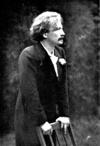 On the eve of World War I, and at the height of his fame, Paderewski bought a 2000 acres (8.1 km²) property, Rancho San Ignacio, near Paso Robles, in San Luis Obispo County, on the central coast of California. A decade later he planted Zinfandel vines on the California property. When the vines matured, the wine was made for him at the nearby York Mountain Winery, then, as now, one of the best-known wineries between Los Angeles and San Francisco.
He was extremely popular internationally, to such an extent that the music hall duo "The Two Bobs" had a hit song in 1916, in music halls across Britain, with the song "When Paderewski plays".
During World War I, Paderewski became an active member of the Polish National Committee
in Paris, which was soon accepted by the Entente
as the representative of Poland
. He became a spokesman of that organisation, and soon also formed other social and political organisations, among them the Polish Relief Fund in London. It was then that he met the English composer Edward Elgar
, who used a theme from Paderewski's Fantasie Polonaise in his work Polonia
written for the Polish Relief Fund concert in London on 6 July 1916.
In April 1918, he met in New York City with leaders of the American Jewish Committee
, including Louis Marshall
, in an unsuccessful attempt to broker a deal whereby organized Jewish groups would support Polish territorial ambitions in exchange for support for equal rights. However, it soon became clear that no plan would satisfy both Jewish leaders and Roman Dmowski
, head of the Polish National Committee.
At the end of the war, with the fate of the city of Poznań
and the whole region of Greater Poland
(Wielkopolska) still undecided, Paderewski visited Poznań. With his public speech on 27 December 1918, the Polish inhabitants of Poznań began a military uprising against Germany, called the Greater Poland Uprising
.
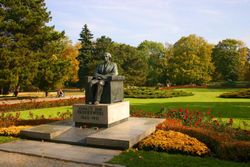 In 1919, in the newly independent Poland, Paderewski became the Prime Minister
and Minister of Foreign Affairs (January 1919 – December 1919), and he thus represented Poland at the Paris Peace Conference
. In the summer of that year, he signed the Treaty of Versailles
, which restored the territories of Greater Poland and Pomerania around the City of Gdańsk to Poland. Although this fell short of what the Polish delegates had demanded, these territories provided the core of the restored Polish state.
After being abandoned by many of his political supporters, Paderewski handed Piłsudski a letter of resignation on 4 December 1919, whereupon he took on the role of Polish Ambassador to the League of Nations
.
In 1922 he retired from politics and returned to his musical life. His first concert after a long break, held at Carnegie Hall
, was a significant success. He also filled Madison Square Garden (20,000 seats) and toured the United States in a private railway car.
Soon he moved to Morges
in Switzerland. After Piłsudski's coup d'état in 1926, Paderewski became an active member of the opposition to Sanacja
rule. In 1936 a coalition of members of the opposition was signed in his mansion; it was nicknamed the Front Morges
after the name of the village.
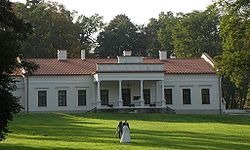 By 1936, two years after the death of his wife, Paderewski consented to appear in a film presenting his talent and art on the screen. This proposal had come at a time when Paderewski did not wish to appear in public. However, the film project did proceed, and the selected film script was an opportunity to feature Paderewski. The film Moonlight Sonata was filmed throughout 1936.
In November 1937 Paderewski agreed to take on one last pupil for piano. This musician was Witold Małcużyński, who had won second place at the International Frédéric Chopin Piano Competition.
After the Polish Defensive War
of 1939 Paderewski returned to public life. In 1940 he became the head of the Polish National Council, a Polish parliament
in exile in London. The eighty-year-old artist also restarted his Polish Relief Fund and gave several concerts (most notably in the United States) to gather money for it. However, his mind was not what it had once been: scheduled again to play Madison Square Garden, he refused to appear, insisting that he had already played the concert, presumably remembering the concert he had played in the 1920s.
In addition to his concert tours, Paderewski was a popular speaker who was renowned for his wit, and was often quoted. He was once introduced to a polo player with the words: "You are both leaders in your spheres, though the spheres are very different." "Not so very different," Paderewski replied. "You are a dear soul who plays polo, and I am a poor Pole who plays solo."
In another incident, Paderewski once recalled, "I established a certain standard of behaviour, that, during my playing, there must be no talking. When they began to talk, I would stop. I would say, 'I am sorry to interrupt your conversation. I deeply regret that I am obliged to disturb you, so I am going to stop for a while to allow you to continue talking.' You can imagine the effect it had..."
During one such tour in 1941, Paderewski was taken ill on 27 June. Nothing was discussed with his personal secretary or entourage. But at the initiative of Sylwin Strakacz, physicians were called in for consultation and diagnosed pneumonia. Despite increasing health and signs of recovery Paderewski died suddenly in New York, at 11:00 pm on 29 June. He was buried in Arlington National Cemetery
, in Arlington Virginia
, near Washington DC
. In 1992, his body was brought to Warsaw
and placed in St. John's Cathedral. His heart is encased in a bronze sculpture in the National Shrine of Our Lady of Czestochowa
near Doylestown, Pennsylvania
.
The Polish Museum of America
in Chicago received a donation of the personal possessions of Ignacy Jan Paderewski following his death in June 1941. Both Ignacy Paderewski and his sister, Antonina Paderewska Wilkonska were enthusiastic supporters and generous sponsors of the Museum. Antonina, executor of Ignacy’s will, decided to donate these personal possessions to the Museum. In addition, the management of the Buckingham Hotel in New York City, where Ignacy spent the last months of his life, allowed Antonina to obtain the furnishings from the suite of rooms he had occupied. These furnishings were also donated to the Museum. With the assistance of Ignacy’s personal secretary, the furnishings and his personal mementos were arranged for public display in the room that had been the first display room of the Museum in 1937. This revised space was officially re-opened with a special dedication ceremony on 3 November 1941, three days before the date that would have marked Paderewski's 81st birthday.
 In 1948 the Ignacy Paderewski Foundations was established in New York City, on the initiative of the Polish community
in New York with the goal of promoting Polish culture in the United States. Two other Polish-American
organizations are also named in his honor and dedicated to promoting the legacy of the maestro: the Paderewski Association in Chicago as well as the Paderewski Music Society in Southern California
.
Due to the unusual combination of the notable achievements of being a world-class pianist and a successful politician, Paderewski has become a favourite example for philosophers, and is often discussed in relation to Saul Kripke
's "A Puzzle about Belief" for having a name that denotes two distinct qualities, that of being a politician and that of being a pianist.
, and Buffalo, New York
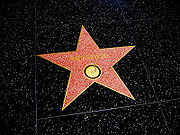
. In addition, the Academy of Music in Poznań is named after him. Paderewski has a star on the Hollywood Walk of Fame
in Los Angeles, awarded in 1960.
In 1925 he was made an honorary Knight Grand Cross of the Order of the British Empire
. This entitled him to the postnominal letters GBE but not to be known as "Sir Ignacy" (despite the erroneous claim in Time), that title being reserved for citizens of one of the countries of which the British monarch is head of state
.
Poland
Poland , officially the Republic of Poland , is a country in Central Europe bordered by Germany to the west; the Czech Republic and Slovakia to the south; Ukraine, Belarus and Lithuania to the east; and the Baltic Sea and Kaliningrad Oblast, a Russian exclave, to the north...
pianist, composer, diplomat, politician, and the second Prime Minister of the Republic of Poland
Prime Minister of the Republic of Poland
The Prime Minister of Poland heads the Polish Council of Ministers and directs their work, supervises territorial self-government within the guidelines and in ways described in the Constitution and other legislation, and acts as the superior for all government administration workers...
.
Biography
Ignacy Jan Paderewski was born in the village of Kurilovka, Litin uyezd in the Podolia GovernoratePodolia Governorate
The Podolia Governorate or Government of Podolia, set up after the Second Partition of Poland, comprised a governorate of the Russian Empire from 1793 to 1917, of the Ukrainian People's Republic from 1917 to 1921, and of the Ukrainian SSR from 1921 to 1925.-Location:The Podolian Governorate...
, the Russian Empire
Russian Empire
The Russian Empire was a state that existed from 1721 until the Russian Revolution of 1917. It was the successor to the Tsardom of Russia and the predecessor of the Soviet Union...
. Today the village is part of the Khmilnyk
Khmilnyk
Khmilnyk is a resort town in Vinnytsia Oblast, Ukraine. The population is 27,900 .The town is situated in the upper part of the river Southern Buh, northeast of Vinnytsia. It is one of the oldest towns of Podillia.-Early history:...
raion
Raion
A raion is a type of administrative unit of several post-Soviet countries. The term, which is from French rayon 'honeycomb, department,' describes both a type of a subnational entity and a division of a city, and is commonly translated in English as "district"...
of Vinnytsia Oblast
Vinnytsia Oblast
Vinnytsia Oblast is an oblast of Ukraine. Its administrative center is Vinnytsia.-Geography:The area of the region is 26,500 km²; its population is 1.7 million....
, Ukraine. His father, Jan Paderewski, was an administrator of large estates. His mother, Poliksena (née Nowicka), died several months after Paderewski was born, and he was brought up by his distant relatives.
Zhytomyr
Zhytomyr is a city in the North of the western half of Ukraine. It is the administrative center of the Zhytomyr Oblast , as well as the administrative center of the surrounding Zhytomyr Raion...
where he moved with his father. However soon after his father's arrest in connections with the January Uprising
January Uprising
The January Uprising was an uprising in the former Polish-Lithuanian Commonwealth against the Russian Empire...
(1863), he was adopted by his aunt. After being released, Paderewski's father married again and moved to the city of Sudylkov near Shepetovka
Shepetivka
Shepetivka is a town located on the Huska River in the Khmelnytskyi Oblast of Western Ukraine. The city's population is 48,212 . Shepetivka is a town of oblast subordinance, and the administrative center of Shepetivka Raion .Shepetivka is an important railway junction with five intersecting...
.
Initially he took piano lessons with a private tutor. At the age of 12, in 1872, he went to Warsaw
Warsaw
Warsaw is the capital and largest city of Poland. It is located on the Vistula River, roughly from the Baltic Sea and from the Carpathian Mountains. Its population in 2010 was estimated at 1,716,855 residents with a greater metropolitan area of 2,631,902 residents, making Warsaw the 10th most...
and was admitted to the Warsaw Conservatorium. After graduating in 1878, he was asked to become a tutor of piano classes at his alma mater, which he accepted. In 1880 Paderewski married Antonina Korsakówna, and soon afterwards, their first child was born. The following year, they discovered that the son was handicapped; soon afterward, Antonina died. Paderewski decided to devote himself to music, and in 1881 he went to Berlin to study music composition with Friedrich Kiel
Friedrich Kiel
Friedrich Kiel was a German composer and music teacher.Writing of the chamber music of Friedrich Kiel, the famous scholar and critic Wilhelm Altmann notes that it was Kiel’s extreme modesty which kept him and his exceptional works from receiving the consideration they deserved...
and Heinrich Urban. In 1884 he moved to Vienna
Vienna
Vienna is the capital and largest city of the Republic of Austria and one of the nine states of Austria. Vienna is Austria's primary city, with a population of about 1.723 million , and is by far the largest city in Austria, as well as its cultural, economic, and political centre...
, where he was a pupil of Theodor Leschetizky. It was in Vienna that he made his musical debut in 1887. He soon gained great popularity and his subsequent appearances (in Paris in 1889, and in London in 1890) were major successes. His brilliant playing created a furore which reached to almost extravagant lengths of admiration; and his triumphs were repeated in the United States in 1891. His name at once became synonymous with the highest level of piano virtuosity. However, not everyone was impressed. After hearing Paderewski for the first time, Moriz Rosenthal
Moriz Rosenthal
Moriz Rosenthal was a great Polish pianist. He was an outstanding pupil of Franz Liszt and a friend and colleague of some of the greatest musicians of his age, including Johannes Brahms, Johann Strauss, Anton Rubinstein, Hans von Bülow, Camille Saint-Saëns, Jules Massenet and Isaac...
said: "Yes, he plays well, I suppose, but he's no Paderewski".
In 1899 he married Baroness de Rosen.
He was also a substantial composer, including many pieces for piano. He became world famous for the Minuet in G
Minuet in G (Paderewski)
The Minuet in G, Op. 14/1, is a short piano composition by Ignacy Jan Paderewski, which became world-famous, overshadowing his more major works such as the Symphony in B minor "Polonia", the Piano Concerto in A minor, and the opera Manru....
, Op. 14/1, part of a set of six pieces that are otherwise forgotten. In 1901 his sole opera Manru
Manru
Manru is an opera in three acts, music by Ignacy Jan Paderewski composed to the libretto by Alfred Nossig Manru is an opera (lyrical drama) in three acts, music by Ignacy Jan Paderewski composed to the libretto by Alfred Nossig Manru is an opera (lyrical drama) in three acts, music by Ignacy Jan...
received its world premiere at Dresden
Dresden
Dresden is the capital city of the Free State of Saxony in Germany. It is situated in a valley on the River Elbe, near the Czech border. The Dresden conurbation is part of the Saxon Triangle metropolitan area....
, then it had its American premiere in 1902 at the Metropolitan Opera
Metropolitan Opera
The Metropolitan Opera is an opera company, located in New York City. Originally founded in 1880, the company gave its first performance on October 22, 1883. The company is operated by the non-profit Metropolitan Opera Association, with Peter Gelb as general manager...
. To this day it remains the only Polish opera
Polish opera
Polish opera may be broadly understood to include operas staged in Poland and works written for foreign stages by Polish composers, as well as opera in the Polish language....
by a Polish composer ever performed there.
Paderewski, his second wife, entourage, parrot and Erard piano travelled to Auckland
Auckland
The Auckland metropolitan area , in the North Island of New Zealand, is the largest and most populous urban area in the country with residents, percent of the country's population. Auckland also has the largest Polynesian population of any city in the world...
, New Zealand from Sydney, Australia aboard the steamer Zealandia on 28 August 1904. He travelled to Wellington
Wellington
Wellington is the capital city and third most populous urban area of New Zealand, although it is likely to have surpassed Christchurch due to the exodus following the Canterbury Earthquake. It is at the southwestern tip of the North Island, between Cook Strait and the Rimutaka Range...
by train and gave a concert there on 12 September.
He was also active in pursuing various philanthropic causes. In 1910 he funded the erection of the Battle of Grunwald
Battle of Grunwald
The Battle of Grunwald or 1st Battle of Tannenberg was fought on 15 July 1410, during the Polish–Lithuanian–Teutonic War. The alliance of the Kingdom of Poland and the Grand Duchy of Lithuania, led respectively by King Jogaila and Grand Duke Vytautas , decisively defeated the Teutonic Knights, led...
Monument in Kraków, in commemoration of the 500th anniversary of the event. In 1913, Paderewski settled in the United States.
He was extremely popular internationally, to such an extent that the music hall duo "The Two Bobs" had a hit song in 1916, in music halls across Britain, with the song "When Paderewski plays".
During World War I, Paderewski became an active member of the Polish National Committee
Polish National Committee (1917-1919)
Polish National Committee was formed in Lausanne on 15 August 1917 by Polish National Democracy politician Roman Dmowski. Its goal was to support Entente by creating the Polish Army fighting alongside of it in exchange of receiving support for independent Poland...
in Paris, which was soon accepted by the Entente
Triple Entente
The Triple Entente was the name given to the alliance among Britain, France and Russia after the signing of the Anglo-Russian Entente in 1907....
as the representative of Poland
Poland
Poland , officially the Republic of Poland , is a country in Central Europe bordered by Germany to the west; the Czech Republic and Slovakia to the south; Ukraine, Belarus and Lithuania to the east; and the Baltic Sea and Kaliningrad Oblast, a Russian exclave, to the north...
. He became a spokesman of that organisation, and soon also formed other social and political organisations, among them the Polish Relief Fund in London. It was then that he met the English composer Edward Elgar
Edward Elgar
Sir Edward William Elgar, 1st Baronet OM, GCVO was an English composer, many of whose works have entered the British and international classical concert repertoire. Among his best-known compositions are orchestral works including the Enigma Variations, the Pomp and Circumstance Marches, concertos...
, who used a theme from Paderewski's Fantasie Polonaise in his work Polonia
Polonia (Elgar)
Polonia is a symphonic prelude by the English composer Edward Elgar written in 1915 as his Op. 76.-History:On 13 April 1915 the Polish conductor Emil Młynarski asked Elgar to compose something, thinking of how Elgar's Carillon had been a recent tribute to Belgium, but this time using Polish...
written for the Polish Relief Fund concert in London on 6 July 1916.
In April 1918, he met in New York City with leaders of the American Jewish Committee
American Jewish Committee
The American Jewish Committee was "founded in 1906 with the aim of rallying all sections of American Jewry to defend the rights of Jews all over the world...
, including Louis Marshall
Louis B. Marshall
Louis Marshall was an American corporate, constitutional and civil rights lawyer as well as a mediator and Jewish community leader who worked to secure religious, political, and cultural freedom for all minority groups...
, in an unsuccessful attempt to broker a deal whereby organized Jewish groups would support Polish territorial ambitions in exchange for support for equal rights. However, it soon became clear that no plan would satisfy both Jewish leaders and Roman Dmowski
Roman Dmowski
Roman Stanisław Dmowski was a Polish politician, statesman, and chief ideologue and co-founder of the National Democracy political movement, which was one of the strongest political camps of interwar Poland.Though a controversial personality throughout his life, Dmowski was instrumental in...
, head of the Polish National Committee.
At the end of the war, with the fate of the city of Poznań
Poznan
Poznań is a city on the Warta river in west-central Poland, with a population of 556,022 in June 2009. It is among the oldest cities in Poland, and was one of the most important centres in the early Polish state, whose first rulers were buried at Poznań's cathedral. It is sometimes claimed to be...
and the whole region of Greater Poland
Greater Poland
Greater Poland or Great Poland, often known by its Polish name Wielkopolska is a historical region of west-central Poland. Its chief city is Poznań.The boundaries of Greater Poland have varied somewhat throughout history...
(Wielkopolska) still undecided, Paderewski visited Poznań. With his public speech on 27 December 1918, the Polish inhabitants of Poznań began a military uprising against Germany, called the Greater Poland Uprising
Greater Poland Uprising (1918–1919)
The Greater Poland Uprising of 1918–1919, or Wielkopolska Uprising of 1918–1919 or Posnanian War was a military insurrection of Poles in the Greater Poland region against Germany...
.
Prime Minister of the Republic of Poland
The Prime Minister of Poland heads the Polish Council of Ministers and directs their work, supervises territorial self-government within the guidelines and in ways described in the Constitution and other legislation, and acts as the superior for all government administration workers...
and Minister of Foreign Affairs (January 1919 – December 1919), and he thus represented Poland at the Paris Peace Conference
Paris Peace Conference, 1919
The Paris Peace Conference was the meeting of the Allied victors following the end of World War I to set the peace terms for the defeated Central Powers following the armistices of 1918. It took place in Paris in 1919 and involved diplomats from more than 32 countries and nationalities...
. In the summer of that year, he signed the Treaty of Versailles
Treaty of Versailles
The Treaty of Versailles was one of the peace treaties at the end of World War I. It ended the state of war between Germany and the Allied Powers. It was signed on 28 June 1919, exactly five years after the assassination of Archduke Franz Ferdinand. The other Central Powers on the German side of...
, which restored the territories of Greater Poland and Pomerania around the City of Gdańsk to Poland. Although this fell short of what the Polish delegates had demanded, these territories provided the core of the restored Polish state.
After being abandoned by many of his political supporters, Paderewski handed Piłsudski a letter of resignation on 4 December 1919, whereupon he took on the role of Polish Ambassador to the League of Nations
League of Nations
The League of Nations was an intergovernmental organization founded as a result of the Paris Peace Conference that ended the First World War. It was the first permanent international organization whose principal mission was to maintain world peace...
.
In 1922 he retired from politics and returned to his musical life. His first concert after a long break, held at Carnegie Hall
Carnegie Hall
Carnegie Hall is a concert venue in Midtown Manhattan in New York City, United States, located at 881 Seventh Avenue, occupying the east stretch of Seventh Avenue between West 56th Street and West 57th Street, two blocks south of Central Park....
, was a significant success. He also filled Madison Square Garden (20,000 seats) and toured the United States in a private railway car.
Soon he moved to Morges
Morges
Morges is a municipality in the Swiss canton of Vaud, located in the district of Morges and is also the seat of the district.-History:...
in Switzerland. After Piłsudski's coup d'état in 1926, Paderewski became an active member of the opposition to Sanacja
Sanacja
Sanation was a Polish political movement that came to power after Józef Piłsudski's May 1926 Coup d'État. Sanation took its name from his watchword—the moral "sanation" of the Polish body politic...
rule. In 1936 a coalition of members of the opposition was signed in his mansion; it was nicknamed the Front Morges
Front Morges
Front Morges was a political alliance of centrist political parties of interwar Poland . It was founded in 1936 in the Swiss village of Morges by general Władysław Sikorski and former Polish Prime Minister Ignacy Paderewski. Prominent activists included Józef Haller, Wojciech Korfanty, and Karol...
after the name of the village.
In November 1937 Paderewski agreed to take on one last pupil for piano. This musician was Witold Małcużyński, who had won second place at the International Frédéric Chopin Piano Competition.
After the Polish Defensive War
Invasion of Poland (1939)
The Invasion of Poland, also known as the September Campaign or 1939 Defensive War in Poland and the Poland Campaign in Germany, was an invasion of Poland by Germany, the Soviet Union, and a small Slovak contingent that marked the start of World War II in Europe...
of 1939 Paderewski returned to public life. In 1940 he became the head of the Polish National Council, a Polish parliament
Sejm
The Sejm is the lower house of the Polish parliament. The Sejm is made up of 460 deputies, or Poseł in Polish . It is elected by universal ballot and is presided over by a speaker called the Marshal of the Sejm ....
in exile in London. The eighty-year-old artist also restarted his Polish Relief Fund and gave several concerts (most notably in the United States) to gather money for it. However, his mind was not what it had once been: scheduled again to play Madison Square Garden, he refused to appear, insisting that he had already played the concert, presumably remembering the concert he had played in the 1920s.
In addition to his concert tours, Paderewski was a popular speaker who was renowned for his wit, and was often quoted. He was once introduced to a polo player with the words: "You are both leaders in your spheres, though the spheres are very different." "Not so very different," Paderewski replied. "You are a dear soul who plays polo, and I am a poor Pole who plays solo."
In another incident, Paderewski once recalled, "I established a certain standard of behaviour, that, during my playing, there must be no talking. When they began to talk, I would stop. I would say, 'I am sorry to interrupt your conversation. I deeply regret that I am obliged to disturb you, so I am going to stop for a while to allow you to continue talking.' You can imagine the effect it had..."
During one such tour in 1941, Paderewski was taken ill on 27 June. Nothing was discussed with his personal secretary or entourage. But at the initiative of Sylwin Strakacz, physicians were called in for consultation and diagnosed pneumonia. Despite increasing health and signs of recovery Paderewski died suddenly in New York, at 11:00 pm on 29 June. He was buried in Arlington National Cemetery
Arlington National Cemetery
Arlington National Cemetery in Arlington County, Virginia, is a military cemetery in the United States of America, established during the American Civil War on the grounds of Arlington House, formerly the estate of the family of Confederate general Robert E. Lee's wife Mary Anna Lee, a great...
, in Arlington Virginia
Virginia
The Commonwealth of Virginia , is a U.S. state on the Atlantic Coast of the Southern United States. Virginia is nicknamed the "Old Dominion" and sometimes the "Mother of Presidents" after the eight U.S. presidents born there...
, near Washington DC
Washington, D.C.
Washington, D.C., formally the District of Columbia and commonly referred to as Washington, "the District", or simply D.C., is the capital of the United States. On July 16, 1790, the United States Congress approved the creation of a permanent national capital as permitted by the U.S. Constitution....
. In 1992, his body was brought to Warsaw
Warsaw
Warsaw is the capital and largest city of Poland. It is located on the Vistula River, roughly from the Baltic Sea and from the Carpathian Mountains. Its population in 2010 was estimated at 1,716,855 residents with a greater metropolitan area of 2,631,902 residents, making Warsaw the 10th most...
and placed in St. John's Cathedral. His heart is encased in a bronze sculpture in the National Shrine of Our Lady of Czestochowa
National Shrine of Our Lady of Czestochowa
The National Shrine of Our Lady of Czestochowa , known also as the American Czestochowa is a Polish-American Roman Catholic shrine near Doylestown, Pennsylvania, founded in 1953. It houses a reproduction of the Black Madonna icon of Częstochowa, Poland...
near Doylestown, Pennsylvania
Doylestown, Pennsylvania
Doylestown is a borough in Bucks County, Pennsylvania, north of Philadelphia. As of the 2010 census, the borough population was 8,380. The borough is the county seat of Bucks County.- History :...
.
The Polish Museum of America
Polish Museum of America
The Polish Museum of America is located in West Town, in what had been the historical Polish Downtown neighborhood of Chicago. It is home to a plethora of Polish artifacts, artwork, and embroidered folk costumes among its growing collection...
in Chicago received a donation of the personal possessions of Ignacy Jan Paderewski following his death in June 1941. Both Ignacy Paderewski and his sister, Antonina Paderewska Wilkonska were enthusiastic supporters and generous sponsors of the Museum. Antonina, executor of Ignacy’s will, decided to donate these personal possessions to the Museum. In addition, the management of the Buckingham Hotel in New York City, where Ignacy spent the last months of his life, allowed Antonina to obtain the furnishings from the suite of rooms he had occupied. These furnishings were also donated to the Museum. With the assistance of Ignacy’s personal secretary, the furnishings and his personal mementos were arranged for public display in the room that had been the first display room of the Museum in 1937. This revised space was officially re-opened with a special dedication ceremony on 3 November 1941, three days before the date that would have marked Paderewski's 81st birthday.
Memorials and tributes
Polonia
The Polish diaspora refers to people of Polish origin who live outside Poland. The Polish diaspora is also known in modern Polish language as Polonia, which is the name for Poland in Latin and in many other Romance languages....
in New York with the goal of promoting Polish culture in the United States. Two other Polish-American
Polish American
A Polish American , is a citizen of the United States of Polish descent. There are an estimated 10 million Polish Americans, representing about 3.2% of the population of the United States...
organizations are also named in his honor and dedicated to promoting the legacy of the maestro: the Paderewski Association in Chicago as well as the Paderewski Music Society in Southern California
Southern California
Southern California is a megaregion, or megapolitan area, in the southern area of the U.S. state of California. Large urban areas include Greater Los Angeles and Greater San Diego. The urban area stretches along the coast from Ventura through the Southland and Inland Empire to San Diego...
.
Due to the unusual combination of the notable achievements of being a world-class pianist and a successful politician, Paderewski has become a favourite example for philosophers, and is often discussed in relation to Saul Kripke
Saul Kripke
Saul Aaron Kripke is an American philosopher and logician. He is a professor emeritus at Princeton and teaches as a Distinguished Professor of Philosophy at the CUNY Graduate Center...
's "A Puzzle about Belief" for having a name that denotes two distinct qualities, that of being a politician and that of being a pianist.
Honours and awards
There are streets and schools named after Paderewski in many major cities in Poland. There are also streets named after him in Perth Amboy, New JerseyPerth Amboy, New Jersey
Perth Amboy is a city in Middlesex County, New Jersey, United States. The City of Perth Amboy is part of the New York metropolitan area. As of the 2010 United States Census, the city population was 50,814. Perth Amboy is known as the "City by the Bay", referring to Raritan Bay.-Name:The Lenape...
, and Buffalo, New York
Buffalo, New York
Buffalo is the second most populous city in the state of New York, after New York City. Located in Western New York on the eastern shores of Lake Erie and at the head of the Niagara River across from Fort Erie, Ontario, Buffalo is the seat of Erie County and the principal city of the...
. In addition, the Academy of Music in Poznań is named after him. Paderewski has a star on the Hollywood Walk of Fame
Hollywood Walk of Fame
The Hollywood Walk of Fame consists of more than 2,400 five-pointed terrazzo and brass stars embedded in the sidewalks along fifteen blocks of Hollywood Boulevard and three blocks of Vine Street in Hollywood, California...
in Los Angeles, awarded in 1960.
In 1925 he was made an honorary Knight Grand Cross of the Order of the British Empire
Order of the British Empire
The Most Excellent Order of the British Empire is an order of chivalry established on 4 June 1917 by George V of the United Kingdom. The Order comprises five classes in civil and military divisions...
. This entitled him to the postnominal letters GBE but not to be known as "Sir Ignacy" (despite the erroneous claim in Time), that title being reserved for citizens of one of the countries of which the British monarch is head of state
Commonwealth Realm
A Commonwealth realm is a sovereign state within the Commonwealth of Nations that has Elizabeth II as its monarch and head of state. The sixteen current realms have a combined land area of 18.8 million km² , and a population of 134 million, of which all, except about two million, live in the six...
.
- Order of the White Eagle
- Order of Virtuti Militari, Silver Cross (posthumously)
- Legion of Honour (France)
- Honorary Knight Grand Cross of the Order of the British Empire (1925)
- Honorary doctorates from universities in Lvov (1912), Krakow (1919), Poznan (1924) and WarsawUniversity of WarsawThe University of Warsaw is the largest university in Poland and one of the most prestigious, ranked as best Polish university in 2010 and 2011...
(1931), as well as several American universities. - Honorary citizen of Warsaw
- Honorary StudentenverbindungStudentenverbindungA Studentenverbindung is a student corporation in a German-speaking country somewhat comparable to fraternities in the US or Canada, but mostly older and going back to other kinds of...
Patria - Academic Golden Laurel of the Polish Academy of Literature for oratory
External links
Fundacja Kultury im. Ignacego Jana Paderewskiego- An article about J.I. Paderewski by Lt. Gen. Edward RownyEdward RownyLieutenant General Edward L. Rowny, born in Baltimore, Maryland on April 3, 1917, was a U.S. Army general and an ambassador, chief U.S. negotiator in arms reduction talks with the Soviet Union, and one of the originators of the helicopter as a platform for combat...
- Paderewski Music Society in Los Angeles
- The Paderewski Association
- J.I. Paderewski Chamber Orchestra
- J.I. Paderewski Tarnow Estate – Kasna Dolna
- J.I. Paderewski International Piano Competition
- J.I. Paderewski Youth Classical Piano Competition in Paso Robles, California
- Tempo Rubato – Chapter contributed to Henry T. FinckHenry Theophilus FinckHenry Theophilus Finck was an American musical critic, born at Bethel, Missouri, and raised in Portland, Oregon, where he was taught piano and violincello. He taught himself Latin and Greek so thoroughly that he was able to enter Harvard as a sophomore in 1872...
's book Success in music and how it is won (1909) - Six recordings by Paderewski in digital restorations to play or download