

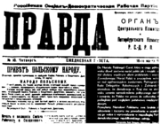
Pravda

Encyclopedia
Pravda was a leading newspaper
of the Soviet Union
and an official organ of the Central Committee
of the Communist Party
between 1912 and 1991.
The Pravda newspaper was started in 1912 in St. Petersburg. It was converted from a weekly Zvezda. It did not arrive in Moscow
until 1918. During the Cold War
, Pravda was well known in the West
for its pronouncements as the official voice of Soviet Communism. (Similarly Izvestia
was the official voice of the Soviet government.)
After the paper was closed down in 1991 by decree of then-President Boris Yeltsin
, many of the staff founded a new paper with the same name, which is now a tabloid
-style Russian news source. There is an unaffiliated Internet
-based newspaper, Pravda Online, run by former Pravda newspaper employees. A number of other newspapers have also been called Pravda, most notably Komsomolskaya Pravda
, formerly the official newspaper of the now defunct Komsomol
and currently the best-selling tabloid in Russia.
party. In October 1908 Leon Trotsky
was called in to edit the newspaper and pick it up from its insignificant and run down state. After several issues, the Spilka left the newspaper to Trotsky, who converted it into a Russian social democratic
newspaper aimed at Russian workers. The paper was published abroad to avoid censorship
and was smuggled into Russia. The first issue was published in Vienna
, Austria
on October 3, 1908. The editorial staff consisted of Trotsky and, at various times, Victor Kopp, Adolf Joffe
and Matvey Skobelev
. The last two had wealthy parents and supported the paper financially.
Since the Russian Social Democratic Labor Party was then split into multiple factions and since Trotsky was a self-described 'non-factional social democrat', the newspaper spent much of its time trying to unite party factions. The editors tried to avoid the factional issues that divided Russian émigrés and concentrated on the issues of interest to Russian workers. Coupled with a lively and easy to understand style, it made the paper very popular in Russia.
In January 1910 the party's Central Committee
had a rare plenary meeting with all party factions represented. A comprehensive agreement to re-unite the party was worked out and tentatively agreed upon. As part of the agreement, Trotsky's Pravda was made a party-financed central organ. Lev Kamenev
, a leading member of the Bolshevik
faction and Lenin's close associate, was made a member of the editorial board, but he withdrew in August 1910 once the reconciliation attempt failed. The newspaper published its last issue on April 15, 1912.
-based legal weekly, Zvezda, in December 1910. When the Bolsheviks formally broke away from the other factions at their conference in Prague
in January 1912, they also decided to convert Zvezda, which was by then published three times a week, into a daily.
The Bolsheviks finally realized their plan when the first issue of Pravda was published in Saint Petersburg on April 22, 1912. It continued publishing legally, although subject to government censorship
, until it was shut down in July 1914 by the government at the beginning of World War I
.
Due to police harassment, the newspaper had to change its name eight times in just two years
In what appeared to be a minor development at the time, in April 1913 Trotsky was so upset by what he saw as a usurpation of 'his' newspaper's name that he wrote a letter http://www.marxists.org/archive/trotsky/works/1930-lif/ch41.htm to Nikolay Chkheidze
bitterly denouncing Vladimir Lenin
and the Bolsheviks. Trotsky was able to suppress the contents of the letter in 1921 to avoid embarrassment, but once he started losing power in the early 1920s, the letter was made public by his opponents within the Communist Party in 1924 and used to paint him as Lenin's enemy.
After a period of relative social calm in 1908-1911, 1912-1914 was a time of rising social and political tensions in Russia following the Lena execution in April 1912. In contrast to Trotsky's Pravda, which had been published for the workers by a small group of intellectuals, the Bolshevik Pravda was published in Russia and was able to publish hundreds of letters by the workers. A combination of rising social tensions and workers' participation made it quite popular and its circulation fluctuated between 20,000 and 60,000, a respectable number for its time, especially considering its audience and government harassment. Another difference between the two Pravdas was the fact that Trotsky's version was financially supported by wealthy contributors while the Bolsheviks were experiencing financial difficulties at the time and had to rely on workers' contributions.
Although Lenin and the Bolsheviks edited many newspapers within and outside of Russia prior to their seizure of power in 1917, it was this 1912-1914 incarnation of Pravda, along with Iskra
which ran from 1900 to 1903, that was later regarded by the Communists as the true forerunner of their official, post-1917, Pravda. The significance of Trotsky's Pravda was downplayed and, after Trotsky's expulsion from the Communist Party, the original Pravda was all but ignored by Soviet historians until perestroika
.
Although Lenin was the leader of the Bolsheviks in 1912-1914, he lived in Europe (in Kraków
between mid-1912 and mid-1914) in exile and couldn't exercise direct control over Pravda. Vyacheslav Molotov
was the de facto editor who controlled the paper in 1912-1914 while other prominent Bolsheviks, including, briefly, Joseph Stalin
(until his arrest and exile in March 1913) served on the board as circumstances permitted. As it later turned out, one of the editors, Miron Chernomazov, was an undercover police agent.
In order to avoid disruption in case of arrest, the real Bolshevik editors were not officially responsible for the paper. Instead, Pravda employed about 40 nominal "editors", usually workers, who would be arrested and go to jail whenever the police closed the paper.
During this period, the editorial board of Pravda often tried to avoid government fines or outright ban by moderating its content. This stance led to repeated clashes between Lenin and the editors, the latter sometimes altering Lenin's articles or even refusing to publish Lenin's works. These clashes were used by Nikita Khrushchev
in late 1961 when he was trying to discredit Molotov.
In December 1912 - October 1913 Pravda was also a battleground in Lenin's struggle with the Bolshevik Duma
deputies, who were trying to mend fences with the Menshevik
deputies while Lenin insisted on a complete break with the Mensheviks. In January 1914, Kamenev was sent to Saint Petersburg to direct Pravda and the Bolshevik faction in the Duma.
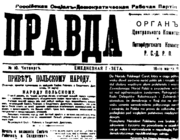 The overthrow of Tsar Nicholas II by the February Revolution
of 1917 allowed Pravda to reopen. The original editors of the newly reincarnated Pravda, Vyacheslav Molotov
and Alexander Shlyapnikov
, were opposed to the liberal Russian Provisional Government
. However, when Kamenev, Stalin and former Duma deputy Matvei Muranov
returned from Siberian exile on March 12, they ousted Molotov and Shlyapnikov and took over the editorial board.
Under Kamenev's and Stalin's influence, Pravda took a conciliatory tone towards the Provisional Government-"insofar as it struggles against reaction or counter-revolution"-and called for a unification conference with the internationalist wing of the Mensheviks. On March 14, Kamenev wrote in his first editorial:
and on March 15 he supported the war effort:
After Lenin's and Grigory Zinoviev
's return to Russia on April 3, Lenin strongly condemned the Provisional Government and unification tendencies in his April Theses
. Kamenev argued against Lenin's position in Pravda editorials, but Lenin prevailed at the April Party conference, at which point Pravda also condemned the Provisional Government as "counter-revolutionary". From then on, Pravda essentially followed Lenin's editorial stance. After the October Revolution of 1917 Pravda was selling nearly 100,000 copies daily.
on March 3, 1918 when the Soviet capital was moved there. Pravda became an official publication, or "organ", of the Soviet Communist Party
. Pravda became the conduit for announcing official policy and policy changes and would remain so until 1991. Subscription to Pravda was mandatory for state run companies, the armed services
and other organizations until 1989.
Other newspapers existed as organs of other state bodies. For example, Izvestia
, which covered foreign relations
, was the organ of the Supreme Soviet of the Soviet Union, Trud
was the organ of the trade union
movement, Bednota
was distributed to the Red Army
and rural peasants, etc. Various derivatives of the name Pravda were used both for a number of national newspapers (Komsomolskaya Pravda
was the organ of the Komsomol
organization, and Pionerskaya Pravda
was the organ of the Young Pioneers
), and for the regional Communist Party newspapers in many republics and provinces of the USSR, e.g. Kazakhstanskaya Pravda
in Kazakhstan
, Polyarnaya Pravda in Murmansk Oblast
, Pravda Severa
in Arkhangelsk Oblast
, or Moskovskaya Pravda
in the city of Moscow.
In the period after the death of Lenin in 1924, Pravda was to form a power base for Nikolai Bukharin
, one of the rival party leaders, who edited the newspaper, which helped him reinforce his reputation as a Marxist theoretician.
Similarly, after the death of Stalin in 1953 and the ensuing power vacuum, Communist Party leader Nikita Khrushchev
used his alliance with Dmitry Shepilov, Pravda' s editor-in-chief, to gain the upper hand in his struggle with Prime Minister Georgy Malenkov
.
A number of places and things in the Soviet Union were named after Pravda. Among them was the city of Pravdinsk
in Gorky Oblast
(the home of a paper mill
producing much newsprint
for Pravda and other national newspapers), and a number of streets and collective farms
.
As the names of the main Communist newspaper and the main Soviet newspaper, Pravda and Izvestia, meant "the truth" and "the news" respectively, a popular Russian saying was "v Pravde net izvestiy, v Izvestiyakh net pravdy" (In the Truth there is no news, and in the News there is no truth).
by Russian President Boris Yeltsin
shut down the Communist Party
and seized all of its property, including Pravda. Its team of journalist
s fought for their newspaper and freedom of speech. They registered a new paper with the same title just weeks after.
A few months later, then-editor Gennady Seleznyov (now a member of the Duma
) sold Pravda to a family
of Greek
entrepreneur
s, the Yannikoses. The next editor-in-chief, Aleksandr Ilyin, handed Pravda
— the Order of Lenin
medals — and the new registration certificate over to the new owners.
By that time, a serious split occurred in the editorial office. Over 90% of the journalists who had been working for Pravda until 1991 quit their jobs. They established their own version of the newspaper, which was later shut down under government pressure. These same journalists, led by former Pravda editors Vadim Gorshenin and Viktor Linnik in January 1999, launched Pravda Online, the first web-based
newspaper in the Russian language; English
, Italian
and Portuguese
versions are also available.
In 1996, two Greek investors launched Pravda Pyat
, a weekly tabloid aimed at younger readers. The new Pravda newspaper and Pravda Online are not related in any way. The paper Pravda tends to analyze events from a leftist point of view, while the web-based tabloid-style newspaper often takes a nationalist and sensationalist approach.
Meanwhile, in 2004, a new urban guide Pravda has been launched in Lithuania. It has no stylistic resemblance to the original communist Pravda, although its mission purports "to report the truth and nothing but the truth".
The newspaper of the Communist Party of the Russian Federation
is also called Gazeta "Pravda".
Newspaper
A newspaper is a scheduled publication containing news of current events, informative articles, diverse features and advertising. It usually is printed on relatively inexpensive, low-grade paper such as newsprint. By 2007, there were 6580 daily newspapers in the world selling 395 million copies a...
of the Soviet Union
Soviet Union
The Soviet Union , officially the Union of Soviet Socialist Republics , was a constitutionally socialist state that existed in Eurasia between 1922 and 1991....
and an official organ of the Central Committee
Central Committee of the Communist Party of the Soviet Union
The Central Committee of the Communist Party of the Soviet Union , abbreviated in Russian as ЦК, "Tse-ka", earlier was also called as the Central Committee of the All-Union Communist Party ...
of the Communist Party
Communist Party of the Soviet Union
The Communist Party of the Soviet Union was the only legal, ruling political party in the Soviet Union and one of the largest communist organizations in the world...
between 1912 and 1991.
The Pravda newspaper was started in 1912 in St. Petersburg. It was converted from a weekly Zvezda. It did not arrive in Moscow
Moscow
Moscow is the capital, the most populous city, and the most populous federal subject of Russia. The city is a major political, economic, cultural, scientific, religious, financial, educational, and transportation centre of Russia and the continent...
until 1918. During the Cold War
Cold War
The Cold War was the continuing state from roughly 1946 to 1991 of political conflict, military tension, proxy wars, and economic competition between the Communist World—primarily the Soviet Union and its satellite states and allies—and the powers of the Western world, primarily the United States...
, Pravda was well known in the West
Western world
The Western world, also known as the West and the Occident , is a term referring to the countries of Western Europe , the countries of the Americas, as well all countries of Northern and Central Europe, Australia and New Zealand...
for its pronouncements as the official voice of Soviet Communism. (Similarly Izvestia
Izvestia
Izvestia is a long-running high-circulation daily newspaper in Russia. The word "izvestiya" in Russian means "delivered messages", derived from the verb izveshchat . In the context of newspapers it is usually translated as "news" or "reports".-Origin:The newspaper began as the News of the...
was the official voice of the Soviet government.)
After the paper was closed down in 1991 by decree of then-President Boris Yeltsin
Boris Yeltsin
Boris Nikolayevich Yeltsin was the first President of the Russian Federation, serving from 1991 to 1999.Originally a supporter of Mikhail Gorbachev, Yeltsin emerged under the perestroika reforms as one of Gorbachev's most powerful political opponents. On 29 May 1990 he was elected the chairman of...
, many of the staff founded a new paper with the same name, which is now a tabloid
Tabloid journalism
Tabloid journalism tends to emphasize topics such as sensational crime stories, astrology, gossip columns about the personal lives of celebrities and sports stars, and junk food news...
-style Russian news source. There is an unaffiliated Internet
Internet
The Internet is a global system of interconnected computer networks that use the standard Internet protocol suite to serve billions of users worldwide...
-based newspaper, Pravda Online, run by former Pravda newspaper employees. A number of other newspapers have also been called Pravda, most notably Komsomolskaya Pravda
Komsomolskaya Pravda
Komsomolskaya Pravda is a daily Russian tabloid newspaper, founded on March 13th, 1925. It is published by "Izdatelsky Dom Komsomolskaya Pravda" .- History :...
, formerly the official newspaper of the now defunct Komsomol
Komsomol
The Communist Union of Youth , usually known as Komsomol , was the youth division of the Communist Party of the Soviet Union. The Komsomol in its earliest form was established in urban centers in 1918. During the early years, it was a Russian organization, known as the Russian Communist Union of...
and currently the best-selling tabloid in Russia.
The Vienna Pravda
The original Pravda was founded in 1905 by the Ukrainian SpilkaSpilka
The Spilka arose late in 1904 having broken away from the Revolutionary Ukrainian Party. It entered the Russian Social Democratic Labour Party as an autonomous regional organisation. In the inner-Party struggle of the R.S.D.L.P. it sided with the Mensheviks. It broke up in the period of reaction...
party. In October 1908 Leon Trotsky
Leon Trotsky
Leon Trotsky , born Lev Davidovich Bronshtein, was a Russian Marxist revolutionary and theorist, Soviet politician, and the founder and first leader of the Red Army....
was called in to edit the newspaper and pick it up from its insignificant and run down state. After several issues, the Spilka left the newspaper to Trotsky, who converted it into a Russian social democratic
Social democracy
Social democracy is a political ideology of the center-left on the political spectrum. Social democracy is officially a form of evolutionary reformist socialism. It supports class collaboration as the course to achieve socialism...
newspaper aimed at Russian workers. The paper was published abroad to avoid censorship
Censorship
thumb|[[Book burning]] following the [[1973 Chilean coup d'état|1973 coup]] that installed the [[Military government of Chile |Pinochet regime]] in Chile...
and was smuggled into Russia. The first issue was published in Vienna
Vienna
Vienna is the capital and largest city of the Republic of Austria and one of the nine states of Austria. Vienna is Austria's primary city, with a population of about 1.723 million , and is by far the largest city in Austria, as well as its cultural, economic, and political centre...
, Austria
Austria
Austria , officially the Republic of Austria , is a landlocked country of roughly 8.4 million people in Central Europe. It is bordered by the Czech Republic and Germany to the north, Slovakia and Hungary to the east, Slovenia and Italy to the south, and Switzerland and Liechtenstein to the...
on October 3, 1908. The editorial staff consisted of Trotsky and, at various times, Victor Kopp, Adolf Joffe
Adolph Joffe
Adolph Abramovich Joffe was a Communist revolutionary, a Bolshevik politician and a Soviet diplomat of Karaim descent.-Revolutionary career:...
and Matvey Skobelev
Matvey Skobelev
-Trotsky's Disciple in Vienna :Skobelev was born in the family of a wealthy Baku oilman . He joined the Russian Social Democratic Labor Party in 1903. After the Russian Revolution of 1905 he went abroad to study at a polytechnic in Vienna...
. The last two had wealthy parents and supported the paper financially.
Since the Russian Social Democratic Labor Party was then split into multiple factions and since Trotsky was a self-described 'non-factional social democrat', the newspaper spent much of its time trying to unite party factions. The editors tried to avoid the factional issues that divided Russian émigrés and concentrated on the issues of interest to Russian workers. Coupled with a lively and easy to understand style, it made the paper very popular in Russia.
In January 1910 the party's Central Committee
Central Committee
Central Committee was the common designation of a standing administrative body of communist parties, analogous to a board of directors, whether ruling or non-ruling in the twentieth century and of the surviving, mostly Trotskyist, states in the early twenty first. In such party organizations the...
had a rare plenary meeting with all party factions represented. A comprehensive agreement to re-unite the party was worked out and tentatively agreed upon. As part of the agreement, Trotsky's Pravda was made a party-financed central organ. Lev Kamenev
Lev Kamenev
Lev Borisovich Kamenev , born Rozenfeld , was a Bolshevik revolutionary and a prominent Soviet politician. He was briefly head of state of the new republic in 1917, and from 1923-24 the acting Premier in the last year of Lenin's life....
, a leading member of the Bolshevik
Bolshevik
The Bolsheviks, originally also Bolshevists , derived from bol'shinstvo, "majority") were a faction of the Marxist Russian Social Democratic Labour Party which split apart from the Menshevik faction at the Second Party Congress in 1903....
faction and Lenin's close associate, was made a member of the editorial board, but he withdrew in August 1910 once the reconciliation attempt failed. The newspaper published its last issue on April 15, 1912.
Before the 1917 Revolution
After the breakdown of the January 1910 compromise, the Bolshevik faction of the RSDLP started publishing a Saint PetersburgSaint Petersburg
Saint Petersburg is a city and a federal subject of Russia located on the Neva River at the head of the Gulf of Finland on the Baltic Sea...
-based legal weekly, Zvezda, in December 1910. When the Bolsheviks formally broke away from the other factions at their conference in Prague
Prague
Prague is the capital and largest city of the Czech Republic. Situated in the north-west of the country on the Vltava river, the city is home to about 1.3 million people, while its metropolitan area is estimated to have a population of over 2.3 million...
in January 1912, they also decided to convert Zvezda, which was by then published three times a week, into a daily.
The Bolsheviks finally realized their plan when the first issue of Pravda was published in Saint Petersburg on April 22, 1912. It continued publishing legally, although subject to government censorship
Censorship
thumb|[[Book burning]] following the [[1973 Chilean coup d'état|1973 coup]] that installed the [[Military government of Chile |Pinochet regime]] in Chile...
, until it was shut down in July 1914 by the government at the beginning of World War I
World War I
World War I , which was predominantly called the World War or the Great War from its occurrence until 1939, and the First World War or World War I thereafter, was a major war centred in Europe that began on 28 July 1914 and lasted until 11 November 1918...
.
Due to police harassment, the newspaper had to change its name eight times in just two years
-
- Рабочая правда (Rabochaya Pravda, Worker’s Truth)
- Северная правда (Severnaya Pravda Northern Truth)
- Правда Труда (Pravda Truda, Labor’s Truth)
- За правду (Za Pravdu, For Truth)
- Пролетарская правда (Proletarskaya Pravda, Proletarian Truth)
- Путь правды (Put' Pravdy, The Way of Truth)
- Рабочий (Rabochy, The Worker)
- Трудовая правда (Trudovaya Pravda, Labor’s Truth)
In what appeared to be a minor development at the time, in April 1913 Trotsky was so upset by what he saw as a usurpation of 'his' newspaper's name that he wrote a letter http://www.marxists.org/archive/trotsky/works/1930-lif/ch41.htm to Nikolay Chkheidze
Nikolay Chkheidze
Nikoloz Chkheidze was a Georgian Menshevik politician who helped to introduce Marxism to Georgia in the 1890s and played a prominent role in the Russian and Georgian revolutions of 1917 and 1918....
bitterly denouncing Vladimir Lenin
Vladimir Lenin
Vladimir Ilyich Lenin was a Russian Marxist revolutionary and communist politician who led the October Revolution of 1917. As leader of the Bolsheviks, he headed the Soviet state during its initial years , as it fought to establish control of Russia in the Russian Civil War and worked to create a...
and the Bolsheviks. Trotsky was able to suppress the contents of the letter in 1921 to avoid embarrassment, but once he started losing power in the early 1920s, the letter was made public by his opponents within the Communist Party in 1924 and used to paint him as Lenin's enemy.
After a period of relative social calm in 1908-1911, 1912-1914 was a time of rising social and political tensions in Russia following the Lena execution in April 1912. In contrast to Trotsky's Pravda, which had been published for the workers by a small group of intellectuals, the Bolshevik Pravda was published in Russia and was able to publish hundreds of letters by the workers. A combination of rising social tensions and workers' participation made it quite popular and its circulation fluctuated between 20,000 and 60,000, a respectable number for its time, especially considering its audience and government harassment. Another difference between the two Pravdas was the fact that Trotsky's version was financially supported by wealthy contributors while the Bolsheviks were experiencing financial difficulties at the time and had to rely on workers' contributions.
Although Lenin and the Bolsheviks edited many newspapers within and outside of Russia prior to their seizure of power in 1917, it was this 1912-1914 incarnation of Pravda, along with Iskra
Iskra
Iskra was a political newspaper of Russian socialist emigrants established as the official organ of the Russian Social Democratic Labour Party. Initially, it was managed by Vladimir Lenin, moving as he moved. The first edition was published in Stuttgart on December 1, 1900. Other editions were...
which ran from 1900 to 1903, that was later regarded by the Communists as the true forerunner of their official, post-1917, Pravda. The significance of Trotsky's Pravda was downplayed and, after Trotsky's expulsion from the Communist Party, the original Pravda was all but ignored by Soviet historians until perestroika
Perestroika
Perestroika was a political movement within the Communist Party of the Soviet Union during 1980s, widely associated with the Soviet leader Mikhail Gorbachev...
.
Although Lenin was the leader of the Bolsheviks in 1912-1914, he lived in Europe (in Kraków
Kraków
Kraków also Krakow, or Cracow , is the second largest and one of the oldest cities in Poland. Situated on the Vistula River in the Lesser Poland region, the city dates back to the 7th century. Kraków has traditionally been one of the leading centres of Polish academic, cultural, and artistic life...
between mid-1912 and mid-1914) in exile and couldn't exercise direct control over Pravda. Vyacheslav Molotov
Vyacheslav Molotov
Vyacheslav Mikhailovich Molotov was a Soviet politician and diplomat, an Old Bolshevik and a leading figure in the Soviet government from the 1920s, when he rose to power as a protégé of Joseph Stalin, to 1957, when he was dismissed from the Presidium of the Central Committee by Nikita Khrushchev...
was the de facto editor who controlled the paper in 1912-1914 while other prominent Bolsheviks, including, briefly, Joseph Stalin
Joseph Stalin
Joseph Vissarionovich Stalin was the Premier of the Soviet Union from 6 May 1941 to 5 March 1953. He was among the Bolshevik revolutionaries who brought about the October Revolution and had held the position of first General Secretary of the Communist Party of the Soviet Union's Central Committee...
(until his arrest and exile in March 1913) served on the board as circumstances permitted. As it later turned out, one of the editors, Miron Chernomazov, was an undercover police agent.
In order to avoid disruption in case of arrest, the real Bolshevik editors were not officially responsible for the paper. Instead, Pravda employed about 40 nominal "editors", usually workers, who would be arrested and go to jail whenever the police closed the paper.
During this period, the editorial board of Pravda often tried to avoid government fines or outright ban by moderating its content. This stance led to repeated clashes between Lenin and the editors, the latter sometimes altering Lenin's articles or even refusing to publish Lenin's works. These clashes were used by Nikita Khrushchev
Nikita Khrushchev
Nikita Sergeyevich Khrushchev led the Soviet Union during part of the Cold War. He served as First Secretary of the Communist Party of the Soviet Union from 1953 to 1964, and as Chairman of the Council of Ministers, or Premier, from 1958 to 1964...
in late 1961 when he was trying to discredit Molotov.
In December 1912 - October 1913 Pravda was also a battleground in Lenin's struggle with the Bolshevik Duma
Duma
A Duma is any of various representative assemblies in modern Russia and Russian history. The State Duma in the Russian Empire and Russian Federation corresponds to the lower house of the parliament. Simply it is a form of Russian governmental institution, that was formed during the reign of the...
deputies, who were trying to mend fences with the Menshevik
Menshevik
The Mensheviks were a faction of the Russian revolutionary movement that emerged in 1904 after a dispute between Vladimir Lenin and Julius Martov, both members of the Russian Social-Democratic Labour Party. The dispute originated at the Second Congress of that party, ostensibly over minor issues...
deputies while Lenin insisted on a complete break with the Mensheviks. In January 1914, Kamenev was sent to Saint Petersburg to direct Pravda and the Bolshevik faction in the Duma.
During the 1917 Revolution
February Revolution
The February Revolution of 1917 was the first of two revolutions in Russia in 1917. Centered around the then capital Petrograd in March . Its immediate result was the abdication of Tsar Nicholas II, the end of the Romanov dynasty, and the end of the Russian Empire...
of 1917 allowed Pravda to reopen. The original editors of the newly reincarnated Pravda, Vyacheslav Molotov
Vyacheslav Molotov
Vyacheslav Mikhailovich Molotov was a Soviet politician and diplomat, an Old Bolshevik and a leading figure in the Soviet government from the 1920s, when he rose to power as a protégé of Joseph Stalin, to 1957, when he was dismissed from the Presidium of the Central Committee by Nikita Khrushchev...
and Alexander Shlyapnikov
Alexander Shlyapnikov
Alexander Gavrilovich Shliapnikov was a Russian communist revolutionary, metalworker, and trade union leader. He is best remembered as a memoirist of the October Revolution of 1917 and as the leader of one of the primary opposition movements inside the Russian Communist Party during the decade of...
, were opposed to the liberal Russian Provisional Government
Russian Provisional Government
The Russian Provisional Government was the short-lived administrative body which sought to govern Russia immediately following the abdication of Tsar Nicholas II . On September 14, the State Duma of the Russian Empire was officially dissolved by the newly created Directorate, and the country was...
. However, when Kamenev, Stalin and former Duma deputy Matvei Muranov
Matvei Muranov
Matvei Konstantinovich Muranov was a Ukrainian-born Bolshevik revolutionary and a Soviet politician.-Revolutionary beginnings:Born in a peasant family in Rybtsy near Poltava, Muranov moved to Kharkov in 1900 and worked as a railroad worker...
returned from Siberian exile on March 12, they ousted Molotov and Shlyapnikov and took over the editorial board.
Under Kamenev's and Stalin's influence, Pravda took a conciliatory tone towards the Provisional Government-"insofar as it struggles against reaction or counter-revolution"-and called for a unification conference with the internationalist wing of the Mensheviks. On March 14, Kamenev wrote in his first editorial:
- What purpose would it serve to speed things up, when things were already taking place at such a rapid pace?
and on March 15 he supported the war effort:
- When army faces army, it would be the most insane policy to suggest to one of those armies to lay down its arms and go home. This would not be a policy of peace, but a policy of slavery, which would be rejected with disgust by a free people.
After Lenin's and Grigory Zinoviev
Grigory Zinoviev
Grigory Yevseevich Zinoviev , born Ovsei-Gershon Aronovich Radomyslsky Apfelbaum , was a Bolshevik revolutionary and a Soviet Communist politician...
's return to Russia on April 3, Lenin strongly condemned the Provisional Government and unification tendencies in his April Theses
Lenin's April Theses
The April Theses were a series of directives issued by the Bolshevik leader Vladimir Lenin upon his return to Petrograd , Russia from his exile in Switzerland. The Theses were mostly aimed at fellow Bolsheviks in Russia and returning to Russia from exile...
. Kamenev argued against Lenin's position in Pravda editorials, but Lenin prevailed at the April Party conference, at which point Pravda also condemned the Provisional Government as "counter-revolutionary". From then on, Pravda essentially followed Lenin's editorial stance. After the October Revolution of 1917 Pravda was selling nearly 100,000 copies daily.
The Soviet period
The offices of the newspaper were transferred to MoscowMoscow
Moscow is the capital, the most populous city, and the most populous federal subject of Russia. The city is a major political, economic, cultural, scientific, religious, financial, educational, and transportation centre of Russia and the continent...
on March 3, 1918 when the Soviet capital was moved there. Pravda became an official publication, or "organ", of the Soviet Communist Party
Communist Party of the Soviet Union
The Communist Party of the Soviet Union was the only legal, ruling political party in the Soviet Union and one of the largest communist organizations in the world...
. Pravda became the conduit for announcing official policy and policy changes and would remain so until 1991. Subscription to Pravda was mandatory for state run companies, the armed services
Soviet Army
The Soviet Army is the name given to the main part of the Armed Forces of the Soviet Union between 1946 and 1992. Previously, it had been known as the Red Army. Informally, Армия referred to all the MOD armed forces, except, in some cases, the Soviet Navy.This article covers the Soviet Ground...
and other organizations until 1989.
Other newspapers existed as organs of other state bodies. For example, Izvestia
Izvestia
Izvestia is a long-running high-circulation daily newspaper in Russia. The word "izvestiya" in Russian means "delivered messages", derived from the verb izveshchat . In the context of newspapers it is usually translated as "news" or "reports".-Origin:The newspaper began as the News of the...
, which covered foreign relations
Diplomacy
Diplomacy is the art and practice of conducting negotiations between representatives of groups or states...
, was the organ of the Supreme Soviet of the Soviet Union, Trud
Trud (Russian newspaper)
Trud is one of Russia’s largest-circulation daily newspapers. It also publishes a weekend edition under a name "Trud-7". Since 2005, acquired by Promsvyazcapital Group and in 2008 has become a core asset of MEDIA3 holding, alongside with Argumenty i Fakty weekly...
was the organ of the trade union
Trade union
A trade union, trades union or labor union is an organization of workers that have banded together to achieve common goals such as better working conditions. The trade union, through its leadership, bargains with the employer on behalf of union members and negotiates labour contracts with...
movement, Bednota
Bednota
Bednota was a daily newspaper for peasants, issued by Central Committee of the Communist Party in Moscow, Russia, from March 1918 till January 1931. Its predecessors were newspapers "Derevenskaya Bednota" , "Soldatskaya Pravda" , "Derevenskaya Pravda"...
was distributed to the Red Army
Red Army
The Workers' and Peasants' Red Army started out as the Soviet Union's revolutionary communist combat groups during the Russian Civil War of 1918-1922. It grew into the national army of the Soviet Union. By the 1930s the Red Army was among the largest armies in history.The "Red Army" name refers to...
and rural peasants, etc. Various derivatives of the name Pravda were used both for a number of national newspapers (Komsomolskaya Pravda
Komsomolskaya Pravda
Komsomolskaya Pravda is a daily Russian tabloid newspaper, founded on March 13th, 1925. It is published by "Izdatelsky Dom Komsomolskaya Pravda" .- History :...
was the organ of the Komsomol
Komsomol
The Communist Union of Youth , usually known as Komsomol , was the youth division of the Communist Party of the Soviet Union. The Komsomol in its earliest form was established in urban centers in 1918. During the early years, it was a Russian organization, known as the Russian Communist Union of...
organization, and Pionerskaya Pravda
Pionerskaya Pravda
Pionerskaya Pravda is an all-Russian newspaper. Initially it was an all-Union newspaper of the Soviet Union. Its name may be translated as "Truth for Young Pioneers"....
was the organ of the Young Pioneers
Young Pioneer organization of the Soviet Union
The Young Pioneer Organization of the Soviet Union, also Vladimir Lenin All-Union Pioneer Organization The Young Pioneer Organization of the Soviet Union, also Vladimir Lenin All-Union Pioneer Organization The Young Pioneer Organization of the Soviet Union, also Vladimir Lenin All-Union Pioneer...
), and for the regional Communist Party newspapers in many republics and provinces of the USSR, e.g. Kazakhstanskaya Pravda
Kazakhstanskaya Pravda
Kazakhstanskaya Pravda is a newspaper from Kazakhstan. It is published in the Russian language.- External links :***...
in Kazakhstan
Kazakhstan
Kazakhstan , officially the Republic of Kazakhstan, is a transcontinental country in Central Asia and Eastern Europe. Ranked as the ninth largest country in the world, it is also the world's largest landlocked country; its territory of is greater than Western Europe...
, Polyarnaya Pravda in Murmansk Oblast
Murmansk Oblast
Murmansk Oblast is a federal subject of Russia , located in the northwestern part of Russia. Its administrative center is the city of Murmansk.-Geography:...
, Pravda Severa
Pravda Severa
Pravda Severa is a Russian Arkhangelsk-based newspaper, published since 1917. It is issued three times a week on Tuesday, Wednesday and Saturday in the A3 format. The Wednesday circulation is 20,050 copies, with 7,000—8,000 copies on Tuesday and Saturday....
in Arkhangelsk Oblast
Arkhangelsk Oblast
Arkhangelsk Oblast is a federal subject of Russia . It includes the Arctic archipelagos of Franz Josef Land and Novaya Zemlya, as well as the Solovetsky Islands in the White Sea....
, or Moskovskaya Pravda
Moskovskaya Pravda
Moskovskaya pravda , is a leading daily morning newspaper of Russia, and formerly of the Soviet Union. It was first published in 1918....
in the city of Moscow.
In the period after the death of Lenin in 1924, Pravda was to form a power base for Nikolai Bukharin
Nikolai Bukharin
Nikolai Ivanovich Bukharin , was a Russian Marxist, Bolshevik revolutionary, and Soviet politician. He was a member of the Politburo and Central Committee , chairman of the Communist International , and the editor in chief of Pravda , the journal Bolshevik , Izvestia , and the Great Soviet...
, one of the rival party leaders, who edited the newspaper, which helped him reinforce his reputation as a Marxist theoretician.
Similarly, after the death of Stalin in 1953 and the ensuing power vacuum, Communist Party leader Nikita Khrushchev
Nikita Khrushchev
Nikita Sergeyevich Khrushchev led the Soviet Union during part of the Cold War. He served as First Secretary of the Communist Party of the Soviet Union from 1953 to 1964, and as Chairman of the Council of Ministers, or Premier, from 1958 to 1964...
used his alliance with Dmitry Shepilov, Pravda
Georgy Malenkov
Georgy Maximilianovich Malenkov was a Soviet politician, Communist Party leader and close collaborator of Joseph Stalin. After Stalin's death, he became Premier of the Soviet Union and was in 1953 briefly considered the most powerful Soviet politician before being overshadowed by Nikita...
.
A number of places and things in the Soviet Union were named after Pravda. Among them was the city of Pravdinsk
Pravdinsk, Balakhna
Pravdinsk was an urban-type settlement in Balakhninsky District of Nizhny Novgorod Oblast, located a few kilometers northwest from the town of Balakhna. Pravdinsk was annexed by the town of Balakhna in 1993, although the name continues in informal usage...
in Gorky Oblast
Nizhny Novgorod Oblast
Nizhny Novgorod Oblast is a federal subject of Russia . Its administrative center is the city of Nizhny Novgorod. Population: The oblast is crossed by the Volga River. Apart from Nizhny Novgorod's metropolitan area, the biggest city is Arzamas...
(the home of a paper mill
Paper mill
A paper mill is a factory devoted to making paper from vegetable fibres such as wood pulp, old rags and other ingredients using a Fourdrinier machine or other type of paper machine.- History :...
producing much newsprint
Newsprint
Newsprint is a low-cost, non-archival paper most commonly used to print newspapers, and other publications and advertising material. It usually has an off-white cast and distinctive feel. It is designed for use in printing presses that employ a long web of paper rather than individual sheets of...
for Pravda and other national newspapers), and a number of streets and collective farms
Kolkhoz
A kolkhoz , plural kolkhozy, was a form of collective farming in the Soviet Union that existed along with state farms . The word is a contraction of коллекти́вное хозя́йство, or "collective farm", while sovkhoz is a contraction of советское хозяйство...
.
As the names of the main Communist newspaper and the main Soviet newspaper, Pravda and Izvestia, meant "the truth" and "the news" respectively, a popular Russian saying was "v Pravde net izvestiy, v Izvestiyakh net pravdy" (In the Truth there is no news, and in the News there is no truth).
The post-Soviet period
On August 22, 1991, a decreeDecree
A decree is a rule of law issued by a head of state , according to certain procedures . It has the force of law...
by Russian President Boris Yeltsin
Boris Yeltsin
Boris Nikolayevich Yeltsin was the first President of the Russian Federation, serving from 1991 to 1999.Originally a supporter of Mikhail Gorbachev, Yeltsin emerged under the perestroika reforms as one of Gorbachev's most powerful political opponents. On 29 May 1990 he was elected the chairman of...
shut down the Communist Party
Communist Party of the Soviet Union
The Communist Party of the Soviet Union was the only legal, ruling political party in the Soviet Union and one of the largest communist organizations in the world...
and seized all of its property, including Pravda. Its team of journalist
Journalist
A journalist collects and distributes news and other information. A journalist's work is referred to as journalism.A reporter is a type of journalist who researchs, writes, and reports on information to be presented in mass media, including print media , electronic media , and digital media A...
s fought for their newspaper and freedom of speech. They registered a new paper with the same title just weeks after.
A few months later, then-editor Gennady Seleznyov (now a member of the Duma
Duma
A Duma is any of various representative assemblies in modern Russia and Russian history. The State Duma in the Russian Empire and Russian Federation corresponds to the lower house of the parliament. Simply it is a form of Russian governmental institution, that was formed during the reign of the...
) sold Pravda to a family
Family
In human context, a family is a group of people affiliated by consanguinity, affinity, or co-residence. In most societies it is the principal institution for the socialization of children...
of Greek
Greece
Greece , officially the Hellenic Republic , and historically Hellas or the Republic of Greece in English, is a country in southeastern Europe....
entrepreneur
Entrepreneur
An entrepreneur is an owner or manager of a business enterprise who makes money through risk and initiative.The term was originally a loanword from French and was first defined by the Irish-French economist Richard Cantillon. Entrepreneur in English is a term applied to a person who is willing to...
s, the Yannikoses. The next editor-in-chief, Aleksandr Ilyin, handed Pravda
Trademark
A trademark, trade mark, or trade-mark is a distinctive sign or indicator used by an individual, business organization, or other legal entity to identify that the products or services to consumers with which the trademark appears originate from a unique source, and to distinguish its products or...
— the Order of Lenin
Order of Lenin
The Order of Lenin , named after the leader of the Russian October Revolution, was the highest decoration bestowed by the Soviet Union...
medals — and the new registration certificate over to the new owners.
By that time, a serious split occurred in the editorial office. Over 90% of the journalists who had been working for Pravda until 1991 quit their jobs. They established their own version of the newspaper, which was later shut down under government pressure. These same journalists, led by former Pravda editors Vadim Gorshenin and Viktor Linnik in January 1999, launched Pravda Online, the first web-based
World Wide Web
The World Wide Web is a system of interlinked hypertext documents accessed via the Internet...
newspaper in the Russian language; English
English language
English is a West Germanic language that arose in the Anglo-Saxon kingdoms of England and spread into what was to become south-east Scotland under the influence of the Anglian medieval kingdom of Northumbria...
, Italian
Italian language
Italian is a Romance language spoken mainly in Europe: Italy, Switzerland, San Marino, Vatican City, by minorities in Malta, Monaco, Croatia, Slovenia, France, Libya, Eritrea, and Somalia, and by immigrant communities in the Americas and Australia...
and Portuguese
Portuguese language
Portuguese is a Romance language that arose in the medieval Kingdom of Galicia, nowadays Galicia and Northern Portugal. The southern part of the Kingdom of Galicia became independent as the County of Portugal in 1095...
versions are also available.
In 1996, two Greek investors launched Pravda Pyat
Pravda Pyat
Pravda Pyat is a weekly Russian tabloid news publication that was a spin-off from Pravda. It was founded by Greek entrepreneurs Christos Giannikos and Fyodoros Giannikos in 1996. The magazine replaced Pravda when that publication ceased operations...
, a weekly tabloid aimed at younger readers. The new Pravda newspaper and Pravda Online are not related in any way. The paper Pravda tends to analyze events from a leftist point of view, while the web-based tabloid-style newspaper often takes a nationalist and sensationalist approach.
Meanwhile, in 2004, a new urban guide Pravda has been launched in Lithuania. It has no stylistic resemblance to the original communist Pravda, although its mission purports "to report the truth and nothing but the truth".
The newspaper of the Communist Party of the Russian Federation
Communist Party of the Russian Federation
The Communist Party of the Russian Federation is a Russian political party. It is the second major political party in the Russian Federation.-History:...
is also called Gazeta "Pravda".
See also
- Central newspapers of the Soviet UnionCentral newspapers of the Soviet UnionThe following publications were known as central newspapers in the Soviet Union. They were organs of the major organizations of the Soviet Union.*Pravda , the organ of the Central Committee of the Communist Party of the Soviet Union....
- Doctors' plotDoctors' plotThe Doctors' plot was the most dramatic anti-Jewish episode in the Soviet Union during Joseph Stalin's regime, involving the "unmasking" of a group of prominent Moscow doctors, predominantly Jews, as conspiratorial assassins of Soviet leaders...
- Eastern Bloc information disseminationEastern Bloc information disseminationEastern Bloc information dissemination was controlled directly by each country's Communist party, which controlled the state media, censorship and propaganda organs...
- People's CorrespondentPeople's correspondentPeople's Correspondents, are a kind of amateur proletarian journalists who have filed reports from the frontlines about the march toward communism since the early years of the Soviet Union. Originally initiated by Vladimir Lenin as a tool for exposing mismanagement and corruption, several million...
- Samantha SmithSamantha SmithSamantha Reed Smith was an American schoolgirl and child actress from Manchester, Maine, who became famous in the Cold War-era United States and Soviet Union...
Further reading
- Cookson, Matthew (October 11, 2003). The spark that lit a revolution. Socialist Worker, p. 7.