

White movement

Encyclopedia
The White movement and its military arm the White Army (Бѣлая Армiя/Белая Армия, Belaya Armiya) - known as the White Guard (Бѣлая Гвардiя/Белая Гвардия, Belaya Gvardiya) or the Whites (Белые and белогвардейцы “White Guardsmen”) - was a loose confederation of Anti-Communist
forces.
The movement comprised one of the politico-military Russian forces who fought the "Red" Bolsheviks in the former Russian Empire
after the October Revolution
, and then against the Red Army
in the subsequent Russian Civil War
(1917–23).
. They advertised themselves as bringing “law and order” and the “salvation of Russia,” fighting against traitors, barbarians, and murderers. They often acted in response to previous Red aggression and worked to remove Soviet organizations and functionaries in White-controlled territory.
Overall, the White Army was nationalistic and patriotic and thus, rejected ethnic particularism and separatism. The White Army generally believed in a united multinational Russia, and opposed separatists wanting to create nation-states instead of the Tsarist Russian Empire. Amongst White Army members, anti-Semitism was widespread which embarrassed its Western sponsors, given the Bolsheviks' outlawing of anti-Semitism in Russia. Winston Churchill personally warned General Denikin, whose forces effected pogroms, that “my task in winning support in Parliament for the Russian Nationalist cause will be infinitely harder if well-authenticated complaints continue to be received from Jews in the zone of the Volunteer Armies”.
Another overarching characteristic of the White movement was the conservatism of many leaders. Autocracy was accepted while “politics” (what they saw as speeches, elections, party activities) was suspect.
The White Armies had no main leader, sets of texts, or doctrine. They did, though, acknowledge a single provisional head of state
, the so called Supreme Governor of Russia
, but this post was only prominent while Alexander Kolchak was filling it. So, aside from being anti-Bolshevik and patriotic, the Whites had no set ideology. The movement had no set plan for foreign policy; Whites differed on policies toward Germany
, debating whether or not to ally with it. The Whites wanted to keep from alienating any potential supporters and allies, and thus saw an exclusively monarchist position as a detriment to their cause and recruitment. White movement leaders such as Anton Denikin advocated for Russians to create their own government, claiming the military could not decide in Russians’ steads. Admiral Alexander Kolchak actually succeeded in creating a temporary wartime government in Omsk
, acknowledged by most other White leaders, only for it to fall with the loss of his armies. Some warlord
s aligned with the White movement, such as Grigory Semyonov
and Roman Ungern von Sternberg
, did not acknowledge any authority but their own. Consequently, the White movement had no set political leanings: members could be monarchists, republicans, rightists, Kadets, etc. Among White Army leaders, neither General Lavr Kornilov nor General Anton Denikin were monarchists, yet General Pyotr Nikolayevich Wrangel was a monarchist willing to soldier for an elected, democratic Russian government. Moreover, other political parties supported the anti-Bolshevik White Army, among them the democrats, the Socialist-Revolutionary Party, and others opposing Vladimir Ilyich Lenin’s Bolshevik October Revolution; yet, depending on the time and place, those White Army supporters also exchanged right-wing allegiance for allegiance with the Red Army.
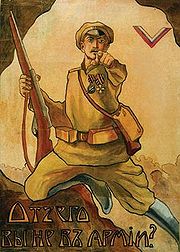
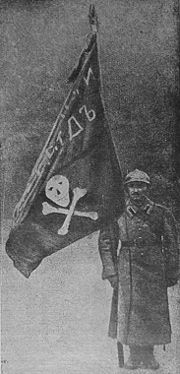 Various and un-unified White forces existed, the most important and largest of which was the Volunteer Army
in South Russia. Starting off as a small and well-organized military in 1917, the Volunteer Army soon grew. In 1918, the Kuban Cossacks joined the White Army and conscription of both peasants and Cossacks began. In late February 1918, 4,000 soldiers under the command of General Aleksei Kaledin were forced to retreat from Rostov-on-Don
due to the onset of the Red Army and left for Kuban
in order to unite with the Kuban Cossacks
- most of which did not support the Volunteer Army - a maneuver known as the Ice March
. In March, 3,000 men under the command of General Viktor Pokrovsky
joined the Volunteer Army, increasing its membership to 6,000, and by June to 9,000. In 1919, the Don Cossacks joined and the Army began drafting Ukrainian peasants. In that year, between May and October, the Volunteer Army grew from 64,000 to 150,000 soldiers and was better supplied than its Red counterpart. The White Army’s rank-and-file comprised active anti-Bolsheviks, such as Cossacks, nobles, and peasants, as conscripts and volunteers.
The White movement’s leaders – and first members – were mainly military officers, though many came from outside of the nobility, such as generals Mikhail Alekseev
and Anton Denikin, who came from serf families; or Lavr Kornilov
, who was a Cossack. The White generals never mastered administration; they often utilized “prerevolutionary functionaries” or “military officers with monarchististic inclinations” for administering White-controlled regions
The White Armies were often lawless and disordered. Also, White-controlled territories had multiple different and varying currencies with unstable exchange rates; and the main currency, the Volunteer Army’s ruble, had no gold backing.
until 1923. The White Army—aided by the Allied forces (Triple Entente
) from countries such as Japan
, the United Kingdom
, France
, Italy
and the United States
and (sometimes) the Central Powers forces such as Germany
and Austria-Hungary
fought in Siberia
, Ukraine
, and the Crimea
, but were defeated by the Red Army because of military and ideological disunity as well as the determination and increasing unity of the Red Army.
The main White Army war theatres were:
The same month, the Second Kuban Campaign was launched with support from Pyotr Krasnov
. By September, the Volunteer Army was composed of 30,000-35,000 members, thanks to mobilization of the Kuban Cossacks gathered in the North Caucasus
. Thus, the Volunteer Army took the name of the Caucasus Volunteer Army.
On January 23, 1919 the Volunteer Army took the name and Denikin oversaw the defeat of the 11th Soviet Army and capture of the North Caucasus region. After capturing Donbass, Tsaritsyn and Kharkov in June, Denikin's forces surrounded Moscow
on July 3 (N.S.). The plan was for 40,000 fighters, under the command of General Vladimir May-Mayevsky
to storm the city.
, Berlin
, Paris
, Harbin
, Istanbul
, and Shanghai
, and established military and cultural networks that lasted through the Second World War
(1939–45), e.g., the Russian community in Harbin
and the Russian community in Shanghai
); afterwards, the White Russian’s anti-Communist
activities established a home base in the United States. Moreover, in the 1920s and the 1930s, the White Movement established organisations, outside of Russia, meant to depose
the Soviet Government with guerrilla warfare
, e.g., the Russian All-Military Union
, the Brotherhood of Russian Truth
, and the National Alliance of Russian Solidarists
. Russian cadet corps were established to prepare the next generation of anti-Communists for the “spring campaign” — a hopeful term denoting a renewed military campaign to reconquer Russia from the Soviet Government. In the event, many cadets volunteered to fight for the Russian Corps
during the Second World War, the White Russian participation in the Russian Liberation Movement
.
White Russians served under the Soviet Red Army
during the Soviet Invasion of Xinjiang
and the Xinjiang War (1937)
. Many graves at a memorial to war dead in Xinjiang
, China
have tombs with Russian Orthodox crosses. These White Russians were killed by the Chinese Muslim 36th Division (National Revolutionary Army)
under General Ma Hushan
.
Anti-communism
Anti-communism is opposition to communism. Organized anti-communism developed in reaction to the rise of communism, especially after the 1917 October Revolution in Russia and the beginning of the Cold War in 1947.-Objections to communist theory:...
forces.
The movement comprised one of the politico-military Russian forces who fought the "Red" Bolsheviks in the former Russian Empire
Russian Empire
The Russian Empire was a state that existed from 1721 until the Russian Revolution of 1917. It was the successor to the Tsardom of Russia and the predecessor of the Soviet Union...
after the October Revolution
October Revolution
The October Revolution , also known as the Great October Socialist Revolution , Red October, the October Uprising or the Bolshevik Revolution, was a political revolution and a part of the Russian Revolution of 1917...
, and then against the Red Army
Red Army
The Workers' and Peasants' Red Army started out as the Soviet Union's revolutionary communist combat groups during the Russian Civil War of 1918-1922. It grew into the national army of the Soviet Union. By the 1930s the Red Army was among the largest armies in history.The "Red Army" name refers to...
in the subsequent Russian Civil War
Russian Civil War
The Russian Civil War was a multi-party war that occurred within the former Russian Empire after the Russian provisional government collapsed to the Soviets, under the domination of the Bolshevik party. Soviet forces first assumed power in Petrograd The Russian Civil War (1917–1923) was a...
(1917–23).
Structure and ideology
In the Russian context, White connoted three designations:- political contra-distinction to the Reds, whose revolutionary Red Army supported the Bolsheviks and CommunismCommunismCommunism is a social, political and economic ideology that aims at the establishment of a classless, moneyless, revolutionary and stateless socialist society structured upon common ownership of the means of production...
; - historical reference to absolute monarchyAbsolute monarchyAbsolute monarchy is a monarchical form of government in which the monarch exercises ultimate governing authority as head of state and head of government, his or her power not being limited by a constitution or by the law. An absolute monarch thus wields unrestricted political power over the...
, specifically united under Russia’s first Tsar, Ivan III (1462–1505), styled “Albus Rex” (“White King”); and - sartorially, that some White Army soldiers wore the white uniforms of Imperial Russia.
Ideology
The White movement posited themselves as the opponents of the “evil” Red ArmyRed Army
The Workers' and Peasants' Red Army started out as the Soviet Union's revolutionary communist combat groups during the Russian Civil War of 1918-1922. It grew into the national army of the Soviet Union. By the 1930s the Red Army was among the largest armies in history.The "Red Army" name refers to...
. They advertised themselves as bringing “law and order” and the “salvation of Russia,” fighting against traitors, barbarians, and murderers. They often acted in response to previous Red aggression and worked to remove Soviet organizations and functionaries in White-controlled territory.
Overall, the White Army was nationalistic and patriotic and thus, rejected ethnic particularism and separatism. The White Army generally believed in a united multinational Russia, and opposed separatists wanting to create nation-states instead of the Tsarist Russian Empire. Amongst White Army members, anti-Semitism was widespread which embarrassed its Western sponsors, given the Bolsheviks' outlawing of anti-Semitism in Russia. Winston Churchill personally warned General Denikin, whose forces effected pogroms, that “my task in winning support in Parliament for the Russian Nationalist cause will be infinitely harder if well-authenticated complaints continue to be received from Jews in the zone of the Volunteer Armies”.
Another overarching characteristic of the White movement was the conservatism of many leaders. Autocracy was accepted while “politics” (what they saw as speeches, elections, party activities) was suspect.
The White Armies had no main leader, sets of texts, or doctrine. They did, though, acknowledge a single provisional head of state
Head of State
A head of state is the individual that serves as the chief public representative of a monarchy, republic, federation, commonwealth or other kind of state. His or her role generally includes legitimizing the state and exercising the political powers, functions, and duties granted to the head of...
, the so called Supreme Governor of Russia
Military dictatorship
A military dictatorship is a form of government where in the political power resides with the military. It is similar but not identical to a stratocracy, a state ruled directly by the military....
, but this post was only prominent while Alexander Kolchak was filling it. So, aside from being anti-Bolshevik and patriotic, the Whites had no set ideology. The movement had no set plan for foreign policy; Whites differed on policies toward Germany
Germany
Germany , officially the Federal Republic of Germany , is a federal parliamentary republic in Europe. The country consists of 16 states while the capital and largest city is Berlin. Germany covers an area of 357,021 km2 and has a largely temperate seasonal climate...
, debating whether or not to ally with it. The Whites wanted to keep from alienating any potential supporters and allies, and thus saw an exclusively monarchist position as a detriment to their cause and recruitment. White movement leaders such as Anton Denikin advocated for Russians to create their own government, claiming the military could not decide in Russians’ steads. Admiral Alexander Kolchak actually succeeded in creating a temporary wartime government in Omsk
Omsk
-History:The wooden fort of Omsk was erected in 1716 to protect the expanding Russian frontier along the Ishim and the Irtysh rivers against the Kyrgyz nomads of the Steppes...
, acknowledged by most other White leaders, only for it to fall with the loss of his armies. Some warlord
Warlord
A warlord is a person with power who has both military and civil control over a subnational area due to armed forces loyal to the warlord and not to a central authority. The term can also mean one who espouses the ideal that war is necessary, and has the means and authority to engage in war...
s aligned with the White movement, such as Grigory Semyonov
Grigory Semyonov
Grigory Mikhaylovich Semyonov, or Semenov , was a Japanese-supported leader of the White movement in Transbaikal and beyond from December 1917 to November 1920, Lieutenant General and Ataman of Baikal Cossacks .-Biography:Semyonov was born in the Transbaikal region of eastern Siberia...
and Roman Ungern von Sternberg
Roman Ungern von Sternberg
Baron Roman Nikolai Maximilian von Ungern-Sternberg was a Russian Yesaul , Lieutenant-general, and a hero of World War I...
, did not acknowledge any authority but their own. Consequently, the White movement had no set political leanings: members could be monarchists, republicans, rightists, Kadets, etc. Among White Army leaders, neither General Lavr Kornilov nor General Anton Denikin were monarchists, yet General Pyotr Nikolayevich Wrangel was a monarchist willing to soldier for an elected, democratic Russian government. Moreover, other political parties supported the anti-Bolshevik White Army, among them the democrats, the Socialist-Revolutionary Party, and others opposing Vladimir Ilyich Lenin’s Bolshevik October Revolution; yet, depending on the time and place, those White Army supporters also exchanged right-wing allegiance for allegiance with the Red Army.
Structure
Volunteer Army
The Volunteer Army was an anti-Bolshevik army in South Russia during the Russian Civil War of 1918-1920....
in South Russia. Starting off as a small and well-organized military in 1917, the Volunteer Army soon grew. In 1918, the Kuban Cossacks joined the White Army and conscription of both peasants and Cossacks began. In late February 1918, 4,000 soldiers under the command of General Aleksei Kaledin were forced to retreat from Rostov-on-Don
Rostov-on-Don
-History:The mouth of the Don River has been of great commercial and cultural importance since the ancient times. It was the site of the Greek colony Tanais, of the Genoese fort Tana, and of the Turkish fortress Azak...
due to the onset of the Red Army and left for Kuban
Kuban
Kuban is a geographic region of Southern Russia surrounding the Kuban River, on the Black Sea between the Don Steppe, Volga Delta and the Caucasus...
in order to unite with the Kuban Cossacks
Kuban Cossacks
Kuban Cossacks or Kubanians are Cossacks who live in the Kuban region of Russia. Most of the Kuban Cossacks are of descendants of two major groups who were re-settled in the Western Northern Caucasus during the Caucasus War in the late 18th century...
- most of which did not support the Volunteer Army - a maneuver known as the Ice March
Ice March
The Ice March , also called the First Kuban Campaign , a military withdrawal lasting from February to May 1918, was one of the defining moments in the Russian Civil War of 1917 to 1921...
. In March, 3,000 men under the command of General Viktor Pokrovsky
Viktor Pokrovsky
Viktor Leonidovich Pokrovsky - Russian lieutenant general and one of the leaders of anti-communist counterrevolutionary White Army during Russian Civil War.-Biography:...
joined the Volunteer Army, increasing its membership to 6,000, and by June to 9,000. In 1919, the Don Cossacks joined and the Army began drafting Ukrainian peasants. In that year, between May and October, the Volunteer Army grew from 64,000 to 150,000 soldiers and was better supplied than its Red counterpart. The White Army’s rank-and-file comprised active anti-Bolsheviks, such as Cossacks, nobles, and peasants, as conscripts and volunteers.
The White movement’s leaders – and first members – were mainly military officers, though many came from outside of the nobility, such as generals Mikhail Alekseev
Mikhail Alekseev
Mikhail Vasiliyevich Alekseyev was an Imperial Russian Army general during World War I and the Russian Civil War. Between 1915 and 1917 he was Chief of Staff to Tsar Nicholas II, and after the February Revolution, March–July 1917 the commander in chief of the Russian army...
and Anton Denikin, who came from serf families; or Lavr Kornilov
Lavr Kornilov
Lavr Georgiyevich Kornilov was a military intelligence officer, explorer, and general in the Imperial Russian Army during World War I and the ensuing Russian Civil War...
, who was a Cossack. The White generals never mastered administration; they often utilized “prerevolutionary functionaries” or “military officers with monarchististic inclinations” for administering White-controlled regions
The White Armies were often lawless and disordered. Also, White-controlled territories had multiple different and varying currencies with unstable exchange rates; and the main currency, the Volunteer Army’s ruble, had no gold backing.
Theatres of operation
The Whites and the Reds fought the Russian Civil War from November 1917 until 1921, and isolated battles continued in the Far EastRussian Far East
Russian Far East is a term that refers to the Russian part of the Far East, i.e., extreme east parts of Russia, between Lake Baikal in Eastern Siberia and the Pacific Ocean...
until 1923. The White Army—aided by the Allied forces (Triple Entente
Triple Entente
The Triple Entente was the name given to the alliance among Britain, France and Russia after the signing of the Anglo-Russian Entente in 1907....
) from countries such as Japan
Empire of Japan
The Empire of Japan is the name of the state of Japan that existed from the Meiji Restoration on 3 January 1868 to the enactment of the post-World War II Constitution of...
, the United Kingdom
United Kingdom
The United Kingdom of Great Britain and Northern IrelandIn the United Kingdom and Dependencies, other languages have been officially recognised as legitimate autochthonous languages under the European Charter for Regional or Minority Languages...
, France
France
The French Republic , The French Republic , The French Republic , (commonly known as France , is a unitary semi-presidential republic in Western Europe with several overseas territories and islands located on other continents and in the Indian, Pacific, and Atlantic oceans. Metropolitan France...
, Italy
Italy
Italy , officially the Italian Republic languages]] under the European Charter for Regional or Minority Languages. In each of these, Italy's official name is as follows:;;;;;;;;), is a unitary parliamentary republic in South-Central Europe. To the north it borders France, Switzerland, Austria and...
and the United States
United States
The United States of America is a federal constitutional republic comprising fifty states and a federal district...
and (sometimes) the Central Powers forces such as Germany
German Empire
The German Empire refers to Germany during the "Second Reich" period from the unification of Germany and proclamation of Wilhelm I as German Emperor on 18 January 1871, to 1918, when it became a federal republic after defeat in World War I and the abdication of the Emperor, Wilhelm II.The German...
and Austria-Hungary
Austria-Hungary
Austria-Hungary , more formally known as the Kingdoms and Lands Represented in the Imperial Council and the Lands of the Holy Hungarian Crown of Saint Stephen, was a constitutional monarchic union between the crowns of the Austrian Empire and the Kingdom of Hungary in...
fought in Siberia
Siberia
Siberia is an extensive region constituting almost all of Northern Asia. Comprising the central and eastern portion of the Russian Federation, it was part of the Soviet Union from its beginning, as its predecessor states, the Tsardom of Russia and the Russian Empire, conquered it during the 16th...
, Ukraine
Ukraine
Ukraine is a country in Eastern Europe. It has an area of 603,628 km², making it the second largest contiguous country on the European continent, after Russia...
, and the Crimea
Crimea
Crimea , or the Autonomous Republic of Crimea , is a sub-national unit, an autonomous republic, of Ukraine. It is located on the northern coast of the Black Sea, occupying a peninsula of the same name...
, but were defeated by the Red Army because of military and ideological disunity as well as the determination and increasing unity of the Red Army.
The main White Army war theatres were:
- The Southern frontVolunteer ArmyThe Volunteer Army was an anti-Bolshevik army in South Russia during the Russian Civil War of 1918-1920....
: Started on November 15, 1917 (creation officially announced on December 27 [both O.S.Old Style and New Style datesOld Style and New Style are used in English language historical studies either to indicate that the start of the Julian year has been adjusted to start on 1 January even though documents written at the time use a different start of year ; or to indicate that a date conforms to the Julian...
]) by General Mikhail AlekseevMikhail AlekseevMikhail Vasiliyevich Alekseyev was an Imperial Russian Army general during World War I and the Russian Civil War. Between 1915 and 1917 he was Chief of Staff to Tsar Nicholas II, and after the February Revolution, March–July 1917 the commander in chief of the Russian army...
and commanded by General Lavr KornilovLavr KornilovLavr Georgiyevich Kornilov was a military intelligence officer, explorer, and general in the Imperial Russian Army during World War I and the ensuing Russian Civil War...
, later headed by General Denikin and named the "Armed Forces of the South of Russia". The Southern Front featured massive-scale operations and was the most dangerous threat to the Bolshevik Government. At first, it was based entirely upon volunteers in Russia proper, mostly the Cossacks, among the first to oppose the Bolshevik Government. In 1919, after General Denikin’s attack upon Moscow failed, the Armed Forces of the South of Russia retreated. On March 26 and March 27, 1920 the remnants of the Volunteer Army were evacuated from NovorossiyskNovorossiyskNovorossiysk is a city in Krasnodar Krai, Russia. It is the country's main port on the Black Sea and the leading Russian port for importing grain. It is one of the few cities honored with the title of the Hero City. Population: -History:...
to the CrimeaCrimeaCrimea , or the Autonomous Republic of Crimea , is a sub-national unit, an autonomous republic, of Ukraine. It is located on the northern coast of the Black Sea, occupying a peninsula of the same name...
, where they merged with the army of Pyotr Wrangel.
- The Eastern (Siberian) front: Started in spring 1918, as a secret movement among army officers and right-wing socialist forces. In that front, they launched an attack in collaboration with the Czechoslovak LegionsCzechoslovak LegionsThe Czechoslovak Legions were volunteer armed forces composed predominantly of Czechs and Slovaks fighting together with the Entente powers during World War I...
(then stranded in Siberia by the Bolshevik Government who barred them from leaving Russia). Admiral Aleksandr Vasilevich Kolchak headed that counter-revolutionary army and a provisional Russian government; despite some significant success in 1919, they were defeated and repelled to far eastern Russia, where they continued fighting until October 1922.
The same month, the Second Kuban Campaign was launched with support from Pyotr Krasnov
Pyotr Krasnov
Pyotr Nikolayevich Krasnov , 1869 – January 17, 1947), sometimes referred to in English as Peter Krasnov, was Lieutenant General of the Russian army when the revolution broke out in 1917, and one of the leaders of the counterrevolutionary White movement afterward.- Russian Army :Pyotr Krasnov...
. By September, the Volunteer Army was composed of 30,000-35,000 members, thanks to mobilization of the Kuban Cossacks gathered in the North Caucasus
North Caucasus
The North Caucasus is the northern part of the Caucasus region between the Black and Caspian Seas and within European Russia. The term is also used as a synonym for the North Caucasus economic region of Russia....
. Thus, the Volunteer Army took the name of the Caucasus Volunteer Army.
On January 23, 1919 the Volunteer Army took the name and Denikin oversaw the defeat of the 11th Soviet Army and capture of the North Caucasus region. After capturing Donbass, Tsaritsyn and Kharkov in June, Denikin's forces surrounded Moscow
Moscow
Moscow is the capital, the most populous city, and the most populous federal subject of Russia. The city is a major political, economic, cultural, scientific, religious, financial, educational, and transportation centre of Russia and the continent...
on July 3 (N.S.). The plan was for 40,000 fighters, under the command of General Vladimir May-Mayevsky
Vladimir May-Mayevsky
Vladimir Zenonovich May-Mayevsky was a general in the Imperial Russian Army and one of the leaders of counterrevolutionary White movement during the Russian Civil War.-Biography:...
to storm the city.
- The Northern and North-Western fronts: Headed by Nikolai Yudenich, Evgeni Miller, and Anatoly LievenAnatoly LievenPrince Anatoly Pavlovich Lieven, , was a Baltic German prince of the Lieven family who commanded a counter-revolutionary White movement during the Russian Civil War in Latvia known after him as the Liventsy ....
, were less co-ordinated than General Denikin’s Army of Southern Russia, were allied with EstoniaEstoniaEstonia , officially the Republic of Estonia , is a state in the Baltic region of Northern Europe. It is bordered to the north by the Gulf of Finland, to the west by the Baltic Sea, to the south by Latvia , and to the east by Lake Peipsi and the Russian Federation . Across the Baltic Sea lies...
, and adventurers led by Pavel Bermondt-Avalov and Stanisław Bułak-Bałachowicz. The most notable operation was the “White Sword” campaign against the Russian capital of Petrograd.
Post–Civil War
The defeated anti-Bolshevik Russians congregated in BelgradeBelgrade
Belgrade is the capital and largest city of Serbia. It is located at the confluence of the Sava and Danube rivers, where the Pannonian Plain meets the Balkans. According to official results of Census 2011, the city has a population of 1,639,121. It is one of the 15 largest cities in Europe...
, Berlin
Berlin
Berlin is the capital city of Germany and is one of the 16 states of Germany. With a population of 3.45 million people, Berlin is Germany's largest city. It is the second most populous city proper and the seventh most populous urban area in the European Union...
, Paris
Paris
Paris is the capital and largest city in France, situated on the river Seine, in northern France, at the heart of the Île-de-France region...
, Harbin
Harbin
Harbin ; Manchu language: , Harbin; Russian: Харби́н Kharbin ), is the capital and largest city of Heilongjiang Province in Northeast China, lying on the southern bank of the Songhua River...
, Istanbul
Istanbul
Istanbul , historically known as Byzantium and Constantinople , is the largest city of Turkey. Istanbul metropolitan province had 13.26 million people living in it as of December, 2010, which is 18% of Turkey's population and the 3rd largest metropolitan area in Europe after London and...
, and Shanghai
Shanghai
Shanghai is the largest city by population in China and the largest city proper in the world. It is one of the four province-level municipalities in the People's Republic of China, with a total population of over 23 million as of 2010...
, and established military and cultural networks that lasted through the Second World War
World War II
World War II, or the Second World War , was a global conflict lasting from 1939 to 1945, involving most of the world's nations—including all of the great powers—eventually forming two opposing military alliances: the Allies and the Axis...
(1939–45), e.g., the Russian community in Harbin
Harbin Russians
The term Harbin Russians or Russian Harbinites refers to several generations of Russians who lived in the city of Harbin, a major junction city on the Chinese Eastern Railway , from approximately 1898 to the mid-1960s....
and the Russian community in Shanghai
Shanghai Russians
The Shanghai Russians were a sizable Russian diaspora that flourished in Shanghai, China between the World Wars. By 1937 it is estimated that there were as many as 25,000 anti-Bolshevik Russians living in the city, the largest European group by far...
); afterwards, the White Russian’s anti-Communist
Anti-communism
Anti-communism is opposition to communism. Organized anti-communism developed in reaction to the rise of communism, especially after the 1917 October Revolution in Russia and the beginning of the Cold War in 1947.-Objections to communist theory:...
activities established a home base in the United States. Moreover, in the 1920s and the 1930s, the White Movement established organisations, outside of Russia, meant to depose
Deposition (politics)
Deposition by political means concerns the removal of a politician or monarch. It may be done by coup, impeachment, invasion or forced abdication...
the Soviet Government with guerrilla warfare
Guerrilla warfare
Guerrilla warfare is a form of irregular warfare and refers to conflicts in which a small group of combatants including, but not limited to, armed civilians use military tactics, such as ambushes, sabotage, raids, the element of surprise, and extraordinary mobility to harass a larger and...
, e.g., the Russian All-Military Union
Russian All-Military Union
The Russian All-Military Union was founded by White Army General Pyotr Wrangel in the Kingdom of Serbs, Croats and Slovenes on September 1, 1924...
, the Brotherhood of Russian Truth
Brotherhood of Russian Truth
The Brotherhood of Russian Truth was a Russian patriotic organization established by Pyotr Krasnov and other former members of the White movement, including Prince Anatoly Lieven, to overthrowBolshevism in Soviet Russia. The term "Russian Truth" is the word used to describe the Russian code of...
, and the National Alliance of Russian Solidarists
National Alliance of Russian Solidarists
The National Alliance of Russian Solidarists ), known by its Russian abbreviation "NTS" is a Russian far-right anticommunist organization founded in 1930 by a group of young Russian anticommunist White emigres in Belgrade, Serbia .The organization was formed in response to the older generation of...
. Russian cadet corps were established to prepare the next generation of anti-Communists for the “spring campaign” — a hopeful term denoting a renewed military campaign to reconquer Russia from the Soviet Government. In the event, many cadets volunteered to fight for the Russian Corps
Russian Corps
The Russian Corps was an armed force composed of anti-communist Russian emigres that existed during the Second World War in German-occupied Serbia...
during the Second World War, the White Russian participation in the Russian Liberation Movement
Russian Liberation Movement
Russian Liberation Movement is a term used to describe Russians during World War II who tried to create an anti-communist armed force which would topple the regime of Joseph Stalin...
.
White Russians served under the Soviet Red Army
Red Army
The Workers' and Peasants' Red Army started out as the Soviet Union's revolutionary communist combat groups during the Russian Civil War of 1918-1922. It grew into the national army of the Soviet Union. By the 1930s the Red Army was among the largest armies in history.The "Red Army" name refers to...
during the Soviet Invasion of Xinjiang
Soviet Invasion of Xinjiang
The Soviet invasion of Xinjiang was a military campaign in the Chinese northwestern region of Xinjiang in 1934. White Russian forces assisted the Soviet Red Army.- Background :...
and the Xinjiang War (1937)
Xinjiang War (1937)
In 1937, an Islamic rebellion broke out in southern Xinjiang. The rebels were 1,500 Uighurs and Tungans led by Kichik Akhund, against the pro-Soviet provincial forces of Sheng Shicai.- Start of rebellion :...
. Many graves at a memorial to war dead in Xinjiang
Xinjiang
Xinjiang is an autonomous region of the People's Republic of China. It is the largest Chinese administrative division and spans over 1.6 million km2...
, China
China
Chinese civilization may refer to:* China for more general discussion of the country.* Chinese culture* Greater China, the transnational community of ethnic Chinese.* History of China* Sinosphere, the area historically affected by Chinese culture...
have tombs with Russian Orthodox crosses. These White Russians were killed by the Chinese Muslim 36th Division (National Revolutionary Army)
36th Division (National Revolutionary Army)
The 36th Division was a cavalry division in the National Revolutionary Army. It was created in 1932 by the Kuomintang for General Ma Zhongying, who was also its first commander. It was made almost entirely out of Hui Muslim troops, all of its officers were Hui, with a few thousand Uighurs forced...
under General Ma Hushan
Ma Hushan
Ma Hu-shan was the half-brother and follower of Ma Chung-ying, a Ma Clique warlord. He ruled over an area of southern Xinjiang, nicknamed Tunganistan by westerners from 1934 to 1937.-Tunganistan:...
.
Prominent persons
- Mikhail Alekseyev
- Stanisław Bułak-Bałachowicz
- Pavel Bermondt-Avalov
- Anton Denikin
- Mikhail DrozdovskyMikhail DrozdovskyMikhail Gordeevich Drozdovsky . Russian army officer and one of the military leaders of the anti-Bolshevik White movement during the Russian Civil War.- Biography :...
- Mikhail Diterikhs
- Alexander DutovAlexander DutovAlexander Ilyich Dutov , one of the leaders of the Cossack counterrevolution in the Urals, Lieutenant General .Dutov was born in Kazalinsk...
- Ivan IlyinIvan IlyinIvan Alexandrovich Ilyin was a Russian religious and political philosopher, White emigre publicist and an ideologue of the Russian All-Military Union.-Young years:...
- Nikolai RuzskyNikolai RuzskyNikolai Vladimirovich Ruzsky , was a Russian general of World War I.Career=His military career prior to the outbreak of World War I in August 1914 took him to both the Russo-Turkish War and the Russo-Japanese War, where he was Chief of Staff to the Second Manchurian Army. In between he served as...
- Alexey Kaledin
- Vladimir KappelVladimir KappelVladimir Oskarovich Kappel was a White Russian military leader.During the First World War he was a Chief of the 347th Infantry Regiment's Staff and an officer in the 1st Army's Staff...
- Aleksandr KolchakAleksandr KolchakAleksandr Vasiliyevich Kolchak was a Russian naval commander, polar explorer and later - Supreme ruler . Supreme ruler of Russia , was recognized in this position by all the heads of the White movement, "De jure" - Kingdom of Serbs, Croats and Slovenes, "De facto" - Entente States...
- Lavr KornilovLavr KornilovLavr Georgiyevich Kornilov was a military intelligence officer, explorer, and general in the Imperial Russian Army during World War I and the ensuing Russian Civil War...
- Pyotr KrasnovPyotr KrasnovPyotr Nikolayevich Krasnov , 1869 – January 17, 1947), sometimes referred to in English as Peter Krasnov, was Lieutenant General of the Russian army when the revolution broke out in 1917, and one of the leaders of the counterrevolutionary White movement afterward.- Russian Army :Pyotr Krasnov...
- Alexander KutepovAlexander KutepovAlexander Pavlovich Kutepov was a leader of the anti-communist Volunteer Army during the Russian Civil War....
- Anatoly LievenAnatoly LievenPrince Anatoly Pavlovich Lieven, , was a Baltic German prince of the Lieven family who commanded a counter-revolutionary White movement during the Russian Civil War in Latvia known after him as the Liventsy ....
- Sergey MarkovSergey MarkovSergey Leonidovich Markov - Russian army general and one of the founders of the Volunteer Army counterrevolutionary force of the White movement in the southern Russia during Russian Civil War.-Biography:...
- Vladimir May-MayevskyVladimir May-MayevskyVladimir Zenonovich May-Mayevsky was a general in the Imperial Russian Army and one of the leaders of counterrevolutionary White movement during the Russian Civil War.-Biography:...
- Evgeny Miller
- Viktor PokrovskyViktor PokrovskyViktor Leonidovich Pokrovsky - Russian lieutenant general and one of the leaders of anti-communist counterrevolutionary White Army during Russian Civil War.-Biography:...
- Grigory SemyonovGrigory SemyonovGrigory Mikhaylovich Semyonov, or Semenov , was a Japanese-supported leader of the White movement in Transbaikal and beyond from December 1917 to November 1920, Lieutenant General and Ataman of Baikal Cossacks .-Biography:Semyonov was born in the Transbaikal region of eastern Siberia...
- Andrei ShkuroAndrei ShkuroAndrei Grigoriyevich Shkuro was a Lieutenant General of the White Army.-Biography:...
- Roman Ungern von SternbergRoman Ungern von SternbergBaron Roman Nikolai Maximilian von Ungern-Sternberg was a Russian Yesaul , Lieutenant-general, and a hero of World War I...
- Pyotr Nikolayevich WrangelPyotr Nikolayevich WrangelBaron Pyotr Nikolayevich Wrangel or Vrangel was an officer in the Imperial Russian army and later commanding general of the anti-Bolshevik White Army in Southern Russia in the later stages of the Russian Civil War.-Life:Wrangel was born in Mukuliai, Kovno Governorate in the Russian Empire...
- Nikolai Yudenich
See also
- Allied Intervention in the Russian Civil WarAllied Intervention in the Russian Civil WarThe Allied intervention was a multi-national military expedition launched in 1918 during World War I which continued into the Russian Civil War. Its operations included forces from 14 nations and were conducted over a vast territory...
- White émigréWhite EmigreA white émigré was a Russian who emigrated from Russia in the wake of the Russian Revolution and Russian Civil War, and who was in opposition to the contemporary Russian political climate....
- Don ArmyDon ArmyThe Don Army was part of the White movement of the Russian Civil War, operating from 1917 to 1919, in the Don region and centered in the town of Novocherkassk.- History :...
- Russian All-Military UnionRussian All-Military UnionThe Russian All-Military Union was founded by White Army General Pyotr Wrangel in the Kingdom of Serbs, Croats and Slovenes on September 1, 1924...
- Basmachi movement
- Estonian War of Independence
- Finnish Civil WarFinnish Civil WarThe Finnish Civil War was a part of the national, political and social turmoil caused by World War I in Europe. The Civil War concerned control and leadership of The Grand Duchy of Finland as it achieved independence from Russia after the October Revolution in Petrograd...
- Great Siberian Ice MarchGreat Siberian Ice MarchThe Great Siberian Ice march was the winter retreat of Vladimir Kappel's White Russian Army in the course of the Russian Civil War in January–February 1920....
- Czechoslovak LegionsCzechoslovak LegionsThe Czechoslovak Legions were volunteer armed forces composed predominantly of Czechs and Slovaks fighting together with the Entente powers during World War I...
- Italian Legione RedentaItalian Legione RedentaItalian Legione Redenta was an Italian military formation that participated in the Siberian Intervention during the Russian Civil War. It was formed with 2500 prisoners of war who had been captured by the Russians from the Austro-Hungarian Army....
- 1st Infantry Brigade (South Africa)